Browsed by
Category: Technology

Gennady Stolyarov I and Gennady Stolyarov II Discuss the Progress of Information Technology (2019)

Gennady Stolyarov I and Gennady Stolyarov II Discuss the Progress of Information Technology (2019)

Gennady Stolyarov I and Gennady Stolyarov II

On January 5, 2019, I spoke with my grandfather, Gennady Stolyarov I (1933-2025), who was one of the pioneering developers of computers in the Soviet Union, regarding his thoughts about how technology and the manner in which we interact with information have evolved during his lifetime and his anticipations about the future. At the time, when he was already 85 years old, he anticipated technology that would directly read human thoughts, advances in artificial intelligence, and even AI personal assistants, as well as using AIs to compose music and develop new inventions.

The discussion was originally conducted in Russian and translated into English by me.

~ Gennady Stolyarov II, January 27, 2025


Conversation of January 5, 2019

Gennady Stolyarov II (GSII): What is the primary difference between how people relate to information now as compared to the mid-20th century?

Gennady Stolyarov I (GSI): On the Internet today there is a far greater volume of content; it is incomparable with what one would have been able to find in books alone.

GSII: So this gives rise to an interesting question: how to increase the capacity of the human brain to absorb all of this information – since there is so much more information, but our brains remain the same?

GSI: I think that it will become possible to simply read thoughts directly and also to direct ideas into the mind. It is clear that the speed of work of which a computer is capable is incomparable to that of your mind. Therefore, systems will be developed so that, instead of spending so much time pressing buttons, one could analyze the electrical signals of the brain and search accordingly, forming an impression of what one wants to find. The mind already somehow formulates the goal of the search; it should be possible to improve the interface between the mind and the computer so that the computer perceives that goal clearly.

GSII: Even today, it is already the case that the information that one wishes to discover exists. For instance, on my mobile phone, it is possible to locate information on almost anything, but that information is not yet immediately accessible, in the sense that one must type something in, search for something – this is not always convenient.

GSI: Yes, exactly.

GSII: And furthermore, the human mind does not directly absorb the information; one must still read it and be capable of understanding the external content in some manner.

GSI: Yes.

GSII: I think that this is a barrier today, because there is a tremendous amount of information, including on science, current world events, history. It is possible to gather many facts, but the human brain is still as primitive as it has previously been.

GSI: Well, it is very difficult to call the brain “primitive”! After all, we still do not understand how it operates! But it would be possible relatively soon to develop this interface that I described for reading your mind in some manner regarding what you would like to search for. Even now there are attempts to access a person’s data – sometimes regrettably, as this may not coincide with a person’s wishes. However, the information that you access or generate can be restructured, regrouped. This could be a useful underprinning for later reorganizing information in accordance with your wishes and conceptions, into a form that is comfortable for you.

GSII: At present, there exist data about a person on various social networks. There is also information from businesses, from commercial transactions – and there is the question of who owns that information. My view is that individuals themselves should own their data and have the right to determine what happens to them – i.e., if anyone else uses that information, it should be with permission to use it for specified purposes.

GSI: It is necessary to develop an artificial intellect that would be capable of reasoning; right now, you are able to search by keywords – but this process should be simplified further, because it has become tedious to press keys on a keyboard; it consumes far too much time. But I think these improvements will arrive quickly enough. The artificial intellect will be able to sort data in accordance with your wishes and group the information it finds into useful categories. It will remember past queries that were made and related information. You might be making an inquiry about something, and you would see a semantic web of terms – showing you what else exists and suggest what you could search for next. For instance, there could be sidebars dedicated to this, and you would pose a query, and you would be asked if you would like a historical view of the matter – what existed previously, what exists now, what are the outlooks for the future; the system will find all this for you. Every step in this direction will substantially increase a person’s intellectual capabilities. This will be a highly interesting field to pursue, and in my view highly effective.

GSII: There are already algorithms which, if you are watching a video, will show you some related videos. Or you could be purchasing something on Amazon or browsing products there; you would be shown similar products.

In 2014 Google conducted its experiment with Google Glass – glasses with a computer display that showed various information – for instance, data about a place that a person was visiting – but this was a closed experiment for a small group of people that still paid over a thousand dollars to participate. Google did not sell Google Glass to the general public who were not signed up for the trial program, and when Google began its experiment, I think the people who did not have Google Glass were envious of those who did. Those who wore the glasses in public places experienced discrimination and complaints, and ultimately Google ended the trial. I think if Google had initially sold Google Glass products to everyone, then it would have been treated no differently from many other new technologies – for instance, mobile phones. Generally, people are not protesting against mobile phones.

GSI: This is true.

GSII: Was earlier technology – for instance, the large computers from the 1960s – more difficult to use compared to today?

GSI: No, the interface with the computer was far more primitive and quite simple to use. This is one of the reasons I think you are much better prepared than I am to interact with new technologies and devices. The interface will continue to be improved; it will present results informatively, work out associations, group and systematize data. This data processing is all work that you could do yourself, but the system will add value in that it could store far larger amounts of data and, based on the extent of progress in artificial intelligence, help you extract from the surrounding informational universe those parts in which you are interested. It would determine your profile; already the beginnings of this are occurring, as you are receiving automatically generated suggestions. And indeed the more sophisticated systems are already under development; improvements occur with every new operating system, and I often see various updates installing on my computer. I am actually a bit frustrated by this, because after the update is installed, one often has to learn to use the interface once again. I do not like that changes are constantly being introduced, and one needs to somehow adjust to them, and one completely lacks the eagerness to spend time on that.

GSII: Yes, but that will also happen with newer versions of operating systems that will replace existing ones entirely, such as Windows 10 replacing Windows 7 and Microsoft discontinuing support for Windows 7 in 2020.

GSI: This is a well-known contradiction [in regard to updates making a system more difficult to use because of the learning curve].

GSII: Now companies are frequently changing and updating their software, and I think it is easier when they update something that the user does not immediately see and use – such as a system file.

GSI: It is important for the user to have freedom from the involuntary introduction of changes to his systems. If he would like to use the new capabilities, there should be open access to them, but old functionalities should not be impacted.

GSII: Yes. What I dislike most about these updates is that the user interface is changed and previous options are sometimes removed.  Perhaps it may be possible for technologies in the future to help humans better and more rapidly adapt to such changes.

More generally, if through some method, using electrical signals, it were possible to download information into a human brain – so that humans would gain the capability to process information from the Internet much more rapidly – in your mind would this improve the quality of human decisions and behaviors? Would humans at last become enlightened?

GSI: This can happen, but it will be necessary to study and comprehend the brain in greater depth. This is extremely important. Actually, in the future your conversational partner will need to be an artificial intellect. You will be interested in some specific kinds of artificial intelligence, in the sphere of your interests and endeavors. Possible applications are quite varied. For some people, the artificial intelligence could aid in composing music. For others, it could help them track down criminals. For others still, it could help them create new inventions. The artificial intellects will be able to connect, analyze information, prepare data for use, systematize materials that you have gathered, This will be a personalized approach; the computer will, as this field progresses, become increasingly specialized toward fulfilling your needs.

GSII: So in essence these will be personal assistants in the form of artificial intelligences.

GSI: Yes.

GSII: What will happen to the interactions between people? What will happen if every person has an artificially intelligent assistant with access to facts and the ability to analyze them?

GSI: Then the artificial intelligences will establish their own network with the AI assistants of your colleagues. They will process information jointly and also present the results of your reasoning to others.

GSII: It is an interesting idea, that if people have these assistants, the assistants will communicate with one another as well – not just with people directly. This is similar to what secretaries of people in leadership positions might have done in the past, before the actual leaders would communicate with one another.

GSI: Also relevant to the topic of the conversation is a television documentary I saw recently, which showed that there already exist programs to create a simulated environment for a patient – for instance, in response to an injury to the nervous system, it is possible to create some kind of illusory world in which the patient could act and develop some sorts of skills. They also showed some interesting images [of the simulated environments] – so all this is also from that sphere of activity.

GSII: Yes, virtual reality is used for medical applications currently.

GSI: Yes, but the most important thing is that the technology that they are applying also follows the general idea that we discussed. The psychologists and neurologists working on this technology are developing an artificial reality.  This is from the same repertoire of approaches.

GSII: Yes, today it is possible for several hundred dollars to purchase glasses to visit virtual spaces. There are games, educational applications, various virtual worlds. Of course, they will need to be developed further and made more accessible to the majority of people. The technology is still not ideal, but something can already be accomplished.

Pictured here are several of Gennady Stolyarov I’s main medals, most prominently the Charles Babbage Medal for the IEEE Computer Pioneer Award, which he received during his visit to Boston in November 2002. Also pictured here are medals that depict Konstantin Tsiolkovsky and Yuri Gagarin.
Today’s Schools Are Yesterday’s Streetcars: How Technology Will Transform Education – Article by Kerry McDonald

Today’s Schools Are Yesterday’s Streetcars: How Technology Will Transform Education – Article by Kerry McDonald

Kerry McDonald
September 2, 2019

************************

We can predict the future of education by glimpsing the past of transportation. Fueled by technological innovation, namely electricity, streetcars gradually replaced the horse-and-buggy in the late 19th and early 20th centuries, followed by mass-produced automobiles that ultimately toppled the streetcar.

Throughout the 20th century, cars became safer, faster, cleaner, and cheaper and allowed individuals unprecedented mobility and autonomy. Then, in the 21st century, car-sharing applications showed how technology could once again disrupt the transportation industry, expanding rider options and challenging entrenched systems of control.

Education transformation will take a similar path. Fueled by technological innovation, schools are now in the middle of their streetcar moment. Chalkboards are still ubiquitous, but computers are increasingly being used not only to supplement learning but also to administer it. Personalized learning, as this technology-enabled classroom education is called, is all the rage.

In public schools like those using Summit Learning, a personalized, online learning approach developed by Facebook engineers and funded by Facebook founder, Mark Zuckerberg, the computer becomes the teacher, executing a largely self-paced curriculum and offering more flexibility and autonomy for students. True education transformation will come when learners realize that they don’t need an intermediary at all.

The platform has sparked controversy, as some parents and educators resist change. Like the streetcar and transportation, personalized learning in schools is altering and modernizing the educational landscape. But it is just a launchpad.True education transformation will come when learners realize that they don’t need an intermediary at all. Personalized learning in conventional schools will shift to self-directed education or unschooling, driven by the learner herself using the resource-rich networks of both real and digital communities. As Ivan Illich wrote in Deschooling Society:

The current search for new educational funnels must be reversed into the search for their institutional inverse: educational webs which heighten opportunity for each one to transform each moment of his living into one of learning, sharing, and caring.

Illich wrote those words in 1970 before the technological webs now at our fingertips were ever imagined. The funnel model of education, even when augmented by technology, is simply passé. Conflating learning with schooling, mired in coercion and a controlled curriculum, is an outdated idea. Schooling is something that others do to you; learning is something you do for yourself.

We already see how this works in our own adult lives. Just as the first automobiles began to disrupt old notions of transportation, recent technological innovations are recalibrating the way we learn. Whether it’s using YouTube to fix a toilet, Duolingo to learn a language, Audible to listen to books, or FaceTime to have lessons with your guitar instructor, technological platforms and applications are quickly helping us to shed our schooled vision of learning. Increasingly, we see that we can self-educate by following our own curiosities and pursuing our own personal and professional goals.

We can choose our own teachers and select the learning tools that work best for us. In his book, Illich wrote,

School prepares for the institutionalization of life by teaching the need to be taught.

Technology frees us from this institutional paradigm of education and lets us teach ourselves.

It can do the same for our children. As our own relationship to learning shifts in response to new technologies that make information and knowledge more accessible, we may begin to question the worn-out ways our children learn. As we realize the value and reward of self-education in our own lives, we’ll want to give this gift to our children.

In his academic papers and award-winning 2013 TED Talk, Newcastle University professor Sugata Mitra explains how children teach themselves without institutional schooling. His “hole in the wall” studies have been widely cited, showing how children from the poorest slums of India to elsewhere around the world are able to learn to read, to teach themselves English, and to understand advanced scientific content (like DNA replication) simply by having access to an Internet-enabled public computer.

Mitra calls this approach “minimally invasive education” and concludes in his talk:

If you allow the educational process to self-organize, then learning emerges. It’s not about making learning happen. It’s about letting it happen.

Thanks to technology, we adults now see this learning emerge all the time in our own lives. It can be the same for our children.

We will realize that we can be educated without being schooled.

In the 21st century, the transportation industry was jolted again by technological innovation. Uber, Lyft, and other car-sharing companies challenged longstanding local monopolies, granting riders more choice and flexibility with better service and lower costs. Next, autonomous vehicles may be the new wave of disruptive innovation in transportation. Meanwhile, in education, technology will continue to expand access to resources, information, knowledge, and skills that make self-education outside of schooling not only possible but preferable.

Like the streetcar and horse-and-buggy, institutional schooling will become a cultural relic, a quaint reminder of yesteryear. We will realize that non-coercive, technology-enabled, self-directed education in collaboration with others results in better, more meaningful, more enduring learning than its institutional predecessors can offer. We will realize that we can be educated without being schooled. Indeed, the future is here.

Gennady Stolyarov II and Johannon Ben Zion Discuss a Transhumanist Vision for U.S. Policy

Gennady Stolyarov II and Johannon Ben Zion Discuss a Transhumanist Vision for U.S. Policy

Gennady Stolyarov II
Johannon Ben Zion


Johannon Ben Zion of the Futurist New Deal Podcast interviews U.S. Transhumanist Party Chairman Gennady Stolyarov II regarding the U.S. Transhumanist Party’s recent efforts, visions for the future of American politics, technological progress and technological Singularities, the importance of life-extension advocacy, open-source approaches to innovation, and overcoming challenges such as information overload and overly slow and cumbersome approval processes for innovative medical treatments. Mr. Stolyarov and Mr. Ben Zion also discussed in general terms the upcoming USTP Presidential Primary Election, for which voting will open on September 22, 2019.

This interview was filmed in Burbank, California, on August 24, 2019, following the Wellness and Longevity Seminar that was hosted there to mark the publication of The Transhumanism Handbook.

References

– “Progress in the Politics of Abundance” – Presentation by Gennady Stolyarov II
– U.S. Transhumanist Party Discussion Panel – Burbank, California – August 24, 2019
– The Transhumanism Handbook
– “The United States Transhumanist Party and the Politics of Abundance” – Mr. Stolyarov’s chapter in “The Transhumanism Handbook” – available for free download
– Free Transhumanist Symbols
– Futurist New Deal Podcast videos
– Johannon Ben Zion – Candidate in the 2019 U.S. Transhumanist Party / Transhuman Party Presidential Primary

Join the U.S. Transhumanist Party for free, no matter where you reside. Those who join by September 22, 2019, will be eligible to vote in the Presidential Primary.

Highlights #1 – First Virtual Debate Among U.S. Transhumanist Party Presidential Candidates – July 6, 2019

Highlights #1 – First Virtual Debate Among U.S. Transhumanist Party Presidential Candidates – July 6, 2019

Rachel Haywire
Johannon Ben Zion
Charles Holsopple
Moderated by Gennady Stolyarov II


Watch highlights from the first virtual debate among U.S. Transhumanist Party / Transhuman Party (USTP) candidates for President of the United States, which took place on Saturday, July 6, 2019, at 3 p.m. U.S. Pacific Time.

Candidates Rachel Haywire, Johannon Ben Zion, and Charles Holsopple provided their introductory statements and discussed how their platforms reflect the Core Ideals of the USTP.

This highlights reel was created by Tom Ross, the USTP Director of Media Production. Watch the full 3-hour debate here.

Learn about the USTP candidates here.

View individual candidate profiles:

Johannon Ben Zion
Rachel Haywire
Charles Holsopple

Join the U.S. Transhumanist Party / Transhuman Party for free, no matter where you reside. Apply in less than a minute here.

Those who join the USTP by August 10, 2019, will be eligible to vote in the Electronic Primary on August 11-17, 2019.

Gennady Stolyarov II and Tobias Teufel Discuss Science, Technology, Politics, and Transhumanism

Gennady Stolyarov II and Tobias Teufel Discuss Science, Technology, Politics, and Transhumanism

Tobias Teufel
Gennady Stolyarov II


On July 9, 2019, U.S. Transhumanist Party Chairman Gennady Stolyarov II conversed with Tobias Teufel, a transhumanist from Germany and Allied Member of the U.S. Transhumanist Party, regarding a variety of subjects – including a comparison / contrast of the voting systems in Germany and the United States, robotics, 3D printing, space colonization, life extension, possibilities for persuading those who are reluctant to accept emerging technologies, as well as some thoughts that Mr. Teufel had in connection with the recent First Virtual Debate of the U.S. Transhumanist Party’s Presidential primary candidates. Overall, Mr. Teufel shared some excellent insights regarding technological possibilities – including many that are open to ordinary people today – and some promising ways in which the Transhumanist Party can continue to reach out and educate the public about ongoing technological advances and their uses. Watch the conversation on YouTube here.

Become a member of the U.S. Transhumanist Party / Transhuman Party for free, no matter where you reside. Apply here in less than a minute.

Gennady Stolyarov II Speaks with Steele Archer of Debt Nation on Transhumanism and Emerging Technologies

Gennady Stolyarov II Speaks with Steele Archer of Debt Nation on Transhumanism and Emerging Technologies

Gennady Stolyarov II
Steele Archer


Watch this wide-ranging discussion between U.S. Transhumanist Party Chairman Gennady Stolyarov II and Steele Archer of the Debt Nation show, addressing a broad array of emerging technologies, the aspirations of transhumanism, and aspects of both broader and more personal economic matters – from the impact of technology on the labor market to how Mr. Stolyarov paid off his mortgage in 6.5 years. This conversation delved into Austrian economics, techno-optimism, cultural obstacles to progress, the work and ideals of the U.S. Transhumanist Party / Transhuman Party, life extension and the “Death is Wrong” children’s book, science fiction, and space colonization – among many other topics.
***
Join the U.S. Transhumanist Party / Transhuman Party for free here.
Cyborg and Transhumanist Forum at the Nevada State Legislature – May 15, 2019

Cyborg and Transhumanist Forum at the Nevada State Legislature – May 15, 2019

Gennady Stolyarov II
Anastasia Synn
R. Nicholas Starr


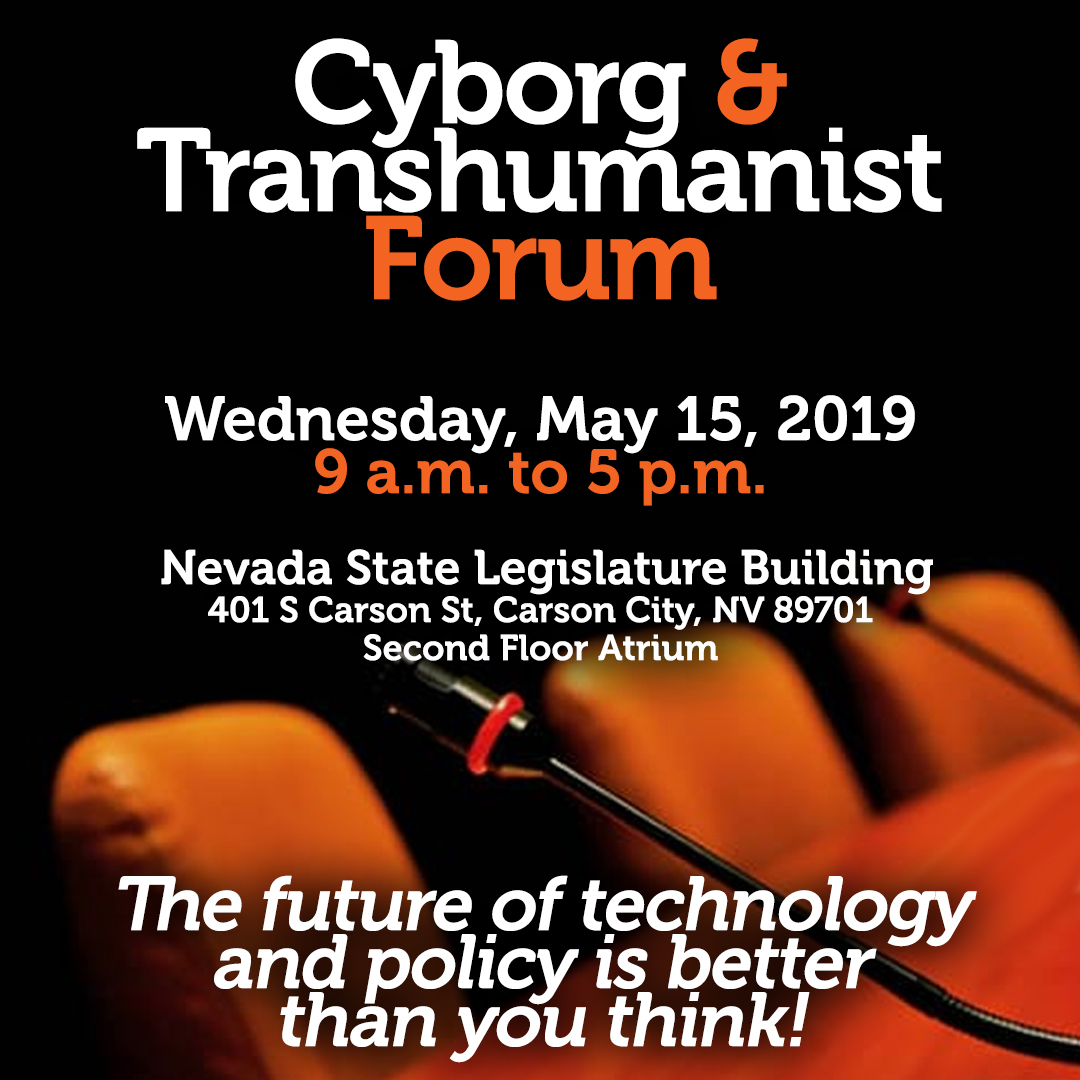
Watch the video containing 73 minutes of excerpts from the Cyborg and Transhumanist Forum, held on May 15, 2019, at the Nevada State Legislature Building.

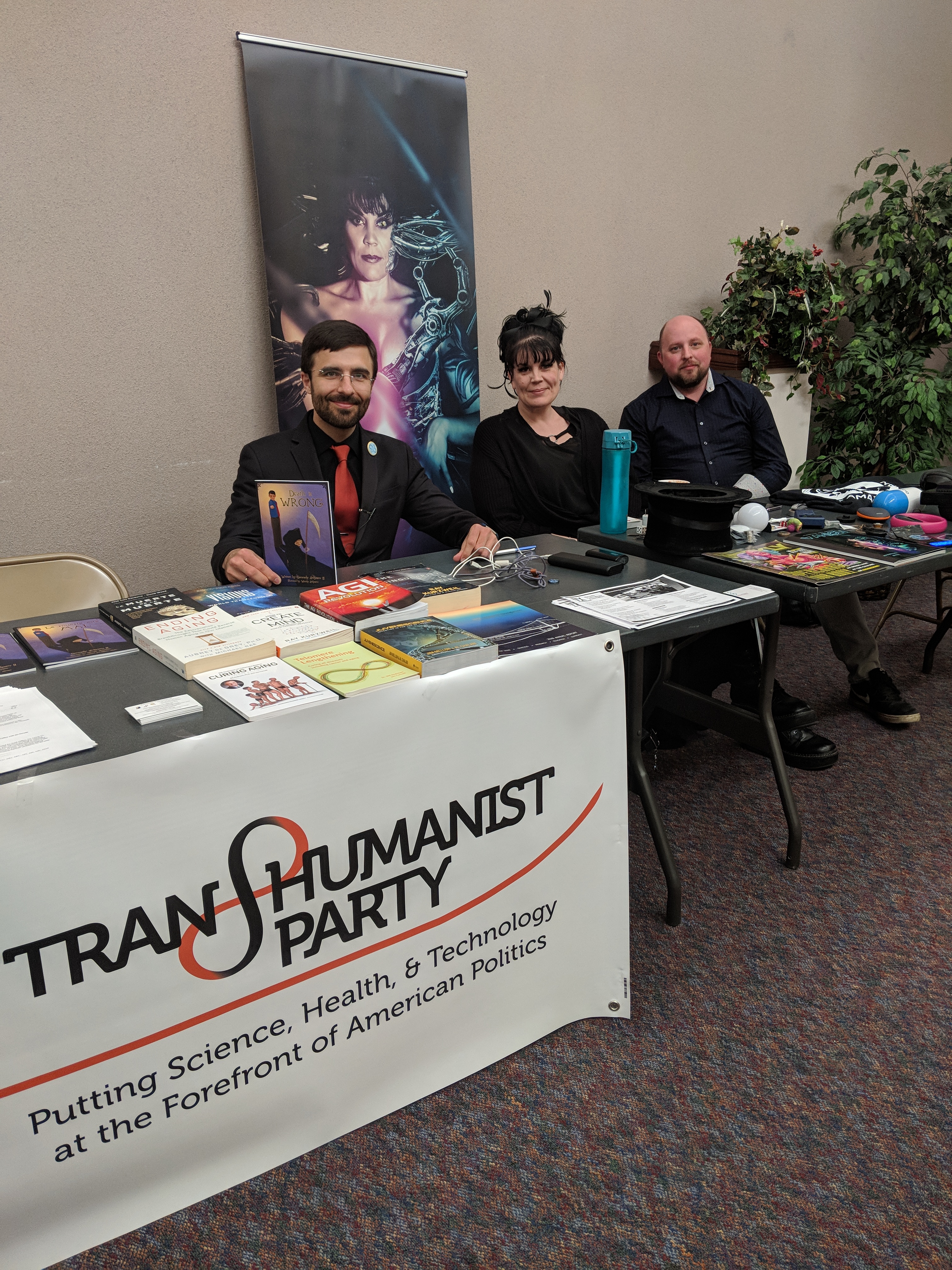
The Cyborg and Transhumanist Forum at the Nevada Legislature on May 15, 2019, marked a milestone for the U.S. Transhumanist Party and the Nevada Transhumanist Party. This was the first time that an official transhumanist event was held within the halls of a State Legislature, in one of the busiest areas of the building, within sight of the rooms where legislative committees met. The presenters were approached by tens of individuals – a few legislators and many lobbyists and staff members. The reaction was predominantly either positive or at least curious; there was no hostility and only mild disagreement from a few individuals. Generally, the outlook within the Legislative Building seems to be in favor of individual autonomy to pursue truly voluntary microchip implants. The testimony of Anastasia Synn at the Senate Judiciary Committee on April 26, 2019, in opposition to Assembly Bill 226, is one of the most memorable episodes of the 2019 Legislative Session for many who heard it. It has certainly affected the outcome for Assembly Bill 226, which was subsequently further amended to restore the original scope of the bill and only apply the prohibition to coercive microchip implants, while specifically exempting microchip implants voluntarily received by an individual from the prohibition. The scope of the prohibition was also narrowed by removing the reference to “any other person” and applying the prohibition to an enumerated list of entities who may not require others to be microchipped: state officers and employees, employers as a condition of employment, and persons in the business of insurance or bail. These changes alleviated the vast majority of the concerns within the transhumanist and cyborg communities about Assembly Bill 226.

From left to right: Gennady Stolyarov II, Anastasia Synn, and Ryan Starr (R. Nicholas Starr)

This Cyborg and Transhumanist Forum comes at the beginning of an era of transhumanist political engagement with policymakers and those who advise them. It was widely accepted by the visitors to the demonstration tables that technological advances are accelerating, and that policy decisions regarding technology should only be made with adequate knowledge about the technology itself – working on the basis of facts and not fears or misconceptions that arise from popular culture and dystopian fiction. Ryan Starr shared his expertise on the workings and limitations of both NFC/RFID microchips and GPS technology and who explained that cell phones are already far more trackable than microchips ever could be (based on their technical specifications and how those specifications could potentially be improved in the future). U.S. Transhumanist Party Chairman Gennady Stolyarov II introduced visitors to the world of transhumanist literature by bringing books for display – including writings by Aubrey de Grey, Bill Andrews, Ray Kurzweil, Jose Cordeiro, Ben Goertzel, Phil Bowermaster, and Mr. Stolyarov’s own book “Death is Wrong” in five languages. It appears that there is more sympathy for transhumanism within contemporary political circles than might appear at first glance; it is often transhumanists themselves who overestimate the negativity of the reaction they expect to receive. But nobody picketed the event or even called the presenters names; transhumanist ideas, expressed in a civil and engaging way – with an emphasis on practical applications that are here today or due to arrive in the near future – will be taken seriously when there is an opening to articulate them.

The graphics for the Cyborg and Transhumanist Forum were created by Tom Ross, the U.S. Transhumanist Party Director of Media Production.

Become a member of the U.S. Transhumanist Party / Transhuman Party free of charge, no matter where you reside.

References

• Gennady Stolyarov II Interviews Ray Kurzweil at RAAD Fest 2018

• “A Word on Implanted NFC Tags” – Article by Ryan Starr

• Assembly Bill 226, Second Reprint – This is the version of the bill that passed the Senate on May 23, 2019.

• Amendment to Assembly Bill 226 to essentially remove the prohibition against voluntary microchip implants

• Future Grind Podcast

• Synnister – Website of Anastasia Synn

Gennady Stolyarov II Interviews Ray Kurzweil at RAAD Fest 2018

Gennady Stolyarov II Interviews Ray Kurzweil at RAAD Fest 2018

Gennady Stolyarov II
Ray Kurzweil


The Stolyarov-Kurzweil Interview has been released at last! Watch it on YouTube here.

U.S. Transhumanist Party Chairman Gennady Stolyarov II posed a wide array of questions for inventor, futurist, and Singularitarian Dr. Ray Kurzweil on September 21, 2018, at RAAD Fest 2018 in San Diego, California. Topics discussed include advances in robotics and the potential for household robots, artificial intelligence and overcoming the pitfalls of AI bias, the importance of philosophy, culture, and politics in ensuring that humankind realizes the best possible future, how emerging technologies can protect privacy and verify the truthfulness of information being analyzed by algorithms, as well as insights that can assist in the attainment of longevity and the preservation of good health – including a brief foray into how Ray Kurzweil overcame his Type 2 Diabetes.

Learn more about RAAD Fest here. RAAD Fest 2019 will occur in Las Vegas during October 3-6, 2019.

Become a member of the U.S. Transhumanist Party for free, no matter where you reside. Fill out our Membership Application Form.

Watch the presentation by Gennady Stolyarov II at RAAD Fest 2018, entitled, “The U.S. Transhumanist Party: Four Years of Advocating for the Future”.

Advocating for the Future – Panel at RAAD Fest 2017 – Gennady Stolyarov II, Zoltan Istvan, Max More, Ben Goertzel, Natasha Vita-More

Advocating for the Future – Panel at RAAD Fest 2017 – Gennady Stolyarov II, Zoltan Istvan, Max More, Ben Goertzel, Natasha Vita-More

Gennady Stolyarov II
Zoltan Istvan
Max More
Ben Goertzel
Natasha Vita-More


Gennady Stolyarov II, Chairman of the United States Transhumanist Party, moderated this panel discussion, entitled “Advocating for the Future”, at RAAD Fest 2017 on August 11, 2017, in San Diego, California.

Watch it on YouTube here.

From left to right, the panelists are Zoltan Istvan, Gennady Stolyarov II, Max More, Ben Goertzel, and Natasha Vita-More. With these leading transhumanist luminaries, Mr. Stolyarov discussed subjects such as what the transhumanist movement will look like in 2030, artificial intelligence and sources of existential risk, gamification and the use of games to motivate young people to create a better future, and how to persuade large numbers of people to support life-extension research with at least the same degree of enthusiasm that they display toward the fight against specific diseases.

Learn more about RAAD Fest here.

Become a member of the U.S. Transhumanist Party for free, no matter where you reside. Fill out our Membership Application Form.

Watch the presentations of Gennady Stolyarov II and Zoltan Istvan from the “Advocating for the Future” panel.

Review of Ray Kurzweil’s “How to Create a Mind” – Article by G. Stolyarov II

Review of Ray Kurzweil’s “How to Create a Mind” – Article by G. Stolyarov II

G. Stolyarov II


How to Create a Mind (2012) by inventor and futurist Ray Kurzweil sets forth a case for engineering minds that are able to emulate the complexity of human thought (and exceed it) without the need to reverse-engineer every detail of the human brain or of the plethora of content with which the brain operates. Kurzweil persuasively describes the human conscious mind as based on hierarchies of pattern-recognition algorithms which, even when based on relatively simple rules and heuristics, combine to give rise to the extremely sophisticated emergent properties of conscious awareness and reasoning about the world. How to Create a Mind takes readers through an integrated tour of key historical advances in computer science, physics, mathematics, and neuroscience – among other disciplines – and describes the incremental evolution of computers and artificial-intelligence algorithms toward increasing capabilities – leading toward the not-too-distant future (the late 2020s, according to Kurzweil) during which computers would be able to emulate human minds.

Kurzweil’s fundamental claim is that there is nothing which a biological mind is able to do, of which an artificial mind would be incapable in principle, and that those who posit that the extreme complexity of biological minds is insurmountable are missing the metaphorical forest for the trees. Analogously, although a fractal or a procedurally generated world may be extraordinarily intricate and complex in their details, they can arise on the basis of carrying out simple and conceptually fathomable rules. If appropriate rules are used to construct a system that takes in information about the world and processes and analyzes it in ways conceptually analogous to a human mind, Kurzweil holds that the rest is a matter of having adequate computational and other information-technology resources to carry out the implementation. Much of the first half of the book is devoted to the workings of the human mind, the functions of the various parts of the brain, and the hierarchical pattern recognition in which they engage. Kurzweil also discusses existing “narrow” artificial-intelligence systems, such as IBM’s Watson, language-translation programs, and the mobile-phone “assistants” that have been released in recent years by companies such as Apple and Google. Kurzweil observes that, thus far, the most effective AIs have been developed using a combination of approaches, having some aspects of prescribed rule-following alongside the ability to engage in open-ended “learning” and extrapolation upon the information which they encounter. Kurzweil draws parallels to the more creative or even “transcendent” human abilities – such as those of musical prodigies – and observes that the manner in which those abilities are made possible is not too dissimilar in principle.

With regard to some of Kurzweil’s characterizations, however, I question whether they are universally applicable to all human minds – particularly where he mentions certain limitations – or whether they only pertain to some observed subset of human minds. For instance, Kurzweil describes the ostensible impossibility of reciting the English alphabet backwards without error (absent explicit study of the reverse order), because of the sequential nature in which memories are formed. Yet, upon reading the passage in question, I was able to recite the alphabet backwards without error upon my first attempt. It is true that this occurred more slowly than the forward recitation, but I am aware of why I was able to do it; I perceive larger conceptual structures or bodies of knowledge as mental “objects” of a sort – and these objects possess “landscapes” on which it is possible to move in various directions; the memory is not “hard-coded” in a particular sequence. One particular order of movement does not preclude others, even if those others are less familiar – but the key to successfully reciting the alphabet backwards is to hold it in one’s awareness as a single mental object and move along its “landscape” in the desired direction. (I once memorized how to pronounce ABCDEFGHIJKLMNOPQRSTUVWXYZ as a single continuous word; any other order is slower, but it is quite doable as long as one fully knows the contents of the “object” and keeps it in focus.) This is also possible to do with other bodies of knowledge that one encounters frequently – such as dates of historical events: one visualizes them along the mental object of a timeline, visualizes the entire object, and then moves along it or drops in at various points using whatever sequences are necessary to draw comparisons or identify parallels (e.g., which events happened contemporaneously, or which events influenced which others). I do not know what fraction of the human population carries out these techniques – as the ability to recall facts and dates has always seemed rather straightforward to me, even as it challenged many others. Yet there is no reason why the approaches for more flexible operation with common elements of our awareness cannot be taught to large numbers of people, as these techniques are a matter of how the mind chooses to process, model, and ultimately recombine the data which it encounters. The more general point in relation to Kurzweil’s characterization of human minds is that there may be a greater diversity of human conceptual frameworks and approaches toward cognition than Kurzweil has described. Can an artificially intelligent system be devised to encompass this diversity? This is certainly possible, since the architecture of AI systems would be more flexible than the biological structures of the human brain. Yet it would be necessary for true artificial general intelligences to be able not only to learn using particular predetermined methods, but also to teach themselves new techniques for learning and conceptualization altogether – just as humans are capable of today.

The latter portion of the book is more explicitly philosophical and devoted to thought experiments regarding the nature of the mind, consciousness, identity, free will, and the kinds of transformations that may or may not preserve identity. Many of these discussions are fascinating and erudite – and Kurzweil often transcends fashionable dogmas by bringing in perspectives such as the compatibilist case for free will and the idea that the experiments performed by Benjamin Libet (that showed the existence of certain signals in the brain prior to the conscious decision to perform an activity) do not rule out free will or human agency. It is possible to conceive of such signals as “preparatory work” within the brain to present a decision that could then be accepted or rejected by the conscious mind. Kurzweil draws an analogy to government officials preparing a course of action for the president to either approve or disapprove. “Since the ‘brain’ represented by this analogy involves the unconscious processes of the neocortex (that is, the officials under the president) as well as the conscious processes (the president), we would see neural activity as well as actual actions taking place prior to the official decision’s being made” (p. 231). Kurzweil’s thoughtfulness is an important antidote to commonplace glib assertions that “Experiment X proved that Y [some regularly experienced attribute of humans] is an illusion” – assertions which frequently tend toward cynicism and nihilism if widely adopted and extrapolated upon. It is far more productive to deploy both science and philosophy toward seeking to understand more directly apparent phenomena of human awareness, sensation, and decision-making – instead of rejecting the existence of such phenomena contrary to the evidence of direct experience. Especially if the task is to engineer a mind that has at least the faculties of the human brain, then Kurzweil is wise not to dismiss aspects such as consciousness, free will, and the more elevated emotions, which have been known to philosophers and ordinary people for millennia, and which only predominantly in the 20th century has it become fashionable to disparage in some circles. Kurzweil’s only vulnerability in this area is that he often resorts to statements that he accepts the existence of these aspects “on faith” (although it does not appear to be a particularly religious faith; it is, rather, more analogous to “leaps of faith” in the sense that Albert Einstein referred to them). Kurzweil does not need to do this, as he himself outlines sufficient logical arguments to be able to rationally conclude that attributes such as awareness, free will, and agency upon the world – which have been recognized across predominant historical and colloquial understandings, irrespective of particular religious or philosophical flavors – indeed actually exist and should not be neglected when modeling the human mind or developing artificial minds.

One of the thought experiments presented by Kurzweil is vital to consider, because the process by which an individual’s mind and body might become “upgraded” through future technologies would determine whether that individual is actually preserved – in terms of the aspects of that individual that enable one to conclude that that particular person, and not merely a copy, is still alive and conscious:

Consider this thought experiment: You are in the future with technologies more advanced than today’s. While you are sleeping, some group scans your brain and picks up every salient detail. Perhaps they do this with blood-cell-sized scanning machines traveling in the capillaries of your brain or with some other suitable noninvasive technology, but they have all of the information about your brain at a particular point in time. They also pick up and record any bodily details that might reflect on your state of mind, such as the endocrine system. They instantiate this “mind file” in a morphological body that looks and moves like you and has the requisite subtlety and suppleness to pass for you. In the morning you are informed about this transfer and you watch (perhaps without being noticed) your mind clone, whom we’ll call You 2. You 2 is talking about his or he life as if s/he were you, and relating how s/he discovered that very morning that s/he had been given a much more durable new version 2.0 body. […] The first question to consider is: Is You 2 conscious? Well, s/he certainly seems to be. S/he passes the test I articulated earlier, in that s/he has the subtle cues of becoming a feeling, conscious person. If you are conscious, then so too is You 2.

So if you were to, uh, disappear, no one would notice. You 2 would go around claiming to be you. All of your friends and loved ones would be content with the situation and perhaps pleased that you now have a more durable body and mental substrate than you used to have. Perhaps your more philosophically minded friends would express concerns, but for the most party, everybody would be happy, including you, or at least the person who is convincingly claiming to be you.

So we don’t need your old body and brain anymore, right? Okay if we dispose of it?

You’re probably not going to go along with this. I indicated that the scan was noninvasive, so you are still around and still conscious. Moreover your sense of identity is still with you, not with You 2, even though You 2 thinks s/he is a continuation of you. You 2 might not even be aware that you exist or ever existed. In fact you would not be aware of the existence of You 2 either, if we hadn’t told you about it.

Our conclusion? You 2 is conscious but is a different person than you – You 2 has a different identity. S/he is extremely similar, much more so than a mere genetic clone, because s/he also shares all of your neocortical patterns and connections. Or should I say s/he shared those patterns at the moment s/he was created. At that point, the two of you started to go your own ways, neocortically speaking. You are still around. You are not having the same experiences as You 2. Bottom line: You 2 is not you.  (How to Create a Mind, pp. 243-244)

This thought experiment is essentially the same one as I independently posited in my 2010 essay “How Can Live Forever?: What Does and Does Not Preserve the Self”:

Consider what would happen if a scientist discovered a way to reconstruct, atom by atom, an identical copy of my body, with all of its physical structures and their interrelationships exactly replicating my present condition. If, thereafter, I continued to exist alongside this new individual – call him GSII-2 – it would be clear that he and I would not be the same person. While he would have memories of my past as I experienced it, if he chose to recall those memories, I would not be experiencing his recollection. Moreover, going forward, he would be able to think different thoughts and undertake different actions than the ones I might choose to pursue. I would not be able to directly experience whatever he choose to experience (or experiences involuntarily). He would not have my ‘I-ness’ – which would remain mine only.

Thus, Kurzweil and I agree, at least preliminarily, that an identically constructed copy of oneself does not somehow obtain the identity of the original. Kurzweil and I also agree that a sufficiently gradual replacement of an individual’s cells and perhaps other larger functional units of the organism, including a replacement with non-biological components that are integrated into the body’s processes, would not destroy an individual’s identity (assuming it can be done without collateral damage to other components of the body). Then, however, Kurzweil posits the scenario where one, over time, transforms into an entity that is materially identical to the “You 2” as posited above. He writes:

But we come back to the dilemma I introduced earlier. You, after a period of gradual replacement, are equivalent to You 2 in the scan-and-instantiate scenario, but we decided that You 2 in that scenario does not have the same identity as you. So where does that leave us? (How to Create a Mind, p. 247)

Kurzweil and I are still in agreement that “You 2” in the gradual-replacement scenario could legitimately be a continuation of “You” – but our views diverge when Kurzweil states, “My resolution of the dilemma is this: It is not true that You 2 is not you – it is you. It is just that there are now two of you. That’s not so bad – if you think you are a good thing, then two of you is even better” (p. 247). I disagree. If I (via a continuation of my present vantage point) cannot have the direct, immediate experiences and sensations of GSII-2, then GSII-2 is not me, but rather an individual with a high degree of similarity to me, but with a separate vantage point and separate physical processes, including consciousness. I might not mind the existence of GSII-2 per se, but I would mind if that existence were posited as a sufficient reason to be comfortable with my present instantiation ceasing to exist.  Although Kurzweil correctly reasons through many of the initial hypotheses and intermediate steps leading from them, he ultimately arrives at a “pattern” view of identity, with which I differ. I hold, rather, a “process” view of identity, where a person’s “I-ness” remains the same if “the continuity of bodily processes is preserved even as their physical components are constantly circulating into and out of the body. The mind is essentially a process made possible by the interactions of the brain and the remainder of nervous system with the rest of the body. One’s ‘I-ness’, being a product of the mind, is therefore reliant on the physical continuity of bodily processes, though not necessarily an unbroken continuity of higher consciousness.” (“How Can Live Forever?: What Does and Does Not Preserve the Self”) If only a pattern of one’s mind were preserved and re-instantiated, the result may be potentially indistinguishable from the original person to an external observer, but the original individual would not directly experience the re-instantiation. It is not the content of one’s experiences or personality that is definitive of “I-ness” – but rather the more basic fact that one experiences anything as oneself and not from the vantage point of another individual; this requires the same bodily processes that give rise to the conscious mind to operate without complete interruption. (The extent of permissible partial interruption is difficult to determine precisely and open to debate; general anesthesia is not sufficient to disrupt I-ness, but what about cryonics or shorter-term “suspended animation?). For this reason, the pursuit of biological life extension of one’s present organism remains crucial; one cannot rely merely on one’s “mindfile” being re-instantiated in a hypothetical future after one’s demise. The future of medical care and life extension may certainly involve non-biological enhancements and upgrades, but in the context of augmenting an existing organism, not disposing of that organism.

How to Create a Mind is highly informative for artificial-intelligence researchers and laypersons alike, and it merits revisiting a reference for useful ideas regarding how (at least some) minds operate. It facilitates thoughtful consideration of both the practical methods and more fundamental philosophical implications of the quest to improve the flexibility and autonomy with which our technologies interact with the external world and augment our capabilities. At the same time, as Kurzweil acknowledges, those technologies often lead us to “outsource” many of our own functions to them – as is the case, for instance, with vast amounts of human memories and creations residing on smartphones and in the “cloud”. If the timeframes of arrival of human-like AI capabilities match those described by Kurzweil in his characterization of the “law of accelerating returns”, then questions regarding what constitutes a mind sufficiently like our own – and how we will treat those minds – will become ever more salient in the proximate future. It is important, however, for interest in advancing this field to become more widespread, and for political, cultural, and attitudinal barriers to its advancement to be lifted – for, unlike Kurzweil, I do not consider the advances of technology to be inevitable or unstoppable. We humans maintain the responsibility of persuading enough other humans that the pursuit of these advances is worthwhile and will greatly improve the length and quality of our lives, while enhancing our capabilities and attainable outcomes. Every movement along an exponential growth curve is due to a deliberate push upward by the efforts of the minds of the creators of progress and using the machines they have built.

This article is made available pursuant to the Creative Commons Attribution 4.0 International License, which requires that credit be given to the author, Gennady Stolyarov II (G. Stolyarov II). Learn more about Mr. Stolyarov here