Tag Archives: Movement for Indefinite Life Extension

by

Life Extension and the Significance of Death – Article by Gyreck

No comments yet

Categories: Transhumanism, Tags: , , , , , , , , , ,

The New Renaissance Hat
Gyreck
May 1, 2013
Recommend this page.
******************************

Some people say that death is what gives life significance, but then people often parrot nonsense they haven’t given any real thought to.

150,000 people die on Earth every day, on average, and people rarely give it much or any thought. That doesn’t sound much like significance or meaning to me, in terms of either life or death. Even just the magnitude of the statement, that 150,000 people die every day, is just lost on people.

Every few days or so, the same number of people die as had died in the entire American Civil War.

Every single year, about the same number of people die as had died in the whole of World War II.

If that sounds too big to grasp (which, of course, it is), just imagine, if you can, a group of just over a hundred people, about the number of people in four full classrooms.  Imagine that group of people crowding into a room with you and then dying right in front of you, from a whole range of causes and within the span of just a single minute. Then, a whole new group of over a hundred comes in, of all ages and backgrounds, and then they, too, all die right in front of you, many in pain and terror, many of them dying horrifically, over the span of the next single minute…. and then over another hundred come in again and start dying over the next minute, and again, and again, over and over, minute after minute…. 1,440 times in a row. Then, you will have the number of people who die over a span of just a single day – the same as 50 World Trade Center attacks. Every day.

The magnitude of it, along with the absolute helplessness of doing anything about it and the knowledge of the absolute certainty that you will be part of one of those groups to die, is just staggering. No small wonder that culture has largely stupefied people to the idea, and has scared and deluded them into all manner of denial over it. This has been such a severe form of trauma to the public’s consciousness that the majority of people actually cling cultishly to the absurd idea that this process is actually a good thing. It’s amazing and shameful to consider how detached someone would have to be from the sheer horror of this thing in order to suggest that it is in any way “good”. Even now, in typing this, I can just hear the voices of protest out there with their excuses and rationalizations about why all this misery and suffering “needs” to happen. We’re all lined up in the concentration camps, and the people in line around you are talking about how it’s a “good” thing and how we “need” to be put into the ovens.

It seems like most of humanity’s problems stem from acquiring absurd beliefs, and then clinging to them with a deaf ear to anything of the contrary. I think that’s really one of the greatest and most disastrous problems the human race needs to overcome.

On the life and death thing…

Putting everything else aside, I think people don’t give life enough value partly because they know they’ll die no matter what they do.

We’re basically all rental cars, and no matter how well we take care of ourselves, we’re going to be taken back in the end, while at the same time no matter how reckless we are with ourselves, we’ll never have to pay for it after the fact. In that situation it’s kind of hard to avoid some form of the attitude “Well f*** it, we’re just going to die anyway”. The effect of this way of thinking is not to give life value. In fact, this does the exact opposite. In principle we like to think this should make us treasure our every moment, given how few and fleeting these moments are, but unless we’re really concentrating and making a point to focus on that idea, that’s not what we really do. For example, we don’t put a lot of value in perishable goods, in rotting houses, or in failing businesses. We do tend to value and invest ourselves in things that have longevity, strength, stability and durability.

Here’s the reality of the situation…

We’re not going to consider death significant until it’s a rare occurrence.

Imagine going for a hundred years without anyone you know dying. How much bigger of a deal is it all of a sudden when somebody does die? Think about how any event involving younger people dying today is always talked about as being a bigger deal than when older people die, how people seem to always bring up how much life the younger ones had left to live.  It’s the amount of life left unlived that ends up getting the focus.  The fact of someone dying at age sixty isn’t seen as being as bad as someone dying at age fifteen.  Now imagine if people were living for over seven hundred years, and then someone dies at only age sixty. How much bigger of a deal has that suddenly become? At the same time, imagine a seven-hundred-year-old dying. How much life, history, and experience has just been lost to the world? Doesn’t that suddenly seem more significant?

In reality, a short expiration date doesn’t make anything more valuable; it just makes it more disposable. The inevitable and very near-future extension of our lifespans is not going to make life less valuable, and death is absolutely not what gives our lives meaning. This is a delusion that most of us are trapped in, and we really need to grow up and do a better job of getting over it.

Gyreck is an artist, philosopher, poet, roboticist, humanist, and rational materialist. You can view some of his art here.

This TRA feature has been edited in accordance with TRA’s Statement of Policy.

by

Liberty Through Long Life – Video by G. Stolyarov II

No comments yet

Categories: Politics, Technology, Transhumanism, Tags: , , , , , , , , , , , , , , , , , , ,

To maximize their hopes of personally experiencing an amount of personal freedom even approaching that of the libertarian ideal, all libertarians should support radical life extension.

References
- “Liberty Through Long Life” – Essay by G. Stolyarov II -
- Resources on Indefinite Life Extension (RILE) -
- “Libertarian Life-Extension Reforms” – Video Series – G. Stolyarov II -
- “Massive open online course” – Wikipedia
- Mozilla’s Open Badges
- “Open Badges and Proficiency-Based Education: A Path to a New Age of Enlightenment” – Essay by G. Stolyarov II
- “Deep Space Industries” – Wikipedia
- “Planetary Resources” – Wikipedia
- The Seasteading Institute
- “Seasteading’s Potential and Challenges: An Overview” — Essay by G. Stolyarov II
- “Seasteading’s Potential and Challenges: An Overview” — Video by G. Stolyarov II
- “Bitcoin” – Wikipedia
- “Benjamin Franklin and the Early Scientific Vision – 1780” – Foundation for Infinite Survival
- “Revisiting the proto-transhumanists: Diderot and Condorcet” – George Dvorsky – Sentient Developments
- “Marquis de Condorcet, Enlightenment proto-transhumanist” – George Dvorsky – IEET
- SENS Research Foundation
- “Ray Kurzweil” – Wikipedia

by

Liberty Through Long Life – Article by G. Stolyarov II

No comments yet

Categories: Politics, Technology, Transhumanism, Tags: , , , , , , , , , , , , , , , , , , ,

The New Renaissance Hat
G. Stolyarov II
April 14, 2013
Recommend this page.
******************************

            It is commonly recognized among libertarians (and some others) that the freedom of individuals to innovate will result in a more rapid rate of technological progress. In “Six Libertarian Reforms to Accelerate Life Extension” I described six liberty-enhancing political changes that would more swiftly bring about the arrival of indefinite human longevity. But, as is less often understood, the converse of this truth also holds. Technological progress in general improves the prospects for liberty and its actual exercise in everyday life. One of the most promising keys to achieving liberty in our lifetimes is to live longer so that we can personally witness and benefit from accelerating technological progress.

            Consider, for example, what the Internet has achieved with respect to expanding the practical exercise of individual freedom of speech. It has become virtually impossible for regimes, including their nominally private “gatekeepers” of information in the mass media and established publishing houses, to control the dissemination of information and the expression of individual opinion. In prior eras, even in countries where freedom of speech was the law of the land, affiliations of the media, by which speech was disseminated, with the ruling elite would serve as a practical barrier for the discussion of views that were deemed particularly threatening to the status quo. In the United States, effective dissent from the established two-party political system was difficult to maintain in the era of the “big three” television channels and a print and broadcast media industry tightly controlled by a few politically connected conglomerates. Now expressing an unpopular opinion is easier and less expensive than ever – as is voting with one’s money for an ever-expanding array of products and services online. The ability of individuals to videotape public events and the behavior of law-enforcement officers has similarly served as a check on abusive behavior by those in power. Emerging online education and credentialing options, such as massive open online courses and Mozilla’s Open Badges, have the power to motivate a widespread self-driven enlightenment which would bring about an increased appreciation for rational thinking and individual autonomy.

            Many other technological advances are on the horizon. The private space race is in full swing, with companies such as SpaceX, Virgin Galactic, Deep Space Industries, and Planetary Resources embarking on ever more ambitious projects. Eventually, these pioneering efforts may enable humans to colonize new planets and build permanent habitats in space, expanding jurisdictional competition and opening new frontiers where free societies could be established. Seasteading, an idea only five years in development, is a concept for building modular ocean platforms where political experimentation could occur and, through competitive pressure, catalyze liberty-friendly innovations on land. (I outlined the potential and the challenges of this approach in an earlier essay.) The coming decades could see the emergence of actual seasteads of increasing sophistication, safety, and political autonomy. Another great potential for increasing liberty comes from the emerging digital-currency movement, of which Bitcoin has been the most prominent exemplar to date. While Bitcoin has been plagued with recent extreme exchange-rate volatility and vulnerability to manipulation and theft by criminal hackers, it can still provide some refuge from the damaging effects of inflationary and redistributive central-bank monetary policy. With enough time and enough development of the appropriate technological infrastructure, either Bitcoin or one of its successor currencies might be able to obtain sufficient stability and reliability to become a widespread apolitical medium of exchange.

            But there is a common requirement for one to enjoy all of these potential breakthroughs, along with many others that may be wholly impossible to anticipate: one has to remain alive for a long time. The longer one remains alive, the greater the probability that one’s personal sphere of liberty would be expanded by these innovations. Living longer can also buy one time for libertarian arguments to gain clout in the political sphere and in broader public opinion. Technological progress and pro-liberty activism can reinforce one another in a virtuous cycle.

            To maximize their hopes of personally experiencing an amount of personal freedom even approaching that of the libertarian ideal, all libertarians should support radical life extension. This sought-after goal of some ancient philosophers, medieval alchemists, Enlightenment thinkers (notably Franklin, Diderot, and Condorcet), and medical researchers from the past two centuries, is finally within reach of many alive today. Biogerontologist Aubrey de Grey of the SENS Research Foundation gives humankind a 50 percent likelihood of reaching “longevity escape velocity” – a condition where increases in life expectancy outpace the rate of human senescence – within 25 years. Inventor, futurist, and artificial-intelligence researcher Ray Kurzweil predicts a radical increase in life expectancy in the 2020s, made possible by advances in biotechnology and nanotechnology, aided by exponentially growing computing power. But, like de Grey and perhaps somewhat unlike Kurzweil, I hold the view that these advances are not inevitable; they rely on deliberate, sustained, and well-funded efforts to achieve them. They rely on support by the general public to facilitate donations, positive publicity, and a lack of political obstacles placed in their way. All libertarians should become familiar with both the technical feasibility and the philosophical desirability of a dramatic, hopefully indefinite, extension of human life expectancies. My compilation of Resources on Indefinite Life Extension (RILE) is a good starting point for studying this subject by engaging with a wide variety of sources, perspectives, and ongoing developments in science, technology, and activism.

            We have only this one life to live. If we fail to accomplish our most cherished goals and our irreplaceable individual universes disappear into oblivion, then, to us, it will be as if those goals were never accomplished. If we want liberty, we should strive to attain it in our lifetimes. We should therefore want those lifetimes to be lengthened beyond any set limit, not just for the sake of experiencing a far more complete liberty, but also for the sake of life itself and all of the opportunities it opens before us.

by

Join the Movement for Indefinite Life Extension: The Most Forward-Thinking Minds Are Not Alone – Video by G. Stolyarov II

2 comments

Categories: Transhumanism, Tags: , , , , , , , , , , , , , , , , , , , , , , ,

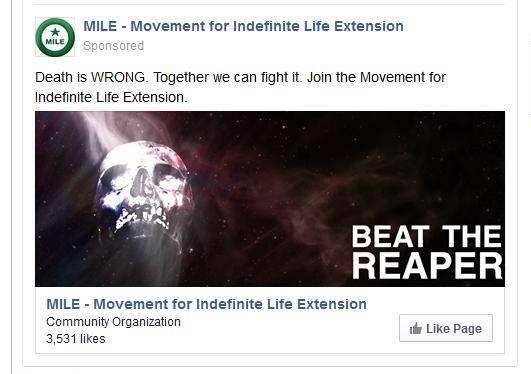
​Help humankind defeat senescence and death by joining the Movement for Indefinite Life Extension (MILE). The MILE offers a way to gauge awareness of and support for indefinite life extension. One of the easiest and most important ways you can begin to make a difference in helping bring indefinite life extension about is to (1) go to the MILE Facebook page, (2) like the MILE on Facebook, (3) read and share the many informational, scientific, and philosophical pieces made available daily on the MILE page, and (4) spread the word to your friends and acquaintances who are already sympathetic to indefinite life extension.

References

- The MILE Facebook Page or http://themile.info

- “Join the Movement for Indefinite Life Extension: The Most Forward-Thinking Minds Are Not Alone” – Essay by G. Stolyarov II

- Supporter of Indefinite Life Extension Open Badge

- Open Badges on Indefinite Life Extension

- Resources on Indefinite Life Extension (RILE)

- Rosetta@home

- Folding@home

- World Community Grid

by

Strategies for Hastening the Arrival of Indefinite Life Extension – Article by G. Stolyarov II

1 comment

Categories: Education, Transhumanism, Tags: , , , , , , , , , , , , , , , , , , , ,

The New Renaissance Hat
G. Stolyarov II
April 3, 2013
Recommend this page.
******************************

We are still several decades away from a time when medical technology will be able keep senescence and death at bay. What can we do until then to hasten the arrival of radical extension and to improve our own chances of benefiting from it? I recently offered my thoughts on this matter on an Immortal Life debate/discussion thread. My proposed approach is versatile and can be distilled into five essential points.

1. Personal Good Health. Each advocate of indefinite life extension should try to personally remain in good health as long as possible. This mostly involves common-sense practices (exercise, moderation in food, as well as avoidance of harmful substances, dangerous habits, and risky pleasures).

2. Utilization of Comparative Advantage. Each advocate of indefinite life extension should work to advance it in the areas where he/she has a comparative advantage. I am sympathetic to Peter Wicks’s statements in this regard – with the caveat that finding what one is best at is an iterative process that requires trying out many approaches and pursuits to discover one’s strengths and the best ways of actualizing them. Moreover, an individual may have multiple areas of strength, and in that case should discover how best to synthesize those areas and use them complementarily. But, crucially, one should not feel constrained to personally follow specific career paths, such as biogerontological research. Rather, one could make a more substantial contribution by maximally utilizing one’s areas of strength, knowledge, and expertise – and contributing some of the proceeds to research on and advocacy of indefinite life extension.

3. Advocacy. As Aubrey de Grey has put it, insufficient funding is a major obstacle to the progress of life-extension research at present. The scientists who are capable of carrying out the research are already here, and they are motivated. They need more support in the form of donations, which can be achieved with enough advocacy and persuasion of the general public (as well as wealthy philanthropists). In this respect, I agree with Franco Cortese that an additional promoter today may make more of a difference than an additional researcher, because the work of the promoters may ensure steady employment for the researchers in the field of anti-aging interventions. My Resources on Indefinite Life Extension (RILE) page catalogues a sampling of the major advances in fighting disease and developing new promising technologies that have occurred in the past several years. If only more people knew… The Movement for Indefinite Life Extension (MILE) attempts to raise this awareness and has been gaining support and recognition at an encouraging pace. You can add to this progress by exploring and liking the MILE Facebook page.

4. Forthrightness. It is important for all advocates of indefinite life extension to be open about their views and to be ready to justify them – even casually and in passing. The idea needs to be made sufficiently commonplace that most people will not only take it seriously but will consider it to be a respectable position within public discourse. At that point, increased funding for research will come.

5. Innovative Education. As my previous points imply, education is key. But education on indefinite life extension needs to be made appealing not just in terms of content, but in terms of the learning process. This is where creativity should be utilized to create an engaging, entertaining, and addictive open curriculum of reading materials and digital certifications, compatible with an Open Badge infrastructure. I have begun to do this with several multiple-choice quizzes pertaining to some of my articles, and I welcome and encourage any similar efforts by others.

by

Join the Movement for Indefinite Life Extension: The Most Forward-Thinking Minds Are Not Alone – Article by G. Stolyarov II

No comments yet

Categories: Transhumanism, Tags: , , , , , , , , , , , , , , , , , , , , , , ,

The New Renaissance Hat
G. Stolyarov II
March 31, 2013
Recommend this page.
******************************

Support for indefinite human life extension is a powerful, intellectually compelling, intuitive position. The best minds will arrive at it on their own, often quite early in life. The sheer injustice of a forced termination of life for a person who has committed no crime and harmed no fellow humans is enough to make a person of intelligence and decency recoil and resist.

Yet the society immediately surrounding the thoughtful proponent of indefinite life extension often does not agree. Culturally ingrained acceptance of “natural” death – be it the result of religion, tradition, Malthusianism, status quo bias or plain resignation – still has a hold on the majority of people. Often this leaves the forward-thinking critic of senescence and death feeling isolated and discouraged.

MILE_graphic

But it does not have to be this way. With the Internet, geographic separation no longer implies a separation of contact. Thinkers from around the world, who have independently come to the same realization regarding the supreme injustice of mandatory death for all, can find one another, share ideas, and cooperate toward achieving radical life extension in our lifetimes.

But to cooperate effectively, we need an effective way of knowing how many of us there are, what our fellow friends of long life are able to do and have accomplished already, what discoveries and breakthroughs scientists are releasing into the world, and where we can invest our own talents to accelerate the arrival of a time when increasing life expectancy will outpace the advent of senescence.

This is where the Movement for Indefinite Life Extension (MILE) comes in. The MILE Facebook page offers a way to gauge awareness of and support for indefinite life extension. One of the easiest and most important ways you can begin to make a difference in helping bring indefinite life extension about is to (1) go to the MILE Facebook page, (2) like the MILE on Facebook, (3) read and share the many informational, scientific, and philosophical pieces made available daily on the MILE page, and (4) spread the word to your friends and acquaintances who are already sympathetic to indefinite life extension.

The MILE aims to identify how many of us throughout the world already support indefinite life extension. Once this base of supporters is established, it will become easier to expand it by reaching out to others and spreading awareness that medical science may put the greatest triumph of all within our personal grasp. The MILE seeks to increase its supporters by an order of magnitude every year. The July 1, 2012, goal of 80 supporters was easily met. By July 1, 2013, the goal is to accumulate 800 supporters. By July 1, 2017, if the MILE can achieve 8 million supporters, we will have a critical mass of people to catalyze massive societal change – from investment into life-saving, life-extending research to political reforms that ensure that obsolete restrictions and special-interest privileges do not stand in the way of medical progress.

The MILE has fewer than 300 supporters left to reach its proximate goal. If you have not already spent five seconds going to the MILE Facebook page and clicking the “Like” button, I encourage you to do so at the earliest opportunity. If you have done so, you have my thanks and the thanks of all of us whose eventual long-term survival may be bolstered by your increment of support. We welcome and encourage your support in spreading the word to others who have already arrived at the realization that achieving radically longer lives is an urgent moral imperative. Surely, there are more than 800 of us out there already.  We want to find out about and empower every person who has ever discovered the importance of indefinite life extension, so that the brilliant spark of aspiration will never be extinguished in any such thinker from lack of fuel.

There is more that you can do to show your support for indefinite life extension.

er of Indefinite Life Extension

Badge awarded for being a supporter of extending human lifespans beyond any fixed limit.

* Get the free Supporter of Indefinite Life Extension Open Badge.

* Read and watch an abundance of Resources on Indefinite Life Extension.

* Write articles, create videos, and engage in regular discussions on this vital subject.

* Run a distributed computing project, such as Rosetta@home, Folding@home, and World Community Grid.

* Come up with opportunities for education and activism that will help spread awareness of indefinite life extension and encourage widespread support.

No matter who you are, or how new the ideas of indefinite life extension are to you, we would be delighted by your participation in the MILE and look forward to welcoming you as a valuable ally.

by

“I-ness” Awareness – Quiz and Badge – Fourth in TRA’s Series on Indefinite Life Extension

No comments yet

Categories: Education, Philosophy, Transhumanism, Tags: , , , , , , , , , , , ,

i-ness_awareness

G. Stolyarov II
March 30, 2013
Recommend this page.
******************************

The Rational Argumentator is proud to announce the fourth in its planned series of quizzes on indefinite life extension, a companion activity to the Resources on Indefinite Life Extension (RILE) page.

"I-ness" Awareness Quiz

Read “How Can I Live Forever?: What Does and Does Not Preserve the Self” by G. Stolyarov II and answer the questions in the quiz below, in accordance with the essay. If you get 100% of the questions correct, you will earn the “I-ness” Awareness badge, the fourth badge in The Rational Argumentator’s interactive educational series on indefinite life extension.  You will need a free account with Mozilla Backpack to receive the badge.

This badge was designed by Wendy Stolyarov, whose art you can see here, here, and here.

Leaderboard: "I-ness" Awareness Quiz

maximum of 7 points
Pos. Name Entered on Points Result
Table is loading
No data available

by

Pascal’s Wager Quiz and Badge – Third in TRA’s Series on Indefinite Life Extension

No comments yet

Categories: Philosophy, Transhumanism, Tags: , , , , , , , , , , , , ,

pascals_wager
G. Stolyarov II
March 27, 2013
Recommend this page.
******************************

The Rational Argumentator is proud to announce the third in its planned series of quizzes on indefinite life extension, a companion activity to the Resources on Indefinite Life Extension (RILE) page.

Pascal's Wager Quiz

Read “An Atheist’s Response to Pascal’s Wager” by G. Stolyarov II and answer the questions in the quiz below, in accordance with the essay. If you get 100% of the questions correct, you will earn the Pascal’s Wager Professional badge, the third badge in The Rational Argumentator’s interactive educational series on indefinite life extension.  You will need a free account with Mozilla Backpack to receive the badge.

This badge was designed by Wendy Stolyarov, whose art you can see here, here, and here.

Leaderboard: Pascal's Wager Quiz

maximum of 7 points
Pos. Name Entered on Points Result
Table is loading
No data available

by

Private or Governmental Funding for Indefinite Life Extension? – Post by G. Stolyarov II

No comments yet

Categories: Politics, Science, Transhumanism, Tags: , , , , , , , , , , , , , ,

The New Renaissance Hat
G. Stolyarov II
March 27, 2013
Recommend this page.
******************************

I was recently asked to comment on an Immortal Life debate/discussion thread about whether governmental or private approaches to funding and motivating research on indefinite life extension are best.

Mine is definitely a libertarian view. I do not support advocating for government funding for life extension, unless the funding is combined with larger reductions in military spending or other destructive government spending. I discuss this issue in two of my videos:

- Eliminating Death – Part 18 – Never Seek Government Funding

- Libertarian Life-Extension Reforms – #6 – Medical Research Instead of Military Spending

The danger of government funding of life extension is that it comes with many political strings attached, and may lead life-extension research itself to be shackled by politically influential opponents of technological progress.

The great weakness of politics as a strategy is that it requires consensus among elites and some connection to majority approval, as well as the overcoming of numerous bureaucratic hurdles and obsolete habits. Private action, as long as it is lawful, can simply be pursued irrespective of how many people agree. There is thus much more flexibility and potential for quick deployment with private approaches toward radical life extension.

Private investment into life-extension research can occur in many ways, both for-profit and non-profit, both direct and indirect. Seasteading is indeed a highly promising approach for experimenting with novel medicines and therapies that might take over a decade to be approved by the FDA in the United States or similar “screening” agencies in other countries.

At the same time, Tom Mooney is correct about the need for a grassroots education campaign. By the time radical life extension begins to become a reality, there needs to be a strong current of public opinion supporting it. Otherwise, the “bioconservatives” might just manage to obtain enough support for their agenda to thwart this vital progress.

by

Who Are the True “Deathists”? – Article by G. Stolyarov II

1 comment

Categories: Transhumanism, Tags: , , , , , , , , , , , , , , , ,

The New Renaissance Hat
G. Stolyarov II
March 24, 2013
Recommend this page.
******************************

On a recent Immortal Life debate/discussion thread, I was asked to participate in a conversation about whether advocates of indefinite life extension should call their opponents “deathists” or whether such a label is counterproductive. Another question on that thread concerned the use of the designation “immortalist” to refer to an advocate of indefinite longevity.

My view on this matter is a nuanced one. It is crucial to make a distinction between (i) people who simply hold the common “tragic worldview” – who accept their mortality as inevitable and try to “make peace” with it and (ii) people who actively work to stop life-extension technologies. The former are simply mistaken and can be reasoned with, persuaded, or at least led to gradually become more comfortable with life extension as it becomes ever more real. The latter, however, might not be open to persuasion and might pursue legislative action (or worse) to stop life-extension research. Every person’s arguments should be addressed civilly and intelligently. The label “deathist” is not uncivil per se, however, and has its place with regard to people who cannot be swayed by argument or evidence from a position that is actively hostile to life extension. These are not your rank-and-file skeptics of radical life extension, but rather people such as Leon Kass, Sherwin Nuland, Daniel Callahan, John Gray, and Nassim Taleb, who will not be shifted from their anti-life-extension views and who have made considerable amounts of money out of attacking pro-longevity ideas. Calling these people “deathists” is not aimed at persuading them, but rather at alerting possibly more objective third parties of the dangers of their views. If there is still the opportunity to persuade someone, then labels of this sort should not be directed at that person.

As for positive labels, I can proudly attribute the term “immortalist” to myself – not because I think that indefinite life extension will by itself bring immortality (it will not), but rather because I think that any condition that more closely approaches immortality is a desirable one. Thus, I support not only the lifting of upper limits on lifespans, but also major improvements in protection against asteroids, earthquakes, weather events, vehicle accidents, infectious diseases, and manmade conflicts. I oppose anything that can destroy an innocent human life.

1 2 3