Browsed by
Category: Announcements

The Rational Argumentator Now Accepts Dogecoin Donations

The Rational Argumentator Now Accepts Dogecoin Donations

The New Renaissance Hat
G. Stolyarov II
January 20, 2014
******************************

I am pleased to announce that, in addition to accepting Bitcoin donations, The Rational Argumentator now also accepts donations in Dogecoin, the world’s first meme-based cryptocurrency. This broadening of donation options is motivated by the desire to encourage the further evolution of decentralized media of exchange, and also by the fact that Dogecoin is presently easier to mine than Bitcoin, thereby facilitating easier entry into the cryptocurrency arena for those who wish to mine rather than purchase cryptocurrencies. Besides, as I pointed out in my recent and fast-spreading article, “Cryptocurrencies as a Single Pool of Wealth”, the purchasing power of Bitcoin and all other similar cryptocurrencies is closely connected, as long as there is free exchange among the cryptocurrencies.

You can donate using the code on the sidebar widget. Here are the donation codes for both Bitcoin and Dogecoin, for your convenience.

Bitcoin: 1J2W6fK4oSgd6s1jYr2qv5WL8rtXpGRXfP

Dogecoin: DCgcDZnTAhoPPkTtNGNrWwwxZ9t5etZqUs

Much cryptocurrency of either kind will be appreciated.

Dogecoin_logo

Death is Wrong – Children’s Book on Life Extension – Written by G. Stolyarov II, Illustrated by Wendy Stolyarov

Death is Wrong – Children’s Book on Life Extension – Written by G. Stolyarov II, Illustrated by Wendy Stolyarov

Death is Wrong - by Gennady Stolyarov II, Illustrated by Wendy Stolyarov

Death is Wrong – by Gennady Stolyarov II, Illustrated by Wendy Stolyarov

Click on the cover for a high-resolution image that you can download, save, and distribute.

If you have ever asked, “Why do people have to die?” then this book is for you. The answer is that no, death is not necessary, inevitable, or good. In fact, death is wrong. Death is the enemy of us all, to be fought with medicine, science, and technology. This book introduces you to the greatest, most challenging, most revolutionary movement to radically extend human lifespans so that you might not have to die at all.

You will learn about some amazingly long-lived plants and animals, recent scientific discoveries that point the way toward lengthening lifespans in humans, and simple, powerful arguments that can overcome the common excuses for death. If you have ever thought that death is unjust and should be defeated, you are not alone. Read this book, and become part of the most important quest in human history.

This book was written by the philosopher and futurist Gennady Stolyarov II and illustrated by the artist Wendy Stolyarov. It is here to show you that, no matter who you are and what you can do, there is always a way for you to help in humanity’s struggle against death.

Death is Wrong is the ambitious new book for children and for life-extension advocates of all ages.

You can purchase Death is Wrong in the following formats and locations:

Paperback Edition: Amazon – $9.48

Paperback Edition: Createspace – $9.48

Kindle Edition: Amazon – $0.99

The First Edition of Death is Wrong was published by the Rational Argumentator Press in conjunction with Ria University Press.

The Rational Argumentator welcomes your reviews of Death is Wrong. You can submit them to TRA by sending them to gennadystolyarovii@yahoo.com. You are also encouraged to review the book on Amazon and spread the word by reprinting the information on this page or your own comments concerning the book on other media outlets.

Non-commercial distribution of Death is Wrong is welcomed – including lending, public readings, and dissemination to libraries and schools. For commercial distribution options, please contact Mr. Stolyarov at gennadystolyarovii@yahoo.com. Because of Mr. Stolyarov’s desire to maximize the spread of this book, non-exclusivity is a key criterion for any commercial distribution rights.

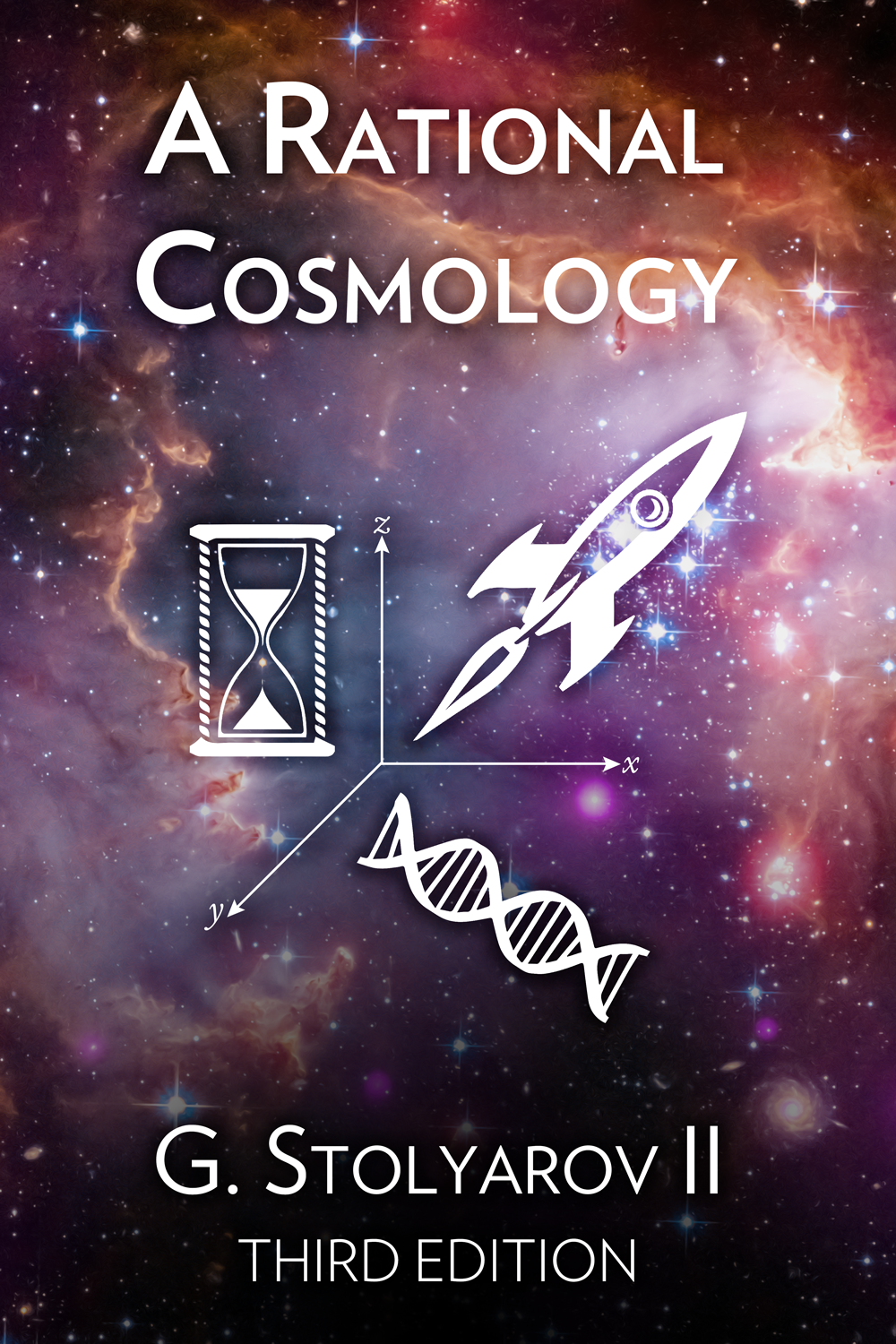
A Rational Cosmology – Treatise by G. Stolyarov II – Third Edition

A Rational Cosmology – Treatise by G. Stolyarov II – Third Edition

A Rational Cosmology - Third Edition - by G. Stolyarov II

A Rational Cosmology – Third Edition – by G. Stolyarov II

Contemporary science does not make as much progress as it could, due the fallacy of empiricism-positivism – the idea that no knowledge is certain beyond refutation and that every claim is contingent on highly narrow, particular, and expensive experiments. A Rational Cosmology, however, provides a thorough refutation of prevalent empiricist-positivist fallacies, both in content and in method. It shatters some of the erroneous philosophical interpretations of theories such as Relativity and Quantum Mechanics. Moreover, it refutes the ex nihilo origin of the universe – including its manifestation in popular views of the Big Bang and Big Crunch – the particle/wave view of light, and a host of other fallacious ideas, using the proper, axiomatic-deductive methodology of identifying those theories’ conceptual flaws and internal contradictions.

As constructive alternatives to these fallacies, A Rational Cosmology presents objective, absolute, rationally grounded views of terms such as universe, matter, volume, space, time, motion, sound, light, forces, fields, and even the higher-order concepts of life, consciousness, and volition. The result is a system verified by ubiquitous observation and common sense, the underpinnings of objective science which demonstrate a knowable, fathomable reality and set the stage for unfettered progress, confidence in reason, and full-scale logical investigation of just about everything existence has to offer.

The Third Edition of A Rational Cosmology has been enhanced and edited, with augmentations and revisions to several of the previous essays. There is a new, beautiful cover design by Wendy D. Stolyarov. Furthermore, there are two additional numbered essays and more recent writings within the Related Essays section.

For the first time, A Rational Cosmology is available for free download in the form of unified files. There are four options to choose from.

Download the PDF version.

Download the MOBI version.

Download the EPUB version.

Download the AZW3 version.

The Rational Argumentator welcomes your reviews of A Rational Cosmology. You can submit them to TRA by sending them to gennadystolyarovii@yahoo.com. You are also encouraged to spread the word by reprinting the information on this page or your own comments concerning the book on other media outlets.

The Rational Argumentator’s Eleventh Anniversary Manifesto

The Rational Argumentator’s Eleventh Anniversary Manifesto

The New Renaissance Hat
G. Stolyarov II
August 31, 2013
******************************

In another productive and transformative year for The Rational Argumentator, I have been able to realize a series of long-held ambitions. New and improved editions of Eden against the Colossus, The Best Self-Help is Free, and Implied Consent have all been released since TRA celebrated its tenth anniversary last year. In addition, the Guide to Stolyarovian Shorthand renders my unique system of efficient note-taking available to the public for the first time. Furthermore, numerous new articles, YouTube videos, and links to Resources on Indefinite Life Extension have been created and published, along with several new and even more remastered musical compositions.  This has been a year of rejuvenating the accomplishments of the past while also shaping the future with new creations. I continue to experiment with and implement new approaches for spreading rational enlightenment to all who are willing. My Open Badges on Indefinite Life Extension are a proof of concept of what could be possible when it comes to motivating free, open-source education that produces externally verifiable outcomes. Of course, developing and expanding the system of Open Badges in any range of conceivable subjects will require a considerable amount of time and exertion of effort. However, TRA now has an embedded system for developing multiple-choice quizzes whose completion will result in the awarding of an Open Badge.

Total eleventh-year visitation for all TRA features was 1,077,192 page views, compared to 1,302,774 during the tenth year and the peak of 1,398,438 during the ninth year. While this was a decrease, it is still a higher number than was observed during any of the first eight years of TRA’s existence. TRA’s lifetime visitation stands at 6,746,360 page views.

I attribute the recent trend in reduced visitation to a decrease in new publication activity. During its eleventh year, TRA published 208 features, compared to 306 during its tenth year. The rate of publication slowed because of an unusually turbulent year, both in terms of events that affected me directly and took me away from a more steady publication regimen, and in terms of larger attention-absorbing, paradigm-shattering developments on a world scale, such as the recent revelations of Orwellian NSA surveillance of the general population.

Still, the fact that visitation slipped by less (a decrease of 22.97%) than the number of published features (a decrease of 32.03%) shows that TRA’s content remains sought-after and relevant, perhaps especially so in light of the very troubled and troubling era in which we live, when the direct threats to our personal liberty and privacy continue to mount and to become unavoidably palpable. The message that individuals have rights, that their lives have inherent value, that no “national security” or “greater good” can trump that value, needs to be proclaimed with renewed urgency and commitment. An alternative to the status quo needs to emerge through intellectual, technological, and political innovation, and it needs to emerge sufficiently soon that the Orwellian boot on the face of mankind does not stamp it out forever. The comprehensive surveillance regime unleashed in secret by the Bush and Obama administrations has no historical parallels; it is what the totalitarian regimes of the 20th century could only have dreamed of. At the same time, an increasing disconnect has occurred between the actions of national-government politicians and anything resembling what the people actually think: witness the rampant war hysteria that the Obama administration is currently attempting to stir up for a pointless, counterproductive invasion of Syria that would already be one of the least popular military undertakings in US history.

What can be done to change the political and cultural status quo to anything resembling sanity – even the kind of sanity that could have been said to characterize the 1990s in the United States? Hundreds of distinct approaches, implemented by millions of individuals, are most certainly required.  This problem is not easy; the world took a wrong turn, probably sometime around September 11, 2001, when the fear of “terrorism” led the political leaders of the Western World to use an infinitesimal threat to justify restrictions and invasions of personal liberty and even bodily integrity, which would have been unthinkable in any other context. After the economic collapse of 2008 and the subsequent bailouts of politically connected cronies, it seemed clear that the national governments of the world have sided with the “men of pull” – as Ayn Rand would have called them – against everybody else.  A free system which rewards merit and undermines stagnant hierarchies of rent-seeking privilege was not allowed to manifest itself. Instead, the very people who caused the world to take a wrong turn remain in charge.

While changing the current state of affairs is no easy task, I can confidently say that, in a hypothetical world where all humans were philosophically inclined, informed on current events, concerned with questions of morality, and interested in continual learning and self-improvement, the wrong turn would never have been taken. In a world that suddenly found itself filled with such enlightened individuals, the harms of the status quo would quickly be undone. The goal of The Rational Argumentator is to assist such enlightened individuals, both those who already are and those who might become enlightened through their independent intellectual explorations. While we are far from a world filled with purveyors of philosophical enlightenment (in the 18th-century sense of that term), every individual who becomes a true rational intellectual and a person of moral conscience can take us one step closer in that direction.

Pervasive NSA surveillance, fortunately, is no threat to TRA, because TRA has always been a publicly accessible endeavor. As I have written previously, if  those employed by the NSA and other spy agencies throughout the world were to read information on The Rational Argumentator, this could only benefit humanity by possibly exposing these individuals to ideas of rationality and moral conscience. The truly troubling aspect of universal surveillance is that it seeks to pry into the communications that we do not wish to disclose to anyone and everyone – private e-mails, phone calls, social-media conversations, financial transactions, and search terms. It is reasonable and justified for individuals who wish to preserve a shred of privacy to change their approach toward such communications. However, as far as TRA is concerned, its work can proceed unimpeded, for its message is meant to reach as many people as possible, NSA agents or not.

However, the recent revelations of NSA spying did lead me to reconsider one matter from my March 2012 statement, “A New Era for The Rational Argumentator”. I no longer consider social-networking sites, such as Facebook or Google+, to be effective ways for individuals to create custom repositories of knowledge. While it is still the case that individuals can access content somewhat tailored to their interests through such networks, the fact remains that the networks have been co-opted through NSA backdoors into their systems. The companies running these networks are no longer benign free-market entities whose goal is to exchange value for value with their customers. Rather, the original market-oriented purpose of these companies has been subverted in favor of becoming privatized arms of the surveillance state. Perhaps these companies had little choice but to comply with requests to spy on their users; observe the fate of Lavabit, whose founder tried to stand on principle and refuse such intrusions. The fact remains, though, that it is not prudent to rely for one’s information and philosophical development solely on sources whose role to gather information about one can affect one’s life far more than any of their incidental ability to give information to one. Does this mean that one should abandon all social networks or even Facebook and Google+? I am not advocating this, though I do advocate extreme prudence on these networks. The path-dependency and network effects are too great at present for such abandonment to be a practical choice for many people, myself included. Rather, I wish to emphasize the continued importance of self-contained online information repositories that do not vary based on the visitor and do not seek to do anything to the visitor other than provide content and elicit feedback in public comments. The Rational Argumentator is just such a source, and I hope in the coming months and years to increase its rate of publication and resume its previous modus operandi of publishing both original content and some of the most thought-provoking content that has appeared elsewhere, relying on TRA’s excellent network of authors and articles published under the Creative Commons License. If I can convince you to access TRA directly (rather than only through a social network) on a routine basis as part of your quest for knowledge and edification, then my planned endeavors will be successful.

You will see, in the coming months, the realization of still more ambitious projects, some of which are presently underway. Through all of the changes, improvements, and revitalizations of past materials, I can make you the same promises that I have made throughout TRA’s lifetime: that I will retain all content ever published on TRA; that I will continue to vigorously promote the ideas of liberty, reason, and technological progress; and that this site shall always remain a haven for high intellectualism and civilized discourse. In whatever way I can, I hope to make this magazine a valuable asset to those of us who have the most at stake in the outcome of the continuing and accelerating race between technological progress and authoritarian intervention.

MOBI and EPUB Formats of “Eden against the Colossus” Now Available

MOBI and EPUB Formats of “Eden against the Colossus” Now Available

As promised, the Second Edition of my science-fiction mystery novel Eden against the Colossus is now available in additional formats. MOBI and EPUB formats for e-readers can now be downloaded for free. As previously, you can also download a free PDF copy of this book.

My sincere thanks go to Wendy Stolyarov for her work in making this release possible.

Second Edition of “Eden against the Colossus” Now Available for Free PDF Download

Second Edition of “Eden against the Colossus” Now Available for Free PDF Download

The New Renaissance Hat
G. Stolyarov II
January 21, 2013
******************************

I am delighted to announce that the Second Edition of my novel Eden against the Colossus (originally written in 2002-2003, and published in 2004) is now available for free download in PDF format. Click here to download and read a copy. I shall also endeavor to make the book available in other e-publishing formats in the near future.

The novel’s official home page has also been updated. You can go there to download the book and read reviews by others. I encourage you to submit reviews of your own to me in the manner described on the page. Additionally, I invite you to read the introduction to the Second Edition below.

   Introduction to the Second Edition

It has been some ten years since I wrote Eden against the Colossus. I worked on this book gradually from July 2002 through July 2003, with some light edits made in the summer of 2004, for online publication in July of that year. In October 2011, Lulu.com, the former host of the e-book, took it down inexplicably. I decided then that I never again would risk the availability of my work being put in jeopardy due to the whims of an external host. Hence, I have worked this past year to release this second edition, entirely free of charge, for as many electronic and e-book formats as I could manage.

In the course of creating the second edition, I performed some thorough editing, largely for style and not content. The aim of the editing process was to retain as much of the original intent and vision of Eden against the Colossus as I could, while improving the phrasing of certain sentences and sometimes modifying or clarifying a few peripheral details to render the story more internally consistent. My writing style has progressed considerably in the past decade, and I have endeavored to apply some of what I have learned in order to enhance this work – but not enough to alter its fundamental structure, plot, or ambience. Moreover, I have not diminished the substance or sophistication one bit.

Science fiction is shaped by the author’s ability to project the future from present circumstances. Upon re-reading and editing this work, it was interesting for me to contemplate the actual changes that had occurred in the world during the intervening ten years, and how they aligned with my predictions. In some ways, I am more optimistic about the future (especially the most proximate century) than I was when I wrote this book. Some of the technologies I anticipated, such as electronic ink, are already ubiquitous (though not facilitated by nanobots and an interface between the mind and an e-reader, as I had imagined). Other technologies, such as in vitro meat, are around the corner in our time – but have taken humankind in my projection some 750 years to arrive at.

I wrote Eden against the Colossus prior to my exposure to the work of Aubrey de Grey on indefinite human life extension and the work of Ray Kurzweil on exponential growth in computing technology, artificial intelligence, and the concept of the technological singularity. Even the Intergalactic Protectorate – with all of its technological marvels – is a pre-singularitarian society in Kurzweil’s sense. I suppose that it had to be one in order for me – from the vantage point of the early twenty-first century – to have been able to conceive of its various aspects. This fictional universe is also one in which sentient machines have not emerged – as I considered them impossible at the time of writing. There are numerous intricate robots on various scales – to be sure – but all of them remain instruments of man. Humans do, however, have numerous technological enhancements to their bodies and minds – a combination of biotechnology and computing add-ons – that serves as a soft parallel to Kurzweil’s concept of the merger of man and machine into an enhanced being of vastly greater cognitive capacity. The dialogue of the characters is far more advanced than most spoken discourse today; think of an entire society possessing the literary skills of elites during the 18th-century Enlightenment – in their speech.

 It is important to understand this hypothetical future as one conditioned by centuries of retrogression, war, and gradual, staggered recovery of civilization. Perhaps it represents one of the less palatable tracks of civilizational progress – where the Malthusians and Luddites set back prosperity and innovation for centuries, but where the human will for life, achievement, and expansion comes out ahead anyway – eventually. I certainly hope that, in the real world, we can do better to prevent the de-civilizing process from taking hold during the early third millennium. I harbor now – to a greater extent than I did ten years ago – the hope of personally someday living in a world where the level of human advancement and prosperity has surpassed what I envisioned here.

Eden against the Colossus is a humanist work, and a proto-transhumanist one. It embraces reason, industry, innovation, and technological progress, and thoroughly critiques and condemns the enemies of human development. Though it will be apparent to the reader from even the prologue, the book is intended as a response to and refutation of Daniel Quinn’s Ishmael, which I still consider to espouse a worldview that is most diametrically opposed to my own. What would the society glorified by Ishmael really look like? Is it truly compatible with the human condition as it can be and ought to be? These questions are explored here in depth. I still think that most of my answers to them are correct, and worthy of consideration – especially as compared to their antitheses. It is particularly important for the ideas of reason, individualism, and technological progress to be spread today – in the face of misguided attacks from such diverse individuals as Leon Kass, Sherwin Nuland, Daniel Callahan, John Gray, and Nassim Taleb, which, if embraced by too many of our contemporaries, could seriously damage the advancement of civilization and our own life expectancies and standards of living. I might have phrased some of my statements differently had I written this work today, but the overall emphasis and intellectual direction are on target. I am rendering this book available to all for free download and redistribution, because I consider it essential to spread sophisticated discussion of these ideas and to counter the opponents of meliorism on both the Left and the Right.

Along with being a science-fiction tale, this book is a philosophical mystery story, which implies that not all pieces of information will be available to the reader immediately. I assure you, however: they will be accounted for. Reality brooks no contradictions, and any fiction that pretends to have value in this world cannot, either.

I have seen fit, as part of the mystery, to invent an entirely new language, which the reader will perceive to be quite confounding. It is meant to be. And, of course, the confusion is meant to be resolved.

 This book is not what it seems when you begin reading it. If it were merely about a straightforward ideological disagreement, or about interaction with an extremely different alien species, it could perhaps be phrased better in a treatise. Even though it may seem that I am telling you a lot of the ideas in the book, this is just one of the mechanisms used to show you this story.

To those who are expecting light reading, this book is certainly not that. It must both set up an elaborate future world and develop the mystery within it. The book must necessarily get off to a slow start, but once the background is explicated, the story begins to take on a life of its own, and careful reading of the early passages will pay intellectual dividends to the reader during the latter half. If you appreciate a text that is constructed with great care and in which every fact and every statement is selected with a logical purpose, then you will enjoy Eden against the Colossus.

Mr. Stolyarov’s Short Story “What Did Not Have to Be” Wins Transhumanity.net 2033 Immortality Fiction Contest

Mr. Stolyarov’s Short Story “What Did Not Have to Be” Wins Transhumanity.net 2033 Immortality Fiction Contest

I am pleased to announce that my short story “What Did Not Have to Be” won first place in the Transhumanity.net 2033 Immortality Fiction Contest. What a fitting outcome at a time when I am focusing more on my writing! The prize for first place is $50.

Here is the Transhumanity.net posting of winners. Out of all the contestants, I portray indefinite human longevity in the most optimistic light – and it would indeed be wonderful if technological progress can get us to this most vital of all goals within the next 20 years!

Bitcoin Donations and Direct Sharing on Social Networks Now Available on TRA

Bitcoin Donations and Direct Sharing on Social Networks Now Available on TRA

The New Renaissance Hat
G. Stolyarov II
November 27, 2012
******************************

I am immensely pleased to announce two major improvements to The Rational Argumentator. I am grateful to Wendy Stolyarov for making these enhancements possible.

First, Bitcoin donations are now accepted via the address on the sidebar. With this enhancement, TRA has joined the Bitcoin economy and hereby expresses its support of this experiment in currencies that are free of central-bank manipulation and that can truly empower individuals.

Bitcoin donations will be used, where possible, on activities that are relevant to TRA’s purpose. It is still certainly the case that only a minority of participants in the tangible and digital economies accept Bitcoin. However, Bitcoin donations to TRA will give me the ability to productively interact with those who do. The uses of donations may include improvements to TRA’s content and infrastructure – as well as the acquisition of goods and services that are relevant to TRA’s purpose or that reward other creators whose work is aligned with that purpose. (I will post about such acquisitions when they happen.) Sometimes I may need to exchange Bitcoin for USD if this can become an effective way to pay for TRA’s web hosting or related upkeep of the site. No donation amount is too small – and every donation will be appreciated. Bitcoin transactions are intended to be anonymous, but you may feel free to otherwise inform me that you have made a donation, and I will thank you individually.

Because TRA is not a corporation or other formal legal entity, donations are not tax-deductible. But your purpose in donating to TRA should not be the achievement of a tax deduction in any event.

Second, you will notice that it is now possible to directly share specific TRA features via Facebook, Google Plus, and Twitter from the main Rational Argumentator page (without needing to click on the link for the individual article). Hopefully, this will encourage more of my readers to spread TRA’s content throughout their social network and thereby encourage the proliferation of rational thinking and high culture.

Announcements and October-November 2012 Update to Resources on Indefinite Life Extension

Announcements and October-November 2012 Update to Resources on Indefinite Life Extension

I expect be unavailable to publish The Rational Argumentator until circa November 22, 2012 – but, in the meantime, various new offerings have been posted for my readers.

In addition, I have recently been impressed by the significant contributions my computer has made to the World Community Grid Help Conquer Cancer distributed computing project. (You can see a presentation by one of the project’s lead scientists, Dr. Igor Jurisica, here.) About a month ago, the Help Conquer Cancer project was enhanced to allow computers’ Graphics Processing Units (GPUs) to assist in the analysis of millions of experiments. My own recently enhanced computer has been participating heavily, which caused my worldwide ranking on World Community Grid to rise within a month from about 60,000th place to 26,744th place (updated every half-day) in terms of credits and 15,795th place in terms of results returned. In addition, for the totality of BOINC distributed computing projects, I have risen to the 98.2932nd percentile and a world rank of 42,446 in terms of total credits and the 99.5634th percentile and a world rank of 10,878 in terms of recent average credit. In the United States, I am ranked at 11,802nd place in terms of total BOINC credit earned.

I expect that my computer will continue to run at full capacity during the upcoming weeks, and indefinitely into the foreseeable future.

For your contemplation and enjoyment, I offer here the list of diverse and fascinating articles and videos that have been included in the Resources on Indefinite Life Extension (RILE) page in October and early November of this year.

Articles

– “Nanoparticles Against Aging” – Science Daily and Asociación RUVID – October 3, 2012

– “Nanoparticles can deliver antiaging therapies” – Brian Wang – The Next Big Future – October 4, 2012

– “A Speculative Order of Arrival for Important Rejuvenation Therapies” – Reason – Fight Aging! – October 4, 2012

– “Therapy will use stem cells to heal heart” – Pauline Tam – October 4, 2012

– “Aubrey de Grey on Longevity Science” – Reason – Fight Aging! – October 5, 2012

– “Predicted sequence of Antiaging rejuvenation” – Brian Wang – The Next Big Future – October 5, 2012

– “Researchers use magnets to cause programmed cancer cell deaths” – Bob Yirka – October 8, 2012 

– “Lilly Alzheimer’s Drug Slows Mental Decline, Study Finds” – Shannon Pettypiece – October 8, 2012

– “Vitamin Variants Could Combat Cancer as Scientists Unravel B12 Secrets” – ScienceDaily and University of Kent – October 8, 2012

– “Human Immortality: Singularity Summit Looks Forward to the Day That Humans Can Live Forever” – Hamdan Azhar – Policymic – October 2012

– “Drug From Chinese ‘Thunder God Vine’ Slays Tumors in Mice” – Drew Armstrong – Bloomberg – October 17, 2012

– “82 Years of Technology Advances; but best yet to come” – Dick Pelletier – Transhumanity.net – October 25, 2012

– “New you by 2022: biotech enhancements will help you ‘grow young’” – Dick Pelletier – Positive Futurist – October 2012

– “Flu Vaccination May Increase Longevity” – Lyle J. Dennis, M.D. – Extreme Longevity – October 29, 2012

– “Dead as a Doornail?” – Peter Rothman – h+ Magazine – November 1, 2012

– “An Outcast Among Peers Gains Traction on Alzheimer’s Cure” – Jeanne Whalen – Wall Street Journal – November 9, 2012


Videos

Anthony Atala
Anthony Atala at TEDMED 2009
January 21, 2010

Ray Kurzweil

From Eliza Watson to Passing the Turing Test – Singularity Summit 2011

October 25, 2011

Nikola Danaylov

– Ray Kurzweil on Singularity 1 on 1: Be Who You Would Like to Be – October 13, 2012

The Rational Argumentator’s Tenth Anniversary Manifesto

The Rational Argumentator’s Tenth Anniversary Manifesto

The New Renaissance Hat
G. Stolyarov II
September 6, 2012
******************************

As I write this, it is amazing to contemplate that The Rational Argumentator has been in existence for over ten years. Since August 31, 2002, much in the world has changed – and much about TRA has changed as well. Some of the most monumental changes in the history of this publication occurred just during the past year.

Total tenth-year visitation for all TRA features was 1,302,774 page views – as compared to 1,398,438 page views during TRA’s ninth year. While this was a decrease of about 6.84%, this was still TRA’s second-highest year in terms of visitation. TRA’s cumulative lifetime visitation stands at 5,669,168 page views, meaning that the 5-million-visit mark was exceeded during the tenth year.

20 additional issues and 200 features were published during the tenth year, through February 29, 2012. As of March 1, 2012, TRA entered into its new era, with a shift from an issue format to a WordPress-based, free-flowing architecture. In that redesign (which is only prospective and does not affect content published before March 1, 2012), I was able to achieve three of the five goals on my “wish list” expressed in the Ninth Anniversary Manifesto. Since then, an additional 106 features were published of TRA – for a total of 306 regular features or the equivalent of 30.6 old issues published during the tenth year.

In early August 2012, another major development for TRA was the shift of web hosts for the domain. Lunarpages no longer hosts The Rational Argumentator’s site, as I opted to switch to MDDHosting due to superior customer service and more reasonable hosting parameters.  During a transition period of several days, my priority was to maintain the accessibility of the site and to continue providing thought-provoking content. I am pleased to say that the transfer of both the hosted files and the domain name occurred without significant disruptions for users.

In addition to an abundance of new YouTube videos on my channel, the past year saw the development of a vast compendium of Resources on Indefinite Life Extension (RILE), which is regularly updated with links to articles and videos intended to enlighten readers as to the feasibility and desirability of indefinite human life extension – as well as ongoing developments and discoveries that aid in attaining that goal.

As the Internet changes, TRA will continue to change with it in order to most effectively complement the vast array of other resources available to individuals who wish to explore the ideas of reason, liberty, and technological progress. At the same time, TRA will always remain a haven for high intellectualism of the sort that is sorely lacking in contemporary culture and discourse. Furthermore, I shall always strive to maintain my promise to retain all content previously published, as a historical repository of knowledge, ideas, and intellectual tools. The Rational Argumentator has achieved a venerable sort of longevity, at least as far as online publications go. My intent is that – like all the good things in life – TRA will continue indefinitely and will only further improve with time.