Browsed by
Category: Culture

Three Popular Myths behind Trump’s Success – Article by Barry Brownstein

Three Popular Myths behind Trump’s Success – Article by Barry Brownstein

The New Renaissance HatBarry Brownstein

******************************
Why the Unprincipled Worst Get on Top

“Nothing sinks people faster in their careers than arrogance,” according to Stephen R. Covey, the bestselling author of The Seven Habits of Highly Effective People. But it is hard to imagine a less humble or more arrogant individual than Donald Trump, and to date, his shoot-from-the-hip, prideful, self-referencing arrogance has not sunk his career.

In his book Principle-Centered Leadership, Covey described “politics without principle” as a politics of personality focused on “the instant creation of an image that sells well in the social and economic marketplace. You see politicians spending millions of dollars to create an image, even though it’s superficial, lacking substance, in order to get votes and gain office.”

The marketplace imposes a check on empty promotion and false confidence, which is why, as Covey observes, the most successful leaders in the private sector are often also quite humble.

So why do the arrogant do so well in elections? Is there something different about the political process that allows the worst to succeed?

In his seminal book The Road to Serfdom, Nobel laureate F.A. Hayek offers part of the answer. He lists three widely held beliefs that allow arrogant politicians to emerge.

Belief 1: We should be able to get out of our economic difficulties without pain.

As Hayek saw it, some people blame “the system” for their troubles and “wish to be relieved of the bitter choice which hard facts often impose upon them.” They “are only too ready to believe that the choice is not really necessary, that it is imposed upon them merely by the particular economic system under which we live.”

Let the implication of Hayek’s words sink in. The successful politicians may be those who increasingly blame the “system.”

With a majority of Americans feeling economically insecure, there is plenty of fear for Trump to exploit and a ready audience for promises that he can ease the economic pain of ordinary Americans.

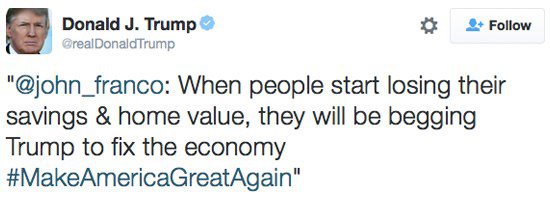
Trump postures as a great fixer. Consider this retweet on Trump’s official Twitter page:
trumptweet20150824

He promises that things are going to be “great again,” once he gets us a better deal with China. Trump tells us he gets what he wants. To purchase a hotel in Miami, he brags, “I went in and punched and punched and beat the hell out of people, and I ended up getting it.”

Of course, Trump is not alone. In their arrogance, politicians will claim to fix social pain points — while they create many, many more.

Belief 2: Government should command or partially command significant portions of the economy.

Hayek observes that many well-meaning people ask, “Why should it not be possible that the same sort of system, if it be necessary to achieve important ends, be run by decent people for the good of the community as a whole?”

Those who believe in command economies think that when things go wrong, it must be because the wrong people are in charge. They don’t question their core belief that controls are needed.

History, economics, and the contemporary world teach lessons of command-and-control societies that have experienced economic failure. Yet, the wrong-person-in-charge belief is sadly all too common.

In her book The Art of Choosing, social psychologist and business professor Sheena Iyengar reports on 2007 research about societal attitudes in East Germany. She observes that among former East Germans, “more than 90% believed socialism was a good idea in principle, one that had just been poorly implemented in the past.”

Look around at your friends and neighbors who are supporting a candidate who advocates top-down solutions to social and economic problems. With few exceptions, they want the same things that you want: prosperity and peace for their family and the world. It is not that they want different outcomes than you do. They simply don’t understand that command economies are inherently, fatally flawed and cannot accomplish those goals.

Without examining their core beliefs, decent people tell themselves they’re choosing the “right” person to put in charge. Arrogant politicians are standing by, posturing as the “right” people.

Belief 3: There is a “good of the community as a whole” that our current economy is not meeting.

It is essential to understand why there can be no such thing as the “good of the community as a whole.” Hayek explains,

The “social goal” or “common purpose” for which society is to be organized is usually vaguely described as the “common good,” the “general welfare,” or the “general interest.” It does not need much reflection to see that these terms have no sufficiently definite meaning to determine a particular course of action.

All top-down solutions will be win-lose, benefiting some and harming others, for as Hayek explains,

The welfare and happiness of millions cannot be measured on a single scale of less or more. The welfare of the people, like the happiness of a man, depends up on a great many things that can be provided in an infinite variety of combinations.

Some see health care as a common good and a human right that the market system has failed to provide. In my FEE essay, “Castro and Obama Are Wrong about ‘Human Rights’” (FEE.org, March 25, 2016), I explain why real rights are win-win, not win-lose. “Rights” such as health care are win-lose and not real rights at all.

The arrogant believe they know what is best for you and best for the community. To them the course of action is clear. However, Hayek warns that in collectivist ethics, the ends justify the means and thus lead to amoral totalitarianism:

There is literally nothing which the consistent collectivist must not be prepared to do if it serves “the good of the whole” because “the good of the whole” is to him the only criterion of what ought to be done.

The Consequences of Our False Beliefs

Since there is no majority to agree on a specific plan of action to promote a nonexistent “common good,” the worst get on top in a centrally planned economy.

The “worst” will take advantage of the fact that agreement can be more readily forged by focusing on a “negative program.” Hayek writes,

It seems to be almost a law of human nature that it is easier for people to agree on a negative program — on the hatred of an enemy, on the envy of those better off — than on any positive task. The contrast between the “we” and the “they,” the common fight against those outside the group, seems to be an essential ingredient in any creed which will solidly knit together a group for common action. It is consequently always employed by those who seek, not merely support of a policy, but the unreserved allegiance of huge masses.

The “mass” that the “worst” seek to mobilize will include those who themselves are not grounded on principles. Hayek cautions that those having “imperfectly formed ideas are easily swayed”; their “passions and emotions are readily aroused.”

Hayek helps us to understand why the careers of arrogant politicians do not sink fast. The careers of arrogant politicians rise as long as we believe in a common good, seek the “right” politicians to be in charge, and support those who promise to shelter us from the work of examining our beliefs and the pain of making a different choice.

We shouldn’t be surprised when the outcome is not what we expect. As Freeman editor B.K. Marcus observes, “The more decisions we cede to the political process, the less we should expect anyone to protect our interests” (“Why Do We Believe These Pathological Liars?” FEE.org, April 27, 2016).

As individuals, we can question our core beliefs. We can humbly “try to live in harmony with natural laws and universal principles.” And we can demand the same of our politicians.

Barry Brownstein is professor emeritus of economics and leadership at the University of Baltimore. He is the author of The Inner-Work of Leadership. He blogs at BarryBrownstein.com, Giving up Control, and America’s Highest Purpose.

This article was published by The Foundation for Economic Education and may be freely distributed, subject to a Creative Commons Attribution 4.0 International License, which requires that credit be given to the author.

Earth Day’s Subtle Pollution – Article by Edward Hudgins

Earth Day’s Subtle Pollution – Article by Edward Hudgins

The New Renaissance HatEdward Hudgins
******************************

On the first Earth Day on April 22, 1970, my high school class traveled to the Mall in D.C. to mark the occasion. Me? I skipped the trip. Instead, I stayed home to watch the crippled Apollo 13 spacecraft return to Earth. My classmates and I had different values. And in the years since, I’ve watched as some of the sub-rosa values of Earth Day have spread to pollute our culture.

save-the-planet-kill-yourselfEarth Day as soft indoctrination

To get the obvious out of the way, it is valid to be concerned about the measurable adverse effects on human health of raw sewage, or toxic waste dumped into rivers, or poisonous factory fumes pumped out to choking lungs. But that concern has metastasized into a cultural hypochondria, a fear that everything created by humans is dangerous and, worse, is dangerous to an abstraction called “the environment” rather than to humans. What happened? For four and a half decades Earth Day has spread a form of soft indoctrination. Every year, school kids cut out little paper trees and leaves, visit recycling plants, watch Al Gore’s Earth in the Balance, and are generally asked by teachers, “What are you doing to help the environment?” Local news reporters visit the Earth Day Greenpeace booths at the town park and interview local politicos or business folks about how they are conserving the planet.
 ***

All value is for humans

What’s missing from this picture? Humans! Certainly the messages are mixed. Certainly there is talk about our kids living healthier lives if they are not exposed to carcinogens and the like. But the subtle shift fostered by this annual April ritual is from the material world being of value to humans to the material world being of value in and of itself.

Forests are of value to humans because we can use their trees for lumber for our houses—good for our material well-being—or walk through them to enjoy their beauty—good for our spiritual well-being. But they are not of value in and of themselves. Yet Earth Day has conditioned two generations to anthropomorphize forests, rivers, oceans, and “the environment” as entities with rights apart from us, the conscious valuers. And these two generations are now susceptible to the appeals of the environmental extremists who argue, in essence, that humans are trespassers on the planet. Thus, we see arguments for public policies that would demonstrably harm humans, especially those in less developed countries.

The value of technology and achievement

Worse, an unthinking regard for the environment blinds many to real future challenges and their only solutions. As poorer countries develop higher living standards, they will not be able to consume resources at the rate Western countries did when they were industrializing. New technologies that allow for more efficient and, as a result, less polluting ways to use resources will be essential. Technology is what created cities, skyscrapers, factories, trains, planes, cars, rockets, and most things that radical environmentalists want to curtail. Technologies are achievements of the human mind that, in turn, empower us to achieve more in our lives and in the world.

31st_centuryThis vision of the future is already grating on those who have been poisoned by the subtle extremist message of Earth Day. But the achievements in recent decades in information technology and the emerging achievements in nanotech, biotech, and artificial intelligence are causing many young people especially to shake off the destructive Earth Day ideology. These individuals understand not only that technology will help us meet true challenges to human well-being. They also appreciate that human well-being is the standard of value.

Let’s hope that in the future Earth Day is superseded by Human Achievement Day!

Dr. Edward Hudgins directs advocacy and is a senior scholar for The Atlas Society, the center for Objectivism in Washington, D.C.

Copyright The Atlas Society. For more information, please visit www.atlassociety.org.

Is Trump a Howard Roark? – Article by Edward Hudgins

Is Trump a Howard Roark? – Article by Edward Hudgins

The New Renaissance HatEdward Hudgins
******************************
Roark vs. TrumpDonald Trump recently said he’s a fan of Ayn Rand’s novel The Fountainhead. Even if you haven’t read it, a reflection on the key characters in that excellent work will help you understand much of what’s wrong with The Donald. Not wishing to write a book-length treatment on the subject, I’ll focus on just one thing that’s relevant to the presidential election: how one treats others.

In an interview with Kristen Powers, Trump said of The Fountainhead, “It relates to business … beauty … life and inner emotions. That book relates to … everything.” (Here he’s right!) He identified with Howard Roark, the novel’s architect hero, loosely based on Frank Lloyd Wright. Trump builds buildings too, so no doubt a novel on the subject would interest him. But much of the resemblance between Roark and Trump ends there.

Roark treats people with respect
Howard Roark loves the creative work of designing buildings for the purpose of seeing them built just the way he designs them. His work is his source of pride. He doesn’t work for the approval of others.

Roark must struggle because in his world established architects simply want to imitate the styles of the past, mainly to impress other people who, for the most part, aren’t particularly impressed in any case.

Roark must find individuals and enterprises that want his buildings. But he is quite clear that “I don’t build in order to have clients. I have clients in order to build.” He does not bastardize his buildings—sticking columns or balconies on them just to make sales. He has his standards. He is honest with his prospective clients and tries to educate them. He respects them enough to treat them like intelligent individuals. If they can’t accept his style, that is unfortunate, but Roark will not pander. Roark has integrity.

Wynand panders to the lowest
Another major character in the novel is Gail Wynand, who rose from nothing to build a chain of “Banner” newspapers. Wynand is good at what he does but what he does is not good. He builds his empire by appealing to the lowest common denominator among his readers. He is a yellow journalist who feeds them scandal, sensation, and schlock. He sees his readers as basically stupid and irrational, and his idea of success is not to appeal to the best within them but, rather, the worst, assuming they deserve nothing better.

And that is how Trump approaches prospective voters in his political campaign. It’s all a sensationalist, headline-grabbing show. It’s saying the most outrageous things to appeal to emotions on the assumption that his audience can’t or doesn’t want to actually think.

Which works?
But there is a major difference between Wynand and Trump. Wynand wants power over others but his sense of self-worth is not dependent on the adulation of the mob he wants to rule. Trump, on the other hand, seems to drink up the applause of his audience, and if someone challenges him, it’s personal and rates the response of the most insecure playground bully.

By contrast, in The Fountainhead, when the novel’s most malicious villain who has tried to block Roark’s career approaches him and asks “What do you think of me?” Roark responds, “But I don’t think of you.” That’s true self-esteem!

Which approach works better: Roark’s career built on dealing with people based on reason, or Wynand’s career built on treating people like idiots? Read The Fountainhead to discover the intriguing answer you probably already suspect. In terms of Trump’s political career, it will depend on how many voters prefer to be treated like idiots rather than with respect.

Dr. Edward Hudgins directs advocacy and is a senior scholar for The Atlas Society, the center for Objectivism in Washington, D.C.

Copyright The Atlas Society. For more information, please visit www.atlassociety.org.

Censorship Is an Unjustifiable Privilege – Article by Chris Marchese

Censorship Is an Unjustifiable Privilege – Article by Chris Marchese

The New Renaissance HatChris Marchese
******************************

Free Speech Is about the Power to Challenge the Status Quo

Free speech is the great equalizer in our society. It doesn’t matter about your race, ethnicity, sex, gender identity, gender expression, sexual orientation, class — you get the point — the First Amendment protects your right to speak freely. Despite this, some student activists — perceiving unequal social conditions, including at institutions of higher education — are fighting for social change at the expense of free speech. The sad irony, however, is that free speech only becomes privileged when it’s restricted, which is why free speech must remain a right equally applicable to all.To understand why, consider Nigerian author Chimamanda Ngozi Adichie’s commencement speech at Wellesley College in 2015. In it, she said, “You, because of your beautiful Wellesley degree, have become privileged, no matter your background.” But, she added, “Sometimes you will need to push [this privilege] aside in order to see clearly,” because “privilege blinds” you to those who are different.

Students calling for speech restrictions are particularly blinded by their privilege, which leaves them unable to see the unjust privilege that restricting speech would further confer upon them. This is dangerous and counterproductive to their cause.

Restricting Speech Is an Unjust Privilege
First, to support restrictions on certain kinds of speech, activists must have (or at least project) unwavering confidence in both themselves and the system in which they are operating — the university in this case — to discern what’s offensive. Even if they see gray areas in expression, they are forced to present issues in absolutist terms if they are to have the perceived moral authority to police and punish those who offend.

Turning again to Adichie’s speech, we can see why this is wrong. As she said, “I knew from … the class privilege I had of growing up in an educated family, that it sometimes blinded me, that I was not always as alert to the nuances of people who were different from me.”

Sometimes, people are genuinely racist (though what’s considered racist varies widely from place to place) and their speech is identifiable as such. But what about the student who isn’t aware of the offense he or she may cause by wearing a sombrero at a party, which some consider cultural appropriation? How about the student who is aware but disagrees that it’s offensive? Should he or she be censored and punished based upon some activists’ standards of right and wrong? Different people have different experiences and different views. Because of this, nuance matters.

Second, while it can be tempting to argue that free speech maintains inequality because it protects offensive speech, this argument fails to distinguish between people and their views. That is, when you censor people — even for offensive speech — you are denying them equal access to, and protection of, the First Amendment and you are doing so from a position of privilege.  The right to free speech gives everyone an equal right to voice his or her opinions — but it does not mean that such opinions will win or even register in any given forum.

Restrictions on free speech, on the other hand, make both people and ideas unequal by subjugating them to someone else’s understanding of what’s right and therefore allowable. Indeed, to assume one’s views are so infallible as to warrant imposition on others and to assume there is no legitimate debate left to be had on certain topics — and the language used in discussing those topics — is a privilege that oppresses not only the hated racist, but the honest dissenter and everyone in between.

Lastly, some students claim that free speech is about power — that it enables and sustains privilege for some but not all. Let’s be clear: free speech is about power. It’s about having the power to challenge the status quo, question society’s deeply held beliefs, and call others to task. But free speech only becomes privileged when it’s restricted.

Understanding the Would-Be Censors
Of course words can have consequences. (If they couldn’t, nobody would bother speaking.) It would be hypocritical to argue that offensive speech will never cause harm, at least to feelings or interests, while also maintaining that speech is so vital it requires robust protection. One could also argue that the marketplace of ideas — like all markets — has negative externalities. The most evident, as campus activists assert, is that offensive speech is protected and those it’s directed at — typically thought to be minorities — are disproportionately burdened by it.

Moreover, restricting or punishing speech provides instant gratification. It’s an immediate and swift response to views one finds abhorrent. It gives the impression that justice has been served. For those who believe society is stacked against them, it’s a small beacon of hope. Restricting speech, then, isn’t seen as infringing upon someone else’s liberty, but rather righting a wrong. The emotional appeal is understandably strong.

But this is not right.

A Just Alternative
The best way to counter hateful, offensive speech is with more speech. Think of it this way: restricting speech treats the symptoms of bigotry by making its manifestations less visible. Conversely, more speech acts as a cure by attacking the underlying disease. The former method may seem effective in the short term, but it’s dangerous in the long run.

As FIRE President and CEO Greg Lukianoff has argued, when offensive speech is banned, it drives those with potentially dangerous views (however determined) underground, making them harder to identify, while also potentially making them more extreme. It also gives a false sense of social progress. And who ultimately pays the price? The people the bans were meant to help, when it turns out society wasn’t as friendly as they believed.

Countering hateful speech with more speech is not seamless. It’s hard work, and it’s not instant. It doesn’t guarantee the flushing of all bigoted and hateful opinions from society, and it often works slowly. Nevertheless, it is the only method that is both just and that makes progress last. Engaging with people who express views different from one’s own moves beyond the superficial to challenge core beliefs, assumptions, and biases — and can help a person identify and recognize his or her own. Consider the case of Megan and Grace Phelps, granddaughters of the pastor who founded the Westboro Baptist Church. After interacting with a Jewish man by email and on Twitter, the sisters decided their views were wrong and decided to leave the WBC, which also meant being excommunicated by their family.

The marketplace of ideas won’t always work this way, and not everyone is destined to see the light. But restricting speech is a privileged response that neither makes society more equal nor has any tangible benefit other than providing a false sense of justice, which, in the long term, only fuels underlying problems. We cannot afford to be blind to this reality.

None of this should be construed as a plea to accept the status quo or to disengage. Rather, it’s a call for college students who support restricting speech to recognize their own privilege. Education is a gift, and college students should use the privilege it confers to advocate for change. But this means realizing free speech is not the enemy of progress, and that restricting it will not make society more equal. To do otherwise — to restrict and punish speech — is to be so willfully blind to privilege as to become the oppressors.

Chris Marchese is a Senior Financial Analyst at Meritor.

This article was originally published by The Foundation for Economic Education and may be freely distributed, subject to a Creative Commons Attribution 4.0 International License, which requires that credit be given to the author.

Donald Trump Is the Nightmare Version of a Political Outsider – Article by Lucy Steigerwald

Donald Trump Is the Nightmare Version of a Political Outsider – Article by Lucy Steigerwald

The New Renaissance HatLucy Steigerwald
******************************

Trump Is Not an Alternative to Politics as Usual: He Is Its Purest Form

At a CNN-hosted town hall debate, Donald Trump said that the US government’s core focus should be on security (times three!), health care, and education. In spite of this vague, rambling answer, and much other blathering in support of big government, the real estate mogul has a large, intense following, which includes people on the right, the left, and even some paleoconservatives and libertarians.

In some ways, it’s understandable: if the normal process of politics revolts you in any way, the dream of anti-candidate Trump is sweet. The approval rating for the presidency in general is around 30 percent, according to Gallup. For Congress, it’s a stingy eight percent. People — or at least the people Gallup calls — do not seem terribly impressed by their elected officials.

Nor should they be. Powerful men and women spy, meddle, steal, and go to war, whether the people want them to or not, and then pat them on the head and coo euphemisms when people get upset with the results.

Into this travesty strolls Donald Trump, with a terrible, shallow campaign, brilliant in its bombastic vagueness. Populism, it’s been a while. You’re looking tanned, rested, but disturbingly familiar.

When Trump boasts about being against the Iraq war, or disses Dick Cheney, or says that being called a politician is insulting, it’s all too easy to like him. It would be so nice to believe he is not one of them, but one of us. Sure, he’s a billionaire on his third wife, with numerous failed business ventures, a love of eminent domain, and his own brand of “luxury” steaks, but he feels our loathing of the political class.

Yet it is infuriating that this is the year, and this is the man who has stolen the heart of the people fed up with DC. Not someone with principles (such as one against, oh, gleefully saying literally anything to be elected), not someone notably different from the elites he professes to loathe — merely a man who knows how to blab with the purest, most bald-faced confidence ever seen on a national stage.

In one way, Trump’s presidential run is about an outsider group revolting against the status quo, the way that fringey, quixotic campaigns like Pat Buchanan, Dennis Kucinich, or Ron Paul’s were. And some libertarians and paleocons have jumped on the Trump float, but it is clearly not their parade. The cause of Trump is not small government or social democracy or even Catholic populism.

It is Charlie Sheen-esque nationalism. It is strident whining confused for truth-telling. It is nonsense mercantilist ideas, bullying as public policy, and the worst anti-immigrant scapegoating in decades. However, there are no ideas here: it’s merely a billionaire playing that he’s angry about Mexicans and rallying swarms to his meaningless sort of “patriotism.”

Whether Trump was inevitable, or whether he simply speaks to the truly mediocre 2016 candidates is uncertain. But boy is it frustrating that the man who wants to raze DC is the one who wants to erect a statue of himself in its place. He tells it like it is, he knows politicians don’t work for the people! But he’s going to wave his hands and make a Mexico wall and 18th-century trade policy appear by incantation.

Back in September, the New Yorker wrote that “Trump … is playing the game of anti-politics.” We should be so lucky. Trump is merely politics distilled down to the size of one angry rich guy. On the campaign trail, would-be officials swear they can do anything and everything (and in the first 100 days, no less). Trump is bolder, brasher, and even more divorced from reality. But he’s still essentially that. The waking reality of the presumptive GOP nominee — who disses Dick Cheney, Hillary Clinton, and both party establishments — is that he is, heart and soul, a consummate politician.

His critique of the political class is not that they meddle too heavily in the lives of individuals, but that they haven’t done enough. If they had, wouldn’t we have a 50-foot wall on the southern border? Wouldn’t all those manufacturing jobs come back from China? For Trump and his supporters, the problem with Washington is not the inherent disaster of a massive bureaucracy with no consequences for failure and a surplus of corrupting power. No, it’s lack of strident, Trump-like spirit: a lack of will.

In spite of his twitches towards a less militaristic foreign policy — in between suggesting the United States rip up the Geneva Conventions, bomb the hell out of Syria, and seize Iraq’s oil — there is nothing really consistent about Trump. He may or may not be worse in practice than the status quo, but there is no reason to suspect that he is the savior of anything except his own ego. Indeed, his view that the government is incompetent due to bad managers sounds more like progressive technocracy than anything conservative. But somehow his screaming fans have gotten their signals crossed or, more grimly, they are as disinterested in small government as he is.

Hating DC is fun, but it doesn’t magically translate to supporting liberty. And populism is a not principle — it has no policies, feasible or otherwise. It is raw emotion. It is preaching. It is the flimflam, finger-pointing, and impossible promises of traditional assembly-line politics, just stripped down to bare parts. Trump is the schoolyard version of everything Marco Rubio or Bill Kristol advocates. He isn’t flattering anyone’s intelligence with his policy acumen. He doesn’t think we’re terribly smart, but he also thinks those fancy pants DC elites are not as smart as they pretend. He’s right about all of that. It’s not as if politics is noble or deserves better than Trump. It is Trump.

The Donald is not some demon summoned from another dimension to destroy America. He probably isn’t a new Hitler or Mussolini. He is a part of us, a glitzy, gilded reflection of the dark soul of politics: the lies, the self-promotion, and the delusion. Take a good, long look.

Lucy Steigerwald is a contributing editor to Antiwar.com and a contributor to Playboy; she previously worked as an Associate Editor for Reason magazine. Her articles have appeared at Playboy, Vice, Antiwar, Reason, Pittsburgh City Paper, the Pittsburgh Tribune-Review, and various libertarian blogs.

This article was originally published by The Foundation for Economic Education and may be freely distributed, subject to a Creative Commons Attribution 4.0 International License, which requires that credit be given to the author.
Star Wars: Intellectual Property Strikes Back – Article by Matthew McCaffrey

Star Wars: Intellectual Property Strikes Back – Article by Matthew McCaffrey

The New Renaissance HatMatthew McCaffrey
******************************

IP Deflates the Expanded Universe

Star Wars: The Force Awakens is already one of the most successful films of all time, and the Star Wars franchise is poised to grow at .5 past light speed for the foreseeable future. Yet, while Disney rapidly develops new chapters for the saga, it’s also quietly deleting some old ones: in 2014, Lucasfilm announced that to make way for the new films, the Star Wars Expanded Universe (or EU) would no longer be considered canon, a decision that disappointed many longtime fans.

The EU refers to the vast number of novels, short stories, comics, and games that explore the Star Wars universe outside the major films. These works enjoy an enormous following but are now consigned to a kind of alternate universe called Star Wars Legends. In other words, they will be disregarded by Lucasfilm’s officially licensed material, and any new Star Wars stories will have to fit the new canon. The original EU is discontinued, which understandably has fans feeling abandoned.

Why should the EU pose a problem, though? Why can’t artists and fans simply continue developing the canon they love, while Lucasfilm does the same? The answer is simple: intellectual property law.

Disney’s ownership of Lucasfilm allows it to license the Star Wars brand and all related intellectual property rights, especially its copyrights and trademarks. Anyone adding to the universe can only do so with permission, giving Lucasfilm power over any content within the universe or even similar to it.

In fact, Lucasfilm has a long history of aggressively litigating its IP, suing everyone from small businesses to major corporations. One of the most infamous cases was brought against the original Battlestar Galactica TV series, which was accused of copying at least 34 distinct ideas from Star Wars. These included such astonishingly original concepts as a friendly robot, an imprisoned heroine, and a movie ending with an awards ceremony.

Returning to the EU, it does make some artistic and financial sense for Disney to steer the franchise in a new direction by discontinuing older content. At the same time, artists and fans want to enjoy the EU they already know and love, something Lucasfilm legally prohibits by enforcing its IP.

My point is not that one stream of content is objectively better, but that it’s vital for all involved to freely choose the kind of content they want to create and sell. By increasing costs to both consumers and innovators, IP has already played a role in the decline of art forms like classical music, and copyrights and trademarks have similar effects in the world of pop art.

For Star Wars, original content mainly revolves around trademark rights, of which Lucasfilm owns many. Its usual defense of these properties is that unlicensed content causes confusion: without legally enforceable restrictions, consumers might think they’re buying “genuine” products when they’re actually getting cheap imitations. Furthermore, products similar to those created by Lucasfilm might be used to earn profits for noncreators who capitalize on confusion. A licensing deal from the original source ensures people won’t be taken in by unskilled or unscrupulous artists.

Assuming this is the real motivation for trademark protection, the argument is still weak. Like many consumer-oriented regulations, trademark law is patronizing: its basic assumption is that people are too dim to distinguish between official products and knockoffs or other free riders on the brand. But consumers, especially the kind of devoted fans Star Wars inspires, are perfectly capable of figuring out for themselves which content they prefer. The real issue boils down to revenue: Lucasfilm doesn’t want other businesses profiting from ideas it “owns,” and it’s perfectly happy to use monopoly privileges to protect its bottom line.

But Lucasfilm doesn’t need to litigate its trademarks to preserve profits or brand identity, which would likely be stronger in the long run without IP. For example, without trademarks, Lucasfilm would continue to officially sanction content it approves of and let consumers know which works are not “official.” If fans respect its judgment, the official Star Wars brand would thrive as people adopted Lucasfilm’s endorsement as a benchmark for quality and narrative continuity.

Competition for fan loyalty would drive official and unofficial creators alike to produce high-quality content. Different groups of creators would specialize in their own alternate universes that would succeed or fail based on their ability to satisfy fans. This would also eliminate the uncertainty surrounding fan fiction, which exists in the complex gray area of “fair use” laws. Most importantly, we’d all be able to decide for ourselves which works we treat as canon and which we abandon to the garbage masher of history.

The only truly expanded universe — one that’s creative, innovative, and prosperous — is one without IP protectionism. When we embrace genuine competition in ideas instead of competition through legal privilege, then, as Obi-Wan Kenobi would say, we’ve “taken a first step into a larger world.”

Matthew McCaffrey is assistant professor of enterprise at the University of Manchester and editor of Libertarian Papers.

This article was published by The Foundation for Economic Education and may be freely distributed, subject to a Creative Commons Attribution 4.0 International License, which requires that credit be given to the author.

One Bad Reason to Hate Trump – Article by Sarah Skwire

One Bad Reason to Hate Trump – Article by Sarah Skwire

The New Renaissance HatSarah Skwire
******************************

99 Reasons, But the Name Ain’t One

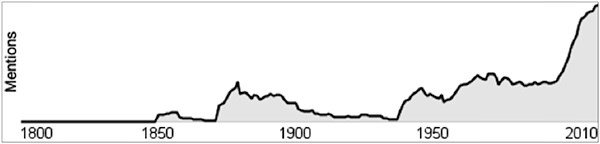
I have 99 (thousand) reasons to hate Donald Trump and to find his campaign stomach turning. I won’t list them here. The Google graph showing the rising use of the word “bloviate” in American political discourse should stand in place of any detailed accounting.

bloviategraph

But what’s grabbed most of the attention since John Oliver mentioned it recently on his show, Last Week Tonight, is Trump’s name. As Oliver notes, “Trump sounds like money.” But, he continues in tones of shock and dismay, “It turns out the name Trump was not always his family name.… An ancestor had changed it to Trump from Drumpf.”

My family name wasn’t originally Skwire. It was Skwirsky. My grandfather and his brothers changed it — right around when Trump’s ancestor changed the family name — because back in those days, it was hard to get jobs in the United States with an obviously foreign name. Trump’s ancestors, I’m sure, did the same thing.

There’s no shame in being from places that aren’t America. There’s no shame in having a last name that’s unusual. And I am bothered by the pleasure we are taking in mocking a name that sounds a little bit funny and a whole lot foreign. It sounds like the kind of rhetoric Trump uses. So I’m not going to indulge.

However.

(And this is a very big “however.”)

I do think there’s something to talk about here, and I don’t think it’s funny at all.

The focus on Trump’s original family name is not analogous to the focus on former Republican presidential candidate Chris Christie’s ample girth. Governor Christie’s poundage was immaterial to his campaign. He has not publically bloviated about the need for the obese to stop being lazy, to start exercising, and to start eating right. He has not signed on to regulatory agendas like former New York mayor Michael Bloomberg’s attempts to control what and how much people eat and drink. He hasn’t, in other words, turned his weight into a centerpiece of his campaign.

Trump, however, has made immigration one of his central issues. Even those of us who have tried desperately to avoid the whole political season have heard that he wants a bigger wall along the border with Mexico, that he wants Mexico to pay for it, and that he would deport 11 million illegal immigrants in short order. A little research turns up Trump’s repeated references to immigrants as criminals, drug dealers, and rapists. Birthright citizenship is dumb, he opines. And the barriers to immigration should be towering, because, Trump says over and over, the people born here should be our first concern.

It’s not funny that Trump’s family name used to be Drumpf. That’s just a standard American story that most of us probably share. To be an American, for most of us, means we’re not really from around here.

But the idea that we might have an American president who thinks it’s fine for the Drumpf family to come to America and achieve unimagined success in a few generations, but who will do everything possible to keep the Rodriguez family or the Habib family from doing the same?

That’s a tragedy.

Sarah Skwire is the poetry editor of the Freeman and a senior fellow at Liberty Fund, Inc. She is a poet and author of the writing textbook Writing with a Thesis. She is a member of the FEE Faculty Network.

This article was published by The Foundation for Economic Education and may be freely distributed, subject to a Creative Commons Attribution 4.0 International License, which requires that credit be given to the author.

Thanks to Court Ruling, Student Literally Can’t Attend School Because He’s Black – Article by Carey Wedler

Thanks to Court Ruling, Student Literally Can’t Attend School Because He’s Black – Article by Carey Wedler

The New Renaissance HatCarey Wedler
******************************

St. Louis, MO — An African-American third-grader in St. Louis, Missouri will be unable to continue attending his charter school due to a decades-old federal court decision intended to fight segregation. Edmund Lee, a high-performing student at Gateway Science Academy, will be forced to leave the school he has attended since kindergarten because he and his mother, La’Shieka White, are moving away from the district where the school is located. Though policy guidelines, pursuant to the court decision, allow students to stay if they move, a provision specifically states he cannot — because he is black.

When I read the guidelines I was in shock,” White said. “I was crying.”

Though media outlets, including Salon, have reported this anachronistic decision to be a result of state law, the policy is actually a result of a U.S. Court of Appeals ruling from 1980 in response to a 1972 lawsuit challenging segregation. In 1983, a desegregation settlement agreement was reached that included “the transfer of black city students into primarily white suburban districts and white suburban students into magnet schools in the city,” explains the Voluntary Interdistrict Choice Corporation, the organization tasked with overseeing the implementation of the 1983 settlement. Until 1999, VICC stood for the Voluntary Interdistrict Coordinating Council, but in 1999, it became a non-profit corporation and the name was changed.

Kurt Fuchs, an employee with the Missouri Department of Elementary and Secondary Education (MDESE), told Anti-Media that Edmund will be able to finish his current semester at Gateway Science Academy, but noted he will have to relocate to a new school next year. He explained that the 1983 settlement agreement was reached when St. Louis’ demographic was predominantly black, and the court decision sought to implement what could be called reverse discrimination.

Sarah Potter, a communications coordinator for the MDESE, explained the settlement initiated transfers intended to equalize race distribution in schools. She said when the agreement was drafted, the region had predominantly white suburbs and predominantly black cities, a demographic the settlement sought to change.

Though the agreement was intended to undo segregation, more than 30 years later it has become a justification for it. Edmund’s mother expressed a broad view of the issues with the court-mandated policy.

I don’t want it to be just about an African-American boy,” she said. “I want it to be about all children.

Staff at the charter school are also dismayed at the way the decades-old policy is now perpetuating the very discrimination it was intended to prevent.

“If this helps us start a conversation about maybe some things that could be different with the law, then that is as good thing,” said Assistant Principal Janet Moak.

Tiffany Luis, Edmund’s third grade teacher, said, “To not see his face in the halls next year would be extremely sad.”

David Glaser, VICC’s chief executive officer, told Anti-Media they are unable to challenge the policy.

I understand why people would like to do [something] different, but there isn’t anything I can do — or that anyone can do — because we are all under the constraints of the decision, and it’s our job to follow the law,” he said. He suggested it is unlikely an exception will be made for Edmund because the court’s decision — and the subsequent 1983 desegregation agreement — are legally binding federal court mandates. “It’s not like we can unilaterally change it,” he said.

As of Thursday afternoon, a petition seeking to allow Edmund to continue his studies at Gateway has garnered over 35,000 signatures. In spite of public outcry, however, it appears that for now, the anti-segregation policy will continue to enforce discrimination.

Glaser noted that even the state legislature can’t do anything because the state of Missouri signed the agreement when it was crafted.

As Tiffany Luis said, “The family is saying they want to stay. I don’t understand why they can’t.


Carey Wedler joined Anti-Media as an independent journalist in September of 2014. Her topics of interest include the police and warfare states, the Drug War, the relevance of history to current problems and solutions, and positive developments that drive humanity forward. She currently resides in Los Angeles, California, where she was born and raised.

This article (Thanks to Court Ruling, Student Literally Can’t Attend School Because He’s Black) is free and open source. You have permission to republish this article under a Creative Commons license with attribution to Carey Wedler and theAntiMedia.org. Anti-Media Radio airs weeknights at 11 pm Eastern/8 pm Pacific.

How Networks Topple Scientific Dogmas – Article by Max Borders

How Networks Topple Scientific Dogmas – Article by Max Borders

The New Renaissance HatMax Borders
******************************

The Peer-to-Peer Republic of Science

Science is undergoing a wrenching evolutionary change.

In fact, most of what we consider to be carried out in the name of science is dubious at best, flat wrong at worst. It appears we’re putting too much faith in science — particularly the kind of science that relies on reproducibility.

In a University of Virginia meta-study, half of 100 psychology study results could not be reproduced.

Experts making social science prognostications turned out to be mostly wrong, according to political science writer Philip Tetlock’s decades-long review of expert forecasts.

But there is perhaps no more egregious example of bad expert advice than in the area of health and nutrition. As I wrote last year for Voice & Exit:

For most of our lives, we’ve been taught some variation on the food pyramid. The advice? Eat mostly breads and cereals, then fruits and vegetables, and very little fat and protein. Do so and you’ll be thinner and healthier. Animal fat and butter were considered unhealthy. Certain carbohydrate-rich foods were good for you as long as they were whole grain. Most of us anchored our understanding about food to that idea.

“Measures used to lower the plasma lipids in patients with hyperlipidemia will lead to reductions in new events of coronary heart disease,” said the National Institutes of Health (NIH) in 1971. (“How Networks Bring Down Experts (The Paleo Example),” March 12, 2015)

The so-called “lipid theory” had the support of the US surgeon general. Doctors everywhere fell in line behind the advice. Saturated fats like butter and bacon became public enemy number one. People flocked to the supermarket to buy up “heart healthy” margarines. And yet, Americans were getting fatter.

But early in the 21st century something interesting happened: people began to go against the grain (no pun) and they started talking about their small experiments eating saturated fat. By 2010, the lipid hypothesis — not to mention the USDA food pyramid — was dead. Forty years of nutrition orthodoxy had been upended. Now the experts are joining the chorus from the rear.

The Problem Goes Deeper

But the problem doesn’t just affect the soft sciences, according to science writer Ron Bailey:

The Stanford statistician John Ioannidis sounded the alarm about our science crisis 10 years ago. “Most published research findings are false,” Ioannidis boldly declared in a seminal 2005 PLOS Medicine article. What’s worse, he found that in most fields of research, including biomedicine, genetics, and epidemiology, the research community has been terrible at weeding out the shoddy work largely due to perfunctory peer review and a paucity of attempts at experimental replication.

Richard Horton of the Lancet writes, “The case against science is straightforward: much of the scientific literature, perhaps half, may simply be untrue.” And according Julia Belluz and Steven Hoffman, writing in Vox,

Another review found that researchers at Amgen were unable to reproduce 89 percent of landmark cancer research findings for potential drug targets. (The problem even inspired a satirical publication called the Journal of Irreproducible Results.)

Contrast the progress of science in these areas with that of applied sciences such as computer science and engineering, where more market feedback mechanisms are in place. It’s the difference between Moore’s Law and Murphy’s Law.

So what’s happening?

Science’s Evolution

Three major catalysts are responsible for the current upheaval in the sciences. First, a few intrepid experts have started looking around to see whether studies in their respective fields are holding up. Second, competition among scientists to grab headlines is becoming more intense. Third, informal networks of checkers — “amateurs” — have started questioning expert opinion and talking to each other. And the real action is in this third catalyst, creating as it does a kind of evolutionary fitness landscape for scientific claims.

In other words, for the first time, the cost of checking science is going down as the price of being wrong is going up.

Now, let’s be clear. Experts don’t like having their expertise checked and rechecked, because their dogmas get called into question. When dogmas are challenged, fame, funding, and cushy jobs are at stake. Most will fight tooth and nail to stay on the gravy train, which can translate into coming under the sway of certain biases. It could mean they’re more likely to cherry-pick their data, exaggerate their results, or ignore counterexamples. Far more rarely, it can mean they’re motivated to engage in outright fraud.

Method and Madness

Not all of the fault for scientific error lies with scientists, per se. Some of it lies with methodologies and assumptions most of us have taken for granted for years. Social and research scientists have far too much faith in data aggregation, a process that can drop the important circumstances of time and place. Many researchers make inappropriate inferences and predictions based on a narrow band of observed data points that are plucked from wider phenomena in a complex system. And, of course, scientists are notoriously good at getting statistics to paint a picture that looks like their pet theories.

Some sciences even have their own holy scriptures, like psychology’s Diagnostic and Statistical Manual. These guidelines, when married with government funding, lobbyist influence, or insurance payouts, can protect incomes but corrupt practice.

But perhaps the most significant methodological problem with science is overreliance on the peer-review process. Peer review can perpetuate groupthink, the cartelization of knowledge, and the compounding of biases.

The Problem with Expert Opinion

The problem with expert opinion is that it is often cloistered and restrictive. When science starts to seem like a walled system built around a small group of elites (many of whom are only sharing ideas with each other) — hubris can take hold. No amount of training or smarts can keep up with an expansive network of people who have a bigger stake in finding the truth than in shoring up the walls of a guild or cartel.

It’s true that to some degree, we have to rely on experts and scientists. It’s a perfectly natural part of specialization and division of labor that some people will know more about some things than you, and that you are likely to need their help at some point. (I try to stay away from accounting, and I am probably not very good at brain surgery, either.) But that doesn’t mean that we shouldn’t question authority, even when the authority knows more about their field than we do.

The Power of Networks

But when you get an army of networked people — sometimes amateurs — thinking, talking, tinkering, and toying with ideas — you can hasten a proverbial paradigm shift. And this is exactly what we are seeing.

It’s becoming harder for experts to count on the vagaries and denseness of their disciplines to keep their power. But it’s in cross-disciplinary pollination of the network that so many different good ideas can sprout and be tested.

The best thing that can happen to science is that it opens itself up to everyone, even people who are not credentialed experts. Then, let the checkers start to talk to each other. Leaders, influencers, and force-multipliers will emerge. You might think of them as communications hubs or bigger nodes in a network. Some will be cranks and hacks. But the best will emerge, and the cranks will be worked out of the system in time.

The network might include a million amateurs willing to give a pair of eyes or a different perspective. Most in this army of experimenters get results and share their experiences with others in the network. What follows is a wisdom-of-crowds phenomenon. Millions of people not only share results, but challenge the orthodoxy.

How Networks Contribute to the Republic of Science

In his legendary 1962 essay, “The Republic of Science,” scientist and philosopher Michael Polanyi wrote the following passage. It beautifully illustrates the problems of science and of society, and it explains how they will be solved in the peer-to-peer age:

Imagine that we are given the pieces of a very large jigsaw puzzle, and suppose that for some reason it is important that our giant puzzle be put together in the shortest possible time. We would naturally try to speed this up by engaging a number of helpers; the question is in what manner these could be best employed.

Polanyi says you could progress through multiple parallel-but-individual processes. But the way to cooperate more effectively

is to let them work on putting the puzzle together in sight of the others so that every time a piece of it is fitted in by one helper, all the others will immediately watch out for the next step that becomes possible in consequence. Under this system, each helper will act on his own initiative, by responding to the latest achievements of the others, and the completion of their joint task will be greatly accelerated. We have here in a nutshell the way in which a series of independent initiatives are organized to a joint achievement by mutually adjusting themselves at every successive stage to the situation created by all the others who are acting likewise.

Just imagine if Polanyi had lived to see the Internet.

This is the Republic of Science. This is how smart people with different interests and skill sets can help put together life’s great puzzles.

In the Republic of Science, there is certainly room for experts. But they are hubs among nodes. And in this network, leadership is earned not by sitting atop an institutional hierarchy with the plumage of a postdoc, but by contributing, experimenting, communicating, and learning with the rest of a larger hive mind. This is science in the peer-to-peer age.

Max Borders is Director of Idea Accounts and Creative Development for Emergent Order. He was previously the editor of the Freeman and director of content for FEE. He is also cofounder of the event experience Voice & Exit.

This article was published by The Foundation for Economic Education and may be freely distributed, subject to a Creative Commons Attribution 4.0 International License, which requires that credit be given to the author.

A Date That Should Live in Infamy – Article by Sanford Ikeda

A Date That Should Live in Infamy – Article by Sanford Ikeda

The New Renaissance HatSanford Ikeda
******************************

Never forget Executive Order 9066

On February 19, 1942 — seventy-four years ago — Franklin Delano Roosevelt signed Executive Order 9066. With the stroke of his pen, the man who had earlier snubbed Jesse Owens after the Berlin Olympics used his executive powers to order the imprisonment of over 100,000 persons of Japanese ancestry (as well as thousands of German and Italian ancestry) for the duration of World War II.

internment-2Most of the internees were natural-born American citizens, whose “crime” was having a parent or merely a grandparent with Japanese blood. It was an act of naked, aggressive racism that damaged people and families, including my own, for generations.

internmentIt happened here. With the NDAA as the law of the land, and with war-mongering and xenophobia, it could happen here again. We must oppose such collectivism and stand for freedom for all.

On a related note, if you think Apple’s current battle with the FBI over iPhone security is based on empty fears of civil-liberties violations, think again. After decades of denials, the US Census Bureau recently admitted that it provided the Treasury Department with the names and addresses of Japanese-Americans who were later tracked down and herded into concentration camps.

Sanford (Sandy) Ikeda is a professor of economics at Purchase College, SUNY, and the author of The Dynamics of the Mixed Economy: Toward a Theory of Interventionism. He is a member of the FEE Faculty Network.

This article was published by The Foundation for Economic Education and may be freely distributed, subject to a Creative Commons Attribution 4.0 International License, which requires that credit be given to the author.