Browsed by
Category: Economics

Contrasting the Roles of World-Transforming Business Enterprises in the Novels of Hazlitt, Heinlein, and Istvan – Article by G. Stolyarov II

Contrasting the Roles of World-Transforming Business Enterprises in the Novels of Hazlitt, Heinlein, and Istvan – Article by G. Stolyarov II

The New Renaissance Hat
G. Stolyarov II
December 17, 2014
******************************

Henry Hazlitt’s Time Will Run Back, Robert Heinlein’s Methuselah’s Children, and Zoltan Istvan’s The Transhumanist Wager each portray a different path by which business enterprises can dramatically improve the human condition, catalyzing paradigm shifts in the societies around them. (Follow the hyperlinks above to read my detailed analyses of each novel.) Far from being concerned solely with immediate profits or meeting quarterly earnings goals, the entrepreneurs depicted in these novels endeavor to thrive despite political persecution and manage to escape and overcome outright dystopias.

Among these three novels, Methuselah’s Children shows the tamest business-based route to reform. For centuries the Howard Foundation aims not to transform the broader society, but rather to protect its own beneficiaries and encourage incrementally greater longevity with each subsequent selectively bred generation. The Howard Families adapt to existing legal and cultural climates and prefer keeping a low profile to instigating a revolution. But even their mild outreach to the general public – motivated by the hope for acceptance and the desire to share their knowledge with the world – brings upon them the full force of the supposedly enlightened and rights-respecting society of The Covenant. Rather than fight, the Howard Families choose to escape and pursue their vision of the good life apart from the rest of humanity. Yet the very existence of this remarkable group and its members’ extraordinary lifespans fuels major changes for humanity during the 75 years of the Howard Families’ voyage. By remaining steadfast to its purpose of protecting its members, the Howard Foundation shows humankind that radical life extension is possible, and Ira Howard’s goal is attained for the remainder of humanity, whose pursuit of extended longevity cannot be stopped once society is confronted with its reality.

The path of incremental and experimental – but principled – reform through the use of business is illustrated in Time Will Run Back. Even though Peter Uldanov does not intend to embark on a capitalist world revolution, he nonetheless achieves this outcome over the course of eight years due to his intellectual honesty, lack of indoctrination, and willingness to consistently follow valid insights to their logical conclusions. Peter discovers the universality of the human drive to start small and, later, large enterprises and produce goods and services that sustain and enhance human well-being. Once Peter begins to undo Wonworld’s climate of perpetual terror and micro-regimentation, his citizens use every iota of freedom to engage in mutually beneficial commerce that allows scarce resources to be devoted to their most highly valued uses. Peter, too, must escape political persecution at the hands of Bolshekov, but, unlike the Howard Families, he does not have the luxury of completely distancing himself from his nemesis. Instead, he must form a competing bulwark against Wonworld’s tyranny and, through the superiority in production that free enterprise makes possible, overthrow the socialist dystopia completely. Where Wonworld experienced a century of technological stagnation, Peter’s Freeworld is able to quickly regain lost ground and experience an acceleration of advancement similar to the one that occurred in the Post-World War II period during which Hazlitt wrote Time Will Run Back. Because human creativity and initiative were liberated through free-market reforms, the novel ends with a promise of open-ended progress and a future of ever-expanding human flourishing.

The most explicitly revolutionary use of business as a transformative tool is found in The Transhumanist Wager. Jethro Knights conceives Transhumania specifically as a haven for technological innovation that would lead to the attainment of indefinite lifespans and rapid, unprecedented progress in every field of science and technology. Transhumania is an incubator for Jethro’s vision of a united transhumanist Earth, ruled by a meritocratic elite and completely guided by the philosophy of Teleological Egocentric Functionalism. Like Lazarus Long and the Howard Families, Jethro finds it necessary to escape wider human society because of political persecution, and, like them, he plans an eventual return. He returns, however, without the intent to re-integrate into human society and pursue what Lazarus Long considers to be a universal human striving for ceaseless improvement. Rather, Jethro considers unaltered humanity to be essentially lost to the reactionary influences of Neo-Luddism, religious fundamentalism, and entrenched political and cronyist special interests. Jethro’s goal in returning to the broader world is a swift occupation and transformation of both the Earth and humankind in Jethro’s image.

Jethro’s path is, in many respects, the opposite of Peter Uldanov’s. Peter begins as an inadvertent world dictator and sequentially relinquishes political power in a well-intentioned, pragmatic desire to foster his subjects’ prosperity. Along the way, Peter discovers the moral principles of the free market and becomes a consistent, rights-respecting minarchist libertarian – a transformation that impels him to relinquish absolute power and seek validation through a free and fair election. Jethro, on the other hand, begins as a private citizen and brilliant entrepreneurial businessman who deliberately implements many free-market incentives but, all along, strives to become the omnipotender – and ends up in the role of world dictator where Peter began. The two men are at polar opposites when it comes to militancy. Peter hesitates even to wage defensive war against Bolshekov and questions the propriety of bringing about the deaths of even those who carry out repeated, failed assassination attempts against him and Adams. Jethro does not hesitate to sweep aside his opposition using massive force – as he does when he obliterates the world’s religious and political monuments in an effort to erase the lingering influence of traditional mindsets and compel all humankind to enter the transhumanist age. Jethro’s war against the world is intended to “shock and awe” governments and populations into unconditional and largely bloodless surrender – but this approach cannot avoid some innocent casualties. Jethro will probably not create Wonworld, because he still understands the role of economic incentives and individual initiative in enabling radical technological progress to come about. However, the benefits of the progress Jethro seeks to cultivate will still be disseminated in a controlled fashion – only to those whom Jethro considers useful to his overall goal of becoming as powerful and advanced as possible. Therefore, Jethro’s global Transhumania will not be Freeworld, either.

All three novels raise important questions for us, as human society in the early 21st century stands on the cusp of major advances in biotechnology, nanotechnology, robotics, artificial intelligence, space travel, and hopefully radical life extension. However, reactionary political and cultural forces continue to inflict massive suffering worldwide through brutal warfare, sweeping surveillance and humiliation of innocent people, policies that instill terror in the name of fighting terror, and labyrinthine obstacles to progress established by protectionist lobbying on behalf of politically connected special interests. Indeed, our status quo resembles the long, tense stagnation against which Jethro revolts to a greater extent than either the largely rights-respecting society of The Covenant or the totalitarian regimentation of Wonworld. But can the way toward a brighter future – paved by the next generation of life-improving technologies – be devised through an approach that does not exhibit Jethro’s militancy or precipitate massive conflict? Time will tell whether humankind will successfully pursue such a peaceful, principled path of radical but universally benevolent advancement. But whatever this path might entail, it is doubtless that the trailblazers on it will be the innovative businessmen and entrepreneurs of the future, without whom the development, preservation, and dissemination of new technologies would not be possible.

References

Hazlitt, Henry. [1966.] 2007. Time Will Run Back. New York: Arlington House. Ludwig von Mises Institute. Available at http://library.freecapitalists.org/books/Henry%20Hazlitt/Time%20Will%20Run%20Back.pdf. Accessed December 13, 2014.

Heinlein, Robert A. [1958] 2005. Revolt in 2100 & Methuselah’s Children. New York: Baen.

Istvan, Zoltan. 2013. The Transhumanist Wager. San Bernardino: Futurity Imagine Media LLC.

Henry Hazlitt’s “Time Will Run Back”: Unleashing Business to Improve the Human Condition – Article by G. Stolyarov II

Henry Hazlitt’s “Time Will Run Back”: Unleashing Business to Improve the Human Condition – Article by G. Stolyarov II

The New Renaissance Hat
G. Stolyarov II
December 13, 2014
******************************

The free-market economist, journalist, and editor Henry Hazlitt wrote his novel The Great Idea in 1951; the book was re-released under the title Time Will Run Back in 1966 in order to emphasize the rediscovery of the lost ideas of free-market capitalism by the novel’s protagonists. In addition to being the most rigorous work of fiction available for the teaching of economic ideas, Time Will Run Back highlights the role of business in taking a society from a condition of destitution, misery, and brutality to one of widespread prosperity, progress, and personal fulfillment.

The novel’s hero, Peter Uldanov, is the son of Stalenin, the dictator of Wonworld – a socialist dystopia that, in the year 2100 (282 A.M. – After Marx) spans the entire globe. Peter, raised away from politics by his mother, has not been indoctrinated into Wonworld’s ideology of totalitarian central planning of all aspects of its citizens’ lives. While completely new to politics, Peter is highly intelligent and an accomplished pianist and mathematician. Stalenin is dying and, out of paternal affection, seeks to engineer Peter’s succession. Peter is intellectually honest and is perplexed at the widespread poverty, famines, and shortages of Wonworld, as well as the constant climate of terror in which its subjects live – even though the regime claims to have “liberated” them from oppression by the capitalists of old. Peter attempts to introduce a series of reforms to allow criticism of the government and free elections, but his goal of achieving human liberation fails to take hold so long as the economy remains completely centrally planned. Peter’s nemesis is Stalenin’s second-in-command Bolshekov, who zealously defends the system of command and control while he is the main agent of torture, execution, and mismanagement within it. Peter enlists the assistance of Thomas Jefferson Adams – the third-highest official in Wonworld. Adams is disillusioned with the socialist system and gropes for alternatives but, like Peter, does not have the benefit of the lessons of history – since any works of literature, economics, philosophy, and political theory that disagreed with Marxism-Leninism were purged after Wonworld’s establishment a century earlier. Adams has become cynical by observing decades of attempted “reforms” within Wonworld, which tinkered with specific policies and plans but never challenged the overarching fact of total central planning. Peter, as an outsider with a fresh perspective, is more willing to overhaul the system’s most fundamental features. In the genuine search for greater prosperity and more humane treatment for Wonworld’s population, he begins to dismantle the socialist system piece by piece, at first without even recognizing that this is the effect of his actions.

Much of the novel depicts Peter and Adams groping toward a system of incrementally freer markets and greater individual liberty as they discuss possible reforms and attempt to understand both their direct and secondary, unintended consequences. As a result of their stepwise sequence of liberalizations, Peter and Adams inadvertently rediscover the old system of capitalism that Wonworld sought to stamp out. Adams often acts as a foil to Peter, proposing modified central plans or mixed-economy systems and attempting to posit the arguments made by inflationists and protectionists that emerge as milder obstacles to liberalization once private property, money, and decentralized economic planning by individuals are restored. Peter, however, is sufficiently wise to be able to perceive the secondary consequences of these proposals and to consistently espouse and act in favor of unhampered individual economic liberty.

Peter’s first successful reform is to permit people to exchange ration coupons which they were allocated for various specific commodities. Previously, each citizen of Wonworld received ration coupons that were limited to his personal use, and there was no way to realize any value from coupons for goods that the individual did not wish to personally consume. Initially, the citizens of Wonworld – terrorized for generations – are reluctant to exchange coupons for fear of being tricked into showing disloyalty, but after a few months of encouragement by Peter’s government, exchanges begin to occur:

At first individuals or families merely exchanged ration tickets with other persons or families living in the same room with them. Then in the same house. Then in the same neighborhood or factory. The rates at which the ration tickets exchanged was a matter of special bargaining in each case. They at first revealed no describable pattern whatever. In one tenement or barracks someone would be exchanging, say, one shirt coupon for five bread coupons; next door one shirt coupon might exchange for fifteen bread coupons.

But gradually a distinct pattern began to take form. The man who had exchanged his shirt coupon for five bread coupons would learn that he could have got fifteen bread coupons from someone else; the man who had given up fifteen bread coupons for one shirt coupon would learn that he might have got a shirt coupon for only five bread coupons. So people began to “shop around,” as they called it, each trying to get the highest bid for what he had to offer, each trying to get the greatest number of the coupons he desired for the coupons with which he was willing to part. The result, after a surprisingly short time, was that a uniform rate of exchange prevailed at any given moment between one type of coupon and another. (Hazlitt 1966, 103)

This reform inaugurates a price system, which facilitates rational planning by individuals and the effective allocation of goods to their most highly valued uses. It also leads to the emergence of markets where large volumes of exchanges can take place:

Then another striking thing happened. People had at first shopped around from house to house and street to street, trying to get the best rate in the kind of coupons they valued most for the kind of coupons they valued least. But soon people anxious to trade their coupons took to meeting regularly at certain places where they had previously discovered that they found the most other traders and bidders and could get the best rates in the quickest time. These meeting points, which people took to calling coupon “markets,” tended to become fewer and larger.

Two principal “markets” gradually established themselves in Moscow, one in Engels Square and the other at the foot of Death-to-Trotsky Street. Here large crowds, composed in turn of smaller groups, gathered on the sidewalk and spread into the street. They were made up of shouting and gesticulating persons, each holding up a coupon or sheet of coupons, each asking how much he was bid, say, in beer coupons for his shirt coupon, or offering his shirt coupon for, say, twelve beer coupons, and asking whether he had any takers. (Hazlitt 1966, 103-104)

As markets take hold, professional brokers emerge to handle large numbers of transactions for ordinary people in exchange for a percentage of ration coupons. The brokers quickly become adept at spotting and eliminating discrepancies among exchange rates between any two types of coupons:

Their competitive bids and offers continued until the relationships were ironed out, so that no further profit was possible for anybody as a result of a discrepancy. For the same reason, Peter found, the ratios of exchange in the market at Engels Square were never far out of line for more than a very short period with the ratios of exchange on Death-to-Trotsky Street; for a set of brokers were always running back and forth between the two markets, or sending messengers, and trying to profit from the least discrepancy that arose between the markets in the exchanges or quotations.

A special name—”arbitrage business”—sprang up for this sort of transaction. Its effect was to unify, or to universalize, price relationships among markets between which this freedom of arbitrage existed. (Hazlitt 1966, 105)

By allowing free exchange and permitting private entrepreneurs to take advantage of arbitrage opportunities, Peter enables a solution to emerge for Wonworld’s previously intractable problem of how to make the best use of scarce resources to fulfill as many human needs as possible. Peter recognizes that, even though the adjustments to prices that guide this process of rational resource allocation may appear automatic, they are in fact the effect of the actions of businesspeople seeking to earn a profit:

They took place solely because there was an alert group of people ready to seize upon the slightest discrepancy to make a transaction profitable to themselves. It was precisely the constant alertness and the constant initiative of these specialists that prevented any but the most minute and short-lived discrepancies from occurring. (Hazlitt 1966, 105)

Allowing free exchange of ration tickets leads to the spontaneous emergence of a monetary system as exchange rates begin to be quoted in terms of only a few leading types of coupons and eventually only in terms of cigarette coupons. These are superseded by packages of cigarettes themselves, which are in turn eventually replaced by gold.

The power struggle between Peter and Bolshekov escalates until Bolshekov engineers Stalenin’s assassination and seizes power in Wonworld. Peter and Adams flee to North America, assisted by their loyal Air Force, and establish their own country – Freeworld – where Peter’s economic reforms continue. Private ownership of land and capital goods is introduced, and large factories are privatized through the issuance of transferable shares to their workers, entitling them to receive a percentage of the profits from the enterprise. This greatly raises the incentives for production, responsibility, and prudent management of resources, as the newly empowered citizens inform Peter:

When he asked one of these new peasant-proprietors about his changed attitude, his explanation was simple: “The more work I and my family put into the farm, the better off we are. Our work is no longer offset by the laziness and carelessness of others. On the other hand, we can no longer sit back and hope that others will make up for what we fail to do. Everything depends on ourselves.”

Another farmer-owner put it this way: “The greater the crop we raise this year, the better off my family will be. But we also have to think of next year and the year after that, so we can’t take any risk of exhausting the soil. Every improvement I put into the farm, whether into the soil or into the buildings, is mine; I reap the fruits of it. But there is something that to me is more important still. I am building this for my family; I am increasing the security of my family; I will have something fine to turn over to my children after I am gone. I don’t know how I can explain it to you, Your Highness, but since my family has owned this land for itself, and feels secure in its right and title to stay here undisturbed, we feel not only that the farm belongs to us but that we belong to the farm. It is a part of us, and we are a part of it. It works for us, and we work for it. It produces for us, and we produce for it. You may think it is just a thing, but it seems as alive as any of us, and we love it and care for it as if it were a part of ourselves.” (Hazlitt 1966, 131)

The ability of individuals to own and run their business and earn a profit turns Freeworld into an economic powerhouse. Whereas Wonworld had, for a century, remained at the level of technological advancement approximately resembling that of 1918-1938, Freeworld becomes a haven for invention, the benefits of which disseminate rapidly to the population. Freeworld’s development appears to rapidly catch up to the condition of Hazlitt’s 1950s and 1960s America:

Constant and bewildering improvements were being made in household conveniences, in fluorescent lighting, in radiant heating, in air-conditioning, in vacuum cleaners, in clothes-washing machines, in dishwashing machines, in a thousand new structural and decorative materials. Great forward leaps were now taken in radio. There was talk of the development, in the laboratories, of the wireless transmission, not merely of music and voices, but of the living and moving image of objects and people.

Hundreds of new improvements, individually sometimes slight but cumulatively enormous, were being made in all sorts of transportation—in automobiles and railroads, in ships and airplanes. Inventors even talked of a new device to be called “jet-propulsion,” which would not only eliminate propellers but bring speeds rivaling that of sound itself.

In medicine, marvelous new anesthetics and new lifesaving drugs were constantly being discovered …

“In our new economic system, Adams,” said Peter, “we seem to have developed hundreds of thousands of individual centers of initiative which spontaneously co-operate with each other. We have made more material progress in the last four years, more industrial and scientific progress, than Wonworld made in a century.” (Hazlitt 1966, 153)

Instead of dreading work and needing to be terrorized into toil, the people begin to welcome and yearn for productive innovation:

Peter was struck by the startling change that had come over the whole spirit of the people. They worked with an energy and zeal infinitely greater than anything they had shown before. Peter now found people everywhere who regarded their work as a pleasure, a hobby, an exciting adventure. They were constantly thinking of improvements, devising new gadgets, dreaming of new processes that would cut costs of production, or new inventions and new products that consumers might want. (Hazlitt 1966, 139)

Peter explains to Adams that this “is precisely what economic liberty does. It releases human energy” (Hazlitt 1966, 139). Whereas, previously, only the Central Planning Board could decide how to direct resources,

Now everybody can plan. Now everybody is a center of planning. The worker can plan to shift to another employer or another line of production where the rewards are higher. He can plan to train himself in a new skill that pays better. And anybody who can save or borrow capital, or who can get the co-operation of other workers or offer them more attractive terms of employment than before, can start a new enterprise, make a new product, fill a new need. And this puts a quality of adventure and excitement into most people’s lives that was never there before. In Wonworld, in effect, only the Dictator himself could originate or initiate: everybody else simply carried out his orders. But in Freeworld anybody can originate or initiate. And because he can, he does. (Hazlitt 1966, 139)

Hazlitt frequently emphasizes the connection between the economic empowerment that freedom in business offers and the resulting surge in the quality of life and daily experience – a sense of responsibility, opportunity, self-direction, and the ability to chart one’s own future that permeates an economy where individuals are their own economic masters. While under central planning, no progress occurs unless initiated by the exceptionally rare enlightened rulers at the top, in a free market every businessman and worker can be an agent of human progress. Peter observes that a free-market system is meritocratic and tends to reward contributions to human well-being: “Everyone tends to be rewarded by the consumers to the extent that he has contributed to the needs of the consumers. In other words, free competition tends to give to labor what labor creates, to the owners of money and capital goods what their capital creates, and to enterprisers what their co-ordinating function creates” (Hazlitt 1966, 139). Adams responds that, to the extent a free-market system is able to achieve this, “no group would have the right to complain. You would have achieved an economic paradise” (Hazlitt 1966, 139). In a later discussion, Peter notes that the profits realized by businesspeople in a free-market system cannot be maintained on the whole except in a growing economy where consumers are increasingly better off; a free-market system cannot be called a profit system “in a declining or even in a stationary economy. It is, of course, a profit-seeking system” (Hazlitt 1966, 150), but the search for profit in a free economy will only succeed if human needs are fulfilled by the entrepreneur in the process.

Cultural and esthetic progress, too, are facilitated by the actions of Freeworld’s entrepreneurs. Hazlitt points out that “it was not merely in material progress that Freeworld achieved such amazing triumphs. No less striking were the new dignity and breadth that individual freedom brought about in the whole cultural and spiritual life of the Western Hemisphere” (Hazlitt 1966, 155). By contrast with Wonworld’s regime-monopolized “art” designed to praise the ruling ideology, the outpouring of creativity and variety in Freeworld “showed itself in novels and plays, in criticism and poetry, in painting, sculpture and architecture, in political and economic thinking, in most sciences, in philosophy and religion” (Hazlitt 1966, 155). Even though freedom in artistic production results in catering “to the presumed tastes of a mass public; and the bulk of what was produced was vulgar and cheap” (Hazlitt 1966, 155), there also emerges the opportunity for some artists to pursue lasting greatness:

What counted, as Peter quickly saw, was that each writer and each artist was now liberated from abject subservience to the state, to the political ruling clique. He was now free to select his own public. He did not need to cater to a nebulous “mass demand.” He could, if he wished, write, build, think, compose or paint for a definite cultivated group, or for his fellow specialists, or for a few kindred spirits wherever they could be found. And plays did have a way of finding their own special audience, and periodicals and books of finding their own special readers.

In contrast with the drabness, monotony and dreariness of Wonworld, the cultural and spiritual life of Freeworld was full of infinite variety, flavor, and adventure. (Hazlitt 1966, 155)

The intellectual honesty of Peter Uldanov enables him to transform the role of inadvertent world dictator to that of guardian of individual freedom. Freeworld overcomes Bolshekov’s Wonworld in a largely bloodless military campaign, due to Freeworld’s overwhelming superiority in production and the eagerness of Wonworld’s citizens to throw off Bolshekov’s totalitarian rule. At the novel’s end, Peter decides to hold free elections and subject his own position to the people’s approval. Running against the mixed-economy “Third Way” advocate Wang Ching-li, Peter narrowly wins the election and becomes the first President of Freeworld, even though his preference would be to devote his time to playing Mozart. Peter has the wisdom to unleash the productive forces of free enterprise and then to step aside, except in maintaining a system that punishes aggression, protects private property, and provides a reliable rule of law. The ending of Time Will Run Back is a happy one, but it is made possible by one key tremendously fortunate and unlikely circumstance – the ability of a fundamentally decent person to find himself in a position of vast political power, whose use he deliberately restrains and channels toward liberalization instead of perpetuating the abuses of the old system. Peter is, in effect, a “philosopher-king” who reasons his way toward free-market capitalism, unleashing private business to bring about massive human progress. Without such an individual, Wonworld could have lingered in misery, stagnation, and even decline for centuries. In our world, however, where the vestiges of free enterprise and the history of economic thought are much stronger, we do not need to rediscover sound economic principles from whole cloth, so perhaps existing societies could eventually muddle through toward freer economies, even though no philosopher-kings are to be found. Hazlitt gave us Peter Uldanov’s story to enable us to understand which reforms and institutions can improve the human condition, and which can only degrade it.

Reference

Hazlitt, Henry. [1966.] 2007. Time Will Run Back. New York: Arlington House. Ludwig von Mises Institute. Available at http://library.freecapitalists.org/books/Henry%20Hazlitt/Time%20Will%20Run%20Back.pdf. Accessed December 13, 2014.
The Fed and the “Salvador Dali Effect” – Article by Dante Bayona

The Fed and the “Salvador Dali Effect” – Article by Dante Bayona

The New Renaissance Hat
Dante Bayona
November 28, 2014
******************************

There is a story about the great Catalan surrealist painter Salvador Dali. It is said that in the last years of his life, when he was already famous, he signed checks knowing that they would not be submitted to the bank for payment. Rather, after partying with his friends and consuming the most expensive items the restaurants had to offer, he would ask for the bill, pull out one of his checks, write the amount, and sign it. Before handing over the check, he quickly turned it around, made a drawing on the back and autographed it. Dali knew the owner of the restaurant would not cash the check but keep it,put it in a frame, and display it in the most prominent place in the restaurant: “An original Dali.”

It was a good deal for Dali: his checks never came back to the bank to be cashed, and he still enjoyed great banquets with all of his friends. Dali had a magic checkbook.

But what would have happened if one day art collectors concluded that Dali’s work really did not capture the essence of surrealism, and therefore that his art was not of great value? If that had happened, every autographed check would have come back to the bank (at least in theory), and Dali would have had to pay up. If Dali had not saved enough money, he would have had to find a job painting houses.

While the analogy is not perfect, we may find that something similar can happen with the Fed and the dollar. For now, The Fed has a magic checkbook that allows it to spend without paying the bill because it thinks the checks will never come back to be cashed.

Dali died long before people stopped valuing his art, but the US economy does not enjoy such a convenient escape. What if, as in the case of art collectors who might no longer see great value in Dali’s work, the world loses faith in the quality of the dollar and stops using it for large international transactions? If that happens, in the same way Dali would have had to pay his bills, the US would also have to make good on the checks it signed. Would the US be able to pay its checks with more checks?

Since each country has its own currency, every central bank around the world has to print more of its national currency to buy the excess of dollars entering the country whenever the US expands its money supply. Thus, in the 1970s, in the wake of the Nixon Shock, members of OPEC accused the US of exporting inflation.

Recall that during the mid-1960s, the US central bank was financing a war in Vietnam and as well as funding Lyndon B. Johnson’s programs of “The Great Society”that supposedly would eliminate poverty. As the Fed was printing money, OPEC members had to inflate their currencies to buy the excess of dollars.

Central banks around the world have to buy excess of dollars entering their countries so their exports do not lose competitiveness. Thus, a double inflation is imposed on every country in the world, one created by its own domestic central bank, because all central banks inflate on their own, and another created by the US central bank. Hans-Hermann Hoppe wrote about the perils of monetary imperialism:

The dominating state will use its superior power to enforce a policy of internationally coordinated inflation. Its own central bank sets the pace in the process of counterfeiting, and the central banks of the dominated states are ordered to use its currency as their own reserves and inflate on top of them. Thus, along with the dominating state and as the earliest receivers of the counterfeit reserve currency, its associated banking and business establishment can engage in an almost costless expropriation of foreign property owners and income producers. A double layer of exploitation of a foreign state and a foreign elite on top of a national state and elite is imposed on the exploited class in the dominated territories, causing prolonged economic dependency on and relative economic stagnation in comparison with the dominant nation. It is this — very uncapitalist — situation that characterizes the status of the United States and the US dollar and that gives rise to the — correct — accusations concerning US economic exploitation and dollar imperialism. 1

While it is true that in the 1970s the dollar enjoyed a worldwide hegemony — given that all European countries had their currencies separated, and given that China and Russia were outside the capitalist world — now the situation is different. Vladimir Putin recently stated that “The international monetary system itself depends a lot on the U.S. dollar, or, to be precise, on the monetary and financial policy of the U.S. authorities. The BRICS countries (Brazil, Russia, India, China and South Africa) want to change this.” 2

Salvador Dali had devised an ingenious method for not paying his bills. Similar stories are told about Pablo Picasso. But the Fed does not produce tangible items that people would rather hold on to, like an original Salvador Dali. The Fed does not produce work or items of value. The Salvador Dali effect, i.e., the ability to prevent checks from being cashed by creating something of real value, does not apply to the Fed. That is why it is good to remind the Fed, and the government, to be careful with the expenditures when partying, just in case the magic checkbook disappears.

  • 1. See Hans-Hermann Hoppe, “Marxist and Austrian Class Analysis.” Journal of Libertarian Studies 9, no. 2 (Fall 1990). www.mises.org/journals/jls/9_2/9_2_5.pdf
  • 2. See Vladimir “Putin, No plans for BRICS military, political alliance.” Russia: RT. Retrieved 16 July 2014. www.rt.com/politics/official-word/172768-putin-brics-economies-alliance

Dante Bayona received his master’s degree in Austrian economics under the direction of Jesús Huerta de Soto in Spain. He was a 2014 Summer Fellow at the Mises Institute, works in the banking sector in New York, and collaborates with MisesHispano.org.

This article was published on Mises.org and may be freely distributed, subject to a Creative Commons Attribution United States License, which requires that credit be given to the author.

Diversity in Goals Brings Diversity in Value – Article by Frank Shostak

Diversity in Goals Brings Diversity in Value – Article by Frank Shostak

The New Renaissance Hat
Frank Shostak
November 28, 2014
******************************

A major problem with the mainstream framework of thinking is that people are presented as if a scale of preferences were hard-wired in their heads. Regardless of anything else this scale remains the same all the time. Valuations however, do not exist by themselves regardless of the things to be valued. On this Rothbard wrote,

There can be no valuation without things to be valued. 1

Valuation is the outcome of the mind valuing things. It is a relation between the mind and things.

Purposeful action implies that people assess or evaluate various means at their disposal against their ends. An individual’s ends set the standard for human valuations and thus choices. By choosing a particular end an individual also sets a standard of evaluating various means.

For instance, if my end is to provide a good education for my child, then I will explore various educational institutions and will grade them in accordance with my information regarding the quality of education that these institutions are providing. Observe that the standard of grading these institutions is my end, which, in this case, is to provide my child with a good education. Or, for instance, if my intention is to buy a car, and there are all sorts of cars available in the market, then I have to specify to myself the specific ends that the car will help me achieve. I need to establish whether I plan to drive long distances or just a short distance from my home to the train station and then catch the train. My final end will dictate how I will evaluate various cars. Perhaps I will conclude that for a short distance, a second-hand car will do the trick.

Since an individual’s ends determine the valuations of means and thus his choices, it follows that the same good will be valued differently by an individual as a result of changes in his ends. At any point in time, people have an abundance of ends that they would like to achieve. What limits the attainment of various ends is the scarcity of means. Hence, once a larger variety of means become available, a greater number of ends — or goals — can be accommodated (i.e., people’s living standards will increase).

Another limitation on attaining various goals is the availability of suitable means. Thus to quell my thirst in the desert, I require water. If no one willing to sell water is nearby, any diamonds in my possession will be of no help in this regard.

Frank Shostak is an adjunct scholar of the Mises Institute and a frequent contributor to Mises.org. His consulting firm, Applied Austrian School Economics, provides in-depth assessments and reports of financial markets and global economies. See Frank Shostak’s article archives.

This article was published on Mises.org and may be freely distributed, subject to a Creative Commons Attribution United States License, which requires that credit be given to the author.

How Wilson and the Fed Extended the Great War – Article by Brendan Brown

How Wilson and the Fed Extended the Great War – Article by Brendan Brown

The New Renaissance Hat
Brendan Brown
November 9, 2014
******************************

As the world reflects on the incomprehensible horror of the Great War which erupted 100 years ago there is a question which goes unasked in the media coverage. How was there no peace deal between the belligerents in 1915 or at latest 1916 once it became clear to all — especially after the Battle of the Somme — that the conflict had developed into a stalemate and holocaust of youth?

While there had been some early hopes for peace in 1916, they quickly evaporated as it became clear that the British government would not agree to a compromise deal. The political success of those who opposed compromise was based to a considerable degree on the argument that soon the US would enter the conflict on the Entente’s (Britain and France) side.

Although the US had allowed the Entente (but not the Central Powers) to access Wall Street without restriction during the first two years of the war, the historical evidence shows that President Wilson had been inclined to threaten Britain with the ending of its access to vital US market financing for its war effort if it failed to negotiate seriously for peace. But Wilson was dissuaded from urging peace on the negotiators by his political adviser Colonel House.

A less well-known story is the role of the then-newly created Fed (which opened its doors in 1914) and its allies within the Wilson administration in facilitating Entente finance. Two prominent Fed members — Paul Warburg and Adolph Miller — had fought a rear-guard campaign seeking to restrict their new institution from discounting trade bills or buying acceptances (largely financing munitions) issued by the belligerents (in practice, the Entente Powers). But, they had been thwarted by the persistence of the New York Fed chief Benjamin Strong (closely allied to J.P. Morgan and others who were gaining tremendously from arranging loans to France and Britain) and the Treasury Secretary McAdoo, the son-in-law of President Wilson. (McAdoo, whose railroad company had been bailed out personally by J.P. Morgan, was also a voting member of the Federal Reserve Board).

Milton Friedman has argued that the creation of the Federal Reserve made no difference to the US monetary and economic outcomes during the period of neutrality (up until March 1917) or during the US participation in the war (to November 1918). The difference, Friedman contended, came afterward when the Fed allowed rapid monetary growth to continue for a further year. Under the pre-Fed regime, Friedman argues, the US would also have experienced huge inflows of gold during the period of neutrality and under existing procedures (for official US gold purchases), and these would have fueled rapid growth of high-powered money and hence inflation. In the period of war participation, the Treasury would have printed money with or without the Fed (as indeed had occurred during the Civil War).

There are two big caveats to consider about Friedman’s “the Fed made no difference” case. The first is that the administration and Wall Street’s ability to facilitate the flow of finance to the Entente would have been constricted in the absence of backdoor support (via trade acceptances and bills) by the new “creature of Jekyll Island” (the Fed). The second is that both camps within the Fed (Benjamin Strong on the one hand, and Paul Warburg and Adolph Miller on the other) were united in welcoming the accumulation of gold on their new institutions’ balance sheet. They saw this as strengthening the metallic base of the currency (both were concerned that the Fed’s creation should not be the start of a journey toward fiat money) and also as a key factor in their aims to make New York the number-one financial center in the world, displacing London in that role.

Without those hang-ups it is plausible that the US would have trodden the same path as Switzerland in dealing with the flood of gold from the belligerents and its inflationary potential. That path was the suspension of official gold purchases and effective temporary floating of the gold price. The latter might have slumped to say $10–14 per ounce from the then official level of $21 and correspondingly the dollar (like the Swiss franc) would have surged, while Sterling and the French franc come under intense downward pressure. In effect the Entente Powers would not have been able to finance their war expenditures by dumping gold in the US and having this monetized by the Fed and Treasury — a process which effectively levied an inflation tax on US citizens.

This suspension of gold purchases would have meant a better prospect of there being a gold-standard world being recreated in the ensuing peace. The exhaustion of British gold holdings during the war ruled out the resurrection of Sterling as gold money. Its so-called return to gold in 1925 was in fact a fixed exchange rate link to the US dollar. The US would have been spared much of the cumulative wartime inflation. The Fed would not have been so flush with gold that it could have tolerated the big monetary binge through 1919 before ultimately being forced by a decline in its free gold position to suddenly tighten policy sharply and induce the Great Recession of 1920–21. That episode led on to the Fed focusing during the 1920s on modern monetary management (counter-cyclical policy changes and price stabilization). The consequences of that focus, ultimately fatal to the gold order, were the Great Boom and the Great Depression.

Brendan Brown is an associated scholar of the Mises Institute and is author of Euro Crash: How Asset Price Inflation Destroys the Wealth of Nations and The Global Curse of the Federal Reserve: Manifesto for a Second Monetarist Revolution. See Brendan Brown’s article archives.

This article was published on Mises.org and may be freely distributed, subject to a Creative Commons Attribution United States License, which requires that credit be given to the author.

The End of Quantitative Easing Is Not the End of Bad Policy – Article by John P. Cochran

The End of Quantitative Easing Is Not the End of Bad Policy – Article by John P. Cochran

The New Renaissance Hat
John P. Cochran
November 7, 2014
******************************

Recently the financial press and media has been abuzz as the Federal Reserve moved closer to the anticipated end to its massive bond and mortgage backed securities purchases known as quantitative easing. James Bullard, President of the St. Louis Federal Reserve Bank, stirred controversy last week when he suggested the Fed should consider continuing the bond buying program after October. But at the October 29th meeting, the policy makers did as anticipated and “agreed to end its asset purchase program.” However one voting member agreed with Mr. Bullard. Per the official press release, “Voting against the action was Narayana Kocherlakota, who believed that, in light of continued sluggishness in the inflation outlook and the recent slide in market-based measures of longer-term inflation expectations, the Committee should commit to keeping the current target range for the federal funds rate at least until the one-to-two-year ahead inflation outlook has returned to 2 percent and should continue the asset purchase program at its current level” (emphasis added).

The action yesterday completes the phase out, which began in January 2014, of the controversial QE3 under the leadership of Ben Bernanke and continued unabated under Janet Yellen.

“Not the End of Monetary Easing”

While the headline in the Wall Street Journal highlighted the action as closing a “chapter on easy money,” a closer look illustrates this is perhaps not the case. The Journal, on the editorial page the same day offers a better perspective, supported by data and the rhetoric in the press release. Much to the determent of future economic prosperity, “The end of Fed bond buying is not the end of monetary easing.”

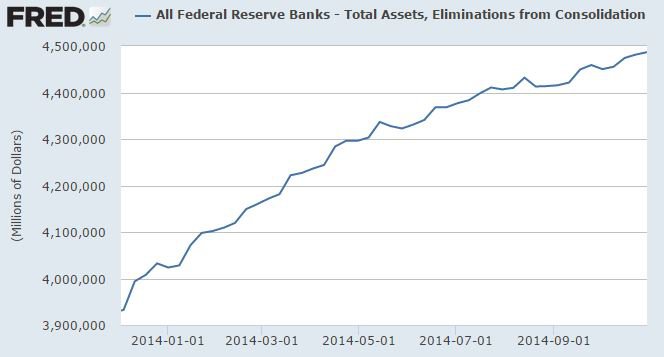
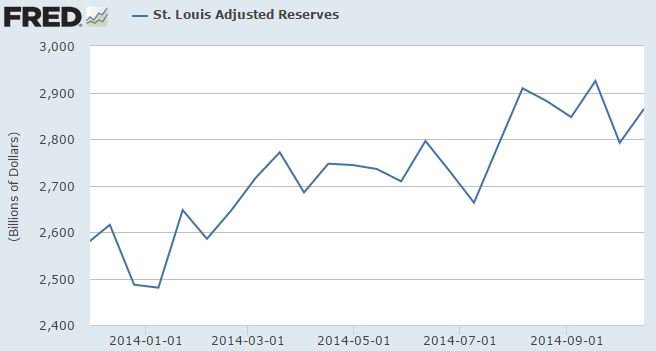
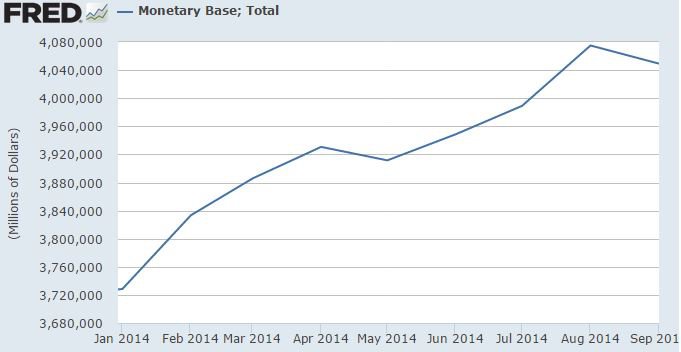
While quantitative easing has contributed to the massive expansion of the Fed balance sheet — now nearly $4.5 trillion in assets — it is not the whole story. Even as the Fed ends new buying of favored assets, the Fed balance sheet will not shrink. As pointed out by the Wall Street Journal, “QE is not over, and the Fed will still reinvest the principal payments from its maturing securities.” Even more relevant, during the phase out there was a continuing expansion of three broad measures of Fed activity; St. Louis Fed adjusted reserves (Figure 1), the monetary base (Figure 2), and Federal Reserve Banks — Total Assets, Eliminations from Consolidation program (Figure 3). (All data from FRED economic data series St. Louis Federal Reserve. Calculations are mine.)

Figure 1: St. Louis Fed Adjusted Reserves

Figure 2: The Monetary Base

Figure 3: Federal Reserve Banks — Total Assets, Eliminations from Consolidation

The Fed’s Balance Sheet Continues to Expand

Despite some ups and downs, adjusted reserves increased 15.8 percent from January 2014 through September 2014, the monetary base by 8.6 percent, and consolidated assets by 10.7 percent. Given QE purchases were $85 billion per month at their peak, this continuing expansion of the Fed balance sheet and the other relevant monetary aggregates, the phase out and end of quantitative easing represents not a change in policy stance, but only a shift in tools. Monetary distortion has continued unabated. The only plus in the change is that more traditional tools of monetary manipulation create only the traditional market distortions; Cantillon effects, false relative prices, particularly interest rates, and the associated misdirection of production and malinvestments. Temporarily gone is the more dangerous Mondustrial Policy where the central bankers further distort credit allocation by picking winners and losers.

As illustrated by the Fed speak in the press release, post QE3-forward policy will, despite John Taylor’s optimism that this would not be the case, continued to be biased against a return to a more balanced, less potentially self-defeating rules-based policy. Instead driven by the Fed’s unwise dual mandate and the strong belief by Fed leadership in Tobin Keynesianism, policy will continue to “foster maximum employment.” This despite strong theoretical arguments (Austrian business cycle theory and the more mainstream natural unemployment rate hypothesis)[1] and good empirical evidence that any short-run positive impact monetary policy may have on employment and production is temporary and in the long run, per Hayek, cause greater instability and potentially even higher unemployment.

The Lasting Legacy of QE

As pointed out by David Howden in “QE’s Seeds Are Already Sown,” and as emphasized by Hayek (in Unemployment and Monetary Policy: Government as Generator of the “Business Cycle”), and recently formalized by Ravier (in “Rethinking Capital-Based Macroeconomics”), the seeds of easy money and credit creation, even when sown during times with unused capacity, bring forth the weeds of instability, malinvestment, bust, and economic displacement. They do not bring the promised return to prosperity, sustainable growth, and high employment.

Since the phase-out is only apparent, and not a real change in policy direction, Joe Salerno’s warning (“A Reformulation of Austrian Business Cycle Theory in Light of the Financial Crisis,” p. 41) remains relevant:

(G)iven the unprecedented monetary interventions by the Fed and the enormous deficits run by the Obama admin­istration, ABCT also explains the precarious nature of the current recovery and the growing probability that the U.S economy is headed for a 1970s-style stagflation.

While highly unlikely there is still time to do the right thing, follow the policy advice of Rothbard and the Austrians, as argued earlier in more detail here and here. Despite some short run costs which are likely small compared to the cost of a decade of stagnation, such a policy is the only reliable route to return the economy to sustainable prosperity.

John P. Cochran is emeritus dean of the Business School and emeritus professor of economics at Metropolitan State University of Denver and coauthor with Fred R. Glahe of The Hayek-Keynes Debate: Lessons for Current Business Cycle Research. He is also a senior scholar for the Mises Institute and serves on the editorial board of the Quarterly Journal of Austrian Economics. Send him mail. See John P. Cochran’s article archives.

This article was published on Mises.org and may be freely distributed, subject to a Creative Commons Attribution United States License, which requires that credit be given to the author.

GDP Economics: Fat or Muscle? – Article by David J. Hebert

GDP Economics: Fat or Muscle? – Article by David J. Hebert

The New Renaissance Hat
David J. Hebert
November 1, 2014
******************************

Recently, Italy “discovered” it was no longer in a recession. Why? The nation started counting GDP figures differently.

Adding illegal revenue from hookers, narcotics and black market cigarettes and alcohol to the eurozone’s third-biggest economy boosted gross domestic product figures.

GDP rose slightly from a 0.1 percent decline for the first quarter to a flat reading, the national institute of statistics said.

Italian officials are, of course, celebrating. In politics, perceptions are more important than reality. But such celebration is troubling for several reasons, which have less to do with headlines or black markets and more to do with fat.

One of F. A. Hayek’s lasting insights was that aggregate variables mask an economy’s underlying structure. For example, a country’s GDP can be calculated by summing the total amount of consumption, investment, government spending, and net exports in a given year. The higher this number, the better an economy is supposed to be doing. But adding these figures together and looking only at their sum can be wildly misleading.

One way to illustrate why is through the following example: I am currently six foot one and weigh 217 pounds. As it turns out, Adrian Peterson, a running back for the NFL’s Minnesota Vikings, is the same height and weight. Looking at only these two variables, Peterson and I are identical. Obviously, this isn’t true.

Likewise, cross-country GDP comparisons are difficult to make. If two nations grow at the same rate, for example, but one nation “invests” in useless boondoggles while the other grows sustainable businesses, we wouldn’t want to claim that both countries have equally healthy economies.

But what about comparisons of a country’s year-to-year GDP? Is this valuable information? Well, yes and no.

If we know that more stuff is being produced this year than last year, we can infer that more activity is happening. However, this doesn’t mean that government should subsidize production in order to increase activity. In that case, all they’re accomplishing is increasing the number of things that are being done at the expense of other things that could have been done.

What economists should be looking for are increases in economically productive activity from year to year. For example, digging a hole and then filling it back in does increase the measure of activity, but it’s not adding any value to society. Digging a hole in your backyard and filling it with water is also activity, but it’s productive because you now have a swimming pool, which you value enough to employ people to create.

It’s no mystery that Italy is seeing a higher GDP as a result of its change in measurement and that as a result it’s avoided a recession on paper. That is, it’s counting more activities as “productive” than it was previously. It is wrong to conclude, though, that more production is actually happening in Italy. These activities were happening before; they just weren’t being counted in any official statistics.

There are many problems with using GDP as a measure for an economy’s health. Changing what counts toward GDP only introduces yet another confounding factor. When I step on the scale, I can get some basic idea of how healthy I am. But when I take my shoes off and step on the scale again, I didn’t magically become healthier. I just changed what’s counting toward my weight. It would be wrong for me to conclude that I can skip the gym today as a result of this recorded weight loss. Similarly, citizens of Italy should not be celebrating their increased GDP. They still face the same problems as before and must still address them.

David Hebert is an Assistant Professor of Economics at Ferris State University. His interests include public finance and property rights.

This article was originally published by The Foundation for Economic Education.

My Tiny Cosmopolitan Apartment – Article by Joseph S. Diedrich

My Tiny Cosmopolitan Apartment – Article by Joseph S. Diedrich

The New Renaissance Hat
Joseph S. Diedrich
October 25, 2014
******************************

Global trade made my little flat a place of international treasures.

***

I live in a studio apartment, so my kitchen is my living room is my bedroom. The other day, I was staring out my sole window when something startled me. (And it wasn’t the subwoofer two floors up.)

It was my coffee. While sipping from my mug, I glanced at the bag of beans. It read, “Origin: Ethiopia.” Next, I read the text on the bottom of my laptop: “Designed by Apple in California. Assembled in China.” I looked down at my necktie: “Bruno Piatelli. Roma.”

This little exercise became a game. From what other far-off places did my stuff come? I sleep on bed sheets from Egypt. I drink bottles of Shiraz from Australia. I pour Canadian maple syrup on my pancakes. Some things weren’t technically “foreign,” but they still came a long way: books printed in New York, apples grown in Washington orchards, and beer brewed in St. Louis.

Within the narrow confines of my apartment was an expansive world market — a veritable microcosm of the global economy.

What startled me most wasn’t that so much had traveled so far. Rather, it was that I found nothing from my own city. While I had purchased some items in Madison, they didn’t originate here.

What about the “buy local” bandwagon? If I were to follow the consumer movement du jour to its fullest extent, I’d be much poorer. Because of a much more constrained division of labor, I’d spend more money on lower quality goods. I probably wouldn’t even have coffee, and I certainly wouldn’t own an Italian necktie.

Yet I don’t intentionally avoid local goods. Every Saturday morning, like a ritual, I visit the county farmers market. I buy delicious seasonal fruits, vegetables, and cheeses from nearby farmers — not because they’re local, but because they’re the best. Produce tends to be tastier if it hasn’t spent a week on a flatbed.

Adam Smith once wrote, “In every country it always is and must be the interest of the great body of the people to buy whatever they want of those who sell it cheapest.” The less trade is restricted between individuals and across borders, the more “the body of people” can “buy whatever they want” the “cheapest.” As society becomes more and more integrated, we can better take advantage of the division of labor, leading to lower prices, greater prosperity, and a higher standard of living for everyone.

When I buy a preferable foreign product instead of its domestic counterpart, I obviously benefit myself. I receive a better product at a better price. I also clearly help the foreign producer.

I benefit the domestic economy, too. By purchasing cheaper foreign goods, I reserve more of my money to spend elsewhere, including in domestic exchange. More importantly, I send a signal to domestic producers: don’t waste your time making that thing! By doing so, I incentivize domestic producers to reallocate their resources to more highly valued endeavors.

It’s true that free trade and globalization make the rich richer. But they also make the poor richer. Trade provides cell phones to people in developing countries. It increases wages. It fosters international peace. And it makes denizens of tiny dwellings feel like the freest, richest people in the world.

Four hundred fifty square feet doesn’t sound like much. Yet somehow I’ve managed to fit states, countries, and even continents inside. The most remarkable thing of all? I didn’t intend for this to happen. I didn’t decide one day to start purchasing only “foreign” goods. I never consciously attempted to avail myself of “exotic” treasures.

Nobody ever intends for this to happen. Every day, we make countless, often subconscious cost-benefit analyses. When it comes to purchasing actual goods, we weigh all the factors we care about — price, quality, size, shape, taste, and so on. We search for the highest quality consumer goods within our respective price ranges. Just by buying what we like, we unwittingly amass personal bazaars.

We are capable of planning only for our individual selves. Despite the ubiquity of cosmopolitan collections of consumer goods, nobody could ever plan for such a thing. We simply lack the capacity to organize an entire economy to fit our specific needs.

This was the keen insight of economist F.A. Hayek, who recently celebrated the 40th anniversary of his Nobel Prize. While he admitted that “all economic activity” involves planning, not all planning is the same. Because there’s “no dispute about whether planning is to be done or not,” what matters is “whether planning is to be done centrally, by one authority for the whole economic system, or is to be divided among many individuals.”

My apartment has only one window, but I feel like I can see the whole world. Every treasure I own is a window to a place I’ve never been and to people I’ve never met.

Joseph S. Diedrich is a Young Voices Advocate, a law student at the University of Wisconsin, and assistant editor at Liberty.me.

***
This article was originally published by The Foundation for Economic Education.

Inflation’s Not the Only Way Easy Money Destroys Wealth – Article by Frank Shostak

Inflation’s Not the Only Way Easy Money Destroys Wealth – Article by Frank Shostak

The New Renaissance Hat
Frank Shostak
October 14, 2014
******************************

The US Federal Reserve can keep stimulating the US economy because inflation is posing little threat, Federal Reserve Bank of Minneapolis President Kocherlakota said. “I am expecting an inflation rate to run below two percent for the next four years, through 2018,” he said. “That means there is more room for monetary policy to be helpful in terms of … boosting demand without running up against generating too much inflation.”

The yearly rate of growth of the official consumer price index (CPI) stood at 1.7 percent in August against two percent in July. According to our estimate, the yearly rate of growth of the CPI could close at 1.4 percent by December. By December next year we forecast the yearly rate of growth of 0.6 percent.

Does Demand Create More Supply?

It seems that the Minneapolis Fed President holds that by boosting the demand for goods and services — by means of additional monetary pumping — it is possible to strengthen economic growth. He believes that by means of strengthening the demand for goods and services the production of goods and services will follow suit. But why should that be so?

If by means of monetary pumping one could strengthen the economic growth then it would imply that — by means of monetary pumping — it is possible to create real wealth and generate an everlasting economic prosperity.

This would also mean that world wide poverty should have been erased a long time ago. After all, most countries today have central banks that possess the skills to create money in large amounts. Yet world poverty remains intact.

Despite massive monetary pumping since 2008, and the policy interest rate of around zero, Fed policymakers seem to be unhappy with the so-called economic recovery. Note that the Fed’s balance sheet, which stood at $0.86 trillion in January 2007 jumped to $4.4 trillion by September this year.

Production Comes Before Demand

We suggest that there is no such thing as an independent category called demand. Before an individual can exercise demand for goods and services, he/she must produce some other useful goods and services. Once these goods and services are produced, individuals can exercise their demand for the goods they desire. This is achieved by exchanging things that were produced for money, which in turn can be exchanged for goods that are desired. Note that money serves here as the medium of exchange — it produces absolutely nothing. It permits the exchange of something for something. Any policy that results in monetary pumping leads to an exchange of nothing for something. This amounts to a weakening of the pool of real wealth — and hence to reduced prospects for the expansion of this pool.

What is required to boost the economic growth — the production of real wealth — is to remove all the factors that undermine the wealth generation process. One of the major negative factors that undermine the real wealth generation is loose monetary policy of the central bank, which boosts demand without the prior production of wealth. (Once the loopholes for the money creation out of “thin air” are closed off the diversion of wealth from wealth generators towards non-productive bubble activities is arrested. This leaves more real funding in the hands of wealth generators — permitting them to strengthen the process of wealth generation (i.e., permitting them to grow the economy).

Artificially Boosted Demand Destroys Wealth

Now, the artificial boosting of the demand by means of monetary pumping leads to the depletion of the pool of real wealth. It amounts to adding more individuals that take from the pool of real wealth without adding anything in return — an economic impoverishment.

The longer the reckless loose policy of the Fed stays in force the harder it gets for wealth generators to generate real wealth and prevent the pool of real wealth from shrinking.

Finally, the fact that the yearly rate of growth of the CPI is declining doesn’t mean that the Fed’s monetary pumping is going to be harmless. Regardless of price inflation monetary pumping results in an exchange of nothing for something and thus, impoverishment.

Frank Shostak is an adjunct scholar of the Mises Institute and a frequent contributor to Mises.org. His consulting firm, Applied Austrian School Economics, provides in-depth assessments and reports of financial markets and global economies. See Frank Shostak’s article archives.

This article was published on Mises.org and may be freely distributed, subject to a Creative Commons Attribution United States License, which requires that credit be given to the author.

The Japanese Deflation Myth and the Yen’s Slump – Article by Brendan Brown

The Japanese Deflation Myth and the Yen’s Slump – Article by Brendan Brown

The New Renaissance Hat
Brendan Brown
October 4, 2014
******************************

The slide of the yen since late summer has brought it to a level some 40 percent lower against the euro and US dollar than just two years go. Yet still Japan’s Prime Minister Shinzo Abe and his central bank chief Haruhiko Kuroda warn that they have not won the battle against deflation. That caution is absurd — all the more so in view of the fact that there was no deflation in the first place.

Some cynics suggest that Abe’s and Haruhiko’s battle cry against this phoney phantom is simply a ruse to gain Washington’s acquiescence in a big devaluation. But whatever the truth about their real intent, Japan’s monetary chaos is deepening.

Japanese Prices Have Been Stable

The CPI in Japan at the peak of the last cycle in 2007 was virtually at the same level as at the trough of the post-bubble recession in 1992, and up a few percentage points from the 1989 cycle peak. Hence, Japan alone has enjoyed the sort of price stability as might be enjoyed in a gold-standard world. Prices have fallen during recessions or during periods of especially-rapid terms-of-trade improvement or productivity growth. They have risen during cyclical booms or at times of big increases in the price of oil.

If price-indices in Japan were adjusted fully to take account of quality improvements they would have been falling slightly throughout, but that would also have been the case under the gold standard and was fully consistent with economic prosperity.

yenslumpSuch swings in prices are wholly benign. For example, lower prices during recession coupled with expectation of higher prices in expansion induce businesses and households to spend more. A valid criticism of the Japanese price experience of the past two decades has been that these swings have lacked vigour due to various rigidities. Particularly valid is the claim that price falls should have been larger during the post-bubble recession of 1990-93 and subsequent potential for recovery would have been correspondingly larger.

Prices in Japan did fall steeply during the Great Recession (2008-10) but the perceived potential for recovery was squeezed by the Obama Monetary Experiment (the Fed’s QE) which meant an immediate slide of the US dollar. It was in response to the related spike of the yen that Prime Minister Abe prepared his counter-stroke. This involved importing the same deflation-phobic inflation-targeting policies that the Obama Federal Reserve was pursuing. Washington could hardly criticize Tokyo for imitating its own monetary experiment.

Deflation and “The Lost Decade”

The architects of the Obama Monetary Experiment have cited as justification Japan’s “lost decade” and the supposed source in deflation. In fact, though, the only period during which the Japanese economy underperformed other advanced economies (as measured by the growth of GDP per capita) was from 1992-97. The underperformance of that period had everything to do with insufficient price and wage flexibility downward, the Clinton currency war, and the vast malinvestment wrought by the prior asset price inflation, coupled with a risk-appetite in Japan shrunken by the recent experience of bust.

Moreover, as time went on, from the early 1990s, huge investment into the Tokyo equity market from abroad compensated for ailing domestic risk appetites. Yes, Japan’s economy could have performed better than the average of its OECD peers if progress had been made in de-regulation, and if Japan had had a better-designed framework of monetary stability to insulate itself from the Greenspan-Bernanke asset price inflation virus of the years 2002-07. (The Greenspan-Bernanke inflation caused speculative temperatures in the yen carry trade to reach crazy heights.) But deflation was never an actual or potential restraint on Japanese prosperity during those years.

True, there was a monetary malaise. Japan’s price stability was based on chance, habit, and economic sclerosis rather than the wisdom of its monetary policy. It had been the huge appreciation of the yen during the Clinton currency war that had snuffed out inflation. Then the surge of cheap imports from China had worked to convince the Japanese public that inflation had indeed come to an end. Lack of economic reform meant that the neutral rates of interest remained at a very low level and so the Bank of Japan’s intermittent zero rate policies did not stimulate monetary growth.

The monetary system in Japan had no secure pivot in the form of high and stable demand for non-interest bearing high-powered money. In Japan the reserve component of the monetary base is virtually indistinguishable from a whole range of close substitutes and banks had no reason to hold large amounts of this (given deposit insurance and the virtual assurance of too-big-to-fail help in need). Monetary policy-making in Japan meant highly discretionary manipulation of short-term interest rates in the pursuance of fine-tuning the business cycle rather than following a set of rules for monetary base expansion.

The Yen After Abenomics

When Prime Minister Abe effected his coup against the old guard at the Bank of Japan there was no monetary constitution to flout. Massive purchases of long-dated Japanese government bonds by the Bank of Japan are lowering the proportion of outstanding government debt held by the public in fixed-rate form. But this is all a slow-developing threat given a gross government debt to GDP ratio of around 230 percent and a current fiscal deficit of 6 percent of GDP. Bank of Japan bond-buying has strengthened irrational forces driving 10-year yields down to almost 0.5 percent despite underlying inflation having risen to 1 percent per annum.

It is doubtless the possibility of an eventual monetization of government debt has been one factor in the slump of the yen. More generally, as the neutral level of interest rates in Japan rises in line with demographic pressures (lower private savings, increased social expenditure) one might fear that BoJ manipulation of rates will eventually set off inflation. Part of the yen’s slump, though, is due to a tendency for that currency to fall when asset price inflation is virulent in the global economy. This stems from the huge carry trade in the yen.

The yen could indeed leap when the global asset price-inflation disease — with its origins in Fed QE — moves to its next phase of steep speculative temperature fall. The yen is now in real effective exchange rate terms at the record low point of the Japan banking crisis in 1997 or the global asset inflation peak of 2007. So, the challenge for investors is to decide when the Abe yen has become so cheap in real terms that its hedge properties make it a worthwhile portfolio component.

Brendan Brown is an associated scholar of the Mises Institute and is author of Euro Crash: How Asset Price Inflation Destroys the Wealth of Nations and The Global Curse of the Federal Reserve: Manifesto for a Second Monetarist Revolution. See Brendan Brown’s article archives.

This article was published on Mises.org and may be freely distributed, subject to a Creative Commons Attribution United States License, which requires that credit be given to the author.