Browsed by
Category: Justice

Internet Gambling Ban: A Winner for Sheldon Adelson, A Losing Bet for the Rest of Us – Article by Ron Paul

Internet Gambling Ban: A Winner for Sheldon Adelson, A Losing Bet for the Rest of Us – Article by Ron Paul

The New Renaissance Hat
Ron Paul
November 16, 2014
******************************
Most Americans, regardless of ideology, oppose “crony capitalism” or “cronyism.” Cronyism is where politicians write laws aimed at helping their favored business beneficiaries. Despite public opposition to cronyism, politicians still seek to use the legislative process to help special interests.For example, Congress may soon vote on legislation outlawing Internet gambling. It is an open secret, at least inside the Beltway, that this legislation is being considered as a favor to billionaire casino owner, Sheldon Adelson. Mr. Adelson, who is perhaps best known for using his enormous wealth to advance a pro-war foreign policy, is now using his political influence to turn his online competitors into criminals.Supporters of an Internet gambling ban publicly deny they are motivated by a desire to curry favor with a wealthy donor. Instead, they give a number of high-minded reasons for wanting to ban this activity. Some claim that legalizing online gambling will enrich criminals and even terrorists! But criminalizing online casinos will not eliminate the demand for online casinos. Instead, passage of this legislation will likely guarantee that the online gambling market is controlled by criminals. Thus, it is those who support outlawing online gambling who may be aiding criminals and terrorists.

A federal online gambling ban would overturn laws in three states that allow online gambling. It would also end the ongoing debate over legalizing online gambling in many other states. Yet some have claimed that Congress must pass this law in order to protect states rights! Their argument is that citizens of states that ban Internet gambling may easily get around those laws by accessing online casinos operating in states where online gambling is legalized.

Even if the argument had merit that allowing states to legalize online gambling undermines laws in other states, it would not justify federal legislation on the issue. Nowhere in the Constitution is the federal government given any authority to regulate activities such as online gambling. Arguing that “states rights” justifies creating new federal crimes turns the Tenth Amendment, which was intended to limit federal power, on its head.

Many supporters of an Internet gambling ban sincerely believe that gambling is an immoral and destructive activity that should be outlawed. However, the proposed legislation is not at all about the morality of gambling. It is about whether Americans who do gamble should have the choice to do so online, or be forced to visit brick-and-mortar casinos.

Even if there was some moral distinction between gambling online or in a physical casino, prohibiting behavior that does not involve force or fraud has no place in a free society. It is no more appropriate for gambling opponents to use force to stop people from playing poker online than it would be for me to use force to stop people from reading pro-war, neocon writers.

Giving government new powers over the Internet to prevent online gambling will inevitably threaten all of our liberties. Federal bureaucrats will use this new authority to expand their surveillance of the Internet activities of Americans who have no interest in gambling, just as they used the new powers granted by the PATRIOT Act to justify mass surveillance.

The proposed ban on Internet gambling is a blatantly unconstitutional infringement on our liberties that will likely expand the surveillance state. Worst of all, it is all being done for the benefit of one powerful billionaire. Anyone who thinks banning online gambling will not diminish our freedoms while enriching criminals is making a losing bet.

Ron Paul, MD, is a former three-time Republican candidate for U. S. President and Congressman from Texas.

This article is reprinted with permission from the Ron Paul Institute for Peace and Prosperity.

Just Cause, or Just ‘Cause? – Article by Bradley Doucet

Just Cause, or Just ‘Cause? – Article by Bradley Doucet

The New Renaissance Hat
Bradley Doucet
November 9, 2014
******************************
The fact that there are some bad people doing some bad things halfway around the world does not mean that “we” have to do something about it. There can be no such thing as an open-ended obligation to help everyone who’s being oppressed, pillaged, raped, enslaved, or murdered by their unprincipled fellows, because such an obligation would be effectively infinite. It would eat up all of our resources. And by and large, we don’t help every person or group of people fight off every aggressor or group of aggressors. Which is a good thing, because our “help” often makes things worse.

So why do we choose to respond when we do choose to respond? Or rather, why do our leaders choose to respond when they do? Is it because it’s the right thing to do? Or do they do it simply because, for whatever combination of factors, they can? A particularly unflattering enemy, perhaps, who can easily be demonized, for reasons both justified and not, and one who cannot really fight back, at least not in any way that would impose serious, widespread repercussions on the voting populace. An enemy, furthermore, who is far enough away that all the collateral damage, all of the innocents killed by our noble bombs dropped from our heroic jets, can be easily ignored, and who anyway look different and talk different and worship the wrong deity.

There is injustice, to be sure, and the gut reaction to want to fight injustice is a good and noble one, but we successfully repress it, or rather our leaders do, when it comes to places like North Korea and Russia, which would be very costly adventures indeed. We cautiously avoid getting into a war with such villains, whom we engaged with zeal just a couple of generations ago. Mutually Assured Destruction surely has something to do with it, but I think we can claim a certain moral progress as well, though perhaps it has not quite kept pace with our material progress.

No more great wars, then, even if they could be justified, because the cost is just too great. But little wars are fine, once in a while, when they can be justified, even if they always seem to do more harm than good. Keeps the troops in fighting form, you know, and keeps the voting public from focusing on domestic problems.

Keeps us from having to come up with more creative ways of responding to aggressors, also. Like, for the billions spent on all those guns and bombs, all those fighting forces and roaring jets and aircraft carriers, above and beyond what is needed to legitimately dissuade or fend off foreign aggressors, we could maybe do something to impede the recruiting efforts of terrorist organizations instead of helping them sign up new members. Instead of feeding their grievances by bombing weddings, maybe we could, I don’t know, drop crates filled with delicious food, or DVDs of television programs showing the richness and complexity of Western life in order to counter their caricatures of our depravity. Maybe we could support the translation of classic liberal tracts into all the languages of the world, as some organizations already do, and smuggle them across the various walls and checkpoints that keep our fellow human beings from escaping their prison countries, in order to counter the propaganda that keeps those walls from crumbling and those checkpoints from being overrun.

These are just the most obvious ideas off the top of my head, but I’m sure we can crack this nut and come up with a thousand innovative ways of responding to homicidal whack jobs that would be better than sending in the flying aces with their deadly payloads. It’s tempting, and even justified, to want to fight fire with fire. But the properly understood cost, in terms of money and lives and opportunities lost and enemies strengthened, even for the “small” wars we fight nowadays, is higher than the meagre benefits we imagine they will bring us. A proper accounting would show the folly of just about every war, and show that just about every war is really fought just because.

Bradley Doucet is Le Québécois Libre‘s English Editor and the author of the blog Spark This: Musings on Reason, Liberty, and Joy. A writer living in Montreal, he has studied philosophy and economics, and is currently completing a novel on the pursuit of happiness. He also writes for The New Individualist, an Objectivist magazine published by The Atlas Society, and sings.
SWAT’s Military Tactics Put Cops at Risk – Article by Daniel J. Bier

SWAT’s Military Tactics Put Cops at Risk – Article by Daniel J. Bier

The New Renaissance Hat
Daniel J. Bier
October 2, 2014
******************************

“Democracy means that when there’s a knock on the door at 3 a.m., it’s probably the milkman.”
—Winston Churchill (apocryphal)

On the morning of May 5, 2011, a Pima County, Arizona, SWAT team pulled up to the home of Jose Guerena, a Marine veteran who had served in Iraq. Sheriff’s deputies threw flashbang grenades as a diversionary tactic and broke down the door.

Inside, Guerena told his wife and 4-year-old son to hide in the closet and went into his hallway holding a rifle. Officers let loose, firing 70 rounds in 10 seconds, hitting him over 20 times.

From the time of their arrival to the final shot, it was all over in less than a minute. Guerena’s rifle had the safety on; he never fired a shot. Police found no evidence of criminal activity.

Police organizations sometimes defend the prolific use of military equipment and tactics as necessary precautions against criminals arming themselves before cops can arrest them. But the overuse of tactical raids carries its own risks, and not just to citizens (and their dogs) who are subjected to battering rams, flash grenades, and automatic weapon fire.

Although SWAT teams were originally developed to handle rare and violent events, such as bank heists and hostage situations, they are now increasingly deployed to handle routine law enforcement functions. Paramilitary units are often the first point of contact in any investigation, and there are some places where all warrants—regardless of the suspect, evidence, or crime—are served by SWAT.

St. Louis County, Missouri—home of the city of Ferguson—is one such jurisdiction. As the county government explains the reasons for its SWAT team, “The Tactical Operations Unit … is capable of dealing with hostage situations, armed and barricaded subjects, suicidal persons and executes all search warrants issued in St. Louis County” (emphasis added).

One of these things, you may notice, is not like the others.

St. Louis is not alone. In a typical case in Prince George’s County, Maryland, a SWAT team burst into a man’s home, shot his two black Labradors, and left his family handcuffed on the floor. A drug dealer had mailed a box of drugs to his address, intending to intercept it before it was delivered. The man was Cheye Calvo, the town’s mayor.

A subsequent lawsuit by Calvo revealed that Prince George’s County uses its SWAT team to serve every single search warrant, even when the police don’t know who the suspects are, if they might be dangerous, or if there are children present.

Calvo succeeded in lobbying for the nation’s first law to track the use of SWAT teams. The data soon revealed that 94 percent of tactical deployments in Maryland were for ordinary search warrants, not for the kinds of violent situations that might typically justify such aggressive use of force. In Prince George’s County, more than half the raids were for misdemeanors or non-serious felonies.

Statewide, only 60 percent of tactical raids actually resulted in arrests for any crime, and Maryland is far from exceptional in using SWAT for trivial issues. In Florida, paramilitary teams perform business license inspections on black and Hispanic barbershops. Tactical raids have also been conducted for such “crimes” as hosting unlicensed poker games, defaulting on student loans, violating copyrights, and making fun of a politician on Twitter.

But there is a price to be paid for sending masked men crashing unannounced through windows and doors into people’s homes 45,000 times a year, often in the middle of the night. Using SWAT to serve minor warrants introduces violence into otherwise non-violent situations, creating, rather than defusing, volatile and dangerous conditions—the very opposite of what SWAT teams were originally meant to do.

It is not unusual even for innocent people awoken in such circumstances to believe that the police are thieves or violent criminals breaking into their homes. Like anyone else confronted with such a disorienting and frightening situation, they may reach for guns or other weapons to defend their home and their family, sometimes with tragic results for both citizens and officers.

Consider just a few recent examples:

  • Ryan Frederick was charged with first-degree murder after he fired on someone smashing their way through his door one night in 2008. The intruder turned out to be Detective Jarrod Shivers serving a no-knock warrant for a non-existent cannabis farm.
  • Henry Magee was a small-time marijuana grower who in December 2013 awoke in the middle of a no-knock raid on his trailer and opened fire on the intruders, killing Deputy Adam Sowders. A grand jury refused to indict him for capital murder.
  • Marvin Louis Guy opened fire on someone breaking in through his window before dawn on May 9, 2014; the intruders were police serving a no-knock drug warrant. They found no narcotics, and no drug-related charges have been filed, but Guy faces the death penalty for killing Detective Charles Dinwiddie.
  • Aaron Awtry, a 72-year-old South Carolinian, assumed that the SWAT team members battering down his door were criminals trying to rob his small-stakes poker game. He opened fire through the door, hitting Deputy Matthew May in the arm, while vice officers returned fire. Awtry was wounded and charged with attempted murder; the other players each received a $100 fine.

Cases of disastrous raids abound, and they reveal a serious problem with the assumption that paramilitary tactics are always safer for police. Some crazy or desperate suspects may indeed justify such preemptive force. But in many other cases, the dangerous and volatile conditions put officers at risk who otherwise would not be.

If a policeman in a blue uniform had knocked on Frederick’s door in the middle of the day, what are the chances that the innocent man would have shot a cop? And surely there are many others like Magee: guilty of something, but otherwise non-violent—or at least not suicidal enough to intentionally shoot a cop—who could be frightened into using a weapon in self-defense.

The most serious problem with the overuse of aggressive, militarized raids is one of information: Residents of the home don’t know who is breaking in, and police officers often don’t know who is inside, so both sides assume the worst and act accordingly. From the perspective of a sleeping homeowner, a no-knock SWAT raid is indistinguishable from an armed robbery. And as Guerena’s case shows, these events can escalate to lethal force in the blink of an eye. It is no exaggeration to say that lives have been ruined and ended because of unnecessary and violent tactics for petty and non-violent offenses.

Before we can address such problems as the use of military equipment by local law enforcement, we must first understand what is driving their demand for armored vehicles and high-powered weapons. The overuse of SWAT and the associated overuse of military gear in civilian policing are in part a result of overblown fears about police safety. But they are also based on a false dilemma between keeping cops unsafe and turning them into an army.

Officer safety is a legitimate problem, but that does not mean more force is always a legitimate answer. The best way to keep officers safe is to try to de-escalate conflicts—reserving SWAT for only the worst situations—and to end the War on Drugs that is at the heart of the breakdown of trust in law enforcement. When that’s done, Americans may once again go to sleep knowing that if you hear a bang on your door at 3 a.m., it’s probably just the newspaper.

Daniel Bier is the executive editor of The Skeptical Libertarian. He writes on issues relating to science, skepticism, and economic freedom, focusing on the role of evolution in social and economic development.

This article was originally published by The Foundation for Economic Education.

Drug Warriors Claim Colorado Going to Pot – Article by Mark Thornton

Drug Warriors Claim Colorado Going to Pot – Article by Mark Thornton

The New Renaissance Hat
Mark Thornton
September 20, 2014
******************************

As we moved into the second half of 2014, I was eager to learn if marijuana legalization in Colorado was succeeding. At first there was little being reported, but eventually reports started appearing in the news. Business Insider reported that “Legalizing Weed in Colorado Is A Huge Success,” although they did temper their report with a “Down Side” as well. Jacob Sullum reported that such things as underage consumption and traffic fatalities have fallen, although the declines were statistically insignificant and part of already declining trends in the statistics.

The important thing for me is that things did not get much worse according to these reports. When you open the door to a newly legal recreational drug via a very clunky regulatory circus, and where the government gives its seal of approval, there are bound to be growing pains and tragic cases. For example, one college student jumped to his death after ingesting six times the recommended number of pot-infused cookies.

The third report I came across was an editorial from the venerable Heritage Foundation. Given the previous reports, I was astonished to learn that in Colorado marijuana use was associated with an increase in highway fatalities, DUI arrests, underage consumption, drug-related student expulsions, college student use, and marijuana-related emergency room visits and hospitalizations.

The editorial concludes: “Drug policy should be based on hard science and reliable data. And the data coming out of Colorado points to one and only one conclusion: the legalization of marijuana in the state is terrible public policy.”

However, I began to get suspicious when I found out that the “hard science and reliable data” were not collected, produced, or analyzed by the Heritage Foundation, but by some outfit named the “Rocky Mountain High Intensity Drug Trafficking Area” program. They produced the report entitled “The Legalization of Marijuana in Colorado: The Impact,” which strongly calls into question the legalization of marijuana in Colorado.

There was no information about the “Rocky Mountain High Intensity Drug Trafficking Area” program (RMHIDRA) in the report other than it was produced by the “Investigative Support Center” in Denver, Colorado. It turns out the program is actually controlled by the White House Office of National Drug Control Policy, otherwise known as the Drug Czar.

Colorado has been in the process of legalizing marijuana since 2000. It initially started small with limited medical marijuana and as of January of 2014, it has legalized both medicinal and recreational marijuana with local option for commercial production and retail distribution. So we should expect, ceteris paribus, that the full price to consumers has fallen and that consumption for medical and recreational use has increased.

One of the most distressing empirical results in the RMHIDRA report was that while overall traffic fatalities decreased 14.8 percent between 2007 and 2012 in Colorado, traffic fatalities involving drivers, pedestrians and bicyclists that tested positive for marijuana increased by 100 percent. This data is exploited over several pages of the report using a variety of tables and charts.

If Coloradoans were consuming more marijuana and relatively less alcohol, we would expect the number of traffic fatalities to decrease because marijuana has been found to be relatively much safer than alcohol in terms of driving and motor skills. But the data indicating a 100 percent increase in fatalities involving marijuana is puzzling, disturbing, and at odds with “hard science.” If this was indeed “reliable data” it would indicate that marijuana consumption in Colorado had greatly increased beyond anyone’s estimation.

It turns out RMHIDRA’s data was anything but “reliable” and would be best characterized as misleading. If you examine the footnote section of the report you will find that the data from 2012 “represents 100 percent reporting” due to the efforts of RMHIDA to scour several data sources. However, a footnote reveals that in the data from 2006 through 2012 a very slight majority of cases, 50.13 percent were not tested! If 100 percent were tested in 2012, then the percent tested for 2006–2011 is far less than 50 percent.

What this means is that if you increased blood testing to 100 percent in 2012 when you were testing less than 50 percent of cases in prior years that you should expect to find at least a 100 percent increase involving traffic fatalities with some detection of marijuana. This result not only brings into question the reports “reliable data,” it brings into serious question RMHIDRA’s respect for “hard science.”

Another basic problem with their data is the meaning of “testing positive for marijuana.” Marijuana’s active ingredient THC can remain detectable days and weeks after it has been consumed. In contrast, marijuana impairment only lasts for several hours and is somewhat offset by safer driving behaviors, such as driving at slower speeds and avoiding high traffic areas. Given that marijuana consumption has increased significantly since 2000 we should indeed expect many more positive blood tests, but without making the leap that marijuana consumption is causing more highway fatalities.

The RMHIDRA report also offers up some dreary data on youth marijuana use. In particular, they conclude that marijuana use by young Coloradans is higher than the national average and increasing. Most importantly, they point out that between the 2008–09 and 2012–/13 school years there was a 32 percent increase in drug-related suspensions and expulsions in Colorado.

Other experts using different data sources believe that there has actually been a secular trend of decreasing marijuana use by the young people of Colorado throughout the entire legalization process. However, with respect to suspensions and expulsions, there has indeed been a 32 percent increase in the number of drug-related suspensions and expulsions.

However, weighted on a per pupil basis, there has been virtually no increase in the rate of drug-related suspensions and expulsions. The numerical increase in suspensions and expulsions is more than completely accounted for by the increased number of pupils and the relative increase of impoverished minority groups.

In addition, “drug related” suspensions and expulsions involves other drugs besides marijuana, such as cocaine, heroin, and methamphetamine. Marijuana-related suspensions and expulsions are overwhelmingly related to “possession” and “under the influence,” not things like violence, property destruction, and classroom disturbances.

The RMHIDRA report spans over 150 pages, but everything I had time to examine was either clearly wrong, misleading, or intentionally sensational.

Of course there are other sources of misinformation on the relative risks of cannabis. For example, there are academics who warn of the dangers of cannabis while they are receiving money from the pharmaceutical pain drug companies. This again suggests a deliberate attempt to mislead the public.

This is particularly disturbing and relevant information given recent reports which indicate that relatively fewer overdose painkiller deaths are occurring in states with medical marijuana laws.

There are clearly some things wrong with Colorado’s approach to legalizing marijuana and there are clearly going to be some bad results at the individual and state level, but this report is not the right way of determining and correcting those problems. As the Heritage Foundation editorial concluded: “Drug policy should be based on hard science and reliable data.”

Mark Thornton is a senior resident fellow at the Ludwig von Mises Institute in Auburn, Alabama, and is the book review editor for the Quarterly Journal of Austrian Economics. He is the author of The Economics of Prohibition, coauthor of Tariffs, Blockades, and Inflation: The Economics of the Civil War, and the editor of The Quotable Mises, The Bastiat Collection, and An Essay on Economic Theory. Send him mail. See Mark Thornton’s article archives.

This article was published on Mises.org and may be freely distributed, subject to a Creative Commons Attribution United States License, which requires that credit be given to the author.

By the Numbers: Is Private Gun Ownership Responsible for Police Militarization? – Article by Daniel J. Bier

By the Numbers: Is Private Gun Ownership Responsible for Police Militarization? – Article by Daniel J. Bier

The New Renaissance Hat
Daniel J. Bier
September 3, 2014
******************************

Are private guns to blame for police militarization and racial tensions with cops? That’s the conclusion of Adam Winkler, a Huffington Post blogger and law professor at UCLA. In the wake of a police officer shooting an unarmed black teenager in Ferguson, Missouri, Winkler argues that private gun ownership is a major culprit for the tensions between citizens and cops.

The problems of racial harassment and police militarization are exacerbated by the fact that America has a heavily-armed civilian population. … Whatever one’s personal views about guns, there is no denying their presence in every American city, from Philadelphia to Ferguson. Nor should we fail to recognize the profound impact this has on law enforcement.

Because there are so many guns out there, police officers are trained to live in fear of the very people they are supposed to protect and serve. … At training academies throughout the nation, new recruits are taught that cop-killers need two things: a will to kill and an opportunity to act. There’s little an officer can do about will … Officers can, however, limit the opportunities for a cop-killer to act by being prepared and quick to defend themselves.

He further contends that police militarization is actually in part the result of private gun ownership: “The Brown protests have also set off a debate about militarization of the police since 9/11. That militarization is partially a result of our heavily-armed civilian population. The armored vehicles that have become the symbol of militarization are being purchased by law enforcement agencies to protect officers against gunfire.”

There are many problems with this argument, but first let me note that the armored vehicles Winkler mentions, such as MRAPs, are designed to protect soldiers from landmines and IEDs in wartime, not to protect peace officers from gunfire. They are mine-resistant, not bullet-resistant, vehicles. If guns are really the concern, “overkill” just doesn’t even cut it here.

But the biggest issue with Winkler’s claim is that widespread private gun ownership far predated police militarization. Large numbers of private citizens have owned firearms throughout American history.

Moreover, gun ownership in the United States has been declining, both before and throughout the process of militarizing law enforcement. The 1980s saw early stirrings of it, with the spread of SWAT teams and Reagan-era “tough on crime” policies. It grew in the mid-1990s under the Clinton administration, which authorized the DoD’s 1033 program, expanding and formalizing the process for giving military gear to police. Finally, after 9/11, militarization took off in earnest, with two wars, paranoia about terrorism, a booming defense industry, and billions of dollars in Homeland Security money to drive it.

Meanwhile, rates of gun ownership through the U.S. dropped or stagnated. Winkler drops the oft-quoted and often misunderstood statistic that there are “320 million guns in the United States, approximately one per person,” but apparently doesn’t recognize that this stat doesn’t mean everyone gets a gun. (A good way to check: Look around you. Do you see any guns? No? Okay, myth busted.) Today, the actual rate of gun ownership is just 34 percent, down from an average of over 52 percent in the 1970s.

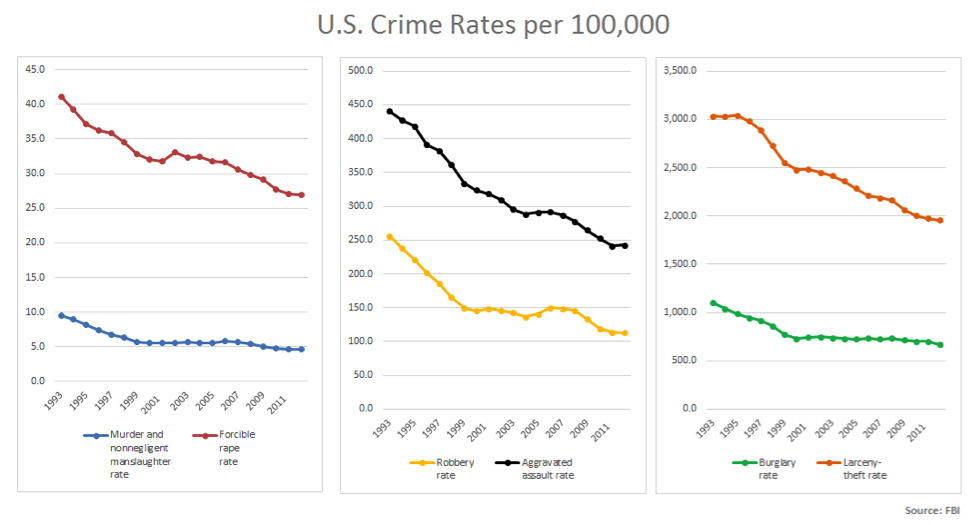
Not only is gun ownership down, so is crime—dramatically so. Starting in 1990, and continuing through recessions, terrorist attacks, and wars, crime has fallen. Murder, rape, robbery, assault—even property crimes—are all down. Cops toting .50 caliber machine guns and driving landmine-resistant vehicles cannot be responding to an epidemic of violence, because one simply doesn’t exist.

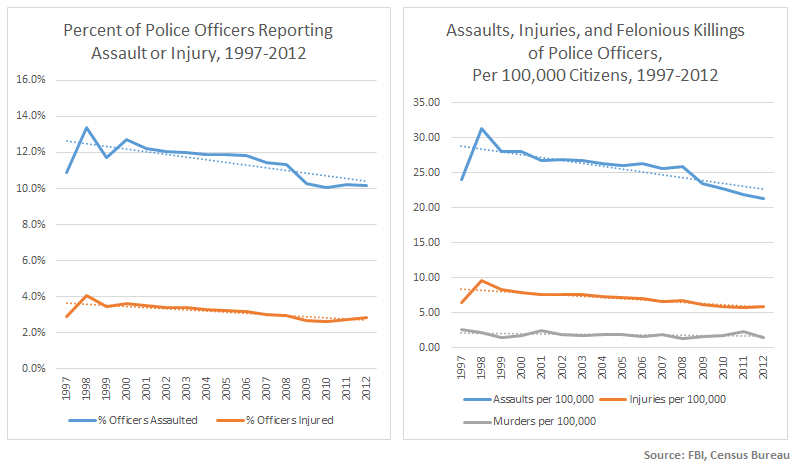
But even if far fewer people own guns and commit crimes than did so in the past, it’s still possible that police officers are uniquely under threat in recent years. Maybe killings, assaults, and injuries of police are on the rise. But they’re not.

In every way, this theory fails to align with the facts. Not only is gun ownership down, but so are crime and attacks on police. Private gun ownership is not responsible for militarization, racial profiling, or tensions with police.

But Winkler is right about one thing: Police officers are being taught to be paranoid about citizens and guns, and that fear is being channeled against minorities, from ATF stings targeted at poor blacks and Hispanics, to New York’s racist stop-and-frisk program, to New Jersey’s felony prosecution of a single mom who tried to do the right thing.

But the reason isn’t that there is more of a threat than there used to be. It’s that people are being systematically misinformed—by reporting like Winkler’s—about the risks they actually face. Telling poor minorities that hostilities with police are really partly their fault—and that if they would just give up their guns, everything would be okay—is not just absurd, it’s actively harmful.

Daniel Bier is the executive editor of The Skeptical Libertarian. He writes on issues relating to science, skepticism, and economic freedom, focusing on the role of evolution in social and economic development.

This article was originally published by The Foundation for Economic Education.
Ferguson: The War Comes Home – Article by Ron Paul

Ferguson: The War Comes Home – Article by Ron Paul

The New Renaissance Hat
Ron Paul
August 26, 2014
******************************
America’s attention recently turned away from the violence in Iraq and Gaza toward the violence in Ferguson, Missouri, following the shooting of Michael Brown. While all the facts surrounding the shooing have yet to come to light, the shock of seeing police using tear gas (a substance banned in warfare), and other military-style weapons against American citizens including journalists exercising their First Amendment rights, has started a much-needed debate on police militarization.The increasing use of military equipment by local police is a symptom of growing authoritarianism, not the cause. The cause is policies that encourage police to see Americans as enemies to subjugate, rather than as citizens to “protect and serve.” This attitude is on display not only in Ferguson, but in the police lockdown following the Boston Marathon bombing and in the Americans killed and injured in “no-knock” raids conducted by militarized SWAT teams.

One particularly tragic victim of police militarization and the war on drugs is “baby Bounkham.” This infant was severely burned and put in a coma by a flash-burn grenade thrown into his crib by a SWAT team member who burst into the infant’s room looking for methamphetamine.

As shocking as the case of baby Bounkham is, no one should be surprised that empowering police to stop consensual (though perhaps harmful and immoral) activities has led to a growth of authoritarian attitudes and behaviors among government officials and politicians. Those wondering why the local police increasingly look and act like an occupying military force should consider that the drug war was the justification for the Defense Department’s “1033 program,” which last year gave local police departments almost $450 million worth of “surplus” military equipment. This included armored vehicles and grenades like those that were used to maim baby Bounkham.

Today, the war on drugs has been eclipsed by the war on terror as an all-purpose excuse for expanding the police state. We are all familiar with how the federal government increased police power after September 11 via the PATRIOT Act, TSA, and other Homeland Security programs. Not as widely known is how the war on terror has been used to justify the increased militarization of local police departments to the detriment of our liberty. Since 2002, the Department of Homeland Security has provided over $35 billion in grants to local governments for the purchase of tactical gear, military-style armor, and mine-resistant vehicles.

The threat of terrorism is used to justify these grants. However, the small towns that receive tanks and other military weapons do not just put them into storage until a real terrorist threat emerges. Instead, the military equipment is used for routine law enforcement.

Politicians love this program because it allows them to brag to their local media about how they are keeping their constituents safe. Of course, the military-industrial complex’s new kid brother, the law enforcement-industrial complex, wields tremendous influence on Capitol Hill. Even many so-called progressives support police militarization to curry favor with police unions.

Reversing the dangerous trend of the militarization of local police can start with ending all federal involvement in local law enforcement. Fortunately, all that requires is for Congress to begin following the Constitution, which forbids the federal government from controlling or funding local law enforcement. There is also no justification for federal drug laws or for using the threat of terrorism as an excuse to treat all people as potential criminals. However, Congress will not restore constitutional government on its own; the American people must demand that Congress stop facilitating the growth of an authoritarian police state that threatens their liberty.

Ron Paul, MD, is a former three-time Republican candidate for U. S. President and Congressman from Texas.

This article is reprinted with permission from the Ron Paul Institute for Peace and Prosperity.

The Injustices of Collectivism in E. M. Forster’s “A Passage to India” (2003) – Essay by G. Stolyarov II

The Injustices of Collectivism in E. M. Forster’s “A Passage to India” (2003) – Essay by G. Stolyarov II

The New Renaissance Hat
G. Stolyarov II
July 29, 2014
******************************
Note from the Author: This essay was originally written in 2003 and published in three parts on Associated Content (subsequently, Yahoo! Voices) in 2007.  The essay received over 2,500 views on Associated Content / Yahoo! Voices, and I seek to preserve it as a valuable resource for readers, subsequent to the imminent closure of Yahoo! Voices. Therefore, this essay is being published directly on The Rational Argumentator for the first time.  
***
~ G. Stolyarov II, July 29, 2014

**

The great Voltaire once wrote, “If we believe absurdities, we shall commit atrocities.” Indeed, an absurdity accountable for a gargantuan share of the brutal injustices inflicted upon people in all times and settings is the fallacy of collectivism.

How Collectivist Attitudes Harm the Best Individuals


E. M. Forster’s A Passage to India illustrates the inhibitive nature of collectivism to aspiring individuals. During the peak of Anglo-Indian sentiment against Aziz due to the false accusation of his assault on Miss Quested, the anger of the collectivist elite of Chandrapore shifts from direct indignation at Miss Quested’s violation to a vague but intense loathing of Indian natives in general. This further instills in Aziz’s accusers the perception that Aziz, a native of India, must be a tainted man because of his race.

Aziz’s friend Cyril Fielding must confront this sentiment in his attempts to ascertain the truth. “[Fielding] had not rallied to the banner of race. He was still after facts, though the herd had decided on emotion… Pity, wrath, heroism, filled then, but the power of putting two and two together was annihilated” (183).

Indeed, the irrationality of collectivist perception had caused Aziz’s accusers to spontaneously forget the man’s immense generosity and the extent of personal debt which he was willing to undergo to arrange the grandiose picnic on which he had invited Mrs. Moore and Miss Quested. Aziz’s intellect, personality, and companionship are ignored in favor of the stereotype of the dark-skinned “monster” with an “inherent affinity for fairer-skinned women” (as states a principal argument presented against him in court).

Yet not only Aziz is hindered by this stigma, but rather all Indians of an educated and intellectual background. Even the intelligent and philosophical District Superintendent McBryde is impelled by a collectivist mindset to state that “all unfortunate natives are criminals at heart, for the simple reason that they live south of latitude 30” (184). McBryde, although not possessed by as intense a loathing for Aziz as others of his countrymen, nevertheless hesitates to grant Fielding the necessary access to the facts of the situation which held the potential of exonerating Aziz, including an interview with Miss Quested.

But by far the most grievous insult to the autonomy and dignity of intelligent Indian individuals is a general sentiment uttered to Mr. Turton in the Chandrapore British Club. “Any native who plays polo is all right. What you’ve got to stamp on is these educated classes, and, mind, I do know what I’m talking about this time” (205).

To the collectivist snob, a stereotypically designated inferior is of no inconvenience so long as he compliantly acknowledges his own inferiority. This is also witnessed in the caste system of India, where, so long as one performs his assigned “duty,” one’s subordinate status is not employed as a vehicle for one’s further plummet into the abyss of humiliation. To perform one’s own duty poorly is thought superior to performing another’s duty well. But those who pursue, through education and interaction with the educated, their own elevation and the improvement of their minds and lives are anathema to a collectivist establishment. They are, to the collectivist, anomalies. They violate his primitive generalizations concerning persons of a particular caste and race. Hence, they must be coercively pressed back down into the preconceived framework of institutionalized hierarchy.

Collectivism’s Destruction of a Friendship


Among the principal aspects of the collectivist mindset is the judging of an individual on the basis of his perceived membership in an often circumstantial and artificially constructed group: a race, nation, or class. While in reality there exist only unique individuals with their own personalities, aspirations, accomplishments, skills, and knowledge, the collectivist mindset disregards all that and instead seeks to portray each individual as just one member of some homogeneous “greater whole.”

Collectivism is profoundly antithetical to the formation and preservation of friendships, especially among individuals perceived by the collectivists as belonging to distinct “groups.”

In A Passage to India, collectivism’s destructive effect on friendships can be observed. Cyril Fielding and Dr. Aziz maintain a strong friendship prior to the unjust accusation and trial of Aziz for an assault he did not commit. But collectivism tears their friendship apart. Despite Fielding’s courageous stance in favor of Aziz during the latter’s trial, Aziz gradually drifts away from his friend due to the mutual antagonism present between the British and Indian camps, each orienting itself against the other based on a collectivist perception.

When Fielding returns to India after a sojourn in England and eagerly writes letters to his old friend, Aziz even refuses to read them and hopes that the incessant rains will derail Fielding’s arrival. Despite a momentary reconciliation, a statement in a subsequent conversation between Aziz and Fielding reveals the ethnic collectivism of Aziz that has torn a rift between their friendship: “We shall drive every blasted Englishman into the sea, and then… and then… we shall be friends.” (362)

This is a brazen confession that irrational lumping of Fielding in with the Chandrapore elite that had assailed Aziz in court, as well as Aziz’s general and unfounded loathing for Englishmen and Westerners per se (not merely the fact of the occupation), will indefinitely preclude him from connecting with Fielding as an individual, despite their mutual respect for each other’s personalities and Fielding’s dauntless prior attempts to defend Aziz for the sake of objective, non-collectivist justice. Aziz is compelled by his bigoted sociocultural milieu (the group of fanatics, who, after the trial, had nearly demolished Chandrapore’s hospital), as well as by his own tendency to submit to popular prejudices, to reject one of the most productive relationships in his life.

A Passage to India insightfully demonstrates that collectivism is not a mere one-sided phenomenon. In most “group conflicts,” extensive and bigoted collectivism is displayed on both sides — as was the case among many British and Indians in the novel. The best people are caught in the crossfire, forced to abandon cherished relationships as a result of others’ superstitions and violent hatreds.

Demonstrations of Collectivism’s Inherent Violence


Collectivist attitudes inevitably lead to violence, because collectivism openly flouts the possibility of rational discussion, civil interaction, and mutually-reinforcing friendships among people who are thought to belong to distinct “groups.”

A Passage to India demonstrates such acts of collectivist upheaval. Following Dr. Aziz’s trial, the jubilant crowd of natives celebrating his victory re-channels its sentiment from one of celebration to one of spiteful vengeance. The natives march on the city hospital and prepare to demolish it. “The new injury lashed the crowd to fury. It had been aimless hitherto, and had lacked a grievance. When they reached the Maidan and saw the sallow arcades of the Minto they shambled towards it howling. It was near midday. The earth and sky were insanely ugly, the spirit of evil again strode abroad” (262).

Only the emergence of the Nawab Bahadur’s grandson in a recovering condition quells the crowd’s fury. However, what is used as the pretext for the march is not its cause. The crowd seeks a means to lash back at “those bigoted Englishmen,” which, as the text indicates, would fulfill the aim that they are deliberately awaiting.

The mob desires to avenge Aziz’s disdainfully collectivist treatment at the hands of his accusers with an even more brute and savage variant of collectivism. Aziz’s exoneration and the delivery of justice do not in themselves satisfy the collectivist crowd. To the collectivist, antagonism with his rivals is irreconcilable, and each particular incident is merely a spark to light a heap of firewood gathered over an extensive period of time. Hence, the collectivist does not rest when genuine threats to his welfare are eliminated. He desires to partake in hostility, and a victory merely places him on the offensive. Hence, both in reality and in fiction that profoundly analyzes the human psyche, collectivism, criminality, and social tumult are inherently linked.

But A Passage to India also contains examples of courageous individuals who resist the collectivist temptation and, through their courage, prevent further acts of vicious and unjustified violence from occurring. Miss Adela Quested, for instance, defies the expectations of her community in order to proclaim Aziz’s innocence in court and thereby fully exonerate him, while Cyril Fielding plays an integral part in the orchestration of Aziz’s defense and the gathering of evidence that would dispel suppositions of Aziz’s guilt. Both Miss Quested and Fielding are able to see past the superficial categories of race and nationality and defend an individual for what he truly is, an innocent, upright, and virtuous human being.


Ethical Arguments Against Abortion: The Cases of Rape and Life Endangerment (2004) – Article by G. Stolyarov II

Ethical Arguments Against Abortion: The Cases of Rape and Life Endangerment (2004) – Article by G. Stolyarov II

The New Renaissance Hat
G. Stolyarov II
July 29, 2014
******************************
Note from the Author: This essay was originally written in 2004 and published on Associated Content (subsequently, Yahoo! Voices) in 2007.  The essay received over 29,000 views on Associated Content / Yahoo! Voices, and I seek to preserve it as a valuable resource for readers, subsequent to the imminent closure of Yahoo! Voices. Therefore, this essay is being published directly on The Rational Argumentator for the first time.  
***
~ G. Stolyarov II, July 29, 2014

**

This essay presents responses from a pro-life perspective to those who would try to justify abortion in general by using the case of rape and the case where the mother’s life is endangered. It offers arguments as to why abortion in the event of rape is morally illegitimate, while abortion where the mother’s life is endangered is acceptable, but does not justify any other kinds of abortion.

On the rape issue: One of the fundamental tenets of any individual-rights-regarding system concerning the use of retaliatory force is that it is to be used only against those directly responsible for the original initiation of force. The guilty party here is the rapist, not the fetus, and the law might legitimately grant its consent to punish the rapist (as rape is a most abominable crime), yet not an innocent child, even if the latter’s dependence on the mother were a direct outcome of the rape.

Let me present a parallel. Pretend that two mutually unfriendly people are neighbors living in the same apartment building in Britain during Hitler’s bombing raids in 1940. A bomb explodes upon the building so as to cause all possible exits to cave in while destroying the wall that separates the neighbors. They are, in effect, forced to share the same living space and work alongside each other in an attempt to tunnel themselves out despite (in this scenario) a mutual dislike.

Does this, then, justify one of the killing the other because of the inconvenience thereby caused, despite the fact that neither one of them had caused it, or would it not instead be justice to demand, upon reaching freedom, that the Nazi air marshal who had commanded the raid to occur be tried as a war criminal? (I know this is an immensely unlikely scenario, but so is rape, and both are possible. And the circumstances here are comparable to those of a pregnancy by rape.)

On the life-endangerment issue: No individual is obliged to sacrifice his/her life to save the life of another. Thus, when it can be medically proved that the life of the mother is in fact substantially endangered by a pregnancy (what constitutes “substantial endangerment” is a matter for medical science to define via conclusions drawn from empirical observation), then an abortion may be undertaken as a last resort.

But the only situation in which it is possible to advocate legal abortion and remain loyal to the principle of individual rights, and it is not a typical situation. Rather, it is an emergency, occurrences of which sort are addressed by Ayn Rand in the essay, “The Ethics of Emergencies,” in The Virtue of Selfishness.

Rand writes that emergencies are exceptions to the rule, and are not the normal state of human existence, or of ethical human relations. To say that some extreme action may be permissible in an emergency is not to extend that permissibility to the realm of normal human existence as addressed by the fundamentals of ethics.

So, simply because an abortion might be justified as a last resort in some very unusual circumstances, this does not at all justify the general legalization of abortion, especially given the fact that the majority of abortions occur simply because a woman had undertaken indiscriminate sexual relations and does not wish to incur the objective consequences of such acts: namely, pregnancy and the obligation to bring up a child.

The Incompatibility of Individual Rights with the Coerced Institutionalization of the “Mentally Ill” (2002) – Article by G. Stolyarov II

The Incompatibility of Individual Rights with the Coerced Institutionalization of the “Mentally Ill” (2002) – Article by G. Stolyarov II

The New Renaissance Hat
G. Stolyarov II
July 29, 2014
******************************
Note from the Author: This essay was originally written in 2002 and published on Associated Content (subsequently, Yahoo! Voices) in 2007.  The essay received over 600 views on Associated Content / Yahoo! Voices, and I seek to preserve it as a valuable resource for readers, subsequent to the imminent closure of Yahoo! Voices. Therefore, this essay is being published directly on The Rational Argumentator for the first time.  
***
~ G. Stolyarov II, July 29, 2014

**

The idea that “mentally ill” persons must be locked in institutions against their wishes is a profoundly authoritarian idea, opposed to the rights of the individual and the founding principles of the United States. Yet it is an idea held by many elites and members of the psychiatric establishment today.

Let us examine the following statement by a prominent contemporary psychiatrist, Dr. Ralph Slovenko: “Crazy people are [now] everywhere. Modern notions of civil liberties and fiscal considerations have combined to produce a population of very disturbed people in every city in America. The notion of local treatment alternatives for mentally incapacitated citizens in a cruel hoax. It is clear that the vast majority of dangerously impaired people are out there in the streets.” (Dr. Ralph Slovenko, professor of law and psychiatry at Wayne State University. 2000. pp.47-48)

This man proclaims, without even any subtlety, that individual rights, the foundation of freedom and prosperity in this country, are a root of derangement within the country’s populace!

Slovenko seeks to deny citizens of the United States the ability to select treatment within their communities should they detect a genuine mental illness and volitionally attempt a recovery. Instead he suggests (as is the application of this particular argument) that persons designated as “insane” or “mentally ill” must be locked against their consent in government-owned institutions for treatment.

Civil liberties as well as concern of officials for proper spending of public funds (which does not encompass the imprisonment of persons who have not committed a crime) had resulted in widespread deinstitutionalization during the 1950s, but people like Dr. Slovenko have been clamoring for the reinstatement of asylums ever since.

In George Orwell’s 1984, the free spirits who resist the Party’s rule are arrested, imprisoned, and subsequently transferred to a facility subordinate to the Ministry of Love in which they undergo a combination of torture and “rehabilitation”, their will the resist broken under a hail of Party dogma. They are declared delusional since their frame of mind differs from that imposed by the social paradigm. Because they see the truth of a single reality and the need to interact with it, they are declared mentally ill and “treated”. Frighteningly enough, real people in our time like Dr. Slovenko also seek to coercively ensnare such “dangerous” persons.

Dr. Slovenko’s words in particular remind one of the major fear of Party officials in George Orwell’s 1984, the so-called “thoughtcrime”, by which concept a man’s freedom, not merely the freedom to do what he pleases but to think what he pleases, is forever deprived from him as a result of the contents of his mind not being in accordance with “socially acceptable” beliefs, i.e. those of the dominant oligarchy. Slovenko suggests precisely that, the containment of persons not for the criminal deed, but for “inclination” or deviation in outward behavior and thought that would brand them with the subjective label, “insane”.

How Collectivism Destroys Friendships and Relationships: Examples from India (2003) – Article by G. Stolyarov II

How Collectivism Destroys Friendships and Relationships: Examples from India (2003) – Article by G. Stolyarov II

The New Renaissance Hat
G. Stolyarov II
July 28, 2014
******************************
Note from the Author: This essay was originally written in 2003 and published on Associated Content (subsequently, Yahoo! Voices) in 2007.  The essay earned over 900 page views on Associated Content/Yahoo! Voices, and I seek to preserve it as a valuable resource for readers, subsequent to the imminent closure of Yahoo! Voices. Therefore, this essay is being published directly on The Rational Argumentator for the first time.  
***
~ G. Stolyarov II, July 28, 2014

**

Collectivism is not only a primary motivation for oppression and persecution; it also precludes friendship among people despite their individual compatibility. Caste-based prejudices in India provide an optimal illustration of this tendency.

In his memoirs, Indian author Shashi Tharoor recalls, upon a childhood visit to an ancestral village, an untouchable boy by the name of Charlis, who was eager to converse, engage in athletic activity, and share sweets with the higher-caste boys. However, the latter rejected Charlis’s company and threatened Tharoor with a beating to relinquish to the confines of the dirt heap the dessert that Charlis had generously provided him with.

Collectivism curtails both an already existing mutual affinity between two individuals, such as the one between Tharoor and Charlis, and one that would have flourished absent the stereotype, such as that between Charlis and the village boys.

Even the most intimate bonds of all, marriages, are tragically disrupted by the Indian caste system. Several cases have emerged in recent years when upper-caste females married lower-caste males without parental consent. The parents of the upper-caste females responded by lynching the newlyweds and encouraging their village neighbors to publicly humiliate their corpses.

Parents, who would have normally approved of a partnership between two people decently endowed and capable of fending for themselves, are impelled by collectivism to monstrously cut short young lives due to the absurdity of collectivist perception.

Caste is thoroughly ingrained in the general culture of India and in the power-mongering calculus of Indian officials. Hence, despite laws prohibiting caste-based hate crimes, enforcement is scant, and violators of individual rights are granted tacit government sanction for their misdeeds. As violence flares up, the government, instead of coordinating an extensive police and judicial effort to bring the criminals to justice, merely augments the multilateral resentment of India’s caste conflict by reserving further strategic positions for one group at the expense of another.

The atrocities for which the absurdity of collectivism can be held liable extend to stifle the realms of individual aspiration, interpersonal relationships, and  justice, all due to the perception of individuals as entirely determined by circumstantial group status and incapable of altering any of their “inclinations” via volitional efforts.

It is essential for the residents of a peaceful, harmonious, and rights-respecting society to comprehend that, just as a circumstance cannot think for an individual, it cannot deterministically manipulate his actions, that birth or skin color are just as irrelevant to an individual’s character and potential as the color of a building’s bricks is to its structural integrity. Only then can each individual achieve the utmost heights within his capacity and establish profound and productive relationships with others. Justice and liberty are possible where even a single individual carries the rejection of collectivism to its logical extreme.