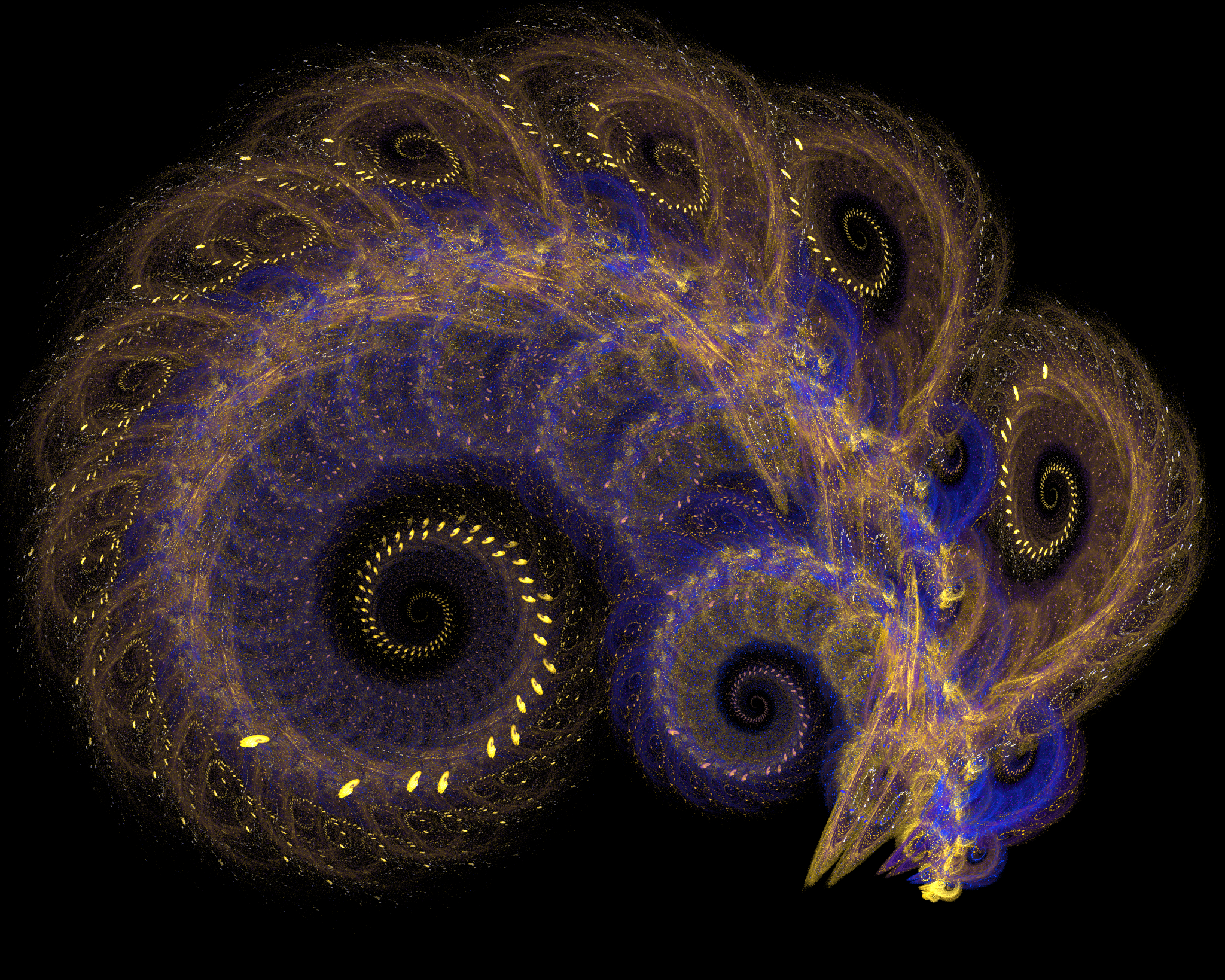
Abstract Orderism Fractal LVI – by G. Stolyarov II
Note: Left-click on this image to get a full view of this digital work of fractal art.
This intricate fractal is formed by means of the intersections of many hundreds of light curves.
This digital artwork was created by Mr. Stolyarov in Apophysis, a free program that facilitates deliberate manipulation of randomly generated fractals into intelligible shapes.
This fractal is an extension of Mr. Stolyarov’s artistic style of Abstract Orderism, whose goal is the creation of abstract objects that are appealing by virtue of their geometric intricacy — a demonstration of the order that man can both discover in the universe and bring into existence through his own actions and applications of the laws of nature.
Fractal art is based on the idea of the spontaneous order – which is pivotal in economics, culture, and human civilization itself. Now, using computer technology, spontaneous orders can be harnessed in individual art works as well.
Note: Left-click on this image to get a full view of this digital work of fractal art.
This fractal resembles a shield within an inverted shield, with an ornate engraving in between.
This digital artwork was created by Mr. Stolyarov in Apophysis, a free program that facilitates deliberate manipulation of randomly generated fractals into intelligible shapes.
This fractal is an extension of Mr. Stolyarov’s artistic style of Abstract Orderism, whose goal is the creation of abstract objects that are appealing by virtue of their geometric intricacy — a demonstration of the order that man can both discover in the universe and bring into existence through his own actions and applications of the laws of nature.
Fractal art is based on the idea of the spontaneous order – which is pivotal in economics, culture, and human civilization itself. Now, using computer technology, spontaneous orders can be harnessed in individual art works as well.
Abstract Orderism Fractal LII – by G. Stolyarov II
Note: Left-click on this image to get a full view of this digital work of fractal art.
This fractal evokes a light source, emitting bursts of illumination.
This digital artwork was created by Mr. Stolyarov in Apophysis, a free program that facilitates deliberate manipulation of randomly generated fractals into intelligible shapes.
This fractal is an extension of Mr. Stolyarov’s artistic style of Abstract Orderism, whose goal is the creation of abstract objects that are appealing by virtue of their geometric intricacy — a demonstration of the order that man can both discover in the universe and bring into existence through his own actions and applications of the laws of nature.
Fractal art is based on the idea of the spontaneous order – which is pivotal in economics, culture, and human civilization itself. Now, using computer technology, spontaneous orders can be harnessed in individual art works as well.
Note: Left-click on this image to get a full view of this digital work of fractal art.
This ornate feather-like fractal is built upon a multitude of spirals at many scales.
This digital artwork was created by Mr. Stolyarov in Apophysis, a free program that facilitates deliberate manipulation of randomly generated fractals into intelligible shapes.
This fractal is an extension of Mr. Stolyarov’s artistic style of Abstract Orderism, whose goal is the creation of abstract objects that are appealing by virtue of their geometric intricacy — a demonstration of the order that man can both discover in the universe and bring into existence through his own actions and applications of the laws of nature.
Fractal art is based on the idea of the spontaneous order – which is pivotal in economics, culture, and human civilization itself. Now, using computer technology, spontaneous orders can be harnessed in individual art works as well.
Note: Left-click on this image to get a full view of this digital work of fractal art.
This fractal resembles a design from a spirograph, coalescing to form a nautilus shape.
This digital artwork was created by Mr. Stolyarov in Apophysis, a free program that facilitates deliberate manipulation of randomly generated fractals into intelligible shapes.
This fractal is an extension of Mr. Stolyarov’s artistic style of Abstract Orderism, whose goal is the creation of abstract objects that are appealing by virtue of their geometric intricacy — a demonstration of the order that man can both discover in the universe and bring into existence through his own actions and applications of the laws of nature.
Fractal art is based on the idea of the spontaneous order – which is pivotal in economics, culture, and human civilization itself. Now, using computer technology, spontaneous orders can be harnessed in individual art works as well.
It is usually the case that the first knee-jerk reaction in opposition to increased human longevity is based on the mistaken belief that life-extension technologies would lead to people being ever more frail and decrepit for a very long time. This is far from the case, and it’s probably not even possible to cost-effectively engineer a society of long-lived frail people – even if that was the goal to hand. If you are frail and decrepit, then you have a high mortality rate due to the level of age-related cellular and molecular damage that is causing the failure and degeneration of your body and its organs. You won’t be around for long. No, the only way to engineer longer healthy life is to extend the period of youth and vitality, a time in which you have little age-related damage and your mortality rate is very low. Most present strategies are aimed to prolong that period of life, either by slowing the rate at which damage occurs (not so good) or finding ways to periodically repair the damage and thus rejuvenate the patient (much better).
Once people grasp that longevity science is the effort to make people younger for far longer, then the second knee-jerk objection arises. This is the belief that a very long-lived individual would become overwhelmed by boredom: they would run out of interest and novelty. This is by far the sillier objection, and there is absolutely no rational basis for it. Even a few moments of thought should convince you that there is far more to do and learn that you could achieve in a thousand life spans – and it’s a little early in the game to be objecting to enhanced longevity on the basis that you can’t think of what to do with life span number number 1001.
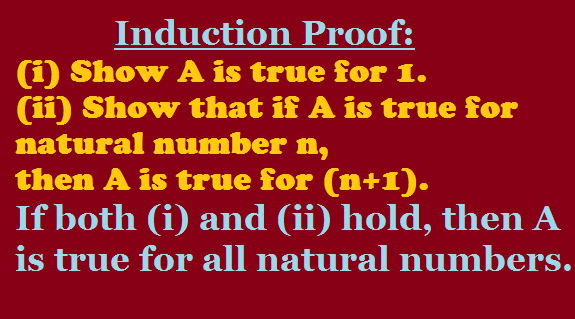
Considering boredom, futility, meaningless, and related matters, I noticed what appears to be an argument by induction in the article below. Mathematical induction is a tool used in formal proofs wherein if you can prove that something is generally true for n and n+1 (where n is a natural number), and then show that it is true for 1, then you can conclude it must be true for all natural numbers. If it is true for 1, then it must be true for 1+1 = 2, and true for 2+1 = 3, and so on.
Person 1 lives a fulfilling and meaningful life for X number of years before that life is terminated by a sudden, massive heart attack. Now, imagine another person whom we shall label (not too creatively) ‘Person 2′. Person 2’s life follows the same general path as that of Person 1, with one exception: It is one day longer than Person 1’s was. Now ask yourself: Is there any reason to suppose that this day – let us assume it is a Tuesday – strikes Person 2 as being meaningless despite the fact that all Tuesdays (and, indeed, every other day in Person 2’s past) seemed worth living? Personally I cannot see any reason to suppose that this Tuesday should not be as worth living through as the previous day was. Person 2’s life was as meaningful as that of Person 1, and the extra day Person 2 lived to see did not negatively affect quality of life (it might have positively affected it, but that is another matter).
OK, so now imagine yet another person who goes by the label of… yes, you guessed it, Person 3. You can probably also guess that Person 3 lives one day longer than Person 2. Once again, I can think of no reason why, where we have two people who live meaningful lives but one lives one day longer, that extra day would not seem worth experiencing. Put another way: If possible, would Persons 2 and 1 rather not be dead on Wednesday (the last day for Person 3) when Monday and all preceding days were worth experiencing? So far as I can see, the answer to that question is, ‘yes’.
There seems to be no reason why this argument should not hold for any number of hypothetical people, each one of which lives one day longer than the last.
Unfortunately you can’t prove conjectures about aspects of human nature with induction (or not yet, at least). What you can do is use it, as above, to mount a more convincing argument. This one is somewhat akin to one of the standard lines in any debate between a person who is in favor of greatly extending healthy life versus someone who isn’t.
Advocate: So you are fine with aging and dying?
Deathist: Yes.
Advocate: So you are fine with dying right now, done and finished?
Deathist: Well, no.
Advocate: Why would you think any differently ten days, or a hundred days, or decades from now, if you still had your health and vigor?
Deathist: Um…
There seems to be a strange disconnect in many people’s minds, in which they are vigorously in favor of being alive right this instant or next week, but they nonetheless believe that their future self of years ahead will be of a different opinion and want to die. Now if you’re on the downhill slope of aging, in great pain, and your body is falling apart, desiring a stopping point is not unreasonable. (With the best of present options for those in that position being cryonics). But in a world of rejuvenation therapies, in which older life is just as healthy, low-risk, and full of possibility as younger life, what mysterious thing is going to make people want to die?
Reason is the founder of The Longevity Meme (now Fight Aging!). He saw the need for The Longevity Meme in late 2000, after spending a number of years searching for the most useful contribution he could make to the future of healthy life extension. When not advancing the Longevity Meme or Fight Aging!, Reason works as a technologist in a variety of industries.
This work is reproduced here in accord with a Creative Commons Attribution license. It was originally published on FightAging.org.
Abstract Orderism Fractal XLIX – Art by G. Stolyarov II
Abstract Orderism Fractal XLIX – by G. Stolyarov II
Note: Left-click on this image to get a full view of this digital work of fractal art.
This fractal resembles sparks of electricity coursing through semi-transparent glass.
This digital artwork was created by Mr. Stolyarov in Apophysis, a free program that facilitates deliberate manipulation of randomly generated fractals into intelligible shapes.
This fractal is an extension of Mr. Stolyarov’s artistic style of Abstract Orderism, whose goal is the creation of abstract objects that are appealing by virtue of their geometric intricacy — a demonstration of the order that man can both discover in the universe and bring into existence through his own actions and applications of the laws of nature.
Fractal art is based on the idea of the spontaneous order – which is pivotal in economics, culture, and human civilization itself. Now, using computer technology, spontaneous orders can be harnessed in individual art works as well.
Abstract Orderism Fractal XLVIII – by G. Stolyarov II
Note: Left-click on this image to get a full view of this digital work of fractal art.
This fractal is a spiral of interwoven spirals.
This digital artwork was created by Mr. Stolyarov in Apophysis, a free program that facilitates deliberate manipulation of randomly generated fractals into intelligible shapes.
This fractal is an extension of Mr. Stolyarov’s artistic style of Abstract Orderism, whose goal is the creation of abstract objects that are appealing by virtue of their geometric intricacy — a demonstration of the order that man can both discover in the universe and bring into existence through his own actions and applications of the laws of nature.
Fractal art is based on the idea of the spontaneous order – which is pivotal in economics, culture, and human civilization itself. Now, using computer technology, spontaneous orders can be harnessed in individual art works as well.
Note: Left-click on this image to get a full view of this digital work of fractal art.
This trilateral fractal radiates swirls of intensity outward from a luminous, fiery core.
This digital artwork was created by Mr. Stolyarov in Apophysis, a free program that facilitates deliberate manipulation of randomly generated fractals into intelligible shapes.
This fractal is an extension of Mr. Stolyarov’s artistic style of Abstract Orderism, whose goal is the creation of abstract objects that are appealing by virtue of their geometric intricacy — a demonstration of the order that man can both discover in the universe and bring into existence through his own actions and applications of the laws of nature.
Fractal art is based on the idea of the spontaneous order – which is pivotal in economics, culture, and human civilization itself. Now, using computer technology, spontaneous orders can be harnessed in individual art works as well.