Browsed by
Category: Politics

Americans Are Going to be Disappointed in Election Outcome – Article by Ron Paul

Americans Are Going to be Disappointed in Election Outcome – Article by Ron Paul

The New Renaissance HatRon Paul
******************************
It is a sad commentary on the state of political life in the United States that our political conventions have become more like rock music festivals than competitions of ideas. There has been a great deal of bombast, of insults, of name-calling, and of chest-beating at both party conventions, but what is disturbingly absent is any mention of how we got to this crisis and how we can get out. From the current foreign-policy mess to the looming economic collapse, all we hear is both party candidates saying they will fix it, no problem.

In her convention speech Hillary Clinton promised that she would “fight terrorism” and defeat ISIS by doing more of what we have been doing all along: bombing. In fact we have dropped more than 50,000 bombs on ISIS in Iraq and Syria over the past two years and all she can say is that she will drop more. How many more bombs will defeat ISIS? How many more years will she keep us in our longest war, Afghanistan? She doesn’t say.

In fact, the New York Times – certainly not hostile to the Clintons – wrote that it was almost impossible to fact-check Hillary’s speech because, “she delivered a speech that was remarkably without hard facts.”

Clinton’s top foreign policy advisor said just a day after her convention speech that her big plan for Syria was to go back to square one and concentrate on overthrowing its secular president. How many more thousands more will die if she gets her way? And won’t she eventually be forced to launch a massive US ground invasion that will also kill more Americans?

Clinton does not understand that a policy of endless interventionism has brought us to our knees and made us far weaker. Does she really expect us to be the policemen of the world with $20 trillion in debt?

Likewise, Republican candidate Donald Trump misses the point. He promises to bring back jobs to America without any understanding of the policies that led to their departure in the first place. Yes, he is correct that the middle class is in worse shape than when Obama took office, but not once did he mention how it happened: the destructive policies of the Federal Reserve; the financing of our warfare/welfare state through the printing of phony money; distorted interest rates that encourage consumption and discourage saving and investment.

Trump tweeted this week that home ownership is at its lowest rate in 51 years. He promised that if elected he will bring back “the American dream.” He seems to have no idea that home ownership is so low because the Fed-created housing bubble exploded in 2007-2008, forcing millions of Americans who did not have the means to actually purchase a home to lose their homes. Not a word about the Fed from Trump.

How are these candidates going to fix the problems we face in America if they have absolutely no idea what caused the problems? No matter who is elected, Americans are going to be very disappointed in the outcome. The warfare/welfare state is going to proceed until we are bankrupt. There is hope, however. It is up to us to focus on the issues, to focus on educating ourselves and others, and to demand that politicians listen.

Ron Paul, MD, is a former three-time Republican candidate for U. S. President and Congressman from Texas.

This article is reprinted with permission from the Ron Paul Institute for Peace and Prosperity.

“The Line” for Green Cards Is So Long, You Might Die of Old Age Waiting – Article by David Bier

“The Line” for Green Cards Is So Long, You Might Die of Old Age Waiting – Article by David Bier

The New Renaissance Hat
David Bier
******************************

Immigrants are often told to “get in line” if they want to stay in the United States. This demand is disingenuous for many reasons. Many immigrants have no line to get into. And even if they do, we are telling them to join these lines when no one even knows how long they are. In many cases, we could be asking immigrants to join a line that they will literally never live to see the end of.

Immigrants might face a line they will literally never live to see the end of. We don’t know much about who’s in these lines until they get to the front, but here’s what we do: Thousands of immigrants come to the United States each year on temporary work visas. While working in temporary status, some of their employers petition on their behalf to obtain green cards for them to stay permanently. If the employer has jumped through all the appropriate hoops, the worker can then apply for a visa, if — and this is a big if — the limit on visas that year has not been reached.

This is where the line — and the waiting — starts. For lawmakers trying to fix the immigration system, figuring out how many people are at this point in the process is critical. But even they don’t know.

5 million people are waiting abroad.We do have a good idea how many people are waiting overseas. The State Department keeps track of those numbers and publishes them annually, and we’re quickly approaching 5 million immigrants waiting abroad, which is an astounding number on its own.

But for temporary immigrants already in the United States, the Department of Homeland Security doesn’t keep track — or doesn’t publish — the number of applicants who are prevented from receiving a green card due to the limits.

The State Department publishes a monthly visa bulletin that tells people in either line — here or abroad — whether they can apply for a green card. It lists a date, as seen below, next to a visa category. This date is the cutoff. If your employer’s petition was filed after the date listed, you cannot apply for a green card yet.

Figure 1: Visa Bulletin — Application Final Action Dates for Employment-Based PreferencesvisabulletinSource: State Department

These dates can sometimes create the misleading impression that immigrants from India, for example, will have “only” twelve years to wait for a green card. But that’s not right. That’s just how long immigrants who are currently receiving their green cards today have been waiting. We simply don’t know how many people applied since October 2004, so we don’t know how long someone applying today will have to wait.

Even the State Department doesn’t know who’s in line.Apparently, even the State Department doesn’t know who is in the line. When the department moves up the dates, it basically guesses how many people applied between the current date and the new date. When it moved the dates up for EB-2 and EB-3 categories from India (workers who have a Master’s or a Bachelor’s degree) to 2010 and 2007, the government was flooded with more applications than there were visas available, and so it moved the dates back again to 2004.

This mistake, however, gave us some small insight into who is waiting.

We cannot know for sure whether everyone who could apply submitted an application before the date moved back, but the Department of Homeland Security lists 46,098 Indians currently waiting at this stage. The State Department also lists almost 30,000 more waiting for employment-based green cards abroad, for a grand total of nearly 76,000 Indians. Because each country is limited to no more than 2,800 visas in each category, clearing just this backlog alone will take almost 10 years for EB-2 and more than 14 years for EB-3.

But that only gets us up to 2007 and 2010 for those categories. We simply have no idea how many people could be waiting beyond those dates. It would be nice to be able to estimate the number based on green card applications filed before those dates, but the list only gives us the number pending at any given time. It doesn’t show the total number submitted in a year. Some may have already been processed. Others may have been submitted later, after other older applications passed through.

A rough estimate shows 230,000 people in line, a fifty year wait.We know that in 2008, there were at least 19,512 green card applications under EB-2. For EB-3, the numbers haven’t gotten up to 2008 yet, but in 2006, there were at least 12,708 filed for that category. Simply carrying these numbers forward for each unknown year, there would be roughly 230,000 people in line, which would translate into an almost 50-year wait.

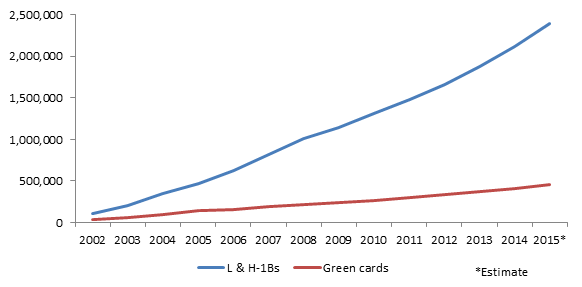
The situation is likely worse than that. We know that the number of Indian temporary workers has increased dramatically relative to the number of green cards issued to them in the past couple decades (Figure 2). We also know that roughly half of all employment-based labor certifications (the step employers complete prior to submitting most EB-2 and EB-3 green card petitions) are for Indian workers.

Figure 2: Total Cumulative Green Cards and L or H-1B Visas Issued to Indians Since 2007
h1bslsgreencardsSources: H-1B/Ls: USCIS/State Department; Green cards: DHS

Since 2002, 450,000 Indians received a green card, while roughly 2.4 million high-skilled immigrants from India and their families have entered under the H visa or L visa (for employees transferring to a U.S. branch of their company). Some portion of these workers could have been beneficiaries of an EB-3 green card petition after 2007, the last date on which we know anything about who is in line.

They’ll be waiting somewhere between 50 and 350 years. All we know is this: somewhere between 230,000 and 2 million Indian workers are in the backlog, so they’ll be waiting somewhere between half a century and three and a half centuries. It is entirely possible that many of these workers will be dead before they receive their green cards. And that’s just one country. The backlogs for Chinese immigrants and immigrants from the Philippines continue to grow as well.

America’s immigration system is broken worse than anyone can even know.

David_BierDavid Bier

David Bier is an immigration policy analyst at the Cato Institute’s Center for Global Liberty and Prosperity.

This article was originally published on FEE.org. Read the original article.

Brazil’s Lost Decade: We Must Free Our Economy – Article by Felipe Capella

Brazil’s Lost Decade: We Must Free Our Economy – Article by Felipe Capella

The New Renaissance HatFelipe Capella
******************************

It was a lost decade for Latin America. Years of populist governments combined with a commodity boom turned out to be our oil curse, our Dutch Disease. This disastrous mix made bad public policies look like temporary successes, pushing developing countries to an unsustainable path. The collectivist ideology monopolized the debate for more than 10 years, and now that the natural resource party is over, the harm of these policies have become clearer: deep economic crisis generated by a utopia whose greatest achievement was turning toilet paper into a rare-earth product.

Populist and authoritarian South American regimes have set up government bureaucracies aimed at pleasing special interest groups that provide political support while tirelessly harming the population as a whole. These groups are divided into several small groups with special rights and privileges: judges, civil servants, members of parliament, friendly businessmen. These factions are getting their more-than-fair share while the unprivileged citizen foots the bill.

Latin American politicians played it very well during these favorable times. Cronyism and populism greatly benefited some chosen groups, while the harms were diffused enough throughout the whole country and difficult to measure during favorable economic winds. Brazil is just the biggest and clearest example of that.

How We Got Here 

For many years Brazil’s road to serfdom was being paved by the left through a combination of the world’s worst ideas: a Venezuelan-like project to subordinate decisions of the Supreme Court to the ratification of Congress; an Ecuadorian will to regulate and control the free press; a Russian compassion for cronies handpicked by the executive; Greek style benefits for public servants; Southern European pension costs (for a much younger population); Argentinean barriers for international trade, and an American/EU taste for subsidies.

The former — and now failed — cherry-picked billionaire darling of the regime Eike Batista was showered with tax funds while ordinary entrepreneurs lacked governmental support; friendly national industries were heavily protected, while people were taxed up to 50 percent on food and health supplies. Oi Telecom, a multibillion dollar mobile company, is just the most recent example of Lula’s national-champion policy (the company has just filed for bankruptcy, with 17 percent of its debt held by state-owned banks).

That was the result of 10 years of left-populist government in Brazil, all of them enjoying the applause of the international press. For years The New York Times constantly published articles with a pro-Dilma/Lula tone. Right after Dilma’s reelection — which is now known to have been funded by money siphoned from state-owned companies — The NYT published a piece half-mocking 48 percent of voters that were concerned about Dilma’s economic and political approaches.

The good thing about bad journalism is that reality eventually catches up with it. Since that 2014 article, Dilma has since lost her job and is about to be impeached for illegal budgetary schemes and deep corruption. Her top aides are all in jail or about to be thrown there, accused of stealing dozens of billions of dollars, including former Ministers and three former treasurers of her Labor Party (which some people now deem to be the most dangerous job in the world). Brazil is in its worst economic crisis since the 1930s, which has been worsening since 2014 (while Dilma was coming up with her now-famous accounting tricks to fool the Brazilian voters). Lula had even become a frequent contributor of The Times after his presidency, but now faces criminal charges and has seen the federal police knock on his door with a coercive trip to the criminal courts.

In its recent opinion page about the failed Rio Olympic Games preparation, The NYT’s favorite Brazilian correspondent Vanessa Barbara wrote that “political turmoil has paralyzed the country and frozen the economy.” This rhetoric of blaming “political turmoil” for Latin American calamities does not help to set the record straight. The problems with the Olympic games stem directly from Dilma’s and Lula’s incompetence and corruption. But the problem also lies on media vehicles like The Times, always ready to turn a blind eye to mismanagement and corruption in the name of ideology.

So here we are. Brazil is a failing state after a decade of populist presidents, misguided policies and commodity boom, all under the auspices of the progressive press.

The Need for Laissez-Faire Liberalism

For a long time, Brazil has been a place where liberalism (i.e., the ideology of freedom and free markets) was mostly marginalized, despite its positive track-record. In the minds of most Brazilians, being liberal was conspiring for the wealthy, being socialist is taking care of the poor.

But if The Times does not want to recognize its mistakes, apparently the Brazilian population is more willing to deal with self-criticism. There is now a strong resurgence of liberalism throughout the country.

Partido Novo (“New Party”) is a new political party created with a clear liberal approach to the economy, and it is just one of the recent examples of how liberalism is growing in the country, waking up millions of Brazilians who were orphans of a liberal political leadership. Many creative and hardworking people that do not think that socialism (or heavy-handed South American social democracy) will make our countries more prosperous. There are substantial constituencies that want public policies driven by research, metrics and actual public interest.

Free Trade Is the Key

The European Union has no appetite and no urgency to negotiate any comprehensive trade agreement with Mercosur or other Latin American countries. The United States faces a choice between a populist protectionist and a trade-dubious democrat (to put it mildly).

It is essential for the world that someone — anyone — pushes forward the liberal pro-trade agenda. As we natives well know, it is never wise to bet on Brazil as a global force for good. But maybe — just maybe — because we are suffering first-hand the harms of a decade of interventionist, protectionist, and corrupted government, we can somehow understand that populism is an illusory lucky charm that actually curses a country for years to come; and maybe — just maybe — we can do something to redeem ourselves.

Now that international trade seems under constant attack from all places and political spectrums, and no big world economy wants to step up and bluntly defend the liberal track record — including the United States — maybe Brazil could become the champion of good policy at last, pushing for reforms throughout Latin America and holding the liberal torch high in these dark times.

As Roberto Campos advised decades ago, for us Brazilians there are only three ways out of the current mess: Rio’s airport, Sao Paulo’s airport, and Liberalism.

Felipe Capella is an attorney turned entrepreneur. He is a former law professor at the Federal University of Santa Catarina (Brazil), former attorney at Sullivan & Cromwell (New York) and the Inter-American Development Bank (Washington, DC), has Master degrees from UPenn/Wharton and Universidad Francisco de Vitoria (Spain), and holds an MBA from FGV (Brazil).

This article was published on Mises.org and may be freely distributed, subject to a Creative Commons Attribution United States License, which requires that credit be given to the author.

Protectionism Will Not Make America Great – Article by Pierre-Guy Veer

Protectionism Will Not Make America Great – Article by Pierre-Guy Veer

The New Renaissance HatPierre-Guy Veer
******************************

At the end of June, presumptive Republican nominee Donald Trump made a fiery speech about trade in Pittsburgh. Using many of Bernie Sanders’ talking points on the subject, Trump said, among others, that he would hold China accountable for the manipulation of its currency and unfair trade practices, withdraw from the Trans-Pacific Partnership, and renegotiate the North American Free Trade Agreement with Mexico and Canada.

Trade vs. Trade Treaties

There is some wisdom on Trump’s part about NAFTA. This agreement would deserve the label “bureaucratic agreement on trade” rather than “free trade agreement.”

For example, Annex 313 states that Bourbon and Tennessee Whiskey can only be called as such (and be sold) if they are produced in Tennessee “in accordance with the laws and regulations of the United States governing the manufacture of Bourbon Whiskey and Tennessee Whiskey.”

The same rule applies to Canadian Whisky in Canada and Tequila and Mezcal in Mexico. Annex 703.2.A.4, on its side, contains a truckload of products which are exempted from free trade, including Canada’s milk supply management which may cost the average family $267 a year.

Trump is also right about being hesitant to support the TPP. What has leaked out of it shows that the agreement has more to do about protecting intellectual property rather than genuine trade liberalization. Such protection would stifle innovation and slow economic growth – just imagine if there had been a patent on the wheel or iron casting when it was first invented.

Fairness is Buying What You Want from Wherever

However, Donald Trump is wrong to advocate for “fair” trade. In his platform he calls for a level playing field in order to have a “fairer” trading relationship with China, known for its heavy top-down approach on foreign businesses.

This amounts to protectionism that could set off a very costly trade war. American consumers will pay the price – a form of tax. It could set off a deep recession. When you consider the stakes here, you see that all of Trump’s valid complaints about trade treaties are designed to bring about something that is even worse.

If, however, Trump’s goal is really to “make America great again,” then he should not be caring about China’s trade practices, but embracing unilateral free trade.

Of course there would be unavoidable, short-term pain with job losses in industries that cannot compete with China and other industries. The steel industry, for example, would not be protected by the recently enabled 266-percent tariff imposed on Chinese steel and would shed many jobs.

However, people using steel (for construction, manufacturing, etc.) would save so much money by being able to import cheaper steel. This surplus money will not evaporate; it will return in the economy in the form of savings, job creation, and economic growth.

This is not trade theory: unilateral free trade has successfully happened. Famous French liberal Frédéric Bastiat has abundantly talked about England turning to unilateral free trade and how it helped the country become even richer.  It even “gave them bread” during a bad harvest 1847 thanks to wheat imports.

By walking down this “bold path,” to quote minister Peel who enacted free trade, America would truly be great. Government would stop subsidizing agriculture in every single form, thereby not only improving the quality of the water supply, but also reversing the contentious debate about undocumented Mexicans whose livelihood was destroyed by U.S. corn subsidies. Capital resources would be allocated in a more efficient way according to supply and demand – it might still be farming, but it could become manufacturing, mining, or even services – and save an average of $6.1 billion per year until 2019.

Trade liberalization, combined with Trump’s promises to lower business income tax to 15 percent and tackle the deficit and debt, would truly “make America great again.” Because after the unavoidable short-term pain of adjusting to new incentives, Americans will get back to work and better supply the world’s demand on their own.

Pierre-Guy Veer


Pierre-Guy Veer

Pierre-Guy Veer is a Linguistic Reviewer at Lionbridge

This article was originally published on FEE.org. Read the original article.

How Pokémon GO Brightened a Dark World – Article by Jeffrey A. Tucker

How Pokémon GO Brightened a Dark World – Article by Jeffrey A. Tucker

The New Renaissance HatJeffrey A. Tucker
******************************

All weekend, I’ve fielded texts from people who are despairing about the state of the country. Is some kind of unsolvable civil war developing between police and people, even between races? And how can politics solve this when the candidates seem to have every interest in actually exploiting and even exacerbating the problem? The opinion pages overflowed with expressions of deep sadness and warnings that, once again, the center is no longer holding. The nation is falling apart.

What could possibly be the solution here? These problems seem so deep as to be insoluble.

Oddly, the answer might be in your pocket. Through our smartphones and the app economy, we are being given tools to allow us to reach the world and connect with others in ways that were previously unimaginable. This is not a political solution; in fact, it might be solution precisely because it is not political.

Pokémon Brings Us Together

Poetically, it was exactly this weekend – following so much terrible news and after a season in which two-thirds of Americans report being alarmed by their coming presidential choices – that millions downloaded and played one of the most delightful digital apps to yet appear: Pokémon GO.

It has broken all records on the numbers of downloads in such a short time. In only a matter of a few days, the mobile app had nearly as many real-time users as Twitter. It now lives on more smartphones that even Tinder. As a term, Pokémon is top trending. If you follow your Facebook home feed, you know all about this. If any application could be described as having swept the nation, this was it.

How can a silly game lift up our hearts and give rise to the better angels of our nature?

That something marvelous had happened was obvious to anyone living in dense population areas. Parks filled up with people playing the game. They were hanging out in public areas around malls, at bus stops, in parking lots, and just about everywhere.

People were holding their phones, playing the game, laughing and moving around. Crucially, people were meeting each other with something in common – people of all races, classes, religions; none of it mattered. They found new friends and came together over a common love.

And there was a common feature to all the people doing this. We smiled. We smiled at each other. Even now, even in the midst of a world in which “the center no longer holds,” we actually found that center again: a heart-felt affection for something we love and an awareness that others share that same aspiration.

It was absolutely beautiful to watch. With an element of fantasy and the assistance of marvelous technology, we experienced the common humanity of our neighbors and strangers in our community. This kind of experience is key for building a social consensus in favor of universal human rights.

Why We Love It

The integration between digital and physical in the Pokémon GO game go beyond anything most people have ever experienced. Turn on your camera and you suddenly find opportunities for catching and collecting pocket monsters all around you. Head outdoors and chase them around, going up level after level and eventually find yourself at a gym where you can digitally battle other players in real space.

Dazzling doesn’t quite describe it. It is fun and imaginative, tapping into the inner kid of all of us. All the technological and intellectual discoveries over the last decades are on display. It all feels so real, all this capturing, collecting, and battling.

The industry calls it “augmented reality.” It’s a new level of gamification, not just something that happens on a screen. It reveals a layer of fantasy within the existing structure of reality itself, meaning that it brings to life the most delightful imaginings of our hearts. It helps us see what we would otherwise not see, and allows us to interact directly with the digitally existing thing.

In this way, Pokémon embodies something that we’ve all begun to intuit but haven’t been able to frame up completely. It is this: there is no longer a separation between what we once called real and what we think of as being a pure Internet fiction. The two are blending in ways that are dramatically enhancing our lives. We are to the point where we can no longer even imagine how the world even worked – and how our minds worked – before market forces blessed humanity with digital innovations.

The Great Blurring

Market-driven technology is not some invading imposition that makes people change the way they live without their permission. Instead it seeks to serve us and make our lives better; that’s its whole purpose and ethos. In the whole course of the digital revolution that began some twenty years ago, we’ve seen the gradual blurring between the physical and digital realms. What was created through code started to become just as substantial and meaningful in our lives as anything that took up physical space and we could touch.

We see this not only in games but also in health care, in finding our way around cities, in opening businesses, in driving, in dating, and in millions of life activities. Crucially, such apps are available to everyone regardless of life station. They spread capital and productivity across all classes of people, and more and more of our lives are migrating to this realm to escape the frustrating limits of physical space.

Of course the doubters have kvetched for two decades now. Old timers have screamed about how all this fascination with the Internet was causing a breakdown in human relationships, how the old-fashioned letter was so much better, why ebooks could never replace the glorious romance of physical books, how online music would kill the industry, how dating apps were killing romance, how time-killing blather on Facebook and Twitter were killing productivity, and so on.

Oh, and remember how video games were going to wreck our health by making us all sedentary? Now we have Pokémon GO players romping over hill and dale to “catch ‘em all.” As a wit on Facebook said, “Pokemon GO has done more for childhood obesity in the last 24 hours than Michelle Obama has in the past 8 years.”

Indeed, none of these fears have panned out. In fact, the opposite has proven true. The digital revolution has connected people as never before and given rise to more of what we love in life, whatever that happens to be.

Such doubters were missing something crucial. The key to the digital realm is its unrelenting adaptability to consumer preferences, thanks to the capacity of innovators to learn from the successes and failures of others. Digital innovation allows the crucial element of discovering and innovating to be crowd sourced, creating an environment of exponentially fast progress.

Market-driven technology is not some invading imposition that makes people change the way they live without their permission. Instead it seeks to serve us and make our lives better; that’s its whole purpose and ethos. Whatever it is we want to do – read, listen, play, study, create – the technology is there to make it easier and more widespread. It democratizes the tools we need to live better lives.

And what does it make possible? Whatever the human mind is capable of creating. And the element of surprise is always there. Just when we think we’ve reached an insuperable limit to the possible, something appears that surpasses that limit.

The individual human mind is not capable of outsmarting the brilliance of a market process that operates without limits.The challenge became very intense when Bitcoin came about in 2009, and the cryptocurrency gradually took on monetary properties. Economists claimed this could never happen, since money absolutely had to originate in a form of real-world scarcity of something you could hold.

I recall a conversation I was having with one skeptic on Skype who kept saying that Bitcoin can’t be money because it doesn’t exist. Frustrated, I asked him if the conversation we were having right then really existed. He said yes. I reminded him that I was not standing next to him and everything we were looking at and hearing was nothing but code.

Our conversation was purely fictional by his standards, simply because its only existence was in the digital realm. And yet it seemed to me to be actually happening. He was speechless.

The lesson here is that the individual human mind is not capable of outsmarting the brilliance of a market process that operates without limits. And within digital spaces today, we experience the closest thing we have to a free market. It is making things no one thought possible, and doing it daily, and doing it for everyone.

Overcoming Power with Humanity

Mobile apps like Pokémon GO can of course be dismissed as just another game, distractions that do not address serious life problems like race conflict and the tit-for-tat killings between police and citizens. But actually there is more going on here.

A few weeks ago, Facebook rolled out its live video functionality for all users – and keep in mind that this is free for everyone on the planet to use. When a police officer shot Philando Castile with four bullets during a routine traffic stop, his girlfriend Diamond Reynolds took out her phone and live streamed one of the most dramatic and powerful moments yet seen on the subject of police power.

It shocked the consciences of millions. Facebook was her 911. Had private enterprise not been there, the world would not have known. Now that we do, change is made more likely.

That’s the serious side of technology while Pokémon GO represents the delightful side. They work together, each making a valuable contribution to enabling a better life. What they have in common is that both are non-state solutions to crying human needs. No politician in history has ever achieved so much for the cause of human rights and human happiness.

Jeffrey Tucker

Jeffrey A. Tucker

Jeffrey Tucker is Director of Content for the Foundation for Economic Education and CLO of the startup Liberty.me. Author of five books, and many thousands of articles, he speaks at FEE summer seminars and other events. His latest book is Bit by Bit: How P2P Is Freeing the World.  Follow on Twitter and Like on Facebook. Email. 

This article was originally published on FEE.org. Read the original article.

Taking the Low Road on Free Trade – Article by Chris Baecker

Taking the Low Road on Free Trade – Article by Chris Baecker

The New Renaissance HatChris Baecker
******************************

During the holidays, I took my daughters to my aunt and uncle’s house in Rogers, TX. Over the last few years, when not working their day jobs at Scott and White hospital in Temple, they have grown a large garden of marketable produce, devoting more than 4 acres to the operation. I sent some photos to a friend of mine who has his own backyard garden. His enthusiasm was palpable. This is a guy who once told me, “everyone should have a garden.”

Fast forward to this spring. I finally got around to buying a bookshelf. As I set about putting it together, I started thinking, “I could put together a nicer, sturdier one than this. All I’d need is some wood, sandpaper, stain/paint, braces … never mind. This one will do for now.”

I don’t have all the tools at my disposal to carry out that sort of a project, any more than I do for gardening. My interests lie elsewhere. In a free society like ours, each person is allowed to pursue their own preferred interests. Eventually, however, we do require other goods for sustenance, and leisure, so we trade with each other.

In what has been the most unpredictable and surprising election season of my lifetime, one issue that has come under unusually widespread attack is free trade.

The Opposition

Resistance to free trade has typically been found in the Democratic Party. Its union supporters fret about their jobs being “shipped overseas,” and environmentalists express concerns about trading with countries that lack “adequate” protections thereof. A few decades ago, that bloc was countered by the relatively more market-friendly Democratic Leadership Council, whose influence peaked with the election of Bill Clinton as president.

Remaining democratic opposition was joined by a couple of protesters from the center-right, H. Ross Perot and Patrick Buchanan. Mr. Perot famously claimed during a 1992 presidential debate that we would hear “a giant sucking sound” of manufacturing going south to Mexico. Four years later, while seeking the Republican Party nomination for President, Mr. Buchanan campaigned on a fear of losing nationality as goods and labor move more seamlessly across borders.

Nowadays, the DLC is defunct (2011) while the spirit of Messrs. Perot and Buchanan has morphed into this election season’s wild card, Donald Trump. The similarities amongst the three are many: businessmen (Perot and Trump), populist streaks, insurgent outsiders, meticulously crafted coifs, etc. They also share a skepticism of free trade.

A few Trump talking points have jumped out at me: “we don’t make things anymore,” we’re in “imbalance (deficit) with” other countries and threatening a 45% tariff on Chinese goods.

Trade protectionism has been around for ages. Our Founding Fathers supported tariffs, which used to be a prominent source of government revenue. Alexander Hamilton even coined the “infant industry” argument, whereby the government shields from international competition new and developing industries deemed important to self-sufficiency and independence.

Trade and Trump

In trade debates of modern times, Republicans have typically argued for “free” trade, whereas “fair trade” was sought by Democrats. Mr. Trump has picked up the mantle of the latter, saying the 45% tariff is merely a threat to achieve such fairness.

I’m reminded of the interrogation scene in the movie “Starsky and Hutch” where
Ben Stiller tries to coerce some information out of a suspect … by pointing the gun at his own head. Why threaten the American consumer with price hikes? Why not, for example, allow domestic steel-input consumers to benefit from rock-bottom prices that result from Chinese overproduction? How does it make sense to protect the American steel industry with a tariff of more than 500% if employment in, and value produced by, those input consumers is greater?

The answer also happens to explain why we’re lagging behind the rest of the world in the sugar trade: concentrated benefits (domestic industry) vs. dispersed costs (artificially inflated prices for consumers). Such beneficiaries typically have more clout with policymakers than consumers do. It’s this kind of rent-seeking that prevents us from being able to take advantage of the shortcomings of a centrally-planned (though certainly less so than a couple generations ago) economy like China’s, or the fact that some countries just flat out produce something more efficiently than we do.

Ironically enough, if Mr. Trump is so concerned with illegal immigration from our south, perhaps he should first take a look at the agricultural and dairy subsidies Uncle Sam doles out that put Mexican farmers out of business and drive them north to get a piece of our artificially- inflated industry.

Moreover, when he asks “(w)ho the hell cares if there’s a trade war?” someone should remind him of the Smoot-Hawley Tariff Act of June 1930. In an effort to protect domestic agricultural and industrial interests, President Herbert Hoover signed it into law over a petition signed by a thousand economists. Other nations retaliated and the world headed toward depression. And that was when trade was a smaller part of the global economy.

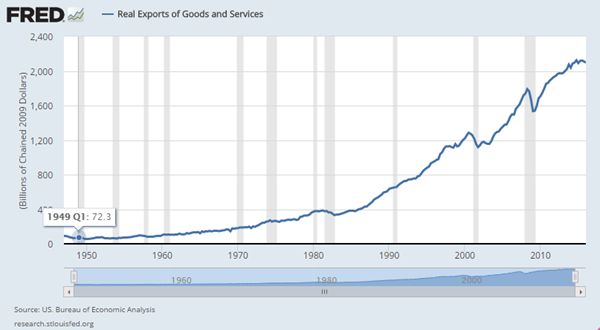
Lesson learned, after the war, the world moved toward freer trade. In that time, our real exports of goods and services rose steadily, accelerating in the mid-1980s, belying the claim that “we don’t make” stuff.

fred_graph1

As Harvard professor and former Chairman of the President’s Council of Economic Advisers Greg Mankiw recently pointed out in The New York Times, manufacturing is currently at an all-time high. The problem, as it were, is that we’re doing it with less manpower.

The Effectiveness of Efficiency

That very transformation is currently underway in the energy industry. Even after the price of oil started tanking, and rigs were idled, and jobs were being eliminated, production still increased. We became more efficient. It won’t take the same quantity of capital and labor to respond to $50 oil the next time it rises to that level. The displaced resources can be redeployed to other areas of the economy.

There are undoubtedly industry shakeups in freer markets. Labor, capital, and entrepreneurs are reshuffled. But our society encourages innovation by safeguarding intellectual and property rights. That allows us to find new and better ways of doing things.

This is just the latest example of our capacity to achieve the self-sufficiency that was the goal of our first Treasury Secretary (Mr. Hamilton) when he submitted to the second Congress suggestions of “encouragement” and “protection of government” in his “Reports on Manufactures.” All the “protection” we need for the aforementioned “encouragement” is between our ears. The human capital that we’ve built up over the years doesn’t go away, but rather accumulates.

Without free trade, there might be an erosion of two of its most important exports: peace and freedom. The world has to cooperate and get along if we all want to prosper. And the freer the people, the greater the likelihood of greater prosperity. Besides, should that peace unfortunately break down again someday, the Second Amendment and our bread basket give us time to dust off and tap that know-how to rev up the necessary industries.

Counterbalancing Deficits

Nevertheless, more trade liberalization is afoot. My industry has a new market: the rest of the world, thanks to the repeal of the oil export ban last December. That’ll surely alleviate something else nearly all our leaders are prone to complain about: our trade deficit.
fred_graph2

It’s a curious thing that you rarely hear that it’s actually only half of an equation, but it is.

The balance of payments (BoP) is basically an accounting of our international transactions. The current account (trade) is the one we always hear about when it’s in deficit. Interestingly enough, it tends to trend back toward break-even only when we’re heading toward recession. It makes sense that imports rise in good times. “We’re Americans,” I tell my students, “we like to buy stuff. We like to buy stuff so much, we rent storage facilities in which to put all our extra stuff!” Regardless, there’s nothing inherently wrong with a trade deficit.

The counterbalance is the capital account. We have a big example of that in our backyard: the Toyota plant in south San Antonio. This is foreign direct investment. That plant is in the heart of truck country. It gives Toyota direct access to that market here. And, they employ highly-skilled Texans. That seems like a win-win, a sign of strength perhaps, when a foreign company wants to locate operations here.
fred_graph3

You actually contribute to the capital account when you crack open a Bud Light after feeding Purina to Scooby, who was hungry because you forgot to feed him while you were eating a Smithfield ham steak (that had been stored in a GE freezer) for dinner before going to see “X-Men: Apocalypse” at the AMC Rivercenter 11. All those companies are foreign-owned. The profit portion of the prices paid for those goods is exported to another country. Foreign entities saw value in the brand recognition of items Americans know and love. And they were able to buy those companies in part because they do more of something that we don’t: save.

When the consumer expenditure portion of the Gross Domestic Product [GDP] started climbing in the 1980s from 60% to almost 70% today, it was arguably fueled by the concurrent proliferation of the all-purpose credit card. Perhaps it goes without saying, but when you’re spending, you’re not saving. And when you’re borrowing, you are dissaving. Much of the consumer savings derived from more efficient global production of goods could go to more savings. Instead, it seems to go toward buying more stuff.
fred_graph4

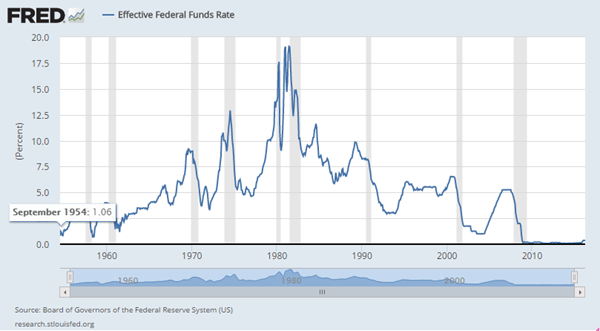
When you think about it though, our incentive to save has slid right alongside available interest rates.

fred_graph5

A couple years after they were pushed way up to break the inflation of the 1970s, interest rates have been on a steady march downward: ~7-8% in 1980s, ~5% in the 1990s, half that in the 2000s, and now near 0%. Monetary policy that could be enticing us to invest in learning new skills, opening a new business, guarding against unforeseen events, etc., instead has nudged us toward $1,000,000,000,000 in both credit card and automobile debt this year. What was the current trade deficit again?

If bringing down the trade deficit is the goal, increasing domestic savings and investment is preferable to erecting trade barriers. And if curbing interest-bearing consumer indebtedness happens as well, all the better.

While former Secretary of State Hillary Clinton seems like little more than a 21st century version of the pandering, “meaningless platitude-spouting” Kevin Fogerty from a classic episode of “Cheers,” Senator Bernie Sanders and Mr. Trump have been more consistent in their views toward free trade. But the aggressive tone they sometimes take toward it and our trading partners reminds me of when my four daughters (average age, 9) bicker with one another. Only it’s more understandable that my girls have to be taught to take the high road.

As for me, one of these days I could take up woodworking, or gardening, or some other hobby/trade that produces tangible output. Right now though, my spare time is best served educating. It’s what I like to do. It’s where I feel most productive. And given this season’s crop of presidential aspirants, there seems to be a need for it.


Chris Baecker

Christopher E. Baecker manages fixed assets for Pioneer Energy Services and is an adjunct lecturer of economics at Northwest Vista College in San Antonio.  He can be reached via www.chrisbaecker.com, @chrisbaecker71 & LinkedIn.com

This article was originally published on FEE.org. Read the original article.


Yes, We Still Make Stuff, and It Wouldn’t Matter if We Didn’t – Article by Steven Horwitz

Yes, We Still Make Stuff, and It Wouldn’t Matter if We Didn’t – Article by Steven Horwitz

The New Renaissance HatSteven Horwitz
******************************

One of the perennial complaints about the US economy is that we don’t “make stuff” anymore. You hear this from candidates from both major parties, but especially from Donald Trump and Bernie Sanders. The argument seems to be that our manufacturing sector has collapsed and that all US workers do is to provide services, rather than manufacturing tangible goods.

It turns out that this perception is wrong, as the US manufacturing sector continues to grow and in 2014 manufacturing output was higher than at any point in US history. But even if the perception were correct, it does not matter. The measure of an economy’s health isn’t the quantity of physical stuff it produces, but rather the value that it produces. And value comes in a variety of forms.

Manufacturing is Up

The path to economic growth is not to freeze into place the US economy of the 1950s. Let’s deal with the myth of manufacturing decline first. The one piece of evidence in favor of that perception is that there are fewer manufacturing jobs today than in the past. Total manufacturing employment peaked at around 19 million jobs in the late 1970s. Today, there are about 12.5 million manufacturing jobs in the US.

However, manufacturing output has never been higher. The real value of US manufacturing output in 2014 was over $2 trillion. The real story of the US manufacturing sector is that we have become so much more efficient, that we can produce more and more manufactured goods with less and less labor. These efficiency gains are largely the result of computer technology and automation, especially in the last fifteen years.

The labor that we no longer need in order to produce an ever-increasing amount of stuff is now available to produce a whole variety of other things we value, from phone apps to entertainment to the expanded number and variety of grocery stores and restaurants, to the data analyses that makes all of this growth possible.

Just as the workers in those factories we are so nostalgic for were labor freed from growing food thanks to the growth in agricultural productivity, so are today’s web designers, chefs at the newest hipster café, and digital editors in Hollywood the labor that has been freed from producing “stuff” thanks to greater technological productivity.

Or, put differently: those agricultural, industrial, and computer revolutions collectively have enabled us to have more food, more stuff, and more entertainment, apps, services, and cage-free chicken salads served with kale. The list of human wants is endless, and the less labor we use to satisfy some of them, the more we have to start working on other ones.

But notice something: all of the things that we produce have something in common. Whether it’s food or footwear, or automobiles or apps, or manicures or massages, the point of production is to rearrange capital and labor in ways that better satisfy wants. In the language of economics, the point of production (and exchange) is to increase utility.

When we produce more cars that people wish to buy, it increases utility. When we open a new Asian fusion street food taco stand, it increases utility. When Uber more effectively uses the existing stock of cars, it increases utility. When we exchange dollars for manicures, it increases utility.

Adam Smith helped us to understand that the wealth of nations is not measured by how much gold a country possesses. Modern economics helps us understand that such wealth is not measured by how much physical stuff we manufacture. Increases in wealth happen because we arrange the physical world in ways that people value more.

Neither producing cars nor providing manicures changes the number of atoms in the universe. Both activities just rearrange existing matter in ways that people value more. That is what economic growth is about.

Misplaced Nostalgia

We’re richer because we have allowed markets to produce with fewer workers. When we are fooled into believing that “growth” is synonymous with “stuff,” we are likely to make two serious errors. First, we ignore the fact that the production of services is value-creating and therefore adds to wealth.

Second, we can easily believe that we need to “protect” manufacturing jobs. We don’t. And if we try to do so, we will not only stifle economic growth and thereby impoverish the citizenry, we will be engaging in precisely the sort of special-interest politics that those who buy the myth of manufacturing often rightly complain about in other sectors.

The path to economic growth is not to freeze into place the US economy of the 1950s. We are far richer today than we were back then, and that’s due to the remaining dynamism of an economy that can still shed jobs it no longer needs and create new ones to meet the ever-changing wants of the consumer.

The US still makes plenty of stuff, but we’re richer precisely because we have allowed markets to do so with fewer workers, freeing those people to provide us a whole cornucopia of new things to improve our lives in endless ways. We can only hope that the forces of misplaced nostalgia do not win out over the forces of progress.

Steven_Horwitz

Steven Horwitz

Steven Horwitz is the Charles A. Dana Professor of Economics at St. Lawrence University and the author of Hayek’s Modern Family: Classical Liberalism and the Evolution of Social Institutions.

He is a member of the FEE Faculty Network.

This article was originally published on FEE.org. Read the original article.

4 Ways to Misuse Gun Statistics – Article by Daniel Bier

4 Ways to Misuse Gun Statistics – Article by Daniel Bier

The New Renaissance HatDaniel Bier
******************************

There are a lot of false, misleading, or irrelevant numbers being thrown around about guns and crime, so here’s a brief guide to four potentially misleading types of statistics.

1. “The United States has a gun for every person.”

It’s practically a rule that every report about guns has to mention some version of this statistic. There are “300 million guns in the United States,” “one gun for every person,” “more guns than people.”

This number is problematic not just because the estimates are dodgy (nobody really knows how many guns there are — estimates range from 250–350 million) but also because of the way guns per capita is used interchangeably with the rate of gun ownership.

Confusing the two is a common mistake. Reported increases in guns per capita often makes it appear that a tidal wave of guns is washing over the country. The Washington Post’s Wonkblog sounds the alarm that there are now “more guns than people.” Sounds scary — we’re outnumbered!

But the General Social Survey finds that 2014 actually marked an all-time low for gun ownership in the United States. (Gallup finds different numbers, but recent surveys by Pew and YouGov essentially confirm the GSS estimate.)

Yes, maybe if you collected all the guns in the country, you could give one to each man, woman, and child, and maybe there’d even be some left over. But this isn’t how gun ownership works. Just because there’s “one gun for everyone” doesn’t mean everyone has a gun. (Easy way to check this: look around you — see any guns? No? Okay then.)

The “one gun for every person” factoid is ubiquitous because it’s easy to remember and hammers home just how many guns there are. There’s some value in pointing out the huge total number of firearms in the United States — it captures the sheer scale of the issue when people are talking about trying to regulate, control, or confiscate them.

But it’s misleading to use the per capita figure to measure the kind of prevalence of guns that matters: how many people actually have firearms?

According to the GSS, just 31 percent of Americans live in a household with a gun — down from over 50 percent in the late 1970s — and only 22 percent personally own a gun. How can this be? Because most gun owners have more than one (and stores and collectors have a whole bunch).

 2. “The US has the highest rate of gun ownership in the world.”

Kinda, sorta, probly, maybe? This again is based on the number of guns per capita. This, at least, is unequivocally clear: whatever estimate you use, the United States has more guns per person than anywhere else.

But that doesn’t necessarily mean that the rate of ownership is higher here than in other countries, even countries with a lot fewer guns per capita.

How could that be? First, survey data for a lot of countries (particularly poor or repressed countries) is dodgy, hard to collect, outdated, and there are lot of unreported or illegal firearms. But more important, again, is the issue with conflating guns per capita with the rate of gun ownership.

Depending on the year and the estimate, the US has between 79 and 113 guns per 100 people. (Note the difficulty of getting an accurate figure, even in a developed country like the United States.)

For simplicity’s sake, let’s use the most commonly cited estimate from the 2007 international Small Arms Survey (SAS): about 88 guns per 100 people.

In the same SAS, Yemen comes second with an average estimate of about 55 guns per 100 people (low estimate: 29; high estimate: 81).

Yet this doesn’t necessarily mean that the US has a higher rate of gun ownership. Remember, in the US, only one third of people live in households with guns, and only about one fifth personally own guns.

There are several ways that Yemen could have a higher rate of gun ownership.

First, guns could be more evenly distributed: Yemen is poor, and guns are expensive, so it might be that in poor countries, more families have guns, but each owns fewer on average. (For instance, some sources claim, even under Saddam Hussein, most Iraqi households had a gun.)

Second, the average American household has 2.6 people; Yemen has 6.7 — meaning that if someone owns a gun, three times more people live in that household in Yemen than in the US, on average, meaning that the household gun ownership rate could be a lot higher.

Third, the median age in Yemen is 18.6 years; in the US, it’s 37.6 years. Relative to population, Yemen has a lot more children than the US, so the rate of gun ownership among adults could be higher than in the US.

Serbia is also sometimes cited as having the second most guns per capita, but it’s hard to know because estimates vary so widely. According a report from Radio Free Europe, “Some 15 percent of Serbia’s citizens legally own firearms.” Serbs have 1.2 million legally registered firearms, but some estimates of illegal firearms more than double that figure to 2.7 million guns.

Assuming that the legal gun owners don’t also own all of the illegal guns, illegal weapons could easily make the actual rate of gun ownership among Serbia’s seven million people higher than the US rate of 22 percent.

The same could also be true in developed countries like Switzerland and Finland (each with an estimated 45 guns per 100 people).

It’s definitely true that the US has the most guns in the world, but it isn’t certain that it has the highest rate of gun ownership.

What does this imply? I suspect it means very little — making uncontrolled international comparisons is generally deceptive — but given the ubiquity of the claim, a lot of people seem to think it matters a great deal to their argument. That it isn’t clear this claim even is a fact should, perhaps, give them pause.

3. Conflating suicides with homicides

The Washington Post’s Fact Checker gave President Obama “two pinocchios” (signifying “significant omissions and/or exaggerations”) for his claim that “states with the most gun laws tend to have the fewest gun deaths.”

Setting aside the ambiguity of what it means to have the “most gun laws,” let’s pay attention to that last phrase. You’ll hear “gun deaths” or “gun-related deaths” referenced a lot when discussing statistics on shootings and gun control.

But, as Reason’s Jacob Sullum points out, about two-thirds of gun deaths are suicides.

While suicide is an important issue, it has nothing to do with crime, murder, or mass shootings. (And the research is mixed about whether restricting gun ownership reduces suicide.) Lumping suicide in with murder roughly triples the number of “gun deaths,” but it’s a deceptive way to look at the problem of violence committed with guns.

Both Sullum and WaPo’s fact checkers found that when you only look at states’ rate of gun homicides, excluding suicides, it makes a huge difference:

Alaska, ranked 50th [the highest in rate of gun deaths] … moved up to 25th place. Utah, 31st on the list, jumped to 8th place. Hawaii remains in 1st place, but the top six now include Vermont, New Hampshire, South Dakota, Iowa and Maine. Indeed, half of the 10 states with the lowest gun-death rates turn out to be states with less-restrictive gun laws.

Meanwhile, Maryland — a more urban state — fell from 15th place to 45th, even though it has very tough gun laws. Illinois dropped from 11th place to 38th, and New York fell from 3rd to 15th.

Suicide and murder have very different causes, consequences, and solutions, and they should always be discussed separately. When they aren’t, it’s a good time to be skeptical.

4. Juxtaposing two random numbers

This is a popular genre of pseudo-statistics, in which people throw together two totally unrelated numbers to try to inflate or downplay one of them.

For instance, the New York Times’s Nicholas Kristof claims, “In America, more preschoolers are shot dead each year (82 in 2013) than police officers are in the line of duty (27 in 2013).”

This is so irrelevant and so meaningless that I’m at a loss as to how it even occurred to Kristof to make this comparison. It serves no purpose at all but to emotionally rig the conversation.

There are maybe several hundred thousand police officers in the United States. There are 20 million children under age five.

What on earth could it mean that there are more preschoolers who die from guns than police killed in the line of duty? Do we have some reason to expect there should be a relationship, higher or lower or parity, between those numbers?

Or is it just that any number of tragedies above zero is going to churn up people’s emotions?

We’re not even comparing the same things: 27 felony murders of police with 82 gun-related deaths of children under five. According to the CDC, 30 of the gun-related deaths were accidents and one was “undetermined intent,” so there were actually 51 felony shooting deaths (typically, stray bullets from other crimes).

Kristof also used the 2013 figure for police murders, but 2013 was an aberrantly low year for cop killings. In 2014, 51 officers were killed in the line of duty; in 2011, it was 72. Presumably he thought it made a better comparison, but it’s just false to say 27 police are killed “each year.” Since 1980, the average is 64 officers killed each year.

What does this prove about the risk of gun violence? Absolutely nothing. And it is precisely as meaningful as Kristof’s comparison, or the common refrain that “more Americans have been murdered with guns in the last X years than in X wars.” There’s not even a suggestion about how these numbers should be related.

In America today, there are more preschoolers who drown (416 in 2013) than firefighters who die in the line of duty (97 in 2013).

What does this mean for the debate about water-related activities? Less than nothing.

Numbers don’t tell us what to do; at best, they tell us what we can do.

There’s no denying America has a lot of guns and a lot of gun crime (although much less than it used to). But numbers won’t tell us what to make of these facts. First, the raw facts of our situation are not as clear as we think, and to the extent we understand them, they don’t tell us much about our policy options. They won’t tell us what we should do about gun crime, or if there’s anything we constitutionally can do (with respect to gun ownership), or if those things sacrifice other important values.

Yet, too often, the debate consists of flinging random numbers and dubious statistics around and then emoting about them. Noting these problematic figures doesn’t prove anything one way or another about any particular policy; instead, let’s first clear out the rubbish so we can actually see the ground we’re fighting over.


Daniel Bier

Daniel Bier is the editor of FEE.org. He writes on issues relating to science, civil liberties, and economic freedom.

This article was originally published on FEE.org. Read the original article.

This article was published by The Foundation for Economic Education and may be freely distributed, subject to a Creative Commons Attribution 4.0 International License, which requires that credit be given to the author.

Banning “Assault Weapons” Will Not Save Lives – Article by Corey Iacono

Banning “Assault Weapons” Will Not Save Lives – Article by Corey Iacono

The New Renaissance HatCorey Iacono
******************************

Last weekend, America regrettably witnessed one of the deadliest mass shootings in the country’s history at a gay nightclub in Orlando, Florida, in which 49 people were murdered and over 50 injured. The atrocity was carried out by a fanatic who pledged allegiance to the Islamic State, using a civilian semi-automatic rifle, the Sig Sauer MCX. (Early reports that it was an AR-15 were mistaken.)

In the wake of this attack, many people have laid the blame on America’s relatively lax gun laws, arguing that so-called “assault weapons” (more appropriately known as semi-automatic rifles) and high-capacity magazines should be banned from civilian use.

They note that many of the deadliest shootings in American history have involved rifles like the AR-15, and they propose that such rifles should be banned to prevent heinous crimes like the Orlando massacre from occurring in the future.

Homicides Dehomogenized

But while it may be true that many mass shootings involved semi-automatic rifles, these events are rare. In fact, the latest data (2014) from the FBI show that all types of rifles were only confirmed to have been used in 248 homicides, down from 351 in 2009. Given the total number of homicides (11,961), rifles were confirmed to have been used in only two percent of murders.

You’re more likely to be stabbed, strangled, or beaten to death with bare hands than killed by someone with a rifle.

It’s impossible to know the true number of murders involving “assault weapons,” because the term is so nebulous, and because the FBI only looks at the categories of rifle, shotgun, and handgun. There are also nearly 2,000 gun murders in which the type of firearm used is unknown. But a rough estimate of 328 homicides with all rifles (extrapolated from rifle’s share of gun murders where the type of weapon is known) is probably close to the truth.

To be very generous to the assault weapon ban argument, let’s assume that all of these 328 murders were done with assault weapons. That would imply that such weapons were involved in less than three percent of all homicides in the United States, at most.

Such deaths are as terrible as any murder, but it is also true that knives, blunt objects, and hands/feet were confirmed to have been used in 1,567, 435, and 660 murders respectively. You are much more likely to be stabbed, strangled, or beaten to death with bare hands than killed by someone with a rifle, and the chances of being killed with an “assault-type rifle” are necessarily lesser still.

Bans Don’t Work

There is also little evidence that these weapons bans have worked in the past. From 1994 to 2004, Congress banned the manufacture, sale, or transfer of a large number of “assault weapons” (including some handguns and high-capacity magazines). An assessment study commissioned by the Department of Justice in 2004 found no evidence that the ban had had any effect on gun violence and concluded that “should it be renewed, the ban’s effects on gun violence are likely to be small at best and perhaps too small for reliable measurement.”

Violent ideologues will not be deterred from their paths of destruction by minor inconveniences.

Research by economist Mark Guis of Quinnipiac University revealed no evidence that either state or federal “assault weapons” bans reduced firearm-homicide rates. Carlisle E. Moody of the College of William and Mary found no evidence that the federal ban on high-capacity magazines had any effect on homicide rates.

Regarding terrorist attacks like the one in Orlando, it’s not clear, even in retrospect, that they would be prevented by more restrictive gun control measures. Stringent gun laws in California and France failed to prevent the recent massacres in San Bernardino and Paris. People driven to violence by ideology will not be easily deterred from their paths of destruction by minor inconveniences; it is simply naïve to believe that smaller magazines or not having a folding stock would have stopped them.

In any event, keeping in mind the horrors that mass shootings entail, “assault weapons” are not even connected to a significant amount of crime in the United States. Even if confiscating and banning them completely erased homicides with committed with them, and the perpetrators didn’t substitute them with other legally available firearms, the effect on homicide rates would be statistically very small.

Many Americans simply don’t believe that some of the most popular rifles in America (overwhelmingly owned for legal and peaceful reasons) should be banned or that tens of millions of Americans’ rights should be infringed upon for so little to show for it. If you care about violence in America, you shouldn’t waste your time on the red herring of “assault weapons.”


Corey Iacono

Corey Iacono is a student at the University of Rhode Island majoring in pharmaceutical science and minoring in economics. He is a Foundation for Economic Education (FEE) 2016 Thorpe Fellow.

This article was originally published on FEE.org. Read the original article.

Nazis on Twitter? That’s What Blocking Is For – Article by Jeffrey A. Tucker

Nazis on Twitter? That’s What Blocking Is For – Article by Jeffrey A. Tucker

The New Renaissance HatJeffrey A. Tucker
******************************

I’ve followed the fascinating case of Jonathan Weisman, The New York Times’s deputy Washington editor, and his conflagration with the legions of Nazis on Twitter. After he tweeted an essay about the rise of fascism in the U.S. — an essay not unlike the one I wrote this time last year — he was dogpiled by a variety of crazy alt-right accounts, and bombarded by some deeply malicious messaging.

You wake in the morning and find 100 notifications from people calling you a tool of the Jews.It might have been new to him, but for most curious Internet users of a certain generation, this is nothing new. For Weisman, it came as a shock, and understandably. The tweets featured photoshopped images of Weisman being marched to the gas chambers, for example. They threatened him with vile anti-Semitic and hard-core racist rhetoric.

He knew that if he merely claimed that this happened, he would be met with incredulity by a mainstream audience. To make sure that people believed him, he spent the day retweeting the vile messages to his followers, as if to say: “this stuff really does exist.”

I know exactly what he means. After my first critical article on Trump last year, one in which I reported on an early campaign speech I watched, I was trolled hard too. You wake in the morning and find 100 notifications from people calling you a tool of the Jews, slamming you with racist cartoons, telling you that you have sold out the white race, and even calling for your death.

These are people who perhaps begin their trajectory with some harmless anti-PC racial banter, but it escalates to become a full-scale political ideology, one that eventually crowds out all concern for human rights and decency. What they have joined isn’t a real army with guns, but when you are targeted it is still emotionally draining and politically frightening to say the least.

It’s supposed to be. That’s why they do it. The point is to shake you up, and make you feel like you are being bombarded.

When I told people about it, they didn’t believe it, or didn’t want to believe it. I too ended up screenshotting and posting in private messages, just to make the point that these vile movements do indeed exist. Even then, people doubt, probably because the sheer aggressiveness of this crowd is rather new in public life, at least in the US.

Hatred, Left and Right

For most of my writing career, I’ve been called a corporate shill by the left, a puppet of the Kochtopus, an apologist for capitalist exploitation and frankenfood. None of the attacks from the left have matched the sheer vitriol of those from the supposed opposite side. These days, though I hold the same libertarian perspective I always have, I’m being denounced as a witting dupe of the rootless commercial class, a shill for the global banksters and usurers, a cuckservative (look it up), and probably a secret Jew myself.

Welcome to Twitter in 2016.

The world truly does seem to be dividing between authoritarians of the right and left, and the rest of us. At some point in last year, hundreds of bitter people left their 4chan caves and became Twitter mavens. It became the choice venue for the far right, which has developed its own internal signaling systems such as putting the signs ((( ))) around ostensibly “known Jews.” They use swastikas as avatars. They post Nazi-era caricatures of Jews. And the rhetoric is a revival of interwar hate that most people believe was vanquished from the earth with the defeat of the Nazis 70 years ago.

Not all the accounts are so blatant. Some prefer the dog-whistle approach in their own posting and merely retweet the more hard-core material. After a while, you can become very talented at spotting the members of this internet junta, and have it confirmed with only one or two degrees of separation from the more overt deniers and/or celebrators of the actual Holocaust (strange how deniers and celebrators hang out together).

Just as left socialism never seems to go away, no matter how many economic disasters it brings about, so it is with national socialism with a rightest tinge. In fact, it seems to be growing, both in Europe and the US, posing a serious challenge to those of us who consider ourselves classical liberals: hard opposition to the left and to the right. As I’ve written elsewhere, the world truly does seem to be dividing between authoritarians of the right and left, opposed consistently by a small but growing group of genuine liberals all over the world.

Terms of Use

Now, to be sure, Jonathan Weisman was exactly right to wonder why Twitter puts up with this stuff. As he points out, banning such accounts is not censorship; this is a private venue that can set its own rules, same as a restaurant or movie theater. And Twitter does indeed have rules against “hateful conduct” that threatens people based on religion and ethnicity, as well as a policy on harassment that prohibits targeting people and inciting others to do the same. There’s no question that these accounts are in violation.

Why doesn’t Twitter act? Well, it sometimes does. After the Weisman articles, Twitter banned some 30 or so accounts. What happened to them? It’s pretty easy: they can easily come back again with another user name. In this sense, Twitter is, by design, much easier to game than Google or Facebook, both of which have much stricter policies. Sockpuppeting is a way of life here.

How does a digital venue decide how strict to be on these matters? It is all about the value of the platform for users. Sometimes tighter is better and other times it is not. In the case of Twitter, a main contribution it makes to global culture is its openness to all. You can find and see and hear just about anything. You can curate your feed. You can include or exclude. Sure, that takes a bit of work, but it is more than worth it.

For Facebook and LinkedIn, matters are very different. Permitting hate, harassment, sex solicitation, porn, and so on, is a problem for the kind of culture they want to create for members. And so it is more carefully policed. Again, this is not censorship anymore than a restaurant that demands shoes is violating human rights. You have the human right to be a Nazi all you want on your own property, but you don’t have the right to do so on property that belongs to others.

What To Do?

As it turns out, the nasty junta of hate-spewing freaks is not an army after all.When this started happening to me, I was initially disoriented and, I admit, a bit shaken. But then it struck me that Twitter surely has permitted a way to deal with this. Sure enough, there is a little gear that allows you to select a pretty little option: block. With the block, that account can no longer contact you or post among your notifications. Quite simply, you stop hearing from them.

I spent about a month doing this to trolls. Oddly, it is very satisfying. Someone tags you in a hate-filled post. With one click, you can blast them out of your curated universe. Once I got the hang of it, it became a game. Instead of getting mad, you just get even. Well, not really. But it sort of feels like it.

You know what? It works. After blocking about 100 accounts over the course of the fall, the problem almost entirely vanished. As it turns out, the nasty junta of hate-spewing freaks is not an army after all. In the end, we might in fact be talking about a few hundred accounts. Maybe it is more. And maybe after this article, they will all be back.

It might not be possible to make them all go away, but there is a way to reduce the influx and almost eliminate the stress. That’s not to minimize the alarming rise of fascism in politics here and abroad, but only to say that we are wise to distinguish between reality and digital illusion.

Blocking Is Betting than Beatings

And this is a much better option than leaning hard on Twitter to do more enforcement of its own terms of use. As much as these people disgust me, I would actually prefer to live in a world in which even deranged Nazis have access to widely available communication channels. I won’t invoke the right of free speech here because that’s not what this is about.

I will, however, say a good word for openness to all – and I mean all – points of view, access to media by all the world’s people (this is a wonderful miracle), and, above all else, the right of individuals to exclude through blocking. This is the way the opinion market should work. This is how we curate our own intellectual lives.

What we absolutely do not need – which Europe has tried to do – are government controls on what types of opinions one is allowed to hold and what books one is allowed to read. If you want violent extremism to grow, this is a great path towards guaranteeing that it will. Shutting people up by force is not the solution. The block button is far more effective than any censor.

Jeffrey Tucker is Director of Digital Development at FEE, CLO of the startup Liberty.me, and editor at Laissez Faire Books. Author of five books, he speaks at FEE summer seminars and other events. His latest book is Bit by Bit: How P2P Is Freeing the World.  Follow on Twitter and Like on Facebook. 

This article was published by The Foundation for Economic Education and may be freely distributed, subject to a Creative Commons Attribution United States License, which requires that credit be given to the author.