Browsed by
Category: Politics

If You Want Security, Pursue Liberty – Article by Ron Paul

If You Want Security, Pursue Liberty – Article by Ron Paul

The New Renaissance HatRon Paul
******************************
Judging by his prime-time speech in early December 2015, the final year of Barack Obama’s presidency will be marked by increased militarism abroad and authoritarianism at home. The centerpiece of the president’s speech was his demand for a new law forbidding anyone on the federal government’s terrorist watch list from purchasing a firearm. There has never been a mass shooter who was on the terrorist watch list, so this proposal will not increase security. However, it will decrease liberty.

Federal officials can have an American citizen placed on the terrorist watch list based solely on their suspicions that the individual might be involved in terrorist activity. Individuals placed on the list are not informed that they have been labeled as suspected terrorists, much less given an opportunity to challenge that designation, until a Transportation Security Administration agent stops them from boarding a plane.

Individuals can be placed on the list if their Facebook or Twitter posts seem “suspicious” to a federal agent. You can also be placed on the list if your behavior somehow suggests that you are a “representative” of a terrorist group (even if you have no associations with any terrorist organizations). Individuals can even be put on the list because the FBI wants to interview them about friends or family members!

Thousands of Americans, including several members of Congress and many employees of the Department of Homeland Security, have been mistakenly placed on the terrorist watch list. Some Americans are placed on the list because they happen to have the same names as terrorist suspects. Those mistakenly placed on the terrorist watch list must go through a lengthy “redress” process to clear their names.

It is likely that some Americans are on the list solely because of their political views and activities. Anyone who doubts this should consider the long history of federal agencies, such as the IRS and the FBI, using their power to harass political movements that challenge the status quo. Are the American people really so desperate for the illusion of security that they will support a law that results in some Americans losing their Second Amendment rights because of a bureaucratic error or because of their political beliefs?

President Obama is also preparing an executive order expanding the federal background check system. Expanding background checks will not keep guns out of the hands of criminals or terrorists. However, it will make obtaining a firearm more difficult for those needing, for example, to defend themselves against abusive spouses.

Sadly, many who understand that new gun-control laws will leave us less free and less safe support expanding the surveillance state. Like those promoting gun control, people calling for expanded surveillance do not let facts deter their efforts to take more of our liberties. There is no evidence that mass surveillance has prevented even one terrorist attack.

France’s mass-surveillance system is much more widespread and intrusive than ours. Yet it failed to prevent the recent attacks. France’s gun-control laws, which are much more restrictive than ours, not only failed to keep guns out of the hands of their attackers, they left victims defenseless. It is thus amazing that many American politicians want to make us more like France by taking away our Second and Fourth Amendment rights.

Expanding the federal government’s power will not increase our safety; it will only diminish our freedom. Americans will have neither liberty nor security until they abandon the fantasy that the US government can provide economic security, personal security, and global security.

Ron Paul, MD, is a former three-time Republican candidate for U. S. President and Congressman from Texas.

This article is reprinted with permission from the Ron Paul Institute for Peace and Prosperity.

The Conservative Meltdown, Courtesy of Trump – Article by Jeffrey A. Tucker

The Conservative Meltdown, Courtesy of Trump – Article by Jeffrey A. Tucker

The New Renaissance HatJeffrey A. Tucker
******************************

Trumpflag2For 60 years, the conservative establishment has worked to overcome the biggest leftist lie of them all: that non-leftists are really Nazis in disguise. To wreck that view, conservatism reinvented itself after World War II.

William Buckley, editor of National Review, led the way. He purged the hard racists, dedicated segregationists, the Falangists, the anti-semites, the crypto-Nazis, the theocrats and ecclesiocrats, and the wildly paranoid conspiracy mongers.

Buckley was the one to do it too, because he was erudite and educated, with a subtle sense of things. It was a massive effort in social and political control, and it mostly worked. The culminating victory came with the election of Ronald Reagan.

So sensitive was Buckley to the charge of Nazi sympathies that he lost his composure completely, on live television, when in 1968 Gore Vidal charged him with being a crypto-Nazi. It was enough to cause Buckley, again on live television, to threaten Vidal with a punch in the face.

https://www.youtube.com/watch?v=ZY_nq4tfi24

And Buckley never stopped the purges even through the 2000s. To be in the Buckley circle, you had to be housebroken. You had to avoid the fever swamps.

Many of these purges were wholly justified, but there was also collateral damage. He also purged the libertarians and the Randians too, for different reasons. Libertarians weren’t on board with the Cold War, so that was enough for him. As for Rand, perhaps it was the atheism above all else, since by this time, a firm defense of religious faith had become essential to the package of this new thing called conservatism.

If Buckley was so worried about the impression that the only alternative to leftism was Nazism, he might have cooled it a bit on suggesting nuclear war against the North Vietnamese and the Russians. If a distinguishing mark of Nazism is the use of mass violence to serve political ends, an ideological change would have been more effective than purges in countering the smears against the right. He might also have shown less affection for police-state tactics against antiwar protestors. After all, these smears from the left have the whiff of credibility for a reason.

And now in 2015 enters Donald Trump. He is not a marginal candidate. His rise and persistent dominance of the Republican field has establishment conservatives panicked, simply because it’s proof that their ideology is not dominant among GOP voters. Every demographic analysis of his supporters shows that they do not get their news from magazines or the internet. These people (middle age, middle income, white) are TV watchers and mostly haven’t been to college. What the intelligentsia says doesn’t impact their lives at all.

And yet their voices have a plurality in the Republican party. We haven’t heard from them that much in recent years because they’ve not had a standard bearer and the establishment has exercised such tight control. Now with Trump, we have the perfect storm: a person who is the caricature of the ugly American. He pushes patriotism to the point of nativism, energy in the executive to the point of fascism, police power as a solution without limits, and military strength to the point of outright worship of war as the only suitable means.

The latent statism of the right reaches its apotheosis in Trump, and it is driving the conservative establishment crazy. He is the painting in the attic, and they want it to remain hidden.

As for populism generally, both conservatives and libertarians have variously toyed with it in the past. Surely the people want liberty. Surely the only real problem is the ruling class and its power. If the people get their way, through an assertive wresting of control from the elites, the result would be a freer America. The real problem traces to the people controlling the party, not the voters as such.

But look at what’s happening. The establishment is losing control, but the result is not a movement that favors freedom but something more like the right-wing version of the Red Guard. The Trump movement is unleashing unguided hate: it was Mexicans, then Syrians, then all Muslims, and now he can stand in front of audiences ridiculing free speech and elicit cheers from the frothing masses.

H.L. Mencken is making much more sense to me today. This is a change for me. I’ve always appreciated Mencken’s love of freedom, his suspicion of the state, his appreciation for high culture, his disdain for the age-old superstitions. All that I could grasp and share. What I could not entirely share was his dread of the common man, and his absolute loathing of the political system that puts the hoi polloi in charge of choosing political leadership. He found the system preposterous.

I’ve always understood the intellectual arguments against democracy and agreed more or less. But I could never muster Mencken’s passion concerning the topic. I’ve never fully understood his intense conviction that democracy is the single biggest threat to liberty.

Trump has changed all that. Now I see it fully. The common man is gold as a consumer, worker, family member, church goer. As a voter and political influencer, the common man is a disaster waiting to happen.

What effect does this have on conservative ideology? It makes the job of seeming intelligent and responsible ever more difficult. If I were a leftist, I would be laughing out loud at all these upheavals. Trump as the only alternative to Sanders/Hillary is not a world I want to inhabit.

My prediction is this. Whether or not Trump snags the nomination, his dominance of the polls in 2015 has given the biggest boost the left has received in half a century. It also calls on conservatives to clean up their act: get more libertarian or prepare for the full Trumpization of your movement.

Read more:
Trumpism: The Ideology
Why We Should Talk About Fascism
The Eff Word Goes Mainstream
Has Donald Trump Unleashed the Neo-Nazis?
How Carly Fiorina and a Boring Debate Took Out Trump
The Rand Paul Campaign: A Retrospective

The featured image was taken by Michael Vadon (CC BY-SA 2.0 — photoshopped).

Jeffrey Tucker is Chief Liberty Officer of Liberty.me (http://liberty.me/join), a subscription-based, action-focused social and publishing platform for the liberty-minded. He is also distinguished fellow of the Foundation for Economic Education (http://fee.org), executive editor of Laissez-Faire Books, research fellow of the Acton Institute, founder of the CryptoCurrency Conference, and author of six books. He is available for speaking and interviews via tucker@liberty.me.

Thanks to “Wiretapping” Laws, Your Cell Phone Is a Felony Machine – Article by Gary McGath

Thanks to “Wiretapping” Laws, Your Cell Phone Is a Felony Machine – Article by Gary McGath

The New Renaissance HatGary McGath
******************************

The prosecutions are clearly meant to chill free speech

In 2006, police in Nashua, New Hampshire, filed charges against Michael Gannon for using a security system in his home. When he brought a security recording to the police to back up a complaint about how he was treated, they arrested him and charged him with “felony wiretapping” — recording what happened in his own house. They were later forced to drop the charges under intense publicity.

The relevant New Hampshire law is titled “Wiretapping and Eavesdropping,” but it isn’t restricted to electronic communications.

It’s a felony if someone “willfully intercepts, endeavors to intercept, or procures any other person to intercept or endeavor to intercept, any telecommunication or oral communication.”

Intercepting means “the aural or other acquisition of, or the recording of, the contents of any telecommunication or oral communication through the use of any electronic, mechanical, or other device.” Oral communication means “any verbal communication uttered by a person who has a reasonable expectation that the communication is not subject to interception, under circumstances justifying such expectation,” but the law doesn’t define “reasonable expectation.”

Recording what someone else says can be a felony unless it falls under the reasonable-expectation exception. Burglars don’t expect to be recorded. I live in the same city as Gannon; if thieves broke into my home and I recorded their activity, would I dare bring the evidence to the police?

The New Hampshire law is a “two-party consent” law; you can’t even record your own conversation with someone else without letting him or her know. Nine to twelve states, depending on interpretation, have two-party consent requirements.

In recent years activists have successfully pushed back against using those laws to prevent or punish recording police activity. Courts have held that when they’re on duty, cops don’t have a reasonable expectation of privacy. Governments can still use the law against people who record other public speech, though.

In 2015, in Portsmouth, New Hampshire, Christopher David was charged with felony wiretapping for recording a conversation on a public street. He recorded a private citizen telling him he could be prosecuted for running an Uber vehicle, which the city has banned. It’s easy to suspect the city is going after him for competing with the city’s taxis, but officially, his “crime” is recording words directed at him in public.

Illinois had a similarly draconian law often used to punish recording the police, which the state’s Supreme Court struck down. The court held:

The recording provision of the eavesdropping statute … burdens substantially more speech than is necessary to serve a legitimate state interest in protecting conversational privacy. Thus, it does not survive intermediate scrutiny. We hold that the recording provision is unconstitutional on its face because a substantial number of its applications violate the First Amendment.

Any legal prohibition ought to satisfy the question, “What harm to someone does it deter?” Recording a person who comes up to you in public and tells you something doesn’t injure him in any way. If he’s giving away information he doesn’t want known, that’s on his own head.

Eugene Volokh notes that without a clear definition of privacy, prohibitions ostensibly designed to protect it can seriously infringe on free speech. “Once restrictions on people’s speech are accepted in the name of ‘privacy,’ people will likely use them to argue for other restrictions on ‘privacy’ grounds, even when the matter involves a very different sort of ‘privacy.’” This is a serious matter, because “the right to information privacy — my right to control your communication of personally identifiable information about me — is a right to have the government stop you from speaking about me.”

Modern technology allows anyone to make video recordings in public, and if anyone’s voice is picked up without consent, the recording could be a crime punishable by years in jail. David Rittgers, an attorney and legal policy analyst at the Cato Institute, argues, “I think in this modern age where everyone has a ‘felony machine’ in their pocket — a cell phone — the [all-party] consent law is outdated.”

When the government surreptitiously captures records of our private communications, it tells us we shouldn’t worry if we have nothing to hide. When we record people speaking openly in public, quite a different standard applies.

Most of the debate about abusive wiretapping and eavesdropping laws has focused on their use to protect police officers caught misbehaving. The problem doesn’t stop there, though. When “reasonable expectation of privacy” isn’t clearly delimited, any recording of what people say in public can become an excuse to throw people in jail.

Gary McGath is a freelance software engineer living in Nashua, New Hampshire.

This article was published by The Foundation for Economic Education and may be freely distributed, subject to a Creative Commons Attribution 4.0 International License, which requires that credit be given to the author.

Waking Up to the Reality of Fascism – Article by Jeffrey A. Tucker

Waking Up to the Reality of Fascism – Article by Jeffrey A. Tucker

The New Renaissance HatJeffrey A. Tucker
******************************

The great extant threat to liberty is nativist authoritarianism

Donald Trump is on a roll, breaking new ground in uses for [centralized] power.

Closing the internet? Sure. “We have to see Bill Gates and a lot of different people… We have to talk to them about, maybe in certain areas, closing that Internet up in some ways.”

Registering Muslims? Lots of people thought he misspoke. But he later clarified: “There should be a lot of systems, beyond databases. We should have a lot of systems.”

Why not just bar all Muslims at the border? Indeed, and to the massive cheers of his supporters, Trump has called for the “total and complete shutdown of Muslims entering the United States.”

Internment camps? Trump cites the FDR precedent: Italians, Germans, and Japanese “couldn’t go five miles from their homes. They weren’t allowed to use radios, flashlights. I mean, you know, take a look at what FDR did many years ago and he’s one of the most highly respected presidents.”

Rounding up millions of people? He’ll create a “deportation force” to hunt down and remove 11 million illegal immigrants.

Killing wives and children? That too. “When you get these terrorists, you have to take out their families.”

Political Vocabulary

This litany of ideas has finally prompted mainstream recognition of the incredibly obvious: If Donald Trump has an ideology, it is best described as fascism.

Even Republican commentators, worried that he might be unstoppable, are saying it now. Military historian and Marco Rubio adviser Max Boot tweeted that “Trump is a fascist. And that’s not a term I use loosely or often. But he’s earned it.” Bush adviser John Noonan said the same.

The mainstream press is more overt. CNN’s Chris Cuomo asked Trump point blank if he is a fascist. The Atlantic writes: “It’s hard to remember a time when a supposedly mainstream candidate had no interest in differentiating ideas he’s endorsed from those of the Nazis.”

There is a feeling of shock in the air, but anyone paying attention should have seen this last summer. Why did it take so long for the consciousness to dawn?

The word fascism has been used too often in political discourse, and almost always imprecisely. It’s a bit like the boy who cried wolf. You warn about wolves so much that no one takes you seriously when a real one actually shows up.

Lefties since the late 1930s have tended to call non-leftists fascists — which has led to a discrediting of the word itself. As time went on, the word became nothing but a vacuous political insult. It’s what people say about someone with whom they disagree. It doesn’t mean much more than that.

Then in the 1990s came Godwin’s Law: “As an online discussion grows longer, the probability of a comparison involving Nazis or Hitler approaches 100 percent.” This law provided a convenient way to dismiss all talk of fascism as Internet babblings deployed in the midst of flame wars.

Godwin’s Law made worse the perception that followed the end of World War II: that fascism was a temporary weird thing that afflicted a few countries but had been vanquished from the earth thanks to the Allied war victory. It would no longer be a real problem but rather a swear word with no real substance.

Fascism Is Real

Without the term fascism as an authentic descriptor, we have a problem. We have no accurate way to identify what is in fact the most politically successful movement of the 20th century. It is a movement that still exists today, because the conditions that gave rise to it are unchanged.

The whole burden of one of the most famous pro-freedom books of the century — Hayek’s The Road to Serfdom — was to warn that fascism was a more immediate and pressing danger to the developed world than Russian-style socialism. And this is for a reason: Hayek said that “brown” fascism did not represent a polar opposite of “red” socialism. In the interwar period, it was common to see both intellectuals and politicians move fluidly from one to the other.

“The rise of Fascism and Nazism was not a reaction against the socialist trends of the preceding period,” wrote Hayek, “but a necessary outcome of those tendencies.”

In Hayek’s reading, the dynamic works like this. The socialists build the state machinery, but their plans fail. A crisis arrives. The population seeks answers. Politicians claiming to be anti-socialist step up with new authoritarian plans that purport to reverse the problem. Their populist appeal taps into the lowest political instincts (nativism, racism, religious bigotry, and so on) and promises a new order of things under better, more efficient rule.

Last July, I heard Trump speak, and his talk displayed all the features of fascist rhetoric. He began with trade protectionism and held up autarky as an ideal. He moved to immigration, leading the crowd to believe that all their economic and security troubles were due to dangerous foreign elements among us. Then came the racial dog whistles: Trump demanded of a Hispanic questioner whether he was a plant sent by the government of Mexico.

There was more. He railed against the establishment that is incompetent and lacking in energy. He bragged about his lack of interest-group ties — which is another way of saying that only he can become the purest sort of dictator, with no quid pro quos to tie him down. (My article on this topic is here.)

Trump is clearly not pushing himself as a traditional American president, heading an executive branch and working with Congress and the judicial branch. He imagines himself as running to head a personal state: his will would be the one will for the country. He has no real plans beyond putting himself in charge — not only of the government but, he imagines, the entire country. It’s a difference of substance that is very serious.

The rest of the campaign has been easy to predict. He refashioned himself as pro-family, anti-PC, and even pro-religion. These traits come with the package — both a reaction to the far left and a fulfillment of its centralist ambitions.

The key to understanding fascism is this: It preserves the despotic ambitions of socialism while removing its most politically unpopular elements. In an atmosphere of fear and loathing, it assures the population that it can keep its property, religion, and faith — provided all these elements are channeled into a grand national project under a charismatic leader of high competence.

Douthat’s Analysis

As the realization has spread that Trump is the real deal, so has the quality of reflection on its implication. Most impressive so far has been Ross Douthat’s article in the New York Times. As he explains, Trump displays as least seven features of Umberto Eco’s list of fascist traits:

A cult of action, a celebration of aggressive masculinity, an intolerance of criticism, a fear of difference and outsiders, a pitch to the frustrations of the lower middle class, an intense nationalism and resentment at national humiliation, and a “popular elitism” that promises every citizen that they’re part of “the best people of the world.”

In this, Trump is different from other American politicians who have been called fascist, writes Douthat. George Wallace was a local-rights guy and hated Washington, whereas Trump loves power and thinks only in terms of centralization. Pat Buchanan’s extreme nativism was always tempered by his attachment to Catholic moral teaching that puts brakes on power ambitions.

Ross Perot was called a fascist, but actually he was a government reformer who wanted to bring business standards to government finance, which is very different from wanting to manage the entire country. And, for all his nonsense about jobs going to Mexico, Perot generally avoided racialist dog whistles.

Why Now and Not Before?

Why has genuine fascism been kept at bay in America? Why has the American right never taken the final step that might have plunged it into authoritarian, nativist aspirations?

Here Douthat is especially insightful:

Part of the explanation has to be that the American conservative tradition has always included important elements — a libertarian skepticism of state power, a stress on localism and states’ rights, a religious and particularly Protestant emphasis on the conscience of an individual over the power of the collective — that inoculated our politics against fascism’s appeal.

Douthat singles out libertarianism as an ideological brake on fascist longings. This is precisely right. Libertarianism grows out of the liberal tradition, which is about far more than merely hating the ruling-class establishment. Classical liberalism has universalist longings, embodied in its defenses of free trade, free speech, free migration, and freedom of religion. The central-planning feature of fascistic ideology is absolutely ruled out by libertarian love for spontaneous social and economic forces at work in society.

As for “energy” emanating from the executive branch, the liberal tradition can’t be clearer. No amount of intelligence, resources, or determined will from the top down can make [central planning] work. The problem is the apparatus itself, not the personalities and values of the rulers who happen to be in charge.

(I’m leaving aside the deep and bizarre irony that many self-professed libertarians have fallen for Trump, a fact which should be deeply embarrassing to anyone and everyone who has affection for human liberty. And good for Ron Paul for denouncing Trump’s authoritarianism in no uncertain terms.)

Can He Win?

Douthat seriously doubts that Trump can finally win over Republicans, due to “his lack of any real religious faith, his un-libertarian style and record, his clear disdain for the ideas that motivate many of the most engaged Republicans.”

I’m not so sure. The economic conditions that led to a rise of Hitler in Germany, Mussolini in Italy, and Franco in Spain are nowhere close to being replicated here. Even so, income growth has stagnated, middle-class social ambitions are frustrated, and many aspects of [federal] government services are failing […] Add fear of terrorism to the mix, and the conditions, at least for some, are nearly right. What Trumpism represents is an attempt to address these problems through more of the same means that have failed in the past.

It’s time to dust off that copy of The Road to Serfdom and realize that the biggest threats to liberty come from unexpected places. While the rank and file are worrying themselves about the influence of progressive professors and group identity politics, they need to open their eyes to the possibility that the gravest threat to American rights and liberties exists within their own ranks.


If you want to understand more about fascism and its history, see this chapter from John T. Flynn’s As We Go Marching.

Jeffrey Tucker is Director of Digital Development at FEE, CLO of the startup Liberty.me, and editor at Laissez Faire Books. Author of five books, he speaks at FEE summer seminars and other events. His latest book is Bit by Bit: How P2P Is Freeing the World.  Follow on Twitter and Like on Facebook. 

This article was published by The Foundation for Economic Education and may be freely distributed, subject to a Creative Commons Attribution United States License, which requires that credit be given to the author.

This TRA feature has been edited in accordance with TRA’s Statement of Policy.

The Islamic State by Any Other Name – Article by Sarah Skwire

The Islamic State by Any Other Name – Article by Sarah Skwire

The New Renaissance HatSarah Skwire
******************************
Terrorists Don’t Deserve to Choose What They’re Called

ISIS does not want to be called Daesh. The group considers the acronym insulting and dismissive. An increasing number of its opponents do not want it to be called the “Islamic State.” They fear that this shorthand reifies the terrorist group’s claims to be a legitimate government.

The debate reminds us that names have power.

Avid readers of fairy tales have always known this. Calling Rumpelstiltskin by his real name banishes him and foils his baby-stealing plans. Speaking your name to a witch or wizard can give them power over you. Patrick Rothfuss’s wildly popular Kingkiller Chronicles contains a magic system where learning the name of an element — like the wind — gives a person magical control over it. And everyone knows what happens when you say Beetlejuice’s name three times.

Converts to new religions often take new names to honor the transformation. We mark significant passages in our lives — birth, marriage, death — with new names. Miss Smith becomes Mrs. Jones. Junior becomes Senior when Senior dies. There’s even an old Jewish tradition that says that, in times of serious illness, one should take a new name in order to fool the Angel of Death.

Whether we believe in magic or religion or not, we feel the power of names throughout our lives. Who didn’t go through a childhood phase of wanting a different name? I was wildly jealous of Catholic friends who got to choose confirmation names. A college friend declared that her first day in college was “time to get a nickname” and had us all brainstorm until she found one she liked. It stuck for the whole four years, and long after. Other college friends made legal name changes to more accurately reflect their cultures or their lives. As an adult, I declined to change my name when I got married because I wanted to hold onto myself. I thought for months about choosing my daughters’ names.

I’m a strong advocate of calling people what they like to be called. My kids try on nicknames like I try on jewelry — experimenting with their identities from day to day and solemnly explaining that from now on, they shall answer to nothing other than “Pumpernickel,” or that “Abby” is now verboten and “Abigail” is in favor. I happily acquiesce in all the changes as they figure out who they are. And I love the new nicknames they create for me. (The latest is “Bob,” because that’s what it sounds like when you say “Mom” with a head cold.)

I think, too, that it is important to use the names that transgendered individuals have chosen for themselves, and the pronouns that reflect their gender — even if it’s an awkward or hard-to-remember change for me. The same goes for other communities based on culture, race, religion, or other common identity. At a bare minimum, as we go through the world, we should have the liberty to say peacefully who we are. And it is a small thing for us to do, generally, to give the respect and the acknowledgement that comes with using someone’s requested name.

But ISIS, or Daesh, is another matter entirely.

It is too late to treat Daesh as Yoko Ono requested that John Lennon’s assassin be treated — by denying it the dignity of a name we deign to speak aloud. We have done nothing but name it and talk about it and publicize its actions. It is probably inappropriate for a family publication to suggest that we might take the Wonderella approach to express our contempt. But we certainly can use an accurate translation of the name they have chosen and turn it into a mildly insulting acronym.

Apparently, it bugs them.

Good.

Sarah Skwire is the poetry editor of the Freeman and a senior fellow at Liberty Fund, Inc. She is a poet and author of the writing textbook Writing with a Thesis. She is a member of the FEE Faculty Network.

This article was published by The Foundation for Economic Education and may be freely distributed, subject to a Creative Commons Attribution United States License, which requires that credit be given to the author.

Who Are the Syrian Refugees? – Article by Alex Nowrasteh

Who Are the Syrian Refugees? – Article by Alex Nowrasteh

The New Renaissance Hat
Alex Nowrasteh
November 20, 2015
******************************

This is the demographic information on all 2,234 Syrian refugees admitted to the United States from October 2010 through November 2015, according to the Refugee Processing Center.

Data on religion for all refugees is from the same source; some additional information comes from the American Community Survey.

Gender and Age

Refugees from Syria are overwhelmingly young. 43 percent of all Syrian refugees are children under the age of 14.

syrian-ages

The gender ratios for Syrian refugees are more balanced. 53 percent are male, 47 percent are female.

syrian-genders

Males aged 14-30, the most potentially dangerous group, are 13 percent of all Syrian refugees.

syrian-males-prime-age

Religion

Data on religion was collected for all Syrian refugees admitted from fiscal year 2011 to today.

About 96 percent of the refugees are Muslim of any denomination; about 3 percent are Christians of any denomination. About 1 percent are nonreligious or of other faiths.

syrian-religions

The Syrian refugee flow is much more Muslim than the global average. Of all refugees resettled in the United States, 44 percent are Christian, compared to less than 3 percent from Syria.

all-refugees-religion

Note about worldwide religious data: I suspect there is some double counting.  

Ethnicity

The Syrian refugees are 87 percent Arab and 10 percent Kurdish, with small representations from other ethnic groups.

syrian-ethnicity


Education Level

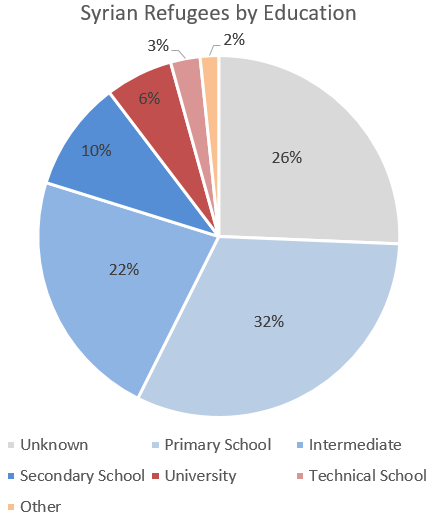
Since 43 percent of the Syrian refugees are under the age of 14, and 56 percent are under 20, Syrian refugees tend to be less educated. 9.4 percent have a technical, university, college, or graduate school level of education. Since the refugee flow skews young, this group should become more educated as they age.

syrian-education

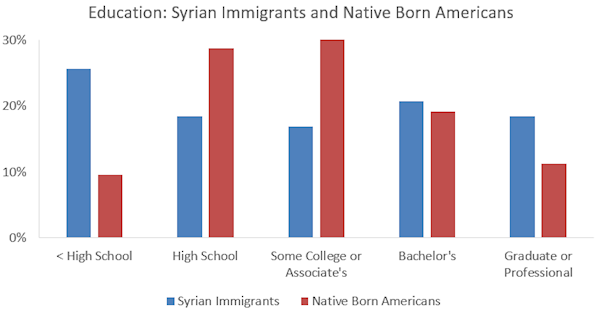
Adult Syrian Americans — over age 25 and born in Syria — are more educated than the current refugee flow.

Overall, Syrian Americans are both more and less educated than the population as a whole. 44 percent of Syrian immigrants have just a high school diploma or less, compared to 38 percent of native born Americans, but 39 percent of Syrian Americans have a bachelor’s degree or higher, compared to 30 percent of the native born.

syrian-vs-american-ed

Sources: American Community Survey, 2014, 1-Year Sample, S0501 and S0201 Syrians

Location

Syrians resettled in the United States are highly concentrated in a few states.

Six states (CA, TX, MI, IL, AZ, and PA) have together received more than half of Syrian refugees.

syrian-state

Twenty states (AR, CO, ID, IN, KS, LA, ME, MD, MN, MO, NV, NH, NM, OK, OR, TN, UT, VA, WA, and WV) have received fewer than 50 refugees.

Fourteen states (AL, AK, DE, HI, IA, MS, MT, NE, ND, RI, SC, SD, VT, and WY) and Washington, DC, have not received any.

Alex Nowrasteh is the immigration policy analyst at the Cato Institute’s Center for Global Liberty and Prosperity.

This article was originally published by The Foundation for Economic Education.

A Multifaceted Strategy to Defeat ISIS – Article by G. Stolyarov II

A Multifaceted Strategy to Defeat ISIS – Article by G. Stolyarov II

The New Renaissance HatG. Stolyarov II
November 15, 2015
******************************

The recent slaughters of hundreds of innocent civilians in Paris, in Ankara, in Beirut, and aboard the Russian Metrojet Flight 9268 illustrate without a shadow of doubt that the threat from the barbaric sect known as ISIS, ISIL, Daesh, and the Islamic State cannot be contained within the Middle East. ISIS is an enemy of humanity, decency, and Western civilization. It will continue killing completely peaceful civilians of Western nations, both in their home countries and abroad, in gruesome ways. ISIS is a cancer upon humanity, and it will continue to metastasize and inflict damage until it is either eradicated or until it completely kills its host. Like cancer, ISIS cannot coexist with a healthy humankind. This cancerous “Islamic State” should be eradicated using the resources of any willing parties.

Now is the time to put aside petty rivalries, animosities, and power politics among advanced nations. All of Western civilization – indeed, the entire world – needs to stand with the people of France and recoil at the atrocities perpetrated against the victims of the Paris attacks of November 13, 2015. There can be no excuses and no apologies for the perpetrators. Anti-modern fundamentalist savagery must be condemned, and the innocent should be mourned. Western civilization needs to send a unified signal that it will have no tolerance for murderous intolerance.

eiffel-tower-303341_1280A concerted, multifaceted strategy is needed to eliminate ISIS while preserving the Enlightenment values which ISIS threatens: liberty, humanism, secularism, tolerance, and progress. No single measure will succeed in solving this dire problem, but a combination of approaches can dramatically reverse the current predicament of Western civilization suffering setback after setback due to the rampages of a relatively small group of barbarians. The representatives of Western civilization should mount a decisive, unapologetic response that not only physically destroys ISIS but also eliminates the societal, economic, and cultural preconditions for its emergence.

If I had the ability to set the United States’ policy for eliminating the ISIS menace, I would institute the measures described below as expeditiously as possible. I estimate that, within approximately one year of the implementation of these measures, ISIS would be completely destroyed, and the probability of any successor organizations emerging would be rendered negligible through the continued application of these approaches.

(1) Setting Aside Foreign-Policy Differences: ISIS threatens everyone – citizens of France, Russia, Turkey, Iran, and the United States, to name just a few. Now is the time to pursue complete cooperation among the governments of countries which have a compelling interest to eradicate ISIS. To achieve such cooperation, the United States government should send a strong signal that all other foreign-policy differences are relatively unimportant and will be overlooked. For instance, with regard to Russia, the United States should openly renounce all strategic ambitions in Ukraine and all intentions to depose the Syrian regime of Bashar al-Assad. The cessation of the demonization of Russia over the Ukrainian civil war (where there is truly no good side) would serve as a major sign to Vladimir Putin of the United States’ goodwill and desire to collaborate on a true existential threat to Western civilization. As for Assad, he – for all of his despicably dictatorial behavior – is an enemy of ISIS, and ISIS would not have emerged had the United States not previously funneled weapons and training to anti-Assad rebels, who either were quickly overwhelmed by the more ruthless ISIS or themselves joined ISIS. For ISIS to be eradicated, Syria’s civil war must end, and peace and order must be restored. Assad may be a dictator, but he does not instigate hostage-takings and mass murders in European cities. Likewise, the United States government should welcome support from Iran in combating the ISIS presence within Iraq. ISIS is a fanatically intolerant Sunni Muslim sect that poses as much of a threat to the Shiite Muslim theocracy of Iran as it does to non-Muslim “infidel” Westerners. A collaborative effort to defeat ISIS would also help to defuse tensions between the United States and Iran by demonstrating to the Iranian regime that the United States does not have imminent intentions to “preemptively” attack Iran out of the (largely unfounded) fear of the continued development of Iran’s nuclear program.

2000px-France_Flag_Map.svg(2) Targeted Multinational Expeditionary Force: It is possible that France will invoke Article 5 of the North Atlantic Treaty, which pledges other members of NATO to come to its defense as a result of the attack by ISIS against French civilians on French soil. While I question the wisdom of the continuation of the NATO arrangement generally, it may be useful for achieving a coordinated response to the ISIS threat in particular. Furthermore, all willing non-NATO powers, including Russia and China, should be invited to take part in the response. ISIS has murdered citizens of the United States, the United Kingdom, Japan, France, Turkey, Russia, and many other countries. Every country can claim with some justification that ISIS is waging war upon its people.

The key for a successful international response against ISIS is to target the response against the actual, known members of ISIS and to minimize damage to innocent civilians. Instead of indiscriminate aerial bombing campaigns or conventional military offensives, a far superior tactic would be to assemble multinational teams of highly trained commandos who would infiltrate key ISIS bases and assassinate the leaders of ISIS, while also sabotaging ISIS’s logistical systems and preventing ISIS from obtaining weaponry and other materiel required for continuing military operations. No civilians should be caught in the crossfire. Instead, the multinational commando teams should actively recruit local residents, who are suffering under the yoke of ISIS in Syria and Iraq, into auxiliary roles. The support of locals could assist with obtaining more reliable on-the-ground intelligence and also in building goodwill for the ouster of ISIS from the communities it currently terrorizes.

While this expeditionary force should be completely friendly to local civilians, it should be completely merciless toward any ISIS fighters. Anyone who has fought and killed on ISIS’s behalf has renounced his right to life by depriving others of their lives in horrific ways. The expeditionary force should be authorized to execute confirmed ISIS fighters, but not to torture or humiliate them. This restraint from savage behavior would illustrate the stark moral contrast between the West and ISIS. ISIS has engaged in outrageous acts of perversion – essentially committing every type of violation of human beings imaginable. The West needs to show that its representatives will only use deadly violence in retaliation and only against those who initiated its use – and even then in a surgical, professional manner necessary to eliminate the threat but to go no further. Moreover, anyone who provides physical support to ISIS but does not directly perpetrate violence, should be arrested and subjected to an on-the-ground military tribunal aimed at procuring a swift determination of guilt or innocence and a proportional punishment in the event of guilt – instead of the prolonged limbo that has characterized American detention facilities of terrorism suspects in the past.

(3) Replacing Bombs with Information: The drone killings perpetrated by the Obama administration during this decade have inflamed the ire of anti-Western militants and have radicalized large segments of the Middle East in reaction to indiscriminate killings of civilians via “signature strikes” that presuppose that any men in their prime are terrorist militants. The problem is not with the drone technology, but rather with the payload that it carries. If bombs and missiles are replaced with informational leaflets, USB drives, and small samples of the material abundance of Western civilization, then this more benevolent use of drones can help convince Middle Eastern residents that ISIS is the path toward suffering, whereas embracing modernity and Western values would be the path toward universal prosperity and happiness. The more Middle Eastern residents find out about Western technologies, philosophies, and opportunities made available within a free, tolerant, hyper-pluralistic society, the less inclined they will be to embrace a Dark-Age mentality of brutally enforced homogeneity.

(4) Elimination of Indiscriminate Surveillance; Escalation of Targeted Surveillance: The indiscriminate electronic surveillance perpetrated by Western governments – particularly those of the United States and the United Kingdom – against their own populations, has clearly not helped to prevent murderous terrorist attacks. Instead, surveilling everyone not only grossly violates individual liberty, but also dissipates the limited resources that could more effectively be prioritized toward known troublemakers. All mass surveillance should cease, but efforts at sophisticated, targeted surveillance of individual terrorism suspects should be escalated. The surveillance itself can be sufficiently surgical as to be non-intrusive to the daily lives of those being surveilled, as long as no imminent threat exists, but should enable a swift response if any plans to do harm are discovered. Surveillance should be focused exclusively on the following categories of individuals: (1) those known to have organizational ties with ISIS, al-Qaeda, or other Islamist terrorist groups; (2) those who, in any medium, espouse militant Islamic fundamentalist views, including anyone who asserts that it is acceptable to kill in the name of Islam; and/or (3) those who originate from majority-Muslim countries and have violent criminal records. This targeted surveillance would not constitute racial or religious profiling, since all peaceful and respectable Muslims (those whose views are compatible with modern Western civilization), as well as peaceful non-Muslim emigrants from majority-Muslim countries, would be spared any surveillance. However, any Islamic fundamentalist who believes in the acceptability of religiously motivated killings, as well as any person connected to the terrorist organizations or known to have committed violent crime that might have any relation to Islamist convictions or influences, should be subjected to additional scrutiny to enable the development of an accurate and comprehensive understanding of the sources of risk facing the Western world. Most importantly, it is time to jettison the political correctness that subjects any non-Muslims to this preemptive surveillance. The threat is one of Islamic fundamentalist terrorism. Non-Muslims are not part of the threat by definition and could not possibly be allies or associates of ISIS. Emphatically, this is not to say that all Muslims are part of the threat; rather, it is simply to recognize that surveilling non-Muslims is a waste of resources as well as a hyper-intrusive violation of the liberties of completely innocent people. The following diagram illustrates the simple insight that could channel limited surveillance capabilities toward detecting actual threats.

Diagram of Possible Sources of Threats of Islamist Terrorism

Surveillance_Threat_Diagram(5) Technological and Economic Transformation of the Middle East through Innovation and Freedom of Exchange: Organizations like ISIS are only able to emerge in a deeply backward cultural, societal, and economic environment, where the embrace of violent, totalitarian seventh-century dogmas could appear even remotely attractive to an uneducated populace with miserable future prospects. Only by a fundamental modernizing, Westernizing transformation can the Middle East escape its current status as a fertile breeding ground for violent fundamentalist criminals. Only by seeing the West as a source of enlightenment and economic prosperity can the populations of the Middle East cease viewing ISIS and similar groups as bulwarks against a perceived Western threat. Therefore, Western governments should lift all political barriers to the free flow of goods and ideas between Western and Middle Eastern countries. All sanctions, embargoes, tariffs, and quotas should be abolished, and the way cleared for the import of technologies and products, as well as the establishment of major branches of Western companies in Middle Eastern countries. In particular, emerging technologies that have the potential to vastly alleviate material scarcity should be encouraged. Biotechnology, including genetic modification, is particularly promising in this respect. As futurist B.J. Murphy pointed out, in response to my analogy between ISIS and cancer, “Like cancer, [which] lately we’ve been using gene editing techniques to finally start punching holes into its existence, maybe we’ll begin using those same techniques to effectively combat against ISIS – genetically modified soldiers to fight, genetically modified crops to combat hunger and malnutrition, and a genetically modified ecosystem to combat poverty.” In a strategy that would constitute the opposite of erecting trade barriers, Western governments should become agents of economic liberalization. They should actively pressure Middle Eastern regimes to accept the importation of genetically modified crops and to amend local laws to permit cutting-edge biotechnological research and experimentation. As a pathway toward economic prosperity, majority-Muslim Middle Eastern nations should emulate an outlier in their region – Israel. Despite its relatively tiny size and the near-constant hostilities in its vicinity, Israel has prospered through the tremendous innovativeness and technological capital of its people. It is an example of how to thrive by cultivating an advanced, technologically oriented economy.

(6) Preserving Individual Liberty at Home: The multifaceted efforts to eradicate ISIS should have absolutely no effect on the freedoms and opportunities available to Americans and other residents of Western nations. It is necessary to decisively illustrate just how unlike the totalitarian ideal of ISIS the Western world is. If those who claim that the Islamist fanatics “hate us for our freedoms” have a grain of truth to their statement, then it is all the more imperative to proudly assert those freedoms, instead of suppressing them in the name of “security” or avoiding offense. Western governments should explicitly reaffirm the protection of free speech and the absolute freedom of individuals to engage in anti-religious expression. The US Congress should pass a resolution strongly supporting the right of any individual to “blaspheme” against any religion, for any reason – justified or not. All blasphemy laws in all Western countries should be repealed, and all politicians should take an explicit stand in favor of tolerance for “blasphemous” speech, no matter whom it might offend. As with the shift from mass to targeted surveillance, all screenings at airports, border crossings, and other mass-transit locations should focus away from the general population and toward Islamist fundamentalist fanatics and likely terror suspects. As a result of this refocusing of resources, for every single suspected Islamist plot, a team of police and intelligence experts should be constantly aware of the status of the threat and prepared to launch a sophisticated response with minimal or no disruption to the general public. Everyone else should be enabled to lead peaceful, dignified lives where the government does not violate the physical bodies or private information of the innocent – similar to the situation for most people in Western countries during the late 1990s.

A successful campaign to defeat ISIS would need to achieve a short-term goal and a long-term goal. The short-term goal – the physical eradication of ISIS – can be accomplished within a year if major world powers set aside their foreign-policy differences and deploy a merciless but scrupulously moral expeditionary force, combined with a powerful informational campaign that transforms tools of destruction into vehicles of Enlightenment. The long-term goal is the modernization and Westernization of the Middle East – the emergence of widespread economic prosperity and major technologically driven uplifting of living standards. The secularization of Middle Eastern governments and the development of more tolerant, enlightened variants of Islamic theology – akin to the transformation of Christianity during the 18th-century Enlightenment in the West – should also be encouraged. To achieve this long-term goal, Western civilization must stand proud once more and cease apologizing for its technological, economic, and cultural superiority to the contemporary Middle East. As beneficial side effects of the struggle against ISIS, the Western world might rediscover the values of the Enlightenment that have been so vital to its progress to date – and reapply and disseminate these universally desirable values in a more potent, assertive form. Furthermore, standing united against ISIS will help avoid needless hostilities among the United States, Russia, China, and Iran and thereby strengthen the prospect for peaceful coexistence among all who value it.

This essay may be freely reproduced using the Creative Commons Attribution Share-Alike International 4.0 License, which requires that credit be given to the author, G. Stolyarov II. Find out about Mr. Stolyarov here.

When You’re Popular, You Don’t Need Freedom of Speech – Article by Andrew Syrios

When You’re Popular, You Don’t Need Freedom of Speech – Article by Andrew Syrios

The New Renaissance Hat
Andrew Syrios
November 9, 2015
******************************

Free speech is not something that people would normally see as a realm of economics, but in many ways, an economic understanding of the support and opposition to free speech can shed a lot of light on what’s happening now in the West.

The first thing that needs to be noted is that the left is winning the culture war. Even though more people identify as “conservative” than “liberal” in the United States, more people now identify as “liberal” than in the past by a substantial margin. Attitudes toward gay marriage shifted extremely quickly toward the left while support for legal abortion stayed mostly steady. And obviously the media, academia, and Hollywood are far to the left as a study by the non-partisan political analytics firm Crowdpac found (and as anyone who watches anything other than Fox News can tell after about five minutes).

Now, some of this is certainly good, such as the shifting views on marijuana legalization. Some is troubling, such as the growing popularity of socialism.

Regardless though, the left, having ascended to cultural dominance, is no longer in need of free speech. After all, no one ever got in trouble for agreeing with the conventional wisdom. As Noam Chomsky said, “Even Goebbels was in favor of free speech he liked.”

On the other hand, the right is behind the eight ball in the culture wars and thereby supports the concept of free speech because they need it lest their very opinions be outlawed. In an economic sense, this could be called the “diminishing marginal utility of free speech.”

The law of diminishing marginal utility states that while keeping consumption of other products constant, there is decline in marginal utility that a person derives from consuming an additional unit of that product. In this case, the product is free speech. New leftists may have proposed unfettered free speech back in the early 1960s, but that was just because the right was the one in power culturally at the time. Free speech had a high utility to the left at the time and low utility to the right.

Now the situation has reversed. The right is at the disadvantage so it appeals to free speech. The left is ahead and no longer needs free speech, so it has discarded it.

If that statement sounds hyperbolic, just think of all of the campus speech codes and the ever expanding list of mostly trivial microagressions that can be taken for “hate speech.”  Here is just a small sampling of examples to illustrate how absurd this has become:

  • Brendan Eich was forced to resign as CEO of Mozilla after a massive backlash for having opposed gay marriage.
  • A candidate in the European elections was arrested in Britain for quoting a passage from Winston Churchill about Islam.
  • Gert Wilders, a politician in the Netherlands, was tried on five counts including “criminally insulting Muslims because of their religion.”
  • Conservative radio host Michael Savage was banned from the airwaves in Britain.
  • Both Mark Steyn and Ezra Levant were dragged in front of the Canadian Human Rights Commission on charges of being “Islamophobic.”
  • A man was fired because someone eavesdropped on his joke about dongles and caused a fuss about it on social media.
  • A group called Color of Change applied enough pressure to get Patrick Buchanan fired from MSNBC for expressing politically incorrect opinions in his book Suicide of a Superpower.
  • The “Pickup Artist” Julien Blanc was barred from entering Britain for making sexist comments.
  • A student at Purdue University was found guilty of “racial harassment” for reading (yes, reading) a book called Notre Dame Vs the Klan in which — it should be noted — the Klan is the bad guy.

Indeed, the list goes on endlessly, and is perhaps best summed up by the almost unconscionable lack of self-awareness required by University of Manchester feminists who recently censored the anti-feminist columnist Milo Yiannopoulos from participating in a debate on — you guessed it — censorship.

Of course much of this is just social pressure or the decisions of private institutions, which is permissible (albeit not condoned) under a libertarian framework. But much of it does involve outright government force, or the longing to use it. For example, Adam Weinstein wants to literally “Arrest Climate-Change Deniers.”

Indeed, while many believe that the youth of today are the most politically tolerant in history, they are actually the least. As April Kelly-Woessner notes, “political tolerance is generally defined as the willingness to extend civil liberties and basic democratic rights to members of unpopular groups.” Which groups are unpopular, is not the question being asked.

So, for example, someone who believes that a man should be able to marry his pet goat is not necessarily politically tolerant. What would make him tolerant in this sense is whether he is willing to recognize the rights (particularly regarding speech) of those who disagree with him and his marital proclivities.

In this respect, political tolerance has declined substantially. For the first time since it was measured, the political tolerance of young people has fallen below that of their parents and as Kelly-Woessner again notes, “… is correlated with a ‘social justice’ orientation,” at least for those under forty.

Indeed, the inability to tolerate political views that run counter to one’s own, particularly on the left, has become so ridiculous to be comical. Just take, for example, Judith Shulevtiz’s description of the “safe space” set up at Brown University because of a debate between the feminist Jessica Valentia and Wendy McElroy where McElroy was likely to criticize the term “rape culture.”

The safe space … was intended to give people who might find comments “troubling” or “triggering,” a place to recuperate. The room was equipped with cookies, coloring books, bubbles, Play-Doh, calming music, pillows, blankets and a video of frolicking puppies, as well as students and staff members trained to deal with trauma.

Well, at least they actually let the debate happen.

But the left has not always had a monopoly on anti-free speech thought and legislation. Nor does the right seem to be opposed to it when it can push such things through today. Helen Thomas was fired from the White House Press Corps for saying “The Jews should get the Hell out of Palestine.” Shirley Sherrod was fired for allegedly anti-white statements, a Kansas woman was fired for a fifty-word Facebook post that was considered anti-American-soldier, and the right went into a fervor over Jeremy Wright’s “chickens coming home to roost” comment.

Whereas liberals want to ban words such as “slut” and, at least in Sheryl Sandberg’s case, “bossy” too, conservatives used to all but ban those “seven words you couldn’t say.”

When the right had more cultural authority, alleged communists were being dragged in front of the House Committee on Un-American Activities, Civil Rights activists were harassed, and the Motion Picture Production Code banned Hollywood directors from showing things such as miscegenation.

But that was then and this is now. As the pendulum of cultural prominence swung from one side to the other, the left and right swapped their support for free speech.

Nevertheless, I don’t want to draw a false equivalence here and say the right would be just as bad as the left if they were winning the culture wars. Much of the ideology on the left, at least the far left, is derived from the likes of Herbert Marcuse and other cultural Marxists who explicitly wanted to limit the free speech of “oppressor classes.”

Discerning what exactly free speech is can sometimes be challenging, as in cases of libel, slander, and direct threats. But these are really not the issues at heart here. The vast majority of speech being “regulated” today is simply that of an unpopular opinion. Yes, many ideas are bad. And they should be refuted. Moreover, resorting to the use of political force to silence adversaries is a sign of the weakness of one’s own position. But, in using force to silence others, anti-speech crusaders are making another argument. They’re arguing that political force can and should be used to silence people we don’t like. What idea could be worse than that?

Andrew Syrios is a partner in the real-estate investment firm Stewardship Properties. He graduated from the University of Oregon with a degree in Business Administration and a Minor in History.

This article was published on Mises.org and may be freely distributed, subject to a Creative Commons Attribution United States License, which requires that credit be given to the author.

Does the Bell Toll for the Fed? – Article by Ron Paul

Does the Bell Toll for the Fed? – Article by Ron Paul

The New Renaissance HatRon Paul
November 9, 2015
******************************
Last week Federal Reserve Chair Janet Yellen hinted that the Federal Reserve Board will increase interest rates at the board’s December meeting. The positive jobs report that was released following Yellen’s remarks caused many observers to say that the Federal Reserve’s first interest rate increase in almost a decade is practically inevitable.

However, there are several reasons to doubt that the Fed will increase rates anytime in the near future. One reason is that the official unemployment rate understates unemployment by ignoring the over 94 million Americans who have either withdrawn from the labor force or settled for part-time work. Presumably the Federal Reserve Board has access to the real unemployment numbers and is thus aware that the economy is actually far from full employment.

The decline in the stock market following Friday’s jobs report was attributed to many investors’ fears over the impact of the predicted interest rate increase. Wall Street’s jitters about the effects of a rate increase is another reason to doubt that the Fed will soon increase rates. After all, according to former Federal Reserve official Andrew Huszar, protecting Wall Street was the main goal of “quantitative easing,” so why would the Fed now risk a Christmastime downturn in the stock markets?

Donald Trump made headlines last week by accusing Janet Yellen of keeping interest rates low because she does not want to risk another economic downturn in President Obama’s last year in office. I have many disagreements with Mr. Trump, but I do agree with him that the Federal Reserve’s polices may be influenced by partisan politics.

Janet Yellen would hardly be the first Fed chair to allow politics to influence decision-making. Almost all Fed chairs have felt pressure to “adjust” monetary policy to suit the incumbent administration, and almost all have bowed to the pressure. Economists refer to the Fed’s propensity to tailor monetary policy to suit the needs of incumbent presidents as the “political” business cycle.

Presidents of both parties, and all ideologies, have interfered with the Federal Reserve’s conduct of monetary policy. President Dwight D. Eisenhower actually threatened to force the Fed chair to resign if he did not give in to Ike’s demands for easy money, while then-Federal Reserve Chair Arthur Burns was taped joking about Fed independence with President Richard Nixon.

The failure of the Fed’s policies of massive money creation, corporate bailouts, and quantitative easing to produce economic growth is a sign that the fiat money system’s day of reckoning is near. The only way to prevent the monetary system’s inevitable crash from causing a major economic crisis is the restoration of a free-market monetary policy.

One positive step Congress may take this year is passing the Audit the Fed bill. Fortunately, Senator Rand Paul is using Senate rules to force the Senate to hold a roll-call vote on Audit the Fed. The vote is expected to take place in the next two-to-three weeks. If Audit the Fed passes, the American people can finally learn the full truth about the Fed’s operations. If it fails, the American people will at least know which senators side with them and which ones side with the Federal Reserve.

Allowing a secretive central bank to control monetary policy has resulted in an ever-expanding government, growing income inequality, a series of ever-worsening economic crises, and a steady erosion of the dollar’s purchasing power. Unless this system is changed, America, and the world, will soon experience a major economic crisis. It is time to finally audit, then end, the Fed.

Ron Paul, MD, is a former three-time Republican candidate for U. S. President and Congressman from Texas.

This article is reprinted with permission from the Ron Paul Institute for Peace and Prosperity.

The War on Cars Is a War on Workers and the Poor – Article by Gary M. Galles

The War on Cars Is a War on Workers and the Poor – Article by Gary M. Galles

The New Renaissance Hat
Gary M. Galles
November 6, 2015
******************************

A just-released poll of Los Angeles residents found that 55 percent of respondents indicated their greatest concern was “traffic and congestion,” far ahead of “personal safety” — the next highest area of concern — at 35 percent. So if their city government was working in their best interests, it would be doing something about automobile congestion.

It is. Unfortunately, it will make things worse.

Los Angeles’s recently adopted Mobility Plan 2035 would replace auto lanes in America’s congestion capital with bus and protected bike lanes, as well as pedestrian enhancements, despite heightening congestion for the vast majority who will continue to drive. Even the City’s Environmental Impact Report admitted “unavoidable significant adverse impacts” on congestion, doubling the number of heavily congested (graded F) intersections to 36 percent during evening rush hours.

Driving Saves Time and Offers More Opportunity

Such an effort to ration driving by worsening gridlock purgatory begs asking a central, but largely ignored, question. Why do planners’ attempts to force residents into walking, cycling, and mass transit — supposedly improving their quality of life — attract so few away from driving?

The reason it takes a coercive crowbar to get most people out of their cars is that automobile users have concluded cars are vastly superior to the alternatives.

Why is automobile use so desirable:

  • Automobiles have far greater and more flexible passenger — and cargo-carrying capacities.
  • They allow direct, point-to-point service.
  • They allow self-scheduling rather than requiring advance planning.
  • They save time.
  • They have far better multi-stop trip capability (this is why restrictions on auto use punish working mothers most).
  • They offer a safer, more comfortable, more controllable environment, from the seats to the temperature to the music to the company.

Those massive advantages explain why even substantial new restrictions on automobiles or improvements in alternatives leave driving the dominant choice. However, they also reveal that a policy that will punish the vast majority who will continue to drive cannot serve residents effectively.

How Restrictions on Automobiles Punish the Working Poor the Most

The superiority of automobiles doesn’t stop at the obvious, either. They expand workers’ access to jobs, increasing productivity and incomes, improve purchasing choices, lower consumer prices and widen social options. Reducing roads’ car-carrying capacity undermines those major benefits.

Cars offer a decrease in commuting times (if not hamstrung by city-government planning), providing workers access to many more potential employers and job markets. This improves worker-employer matches, with expanded productivity both benefiting employers and raising workers’ incomes.

One study found that a 10-percent improvement in travel time raised worker productivity 3 percent. And increasing from a 3 mph walking speed to 30 mph driving speed is a 900-percent increase. In a similar vein, a Harvard analysis found that for those lacking high-school diplomas, owning a car increased monthly earnings by $1,100.

Cars are also the only means of assembling enough customers to sustain large stores with highly diverse offerings. Similarly, “automobility” dramatically expands the menu of social opportunities that are accessible.

Supporters like Los Angeles Mayor Eric Garcetti may dismiss the serious adverse effects of the “road diets” they propose (a term whose negative implications were too obvious, getting it benched in favor of the better-sounding “complete streets”). But by demeaning cars as “the old model” and insisting “we have to have neighborhoods that are more self-contained,” the opponents of auto use do nothing to lessen the huge costs or increase the very limited benefits they plan to impose on those they supposedly represent.

Further, the “new model” of curtailing road capacity to force people out of cars is really a recycled old far-inferior model. As urban policy expert Randal O’Toole noted in The Best-Laid Plans:

Anyone who prefers not to drive can find neighborhood … where they can walk to stores that offer a limited selection of high-priced goods, enjoy limited recreation and social opportunities, and take slow public transit vehicles to some but not all regional employment centers, the same as many Americans did in 1920. But the automobile provides people with far more benefits and opportunities than they could ever have without it.

Gary M. Galles is a professor of economics at Pepperdine University. He is the author of The Apostle of Peace: The Radical Mind of Leonard Read. Send him mail. See Gary Galles’s article archives.

This article was published on Mises.org and may be freely distributed, subject to a Creative Commons Attribution United States License, which requires that credit be given to the author.