Browsed by
Category: Politics

Liberty or Death: Why Libertarians Should Proclaim That Death is Wrong – Article by G. Stolyarov II

Liberty or Death: Why Libertarians Should Proclaim That Death is Wrong – Article by G. Stolyarov II

The New Renaissance Hat
G. Stolyarov II
March 14, 2014
******************************

Do you wish to actually live in a free society, rather than just ponder what one would be like? For some, the desire to live in liberty is so strong that they would echo Patrick Henry’s immortal words, “Give me liberty or give me death!” More than just those words should be immortal; in fact, you should be. Without intending it, Patrick Henry communicated a truth that is becoming increasingly apparent in our era: we can one day be truly free if humans achieve indefinite life extension; without it, we will be both unfree and eventually dead. Within our lifetimes, we will either have liberty and no death, or death and no liberty. We cannot have both liberty and death.

Death is Wrong is my new children’s book on indefinite life extension, beautifully illustrated by my wife Wendy Stolyarov.  The book is an educational primer which presents, in a concise, accessible manner the philosophical desirability and scientific feasibility of lifting the upper limit on human lifespans through the application of science and medical technology. We are currently in the midst of an Indiegogo fundraiser to spread this book to 1000 children, free of cost to them.  Death is Wrong does not take any political positions and does not advocate specifically for libertarianism, since we seek to focus on life extension in the book and to attract as universal a base of support as possible. It is certainly feasible to hold almost any political persuasion and to advocate the radical extension of human lifespans. Yet I, as a libertarian, see the defeat of senescence through medical progress to be an indispensable component to achieving liberty.
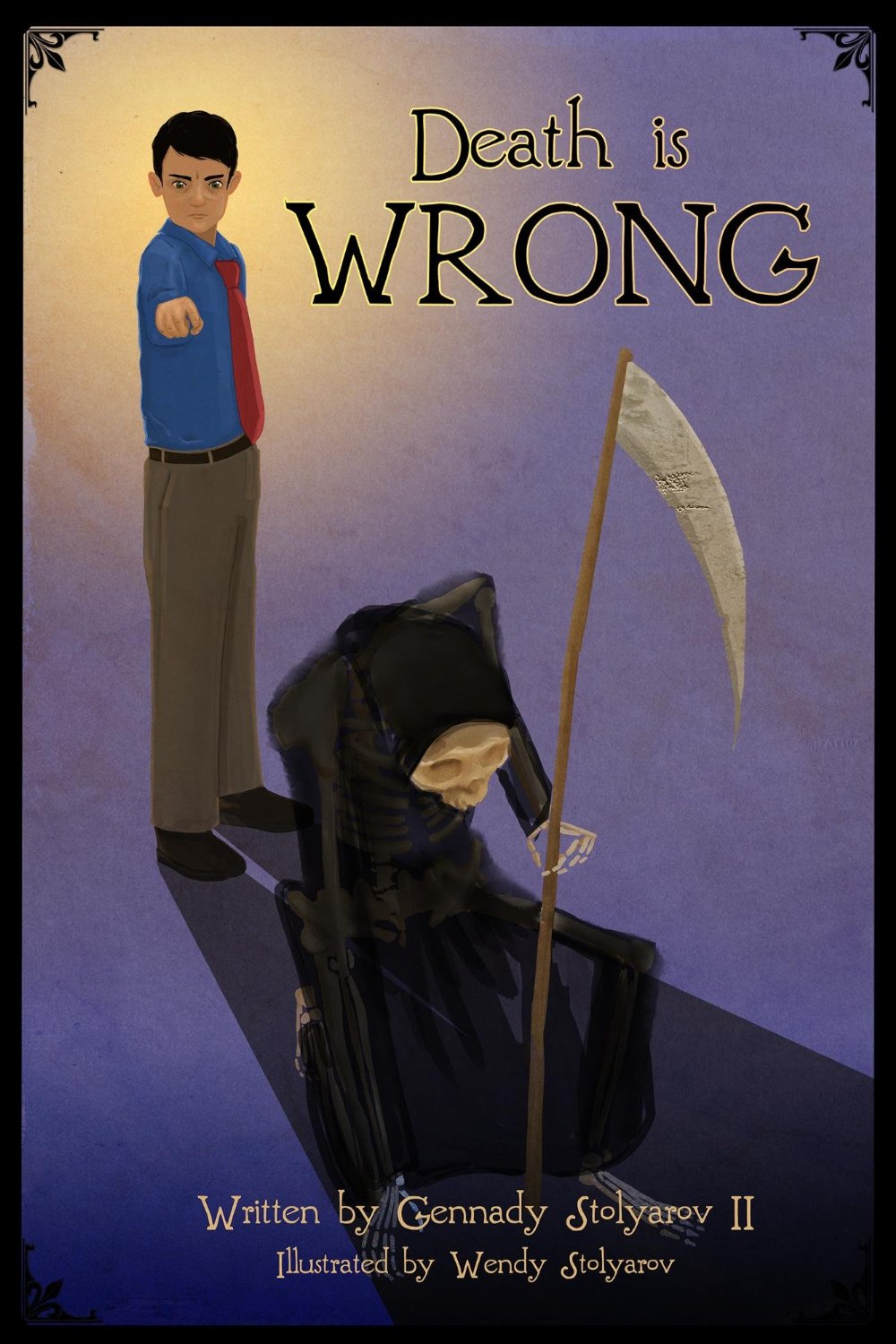
Death is Wrong - by Gennady Stolyarov II, Illustrated by Wendy Stolyarov

The U.S. Declaration of Independence proclaims that humans have the rights to life, liberty, and the pursuit of happiness. While the right to life is a negative right – the right not to have others infringe on one’s life – it is nonetheless indisputable that the positive condition of life is the prerequisite for the exercise of any kind of liberty and the pursuit of any kind of happiness. If one is dead, there is nothing – no choice, no growth, no self-actualization – and not even a memory of any past deed or previous fulfillment of one’s goals. Without life, liberty is impossible, and yet biological decay propels us all toward the loss of the very potential for liberty. Death obliterates everything: our precious individual universes, full of sensations, insights, thoughts, and aspirations are forever snuffed out, deprived of the possibility of ever fulfilling any goal or actualizing any ideal.

In “Liberty Through Long Life” – written in April 2013 – I described the possibilities for improving the prospects of liberty just on the horizon, facilitated by accelerating technological progress – from emerging methods of online education to cryptocurrencies to seasteading and space colonization. I explained that libertarians should want to live as long as possible in order to see and benefit from the fruits of these tremendous innovations.

Just two months after I wrote “Liberty Through Long Life”, most of us in the Western world found out just how unfree we truly were. Especially in the aftermath of Edward Snowden’s revelations that the U.S. National Security Agency and its counterparts in many Western countries are spying indiscriminately on hundreds of millions of innocents, it has become apparent that the political struggle for liberty in today’s climate has encountered barriers that appear, at present, virtually insurmountable. I am not referring to failure to achieve the libertarian political ideal or even a directional approach toward such an ideal – despite the ardent, passionate, unquestionably dedicated work that activists for liberty have done during and between the past several election cycles. The situation today is worse than that. Even abolishing the Orwellian spying apparatus and penalizing those officials who concealed and then endorsed it appears to be seen as out of the question by the political elite, no matter how great the pressure from the public and how completely useless the mass spying has turned out to be. More than ten months after Snowden’s revelations, all of the powerful people who orchestrated the mass surveillance remain in their offices, and Snowden is a fugitive in Russia. Now it has even been disclosed that the NSA has devised programs to harvest data from private hard drives, webcams, and microphones by infecting personal computers with malware in mass. Can we expect to see an end to what we would have, just one year ago, considered an unimaginably intimate surveillance – or, more likely, will the gatekeepers of the current political order assemble all of their power in the effort to perpetuate it? Achieving mere non-perversity – not to mention liberty – as an immutable principle for contemporary Western political arrangements to follow, would appear to be a Herculean task.

Yet I do not intend to undermine hope. Eventually the world improves, and old oppressions dwindle away. Yet “eventually” can be a long time. It took millennia to put an end to the legal institution of slavery, and during the early 18th century it seemed firmly rooted in the Western world. Yet forward-thinking outliers – from the Quakers to the Enlightenment philosophes – recognized its depravity and articulated the moral case for abolition back when slave labor seemed to be inextricably integrated into the most influential economies and systems of production. William Lloyd Garrison, the great 19th-century abolitionist, recognized that the push to end slavery as soon as possible was necessary to see it ended at all. He wrote, “Urge immediate abolition as earnestly as we may, it will, alas! be gradual abolition in the end. We have never said that slavery would be overthrown by a single blow; that it ought to be, we shall always contend.” [1] Slavery was ultimately abolished through a long sequence of often highly sub-optimal steps – but, were it not for the uncompromising immediate abolitionism of people like Garrison, it might not have been abolished at all, or at least would have been abolished much later. If we argue for liberty today, it will still likely take decades of the most ardent advocacy and activism to undo the harms caused by ongoing and escalating infringements of every natural and constitutional right of even the most law-abiding citizens. Therefore, while I support every effort – conventional or radically innovative – to move our societies and governments in the direction of liberty, it is essential to recognize that the success of such efforts will take an immense amount of time. If you do not remain alive during that time, then you will die without having known true liberty.

Yet we should urge not just the immediate abolition of oppression – but also of death itself. The forward-thinking outliers today – thinkers in the transhumanist and life-extension movements – recognize that transitioning from today’s medical system to one in which humans could achieve longevity escape velocity – where every year lived increases life expectancy by more than one year – will likely take decades of the most dedicated efforts in research and advocacy. Dr. Aubrey de Grey of the SENS Research Foundation, one of the foremost advocates of indefinite life extension, thinks that there exists a 50% chance of reaching longevity escape velocity in 25 years, with adequate funding. Yet, in order to catalyze the culture to embrace, or at least not oppose, the research projects and medical therapies needed, the sentiment that the abolition of death for innocent humans is desirable yesterday is imperative. This is a sentiment with which libertarians can find a close kinship, for they know well the desire for liberty to be here yesterday. This does not mean that we should forsake long-term plans or disdain incremental improvement in lifespans or medical treatments. Quite the contrary, the achievement of the great goal of preserving each innocent life will be made out of a long sequence of such incremental improvements that will save an increasing proportion of people with each new feat of progress. But we should also strive to greatly accelerate progress in biogerontological research and medicine, so that the breakthroughs can come in time to save us and those whom we cherish.

Educating the next generation to work with full dedication toward both liberty and immensely longer lifespans is a key component of this new abolitionism of the 21st century. Every bit of liberty achieved for medical innovators and cutting-edge researchers in biotechnology and nanotechnology will be a boon to the rate of progress. Every bit of lifespan extension will give activists for liberty more time to reverse Western political systems’ gallop toward totalitarianism, or to develop innovative workarounds that bypass the political systems altogether. Death is Wrong breaks with the prevalent traditional approaches of teaching children about death – approaches which either attempt to justify death through arguments that devalue the moral worth of human life entirely, or else endeavor to persuade children to resign themselves to an inevitable if regrettable end and to fill their time with other pursuits to get the thought of death out of their minds.  Instead, the book confronts the predicament of human mortality head on and shows young readers that death is neither insurmountable nor just; instead, it can be defeated, albeit with great effort. My hope is that enough young minds will be motivated by Death is Wrong to acquire the skill sets in science, philosophy, and advocacy needed to accelerate the arrival of indefinite longevity. More generally, I hope that the book will challenge children to break from conventional packages of thinking and engage every single idea critically and actively, eventually arriving at practical and moral worldviews based on principles that correspond to reality rather than the surrounding majority opinion.

Every day approximately 150,000 humans die throughout the world – 100,000 of them from diseases of senescence. Every day by which we can hasten the arrival of indefinite longevity, at least 100,000 precious individual universes will be preserved and will be able to join us in contributing their ideas and actions toward a free, just, humane society that respects and protects the rights of every individual. The contribution of indefinite life extension to human survival rates will likely even be beyond the gains reached solely due to medical progress. As I explained in “Life Extension and Risk Aversion”, the longer people’s lifespans and time horizons become, the more conscientiously they will seek to avoid or diminish physical hazards that could deprive them of hundreds or thousands of years of expected life. Exceptionally long-lived humans will work with far more intensity to reduce the prevalence of accidents, infections, natural disasters, crimes, wars, and – yes – politically motivated physical harm. A society comprised of such young supercentenarians would quickly become one of libertarians.

Libertarians can help by joining the movement for indefinite life extension and supporting the fundraiser to spread Death is Wrong to 1000 children – the next generation whose work may well enable us all to live in true liberty one day. May we have liberty – and defeat death!

[1] Quoted in William H. Pease and Jane H. Pease, eds., The Antislavery Argument (Indianapolis: Bobbs-Merrill Co., 1965), p. xxxv.

Charity, Compulsion, and Conditionality – Video by G. Stolyarov II

Charity, Compulsion, and Conditionality – Video by G. Stolyarov II

Libertarians’ opposition to coercive redistribution of wealth does not mean that they are opposed to charitable giving that improves people’s lives.

In this video, Mr. Stolyarov analyzes why private charities are more effective in benefiting their intended recipients than programs which involve coercive redistribution of wealth. Paradoxically, it is the extreme conditionality of many coercive welfare programs that leads them to be less effective than the voluntary decisions of diverse individuals and organizations.

References

– “The Costs of Public Income Redistribution and Private Charity” – James Rolph Edwards – Journal of Libertarian Studies – Summer 2007
– In Our Hands: A Plan To Replace The Welfare State (2006) – Book by Charles Murray

At the Fed, the More Things Change, the More They Stay the Same – Article by Ron Paul

At the Fed, the More Things Change, the More They Stay the Same – Article by Ron Paul

The New Renaissance Hat
Ron Paul
February 16, 2014
******************************
Last week, Federal Reserve Chairman Janet Yellen testified before Congress for the first time since replacing Ben Bernanke at the beginning of the month. Her testimony confirmed what many of us suspected, that interventionist Keynesian policies at the Federal Reserve are well-entrenched and far from over. Mrs. Yellen practically bent over backwards to reassure Wall Street that the Fed would continue its accommodative monetary policy well into any new economic recovery. The same monetary policy that got us into this mess will remain in place until the next crisis hits.

Isn’t it amazing that the same people who failed to see the real estate bubble developing, the same people who were so confident about economic recovery that they were talking about “green shoots” five years ago, the same people who have presided over the continued destruction of the dollar’s purchasing power never suffer any repercussions for the failures they have caused? They treat the people of the United States as though we were pawns in a giant chess game, one in which they always win and we the people always lose. No matter how badly they fail, they always get a blank check to do more of the same.

It is about time that the power brokers in Washington paid attention to what the Austrian economists have been saying for decades. Our economic crises are caused by central-bank infusions of easy money into the banking system. This easy money distorts the structure of production and results in malinvested resources, an allocation of resources into economic bubbles and away from sectors that actually serve consumers’ needs. The only true solution to these burst bubbles is to allow the malinvested resources to be liquidated and put to use in other areas. Yet the Federal Reserve’s solution has always been to pump more money and credit into the financial system in order to keep the boom period going, and Mrs. Yellen’s proposals are no exception.

Every time the Fed engages in this loose monetary policy, it just sows the seeds for the next crisis, making the next crash even worse. Look at charts of the federal funds rate to see how the Fed has had to lower interest rates further and longer with each successive crisis. From six percent, to three percent, to one percent, and now the Fed is at zero. Some Keynesian economists have even urged central banks to drop interest rates below zero, which would mean charging people to keep money in bank accounts.

Chairman Yellen understands how ludicrous negative interest rates are, and she said as much in her question and answer period last week. But that zero lower rate means the Fed has had to resort to unusual and extraordinary measures: quantitative easing. As a result, the Fed now sits on a balance sheet equivalent to nearly 25 percent of US GDP, and is committing to continuing to purchase tens of billions more dollars of assets each month.

When will this madness stop? Sound economic growth is based on savings and investment, deferring consumption today in order to consume more in the future. Everything the Fed is doing is exactly the opposite, engaging in short-sighted policies in an attempt to spur consumption today, which will lead to a depletion of capital, a crippling of the economy, and the impoverishment of future generations. We owe it not only to ourselves, but to our children and our grandchildren, to rein in the Federal Reserve and end once and for all its misguided and destructive monetary policy.

Ron Paul, MD, is a former three-time Republican candidate for U. S. President and Congressman from Texas.

This article is reprinted with permission from the Ron Paul Institute for Peace and Prosperity.

Majoritarian Processes versus Open Playing Fields – Video by G. Stolyarov II

Majoritarian Processes versus Open Playing Fields – Video by G. Stolyarov II

Putting innovation to a vote is never a good idea. Consider the breakthroughs that have improved our lives the most during the 20th and early 21st centuries. Did anyone vote for or ordain the creation of desktop PCs, the Internet, smartphones, or tablet computers?

It is only when some subset of reality is a fully open playing field, away from the notice of vested interests or their ability to control it, that innovation can emerge in a sufficiently mature and pervasive form that any attempts to suffocate it politically become seen as transparently immoral and protectionist.

All major improvements to our lives come from these open playing fields.

References
– “Putting Innovation to a Vote? Majoritarian Processes versus Open Playing Fields” – Essay by G. Stolyarov II
– “Satoshi Nakamoto” – Wikipedia
– The Seasteading Institute

Will No One Challenge Obama’s Executive Orders? – Article by Ron Paul

Will No One Challenge Obama’s Executive Orders? – Article by Ron Paul

The New Renaissance Hat
Ron Paul
February 11, 2014
******************************
President Obama’s state of the union pledge to “act with or without Congress” marks a milestone in presidential usurpation of Congressional authority.  Most modern presidents have used executive orders to change and even create laws without Congressional approval. However President Obama is unusually brazen, in that most presidents do not brag about their plans to rule by executive order in state of the union speeches.

Sadly, his pledge to use his pen to implement laws and policies without the consent of Congress not only received thunderous applause from representatives of the president’s party, some representatives have even pledged to help Obama get around Congress by providing him with ideas for executive orders. The Constitution’s authors would be horrified to see legislators actively aiding and abetting a president taking power away from the legislature.

Executive orders are perfectly legitimate and even necessary if, in the words of leading Constitutional Scholar Judge Andrew Napolitano, they “….  guide the executive branch on how to enforce a law or…complement and supplement what Congress has already done.” The problem is that most modern presidents have abused this power to issue orders that, as Judge Napolitano puts it, “restates federal law, or contradicts federal law, or does the opposite of what the federal law is supposed to do.”

Political opponents of the president rightly condemned Obama for disregarding the Constitution. However, it was not that long ago that many of the same politicians were labeling as “unpatriotic” or worse anyone who dared question President Bush’s assertions that he had the “inherent” authority to launch wars, spy on Americans, and even indefinitely detain American citizens.

Partisan considerations also make some members of the opposition party hesitate to rein in the president. These members are reluctant to set a precedent of “tying the president’s hands” that could be used against a future president of their own party.

The concentration of power in the office of the president is yet one more negative consequence of our interventionist foreign policy. A foreign policy based on interventionism requires a strong and energetic executive, unfettered by Constitutional niceties such as waiting for Congress to pass laws or declare war.  So it simply was natural, as America abandoned the traditional foreign policy of non-interventionism, for presidents to act “without waiting for Congress.” After all, the president is “commander-in-chief” and he needs to protect “national security,” they argued. Once it became accepted practice for the president to disregard Congress in foreign affairs, it was only a matter of time before presidents would begin usurping Congressional authority in domestic matters.

It should not be surprising that some of the biggest promoters of an “energetic” executive are the neoconservatives. They are also enthusiastic promoters of the warfare state. Sadly, they have misled many constitutionalists into believing that one can consistently support unchecked presidential authority in foreign policy, but limit presidential authority in domestic matters. Until it is fully understood that virtually limitless presidential authority in foreign affairs cannot coexist with strict limits on Presidential authority in domestic matters, we will never limit the power of the Presidency.

The people must also insist that politicians stop viewing issues concerning the separation of powers through a partisan lens and instead be willing to act against any president who exceeds his constitutional limitations. Thankfully we have scholars such as Louis Fisher, who has just published an important new book on presidential power, to help us better understand the Founders’ intent with regard to separation of powers. The key to achieving this goal is to make sure the people understand that any president of any party who would exceed constitutional limitations is a threat to liberty, and any member of Congress who ignores or facilitates presidential usurpation is being derelict in his Constitutional duty.

Ron Paul, MD, is a former three-time Republican candidate for U. S. President and Congressman from Texas.

This article is reprinted with permission from the Ron Paul Institute for Peace and Prosperity.

Putting Innovation to a Vote? Majoritarian Processes versus Open Playing Fields – Article by G. Stolyarov II

Putting Innovation to a Vote? Majoritarian Processes versus Open Playing Fields – Article by G. Stolyarov II

The New Renaissance Hat
G. Stolyarov II
February 4, 2014
******************************

Putting innovation to a vote is never a good idea. Consider the breakthroughs that have improved our lives the most during the 20th and early 21st centuries. Did anyone vote for or ordain the creation of desktop PCs, the Internet, smartphones, or tablet computers? No: that plethora of technological treasures was made available by individuals who perceived possibilities unknown to the majority, and who devoted their time, energy, and resources toward making those possibilities real. The electronic technologies which were unavailable to even the richest, most powerful men of the early 20th century now open up hitherto unimaginable possibilities even to children of poor families in Sub-Saharan Africa.

On the other hand, attempts to innovate through majority decisions, either by lawmakers or by the people directly, have failed to yield fruit. Although virtually everyone would consider education, healthcare, and defense to be important, fundamental objectives, the goals of universal cultivation of learning, universal access to healthcare, and universal security against crime and aggression have not been fulfilled, in spite of massive, protracted, and expensive initiatives throughout the Western world to achieve them. While it is easy even for people of little means to experience any art, music, literature, films, and games they desire, it can be extremely difficult for even a person of ample means to receive the effective medical care, high-quality formal education, and assurance of safety from both criminals and police brutality that virtually anyone would desire.

Why is it the case that, in the essentials, the pace of progress has been far slower than in the areas most people would deem to be luxuries or entertainment goods? Why is it that the greatest progress in the areas treated by most as direct priorities comes as a spillover benefit from the meteoric growth in the original luxury/entertainment areas? (Consider, as an example, the immense benefits that computers have brought to medical research and patient care, or the vast possibilities for using the Internet as an educational tool.) In the areas from which the eye of formal decision-making systems is turned away, experimentation can commence, and courageous thinkers and tinkerers can afford to iterate without asking permission. So teenagers experimenting in their garages can create computer firms that shape the economy of a generation. So a pseudonymous digital activist, Satoshi Nakamoto, can invent a cryptocurrency algorithm that no central bank or legislature would have allowed to emerge at a proposal stage – but which all governments of the world must now accept as a fait accompli that is not going away.

Most people without political connections or strong anti-free-enterprise ideologies welcome these advances, but no such breakthroughs can occur if they need to be cleared through a formal majoritarian system of any stripe. A majoritarian system, vulnerable to domination by special interests who benefit from the economic and societal arrangements of the status quo, does not welcome their disruption. Most individuals have neither the power nor the tenacity to shepherd through the political process an idea that would be merely a nice addition rather than an urgent necessity. On the other hand, the vested and connected interests whose revenue streams, influence, and prestige would be disrupted by the innovation have every incentive to manipulate the political process and thwart the innovations they can anticipate.

It is only when some subset of reality is a fully open playing field, away from the notice of vested interests or their ability to control it, that innovation can emerge in a sufficiently mature and pervasive form that any attempts to suffocate it politically become seen as transparently immoral and protectionist. The open playing field can be any area that is simply of no interest to the established powers – as could be said of personal computers through the 1990s. Eventually, these innovations evolve so dramatically as to upturn the major economic and social structures underpinning the establishment of a given era. The open playing field can be a jurisdiction more welcoming to innovators than its counterparts, and beyond the reach of innovation’s staunchest opponents. Seasteading, for example, would enable more competition among jurisdictions, and is particularly promising as a way of generating more such open playing fields. The open playing field can be an entirely new area of human activity where the power structures are so fluid that staid, entrenched interests have not yet had time to emerge. The early days of the Internet and of cryptocurrencies are examples of these kinds of open playing fields. The open playing field can even occur after a major upheaval has dislodged most existing power structures, as occurred in Japan after World War II, when decades of immense progress in technology and infrastructure followed the toppling of the former militaristic elite by the United States.

The beneficent effect of the open playing field is made possible not merely due to the lack of formal constraints, but also due to the lack of constraints on human thinking within the open playing field. When the world is fresh and new, and anything seems possible, human ingenuity tends to rise to the occasion. If, on the other hand, every aspect of life is hyper-regimented and weighed down by the precedents, edicts, compromises, and traditions of era upon era – even with the best intentions toward optimization, justice, or virtue – the existing strictures constrain most people’s view of what can be achieved, and even the innovators will largely struggle to achieve slight tweaks to the status quo rather than the kind of paradigm-shifting change that propels civilization forward and upward. In struggling to conform to or push against the tens of thousands of prescriptions governing mundane life, people lose sight of astonishing futures that might be.

The open playing fields may not be for everyone, but they should exist for anyone who wishes to test a peaceful vision for the future.  Voting works reasonably well in the Western world (most of the time) when it comes to selecting functionaries for political office, or when it is an instrument within a deliberately gridlocked Constitutional system designed to preserve the fundamental rules of the game rather than to prescribe each player’s move. But voting is a terrible mechanism for invention or creativity; it reduces the visions of the best and brightest – the farthest-seeing among us – to the myopia of the median voter. This is why you should be glad that nobody voted on the issue of whether we should have computers, or connect them to one another, or experiment with stores of value in a bit of code. Instead, you should find (or create!) an open playing field and give your own designs free rein.

To Those of You Who Are Indifferent, This Bell Is Ringing for You – Article by Tatiana Chornovol

To Those of You Who Are Indifferent, This Bell Is Ringing for You – Article by Tatiana Chornovol

The New Renaissance Hat
Tatiana Chornovol
February 4, 2014
******************************
Original Publication: Ukrainian Pravda
Translated by Olia Knight
Edited by Isis Wisdom
Source: http://blogs.pravda.com.ua/authors/chornovol/52ed347c55539/
Reprinted with permission
***
Editor’s Note: The Rational Argumentator is reprinting this article by Tatiana Chornovol in order to continue giving readers an understanding of the horrendous violations of human rights and human dignity by the regime of Viktor Yanukovych in Ukraine. The scale and tactics involved in the repression orchestrated (sometimes through informal means) by Yanukovych are unprecedented in their extent and brutality for any Slavic post-Soviet republic, and, indeed, one would have to look back to the Stalin era to find more widespread atrocities committed even during the time of the USSR. For civilization to return to Ukraine, the Yanukovych regime needs to be removed from power.
                                               ~ Gennady Stolyarov II, Editor-in-Chief, The Rational Argumentator
***

Don’t you agree that no one is safe when there is a maniac in a city? The situation in Ukraine is much worse – we have a maniac running our country and he is served by a repressive state machine that has the ability to create death squads in every city.

Maniacs are usually difficult to detect since they lead normal lives, and often have families and children. But our maniac is worse, since he does not even find it necessary to hide. In only the third year of his presidency, Yanukovych started giving orders to abduct, torture, murder, and freeze ordinary people to death with their hands tied up. For him, this is just political technologies. Besides, he plans to reign for at least two presidential terms and then hand over power by inheritance. What, then, will happen to Ukraine and us?

Those of you who are indifferent, ask yourself, are you ready to live in the country of a maniac who doesn’t even try to look like a healthy person?

If not, then you’re already late. Because we already live in this country. You just haven’t noticed it yet. Because it has not reached your turn yet, but it definitely will, even if you don’t care.

I know what I’m writing about, because I’m among those whose turn has come, I am with the people who are next in line, and I stand in this line again deliberately.

Recently, I witnessed a conversation at Automaidan headquarters. One of the participants was Yaroslav Gonchar, who escaped Berkut. He is the one of the daredevil activists who, with his own car on Obolon [district], stopped Berkut [special riot police forces] buses that were going to Maidan from Mezhyhirya [President Yanukovych’s estate residence]. Tens of Berkut officers first destroyed his car, then started beating Yaroslav and his partner. Yaroslav’s seatbelt helped him stay inside the car, in the heat of their sadistic attack Berkut could not pull him out, and beating him through the smashed windows proved ineffective. That is why he was “not completely beat up.”

The second participant is Volodymyr Maralov, who is “not completely shot up.” He is an activist from the “Road Control” group who was seized from the street by unknown thugs: they interrogated him, and then shot him through the heart. The bullet miraculously turned into the muscles and did not touch the heart.

So, the conversation was as follows: the person who was “not completely beaten up” was interested in what the person who was “not completely shot up” felt when he got shot.

The reply was interesting to me too. I admit, I was really interested, because getting shot with a bullet is now more real than going to the movies, for example. Volodymyr’s response calmed me down a bit because he said it had not hurt him much. At first it pushes you, and then you pass out. I told Volodymyr happily that when you get hit on the head, you feel something similar. Loss of consciousness saves you from the pain.

So, this is how our happy conversation went, since today in our value system, a painless death is good.

Those of you who are indifferent, just imagine what interests us, so if you stay indifferent, because of it, someday indifference will come to you too.

Understand what a terrible parallel reality we suddenly got ourselves into, we, innocent children, who played in peace and love all our lives, had ordinary responsibilities, raised children, maybe were a bit more romantic and idealistic than the majority of the population, maybe believed in dignity, honesty, and patriotism a little more… That’s why our turn came first, and in our lives it’s become commonplace, when by the order of one sadist, the maniac Victor Yanukovych, death squads beat our friends, shoot them, leave them to freeze in the forests, and buried them in graves as unidentified bodies.

In this reality it’s already perceived as a miracle, like proof of God’s existence, that Ihor Lutsenko remained alive, and that Dmytro Bulatov – is alive.

I will be honest, I had already buried Dmytro. When I went outside and felt the cruel frost, my imagination constantly drew the picture of him freezing to death in the forest. When I was told that maybe “he is in hiding,” I still imagined his frozen body covered by snow, because in my memory sounded his sincere: “I am ready to go all the way to the end,” when he came to visit me at the hospital.

That is why after Bulatov was found, I was happy and was not upset that he was tortured: “What’s important is that he is alive.”

But deep down, I am not sure about it. I do not know what is good now. Since in our reality being alive after torture might mean that the torturers will get you later. It is easy to die for the first time…

I remember when I was at Borispyl highway, experiencing numerous blows to the head, moments before I passed out I realized that it was the end. But, I was not scared, because I was ready to die in a somewhat similar manner long before this event. But I also remember thinking happily that I did not feel a strong pain from the beatings and therefore I did not risk being on my knees unconscious before the executioners. Also, it was a joyous awareness that I had done enough to get to Yanukovych even after my death.

But it is hard to die a second time…

Because everything has changed now, it is not enough to die today. It is irresponsible. We must win, which is much more difficult.

Besides, you keep worrying about friends, acquaintances, and strangers from Maidan. Because they are so valuable. This country (your children, those of you who are indifferent) needs those people who are out on Maidan alive, because these are the best people in the country. Whoever has been on Maidan knows that, there, are concentrated the most moral, responsible, intelligent, and brave, who know they cannot entrust their country and their own children to murderers, rapists, and the mafia.

And we have to win because it is our responsibility, because we are strong, because we are not afraid to sacrifice ourselves. It is widely known that people who are ready to die are worth many of those ready to kill.

However, our victory does not depend so much on our qualities but primarily on the number of those who are concerned. So, I appeal to the indifferent and the apolitical – hear, and join us.

I appeal to the military: how can you be indifferent when you gave an oath to serve Ukraine?

I understand that our officers are not always men of honor (in the army corruption and bullying are rampant), and to ask them for help is ridiculous. However, I am asking. I ask the military – realize your responsibility, and that your indifference empowers the maniac. Protect the country to which you swore an oath. Maybe this is your calling. Maybe you were born and joined the army not to take small bribes and die from alcoholism, but to save the country from the maniac and save your children (adults, young, or not-yet-born).

Indifferent people, please understand this faster and start to care. Because our numbers matter the most for a victory.

What to do? What is the plan of action?

In essence, the most important thing is to care. In this, there is work for everyone.

For example, the police tried to arrest tortured Bulatov yesterday. Is this not a good reason for masses of Kyivans to come and support him at the hospital?  However, there was a small group of people at Borys clinic yesterday. We are grateful to them, since the weather was brutal. This small group of concerned citizens looked strange against a background of lit windows in a Kyiv suburb of Poznyaky. Why don’t those who live nearby come for support? Because of their work, because of their kids, because they have to pay their rent, and because they really do not care about what’s happening on Maidan?

Thousands and thousands of indifferent people…

Recently, I used public transportation from Boryspil to Maidan for the first time since I got beaten and walked around the village. It’s a habitual route I used to take hundreds of times. However, this time I was already in a different country – anxious. I looked around at the crosswalks uncomfortably.

I was alone, since my husband and father took my friend Oleg to a hospital. “Titushky” [hired thugs] beat him on the head with baseball bats.

It happened at Cherkasy. “Titushky” jumped out at us from three cars not far from the Regional District Administration. They first attacked the men, since I was dragging my feet.

I grabbed a small cudgel from building materials by the dumpster and helped my husband to fight them off. I must confess, for the first time in my life, I was aggressive and fought the attackers with all my strength.

Then I ran to help Oleg out, three men were trying to strangle him, but I did not have enough strength for an effective attack. They grabbed me. My husband got me away from them. Oleg was on the ground. We were ashamed to run. Literally, we left our friend to his death. He was tortured. They beat him with the bat to kill, targeting his head and body. It was a miracle he survived. He had a 10 centimeter stitch on his head.

Imagine I left my friend! I left the person who protected me with his body…

I became a worse person. When criminals exploit a brutal animalistic rule of life in the country, we all become worse, much worse. We become ready for horrible things.

That is why those of you who are indifferent should not stay away when the bells are ringing. When there is still time to stop the most horrible.

Indifferent people: imagine if Yanukovych’s repressive machine breaks Maidan, then what will his caste of executioners, the death squad, do?

They will continue doing what they always do – kill. It’s a repressive machine that will only become stronger, it always needs more meat and fear.

Then you will envy us, the activists of Maidan. Because in that terrible country of Yanukovych the maniac’s, in the country of terror, thugs, cattle, and watchful eyes, we will no longer exist. We, the happy ones, will not be there.

And you – indifferent ones – will. You will be the torturers, the victims, and the majority of you will be the cattle.

Can you survive as cattle? Sure. But then you would always risk  your children’s wish to not be cattle. Then, you will lose your children, since no one else will protect them, and then you will be all alone in your indifference.

Think about it now. Then it will be too late.

How late was it in 1933 when people who did not care to fight for their independence, ate their children?

Tatiana Chornovol is a Ukrainian activist, investigative journalist, and leader in the Euromaidan protest against the regime of Viktor Yanukovych.
The Continuing Al-Qaeda Threat – Article by Ron Paul

The Continuing Al-Qaeda Threat – Article by Ron Paul

The New Renaissance Hat
Ron Paul
February 2, 2014
******************************
Appearing last week before the Senate Intelligence Committee, Director of National Intelligence James Clapper testified that he could not say the threat from al-Qaeda is any less today than it was ten years ago. It was a shocking admission. Does he mean that the trillions of dollars spent fighting the war on terrorism have resulted in no gains? That those who urged us to give up some of our liberties to gain security have, as Benjamin Franklin warned, lost both?

There may be reasons Director Clapper would want us to believe that the threat from al-Qaeda is as strong as ever. An entire industry has arisen from the government’s war on terror, and for both the government sector and the security-industrial complex the terrorist threat is big business. Economic pressure has thus far not affected the military or intelligence sectors – despite false claims that the sequestration cut military spending. However, emphasizing continued high threat levels without being able to openly explain them due to secrecy requirements is one way to keep the security budget untouched.

Also, emphasizing the continued high threat level from terrorists overseas is a good way to frighten citizens away from their increasing outrage over reports of massive domestic spying by the NSA. Unfortunately Americans may still be more willing to give up their liberties if they are told that the threats to their security remain as high as ever.

What if Clapper is telling us the truth, however? What would this revelation mean if that is the case?

For one, it means that we have gotten very little for the tremendous amount of spending on the war on terrorism and the lives lost. We are told that the military and intelligence community can protect us if they are given the tools they need, but it appears they have not done a very good job by their own admission.

More likely, it may mean that the US government’s policies are causing more al-Qaeda groups to arise and take the place of those who have been defeated by US drone and military attacks. Clapper does mention that there are so many different al-Qaeda franchises popping up it is difficult to keep track of them all, much less defeat them. But why is that? A former State Department official stated last year that every new drone strike in Yemen that kills innocent people results in the creation of 40-60 new enemies. Likewise, the young girl from Pakistan who had been brutally shot by the Taliban for her desire to go to school told President Obama during a White House meeting that “drone attacks are fueling terrorism. Innocent victims are killed in these acts, and they lead to resentment among the Pakistani people.”

Are there more al-Qaeda groups out there because our policies keep creating new ones?

On that point, Clapper said to the Senate that in Syria the al-Qaeda affiliated al-Nusra Front “does have aspirations for attacks on the homeland.” It is all the more disturbing, then, to have also read last week that Congress voted in secret to resume sending weapons to the Syrian rebels, who are dominated by al-Qaeda-affiliated groups. We have read about US-supplied weapons meant for “moderates” in Syria being seized by radicals on several occasions, and the Voice of America reported last year that our Saudi “allies” are arming the same al-Nusra Front that Clapper identifies as a threat to the US. Is the US Congress arming the very people who will commit the next attack on US soil?

Why is al-Qaeda as much a threat as it was ten years ago? Perhaps it is that we continue to fight the wrong war in the wrong manner. Perhaps because we refuse to consider that many overseas are angry because of our government’s policies and actions. After ten years of no progress, is it not time to try something new? Is it not time to try non-intervention and a strong defense rather than drone strikes and pre-emptive attacks?

Ron Paul, MD, is a former three-time Republican candidate for U. S. President and Congressman from Texas.

This article is reprinted with permission from the Ron Paul Institute for Peace and Prosperity.

Who Really Cares – Article by Bradley Doucet

Who Really Cares – Article by Bradley Doucet

The New Renaissance Hat
Bradley Doucet
January 31, 2014
******************************
I have a pretty positive view of human nature, for a number of reasons. Partly, I’m consciously correcting for the negative bias of “if it bleeds, it leads” journalism. I also reject the idea that being self-interested is necessarily anti-social. Pursuing your own happiness, rightly understood, is a good thing. In fact, I would argue that those who care little for loftier goals like the good of society often do more good than do-gooders, as long as they pursue their self-interest rationally.
***
But caring about others is also a good thing, of course. And nobody cares more than those activists, pundits, political leaders, and enthusiastic voters who are involved in fighting to bring about a better society, right? Well, not according to philosopher Michael Huemer. In a very readable and thought-provoking paper entitled “In Praise of Passivity,” Huemer suggests that most people who see themselves as motivated by some high political ideal are instead motivated “by a desire to perceive themselves as working for the noble ideal.”How can you tell who really cares?
***
Huemer writes, “If people are seeking high ideals such as justice or the good of society, then they will work hard at figuring out what in fact promotes those ideals and will seek out information to correct any errors in their assumptions about what promotes their ideals, since mistaken beliefs on this score could lead to all of their efforts being wasted.”
***
This requires, among other things, reading up on more than one side of a controversial issue. Huemer doesn’t think most people with strong political opinions do these kinds of things. Rather, according to his observations, “most people who expend a great deal of effort promoting political causes expend very little effort attempting to make sure their beliefs are correct. They tend to hold very strong beliefs that they are very reluctant to reconsider.”This tendency certainly counts against my positive view of human nature.
***
Given how difficult it is to acquire real knowledge in the social sciences—something Huemer explores in his paper—people who merely want to perceive themselves as working for high political ideals are very likely to do more harm than good. But all is not lost. For one thing, I ascribe no ill will to people who want to feel good about themselves. And fortunately, there are workarounds for our all-too-human cognitive biases. Huemer has several recommendations for how to do some real good (and avoid doing real harm) in the world, recommendations that will surely challenge many people’s assumptions — which is itself a good thing.


Bradley Doucet is Le Québécois Libre‘s English Editor and the author of the blog Spark This: Musings on Reason, Liberty, and Joy. A writer living in Montreal, he has studied philosophy and economics, and is currently completing a novel on the pursuit of happiness. He also writes for The New Individualist, an Objectivist magazine published by The Atlas Society, and sings.

Dispatch from Ukraine – Article by Anonymous Ukrainian Journalist

Dispatch from Ukraine – Article by Anonymous Ukrainian Journalist

The New Renaissance Hat
Anonymous Ukrainian Journalist
January 27, 2014
******************************

This article was originally published by the Foundation for Economic Education (FEE).

Note from FEE President Lawrence W. Reed: Events in Ukraine in recent days have gripped the hearts of people around the world. We at FEE are appalled at the repressive measures being taken by the Ukrainian state against protesters, particularly young people who are active there in the movement for peace, liberty, and representative government. We sincerely hope that the brutality of statism, on vivid and tragic display at this very moment in Ukraine, will be crushed by the forces of freedom and with a minimum of bloodshed. Below, we share with our readers a moving account of what’s happening from a Ukrainian journalist who is in Kiev on the front lines of the current upheaval. We withhold his name for his protection.

—Lawrence W. Reed, FEE president.

Dear friends—especially foreign journalists and editors,

These days I receive from you lots of inquiries requesting descriptions of the current situation in Kiev and overall in Ukraine, express my opinion on what is happening, and formulate my vision of at least the nearest future. Since I am simply physically unable to respond separately to each of your publications with an extended analytical essay, I have decided to prepare this brief statement, which each of you can use in accordance with your needs. The most important things I must tell you are as follows.

During the less than four years of its rule, Mr. Yanukovych’s regime has brought the country and the society to the utter limit of tensions. Even worse, it has boxed itself into a no-exit situation where it must hold on to power forever—by any means necessary. Otherwise it would have to face criminal justice in its full severity. The scale of what has been stolen and usurped exceeds all imagination of what human avarice is capable.

The only answer this regime has been proposing in the face of peaceful protests, now in their third month, is violence, violence that escalates and is “hybrid” in its nature: special forces attacks at the Maidan (the central square of Kiev, the Ukrainian capital) are combined with individual harassment and persecution of opposition activists and ordinary participants in protest actions (surveillance, beatings, torching of cars and houses, storming of residences, searches, arrests, rubber-stamp court proceedings). The keyword here is intimidation. And since it is ineffective, and people are protesting on an increasingly massive scale, the powers that be make these repressive actions even harsher.

The “legal base” for them was created on January 16, when the Members of Parliament, fully dependent on the President, in a crude violation of all rules of procedure and voting, indeed of the Constitution itself, in the course of just a couple of minutes (!) with a simple show of hands voted in a whole series of legal changes which effectively introduced dictatorial rule and a state of emergency in the country without formally declaring them. For instance, by writing and disseminating this, I am subject to several new criminal code articles for “defamation,” “inflaming tensions,” etc.

Briefly put, if these “laws” are recognized, one should conclude: in Ukraine, everything that is not expressly permitted by the powers that be is forbidden. And the only thing permitted by those in power is to yield to them. Not agreeing to these “laws,” on January 19 the Ukrainian society rose up, yet again, to defend its future.

Today in television newsreels coming from Kiev you can see protesters in various kinds of helmets and masks on their faces, sometimes with wooden sticks in their hands. Do not believe that these are “extremists,” “provocateurs,” or “right-wing radicals.” My friends and I also now go out protesting dressed this way. In this sense my wife, my daughter, our friends, and I are also “extremists.” We have no other option: We have to protect our life and health, as well as the life and health of those near and dear to us. Special forces units shoot at us, their snipers kill our friends. The number of protesters killed just on one block in the city’s government quarter is, according to different reports, either 5 or 7. Additionally, dozens of people in Kiev are missing.

We cannot halt the protests, for this would mean that we agree to live in a country that has been turned into a lifelong prison. The younger generation of Ukrainians, which grew up and matured in the post-Soviet years, organically rejects all forms of dictatorship. If dictatorship wins, Europe must take into account the prospect of a North Korea at its eastern border and, according to various estimates, between 5 and 10 million refugees. I do not want to frighten you.

We now have a revolution of the young. Those in power wage their war first and foremost against them. When darkness falls on Kiev, unidentified groups of “people in civilian clothes” roam the city, hunting for the young people, especially those who wear the symbols of the Maidan or the European Union. They kidnap them, take them out into forests, where they are stripped and tortured in fiercely cold weather. For some strange reason the victims of such actions are overwhelmingly young artists—actors, painters, poets. One feels that some strange “death squadrons” have been released in the country with an assignment to wipe out all that is best in it.

One more characteristic detail: In Kiev hospitals the police force entraps the wounded protesters; they are kidnapped and (I repeat, we are talking about wounded persons) taken out for interrogation at undisclosed locations. It has become dangerous to turn to a hospital even for random passersby who were grazed by a shard of a police plastic grenade. The medics only gesture helplessly and release the patients to the so-called “law enforcement.”

To conclude: In Ukraine full-scale crimes against humanity are now being committed, and it is the present government that is responsible for them. If there are any extremists present in this situation, it is the country’s highest leadership that deserves to be labeled as such.

And now turning to your two questions which are traditionally the most difficult for me to answer: I don’t know what will happen next, just as I don’t know what you could now do for us. However, you can disseminate, to the extent your contacts and possibilities allow, this appeal. Also, empathize with us. Think about us. We shall overcome all the same, no matter how hard they rage. The Ukrainian people, without exaggeration, now defend the European values of a free and just society with their own blood. I very much hope that you will appreciate this.