Browsed by
Category: Technology

Death is Wrong – Children’s Book on Life Extension – Written by G. Stolyarov II, Illustrated by Wendy Stolyarov

Death is Wrong – Children’s Book on Life Extension – Written by G. Stolyarov II, Illustrated by Wendy Stolyarov

Death is Wrong - by Gennady Stolyarov II, Illustrated by Wendy Stolyarov

Death is Wrong – by Gennady Stolyarov II, Illustrated by Wendy Stolyarov

Click on the cover for a high-resolution image that you can download, save, and distribute.

If you have ever asked, “Why do people have to die?” then this book is for you. The answer is that no, death is not necessary, inevitable, or good. In fact, death is wrong. Death is the enemy of us all, to be fought with medicine, science, and technology. This book introduces you to the greatest, most challenging, most revolutionary movement to radically extend human lifespans so that you might not have to die at all.

You will learn about some amazingly long-lived plants and animals, recent scientific discoveries that point the way toward lengthening lifespans in humans, and simple, powerful arguments that can overcome the common excuses for death. If you have ever thought that death is unjust and should be defeated, you are not alone. Read this book, and become part of the most important quest in human history.

This book was written by the philosopher and futurist Gennady Stolyarov II and illustrated by the artist Wendy Stolyarov. It is here to show you that, no matter who you are and what you can do, there is always a way for you to help in humanity’s struggle against death.

Death is Wrong is the ambitious new book for children and for life-extension advocates of all ages.

You can purchase Death is Wrong in the following formats and locations:

Paperback Edition: Amazon – $9.48

Paperback Edition: Createspace – $9.48

Kindle Edition: Amazon – $0.99

The First Edition of Death is Wrong was published by the Rational Argumentator Press in conjunction with Ria University Press.

The Rational Argumentator welcomes your reviews of Death is Wrong. You can submit them to TRA by sending them to gennadystolyarovii@yahoo.com. You are also encouraged to review the book on Amazon and spread the word by reprinting the information on this page or your own comments concerning the book on other media outlets.

Non-commercial distribution of Death is Wrong is welcomed – including lending, public readings, and dissemination to libraries and schools. For commercial distribution options, please contact Mr. Stolyarov at gennadystolyarovii@yahoo.com. Because of Mr. Stolyarov’s desire to maximize the spread of this book, non-exclusivity is a key criterion for any commercial distribution rights.

SENS or Cryonics?: My Answer to a Hypothetical Choice – Video by G. Stolyarov II

SENS or Cryonics?: My Answer to a Hypothetical Choice – Video by G. Stolyarov II

If Mr. Stolyarov had $1 billion to donate to life extension, would he donate it to SENS (Strategies for Engineered Negligible Senescence) or cryonics? Find out his answer.

References:
– “How Can I Live Forever?: What Does and Does Not Preserve the Self” – Essay by G. Stolyarov II
– “How Can I Live Forever?: What Does and Does Not Preserve the Self” – Video by G. Stolyarov II
– SENS Research Foundation Website
– “Kim Suozzi Cryogenically Preserved After Battle With Brain Cancer” – Huffington Post – January 22, 2013

The Boon to Longevity Progress Will Be Increased Activism, Advocacy, and Lobbying – Article by Franco Cortese

The Boon to Longevity Progress Will Be Increased Activism, Advocacy, and Lobbying – Article by Franco Cortese

The New Renaissance Hat
Franco Cortese
November 17, 2013
******************************
When asked what the biggest bottleneck for progress in life extension is, most thinkers and researchers say funding. Others say the biggest bottleneck is breakthroughs, while still others say it’s our way of approaching the problem (i.e., seeking healthy life extension, a.k.a. “aging gracefully”, instead of more comprehensive methods of radical life extension). But the majority seem to feel that the largest determining factor impacting how long it takes to achieve indefinite lifespans is adequate funding to plug away at developing and experimentally verifying the various alternative technologies and methodologies that have already been proposed (e.g. Robert Freitas’s Nanomedicine [1], Aubrey de Grey’s Strategies for Engineered Negligible Senescence [2, 3, 4], Michael R. Rose’s Evolutionary Longevity [5, 6]). I claim that Radical Longevity’s biggest bottleneck is not funding, but advocacy, activism and lobbying.
***

This is because the final objective of increased funding for Radical Longevity and Life Extension research can be more effectively and efficiently achieved through public advocacy for Radical Life Extension than it can by direct funding or direct research, per unit of time or effort. Research and development obviously still need to be done, but an increase in researchers needs an increase in funding, and an increase in funding needs an increase in the public perception of indefinite longevity’s feasibility and desirability.

There is no definitive timespan that it will take to achieve radically extended life. How long it takes to achieve Radical Longevity is determined by how hard we work at it and how much effort we put into it. More effort means that it will be achieved sooner. And by and large, an increase in effort can be best achieved by an increase in funding, and an increase in funding can be best achieved by an increase in public advocacy. You will likely accelerate the development of Radically Extended Life, per unit of time or effort, by advocating the desirability, ethicality, and technical feasibility of longer life than you will by doing direct research, or by working towards the objective of directly contributing funds to life-extension projects and research initiatives.

In order to get funding we need to demonstrate with explicit clarity just how much we want it, and that we can do so while minimizing potentially negative societal repercussions like overpopulation. We must do our best to vehemently invalidate the clichés that promulgate the sentiment that life extension is dangerous or unethical. It needn’t be either, and nor is it necessarily likely to be either.

Some think that spending one’s time deliberating the potential issues that could result from greatly increased lifespans and the ways in which we could mitigate or negate them won’t make a difference until greatly increased lifespans are actually achieved. I disagree. While any potentially negative repercussions of life extension (like overpopulation) aren’t going to happen until life extension is achieved, offering solution paradigms and ways in which we could negate or mitigate such negative repercussions decreases the time we have to wait for it by increasing the degree with which the wider public feels it to be desirable, and that it can very well be done safely and ethically. Those who are against radical life extension are against it either because they think it is infeasible (in which case being “against” it may be too strong a descriptor) or because they have qualms relating to its ethicality or its safety. More people openly advocating against it means a higher public perception of its undesirability. Whether indefinite longevity is eventually achieved via private industry or via government-subsidized research initiatives, we need to create the public perception that it is widely desired before either government or industry will take notice.

The sentiment that the best thing we can do is simply live healthily and wait until progress is made seems to be fairly common as well. People have the feeling that researchers are working on it, that it will happen if it can happen, and that waiting until progress is made is the best course to take. Such lethargy will not help Radical Longevity in any way. How long we have to wait for indefinite lifespans is a function of how much effort we put into it. And in this article I argue that how much funding and attention life extension receives is by and large a function of how widespread the public perception of its feasibility and desirability is.

This isn’t simply about our individual desires to live longer. It might be easier to hold the sentiment that we should just wait it out until it happens if we only consider its impact on the scale of our own individual lives. Such a sentiment may also be aided by the view that greatly longer lives would be a mere advantage, nice but unnecessary. I don’t think this is the case. I argue that the technological eradication of involuntary death is a moral imperative if there ever was one. If how long we have to wait until radical longevity is achieved depends on how vehemently we demand it and on how hard we work to create the public perception that longer life is widely longed-for, then to what extent are  100,000 lives lost potentially needlessly every day while we wait on our hands? One million people will die wasteful and involuntary deaths in the next 10 days. 36.5 million people will die this year from age-correlated causes of functional decline. This puts the charges of inethicality in a ghostly new light. If advocating the desirability, feasibility, and blatant ethicality of life extension can hasten its implementation by even a mere 10 days, then one million lives that would have otherwise been lost will have been saved by the efforts of life-extension advocates, researchers, and fiscal supporters. Seen in this way, working toward radical longevity may very well be the most ethical and selfless way you could spend your time, in terms of the number of lives saved and/or the amount of suffering prevented.

One of the most common and easy-to-raise concerns I come across in response to any effort to minimize the suffering of future beings is that there are enough problems to worry about right now. “Shouldn’t we be worrying about lessening starvation in underdeveloped countries first? They’re starving right now. Shouldn’t we be focusing on the problems of today, on things that we can have a direct impact on?” Indeed. 100,000 people will die, potentially needlessly, tomorrow. The massive number of people that suffer involuntary death is a problem of today! Indeed, it may very well be the most pressing problem of today! What other source of contemporary suffering claims so many lives, and occurs on such a massive scale? What other “problem of today” is responsible for the needless and irreversible involuntary death of one hundred thousand lives per day? Certainly not starvation, or war, or cancer, all of which in themselves represent smaller sources of involuntary death. Longevity advocates do what they do for the same reason that people who try to mitigate starvation, war, and cancer do what they do, namely to lessen the amount of involuntary death that occurs.

This is a contemporary problem that we can have a direct impact on. People intuitively assume that we won’t achieve radically extended life until far in the future. This makes them conflate any lives saved by radically extended lifespans with lives yet to come into existence. This makes them see involuntary death as a problem of the future, rather than a problem of today. But more people than I’ve ever known will die tomorrow, from causes that are physically possible to obviate and ameliorate – indeed, from causes that we have potential and conceptual solutions for today.

I have attempted to show in this article that advocating life-extension should be considered as “working toward it” to as great an extent as directly funding it or performing direct research on it is considered as “working toward it”. Advocacy has greater potential to increase life extension’s widespread desirability than direct work or funding does, and increasing both its desirability and the public perception if its desirability has more potential to generate increased funding and research-attention for life-extension than direct funding or research does. Advocacy thus has the potential to contribute to the arrival of life extension and hasten its implementation just as much, if not more so (as I have attempted to argue in this article), than practical research or direct funding does. This should motivate people to help create the momentous momentum we need to really get the ball rolling. To be a longevity advocate is to be a longevity worker! Involuntary death from age-associated, physically-remediable causes is the largest source of death, destruction and suffering today.  Don’t you want to help prevent the most widespread source of death and of suffering in existence today? Don’t you want to help mitigate the most pressing moral concern not only of today, but of the entirety of human history – namely physically remediable involuntary death?

Then advocate the technological eradication of involuntary death. Advocate the technical feasibility, extreme desirability, and blatant ethicality of radically extending life. Death is a cataclysm. We need not sanctify the seemingly inevitable any longer. We need not tell ourselves that death is somehow a good thing, or something we can do nothing about, in order to live with the “fact” of it any longer. Soon it won’t be a fact of life. Soon it will be an artifact of history. Life may not be ipso facto valuable according to all philosophies of value – but life is a necessary precondition for any sort of value whatsoever. Death is dumb, dummy! An incontrovertible waste convertible into nothing! A negative-sum blight! So if you want to contribute to the solution of problems of today, if you want to help your fellow man today, then stand proud and shout loud “Doom to Arbitrary Duty and Death to  Arbitrary Death!” at every crowd cowed by the seeming necessity of death.

***

Franco Cortese is a futurist, author, editor, Affiliate Scholar at the Institute for Ethics & Emerging Technologies, Ambassador at The Seasteading Institute, Affiliate Researcher at ELPIs Foundation for Indefinite Lifespans, Fellow at Brighter Brains Institute, Advisor at the Lifeboat Foundation (Futurists Board Member and Life Extension Scientific Advisory Board Member), Director of the Canadian Longevity Alliance, Activist at the International Longevity Alliance, Canadian Ambassador at Longevity Intelligence Communications, an Administrator at MILE (Movement for Indefinite Life Extension), Columnist at LongeCity, Columnist at H+ Magazine, Executive Director of the Center for Transhumanity, Contributor to the Journal of Geoethical Nanotechnology, India Future Society, Serious Wonder, Immortal Life and The Rational Argumentator. Franco edited Longevitize!: Essays on the Science, Philosophy & Politics of Longevity, a compendium of 150+ essays from over 40 contributing authors.
***
References:
***
[1]. de Grey AD, Ames BN, Andersen JK, Bartke A, Campisi J, HewardCB, McCarter RJ, Stock G (2002). “Time to Talk SENS: Critiquing the Immutability of Human Aging”. Annals of the New York Academy of Sciences 959: 452–62. PMID 11976218.
***

[2]. de Grey, Aubrey (2003). The Mitochondrial Free Radical Theory of Aging. Austin, Texas: Landes Bioscience. ISBN 1-58706-155-4.

[3]. de Grey, Aubrey and Rae, Michael (2007). Ending Aging: The Rejuvenation Breakthroughs that Could Reverse Human Aging in Our Lifetime. St. Martin’s Press.

[4]. Laurence D. Mueller, Casandra L. Rauser and Michael R. Rose (2011). Does Aging Stop? Oxford University Press.

[5]. Garland, T., Jr., and M. R. Rose, eds. (2009). Experimental Evolution: Concepts, Methods, and Applications of Selection Experiments. University of California Press.

What Does Greenpeace Have Against Golden Rice? – Article by Bradley Doucet

What Does Greenpeace Have Against Golden Rice? – Article by Bradley Doucet

The New Renaissance Hat
Bradley Doucet
November 17, 2013
******************************
Imagine if you stumbled across a naturally-occurring variety of rice that was rich in beta-carotene, a precursor to vitamin A found in carrots, pumpkins, and sweet potatoes. A lack of vitamin A in the body leads to an increased risk of blindness and increased susceptibility to disease, which can in turn lead to premature death in small children. If you could get people in poor rice-based societies to substitute this newfound variety of rice for the kind of rice they normally eat, then you could help them dramatically improve their health.Well, no such naturally-occurring variety of rice exists on Earth. Fortunately, though, some very intelligent human beings have created such a variety through genetic modification or genetic engineering (GE). It is called “Golden Rice” because of its golden colour. But far from celebrating this life-saving invention, groups like Greenpeace are fighting to stop it from being accepted and implemented. My first reaction to this was that the good people at Greenpeace and similar groups are out of their gourds. But skeptical though I was, I wanted to give them a chance to change my mind, to prove me wrong. What I found was not very impressive. Here are some of the reasons the organization gives [1] for claiming that “Golden Rice is environmentally irresponsible, poses risks to human health, and could compromise food, nutrition and financial security.” 1) “The tens of millions of dollars invested in Golden Rice would have been better spent on VAD [vitamin A deficiency] solutions that are already available and working, such as food supplements, food fortification and home gardening.” Well, maybe yes, maybe no. But who is to decide where money is better spent? I personally would rather have lots of people trying lots of different things. The best solutions will win out in the marketplace if people are free to choose. Oh, and Golden Rice is a form of food fortification. It just takes place at the genetic level.

2) “If cross-pollination or seed mix-up causes Golden Rice contamination, it could prove difficult, if not impossible to eradicate.” The use of words like ‘contamination’ and ‘eradicate’ are clearly meant to poison the debate, to get people to equate Golden Rice with dangerous diseases and harmful radiation. Rhetoric aside, is there any reason to expect more cross-pollination or seed mix-ups with Golden Rice than with other varieties? Are we afraid that basmati might cross-pollinate jasmine rice?

3) “If any hazardous, unexpected effects would develop from Golden Rice, the GE contamination would affect countries where rice is an essential staple and put people and food security at risk.” The reason they have to imagine hypothetical hazardous effects is that as far as anyone can tell, Golden Rice has no actual hazardous effects. It’s safe. It’s been tested. In the absence of any indication that it is harmful, we should go ahead and consume it. Or at least let other people consume it if we ourselves are filled with irrational fear.

4) “It is irresponsible to impose Golden Rice on people if it goes against their religious beliefs, cultural heritage and sense of identity, or simply because they do not want it.” Uh, no argument here. It’s not just irresponsible, it’s completely immoral. But who, exactly, is talking about imposing anything on anyone? Groups like Greenpeace are the ones that want to prevent people from being able to choose Golden Rice. I’m unaware of anyone who wants to force people to eat it, or farmers to grow it.

5) “Golden Rice does not address the underlying causes of VAD, which are mainly poverty and lack of access to a healthy and varied diet.” So what? An artificial knee doesn’t address the underlying causes of bone density loss, but it sure makes life better for people whose natural knees are worn out. Getting at underlying causes is great, and I am certainly all for the economic freedom that will help the poor escape poverty. But in the meantime, treating some of the more dire symptoms of poverty also seems like a good idea.

6) “[T]he single-crop approach of Golden Rice could make malnutrition worse because it encourages a diet based solely on rice, rather than increasing access to a diverse diet of fruits and vegetables, considered crucial to combatting VAD and other nutrient deficiencies.” Golden Rice is a food, not an approach. The sooner the people in poor rice-based societies can get access to a diverse diet with lots of fruits and vegetables, the better, but again, in the meantime, Golden Rice can help. To forbid this option while holding out for a better one is perverse.

7) “Despite all the hype surrounding Golden Rice, it still remains unproven whether daily consumption of Golden Rice would actually improve the vitamin A status of people who are deficient.” This is patently false. Scientific studies have shown that the beta-carotene contained in Golden Rice is “highly available and easily taken up into the bloodstream by the human digestive system.” There is no reason to believe that Golden Rice would not improve the vitamin A status of people who are deficient, and every reason to believe that it would.

Since the reasons Greenpeace gives for opposing Golden Rice are so transparently inadequate, I have to wonder what the real, unstated reasons are. I can’t help but think that the people in charge of this campaign are unscientifically opposed to the transformative technology of genetic engineering itself, despite all of its potential to improve human lives. It really seems to me that they are motivated by an ecological religion whose goal is not to make human life better, but to preserve the non-human natural world for its own sake, and to stop us from altering it in any way unless it is to return it to a previous state before humans started altering it, which was somehow a better state despite being less suited to human survival and flourishing.

I’m all for reducing pollution and dealing with other environmental problems to the extent that doing so actually improves the human condition. Prioritizing the environment to the detriment of human well-being, though, I can’t get behind. And preventing the deployment of beneficial technologies that we have no reason to think would have any harmful effects on people or the environment? That is simply indefensible. Greenpeace should cease its harmful campaign against Golden Rice and get behind this life-saving technology.

1. Greenpeace refers to Golden Rice as “GE ‘Golden’ rice,” which I find clunky. For the sake of readability, I have replaced every instance of “GE ‘Golden’ rice” with “Golden Rice” in quotations from the Greenpeace website.

Bradley Doucet is Le Québécois Libre‘s English Editor and the author of the blog Spark This: Musings on Reason, Liberty, and Joy. A writer living in Montreal, he has studied philosophy and economics, and is currently completing a novel on the pursuit of happiness. He also writes for The New Individualist, an Objectivist magazine published by The Atlas Society, and sings.
Longevity Logistics: We Can Manage the Effects of Overpopulation – Article by Franco Cortese

Longevity Logistics: We Can Manage the Effects of Overpopulation – Article by Franco Cortese

The New Renaissance Hat
Franco Cortese
November 5, 2013
******************************

This is a more popularly-oriented version of a scholarly article in review for the Journal of Evolution and Technology.

By far the most predominant criticism made against indefinite longevity is overpopulation. It is the first “potential problem” that comes to mind. But fortunately it seems that halting the global mortality rate would not cause an immediate drastic increase in global population; in fact, if the mortality rate dropped to zero tomorrow then the doubling rate for the global population would only be increased by a factor of 1.75 [1], which is smaller than the population growth rate during the post-WWII baby-boom.

Population is significantly more determined by birth rate than by death rate, simply because many people have more than one natural child.

This means that we should not see an unsustainable rise in population following even the complete cessation of death globally for a number of generations. We will run into problems 3 or 4 generations hence – but this leaves us with time enough to plan for overpopulation before we’re forced to resort to more drastic solution-paradigms like procreation-bans and space colonization.

Moreover, there are a number of proposed, and in some cases implemented, solutions to existing, contemporary problems that can be utilized for the purpose of minimizing overpopulation’s detrimental effects on living space and non-renewable resource constraints. These contemporary concerns include climate change and dependence on non-renewable energy sources, and they are only increasing in the amount of public attention they are attracting.

While these concerns and their potential solutions were not created by overpopulation or with overpopulation in mind, the potentially negative effects of an increasing global population can be effectively combated all the same using such contemporary methods and technologies.

Thus we can take advantage of the solution-paradigms developed for such contemporary concerns as climate change and dependence on non-renewable resources, and borrow from such movements as the sustainability movement and the seasteading movement, so as to better mitigate and effectively plan for the negative repercussions of a growing global population caused by the emergence of effective longevity technologies.

In a session with The President’s Council on Bioethics (as it was composed during the Bush Administration), S. Jay Olshansky [2] reported calculations he performed indicating that complete cessation of the global morality rate today would lead to less population growth than resulted from the post-WWII “Baby Boom”:

This is an estimate of the birth rate and the death rate in the year 1000, birth rate roughly 70, death rate about 69.5. Remember when there’s a growth rate of 1 percent, very much like your money, a growth rate of 1 percent leads to a doubling time at about 69 to 70 years. It’s the same thing with humans. With a 1 percent growth rate, the population doubles in about 69 years. If you have the growth rate — if you double the growth rate, you have the time it takes for the population to double, so it’s nothing more than the difference between the birth rate and the death rate to generate the growth rate. And here you can see in 1900, the growth rate was about 2 percent, which meant the doubling time was about five years. During the 1950s at the height of the baby boom, the growth rate was about 3 percent, which means the doubling time was about 26 years. In the year 2000, we have birth rates of about 15 per thousand, deaths of about 10 per thousand, low mortality populations, which means the growth rate is about one half of 1 percent, which means it would take about 140 years for the population to double.

Well, if we achieved immortality today, in other words, if the death rate went down to zero, then the growth rate would be defined by the birth rate. The birth rate would be about 15 per thousand, which means the doubling time would be 53 years, and more realistically, if we achieved immortality, we might anticipate a reduction in the birth rate to roughly ten per thousand, in which case the doubling time would be about 80 years. The bottom line is, is that if we achieved immortality today, the growth rate of the population would be less than what we observed during the post-World War II baby boom.

We would eventually run into problems, of course, a century down the road, but just so you know the growth rates would not be nearly what they were in the post-World War II era, even with immortality today.

In other words we will only have increased the doubling-time of the global population by a factor of 1.75 if we achieved indefinite longevity today (e.g., a doubling time of 140 years in 2000 compared to a doubling time of 80 years). This means that we will have two to four generations worth of time to consider possible solutions to growing population before we are faced with the “hard choice” of (1) finding new space and resources or else (2) limiting or regulating the global birthrate.

An alternate study on the demographic consequences of life extension concluded that “population changes are surprisingly slow in their response to a dramatic life extension”. The study applied “the cohort-component method of population projections to 2005 Swedish population for several scenarios of life extension and a fertility schedule observed in 2005,” concluding that “even for a very long 100-year projection horizon, with the most radical life extension scenario (assuming no aging at all after age 60), the total population increases by 22% only (from 9.1 to 11.0 million)” and that “even in the case of the most radical life extension scenario, population growth could be relatively slow and may not necessarily lead to overpopulation.” [2]. The total population increase due to the complete negation of mortality given by this study is significantly lower than the figure calculated by Olshansky.

Finding innovative solutions to new and old problems is what humanity does. We have a variety of possible viable options to increase the resources and living space available to humanity already. Moreover, there are several other contemporary concerns that are invoking the development of technological and methodological solutions that can be applied to our own concerns regarding the effects of overpopulation. Surely we can conceive of optimal solutions to these problems (and the more pressing a given problem is, the more funding it receives and the faster the solution to it is accomplished) – and take advantage of the growing methodological and technical infrastructure being developed for related and convergent problems – within the time it will take to feel overpopulation’s effect on living space and resources.

We could, for instance, colonize the oceans [3, 4, 5], drawing from the engineering, construction techniques used to build, maintain, and safely inhabit contemporary VLFSs (Very Large Floating Structures). 75% of the Earth’s surface area is, after all, water. This would increase our potential living space 3-fold – and I say “potential” because we surely don’t currently maximize living space on the 25% of the Earth’s surface occupied by land. Furthermore, humanity has as yet barely ventured beyond the surface of the earth – which is a sphere after all. There is nothing to prevent society building higher and building deeper. Indeed, with contemporary and projected advances in materials science and structural engineering, there is no theoretical limit to the height of structures we can safely build – the space elevator being a case in point. And while there will indeed be a maximum size wherein building higher becomes economically prohibitive (a limit determined to a large extent by the materials used), contemporary megastructures [6] indicate that very large structures can be built safety and cost-effectively. Underground living [7, 8, 9, 10] is another potential solution-paradigm as well; underground structures require less energy, are protected from weathering effects and changing temperatures to a much greater extent than structures exposed to the elements, and are less susceptible to damage from natural disasters. Furthermore, there are a number of underground cities in existence today [11], with existing techniques and technologies used to better facilitate contemporary underground living, which we can take advantage of.

In fact, the problem of limited living space is a contemporary problem for certain nations like Japan, and active projects to combat this growing problem have already been undertaken in many cases. This means that there will be an existing host of solutions, with their own technological and methodological infrastructures, which we can benefit from and take advantage of when the problematizing effects of growing global population become immediate. Not only can we take advantage of the existing engineering methodologies developed for use in the construction of VLFSs, but we can also take advantage of the growing body of knowledge pertaining to megastructural engineering and even existing proposals for floating cities [12, 13, 14, 15, 17, 18]. Another possible solution is artificial islands [19].

Furthermore, in recent years the topic of Very Large Floating Structures [21, 22] has experienced a surge of renewed interest occurring in tandem with the increasing interest in seasteading [23, 24], – that is, the creation of very-large-floating-structures for reasons of political sovereignty as well as to allow corporations to get around the laws of a given nation by occupying an area outside of exclusive economic zones. This renewed interest can only increase the amount of attention and funding these concepts receive, in turn increasing the viability of VLFS designs and their underlying structural-engineering and energy-production concerns.

Another contemporary movement that will prove advantageous for our own concerns with the effects of overpopulation on living space, working space, and resource space is the growing green movement and sustainability movement. The problem of resource scarcity is already upon us in many areas, and there exists contemporary motivation for finding more resource-efficient ways of making energy and producing goods, and for lessening our dependency on non-renewable energy sources. Climate change has only become an increasingly predominant concern in international politics, and many incentives exist to lessen our dependence on non-renewable energy sources as well as to lessen the environmental impact of contemporary civilization, which is itself another oft-touted problematic concern possibly resulting from overpopulation. Developments in these areas are only set to continue, for reasons wholly unrelated to the effects of overpopulation, and when those effects come to the fore we will have a collection of existing methodologies that can then be harnessed to lessen the impact of overpopulation on living space and resource scarcity.

The predominance of these problems, as well as the amount of attention and funding they are expected to receive (and thus the viability of their potential solutions), will only increase as we move forward into the future. The solutions we have to the potential problems of overpopulation – namely resource scarcity and lack of living space – will not only increase as the effects of overpopulation get closer, but the technological and methodological infrastructures underlying those solutions will also become more tried, tested, and robust, fueled by contemporary concerns over decreasing living space, climate-change and resource scarcity.

While space colonization is the most frequently proffered technological solution to the possibility of future overpopulation, I think we will turn to various Earth-bound solutions to increasing humanity’s available living space, as well as the space available for agricultural labs, that is the manufacture of food-stuffs, or indoor farming systems [25, 26, 28], before colonizing the cosmos becomes an economically optimal option. I think these sorts of solutions will be employed long before humanity is forced to either regulate the birthrate or move into the cosmos.

Moreover, people who wish to have children will have incentive to support politicians running on policies promoting new solutions to decreasing living space. Consider the number of U.S. taxpayer dollars spent during the Space Race, with no immediate material or scientific benefit (other than to prove it could be done, as well as to maintain rough militaristic equality with the USSR to some extent, as the state of rocket technology was indicative of the state of ballistic technologies like missiles). If humanity is forced to choose between having children and receiving the medical treatments that will keep them from dying, surely people will be motivated to fund initiatives and projects aimed at solving the problems of decreasing living space and increasing resource constraints due to a growing global population.

It is important to remember that the largest increase in life expectancy we have experienced historically was followed by a drastic decrease in birthrate over the next few generations thereafter. Before the Industrial Revolution, English women had on average 6 children. In 2000 the average was less than 2.

Figure 1: Fertility Rates in England, 1540-2000
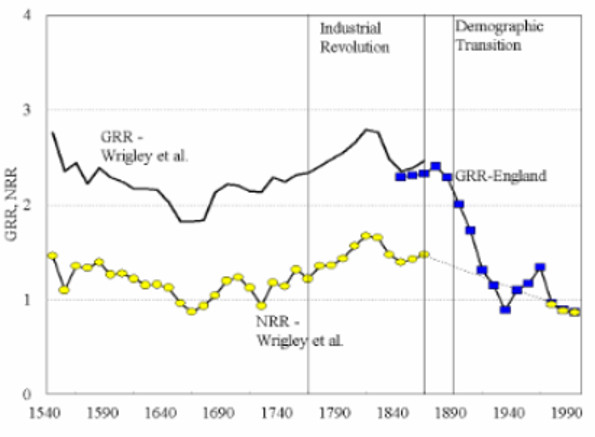
Note: GRR = Gross Reproduction Rate, NRR = Net Reproduction Rate
Source: Wrigley et al. (1997) p. 614. Office of National Statistics, United Kingdom.

The drop in birthrate following the industrial revolution has several causes. Chief among them is the fact that children were considered to some extent as assets, helping with maintaining the family livelihood, often by doing agricultural work on a family farm or helping with household chores (which were much more extensive then). Another large determining factor is a high rate of child mortality; thus families would have multiple children in anticipation of losing some to death. But with a rise in living conditions, the child mortality rate dropped drastically – and as a result we stopped having more kids in anticipation of some of them dying. Moreover, we started treating children less as assets and more as people to nurture and raise for their own sake. Longer lives, and less susceptibility to death in general, appears to have made us better parents.

Thus it is not only possible but probable that we will see a similar drop in the birthrate as a consequence of a significant future increase in average lifespan, with people having children much later in life, when they are more financially stable and when they have done all the commitment-free things they’ve always wanted to do. Without a looming limit on one’s available reproductive lifespan, there will be no pressing motivation to have children “before it’s too late” – and this alone could very well facilitate an unprecedented decrease in the Total Fertility Rate (TFR) of the global population.

Evidence indicates that the drop in birth rate was neither limited to England, nor an isolated result of the Industrial Revolution. A net drop in the TFR seems to be a longer-term trend concurrent across the globe. It is likely that the drop in the TFR is due to the same factors as the drop in birth rate following the Industrial Revolution – increasing life expectancy and continually improving living conditions allow people to have children without expecting a portion of them to be lost to death, to have them for the sake of having children rather than as assets to aid in maintaining the family livelihood, and to have children later in life due to the increase in one’s reproductive lifespan that comes with increasing life expectancy. The fact that the drop in TFR is not an isolated historical event is advantageous because the global population is affected by birth rate much more than by the mortality rate. Hence we may see a continuing decrease in the TFR occur in tandem with increasing life expectancy, leveling out the imbalance created by a mortality rate of zero by a larger than has been heretofore anticipated. (Source: U.S. Central Intelligence Agency, World Factbook.)

Let us suppose, for a moment, the worst: that indefinite longevity is achieved and we completely ignore (i.e., fail to plan for) overpopulation until its effects start becoming readily apparent. Even in this seeming worst-case scenario, overpopulation is not likely to result in any great tragedies. In such a case we would be forced to limit the global birthrate until we are able to implement the solutions that would allow us to sustainably procreate again. If people have a strong enough desire to continue having children, then they will express their demand and politicians will consequently base their policies upon deliberative initiatives to increase available living and agricultural space – and get elected if the desire to freely procreate is strong and widespread enough. Failing to plan for overpopulation will simply be a wake-up call, letting us know that we should have been planning for its effects from the beginning, and that we had better start planning for them now if we want to continue to freely procreate.

Thus while overpopulation is the most prominent and most credible criticism against continually increasing lifespans, and the one that needs to be planned for the most (because it will eventually happen, but it will lead to sustainability, resource, and living-space problems only if we do nothing about it), it is in no way insoluble, nor particularly pressing in terms of the time available to plan and implement solutions to shrinking living space and resource space (i.e., the space occupied by resources such as food, energy production, workplaces, etc.). We have a host of potential solutions today, ones we can use to increase available living space without regulating the global birthrate, and decades following the achievement of indefinite lifespans to consider the advantages and disadvantages of the various possible solutions, to develop them and to implement them.

So then: where to from here? Overpopulation is still the most prominent criticism raised against indefinite longevity, and if combated, the result could be an increase in public support for the Longevity movement. You might think that the widespread concern with overpopulation due to increasing longevity won’t really matter, if they turn out to be wrong, and overpopulation isn’t so insoluble a problem as one is inclined to first presume. But this misses a crucial point: that the time it takes to achieve longevity is determined by and large by how strongly and in how widespread a manner society and the members constituting it desire and demand it. If we can convince people today that overpopulation isn’t an insoluble problem, then continually increasing longevity might happen much sooner than otherwise. At the cost of 100,000 deaths due to age-correlated causes per day, I think hastening the arrival of indefinite longevity therapies by even a modest amount is somewhat imperative. Hastening its arrival by one month will save 3 million lives, and achieving it one year sooner than otherwise will save an astounding 36.5 Million real, human lives.

Thus, we should work toward putting more concrete numbers to these estimates. How much more living space can be feasibly created by colonizing the oceans? How deep can we really dig, build and live? How high can we safely build? Is there a threshold height or depth where building higher or deeper becomes too economically prohibitive to be worth the added living, working or resource space? What are the parameters (e.g., material strength/cost ratio, specific structural design) determining such a threshold?

First, we need to collect and analyze the feasibility studies that have already been undertaken on floating cities, artificial islands, VLFSs and the new solution-paradigms that are emerging to combat the contemporary concerns of sustainability and resource scarcity. In short, we need to compile data from the feasibility studies that have already been done, and the projects already implemented. Then we need to plan and commission further feasibility studies, undertaken by engineers and geologists, to build upon the work already accomplished in feasibility studies pertaining to existing designs for floating cities and other Very Large Floating Structures. We need to put some numbers to the cost the additional space for food, resources, work and living necessitated by widely available life-extension therapies. We need to do some hard calculations to show that the effects of overpopulation are problems that can be solved using existing megascale engineering and construction techniques and materials, safely and economically. We need to show the world that it has more space than it ever thought it had, and that such solution-paradigms as cosmic colonization and procreative regulation are neither the only ones, nor necessarily the most optimal ones. We need, in short, to show them that, in this case, where there’s a will there’s a way, and that the weight of waiting is too high a price to pay.

Franco Cortese is a futurist, author, editor, Affiliate Scholar at the Institute for Ethics & Emerging Technologies, Ambassador at The Seasteading Institute, Affiliate Researcher at ELPIs Foundation for Indefinite Lifespans, Fellow at Brighter Brains Institute, Advisor at the Lifeboat Foundation (Futurists Board Member and Life Extension Scientific Advisory Board Member), Director of the Canadian Longevity Alliance, Activist at the International Longevity Alliance, Canadian Ambassador at Longevity Intelligence Communications, an Administrator at MILE (Movement for Indefinite Life Extension), Columnist at LongeCity, Columnist at H+ Magazine, Executive Director of the Center for Transhumanity, Contributor to the Journal of Geoethical Nanotechnology, India Future Society, Serious Wonder, Immortal Life and The Rational Argumentator. Franco edited Longevitize!: Essays on the Science, Philosophy & Politics of Longevity, a compendium of 150+ essays from over 40 contributing authors.

References:

  1. Presidents Council for Bioethics: Transcripts (December 12, 2002): Session 2: Duration of Life: Is There a Biological Warranty Period? 01.
  2. L. A. Gavrilov and N.S. Gavrilova. “Demographic Consequences of Defeating Aging”. Rejuvenation Research. 2010 April; 13(2-3): 329–334.
  3. Ibid.
  4. McCullagh, Declan. “Seasteaders” Take First Step Toward Colonizing The Oceans.” CBS News, October 9, 2009. 02
  5. Pasternack, Alex. “Bioengineer aspires to colonize the sea.” CNN, January 12, 2011. 03
  6. Banham, Reyner. Megastructure: urban futures of the recent past. London: Thames and Hudson, 1976.
  7. Tsuchiyama, Ray. “Ocean Colonies as Next Frontier.” Forbes, April 24, 2011. Accessed August 1, 2013. 04
  8. “Inside Underground Cities.” Before Its News. 2013 March. 05
  9. South, D. B., and Freda Parker. “Underground Homes – Good or Bad?” Monolithic, January 22, 2009. 06.
  10. Good Earth Plants & Greenscaped Buildings. “Underground Living.” Last modified May 6, 2013. 07.
  11. Kelly, J. “10 Amazing Underground Cities”. Listverse.com. January 22, 2013. Accessed August 1, 2013. 08
  12. Gammon, Katharine. “Building Artificial Islands That Rise With Sea.” PopSci, June 8, 2012. 09
  13. Cottrell, Claire. “A Survey of Futuristic Floating Cities.” FlavorWire, November 2, 2012. 10
  14. “Cities on the Ocean.” Technology Quarterly – The Economist. Q4 2011.
  15. Bonsor, Kevin. “How the Floating Cities Will Work.” HowStuffWorks. n.d. 11.
  16. DigInfo TV. “GREEN FLOAT – a Floating City in the Sky.” Accessed August 6, 2013. 12.
  17. National Geographic. “Pictures: Floating Cities of the Future.” Accessed August 6, 2013. 13.
  18. Emerging Technology News. “Self-Sufficient Floating Cities Planned for 2025: Japan.” Accessed August 6, 2013. 14.
  19. “An artificial island in Hambantota.” News.LK, August 2, 2013. 15
  20. Goodier, Rob. “The World’s 18 Strangest Man Made Islands.” Popular Mechanics, n.d. 16
  21. E. Watanabe, C.M. Wang, T. Utsunomiya and T. Moan. “Very Large Floating Structures: Applications, Analysis and Design”. CORE Report No. 2004-02. Centre for Offshore Research and Engineering National University of Singapore. 17
  22. C.M. Wang, and Z. Tay. Very Large Floating Structures: Applications, Research and Development. In The Proceedings of the Twelfth East Asia-Pacific Conference on Structural Engineering and Construction — EASEC12. Edited by LAM Heung Fai. Singapore: Department of Civil Engineering, National University of Singapore Kent Ridge, 2011. 18
  23. World Architecture News. “Seasteading, United States.” Accessed August 6, 2013. 19
  24. The Seasteading Institute. The Seasteading Institute Annual Report 2008. Rep. n.p., n.d.
  25. Nagy, Attila. “14 High-Tech Farms Where Veggies Grow Indoors.” Gizmodo, June 17. 20.
  26. Meinhold, Bridgette. “Indoor Vertical Farm ‘Pinkhouses’ Grow Plants Faster With Less Energy.” Inhabitat. Last modified May 23, 2013. 21.
  27. TerraSphere. “Urban farming 2.0: No soil, no sun.” Accessed August 1, 2013. 22.
  28. The Vertical Farm Project – Agriculture for the 21st Century and Beyond. “Vertical Farm Designs.” Accessed August 6, 2013. 23


Support the “Little Mouse” Crowdfunded Life-Extension Research Project! – Post by G. Stolyarov II

Support the “Little Mouse” Crowdfunded Life-Extension Research Project! – Post by G. Stolyarov II

The New Renaissance Hat
G. Stolyarov II
October 4, 2013
******************************

As part of my escalating efforts to advance the prospects of radical life extension through my individual actions, I have donated $50 to an ambitious new crowdfunding project to research longevity-enhancing treatments in mice.

This international project, undertaken by researchers at the Kiev Institute of Gerontology and supported by the Methuselah Foundation and the SENS Research Foundation, has an Indiegogo fundraising page, titled “I am a little mouse and I want to live longer!”, where contributions can be made.

I am proud to donate to this effort to support longevity research through crowdfunding. This project allows those of us who seek longer lifespans, and who wish to advance the science that will get us there, to contribute directly in a manner whereby each of us can make a sizable fraction of the difference for this research effort. I look forward to the great work that this project will accomplish. Achieving statistically significant mouse life extension in the near future could trigger massive public interest and the influx of major research funds to attain increasingly ambitious life-extension goals in higher-order mammals, culminating in us.

The project has already raised $8,673 and has 16 days remaining to reach its $15,000 goal. The Methuselah Foundation will match each $1,000 given with an equivalent donation – so it is possible to double one’s impact by contributing funds to this research effort.

Calico and the Paradigm Shift in the War on Death – Video by G. Stolyarov II

Calico and the Paradigm Shift in the War on Death – Video by G. Stolyarov II

Finally, the war on human senescence and involuntary death has become mainstream. With Google’s announcement of the formation of Calico, a company specifically focused on combating senescence and the diseases it brings about, a large and influential organization has finally taken a stand on the side of longer life.

References
– “Calico and the Paradigm Shift in the War on Death” – Article by G. Stolyarov II
– “Google announces Calico, a new company focused on health and well-being” – Google Press Release – September 18, 2013
– “TIME Feature: CSO Aubrey de Grey on Google’s Newly Launched Anti-Aging Initiative” – SENS Research Foundation – September 18, 2013
– “Google’s Calico: the War on Aging Has Truly Begun” – Aubrey de Grey – TIME Magazine – September 18, 2013
– SENS Research Foundation

The Last Generation to Die – Article by Reason

The Last Generation to Die – Article by Reason

The New Renaissance Hat
Reason
September 27, 2013
******************************

The last generation whose members will be forced into death by aging is alive today. It won’t be the youngest of us, born in the past few years – they, most likely, have thousands of years ahead of them. It won’t be the oldest of us either, as even under the plausible best of circumstances we are twenty to thirty years away from a widespread deployment of rejuvenation therapies based on the SENS research program. As to the rest of us, just who is left holding the short straw at the end of the day depends on the speed of progress in medical science: advocacy, fundraising, and the effectiveness of research and development initiatives. Persuasion and money are far more important at this early stage than worrying about how well the researchers are doing their jobs, however.

We live in a world in which the public is only just starting to come around to the idea that aging can be treated, and demonstrations of rejuvenation in the laboratory could be achieved in a crash program lasting ten to twenty years, at a comparatively small cost. But still, most people don’t care about living longer, and most people try not to think about aging, or the future of degeneration and sickness that awaits. They think it is inevitable, but that is no longer true. If you are in early middle age today in the first world, then you have a good shot at living for centuries if the world suddenly wakes up tomorrow and massive funding pours into rejuvenation research. You will age and die on a timescale little different from that of your parents if that awakening persistently fails to happen.

So, roll the dice, or help out and try to swing the odds in your favor. Your choice.

Crowdfunding on Kickstarter and related sites is still the new new thing, the shine not yet worn off. One of the truths that this activity reinforces is that it is far, far easier to raise funding for the next throwaway technological widget than for medical research projects aimed at the betterment of all humanity. Research crowdfunding is a tiny, distant moon orbiting the great mass of comics, games, and devices on Kickstarter, Indiegogo, and others. Hell, it’s easier to crowdfund a short film that points out how close human rejuvenation might be to the present day than it is to crowdfund a project to actually conduct a portion of that research. Is this a reflection of rationality? You decide, though it could be argued either way regarding whether a dollar given to raising awareness is more valuable than a dollar given to the researchers at this point in time. Both research and persuasion need to happen.

The Last Generation To Die – A Short Film

Quote:

Set in the future when science first begins to stop aging, a daughter tries to save her father from natural death. The story takes place roughly 30 years in the future at the moment when science has first figured out how to stop aging through genetics. It is framed around the gulf between generations that would occur with the first release of this technology. A daughter who works for a company called Aperion Life – the first to bring this new technology to the public – wants to save her aging father. She starts him on the trials but he soon stops coming. The film continues with the conflict rising between them as she wants him to live on with her while he feels a natural ending is more human.The film centers itself around the natural conflict that would exist at this divide. Upon developing this story, I’ve asked many people and I’ve found a pretty even 50/50 divide of opinions strongly on one side or the other- either they want to die naturally and believe there is beauty in finality, or they want to see what the future holds and have more time to explore and learn more in life. I’d like to turn the question to you… Which side are you on? Would you want to live on or die naturally?

I feel this is a film that needs to be made. Asking these questions in the form of art and story will help start the discussion. Our world is changing very fast and the rate of technology is speeding up. What does all of this mean for humanity? Everything we know, from a book to a play to a song, ends… What does it mean when there is no ending? Would we be more complacent? Would life be as meaningful? Is there more of a beauty in the way it has always been with our passing or is there more beauty in our bodies and minds staying fresh and alive for many, many years to come? What about social justice and overpopulation? Would life become boring after living on indefinitely or would you find it exhilarating to have time to learn new languages, instruments, subjects – to read more books, to love more – to live several lifetimes? Would it be worth it if some of your most loved friends or relatives passed on and wouldn’t live on with you? Are you interested in seeing what the future brings in technology and social evolution or are you happy to have contributed and be a part of it for a short time?

Tim Maupin’s Film, ‘The Last Generation to Die’, to Explore Longevity and Life Extension

Quote:

Chicago filmmaker Tim Maupin launched a Kickstarter for a short film titled, “The Last Generation to Die.” Maupin thinks now is a great time to start a conversation about life extension. And he’s right. The idea that within decades a genetic fountain of youth may plausibly reverse the aging process, even indefinitely stave off death, seems to be rising up in pop culture. Maupin’s Kickstarter has so far raised over $15,000 – $6,000 more than its initial funding goal. Encouraged by the positive response, they’re dreaming bigger and hope to fund a stretch goal of $25,000 in the last 10 days of the campaign.

Reason is the founder of The Longevity Meme (now Fight Aging!). He saw the need for The Longevity Meme in late 2000, after spending a number of years searching for the most useful contribution he could make to the future of healthy life extension. When not advancing the Longevity Meme or Fight Aging!, Reason works as a technologist in a variety of industries.  

This work is reproduced here in accord with a Creative Commons Attribution license.  It was originally published on FightAging.org.

Editor’s Note from G. Stolyarov II: I am proud to have donated $50 to help make the film The Last Generation to Die a success. I encourage all readers to donate during the remaining nine days in which the Kickstarter project is open to accepting funds.

Calico and the Paradigm Shift in the War on Death – Article by G. Stolyarov II

Calico and the Paradigm Shift in the War on Death – Article by G. Stolyarov II

The New Renaissance Hat
G. Stolyarov II
September 19, 2013
******************************

Finally, the war on human senescence and involuntary death has become mainstream. With Google’s announcement of the formation of Calico, a company specifically focused on combating senescence and the diseases it brings about, a large and influential organization has finally taken a stand on the side of longer life. Unlike the cautious, short-term orientation of many more conventional manufacturers of drugs and medical devices, Google’s philosophy of making investments with possible immense payoffs in the distant future offers tremendous hope that this company will be around through the many years it will take to engage in the search for promising treatments and their subsequent testing.

 Aubrey de Grey, one of the chief strategists and key intellectual innovators in the escalating war on senescence, has written that Calico signals that the war on aging has truly begun. De Grey emphasizes that it is no longer necessary to persuade most of academia that this war is a worthwhile endeavor: “With Google’s decision to direct its astronomical resources to a concerted assault on aging, that battle may have been transcended: once financial limitations are removed, curmudgeons no longer matter.” As with its remarkable advances in autonomous vehicles, mobile operating systems, and wearable computing, Google does not need to ask the permission of the entire world to explore the possibilities. Rather, it can simply achieve the breakthroughs, whose momentum and adoption naysayers would be powerless to halt.

Funding has always been a major bottleneck for true life-extending research, but now the resources of Google, as well as the highly skilled researchers who will surely be recruited by Calico, will enable this bottleneck to be overcome. Few details about the company are yet available, and it is likely that several years will elapse before major discoveries are announced. However, the barrier to mainstream acceptability of the war on senescence has been breached. Once significant successes are announced, other companies will hopefully shed some of their current caution and will seek to profit from the burgeoning field of longevity research. A few other companies still may even try to emulate Calico before any results are announced – just so as to remain competitive with Google and stay ahead of the pack, in their view.

The key to the success of any sustainable enterprise focused on life-extension research is to recognize that the sole pursuit of profits next quarter or next year is not a viable strategy for altering the status quo in radical ways. Great innovations require great leaps outside the norm. Such leaps are not often immediately rewarded financially by the broader market, which is why much of the longevity research to date has been sponsored by non-profit institutions such as the SENS Research Foundation and various universities. However, a prudent, forward-looking pursuit of profit can take the radical alteration of the status quo to the next level, by harnessing the immensely powerful motive of self-interest for the purpose of improving human lives. In this case, the improvement from gains to human longevity – and hopefully the ultimate defeat of senescence altogether – would be so immense as to be humankind’s crowning achievement. Google develops technologies with the eventual intent of marketing them to millions of consumers, and the success of Calico would be a triumph not just for longevity research but for the dissemination of cures to age-related diseases, and perhaps to senescence itself.

While anyone of sufficient intellectual courage can have a long-term vision and projects aimed at advancing that vision, Google has the distinct advantage of an extremely viable business in the present, which continues to bring in short-term revenues so that Calico does not need to be concerned with profits next quarter or next year. Instead, Calico will be able to survive on the profits of Google’s many ongoing operations, while devoting the time and effort of world-class researchers to pursuing all of the explorations, experiments, and tests that are needed to ultimately develop marketable cures. Once the cures are out there, though, the profits could be unprecedented, because life is the most precious, the most fundamental value we humans have. Any entity that discovers a way to transcend the current frailties of old age and push back or remove the current limits on human lifespans will become fabulously wealthy beyond comparison.

May Calico usher in Adam Smith’s invisible hand in the realm of longevity medicine – a hand that pushes back senescence and death and creates a world where health and wealth are ours to enjoy indefinitely.

Longevitize!: The Master Compendium for the Life-Extension Movement – Post by G. Stolyarov II

Longevitize!: The Master Compendium for the Life-Extension Movement – Post by G. Stolyarov II

The New Renaissance Hat
G. Stolyarov II
September 7, 2013
******************************

longevitize2013_med

Longevitize!: Essays on the Science, Philosophy & Politics of Longevity is a new and (literally) vital compilation, edited by Franco Cortese, which assembles perhaps the widest array of resources on radical life extension in one location. You can read a detailed description of the book here. Cortese’s ambitious projects have breathed new life into the transhumanist and immortalist movements, and Longevitize promises to be perhaps his most influential contribution to date, illustrating a thorough grasp of the current state of the efforts to defeat senescence and enable humankind to transcend its primordial limitations.

In addition to 164 articles representing diverse perspectives about the scientific, philosophical, and political aspects and implications of indefinite life extension, this compendium includes an immensity of links to external resources, including books, articles, and videos. I am proud that my Resources on Indefinite Life Extension (RILE) page formed the crux of the book’s Appendix II. Longevitize permits the reader to delve as deeply as can be desired into studying the feasibility, desirability, and possibilities for implementation of the defeat of senescence and involuntary death.

I am proud to have contributed 27 essays to this anthology, spanning 9 years of my thinking and writing on the prospect of indefinite longevity. In addition, the excellent cover was designed by my wife Wendy Stolyarov, incorporating Maxim Vorobiev’s 1842 painting, “Oak fractured by a lightning bolt. Allegory on wife’s death.” Death destroys our irreplaceable individual universes much like that lightning destroyed the tree. It is time to put an end to this travesty, and Longevitize offers an amazing toolkit and intellectual foundation for doing so. Buy this book, read it, and use it in your further intellectual explorations – including your writing, research, argumentation, and activism.

Right now, Longevitize! is available as an e-book for $9.99, both in PDF and MOBI formats, from Amazon. A hard-copy version is currently being prepared.