Browsed by
Category: Transhumanism

The Slowly Spreading Realization That Aging Can Be Defeated – Article by Reason

The Slowly Spreading Realization That Aging Can Be Defeated – Article by Reason

The New Renaissance Hat
Reason
May 21, 2014
******************************

At some point in the next ten to twenty years the public at large, consisting of people who pay little attention to the ins and outs of progress in medicine, will start to wake up to realize that much longer healthy lives have become a possibility for the near future. The preliminaries to this grand awakening have been underway for a while, gradually, and will continue that way for a while longer. A few people every day in ordinary walks of life notice that, hey, a lot of scientists are talking about greatly extending human life spans these days, and, oh look, large sums of money are floating around to back this aim. There will be a slow dawning of realization, one floating light bulb at a time, as the concept of radical life extension is shifted in another brain from the “science fiction” bucket to the “science fact” bucket.

Some folk will then go back to what they were doing. Others will catch the fever and become advocates. A tiny few will donate funds in support of research or pressure politicians to do the same. Since we live in an age of pervasive communication, we see this process as it occurs. Many people are all to happy to share their realizations on a regular basis, and in this brave new world everyone can be a publisher in their own right.

Here is an example that I stumbled over today; a fellow with a day-to-day focus in a completely unrelated industry took notice and thought enough of what is going on in aging research to talk about it. He is still skeptical, but not to the point of dismissing the current state and prospects for longevity science out of hand: he can see that this is actionable, important knowledge.

What if de Grey and Kurzweil are half right?

Quote:

I think these guys – and the whole movement to conquer aging – is fascinating. I am highly skeptical of the claims, however. Optimism is all well and good, and I have no off-hand holes to poke in their (very) well-articulated arguments. But at the same time, biology is fiendishly complex, the expectations beyond fantastical.

Still though, I have to wonder: What if guys like de Grey and Kurzweil are half right, or even just partially right? What if, 30 years from now, it becomes physically impossible to tell a 30-year-old from a 70-year-old by physical appearance alone? It sounds nutty. But it’s a lot less nuttier, and a lot closer to the realm of possibility, than living to 1,000 – which, again, some very smart people have taken into their heads as an achievable thing.

People who don’t take care of themselves are insane. Ok, not actually “insane.” But seriously, given the potential rewards AND the risks, not taking care of your body and mind – not treating both with the utmost respect and care – seems absolutely nuts. At the poker table I see these young kids whose bodies are already turning to mush, and a part of me just wants to grab them by the shirt collar and say “Dudes! What the hell is WRONG with you!!!”

If it is possible – just realistically possible, mind you – that I could still be kicking ass and taking names at 125 years old, then I want to be working as hard as I can to preserve and maintain my equipment here and now. No matter what miracles medical science will achieve in future, working from the strongest, healthiest base possible will always improve the potential results, perhaps by an order of magnitude. Individuals who go into old age with fit, healthy bodies and sound minds, and longstanding habits to maintain both, may find potential for extended performance at truly high quality of life that was never before imaginable.

As the foundations of rejuvenation biotechnology are assembled and institutions like the SENS Research Foundation continue to win allies in the research community and beyond, the number of people experiencing this sort of epiphany will grow. The more the better and the sooner the better, as widespread support for the cause of defeating aging through medical science is necessary for more rapid progress: large scale funding always arrives late to the game, attracted by popular sentiment. The faster we get to that point, the greater our chances of living to benefit from the first working rejuvenation treatments.

Reason is the founder of The Longevity Meme (now Fight Aging!). He saw the need for The Longevity Meme in late 2000, after spending a number of years searching for the most useful contribution he could make to the future of healthy life extension. When not advancing the Longevity Meme or Fight Aging!, Reason works as a technologist in a variety of industries. 
***

This work is reproduced here in accord with a Creative Commons Attribution license. It was originally published on FightAging.org.

Motivated Time Prospectors – Article by Eric Schulke

Motivated Time Prospectors – Article by Eric Schulke

The New Renaissance Hat
Eric Schulke
May 16, 2014
******************************

Think of all the people’s lots in life that you don’t have. You will regret not having more chances to stand here as you are now. It is said that if everybody put their worries into a pile and then took an equal share from the pile, then most people would be content to take back their own share of them. I was reading an article that said,

“To be sick and dying in Vegas has its own existential horror. Not only do you realize that you are going to die and that you don’t matter to the world, but you also realize that much of the world is awful and yet you still would do anything to live.”

Struggling to survive on this planet can be miserable, and yet we continue to stick with it. Why? Because we know that with life there is a chance to engage in more experience. It seems that a person can live, in part, on the desire for continued experience. That chance drives us to keep reaching for achievement and progress.

What does one want to experience in life? What does that honest-to-life list look like? If you had to draw up a complete list, could you do it, or describe the nature of it? The active wanting of experience, it seems, is a major cure to indifference toward death. It seems that it might be a life-or-death question.

We have become really good at being indifferent to the most widespread forms of death, in order to spare ourselves from stressing out on futilely trying to do something about it. Now that we have the tools and techniques, and the times have changed, we have to change that way of thinking from indifference back toward letting that horror affect us. Horror benefits us in that it is our cue to be driven to action to make sure that the horror can’t happen again. If a poltergeist starts ravaging your house, that’s your signal to get out of there, in the same way that the horror that general death, aging, and other diseases are your signal to get death, aging, and other diseases away from you and out of your cells.

Carl Sagan’s daughter once related his words that “there was nothing he would like more in the world than to see his mother and father again.” I was thinking about what an insult added to injury he must have felt in his final days, to have the paralyzing misery of impending death heaped on top of crushing pain. Let that kind of pain course through your mind, face it, bring it to a steaming rage, and let the energy power you to help execute any of the various assaults on aging and disease that are underway in laboratories in various places around the world.

In another article, I was reading about a guy whose daughter went missing in 1971, and was never found. He lived to be 102 and died in the fall of 2013. He had stated that one of the hardest burdens for him was never knowing what happened to his daughter. What misery, for all those years… Think of that… Then five days after he died, his daughter’s car was found upside down in a river; she was the apparent victim of a decades-old car crash.

I can’t fathom that life could inflict such a bitter spite upon somebody. That story stirs up the kind of despair and anguish that each death seems to deserve. It’s the kind of anguish you need to figure out how to allow in, in order to have the right kinds of drive to help pull the Movement for Indefinite Life Extension forward with us.

So once we get there, back to that place where we stand amidst realization of the horror of death, how do we face it? One good basic and natural way to do so, it seems, is to purposefully enjoy the good parts of life, and strategize and take action in helping to fix the worst of the broken things. It’s fun and fulfilling. Life isn’t bad, it’s an adventure. A tough challenge is like a choppy sea, like two armies clashing, or mountain climbers fighting the elements. The implementation of the solution of each challenge is like a Renaissance of scale, some miniature, some very large, like Caesar vs. Vercingetorix, or Charlemagne vs. the Vikings. It’s like the writings of Caesar, the writing-resurgence work of the Carolingians, Vercingetorix and the fate of an entire Celtic confederation, or the first times the Vikings set sail out beyond Greenland.

A few days ago I was thinking about a typical farm hand of Medieval times, walking outside to smell the heavy wet grass and earth of a cold wet spring day. How did they remember the great Lombard migrations, or Scandinavian raiders docking at Pisa? Who was Charlemagne to people before negationists took hold? What did they think might become of the future? Many of them must have felt lost at that kind of thought.

Focus on your heartbeat, feel it pulsing. Theirs pulsed like that. They thought of their hearts stopping and of how it couldn’t possibly be lost to the dust of history anytime soon. You think that, too. Their hearts are lost to the dust of history. Yours is next.

What does every year, and every moment mean to the history of everything? I read recently that if you throw a pebble, it could be offsetting the center of gravity of the universe. Every moment means everything, every moment is everything. Every moment is a world in itself, a great painting, a great work of art, a great burning torch, a water well built in inhospitable lands. Think of how many heartbeats have come to a stop, how many paintings have been burned… So many tangled groves in forests have had the wind blowing through them for all of these years, without one person, without one spoken word, in a place near a stream, where there was once a mighty, crackling stone fireplace that warmed multiple generations of families across the 6th through 8th centuries. It was a place that hosted countless memories which later tormented the souls of dying, now long-dead grandfathers.

They don’t deserve to be dead. They deserve what they earned: the world that is paying exponentially exciting, satiating, and fullfillingly valuable dividends today. This is an incredibly motivating and driving factor in what pushes me to pursue indefinite life extension. People take on a variety of diverse augmentations over time, becoming unique collections of intriguing insight – dynamic power tools for slicing and dicing the elements. We can’t afford for these wealths of rare and powerful abilities and resources to be pillaged and killed off. Sometimes it seems as if life-extensionists like me have to explain to people why it’s bad to let people be killed before we can get down to business in a worldwide effort to reach the goals that can get this done.

We are like the union for the people that make a profession out of being human. We are creating better and better pay, and we demand longer hours. I want every feasible remedy that can restore and maintain life to be a permanent fixture in this reality, for it to be harvested like air. There is no reason a heart has to give out. There is no reason we cannot prevent tangles from forming in the brain. Our organs and cells don’t have to degrade. We have tools, techniques, and brains. We will make it through these obstacles.

How long will it be before our times are old, before 2015 cars look like old classics, and thoughts of our times are most often associated with the smell of the pages of books that have been moved from their years of service on shelves, to boxes of outdated material in back rooms? Many experiences and voyages that could have happened, and could have been chronicled in those boxes, can never exist.

That’s the problem, it seems: There are experiences that could have existed, but that now never can. Thoughtful experience – there is no reason to forgo it or allow it to be lost – hence the basic, inherent reasoning for supporting indefinite life extension, it seems.

Every moment is the gold, the thing to be mined, the thing to be in awe of, to seek, pursue, and strategize toward, to work for, to feel victorious for possessing. Let’s mine more time: support the Movement for Indefinite Life Extension. Don’t be distracted by fool’s gold while the most valuable gold, time, slips through your fingers.

One of these days, we will put funeral homes across the world out of business, and it will be a great victory. We will celebrate, and the festivities will be grand. But we must get a move on now, because our chances are turning into sand.

Eric Schulke was a director at LongeCity during 2009-2013. He has also been an activist with the Movement for Indefinite Life Extension and other causes for over 13 years.

Extending Life in Mice With Artificially Shortened Life Spans is Rarely Directly Relevant or Useful – Article by Reason

Extending Life in Mice With Artificially Shortened Life Spans is Rarely Directly Relevant or Useful – Article by Reason

The New Renaissance Hat
Reason
May 4, 2014
******************************

There are numerous examples of studies that use mice genetically engineered to suffer forms of shortened life span with the appearance of accelerated aging. One has to be very cautious in reading anything into this sort of work, however: it is rarely of any great relevance to normal aging, as it creates and then attempts to ameliorate an entirely artificial situation. The appearance of accelerated aging is not in fact accelerated aging, but is rather often caused by mechanisms that are of little importance in normal aging. Even when the mechanisms are relevant, the overall metabolic circumstances can render it impossible to determine whether or not a partial treatment will be of any use in normal aging. The gold standard for relevance when evaluating new methods is the extension of life in unmodified mice, but unfortunately this is expensive and slow.

The publicity materials quoted below are a good example of research in animals exhibiting shortened life spans. Here scientists are investigating a protein involved in the induction of cellular senescence. As is often the case, however, from the structure of the work it is impossible to tell whether or not their drug candidate will be of any use as a treatment to lower levels of cellular senescence in normal aging and thus produce benefits such as extended health and life span. Those tests will still have occur:

Quote:

When cells or tissue age – called senescence – they lose the ability to regenerate and secrete certain proteins, like a distinctive fingerprint. One of those proteins, PAI-1 (plasminogen activator inhibitor) has been [a focus of] research, originally as it relates to cardiovascular disease. “We made the intellectual leap between a marker of senescence and physiological aging. We asked is this marker for cell aging one of the drivers or mechanisms of rapid physiological aging?”

For the study, [researchers] used mice bred to be deficient in a gene (Klotho) that suppresses aging. These mice exhibit accelerated aging in the form of arteriosclerosis, neurodegeneration, osteoporosis and emphysema and have much shorter life spans than regular mice. [These] rapidly aging mice produce increased levels of PAI-1 in their blood and tissue.

Then scientists fed the rapidly aging mice TM5441 – the experimental drug – in their food every day. The result was a decrease in PAI-1 activity, which quadrupled the mice’s life span and kept their organs healthy and functioning. “This is a completely different target and different drug than anything else being investigated for potential effects in prolonging life. It makes sense that this might be one component of a cocktail of drugs or supplements that a person might take in the future to extend their healthy life.”

Link: http://www.northwestern.edu/newscenter/stories/2014/04/experimental-drug-prolongs-life

Reason is the founder of The Longevity Meme (now Fight Aging!). He saw the need for The Longevity Meme in late 2000, after spending a number of years searching for the most useful contribution he could make to the future of healthy life extension. When not advancing the Longevity Meme or Fight Aging!, Reason works as a technologist in a variety of industries. 
***

This work is reproduced here in accord with a Creative Commons Attribution license. It was originally published on FightAging.org.

The Methuselah Mouse Prize: Changing the Conversation about Aging – Article by Advocate of Negligible Senescence

The Methuselah Mouse Prize: Changing the Conversation about Aging – Article by Advocate of Negligible Senescence

The New Renaissance Hat
Advocate of Negligible Senescence
May 3, 2014
******************************
ANS_Methuselah_Mouse_Prize
Methuselah Foundation created a stir in the research community by introducing the Methuselah Mouse Prize in 2003. The Mouse Prize was designed to directly accelerate the development of revolutionary new life extension therapies by awarding two cash prizes: one to the research team that broke the world record for the oldest-ever mouse; and one to the team that developed the most successful late-onset rejuvenation strategy.Unlike other engineering prizes (for example, the X Prize for lunar exploration), an award of the Methuselah Mouse Prize is not the end of the matter. The winner establishes a record that others have to break.
***

Why mice? Mice are genetically similar to humans. They are small and inexpensive to maintain so studying large quantities is feasible. Their short lifespan, about three years, makes it possible to see if interventions result in longer, healthier lives—all in time to be of benefit to our own lives.

The Mouse Prize for longevity was first won by a team led by Dr. Andrzej Bartke of Southern Illinois University. The prize for rejuvenation first went to Dr. Stephen Spindler of the University of California.

Additionally, in 2009, the first Special Mprize Lifespan Achievement Award went to Dr. Z. Dave Sharp for the successful healthy life extension of already aged mice using a pharmaceutical, rapamycin.
***
Through programs like the Methuselah Mouse Prize, Methuselah Foundation has helped change the conversation on aging and longevity, lending credibility and prestige to areas of research that once were openly frowned upon.
***

Previous winners have already proven that healthy life can be extended; more wins are possible by researchers who can best previous winners’ performances, and each new winner pushes the outer limits of healthy life back even further.

How translatable the lesson of a Methuselah mouse will be to people is a matter of debate. The logic of disposable-soma theory applies to both species.

Private donations made since 2003 have bumped the prize value up to nearly $3.5 million, according to the latest update on the Methuselah Foundation website.

Don’t be misled by the size of the fund into thinking that a small donation will make no difference, because this is fundamentally a popular enterprise, a people’s prize, so the number of individual donors is really just as important as the total.

Searching for a cure for age-related ill health, a problem that kills more people than all other causes combined, is a moral imperative. The Advocate for Negligible Senescence publishes articles that discuss and educate the public about research to combat senescence. See the Advocate’s Facebook page.  
Transhumanism and Minarchism Are Compatible: A Response to The Sliceman – Article by G. Stolyarov II

Transhumanism and Minarchism Are Compatible: A Response to The Sliceman – Article by G. Stolyarov II

The New Renaissance Hat
G. Stolyarov II
April 27, 2014
******************************

This essay is part of a debate with The Sliceman on whether transhumanism and minarchism are compatible. For prior installments of the conversation, see the following essays:

– “Why I Do Not Adhere to Anarcho-Capitalism” by G. Stolyarov II

– “In Response to G. Stolyarov II and his Transhumanist Minarchism” by The Sliceman

I appreciate that The Sliceman has taken the time to post his thoughts on the question of the compatibility of transhumanism and minarchism, and I thank him for his good words regarding my work. If, as he writes, we agree on 90% of the issues, “with the lone exceptions being minarchy and monogamy”, then we have plenty of common ground that could also be used to reach some points of agreement on the question of transhumanist minarchism.

My aim in this discussion will not be to discredit or refute anarcho-capitalism; instead, I will strive to show that transhumanist minarchism is a fully reasonable and logically consistent position. Empirically, transhumanist anarcho-capitalism also clearly has articulate adherents and holds out promise for the incremental improvement of the human condition. The Sliceman writes of my views, “Your stance is that, [anarcho-capitalism] would be better than normal statism, but not as good as minarchism.” This is correct, meaning that I would see transhumanist anarcho-capitalism as an improvement over the status quo both politically and technologically. However, transhumanist minarchism would be superior still, because it would contain a method for resolving tensions and disputes that would have escalated into violence under transhumanist anarcho-capitalism.

The Sliceman writes in response to my statement that anarcho-capitalism has no practical application in today’s world that “yes, there has never been a practical application of Anarcho-Capitalism replacing a state but there has never been an economic powerhouse minarchy that didn’t evolve into totalitarianism either. We are BOTH in the realm of theory here, my friend.”

In an important way, I agree. I wrote in “Why I Do Not Adhere to Anarcho-Capitalism” that “Neither my position nor the anarcho-capitalists’ has any existing real-world incarnation. The question before us, then, is which of these positions would result in less overall violence and coercive dishonesty if implemented in practice?” However, in another important way, I disagree with the argument that an empirical refutation of minarchism can be offered by observing formerly freer societies that have devolved into totalitarian or near-totalitarian ones. The Sliceman is correct that the United States has undertaken this trajectory over the past 238 years, while in the meantime facilitating considerable prosperity and economic growth through political structures that were freer than most. However, at no point in history was the United States minarchistic – not even by a long shot. The U.S. Constitution and Bill of Rights were closer to the libertarian ideal than the governance structures of 18th-century Europe, to be sure, so they constituted steps in the right direction for their time. But the very language of these documents – including the “Commerce Clause”, the “General Welfare Clause”, and the “Necessary and Proper Clause” – opened the floodgates for extensive centralized intervention as these clauses were interpreted to have increasingly expansive and open-ended meanings. The devolution of the United States to the near-totalitarianism it exhibits today is not the result of minarchism, but israther due to the infusion of non-minarchistic elements into the US political structure at its founding. (The recognition of slavery certainly did not help, either; it paved the way for the bloody Civil War, which led to the first round of attempted totalitarianism by central governments under Abraham Lincoln in the Union and Jefferson Davis in the Confederacy.) I also note that the non-minarchistic nature of the early United States can be clearly seen in such travesties against liberty as the Alien and Sedition Acts of 1798 (which effectively forbade criticism of the government) and even Thomas Jefferson’s Embargo Act of 1807 (which effectively forbade all overseas trade) – neither of which would be conceivable even in today’s United States.

So the historical trajectory of the United States is no more an argument against minarchism than the brutal infighting and miserable standards of living in Somalia today are an argument against anarchism. The argument presented by The Sliceman that bureaucracies tend to try to grab more power for themselves may be true, but, if so, its only implication is that non-minarchistic elements of a government will tend to expand over time, changing the proportions of an initial mix of coercive and non-coercive government functions to be more heavily dominated by the coercive functions over time. However, if a minarchist government lacks the coercive functions (which involve non-retaliatory use of force) to begin with, and both the constitution and public opinion provide strong barriers to the emergence of such coercive functions, then the trajectory toward totalitarianism need not occur.

The Sliceman writes, “In fact, I believe minarchy to be much more theoretical than anarchy. Anarchy can be seen all over the world every day in the form of capitalism and voluntary association and order. Minarchy is almost never seen in all of history.” Both minarchy and anarchy are similarly theoretical, in my view, because, just as there has never been a completely minarchist government in history, there has never been a complete anarcho-capitalism in any society. Because every person encounters some dose of coercion in going about his or her daily life, that coercion necessarily shapes individual incentives and the kinds of markets and goods and services that arise in the society where the coercion exists. It is true, for instance, that unregulated black markets arise virtually everywhere that a government attempts to prohibit a good or service, but the content, environment, and limitations of those black markets are very much determined by the fact that the prohibition exists in the first place, as well as the extent and manner of the prohibition’s enforcement. Just as a true minarchism could only exist if a government did not have any legitimate power to initiate force, so a true anarcho-capitalism could only exist if there were no need to develop workarounds for the limitations imposed by a centralized authority.

This leads me to the conclusion that what matters more is the incremental direction of political change that one advocates – rather than one’s desired theoretical destination. For instance, abolishing NSA surveillance of the general population, dismantling the TSA, repealing the income tax, withdrawing all overseas US troops, halting the War on Drugs, and ending the requirement that the FDA approve all medicines prior to their availability for purchase by the general public, would all be measures favored by both minarchists and anarcho-capitalists. Their implementation would greatly increase the liberty enjoyed by people in practice, and such measures would also dramatically accelerate the rates of technological progress and economic growth. Whether the changes could be best accomplished by working within or outside the political system is an empirical question, and various strategies can be, at their core, compatible with both minarchism and anarcho-capitalism.

The Sliceman writes: “how dare you consider yourself a transhumanist, yet scoff at that which hasnt been tried yet[?] The automobile has not yet been created, but that is no reason to think the future is a faster horse. If history has taught us anything, it’s that someone’s lack of imagination does not deter future technological advancement in the areas of industry, economy, religion, or government.”

My argument regarding the lack of practical application for anarcho-capitalism does not hinge on the fact that it has not been tried yet in its full form. In fact, I would encourage some group of people to try it – perhaps on a seastead, a small island, or a space colony. The results of such an experiment would provide valuable empirical evidence and fuel for further thought and work in political philosophy. As I have previously stated, my preferred political system of minarchism also has not been tried in its consistent form, so my preference for it does not stem from any aversion for the new and untried.

Rather, when I say that anarcho-capitalism has no practical application today, my exact meaning is that I have yet to see a viable proposal for bringing it about through a transition from the status quo. Unlike minarchism, for whose attainment a sequence of political reforms can be articulated, many strains of anarcho-capitalism reject working within the political system, period, so it is unclear how exactly the transformation from a militaristic welfare state to an anarcho-capitalist society is envisioned to occur. As I wrote in “Why I Do Not Adhere to Anarcho-Capitalism”, “I happen to believe that political theory is more than a mind game; it has relevance to the real world, and it ought to have real-world implications for how we act in our own lives. It is not enough to simply state that one would like the world to be a certain way. Rather, a specific, technical, and quite involved series of steps is necessary to transition from the status quo to any state considered desirable. To simply contemplate the end outcome without any idea of how to attain it or even approach it is to divorce one’s political thinking from reality.” It also appears to me that, when an anarcho-capitalist does propose ways of working “outside the system” – including seasteading, cryptocurrencies, informal markets, and digital communities – these ways are also perfectly compatible with minarchism. They involve the use of technological innovation, jurisdictional competition, and civil society to motivate a reduction of political power from without. Yet, unfortunately, too many anarcho-capitalists let the perfect (in their minds) be the enemy of the good, and they reject or resist any attempts at bringing about incremental change (even outside of politics proper), for fear that those attempts are somehow intertwined with and corrupted by the existing political or social order. I do support the practical efforts of anarcho-capitalists to achieve their vision in peaceful ways. However, if and when they do this, they do not engage in any activities that are exclusively anarcho-capitalist or that would require adherence to anarcho-capitalism to pursue. A minarchist could undertake those same actions just as effectively.

I note that the lack of a concrete proposal to achieve anarcho-capitalism is quite different from what one observes with transhumanist projects and aspirations. Virtually every transhumanist vision, from indefinite life extension to various incarnations of the technological Singularity, has an associated detailed sequential plan for attaining it or view of the unfolding events that would bring it about. Consider, as examples of this, Aubrey de Grey’s SENS roadmap to reversing all the types of age-related damage, or Ray Kurzweil’s Law of Accelerating Returns, forecasting the continued exponential growth of emerging technologies. I certainly see the amount of centralized control in a society as capable of having a powerful impact on the rate at which these transhumanist aspirations can be realized; the more centralized control, the slower the rate. However, neither minarchism nor anarcho-capitalism would impose coercive restrictions on transhumanist projects, and so both are, in theory, quite compatible with transhumanism. Minarchism has the added advantage that it more readily embraces incremental political reforms that could help make an existing society more free, even if any given reform will not completely achieve the libertarian ideal. Minarchist activism could therefore be one effective way to increase the rate of technological progress in the near-to-intermediate term, paving the way for massive prosperity in the long term, which would increasingly consign the “social service” role of many welfare states to irrelevance.

The Sliceman writes, “Libertarian Tranhumanism and Minarchism is an extremely rare match. The creed of Transhumanism is to use historical patterns and trends to predict the future. I’m sure this study greatly contributed to your [belief] and support for indefinite life extension. The creed of Libertarianism is to increase liberty, freedom, and the protection of private property by decreasing the institutionalized initiation of the use of force that is the state.”

I disagree with the proposition that libertarian transhumanism and minarchism are a rare match. It is important to keep in mind that, among libertarians today, anarcho-capitalism is still a significant minority position. Transhumanism attracts significant interest from both libertarians and non-libertarians alike, but its affinity with libertarianism is stronger, so a larger proportion of libertarians are transhumanists as compared to non-libertarians. I have seen no evidence to suggest that anarchist libertarians are more inclined toward transhumanism than minarchist libertarians. While I have done no polling on this question (and some empirical research would certainly be extremely interesting here), a more plausible hypothesis is that transhumanism attracts libertarians independently of their views on the question of minarchy versus anarchy. So if X% of libertarians are anarchists, and (100-X)% are minarchists, and Y% of libertarians are attracted to transhumanism, then it would appear that, as long as X% < 50%, then X%*Y% would be less than (100-X)%*Y%, so there would be more minarchist transhumanists than anarcho-capitalist transhumanists. Again, this is only a hypothesis at present, and conducting a scientific poll of libertarian transhumanists would enable a more in-depth exploration of this question.

The Sliceman continues by describing an “exponential curve of liberty” that has unfolded throughout history, as greater technological advancement, especially in communication technology, has increased individual sovereignty. I agree with this general characterization. In fact, it fits with Steven Pinker’s immensely well-researched look in The Better Angels of Our Nature into the decline in rates of human violence over time, as technology, culture, and political liberty have tended to progress. However, Pinker is certainly no anarchist. He points out that hunter-gatherer “stateless” societies experienced per capita rates of violence and murder greatly exceeding those of the most despotic governments or those that were manifested during the two World Wars of the 20th century. Pinker’s view is that even despotic government is preferable to tribalism or lawlessness, while constitutional or limited government is greatly preferable to despotic government in reducing the rates of violence (which are at their lowest point now as compared to any prior era) and maximizing the scope of individual liberty. I have read the entirety of The Better Angels of Our Nature, and it appears that the evidence Pinker presents suggests that technology, commerce, and culture – rather than political structures – offer the greatest contributions to the reduction of violence, perhaps because political structures are very much conditioned by the technological, economic, and cultural environments in which they arise.

The Sliceman writes, “The question here is what kind of liberty this technology will lead us to. Your answer seems to be that the exponential change in liberty will come to a stop at minarchy and we will just stay there, where my answer is that the exponential change will continue and the only logical conclusion is that we will approach 100% liberty with only [a] few tiny fractions of a percent of violence being accounted for by the fact that we are still, in fact, animals, and animals are violent.”

Supposing that exponential increases in liberty through technological progress can be achieved, this is not per se a sufficient argument that all government would disappear. For instance, exponential advances have been made to store data in ever-smaller volumes of physical space. This does not, however, suggest that we will ever arrive at a point where no physical space at all will be required for the storage of data. At most, we could perhaps keep reducing the space required without any lower limit, but we would only asymptotically approach zero space without ever getting there. The same reasoning could apply to government. Indeed, I see in accelerating technological progress our best prospect for minarchism. As advancing technology raises the prevailing levels of prosperity, fewer people will find themselves in need of government services to rectify any perceived deficiencies in their lives. The more the role of the redistributive welfare state dwindles away, the more governments would be relegated to their theoretically justified roles under minarchism – the resolution of disputes and protection against the initiation of force. It is quite feasible that additional private mechanisms for dispute resolution would emerge, and people would become generally more comfortable and less likely to want to engage in violence in the first place – both of which phenomena would reduce the frequency with which the government would resolve disputes in practice or interject its retaliatory force. If many humans receive augmentations to their minds, increasing both their intelligence and their moral sense, then the result will be an even further-reduced inclination to initiate force. But would this trend ever result in the elimination of government altogether? I doubt it – for the simple reason that the ability to have an ultimate arbiter of disputes or an entity that can interject itself to prevent violence would be too valuable for a future society to do away with altogether. 99.9999% of future transhumans may be entirely peaceful and capable of dealing with one another solely through market arrangements. But suppose there is even one person who rejects all transhumanist paths for humankind and who seeks, in some way, to use violence to wage war on the transhumanist society. Maintaining some very minimal government to deter this person would be wise. Furthermore, if the situation improves to the point where no such person exists, then the mechanisms of a minimal government might well lie dormant for a time – but there would be no reason to abolish them. It would be better to keep them available, just in case a future threat of violence arises, and all market-based methods for preventing it fail. After all, what would happen if some barbarous militaristic alien species discovers the transhumanist Earth and simply launches an invasion, with no questions asked?

The Sliceman writes, “You don’t need an ultimate arbiter when you are running your contracts through the Bitcoin Blockchain or its future replacement. You don’t need an ultimate arbiter when everything on Earth is constantly being recorded and a murderer (whose act can be proven 10 ways from Sunday through constant voluntary surveillance i.e.: Google glass, dashcams, and their future equivalents) can be given a voluntary unanimous Yelp review of ‘exile’.” In some cases, technologies such as the blockchain or universal sousveillance might actually generate more of a need for an ultimate arbiter. It is true that those technologies can facilitate more transparency and discovery of facts, but, in some cases, they are just as open to exploitation for nefarious motives. For technologies based on the blockchain, this is evidenced by the many thefts that have occurred from third-party Bitcoin services or the dishonesty and consequent failure of Mt. Gox. For sousveillance, there is an extremely fine but important line between monitoring that can help deter or prevent crime and monitoring that can infringe on individual privacy and deter innocent behaviors that could only occur in private. When such conflict areas arise (as is inevitable with transformative new technologies), it would be nice to have an impartial arbiter that could resolve conflicting legitimate interests and help overcome the “growing pains” of technological change. Of course, today’s archaic and cumbersome legal system is not the answer to this challenge, but a highly streamlined, extremely knowledgeable, and technologically sophisticated minarchist court might be.

The Sliceman writes that “Technology does not stop at minarchy.” I respond that, ultimately, no single form of government can be seen as the final form, upon which there cannot be any improvement. I do not rule out the existence of true anarcho-capitalism at some future time, somewhere. In “Why I Do Not Adhere to Anarcho-Capitalism”, I wrote that “Perhaps the anarcho-capitalist ideal will be realizable in some distant future time, once human beings have progressed morally and technologically to such an extent that the initiation of force is no longer lucrative to anybody.” I would have no quarrel with transhumanists who attempt to implement anarcho-capitalism through emerging technologies – but, at the same time, minarchism appears to be a far more proximate prospect, and, in the next several decades at least, the very same concrete methods that any anarcho-capitalist would effectively pursue, could also be used to pursue minarchism (since societies would be moved in the direction of both ideals by the application of such methods). Perhaps one implication of my argument is that, for the time being, it does not really matter whether one is a minarchist or an anarcho-capitalist, as long as one supports pro-liberty incremental changes. Another implication, however, is that minarchism and transhumanism are fully compatible, at least for the foreseeable future.

“Death is Wrong” Fundraiser: Another Ship Returns to Harbor after Braving the Seas for the Cause – Article by Eric Schulke

“Death is Wrong” Fundraiser: Another Ship Returns to Harbor after Braving the Seas for the Cause – Article by Eric Schulke

The New Renaissance Hat
Eric Schulke
April 26, 2014
******************************

On December 2nd of 2013, the Movement for Indefinite Life Extension began a contest for people to send in their ideas on how to spend money on outreach for the cause. The following question was asked:

If you were to receive a check in the mail with $5,000 to inform as many people as possible about the desirability and the prospects for indefinite life extension, to get them interested in the people, projects and organizations working directly or indirectly toward indefinite life extension, then how might you spend it?

Six entries were entered into a poll.

The entry with the most votes was Gennady Stolyarov’s entry to distribute 1,000 copies of his and his wife Wendy’s great new children’s book Death is Wrong. Their winning entry won them one of four books that were given away for the contest: a signed copy of The Transhumanist Wager, which was generously contributed to the project by its author, Zoltan Istvan.

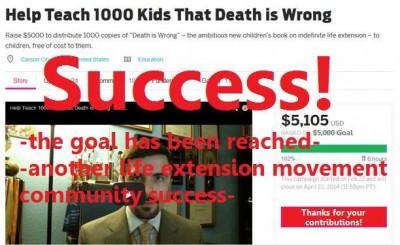
A group of us put our heads together and came up with a plan to raise the money. The fundraiser was launched on February 23rd of 2014 and successfully completed on April 23rd of 2014.

It is a great success on multiple levels for the Death is Wrong book and vision in itself, which supports indefinite-life-extension research and philosophy in general, and which is written by one of the many Movement for Indefinite Life Extension leaders, Gennady Stolyarov.

It is also a great success for the Movement for Indefinite Life Extension in general on many levels. It is one of the first major projects the MILE has executed in its upcoming series of projects to work to reach 80,000 “likes” at MILE Facebook page for the Year 3 goal, which begins on July 17th 2014, and tasks us with collectively helping to achieve the group victory of moving from 8,000 likes, to 80,000 likes by the July 17th of the following year, 2015.

Rodney Ashby and Jason Shields helped us get the momentum rolling and did fundraising throughout, and Tonya Scholz gave the project a big hand. Gennady Stolyarov made an amazing media tour for the project, finding himself talking about it in interviews and getting mentions and reports from a variety of sources. Most of them are of his own arranging, some of these outlets picked the story up on their own, and there are some opportunities that I arranged. They include, but are not limited to, the following:

There were 92 contributions from over 80 individuals and one group, including, but not limited to:

There were also at least 13 anonymous donations. I did a count of all of the donors that I brought in. A close, conservative estimate is that I brought in around 70% of them.

We ended up raising $5,141, compounding on the success by $141. That means that we raised enough to distribute 29 more books than projected. Those of us that worked with this didn’t take a single dime as a cut of this. I put a hundred dollars or so in ads into it, and Wendy and Gennady have given countless hours of their time to rewarding donors. Countless others, like general activists and reporters, have put their time and resources into this. The Life Extension Foundation made an inspiring and generous $1,255 dollar donation to close the deal.

Gennady and I have already secured the distribution of 140 copies, and there are now over 1,000 total available for distribution. An order even went out to Aubrey de Grey, whose work is one of the many topics that is talked about in the book. Gennady Stolyarov writes in the Indiegogo update page that,

Update of April 16, 2014: I am delighted to announce that a shipment of 10 Death is Wrong books was made yesterday to Dr. Aubrey de Grey himself at the SENS Research Foundation. Since Dr. de Grey’s work is a crucial inspiration for Death is Wrong and my longevity activism more generally, I am immensely pleased that he has agreed to receive this shipment and make the books available for distribution.

We encourage the distribution of Death is Wrong books to places like schools, libraries, and directly to parents and children. We ask people to order as many copies as they think they may be able to give away to kids and people with kids, at Transhuman and health events, rallies, and similar events. Gennady has instructions on how to order them free of charge:

Instructions for Longevity Activists to Request Copies of Death is Wrong

– Send an e-mail to gennadystolyarovii@gmail.com

– Provide your name, your mailing address, a statement of your support for indefinite life extension, and a brief description of your plan to spread the book to children in your local area. Remember that all copies received pursuant to this initiative would need to be offered to children free of charge (as gifts or reading opportunities) and may not be resold.

– Provide the number of copies of Death is Wrong that you are requesting.

– Preferably, provide an indication that you would be willing to send photographs of the books that have been delivered to you as well as events where you will be distributing the books.

The project has been a great community effort. The Movement for Indefinite Life extension is our collective spirit, not an organization. Together we collect supporters for all of the constructive projects and organizations. There must have been over 150 people involved. More activists flexed their life-extension muscles, and we helped more people that want to get involved to take the first step. If you’ve ever saved money, then you know how incremental change adds up. You cannot achieve the saving of $8,000 unless you first get to $2,000, and $6,000, and so forth.

It’s an example of elements coming together for a movement, like this article says:

A movement occurs when, one, a large number of people have a need that, two, lines up with the necessary ingredients to make it happen, and those two things are sparked by, three, a catalyst.

The need to survive has always been here. The ingredients have been getting added to the mix since the dawn of the Scientific Revolution. The element of the love for life is in the air, thick with explosive properties, fueled by indefinite-life-extension research and outreach from around the world and across time. People are busy working on rallies, conferences, events, interviews, getting the message out, and all the rest. The tools and the ability to make this happen are ripe, and growing more and better yields of produce by the month. Every time you put a match to it, it erupts in indefinite-life-extension activism. Be that spark today and get in on this movement.

We have more projects like this ahead, and there are plenty of others to choose from in the communities, pages, groups, organizations, sites, and other venues, around the world, growing here toward that tipping point where we can have the opportunity to spill across the ticker tapes of screens and the minds of the young and old alike, lighting hearts and minds on fire with desire to chip in together to make this happen. This is an incredible opportunity, this time here, fertile with tools and insights, unleashed capabilities beyond our wildest dreams. People are already capable of tons of incredible things that you don’t even know about yet.

Columbus went on a fantastic voyage. When you think of those times, and how fulfilling and enthralling it must have been for them to be able to be part of that, realize that indefinite life extension, all this Transhumanism, is an even greater frontier, and you are in an even more incredible and glorious position than people like Columbus and his crew. It’s a position here where anybody, where you, can help sail out into these incredible frontiers that are opened up through the ever-expanding fields of science and technology.

Eric Schulke was a director at LongeCity during 2009-2013. He has also been an activist with the Movement for Indefinite Life Extension and other causes for over 13 years.

Death is Wrong - by Gennady Stolyarov II, Illustrated by Wendy Stolyarov

“Death is Wrong” Fundraiser Success – Video by G. Stolyarov II

“Death is Wrong” Fundraiser Success – Video by G. Stolyarov II

The New Renaissance Hat
G. Stolyarov II
April 23, 2014
******************************

A compounded victory! We have raised enough funds through Indiegogo to provide at least 1029 free paperback copies of Death is Wrong to children throughout the world.

Please watch my video announcement of the fundraiser’s success! (The number of available books has increased since I mentioned being able to provide 1024 books in the video.)

140 copies have been distributed; 159 are immediately ready to go upon request. Within 15 days, we will have the funds to distribute all of the remaining books to activists who ask for them.

Extensive thanks go to Bill Faloon of the Life Extension Foundation and Tonya Scholz, who persuaded Mr. Faloon to provide the Life Extension Foundation’s support. They have my eternal gratitude for their generous willingness to step in and get us the rest of the way to our goal. Thank you, also, to every single one of our 92 funders and hundreds of supporters throughout the world!

Earlier today I was interviewed by Tonya Scholz and Sandra Lopez on their Social Chats livestreamed radio program. We had a delightful conversation about Death is Wrong and the amazing reach it has had thus far. You can listen to the recording of the interview here.

Also, I am happy to announce that the five-day window for free downloads of the Kindle version has resulted in 318 downloads – an additional way in which the book has spread significantly!

Instructions for Longevity Activists to Request Copies of Death is Wrong

– Send an e-mail to gennadystolyarovii@gmail.com

– Provide your name, your mailing address, a statement of your support for indefinite life extension, and a brief description of your plan to spread the book to children in your local area. Remember that all copies received pursuant to this initiative would need to be offered to children free of charge (as gifts or reading opportunities) and may not be resold.

– Provide the number of copies of Death is Wrong that you are requesting.

– Preferably, provide an indication that you would be willing to send photographs of the books that have been delivered to you as well as events where you will be distributing the books.

Mr. Stolyarov’s Article “Indefinite Lifespans Are Possible in Our Lifetimes” Published by Viral Global News

Mr. Stolyarov’s Article “Indefinite Lifespans Are Possible in Our Lifetimes” Published by Viral Global News

The New Renaissance Hat
G. Stolyarov II
April 22, 2014
******************************

I was pleased to contribute a guest article to Viral Global News, titled “Indefinite Lifespans Are Possible in Our Lifetimes”. The article discusses my illustrated children’s book Death is Wrong, my effort to spread 1000 paperback copies to children, free of cost to them, as well as the basics of Dr. Aubrey de Grey’s research program of SENS (Strategies for Engineered Negligible Senescence), through whose realization the reversal of senescence and the achievement of indefinite longevity would be possible within the next several decades. Read the article here.

Here is the list of references accompanying my article. Please refer to these sources if you would like a more in-depth look at the topics I briefly discuss.

References

– Death is Wrong in paperback format on Amazon

– Death is Wrong in Kindle format on Amazon

– Indiegogo Campaign: Help Teach 1000 Kids That Death is Wrong

– “Fable of the Dragon-Tyrant” by Nick Bostrom

– “Life Span Extension Research and Public Debate: Societal Considerations”. Aubrey D.N.J. de Grey. Methuselah Foundation and SENS Research Foundation. 2007.

– “Negligible senescence” – Wikipedia

– “Turritopsis dohrnii” – Wikipedia

– “Transdifferentiation” – Wikipedia

– SENS Research Foundation

– Chart of types of aging-related damage in “A Reimagined Research Strategy for Aging” – SENS Research Foundation

– “Living to 1000: an interview with Aubrey de Grey”. Zander Redwood. 80,000 Hours. April 12, 2012.

– Genentech Alzheimer’s Prevention Trial

– “Progress Against Aging”. Campaign Against Aging. 2010.

– Aubrey de Grey’s video response to Gennady Stolyarov II’s question on how to make up lost progress in anti-aging research – in “Projects to accelerate radical healthy longevity” – Video by the London Futurists

– “How Google’s Calico aims to fight aging and ‘solve death’” – Arion McNicoll – CNN – October 3, 2013

– Human Longevity, Inc.

SENS Research on the seven types of damage constituting senescence:

– Cell Loss and Atrophy

– Dysfunctional/Senescent Cells

– Nuclear Mutations

– Mitochondrial Mutations

– Extracellular Junk

– Intracellular Junk

– Extracellular Crosslinks

“Death is Wrong” Campaign Update – April 21, 2014 – Video by G. Stolyarov II

“Death is Wrong” Campaign Update – April 21, 2014 – Video by G. Stolyarov II

Mr. Stolyarov provides an update and call to action regarding his effort to Help Teach 1000 Kids That Death is Wrong.

Two days remain until the April 23, 2014, deadline for fundraising for the effort to spread 1000 paperback copies of Death is Wrong to children, free of cost to them. Contribute today to help broaden the reach of this culturally transformative illustrated children’s book on indefinite life extension.

As of April 21, 2014, $3,620 have been raised in this flexible-funding campaign, and $1,380 remain to reach the $5,000 target.

  • At least 725 books will be shipped in total.
  • 140 have been shipped already to longevity activists in the US, UK, Mexico, Poland, India, and Indonesia.
  • 133 books are ready to be shipped upon request.

The Kindle version of “Death is Wrong” is free to download through April 22, 2014. Get it here.

Get your copy today and refer as many children as you can to the link.

The impact of Death is Wrong is just beginning to occur!

References

BBC Future – “How to live forever” – Article by Frank Swain – April 21, 2014

Viral Global News – “Indefinite Lifespans Are Possible in Our Lifetimes” – Article by Gennady Stolyarov II -April 21, 2014

The Future And You – Discussion Between Stephen Euin Cobb and Gennady Stolyarov II
– Part 1 – http://traffic.libsyn.com/thefutureandyou/TFAY_2014_4_2.mp3
– Part 2 – http://traffic.libsyn.com/thefutureandyou/TFAY_2014_4_9.mp3

LongeCity Now – Justin Loew Interviews Gennady and Wendy Stolyarov – http://www.longecity.org/media/LongeCityPodcast_Stolyarov2014_A01.mp3

The Humility of Futurism – Article by Adam Alonzi

The Humility of Futurism – Article by Adam Alonzi

The New Renaissance Hat
Adam Alonzi
April 20, 2014
******************************

Civilization operates as if its troubles and their solutions will be as relevant tomorrow as they are today. Likely they were obsolete yesterday. How preposterous do the worries and aspirations of yesteryear seem now? What has not been refined since its conception? Our means of subsistence, entertainment, expression and enlightenment continue to change, although, at least unconsciously, they are accepted as stable. Change, once gradual, now quickens exponentially. Countless professions have been created and destroyed by advances; old orders have been destroyed, new ones have arisen; our world outlooks have been revolutionized by new discoveries over and over, although a sizable portion of the world is unwilling or unable to understand a man like Aubrey de Grey and an equally sizable portion of the population is still struggling with Copernicus. A Futurist accepts himself and his ideas as incomplete, therefore he actively works to improve upon them. Futurism is the first ideology that explicitly accepts the necessity and desirability of change.

It is a mistake to think we have reached the final stage of our journey. Plateaus are mirages conjured by the shortsighted; human evolution is a mountain without a peak. If a man has eyes, let him see all we have done and all we have yet to do. Let him gain the humility religion and liberalism have failed to inculcate into him and so many others. Each generation repeats this mistake. There is no evidence to suggest we are complete or are doomed now only to regress. Naysayers seem motivated to dismiss the triumphs of others out of fear they themselves will appear even less significant. Historically the distant future has received little attention compared to such pressing questions as the number of angels on the head of a pin or the labor theory of value. This may be thanks to a fondness for the apocalyptic, a fascination which certainly has not faded with time, but it is also attributable to the egotistical need to stand out. All epochs are transitions. The advances of this decade have failed to restore popular faith in progress, yet the very word is misleading. Faith does rest not upon an empirical foundation. There are scores of popular beliefs founded upon little or no evidence. Yet the proof of progress is all around us. Death wishes and earth-annihilating misanthropy aside, we can trace the modern disdain for the march forward to the fashionable nonsense of academia.


Speculations and prophecies, even conservative estimates based on careful analysis, are treated with derision by the public. To say one has faith in technology is misleading. To compare the singularity to the rapture is like comparing planetary motion to Santa Claus. One is rooted in scripture, the other in observation. The doomsayers, secular and religious alike, enjoy forecasting our demise. The essential corruption critics charge Western civilization with is common to all; it is called human nature. It is meant to be transcended, not through critiques of immaterial “cultural entities,” but by improving our bodies and our minds through bioengineering. No belief is needed here. We do not rely upon a outworn holy book or the absurd dialectic of the Marxists. We change and adapt because we must. This is a point of pride, not one of shame. We do not worship the past; we have shrugged it off. Compared to the ridiculous claims circulating in the cesspool collectively referred to as “the humanities” this is a sane position, yet it is treated with nothing by scorn by those who, wishing so ardently to distance themselves from Western civilization, bite the hands that feed them, clothes them, and shelters them. While they navigate by GPS, post their inane tangents on social media sites, and try with all their might to discredit the culture to which they owe their lives and livelihoods, others push forward. Self-proclaimed critics of Western civilization should consider trading their general practitioner for an Angolan witch doctor. It is hard to respect those who do not practice what they preach.

Postmodernism and cultural relativism, though they have pretensions of completeness and delusions of permanence, are but passing fads. Something devoid of usefulness or, for that matter, a coherent hypothesis, cannot last long when technology is generating so much benefit to so many people. A meme will continue to propagate itself long after it has served its purpose, to the detriment of competitors and to society at large. It is the duty of Futurists and Transhumanists to demolish the acceptability of rubbish in academia and in the media. The Luddites are more dangerous than the Creationists. Hubris is barely acceptable in the hard sciences, but in an absolutely unempirical discipline like philosophy, it is deplorable. Our first priority should not be political or religious; it should be scientific. To whom do we owe our prosperity, and to whom do we owe our future? To whom do we owe our lives and the lives of our children? How many of us would not be here today were it not for the men and women of modern medicine? This is not the end. Forget the weary and the overwhelmed; they are weak. Forget the ones who have no desire to climb higher; they are unfit. Cast aside the ones who pray fervently for the undoing of their own species; they are the most vile of all. This is not the end. This is our beginning.
***
Adam Alonzi is the author of Praying for Death and A Plank in Reason. He is also a futurist, inventor, DIY enthusiast, biotechnologist, programmer, molecular gastronomist, consummate dilletante and columnist at The Indian Economist. Read his blog Cool Flickers.
***
Help the next generation embrace a progress-filled vision of the future by supporting the illustrated children’s book Death is Wrong (free in Kindle format until April 22, 2014), and the campaign to distribute 1000 paperback copies to children, free of cost to them. The Indiegogo fundraising period ends on April 23, so please consider making a contribution today.
***