Browsed by
Tag: central bank

David Brooks, The Whigs, and Corporate Welfare – Article by Thomas J. DiLorenzo

David Brooks, The Whigs, and Corporate Welfare – Article by Thomas J. DiLorenzo

The New Renaissance Hat
Thomas J. DiLorenzo
February 8, 2014

******************************

In a January 30 column David Brooks, the house neoconservative of the New York Times, urged Obama to ignore both his socialist/egalitarian base and the “conservative tradition that believes in limiting government to enhance freedom.” Obama already has nothing but hateful contempt for the latter tradition and needs no convincing by a right-wing statist like David Brooks.

The president should also abandon his life-long infatuation with and devotion to socialism as well, advises David Brooks. In its place he should pursue an agenda of crony capitalism disguised as a “social mobility agenda” with the help of professional propagandists and perverters of American history such as Brooks and his fellow neoconservatives. Of course, Brooks doesn’t use these less-than-flattering words to describe his Machiavellian agenda. He talks of “a third ancient tradition” in American history, namely, “the Whig tradition, which begins with people like Henry Clay, Daniel Webster and Abraham Lincoln.”

Either Brooks knows nothing at all, whatsoever, about the Whig Party tradition in American history, or he is lying through his teeth about it. For he describes it as having been devoted to “using the power of government to give marginalized Americans the tools to compete in a capitalist economy.” The Whigs, says Brooks, “fought against the divisive populist Jacksonians” who supposedly sought to “pit classes against each other.” Every bit of this is exactly the opposite of the truth. The Whigs were the party of crony capitalism, of government of plutocracy, by the plutocracy, for the plutocracy. That is why so many historians have marveled over how a man like Abe Lincoln, who grew up so poor, would become the political water carrier for the Northeastern moneyed elite in American politics.

The most divisive economic issue in American politics during the heyday of the Whig Party (1832–1852) was the battle over free trade versus protectionism. If the Whigs stood for anything, they stood for corporate welfare in the form of high protectionist tariffs that would plunder the masses for the benefit of the few. This meant, for the most part, plundering Southern farmers more than anyone for the benefit of Northern manufacturers who would be protected from international competition by the high tariffs. As John C. Calhoun once said, what “protectionism” protects the public from is low prices. Next to slavery, protectionism was the biggest assault on property rights in America during the first half of the nineteenth century. The Whigs did not believe in “sacred” property rights, as Brooks foolishly writes. Their entire political agenda was based on the government-enforced attenuation of property rights for the benefit of the wealthy and politically-connected.

Next to political plunder through protectionism, the Whigs stood for the worst sort of crony capitalism in the form of needless corporate welfare for road-, canal-, and railroad-building corporations. This was euphemistically called “internal improvement subsidies” at the time. Private capital markets financed thousands of miles of private roads during the first decades of the nineteenth century. As of 1800 there were 69 privately-financed road-building companies in America that would build more than 400 private roads over the next 40 years, as economist Daniel Klein has documented. The great railroad entrepreneur James J. Hill also proved that government subsidies were not needed to build a transcontinental railroad as he and his investors and business partners built and managed the Great Northern Railroad without a dime of government subsidy, not even “land grants.”

When the Whigs did get their way and conned state government into funding “internal improvement subsidies”, it was an unmitigated financial disaster. Very few, if any, projects were ever finished; taxpayers were stuck with enormous government debts to pay off; much of the money was simply stolen; and by 1860 every state except for Massachusetts had amended its constitution to prohibit the use of tax dollars for corporations with which to do anything, according to economic historian Carter Goodrich.

Edgar Lee Masters, the famous 1930s-era poet, playwright (author of The Spoon River Anthology), and law partner of Clarence Darrow, perfectly described the Whig Party on page 27 of his book, Lincoln the Man. Describing the leader of the Whigs, Henry Clay, Masters wrote:

Clay was the champion of that political system which doles favors to the strong in order to win and to keep their adherence to the government. His system offered shelter to devious schemes and corrupt enterprises. … He was the beloved son [figuratively speaking] of Alexander Hamilton with his corrupt funding schemes, his superstitions concerning the advantage of a public debt, and a people taxed to make profits for enterprises that cannot stand alone. His example and doctrines led to the creation of a party that had no platform to announce, because its principles were plunder and nothing else.

This is exactly correct, and exactly the opposite of what David Brooks wants his New York Times audience to believe. Clay’s agenda, which Alexander Hamilton originally labeled “The American System,” was really an Americanized version of the corrupt mercantilist system the American founders had fought a revolution against. The Hamilton/Clay/Lincoln “American System” included protectionism, corporate welfare, and a central bank to dispense even more corporate welfare subsidies to politically-connected businesses. It was a recipe for political power based on using taxpayer dollars to line the pockets of the (mostly Northern state) business plutocracy at the expense of the general public. Some things never change in a democracy.

It is equally outrageous for Brooks to claim that the Jacksonians were “divisive” and wanted to “pit classes against each other.” This was the function of David Brooks’s beloved Whigs, who were simply an early version of the neoconservatives; it was the libertarian Jacksonians who opposed politicized divisiveness and the pitting of classes against each other. This is exemplified in President Andrew Jackson’s famous veto of the re-chartering of the Second Bank of the United States, a precursor of the Fed.

The Whigs championed a central bank. The Bank of the United States (BUS) even paid both of Brooks’s heroes, Clay and Webster, many thousands of dollars as bribery money to promote the continuation of the bank despite the fact that it was well known that the BUS had corrupted politics and generated boom-and-bust cycles. In vetoing the re-chartering of the BUS (which was not overturned), Jackson wrote:

It is to be regretted that the rich and powerful too often bend the acts of government to their selfish purposes. … In the full enjoyment of the gifts of Heaven and the fruits of superior industry, economy and virtue, every man is equally entitled to protection by the law; but when the laws undertake to add to these natural and just advantages artificial distinctions, to grant titles, gratuities, and exclusive privileges, to make the rich richer and the potent more powerful, the humble members of society — the farmers, mechanics and laborers — who have neither the time nor the means of securing like favors to themselves, have a right to complain of the injustice of their Government. … In the act before me [the bill to re-charter the BUS] there seems to be a wide and unnecessary departure from these just principles.

Neither Jackson nor the Jacksonians were “perfect” libertarians, but by their motto of “equal rights” they meant equality under the law and opposition to the use of the state to dispense “exclusive privileges” and special favors to special interests. They stood for exactly the opposite of what David Brooks claims they stood for, in other words.

Brooks’s commentary turns to slapstick humor at one point when he claims that the Whigs, who were, after all, politicians, were somehow “family-oriented in their moral and social attitudes.” (I assume that he threw this into his article to further dupe the “evangelical Christian” base of the Republican Party into accepting his thesis). The leader of the Whigs, the slave-owning Kentucky hemp plantation patriarch Henry Clay, was indeed “family oriented” in that he had 11 children. But he was also a notorious gambler who rang up $40,000 in personal debt in the 1820s and was famous for staying out late carousing and dancing with women other than his wife while he was in Washington and the wife was back home in Kentucky, according to several biographies.

Armed with this absurdly false history of American politics, Brooks argues for an explosion of governmental central planning by Obama during the rest of his term. He wants Obama to employ “social entrepreneurs” to fundamentally transform American society by “improving family patterns,” expanding early childhood education, “structuring neighborhoods,” paying “young men wage subsidies so they are worth marrying,” training “middle-aged workers” for jobs, and generally micromanaging everyone’s life from cradle to grave. In his words, government should promote “[social] mobility issues from the beginning to the end of the lifespan.”

Something very much like this has been tried before. It was called totalitarian socialism, and it failed miserably.

Thomas DiLorenzo is professor of economics at Loyola University Maryland and a member of the senior faculty of the Mises Institute.

He is the author of The Real Lincoln; Lincoln Unmasked; How Capitalism Saved America; and Hamilton’s Curse: How Jefferson’s Archenemy Betrayed the American Revolution — And What It Means for Americans Today. Send him mail.

This article was published on Mises.org and is reprinted pursuant to a Creative Commons Attribution License.
After 100 Years of Failure, It’s Time to End the Fed! – Article by Ron Paul

After 100 Years of Failure, It’s Time to End the Fed! – Article by Ron Paul

The New Renaissance Hat
Ron Paul
December 15, 2013
******************************

A week from now, the Federal Reserve System will celebrate the 100th anniversary of its founding. Resulting from secret negotiations between bankers and politicians at Jekyll Island, the Fed’s creation established a banking cartel and a board of federal-government overseers that has grown ever stronger through the years. One would think this anniversary would elicit some sort of public recognition of the Fed’s growth from a quasi-agent of the Treasury Department intended to provide an elastic currency, to a de facto independent institution that has taken complete control of the economy through its central monetary planning. But just like the Fed’s creation, its 100th anniversary may come and go with only a few passing mentions.

Like many other horrible and unconstitutional pieces of legislation, the bill which created the Fed, the Federal Reserve Act, was passed under great pressure on December 23, 1913, in the waning moments before Congress recessed for Christmas with many Members already absent from those final votes. This underhanded method of pressuring Congress with such a deadline to pass the Federal Reserve Act would provide a foreshadowing of the Fed’s insidious effects on the US economy—with actions performed without transparency.

Ostensibly formed with the goal of preventing financial crises such as the Panic of 1907, the Fed has become increasingly powerful over the years. Rather than preventing financial crises, however, the Fed has constantly caused new ones. Barely a few years after its inception, the Fed’s inflationary monetary policy to help fund World War I led to the Depression of 1920. After the economy bounced back from that episode, a further injection of easy money and credit by the Fed led to the Roaring Twenties and to the Great Depression, the worst economic crisis in American history.

But even though the Fed continued to make the same mistakes over and over again, no one in Washington ever questioned the wisdom of having a central bank. Instead, after each episode the Fed was given more and more power over the economy. Even though the Fed had brought about the stagflation of the 1970s, Congress decided to formally task the Federal Reserve in 1978 with maintaining full employment and stable prices, combined with constantly adding horrendously harmful regulations. Talk about putting the inmates in charge of the asylum!

Now we are reaping the noxious effects of a century of loose monetary policy, as our economy remains mired in mediocrity and utterly dependent on a stream of easy money from the central bank. A century ago, politicians failed to understand that the financial panics of the 19th century were caused by collusion between government and the banking sector. The federal government’s growing monopoly on money creation, high barriers to entry into banking to protect politically favored incumbents, and favored treatment for government debt combined to create a rickety, panic-prone banking system. Had legislators known then what we know now, we could hope that they never would have established the Federal Reserve System.

Today, however, we do know better. We know that the Federal Reserve continues to strengthen the collusion between banks and politicians. We know that the Fed’s inflationary monetary policy continues to reap profits for Wall Street while impoverishing Main Street. And we know that the current monetary regime is teetering on a precipice. One hundred years is long enough. End the Fed.

Ron Paul, MD, is a former three-time Republican candidate for U. S. President and Congressman from Texas.

This article is reprinted with permission from the Ron Paul Institute for Peace and Prosperity.

Janet Yellen, the “Pink Dream,” and a Coming Economic Nightmare – Article by Joseph T. Salerno

Janet Yellen, the “Pink Dream,” and a Coming Economic Nightmare – Article by Joseph T. Salerno

The New Renaissance Hat
Joseph T. Salerno
November 19, 2013
******************************

On Monday, former Fed official Andrew Huszar publicly apologized to the American public for his seminal role in executing the Quantitative Easing (QE) program, a program he characterizes as “the greatest backdoor Wall Street bailout of all time,” and “the largest financial-markets intervention by any government in world history.” While this is a momentous admission from an insider (Mr. Huszar is also a former Wall Street banker), perhaps Mr. Huszar’s most revealing statement concerned the results of QE’s “relentlessly pumping money into the financial markets during the past five years.” He referred to the spectacular rally in financial markets and expressed agreement with the growing belief among expert observers that market conditions had become “bubble-like.”

In a paper just released by the American Enterprise Institute, another former policymaker, resident fellow Desmond Lachman, formerly deputy director of the International Monetary Fund’s Policy Development and Review Department, warns that QE and other “unorthodox monetary policies” are having “unintended consequences.” Among other consequences, Lachman sees signs of incipient bubbles forming throughout the world:

An important aim of the QE policies pursued in the United States, the United Kingdom, and Japan has been to encourage risk taking and to raise asset prices as the means to stimulate aggregate demand. The question that now needs to be asked is whether these policies may have given rise to excessive risk taking, overleveraging, and bubbles in asset and credit markets. In this context, one has to wonder whether historically low yields on junk bonds in the industrialized countries now understate the risk of owning those bonds. . . . One also has to wonder whether yields on sovereign bonds in the European periphery have become disassociated from those countries’ underlying economic fundamentals and whether global equity valuations have not become excessively rich.

The markets for gems and for collectibles have also become very frothy of late. Yesterday, new records were set for a gemstone and for an Andy Warhol piece of art sold at auction. The “Pink Dream,” is a 59.60 carat vivid pink diamond, which is the highest color grade for diamonds, and the purity of its crystals is ranked among the top 2 percent in the world. The record setting price was $83 million. Not coincidentally, the DJIA set an intraday record shortly before the auction. The new record price for the Andy Warhol piece was $105.4 million. The auction’s combined $199.5 million in revenues was also a record for Sotheby’s. During Sotheby’s Geneva fall auction season, records were also set for the prices of an orange diamond and a Rolex Daytona watch.

While the Austrian insight that super-accommodative Fed monetary policy may be causing a recurrence of asset bubbles is making headway in policy circles, it has not yet dawned on Janet Yellen. Nor is such an epiphany likely. Ms. Yellen wears the intellectual blinders of the mainstream macroeconomist which force her to focus narrowly on arbitrary and increasingly irrelevant statistical averages and aggregates like the CPI, the unemployment rate, and GDP and to ignore what is going on around her in real markets.

This was clearly revealed in remarks prepared for her confirmation hearing released yesterday. Ms. Yellen noted that the rate of increase in the CPI index was less than the Fed target of 2.00 percent and that the labor market and the economy were performing far short of their potential (based on the meaningless concept of “potential GDP”). She thus reiterated her commitment to continuing monetary accommodation and “unconventional policy tools such as asset purchases.” It is true that in her testimony before the Senate committee on Thursday she did concede that it is “important for the Fed to attempt to detect asset bubbles when they are forming.” However, she blithely dismissed concerns that recent record highs in asset markets reflected “bubble-like conditions.” With Ms. Yellen’s confirmation highly likely, we can look forward to the Fed blindly fueling asset bubbles to a fare-thee-well. With the financial system still on shaky ground, this will lead to another financial meltdown and a U.S. government takeover of the financial system, the likes of which will make the last Wall Street bailout appear to be a minor intervention.

Joseph Salerno is academic vice president of the Mises Institute, professor of economics at Pace University, and editor of the Quarterly Journal of Austrian Economics. He has been interviewed in the Austrian Economics Newsletter and on Mises.org. Send him mail. See Joseph T. Salerno’s article archives.

This article was published on Mises.org and may be freely distributed, subject to a Creative Commons Attribution United States License, which requires that credit be given to the author.

Inflation Has Not Cured Iceland’s Economic Woes – Article by David Howden

Inflation Has Not Cured Iceland’s Economic Woes – Article by David Howden

The New Renaissance Hat
David Howden
November 6, 2013
******************************

No two countries’ responses have polarized commentators over the past five years more than the contrasting post-crisis policies in Iceland and Ireland.

In a paper published in Economic Affairs (available here as a PDF) I contrast the policies enacted by Iceland and Ireland, perhaps the two countries most affected by the liquidity freeze of 2008. A common conclusion has been that one country did everything right and the other did everything wrong, however, I take a more pragmatic approach. There are some positive aspects in each case, and other aspects we can do without.

At the risk of over-simplifying their situations, the key policy differences are:

  1. Iceland allowed substantial swaths of its financial sector to collapse (mostly foreign-domiciled subsidiaries) while Ireland enacted blanket guarantees to keep its financial sector afloat.
  2. Iceland quickly inflated its krona in a bid to regain international competitiveness through depreciation. By being locked in the euro, Ireland was unable to pursue a similar path and instead had to become more attractive to foreigners by lowering its domestic prices (i.e., disinflation or outright deflation).
  3. Iceland stymied a capital flight by enacting monetary controls aimed at keeping investment within the country. By being part of the European Union, Ireland maintained its commitment to free capital markets, and investors were able to enter or exit as they pleased.

The evidence is mixed as to which solution was more effective. Iceland seems to have softened the immediate blow of its recession, but present growth in Ireland is stronger. In a similar way, unemployment in Iceland was less and still remains lower today.

For our purposes here, I want to focus just on the effects of their respective monetary policies, and how the short-term gains from Iceland’s inflationary response now pale in comparison to Ireland’s more subdued response.

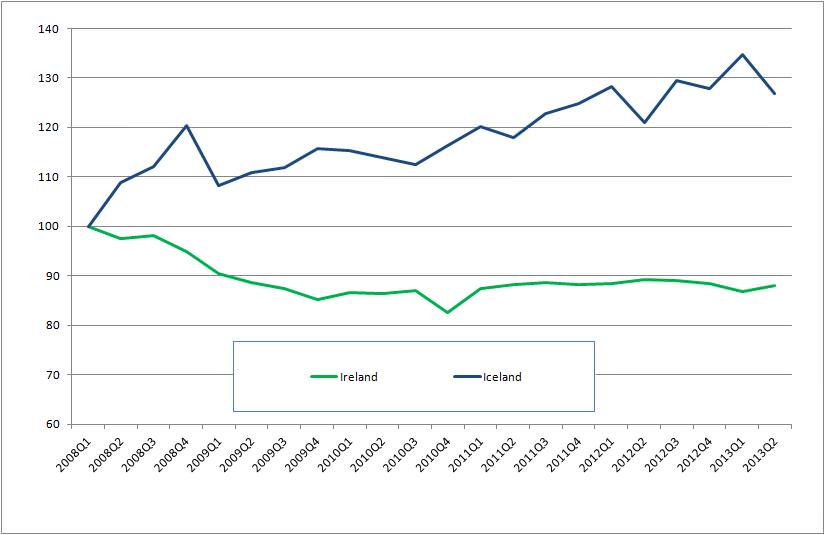
Figure 1: Nominal GDP (2008 = 100) Source: Federal Reserve Bank of St. Louis
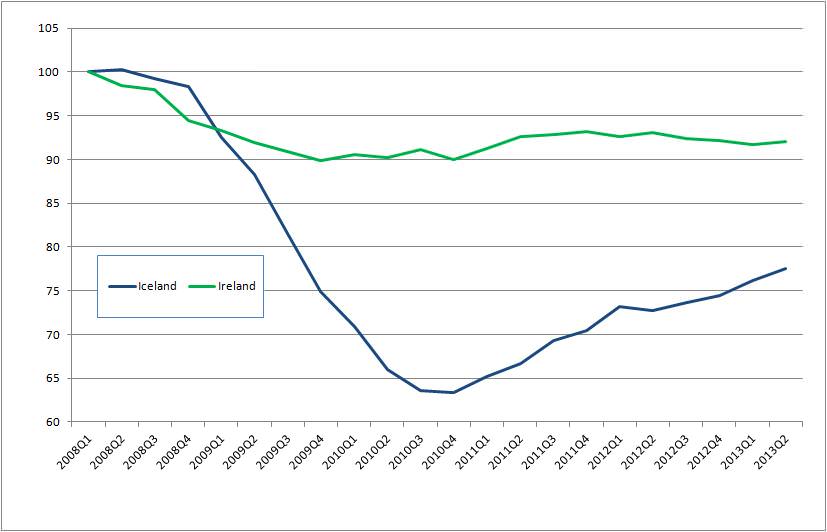
Figure 1 shows the common story. Iceland’s inflationary policy stimulated exports, papered over some bad debts, and in general allowed it to exit the storm relatively unscathed. In contrast, Ireland is languishing in slow growth and five years later the country’s income is still 10 percent below its pre-bust peak.

Such an analysis neglects the pernicious effects of inflation on the Icelandic economy. This policy increased the money supply by almost 20 percent in 2008 alone, and lead to an immediate increase in prices.

Figure 2: Real GDP (2008 = 100) Source: Federal Reserve Bank of St. Louis
In figure 2 we get a better feel for how the situation felt to the average Icelander or Irishman. As the Central Bank of Iceland inflated the money supply, price inflation raged. Icelanders continually felt their financial security worsen as their purchasing power collapsed. This was not apparent to the rest of the world, fixated as it was on the nominal prices the Icelandic economy posted. By its nadir in late 2010, inflation-adjusted income in Iceland was down over 35 percent.

In Ireland this decline was muted because of price deflation. As domestic prices fell it became easier for Irish citizens to make their declining nominal incomes go further. At its worst, the Irish economy collapsed less than 10 percent in real terms.

This seems to suggest that Ireland had the better solution by not pursuing an inflationary monetary policy. Some will note, however, that Iceland’s recovery since 2010 has been quite strong.

Indeed, if we look at the drop in the employment rate for both countries most probably feel more sympathy for the masses of unemployed Irishmen.

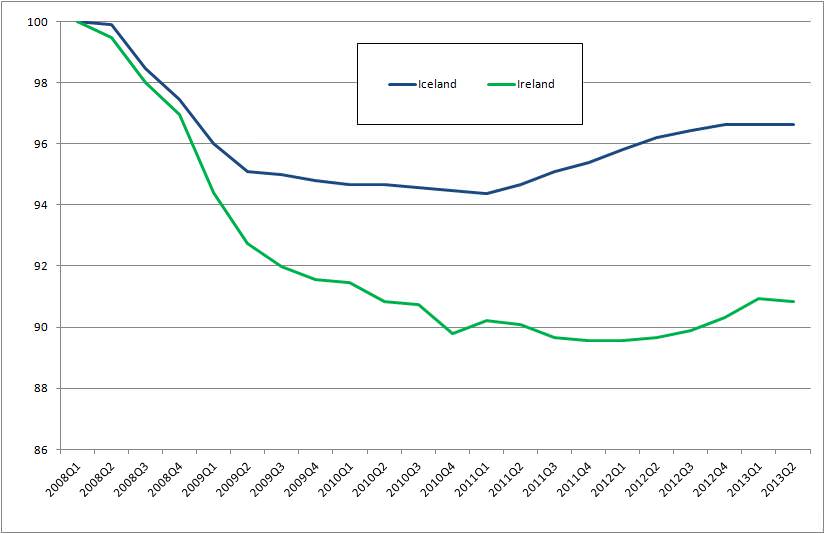
Figure 3: Employment rate (2008 = 1) Source: Federal Reserve Bank of St. Louis
Digging deeper, however, we find that not all is as it seems. Many Icelanders work two jobs to make ends meet. This effect was increasingly pronounced through the recession as inflation made it more difficult to get by with one salary. As a consequence, many Icelanders lost one job during the recession but the unemployment statistics did not reflect this as they were still employed elsewhere. This is notably not the case in Ireland, where not only is one job per worker the norm, but falling prices made it easier for an employed person to make ends meet as the recession continued.

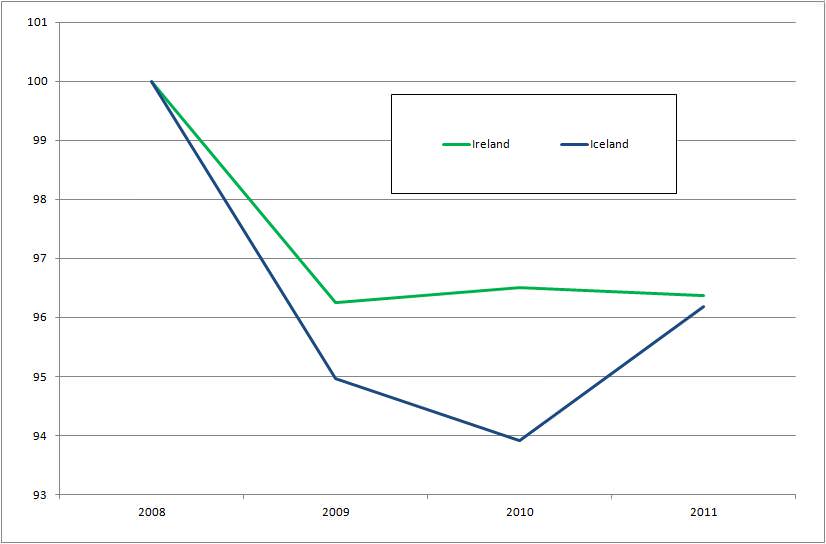
A better way to gauge the employment situation is to look at changes in the hours worked.

Figure 4: Annual hours worked (2008 = 100) Source: Federal Reserve Bank of St. Louis

Here we can see the situation is reversed. By the recession’s trough in 2010 the number of hours worked by the average Icelander had fallen 6 percent while in Ireland the corresponding drop was only 3.5 percent — almost half as much.

Both countries still have problems. Iceland’s monetary controls are notably stifling needed investment, while Ireland is left with a large debt from bailing out its banks, and this is stalling growth. One thing is clear though — the effects of monetary policy are stark and the proclaimed benefits of Iceland’s inflationary policy were counteracted by the price inflation that ensued.

Don’t let a good crisis go to waste; learn something from it. As the tale of these two countries demonstrates, inflating one’s currency may give the appearance of recovery, but the truth is somewhat less rosy.

David Howden is Chair of the Department of Business and Economics and professor of economics at St. Louis University’s Madrid Campus, Academic Vice President of the Ludwig von Mises Institute of Canada, and winner of the Mises Institute’s Douglas E. French Prize. Send him mail. See David Howden’s article archives.

This article was published on Mises.org and may be freely distributed, subject to a Creative Commons Attribution United States License, which requires that credit be given to the author.

New Fed Boss Same as the Old Boss – Article by Ron Paul

New Fed Boss Same as the Old Boss – Article by Ron Paul

The New Renaissance Hat
Ron Paul
October 13, 2013
******************************

The news that Janet Yellen was nominated to become the next Chairman of the Board of Governors of the Federal Reserve System was greeted with joy by financial markets and the financial press. Wall Street saw Yellen’s nomination as a harbinger of continued easy money. Contrast this with the hand-wringing that took place when Larry Summers’ name was still in the running. Pundits worried that Summers would be too cautious, too hawkish on inflation, or too close to big banks.

The reality is that there wouldn’t have been a dime’s worth of difference between Yellen’s and Summers’ monetary policy. No matter who is at the top, the conduct of monetary policy will be largely unchanged: large-scale money printing to bail out big banks. There may be some fiddling around the edges, but any monetary policy changes will be in style only, not in substance.

Yellen, like Bernanke, Summers, and everyone else within the Fed’s orbit, believes in Keynesian economics. To economists of Yellen’s persuasion, the solution to recession is to stimulate spending by creating more money. Wall Street need not worry about tapering of the Fed’s massive program of quantitative easing under Yellen’s reign. If anything, the Fed’s trillion dollars of yearly money creation may even increase.

What is obvious to most people not captured by the system is that the Fed’s loose monetary policy was the root cause of the current financial crisis. Just like the Great Depression, the stagflation of the 1970s, and every other recession of the past century, the current crisis resulted from the creation of money and credit by the Federal Reserve, which led to unsustainable economic booms.

Rather than allowing the malinvestments and bad debts caused by its money creation to liquidate, the Fed continually tries to prop them up. It pumps more and more money into the system, piling debt on top of debt on top of debt. Yellen will continue along those lines, and she might even end up being Ben Bernanke on steroids.

To Yellen, the booms and bust of the business cycle are random, unforeseen events that take place just because. The possibility that the Fed itself could be responsible for the booms and busts of the business cycle would never enter her head. Nor would such thoughts cross the minds of the hundreds of economists employed by the Fed. They will continue to think the same way they have for decades, interpreting economic data and market performance through the same distorted Keynesian lens, and advocating for the same flawed policies over and over.

As a result, the American people will continue to suffer decreases in the purchasing power of the dollar and a diminished standard of living. The phony recovery we find ourselves in is only due to the Fed’s easy money policies. But the Fed cannot continue to purchase trillions of dollars of assets forever. Quantitative easing must end sometime, and at that point the economy will face the prospect of rising interest rates, mountains of bad debt and malinvested resources, and a Federal Reserve which holds several trillion dollars of worthless bonds.

The future of the US economy with Chairman Yellen at the helm is grim indeed, which provides all the more reason to end our system of central economic planning by getting rid of the Federal Reserve entirely. Ripping off the bandage may hurt some in the short run, but in the long term everyone will be better off. Anyway, most of this pain will be borne by the politicians, big banks, and other special interests who profit from the current system. Ending this current system of crony capitalism and moving to sound money and free markets is the only way to return to economic prosperity and a vibrant middle class.

Ron Paul, MD, is a former three-time Republican candidate for U. S. President and Congressman from Texas.

This article is reprinted with permission from the Ron Paul Institute for Peace and Prosperity.

Federal Reserve Blows More Bubbles – Article by Ron Paul

Federal Reserve Blows More Bubbles – Article by Ron Paul

The New Renaissance Hat
Ron Paul
May 5, 2013
******************************

Last week at its regular policy-setting meeting, the Federal Reserve announced it would double down on the policies that have failed to produce anything but a stagnant economy. It was a disappointing, but not surprising, move.

The Fed affirmed that it is prepared to increase its monthly purchases of Treasuries and mortgage-backed securities if things don’t start looking up. But actually the Fed has already been buying more than the announced $85 billion per month. Between February and March, the Fed’s securities holdings increased $95 billion. From March to April, they increased $100 billion. In all, the Fed has pumped more than a half trillion dollars into the economy since announcing its latest round of “quantitative easing” (QE3) in September 2012.

Although many were up in arms when the Fed said it would buy $600 billion in government debt outright for the previous round, QE2, all seems quiet about the magnitude of QE3 because it doesn’t come with huge up-front total price tag. But by year’s end the Fed’s balance sheet could hit $4 trillion.

With no recovery in sight, where’s all this money going? It is creating bubbles. Bubbles in the housing sector, the stock market, and government debt. The national debt is fast approaching $17 trillion, with the Fed monetizing most of the newly issued debt. The stock market has been hitting record highs for the past two months as investors seek to capitalize on the Fed’s easy money. After all, as long as the Fed keeps the spigot open, nominal profits are there for the taking. But this is a house of cards. Eventually, just like in 2008-2009, the market will discipline the bad actions of the Fed and seek to find the real normal.

In the meantime, real families are suffering. While Wall Street and the federal government take advantage of access to the Fed’s new “free” money, the Fed claims there is no inflation. But who hasn’t paid higher prices at the grocery store, the gas pump, for tuition, for insurance? It’s bad enough that household incomes have stagnated, but real purchasing power has declined so much that one in seven Americans, 47.3 million people, are on food stamps. Five million are collecting unemployment insurance with 21.5 million afflicted by unemployment according to the federal government’s own figures. That’s 13.9 percent — close to double the 7.5 percent unemployment number reported last week.

We are certainly not in a recovery. We don’t see the long unemployment and soup-kitchen lines like in the Great Depression, but that’s just because the lines are electronic now.

It is not surprising the Fed has decided to hand the American people more of the same failed policies. But it is disappointing. We know what the real solution is: allow the marketplace to work. Allow entrepreneurs the chance to create instead of stifling innovation with arbitrary regulations. Allow interest rates to rise to equal the risks in the economy. Allow bad debts to be liquidated so we can build on a firm foundation. Stop printing money to benefit the government and big banks. Restore sound money to the economy and the American people. Sound money is the bedrock for prosperity and the best check on big government and crony capitalism.

Ron Paul, MD, is a former three-time Republican candidate for U. S. President and Congressman from Texas.

This article is reprinted with permission.

Bitcoin Donations and Direct Sharing on Social Networks Now Available on TRA

Bitcoin Donations and Direct Sharing on Social Networks Now Available on TRA

The New Renaissance Hat
G. Stolyarov II
November 27, 2012
******************************

I am immensely pleased to announce two major improvements to The Rational Argumentator. I am grateful to Wendy Stolyarov for making these enhancements possible.

First, Bitcoin donations are now accepted via the address on the sidebar. With this enhancement, TRA has joined the Bitcoin economy and hereby expresses its support of this experiment in currencies that are free of central-bank manipulation and that can truly empower individuals.

Bitcoin donations will be used, where possible, on activities that are relevant to TRA’s purpose. It is still certainly the case that only a minority of participants in the tangible and digital economies accept Bitcoin. However, Bitcoin donations to TRA will give me the ability to productively interact with those who do. The uses of donations may include improvements to TRA’s content and infrastructure – as well as the acquisition of goods and services that are relevant to TRA’s purpose or that reward other creators whose work is aligned with that purpose. (I will post about such acquisitions when they happen.) Sometimes I may need to exchange Bitcoin for USD if this can become an effective way to pay for TRA’s web hosting or related upkeep of the site. No donation amount is too small – and every donation will be appreciated. Bitcoin transactions are intended to be anonymous, but you may feel free to otherwise inform me that you have made a donation, and I will thank you individually.

Because TRA is not a corporation or other formal legal entity, donations are not tax-deductible. But your purpose in donating to TRA should not be the achievement of a tax deduction in any event.

Second, you will notice that it is now possible to directly share specific TRA features via Facebook, Google Plus, and Twitter from the main Rational Argumentator page (without needing to click on the link for the individual article). Hopefully, this will encourage more of my readers to spread TRA’s content throughout their social network and thereby encourage the proliferation of rational thinking and high culture.

The Golden Age of Freedom Is Still Ahead – Article by Anthony Gregory

The Golden Age of Freedom Is Still Ahead – Article by Anthony Gregory

The New Renaissance Hat
Anthony Gregory
October 6, 2012
******************************

Free enterprise is often associated with the past. This perception puts the market’s champions, seen as hopeless reactionaries, on the defensive.

A typical narrative follows: America had an insufficiently active government under the Articles of Confederation. The Constitution expanded the central government to meet society’s needs. In this climate, where property rights continued to trump the common good, the central government could not maintain national cohesion and ensure racial equality. During the Civil War, the federal government grew to preserve the Union, enable commerce through expansion of infrastructure, and abolish the ancient evil of slavery. During the late nineteenth century, laissez faire reigned supreme. Unchecked, robber barons exploited their customers and workers.

American society, so continues the narrative, overcame its laissez-faire history and embraced active government in the Progressive Era. Commerce, banking, monopolies, food and drugs, and labor conditions finally became regulated. The market was still too free, however, causing the stock market crash and the Great Depression, which the New Deal’s reforms finally addressed. Anachronistic free marketers resisted this progress.

A generation later the free market proved inadequate on race relations, education, poverty, social insurance, workers’ conditions, and the environment. New regulations, taxes, and programs arose in the 1960s and 1970s to address these deficiencies. Ronald Reagan’s election marked a conservative counterrevolution toward the free market, causing the savings-and-loan crisis, rising income disparities, and, ultimately, the 2008 financial collapse. After four consecutive reactionary presidents—Bill Clinton being a practitioner of neoliberal austerity—deregulation and market fundamentalism have again revealed themselves as outdated approaches to America’s modern problems.

This repeated recognition that the free market no longer suits society’s needs is a common theme of modern liberalism. Through experience the inadequacy of the unhampered market has forced enlightened observers to accept the need for more government.

One obvious problem with this narrative is the steadily changing definition of “free market.” The free market is said to have caused problems addressed in the Progressive Era, yet once again the market economy was blamed for the Depression.The New Deal is said finally to have abolished laissez faire, yet laissez faire has been the culprit in every crisis since. Thoughtful proponents of this narrative explain that the 1980s, for example, were somehow substantially more laissez-faire than the 1970s, yet they rarely present more than a handful of superficial examples of deregulation amid an overall trend of regulatory expansion.

A major problem market proponents have in confronting this narrative, whatever its shortcomings, arises because they themselves sometimes accept it implicitly, often complaining about the liberties lost over the years. The significant kernel of truth is that the national government has unmistakably grown well beyond anything imagined in 1789 or even the nineteenth century. And surely, for every argument statists have defending this growth, compelling historical and economic counterarguments are available.

Yet we must be careful before conceding this premise that the past was laissez-faire. By celebrating the political economy of yesteryear, we risk associating our ideals with the past’s many injustices. We can and should avoid this baggage entirely.

Slavery: The Opposite of Free Enterprise

No libertarian defends the horrid institution of slavery. The problem comes in how free marketers sometimes describe slavery as a mere exception to the rule of early American freedom. In fact this exception virtually swallowed the principle whole.

Progressives love contrasting the pro-liberty, anti-tax rhetoric of the founding generation with the slavery that they tolerated or championed. Robin Einhorn’s American Taxation, American Slavery is a sophisticated contribution to the argument that those loudly protesting taxes were often the very people who clung to human bondage. This argument indicts the rhetoric of property rights, which is foundational to free enterprise and, in a warped form, the “right” of one person to own another. Infamously, the Supreme Court found in Dred Scott v. Sanford (1857) that the Fifth Amendment protected a white man’s right not to be deprived of his slave without due process. Given this association between America’s slave-owning generations and the rhetoric of liberty, it is crucial that free marketers explain, emphatically and intelligently, how slavery was the very negation of the free-market system.

The subjugation of slaves would undermine early America’s status as a free country even if slaves were a tiny minority. They were not. Slaves amounted to 18 percent of the population at the time of the Constitution’s ratification and 12.6 percent on the eve of the Civil War, at which point there were nearly four million.

Libertarians should study the brutality of this system. Historians estimate that hundreds of thousands of slaves were forced to migrate in antebellum America’s internal slave trade. Children were frequently ripped from their families. Beatings and rape were ubiquitous, and torture as punishment was hardly unusual.

Even slaves with relatively humane masters lacked the freedoms that most of today’s Americans, living under the modern leviathan, take for granted.

Peter Kolchin, in his seminal American Slavery: 1619–1877, sums up the reality:

Slaves could hardly turn around without being told what to do.They lived by rules, sometimes carefully constructed and formally spelled out and sometimes haphazardly conceived and erratically imposed. Rules told them when to rise in the morning, when to go to the fields, when to break for meals, how long and how much to work, and when to go to bed; rules also dictated a broad range of activities that were forbidden without special permission, from leaving home to getting married; and rules allowed or did not allow a host of privileges, including the right to raise vegetables on garden plots, trade for small luxuries, hunt, and visit neighbors. Of course, all societies impose rules on their inhabitants in the form of laws, but the rules that bound slaves were unusually detailed, covered matters normally untouched by law, and were arbitrarily imposed and enforced, not by an abstract entity that (at least in theory) represented their interests, but by their owners. Slaves lived with their government.

I thank God I don’t live with my government! For many years the pro-market tradition saw slavery as a grave violation of its principles. Kolchin writes:

Early political economists—including Adam Smith, whose book The Wealth of Nations (1776) remained for decades the most influential justification for the principles underlying capitalism—believed that slavery, by preventing the free buying and selling of labor power and by eliminating the possibility of self-improvement that was the main incentive to productive labor, violated central economic laws.

Although critics blame market exchange for the rise of slavery, this criticism is grossly unfair. The slave trade was indeed a market of sorts—unfree, unjust, and regulated—but the most fundamental relationship in slavery was not a market at all. Kolchin explains:

Slave owners engaged in extensive commercial relations, selling cotton (and other agricultural products), buying items both for personal consumption and for use in their farming operations, borrowing money, and speculating in land and slaves, but the market was conspicuously absent in regulating relations between the masters and their slaves. In other words, relations of exchange were market-dominated, but relations of production were not.

The slave power dominated political life in the South and enjoyed federal support through the Fugitive Slave Clause. Slavery was a major government program, its enforcement costs socialized through law. “The chief way that the South’s slaveholding elite externalized the costs of the peculiar institution was slave patrols,” writes Jeffrey Rogers Hummel in Emancipating Slaves, Enslaving Free Men. These slave patrols were “established in every slave state” to enforce black codes, inflict punishment, and suppress insurrections and were “compulsory for most able bodied white males.” Slave patrols, necessary to slavery’s maintenance, were a flagrant violation of the free economy.

The destruction of the Indians, the restrictions on women owning property, and many other antebellum policies also illustrate that the United States hardly had a free market before the Civil War. Slavery best makes the point. The conflation of a slave society with free enterprise is an obscenity.

Protectionism, Nationalism, and Corporatism

Outside of slavery nineteenth-century America often fell far short of the free-market ideal. Protectionism was a perennial problem, from the nationalist Tariff of 1816 to the sectionally biased Tariff of 1824 and the infamous Tariff of Abominations in 1828, from President Andrew Jackson’s threat to invade South Carolina to enforce the Tariff of 1832 to the Morrill Tariff of 1861. In 1870 the average tariff rate hit 44.6 percent. High tariffs financed the corporatist arrangement of federal subsidies for waterways, canals, and railroads during the Civil War, a war that defied market principles dramatically through its taxation, conscription, militarization of society, massive inflation, and inauguration of new government bureaus.

After slavery’s abolition and before the twentieth century, American economic liberty in some senses achieved a peak, but not without many qualifications. Immediately after the Civil War, state-level black codes kept nominally free blacks in a form of extended slavery, indenturing them to employers and criminalizing “vagrancy.” The U.S.  government began enforcing Reconstruction in the conquered South through military rule. Reconstruction counteracted State-imposed rights violations but also fostered a rise in government education and infrastructure projects financed through federal subsidies and considerable hikes on state-level property taxes. Government schooling became much more prevalent in the South, and by the end of the century 75 percent of the states had compulsory attendance laws.

The banking system—fundamental to any modern economy—was regulated by the federal government for most of the nineteenth century. There was a National Bank from 1791 to 1811 and again from 1816 to 1832.The Civil War birthed a new federal banking system that quickly grew, eventually culminating in the creation of the Federal Reserve in 1913.

In the late nineteenth century Benjamin Tucker identified four federally created monopoly powers that robbed Americans of their liberty—the land monopoly, money monopoly, patent monopoly, and tariff monopoly. These mostly involved federal privileges, but the heavy hand of government was also felt locally. Nineteenth-century state governments, at times working with federal authorities, displaced and killed American Indians; regulated various professions, labor relations, consumption goods, and businesses; and implemented social programs.

All in all, the U.S. regulatory state, explains Roderick Long, was not a twentieth-century innovation, but rather was “deeply involved from the start, particularly in the banking and currency industries and in the assignment of property titles to land. (Even such land as was not stolen from the natives was seldom appropriated in accordance with any sort of Lockean homesteading principle; instead, vast tracts of unimproved land were simply declared property by barbed wire or legislative fiat.)”

In substantial ways the economy of the late nineteenth century was freer than today, although some groups were heavily controlled, not least of all the southern blacks persecuted by Jim Crow laws, to say nothing of whites restricted by segregation from freely associating with these blacks.

Even nationally the twilight of the nineteenth century was a mixed bag. Veto-happy Grover Cleveland was probably the most laissez-faire president in half a century and ever since. Yet Cleveland’s terms had nontrivial blemishes: He used U.S. Marshals to quell the Pullman strike and enforce the Sherman Antitrust Act, supported the Dawes Act’s aggrandizement of presidential authority over Indian affairs, strengthened the Chinese Exclusion Act, begrudgingly acquiesced to an income tax to offset reduced tariff revenue, created the Interstate Commerce Commission, and despite a largely anti-imperialist record, threatened and used military force to assert dominance in Latin America against European influence and in favor of U.S. banking interests.

Shifting Definition

The market’s defenders often mimic its opponents in moving the benchmarks to describe historical periods as “laissez-faire.” This dangerous game does not stop with the nineteenth century.

American life before the New Deal was certainly freer in important respects, but we must be cautious in defending the 1920s. Putting aside the bloated bureaucracies lingering from World War I, the Fordney McCumber Tariff of 1922, the Immigration Control Act of 1924, and the calamity of alcohol prohibition, it was 1920s credit expansion that Austrian economists credibly blame for the boom and 1929 crash. We lose credibility in carelessly praising the pre–New Deal Era while blaming the Depression on policies enacted in that time.

Less ambitious free marketers idealize the 1950s—the decade of top marginal tax rates exceeding 90 percent (and, for the poorest Americans, 20 percent); the FCC’s puritanical regulation of the airwaves and maintenance of the telephone monopoly; the booming military-industrial complex; and the growing regimentation of industry, farming, and higher education. The transformative Great Society was in many ways an expansion on Eisenhower-era precedents more than a qualitative break from the past.

Even more desperate acts of nostalgia glorify the Reagan years. Although some government impositions were curtailed on the margins, Ronald Reagan oversaw growth of the New Deal–Great Society regime, as deficit spending exploded, Social Security and protectionism expanded, and foreign aid and bureaucracies ballooned.

None of this sober reflection backward should prompt us to see our history as an inexorable march toward liberty. There have been major advances in modern times—abolition of the draft, strengthened free-speech rights, and greater legal tolerance for minorities—but even in areas like racial oppression and personal freedom, many matters have worsened. Over two million Americans are behind bars. The drug war has devastated African-American communities. Last year the national government deported more immigrants than ever before. The war on terror has shredded basic rights. Washington’s run-of-the-mill economic interventions—in the name of health, equality, environmentalism, and fighting poverty—have escalated.The national debt and entitlement state have seen an unprecedented boom.

Neither today’s dismal state of affairs nor past oppression should make us nihilistic. History can teach us a lot about liberty. Certain areas of American life were freer in the nineteenth century than today and others were not, and the social blessings arising from relative conditions of liberty are worth identifying and understanding. Economics shows that free markets serve the masses by elevating workers’ productivity and smashing the old order of privilege and oppression. Both experience and economic science demonstrate the superiority of liberty to statism.

The golden era of freedom and free markets is not now and it’s not behind us. It is still ahead of us. This is reason to rejoice. We can happily envision a much better future.

Anthony Gregory is a Research Fellow at the Independent Institute.

This article was published by The Foundation for Economic Education and may be freely distributed, subject to a Creative Commons Attribution United States License, which requires that credit be given to the author.

Legalize Competing Currencies – Article by Ron Paul

Legalize Competing Currencies – Article by Ron Paul

The New Renaissance Hat
Ron Paul
August 16, 2012
******************************

I recently held a hearing in my congressional subcommittee on the subject of competing currencies.  This is an issue of enormous importance, but unfortunately few Americans understand how the Federal Reserve and Treasury Department impose a strict monopoly on money in America.

This monopoly is maintained using federal counterfeiting laws, which is a bit rich.  If any organization is guilty of counterfeiting dollars, it is our own Treasury.  But those who dare to challenge federal legal tender laws by circulating competing currencies – at least physical currencies – risk going to prison.

Like all federally created monopolies, the federal monopoly on money results in substandard product in the form of our ever-depreciating dollars.

Yet governments have always sought to monopolize the issuance of money, either directly or through the creation of central banks. The expanding role of the Federal Reserve in the 20th century enabled our federal government to grow wildly larger than would have been possible otherwise.  Our Fed, like all central banks, encourages deficits by effectively monetizing Treasury debt.  But the price we pay is the terrible and ongoing debasement of our money.

Allowing individuals and business to use alternate currencies, especially currencies backed by gold and silver, would expose the whole rotten system because the marketplace would prefer such alternate currencies unless and until the Fed suddenly imposed radical discipline on its dollar inflation.

Sadly, Americans are far less free than many others around the world when it comes to protecting themselves against the rapidly depreciating US dollar.  Mexican workers can set up accounts denominated in ounces of silver and take tax-free delivery of that silver whenever they want.  In Singapore and other Asian countries, individuals can set up bank accounts denominated in gold and silver.  Debit cards can be linked to gold and silver accounts so that customers can use gold and silver to make point of sale transactions, a service which is only available to non-Americans.

The obvious solution is to legalize monetary freedom and allow the circulation of parallel and competing currencies.  There is no reason why Americans should not be able to transact, save, and invest using the currency of their choosing.  They should be free to use gold, silver, or other currencies with no legal restrictions or punitive taxation standing in the way.  Restoring the monetary system envisioned by the Constitution is the only way to ensure the economic security of the American people.

After all, if our monetary system is fundamentally sound– and the Federal Reserve indeed stabilizes the dollar as its apologists claim–then why fear competition?  Why do we accept that centralized, monopoly control over our money is compatible with a supposedly free-market economy?  In a free market, the government’s fiat dollar should compete with alternate currencies for the benefit of American consumers, savers, and investors.

As Austrian economist Ludwig von Mises explained, sound money is an instrument that protects our civil liberties against despotic government. Our current monetary system is indeed despotic, and the surest way to correct things simply is to legalize competing currencies.

Representative Ron Paul (R – TX), MD, is a Republican candidate for U. S. President. See his Congressional webpage and his official campaign website

This article has been released by Dr. Paul into the public domain and may be republished by anyone in any manner.

Not Enough Inflation? – Article by Tyler Watts

Not Enough Inflation? – Article by Tyler Watts

The New Renaissance Hat
Tyler Watts
July 15, 2012
******************************

Two wrongs may not make a right, but a second dose of poison might just cure the first dose. That’s at least what Paul Krugman, America’s most prominent left-wing economic pundit, is saying about an untapped remedy for our economic woes. In his April 5 New York Times column, “Not Enough Inflation,” Krugman repeated his claim that “a bit more inflation would be a good thing, not a bad thing.”

If you’re wondering how progressively higher prices for everyday goods could help any household get ahead economically, let alone contribute to overall economic recovery, you’re in good company. As all econ-principles students know, inflation is caused by an increase in the supply of money relative to money demand. The increase in consumer goods prices—that’s how the layman defines and experiences inflation—is really just a symptom of the reduced purchasing power of money caused by the increase in its quantity. The higher prices for all goods in turn mean lower real incomes for consumers—which is all of us—not to mention that inflation is also typically symptomatic of the boom-bust business cycle and can cause significant widespread economic damage. In its most severe forms, inflation can wipe out people’s monetary wealth and bring commerce to a halt.

But smart guys like Professor Krugman aren’t mere monetary cranks. They know that high inflation is economically dangerous. What they’re asking for is just a small, temporary dose of fresh money to inject some new life into the economy. There is a kernel of truth to this inflationary prescription. As the Scottish philosopher David Hume explained in his 1752 essay Of Money, prices for different kinds of goods react differently to new money entering the economy. Generally speaking, commodities or consumer goods prices will rise faster than wages. So for a manufacturing entrepreneur, for instance, who employs many workers, inflation will cause output prices (revenue) to increase relative to wages (costs), bringing an increase in profits that will induce an increase in output. Therefore, in Hume’s terms, an increase of money “must first quicken the diligence of every [entrepreneur], before it increase the price of labor.”

This “sticky wages” effect is what economists like Hume, John Maynard Keynes, and Krugman have in mind when advocating inflationary stimulus. Krugman also notes that “parts of the private sector continue to be crippled by the overhang of debt accumulated during the bubble years,” and that “modest inflation . . . by eroding the real value of that debt . . . [would] help promote the private-sector recovery.” So higher inflation not only increases the demand for labor, but can also help clean up companies’ and individuals’ balance sheets, giving them the ability to ramp up their hiring and spending. What’s not to love about this miracle elixir?

There are two big problems with inflationary stimulus. The first involves the process dynamics of the market economy. The inflationists tend to omit the rest of the story, which involves the long-run effects of new money. New money will eventually increase all prices—even wages—meaning the stimulus effect can only be temporary. For if entrepreneurs read the price increases not as mere inflation, but higher demand for their products (as the inflationists hope), they are liable to make investments to expand their production capacity. Once the inflation effect peters out, once rising wages eventually push profits back down, they find that extra production is no longer profitable. The expansion can’t be sustained without more inflationary stimulus.

In a rising inflation environment, moreover, people will eventually come to anticipate further price increases. Workers demand upward wage adjustments in advance, and entrepreneurs anticipate rising costs and thus scale back their expansion plans. Once people catch on to inflationary stimulus in this fashion, larger and larger money injections (that is, higher inflation rates) are needed to merely maintain output levels. At some point, the high, rising, and volatile inflation rate itself becomes a drag on the economy. Miscalculation of next year’s, or even next month’s, inflation rate could spell disaster for entrepreneur and worker alike. As inflation heats up, it can actually drag investment down, as people seek to shelter their wealth in “sterile” assets like gold. Inflation, instead of a stimulus factor, becomes a source of economic confusion and frustration. Iconic images of people hauling wheelbarrow loads of money to buy a loaf of bread in post-World War I Germany remind us of the potential economic turmoil of unchecked inflation. This of course is not what Krugman has in mind, but we should not forget that the mightiest river begins as a trickle.

The second big problem with inflation is a moral one. Along with causing economic confusion, inflation redistributes wealth. The key fact here, again, is that not all prices rise immediately when new money enters circulation. People who are first to receive the new money get to spend it before prices go up. Those last in line see prices go up before their own incomes do. Inflation also redistributes wealth from lenders to borrowers, as Krugman indicated, by reducing the real value of debt. But Krugman conveniently ignores the corresponding fact that, whenever a borrower’s real debt burden is eased, a lender’s asset value is eroded. Thus to use inflation as a partial bailout for borrowers is to harm lenders and investors. This is happening already—even at “mild” inflation rates that are too low for Krugman’s tastes, real returns on investments like bank CDs are driven into negative territory.

Through these redistributions of purchasing power, inflation acts like a tax: a tax on savers, on investors, on those at the very end of the monetary policy food chain. Ironically for Progressives like Krugman, this inflation tax arguably hits the poor and uneducated hardest. Educated, economically sophisticated people know the warning signs of inflation and know how to shelter their assets—as attested by the flurry of gold bullion dealers’ ads on cable news and AM radio. The poor are much more likely to be wage earners whose incomes tend to lag inflation, or pensioners who, even with annual cost-of-living adjustments, can still see consistent reductions in their purchasing power.

Nonetheless, Krugman and the inflation party don’t understand the free-market camp’s arguments against inflation. He accuses us of “obsessing” over inflation, while he thinks the Fed should focus on curing unemployment. Even conceding that inflation can provide a temporary, halting employment stimulus, the objection remains strong. It comes down to the fact that inflation is a big lie—or, should we say, a million little lies, because inflation distorts all prices and thereby hinders their crucial function of giving entrepreneurs and workers the correct information and incentives on which to make the best economic decisions. Inflation’s promises of faster growth and greater wealth are illusory. Like alcohol or drug abuse, every high begets a crash that demands larger and larger doses to maintain the effect. Inflation is a dangerous medicine that stands to do the patient more harm than good.

Tyler Watts is an assistant professor of economics at Ball State University and the winner of the 2012 Beth A. Hoffman Memorial Prize for Economic Writing.

This article was published by The Foundation for Economic Education and may be freely distributed, subject to a Creative Commons Attribution United States License, which requires that credit be given to the author.