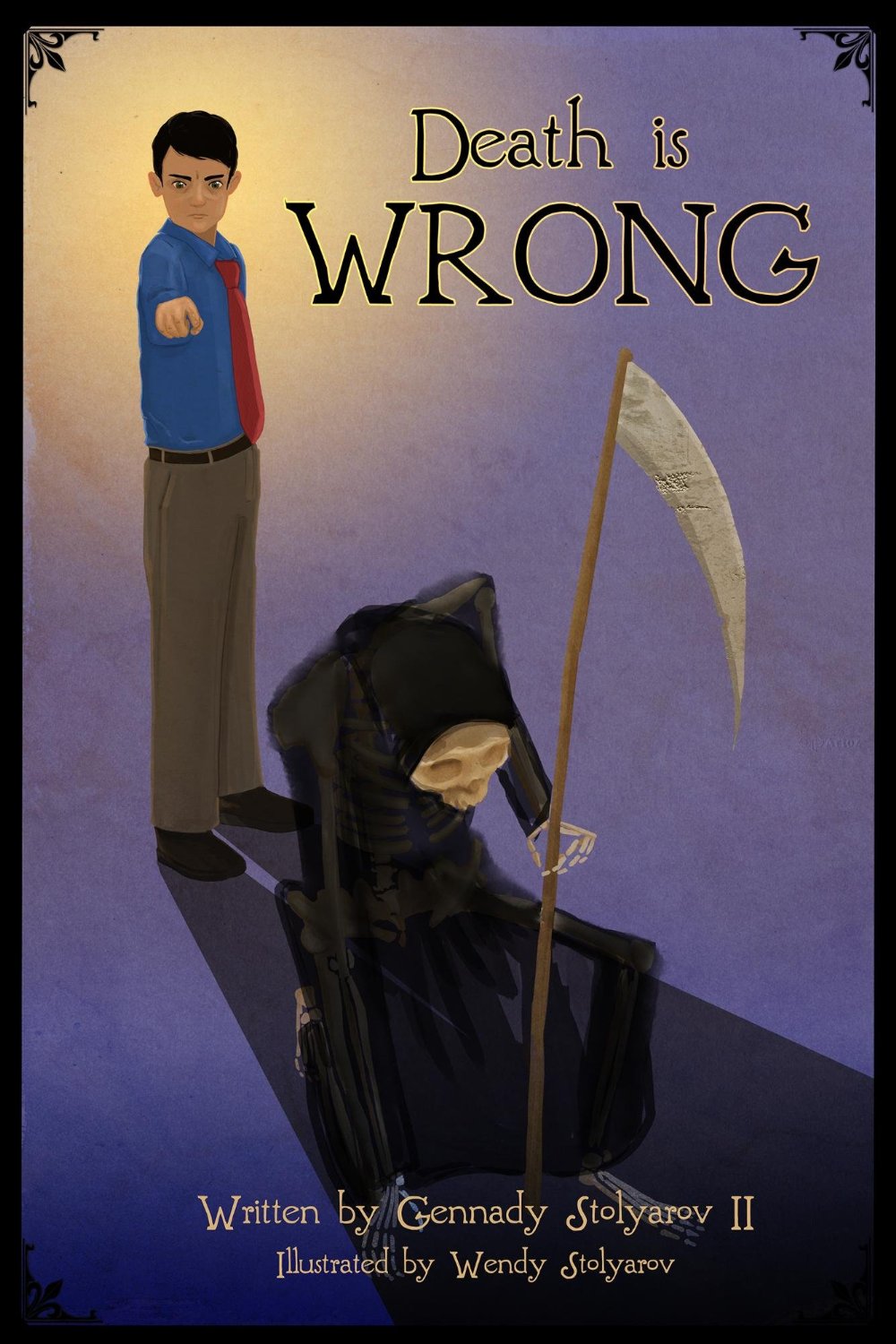
Only 9 Death is Wrong books remain to be sent out as part of our worldwide distribution effort! If you wish to help in providing the books out to children, this is your last chance to get your free shipment now.
10 books were recently sent to Jason Limbert – a long-time supporter of radical life extension in Mississauga, Ontario, Canada. He will be distributing these books to children in his extended family, their friends, and children of neighbors.
3 books were sent to children of relatives of Wendy Stolyarov, my wife and the illustrator of Death is Wrong.
2 books were sent to RJ Lewis in California, a mother, inventor, publicist, and supporter of life extension and cryonics.
We continue to receive excellent exposure from the previous shipments. Here is a picture sent by Jennifer Huse of the shipment that recently arrived at the Spot the Knot medical spa in Eatontown, New Jersey.
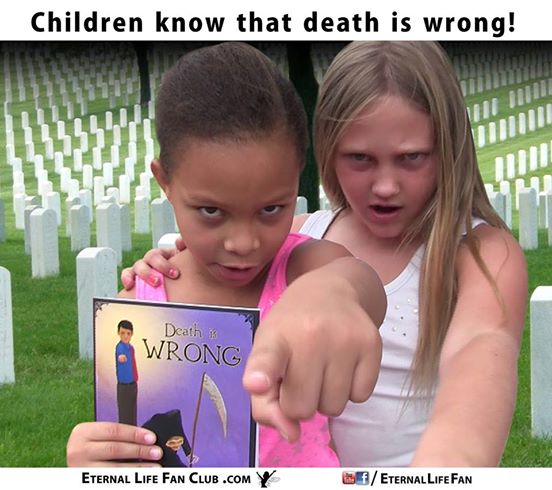
Roen Horn of the Eternal Life Fan Club has begun a strongly publicized series of book giveaways, the first of which he captured on camera. Here is his video featuring two kids who know that death is wrong.
Accompanying Roen’s video are these excellent graphics.
All this was made possible by our distribution campaign. We see here great examples of the impact this book is having right now. We are making history by gradually injecting the ideas of indefinite life extension into the cultural mainstream. Help us finish this effort by spreading our last freely available books! To receive your free shipment, e-mail me at gennadystolyarovii@gmail.com with (i) your name, (ii) your MAILING ADDRESS, (iii) your support for indefinite life extension, (iv) the NUMBER OF COPIES of Death is Wrong requested, and (v) your plan for spreading the books to children, free of cost to them.
LEV: The Game – Play to Win Indefinite Life – Article by G. Stolyarov II
LEV: The Game is a work in progress, whose potential to spread the message of indefinite life extension to the general public encourages me greatly. Developed by a team from Belgium – consisting of Anthony Lamot, Mathieu Hinderyckx, and Maxime Devos – this Android mobile game is currently in its Alpha phase. The creators have initiated an Indiegogo fundraiser to raise 6000 Euros (approximately 8100 US dollars at July 2014 exchange rates) in order to greatly expand the game and add its most complex and engaging elements. You can watch their video introduction to the game and the fundraiser here.
The premise of LEV: The Game is the same as the aim of those of us who wish to extend our lives without end. One’s character is challenged with living for as long as possible and attaining longevity escape velocity by reversing the damage of senescence at a faster rate than it accumulates. Every year in the game, the character receives an allotment of energy points with which to purchase power-ups, such as stem-cell therapies, applications of nano-medicine, cybernetic enhancements, or simple increments of diet and exercise. Each power-up can either increase the remaining expected lifespan, increase the rate at which energy points accumulate (called “productivity” in the game), or reduce the character’s rate of bodily decay. The player needs to achieve a delicate balancing of these power-ups to avoid expiring before he/she accumulates enough energy points to purchase the next life-extending advance.
Becoming an Alpha tester of LEV: The Game is absolutely free, and I was pleased to be able to participate in mid-July 2014. After eight attempts, I succeeded in getting a character to reach the age of 200, which is the game’s current victory condition. If the developers can raise their desired funds, they anticipate extending the gameplay to enable one’s character to reach the age of 1000.
To become an Alpha tester, you will need to join the LEV: The Game (Alpha) Google Group, using a Google account that is also linked to a mobile phone or tablet that runs the Android operating system. After you join, you can download the game from the Google Play store here. Remember to click the “Become a Tester” button to enable the download to work. When testing the game in this early stage, make sure you un-pause it first using the speed settings in the top-left-hand portion of the screen, before navigating to any of the other available windows.
Why LEV: The Game is Immensely Important
Our ability to achieve indefinite life extension personally will depend on the amount of resources and support from the general public invested in the overcoming of age-related bodily damage. Most people, unfortunately, continue to either be resigned to the inevitability of death, or to argue against the desirability of indefinite longevity due to extremely basic misconceptions. Even apart from the absurdly false boredom argument, overpopulation argument, and “playing God” argument, there is a more basic fallacy – the Tithonus error, which posits that becoming chronologically older necessarily means becoming biologically more decrepit. Yet the only way indefinite longevity could be achieved would be for people to remain biologically young, so that their susceptibility to deadly diseases does not increase beyond that of people in their twenties today. How could longevity advocates get the general public to understand this? Convincing people through arguments alone may often fail, simply because the Dragon-Tyrant of death is so ubiquitous and so overwhelming that many people will grasp at any straw, no matter how flimsy, to avoid being confronted with the grave injustice of their current predicament.
But a game gives a fresh, different, and engaging way to see and experience what indefinite longevity would truly entail. Anyone playing LEV: The Game would quickly see that becoming increasingly frail is no way to increase life expectancy. Your character will die if he/she experiences sufficient biological decay. You will be able to see a graph of the character’s remaining life expectancy and the rate at which decay is expected to proceed during the years they have left. If you apply the most effective combinations of power-ups, you will also see the life-expectancy curve shift upward – sometimes slightly, at other times by massive jumps. The latter situation reflects what can happen once humans begin to undergo periodic rejuvenation therapies to remove age-related damage, as posited in Dr. Aubrey de Grey’s SENS approach.
Furthermore, LEV: The Game encourages its players to engage in paradigm-shifting thinking about their own future trajectories. Instead of planning for gradual debilitation and eventual death, as most people do today when projecting their careers, retirements, finances, and family lives, a strikingly different mindset can take hold – the quest for perpetual maintenance and a return to youthfulness that may be possible at any chronological age, with sufficient technological advances and vigilance regarding one’s health. I admire the integration in LEV: The Game of biomedical treatments, cybernetic enhancements, and simple prudent habits – such as a healthy diet, regular exercise, cognitive activity, and access to relevant health information (even “Quantified Self” is a power-up that one can purchase). We should all strive to live the most informed and healthy lives possible, given present technology, in order to maximize our chances of surviving to the next wave of breakthroughs on the way to longevity escape velocity.
Not a day passes when I do not think about innovative ways to reach the general public with the message of indefinite life extension. For years, I have advocated the gamification of this literally vital idea as one of the most powerful ways to catalyze cultural change on this issue. I am immensely pleased to now witness such an effort taking off, due to the excellent work of Messrs. Lamot, Hinderyckx, and Devos. I donated to the Indiegogo fundraiser to help propel LEV: The Game to its hopefully world-changing final version. I hope that all readers of this article will be able to do the same.
Free PDF of «Смерть неправильна!» – Russian Translation of “Death is Wrong”
A free PDF version of «Смерть неправильна!» – the Russian translation of Death is Wrong – is now available for download from The Rational Argumentator. You can obtain your copy here and may spread it to Russian-speaking audiences as widely as you wish.
«Смерть неправильна!» was translated into Russian by Marcus Baylin.
«Смерть неправильна!» – Russian Translation of “Death is Wrong” – Translated by Marcus Baylin – Post by G. Stolyarov II
The Russian translation of Death is Wrong – «Смерть неправильна!» – generously translated by Marcus Baylin – is now available via Google Books. You can see a complete preview here.
A paperback version can be obtained from Createspace for $11.23 here.
Amazon has begun to carry the paperback version here.
For some reason, the Amazon Kindle format does not yet support Cyrillic characters, so I have instead decided to offer an electronic version through Google Play.
The electronic version will be downloadable for FREE on Google Play within the next 24 hours on this page.
You have my permission to spread the electronic version of the book to Russian-speaking audiences as widely as possible, with no strings attached.
We can also send some free paperback Russian books to anyone who is willing to distribute them to Russian-speaking children. (This offer is good while supplies last; we have resources to ship 171 copies of Death is Wrong in either English or Russian. If you are interested, e-mail me at gennadystolyarovii@gmail.com with (i) your name, (ii) your MAILING ADDRESS, (iii) your support for indefinite life extension, (iv) the NUMBER OF COPIES of Death is Wrong requested, and (v) your plan for spreading the books to children, free of cost to them.)
Another View of Aging Science: That We Don’t Know Enough – Article by Reason
Early this month I pointed out an example of the viewpoint on aging research that focuses on drugs, lifestyle, and metabolic manipulation and sees present work in that area to be a matter of significant and ongoing process. I disagree, for reasons that were explained in that post. Today, I’ll take a glance at a different view of the science of aging and longevity, one that is far more popular in the mainstream research community, and with which I also vehemently disagree.
Researchers in this field might be loosely divided into three camps, which are as follows ordered from largest to smallest: (a) those who study aging as a phenomenon without seeking to produce treatments, (b) those who see to slow aging through development of means to alter the operation of metabolism, such as calorie restriction mimetic drugs, and (c) those who aim to produce rejuvenation biotechnology capable of reversing aging. The vast majority of the aging research community at present consider that too little is known of the details of the progression of aging to make significant inroads in the design of treatments, and that the way forward is fundamental research with little hope of meaningful application for the foreseeable future. This attitude is captured here:
We can’t ‘cure death’ because biology is extremely complicated. Without a fundamental understanding of how biological organisms work on a molecular level, we’re left to educated guesses on how to fix things that are breaking in the human body. Trying to cure disease without a full understanding of the underlying principles is like trying to travel to the moon without using Newton’s laws of motion.
The reason we haven’t cured death is because we don’t really understand life.
This is only half true, however. It is true if your goal is to slow down aging by engineering metabolism into a new state of safe operation in which the damage of aging accumulates more slowly. This is an enormous project. It is harder than anything that has been accomplished by humanity to date, measured on any reasonable scale of complexity. The community has only a few footholds in the vast sea of interactions that make up the progression of metabolism and damage through the course of aging, and this is despite the fact that there exists an easily obtained, very well studied altered state of metabolism that does in fact slow aging and extend life. Calorie restriction can be investigated in almost all laboratory species, and has been the subject of intense scrutiny for more than a decade now. Yet that barely constitutes a start on the long road of figuring out how to replicate the effects of calorie restriction on metabolism, let alone how to set off into the unknown to build an even better metabolic state of operation.
Listing these concerns is not even to start in on the fact that even if clinicians could perfectly replicate the benefits of calorie restriction, these effects are still modest in the grand scheme of things. It probably won’t add more than ten years to your life, and it won’t rejuvenate the old, nor restore any of their lost functionality. It is a way of slowing down remaining harm, not repairing the harm that has happened. All in all it seems like a poor use of resources.
People who argue that we don’t understand enough of aging to treat it are conveniently omitting the fact that the research community does in fact have a proven, time-tested consensus list of the causes of aging. These are the fundamental differences between old tissue and young tissue, the list of changes that are not in and of themselves caused by any other process of aging. This is the damage that is the root of aging. There are certainly fierce arguments over which of these are more important and how in detail they actually interact with one another and metabolism to cause frailty, disease, and death. I’ve already said as much: researchers are still in the early days of producing the complete map of how aging progresses at the detail level. The actual list of damage and change is not much debated, however: that is settled science.
Thus if all you want to do is produce good treatments that reverse the effects of aging, you don’t need to know every detail of the progression of aging. You just need to remove the root causes. It doesn’t matter which of them are more or less important, just remove them all, and you’ll find out which were more or less important in the course of doing so – and probably faster than those who are taking the slow and stead scholarly route of investigation. If results are what we want to see then instead of studying ever more esoteric little corners of our biology, researchers might change focus on ways to repair the known forms of damage that cause aging. In this way treatments can be produced that actually rejuvenate patients, and unlike methods of slowing aging will benefit the old by reversing and preventing age-related disease.
This is exactly analogous to the long history of building good bridges prior to the modern age of computer simulation and materials science. With the advent of these tools engineers can now build superb bridges, of a quality and size that would once have been impossible. But the engineers of ancient Rome built good bridges: bridges that allowed people to cross rivers and chasms and some of which still stand today. Victorian engineers built better bridges to facilitate commerce that have stood the test of time, and they worked with little more than did the Romans in comparison to today’s technologies. So the aging research community could begin to build their bridges now, we don’t have to wait for better science. Given that we are talking about aging, and the cost of aging is measured in tens of millions of lives lost and hundreds of millions more left suffering each and every year, it is amazing to me that there are not more initiatives focused on taking what is already known and settled about the causes of aging and using that knowledge to build rejuvenation treatments.
What we see instead is a field largely focused on doing nothing but gathering data, and where there are researchers interesting in producing treatments, they are almost all focused on metabolic engineering to slow aging. The long, hard road to nowhere helpful. Yet repairing the known damage of aging is so very obviously the better course for research and development when compared to the prospect of an endless exploration and cataloging of metabolism. If we want the chance of significant progress towards means of treating aging in our lifetime, only SENS and other repair-based approaches have a shot at delivering. Attempts to slow aging are only a distraction: they will provide a growing flow of new knowledge of our biochemistry and the details of aging, but that knowledge isn’t needed in order to work towards effective treatments for aging today.
Reason is the founder of The Longevity Meme (now Fight Aging!). He saw the need for The Longevity Meme in late 2000, after spending a number of years searching for the most useful contribution he could make to the future of healthy life extension. When not advancing the Longevity Meme or Fight Aging!, Reason works as a technologist in a variety of industries.
***
This work is reproduced here in accord with a Creative Commons Attribution license. It was originally published on FightAging.org.
“Death is Wrong” – Book Distribution and Call to Action – May 28, 2014 – Video by G. Stolyarov II
Mr. Stolyarov provides an update regarding the effort to distribute over 1,000 free, paperback copies of Death is Wrong to children.
As of May 28, 2014, 644 books have been sent out, and 385 remain to be distributed, out of an eventual goal of 1,029 books provided to children, free of cost to them.
Instructions for Longevity Activists to Request Copies of “Death is Wrong”
– Provide (i) your name, (ii) your mailing address, (iii) a statement of your support for indefinite life extension, and (iv) a brief description of your plan to spread the book to children in your local area. Remember that all copies received pursuant to this initiative would need to be offered to children free of charge (as gifts or reading opportunities) and may not be resold.
– Provide the number of copies of Death is Wrong that you are requesting.
– Preferably, provide an indication that you would be willing to send photographs of the books that have been delivered to you as well as events where you will be distributing the books.
Most people want to die of in their sleep, in peace, of old age, without pain and surrounded by their family and loved ones after achieving success and after having done something worthwhile.But the facts suggest, that such a peaceful end is granted to very few people, while most people have to endure different disabilities and diseases associated with aging and terrible pain and decreased function, performance, and the lack of joy coming with it.The Global Burden of Disease (GBD) project originated in 1990 in a collaboration between the World Health Organization, Harvard School of Public Health, the Institute for Health Metrics and Evaluation (IHME), and the World Bank.
The focus of the Global Burden of Disease Study is to provide a detailed statistical analysis of the impact of diseases leading to death and disability across various regions around the world. The purpose of the study is to reveal gaps between current and ideal health circumstances and develop strategies to reduce this gap.
The 2010 Global Burden of Disease study reveals a significant shift in the nature of disease worldwide. There has been a significant increase in chronic disease worldwide. This is due to demographics of aging, and the subsequent increase of age-related disease.
Worldwide, the contribution of different risk factors to disease burden has changed substantially, with a shift away from risks for communicable diseases in children towards those for non-communicable diseases in adults.
As life expectancy has increased, the number of healthy years lost to disability has also increased in most countries, consistent with the expansion of morbidity hypothesis, which has implications for health planning and health-care expenditure.One of the key findings reveals that we are living longer, but under an increased burden of chronic disease that impairs our quality of life.These results are distressing: men can expect to spend an average of 9.2 years and women 11.5 years with some form of a chronic disability. In other words, during the last decade of lives, on average, our quality of life might become significantly impaired by the presence of a chronic disease.
The paradox, then – the fact that people want to be actively saved if they are near or at the moment of death, but also want to die peacefully – seems to be rooted in a pretty profound medical illiteracy.
Healthy people don’t die in their sleep, “peacefully” or otherwise. You don’t hear about too many 25-year-olds dying suddenly of heart attacks or strokes during their nightly slumber.
When people in their twenties die, it’s usually considered tragic. When babies are found dead in their cribs, it’s referred to by a name (“Sudden Infant Death Syndrome”). But when elderly people die, in bed or otherwise, there tends to be a curious tone of, “Well, at least they went peacefully.”
The increase in life expectancy and the resulting growth of the elderly population are also thought to be driving up the number of elderly people with disabilities.
Typically in the case of dying in your sleep due to old age, an autopsy can determine exactly what went wrong, or what stopped working. For example, your heart could simply get tired and stop beating, because it’s been working hard for the past eighty or ninety years.
The phrase “natural causes” or dying “of old age” is a very strange one really. Ultimately what it means is that someone who dies of natural causes, dies of aging in a way that has not been given an additional name; so really it’s just a matter of terminology. The difference is between dying of “natural causes” and dying of some other specifically named thing that doesn’t really often affect young adults.
Searching for a cure for age-related ill health, a problem that kills more people than all other causes combined, is a moral imperative. The Advocate for Negligible Senescence publishes articles that discuss and educate the public about research to combat senescence. See the Advocate’s Facebook page.
Motivated Time Prospectors – Article by Eric Schulke
Think of all the people’s lots in life that you don’t have. You will regret not having more chances to stand here as you are now. It is said that if everybody put their worries into a pile and then took an equal share from the pile, then most people would be content to take back their own share of them. I was reading an article that said,
“To be sick and dying in Vegas has its own existential horror. Not only do you realize that you are going to die and that you don’t matter to the world, but you also realize that much of the world is awful and yet you still would do anything to live.”
Struggling to survive on this planet can be miserable, and yet we continue to stick with it. Why? Because we know that with life there is a chance to engage in more experience. It seems that a person can live, in part, on the desire for continued experience. That chance drives us to keep reaching for achievement and progress.
What does one want to experience in life? What does that honest-to-life list look like? If you had to draw up a complete list, could you do it, or describe the nature of it? The active wanting of experience, it seems, is a major cure to indifference toward death. It seems that it might be a life-or-death question.
We have become really good at being indifferent to the most widespread forms of death, in order to spare ourselves from stressing out on futilely trying to do something about it. Now that we have the tools and techniques, and the times have changed, we have to change that way of thinking from indifference back toward letting that horror affect us. Horror benefits us in that it is our cue to be driven to action to make sure that the horror can’t happen again. If a poltergeist starts ravaging your house, that’s your signal to get out of there, in the same way that the horror that general death, aging, and other diseases are your signal to get death, aging, and other diseases away from you and out of your cells.
Carl Sagan’s daughter once related his words that “there was nothing he would like more in the world than to see his mother and father again.” I was thinking about what an insult added to injury he must have felt in his final days, to have the paralyzing misery of impending death heaped on top of crushing pain. Let that kind of pain course through your mind, face it, bring it to a steaming rage, and let the energy power you to help execute any of the various assaults on aging and disease that are underway in laboratories in various places around the world.
In another article, I was reading about a guy whose daughter went missing in 1971, and was never found. He lived to be 102 and died in the fall of 2013. He had stated that one of the hardest burdens for him was never knowing what happened to his daughter. What misery, for all those years… Think of that… Then five days after he died, his daughter’s car was found upside down in a river; she was the apparent victim of a decades-old car crash.
I can’t fathom that life could inflict such a bitter spite upon somebody. That story stirs up the kind of despair and anguish that each death seems to deserve. It’s the kind of anguish you need to figure out how to allow in, in order to have the right kinds of drive to help pull the Movement for Indefinite Life Extension forward with us.
So once we get there, back to that place where we stand amidst realization of the horror of death, how do we face it? One good basic and natural way to do so, it seems, is to purposefully enjoy the good parts of life, and strategize and take action in helping to fix the worst of the broken things. It’s fun and fulfilling. Life isn’t bad, it’s an adventure. A tough challenge is like a choppy sea, like two armies clashing, or mountain climbers fighting the elements. The implementation of the solution of each challenge is like a Renaissance of scale, some miniature, some very large, like Caesar vs. Vercingetorix, or Charlemagne vs. the Vikings. It’s like the writings of Caesar, the writing-resurgence work of the Carolingians, Vercingetorix and the fate of an entire Celtic confederation, or the first times the Vikings set sail out beyond Greenland.
A few days ago I was thinking about a typical farm hand of Medieval times, walking outside to smell the heavy wet grass and earth of a cold wet spring day. How did they remember the great Lombard migrations, or Scandinavian raiders docking at Pisa? Who was Charlemagne to people before negationists took hold? What did they think might become of the future? Many of them must have felt lost at that kind of thought.
Focus on your heartbeat, feel it pulsing. Theirs pulsed like that. They thought of their hearts stopping and of how it couldn’t possibly be lost to the dust of history anytime soon. You think that, too. Their hearts are lost to the dust of history. Yours is next.
What does every year, and every moment mean to the history of everything? I read recently that if you throw a pebble, it could be offsetting the center of gravity of the universe. Every moment means everything, every moment is everything. Every moment is a world in itself, a great painting, a great work of art, a great burning torch, a water well built in inhospitable lands. Think of how many heartbeats have come to a stop, how many paintings have been burned… So many tangled groves in forests have had the wind blowing through them for all of these years, without one person, without one spoken word, in a place near a stream, where there was once a mighty, crackling stone fireplace that warmed multiple generations of families across the 6th through 8th centuries. It was a place that hosted countless memories which later tormented the souls of dying, now long-dead grandfathers.
They don’t deserve to be dead. They deserve what they earned: the world that is paying exponentially exciting, satiating, and fullfillingly valuable dividends today. This is an incredibly motivating and driving factor in what pushes me to pursue indefinite life extension. People take on a variety of diverse augmentations over time, becoming unique collections of intriguing insight – dynamic power tools for slicing and dicing the elements. We can’t afford for these wealths of rare and powerful abilities and resources to be pillaged and killed off. Sometimes it seems as if life-extensionists like me have to explain to people why it’s bad to let people be killed before we can get down to business in a worldwide effort to reach the goals that can get this done.
We are like the union for the people that make a profession out of being human. We are creating better and better pay, and we demand longer hours. I want every feasible remedy that can restore and maintain life to be a permanent fixture in this reality, for it to be harvested like air. There is no reason a heart has to give out. There is no reason we cannot prevent tangles from forming in the brain. Our organs and cells don’t have to degrade. We have tools, techniques, and brains. We will make it through these obstacles.
How long will it be before our times are old, before 2015 cars look like old classics, and thoughts of our times are most often associated with the smell of the pages of books that have been moved from their years of service on shelves, to boxes of outdated material in back rooms? Many experiences and voyages that could have happened, and could have been chronicled in those boxes, can never exist.
That’s the problem, it seems: There are experiences that could have existed, but that now never can. Thoughtful experience – there is no reason to forgo it or allow it to be lost – hence the basic, inherent reasoning for supporting indefinite life extension, it seems.
Every moment is the gold, the thing to be mined, the thing to be in awe of, to seek, pursue, and strategize toward, to work for, to feel victorious for possessing. Let’s mine more time: support the Movement for Indefinite Life Extension. Don’t be distracted by fool’s gold while the most valuable gold, time, slips through your fingers.
One of these days, we will put funeral homes across the world out of business, and it will be a great victory. We will celebrate, and the festivities will be grand. But we must get a move on now, because our chances are turning into sand.
This review was originally posted on the Facebook page of the Eternal Life Fan Club, a community created by Roen Horn to share philosophy, research, and strategies to help humans increase their chances of living forever.
I finally got around to reading the new transhumanist children’s book Death is Wrong. I was impressed with the simplicity and clarity of the message, and my impression was that children could easily digest the information. It’s about time there was a children’s book promoting the message of indefinite life-extension. This book should be mandatory reading in elementary schools. I was pleased to see that the book gave mention to Aubrey de Grey and SENS Research Foundation. Besides explaining the logical reasons for why death is wrong, I was delighted that the book spoke about the frailness of life and the overwhelming sadness of death. The book also specified the importance of vigilantly avoiding dangerous behaviors which would endanger one’s life, and the importance of taking care of one’s health. I think that message is especially important for young children to hear. The book leaves the reader with the optimistic outlook that death does not have to be inevitable. If we know that death is wrong, then we must wage war on death and never give up until we have won this fight. You can find the book on Amazon here.
Wendy Stolyarov, Illustrator of Death is Wrong, at the Transhuman Visions 2.0 Conference – March 1, 2014
“Death is Wrong” Fundraiser: Another Ship Returns to Harbor after Braving the Seas for the Cause – Article by Eric Schulke
On December 2nd of 2013, the Movement for Indefinite Life Extension began a contest for people to send in their ideas on how to spend money on outreach for the cause. The following question was asked:
If you were to receive a check in the mail with $5,000 to inform as many people as possible about the desirability and the prospects for indefinite life extension, to get them interested in the people, projects and organizations working directly or indirectly toward indefinite life extension, then how might you spend it?
It is a great success on multiple levels for the Death is Wrong book and vision in itself, which supports indefinite-life-extension research and philosophy in general, and which is written by one of the many Movement for Indefinite Life Extension leaders, Gennady Stolyarov.
It is also a great success for the Movement for Indefinite Life Extension in general on many levels. It is one of the first major projects the MILE has executed in its upcoming series of projects to work to reach 80,000 “likes” at MILE Facebook page for the Year 3 goal, which begins on July 17th 2014, and tasks us with collectively helping to achieve the group victory of moving from 8,000 likes, to 80,000 likes by the July 17th of the following year, 2015.
Rodney Ashby and Jason Shields helped us get the momentum rolling and did fundraising throughout, and Tonya Scholz gave the project a big hand. Gennady Stolyarov made an amazing media tour for the project, finding himself talking about it in interviews and getting mentions and reports from a variety of sources. Most of them are of his own arranging, some of these outlets picked the story up on their own, and there are some opportunities that I arranged. They include, but are not limited to, the following:
This new fundraiser, started today, to distribute copies of the important book Death is Wrong, is a project that can go a long way. A thousand books might not seem like a lot in the grand scheme of things, but it can make a big difference.
Stolyarov is hoping to kindle a small spark of hope into an eternal flame. “What I think is necessary right now is a determined push to dramatically accelerate the pace of technological progress,” he says. “We have a fighting chance right now, but in order to make it happen we have to be the agents of change.”
I like to see advocates setting forth to create small scale initiatives like the children’s book Death is Wrong and the associated fundraiser to distribute copies. At the large scale a broad advocacy movement for a cause in medical research isn’t a monolithic thing; it is made up thousands of such efforts, a tapestry of individual who each thought enough of the cause to stand up and do something about it. More of this is always a good thing, and working towards a cure for degenerative aging is the most worthy of causes that I know of.
Parents who share his philosophy would therefore be wise to inoculate their children against “death acceptance” early, Stolyarov says. “Ideally, they would walk away with a motivation to do something about this dragon tyrant in the room, this problem of death. I don’t want these vestigial forms of thinking to essentially cause mass suffering and death. We need to push for these [life-extending] technologies to be invented as early as possible, as effectively as possible.”
There were 92 contributions from over 80 individuals and one group, including, but not limited to:
There were also at least 13 anonymous donations. I did a count of all of the donors that I brought in. A close, conservative estimate is that I brought in around 70% of them.
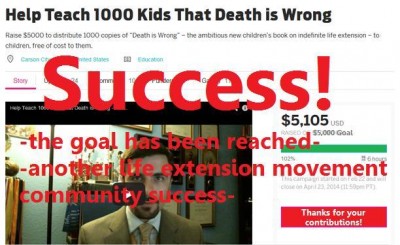
We ended up raising $5,141, compounding on the success by $141. That means that we raised enough to distribute 29 more books than projected. Those of us that worked with this didn’t take a single dime as a cut of this. I put a hundred dollars or so in ads into it, and Wendy and Gennady have given countless hours of their time to rewarding donors. Countless others, like general activists and reporters, have put their time and resources into this. The Life Extension Foundation made an inspiring and generous $1,255 dollar donation to close the deal.
Gennady and I have already secured the distribution of 140 copies, and there are now over 1,000 total available for distribution. An order even went out to Aubrey de Grey, whose work is one of the many topics that is talked about in the book. Gennady Stolyarov writes in the Indiegogo update page that,
Update of April 16, 2014: I am delighted to announce that a shipment of 10 Death is Wrong books was made yesterday to Dr. Aubrey de Grey himself at the SENS Research Foundation. Since Dr. de Grey’s work is a crucial inspiration for Death is Wrong and my longevity activism more generally, I am immensely pleased that he has agreed to receive this shipment and make the books available for distribution.
We encourage the distribution of Death is Wrong books to places like schools, libraries, and directly to parents and children. We ask people to order as many copies as they think they may be able to give away to kids and people with kids, at Transhuman and health events, rallies, and similar events. Gennady has instructions on how to order them free of charge:
Instructions for Longevity Activists to Request Copies of Death is Wrong
– Provide your name, your mailing address, a statement of your support for indefinite life extension, and a brief description of your plan to spread the book to children in your local area. Remember that all copies received pursuant to this initiative would need to be offered to children free of charge (as gifts or reading opportunities) and may not be resold.
– Provide the number of copies of Death is Wrong that you are requesting.
– Preferably, provide an indication that you would be willing to send photographs of the books that have been delivered to you as well as events where you will be distributing the books.
The project has been a great community effort. The Movement for Indefinite Life extension is our collective spirit, not an organization. Together we collect supporters for all of the constructive projects and organizations. There must have been over 150 people involved. More activists flexed their life-extension muscles, and we helped more people that want to get involved to take the first step. If you’ve ever saved money, then you know how incremental change adds up. You cannot achieve the saving of $8,000 unless you first get to $2,000, and $6,000, and so forth.
It’s an example of elements coming together for a movement, like this article says:
A movement occurs when, one, a large number of people have a need that, two, lines up with the necessary ingredients to make it happen, and those two things are sparked by, three, a catalyst.
The need to survive has always been here. The ingredients have been getting added to the mix since the dawn of the Scientific Revolution. The element of the love for life is in the air, thick with explosive properties, fueled by indefinite-life-extension research and outreach from around the world and across time. People are busy working on rallies, conferences, events, interviews, getting the message out, and all the rest. The tools and the ability to make this happen are ripe, and growing more and better yields of produce by the month. Every time you put a match to it, it erupts in indefinite-life-extension activism. Be that spark today and get in on this movement.
We have more projects like this ahead, and there are plenty of others to choose from in the communities, pages, groups, organizations, sites, and other venues, around the world, growing here toward that tipping point where we can have the opportunity to spill across the ticker tapes of screens and the minds of the young and old alike, lighting hearts and minds on fire with desire to chip in together to make this happen. This is an incredible opportunity, this time here, fertile with tools and insights, unleashed capabilities beyond our wildest dreams. People are already capable of tons of incredible things that you don’t even know about yet.
Columbus went on a fantastic voyage. When you think of those times, and how fulfilling and enthralling it must have been for them to be able to be part of that, realize that indefinite life extension, all this Transhumanism, is an even greater frontier, and you are in an even more incredible and glorious position than people like Columbus and his crew. It’s a position here where anybody, where you, can help sail out into these incredible frontiers that are opened up through the ever-expanding fields of science and technology.

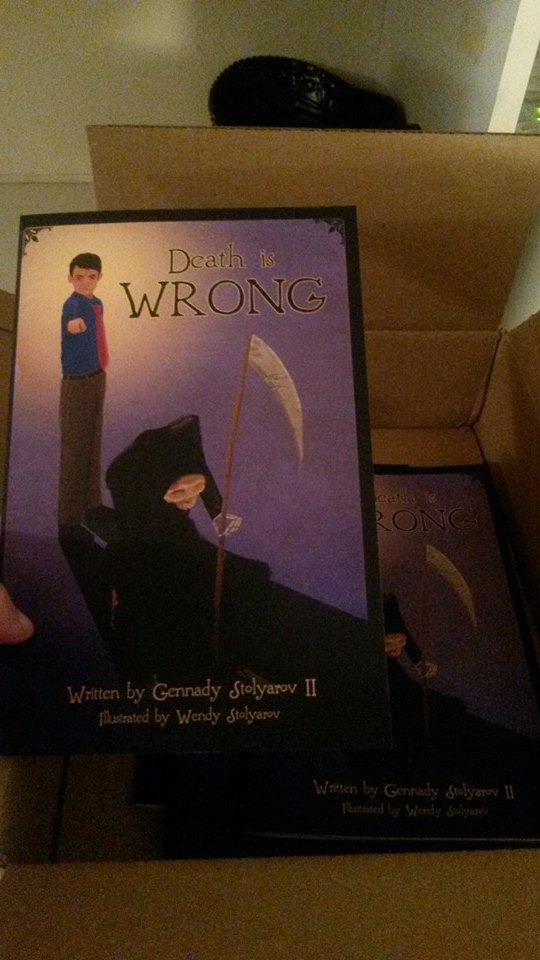 Roen Horn of the Eternal Life Fan Club has begun a strongly publicized series of book giveaways, the first of which he captured on camera. Here is his video featuring two kids who know that death is wrong.