Browsed by
Tag: economics

The Fed Desperately Tries to Maintain the Status Quo – Article by Ronald-Peter Stöferle

The Fed Desperately Tries to Maintain the Status Quo – Article by Ronald-Peter Stöferle

The New Renaissance HatRonald-Peter Stöferle
November 5, 2015
******************************

During the press conferences of recent FOMC meetings, millions of well-educated investment professionals have been sitting in front of their screens, chewing their fingernails, listening as if spellbound to what Janet Yellen has to tell them. Will she finally raise the federal funds rate that has been zero bound for over six years?

Obviously, each decision is accompanied by nervousness on the markets. Investors are fixated by a fidgety curiosity ahead of each Fed decision and never fail to meticulously observe Janet Yellen and the FOMC, and engage in monetary ornithology on doves (growth- and employment-oriented FOMC members) and hawks (inflation-oriented FOMC members).

Fed watchers also hope for some enlightening information from Ben Bernanke. According to Reuters, some market participants paid some $250,000 just to join one of several dinners, where the ex-chairman spilled the beans. Apparently, he does not expect the federal funds rate to return to its long-term average of about 4 percent during his lifetime.

In a conversation with Jim Rickards, Bernanke stated that a rate hike would only be possible in an environment in which “the U.S. economy is growing strongly enough to bear the costs of higher rates.” Moreover, a rate increase would have to be clearly communicated and anticipated by the markets — not to protect individual investors from losses, Bernanke assures us, but rather to prevent jeopardizing the stability of the “system as a whole.”

It is axiomatic that zero-interest-rate-policy (ZIRP) cannot be a permanent fixture. Indeed, Janet Yellen has been going on about increasing rates for almost two years now. But, how much more lead time will it require to “prepare” the markets? In both September and October the FOMC chickened out, even though we are not talking about hiking the rate back to “monetary normalcy” in one blow. The decision on the table is whether or not to increase the rate by a trifling quarter point!

The Fed’s quandary can be understood a little better by examining what “monetary normalcy,” or a “normal interest rate,” is supposed to be. Or, even more fundamentally: what is an interest rate?

We “Austrians” understand an interest rate as an expression of market participants’ time preference. The underlying assumption is that people are inclined to consume a certain product sooner rather than later. Hence, if savers restrict their current consumption and provide the resources for investment instead, they do so only on condition that they will be compensated by increased opportunities for consumption in the future. In free markets, the interest rate can be regarded as a measure of the compensation payment, where people are willing to trade present goods for future goods. Such an interest rate is commonly referred to as the “natural interest rate.” Consequently, the FOMC bureaucrats would ideally set as a goal a “normal interest rate” that equals the “natural” one.This, however, remains unlikely.

Six Years of “Unconventional” Monetary Policy
ZIRP was introduced six years ago in response to the financial crisis, and three QE programs have been conducted. This so-called “unconventional monetary policy” is supposed to be abandoned as soon as the economy has gathered pace. Despite the tremendous magnitude of these market interventions, the momentum in the US economy is rather lame. Weak Q1 data, which probably resulted from a weak trade balance due to a 15 percent rise of the US dollar, shocked even the most pessimistic of analysts; the OECD and the IMF have revised down their 2015 growth estimates. A long-lasting, self-sustaining growth is out of the question. This confirms the assumption that ZIRP fuels everything under the sun — see “The Unseen Consequences of Zero-Interest-Rate Policy” — except long-term productive investment.And what about unemployment and inflation that are key elements of the Fed’s mandate? The conventional unemployment rate (U3) has returned to its long-run normal level, so the view prevails that things are developing well. However, those figures conceal a workforce participation rate that has fallen by more than 3 percent since 2008, indicating that some 2.5 million Americans are currently no longer actively looking for a new job. However, should the economic situation improve, they would likely rejoin the labor force. Furthermore, the proportion of those only working part-time due to a lack of full-time positions is much higher now than before the crisis. “True” unemployment currently stands rather at about 7.25 percent.

A Weak Economy and Weak Inflation
With regard to inflation, the Fed’s target is 2 percent, as measured by growth of the PCE-index. This aims to buffer the fiat money system against the threat of price deflation. In a deflationary environment, it is believed, the debt-servicing capacity of market participants (e.g., governments, private enterprises, financial institutions, and private households) would come under intense pressure and likely trigger a chain reaction in which loans collapse and the monetary system implodes.

In many countries, and among them the US, inflation is remarkably low — partly due to transitory effects of lower energy and import prices — while low interest rates have merely weaved their way to asset price inflation so far. But, as price reactions to monetary policy maneuvers may occur with a lag of a few years, we should expect that sooner or later inflation will also spill over to normal markets.

As a response to anything short of massive improvement of economic and employment data, a rate hike is scarcely likely, and inflation in the short-term is also unlikely. Moreover, the current composition of the FOMC — which is extremely dovish — implies inflation-sensitive voices are relatively underrepresented. This gives rise to the suspicion that rate hikes are not very likely at all in the scenario in the short-term.

What Will the Fed Do If There’s Real Economic Trouble?
One is concerned about economic development, which has a shaky foundation and headwinds from other parts of the world; it appears that growth has cooled down substantially in the BRICS countries. Meanwhile, China might be on the brink of a severe recession. (Indeed, China was possibly the most decisive factor to nudge the Fed away from raising rates in September and October.) This implies that world-wide interest rates will remain at very low levels and a significant rate hike in the US would represent a sharp deviation in this environment, bringing with it massive competitive disadvantages.

The markets are noticeably pricing out a significant rate hike. The production structure has long since adapted to ZIRP and “short-term gambling, punting on momentum-driven moves, on levered buybacks” are further lifting the opportunity costs of abandoning it. In order to try to rescue its credibility, the Fed may decide to try some timid, quarter-point increases.

But what will they do if markets really crash? Indeed, they are terrified of the avalanche that they might trigger. If there are any symptoms that portend calamity, the Fed will inevitably return to ZIRP, launch a QE4, or might even introduce negative interest rates. Hence, there does not seem to be a considerable degree of latitude such that a return to conventional monetary policy could seriously be expected.

“The Fed is raising rates!” — This has become a running gag.

Ronald-Peter Stöferle is a Chartered Market Technician (CMT) and a Certified Financial Technician (CFTe). During his studies in business administration and finance at the Vienna University of Economics and the University of Illinois at Urbana-Champaign, he worked for Raiffeisen Zentralbank (RZB) in the field of Fixed Income/Credit Investments. In 2006 he began writing reports on gold. His six benchmark reports called “In GOLD we TRUST” drew international coverage on CNBC, Bloomberg, the Wall Street Journal, The Economist and the Financial Times. He was awarded “2nd most accurate gold analyst” by Bloomberg in 2011.

This article was originally published by the Ludwig von Mises Institute. Permission to reprint in whole or in part is hereby granted, provided full credit is given.
Bernie Is Wrong: Trade Is Awesome for the Poor and for America – Article by Corey Iacono

Bernie Is Wrong: Trade Is Awesome for the Poor and for America – Article by Corey Iacono

The New Renaissance HatCorey Iacono
August 28, 2015

******************************

The socialist senator is totally wrong about free trade

Sen. Bernie Sanders, the Democratic presidential hopeful, is no fan of free trade. In an interview with Vox, Sanders’ made his anti-trade position clear: “Unfettered free trade has been a disaster for the American people.”

He also noted that he voted against all the free trade agreements that were proposed during his time in Congress and that if elected President he would “radically transform trade policies” in favor of protectionism.

Sanders and his ilk accuse their intellectual opponents of promoting “trickle-down economics,” but that is precisely what he is advocating when it comes to trade. The argument for protectionism ultimately relies on the belief that protecting domestic corporations from foreign competition and keeping consumer prices high will somehow benefit society as whole.

However, the real effect of protectionism is to increase monopoly and consequently reduce overall economic welfare. In fact, according to a paper by economists at the Federal Reserve Bank of Minneapolis, “Government policies…such as tariffs and other forms of protection are an important source of monopoly” that lead to “significant welfare losses.”

In contrast to Sanders’ assertion that the expansion of free trade has been a disaster for the American people, there is a near unanimous consensus among economists that the opposite is true.

An IGM Poll of dozens of the most renowned academic economists found that, weighted for each respondent’s confidence in their answer, 96 percent of economists agreed, “Freer trade improves productive efficiency and offers consumers better choices, and in the long run these gains are much larger than any effects on employment.”

When the vast majority of economists of all sorts of ideological stripes agree that free trade is a good thing, maybe, just maybe, they’re onto something.

In fact, they surely are. Using four different methods, economists at the Petersen Institute for International Economics estimated the economic benefits from the expansion of technology that facilitates international trade (such as container ships), as well as the removal of government-imposed barriers to international trade (such as tariffs). Since the end of World War II, they generated “an increase in US income of roughly $1 trillion a year,” which translates into an increase in “annual income of about $10,000 per household.”

This result is mostly driven by the fact that foreign businesses produce many goods which are used in the production process at a lower cost than their domestic competitors. Access to these low-cost foreign inputs allows American businesses to decrease their production costs and consequently increase their total output, making the nation as a whole much wealthier than it otherwise would have been.

Moreover, contrary to common conjecture, the benefits of international trade haven’t simply accrued to the wealthy alone. Low and middle income individuals tend to spend a greater share of their income on cheap imported consumer goods than those with higher incomes. As a result, international trade tends to benefit these income groups more so than the wealthy.

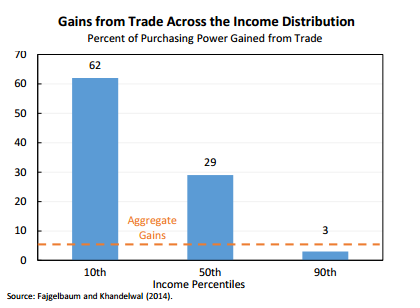
Corey Iacono Sanders ArticleIndeed, according to the President’s Council of Economic Advisers, middle income consumers have about 29 percent greater purchasing power as a result of international trade.

In other words, middle income consumers can buy 29 percent more goods and services as a result of the access to low-cost imports from foreign countries.

Low income consumers see even greater gains with 62 percent higher purchasing power as a result of trade. In contrast, the top 10 percent of income earners only saw an increase in purchasing power of 3 percent as a result of trade.

On top of that, international trade has provided benefits by bringing new and innovative products to American consumers.

According seminal research by Christian Broda of the University of Chicago and David E. Weinstein of Colombia University, the variety of imported goods increased three-fold from 1972 to 2001. The value to American consumers of this import induced expanded product variety is estimated to be equivalent to 2.6 percent of national income, about $450 billion as of 2014. That’s not exactly small change.

The spread of free trade has also made considerable contributions to environmental protection, gender equality, and global poverty reduction. As a result of the spread of clean technology facilitated by freer trade, “every 1 percent increase in income as a result of trade liberalization (the removal of government-imposed barriers to trade), pollution concentrations fall by 1 percent,” according to the Council of Economic Advisers.

The CEA also has found that “industries with larger tariff declines saw greater reductions in the [gender] wage gap,” suggesting that facilitating foreign competition through trade liberalization reduces the ability of employers to discriminate against women.

In regards to global poverty reduction, research has shown that in response to US import tariff cuts, developing countries, such as Vietnam, export more to the US, leading to higher incomes and less poverty.

Despite the large gains from trade America has already reaped, there is still room for improvement (contrary to Sen. Sanders’ accusations of “unfettered” free trade). The PIIE economists estimate that further trade liberalization would increase “US household income between $4,000 and $5,300 annually,” leading the them to conclude that, “in the future as in the past, free trade can significantly raise income — and quality of life — in the United States.”

Ultimately, the conclusion that most economists seem to reach is that, from being a disaster, the expansion of free trade has been a tremendous success, and that further trade liberalization would most likely make Americans, and the rest of the world, considerably better off.

Don’t let fear-mongering about foreigners and China scare you: free trade benefits everyone, especially the poor, while protectionism benefits only the politically powerful.

Corey Iacono is a student at the University of Rhode Island majoring in pharmaceutical science and minoring in economics. 

This article was published by The Foundation for Economic Education and may be freely distributed, subject to a Creative Commons Attribution 4.0 International License, which requires that credit be given to the author.

The Gig Economy Makes Karl Marx’s Dreams Come True – And It’s All Capitalism’s Doing – Article by Max Borders

The Gig Economy Makes Karl Marx’s Dreams Come True – And It’s All Capitalism’s Doing – Article by Max Borders

The New Renaissance HatMax Borders
August 4, 2015
******************************
When Joe Average steps out of his car after completing his shift for Lyft, he does so on his own terms. Nobody tells him when to start. Nobody tells him when to stop. The siren song that is prime time pricing might have coaxed him off the couch, but ultimately it was his call. And with the rest of his day, he’s going to go fishing. You see, Joe loves to fish — even more than he loves making money. After dinner, he might take some time to criticize the second season of True Detective.

Would ole Karl Marx have been happy with this result?

In The German Ideology, Marx wrote,

For as soon as the distribution of labour comes into being, each man has a particular, exclusive sphere of activity, which is forced upon him and from which he cannot escape. He is a hunter, a fisherman, a herdsman, or a critical critic, and must remain so if he does not want to lose his means of livelihood; while in communist society, where nobody has one exclusive sphere of activity but each can become accomplished in any branch he wishes, society regulates the general production and thus makes it possible for me to do one thing today and another tomorrow, to hunt in the morning, fish in the afternoon, rear cattle in the evening, criticise after dinner, just as I have a mind, without ever becoming hunter, fisherman, herdsman or critic.

Marx should be delighted — oh, except that it’s capitalism, not communism, that’s allowing Joe to be a fisherman and a critic on his own terms.

The sharing or “gig” economy is not only disrupting the way people live and work; it’s dividing the left considerably.

On the one hand, you have the nostalgic leftists who want Joe to work a nine-to-five job and skip the fishing. You know, like people did in the 1950s. As Freeman columnist Steve Horwitz writes, presidential candidate Hillary Clinton

longs for a time like the 1950s when workers had the structure of the corporate world and unions through which to lobby and negotiate for pay and benefits, rather than the so-called “gig” economy of so many modern freelance employees, such as Uber drivers. “This on-demand or so-called gig economy is creating exciting opportunities and unleashing innovation,” Clinton said, “but it’s also raising hard questions about workplace protection and what a good job will look like in the future.”

Joe already told us what a good job looks like. It’s one that lets him spend time fishing and criticizing.

More confusing (or confused, perhaps) is Paul Mason’s writing in the Guardian. He lauds “postcapitalism,” which has all the hallmarks of a society Clinton is worried about:

Postcapitalism is possible because of three major changes information technology has brought about in the past 25 years. First, it has reduced the need for work, blurred the edges between work and free time and loosened the relationship between work and wages.

Bingo. The gig economy. But does it make sense to give capitalism a different name? I suppose one could. After all, Marx coined the term. But Marx’s definition of capitalism is a system based on private ownership of the means of production. Has that dynamic fundamentally changed?

Far from it. The sharing economy is simply decentralizing power by allowing ordinary people to use their own small-scale means of production. By solving coordination problems and lowering transaction costs, technology is augmenting capitalism.

When Joe drives for Lyft, for example, his car is still his car. And now more of his time is his, too. Capitalism, even as Marx defined it, hasn’t fundamentally changed. But the use of technology to awaken sleeping private capital is allowing the system to evolve — and rather nicely if you’re Joe Average, or one of thousands of other workers like him.

Now, I’m not saying that there is nothing interesting going on in the electronic commons. Ideas are being configured and reconfigured in the networked economy. Many of those ideas are being taken out of the intellectual-property regime, thanks to open sourcing, and this can be a good thing. There are fierce debates about whether intellectual property (claims to property in ideas and in nonscarce goods) is justifiable. But passing over those debates, more and more open-source technologies are coming online for exploitation by everyone.

Do open sourcing and the creative commons take us to postcapitalism?

I don’t know. But fundamentally, as long as the process is voluntary and carried out peacefully by a community of cooperators, who cares what you call it? Should we be upset that the guy who founded Lyft is getting rich from the tech? Some people are, because they see the accumulation of wealth as taboo. But Joe’s life is better than it would have been in the absence of Lyft. The company allows him to live more of the life he wants to live.

As long as Joe Average is happier, who cares what Hillary Clinton thinks?

Max Borders is editor of The Freeman magazine and director of content for The Foundation for Economic Education (FEE). He is also author of Superwealth: Why we should stop worrying about the gap between rich and poor. A writer and innovator with a decade of experience in the non-profit world, Max works daily towards a condition of peace, freedom and abundance for all people.

This article was published by The Foundation for Economic Education and may be freely distributed, subject to a Creative Commons Attribution 4.0 International License, which requires that credit be given to the author.

Technology Needs Capital To Produce Economic Growth – Article by Frank Shostak

Technology Needs Capital To Produce Economic Growth – Article by Frank Shostak

The New Renaissance Hat
Frank Shostak
June 8, 2015
******************************

In his article “The Big Meh” Paul Krugman complains that despite all the information technology advances the effect so far has been negligible as far as economic growth is concerned.

Krugman writes “That the whole digital era, spanning more than four decades, is looking like a disappointment. New technologies have yielded great headlines but modest economic results. Why? … The answer is that I don’t know — but neither does anyone else.”

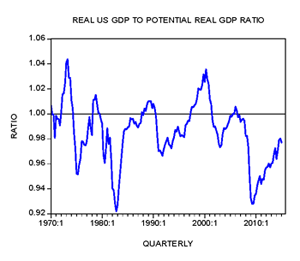
Indeed if one looks at the real gross domestic product to the potential real gross domestic product ratio the economy does appear to be hovering below potential with the ratio of 0.977 registered in Q1 this year.

shostak_june 8 300_1

Contrary to Krugman, we suggest that economists such as Ludwig von Mises and Murray Rothbard have provided a clear answer to the issue of technology and economic growth.

In Man, Economy, and State, Rothbard says that technology, while important, must always work through the investment of capital in order to generate economic growth.

On this issue, Rothbard quotes Mises who says,

What is lacking in (underdeveloped counties) is not knowledge of Western technological methods (“know how”); that is learned easily enough. The service of imparting knowledge, in person or in book form, can be paid for readily. What is lacking is the supply of saved capital needed to put the advanced methods into effect.

Most modern theories that emphasize the importance of new ideas and new technologies give the impression that these ideas and technologies have a “life of their own.” Many experts hold that because of the limited amounts of capital and labor, without technological progress, the opportunities for growth will eventually run out.

We Need Funding To Implement New Ideas

Ideas, unlike material inputs, are not themselves scarce. Consequently, it is argued, new ideas for more efficient processes and new products can make continuous growth possible.

We suggest that regardless of how many ideas people have, what matters is whether these ideas can be implemented. What always limits the implementation of various new techniques is the availability of funding. While ideas and new techniques can result in a better use of scarce resources, they can however, do very little without the pool of real savings.

So regardless of how clever we are and regardless of various technological ideas, without an adequate pool of funding nothing will emerge. It is through the expansion in the pool of real savings that an increase in the stock of capital goods is possible. And it is the increase in the capital goods per worker that permits economic growth to emerge.

To Get More Funding, We Need Savings

Obviously, new ideas and new technology can be introduced during the production of new capital goods (i.e., new technology) and will be imbedded in the capital goods stock. The crux of the matter however, is that capital goods cannot emerge without a prior increase in the pool of funding or pool of real savings.

Take, for instance, a baker John who produced ten loaves of bread. He consumes two loaves of bread whilst the other two loaves — his real savings — he employs to purchase a new part to improve his oven. With a better oven he can now raise the output of bread to twenty loaves. If he still consumes only two loaves, then with a larger savings (now stands at eighteen loaves) he can enhance further his oven by introducing new parts, which will enable the introduction of new technology. Note that all this is made possible on account of real savings.

We suggest that despite new technologies, a major impediment to economic growth has been the relentless central bank tampering with financial markets.

Since 2008 this tampering was made manifest in the extremely loose monetary policy of the Fed that resulted in the massive monetary expansion of the Fed’s balance sheet and the lowering of interest rates to almost nil.

These policies have been responsible for a severe erosion of the pool of real savings and thus a weakening of the process of capital formation. This in turn has undermined real economic growth notwithstanding new information technology.

For Krugman and his followers savings is bad news — it is seen as less demand — hence one shouldn’t be surprised that Krugman is puzzled as to why new ideas haven’t manifested in a more robust economic growth. Contrary to Krugman, boosting so-called aggregate demand whilst undermining the capital formation process, and hence the ability to produce goods and services, cannot strengthen economic growth over time. In fact this way of thinking results in the notion that something can be generated out of nothing.

Frank Shostak is an adjunct scholar of the Mises Institute and a frequent contributor to Mises.org. His consulting firm, Applied Austrian School Economics, provides in-depth assessments and reports of financial markets and global economies.

This article was originally published by the Ludwig von Mises Institute. Permission to reprint in whole or in part is hereby granted, provided full credit is given.
The Bait-and-Switch Behind Economic Populism – Article by Nicolás Cachanosky

The Bait-and-Switch Behind Economic Populism – Article by Nicolás Cachanosky

The New Renaissance Hat
Nicolás Cachanosky
May 26, 2015
******************************

Argentina will hold elections this year, and a number of provinces will be electing governors. Buenos Aires, the capital city, is holding elections for mayor, and Mauricio Macri, who is stepping down as mayor, is a favorite to become the next president. Toward the end of the year, a presidential election will be held and Cristina Kirchner, after two consecutive mandates, will have to step down because she cannot be re-elected.

Like Chávez and Maduro in Venezuela, Argentina can be described as a country that fell victim to extreme populism during the Nestor and Cristina Kirchner administrations, which began in 2003. Twelve years later, this populist political project is about to end.

The economic policy of populism is characterized by massive intervention, high consumption (and low investment), and government deficits. This is unsustainable and we can identify several stages as it moves toward its inevitable economic failure. The last decade of extreme populism in Argentina can be described as following just such a pattern.

After observing the populist experience in several Latin American countries, Rudiger Dornbusch and Sebastián Edwards identified four universal stages inherent in populism in their article “Macroeconomic Populism” (1990). Even though populism can present a wide array of policies, certain characteristics seem to be present in most of the cases.

Populism usually fosters social mobilization, political propaganda, and the use of symbols and marketing practices designed to appeal to voter’s sentiments. Populism is especially aimed at those with low income, even if the ruling party cannot explain the source of its leaders’ high income. Populist rulers find it easy to use scapegoats and conspiracy theories to explain why the country is going through a hard time, while at the same time present themselves as the saviors of the nation. It is not surprising that for some, populism is associated with the left and socialist movements, and by others with the right and fascist policies.

The four stages of populism identified by Dornbusch and Edwards are:

Stage I

The populist diagnosis of what is wrong with an economy is confirmed during the first years of the new government. Macroeconomic policy shows good results like growing GDP, a reduction in unemployment, increase in real wages, etc. Because of output gaps, imports paid with central bank reserves, and regulations (maximum prices coupled with subsidies to the firms), inflation is mostly under control.

Stage II

Bottleneck effects start to appear because the populist policies have emphasized consumption over investment, the use of reserves to pay for imports, and the consumption of capital stock. Changes in sensitive relative prices start to become necessary, and this often leads to a devaluation of the exchange rate, price changes in utilities (usually through regulation), and the imposition of capital controls. Government tries, but fails, to control government spending and budget deficits.

The underground economy starts to increase as the fiscal deficit worsens because the cost of the promised subsidies need to keep up with a now-rising inflation. Fiscal reforms are necessary, but avoided by the populist government because they go against the government’s own rhetoric and core base of support.

Stage III

Shortage problems become significant, inflation accelerates, and because the nominal exchange rate did not keep pace with inflation, there is an outflow of capital (reserves). High inflation pushes the economy to a de-monetization. The local currency is used only for domestic transactions, but people save in US dollars.

The fall in economic activity negatively affects tax receipts increasing the deficit even more. The government needs to cut subsidies and increases the rate of the exchange rate, depreciation. Real income starts to fall and signs of political and social instability start to appear. At this point the failure of the populist project becomes apparent.

Stage IV

A new government is swept into office and is forced to engage in “orthodox” adjustments, possibly under the supervision of the IMF or an international organization that provides the funds required to go through policy reforms. Because capital has been consumed and destroyed, real wages fall to levels even lower than those that existed at the beginning of the populist government’s election. The “orthodox” government is then responsible for picking up the pieces and covering the costs of failed policies left from the previous populist regime. The populists are gone, but the ravages of their policies continue to manifest themselves. In Argentina the expression “economic bomb” is used to describe the economic imbalances that government leaves for the next one.

Economic Populism is Alive and Well

Even though Dornbusch and Edwards wrote their article in 1990, the similarities to the situation in countries like Venezuela, Bolivia, and Argentina is notable. In recent years, to keep populist ideas going in the minds of voters, Venezuela created the Ministry of Happiness, and Argentina created a new Secretary of National Thought.

These four stages are actually cyclical. The populist movement uses the fourth stage to criticize the orthodox party, and argues that during the populists’ tenure, things were better. The public opinion discontent with stage IV allows the populist movement to win new elections, receive an economy in a crisis or recession and the cycle starts over again from stage I. It is not surprising that populist governments usually appear following the hard times caused by economic crisis. A more bold populist government could avoid stage IV by finding a way to remain in office, calling off elections, or creating fake election results (as was the case in Venezuela). At such a point, the populist government succeeds in turning the country into a fully authoritarian nation.

Nicolás Cachanosky, a native of Argentina, is assistant professor of economics at Metropolitan State University of Denver.

This article was published on Mises.org and may be freely distributed, subject to a Creative Commons Attribution United States License, which requires that credit be given to the author.

Fantasy Bookstore Fights Fantasy Economics – San Francisco Sci-Fi Lovers Do Battle With the Minimum Wage – Article by Gary McGath

Fantasy Bookstore Fights Fantasy Economics – San Francisco Sci-Fi Lovers Do Battle With the Minimum Wage – Article by Gary McGath

The New Renaissance Hat
Gary McGath
May 18, 2015
******************************

Borderlands is an independent bookstore in San Francisco with an enthusiastic following among science fiction fans. It’s not just a place to buy books, but in the words of its mission statement “a social and professional center for readers, writers, publishers, reviewers, artists and other individuals with a strong interest in the fields of Science Fiction, Fantasy, Horror and Macabre Fiction.” Authors frequently appear there, and readers meet for discussions.

Like other bookstores, Borderlands has found staying in business difficult. It nearly closed early in 2015, and management put the blame for this on the city’s increase in the minimum wage. On February 1, it announced:

In November, San Francisco voters overwhelmingly passed a measure that will increase the minimum wage within the city to $15 per hour by 2018.

Although all of us at Borderlands support the concept of a living wage in principal [sic] and we believe that it’s possible that the new law will be good for San Francisco — Borderlands Books as it exists is not a financially viable business if subject to that minimum wage.

Consequently we will be closing our doors no later than March 31st.  The cafe will continue to operate until at least the end of this year.

Thanks to sponsorship from its community, Borderlands was able to avoid closing and is still in business, at least for now. Still, its crisis graphically shows one of the damaging consequences of minimum wage laws.

If the cost of something goes up, people will buy less of it, or if they can’t, they’ll make up for it in some other way. This applies to employees as much as to anything else. Some businesses can raise their prices to meet increased labor costs, but books are a highly competitive market, and consumers are very sensitive to price changes.

Small businesses in general have fewer options. A large operation may be able to absorb the cost or find ways to pass it on. It can reduce hours, require extra duties, or replace people with machines. These options don’t work well when the staff is small and the love of what they’re doing is a big reason they stay there.

Borderlands is hardly a unique case. The management was careful not to take a position against the minimum wage, but zero dollars for unemployed workers isn’t a “living wage,” and it’s meaningless to say that putting low-wage employees out of work is “good for San Francisco.” It is individuals, not a city, who have to get food and a place to live.

A paid sponsorship program was the key to Borderlands’ short-term survival. Science fiction fans are heavily networked, and many work in well-paying jobs, so the store benefited from a community with money to spare.

Well-known authors like Seanan McGuire and Cory Doctorow helped publicize the cause. Borderlands deserves credit for its innovative approach, but other businesses aren’t always so lucky, and they will fold without being widely noticed or mourned. Fans of bookstores realized, perhaps too late, that for the industry to survive as a whole, the bookstore must be profitable as a business venture, rather than a charity case.

Minimum-wage increases aren’t magic money. Any cost increase has to come out of something, and low-paying jobs that can’t justify the increase are the first place they’ll come out of. Thinking it happens for free is just fantasy.

Gary McGath is a freelance software engineer living in Nashua, New Hampshire.

This article was originally published by The Foundation for Economic Education.
The Costs of Hysteria: How Economists are Misleading the Public on Climate-Change Policy – Article by Robert P. Murphy

The Costs of Hysteria: How Economists are Misleading the Public on Climate-Change Policy – Article by Robert P. Murphy

The New Renaissance Hat
Robert P. Murphy
May 5, 2015
******************************

Suppose the “scientific consensus” on climate change is right. Let’s also stipulate, for the sake of argument, that the computer projections used by the United Nations and the US government are correct, and that economists are able to translate those data into meaningful projections about costs and benefits to people living in the future with climate change.

Despite what the public has been led to believe, the situation is not a crisis at all — and certainly not something that demands drastic government actions to avert serious damage to the environment. In fact, implementing the wrong policy can cause far more damage than it can prevent.

It’s understandable that the public has no idea of the real state of the literature on climate change policy, because even professional economists use utterly misleading rhetoric in this arena. To show what I mean, first, let’s quote from a recent Noah Smith Bloomberg article, which urges left-liberals to support the Trans-Pacific Partnership (TPP) trade deal:

One of the bigger economic issues under debate right now is the Trans-Pacific Partnership (TPP), the multilateral trade deal that would include most countries in the Asia-Pacific region as well as the US. Many people both here and abroad are suspicious of trade deals, while economists usually support them. This time around, however, the dynamic is a little bit different — the TPP is getting some pushback from left-leaning economists such as Paul Krugman.

Krugman’s point is that since US trade is already pretty liberalized … the effect of further liberalization will be small.… I’m usually more of a free-trade skeptic than the average economist.… But in this case, I’m strongly on the pro-TPP side. There are just too many good arguments in favor.

University of California-Berkeley economist Brad DeLong does some quick back-of-the-envelope calculations, and estimates that the TPP would increase the world’s wealth by a total of $3 trillion. Though that’s not a big deal in the grand scheme of things, it’s one of the best reforms that’s feasible in the current polarized political situation. (emphasis added)

To summarize the flavor of Smith’s discussion, he thinks the TPP is “one of the bigger economic issues” today, and that its potential windfall to humanity of $3 trillion is “not a big deal in the grand scheme of things” but certainly worth pursuing if attainable. Krugman disagrees with Smith’s assessment, but their differences are clearly quibbles over numbers and strategies; it’s not as if Smith thinks Krugman is a “Ricardo denier” or accuses Krugman of hating poor Asians by opposing the trade deal.

We get a much different tone if instead we look at Smith discussing climate-change policy. For example, in June 2014, Smith wrote a Bloomberg piece on five ways to fight global warming. In the interest of brevity, let me simply quote Smith’s concluding paragraph:

If we do these five things, then the US can still save the world from global warming, even though we’re no longer the main cause of the problem. And the short-run cost to our economy will be very moderate. Saving the world on the cheap sounds like a good idea to me. (emphasis added)

Clearly, there is a chasm in the rhetoric between Smith’s two Bloomberg pieces. When discussing the TPP, it’s an honest disagreement between experts over a trade agreement that Smith thinks is definitely worthwhile, but in the grand scheme is not that big a deal. In contrast, government policies concerning climate change literally involve the fate of the planet.

At this point, most readers would wonder what the problem is. After all, isn’t man-made climate change a global crisis? Why shouldn’t Smith use much stronger rhetoric when describing it?

I am making this comparison because according to one of the pioneers in climate-change economics, William Nordhaus, even if all governments around the world implemented the textbook-perfect carbon tax, the net gain to humanity would be … drumroll please … $3 trillion. In other words, one of the world’s experts on the economics of climate change estimates that the difference to humanity between (a) implementing the perfect carbon-tax policy solution and (b) doing absolutely nothing was about the same difference as DeLong estimated when it comes to the TPP.

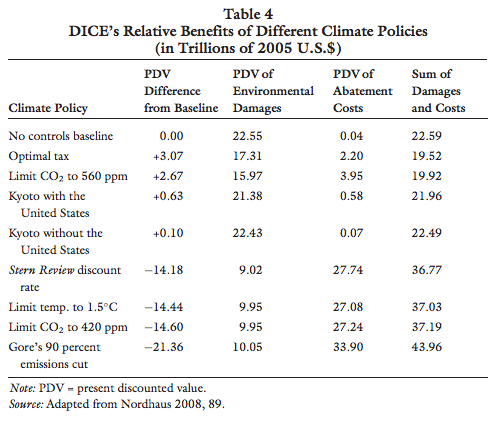
To be more specific, the $3 trillion Nordhaus estimate comes from the 2008 calibration of his Dynamic Integrated Climate-Economy (DICE) model. (The numbers have gone up since then, but I studied his 2008 calibration in great detail.) Note that this isn’t some “denier” computer simulation, rejected by the serious scientists. On the contrary, Nordhaus’s DICE model was one of only three chosen by the Obama administration when it set up a working group to estimate the monetary damages of carbon dioxide emissions. To help the reader understand the trade-offs humanity faces when it comes to climate change, let me reproduce table 4 from my Independent Review article that critically evaluated Nordhaus’s model:    

The table shows Nordhaus’s estimates (made in 2008 based on the “consensus” scientific assessments of the time) of the net benefits of various possible governmental climate policy approaches. The first row shows what happens if governments do nothing. There will be $22.55 trillion (in present value terms, and quoted in 2005 dollars) of environmental damage, but virtually no economic costs of complying with regulations, for a total harm of $22.59 trillion.

In contrast, if governments around the world implemented Nordhaus’s recommended “optimal” carbon tax, the world would be spared a little more than $5 trillion in future environmental damage, while future economic output would be $2.2 trillion lower due to complying with the carbon tax. Adding it all up, humanity would suffer total harms of $19.52 trillion, meaning the world would be $3.07 trillion wealthier with the optimal, global carbon tax (because $22.59 − $19.52 = $3.07).

Central to the economic way of thinking is the concept of trade-offs. Every possible policy — including a policy of doing nothing — comes with costs. But the public tends to hear about only one set of costs, not the full array. For example, as the earlier table shows, the wrong climate policy can be much, much worse than doing nothing. Nordhaus evaluated Al Gore’s suggestion to cut emissions by 90 percent, and estimated that it would make humanity some $21 trillion poorer compared to the do-nothing baseline — a net harm seven times greater than the net benefits of the textbook-optimal approach.

My point here is not to trumpet Nordhaus’s numbers as being gospel. (My Independent Review article was a full-blown critique of his model.) Rather, I am pointing out that even one of the leading models that underpins the so-called consensus on climate-change activism shows that this is hardly the planetary crisis that the rhetoric of Smith and others would suggest. The actual numbers are in the same ballpark as those of trade deals — and nobody thinks the fate of the planet hangs on the passage of a trade deal.

More generally, what even most economists have failed to convey to the public is that climate-change policies at best will affect things on the margin. Nordhaus’s table beautifully illustrates this. The optimal carbon tax doesn’t eliminate the climate-change damage that his computer simulations predict. On the contrary, the carbon tax only reduces it from about $23 trillion down to $17 billion. The reason it doesn’t make sense to enact a more aggressive carbon tax is that the (marginal) harm to the conventional economy would exceed the (marginal) environmental benefit. There are several policies in the table that reduce environmental damage below the $17 trillion mark, but they hurt the economy so much more that, on net, they are inferior approaches.

It is understandable that noneconomists would fail to employ marginal analysis and would engage in overblown rhetoric when discussing something as controversial as climate-change policy. However, too many professional economists have also fallen into this bad habit, including not just Smith but also Krugman and many others.

Robert P. Murphy has a PhD in economics from NYU. He is the author of The Politically Incorrect Guide to Capitalism and The Politically Incorrect Guide to The Great Depression and the New Deal.

This article was originally published by The Foundation for Economic Education and may be freely distributed, subject to a Creative Commons Attribution 4.0 International License, which requires that credit be given to the author.

Michel Chevalier’s Case Against the Patent System – Article by Louis Rouanet

Michel Chevalier’s Case Against the Patent System – Article by Louis Rouanet

The New Renaissance Hat
Louis Rouanet
April 17, 2015
******************************

Michel Chevalier (1806–1879) was a very influential French economist during the second half of the nineteenth century. He is still widely known in France for being the architect of the Cobden-Chevalier Treaty of 1860 which was the free-trade agreement between France and Great Britain. Michel Chevalier is, however, less known for his major contribution to the intellectual property debate. [1] Contrary to Jean Baptiste Say, Gustave de Molinari, and many other French economists, Chevalier fiercely opposed the patent system. As Fritz Machlup remarked: “Among French economists, Michel Chevalier was probably the most emphatic in the joint antagonism to tariffs and patents, declaring that both ‘stem from the same doctrine and result in the same abuses.’”

Taking a fresh look at Michel Chevalier’s major work, Les Brevets d’invention (1878), we find it to be not only a well-written and powerful book, but also has remained impressively relevant. The arguments advanced by Chevalier anticipate the current arguments of the present opponents of intellectual property.

Patents as Contrary to Freedom and Economic Progress

Michel Chevalier argues that patents cannot be justified if they are contrary to freedom, even if beneficial to technological change. For him “From the moment we can make effective the patent only through inquisitorial expedients, violence, and subversion of liberty of labor, it is proof that we must renounce patents.” Chevalier rejects utilitarianism as a sufficient method to justify or refute the patent system. Chevalier’s opposition to patents, however, is not just based on moral arguments but shows the disastrous effects of this system for both foreign trade and the economy in general.

According to Chevalier, patents are of the same nature as privileges and monopolies which were prevalent during the Ancien Régime. They are also comparable in their effects to protectionist policies:

In absolute terms, patents diminish the productive power of nations that recognize them: evident proposition for those who believe that freedom, free competition, is the great lever of industrial progress.

Chevalier goes on to note the conservative and anti-innovation nature of monopolies and gives many examples of monopolies during the Ancien Régime. According to him, the innovators during the Ancien Régime weren’t rewarded, not because of the absence of patents, but because of the corporation guild system which was destroying competition and freedom to entry into markets. Thus, the innovators were constantly sued by guilds and consumers rarely benefited from their inventions. This argument is still relevant today. Indeed, companies protected from competition and government-owned corporations are often less innovative and more subject to conservative measures. Sectors typically run by government such as schools experience very little technological progress. On the other hand, the competitive process of the market gives incentives for the actors to differentiate from the other producers. As Pascal Salin stated, the company which makes the highest profits on a free market is the company which is the best positioned to “invent the future.” The essential virtue of competition is that it encourages producers to innovate in order to better serve the needs of consumers.

As one of his more striking examples, Chevalier examines the case of aniline — a dye and major innovation in the chemical industry — and shows how monopoly, resulting from patents, leads to hampered innovation. His interpretation of the problems caused by patents in the chemical industry at the time is consistent with more recent studies done by Boldrin and Levine in Against Intellectual Monopoly, now the seminal work on the topic.

Innovation as a Process

Chevalier understood that innovation is, above all, a process and that giving privileges to the innovator will destroy this process, leading to less and not more inventions. He wrote:

Every industrial discovery is the product of the general ferment of ideas, the result of an internal work which was accomplished with the support of a large number of successive or simultaneous collaborators in society, often for centuries.

This argument regarding the cumulative nature of innovation is still the most powerful argument against intellectual monopoly today and has also been the theme of several recent studies.2 Similar to Chevalier, Hayek saw innovation as a process and stated that “it is not obvious that such forced scarcity [intellectual property] is the most effective way to stimulate the human creative process.”

In an 1862 debate in the Académe des Sciences Morales et Politiques, Chevalier gave the example of Louis Daguerre, one of the inventors of photography, who didn’t seek a patent for his system of photography. According to Chevalier, the absence of a patent led to necessary improvements of the daguerreotype and fostered its widespread use. His conclusion is the following:

The spirit of man proceeds only by successive trials and repeated attempts. Discoveries do not arrive with a single bound to the degree of perfection or completion, which is reserved for them; there must be renewed, persevering efforts, cut by breaks that allow, so to speak, to breath. … If it is true that the invention must pass through the hands of twenty people before reaching its final state, it follows that the exclusive privilege granted to the first patented, and to each of his followers, prevents this practical result rather than facilitate it.

The Increasing Number of Patents and Negative Consequences

Already during the nineteenth century, legal instability and uncertainty challenged the actual efficiency of the patent system and the economists were very much aware of this problem. Chevalier warned that the patent system would lead to legal uncertainty for the companies and would lead the industry back to a guild system where no entrepreneur would dare to enter a market for fear of being sued by patent holders. Chevalier was ahead of his time by denouncing what can be considered the ancestors of today’s patent trolls.

Chevalier concluded his 1862 article by stating: “I think I have said enough to show that the patent legislation has been an eccentricity of the legislator.” He went further in 1863 and added that “[a]ll friends of industrial and social progress must work together to rescue the industry of obstacles, obsolete remains of the past. Patents must disappear first.” [3]

1. Fritz Machlup and Edith Penrose briefly discussed Michel Chevalier in “The Patent Controversy in the Nineteenth Century,” Journal of Economic History, 1950.

2. See Alberto Galasso et Mark Schankerman, “Patents and Cumulative Innovation: Causal Evidence from the Courts”, NBER working paper, 21 June 2014 ; and also, Alessandro Nuvolari, “Collective Invention during the British Industrial Revolution: The Case of the Cornish Pumping Engine,” Cambridge Journal of Economics 28, No. 3 (2004).

3. Quoted in Eugène Pouillet, “Traité théorique et pratique des brevets d’invention et de la contrefaçon,” 1909, pp. x–xi.

Louis Rouanet is a student at Sciences Po Paris (Institute of Political Studies) where he studies economics and political science.

This article was originally published by the Ludwig von Mises Institute. Permission to reprint in whole or in part is hereby granted, provided full credit is given.
Free Study Guide on Public-Choice Economics – Third Edition – by G. Stolyarov II

Free Study Guide on Public-Choice Economics – Third Edition – by G. Stolyarov II

The New Renaissance Hat
G. Stolyarov II
July 3, 2014
******************************

The Third Edition of the popular Free Study Guide on Public-Choice Economics, prior editions of which have received over 31,000 views, is now available for download. Click here to download a free PDF copy of the Third Edition of this study guide.

This study guide covers 20 areas of public-choice theory and related topics in a question-and-answer format, with questions developed by Mr. Stolyarov on the basis on his notes taken in Stolyarovian Shorthand during the 2008 session of the Public Choice Economics course at Hillsdale College, taught by the renowned economist and professor, Dr. Gary Wolfram.

See more educational offerings in The Rational Argumentator’s section of Free Tools for Rational Education.

Ceremonial plastic sword, awarded to Mr. Stolyarov in 2008 for receiving the highest grade in Professor Gary Wolfram’s Public Choice Economics course at Hillsdale College.

Ceremonial plastic sword, awarded to Mr. Stolyarov in 2008 for receiving the highest grade in Professor Gary Wolfram’s Public Choice Economics course at Hillsdale College.

Fearless, Provocative, and Inescapably Thought-Provoking: Review of Kyrel Zantonavitch’s “Pure Liberal Fire” – Article by G. Stolyarov II

Fearless, Provocative, and Inescapably Thought-Provoking: Review of Kyrel Zantonavitch’s “Pure Liberal Fire” – Article by G. Stolyarov II

The New Renaissance Hat
G. Stolyarov II
May 16, 2014
******************************
Pure Liberal Fire by Kyrel Zantonavitch is available on Amazon in paperback and Kindle formats.
***
There is perhaps not a single thinker in the world more fearless than Kyrel Zantonavitch. Pure Liberal Fire is the direct, provocative distillation of his thoughts on metaphysics, epistemology, ethics, politics, economics, culture, religion, and the history of philosophy – including Objectivism and Classical Liberalism. Zantonavitch seeks to evoke a pure, true liberalism, and he shows no mercy for ideologies and attitudes that constitute its antithesis. He certainly leaves no doubt in the reader’s mind about where he stands on the issues addressed – and each article within the book employs an abundance of superlative expressions – be they positive or negative. When Zantonavitch praises, he really praises – and the same goes for when he condemns.
***

I give this book a rating of five stars because it invariably makes people think – no matter who they are or what their starting persuasions and assumptions might be. There are many areas in which I strongly agree with Zantonavitch – and quite a few where I strongly disagree as well. He articulates many valid points about the fundamentals of philosophy, the importance of liberty in political theory, atheism, the damage perpetrated by various political movements and policies, and the unfortunate tendencies among historical and current Objectivists toward dogmatism and conformism instead of independent thought and the honest pursuit of truth. Some of our areas of disagreement include war, areas of foreign policy, and, perhaps more generally, the desired mechanisms for achieving societal change.

Zantonavitch’s approach and style would entail achieving a fiery, dramatic, immediate deposition of everything (every person, every policy, every idea) he considers evil, dangerous, or damaging. My view of reform is more surgical, focused on getting the sequence of steps right so as to minimize the damage inflicted during the transition while ridding the world of the disease of bad policies (and, in a more long-term fashion, through persuasion and free-market education, also ridding it of bad thinking of the sort that motivates bad policies).

Zantonavitch combines his no-holds-barred treatment of his subject matters with a unique dialectical technique. There are several places in a book where he characterizes a particular set of ideas (or people) in a strongly negative way – but then later (or earlier) also portrays them as either highly praiseworthy, or at the very least understandable and characterized by redeeming attributes. Two examples that come to mind are (1) his discussions of Objectivism as a brainwashing cult in some places and as the most advanced, best-developed philosophy to date in others, and (2) his characterizations in some places of religious believers as not particularly bad as long as they do not take their belief too seriously – and in other places of anyone who believes in a god or teaches his/her children such beliefs as being guilty of evil and/or abuse. The reader can glimpse in this a deliberate juxtaposition of these opposing characterizations in a dialectical fashion – in an attempt to examine both the positive and the negative aspects of the ideas and behaviors Zantonavitch is writing about. (With regard to Objectivism, there is definitely merit in pointing out both the great strengths and the failures, as I have myself done, for instance.) This also creates a second layer of meaning in Zantonavitch’s work, as his uses of positive and negative superlatives with regard to the same subject are seldom immediately close to one another. While the rest of his writing endeavors to be extremely direct (indeed, provocative) with regard to its meaning, he seems to expect his readers to make their own connections in this respect without him deliberately pointing them out. As a result, with regard to Objectivism especially, Zantonavitch’s readers have the opportunity to acquire a more balanced, nuanced view after having been exposed to both his glorious praise and his scathing condemnation of the philosophy.