Browsed by
Tag: economy

Europe and Deflation Paranoia – Article by Frank Hollenbeck

Europe and Deflation Paranoia – Article by Frank Hollenbeck

The New Renaissance Hat
Frank Hollenbeck
April 30, 2014
******************************

There is a current incessant flow of articles warning us of the certain economic calamity if deflation is allowed to show its nose for even the briefest period of time. This ogre of deflation, we are told, must be defeated with the printing presses at all costs. Of course, the real objective of this fear mongering is to enable continued national-government theft through debasement. Every dollar printed is a government tax on cash balances.

There are two main sources of deflation. The first comes from a general increase in the amount of goods and services available. In this type of deflation, a reduction in costs, in a competitive environment, leads to lower prices. The high technology sector has thrived in this type of deflation for decades as technical progress (e.g., the effect of Moore’s Law) has powered innovations and computing power at ever-decreasing costs. The same was true for most industries during much of the nineteenth century, as the living standard increased considerably. Every man benefited from the increase in real wages resulting from lower prices.

The second source of deflation is from a reduction in the money supply that comes from an increase in the desire of the public or banking sectors to hold cash (i.e., hoarding).[1] An uncomplicated example will make this point clearer. Suppose we have 10 pencils and $10. Only at an equilibrium price of $1 will there be no excess output or excess money.

Suppose the production cost of a pencil is 80 cents. The rate of return is 25 percent. Now suppose people hoard $5 and stuff money in their mattress instead of saving it. The price of a pencil will be cut in half, falling from $1 to 50 cents, since we now have a money supply of $5 chasing 10 pencils. If input prices also fall to 40 cents per pencil then there is no problem since the rate of return is still 25 percent. In this example, a drop in output prices forced an adjustment in input prices.

The Keynesian fear is that input prices will not adjust fast enough to a drop in output prices so that the economy will fall into a deflation-depression spiral. The Keynesian-monetarist solution is to have the government print $5 to avoid this deflation.

Yet, this money creation is distortive and will cause a misallocation of resources since the new money will not be spent in the same areas or proportions as the money that is now being “hoarded” (as defined by Keynesians). Furthermore, even if the government could find the right areas or proportions, it would still lead to misallocations, since the hoarding reflects a desire to realign relative prices closer to what society really wants to be produced. The printing of money may actually increase the desire to hold cash, as we see today. Holding cash may be the preferred choice over consumption or investment (savings) when relative and absolute prices have been distorted by the printing press.

Of course, no one is really asking the critical questions. Why does holding more cash change the money supply, and why did the public and banks decide to increase their cash holdings in the first place?[2] Without fractional reserve banking, neither the public nor the banks could significantly change the money supply by holding more cash, nor could banks extend credit faster than slow-moving savings. The boom and ensuing malinvestments would be a thing of the past and, thus, so would the desire to hold more cash during the bust phase of the business cycle. If central banks are really concerned about this type of deflation, they should be addressing the cause — fractional reserve banking — and not the result. Telling a drunk that he can avoid the hangover by drinking even more whiskey is simply making the situation worse.[3] The real solution is to have him stop drinking.

According to the European Central Bank’s Mario Draghi,

The second drawback of low inflation … is that it makes the adjustment of imbalances much more difficult. It is one thing to have to adjust relative prices with an inflation rate which is around 2%, another thing is to adjust relative prices with an inflation rate which is around 0.5%. That means that the change in certain prices, in order to readjust, will have to become negative. And you know that prices and wages have a certain nominal rigidity which makes these adjustments more complex.

Draghi is confusing the first source of deflation with the second. The recent low inflation in the Euro zone can be attributed primarily to a strengthening of the Euro, and a drop in food and energy prices.

Economists at the Bundesbank must be quietly seething. They are obviously not blind to the ECB’s excuses to indirectly monetize the southern bloc’s debt. Draghi’s “whatever it takes” comment gave southern bloc countries extra time. Yet, little has been done to reign in the size of bloated public sectors. Debt-to-GDP ratios continue to rise and higher taxes in southern bloc countries have caused an even greater contraction of the private sector. Many banks in southern Europe are technically bankrupt. Non-performing loans in Italy have gone from about 5.8 percent in 2007 to over 15 percent today. And, the situation is getting worse.

Greece recently placed a five-year bond at under 5 percent which was eight times oversubscribed. This highlights the degree to which the financial sector in Europe is now dependent on the “Draghi put.” As elsewhere in the world, interest rates in Europe are totally distorted and no longer serve the critical function of allocating resources according to society’s time preference of consumption, or even reflect any real risk of default.

The ECB will likely impose negative rates shortly but will discover, as the Fed and others did before it, that you can bring a horse to water but cannot make him drink. QE will then be on the table, but unlike the Fed, the ECB is limited in the choice of assets it can purchase since direct purchase of Euro government bonds violates the German constitution. One day, Germany and the southern bloc countries, including France, will clash on what is the appropriate role of monetary policy.

Germany would be wise to plan, today, for a possible Euro exit.

Notes

[1] Keynesians view holding cash, and even holding savings in banks as “hoarding,” but properly understood, only the equivalent of stuffing money in a mattress is hoarding.

[2] Fractional-reserve lending is inflationary, thus contributing to inflationary booms. In turn, banks hold more cash when they fear a confidence crisis, which is also a result of the boom.

[3] Since inflationary fractional-reserve lending is a source of the problem, additional lending of the same sort is not the solution.

Frank Hollenbeck teaches finance and economics at the International University of Geneva. He has previously held positions as a Senior Economist at the State Department, Chief Economist at Caterpillar Overseas, and as an Associate Director of a Swiss private bank. See Frank Hollenbeck’s article archives.

This article was published on Mises.org and may be freely distributed, subject to a Creative Commons Attribution United States License, which requires that credit be given to the author.
At the Fed, the More Things Change, the More They Stay the Same – Article by Ron Paul

At the Fed, the More Things Change, the More They Stay the Same – Article by Ron Paul

The New Renaissance Hat
Ron Paul
February 16, 2014
******************************
Last week, Federal Reserve Chairman Janet Yellen testified before Congress for the first time since replacing Ben Bernanke at the beginning of the month. Her testimony confirmed what many of us suspected, that interventionist Keynesian policies at the Federal Reserve are well-entrenched and far from over. Mrs. Yellen practically bent over backwards to reassure Wall Street that the Fed would continue its accommodative monetary policy well into any new economic recovery. The same monetary policy that got us into this mess will remain in place until the next crisis hits.

Isn’t it amazing that the same people who failed to see the real estate bubble developing, the same people who were so confident about economic recovery that they were talking about “green shoots” five years ago, the same people who have presided over the continued destruction of the dollar’s purchasing power never suffer any repercussions for the failures they have caused? They treat the people of the United States as though we were pawns in a giant chess game, one in which they always win and we the people always lose. No matter how badly they fail, they always get a blank check to do more of the same.

It is about time that the power brokers in Washington paid attention to what the Austrian economists have been saying for decades. Our economic crises are caused by central-bank infusions of easy money into the banking system. This easy money distorts the structure of production and results in malinvested resources, an allocation of resources into economic bubbles and away from sectors that actually serve consumers’ needs. The only true solution to these burst bubbles is to allow the malinvested resources to be liquidated and put to use in other areas. Yet the Federal Reserve’s solution has always been to pump more money and credit into the financial system in order to keep the boom period going, and Mrs. Yellen’s proposals are no exception.

Every time the Fed engages in this loose monetary policy, it just sows the seeds for the next crisis, making the next crash even worse. Look at charts of the federal funds rate to see how the Fed has had to lower interest rates further and longer with each successive crisis. From six percent, to three percent, to one percent, and now the Fed is at zero. Some Keynesian economists have even urged central banks to drop interest rates below zero, which would mean charging people to keep money in bank accounts.

Chairman Yellen understands how ludicrous negative interest rates are, and she said as much in her question and answer period last week. But that zero lower rate means the Fed has had to resort to unusual and extraordinary measures: quantitative easing. As a result, the Fed now sits on a balance sheet equivalent to nearly 25 percent of US GDP, and is committing to continuing to purchase tens of billions more dollars of assets each month.

When will this madness stop? Sound economic growth is based on savings and investment, deferring consumption today in order to consume more in the future. Everything the Fed is doing is exactly the opposite, engaging in short-sighted policies in an attempt to spur consumption today, which will lead to a depletion of capital, a crippling of the economy, and the impoverishment of future generations. We owe it not only to ourselves, but to our children and our grandchildren, to rein in the Federal Reserve and end once and for all its misguided and destructive monetary policy.

Ron Paul, MD, is a former three-time Republican candidate for U. S. President and Congressman from Texas.

This article is reprinted with permission from the Ron Paul Institute for Peace and Prosperity.

Bernanke’s Legacy: A Weak and Mediocre Economy – Article by John P. Cochran

Bernanke’s Legacy: A Weak and Mediocre Economy – Article by John P. Cochran

The New Renaissance Hat
John P. Cochran
February 8, 2014

******************************

As Chairman Bernanke’s reign at the Fed comes to an end, the Wall Street Journal provides its assessment of “The Bernanke Legacy.” Overall the Journal does a reasonable job on both Greenspan and Bernanke, especially compared to the “effusive praise from the usual suspects; supporters of monetary central planning. The Journal argues when accessing Bernanke’s performance it is appropriate to review Bernanke’s performance “before, during, and after the financial panic.”

While most assessments of Bernanke’s performance as a central banker focus on the “during” and “after” financial-crisis phases with much of the praise based on the “during” phase, the Journal joins the Austrians and John Taylor in unfavorable assessment of the more critical “before” period. It was this period when the Fed generated its second boom-bust cycle in the Greenspan-Bernanke era. In the Journal’s assessment, Bernanke, Greenspan, and the Fed deserve an “F.” While this pre-crisis period mostly fell under the leadership of Alan Greenspan, the Journal highlights that Bernanke was the “leading intellectual force” behind the pre-crisis policies. As a result of these too-loose, too-long policies, just as the leadership of the Fed passed from Greenspan to Bernanke, the credit boom the Fed “did so much to create turned to mania, which turned to panic, which became a deep recession.” The Journal’s description of Bernanke’s role should be highlighted in any serious analysis of the Bernanke era:

His [Bernanke’s] role goes back to 2002 when as a Fed Governor he gave a famous speech warning about deflation that didn’t exist [and if it did exist should not have been feared].[1] He and Mr. Greenspan nonetheless followed the advice of Paul Krugman to promote a housing bubble to offset the dot-com crash.

As Fed transcripts show, Mr. Bernanke was the board’s intellectual leader in its decision to cut the fed-funds rate to 1% in June 2003 and keep it there for a year. This was despite a rapidly accelerating economy (3.8% growth in 2004) and soaring commodity and real-estate prices. The Fed’s multiyear policy of negative real interest rates produced a credit mania that led to the housing bubble and bust.

For some of the best analysis of the Fed’s pre-crisis culpability one should turn to Roger Garrison’s excellent analysis. In a 2009 Cato Journal paper, Garrison (2009, p. 187) characterizes Fed policy during the “Great Moderation” as a “learning by doing policy” which, based on events post-2003, would be better classified as “so far so good” or “whistling in the dark.” The actual result of this “learning by doing policy” is described by Garrison in “Natural Rates of Interest and Sustainable Growth”:

In the earlier episode [dot.com boom-bust], the Federal Reserve moved to counter the upward pressure of interest rates, causing actual interest rates not to deviate greatly from the historical norm. In the later episode [housing bubble/boom-bust], the Federal Reserve moved to reinforce the downward pressure on interest rates, causing the actual interest rates to be exceedingly low relative to the historical norm. Although the judgment, made retrospectively by economists of virtually all stripes, that the Fed funds target rate was “too low for too long” between mid-2003 and mid-2004, it was almost surely too low for too long relative to the natural rate in both episodes. (p. 433)

Given this and other strong evidence of the Fed’s role in creating the credit-driven boom, the Journal faults “Mr. Bernanke’s refusal to acknowledge that the Fed made any mistake in the mania years.”

On the response to the crisis, the Journal refrains from the accolades of many who credit the Fed led by the leading scholar of the Great Depression from acting strongly to prevent another such calamity. According to the Fed worshipers, things might not be good, but without the unprecedented actions and bailouts things would have been catastrophic. The Journal’s more measured assessment:

Once the crisis hit, Mr. Bernanke and the Fed deserve the benefit of the doubt. From the safe distance of hindsight, it’s easy to forget how rapid and widespread the financial panic was. The Fed had to offset the collapse in the velocity of money with an increase in its supply, and it did so with force and dispatch. One can disagree with the Fed’s special guarantee programs, but we weren’t sitting in the financial polar vortex at the time. It’s hard to see how others would have done much better.

But discerning readers of Vern McKinley’s Financing Failure: A Century of Bailouts might disagree. Fed actions, even when not verging on the illegal, were counter-productive, unnecessary, and contributed to action-freezing policy uncertainty which contributed to the collapse of the velocity of money. McKinley describes much of what was done as “seat-of-the-pants decision-making” (pp. 305-306):

“Seat of the pants” is not a flattering description of the methods of the regulators, but its use is justified to describe the panic-driven actions during the 2000s crisis. It is only natural that under the deadline of time pressure judgment will be flawed, mistakes will be made and taxpayer exposure will be magnified, and that has clearly been the case. With the possible exception of the Lehman Brothers decision … all of the major bailout decisions during the 2000s crisis were made under duress of panic over a very short period of time with very limited information at hand and with input of a limited number of objective parties involved in the decision making. Not surprisingly, these seat-of-the-pants responses did not instill confidence, and there was no clear evidence collected that the expected negative fallout would truly have occurred.

While a defense of some Fed action could be found in Hayek’s 1970s discussion of “best” policy under bad institutions (a central bank) where he argued that during a crisis a central bank should act to prevent a secondary deflation, the Fed actions went clearly beyond such a recommendation. Better would have been an immediate policy to end the credit expansion in its tracks. The Fed’s special guarantee programs and movement toward a mondustrial policy should be a great worry to anyone concerned about long-term prosperity and liberty. Whether any human running a central bank could have done better is an open question, but other monetary arrangements could clearly have led to better outcomes.

The Journal’s analysis of post-crisis policy, while not as harsh as it should be,[2] is critical. Despite an unprecedented expansion of the Fed’s balance sheet, the “recovery is historically weak.” At some point “a Fed chairman has to take some responsibility for the mediocre growth — and lack of real income growth — on his watch.” Bernanke’s policy is also rightly criticized because “The other great cost of these post-crisis policies is the intrusion of the Fed into politics and fiscal policy.”

Because the ultimate outcome of this monetary cycle hinges on how, when, or if the Fed can unwind its unwieldy balance sheet, without further damage to the economy; most likely continuing stagnation or a return to stagflation, or less likely, but possible hyper-inflation or even a deflationary depression, the Bernanke legacy will ultimately depend on a Bernanke-Yellen legacy. Given, as the Journal points out, “Politicians — and even some conservative pundits — have adopted the Bernanke standard that the Fed’s duty is to reduce unemployment and manage the business cycle,” the prospect that this legacy will be viewed favorably is less and less likely. Perhaps if the editors joined Paul Krugman in reading and fully digesting Joe Salerno’s “A Reformulation of Austrian Business Cycle Theory in Light of the Financial Crisis,” they would correctly fail Bernanke and Fed policy before, during, and after the crisis.

But what should be the main lesson of a Greenspan-Bernanke legacy? Clearly, if there was no pre-crisis credit boom, there would have been no large financial crisis and thus no need for Bernanke or other human to have done better during and after. While Austrian analysis has often been criticized, incorrectly,[3] for not having policy recommendations on what to do during the crisis and recovery, it should be noted that if Austrian recommendations for eliminating central banks and allowing banking freedom had been followed, no such devastating crisis would have occurred and no heroic policy response would have been necessary in the resulting free and prosperous commonwealth.

Notes

[1] See Joseph T. Salerno, “An Austrian Taxonomy of Deflation — With Applications to the U.S.” Quarterly Journal of Austrian Economics 6, no. 4 (2001).

[2] See John P. Cochran’s, Bernanke: The Good Engineer? Mises Daily Article, 21 March 2013 and Bernanke: A Tenure of Failure, Mises Daily Article, 31, July 2013.

[3] See John P. Cochran, Recessions: The Don’t Do List, Mises Daily Article, 17 February 2013.

John P. Cochran is emeritus dean of the Business School and emeritus professor of economics at Metropolitan State University of Denver and coauthor with Fred R. Glahe of The Hayek-Keynes Debate: Lessons for Current Business Cycle Research. He is also a senior scholar for the Mises Institute and serves on the editorial board of the Quarterly Journal of Austrian Economics. Send him mail. See John P. Cochran’s article archives.

This article was published on Mises.org and may be freely distributed, subject to a Creative Commons Attribution United States License, which requires that credit be given to the author.

David Brooks, The Whigs, and Corporate Welfare – Article by Thomas J. DiLorenzo

David Brooks, The Whigs, and Corporate Welfare – Article by Thomas J. DiLorenzo

The New Renaissance Hat
Thomas J. DiLorenzo
February 8, 2014

******************************

In a January 30 column David Brooks, the house neoconservative of the New York Times, urged Obama to ignore both his socialist/egalitarian base and the “conservative tradition that believes in limiting government to enhance freedom.” Obama already has nothing but hateful contempt for the latter tradition and needs no convincing by a right-wing statist like David Brooks.

The president should also abandon his life-long infatuation with and devotion to socialism as well, advises David Brooks. In its place he should pursue an agenda of crony capitalism disguised as a “social mobility agenda” with the help of professional propagandists and perverters of American history such as Brooks and his fellow neoconservatives. Of course, Brooks doesn’t use these less-than-flattering words to describe his Machiavellian agenda. He talks of “a third ancient tradition” in American history, namely, “the Whig tradition, which begins with people like Henry Clay, Daniel Webster and Abraham Lincoln.”

Either Brooks knows nothing at all, whatsoever, about the Whig Party tradition in American history, or he is lying through his teeth about it. For he describes it as having been devoted to “using the power of government to give marginalized Americans the tools to compete in a capitalist economy.” The Whigs, says Brooks, “fought against the divisive populist Jacksonians” who supposedly sought to “pit classes against each other.” Every bit of this is exactly the opposite of the truth. The Whigs were the party of crony capitalism, of government of plutocracy, by the plutocracy, for the plutocracy. That is why so many historians have marveled over how a man like Abe Lincoln, who grew up so poor, would become the political water carrier for the Northeastern moneyed elite in American politics.

The most divisive economic issue in American politics during the heyday of the Whig Party (1832–1852) was the battle over free trade versus protectionism. If the Whigs stood for anything, they stood for corporate welfare in the form of high protectionist tariffs that would plunder the masses for the benefit of the few. This meant, for the most part, plundering Southern farmers more than anyone for the benefit of Northern manufacturers who would be protected from international competition by the high tariffs. As John C. Calhoun once said, what “protectionism” protects the public from is low prices. Next to slavery, protectionism was the biggest assault on property rights in America during the first half of the nineteenth century. The Whigs did not believe in “sacred” property rights, as Brooks foolishly writes. Their entire political agenda was based on the government-enforced attenuation of property rights for the benefit of the wealthy and politically-connected.

Next to political plunder through protectionism, the Whigs stood for the worst sort of crony capitalism in the form of needless corporate welfare for road-, canal-, and railroad-building corporations. This was euphemistically called “internal improvement subsidies” at the time. Private capital markets financed thousands of miles of private roads during the first decades of the nineteenth century. As of 1800 there were 69 privately-financed road-building companies in America that would build more than 400 private roads over the next 40 years, as economist Daniel Klein has documented. The great railroad entrepreneur James J. Hill also proved that government subsidies were not needed to build a transcontinental railroad as he and his investors and business partners built and managed the Great Northern Railroad without a dime of government subsidy, not even “land grants.”

When the Whigs did get their way and conned state government into funding “internal improvement subsidies”, it was an unmitigated financial disaster. Very few, if any, projects were ever finished; taxpayers were stuck with enormous government debts to pay off; much of the money was simply stolen; and by 1860 every state except for Massachusetts had amended its constitution to prohibit the use of tax dollars for corporations with which to do anything, according to economic historian Carter Goodrich.

Edgar Lee Masters, the famous 1930s-era poet, playwright (author of The Spoon River Anthology), and law partner of Clarence Darrow, perfectly described the Whig Party on page 27 of his book, Lincoln the Man. Describing the leader of the Whigs, Henry Clay, Masters wrote:

Clay was the champion of that political system which doles favors to the strong in order to win and to keep their adherence to the government. His system offered shelter to devious schemes and corrupt enterprises. … He was the beloved son [figuratively speaking] of Alexander Hamilton with his corrupt funding schemes, his superstitions concerning the advantage of a public debt, and a people taxed to make profits for enterprises that cannot stand alone. His example and doctrines led to the creation of a party that had no platform to announce, because its principles were plunder and nothing else.

This is exactly correct, and exactly the opposite of what David Brooks wants his New York Times audience to believe. Clay’s agenda, which Alexander Hamilton originally labeled “The American System,” was really an Americanized version of the corrupt mercantilist system the American founders had fought a revolution against. The Hamilton/Clay/Lincoln “American System” included protectionism, corporate welfare, and a central bank to dispense even more corporate welfare subsidies to politically-connected businesses. It was a recipe for political power based on using taxpayer dollars to line the pockets of the (mostly Northern state) business plutocracy at the expense of the general public. Some things never change in a democracy.

It is equally outrageous for Brooks to claim that the Jacksonians were “divisive” and wanted to “pit classes against each other.” This was the function of David Brooks’s beloved Whigs, who were simply an early version of the neoconservatives; it was the libertarian Jacksonians who opposed politicized divisiveness and the pitting of classes against each other. This is exemplified in President Andrew Jackson’s famous veto of the re-chartering of the Second Bank of the United States, a precursor of the Fed.

The Whigs championed a central bank. The Bank of the United States (BUS) even paid both of Brooks’s heroes, Clay and Webster, many thousands of dollars as bribery money to promote the continuation of the bank despite the fact that it was well known that the BUS had corrupted politics and generated boom-and-bust cycles. In vetoing the re-chartering of the BUS (which was not overturned), Jackson wrote:

It is to be regretted that the rich and powerful too often bend the acts of government to their selfish purposes. … In the full enjoyment of the gifts of Heaven and the fruits of superior industry, economy and virtue, every man is equally entitled to protection by the law; but when the laws undertake to add to these natural and just advantages artificial distinctions, to grant titles, gratuities, and exclusive privileges, to make the rich richer and the potent more powerful, the humble members of society — the farmers, mechanics and laborers — who have neither the time nor the means of securing like favors to themselves, have a right to complain of the injustice of their Government. … In the act before me [the bill to re-charter the BUS] there seems to be a wide and unnecessary departure from these just principles.

Neither Jackson nor the Jacksonians were “perfect” libertarians, but by their motto of “equal rights” they meant equality under the law and opposition to the use of the state to dispense “exclusive privileges” and special favors to special interests. They stood for exactly the opposite of what David Brooks claims they stood for, in other words.

Brooks’s commentary turns to slapstick humor at one point when he claims that the Whigs, who were, after all, politicians, were somehow “family-oriented in their moral and social attitudes.” (I assume that he threw this into his article to further dupe the “evangelical Christian” base of the Republican Party into accepting his thesis). The leader of the Whigs, the slave-owning Kentucky hemp plantation patriarch Henry Clay, was indeed “family oriented” in that he had 11 children. But he was also a notorious gambler who rang up $40,000 in personal debt in the 1820s and was famous for staying out late carousing and dancing with women other than his wife while he was in Washington and the wife was back home in Kentucky, according to several biographies.

Armed with this absurdly false history of American politics, Brooks argues for an explosion of governmental central planning by Obama during the rest of his term. He wants Obama to employ “social entrepreneurs” to fundamentally transform American society by “improving family patterns,” expanding early childhood education, “structuring neighborhoods,” paying “young men wage subsidies so they are worth marrying,” training “middle-aged workers” for jobs, and generally micromanaging everyone’s life from cradle to grave. In his words, government should promote “[social] mobility issues from the beginning to the end of the lifespan.”

Something very much like this has been tried before. It was called totalitarian socialism, and it failed miserably.

Thomas DiLorenzo is professor of economics at Loyola University Maryland and a member of the senior faculty of the Mises Institute.

He is the author of The Real Lincoln; Lincoln Unmasked; How Capitalism Saved America; and Hamilton’s Curse: How Jefferson’s Archenemy Betrayed the American Revolution — And What It Means for Americans Today. Send him mail.

This article was published on Mises.org and is reprinted pursuant to a Creative Commons Attribution License.

The Paradox of Public Assistance – Article by David J. Hebert

The Paradox of Public Assistance – Article by David J. Hebert

The New Renaissance Hat
David J. Hebert
January 26, 2014
******************************

Let’s put ideology aside for a moment. One might not think it’s morally or politically justifiable to take from one person in order to help another. But for now, let’s ask another question: Does it help?

A lot of people see the existence of “poverty amid plenty,” wherein a few people have acquired a lot of wealth while the overwhelming majority struggles to make ends meet. The standard call is to provide some means of transferring those resources from the haves to the have-nots, either through a progressive tax policy or via some direct transfer program.

The problem with these policies is obviously not in their stated goals. Who could argue against the desire to help people? Nor is it, entirely, the coercive nature of redistribution. The real problem comes in the ability of welfare advocates to actually reduce poverty in an effective and long-lasting manner.

World Coyne

In his latest book, Doing Bad by Doing Good, Chris Coyne discusses problems with delivering effective humanitarian aid to other countries. Coyne identifies two potential problems: the planner’s problem and the incentive problem.

Briefly, the planner’s problem refers to the impossibility of people outside of a society actually to possess the information required to assist in fostering continued economic development. The incentive problem refers to the idea that the planners may face perverse incentives to go ahead and do something that the planner’s problem suggests is impossible to start with.

These points are all well and good, and should be well received at least by readers of this publication. But I think we can go further to urge that the problems Coyne identifies apply equally to issues related to domestic intervention.

Disconnect

The people who advocate most strongly for poverty relief programs are not, in fact, people who are poor. Rather, they are people who are typically either politicians seeking reelection or wealthy people who have some overwhelming desire to do something (usually they want to get other people to give them money to do something). They are not poor, but rather they simply do not like seeing poor people suffer and feel some desire to help. However, because they are not poor themselves, they have absolutely no idea what it is that poor people actually want.

Do they want shelter, clothing, and food? Yes. Do they want education, hygiene, and employment? Of course. But in what order, how much, and of what type? In a world of scarcity, the answers to these questions are of crucial importance if we are to find ways to help the most people as quickly and effectively as possible. And yet, the answers to these questions are wholly unknowable to outside observers.

Similarly, and perhaps more importantly, the incentive problem that the planners face also applies to domestic intervention. Politicians are people who, just like us, are primarily concerned with helping themselves. Given their position, what is in their interest might sometimes in be the interest of the “general public” (providing genuine public goods, the rule of law, etc.) but as James Buchanan and Gordon Tullock rightfully point out in their groundbreaking book, The Calculus of Consent, this is not guaranteed to be true at all times and in all cases. In fact, it may be the case that as a direct result of political involvement, incentives may direct their behavior in ways that enrich concentrated interests and impoverish poor people even more.

The War on Poverty

One answer is that the disparity might be much, much worse without government intervention—that is, the rich would be even richer and the poor would be even poorer. But another possibility is that the war on poverty directly contributes to a burgeoning underclass. How can we adjudicate between these positions?

On the surface, giving people aid seems like a straightforward proposition. We observe people suffering and then send resources to them to alleviate that suffering. On the other hand, as Buchanan pointed out in 1975, we run into problems in which the aid designed to alleviate poverty actually perpetuates it, creating dependency. This dependency, in turn, means that an increasing number of people derive the majority of their income from aid.

Paid to Be Poor

That some of the poor get most of their income from the government is not to argue that welfare recipients are lazy or don’t wish to work. Rather it suggests that the incentives they face may make them reluctant to accept employment opportunities at offered wages. We can think through this proposition logically: Suppose I offer you $240 per week in financial aid while you are between jobs. You would be receiving that money for zero hours of work per week. Being an honest person, you go out and look for work, eventually finding a job that pays you $8 per hour, or $320 per week working full time. Should you take that job?

On the one hand, you would receive more money by taking that job than you would by accepting the aid. However, economics teaches us the value in thinking at the margin. Doing so reveals that you would only receive an additional $120 per week in exchange for your 40 hours of work. In other words, taking into account your opportunity cost, you would really only be earning $3 per hour! While I certainly cannot speak for everyone, I feel reasonably confident in saying that few people in this country value their time at only $3 per hour. Realizing this, it is no puzzle why people receiving aid tend to stay unemployed for so long. The Cato Institute recently published a study offering evidence of the work versus welfare trade-off, which can be found here.

Politics and Perquisites

Now that we understand why domestic aid programs may lead to the perpetuation of poverty among the poor, we’re ready to discuss how they may lead to the enrichment of the already wealthy. When politicians decide to try to do something about an issue, one of the first things that they do is convene special hearings about the issue. Here, they call upon the testimonies of experts to try to figure out (1) what can be done and then (2) how best to do it.

The problem here is that the very people who are best equipped to detail how to solve the problem will typically explain that they themselves (or the people that they represent) are in fact the best to solve the problem and should be awarded the contract to solve the problem. We see this in government all the time. Take, for example, the company that was placed in charge of rebuilding Iraq after the US invasion in 2006: Halliburton, which was formerly run by then-Vice President Dick Cheney. Is it any wonder why this company was awarded these contracts? Kwame Kilpatrick, when he was mayor of Detroit, would routinely award offices and several perks to his friends and family members. Don’t forget about the legendary William Tweed, better known as “Boss Tweed.” The point here is not that all politicians are corrupt, but that knowing a politician who is in a position to award perks puts you in good stead to be the recipient of largesse. And, of course, if that’s true, you have very good reasons to create incentives for the politician to steer favors in your direction. It is the nature of politics.

What to Do

Evidencing the failure of domestic aid to help combat poverty, Abigail Hall has an excellent article, forthcoming in the Journal of Private Enterprise, detailing the failure of the Appalachian Regional Commission. This line of research might lead one to the sobering conclusion that there is little that can be done to alleviate the suffering of the poor. Nothing could be further from the truth, however.

We can take away a couple of things from this type of work:

1) The limits of what can be directly achieved through political means of alleviating poverty; and

2) The idea that the expansion of opportunity ultimately drives economic growth and helps the poor.

Rather than focusing on giving poor people the resources to live well, we should instead focus on removing the barriers that prevent people from discovering ways to be productive. Doing so would not only provide them with the tools to lift themselves out of poverty, but would also provide the basis of dignity.

David Hebert is a Ph.D. student in economics at George Mason University. His research interests include public finance and property rights.

This article was originally published by The Foundation for Economic Education.
Dead Models vs. Living Economics – Article by Sanford Ikeda

Dead Models vs. Living Economics – Article by Sanford Ikeda

The New Renaissance Hat
Sanford Ikeda
November 23, 2013
******************************

Since 2008, straw-man versions of free-market economics have popped up whenever someone needs an easy villain. Keynes roared back to prominence, and it looks like this reaction might be gaining steam.

According to an article in The Guardian, students at a few British universities, prompted by “a leading academic,” are demanding that economics professors stop teaching what they refer to as “neoclassical free-market theories.”

Michael Joffe, an economics professor at Imperial College, said, “The aim should be to provide students with analysis based on the way the world works, not the way theories argue it ought to work.”

Joffe is right on that point. But his target is wrong: It’s not free-market economics that’s the problem, it’s the model of perfect competition that often gets conflated with free-market economics. A commenter on my recent columns addressing falsehoods about the free market (here and here) suggested I discuss this conflation.

I was thinking of putting it into a third “falsehoods” column. But the Guardian story makes me think the issue deserves more attention. Here’s the key passage:

The profession has been criticised for its adherence to models of a free market that claim to show demand and supply continually rebalancing over relatively short periods of time—in contrast to the decade-long mismatches that came ahead of the banking crash in key markets such as housing and exotic derivatives, where asset bubbles ballooned [emphasis added].

Why Do You Support the Free Market?

“Free-market economists,” on the other hand, typically have confidence in free markets owing to our understanding of economics, although we often (notoriously) disagree on exactly what the correct economics is. A number of free-market economists base their confidence on what is known as the model of “perfect competition.” Briefly, that model shows how in the long run the price of a good in a competitive market will equal the additional cost of producing a unit of that good (i.e., its marginal cost), and it shows that no one has the power to set prices on her own. How do you get those results? By making something like the following assumptions:

  1. Free entry: While buyers and sellers may incur costs to consume and to produce, there are no additional costs to enter or leave a market.
  2. Product homogeneity: From the point of view of any buyer in the market, the output of one seller is a perfect substitute for the output of any other seller.
  3. Many buyers and sellers: No single buyer or seller is large enough to independently raise or lower the market price.
  4. Perfect knowledge: All buyers and sellers have so much information that they will never regret any action they take.

From these assumptions you can derive not only marginal-cost pricing but also nice efficiency properties as well: There is no waste and costs are minimized. Which is why people like the model.

Moreover, for some important questions the analysis of supply and demand under perfect competition is quite useful. Push the legal minimum wage too high and you’ll generate unemployment; push the maximum rent-control rate too low and you’ll get housing shortages. Also, financial markets sometimes—though as we have seen, not always—conform to the predictions of perfect competition. It’s a robust theory in many ways, but if you base your support for the free market on the model of perfect competition, you’re on shaky ground. The evidence against it is pretty devastating.

Free Entry, Not Perfect Knowledge

In fact, it doesn’t even take the Panic of 2008 to shake up the model; any comparison of the model with everyday reality would do the job. Assumptions two and three about product homogeneity and many buyers and sellers are pretty unrealistic, but it’s the last assumption about perfect knowledge that’s the killer. (I’m aware of Milton Friedman’s “twist” (PDF), which argues that this is irrelevant and only predictions matter, but it’s a methodology I don’t agree with.) Markets are rarely if ever at or near equilibrium, and people with imperfect knowledge make disequilibrating mistakes, even without the kind of government intervention that caused the Panic of 2008.

When the institutions are right, however, people learn from the mistakes that they or others make, and there’s a theory of markets—certainly neither Keynesian nor Marxist—that fits the bill better than perfect competition.

It’s Austrian theory. Its practitioners argue competition is an entrepreneurial-competitive process (PDF). This theory not only says that competition exists in the presence of ignorance, error, and disequilibrium, it explains how profit-seeking entrepreneurs in a free market positively thrive in this environment. The principal assumption that the theory rests on, besides the existence of private property, is No. 1: free entry.

As long as there are no legal barriers to entry, if Jack wants to sell an apple for $1 and Jill is asking $2 for that same quality apple—that is, there is a disequilibrium here in which either Jack or Jill (or both) is making an error—you can profit by buying low from Jack and selling high to Jill’s customer, Lucy. If another entrepreneur, Linus, spots what you’re doing, he can bid up the price you’re giving Jack and bid down the price at which you’re selling to Lucy. Bottom line: A process of entrepreneurial competition tends to remove errors. There is no need to assume perfect knowledge to get a competitive outcome; instead, competition itself improves the level of knowledge.

So Joffe and the critics are wrong about the theory. You don’t knock out the theoretical legs from under the free market by “debunking” the model of perfect competition. He is also wrong about the history. As I’ve referenced many times, economists Steve Horwitz and Pete Boettke have documented how a government-led, interventionist dynamic, and not the free market, led to the Panic of 2008.

Joffe, the Imperial College professor, “called for economics courses to embrace the teachings of Marx and Keynes to undermine the dominance of neoclassical free-market theories.” He also complains that “there is a lot that is taught on [sic] economics courses that bears little relation to the way things work in the real world.” I agree. But that complaint would apply at least as much to the Keynesian and Marxian economics he hypes as to the static, equilibrium-based models of competition he slams.

Sanford Ikeda is an associate professor of economics at Purchase College, SUNY, and the author of The Dynamics of the Mixed Economy: Toward a Theory of Interventionism.
***
This article was originally published by The Foundation for Economic Education.
Remembrance Day 2038 – Short Story by Bradley Doucet

Remembrance Day 2038 – Short Story by Bradley Doucet

The New Renaissance Hat
Bradley Doucet
November 11, 2013
******************************

One hundred years ago, humanity was on the verge of global war. Hitler’s Germany had already annexed Austria, and Hirohito’s Japan had invaded China, Mongolia, and the USSR. Tens of millions of people would die in the ensuing Second World War, the deadliest conflict in human history. Today, we remember the fallen, both military and civilian, in this and other wars. We remember, and we give thanks for the current peace, which we have good grounds for believing will be an enduring one.

As recently as 25 years ago, such optimism would have seemed naïve. Though the world was already becoming much less violent in general, the terrorist attacks of September 11, 2001 were still an open psychic wound for many Americans, and isolated wars raged on in many regions. Fears of nuclear proliferation threatened to spark further conflicts in the already volatile Middle East.

But parallel to these political events and tensions, the global economy kept growing, spreading the benefits of industrialization and trade to more and more people in more and more countries. The more obvious the connection became between basic economic freedom and rising standards of living, the harder it became for even the most authoritarian regimes to resist the push for freer markets. Dire poverty has now been all but eradicated and real economic security is commonplace. And as people have more to live for, they are less willing to die for their countries. Pragmatic negotiations have become more attractive, and violent conflict less so.

The change that humanity has undergone can be summed up by a simple but profound slogan: Make trade, not war. As we have become more accustomed to seeing our neighbours as potential trading partners in positive-sum exchanges, killing them no longer seems to make a lot of sense. We remember today the wars of the past, that we might better appreciate our present peace and extend it indefinitely into the future.

Bradley Doucet is Le Québécois Libre‘s English Editor and the author of the blog Spark This: Musings on Reason, Liberty, and Joy. A writer living in Montreal, he has studied philosophy and economics, and is currently completing a novel on the pursuit of happiness. He also writes for The New Individualist, an Objectivist magazine published by The Atlas Society, and sings.

Inflation Has Not Cured Iceland’s Economic Woes – Article by David Howden

Inflation Has Not Cured Iceland’s Economic Woes – Article by David Howden

The New Renaissance Hat
David Howden
November 6, 2013
******************************

No two countries’ responses have polarized commentators over the past five years more than the contrasting post-crisis policies in Iceland and Ireland.

In a paper published in Economic Affairs (available here as a PDF) I contrast the policies enacted by Iceland and Ireland, perhaps the two countries most affected by the liquidity freeze of 2008. A common conclusion has been that one country did everything right and the other did everything wrong, however, I take a more pragmatic approach. There are some positive aspects in each case, and other aspects we can do without.

At the risk of over-simplifying their situations, the key policy differences are:

  1. Iceland allowed substantial swaths of its financial sector to collapse (mostly foreign-domiciled subsidiaries) while Ireland enacted blanket guarantees to keep its financial sector afloat.
  2. Iceland quickly inflated its krona in a bid to regain international competitiveness through depreciation. By being locked in the euro, Ireland was unable to pursue a similar path and instead had to become more attractive to foreigners by lowering its domestic prices (i.e., disinflation or outright deflation).
  3. Iceland stymied a capital flight by enacting monetary controls aimed at keeping investment within the country. By being part of the European Union, Ireland maintained its commitment to free capital markets, and investors were able to enter or exit as they pleased.

The evidence is mixed as to which solution was more effective. Iceland seems to have softened the immediate blow of its recession, but present growth in Ireland is stronger. In a similar way, unemployment in Iceland was less and still remains lower today.

For our purposes here, I want to focus just on the effects of their respective monetary policies, and how the short-term gains from Iceland’s inflationary response now pale in comparison to Ireland’s more subdued response.

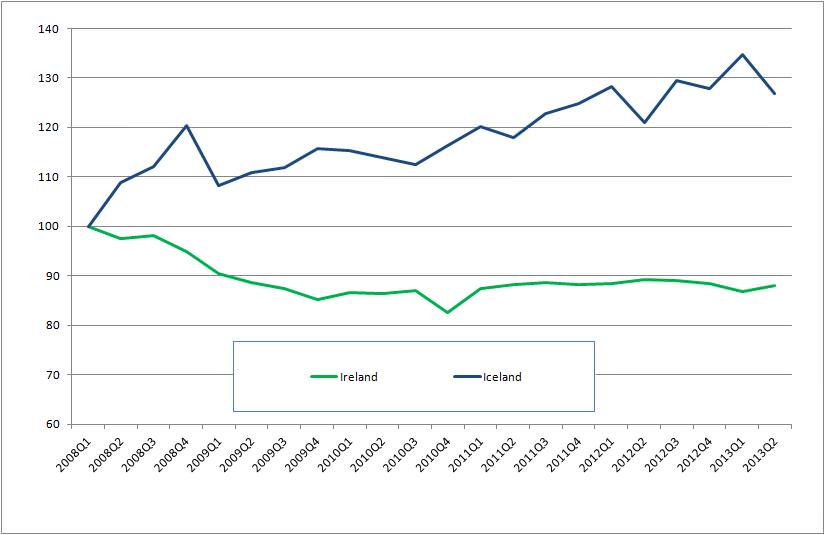
Figure 1: Nominal GDP (2008 = 100) Source: Federal Reserve Bank of St. Louis
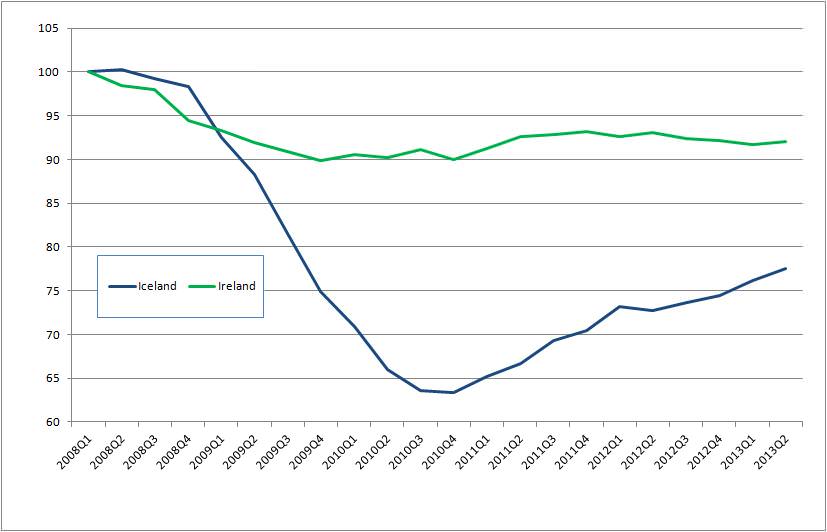
Figure 1 shows the common story. Iceland’s inflationary policy stimulated exports, papered over some bad debts, and in general allowed it to exit the storm relatively unscathed. In contrast, Ireland is languishing in slow growth and five years later the country’s income is still 10 percent below its pre-bust peak.

Such an analysis neglects the pernicious effects of inflation on the Icelandic economy. This policy increased the money supply by almost 20 percent in 2008 alone, and lead to an immediate increase in prices.

Figure 2: Real GDP (2008 = 100) Source: Federal Reserve Bank of St. Louis
In figure 2 we get a better feel for how the situation felt to the average Icelander or Irishman. As the Central Bank of Iceland inflated the money supply, price inflation raged. Icelanders continually felt their financial security worsen as their purchasing power collapsed. This was not apparent to the rest of the world, fixated as it was on the nominal prices the Icelandic economy posted. By its nadir in late 2010, inflation-adjusted income in Iceland was down over 35 percent.

In Ireland this decline was muted because of price deflation. As domestic prices fell it became easier for Irish citizens to make their declining nominal incomes go further. At its worst, the Irish economy collapsed less than 10 percent in real terms.

This seems to suggest that Ireland had the better solution by not pursuing an inflationary monetary policy. Some will note, however, that Iceland’s recovery since 2010 has been quite strong.

Indeed, if we look at the drop in the employment rate for both countries most probably feel more sympathy for the masses of unemployed Irishmen.

Figure 3: Employment rate (2008 = 1) Source: Federal Reserve Bank of St. Louis
Digging deeper, however, we find that not all is as it seems. Many Icelanders work two jobs to make ends meet. This effect was increasingly pronounced through the recession as inflation made it more difficult to get by with one salary. As a consequence, many Icelanders lost one job during the recession but the unemployment statistics did not reflect this as they were still employed elsewhere. This is notably not the case in Ireland, where not only is one job per worker the norm, but falling prices made it easier for an employed person to make ends meet as the recession continued.

A better way to gauge the employment situation is to look at changes in the hours worked.

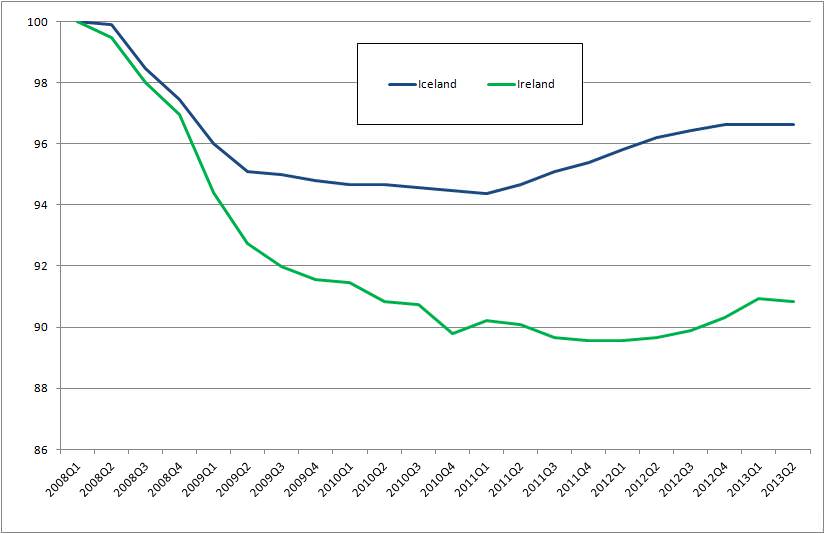
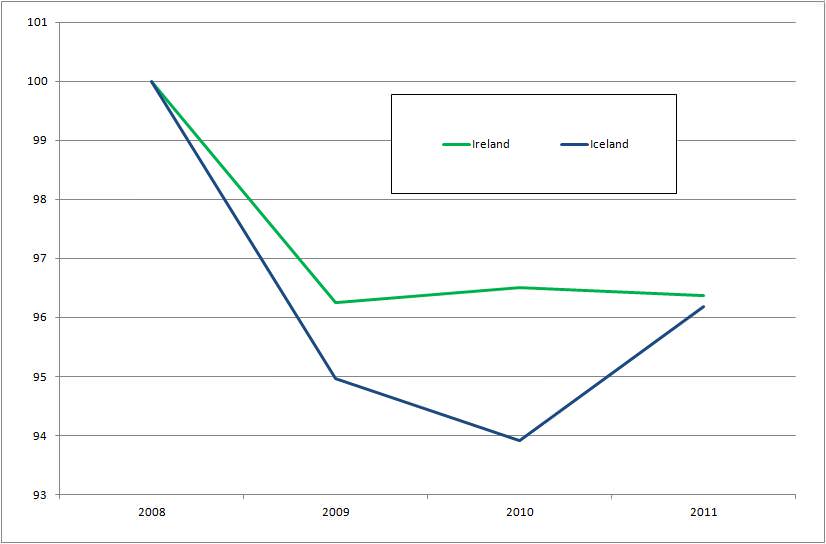
Figure 4: Annual hours worked (2008 = 100) Source: Federal Reserve Bank of St. Louis
Here we can see the situation is reversed. By the recession’s trough in 2010 the number of hours worked by the average Icelander had fallen 6 percent while in Ireland the corresponding drop was only 3.5 percent — almost half as much.

Both countries still have problems. Iceland’s monetary controls are notably stifling needed investment, while Ireland is left with a large debt from bailing out its banks, and this is stalling growth. One thing is clear though — the effects of monetary policy are stark and the proclaimed benefits of Iceland’s inflationary policy were counteracted by the price inflation that ensued.

Don’t let a good crisis go to waste; learn something from it. As the tale of these two countries demonstrates, inflating one’s currency may give the appearance of recovery, but the truth is somewhat less rosy.

David Howden is Chair of the Department of Business and Economics and professor of economics at St. Louis University’s Madrid Campus, Academic Vice President of the Ludwig von Mises Institute of Canada, and winner of the Mises Institute’s Douglas E. French Prize. Send him mail. See David Howden’s article archives.

This article was published on Mises.org and may be freely distributed, subject to a Creative Commons Attribution United States License, which requires that credit be given to the author.

Economies are Not Destroyed in a Day – Article by Nicolás Cachanosky

Economies are Not Destroyed in a Day – Article by Nicolás Cachanosky

The New Renaissance Hat
Nicolás Cachanosky
October 26, 2013
******************************

Earlier this month, Argentina’s leading conservative paper, La Nación published an unsigned editorial comparing the economies of Argentina and Venezuela. The editorial concluded that as economic freedom declines in Argentina, and as Argentina adopts more of what Chavez called “twenty-first century socialism,” it is becoming increasingly similar to Venezuela. Is this true? Will Argentina suffer the same fate as Venezuela where poverty is increasing and toilet paper can be a luxury?

The similarities of regulations and economic problems facing both countries are indeed striking in spite of obvious differences in the two countries. Yet, when people are confronted with the similarities, it is common to hear replies like “but Argentina is not Venezuela, we have more infrastructure and resources.”

Institutional changes, however, define the long-run destiny of a country, not its short-run prosperity.

Imagine that Cuba and North Korea became, overnight, the two most free-market, limited-government countries in the world. The two countries would have immediately gained civil liberties and economic freedom, but they would still have to accumulate wealth and to develop their economies. The institutional change affects the political situation immediately, but a new economy requires time to take shape. For example, as China opened parts of its economy to international markets, the country started to grow, and we are now seeing the effects of decades of relative economic liberalization. It is true that many areas in China continue to lack significant freedoms, but it would be a much different China today had it refused to change its institutions decades ago.

The same occurs if one of the wealthiest and developed countries in the world were to adopt Cuban or North Korean institutions overnight. The wealth and capital does not vanish in 24 hours. The country would shift from capital accumulation to capital consumption and it might take years or even decades to drain the coffers of previous accumulated wealth. In the meantime, the government has the resources to play the game of Bolivarian (i.e., Venezuelan) populist socialism and enjoy the wealth, highways, electrical infrastructure, and communication networks that were the result of the more free-market institutional realities of the past.

Eventually, though, highways start to deteriorate from the lack of maintenance (or trains crash in the station killing dozens of passengers), the energy sector starts to waver, energy imports become unavoidable, and the communication network becomes obsolete. In other words, economic populism is financed with resources accumulated by non-populist institutions.

According to the Fraser Institute’s Economic Freedom of the World project, Argentina ranked 34th-best in the year 2000. By 2011, however, Argentina fell to 137, next to countries like Ecuador, Mali, China, Nepal, Gabon, and Mozambique. There is no doubt that Argentina enjoys a higher rate of development and wealth than those other countries. But, can we still be sure that this will be the situation 20 or 30 years from now? The Argentinean president is known for having said that she would like Argentina to be a country like Germany, but the path to becoming like Switzerland or Germany involves adopting Swiss and German-type institutions, which Argentina is not doing.

The adoption of Venezuelan institutions in Argentina, came along with high growth rates. These growth rates, however, are misleading:

First, economic growth, properly speaking, is not an increase in “production,” but an increase in “production capacity.” The growth in observed GDP after a big crisis is economic recovery, not economic growth properly understood.

Second, you can increase your production capacity by investing in the wrong economic activities. Heavy price regulation, as takes place in Argentina (now accompanied by high rates of inflation), misdirects resource allocation by affecting relative prices. We might be able to see and even touch the new investment, but such capital is the result of a monetary illusion. The economic concept of capital does not depend on the tangibility or size of the investment (i.e, on its physical properties), but on its economic value. When the time comes for relative prices to adjust to reflect real consumer preferences, and the market value of capital goods drops, capital is consumed or destroyed in economic terms even if the physical qualities of capital goods remains unchanged.

Third, production can increase not because investment increases, but because people are consuming invested capital, as is the case when there is an increase in the rate that machinery and infrastructure wear out.

I’m not saying that there is no genuine growth in Argentina, but it remains a fact that a nontrivial share of the Argentinean GDP growth can be explained by: (1) recovery, (2) misdirection of investment, and (3) capital consumption. If that weren’t the case, employment creation wouldn’t have stagnated and the country’s infrastructure should be shining rather than falling into pieces.

Most economists and policy analysts seem to have a superficial reading of economic variables. If an economy is healthy, then economic variables look good, GDP grows, and inflation is low. But the fact that we observe good economic indicators does not imply that the economy is healthy. There’s a reason why a doctor asks for tests from a patient that appears well. Feeling well doesn’t mean there might not be a disease that shows no obvious symptoms at the moment. The economist who refuses to have a closer look and see why GDP grows is like a doctor who refuses to have a closer look at his patient. The Argentinian patient has caught the Bolivarian disease, but the most painful symptoms have yet to surface.

NOTE: This is a translated and expanded version of an original piece published in Economía Para Todos (Economics for Everyone).

Nicolás Cachanosky is Assistant Professor of Economics at Metropolitan State University of Denver. See Nicolás Cachanosky’s article archives.

You can subscribe to future articles by Nicolás Cachanosky via this RSS feed.

This article was published on Mises.org and may be freely distributed, subject to a Creative Commons Attribution United States License, which requires that credit be given to the author.

Debt-Ceiling Crises: Imagined and Real – Article by D. W. MacKenzie

Debt-Ceiling Crises: Imagined and Real – Article by D. W. MacKenzie

The New Renaissance Hat
D. W. MacKenzie
October 14, 2013
******************************

The federal government shutdown and impending debt ceiling “deadline” have led to near panic over possible default on the national debt. This imagined “default crisis” is a canard used for demagogic fearmongering. That said, the long-term federal financial issues are all too serious.

If federal officials simply continue on with their current financial plans, the U.S. government could run into trouble in early November. Without a debt ceiling increase, the Treasury would be unable to meet some of its financial obligations. Treasury bills would take a hit in international markets. With T-bills losing value in markets, interest rates—especially short-term interest rates—would start to rise. Rising interest rates would impair recovery from the 2008 financial crisis.

The assertion that a debt crisis would impair an already weak economic recovery is correct. However, any claim that the federal government is up against a hard deadline to meet its legal financial obligations is utterly untrue. The federal government holds vast amounts of property, all of which is available to be sold off. How much is needed to cover federal interest payments?

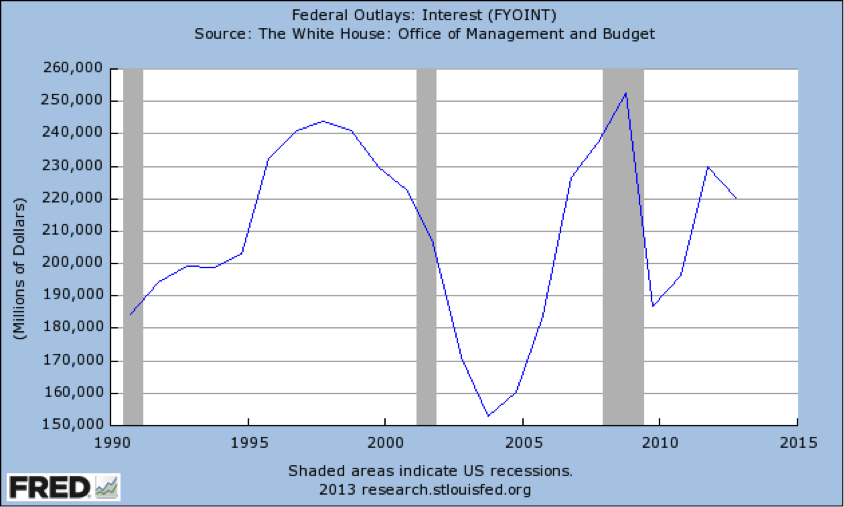
Interest rates are, for the moment, very low. Accordingly, interest payments on the debt are a small percentage of the total federal budget, despite the large size of the national debt.

With annual interest payments at a couple of hundred billion dollars, there is no impending debt-ceiling default crisis.

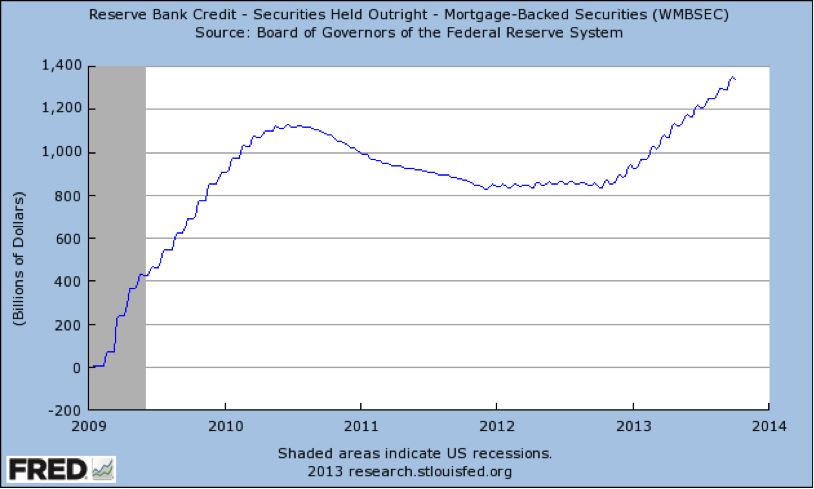
How exactly could the federal government pay interest on the national debt? To start with, the Federal Reserve now holds large numbers of mortgage-backed securities. There is some uncertainty over the market value of these securities, but their face value is immense, well over one trillion dollars. Sales of some of the better quality mortgage-backed securities could fund interest payments in the short term.

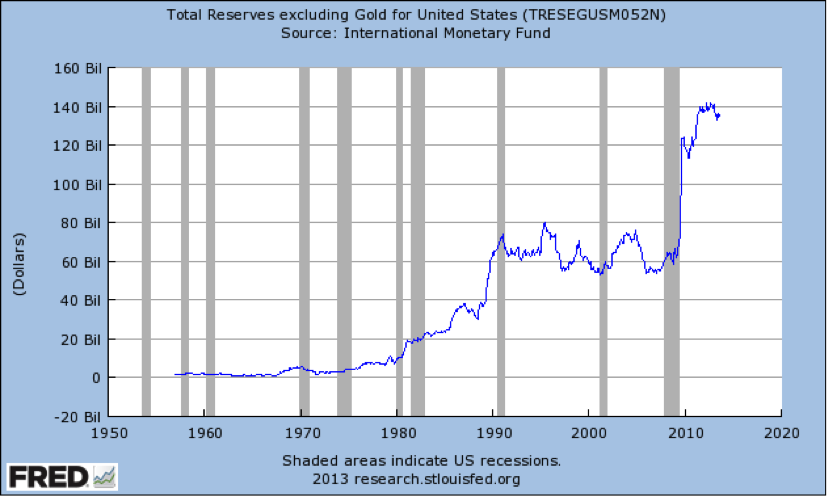
U.S. gold reserves are also substantial. The U.S. holds thousands of tons of gold at Fort Knox and at the New York Federal Reserve.

Sales of a small part of U.S. gold reserves could be used to make immediate interest payments.

The U.S. government also holds large amounts of idle real estate. The federal government spends $8 billion on vacant buildings annually. That’s for an estimated total of 55,000 to 77,000 buildings. The fact that our federal officials aren’t sure how many buildings they manage is itself disturbing, and a sign of incompetence. However, it seems that there are at least over 50,000 such buildings. How many hours would it take for federal employees who “manage” these buildings to post some of them on eBay? Surely sales of these properties would raise enough money to cover federal interest for about a month or two of the next year, even if each of these buildings sold for only a half a million dollars on average.

Efficient, competent public officials could simply announce auctions and begin to sell some of these buildings. Of course, red tape could delay property auctions. However, the Fed could make immediate interest payments by using its discretionary powers to sell mortgage-backed securities and gold reserves. President Obama could, in the meantime, expedite sales of vacant federal buildings—not to mention federal lands—by cutting red tape. (See map of federally managed land.)

The President has already acted in arbitrary—and some would say illegal—ways: by granting special exemptions from the Affordable Care Act to favored corporations, by using drones to kill U.S. citizens, and by targeting unfriendly political groups for audits. If Obama really wants save his beloved federal government from default, why shouldn’t he just use the extraordinary powers that he has already claimed to order the immediate sale of vacant buildings? The point here is not to encourage further illegality on the part of this President (he needs no assistance in such matters). The point here is that Obama does not have his back against a wall; there is no “gun to his head.” Obama has already claimed more than enough discretionary powers to prevent a debt-ceiling default in November. If default does happen it is entirely his choice, given that he has legal options and has already assumed various unconstitutional powers.

Obama has occasionally mentioned that some programs might be trimmed or cut. As Obama put it in 2010, “We cannot sustain a system that bleeds billions of taxpayer dollars on programs that have outlived their usefulness, or exist solely because of the power of a politician, lobbyist, or interest group.” He added, “We simply cannot afford it.”

The federal government holds over 700 million barrels of oil in the Strategic Petroleum Reserve. Obama could raise billions of dollars for interest payments without selling the whole reserve. Some people might see sales of the SPR as irresponsible. However, the oil in this reserve is a small fraction of monthly oil consumption, U.S. oil production is rising, and owners of foreign oil have overwhelming financial interests in continued oil sales to the United States.

The federal government also holds a Strategic Helium Reserve. It was created for “national security,” for blimps used by the military leading up to and during World War II. This program is archaic and the government already sells some helium. It could sell all of it and shut this program down.

Default on the debt is always possible. Obama and his people at the Treasury Department could have refused to pay interest on the national debt last month even though they had this money at hand. They could choose to default next month even though they can get the money—either through legal means or according to Obama’s demonstrated willingness to act illegally. The sale of federal assets and closing of federal programs would do more than just meet short-term interest payments on the national debt. Movement of securities, gold, buildings, oil, and helium would put these resources in the hands of people who would not merely put these resources to better use, but to actual use. The leeway that exists in federal finances points to longer-term financial and economic problems. Why would Obama engage in fearmongering on the national debt when obvious solutions to this problem exist? For that matter, why would federal officials hold so many idle resources for so long?

The reason why the federal government runs deficits nearly every year, despite collecting trillions in annual taxes, is because it wastes vast amounts of money on dysfunctional programs and special-interest payoffs. An efficient government would not need to tax and borrow nearly as much as does the federal government. The gross inefficiency of government has put federal finances in long-term jeopardy.

The real debt ceiling is determined by the ability of all working Americans to pay more taxes. How much more can we pay? Continued structural deficits and rising entitlement spending will result in default on the national debt, but not for a number of years. The existing path of long-term federal spending does surpass the capacity of taxpayers to fund the federal government, as it is currently designed. Future default on the national debt will have severe consequences. However, Obama’s willingness to engage in demagoguery on the immediate debt-ceiling issue is one of many signs that politicians are unwilling to take necessary steps to fix long-term fiscal finances.

The legal debt-ceiling crisis of 2013 is manufactured and phony. Even if Congress refuses to raise the legal debt ceiling this year, there are many ways of avoiding immediate default. The real problem we face is wasteful and irresponsible spending that will make default unavoidable eventually. Long-run default is, of course, avoidable. What we need are real cuts in federal spending, actual sales of federal assets and properties, and rationality in federal finances. Cutting spending and selling assets are easier said than done. Achieving smaller government will require a dramatic shift in public opinion. Americans need to realize that politicians who try to scare us are the ones that we really should fear.

D. W. MacKenzie is an assistant professor of economics at Carroll College in Helena, Montana. 

This article was originally published by The Foundation for Economic Education.