Browsed by
Tag: ethics

The Straw Rand Fallacy – Article by Bradley Doucet

The Straw Rand Fallacy – Article by Bradley Doucet

The New Renaissance Hat
Bradley Doucet
September 13, 2014
******************************

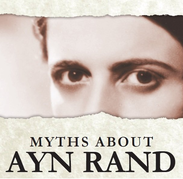
MythsRandMany critics of Ayn Rand have a maddening tendency to take her to task for ideas she did not defend and in fact explicitly rejected. They would rather score cheap debating points, it seems, than actually think about her challenging vision of the possibilities of human life. Disagree with her all you want, but as Laurie Rice puts it in the introduction to Myths about Ayn Rand: Popular Errors and the Insights They Conceal, “If you value your argument, you do it a disservice by misrepresenting its opponent.”

This slim volume of essays, published by the folks at The Atlas Society (for whom I have written) does a good job of dispelling some of the disinformation you may have come across regarding the author of The Fountainhead and Atlas Shrugged. And when the Kindle edition is available for a buck and can be read through in one sitting, critics have no excuse for getting it wrong.

David Kelly kicks things off by showing that Rand was not an elitist. Yes, the heroes of her novels are high achievers, which is what makes them so inspiring, but she explicitly rejected the notion that such people were morally superior to others and should rule over the rest of humanity. On her vision, Kelly writes, “It isn’t for the privileged, but for the productive. It isn’t against the poor, but against the irrational, the slothful, the envious, and the power-seeking—whatever their origin or social status.”

Will Thomas takes the baton for myths two to five, explaining why Rand was not a conservative, was not for dog-eat-dog selfishness, and was not simply pro-wealthy or pro-business, and arguing also that she was indeed a serious philosopher. On this last point, Thomas tells us that although she was not an academic scholar, her views have come to have some influence on academic philosophy, especially in the realms of ethics and political philosophy, but also increasingly in epistemology as well.

Yet her philosophy, in very non-elitist fashion, has admittedly had more influence on ordinary people, and indeed, Rand argued persuasively that philosophy is for everyone, that it is something we all need. As Thomas writes, her novels are not just popular because of their entertainment value—though they are entertaining, despite another widespread myth not explicitly addressed in this collection. “When people read Rand, they are inspired, and challenged, and made to rethink what they’ve been taught. That’s because Rand offers them timeless and compelling ideas about human life and the world we live in. It’s her philosophy that keeps readers coming back.”

In the postscript, Alexander Cohen takes up this theme in an open response to President Obama’s implication, during the 2012 election campaign, that Rand is for teenagers. Cohen writes, “If you’re the sort of teenager who wants an uplifting moral vision, a vision of joy and achievement rather than suffering and sacrifice […] then Ayn Rand is for you.” But if you didn’t happen to discover her as a teen, and if you’re the sort of adult who also wants to be uplifted and inspired, then Ayn Rand just might be for you, too.

Bradley Doucet is Le Québécois Libre‘s English Editor and the author of the blog Spark This: Musings on Reason, Liberty, and Joy. A writer living in Montreal, he has studied philosophy and economics, and is currently completing a novel on the pursuit of happiness. He also writes for The New Individualist, an Objectivist magazine published by The Atlas Society, and sings.
Ethical Arguments Against Abortion: The Cases of Rape and Life Endangerment (2004) – Article by G. Stolyarov II

Ethical Arguments Against Abortion: The Cases of Rape and Life Endangerment (2004) – Article by G. Stolyarov II

The New Renaissance Hat
G. Stolyarov II
July 29, 2014
******************************
Note from the Author: This essay was originally written in 2004 and published on Associated Content (subsequently, Yahoo! Voices) in 2007.  The essay received over 29,000 views on Associated Content / Yahoo! Voices, and I seek to preserve it as a valuable resource for readers, subsequent to the imminent closure of Yahoo! Voices. Therefore, this essay is being published directly on The Rational Argumentator for the first time.  
***
~ G. Stolyarov II, July 29, 2014

**

This essay presents responses from a pro-life perspective to those who would try to justify abortion in general by using the case of rape and the case where the mother’s life is endangered. It offers arguments as to why abortion in the event of rape is morally illegitimate, while abortion where the mother’s life is endangered is acceptable, but does not justify any other kinds of abortion.

On the rape issue: One of the fundamental tenets of any individual-rights-regarding system concerning the use of retaliatory force is that it is to be used only against those directly responsible for the original initiation of force. The guilty party here is the rapist, not the fetus, and the law might legitimately grant its consent to punish the rapist (as rape is a most abominable crime), yet not an innocent child, even if the latter’s dependence on the mother were a direct outcome of the rape.

Let me present a parallel. Pretend that two mutually unfriendly people are neighbors living in the same apartment building in Britain during Hitler’s bombing raids in 1940. A bomb explodes upon the building so as to cause all possible exits to cave in while destroying the wall that separates the neighbors. They are, in effect, forced to share the same living space and work alongside each other in an attempt to tunnel themselves out despite (in this scenario) a mutual dislike.

Does this, then, justify one of the killing the other because of the inconvenience thereby caused, despite the fact that neither one of them had caused it, or would it not instead be justice to demand, upon reaching freedom, that the Nazi air marshal who had commanded the raid to occur be tried as a war criminal? (I know this is an immensely unlikely scenario, but so is rape, and both are possible. And the circumstances here are comparable to those of a pregnancy by rape.)

On the life-endangerment issue: No individual is obliged to sacrifice his/her life to save the life of another. Thus, when it can be medically proved that the life of the mother is in fact substantially endangered by a pregnancy (what constitutes “substantial endangerment” is a matter for medical science to define via conclusions drawn from empirical observation), then an abortion may be undertaken as a last resort.

But the only situation in which it is possible to advocate legal abortion and remain loyal to the principle of individual rights, and it is not a typical situation. Rather, it is an emergency, occurrences of which sort are addressed by Ayn Rand in the essay, “The Ethics of Emergencies,” in The Virtue of Selfishness.

Rand writes that emergencies are exceptions to the rule, and are not the normal state of human existence, or of ethical human relations. To say that some extreme action may be permissible in an emergency is not to extend that permissibility to the realm of normal human existence as addressed by the fundamentals of ethics.

So, simply because an abortion might be justified as a last resort in some very unusual circumstances, this does not at all justify the general legalization of abortion, especially given the fact that the majority of abortions occur simply because a woman had undertaken indiscriminate sexual relations and does not wish to incur the objective consequences of such acts: namely, pregnancy and the obligation to bring up a child.

An Analysis of Ethical Issues in the Film “The Rain Man” (2004) – Article by G. Stolyarov II

An Analysis of Ethical Issues in the Film “The Rain Man” (2004) – Article by G. Stolyarov II

The New Renaissance Hat
G. Stolyarov II
July 26, 2014
******************************
Note from the Author: This essay was originally written in 2004 and published on Associated Content (subsequently, Yahoo! Voices) in 2007.  The essay earned over 17,200 page views on Associated Content/Yahoo! Voices, and I seek to preserve it as a valuable resource for readers, subsequent to the imminent closure of Yahoo! Voices. Therefore, this essay is being published directly on The Rational Argumentator for the first time.  
***
~ G. Stolyarov II, July 26, 2014

**

The central ethical dilemma of the 1988 film The Rain Man concerns the proper treatment to be afforded to Raymond, an autistic man who is capable of performing immense feats of mathematical calculation but is psychologically attached to predetermined habits and routines, thus being unable to adapt to changing situations around him. Should Raymond be given a chance to live in an open setting, where he can freely interact with the world around him, or should he be confined to an institution?

Raymond’s brother, Charlie, discovers Raymond’s existence only after the death of their father, who had willed the vast majority of his inheritance to Raymond. Charlie is at first immensely spiteful at his father’s decision and removes Raymond from the mental institution, attempting to blackmail the doctor in charge to transfer $1.5 million to Charlie. Charlie is easily frustrated by Raymond’s habits and oddities, as well as his need to always receive precisely the treatment to which he had become accustomed.

However, Charlie later discovers Raymond’s intelligent side during a trip to Las Vegas, where Raymond employs his astoundingly swift processing skills to win $86,000 while gambling. The two brothers subsequently forge an emotional bond, and Charlie is reluctant to return Raymond to the institution. He demonstrates the wish to take care of his brother and points out that Raymond has learned numerous new skills and information during the trip. However, the doctors in charge of Raymond show Charlie that Raymond’s autonomy is greatly impaired; they ask Raymond a series of mutually exclusive questions, to which Raymond merely answers, “Yes.”

Suzanne, Charlie’s girlfriend, thinks that Charlie’s initial treatment of Raymond is too harsh and intolerant. She would like to see Raymond afforded a more flexible and less dominating treatment by Charlie, and is upset that Charlie is using Raymond in order to blackmail the doctor into giving Charlie money. Eventually, however, she becomes pleased by Charlie’s increasing proximity to and genuine care for his brother.

Charlie’s initial “kidnapping” of Raymond was based on Charlie’s perception that Raymond was an easily manipulated disabled person who would comply with Charlie’s scheme to extort money from the doctor. Nevertheless, Raymond proves to have a personality of his own, which at first greatly irritates Charlie, but which Charlie eventually comes to love and refuses to relinquish. The doctor remains firm in his stance not to give the money of Charlie’s father in exchange for Raymond, and Charlie rejects a $250,000 offer in exchange for which he was to have severed all involvement with Raymond. After the doctors demonstrate Raymond’s incapacity to make significant decisions, Charlie reluctantly agrees to allow him to return to the mental institution.

Despite the fact that Charlie and Raymond must separate at the end, Charlie promises to visit frequently, and his influence on Raymond has not been in vain. Raymond and Charlie now share jokes, and Raymond’s range of comfort with respect to the products, services, and activities of daily life has been greatly amplified. Raymond, moreover, had assisted in rendering Charlie’s financial state more secure than it had been in the beginning of the film by winning $86,000 in Las Vegas. Charlie also learns to be more patient and tolerant in his relations with other human beings. He learns to discover the merits and values offered by others rather than merely lashing out at them in frustration.

The decision to return Raymond to the mental institution demonstrated first and foremost the principle of nonmaleficence. The doctors wished to ascertain that Raymond would not pose a danger to his own life by certain irrational and perhaps involuntary reactions, such as banging his head against a window as a result of hearing a smoke alarm. However, this action denied some of Charlie’s attempts at beneficence toward Raymond, as Charlie attempted to provide Raymond shelter, entertainment, and opportunity beyond what Raymond was used to or what was offered at the hospital. Though some of Charlie’s influence remained with Raymond, the doctors’ decision prevented additional improvements to Raymond’s state due to the concern that attempts at these would undermine Raymond’s already delicate condition. The principle of autonomy was also denied, as Raymond was deemed incapable of making his own choices; the doctors demonstrated that he would give contradictory answers to the questions asked of him, and thus argued that their paternalistic supervision over his decision-making would benefit him most.

An alternative decision with respect to Raymond’s fate would have been to allow Raymond to remain with Charlie, but under the supervision of various doctors and psychological counselors. In this way, the doctors could have continued to exercise precautionary measures against Raymond’s self-destructive activities, while Charlie could have continued to broaden Raymond’s comfort zone and eventually render him fit for rudimentary social interaction. This would both benefit Raymond and protect him from harm, fulfilling the principles of beneficence and nonmaleficence.

Moreover, Raymond would, with an expanded worldview, gain greater autonomy in making his own decisions. A freer environment (where constraints are flexible rather than rigid) would enable Raymond to have the greatest possible degree of personal autonomy that he is capable of carrying out. Moreover, the principle of justice requires that Raymond be given the same right to the pursuit of happiness as is afforded to non-autistic persons. This means that absolute paternalism over Raymond should be off-limits to his guardians, who need not regulate every detail of Raymond’s life in order to ensure his security. This decision would be more consistent with the ethics of principlism than the one actually carried out in the film.

An Analysis of Ethical Issues in the Film “Jurassic Park” (2004) – Article by G. Stolyarov II

An Analysis of Ethical Issues in the Film “Jurassic Park” (2004) – Article by G. Stolyarov II

The New Renaissance Hat
G. Stolyarov II
July 26, 2014
******************************
Note from the Author: This essay was originally written in 2004 and published on Associated Content (subsequently, Yahoo! Voices) in 2007.  The essay earned over 18,000 page views on Associated Content/Yahoo! Voices, and I seek to preserve it as a valuable resource for readers, subsequent to the imminent closure of Yahoo! Voices. Therefore, this essay is being published directly on The Rational Argumentator for the first time.  ***
***
~ G. Stolyarov II, July 26, 2014
***
The central ethical dilemma of the 1993 Steven Spielberg film, Jurassic Park, hinges on the question of whether man should employ his knowledge of genetics to revive a species that had become extinct as a result of natural processes. The scenario presented by the film is one of utter pandemonium and devastation after carnivorous dinosaurs, such as velociraptors and Tyrannosaurus rex defy security measures and trample on the human-built infrastructure of Jurassic Park. From this arises a more complex series of questions: to what extent should man manipulate genetic information? Which species can he legitimately revive, and which must he refrain from reanimating? At which point is it proper to state that one has taken sufficient precautions against potential threats and proceed with a given project?
***

John Hammond is the founder of Jurassic Park, an entrepreneur who wants to give his visitors an absolutely genuine experience in observing revived dinosaurs and omit no element of the Mesozoic era, even the carnivorous dinosaurs that view humans as prey. Hammond introduces a group of scientists to Jurassic Park and seeks to convince them to give their professional endorsement to the endeavor as a means of mollifying his investors. He repeatedly ignores warnings from Dr. Malcolm and others that the situation is likely to go awry and arranges the tour to take place when there is a high likelihood of a storm occurring. In the meantime, Dennis Nedry, who programs the security systems in Jurassic Park, seeks to steal valuable dinosaur embryos and sell them on the black market. In order to escape and cause havoc in Jurassic Park, he disables the security systems and lets the dinosaurs loose during the storm. By the time the security systems are reestablished, the dinosaurs have already penetrated the main compound.

Dr. Ian Malcolm is a chaos theorist who constantly warns that Hammond’s seeming control over the course Jurassic Park will follow is a mere illusion, that there are numerous factors that cannot be foreseen when two species separated by 65 million years of evolutionary history collide. His prediction is realized, as the all-female contingent of dinosaurs finds a way to reproduce by spontaneously changing sex, as their frog DNA permits. Drs. Grant and Sappler, specialists in the fauna and flora of the Mesozoic, display concern about Hammond’s introduction of certain species into the park which would not be able to adapt to an age in which they do not belong and behave as if they were still in the Mesozoic.

In order to protect visitors from the dinosaurs, Jurassic Park possesses a system of security fences and remote feeding, which allows goats and other medium-sized mammals to be airlifted into the dinosaur cages while keeping humans out of harm’s way. Unfortunately, this does not take into account the fact that carnivorous dinosaurs are instructed by their instincts to hunt their prey, not ingest passive critters that are delivered to them. When Nedry disables the security systems, the dinosaurs have their chance to lunge at the tour vans in search of more active, human prey. They have also begun to feed on one another, the velociraptors consuming small dinosaurs and being in turn hunted by T. rex. The velociraptors are the most agile, coordinated, and intelligent of the dinosaurs, and have even learned to open door handles, surprising even the initial skeptics of the Jurassic Park endeavor. During the course of the dinosaurs’ siege of the Jurassic Park compound, Hammond’s hopes to revive Jurassic Park with enhanced security measures are shattered, and the objective of the humans becomes, as Dr. Sappler suggested, to save the lives of those endangered by the catastrophe. Hammond is not thrilled with the destruction of his most ambitious dream, and regretfully eyes the fossilized mosquito at the tip of his cane, but he must eventually come to terms with the reality of his experiment’s failure.

Jurassic Park’s failure results in numerous fatalities, including that of the visiting lawyer, the chief programmer, and the man in charge of feeding and containing the dinosaurs. Other lives are placed on the line, including those of Dr. Grant, Dr. Malcolm, and Hammond’s own grandchildren. Even after security is established, no place on the island is safe, as the velociraptors penetrate into the main compound and a helicopter is summoned to evacuate the survivors. Aside from the human toll, the consequences of leaving an unmonitored dinosaur ecosystem in place are problematic, to say the least. The dinosaurs are able to breed and entrench themselves on the island. The films which follow Jurassic Park explore the situation on the island after humans return to it to face a far stronger and more aggressive dinosaur population. Moreover, The Lost World depicts a threat to the mainland human population as a T. rex is illegally imported into the United States. These problems were, obviously, not foreseen by Hammond and other creators of Jurassic Park.

The creation of Jurassic Park was an attempt at beneficence, intended to grant visitors of all economic standings an experience hitherto closed to them, a glimpse at an era 65 million years in the past. Moreover, Hammond sought to exercise his autonomy in employing scientific knowledge of genetics to engineer new species in order to earn profit and personal satisfaction. However, the principle of nonmaleficence was neglected in this process, since, though Hammond did take security precautions intended to avoid harm to visitors, he did not fully consider other potential threats and carried the project forward without analyzing possible implications of blending dinosaur DNA with that of frogs or subjecting the park’s security to the control of the unstable and unreliable Dennis Nedry.

An alternate course of action to the swift establishment of Jurassic Park would have been to proceed at a more cautious pace and be more discriminatory as to the features included in the park. Herbivorous dinosaurs alone would not have posed a dramatic threat to human lives, and would likely have been docile enough to be contained by the security measures that the park possessed. This is supported by the fact that Dr. Grant and Hammond’s grandchildren were able to pet a gigantic herbivore and only received a burst of mucus in the face.

Moreover, a more selective process for employment at Jurassic Park might have been able to weed out individuals like Nedry, who was principally responsible for security failures. Every field of human existence has its blackguards and deceivers. This does not justify curtailing endeavors in those fields, but it does warrant a more stringent approach toward keeping those individuals out of positions of power.

As for employing the DNA of frogs, it might have been possible to locate a species that does not spontaneously change sex and use its genes to fill the “gaps” in dinosaur DNA. Dr. Malcolm’s ideas of a complex interplay of factors determining the outcome of a given event should not deter individuals from undertaking endeavors as novel and ambitious as Jurassic Park, but the complexity, which I think is perfectly within the grasp of human cognition, does need to be taken into account. This would fit the ethics of principlism, as Jurassic Park already fulfills the standards of beneficence and autonomy, and nonmaleficence can be achieved by taking stricter precautions to control the dinosaurs and the security measures of the park. The principle of justice would necessitate that individuals like Hammond have the right, like all others living in a free country, to use their property and create a profit-making venture (this can be termed comparative justice in a paradigm where the right to free enterprise exists in a majority of cases).

Immanuel Kant’s Ideas on Knowledge, Science, Morality, and Rational Free Will (2002) – Essay by G. Stolyarov II

Immanuel Kant’s Ideas on Knowledge, Science, Morality, and Rational Free Will (2002) – Essay by G. Stolyarov II

The New Renaissance Hat
G. Stolyarov II
July 23, 2014
******************************
Note from the Author: This essay was originally written in 2002 and published in three parts on Associated Content (subsequently, Yahoo! Voices) in 2007.  The essay earned over 23,000 page views on Associated Content/Yahoo! Voices, and I seek to preserve it as a valuable resource for readers, subsequent to the imminent closure of Yahoo! Voices. Therefore, this essay is being published directly on The Rational Argumentator for the first time.  The essay should be read as a factual exposition, not an endorsement, of Kant’s views.***
***
~ G. Stolyarov II, July 23, 2014
***

Immanuel Kant’s Early Life and Ideas on Knowledge

***

Immanuel Kant was born in 1724 in the East Prussian city of Konigsberg (modern Kaliningrad, although the post-Communist leadership of the Russian Federation is considering an alteration of its name to “Kantgrad”), in the middle-class family of a manufacturer of saddles. He lived on a moderate income, sufficient for him to attend the university within the city and display the reputation of a formidable student.

Kant was a man of rather fragile health and a “late bloomer”, and thus spent the better portion of his youth slowly obtaining knowledge sufficient to gradually ascend the hierarchy within the university. His early years were spent constantly engaging in social activities and exposing himself to both the mundane and the ideological worlds. However, his contemporaries perceived that despite his insightful mind and abundance of ideas, Kant would never emerge as a leading philosopher due to the worldly distractions that he faced.

The young Kant became determined to prove his doubters wrong. He altered his routine, beginning in his late twenties and intensifying as he neared old age, into a rigid, nearly mechanical working discipline, forfeiting most interpersonal interactions other than those with his students (he was a private tutor earning a meager income prior to having earned his doctorate in 1755). He resolved never to marry nor acquire a family that would divert him from the task of becoming the prominent thinker who revolutionized Western thought.

Kant’s first work was composed in 1746, and titled Thoughts on the True Estimation of Living Forces. His ideology developed from that point into the formidable and thought-provoking philosophical doctrine that one would encounter in Critique of Pure Reason (First Edition published in 1781, the Second Edition in 1787).

Kant argues that there exists a difference between individual perception of the world and the absolute reality in which the human species dwells. He refers to the external world as “things-in-themselves,” of which every person possesses a varying and inaccurate understanding due to the unique manner in which an individual’s mind would process this information. This activity is known as synthesis, and involves the assimilation of data into the mind, after which it is blended with and connected to previous experiences to thus add to one’s perception.

Kant rejects the existence of a priori intuitive postulates within the human mind, claiming that so-called “intuition” is a product of having received information, then engaged in discourse on or analysis of the topic that the information concerns, and, at last, forged a conclusion, a point where synthesis forms the understanding that becomes a portion of our perception. Kant divides intuition into two categories, “sensible,” which is presented with material after which it undergoes synthesis and extracts an “insight” from it, and “intellectual,” which actually “creates” truth. Only God, according to Kant’s doctrine, would possess intellectual intuition.

Immanuel Kant’s Ideas on Science and Morality

***

According to  Immanuel Kant, no person may possess inherent wisdom about reality. This is best summarized in the philosopher’s famous expression, “Thoughts without content are empty; intuitions without data are blind.”

Indeed, Kant believes that in order for us to utilize our sensible intuition, we must possess two stimuli, “physical sensation” and “moral duty.” The first of the two addresses a portion of Kantian thought known as “empirical realism,” a reasoning that defines that absolute reality as the entire universe in which all human beings dwell. Every time we acquire external data from that absolute reality, our perception of it assumes a greater degree of accuracy. And what would be the optimal way of acquiring such data with only minimal if any contact with other persons’ perceptions (which are, like ours, inaccurate, only in different ways, since each human being possesses a unique arsenal of experiences)?

Scientific exploration is, therefore, the key to an ultimate comprehension of things-in-themselves. Kant was a fervent admirer of Newtonian thought and the Scientific Method, which permitted scientists to ascend to unprecedented heights in their understanding of and control over nature.

The second stimulus to action, moral duty, provides the explanation for the purpose of all human actions toward the comprehension of the universe. This portion of Kant’s doctrine has been dubbed by the philosopher as “transcendental idealism,” since it establishes a framework outside the natural world upon which correct actions are based. Kant sees the ultimate virtues to be the attempts to reach three goals which are not yet found in reality, God, freedom, and the immortality of individuals. God, the Creator and Supreme Being of the universe, must be fathomed, properly interpreted, and obeyed in accordance with his true desires. Freedom, the individual liberty to act as one wishes and to grant all others this right, must be instituted through societal reforms and a development of ideology to understand the proper order that would establish such an atmosphere. And, at last, every human being must rise to possess the right to exist for an indefinite length of time that he may obey the commandments of God and practice his freedoms. Kant states that all which is right and moral must be based upon those three principles.

As such, Kant separates the scientific realm (which describes what is) from the moral realm (which explains what ought to be), but he considers these two realms to go hand-in-hand — ultimately advocating putting the scientific realm in service to moral one.

Immanuel Kant’s View of Rational Free Will and Its Implications for Criminal Justice

***

In the view of Immanuel Kant (1724 – 1804), all individuals possess a “rational free will” and are capable of recognizing the three pillars of morality – God, freedom, and immortality – and acting accordingly with them. Kant recognizes that every intended deed is purposeful and selected by the person who commits it.

According to Kant, no set of circumstances, no matter how great their severity, can force a person to abandon the three moral virtues unless the individual himself selects to do so. And this selection, then, permits for punishment to be distributed to an individual based on the action undertaken. Thus, every deed committed with the intention of being so done implies a moral accountability within the human responsible.

This model of thought is of immense help to understanding what actions Kant saw as necessary for the creation of justice within the real world, since, once again, every individual’s worldview is based upon that individual’s own set of experiences. Thus, any judgment by one individual of another’s set of “data” will be subjective and skewed, which perverts any prospect for objective justice. That is, unless an objective framework such as one of “God, freedom, immortality” is used to evaluate a deed and not the person responsible, while properly rewarding or punishing the latter.

A Kantian justice system would thus solely focus on what was done, rather than on the character of the person who did it. No excuses regarding a criminal’s genome, upbringing, history of mental illness, or socioeconomic status can exonerate him from receiving punishment for the criminal act. The fact that a man was abused during his childhood does not justify his infliction of similar abuse on others later in life. The fact that a mother who drowned her five children was suffering from post-partum depression does not nullify her responsibility for the act and the need to punish her to the utmost extent possible.

Indeed, a court organized on Kantian lines might be able to exercise its functions using purely objective, factual considerations. Evaluating the evidence in a specific case, the court could conclusively determine what was done, and who did it, from which the punishment for the perpetrator would follow algorithmically, being already stipulated in the law. Whether the criminal is a “nice person” or has a history of past troubles would have no bearing on the outcome – thus eliminating the need for subjective opinions entering the analysis. Neither aloof nor passionate behavior on the part of the defendant in the courtroom would have the ability to sway the court’s decision one bit.

How to Fail a Class of Any Kind (2007) – Article by G. Stolyarov II

How to Fail a Class of Any Kind (2007) – Article by G. Stolyarov II

The New Renaissance Hat
G. Stolyarov II
July 20, 2014
******************************
Note from the Author: This satirical article was originally published on Associated Content (subsequently, Yahoo! Voices) in 2007.  I seek to preserve it as an entertaining but didactic resource for readers, subsequent to the imminent closure of Yahoo! Voices. Therefore, this article is being published directly on The Rational Argumentator for the first time.  
***
~ G. Stolyarov II, July 20, 2014
***

Results Guaranteed, or Your Money Back!

***
Numerous online articles exist to help people who seek to pass a class or even get an exceptionally good grade in it. But, in the course of my research, I have found few reliable, comprehensive guides to failing a course. So, in the interest of those who might be seeking to learn how, I provide some assistance here. Now, granted, I have never personally failed a course, but I have seen enough people accomplish such a feat that I consider myself qualified to write about it. So here it is: a guide to failing a class in any kind of subject and any type of educational institution.
***

The first thing to understand about failing a class is that it is extremely difficult to do. You must really work at it in order to accomplish this goal! After all, rarely do teachers in the public schools or universities give F grades anymore. Simple lack of knowledge of the content will no longer suffice to earn you a failing grade; it might get you a C or a D, if you are lucky. This traditional approach to failing a course is even less reliable these days because numerous instructors grade on a curve. If it so happens that most of your classmates are more ignorant on the subject than you are, then you might even end up with a B or A-, in which case your efforts to fail the course will probably be irreversibly frustrated.

But fear not! Failing a class can still be done, if you work hard enough at it. Here are some tips about how you, too, can lead the glorious life of an academic underdog.

1. Cheat, and cheat often! Most educational institutions these days have a zero tolerance policy for academic dishonesty. This is the route to go for quick, efficient results if you seek to fail a class. You might even be suspended from the school, which translates into some wonderful free time! The best ways to cheat are blatant and obvious ones. When there is a test, stand up out of your seat, walk to the student next to you, and wait until he puts down his pen and takes a moment’s pause from writing. Then grab his test, walk back to your desk, and copy every word of it, all in front of the teacher and the other students. In most cases, other students will not let you cheat off of them, since they will be conscious of the fact that the school’s academic dishonesty policy will also hold them liable in that case. But if you follow this advice, the other student will have no choice but to let you commit the infraction; he will have been coerced into it.

Extreme plagiarism is another possible route to cheating, especially for those who are shy about making a public scene. Whenever you are assigned a paper on any subject, Google that subject and copy the first search result, word for word. You will be virtually guaranteed that the teacher will be able to look up the same page you found within minutes and discover your plagiarism. Alternatively, you can simply choose to omit standard punctuation in your bibliography, or use MLA style when APA style is called for, or vice versa. These days in academic institutions, using the wrong format for your Works Cited page is almost as severely punished as plagiarism.

If you have ethical scruples about committing academic dishonesty, just give yourself a little inspirational talk in front of the mirror every morning. Repeat three times, “I, too, can be a cheater!” Remember that an early start into the field of immorality is virtually required to have a successful career as a professional gangster, pop idol, pyramid-scheme advertiser, or politician.

2. Never attend class. You cannot be aware of material discussed in class if you never go there; furthermore, you will have the advantage of not knowing what homework was assigned and what reading material you ought to study. This is a failure-proof method of failing the class, unless your school or college automatically withdraws you from it for lack of attendance. Resist the temptation of asking your friends about the proceedings in class or doing independent research into areas related to the subject matter. Remember that it is difficult to fail a class these days while retaining the slightest bit of moral reservation about your goal.

3. Go to raucous parties every night. At the parties, drink vast quantities of alcohol. When you come to class next day, you will be intoxicated out of your mind, which will safeguard you against any relapses of conscientious listening and class participation. Even if you really want to answer a question, you will be unable to. As an added bonus, you might be suspended from the educational institution for being under the influence of alcohol.

4. When taking multiple choice tests, pick a letter and stick to it! Always circle that letter as your answer of choice for every question. If there are four possible choices for each question, then your expected percentage of correct answers is 25% – well into the F range. If there are five possible choices, you can do even better with an expected grade of 20%. For more advanced multiple choice tests, where there might be more than one correct answer per question, you might even get away with grades in the single digits!

5. Sleep in class. If you cannot overcome your conscience and absolutely must attend class, at least try not to be awake for it. If you are, you might just learn something against your best attempts. Consider staying up the entire previous night in order to fall asleep with less difficulty when class is in session. Remember to choose the remotest corner of the class to sit in, possibly behind tall people who obstruct the teacher’s view of you. Otherwise, you run the risk of being awakened and, once again, learning something.

6. Always procrastinate. As a matter of fact, never turn in those assignments at all! Wait until the grade penalties for late work accumulate to the point where you get a zero grade on all your work; then, you will have failed the class without even needing to exert any effort! Once you fail your first course, you will be well on your way to a bright future. Remember that your personal merit, hard work, and knowledge do not matter at all in the real world; success is based purely on luck, or on exploiting those people who do work diligently and honestly. Just sit back, engage in your share of parasitism off the accomplishments of others, and wait for genuine success and happiness to come to you! It’s that simple, though most people are far too bound by conventional Western meritocratic prejudices to understand or implement it. If you become an outstanding failure, perhaps I will write your biography someday.

The Rejection of the Practical-Moral Dichotomy in Ayn Rand’s “The Fountainhead” (2004) – Article by G. Stolyarov II

The Rejection of the Practical-Moral Dichotomy in Ayn Rand’s “The Fountainhead” (2004) – Article by G. Stolyarov II

The New Renaissance Hat
G. Stolyarov II
July 19, 2014
******************************
Note from the Author: This essay was originally written in 2004 and published on Associated Content (subsequently, Yahoo! Voices) in 2007.  I seek to preserve it as a valuable resource for readers, subsequent to the imminent closure of Yahoo! Voices. Therefore, this essay is being published directly on The Rational Argumentator for the first time.  
***
~ G. Stolyarov II, July 19, 2014
***
Howard Roark was never a man to conform to “mainstream” attitudes. At the Stanton Institute of Technology, Roark refuses to design Tudor chapels and French opera houses, instead exercising his individual reasoning in the creation of aesthetic features that fortify the individual integrity of his buildings. Upon entering the professional field, Roark signs building contracts on one crucial condition; that he be permitted to erect his structures exactly as he had devised them. At first, it seems that Roark is treading a path destined to ruin his career and prospects for success, for his acts counter the conventional “wisdom” that man can either be practical or moral, “flexible” or principled, fulfilled in body or in spirit, but not both. He is expelled from Stanton, and attracts few clients to his office. However, in Ayn Rand’s novel, The Fountainhead, Roark’s ultimate triumph demonstrates a staunch rejection of the practical-moral dichotomy and the possibilities that liberation therefrom can bring the individual creator.
***

Roark’s success is rooted in a proper identification of practicality and morality. Roark refuses to superfluously ornament his buildings at the expense of structural efficacy. He recognizes unique qualities to every building material and refuses to make “copies in steel and concrete of copies in plaster of copies in marble of copies in wood,” not wishing to blindly follow the obsolete techniques of the past like sacred doctrine (24). When Roark develops the Heller House, he endows the building with elements that blend together its function and appearance, including no false pillars or deceptive facades. Roark thinks that “a house can have integrity, just like a person, and just as seldom” and Heller agrees that every slightest routine performed in such a consistent dwelling is filled with “dignity and honesty.” (136) Roark’s notion of practicality is one of strict purpose and reason. He crafts his buildings giving objective consideration to all the facts and tools at his disposal. His Monadnock Valley Resort, for example, seems a natural extension of its landscape. Roark employs his brilliant skills in mathematics and structural engineering to bring forth sensible structures that captivate their residents. Though the Monadnock Valley Resort had been intended to fail by the firm that contracted Roark, from its very opening, it is filled for a year in advance. Despite initial difficulties, Roark’s perseverance enables him to find clients who appreciate his love of coherence and principle. Jimmy Gowan and John Fargo request that Roark create a gas station and store, buildings which would attract consumers as a result of their originality and convenience. Roger Enright, a self-made businessman, offers Roark to construct his home, and is immensely pleased with the results. Eventually, even the great newspaper magnate, Gail Wynand, selects Roark to build those structures that represent Wynand’s actual values and individual character, his home, which is meant as a tribute to Wynand’s wife Dominique, and the Wynand Building, “a monument to [his] life” (593).

Roark’s architectural career is ultimately a grand triumph due the fortitude of Roark’s moral principles and approach toward work. Roark is a staunch egoist and individualist. He summarizes his philosophy: “I’m never concerned with my clients, only with their architectural requirements.” (578) He builds not for the sake of appeasing the public, or gathering prestige, or riding the accomplishments of others as does the second-hander, but rather due to his ardent devotion to the creation itself. He recognizes that “to get things done, you must love the doing, not the secondary consequences. The work, not the people. Your own action, not any possible object of your charity.” (578) In his moral quest, Roark pursues the fulfillment of his ego’s designs; everything else is a means to this end. Thus, Roark refuses to modify his designs for the sake of pandering to others’ petty whims and blind tradition-worship. When the government initiates a low-rent housing project for the poor, Roark sees no inherent nobility in sacrificing public funds for such an endeavor. However, he is interested in the problem of cost-efficient homes and yearns to see his solution materialized. He therefore strikes an agreement with his ex-competitor, the second-hander architect Peter Keating, in which he allows Keating to turn in Roark’s work as Keating’s own, if Roark is promised that Cortlandt Homes will be designed exactly as planned. Despite Keating’s best efforts, however, the arch-collectivist Ellsworth Toohey, who informally controls the project, transforms it into a “cooperative job,” allowing two more architects to meddle with Roark’s design and rob it of much of its efficacy by adding costly, useless ornamentation. This is a colossal moral infraction that Roark cannot sanction. He responds to the desecration of his work by detonating the entire building complex.

Justifying his action at his trial, Roark states that “the form was mutilated by two second-handers who assumed the right to improve upon that which they had not made and could not equal.” (683) He is outraged at those who would sacrifice a creator’s autonomy for any “greater purpose,” who would turn a mutually profitable exchange into the enslavement of one for the sake of others. His entire prior career, his selective approach toward clients preserved his freedom to build intact, but when the pseudo-morality of altruism attempts to turn him into a vehicle for the whims of collectives, Roark responds with a forthright affirmation of his right to exist for his own sake and no one else’s. He is exonerated and, because of his unequivocal, firm approach to both practicality and morality, able to win in both matter and spirit. Enright purchases the Cortlandt site for Roark so that Roark’s design can indeed come into existence. The book ends with Roark atop the Wynand Building, at the highest point in New York, symbolic of his triumph over all obstacles and his attainment of the most exalted success and happiness possible, standing upon the work of his own mind.

For Roark, practicality is reason and morality is egoism; the two are compatible and mutually reinforcing. This unity does not exist in the minds of most of the other characters in the book. Peter Keating believes that practicality is conformity. He surrenders his personal aspiration to become an artist to his mother’s urgings that he enter architecture. His entire career rides on borrowing others’ borrowed elements for his buildings or borrowing Roark’s originality. Keating’s greatest “accomplishment”, the Cosmo-Slotnick Building, is built in the Renaissance style (to please Ralston Holcombe, one of the judges, who appreciates only Renaissance buildings) and employs Roark’s structural features. Keating is autonomous neither in his engineering nor in his aesthetics. While with Roark, these disciplines are an inseparable alloy drawn from his mind, with Keating, they are a haphazard mix of something from everything and nothing in particular. At the twilight of his architectural career, the defeated Keating confesses that he has never built anything original in his entire life. Whereas for Roark, morality is forthright pride, for Keating, it is guilty appeasement. Whereas Roark knows his own worth, Keating must constantly find it in the reassurance of others, especially his confidant, Ellsworth Toohey. He is glad to hear that he as an individual is unimportant and that his true purpose is servitude to others and a sacrifice of everything, including his own happiness. For Keating has, through his endless pandering and borrowing, surrendered his ego for absolutely nothing, to be brushed aside by the collectives to whom he paid tribute as soon as “modern architecture” replaces his classical eclecticism. When Toohey finally bares the monstrous essence of altruism before Keating and reveals his true intent to rule the world and crush the human spirit, Keating is horrified, but can do nothing to oppose Toohey or resist his manipulations. While Keating, the “practical” man in the conventional sense of the term, has given up his convictions for fleeting prestige, he left the field of the moral to the sadists of the soul.

In the beginning of the novel, Dominique Francon does not believe that the moral and the practical can be reconciled. She tells of a time when she destroyed a beautiful statue because she thought it incompatible with the essential nature of existence-pain, distortion, and suffering. She appreciates genuine talent in Roark’s buildings, but deems them “too perfect” to exist in a world where every tainted member of the multitudes would desecrate them with his presence. Therefore, she prefers to side with Roark’s persecutors, as she views ultimate power to be in the hands of the immoral. She attempts to sacrifice herself to Peter Keating, the man she would love least, by intentionally marrying him and performing physical favors for others in order to get him commissions. Then she surrenders herself to Gail Wynand, a man who is a moral egoist in his private life but a vehicle for mob sentiments in his public. Though she does not love Wynand, she finds in him an appreciation for her as a woman who recognizes true beauty and morality, even if she views it to be doomed to defeat. Dominique’s outlook changes as she witnesses Roark’s perseverance in the face of societal pressures. Though Wynand loves to break men of integrity for sport, Roark eventually wins Wynand’s devotion, his quest for the right to use his mind, and Dominique’s hand in marriage.

Just as Dominique recognizes that both the moral and practical can triumph in a man of firm convictions, so does The Fountainhead demonstrate the insight that Rand would later express as a groundbreaking discovery in Objectivist ethics: “The practical is the moral.”

An Analysis of Ethical Issues in the Film “Gattaca” (2004) – Article by G. Stolyarov II

An Analysis of Ethical Issues in the Film “Gattaca” (2004) – Article by G. Stolyarov II

The New Renaissance Hat
G. Stolyarov II
July 4, 2014
******************************
Note from the Author: This essay was originally written in 2004 and published on Associated Content (subsequently, Yahoo! Voices) in 2007. It earned over 40,000 page views since, and I seek to preserve it as a valuable resource for readers, subsequent to the imminent closure of Yahoo! Voices. Therefore, this essay is being published directly on The Rational Argumentator for the first time. 
***
~ G. Stolyarov II, July 4, 2014
***

The central ethical dilemma of the 1997 Andrew Niccol film Gattaca concerns the manner in which an individual ought to be judged. Should it be by the composition of his genome, present at birth, or by the attributes of personality and ambition that are chosen by that individual? In the futuristic society depicted in the film, genetic engineering allows for the elimination of almost all physical defects in newborns, whose bodily characteristics later render them far more favorable candidates for employment than those whose genes had not been enhanced in this manner. Eventually, interviews are conducted not to assess an applicant’s character and determination, but his genetic code. The even more fundamental question that arises from this is, “What determines the essential identity of a human being? Is it his genetic code, or is it something else?”

Vincent is a child born in the obsolete manner, and thus his genome is riddled with “errors,” from which high “probabilities” of him obtaining certain ailments later in life are inferred. Nevertheless, these are probabilities only, and Vincent is healthy, athletic, and yearns to one day explore outer space. Unfortunately, he is denied admission to Gattaca, the facility of the space program, on the basis of his genome alone. Despite his splendid knowledge of astronomy and navigation, the best test scores in the world will not admit him.

Yet Vincent is not content with the position of janitor, and “borrows” the identity of Jerome Morrow, a paralyzed individual with a superb genome. A series of complex procedures is designed to allow Vincent to pass all the substance tests and gain admission to Gattaca under the name of Jerome Morrow. Jerome may have the genetic endowment to enter Gattaca, but he lacks the will, and thus harbors no objection to Vincent taking his place. Another employee at Gattaca, Irene, had also been born in the obsolete manner, but her genome is adequate enough for her to be permitted to work on minor tasks. She suspects that Vincent may be connected with the recent murder of the mission director, who was about to uncover Vincent’s actual identity. In the process, however, she enters a relationship with Vincent, and faces the dilemma of whether or not to disclose his identity to the police.

Vincent’s brother, Anton, is the inspector heading the murder investigation. Throughout his childhood, he sought to demonstrate his superiority to Vincent by virtue of his enhanced genetic endowment. Nevertheless, Vincent had once saved Anton’s life in a game of “chicken,” where Anton’s body had failed him, while Vincent’s was able to endure. Anton wishes to maintain the image of his superiority and is immensely jealous of Vincent’s successful aspiring to the heights of outer space.

Vincent attempts to deceive the security systems at Gattaca by pretending to be Jerome Morrow and presenting samples of bodily substances prepared by Jerome for various examinations. In the meantime, he studies and works diligently, and his level of performance at Gattaca is precisely what is anticipated of a man with a privileged genetic endowment. Thus, only a few people ever come to suspect that Vincent is a “borrowed ladder,” a fabricator of his genetic identity. Vincent is set to depart on a mission into space, after which his individual merits will overrule his genome conclusively, and he will no longer be subject to genetic security tests. However, the murder of the mission director subjects Gattaca to a series of extremely intrusive investigations by police that threaten to uncover Vincent’s true identity and even arrest him for murder, even though Vincent is innocent of the crime.

Vincent’s tenacity and resolve to enter space ultimately allow him to successfully endure turbulent times. Despite a multitude of close calls, he is saved from universal detection, though he is recognized by Irene, whose personal admiration for Vincent overrides the fact that Vincent had broken the law. Anton also recognizes his brother and threatens to arrest him, still acting on his childhood jealousy. However, a final game of “chicken,” in which Vincent saves Anton once again, proves that Vincent’s defiance of the inferior expectations imposed upon him by his society has enabled him to exceed in his abilities individuals like Anton, whom societal expectations had favored. The doctor at Gattaca recognized Vincent’s individual merits and decided to fabricate a “valid” test for him on the day of the launch. To people like the doctor, Vincent has proved his worth and his genetic composition has become irrelevant.

Vincent’s course of action, though in violation of the law, was not in violation of moral principles. Vincent had harmed no one by his attempt to pursue his ambitions at Gattaca and in outer space; thus, his action exhibited the principle of nonmaleficence. His exploratory endeavors are of immense benefit to both himself and the level of knowledge available to the general society; thus, his action fulfills the principle of beneficence. His action was an exercise of his individual autonomy and right to self-determination in the face of a hierarchical culture that repressed these rights. Finally, his action attempted to allow Vincent to experience the just treatment that he deserved on the basis of his merits, and which, absent the action, would have been denied to him on the basis of his genome. Thus, the action fulfills the principle of justice.

A rational society would have resolved the ethical dilemma of the proper criterion of judging an individual by eschewing determinism altogether. Vincent should not have initially been seen solely as the product of his genes, for a man is born tabula rasa where the mind is concerned. The human genome determines only the structural mechanisms that exist in the individual organism. How the individual employs those mechanisms is a matter of pure willpower and determination. Few genes can conclusively determine an individual’s fate; a high probability of heart disease can be reduced by strenuous exercise, of the sort Vincent engaged in. A low “intelligence quotient” is no obstacle to an individual reading, comprehending, and applying immense volumes of material, so long as the interest to do so is clearly seen.

Vincent should have been admitted to Gattaca on the basis of a one-on-one interview process that tested his knowledge, physical skill, and enthusiasm for space exploration, for, without these, the finest genetic endowment can still produce a Jerome Morrow, a man who is paralyzed not only in body (by an accident) but in mind (by lack of ambition). The theory that fits this solution is principlism. Vincent is not harming anyone by pursuing his own favorite field of exploration; thus, the action is nonmaleficent. He is amply benefiting himself and others through his skilled endeavors in the realm of space exploration; thus, the action is beneficent. He is allowed to exercise his individual autonomy and pursue his goals, regardless of societal prejudices. And, finally, he is entitled to the same freedom of action and opportunity that other members of his society (the genetically engineered individuals) possess, which passes the test for comparative justice.

Fearless, Provocative, and Inescapably Thought-Provoking: Review of Kyrel Zantonavitch’s “Pure Liberal Fire” – Article by G. Stolyarov II

Fearless, Provocative, and Inescapably Thought-Provoking: Review of Kyrel Zantonavitch’s “Pure Liberal Fire” – Article by G. Stolyarov II

The New Renaissance Hat
G. Stolyarov II
May 16, 2014
******************************
Pure Liberal Fire by Kyrel Zantonavitch is available on Amazon in paperback and Kindle formats.
***
There is perhaps not a single thinker in the world more fearless than Kyrel Zantonavitch. Pure Liberal Fire is the direct, provocative distillation of his thoughts on metaphysics, epistemology, ethics, politics, economics, culture, religion, and the history of philosophy – including Objectivism and Classical Liberalism. Zantonavitch seeks to evoke a pure, true liberalism, and he shows no mercy for ideologies and attitudes that constitute its antithesis. He certainly leaves no doubt in the reader’s mind about where he stands on the issues addressed – and each article within the book employs an abundance of superlative expressions – be they positive or negative. When Zantonavitch praises, he really praises – and the same goes for when he condemns.
***

I give this book a rating of five stars because it invariably makes people think – no matter who they are or what their starting persuasions and assumptions might be. There are many areas in which I strongly agree with Zantonavitch – and quite a few where I strongly disagree as well. He articulates many valid points about the fundamentals of philosophy, the importance of liberty in political theory, atheism, the damage perpetrated by various political movements and policies, and the unfortunate tendencies among historical and current Objectivists toward dogmatism and conformism instead of independent thought and the honest pursuit of truth. Some of our areas of disagreement include war, areas of foreign policy, and, perhaps more generally, the desired mechanisms for achieving societal change.

Zantonavitch’s approach and style would entail achieving a fiery, dramatic, immediate deposition of everything (every person, every policy, every idea) he considers evil, dangerous, or damaging. My view of reform is more surgical, focused on getting the sequence of steps right so as to minimize the damage inflicted during the transition while ridding the world of the disease of bad policies (and, in a more long-term fashion, through persuasion and free-market education, also ridding it of bad thinking of the sort that motivates bad policies).

Zantonavitch combines his no-holds-barred treatment of his subject matters with a unique dialectical technique. There are several places in a book where he characterizes a particular set of ideas (or people) in a strongly negative way – but then later (or earlier) also portrays them as either highly praiseworthy, or at the very least understandable and characterized by redeeming attributes. Two examples that come to mind are (1) his discussions of Objectivism as a brainwashing cult in some places and as the most advanced, best-developed philosophy to date in others, and (2) his characterizations in some places of religious believers as not particularly bad as long as they do not take their belief too seriously – and in other places of anyone who believes in a god or teaches his/her children such beliefs as being guilty of evil and/or abuse. The reader can glimpse in this a deliberate juxtaposition of these opposing characterizations in a dialectical fashion – in an attempt to examine both the positive and the negative aspects of the ideas and behaviors Zantonavitch is writing about. (With regard to Objectivism, there is definitely merit in pointing out both the great strengths and the failures, as I have myself done, for instance.) This also creates a second layer of meaning in Zantonavitch’s work, as his uses of positive and negative superlatives with regard to the same subject are seldom immediately close to one another. While the rest of his writing endeavors to be extremely direct (indeed, provocative) with regard to its meaning, he seems to expect his readers to make their own connections in this respect without him deliberately pointing them out. As a result, with regard to Objectivism especially, Zantonavitch’s readers have the opportunity to acquire a more balanced, nuanced view after having been exposed to both his glorious praise and his scathing condemnation of the philosophy.

Individualism, Objective Reality, and Open-Ended Knowledge – Video by G. Stolyarov II

Individualism, Objective Reality, and Open-Ended Knowledge – Video by G. Stolyarov II

Mr. Stolyarov explains how an objective reality governed by physical laws is compatible with individual self-determination and indeed is required for individuals to meaningfully expand their lives and develop their unique identities.

Reference

– “Individualism, Objective Reality, and Open-Ended Knowledge” – Post by G. Stolyarov II