Browsed by
Tag: Fed

If the Fed Has Nothing to Hide, It Has Nothing to Fear – Article by Ron Paul

If the Fed Has Nothing to Hide, It Has Nothing to Fear – Article by Ron Paul

The New Renaissance Hat
Ron Paul
January 19, 2015
******************************
Since the creation of the Federal Reserve in 1913, the dollar has lost over 97 percent of its purchasing power, the US economy has been subjected to a series of painful Federal Reserve-created recessions and depressions, and the federal government has grown to dangerous levels thanks to the Fed’s policy of monetizing the debt. Yet the Federal Reserve still operates under a congressionally-created shroud of secrecy.No wonder almost 75 percent of the American public supports legislation to audit the Federal Reserve.

The new Senate leadership has pledged to finally hold a vote on the audit bill this year, but, despite overwhelming public support, passage of this legislation is by no means assured.

The reason it may be difficult to pass this bill is that the 25 percent of Americans who oppose it represent some of the most powerful interests in American politics. These interests are working behind the scenes to kill the bill or replace it with a meaningless “compromise.” This “compromise” may provide limited transparency, but it would still keep the American people from learning the full truth about the Fed’s conduct of monetary policy.

Some opponents of the bill say an audit would somehow compromise the Fed’s independence. Those who make this claim cannot point to anything in the text of the bill giving Congress any new authority over the Fed’s conduct of monetary policy. More importantly, the idea that the Federal Reserve is somehow independent of political considerations is laughable. Economists often refer to the political business cycle, where the Fed adjusts its policies to help or hurt incumbent politicians. Former Federal Reserve Chairman Arthur Burns exposed the truth behind the propaganda regarding Federal Reserve independence when he said, if the chairman didn’t do what the president wanted, the Federal Reserve “would lose its independence.”

Perhaps the real reason the Fed opposes an audit can be found by looking at what has been revealed about the Fed’s operations in recent years. In 2010, as part of the Dodd-Frank bill, Congress authorized a one-time audit of the Federal Reserve’s activities during the financial crisis of 2008. The audit revealed that between 2007 and 2008 the Federal Reserve loaned over $16 trillion — more than four times the annual budget of the United States — to foreign central banks and politically influential private companies.

In 2013 former Federal Reserve official Andrew Huszar publicly apologized to the American people for his role in “the greatest backdoor Wall Street bailout of all time” — the Federal Reserve’s quantitative easing program. Can anyone doubt an audit would further confirm how the Fed acts to benefit economic elites?

Despite the improvements shown in the (federally manipulated) economic statistics, the average American has not benefited from the Fed’s quantitative easing program. The abysmal failure of quantitative easing in the US may be one reason Switzerland stopped pegging the value of the Swiss Franc to the Euro following reports that the European Central Bank is about to launch its own quantitative easing program.

Quantitative easing is just the latest chapter in the Federal Reserve’s hundred-year history of failure. Despite this poor track record, Fed apologists still claim the American people benefit from the Federal Reserve System. But, if that were the case, why wouldn’t they welcome the opportunity to let the American people know more about monetary policy? Why is the Fed acting like it has something to hide if it has nothing to fear from an audit?

The American people have suffered long enough under a monetary policy controlled by an unaccountable, secretive central bank. It is time to finally audit — and then end — the Fed.

Ron Paul, MD, is a former three-time Republican candidate for U. S. President and Congressman from Texas.

This article is reprinted with permission from the Ron Paul Institute for Peace and Prosperity.

Janet Yellen’s Christmas Gift to Wall Street – Article by Ron Paul

Janet Yellen’s Christmas Gift to Wall Street – Article by Ron Paul

The New Renaissance Hat
Ron Paul
December 21, 2014
******************************
Last week we learned that the key to a strong economy is not increased production, lower unemployment, or a sound monetary unit. Rather, economic prosperity depends on the type of language used by the central bank in its monetary policy statements. All it took was one word in the Federal Reserve Bank’s press release — that the Fed would be “patient” in raising interest rates to normal levels — and stock markets went wild. The S&P 500 and the Dow Jones Industrial Average had their best gains in years, with the Dow gaining nearly 800 points from Wednesday to Friday and the S&P gaining almost 100 points to close within a few points of its all-time high.

Just think of how many trillions of dollars of financial activity that occurred solely because of that one new phrase in the Fed’s statement. That so much in our economy hangs on one word uttered by one institution demonstrates not only that far too much power is given to the Federal Reserve, but also how unbalanced the American economy really is.

While the real economy continues to sputter, financial markets reach record highs, thanks in no small part to the Fed’s easy money policies. After six years of zero interest rates, Wall Street has become addicted to easy money. Even the slightest mention of tightening monetary policy, and Wall Street reacts like a heroin addict forced to sober up cold turkey.

While much of the media paid attention to how long interest rates would remain at zero, what they largely ignored is that the Fed is, “maintaining its existing policy of reinvesting principal payments from its holdings of agency debt and agency mortgage-backed securities in agency mortgage-backed securities.” Look at the Fed’s balance sheet and you’ll see that it has purchased $25 billion in mortgage-backed securities since the end of QE3. Annualized, that is $200 billion a year. That may not be as large as QE2 or QE3, but quantitative easing, or as the Fed likes to say “accommodative monetary policy” is far from over.

What gets lost in all the reporting about stock market numbers, unemployment rate figures, and other economic data is the understanding that real wealth results from production of real goods, not from the creation of money out of thin air. The Fed can rig the numbers for a while by turning the monetary spigot on full blast, but the reality is that this is only papering over severe economic problems. Six years after the crisis of 2008, the economy still has not fully recovered, and in many respects is not much better than it was at the turn of the century.

Since 2001, the United States has grown by 38 million people and the working-age population has grown by 23 million people. Yet the economy has only added eight million jobs. Millions of Americans are still unemployed or underemployed, living from paycheck to paycheck, and having to rely on food stamps and other government aid. The Fed’s easy money has produced great profits for Wall Street but it has not helped — and cannot help — Main Street.

An economy that holds its breath every six weeks, looking to parse every single word coming out of Fed Chairman Janet Yellen’s mouth for indications of whether to buy or sell, is an economy that is fundamentally unsound. The Fed needs to stop creating trillions of dollars out of thin air, let Wall Street take its medicine, and allow the corrections that should have taken place in 2001 and 2008 to liquidate the bad debts and malinvestments that permeate the economy. Only then will we see a real economic recovery.

Ron Paul, MD, is a former three-time Republican candidate for U. S. President and Congressman from Texas.

This article is reprinted with permission from the Ron Paul Institute for Peace and Prosperity.

The Fed and the “Salvador Dali Effect” – Article by Dante Bayona

The Fed and the “Salvador Dali Effect” – Article by Dante Bayona

The New Renaissance Hat
Dante Bayona
November 28, 2014
******************************

There is a story about the great Catalan surrealist painter Salvador Dali. It is said that in the last years of his life, when he was already famous, he signed checks knowing that they would not be submitted to the bank for payment. Rather, after partying with his friends and consuming the most expensive items the restaurants had to offer, he would ask for the bill, pull out one of his checks, write the amount, and sign it. Before handing over the check, he quickly turned it around, made a drawing on the back and autographed it. Dali knew the owner of the restaurant would not cash the check but keep it,put it in a frame, and display it in the most prominent place in the restaurant: “An original Dali.”

It was a good deal for Dali: his checks never came back to the bank to be cashed, and he still enjoyed great banquets with all of his friends. Dali had a magic checkbook.

But what would have happened if one day art collectors concluded that Dali’s work really did not capture the essence of surrealism, and therefore that his art was not of great value? If that had happened, every autographed check would have come back to the bank (at least in theory), and Dali would have had to pay up. If Dali had not saved enough money, he would have had to find a job painting houses.

While the analogy is not perfect, we may find that something similar can happen with the Fed and the dollar. For now, The Fed has a magic checkbook that allows it to spend without paying the bill because it thinks the checks will never come back to be cashed.

Dali died long before people stopped valuing his art, but the US economy does not enjoy such a convenient escape. What if, as in the case of art collectors who might no longer see great value in Dali’s work, the world loses faith in the quality of the dollar and stops using it for large international transactions? If that happens, in the same way Dali would have had to pay his bills, the US would also have to make good on the checks it signed. Would the US be able to pay its checks with more checks?

Since each country has its own currency, every central bank around the world has to print more of its national currency to buy the excess of dollars entering the country whenever the US expands its money supply. Thus, in the 1970s, in the wake of the Nixon Shock, members of OPEC accused the US of exporting inflation.

Recall that during the mid-1960s, the US central bank was financing a war in Vietnam and as well as funding Lyndon B. Johnson’s programs of “The Great Society”that supposedly would eliminate poverty. As the Fed was printing money, OPEC members had to inflate their currencies to buy the excess of dollars.

Central banks around the world have to buy excess of dollars entering their countries so their exports do not lose competitiveness. Thus, a double inflation is imposed on every country in the world, one created by its own domestic central bank, because all central banks inflate on their own, and another created by the US central bank. Hans-Hermann Hoppe wrote about the perils of monetary imperialism:

The dominating state will use its superior power to enforce a policy of internationally coordinated inflation. Its own central bank sets the pace in the process of counterfeiting, and the central banks of the dominated states are ordered to use its currency as their own reserves and inflate on top of them. Thus, along with the dominating state and as the earliest receivers of the counterfeit reserve currency, its associated banking and business establishment can engage in an almost costless expropriation of foreign property owners and income producers. A double layer of exploitation of a foreign state and a foreign elite on top of a national state and elite is imposed on the exploited class in the dominated territories, causing prolonged economic dependency on and relative economic stagnation in comparison with the dominant nation. It is this — very uncapitalist — situation that characterizes the status of the United States and the US dollar and that gives rise to the — correct — accusations concerning US economic exploitation and dollar imperialism. 1

While it is true that in the 1970s the dollar enjoyed a worldwide hegemony — given that all European countries had their currencies separated, and given that China and Russia were outside the capitalist world — now the situation is different. Vladimir Putin recently stated that “The international monetary system itself depends a lot on the U.S. dollar, or, to be precise, on the monetary and financial policy of the U.S. authorities. The BRICS countries (Brazil, Russia, India, China and South Africa) want to change this.” 2

Salvador Dali had devised an ingenious method for not paying his bills. Similar stories are told about Pablo Picasso. But the Fed does not produce tangible items that people would rather hold on to, like an original Salvador Dali. The Fed does not produce work or items of value. The Salvador Dali effect, i.e., the ability to prevent checks from being cashed by creating something of real value, does not apply to the Fed. That is why it is good to remind the Fed, and the government, to be careful with the expenditures when partying, just in case the magic checkbook disappears.

  • 1. See Hans-Hermann Hoppe, “Marxist and Austrian Class Analysis.” Journal of Libertarian Studies 9, no. 2 (Fall 1990). www.mises.org/journals/jls/9_2/9_2_5.pdf
  • 2. See Vladimir “Putin, No plans for BRICS military, political alliance.” Russia: RT. Retrieved 16 July 2014. www.rt.com/politics/official-word/172768-putin-brics-economies-alliance

Dante Bayona received his master’s degree in Austrian economics under the direction of Jesús Huerta de Soto in Spain. He was a 2014 Summer Fellow at the Mises Institute, works in the banking sector in New York, and collaborates with MisesHispano.org.

This article was published on Mises.org and may be freely distributed, subject to a Creative Commons Attribution United States License, which requires that credit be given to the author.

How Wilson and the Fed Extended the Great War – Article by Brendan Brown

How Wilson and the Fed Extended the Great War – Article by Brendan Brown

The New Renaissance Hat
Brendan Brown
November 9, 2014
******************************

As the world reflects on the incomprehensible horror of the Great War which erupted 100 years ago there is a question which goes unasked in the media coverage. How was there no peace deal between the belligerents in 1915 or at latest 1916 once it became clear to all — especially after the Battle of the Somme — that the conflict had developed into a stalemate and holocaust of youth?

While there had been some early hopes for peace in 1916, they quickly evaporated as it became clear that the British government would not agree to a compromise deal. The political success of those who opposed compromise was based to a considerable degree on the argument that soon the US would enter the conflict on the Entente’s (Britain and France) side.

Although the US had allowed the Entente (but not the Central Powers) to access Wall Street without restriction during the first two years of the war, the historical evidence shows that President Wilson had been inclined to threaten Britain with the ending of its access to vital US market financing for its war effort if it failed to negotiate seriously for peace. But Wilson was dissuaded from urging peace on the negotiators by his political adviser Colonel House.

A less well-known story is the role of the then-newly created Fed (which opened its doors in 1914) and its allies within the Wilson administration in facilitating Entente finance. Two prominent Fed members — Paul Warburg and Adolph Miller — had fought a rear-guard campaign seeking to restrict their new institution from discounting trade bills or buying acceptances (largely financing munitions) issued by the belligerents (in practice, the Entente Powers). But, they had been thwarted by the persistence of the New York Fed chief Benjamin Strong (closely allied to J.P. Morgan and others who were gaining tremendously from arranging loans to France and Britain) and the Treasury Secretary McAdoo, the son-in-law of President Wilson. (McAdoo, whose railroad company had been bailed out personally by J.P. Morgan, was also a voting member of the Federal Reserve Board).

Milton Friedman has argued that the creation of the Federal Reserve made no difference to the US monetary and economic outcomes during the period of neutrality (up until March 1917) or during the US participation in the war (to November 1918). The difference, Friedman contended, came afterward when the Fed allowed rapid monetary growth to continue for a further year. Under the pre-Fed regime, Friedman argues, the US would also have experienced huge inflows of gold during the period of neutrality and under existing procedures (for official US gold purchases), and these would have fueled rapid growth of high-powered money and hence inflation. In the period of war participation, the Treasury would have printed money with or without the Fed (as indeed had occurred during the Civil War).

There are two big caveats to consider about Friedman’s “the Fed made no difference” case. The first is that the administration and Wall Street’s ability to facilitate the flow of finance to the Entente would have been constricted in the absence of backdoor support (via trade acceptances and bills) by the new “creature of Jekyll Island” (the Fed). The second is that both camps within the Fed (Benjamin Strong on the one hand, and Paul Warburg and Adolph Miller on the other) were united in welcoming the accumulation of gold on their new institutions’ balance sheet. They saw this as strengthening the metallic base of the currency (both were concerned that the Fed’s creation should not be the start of a journey toward fiat money) and also as a key factor in their aims to make New York the number-one financial center in the world, displacing London in that role.

Without those hang-ups it is plausible that the US would have trodden the same path as Switzerland in dealing with the flood of gold from the belligerents and its inflationary potential. That path was the suspension of official gold purchases and effective temporary floating of the gold price. The latter might have slumped to say $10–14 per ounce from the then official level of $21 and correspondingly the dollar (like the Swiss franc) would have surged, while Sterling and the French franc come under intense downward pressure. In effect the Entente Powers would not have been able to finance their war expenditures by dumping gold in the US and having this monetized by the Fed and Treasury — a process which effectively levied an inflation tax on US citizens.

This suspension of gold purchases would have meant a better prospect of there being a gold-standard world being recreated in the ensuing peace. The exhaustion of British gold holdings during the war ruled out the resurrection of Sterling as gold money. Its so-called return to gold in 1925 was in fact a fixed exchange rate link to the US dollar. The US would have been spared much of the cumulative wartime inflation. The Fed would not have been so flush with gold that it could have tolerated the big monetary binge through 1919 before ultimately being forced by a decline in its free gold position to suddenly tighten policy sharply and induce the Great Recession of 1920–21. That episode led on to the Fed focusing during the 1920s on modern monetary management (counter-cyclical policy changes and price stabilization). The consequences of that focus, ultimately fatal to the gold order, were the Great Boom and the Great Depression.

Brendan Brown is an associated scholar of the Mises Institute and is author of Euro Crash: How Asset Price Inflation Destroys the Wealth of Nations and The Global Curse of the Federal Reserve: Manifesto for a Second Monetarist Revolution. See Brendan Brown’s article archives.

This article was published on Mises.org and may be freely distributed, subject to a Creative Commons Attribution United States License, which requires that credit be given to the author.
The End of Quantitative Easing Is Not the End of Bad Policy – Article by John P. Cochran

The End of Quantitative Easing Is Not the End of Bad Policy – Article by John P. Cochran

The New Renaissance Hat
John P. Cochran
November 7, 2014
******************************

Recently the financial press and media has been abuzz as the Federal Reserve moved closer to the anticipated end to its massive bond and mortgage backed securities purchases known as quantitative easing. James Bullard, President of the St. Louis Federal Reserve Bank, stirred controversy last week when he suggested the Fed should consider continuing the bond buying program after October. But at the October 29th meeting, the policy makers did as anticipated and “agreed to end its asset purchase program.” However one voting member agreed with Mr. Bullard. Per the official press release, “Voting against the action was Narayana Kocherlakota, who believed that, in light of continued sluggishness in the inflation outlook and the recent slide in market-based measures of longer-term inflation expectations, the Committee should commit to keeping the current target range for the federal funds rate at least until the one-to-two-year ahead inflation outlook has returned to 2 percent and should continue the asset purchase program at its current level” (emphasis added).

The action yesterday completes the phase out, which began in January 2014, of the controversial QE3 under the leadership of Ben Bernanke and continued unabated under Janet Yellen.

“Not the End of Monetary Easing”

While the headline in the Wall Street Journal highlighted the action as closing a “chapter on easy money,” a closer look illustrates this is perhaps not the case. The Journal, on the editorial page the same day offers a better perspective, supported by data and the rhetoric in the press release. Much to the determent of future economic prosperity, “The end of Fed bond buying is not the end of monetary easing.”

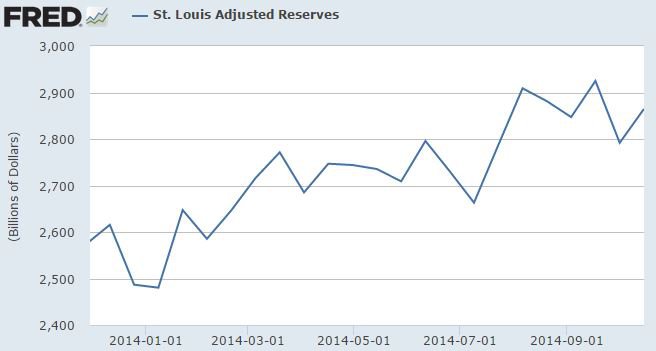
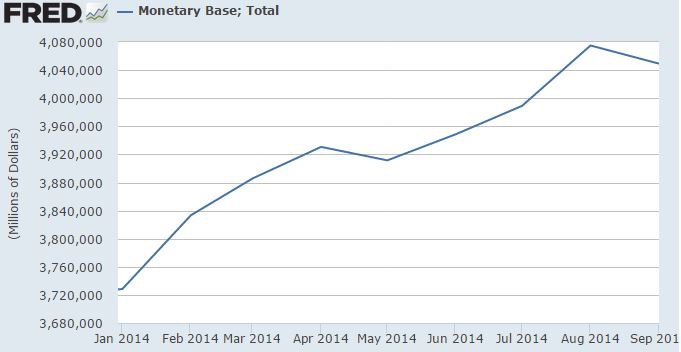
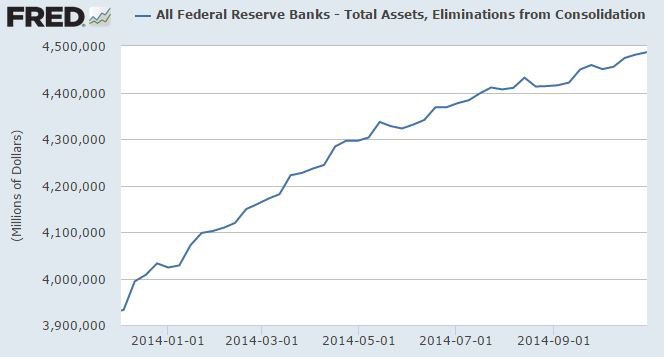
While quantitative easing has contributed to the massive expansion of the Fed balance sheet — now nearly $4.5 trillion in assets — it is not the whole story. Even as the Fed ends new buying of favored assets, the Fed balance sheet will not shrink. As pointed out by the Wall Street Journal, “QE is not over, and the Fed will still reinvest the principal payments from its maturing securities.” Even more relevant, during the phase out there was a continuing expansion of three broad measures of Fed activity; St. Louis Fed adjusted reserves (Figure 1), the monetary base (Figure 2), and Federal Reserve Banks — Total Assets, Eliminations from Consolidation program (Figure 3). (All data from FRED economic data series St. Louis Federal Reserve. Calculations are mine.)

Figure 1: St. Louis Fed Adjusted Reserves

Figure 2: The Monetary Base

Figure 3: Federal Reserve Banks — Total Assets, Eliminations from Consolidation

The Fed’s Balance Sheet Continues to Expand

Despite some ups and downs, adjusted reserves increased 15.8 percent from January 2014 through September 2014, the monetary base by 8.6 percent, and consolidated assets by 10.7 percent. Given QE purchases were $85 billion per month at their peak, this continuing expansion of the Fed balance sheet and the other relevant monetary aggregates, the phase out and end of quantitative easing represents not a change in policy stance, but only a shift in tools. Monetary distortion has continued unabated. The only plus in the change is that more traditional tools of monetary manipulation create only the traditional market distortions; Cantillon effects, false relative prices, particularly interest rates, and the associated misdirection of production and malinvestments. Temporarily gone is the more dangerous Mondustrial Policy where the central bankers further distort credit allocation by picking winners and losers.

As illustrated by the Fed speak in the press release, post QE3-forward policy will, despite John Taylor’s optimism that this would not be the case, continued to be biased against a return to a more balanced, less potentially self-defeating rules-based policy. Instead driven by the Fed’s unwise dual mandate and the strong belief by Fed leadership in Tobin Keynesianism, policy will continue to “foster maximum employment.” This despite strong theoretical arguments (Austrian business cycle theory and the more mainstream natural unemployment rate hypothesis)[1] and good empirical evidence that any short-run positive impact monetary policy may have on employment and production is temporary and in the long run, per Hayek, cause greater instability and potentially even higher unemployment.

The Lasting Legacy of QE

As pointed out by David Howden in “QE’s Seeds Are Already Sown,” and as emphasized by Hayek (in Unemployment and Monetary Policy: Government as Generator of the “Business Cycle”), and recently formalized by Ravier (in “Rethinking Capital-Based Macroeconomics”), the seeds of easy money and credit creation, even when sown during times with unused capacity, bring forth the weeds of instability, malinvestment, bust, and economic displacement. They do not bring the promised return to prosperity, sustainable growth, and high employment.

Since the phase-out is only apparent, and not a real change in policy direction, Joe Salerno’s warning (“A Reformulation of Austrian Business Cycle Theory in Light of the Financial Crisis,” p. 41) remains relevant:

(G)iven the unprecedented monetary interventions by the Fed and the enormous deficits run by the Obama admin­istration, ABCT also explains the precarious nature of the current recovery and the growing probability that the U.S economy is headed for a 1970s-style stagflation.

While highly unlikely there is still time to do the right thing, follow the policy advice of Rothbard and the Austrians, as argued earlier in more detail here and here. Despite some short run costs which are likely small compared to the cost of a decade of stagnation, such a policy is the only reliable route to return the economy to sustainable prosperity.

John P. Cochran is emeritus dean of the Business School and emeritus professor of economics at Metropolitan State University of Denver and coauthor with Fred R. Glahe of The Hayek-Keynes Debate: Lessons for Current Business Cycle Research. He is also a senior scholar for the Mises Institute and serves on the editorial board of the Quarterly Journal of Austrian Economics. Send him mail. See John P. Cochran’s article archives.

This article was published on Mises.org and may be freely distributed, subject to a Creative Commons Attribution United States License, which requires that credit be given to the author.
Inflation’s Not the Only Way Easy Money Destroys Wealth – Article by Frank Shostak

Inflation’s Not the Only Way Easy Money Destroys Wealth – Article by Frank Shostak

The New Renaissance Hat
Frank Shostak
October 14, 2014
******************************

The US Federal Reserve can keep stimulating the US economy because inflation is posing little threat, Federal Reserve Bank of Minneapolis President Kocherlakota said. “I am expecting an inflation rate to run below two percent for the next four years, through 2018,” he said. “That means there is more room for monetary policy to be helpful in terms of … boosting demand without running up against generating too much inflation.”

The yearly rate of growth of the official consumer price index (CPI) stood at 1.7 percent in August against two percent in July. According to our estimate, the yearly rate of growth of the CPI could close at 1.4 percent by December. By December next year we forecast the yearly rate of growth of 0.6 percent.

Does Demand Create More Supply?

It seems that the Minneapolis Fed President holds that by boosting the demand for goods and services — by means of additional monetary pumping — it is possible to strengthen economic growth. He believes that by means of strengthening the demand for goods and services the production of goods and services will follow suit. But why should that be so?

If by means of monetary pumping one could strengthen the economic growth then it would imply that — by means of monetary pumping — it is possible to create real wealth and generate an everlasting economic prosperity.

This would also mean that world wide poverty should have been erased a long time ago. After all, most countries today have central banks that possess the skills to create money in large amounts. Yet world poverty remains intact.

Despite massive monetary pumping since 2008, and the policy interest rate of around zero, Fed policymakers seem to be unhappy with the so-called economic recovery. Note that the Fed’s balance sheet, which stood at $0.86 trillion in January 2007 jumped to $4.4 trillion by September this year.

Production Comes Before Demand

We suggest that there is no such thing as an independent category called demand. Before an individual can exercise demand for goods and services, he/she must produce some other useful goods and services. Once these goods and services are produced, individuals can exercise their demand for the goods they desire. This is achieved by exchanging things that were produced for money, which in turn can be exchanged for goods that are desired. Note that money serves here as the medium of exchange — it produces absolutely nothing. It permits the exchange of something for something. Any policy that results in monetary pumping leads to an exchange of nothing for something. This amounts to a weakening of the pool of real wealth — and hence to reduced prospects for the expansion of this pool.

What is required to boost the economic growth — the production of real wealth — is to remove all the factors that undermine the wealth generation process. One of the major negative factors that undermine the real wealth generation is loose monetary policy of the central bank, which boosts demand without the prior production of wealth. (Once the loopholes for the money creation out of “thin air” are closed off the diversion of wealth from wealth generators towards non-productive bubble activities is arrested. This leaves more real funding in the hands of wealth generators — permitting them to strengthen the process of wealth generation (i.e., permitting them to grow the economy).

Artificially Boosted Demand Destroys Wealth

Now, the artificial boosting of the demand by means of monetary pumping leads to the depletion of the pool of real wealth. It amounts to adding more individuals that take from the pool of real wealth without adding anything in return — an economic impoverishment.

The longer the reckless loose policy of the Fed stays in force the harder it gets for wealth generators to generate real wealth and prevent the pool of real wealth from shrinking.

Finally, the fact that the yearly rate of growth of the CPI is declining doesn’t mean that the Fed’s monetary pumping is going to be harmless. Regardless of price inflation monetary pumping results in an exchange of nothing for something and thus, impoverishment.

Frank Shostak is an adjunct scholar of the Mises Institute and a frequent contributor to Mises.org. His consulting firm, Applied Austrian School Economics, provides in-depth assessments and reports of financial markets and global economies. See Frank Shostak’s article archives.

This article was published on Mises.org and may be freely distributed, subject to a Creative Commons Attribution United States License, which requires that credit be given to the author.

At the Fed, the More Things Change, the More They Stay the Same – Article by Ron Paul

At the Fed, the More Things Change, the More They Stay the Same – Article by Ron Paul

The New Renaissance Hat
Ron Paul
February 16, 2014
******************************
Last week, Federal Reserve Chairman Janet Yellen testified before Congress for the first time since replacing Ben Bernanke at the beginning of the month. Her testimony confirmed what many of us suspected, that interventionist Keynesian policies at the Federal Reserve are well-entrenched and far from over. Mrs. Yellen practically bent over backwards to reassure Wall Street that the Fed would continue its accommodative monetary policy well into any new economic recovery. The same monetary policy that got us into this mess will remain in place until the next crisis hits.

Isn’t it amazing that the same people who failed to see the real estate bubble developing, the same people who were so confident about economic recovery that they were talking about “green shoots” five years ago, the same people who have presided over the continued destruction of the dollar’s purchasing power never suffer any repercussions for the failures they have caused? They treat the people of the United States as though we were pawns in a giant chess game, one in which they always win and we the people always lose. No matter how badly they fail, they always get a blank check to do more of the same.

It is about time that the power brokers in Washington paid attention to what the Austrian economists have been saying for decades. Our economic crises are caused by central-bank infusions of easy money into the banking system. This easy money distorts the structure of production and results in malinvested resources, an allocation of resources into economic bubbles and away from sectors that actually serve consumers’ needs. The only true solution to these burst bubbles is to allow the malinvested resources to be liquidated and put to use in other areas. Yet the Federal Reserve’s solution has always been to pump more money and credit into the financial system in order to keep the boom period going, and Mrs. Yellen’s proposals are no exception.

Every time the Fed engages in this loose monetary policy, it just sows the seeds for the next crisis, making the next crash even worse. Look at charts of the federal funds rate to see how the Fed has had to lower interest rates further and longer with each successive crisis. From six percent, to three percent, to one percent, and now the Fed is at zero. Some Keynesian economists have even urged central banks to drop interest rates below zero, which would mean charging people to keep money in bank accounts.

Chairman Yellen understands how ludicrous negative interest rates are, and she said as much in her question and answer period last week. But that zero lower rate means the Fed has had to resort to unusual and extraordinary measures: quantitative easing. As a result, the Fed now sits on a balance sheet equivalent to nearly 25 percent of US GDP, and is committing to continuing to purchase tens of billions more dollars of assets each month.

When will this madness stop? Sound economic growth is based on savings and investment, deferring consumption today in order to consume more in the future. Everything the Fed is doing is exactly the opposite, engaging in short-sighted policies in an attempt to spur consumption today, which will lead to a depletion of capital, a crippling of the economy, and the impoverishment of future generations. We owe it not only to ourselves, but to our children and our grandchildren, to rein in the Federal Reserve and end once and for all its misguided and destructive monetary policy.

Ron Paul, MD, is a former three-time Republican candidate for U. S. President and Congressman from Texas.

This article is reprinted with permission from the Ron Paul Institute for Peace and Prosperity.

Bernanke’s Legacy: A Weak and Mediocre Economy – Article by John P. Cochran

Bernanke’s Legacy: A Weak and Mediocre Economy – Article by John P. Cochran

The New Renaissance Hat
John P. Cochran
February 8, 2014

******************************

As Chairman Bernanke’s reign at the Fed comes to an end, the Wall Street Journal provides its assessment of “The Bernanke Legacy.” Overall the Journal does a reasonable job on both Greenspan and Bernanke, especially compared to the “effusive praise from the usual suspects; supporters of monetary central planning. The Journal argues when accessing Bernanke’s performance it is appropriate to review Bernanke’s performance “before, during, and after the financial panic.”

While most assessments of Bernanke’s performance as a central banker focus on the “during” and “after” financial-crisis phases with much of the praise based on the “during” phase, the Journal joins the Austrians and John Taylor in unfavorable assessment of the more critical “before” period. It was this period when the Fed generated its second boom-bust cycle in the Greenspan-Bernanke era. In the Journal’s assessment, Bernanke, Greenspan, and the Fed deserve an “F.” While this pre-crisis period mostly fell under the leadership of Alan Greenspan, the Journal highlights that Bernanke was the “leading intellectual force” behind the pre-crisis policies. As a result of these too-loose, too-long policies, just as the leadership of the Fed passed from Greenspan to Bernanke, the credit boom the Fed “did so much to create turned to mania, which turned to panic, which became a deep recession.” The Journal’s description of Bernanke’s role should be highlighted in any serious analysis of the Bernanke era:

His [Bernanke’s] role goes back to 2002 when as a Fed Governor he gave a famous speech warning about deflation that didn’t exist [and if it did exist should not have been feared].[1] He and Mr. Greenspan nonetheless followed the advice of Paul Krugman to promote a housing bubble to offset the dot-com crash.

As Fed transcripts show, Mr. Bernanke was the board’s intellectual leader in its decision to cut the fed-funds rate to 1% in June 2003 and keep it there for a year. This was despite a rapidly accelerating economy (3.8% growth in 2004) and soaring commodity and real-estate prices. The Fed’s multiyear policy of negative real interest rates produced a credit mania that led to the housing bubble and bust.

For some of the best analysis of the Fed’s pre-crisis culpability one should turn to Roger Garrison’s excellent analysis. In a 2009 Cato Journal paper, Garrison (2009, p. 187) characterizes Fed policy during the “Great Moderation” as a “learning by doing policy” which, based on events post-2003, would be better classified as “so far so good” or “whistling in the dark.” The actual result of this “learning by doing policy” is described by Garrison in “Natural Rates of Interest and Sustainable Growth”:

In the earlier episode [dot.com boom-bust], the Federal Reserve moved to counter the upward pressure of interest rates, causing actual interest rates not to deviate greatly from the historical norm. In the later episode [housing bubble/boom-bust], the Federal Reserve moved to reinforce the downward pressure on interest rates, causing the actual interest rates to be exceedingly low relative to the historical norm. Although the judgment, made retrospectively by economists of virtually all stripes, that the Fed funds target rate was “too low for too long” between mid-2003 and mid-2004, it was almost surely too low for too long relative to the natural rate in both episodes. (p. 433)

Given this and other strong evidence of the Fed’s role in creating the credit-driven boom, the Journal faults “Mr. Bernanke’s refusal to acknowledge that the Fed made any mistake in the mania years.”

On the response to the crisis, the Journal refrains from the accolades of many who credit the Fed led by the leading scholar of the Great Depression from acting strongly to prevent another such calamity. According to the Fed worshipers, things might not be good, but without the unprecedented actions and bailouts things would have been catastrophic. The Journal’s more measured assessment:

Once the crisis hit, Mr. Bernanke and the Fed deserve the benefit of the doubt. From the safe distance of hindsight, it’s easy to forget how rapid and widespread the financial panic was. The Fed had to offset the collapse in the velocity of money with an increase in its supply, and it did so with force and dispatch. One can disagree with the Fed’s special guarantee programs, but we weren’t sitting in the financial polar vortex at the time. It’s hard to see how others would have done much better.

But discerning readers of Vern McKinley’s Financing Failure: A Century of Bailouts might disagree. Fed actions, even when not verging on the illegal, were counter-productive, unnecessary, and contributed to action-freezing policy uncertainty which contributed to the collapse of the velocity of money. McKinley describes much of what was done as “seat-of-the-pants decision-making” (pp. 305-306):

“Seat of the pants” is not a flattering description of the methods of the regulators, but its use is justified to describe the panic-driven actions during the 2000s crisis. It is only natural that under the deadline of time pressure judgment will be flawed, mistakes will be made and taxpayer exposure will be magnified, and that has clearly been the case. With the possible exception of the Lehman Brothers decision … all of the major bailout decisions during the 2000s crisis were made under duress of panic over a very short period of time with very limited information at hand and with input of a limited number of objective parties involved in the decision making. Not surprisingly, these seat-of-the-pants responses did not instill confidence, and there was no clear evidence collected that the expected negative fallout would truly have occurred.

While a defense of some Fed action could be found in Hayek’s 1970s discussion of “best” policy under bad institutions (a central bank) where he argued that during a crisis a central bank should act to prevent a secondary deflation, the Fed actions went clearly beyond such a recommendation. Better would have been an immediate policy to end the credit expansion in its tracks. The Fed’s special guarantee programs and movement toward a mondustrial policy should be a great worry to anyone concerned about long-term prosperity and liberty. Whether any human running a central bank could have done better is an open question, but other monetary arrangements could clearly have led to better outcomes.

The Journal’s analysis of post-crisis policy, while not as harsh as it should be,[2] is critical. Despite an unprecedented expansion of the Fed’s balance sheet, the “recovery is historically weak.” At some point “a Fed chairman has to take some responsibility for the mediocre growth — and lack of real income growth — on his watch.” Bernanke’s policy is also rightly criticized because “The other great cost of these post-crisis policies is the intrusion of the Fed into politics and fiscal policy.”

Because the ultimate outcome of this monetary cycle hinges on how, when, or if the Fed can unwind its unwieldy balance sheet, without further damage to the economy; most likely continuing stagnation or a return to stagflation, or less likely, but possible hyper-inflation or even a deflationary depression, the Bernanke legacy will ultimately depend on a Bernanke-Yellen legacy. Given, as the Journal points out, “Politicians — and even some conservative pundits — have adopted the Bernanke standard that the Fed’s duty is to reduce unemployment and manage the business cycle,” the prospect that this legacy will be viewed favorably is less and less likely. Perhaps if the editors joined Paul Krugman in reading and fully digesting Joe Salerno’s “A Reformulation of Austrian Business Cycle Theory in Light of the Financial Crisis,” they would correctly fail Bernanke and Fed policy before, during, and after the crisis.

But what should be the main lesson of a Greenspan-Bernanke legacy? Clearly, if there was no pre-crisis credit boom, there would have been no large financial crisis and thus no need for Bernanke or other human to have done better during and after. While Austrian analysis has often been criticized, incorrectly,[3] for not having policy recommendations on what to do during the crisis and recovery, it should be noted that if Austrian recommendations for eliminating central banks and allowing banking freedom had been followed, no such devastating crisis would have occurred and no heroic policy response would have been necessary in the resulting free and prosperous commonwealth.

Notes

[1] See Joseph T. Salerno, “An Austrian Taxonomy of Deflation — With Applications to the U.S.” Quarterly Journal of Austrian Economics 6, no. 4 (2001).

[2] See John P. Cochran’s, Bernanke: The Good Engineer? Mises Daily Article, 21 March 2013 and Bernanke: A Tenure of Failure, Mises Daily Article, 31, July 2013.

[3] See John P. Cochran, Recessions: The Don’t Do List, Mises Daily Article, 17 February 2013.

John P. Cochran is emeritus dean of the Business School and emeritus professor of economics at Metropolitan State University of Denver and coauthor with Fred R. Glahe of The Hayek-Keynes Debate: Lessons for Current Business Cycle Research. He is also a senior scholar for the Mises Institute and serves on the editorial board of the Quarterly Journal of Austrian Economics. Send him mail. See John P. Cochran’s article archives.

This article was published on Mises.org and may be freely distributed, subject to a Creative Commons Attribution United States License, which requires that credit be given to the author.

After 100 Years of Failure, It’s Time to End the Fed! – Article by Ron Paul

After 100 Years of Failure, It’s Time to End the Fed! – Article by Ron Paul

The New Renaissance Hat
Ron Paul
December 15, 2013
******************************

A week from now, the Federal Reserve System will celebrate the 100th anniversary of its founding. Resulting from secret negotiations between bankers and politicians at Jekyll Island, the Fed’s creation established a banking cartel and a board of federal-government overseers that has grown ever stronger through the years. One would think this anniversary would elicit some sort of public recognition of the Fed’s growth from a quasi-agent of the Treasury Department intended to provide an elastic currency, to a de facto independent institution that has taken complete control of the economy through its central monetary planning. But just like the Fed’s creation, its 100th anniversary may come and go with only a few passing mentions.

Like many other horrible and unconstitutional pieces of legislation, the bill which created the Fed, the Federal Reserve Act, was passed under great pressure on December 23, 1913, in the waning moments before Congress recessed for Christmas with many Members already absent from those final votes. This underhanded method of pressuring Congress with such a deadline to pass the Federal Reserve Act would provide a foreshadowing of the Fed’s insidious effects on the US economy—with actions performed without transparency.

Ostensibly formed with the goal of preventing financial crises such as the Panic of 1907, the Fed has become increasingly powerful over the years. Rather than preventing financial crises, however, the Fed has constantly caused new ones. Barely a few years after its inception, the Fed’s inflationary monetary policy to help fund World War I led to the Depression of 1920. After the economy bounced back from that episode, a further injection of easy money and credit by the Fed led to the Roaring Twenties and to the Great Depression, the worst economic crisis in American history.

But even though the Fed continued to make the same mistakes over and over again, no one in Washington ever questioned the wisdom of having a central bank. Instead, after each episode the Fed was given more and more power over the economy. Even though the Fed had brought about the stagflation of the 1970s, Congress decided to formally task the Federal Reserve in 1978 with maintaining full employment and stable prices, combined with constantly adding horrendously harmful regulations. Talk about putting the inmates in charge of the asylum!

Now we are reaping the noxious effects of a century of loose monetary policy, as our economy remains mired in mediocrity and utterly dependent on a stream of easy money from the central bank. A century ago, politicians failed to understand that the financial panics of the 19th century were caused by collusion between government and the banking sector. The federal government’s growing monopoly on money creation, high barriers to entry into banking to protect politically favored incumbents, and favored treatment for government debt combined to create a rickety, panic-prone banking system. Had legislators known then what we know now, we could hope that they never would have established the Federal Reserve System.

Today, however, we do know better. We know that the Federal Reserve continues to strengthen the collusion between banks and politicians. We know that the Fed’s inflationary monetary policy continues to reap profits for Wall Street while impoverishing Main Street. And we know that the current monetary regime is teetering on a precipice. One hundred years is long enough. End the Fed.

Ron Paul, MD, is a former three-time Republican candidate for U. S. President and Congressman from Texas.

This article is reprinted with permission from the Ron Paul Institute for Peace and Prosperity.

Janet Yellen, the “Pink Dream,” and a Coming Economic Nightmare – Article by Joseph T. Salerno

Janet Yellen, the “Pink Dream,” and a Coming Economic Nightmare – Article by Joseph T. Salerno

The New Renaissance Hat
Joseph T. Salerno
November 19, 2013
******************************

On Monday, former Fed official Andrew Huszar publicly apologized to the American public for his seminal role in executing the Quantitative Easing (QE) program, a program he characterizes as “the greatest backdoor Wall Street bailout of all time,” and “the largest financial-markets intervention by any government in world history.” While this is a momentous admission from an insider (Mr. Huszar is also a former Wall Street banker), perhaps Mr. Huszar’s most revealing statement concerned the results of QE’s “relentlessly pumping money into the financial markets during the past five years.” He referred to the spectacular rally in financial markets and expressed agreement with the growing belief among expert observers that market conditions had become “bubble-like.”

In a paper just released by the American Enterprise Institute, another former policymaker, resident fellow Desmond Lachman, formerly deputy director of the International Monetary Fund’s Policy Development and Review Department, warns that QE and other “unorthodox monetary policies” are having “unintended consequences.” Among other consequences, Lachman sees signs of incipient bubbles forming throughout the world:

An important aim of the QE policies pursued in the United States, the United Kingdom, and Japan has been to encourage risk taking and to raise asset prices as the means to stimulate aggregate demand. The question that now needs to be asked is whether these policies may have given rise to excessive risk taking, overleveraging, and bubbles in asset and credit markets. In this context, one has to wonder whether historically low yields on junk bonds in the industrialized countries now understate the risk of owning those bonds. . . . One also has to wonder whether yields on sovereign bonds in the European periphery have become disassociated from those countries’ underlying economic fundamentals and whether global equity valuations have not become excessively rich.

The markets for gems and for collectibles have also become very frothy of late. Yesterday, new records were set for a gemstone and for an Andy Warhol piece of art sold at auction. The “Pink Dream,” is a 59.60 carat vivid pink diamond, which is the highest color grade for diamonds, and the purity of its crystals is ranked among the top 2 percent in the world. The record setting price was $83 million. Not coincidentally, the DJIA set an intraday record shortly before the auction. The new record price for the Andy Warhol piece was $105.4 million. The auction’s combined $199.5 million in revenues was also a record for Sotheby’s. During Sotheby’s Geneva fall auction season, records were also set for the prices of an orange diamond and a Rolex Daytona watch.

While the Austrian insight that super-accommodative Fed monetary policy may be causing a recurrence of asset bubbles is making headway in policy circles, it has not yet dawned on Janet Yellen. Nor is such an epiphany likely. Ms. Yellen wears the intellectual blinders of the mainstream macroeconomist which force her to focus narrowly on arbitrary and increasingly irrelevant statistical averages and aggregates like the CPI, the unemployment rate, and GDP and to ignore what is going on around her in real markets.

This was clearly revealed in remarks prepared for her confirmation hearing released yesterday. Ms. Yellen noted that the rate of increase in the CPI index was less than the Fed target of 2.00 percent and that the labor market and the economy were performing far short of their potential (based on the meaningless concept of “potential GDP”). She thus reiterated her commitment to continuing monetary accommodation and “unconventional policy tools such as asset purchases.” It is true that in her testimony before the Senate committee on Thursday she did concede that it is “important for the Fed to attempt to detect asset bubbles when they are forming.” However, she blithely dismissed concerns that recent record highs in asset markets reflected “bubble-like conditions.” With Ms. Yellen’s confirmation highly likely, we can look forward to the Fed blindly fueling asset bubbles to a fare-thee-well. With the financial system still on shaky ground, this will lead to another financial meltdown and a U.S. government takeover of the financial system, the likes of which will make the last Wall Street bailout appear to be a minor intervention.

Joseph Salerno is academic vice president of the Mises Institute, professor of economics at Pace University, and editor of the Quarterly Journal of Austrian Economics. He has been interviewed in the Austrian Economics Newsletter and on Mises.org. Send him mail. See Joseph T. Salerno’s article archives.

This article was published on Mises.org and may be freely distributed, subject to a Creative Commons Attribution United States License, which requires that credit be given to the author.