Browsed by
Tag: Federal Reserve

Janet Yellen’s Christmas Gift to Wall Street – Article by Ron Paul

Janet Yellen’s Christmas Gift to Wall Street – Article by Ron Paul

The New Renaissance Hat
Ron Paul
December 21, 2014
******************************
Last week we learned that the key to a strong economy is not increased production, lower unemployment, or a sound monetary unit. Rather, economic prosperity depends on the type of language used by the central bank in its monetary policy statements. All it took was one word in the Federal Reserve Bank’s press release — that the Fed would be “patient” in raising interest rates to normal levels — and stock markets went wild. The S&P 500 and the Dow Jones Industrial Average had their best gains in years, with the Dow gaining nearly 800 points from Wednesday to Friday and the S&P gaining almost 100 points to close within a few points of its all-time high.

Just think of how many trillions of dollars of financial activity that occurred solely because of that one new phrase in the Fed’s statement. That so much in our economy hangs on one word uttered by one institution demonstrates not only that far too much power is given to the Federal Reserve, but also how unbalanced the American economy really is.

While the real economy continues to sputter, financial markets reach record highs, thanks in no small part to the Fed’s easy money policies. After six years of zero interest rates, Wall Street has become addicted to easy money. Even the slightest mention of tightening monetary policy, and Wall Street reacts like a heroin addict forced to sober up cold turkey.

While much of the media paid attention to how long interest rates would remain at zero, what they largely ignored is that the Fed is, “maintaining its existing policy of reinvesting principal payments from its holdings of agency debt and agency mortgage-backed securities in agency mortgage-backed securities.” Look at the Fed’s balance sheet and you’ll see that it has purchased $25 billion in mortgage-backed securities since the end of QE3. Annualized, that is $200 billion a year. That may not be as large as QE2 or QE3, but quantitative easing, or as the Fed likes to say “accommodative monetary policy” is far from over.

What gets lost in all the reporting about stock market numbers, unemployment rate figures, and other economic data is the understanding that real wealth results from production of real goods, not from the creation of money out of thin air. The Fed can rig the numbers for a while by turning the monetary spigot on full blast, but the reality is that this is only papering over severe economic problems. Six years after the crisis of 2008, the economy still has not fully recovered, and in many respects is not much better than it was at the turn of the century.

Since 2001, the United States has grown by 38 million people and the working-age population has grown by 23 million people. Yet the economy has only added eight million jobs. Millions of Americans are still unemployed or underemployed, living from paycheck to paycheck, and having to rely on food stamps and other government aid. The Fed’s easy money has produced great profits for Wall Street but it has not helped — and cannot help — Main Street.

An economy that holds its breath every six weeks, looking to parse every single word coming out of Fed Chairman Janet Yellen’s mouth for indications of whether to buy or sell, is an economy that is fundamentally unsound. The Fed needs to stop creating trillions of dollars out of thin air, let Wall Street take its medicine, and allow the corrections that should have taken place in 2001 and 2008 to liquidate the bad debts and malinvestments that permeate the economy. Only then will we see a real economic recovery.

Ron Paul, MD, is a former three-time Republican candidate for U. S. President and Congressman from Texas.

This article is reprinted with permission from the Ron Paul Institute for Peace and Prosperity.

The Fed and the “Salvador Dali Effect” – Article by Dante Bayona

The Fed and the “Salvador Dali Effect” – Article by Dante Bayona

The New Renaissance Hat
Dante Bayona
November 28, 2014
******************************

There is a story about the great Catalan surrealist painter Salvador Dali. It is said that in the last years of his life, when he was already famous, he signed checks knowing that they would not be submitted to the bank for payment. Rather, after partying with his friends and consuming the most expensive items the restaurants had to offer, he would ask for the bill, pull out one of his checks, write the amount, and sign it. Before handing over the check, he quickly turned it around, made a drawing on the back and autographed it. Dali knew the owner of the restaurant would not cash the check but keep it,put it in a frame, and display it in the most prominent place in the restaurant: “An original Dali.”

It was a good deal for Dali: his checks never came back to the bank to be cashed, and he still enjoyed great banquets with all of his friends. Dali had a magic checkbook.

But what would have happened if one day art collectors concluded that Dali’s work really did not capture the essence of surrealism, and therefore that his art was not of great value? If that had happened, every autographed check would have come back to the bank (at least in theory), and Dali would have had to pay up. If Dali had not saved enough money, he would have had to find a job painting houses.

While the analogy is not perfect, we may find that something similar can happen with the Fed and the dollar. For now, The Fed has a magic checkbook that allows it to spend without paying the bill because it thinks the checks will never come back to be cashed.

Dali died long before people stopped valuing his art, but the US economy does not enjoy such a convenient escape. What if, as in the case of art collectors who might no longer see great value in Dali’s work, the world loses faith in the quality of the dollar and stops using it for large international transactions? If that happens, in the same way Dali would have had to pay his bills, the US would also have to make good on the checks it signed. Would the US be able to pay its checks with more checks?

Since each country has its own currency, every central bank around the world has to print more of its national currency to buy the excess of dollars entering the country whenever the US expands its money supply. Thus, in the 1970s, in the wake of the Nixon Shock, members of OPEC accused the US of exporting inflation.

Recall that during the mid-1960s, the US central bank was financing a war in Vietnam and as well as funding Lyndon B. Johnson’s programs of “The Great Society”that supposedly would eliminate poverty. As the Fed was printing money, OPEC members had to inflate their currencies to buy the excess of dollars.

Central banks around the world have to buy excess of dollars entering their countries so their exports do not lose competitiveness. Thus, a double inflation is imposed on every country in the world, one created by its own domestic central bank, because all central banks inflate on their own, and another created by the US central bank. Hans-Hermann Hoppe wrote about the perils of monetary imperialism:

The dominating state will use its superior power to enforce a policy of internationally coordinated inflation. Its own central bank sets the pace in the process of counterfeiting, and the central banks of the dominated states are ordered to use its currency as their own reserves and inflate on top of them. Thus, along with the dominating state and as the earliest receivers of the counterfeit reserve currency, its associated banking and business establishment can engage in an almost costless expropriation of foreign property owners and income producers. A double layer of exploitation of a foreign state and a foreign elite on top of a national state and elite is imposed on the exploited class in the dominated territories, causing prolonged economic dependency on and relative economic stagnation in comparison with the dominant nation. It is this — very uncapitalist — situation that characterizes the status of the United States and the US dollar and that gives rise to the — correct — accusations concerning US economic exploitation and dollar imperialism. 1

While it is true that in the 1970s the dollar enjoyed a worldwide hegemony — given that all European countries had their currencies separated, and given that China and Russia were outside the capitalist world — now the situation is different. Vladimir Putin recently stated that “The international monetary system itself depends a lot on the U.S. dollar, or, to be precise, on the monetary and financial policy of the U.S. authorities. The BRICS countries (Brazil, Russia, India, China and South Africa) want to change this.” 2

Salvador Dali had devised an ingenious method for not paying his bills. Similar stories are told about Pablo Picasso. But the Fed does not produce tangible items that people would rather hold on to, like an original Salvador Dali. The Fed does not produce work or items of value. The Salvador Dali effect, i.e., the ability to prevent checks from being cashed by creating something of real value, does not apply to the Fed. That is why it is good to remind the Fed, and the government, to be careful with the expenditures when partying, just in case the magic checkbook disappears.

  • 1. See Hans-Hermann Hoppe, “Marxist and Austrian Class Analysis.” Journal of Libertarian Studies 9, no. 2 (Fall 1990). www.mises.org/journals/jls/9_2/9_2_5.pdf
  • 2. See Vladimir “Putin, No plans for BRICS military, political alliance.” Russia: RT. Retrieved 16 July 2014. www.rt.com/politics/official-word/172768-putin-brics-economies-alliance

Dante Bayona received his master’s degree in Austrian economics under the direction of Jesús Huerta de Soto in Spain. He was a 2014 Summer Fellow at the Mises Institute, works in the banking sector in New York, and collaborates with MisesHispano.org.

This article was published on Mises.org and may be freely distributed, subject to a Creative Commons Attribution United States License, which requires that credit be given to the author.

How Wilson and the Fed Extended the Great War – Article by Brendan Brown

How Wilson and the Fed Extended the Great War – Article by Brendan Brown

The New Renaissance Hat
Brendan Brown
November 9, 2014
******************************

As the world reflects on the incomprehensible horror of the Great War which erupted 100 years ago there is a question which goes unasked in the media coverage. How was there no peace deal between the belligerents in 1915 or at latest 1916 once it became clear to all — especially after the Battle of the Somme — that the conflict had developed into a stalemate and holocaust of youth?

While there had been some early hopes for peace in 1916, they quickly evaporated as it became clear that the British government would not agree to a compromise deal. The political success of those who opposed compromise was based to a considerable degree on the argument that soon the US would enter the conflict on the Entente’s (Britain and France) side.

Although the US had allowed the Entente (but not the Central Powers) to access Wall Street without restriction during the first two years of the war, the historical evidence shows that President Wilson had been inclined to threaten Britain with the ending of its access to vital US market financing for its war effort if it failed to negotiate seriously for peace. But Wilson was dissuaded from urging peace on the negotiators by his political adviser Colonel House.

A less well-known story is the role of the then-newly created Fed (which opened its doors in 1914) and its allies within the Wilson administration in facilitating Entente finance. Two prominent Fed members — Paul Warburg and Adolph Miller — had fought a rear-guard campaign seeking to restrict their new institution from discounting trade bills or buying acceptances (largely financing munitions) issued by the belligerents (in practice, the Entente Powers). But, they had been thwarted by the persistence of the New York Fed chief Benjamin Strong (closely allied to J.P. Morgan and others who were gaining tremendously from arranging loans to France and Britain) and the Treasury Secretary McAdoo, the son-in-law of President Wilson. (McAdoo, whose railroad company had been bailed out personally by J.P. Morgan, was also a voting member of the Federal Reserve Board).

Milton Friedman has argued that the creation of the Federal Reserve made no difference to the US monetary and economic outcomes during the period of neutrality (up until March 1917) or during the US participation in the war (to November 1918). The difference, Friedman contended, came afterward when the Fed allowed rapid monetary growth to continue for a further year. Under the pre-Fed regime, Friedman argues, the US would also have experienced huge inflows of gold during the period of neutrality and under existing procedures (for official US gold purchases), and these would have fueled rapid growth of high-powered money and hence inflation. In the period of war participation, the Treasury would have printed money with or without the Fed (as indeed had occurred during the Civil War).

There are two big caveats to consider about Friedman’s “the Fed made no difference” case. The first is that the administration and Wall Street’s ability to facilitate the flow of finance to the Entente would have been constricted in the absence of backdoor support (via trade acceptances and bills) by the new “creature of Jekyll Island” (the Fed). The second is that both camps within the Fed (Benjamin Strong on the one hand, and Paul Warburg and Adolph Miller on the other) were united in welcoming the accumulation of gold on their new institutions’ balance sheet. They saw this as strengthening the metallic base of the currency (both were concerned that the Fed’s creation should not be the start of a journey toward fiat money) and also as a key factor in their aims to make New York the number-one financial center in the world, displacing London in that role.

Without those hang-ups it is plausible that the US would have trodden the same path as Switzerland in dealing with the flood of gold from the belligerents and its inflationary potential. That path was the suspension of official gold purchases and effective temporary floating of the gold price. The latter might have slumped to say $10–14 per ounce from the then official level of $21 and correspondingly the dollar (like the Swiss franc) would have surged, while Sterling and the French franc come under intense downward pressure. In effect the Entente Powers would not have been able to finance their war expenditures by dumping gold in the US and having this monetized by the Fed and Treasury — a process which effectively levied an inflation tax on US citizens.

This suspension of gold purchases would have meant a better prospect of there being a gold-standard world being recreated in the ensuing peace. The exhaustion of British gold holdings during the war ruled out the resurrection of Sterling as gold money. Its so-called return to gold in 1925 was in fact a fixed exchange rate link to the US dollar. The US would have been spared much of the cumulative wartime inflation. The Fed would not have been so flush with gold that it could have tolerated the big monetary binge through 1919 before ultimately being forced by a decline in its free gold position to suddenly tighten policy sharply and induce the Great Recession of 1920–21. That episode led on to the Fed focusing during the 1920s on modern monetary management (counter-cyclical policy changes and price stabilization). The consequences of that focus, ultimately fatal to the gold order, were the Great Boom and the Great Depression.

Brendan Brown is an associated scholar of the Mises Institute and is author of Euro Crash: How Asset Price Inflation Destroys the Wealth of Nations and The Global Curse of the Federal Reserve: Manifesto for a Second Monetarist Revolution. See Brendan Brown’s article archives.

This article was published on Mises.org and may be freely distributed, subject to a Creative Commons Attribution United States License, which requires that credit be given to the author.

The End of Quantitative Easing Is Not the End of Bad Policy – Article by John P. Cochran

The End of Quantitative Easing Is Not the End of Bad Policy – Article by John P. Cochran

The New Renaissance Hat
John P. Cochran
November 7, 2014
******************************

Recently the financial press and media has been abuzz as the Federal Reserve moved closer to the anticipated end to its massive bond and mortgage backed securities purchases known as quantitative easing. James Bullard, President of the St. Louis Federal Reserve Bank, stirred controversy last week when he suggested the Fed should consider continuing the bond buying program after October. But at the October 29th meeting, the policy makers did as anticipated and “agreed to end its asset purchase program.” However one voting member agreed with Mr. Bullard. Per the official press release, “Voting against the action was Narayana Kocherlakota, who believed that, in light of continued sluggishness in the inflation outlook and the recent slide in market-based measures of longer-term inflation expectations, the Committee should commit to keeping the current target range for the federal funds rate at least until the one-to-two-year ahead inflation outlook has returned to 2 percent and should continue the asset purchase program at its current level” (emphasis added).

The action yesterday completes the phase out, which began in January 2014, of the controversial QE3 under the leadership of Ben Bernanke and continued unabated under Janet Yellen.

“Not the End of Monetary Easing”

While the headline in the Wall Street Journal highlighted the action as closing a “chapter on easy money,” a closer look illustrates this is perhaps not the case. The Journal, on the editorial page the same day offers a better perspective, supported by data and the rhetoric in the press release. Much to the determent of future economic prosperity, “The end of Fed bond buying is not the end of monetary easing.”

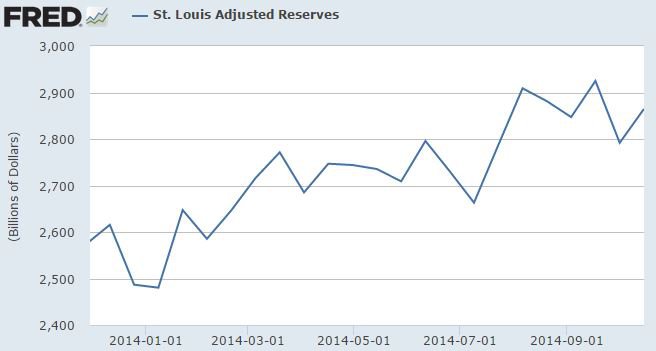
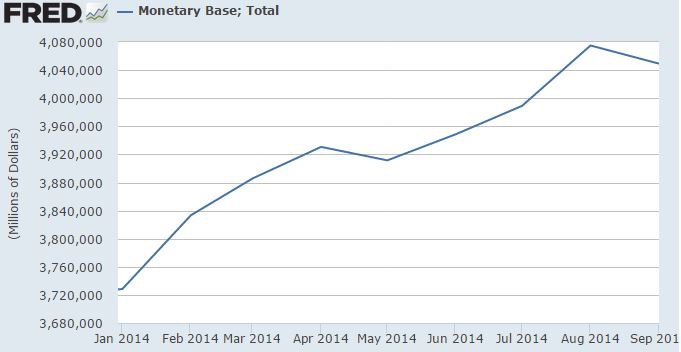
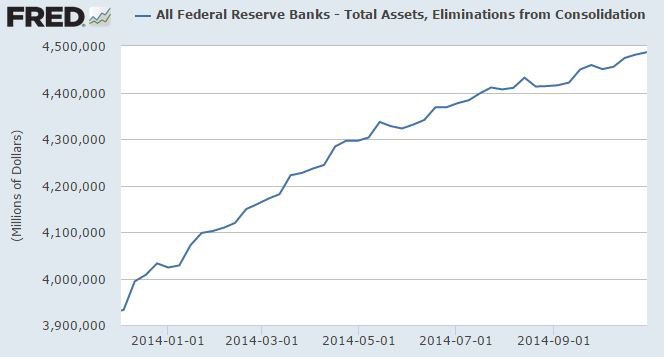
While quantitative easing has contributed to the massive expansion of the Fed balance sheet — now nearly $4.5 trillion in assets — it is not the whole story. Even as the Fed ends new buying of favored assets, the Fed balance sheet will not shrink. As pointed out by the Wall Street Journal, “QE is not over, and the Fed will still reinvest the principal payments from its maturing securities.” Even more relevant, during the phase out there was a continuing expansion of three broad measures of Fed activity; St. Louis Fed adjusted reserves (Figure 1), the monetary base (Figure 2), and Federal Reserve Banks — Total Assets, Eliminations from Consolidation program (Figure 3). (All data from FRED economic data series St. Louis Federal Reserve. Calculations are mine.)

Figure 1: St. Louis Fed Adjusted Reserves

Figure 2: The Monetary Base

Figure 3: Federal Reserve Banks — Total Assets, Eliminations from Consolidation

The Fed’s Balance Sheet Continues to Expand

Despite some ups and downs, adjusted reserves increased 15.8 percent from January 2014 through September 2014, the monetary base by 8.6 percent, and consolidated assets by 10.7 percent. Given QE purchases were $85 billion per month at their peak, this continuing expansion of the Fed balance sheet and the other relevant monetary aggregates, the phase out and end of quantitative easing represents not a change in policy stance, but only a shift in tools. Monetary distortion has continued unabated. The only plus in the change is that more traditional tools of monetary manipulation create only the traditional market distortions; Cantillon effects, false relative prices, particularly interest rates, and the associated misdirection of production and malinvestments. Temporarily gone is the more dangerous Mondustrial Policy where the central bankers further distort credit allocation by picking winners and losers.

As illustrated by the Fed speak in the press release, post QE3-forward policy will, despite John Taylor’s optimism that this would not be the case, continued to be biased against a return to a more balanced, less potentially self-defeating rules-based policy. Instead driven by the Fed’s unwise dual mandate and the strong belief by Fed leadership in Tobin Keynesianism, policy will continue to “foster maximum employment.” This despite strong theoretical arguments (Austrian business cycle theory and the more mainstream natural unemployment rate hypothesis)[1] and good empirical evidence that any short-run positive impact monetary policy may have on employment and production is temporary and in the long run, per Hayek, cause greater instability and potentially even higher unemployment.

The Lasting Legacy of QE

As pointed out by David Howden in “QE’s Seeds Are Already Sown,” and as emphasized by Hayek (in Unemployment and Monetary Policy: Government as Generator of the “Business Cycle”), and recently formalized by Ravier (in “Rethinking Capital-Based Macroeconomics”), the seeds of easy money and credit creation, even when sown during times with unused capacity, bring forth the weeds of instability, malinvestment, bust, and economic displacement. They do not bring the promised return to prosperity, sustainable growth, and high employment.

Since the phase-out is only apparent, and not a real change in policy direction, Joe Salerno’s warning (“A Reformulation of Austrian Business Cycle Theory in Light of the Financial Crisis,” p. 41) remains relevant:

(G)iven the unprecedented monetary interventions by the Fed and the enormous deficits run by the Obama admin­istration, ABCT also explains the precarious nature of the current recovery and the growing probability that the U.S economy is headed for a 1970s-style stagflation.

While highly unlikely there is still time to do the right thing, follow the policy advice of Rothbard and the Austrians, as argued earlier in more detail here and here. Despite some short run costs which are likely small compared to the cost of a decade of stagnation, such a policy is the only reliable route to return the economy to sustainable prosperity.

John P. Cochran is emeritus dean of the Business School and emeritus professor of economics at Metropolitan State University of Denver and coauthor with Fred R. Glahe of The Hayek-Keynes Debate: Lessons for Current Business Cycle Research. He is also a senior scholar for the Mises Institute and serves on the editorial board of the Quarterly Journal of Austrian Economics. Send him mail. See John P. Cochran’s article archives.

This article was published on Mises.org and may be freely distributed, subject to a Creative Commons Attribution United States License, which requires that credit be given to the author.

Inflation’s Not the Only Way Easy Money Destroys Wealth – Article by Frank Shostak

Inflation’s Not the Only Way Easy Money Destroys Wealth – Article by Frank Shostak

The New Renaissance Hat
Frank Shostak
October 14, 2014
******************************

The US Federal Reserve can keep stimulating the US economy because inflation is posing little threat, Federal Reserve Bank of Minneapolis President Kocherlakota said. “I am expecting an inflation rate to run below two percent for the next four years, through 2018,” he said. “That means there is more room for monetary policy to be helpful in terms of … boosting demand without running up against generating too much inflation.”

The yearly rate of growth of the official consumer price index (CPI) stood at 1.7 percent in August against two percent in July. According to our estimate, the yearly rate of growth of the CPI could close at 1.4 percent by December. By December next year we forecast the yearly rate of growth of 0.6 percent.

Does Demand Create More Supply?

It seems that the Minneapolis Fed President holds that by boosting the demand for goods and services — by means of additional monetary pumping — it is possible to strengthen economic growth. He believes that by means of strengthening the demand for goods and services the production of goods and services will follow suit. But why should that be so?

If by means of monetary pumping one could strengthen the economic growth then it would imply that — by means of monetary pumping — it is possible to create real wealth and generate an everlasting economic prosperity.

This would also mean that world wide poverty should have been erased a long time ago. After all, most countries today have central banks that possess the skills to create money in large amounts. Yet world poverty remains intact.

Despite massive monetary pumping since 2008, and the policy interest rate of around zero, Fed policymakers seem to be unhappy with the so-called economic recovery. Note that the Fed’s balance sheet, which stood at $0.86 trillion in January 2007 jumped to $4.4 trillion by September this year.

Production Comes Before Demand

We suggest that there is no such thing as an independent category called demand. Before an individual can exercise demand for goods and services, he/she must produce some other useful goods and services. Once these goods and services are produced, individuals can exercise their demand for the goods they desire. This is achieved by exchanging things that were produced for money, which in turn can be exchanged for goods that are desired. Note that money serves here as the medium of exchange — it produces absolutely nothing. It permits the exchange of something for something. Any policy that results in monetary pumping leads to an exchange of nothing for something. This amounts to a weakening of the pool of real wealth — and hence to reduced prospects for the expansion of this pool.

What is required to boost the economic growth — the production of real wealth — is to remove all the factors that undermine the wealth generation process. One of the major negative factors that undermine the real wealth generation is loose monetary policy of the central bank, which boosts demand without the prior production of wealth. (Once the loopholes for the money creation out of “thin air” are closed off the diversion of wealth from wealth generators towards non-productive bubble activities is arrested. This leaves more real funding in the hands of wealth generators — permitting them to strengthen the process of wealth generation (i.e., permitting them to grow the economy).

Artificially Boosted Demand Destroys Wealth

Now, the artificial boosting of the demand by means of monetary pumping leads to the depletion of the pool of real wealth. It amounts to adding more individuals that take from the pool of real wealth without adding anything in return — an economic impoverishment.

The longer the reckless loose policy of the Fed stays in force the harder it gets for wealth generators to generate real wealth and prevent the pool of real wealth from shrinking.

Finally, the fact that the yearly rate of growth of the CPI is declining doesn’t mean that the Fed’s monetary pumping is going to be harmless. Regardless of price inflation monetary pumping results in an exchange of nothing for something and thus, impoverishment.

Frank Shostak is an adjunct scholar of the Mises Institute and a frequent contributor to Mises.org. His consulting firm, Applied Austrian School Economics, provides in-depth assessments and reports of financial markets and global economies. See Frank Shostak’s article archives.

This article was published on Mises.org and may be freely distributed, subject to a Creative Commons Attribution United States License, which requires that credit be given to the author.

The Japanese Deflation Myth and the Yen’s Slump – Article by Brendan Brown

The Japanese Deflation Myth and the Yen’s Slump – Article by Brendan Brown

The New Renaissance Hat
Brendan Brown
October 4, 2014
******************************

The slide of the yen since late summer has brought it to a level some 40 percent lower against the euro and US dollar than just two years go. Yet still Japan’s Prime Minister Shinzo Abe and his central bank chief Haruhiko Kuroda warn that they have not won the battle against deflation. That caution is absurd — all the more so in view of the fact that there was no deflation in the first place.

Some cynics suggest that Abe’s and Haruhiko’s battle cry against this phoney phantom is simply a ruse to gain Washington’s acquiescence in a big devaluation. But whatever the truth about their real intent, Japan’s monetary chaos is deepening.

Japanese Prices Have Been Stable

The CPI in Japan at the peak of the last cycle in 2007 was virtually at the same level as at the trough of the post-bubble recession in 1992, and up a few percentage points from the 1989 cycle peak. Hence, Japan alone has enjoyed the sort of price stability as might be enjoyed in a gold-standard world. Prices have fallen during recessions or during periods of especially-rapid terms-of-trade improvement or productivity growth. They have risen during cyclical booms or at times of big increases in the price of oil.

If price-indices in Japan were adjusted fully to take account of quality improvements they would have been falling slightly throughout, but that would also have been the case under the gold standard and was fully consistent with economic prosperity.

yenslumpSuch swings in prices are wholly benign. For example, lower prices during recession coupled with expectation of higher prices in expansion induce businesses and households to spend more. A valid criticism of the Japanese price experience of the past two decades has been that these swings have lacked vigour due to various rigidities. Particularly valid is the claim that price falls should have been larger during the post-bubble recession of 1990-93 and subsequent potential for recovery would have been correspondingly larger.

Prices in Japan did fall steeply during the Great Recession (2008-10) but the perceived potential for recovery was squeezed by the Obama Monetary Experiment (the Fed’s QE) which meant an immediate slide of the US dollar. It was in response to the related spike of the yen that Prime Minister Abe prepared his counter-stroke. This involved importing the same deflation-phobic inflation-targeting policies that the Obama Federal Reserve was pursuing. Washington could hardly criticize Tokyo for imitating its own monetary experiment.

Deflation and “The Lost Decade”

The architects of the Obama Monetary Experiment have cited as justification Japan’s “lost decade” and the supposed source in deflation. In fact, though, the only period during which the Japanese economy underperformed other advanced economies (as measured by the growth of GDP per capita) was from 1992-97. The underperformance of that period had everything to do with insufficient price and wage flexibility downward, the Clinton currency war, and the vast malinvestment wrought by the prior asset price inflation, coupled with a risk-appetite in Japan shrunken by the recent experience of bust.

Moreover, as time went on, from the early 1990s, huge investment into the Tokyo equity market from abroad compensated for ailing domestic risk appetites. Yes, Japan’s economy could have performed better than the average of its OECD peers if progress had been made in de-regulation, and if Japan had had a better-designed framework of monetary stability to insulate itself from the Greenspan-Bernanke asset price inflation virus of the years 2002-07. (The Greenspan-Bernanke inflation caused speculative temperatures in the yen carry trade to reach crazy heights.) But deflation was never an actual or potential restraint on Japanese prosperity during those years.

True, there was a monetary malaise. Japan’s price stability was based on chance, habit, and economic sclerosis rather than the wisdom of its monetary policy. It had been the huge appreciation of the yen during the Clinton currency war that had snuffed out inflation. Then the surge of cheap imports from China had worked to convince the Japanese public that inflation had indeed come to an end. Lack of economic reform meant that the neutral rates of interest remained at a very low level and so the Bank of Japan’s intermittent zero rate policies did not stimulate monetary growth.

The monetary system in Japan had no secure pivot in the form of high and stable demand for non-interest bearing high-powered money. In Japan the reserve component of the monetary base is virtually indistinguishable from a whole range of close substitutes and banks had no reason to hold large amounts of this (given deposit insurance and the virtual assurance of too-big-to-fail help in need). Monetary policy-making in Japan meant highly discretionary manipulation of short-term interest rates in the pursuance of fine-tuning the business cycle rather than following a set of rules for monetary base expansion.

The Yen After Abenomics

When Prime Minister Abe effected his coup against the old guard at the Bank of Japan there was no monetary constitution to flout. Massive purchases of long-dated Japanese government bonds by the Bank of Japan are lowering the proportion of outstanding government debt held by the public in fixed-rate form. But this is all a slow-developing threat given a gross government debt to GDP ratio of around 230 percent and a current fiscal deficit of 6 percent of GDP. Bank of Japan bond-buying has strengthened irrational forces driving 10-year yields down to almost 0.5 percent despite underlying inflation having risen to 1 percent per annum.

It is doubtless the possibility of an eventual monetization of government debt has been one factor in the slump of the yen. More generally, as the neutral level of interest rates in Japan rises in line with demographic pressures (lower private savings, increased social expenditure) one might fear that BoJ manipulation of rates will eventually set off inflation. Part of the yen’s slump, though, is due to a tendency for that currency to fall when asset price inflation is virulent in the global economy. This stems from the huge carry trade in the yen.

The yen could indeed leap when the global asset price-inflation disease — with its origins in Fed QE — moves to its next phase of steep speculative temperature fall. The yen is now in real effective exchange rate terms at the record low point of the Japan banking crisis in 1997 or the global asset inflation peak of 2007. So, the challenge for investors is to decide when the Abe yen has become so cheap in real terms that its hedge properties make it a worthwhile portfolio component.

Brendan Brown is an associated scholar of the Mises Institute and is author of Euro Crash: How Asset Price Inflation Destroys the Wealth of Nations and The Global Curse of the Federal Reserve: Manifesto for a Second Monetarist Revolution. See Brendan Brown’s article archives.

This article was published on Mises.org and may be freely distributed, subject to a Creative Commons Attribution United States License, which requires that credit be given to the author.

Will the Swiss Vote to Get Their Gold Back? – Article by Ron Paul

Will the Swiss Vote to Get Their Gold Back? – Article by Ron Paul

The New Renaissance Hat
Ron Paul
September 14, 2014
******************************
On November 30th, voters in Switzerland will head to the polls to vote in a referendum on gold. On the ballot is a measure to prohibit the Swiss National Bank (SNB) from further gold sales, to repatriate Swiss-owned gold to Switzerland, and to mandate that gold make up at least 20 percent of the SNB’s assets. Arising from popular sentiment similar to movements in the United States, Germany, and the Netherlands, this referendum is an attempt to bring more oversight and accountability to the SNB, Switzerland’s central bank.
***

The Swiss referendum is driven by an undercurrent of dissatisfaction with the conduct not only of Swiss monetary policy, but also of Swiss banking policy. Switzerland may be a small nation, but it is a nation proud of its independence and its history of standing up to tyranny. The famous legend of William Tell embodies the essence of the Swiss national character. But no tyrannical regime in history has bullied Switzerland as much as the United States government has in recent years.

The Swiss tradition of bank secrecy is legendary. The reality, however, is that Swiss bank secrecy is dead. Countries such as the United States have been unwilling to keep government spending in check, but they are running out of ways to fund that spending. Further taxation of their populations is politically difficult, massive issuance of government debt has saturated bond markets, and so the easy target is smaller countries such as Switzerland which have gained the reputation of being “tax havens.” Remember that tax haven is just a term for a country that allows people to keep more of their own money than the US or EU does, and doesn’t attempt to plunder either its citizens or its foreign account-holders. But the past several years have seen a concerted attempt by the US and EU to crack down on these smaller countries, using their enormous financial clout to compel them to hand over account details so that they can extract more tax revenue.

The US has used its court system to extort money from Switzerland, fining the US subsidiaries of Swiss banks for allegedly sheltering US taxpayers and allowing them to keep their accounts and earnings hidden from US tax authorities. EU countries such as Germany have even gone so far as to purchase account information stolen from Swiss banks by unscrupulous bank employees. And with the recent implementation of the Foreign Account Tax Compliance Act (FATCA), Swiss banks will now be forced to divulge to the IRS all the information they have about customers liable to pay US taxes.

On the monetary policy front, the SNB sold about 60 percent of Switzerland’s gold reserves during the 2000s. The SNB has also in recent years established a currency peg, with 1.2 Swiss francs equal to one euro. The peg’s effects have already manifested themselves in the form of a growing real estate bubble, as housing prices have risen dangerously. Given the action by the European Central Bank (ECB) to engage in further quantitative easing, the SNB’s continuance of this dangerous and foolhardy policy means that it will continue tying its monetary policy to that of the EU and be forced to import more inflation into Switzerland.

Just like the US and the EU, Switzerland at the federal level is ruled by a group of elites who are more concerned with their own status, well-being, and international reputation than with the good of the country. The gold referendum, if it is successful, will be a slap in the face to those elites. The Swiss people appreciate the work their forefathers put into building up large gold reserves, a respected currency, and a strong, independent banking system. They do not want to see centuries of struggle squandered by a central bank. The results of the November referendum may be a bellwether, indicating just how strong popular movements can be in establishing central bank accountability and returning gold to a monetary role.

Ron Paul, MD, is a former three-time Republican candidate for U. S. President and Congressman from Texas.

This article is reprinted with permission from the Ron Paul Institute for Peace and Prosperity.

Obama Has No Middle East Strategy? Good! – Article by Ron Paul

Obama Has No Middle East Strategy? Good! – Article by Ron Paul

The New Renaissance Hat
Ron Paul
September 1, 2014
******************************
Last week President Obama admitted that his administration has not worked out a strategy on how to deal with the emergence of the Islamic State in Iraq and Syria (ISIS) as a dominant force in the Middle East. However, as ISIS continues its march through Syria and Iraq, many in the US administration believe it is, in the words of Defense Secretary Chuck Hagel, a threat “beyond anything we have ever seen.”Predictably, the neocons attacked the president’s speech. They believe the solution to any problem is more bombs and troops on the ground, so they cannot understand the president’s hesitation.

Chairman of the House Armed Services Committee Buck McKeon made it clear that fighting ISIS is going to cost a lot more money and will bring US forces back to Iraq for the third time. The post-Iraq, post-Afghanistan peace dividend disintegrates.

Mr. McKeon said last week:

ISIS is an urgent threat and a minimalist approach, that depends solely on FY15 funding or pinprick strikes that leave fragile forces in Iraq and Syria to do the hard fighting, is insufficient to protect our interests and guarantee our safety in time.

What does this mean in practice? If the neocons have their way, the Federal Reserve will “print” more money to finance another massive US intervention in the Middle East. In reality this means further devaluation of the US dollar, which is a tax on all Americans that will hit the poorest hardest.

A new US military incursion will not end ISIS; it will provide them with the recruiting tool they most crave, while draining the US treasury. Just what Osama bin Laden wanted!

McKeon and the other hawks act as if they had only recently become aware of the ISIS. Or if they noticed it, they pretend US policy had nothing to do with its rise.

McKeon also said last week, “ISIS threat was allowed to build and fester over a period of time.”

In fact, US regime-change policy in Syria was directly responsible for the rise of ISIS over these past three years. As journalist Eric Margolis observed recently, the emergence of ISIS is the “mother of all blowback.” The neocons who want us to get tougher on ISIS, including a US attack on Syria, are the same ones who not long ago demanded that we support groups like ISIS to overthrow the Assad government in Syria. US-trained and funded “moderates” from the Free Syrian Army joined the Islamist militias including ISIS, taking US weapons and training with them.

Three years of supporting any force that might overthrow the secular government of President Assad has produced a new monster in the Middle East that neocons insist the US must slay.

Why can’t they just admit they were wrong? Why can’t the interventionists just admit that their support for regime change in Syria was a terrible and tragic mistake?

If ISIS is as big a threat as they claim, why can’t they simply ask Assad to help out? Assad has never threatened the United States; ISIS has. Assad has been fighting ISIS and similar Islamist extremist groups for three years.

Why does the US government insist on aligning with theocracies in the Middle East? If there is anything that contradicts the US Constitution and American values it is a theocratic government. I do not believe that a majority in the Middle East wants to live under such a system, so why do we keep pushing it on them? Is that what they call promoting democracy?

A lack of strategy is a glimmer of hope. Perhaps the president will finally stop listening to the neocons and interventionists whose recommendations have gotten us into this mess in the first place! Here’s a strategy: just come home.

Ron Paul, MD, is a former three-time Republican candidate for U. S. President and Congressman from Texas.

This article is reprinted with permission from the Ron Paul Institute for Peace and Prosperity.

Confusing Capitalism with Fractional-Reserve Banking – Article by Frank Hollenbeck

Confusing Capitalism with Fractional-Reserve Banking – Article by Frank Hollenbeck

The New Renaissance Hat
Frank Hollenbeck
August 10, 2014
******************************

Today, capitalism is blamed for our current disastrous economic and financial situation and a history of incessant booms and busts. Support for capitalism is eroding worldwide. In a recent global poll, 25 percent (up 2 percent from 2009) of respondents viewed free enterprise as “fatally flawed and needs to be replaced.” The number of Spaniards who hold this view increased from 29 percent in 2009 to 42 percent, the highest amongst those polled. In Indonesia, the percentage went from 17 percent to 32 percent.

Most, if not all, booms and busts originate with excess credit creation from the financial sector. These respondents, incorrectly, assume that this financial system structured on fractural reserve banking is an integral part of capitalism. It isn’t. It is fraud and a violation of property rights, and should be treated as such.

In the past, we had deposit banks and loan banks. If you put your money in a deposit bank, the money was there to pay your rent and food expenses. It was safe. Loan banking was risky. You provided money to a loan bank knowing funds would be tied up for a period of time and that you were taking a risk of never seeing this money again. For this, you received interest to compensate for the risk taken and the value of time preference. Back then, bankers who took a deposit and turned it into a loan took the risk of shortly hanging from the town’s large oak tree.

During the early part of the nineteenth century, the deposit function and loan function were merged into a new entity called a commercial bank. Of course, very quickly these new commercial banks realized they could dip into deposits, essentially committing fraud, as a source of funding for loans. Governments soon realized that such fraudulent activity was a great way to finance government expenditures, and passed laws making this fraud legal. A key interpretation of law in the United Kingdom, Foley v. Hill, set precedence in the financial world for banking laws to follow:

Foley v. Hill and Others, 1848:

Money, when paid into a bank, ceases altogether to be the money of the principal; it is then the money of the banker, who is bound to an equivalent by paying a similar sum to that deposited with him when he is asked for it. … The money placed in the custody of a banker is, to all intents and purposes, the money of the banker, to do with it as he pleases; he is guilty of no breach of trust in employing it; he is not answerable to the principal if he puts it into jeopardy, if he engages in a hazardous speculation; he is not bound to keep it or deal with it as the property of his principal; but he is, of course, answerable for the amount, because he has contracted, having received that money, to repay to the principal, when demanded, a sum equivalent to that paid into his hands. [1]

In other words, when you put your money in a bank it is no longer your money. The bank can do anything it wants with it. It can go to the casino and play roulette. It is not fraud legally, and the only requirement for the bank is to run a Ponzi scheme, giving you the money deposited by someone else if they lost your money and you happen to come back asking for your money. This legalization of fraud is essentially one of the main reasons no one went to jail after the debacle of 2008.

The primary cause of the financial panics during the nineteenth century was this fraudulent nature of fractional reserve banking. It allowed banks to create excessive credit growth which led to boom and bust cycles. If credit, instead, grew as fast as slow moving savings, booms and bust cycles would be a thing of the past.

Critics of the gold standard, (namely, Krugman, et al.), usually point to these cycles as proof that it failed as a monetary system. They are confusing causation with association. The gold standard did not cause these financial panics. The real cause was fractional reserve banking that was grafted onto the gold standard. The gold standard, on the contrary, actually greatly limited the severity of these crises, by limiting the size of the money multiplier.

This is why in the early days of banking in the US, some wildcat bankers would establish themselves in the most inaccessible locations. This was to ensure that few would actually come and convert claims for gold into actual gold since banks had created claims that far exceeded the actual gold in their vaults. And, if by chance a depositor tried to convert his claims into gold, they would be treated as thieves, as though they were stealing the bank’s property by asking for their gold back.

The Federal Reserve System was created following the panics of 1903 and 1907 to counterbalance the negative impact of fractional reserve banking. One hundred years after its creation, the Fed can only be given a failing grade. Money is no longer a store of value, and the world has experienced two of its worst financial crises. Instead of a counterbalance, the central bank has fed and expanded the size of the beast. This was to be expected.

That global poll on capitalism also found that almost half (48 percent) of respondents felt that the problems of capitalism could be resolved with added regulations and reform. Janet Yellen also holds this view, and that regulation, not interest rates, should be the main tool to avoid another costly boom and bust in global finance. This is extremely naïve. We already have more compliance officers in banks than loan officers. Recent banking legislation, Dodd-Frank, and the Vickers and Liikanen reports will probably make the situation even worse. Banks will always be able to use new technologies and new financial instruments to stay one step ahead of the regulators. We continue to put bandages on a system that is rotten to the core. Banking in its current form is not capitalism. It is fraud and crony capitalism, kept afloat by ever-more desperate government interventions. It should be dismantled. Under a system of 100 percent reserves, loan banks (100 percent equity-financed investment trusts) would be like any other business and would not need any more regulation than that of the makers of potato chips.

Notes

[1] Quoted in Murray Rothbard’s, The Mystery of Banking (Auburn, AL: Mises Institute, 2008), p. 92.

Frank Hollenbeck teaches finance and economics at the International University of Geneva. He has previously held positions as a Senior Economist at the State Department, Chief Economist at Caterpillar Overseas, and as an Associate Director of a Swiss private bank. See Frank Hollenbeck’s article archives.

This article was published on Mises.org and may be freely distributed, subject to a Creative Commons Attribution United States License, which requires that credit be given to the author.

Dispelling Popular Great Depression Myths: Robert Murphy’s “The Politically Incorrect Guide to the Great Depression and the New Deal” (2009) – Article by G. Stolyarov II

Dispelling Popular Great Depression Myths: Robert Murphy’s “The Politically Incorrect Guide to the Great Depression and the New Deal” (2009) – Article by G. Stolyarov II

The New Renaissance Hat
G. Stolyarov II
Originally Published November 25, 2009
as Part of Issue CCXIX of The Rational Argumentator
Republished July 23, 2014
******************************
Note from the Author: This essay was originally published as part of Issue CCXIX of The Rational Argumentator on November 25, 2009, using the Yahoo! Voices publishing platform. Because of the imminent closure of Yahoo! Voices, the essay is now being made directly available on The Rational Argumentator.
~ G. Stolyarov II, July 23, 2014
***

Download a free audio recording of this essay here.

We live in times when fact and propaganda are all too easily – and often deliberately – conflated. I recall, a long time ago, sitting in my public high school’s Advanced Placement US History course, when the instructor explicitly mentioned “lack of government regulation” as one of the causes of the Great Depression. The odd aspect was that he prefaced this explanation with an explicit warning to me that I would not like what he was about to say.

It was as if he knew that he was presenting an ideologically charged position as fact – and he did it anyway, because, in his mind, no other interpretation of the Great Depression was possible. He and millions like him would benefit immensely from reading Robert P. Murphy’s The Politically Incorrect Guide to the Great Depression and the New Deal.

The myth of the Great Depression being caused by laissez-faire capitalism – and being solved by either the New Deal, World War II, or both – is so prevalent that in popular-opinion surveys, Franklin Delano Roosevelt routinely appears in the top five of all US presidents, while the name of Herbert Hoover has become synonymous with government inaction during an economic crisis. Hundreds of books, essays, and even works of fiction have been published to challenge these notions – but somehow the fallacies have prevailed; and they have been eagerly exploited by the would-be FDRs of the past seven decades.

For millions of Americans who have not studied Austrian economics and the Mises/Hayek theory of the business cycle, or read the brilliant critiques of the New Deal by H.L. Mencken, Isabel Paterson, Albert Jay Nock, Garet Garrett, and John T. Flynn, the commonplace myth of laissez-faire as ruinous and FDR as savior appears true, self-evident, and incontestable. Unfortunately, many of these same people vote for politicians and policies that promise a “New New Deal.” Such a plan would further exacerbate the current economic crisis, which is fueled by hyperregulation, Federal Reserve manipulation of the money supply, and the unforeseen consequences of prior interventions, including the original New Deal.

Murphy’s work seeks to correct popular misunderstandings of the Great Depression by attacking them directly. Virtually every single commonly encountered assertion – that the Depression was caused by the excesses of capitalism, that Hoover exacerbated the Depression by “doing nothing,” that the New Deal revitalized economic activity and mitigated unemployment, and that World War II energized the United States into recovery – is refuted at length. In the course of this debunking, the reader is treated to concise, elegant explanations of the Austrian theory of the business cycle, the economics of tax reduction, the virtues of the gold standard and the dangers of fiat currencies, and to discussions of the errors both in Keynesian prescriptions for deficit spending and in the Chicago School’s suggestion that the Federal Reserve triggered the Great Depression by failing to inflate sufficiently.

To add flavor to the book and enable readers to identify with more concrete aspects of the policies it criticizes, Murphy discusses many of the follies and corruptions of the New Deal: FDR’s use of “lucky numbers” to set the price of gold, the persecution of the Schechter brothers for defying the National Recovery Administration’s restrictions on poultry production, FDR’s attempt to pack the Supreme Court with his supporters after the court ruled in favor of the Schechter brothers, the confiscation of private citizens’ gold holdings, and the New Dealers’ pervasive use of government funding to bribe and intimidate constituencies into supporting FDR’s policies.

Murphy skillfully reminds us that the politicians who seek to suppress our economic and political liberties in favor of a central plan are neither omniscient nor benevolent; they quite frequently pull policy prescriptions out of thin air and they are anything but evenhanded, tolerant, or concerned for objective human wellbeing. Behind the lofty rhetoric and faux amiability of men like FDR stands the harsh, impatient, implacable, and often indiscriminate enforcer, in the mold of those thugs who broke into peaceful men’s homes to ensure that they were not violating the National Industrial Recovery Act by sewing clothes at night.

If there is any hope for an intellectual rejection of New Deal ideology in the United States, Murphy’s book will be one of the crucial elements motivating it. Murphy bridges the gulf between high theory and the concerns accessible to the majority of readers. While it is unfortunate that, given the state of education in our time, most Americans would not be able to immunize themselves against common economic fallacies by directly reading Menger, Mises, Hayek, and Rothbard, Murphy helps bring some of the key ideas of these thinkers into a format more accessible to a layman with no formal economic training.

Murphy also incorporates the work of such historians as Burton Folsom and Paul Johnson, and he draws on biographical information to shed light on the lives, motivations, and personalities of Calvin Coolidge, Herbert Hoover, and other key figures of the 1920s and 1930s. Murphy does for the popular understanding of the Great Depression in the early 21st century what Frederic Bastiat did for free trade in the mid-19th and what Leonard Read and Henry Hazlitt did for basic economic principles in the 20th.

I am a former student of Murphy, and I can credit his instruction for enabling me to advance from a basic understanding of Austrian economics to the publication of a paper in the Quarterly Journal of Austrian Economics. From personal experience, I know him to be well-read, cosmopolitan, sophisticated, and capable of articulating the arguments – and recognizing the strengths and weaknesses – of an immense variety of theories and worldviews. At the same time, he possesses a talent for communicating complex and challenging ideas, connecting them to concrete phenomena, and even joking about them.

As such, he is eminently suited to bringing some of the most important economic and historical insights of the 20th century to a mass audience. Indeed, it might reasonably be hoped that thousands of readers of this book will use it as a gateway to discovering the works of the many free-market thinkers cited therein. The lists of suggested readings (“Books You’re Not Supposed to Read”) peppered throughout the text make it a worthwhile purchase by themselves.

Perhaps someday my old US history teacher, and men like him, will use The Politically Incorrect Guide to the Great Depression in their courses to balance the many explicitly pro-New Deal and prointerventionist texts and presentations that dominate public-school curricula today. If this is too much to hope for, then at least this book has the potential to appeal to many young students and be sought out by them on their own initiative – as an antidote to the fallacies they encounter from “mainstream” sources.

Read other articles in The Rational Argumentator’s Issue CCXIX.