Browsed by
Tag: free trade

Bernie Is Wrong: Trade Is Awesome for the Poor and for America – Article by Corey Iacono

Bernie Is Wrong: Trade Is Awesome for the Poor and for America – Article by Corey Iacono

The New Renaissance HatCorey Iacono
August 28, 2015

******************************

The socialist senator is totally wrong about free trade

Sen. Bernie Sanders, the Democratic presidential hopeful, is no fan of free trade. In an interview with Vox, Sanders’ made his anti-trade position clear: “Unfettered free trade has been a disaster for the American people.”

He also noted that he voted against all the free trade agreements that were proposed during his time in Congress and that if elected President he would “radically transform trade policies” in favor of protectionism.

Sanders and his ilk accuse their intellectual opponents of promoting “trickle-down economics,” but that is precisely what he is advocating when it comes to trade. The argument for protectionism ultimately relies on the belief that protecting domestic corporations from foreign competition and keeping consumer prices high will somehow benefit society as whole.

However, the real effect of protectionism is to increase monopoly and consequently reduce overall economic welfare. In fact, according to a paper by economists at the Federal Reserve Bank of Minneapolis, “Government policies…such as tariffs and other forms of protection are an important source of monopoly” that lead to “significant welfare losses.”

In contrast to Sanders’ assertion that the expansion of free trade has been a disaster for the American people, there is a near unanimous consensus among economists that the opposite is true.

An IGM Poll of dozens of the most renowned academic economists found that, weighted for each respondent’s confidence in their answer, 96 percent of economists agreed, “Freer trade improves productive efficiency and offers consumers better choices, and in the long run these gains are much larger than any effects on employment.”

When the vast majority of economists of all sorts of ideological stripes agree that free trade is a good thing, maybe, just maybe, they’re onto something.

In fact, they surely are. Using four different methods, economists at the Petersen Institute for International Economics estimated the economic benefits from the expansion of technology that facilitates international trade (such as container ships), as well as the removal of government-imposed barriers to international trade (such as tariffs). Since the end of World War II, they generated “an increase in US income of roughly $1 trillion a year,” which translates into an increase in “annual income of about $10,000 per household.”

This result is mostly driven by the fact that foreign businesses produce many goods which are used in the production process at a lower cost than their domestic competitors. Access to these low-cost foreign inputs allows American businesses to decrease their production costs and consequently increase their total output, making the nation as a whole much wealthier than it otherwise would have been.

Moreover, contrary to common conjecture, the benefits of international trade haven’t simply accrued to the wealthy alone. Low and middle income individuals tend to spend a greater share of their income on cheap imported consumer goods than those with higher incomes. As a result, international trade tends to benefit these income groups more so than the wealthy.
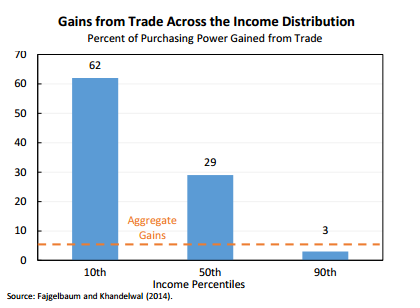
Corey Iacono Sanders ArticleIndeed, according to the President’s Council of Economic Advisers, middle income consumers have about 29 percent greater purchasing power as a result of international trade.

In other words, middle income consumers can buy 29 percent more goods and services as a result of the access to low-cost imports from foreign countries.

Low income consumers see even greater gains with 62 percent higher purchasing power as a result of trade. In contrast, the top 10 percent of income earners only saw an increase in purchasing power of 3 percent as a result of trade.

On top of that, international trade has provided benefits by bringing new and innovative products to American consumers.

According seminal research by Christian Broda of the University of Chicago and David E. Weinstein of Colombia University, the variety of imported goods increased three-fold from 1972 to 2001. The value to American consumers of this import induced expanded product variety is estimated to be equivalent to 2.6 percent of national income, about $450 billion as of 2014. That’s not exactly small change.

The spread of free trade has also made considerable contributions to environmental protection, gender equality, and global poverty reduction. As a result of the spread of clean technology facilitated by freer trade, “every 1 percent increase in income as a result of trade liberalization (the removal of government-imposed barriers to trade), pollution concentrations fall by 1 percent,” according to the Council of Economic Advisers.

The CEA also has found that “industries with larger tariff declines saw greater reductions in the [gender] wage gap,” suggesting that facilitating foreign competition through trade liberalization reduces the ability of employers to discriminate against women.

In regards to global poverty reduction, research has shown that in response to US import tariff cuts, developing countries, such as Vietnam, export more to the US, leading to higher incomes and less poverty.

Despite the large gains from trade America has already reaped, there is still room for improvement (contrary to Sen. Sanders’ accusations of “unfettered” free trade). The PIIE economists estimate that further trade liberalization would increase “US household income between $4,000 and $5,300 annually,” leading the them to conclude that, “in the future as in the past, free trade can significantly raise income — and quality of life — in the United States.”

Ultimately, the conclusion that most economists seem to reach is that, from being a disaster, the expansion of free trade has been a tremendous success, and that further trade liberalization would most likely make Americans, and the rest of the world, considerably better off.

Don’t let fear-mongering about foreigners and China scare you: free trade benefits everyone, especially the poor, while protectionism benefits only the politically powerful.

Corey Iacono is a student at the University of Rhode Island majoring in pharmaceutical science and minoring in economics. 

This article was published by The Foundation for Economic Education and may be freely distributed, subject to a Creative Commons Attribution 4.0 International License, which requires that credit be given to the author.

Ex-Im Bank is Welfare for the One Percent – Article by Ron Paul

Ex-Im Bank is Welfare for the One Percent – Article by Ron Paul

The New Renaissance Hat
Ron Paul
June 1, 2015
******************************

This month Congress will consider whether to renew the charter of the Export-Import Bank (Ex-Im Bank). Ex-Im Bank is a New Deal-era federal program that uses taxpayer funds to subsidize the exports of American businesses. Foreign businesses, including state-owned corporations, also benefit from Ex-Im Bank. One country that has benefited from $1.5 billion of Ex-Im Bank loans is Russia. Venezuela, Pakistan, and China have also benefited from Ex-Im Bank loans.With Ex-Im Bank’s track record of supporting countries that supposedly represent a threat to the US, one might expect neoconservatives, hawkish liberals, and other supporters of foreign intervention to be leading the effort to kill Ex-Im Bank. Yet, in an act of hypocrisy remarkable even by DC standards, many hawkish politicians, journalists, and foreign policy experts oppose ending Ex-Im Bank.

This seeming contradiction may be explained by the fact that Ex-Im Bank’s primary beneficiaries include some of America’s biggest and most politically powerful corporations. Many of Ex-Im Bank’s beneficiaries are also part of the industrial half of the military-industrial complex. These corporations are also major funders of think tanks and publications promoting an interventionist foreign policy.

Ex-Im Bank apologists claim that the bank primarily benefits small business. A look at the facts tells a different story. For example, in fiscal year 2014, 70 percent of the loans guaranteed by Ex-Im Bank’s largest program went to Caterpillar, which is hardly a small business.

Boeing, which is also no one’s idea of a small business, is the leading recipient of Ex-Im Bank aid. In fiscal year 2014 alone, Ex-Im Bank devoted 40 percent of its budget — $8.1 billion — to projects aiding Boeing. No wonder Ex-Im Bank is often called “Boeing’s bank.”

Taking money from working Americans, small businesses, and entrepreneurs to subsidize the exports of large corporations is the most indefensible form of redistribution. Yet many who criticize welfare for the poor on moral and constitutional grounds do not raise any objections to welfare for the rich.

Ex-Im Bank’s supporters claim that ending Ex-Im Bank would deprive Americans of all the jobs and economic growth created by the recipients of Ex-Im Bank aid. This claim is a version of the economic fallacy of that which is not seen. The products exported and the people employed by businesses benefiting from Ex-Im Bank are visible to all. But what is not seen are the products that would have been manufactured, the businesses that would have been started, and the jobs that would have been created had the funds given to Ex-Im Bank been left in the hands of consumers.

Another flawed justification for Ex-Im Bank is that it funds projects that could not attract private sector funding. This is true, but it is actually an argument for shutting down Ex-Im Bank. By funding projects that cannot obtain funding from private investors, Ex-Im Bank causes an inefficient allocation of scarce resources. These inefficiencies distort the market and reduce the average American’s standard of living.

Some Ex-Im Bank supporters claim that Ex-Im Bank promotes free trade. Like all other defenses of Ex-Im Bank, this claim is rooted in economic fallacy. True free trade involves the peaceful, voluntary exchange of goods across borders — not forcing taxpayers to subsidize the exports of politically powerful companies.

Ex-Im Bank distorts the market and reduces the average American’s standard of living in order to increase the power of the federal government and enrich politically powerful corporations. Congress should resist pressure from the crony capitalist lobby and allow Ex-Im Bank’s charter to expire at the end of the month. Shutting down Ex-Im Bank would improve our economy and benefit most Americans. It is time to kick Boeing and all other corporate welfare queens off the dole.

Ron Paul, MD, is a former three-time Republican candidate for U. S. President and Congressman from Texas.

This article is reprinted with permission from the Ron Paul Institute for Peace and Prosperity.

How Embargoes Destroy Freedom – Article by Ryan W. McMaken

How Embargoes Destroy Freedom – Article by Ryan W. McMaken

The New Renaissance Hat
Ryan W. McMaken
February 12, 2015
******************************

In the wake of the Obama administration’s partial normalization of relations with Cuba, proponents of the embargo condemned the move, with National Review publishing an unsigned editorial claiming that allowing Americans to trade freely with the island nation amounts to giving comfort to murderous dictators. NR’s editors concluded with:

The Cuban government is not legitimate, and never has been. It is a one-party dictatorship with a gulag, an archipelago of prisons into which democrats and dissidents are thrown. We hope that the new American policy — Obama’s policy — does not benefit the Cuban dictatorship and harm Cuban democrats. We fear that yesterday was a good day for the Castros and a bad day for the Cuban people, and for American foreign policy.

This is all very interesting from an international relations perspective, and there is no doubt that the Cuban regime is a brutal regime. On the other hand, why does the brutality of the Cuban regime make it alright for the US regime to jail and persecute private American citizens who attempt to trade with people in Cuba?

That is, after all, the position of those who favor the embargo. Embargoes are not something where a magic fairy waves her wand and Cuba suddenly becomes invisible to Americans.

No, supporting an embargo means supporting the government when it fines, prosecutes, and jails peaceful citizens who attempt to engage in truly free trade. Support for an embargo also requires support for a customs bureaucracy that spies on merchants and consumers, and the whole panoply of enforcement programs necessary to punish those who run afoul of the government’s arbitrary pronouncements on what kind of trade is acceptable, and what kind is verboten. Naturally, this is all paid for by the taxpayers.

How the American Federal Government Punishes Trade

To get a taste of the reality of embargoes, one need only consult the Treasury Department’s summary of the Cuban embargo as administered by the “Office of Foreign Assets Control.”

For those who think the embargo has something to do with freedom, they might wish to consult the section on punishments for trading with people in Cuba:

Criminal penalties for violating the Regulations range up to 10 years in prison, $1,000,000 in corporate fines, and $250,000 in individual fines. Civil penalties up to $65,000 per violation may also be imposed. The Regulations require those dealing with Cuba (including traveling to Cuba) to maintain records for five years and, upon request from OFAC, to furnish information regarding such dealings.

Nothing says “freedom” like $250,000 fines and mandatory presentation of five years of private records upon demand from the federal government.

Private companies, of course, regard such potentially draconian sanctions as no joke, and companies must spend time and resources training employees and business associates to be sure that they do not find themselves in violation of federal law. This manual from Snap-on Tools is one example of how private companies must stay up to date on details such as this:

The U.S. Treasury Department’s Office of Foreign Assets Control (OFAC) maintains strict embargoes banning, and lesser sanctions limiting U.S companies and their foreign subsidiaries from entering into commercial transactions with specified foreign countries, persons and business entities. Congress recently quintupled the maximum civil fines per violation of many of these sanctions from $11,000 to $50,000 (each unlawful shipment constitutes a violation), and doubled maximum potential criminal penalties assessed willful violations from 10 years to 20 years in prison. Moreover, enforcement is being given a much higher priority…

It’s easy to see why those who favor greater government intervention in the economy would have no problem with such a program, but it’s alleged defenders of free markets like the editors at National Review who appear to be most insistent that the US government keep all its agents armed and ready, and a prison cell open for anyone who violates their federal programs of choice.

Embargoes as Mercantilist Prohibition

At their heart, embargoes are nothing but a specific type of prohibition. Sometimes, the government imposes prohibitions on transactions involving certain goods, such as cannabis. Other times, the prohibition extends to all transactions with people in a certain place. The fundamentals are the same, however, in that they prohibit peaceful exchange, with heavy penalties for violators.

Moreover, embargoes are a throwback to the mercantilism of the days of yore when economic policy was viewed as a tool of international affairs, and should be designed, at least in part, to benefit the regime of the home country.

Historically, the mercantilist regimes of old tightly controlled trade opportunities which were debated as part of armistice agreements, such as the Peace of Utrech (1713) when the British were able to force the Spanish to allow exactly one ship of merchandise annually into Spanish colonies. At home, during the same era, the British state forbade its own citizens with valuable engineering knowledge from leaving the country, lest they emigrate to a foreign land and share their knowledge with foreigners. The economic needs of the state superceded those of the individual.

This is the type of economic policy that precipitated the American Revolution, when Americans in the colonies were allowed to trade with only specified nation-states and territories in such a way that was seen as advantageous to the British Crown. The freedom fighters in that conflict engaged in rampant smuggling throughout eastern North America to avoid taxes and to trade with the French and the Spanish who were hardly paragons of democratic liberalism.

Unfortunately, the Americans did not learn their lesson in the revolution, and got to work erecting their own trade restrictions by the late eighteenth century. The greatest crime of the era, however, was Thomas Jefferson’s embargo against the British which crippled the shipping and shipbuilding industries in the United States. Naturally, it was pointed out at the time that the Constitution did not permit any such action on the part of the federal government. No such quaint considerations restrain the American state or its pro-embargo allies today.

Cuba is not the only country subject to embargoes handed out by the American state, and North Korea, Iran, and Syria are in similar positions. The question is often asked as to whether or not these sanctions work. I would certainly claim that they do not work in accomplishing their stated purposes, but whether or not they work is really beside the point. Those who advocate for such embargoes need to back up a step and first prove that it is moral and legitimate for nation-states to dictate to the people who pay the bills (i.e., the taxpayers) with whom they are allowed to trade. A society that actually respects private property rights, of course, will accept no such proposition and will respect the right of private citizens to dispose of their property as they see fit. On the other hand, those who believe that it’s the prerogative of governments to micromanage private property and throw violators in prison are encouraged to move somewhere that the government can take a robust and active role in such things. Cuba, for instance.

Ryan W. McMaken is the editor of Mises Daily and The Free Market. He has degrees in economics and political science from the University of Colorado, and was the economist for the Colorado Division of Housing from 2009 to 2014. He is the author of Commie Cowboys: The Bourgeoisie and the Nation-State in the Western Genre. 
***
This article was published on Mises.org and may be freely distributed, subject to a Creative Commons Attribution United States License, which requires that credit be given to the author.
Mercantilism vs. Free Trade: The Early Years – Article by Chi-Yuen Wu

Mercantilism vs. Free Trade: The Early Years – Article by Chi-Yuen Wu

The New Renaissance Hat
Chi-Yuen Wu
September 27, 2013
******************************

Note from the Ludwig von Mises Institute (reprinted with permission, pursuant to a Creative Commons Attribution license): This selection is from Chapter II of Chi-Yuen Wu’s An Outline of International Price Theory, available in paperback and ebook editions in the Mises store.

In Chapter II, Wu discusses some early controversies in Mercantilist thought, and their effects on our thinking about free trade. It is interesting to read Wu’s summary of the debate between the interests of England-based manufacturers of clothing and the importers of clothing from the East India Company. In both cases, they are arguing from the position of special interest groups, but the arguments made by the East India Company, while not made in the spirit of any true devotion to free trade, are harbingers of later advances in our understanding of the value of free trade.

***

The overseas discoveries in the last decades of the fifteenth century had widened the boundaries of international trade and had given rise to a change in its nature and an expansion of its volume. As a result of the opening of the new silver mines between 1540 and 1600 in America, Europe was supplied with an abundance of money metals and thus the establishment of a real price economy was facilitated. That change in commerce together with the extension in the use of money accelerated the development of the new spirit of private enterprise and paved the way for the triumph of the moneyed classes. In fact, the time had come for a transition from a number of local economies to a national economy, from feudalism to commercial capitalism, from a state of comparatively little trade to an epoch of extensive international commerce. That change in the economic structure is sometimes called by economic historians the “Commerical Revolution.”

In the world of thought, that change in the economic structure found its expression in what is known as “Mercantilism.”

… First of all, all mercantilists considered the benefit of the State as the end and object of economic activities, in their view the interests of the State had always to take precedence to the interests of the individual. The aim of all mercantilistic doctrines is to increase the economic power of the State. Moreover, the interests of the state were, in their eyes, by no means necessarily in harmony with the activities of the individual. According to them, wages, interest, industry, and trade should be regulated so as to benefit the State. Finally, the importance of “treasure” to a State was greatly emphasized. The reasons given in support of their advocacy of the accumulation of the previous metals changed from one time to another, but all mercantilists agreed that a nation must try by all means to increase its “treasure.” In general, they recognized that countries which did not possess gold or silver mines could not increase their stocks of the previous metals except by an annually recurring favorable balance of trade (if peaceful means alone were adopted). Consequently, they gave foreign trade the foremost place among the industries of a nation. …

The protection versus “free trade” controversy at the end of the seventeenth century was connected with the East India trade. In the latter half of that century the imports of Indian textiles into England were increasing, especially in the last two decades. Owing to the high costs of production, the English textile industries could not withstand the competition of the Indian imports. The result was that in the last decade of the century the English woolen and silk industries faced a grave crisis. Those industries were experiencing depression and unemployment, and complaints were made by the weavers and the public in general against the East India trade.

The best spokesmen of the weavers’ interests were John Cary and John Pollexfen. Like other mercantilists, they based their contention upon the conception of the State as an economic entity and stood for a definite national economic policy for the benefit of the state. … Cary and Pollexfen … judged the benefit of trade … by the nature of the exports and imports [rather] than by their quantity and value. In other words, “that Trade is advantageous to the Kingdom … which Exports our Product and Manufactures; which Imports to us such Commodities as may be manufactured here, or to be used in making our manufactures; which supplies us with such things, without which we cannot carry on our Foreign Trade; [and] which encourages our Navigation, and increases our Seamen.”

Judged by those criteria, the East India trade was said to be harmful and not beneficial to England … [Cary and Pollexfen] no longer valued foreign trade and the treasure brought by it for their own sakes but for the effects upon home industries and trade.

The ablest upholders of the East India Company were Josiah Child and Charles Davenant. They did not deny the obvious fact that the Indian trade was detrimental to certain industries, but they maintained that the fact was not a sufficient condemnation of the East India trade.

In place of those criteria, they tried to establish a new rule for testing whether a trade is beneficial to a state or not:

The best and most certain discovery … is to be made from the encrease or diminution of our Trade and Shipping in general. … Where-ever Trade is great and continuous so, and grows daily more great and encreaseth in Shipping, and … for a succession not of a few years, but of Ages, that Trade must be nationally profitable.

Using that criterion and facts that they had adduced to show that the East India trade had promoted the general prosperity of the nation, they were able to make out a case for the view that the East India trade was beneficial to the country.

Negatively, they tried to show that the proposal to prohibit the wearing of all Indian imported textiles in England would be detrimental to the nation.

However, they could not do so without sacrificing some part of their mercantilistic doctrines and approaching the doctrine of free trade. The following quotations perhaps sufficiently reveal their main arguments:

Trade is in its nature free, finds its own channel, and best directeth its own course: and all laws to give it rules and directions, and to limit and circumscribe it, may serve the particular ends of private men, but are seldom advantageous to the public.

For all trades have a mutual dependence one upon the other, and one begets another, and the loss of one frequently loses half the rest.

It should be noted they were not free traders at heart. They advocated leaving trade free from restraints only in so far as the argument served the purpose of their Company and their views constitute a mere case of special pleading.

Author Description from the Ludwig von Mises Bookstore:

Greatness often comes from the most unlikely corners. Chi-Yuen Wu began this treatise while a student at London School of Economics during the Great Depression, then returning to an anxious China, on the verge of war, and in the throes of economic instability, finished it from the remoteness of Western China after being displaced from his home.

Wu looked at the history of economic thought as a way to explain what was happening and why. Lionel Robbins, in the Preface, says “Few, can read his penetrating commentaries without feeling that he has added substantially to knowledge, both in his elucidations and in his presentation of the general perspective of development.”

Murray Rothbard considered Outlines of International Price Theories to be a seminal contribution to the theory of price and international trade.

Review of Gary Wolfram’s “A Capitalist Manifesto” – Article by G. Stolyarov II

Review of Gary Wolfram’s “A Capitalist Manifesto” – Article by G. Stolyarov II

The New Renaissance Hat
G. Stolyarov II
January 5, 2013
******************************

While Dr. Gary Wolfram’s A Capitalist Manifesto is more an introduction to economics and economic history than a manifesto, it communicates economic concepts in a clear and entertaining manner and does so from a market-friendly point of view. Wolfram’s strengths as an educator stand out in this book, which could serve as an excellent text for teaching basic microeconomics and political economy to all audiences. Wolfram is a professor of economics at Hillsdale College, whose course in public-choice economics I attended. The book’s narration greatly resembles my experience of Wolfram’s classroom teaching, which focuses on the essence of an idea and its real-world relevance and applications, often utilizing entertaining concrete examples.

The book begins with several chapters on introductory microeconomics – marginal analysis, supply, demand, market equilibrium, opportunity cost, and the effects of policies that artificially prevent markets from clearing. The middle of the book focuses on economic history and political economy – commenting on the development of Western markets from the autarkic, manorial system of the feudal Middle Ages, through the rise of commerce during the Early Modern period, the Industrial Revolution, the emergence of corporations, and the rise in the 20th century of economic regimentation by national governments. One of the strengths of this book is its treatment of the benefits of free trade, from its role in progress throughout history to the theoretical groundwork of Ricardian comparative advantage. Enlightening discussions of constitutionalism and the classical idea of negative liberty are also provided. Wolfram introduces the insights of Ludwig von Mises regarding the infeasibility of central planning in solving the problem of economic calculation, as well as Friedrich Hayek’s famous “knowledge problem” – the dispersion of information among all the individuals in an economy and the impossibility of a central planner assembling all the information needed to make appropriate decisions. Wolfram further articulates the key insights of Frederic Bastiat: the seen versus the unseen in economic policy, the perils of coercive redistribution of wealth, the immorality of using the law to commit acts which would have been unacceptable if done by private individuals acting alone, and the perverse incentives created by a system where the government is able to dispense special privileges to a select few.

The latter third of the book focuses on such areas as money, inflation, and macroeconomics – including an exposition of the Keynesian model and its assumptions. Wolfram is able to explain Keynesian economics in a more coherent and understandable manner than most Keynesians; he thoroughly understands the theories he critiques, and he presents them with fairness and objectivity. I do, however, wish that the book had delved more thoroughly into a critique of Keynesianism. The discussion therein of the Keynesian model’s questionable assumptions is a good start, and perhaps a gateway to more comprehensive critiques, such as those of Murray Rothbard and Robert Murphy. A layperson reading A Capitalist Manifesto would be able to come out with a fundamental understanding of Keynes’s central idea and its assumptions – but he would not, solely as a result of this book, necessarily be able to refute the arguments of Keynes’s contemporary followers, such as Joseph Stiglitz and Paul Krugman. Wolfram mentions critiques of Keynesianism by Milton Friedman and the monetarist school, the concept of rational expectations precipitating a move away from Keynesianism in the late 1970s, and the “supply-side” interpretations of the Keynesian model from the 1980s. However, those viewpoints are not discussed in the same level of detail as the basic Keynesian model.

More generally, my only significant critique of A Capitalist Manifesto is that it is too brief in certain respects. It offers promising introductions to a variety of economic ideas, but leaves some significant questions arising from those areas unanswered. Wolfram introduces the history and function of the corporation but does not discuss the principal-agent problem in large, publicly traded firms with highly dispersed ownership. To anticipate and answer (and perhaps partially acknowledge the validity of) criticisms of the contemporary corporate form of organization, commentary on how this problem might be overcome is essential. Wolfram explains the components and computation of Gross Domestic Product and the Consumer Price Index but devotes only a small discussion to critiques of these measures – critiques that are particularly relevant in an electronic age, when an increasing proportion of valuable content – from art to music to writing to games – is delivered online at no monetary cost to the final consumer. How can economic output and inflation be measured and meaningfully interpreted in an economy characterized partially by traditional money-for-goods/services transactions and partially by the “free” content model that is funded through external sources (e.g., donations or the creators’ independent income and wealth)? Moreover, does Wolfram’s statement that the absence of profit (sufficient to cover the opportunity cost) would result in the eventual decline of an enterprise need to be qualified to account for new models of delivering content? For instance, if an individual or firm uses one income stream to support a different activity that is not itself revenue- or profit-generating, there is a possibility for this arrangement to be sustainable in the long term if it is also justified by perceived non-monetary value.

Wolfram’s discussion of inflation is correct and forms a strong link between inflation and the quantity of money (government-issued fiat money these days) – but I would have wished to see a more thorough focus on Ludwig von Mises’s insight that new money does not enter the economy to equally raise everybody’s incomes simultaneously; rather, the distortion due to inflation comes precisely from the fact that some (the politically favored) receive the new money and can benefit from using it while prices have not yet fully adjusted. (This can be logically inferred from Wolfram’s discussion of some of the “tools” of the Federal Reserve, which directly affect the incomes of politically connected banks – but I wish the connection to Mises’s insight had been made more explicit.) Wolfram does mention that inflation can be a convenient tool for national governments to reduce their debt burdens, and he also discusses the inflationary role of fractional-reserve banking and “tools” available to central banks such as the Federal Reserve. However, Wolfram’s proposed solutions to the problems of inflation remain unclear from the text. Does he support Milton Friedman’s proposal for a fixed rate of growth in the fiat-money supply, or does he advocate a return to a classical gold standard – or perhaps to a system of market-originated competing currencies, as proposed by Hayek? It would also have been interesting to read Wolfram’s thoughts on the prospects and viability of peer-to-peer and digital currencies, such as Bitcoin, and whether these could mitigate some of the deleterious effects of central-bank-generated inflation.

Wolfram does discuss in some detail the sometimes non-meritocratic outcomes of markets – stating, for instance, that “boxers may make millions of dollars while poets make very little.” Indeed, it is possible to produce far more extreme comparisons of this sort – e.g., a popular “star” with no talent or sense earning millions of dollars for recording-studio-hackneyed “music” while genuinely talented classical musicians and composers might earn relatively little, or even have their own work remain a personal hobby pursued for enjoyment alone. To some critics of markets, this may well be the reason to oppose them and seek some manner of non-market compensation for people of merit. For a defender of the unhampered market economy, a crucial endeavor should be to demonstrate that truly free markets (unlike the heavily politicized markets of our time) can tend toward meritocracy in the long run, or at least offer people of merit a much greater range of possibilities for success than exists under any other system. Another possible avenue of exploration might be the manner in which a highly regimented political system (especially in the areas of education) might result in a “dumbed-down” culture which neglects and sometimes outright opposes intellectual and esthetic sophistication and the ethic of personal productivity which is indispensable to a culture that prizes merit. Furthermore, defenders of markets should continually seek out ways to make the existing society more meritocratic, even in the face of systemic distortions of outcomes. Technology and competition – both of which Wolfram correctly praises – should be utilized by liberty-friendly entrepreneurs to provide more opportunities for talented individuals to demonstrate their value and be rewarded thereby.

Wolfram’s engaging style and many valid and enlightening insights led me to desire more along the same lines from him. Perhaps A Capitalist Manifesto will inspire other readers to ask similar questions and seek more market-friendly answers. Wolfram provides a glossary of common economic terms and famous historical figures, as well as some helpful references to economic classics within the endnotes of each chapter.  A Capitalist Manifesto will have its most powerful impact if readers see it as the beginning of their intellectual journey and utilize the gateways it offers to other writings in economics and political economy.

Disclosure: I received a free copy of the book for the purposes of creating a review.

Buy Team America? – Article by Gary M. Galles

Buy Team America? – Article by Gary M. Galles

The New Renaissance Hat
Gary M. Galles
August 18, 2012
*****************************

Samuel Johnson once wrote that “patriotism is the last refuge of a scoundrel,” criticizing adverse policies and proposals falsely claimed to be based in patriotism. This has been most recently illustrated by the political furor over “made-in-China” Team USA uniforms. Many politicians asserted that it was un-American, with Senate Majority Leader Harry Reid saying those uniforms should be burned. Supposedly patriotic pressures to mandate “buying American” sprang up immediately, and Ralph Lauren quickly capitulated, promising to “go and sin no more.”

While some of the details of this flap are unusual, protectionism dressed up as patriotism follows a well-worn script.

Imports are found to cause some domestic harm. Given that those imports harm competing domestic producers, “Buy American” or some other version of protectionism is put forth as the patriotic response (with the producers seeking protection from superior competitors leading the patriotism bandwagon). The Team USA version simply exploits the Olympics’ peak in pro-American sentiment and symbolism to make the same case (though it makes no more sense than requiring that we grow our own coffee and bananas for our athletes).

The problem is that imports always harm competing domestic producers, so that the patriotism argument can always be used as political cover whenever any domestic producers get the government’s ear. And there are always politicians ready to listen.

One person who recognized the abuses and illogic of this approach was Leonard Read. In particular, his chapter “Buy American,” in Having My Way (1974), lays out a better way to approach the issue.

The admonition to “Buy American” has two diametrically opposed meanings. The first is its popular and mischievous meaning — shun goods produced in foreign countries. The second, and loftier meaning embodied in these words, is rarely mentioned or thought of — shun principles and practices alien to the American dream of limited government and personal freedom.

Producers who plead with consumers to “Buy American” are appealing to blind patriotism. Buy my product because it is made here; heed not its price or quality. This is sheer chauvinism. Suppose I were to urge your acceptance of my ideas, rather than those of Marx or Machiavelli, merely because of our differing nationalities. The absurdity of such an appeal is obvious: neither goods nor ideas are properly judged in this fashion; geographical origin has nothing to do with the matter.

Read points out that that the traditional use of “Buy American” is to justify some citizens beggaring their own neighbors, rather than something that advances any sensible interpretation of our general welfare. However, there is an interpretation that does advance our general welfare. Don’t buy (i.e., accept and make use of) actions that violate the American principle of freedom to choose your own productive associations, as long as you don’t violate the common, inalienable rights of others.

Read recognizes that whether a principle is true or not has nothing to do with where it comes from (i.e., ad hominem or “against-the-man” attacks do nothing to invalidate something that is true, although you wouldn’t know it from political rhetoric). As a result, he offers an excellent way to test whether some supposed general principle is valid — change “Buy USA” to “Buy Chinese” or “Buy Mexican,” and ask if Americans would accept the proposition as true based on their patriotism. If it is really a general principle, it is as valid for others in their dealings with us as their potential suppliers as it is for us in dealing with them as our potential suppliers, and the answer would not change. We would support others’ protectionism just as much as our own. But if it is really special pleading, rather than a general principle, people’s answers would change, as when people hypocritically attack other countries for their protectionism at the same time we defend ours as principled.

Read also recognized that the extent of protectionism is far vaster than most people recognize.

All obstacles to competition, be they foreign or domestic, are but variants of this theme.

The difference between a ban on buying a foreign country’s products and imposing tariffs, quotas, or any of a host of nontariff barriers is only one of degree. Whether it benefits or harms Americans does not change; only the degree of such benefit or harm. Similarly, change “Buy American” to “Buy Local,” as with locavore campaigns in agriculture, and the logic is equally invalid.

Such protectionism goes well beyond international trade, as well.

Change the wording to “Buy Union,” as with project labor agreements and prevailing (higher-than-competitive) wage laws, and the logic is the same. Union members are protected from the competition of other workers who would work for less. But that protection not only harms nonunion workers; it also harms customers, whose costs are increased.

Price controls are also protectionism. For example, a minimum wage protects other workers from competing with those who would be willing to work for less, but it harms both those denied their most productive employment and consumers.

The vast majority of antitrust cases are also forms of protectionism. They are not brought by consumers, who generally gain from the practices involved, but by outcompeted rivals who want to take away others’ advantages — advantages passed on to customers. Those outcompeted rivals don’t want potential customers to go elsewhere — and use antitrust to restrict consumers’ ability to access superior options.

A vast array of licensing schemes follows the same pattern. They hide behind masks of quality or safety but primarily keep new competitors out and keep those who would offer lower-quality–lower-price options some customers would prefer from doing so.

Leonard Read offers a powerful solution, powerfully illustrated by America’s own past.

Enough of this mischievous notion. Let us try instead to appreciate and “buy” the American ideal of freedom.

Ralph Waldo Emerson had this to say: “America is another name for opportunity. Our whole history appears like a last effort of divine Providence in behalf of the human race.”

As to the best in political economy, consider the Constitution of the United States. Regardless of its several flaws, no other nation’s charter has equaled it in an economic sense.

In what respect is this distinctively American? Here is the answer: “No state shall without the consent of the Congress, lay any imposts on imports and exports … “

In a nutshell, no tariffs, quotas, embargoes between the several states…the world has never known a free trade area as large as the U.S.A. when measured in value of goods and services produced and exchanged. Never perfectly free, but the nearest approximation to freedom!

In other words, the freedom to associate for productive purposes however and with whomever one chooses, because people were protected from many of the violations of that principle that governments have imposed throughout history, was the essence of the American miracle. And at its heart, as Thomas Jefferson wrote, was “the first principle of association, the guarantee to everyone the free exercise of his industry and the fruits acquired by it.”

Further, Read’s focus on America’s free internal trade offers a counterpoint to a frequent misinterpretation. Those who defend protectionism as a valid principle claim that it was the protectionism adopted by the United States in the form of tariffs that advanced our staggering early economic success. While it is true that import tariffs were imposed, and eventually dramatically raised (see the history of the “Tariff of Abominations” as an example), that was not the source of our success any more than hurdles — which slow running speeds — should be given credit for increasing running speeds because hurdlers are fast. The reality is that the positive impact of our massive internal free-trade zone and other constitutional restrictions on government interference far outweighed the negative impact of international-trade restrictions.

Read then addresses one particular common defense of protectionism: the “infant-industry” argument that free trade may be good in general, but that industries must be protected until they can grow to a scale where they can compete, which amounts to a claim that the benefits of freedom require restricting the freedom that generates them.

In reality, it is competition which protects “infant industries” — it protects them from stagnation and persuades them to grow.

In the absence of competition and freedom of transactions, producers stagnate. It is only when others are doing better that one attempts to overcome, to gain strength. Competition, combined with free exchange, makes strong giants out of weak infants — this is the password to economic opportunity and well-being — an American idea well worth buying.

Read recognized that from the perspective of consumers it is the competition that takes place without artificial assistance or restriction that expands their options the most. It does not matter whether competition leads to a foreign producer who offers better terms because of superior efficiencies or if that producer is American. So there is no reason to artificially nurture American infant industries (which often claim to be infants virtually forever), because it is the results of real superiority that benefit consumers, and artificially tilting the playing field only inhibits the process that best discovers and passes on the gains of such superiority.

Read next turns to another test that rejects the logic of protectionism. If we accepted protectionism in principle, we would be for it in all cases. But, as he notes, we are all free traders when it benefits us. In other words, we recognize that we gain from free trade, except when we are the one benefitted by special treatment — necessarily at others’ even greater costs — by those restrictions. We abandon our own revealed preference for freedom only when bribed by receiving some of what is essentially stolen from others.

Regardless of all the noisy arguments to the contrary, everyone known to me favors both competition and free trade. Name one who does not favor competition among those from whom he buys. Logically, then, how can one favor competition among millions of others and be against it for himself! This is irrationality, not disagreement.

Precisely the same can be said for free trade — domestic or foreign. Name one who would not welcome an order for his products from another country or county. Everyone favors exports. Imports? Favoring exports and objecting to imports is the same as favoring selling and objecting to being paid. This is an absurdity, not disagreement.

Leonard Read realized that the logic of protectionism is riddled with errors and that the practice of protectionism, in its myriad forms, is theft that impoverishes everyone except those bribed by the gains of their protected status and those whose political clout greases those transactions. It is a far cry from either liberty or justice for all. Read’s conclusion:

What then is meant by “Buy American” in its proper sense? Let willing exchange prevail among all people, locally and worldwide. Let each buyer or seller be guided by his own scale of values. Sell the American way and buy the American way — not as presently practiced, but as once prevailed and ought to be reinstituted. Keep ours the land of opportunity for everyone.

Gary M. Galles is a professor of economics at Pepperdine University. Send him mail. See Gary Galles’s article archives.

You can subscribe to future articles by Gary Galles via this RSS feed.

Copyright © 2012 by the Ludwig von Mises Institute. Permission to reprint in whole or in part is hereby granted, provided full credit is given.