Browsed by
Tag: freedom

The Costs of Hysteria: How Economists are Misleading the Public on Climate-Change Policy – Article by Robert P. Murphy

The Costs of Hysteria: How Economists are Misleading the Public on Climate-Change Policy – Article by Robert P. Murphy

The New Renaissance Hat
Robert P. Murphy
May 5, 2015
******************************

Suppose the “scientific consensus” on climate change is right. Let’s also stipulate, for the sake of argument, that the computer projections used by the United Nations and the US government are correct, and that economists are able to translate those data into meaningful projections about costs and benefits to people living in the future with climate change.

Despite what the public has been led to believe, the situation is not a crisis at all — and certainly not something that demands drastic government actions to avert serious damage to the environment. In fact, implementing the wrong policy can cause far more damage than it can prevent.

It’s understandable that the public has no idea of the real state of the literature on climate change policy, because even professional economists use utterly misleading rhetoric in this arena. To show what I mean, first, let’s quote from a recent Noah Smith Bloomberg article, which urges left-liberals to support the Trans-Pacific Partnership (TPP) trade deal:

One of the bigger economic issues under debate right now is the Trans-Pacific Partnership (TPP), the multilateral trade deal that would include most countries in the Asia-Pacific region as well as the US. Many people both here and abroad are suspicious of trade deals, while economists usually support them. This time around, however, the dynamic is a little bit different — the TPP is getting some pushback from left-leaning economists such as Paul Krugman.

Krugman’s point is that since US trade is already pretty liberalized … the effect of further liberalization will be small.… I’m usually more of a free-trade skeptic than the average economist.… But in this case, I’m strongly on the pro-TPP side. There are just too many good arguments in favor.

University of California-Berkeley economist Brad DeLong does some quick back-of-the-envelope calculations, and estimates that the TPP would increase the world’s wealth by a total of $3 trillion. Though that’s not a big deal in the grand scheme of things, it’s one of the best reforms that’s feasible in the current polarized political situation. (emphasis added)

To summarize the flavor of Smith’s discussion, he thinks the TPP is “one of the bigger economic issues” today, and that its potential windfall to humanity of $3 trillion is “not a big deal in the grand scheme of things” but certainly worth pursuing if attainable. Krugman disagrees with Smith’s assessment, but their differences are clearly quibbles over numbers and strategies; it’s not as if Smith thinks Krugman is a “Ricardo denier” or accuses Krugman of hating poor Asians by opposing the trade deal.

We get a much different tone if instead we look at Smith discussing climate-change policy. For example, in June 2014, Smith wrote a Bloomberg piece on five ways to fight global warming. In the interest of brevity, let me simply quote Smith’s concluding paragraph:

If we do these five things, then the US can still save the world from global warming, even though we’re no longer the main cause of the problem. And the short-run cost to our economy will be very moderate. Saving the world on the cheap sounds like a good idea to me. (emphasis added)

Clearly, there is a chasm in the rhetoric between Smith’s two Bloomberg pieces. When discussing the TPP, it’s an honest disagreement between experts over a trade agreement that Smith thinks is definitely worthwhile, but in the grand scheme is not that big a deal. In contrast, government policies concerning climate change literally involve the fate of the planet.

At this point, most readers would wonder what the problem is. After all, isn’t man-made climate change a global crisis? Why shouldn’t Smith use much stronger rhetoric when describing it?

I am making this comparison because according to one of the pioneers in climate-change economics, William Nordhaus, even if all governments around the world implemented the textbook-perfect carbon tax, the net gain to humanity would be … drumroll please … $3 trillion. In other words, one of the world’s experts on the economics of climate change estimates that the difference to humanity between (a) implementing the perfect carbon-tax policy solution and (b) doing absolutely nothing was about the same difference as DeLong estimated when it comes to the TPP.

To be more specific, the $3 trillion Nordhaus estimate comes from the 2008 calibration of his Dynamic Integrated Climate-Economy (DICE) model. (The numbers have gone up since then, but I studied his 2008 calibration in great detail.) Note that this isn’t some “denier” computer simulation, rejected by the serious scientists. On the contrary, Nordhaus’s DICE model was one of only three chosen by the Obama administration when it set up a working group to estimate the monetary damages of carbon dioxide emissions. To help the reader understand the trade-offs humanity faces when it comes to climate change, let me reproduce table 4 from my Independent Review article that critically evaluated Nordhaus’s model:    
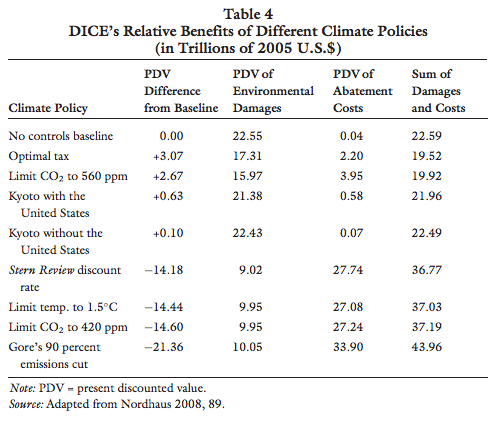
The table shows Nordhaus’s estimates (made in 2008 based on the “consensus” scientific assessments of the time) of the net benefits of various possible governmental climate policy approaches. The first row shows what happens if governments do nothing. There will be $22.55 trillion (in present value terms, and quoted in 2005 dollars) of environmental damage, but virtually no economic costs of complying with regulations, for a total harm of $22.59 trillion.

In contrast, if governments around the world implemented Nordhaus’s recommended “optimal” carbon tax, the world would be spared a little more than $5 trillion in future environmental damage, while future economic output would be $2.2 trillion lower due to complying with the carbon tax. Adding it all up, humanity would suffer total harms of $19.52 trillion, meaning the world would be $3.07 trillion wealthier with the optimal, global carbon tax (because $22.59 − $19.52 = $3.07).

Central to the economic way of thinking is the concept of trade-offs. Every possible policy — including a policy of doing nothing — comes with costs. But the public tends to hear about only one set of costs, not the full array. For example, as the earlier table shows, the wrong climate policy can be much, much worse than doing nothing. Nordhaus evaluated Al Gore’s suggestion to cut emissions by 90 percent, and estimated that it would make humanity some $21 trillion poorer compared to the do-nothing baseline — a net harm seven times greater than the net benefits of the textbook-optimal approach.

My point here is not to trumpet Nordhaus’s numbers as being gospel. (My Independent Review article was a full-blown critique of his model.) Rather, I am pointing out that even one of the leading models that underpins the so-called consensus on climate-change activism shows that this is hardly the planetary crisis that the rhetoric of Smith and others would suggest. The actual numbers are in the same ballpark as those of trade deals — and nobody thinks the fate of the planet hangs on the passage of a trade deal.

More generally, what even most economists have failed to convey to the public is that climate-change policies at best will affect things on the margin. Nordhaus’s table beautifully illustrates this. The optimal carbon tax doesn’t eliminate the climate-change damage that his computer simulations predict. On the contrary, the carbon tax only reduces it from about $23 trillion down to $17 billion. The reason it doesn’t make sense to enact a more aggressive carbon tax is that the (marginal) harm to the conventional economy would exceed the (marginal) environmental benefit. There are several policies in the table that reduce environmental damage below the $17 trillion mark, but they hurt the economy so much more that, on net, they are inferior approaches.

It is understandable that noneconomists would fail to employ marginal analysis and would engage in overblown rhetoric when discussing something as controversial as climate-change policy. However, too many professional economists have also fallen into this bad habit, including not just Smith but also Krugman and many others.

Robert P. Murphy has a PhD in economics from NYU. He is the author of The Politically Incorrect Guide to Capitalism and The Politically Incorrect Guide to The Great Depression and the New Deal.

This article was originally published by The Foundation for Economic Education and may be freely distributed, subject to a Creative Commons Attribution 4.0 International License, which requires that credit be given to the author.

Speaking Truth to Power: Jimmy Lai – Article by Lawrence W. Reed

Speaking Truth to Power: Jimmy Lai – Article by Lawrence W. Reed

The New Renaissance Hat
Lawrence W. Reed
May 4, 2015
******************************

For years, a bust of John James Cowperthwaite sat prominently in the foyer of Jimmy Lai’s Next Media office in Hong Kong, along with others of economists F.A. Hayek and Milton Friedman. If that’s all you ever knew about Jimmy Lai, you could at least surmise that he loves liberty and free markets.

Cowperthwaite had been the architect of Hong Kong’s free-market miracle. He started with a destitute rock and turned it into one of the world’s freest and most prosperous economies. (Indeed, I’ve suggested that he deserves to be recognized annually and everywhere with a Cowperthwaite Day on the anniversary of his birthdate, April 25.) Jimmy Lai is precisely the sort of individual that Cowperthwaite had in mind when he decided that entrepreneurs, not central planners, should drive an economy. Because of what Cowperthwaite had done, Jimmy Lai found a hero himself. And Lai, too, would go on to do great things.

Of the characteristics most often identified with successful entrepreneurship, Jimmy Lai possesses them all in abundance. He is a self-starter who takes initiative (and risk) with enthusiasm. He’s creative and intuitive. He’s passionate and tenacious. Where others see problems, he sees opportunity. He’s a visionary, both in business endeavors and for society at large. He doesn’t hesitate to defy conventional wisdom when it points to a dead end. Whatever he undertakes, he musters the courage to act. He puts his all — money, time, and energy — where his mouth is (and where his convictions are).

On paper, Lai’s early life would seem unlikely to produce a “real hero.” He was born in China the year before it fell under Mao Zedong’s dictatorial rule. Lai was smuggled out of the country and into Hong Kong at age 12. In the absence of child-labor laws, which would have ensured his deprivation there, too, Lai went to work in a garment factory for $8 a month. Fifteen years later, he bought his own garment factory and built it into the giant known as Giordano, now a leading international retailer. Lai’s boundless entrepreneurial zeal, free to operate within Hong Kong’s laissez-faire business environment, yielded jobs for thousands and consumer goods for millions.

But in 1989, Beijing’s infamous Tiananmen Square massacre set Jimmy Lai on a new course. With Hong Kong scheduled to be transferred from British to Chinese rule in just eight years, Lai knew that maintaining traditional freedoms under Beijing’s rule would be a challenge. So he ventured into media, creating what soon became the territory’s largest-circulation magazines, Sudden Weekly and Next. In spite of Beijing’s coercion of advertisers, Jimmy Lai’s tabloid-style newspaper, Apple Daily, is still the premier voice in Asia for the freedoms of speech, press, and enterprise.

Jimmy Lai does not shrink from controversy. The Communist Party of China, he wrote in a 1994 column, is “a monopoly that charges a premium for a lousy service.” He defended the student demonstrators when they went into the streets by the hundreds of thousands in late 2014 in defense of democracy. He routinely exposed corruption in both government and business, including the especially toxic brand of corruption that arises when the two get in bed together. He sold Giordano, the apparel firm he founded, to save it from Beijing’s intense pressure, but he refuses to this day to renounce his principles.

In December 2014, he revealed that he was stepping down as publisher of Apple Daily and chairman of Next Media to devote more time to family and personal interests. A month later, and for the second time, unknown assailants firebombed his home. He remains under intense scrutiny from Beijing, which regularly employs ugly rumors, threats of litigation, and other nefarious means to undermine his influence.

Earlier this year, Lai told the New York Times that he never planned to make his media empire into a family dynasty. His six children (ages 8 to 37) are not in line as heirs to that business or its leadership positions. “I don’t think I should ask my kids to inherit my business, because they can’t start where I did,” he said. “I was from the street. I’m a very different make of person. I’ve been a fighter all my life.”

Whatever the future holds for Jimmy Lai, friends of liberty everywhere can count him as one very brave man.

For additional information:

In the Freeman:

Lawrence W. (“Larry”) Reed became president of the Foundation for Economic Education (FEE) in 2008. Prior to that, he was a founder and president for twenty years of the Mackinac Center for Public Policy in Midland, Michigan. He also taught Economics full-time and chaired the Department of Economics at Northwood University in Michigan from 1977 to 1984.

He holds a B.A. degree in Economics from Grove City College (1975) and an M.A. degree in History from Slippery Rock State University (1978), both in Pennsylvania. He holds two honorary doctorates, one from Central Michigan University (Public Administration—1993) and Northwood University (Laws—2008).

This article was originally published by The Foundation for Economic Education and may be freely distributed, subject to a Creative Commons Attribution 4.0 International License, which requires that credit be given to the author.
USA FREEDOM Act: Just Another Word for Lost Liberty – Article by Ron Paul

USA FREEDOM Act: Just Another Word for Lost Liberty – Article by Ron Paul

The New Renaissance Hat
Ron Paul
May 4, 2015
******************************
Apologists for the National Security Agency (NSA) point to the arrest of David Coleman Headley as an example of how warrantless mass surveillance is necessary to catch terrorists. Headley played a major role in the 2008 Mumbai terrorist attack that killed 166 people.While few would argue that bringing someone like Headley to justice is not a good thing, Headley’s case in no way justifies mass surveillance. For one thing, there is no “terrorist” exception in the Fourth Amendment. Saying a good end (capturing terrorists) justifies a bad means (mass surveillance) gives the government a blank check to violate our liberties.
***

Even if the Headley case somehow justified overturning the Fourth Amendment, it still would not justify mass surveillance and bulk data collection. This is because, according to an investigation by ProPublica, NSA surveillance played an insignificant role in catching Headley. One former counter-terrorism official said when he heard that NSA surveillance was responsible for Headley’s capture he “was trying to figure out how NSA played a role.”

The Headley case is not the only evidence that the PATRIOT Act and other post-9/11 sacrifices of our liberty have not increased our security. For example, the NSA’s claim that its surveillance programs thwarted 54 terrorist attacks has been widely discredited. Even the president’s Review Group on Intelligence and Communications Technologies found that mass surveillance and bulk data collection was “not essential to preventing attacks.”

According to the congressional Joint Inquiry into Intelligence Activities before and after the Terrorist Attacks of September 11, 2001 and the 9/11 Commission, the powers granted the NSA by the PATRIOT Act would not have prevented the 9/11 attacks. Many intelligence experts have pointed out that, by increasing the size of the haystack government agencies must look through, mass surveillance makes it harder to find the needle of legitimate threats.

Even though mass surveillance threatens our liberty, violates the Constitution, and does nothing to protect us from terrorism, many in Congress still cling to the fiction that the only way to ensure security is to give the government virtually unlimited spying powers. These supporters of the surveillance state are desperate to extend the provisions of the PATRIOT Act that are set to expire at the end of the month. They are particularly eager to preserve Section 215, which authorizes many of the most egregious violations of our liberties, including the NSA’s “metadata” program.

However, Edward Snowden’s revelations have galvanized opposition to the NSA’s ongoing violations of our liberties. This is why Congress will soon vote on the USA FREEDOM Act. This bill extends the expiring surveillance laws. It also contains some “reforms” that supposedly address all the legitimate concerns regarding mass surveillance.

However, a look at the USA FREEDOM Act’s details, as opposed to the press releases of its supporters, shows that the act leaves the government’s mass surveillance powers virtually untouched.

The USA FREEDOM Act has about as much to do with freedom as the PATRIOT Act had to do with patriotism. If Congress truly wanted to protect our liberties it would pass the Surveillance State Repeal Act, which repeals the PATRIOT Act. Congress should also reverse the interventionist foreign policy that increases the risk of terrorism by fostering resentment and hatred of Americans.

Fourteen years after the PATRIOT Act was rushed into law, it is clear that sacrificing liberty does little or nothing to preserve security. Instead of trying to fool the American people with phony reforms, Congress should repeal all laws that violate the Fourth Amendment, starting with the PATRIOT Act.

Ron Paul, MD, is a former three-time Republican candidate for U. S. President and Congressman from Texas.

This article is reprinted with permission from the Ron Paul Institute for Peace and Prosperity.

A Portrait of the Classical Gold Standard – Article by Marcia Christoff-Kurapovna

A Portrait of the Classical Gold Standard – Article by Marcia Christoff-Kurapovna

The New Renaissance Hat
Marcia Christoff-Kurapovna
April 15, 2015
******************************

“The world that disappeared in 1914 appeared, in retrospect, something like our picture of Paradise,” wrote the economist Cecil Hirsch in his June 1934 review of R.W. Hawtrey’s classic, The Art of Central Banking (1933). Hirsch bemoaned the loss of the far-sighted restraint that had once prevailed among the “bankers’ banks” of the West, concluding that modern times “had failed to attain the standard of wisdom and foresight that prevailed in the 19th century.”That wisdom and foresight was once upon a time institutionalized throughout an international monetary culture — gold-based, wary of credit, and contemptuous of debt, public or private. This world included central banks including the Bank of England, the Bank of France, the Swiss National Bank, the early Federal Reserve, the Imperial Bank of Austria-Hungary, and the German Reichsbank. But the entrenched hard-money ideology of the time restrained all of them. The Bank of Russia, for example, which once required 50 percent to 100 percent gold backing of all notes issued, possessed the second largest gold reserves on the planet at the turn of the twentieth century.

“The countries that were tied together in the gold standard system represented to a not inconsiderable degree a community of interest in and responsibility for the maintenance of economic and financial stability throughout the world,” recounted Aldoph C. Miller, member of the Federal Reserve Board from 1914 to 1936, in The Proceedings of the Academy of Political Science, in May 1936. “The gold standard was the one outstanding symbol of unity and economic solidarity which the nineteenth century world had developed.”

It was a time when “automatic market forces,” as economists of the day referred to them, prevailed over monetary management. Redeemability of money in (fine) gold ensured, within limits, stability in foreign exchange rates. Credit was extended only as far as reserve ratios would allow, and central banks were required to keep fixed reserves of gold against notes-in-circulation and against demand deposits.

When Markets Dominated Monetary “Policy”

Gold flows regulated international price relationships through markets, which adjusted themselves accordingly: prices rose when there was an influx of gold — for example, when one country received a debt payment from another country (always in gold), or during such times as the California or Australian gold rushes of the 1870s. These inflows meant credit expansion and a rise in prices. An outflow of gold meant credit was contracted and price deflation followed.

The efficiency of that standard was not impeded by the major central banks in such a way that “any disturbance of economic or financial character originating at any point in the world which might threaten the continued maintenance of economic equilibrium was quickly detected by foreign exchanges,” Miller, the Federal Reserve board member, noted in his paper. “In this way, the gold standard system became in a very real sense a regime or rule of economic health, a method of catching economic disturbances in the bud.”

The Bank of England, the grand master of them all, was the financial center of the universe, whose tight handle on its credit policies was so disciplined that the secured the top spot while not even holding the largest gold reserves. Consistent in its belief that protection of reserves was the chief, and only important, criterion of credit policy, England became the leading exporter of capital, the free market for gold, the international discount market, and international banker for the trade of other countries, as well as her own. The world was in this sense on the sterling standard.

The Bank of France, wisely admonished by its founder, Napoleon, to make sure France was always a creditor country, was so replete with reserves it made England a 500 million franc loan (in 1915 numbers) at the onset of the World War I. Switzerland, perhaps the last “19th-century-style” hold-out today with unlimited-liability private bankers and strict debt-ceiling legislation, also required high standards of its National Bank, founded in 1907. By the 1930s that country had higher banking reserves than the US; the Swiss franc was never explicitly devalued, unlike nearly every other Western nation’s currency, and the country’s domestic price level remained the most stable in the world.

For a time, the disciplined mindset of these banks found its way across the Atlantic, where the idea of a central bank had been long the subject of hot debate in the US. The economist H. Parker Willis, writing about the controversy in The Journal of the Proceedings of the Academy of Political Science, October 1913, admonished: “The Federal Reserve banks are to be ‘bankers’ banks,’ and they are intended to do for the banker what he himself does for the public.”

At first, the advice was heeded: in September 1916, almost two years after its founding on December 23,1913, the fledgling Fed worked out an amendment to its gold policy on the basis of a very conservative view of credit. This new policy sought to restrain “the undue and unnecessary expansion of credit,” wrote Fed board member Miller, in an article for The American Economic Review, in June 1921.

The Bank of Russia, during the second half of the nineteenth century steered itself through the Crimean War, the Russo-Turkish War, the Russo-Japanese War, impending Balkan wars — not to mention all that was to follow — and managed to emerge with sound fiscal policies and massive gold reserves. According to The Economist of May 20, 1899, Russian holdings were 95 million pounds sterling of gold, while the Bank of France held 78 million sterling worth. (Austria-Hungary held 30 million sterling worth of gold and the Bank of England 30 million sterling worth of both gold and silver.) “Russia up to the very moment of rupture [with Japan, 1904–1905], was working imperturbably at the progressive consolidation of her finances,” reported Karl Helfferich of the University of Berlin, at a meeting of The Royal Economic Society [UK] in December 1904. “Even in years of industrial crises and defective harvest, her foreign trade showed an excess of exports over imports more than sufficient to compensate payments sent abroad. And, as guarantee her monetary system she has succeeded in a amassing and maintaining a vast reserve of gold.”

These banks, in turn, drew on the medieval/Renaissance and Baroque-era banking traditions of the Hanseatic League, the Bank of Venice, and Amsterdam banks. Payment-on-demand “in good and heavy gold” was like a blood-oath binding the banker-client relationship. The transfer of credit “did not arise from any such substitution of credit for money,” noted Charles F. Dunbar, in The Quarterly Journal of Economics of April 1892, “but from the simple fact that the transfer in-bank saved the necessity of counting coin and manual delivery of every transaction.”

Bankers were forbidden to deal in certain commodities, could not make loans or create credit for the purchase of such commodities, and forbade both foreigners and citizens from buying silver on credit unless the same amount in cash was in the bank. According to Dunbar, a Venetian law of 1403 on reserve requirements became the basis of US banking law on the deposits of public securities in the late 1800s.

After the fall of bi-metallism in the 1870s, gold continued to perform monetary functions among the main countries of the Western world (and the well-administered Bank of Japan). It was the only medium of exchange and the only currency with unrestricted legal tender. It became the vaunted “measure of value.” Bank currency notes were simply used as auxiliary to gold and, in general, did not enjoy the privilege of legal tender.

The End of An Era

It was certainly not a flawless system, or without periodic crises. But central banks had to act in an exceptionally prudent manner given the all-over public distrust of paper money.

As economist Andrew Jay Frame of the University of Chicago, writing in The Journal of Political Economy, in January 1912, noted: “During panics in Britain in 1847 and 1866, when cash payments were suspended, the floodgates of cash were opened [by The Bank of England], the governor sent word to the street that solvent banks would be accommodated, and the panic was relieved.” Frame then adds: “However, this extra cash and the increased loans that went with it were very quickly put to an end to avoid credit expansion.”

The US was equally confident of its prudent attitude. Aldoph Miller, writing of Federal Reserve policy, remarked: “The three chief elements of the policy of a central bank or system of reserve holding institutions are best disclosed in connection with the attitude towards 1) gold 2) currency 3) credit.” He noted proudly: “The federal reserve system has met [these] tests on the whole with remarkable success.”

But after World War I, a different international landscape was left behind. England had been displaced as the center of international finance; the US and France emerged as the chief post-war creditor countries. The mechanism of the gold standard to which depreciated currencies could be related no longer existed. Only the US was left with a full gold standard. England and France had a gold bullion standard and other countries (Germany, primarily) had a gold-exchange standard.

A matrix of unbalanced trade relationships began to saturate the international economy. Then, with so many foreign countries attendant upon its speculative boom, the US manipulated its own domestic credit policies to ease credit and exchange-standard controls. This eventually culminated in an international financial crisis of 1931. Under Bretton Woods (1944), the gold standard was effectively abandoned: domestic convertibility was illegal and the role of gold was very constrained in favor of the dollar.

“It was, at least in theory, simple enough in the old days,” wrote a wistful W. Randolph Burgess, head of the New York Federal Reserve, in 1938. “In the present strange new world, where the old gold portents have lost their former meaning, where is the radio beam which the central banker may follow? What is the equivalent of gold?”

The men of his era and of the late nineteenth century understood the meaning of such a question and, more importantly, why it is one that must be asked. But theirs was a different world, indeed — one without “QE,” ZIRP,” or “Unknown Knowns” as fiscal policy. And there were no helicopters, either.

Marcia Christoff-Kurapovna is at work on the biography of a prominent European head of state and businessman.  Her work has appeared in such publications as The Wall Street Journal, The Economist and Foreign Affairs.

This article was originally published by the Ludwig von Mises Institute. Permission to reprint in whole or in part is hereby granted, provided full credit is given.

The Ukrainian Regime’s Censorship Spreads West to Canada, and Political Correctness is to Blame – Article by G. Stolyarov II

The Ukrainian Regime’s Censorship Spreads West to Canada, and Political Correctness is to Blame – Article by G. Stolyarov II

The New Renaissance Hat
G. Stolyarov II
April 14, 2015
******************************

There is nothing friendly to liberty or to Western values about the government of Petro Poroshenko and Arseniy Yatseniuk in Ukraine – a regime completely incapable of understanding the principle of individual rights or the freedoms of speech, property, and conviction that this principle entails. The Ukrainian government has just enacted a law prohibiting the private expression of Communist symbols and ideology, while elevating to “national hero” status the Ukrainian Insurgent Army of Stepan Bandera, who collaborated with the Nazi army during World War II and committed systematic acts of genocide against Russian, Belarusian, Polish, and Jewish civilians. Bandera serves as an explicit inspiration for the neo-Nazi Right Sector paramilitary organization, whose fighters have been documented by Amnesty International to have committed extensive war crimes against civilians in the Donbass region, and whose leader Dmytro Yarosh now holds a prominent position as advisor to the Ukrainian Commander-in-Chief.

Criticism of Bandera and his Ukrainian Insurgent Army is now illegal in Ukraine. According to UaPosition, a Ukrainian website aimed at informing non-Ukrainians about Ukraine, the text of the law legitimizing Bandera’s thugs reads as follows: “Public denial of the legitimacy of the struggle for the independence of Ukraine in the twentieth century [is] recognized [as an] insult to the memory of fighters for independence of Ukraine in the XX century [and as] disparagement of the Ukrainian people and is illegal.”

As David Boaz put it, “One difference between libertarianism and socialism is that a socialist society can’t tolerate groups of people practicing freedom, but a libertarian society can comfortably allow people to choose voluntary socialism.” No libertarian or even remotely quasi-libertarian society would censor the expression of even the most strident socialist or communist viewpoints. On the other hand, legal censorship of opposing viewpoints was indeed a hallmark of the former Soviet Union. A government that attempts to censor the ideas that, at least ostensibly, animated Soviet policies, becomes just a mirror image of the Soviet regime by adopting the very same policies in essence. In addition, the Ukrainian regime has prohibited films alleged to “glorify” the Russian military and has imprisoned journalists and activists who criticized military conscription, such as Ruslan Kotsaba.

The Poroshenko/Yatseniuk government has assumed the worst characteristics of the former USSR regime without any of its few decent attributes. By validating both historical genocidal ethnic nationalism and its neo-Nazi successor movements, the Ukrainian regime has departed from one of the most important admirable aspects of the post-1941 USSR: its adamant opposition to Nazism and to the plethora of ethnically tinged fascist movements that arose in the wake of Hitler’s invasions of Eastern Europe. Indeed, one of the reasons why so many Soviet subjects of diverse ethnicities acquiesced to the tyranny of Stalin and his successors was the fact that the Soviet regime did act to protect them against the worse threat of genocide by Hitler and his petty nationalist allies. The prohibition on criticism of the Banderites is, in the eyes of many Ukrainians, Russians, and Belarusians, a prohibition on criticism of the armed gangs who murdered or tried to murder their grandparents.

Even more troubling, however, is that the zeal of “pro-Ukrainian” activists in the West is creating a chilling effect on speech and criticism of the Ukrainian regime even in Canada. Valentina Lisitsa, a world-renowned pianist born in Ukraine who became a US citizen and is currently residing in Paris, has become the latest victim of the campaign to silence those who disagree with militant Ukrainian nationalism. Lisitsa’s performances of classical compositions (see and hear examples here, here, here, and here) are completely apolitical and have attracted tens of millions of views on her YouTube channel. She was due to play Rachmaninoff’s Concerto #2 (earlier recordings are here, here, and here) at the Toronto Symphony Orchestra, before her appearance was cancelled at the behest of anonymous Ukrainian nationalist activists, who also fueled a social-media outcry against Lisitsa. The reason? Lisitsa posted on her Twitter account satirical, often scathing criticism of the Ukrainian government and its war against separatists in the Donbass – specifically condemning the neo-Nazi and genocidal strains among the Ukrainian government’s paramilitary supporters. She has remained steadfast in defending her posts as free expression – and rightfully so, as her liberty to express her views does not require those views or the manner of their expression to be inoffensive or universally agreeable to all. Furthermore, any manner of words or imagery she used pales in comparison to the real deaths of over 6,000 civilians (and likely many more) in the Donbass, many at the hands of the Ukrainian army and its allied “volunteer” paramilitary battalions. Lisitsa was outraged at the people and policies that brought about the deaths of these innocents, and she was right to proclaim her outrage.

But whether or not one agrees with Lisitsa or with the manner in which she expressed her views, her performance of Rachmaninoff had no relationship to any of her political activities – and none of her other classical performances over the course of many years had even the remotest political aspect. By successfully pressuring the Toronto Symphony Orchestra to cancel Lisitsa’s appearance, the Ukrainian nationalist activists recreated in Canada the same politicization of classical music for which Stalin’s Soviet Union was infamous. Some of the most innovative 20th-century composers – including Sergei Prokofiev, Dmitri Shostakovich, and Aram Khachaturian – were often victims of Stalin’s denunciations and sometimes came perilously close to imprisonment or worse. In a free society, it is generally recognized that a person’s artistic prowess and political positions are separate matters unless the artist wishes to intentionally combine the two – as, for instance, in a work of explicitly politically motivated art. Preventing the performance of art that is inherently apolitical, on the grounds of the artist’s outside political activities, creates a chilling effect on both art and peaceful political activism. Artists, fearing that their livelihoods would be denied to them if they became too vocal about current events and ran afoul of one pressure group or another, would be incentivized to stick only to bland, uncontroversial statements or avoid discussing any subjects where significant disagreements might arise. Art would suffer, as works of technical and esthetic merit would become more difficult for audiences to access, given that anybody with controversial political views would be shut out of the talent pool.

The cultural reign of political correctness in the West further exacerbates the threat of the chilling effect on art and speech. The political repression of art in the contemporary West would come not from a top-down decree by a government, but rather due to any sufficiently vocal special interest claiming to be “offended” – not just by an idea contrary to its own agenda, but by the whole person expressing that idea. It then becomes the case that no Stalin is necessary – but the effect is the same: ideologically motivated threats cowing artists into acquiescence to the popular political agenda of the day. A person can become widely denounced, blacklisted, and shut out from opportunities that should be determined by artistic merit alone – not due to any conspiracy, but rather because the typical, middle-of-the-road decision makers in private as well as public institutions become fearful of the special interests’ ire. Political correctness is not primarily a problem of governments, but rather a problem of a deeply broken societal and intellectual culture, where not giving offense is prioritized over the pursuit of truth and justice. In the case of Lisitsa, as usual, the politically correct prohibition on offense results in the most offensive possible ideologies having a free hand to shut down dissenting views. What “offended” fundamentalist Islam has been able to perpetrate in shutting down debate in Europe for over a decade, “offended” Ukrainian nationalism is beginning to inflict in Canada now, often with the vociferous support of media commentators crusading against “hate speech” – a phrase which can mean anything they want it to mean.

The Ukrainian nationalists are able to export their agenda of censorship and intimidation to the West as parasites taking advantage of a weakened host. Political correctness is the disease that renders Western public discourse vulnerable to their arguments, while endangering the vital critical voices who need to be heard in order to prevent a tragic Western-led escalation of the Ukrainian civil war. It seems that the only way the Ukrainian regime and its nationalist allies will be able to render Ukraine more Western is to render the West more like Ukraine. We in the West need to strengthen our defenses and develop an immunity against this incursion of illiberalism by reaffirming the values of individual rights, open discourse and debate on controversial ideas, free expression of dissenting views, and resistance to the dependence of art on political orthodoxy.

The New Militarism – Who Profits? – Article by Ron Paul

The New Militarism – Who Profits? – Article by Ron Paul

The New Renaissance Hat
Ron Paul
April 14, 2015
******************************
Militarism and military spending are everywhere on the rise, as the new Cold War propaganda seems to be paying off. The new “threats” that are being hyped bring big profits to military contractors and the network of think tanks they pay to produce pro-war propaganda. Here are just a few examples:
***

The German government announced last week that it would purchase 100 more “Leopard” tanks – a 45 percent increase in the country’s inventory. Germany had greatly reduced its inventory of tanks as the end of the Cold War meant the end of any threat of a Soviet ground invasion of Europe. The German government now claims these 100 new tanks, which may cost nearly half a billion dollars, are necessary to respond to the new Russian assertiveness in the region. Never mind that Russia has neither invaded nor threatened any country in the region, much less a NATO member country.

The US Cold War-era nuclear bunker under Cheyenne Mountain, Colorado, which was all but shut down in the 25 years since the fall of the Berlin Wall, is being brought back to life. The Pentagon has committed nearly a billion dollars to upgrading the facility to its previous Cold War-level of operations. US defense contractor Raytheon will be the prime beneficiary of this contract. Raytheon is a major financial sponsor of think tanks like the Institute for the Study of War, which continuously churn out pro-war propaganda. I am sure these big contracts are a good return on that investment.

NATO, which I believe should have been shut down after the Cold War ended, is also getting its own massively expensive upgrade. The Alliance commissioned a new headquarters building in Brussels, Belgium, in 2010, which is supposed to be completed in 2016. The building looks like a hideous claw, and the final cost – if it is ever finished – will be well over one billion dollars. That is more than twice what was originally budgeted. What a boondoggle! Is it any surprise that NATO bureaucrats and generals continuously try to terrify us with tales of the new Russian threat? They need to justify their expansion plans!

So who is the real enemy? The Russians?

No, the real enemy is the taxpayer. The real enemy is the middle class and the productive sectors of the economy. We are the victims of this new runaway military spending. Every dollar or euro spent on a contrived threat is a dollar or euro taken out of the real economy and wasted on military Keynesianism. It is a dollar stolen from a small business owner that will not be invested in innovation, spent on research to combat disease, or even donated to charities that help the needy.

One of the most pervasive and dangerous myths of our time is that military spending benefits an economy. This could not be further from the truth. Such spending benefits a thin layer of well-connected and well-paid elites. It diverts scarce resources from meeting the needs and desires of a population and channels them into manufacturing tools of destruction. The costs may be hidden by the money-printing of the central banks, but they are eventually realized in the steady destruction of a currency.

The elites are terrified that peace may finally break out, which will be bad for their profits. That is why they are trying to scuttle the Iran deal, nix the Cuba thaw, and drum up a new “Red Scare” coming from Moscow. We must not be fooled into believing their lies.

Ron Paul, MD, is a former three-time Republican candidate for U. S. President and Congressman from Texas.

This article is reprinted with permission from the Ron Paul Institute for Peace and Prosperity.

Little Free Libraries: A Love Letter – Article by Sarah Skwire

Little Free Libraries: A Love Letter – Article by Sarah Skwire

The New Renaissance Hat
Sarah Skwire
February 14, 2015
******************************
Still falling for the written word, despite America’s killjoys

The Little Free Library movement began in 2009 when Todd Bol built a miniature model schoolhouse, put it on a post in his front yard, filled it with books, and put up a sign stating, “Free Books.” It was a way to honor his mom — a former school teacher — and to share his love of reading with his neighborhood. The idea took off, and now there are thousands of Little Free Libraries.

The idea is simple. You put a small book box up on a post in your front yard, stock it with books, and people who are passing by on the way to the park, or the mailbox, or the ice cream store, or the coffee shop grab a book, read it, and return it later. Or maybe they keep it and replace it with one of their own. It’s a quiet way of building community and of sharing the pleasure of books with your neighbors. It’s simple. It’s something one person can do to make a difference.

So, naturally, people want to shut it down.

Shreveport, Louisiana, recently declared Little Free Libraries to be “commercial enterprises,” which cannot operate in residential zones. Whitefish Bay, Wisconsin, told citizens that Little Free Libraries could only be put in backyards — which completely destroys the whole idea of offering books to casual passers-by. Leawood, Kansas, made a nine-year-old take down his Little Free Library until the town council managed to pass an emergency moratorium that allowed him to return it to his yard. As soon as the Little Free Libraries go up, it seems, some killjoy finds them annoying and wants them taken down.

I know a lot of words. I’m not sure I have any that are harsh enough for people who want to stop others from making it easy and pleasant and fun and free to bring a book into your life.

Maybe that’s because I remember almost nothing that happened before the day I learned to read. But I do remember the day I learned. I was 3 1/2. My brother had just started kindergarten and was learning how to read. In the grand tradition of annoying little sisters everywhere, I immediately insisted on doing the same. So my earliest clear memories are of sitting cross-legged on the kitchen floor while Mom loaded the dishwasher and listened to me sound out Arnold Lobel’s Small Pig one slow and painstaking phoneme at a time.

Vacuum.

Cement.

The words were difficult. But I was stubborn, and Mom was patient.

Over the course of two weeks or so, I read the whole book. By myself.

Having figured out the general principle, I assumed I could read anything and everything. And so I did. I stayed up past midnight to finish the Wizard of Oz because I had to make sure that Dorothy got home okay. I sat on the sidelines at recess, reading. I walked into more than a few walls, reading. And the local library should probably have named a wing after me because I racked up so many late fees on books I just couldn’t bear to give back.

Miserable and lonely middle school years were leavened by friends in books and by fantasy novels about escapes to other worlds. Heartbreaks in high school were softened by Jane Austen’s wit and by the greater tragedies in Edith Wharton’s House of Mirth and Theodore Dreiser’s Sister Carrie. Well-thumbed, borrowed paperbacks of Interview with the Vampire and Forever Amber provided another kind of education. And college? And graduate school? Orgies of the written word.

I loved all of it. I still love all of it. From the most erudite and complex poetry to comic books and genre fiction to (when I’m really stuck) the text on the back of the cereal box, my first and best and longest-lasting romance has been with the written word.

It started with Small Pig. It started on the kitchen floor. I fell in love, and I have never stopped falling.

And because I am so smitten, I want everyone else to be. I write this column and post on Facebook and annoy my friends by evangelizing about my latest book obsessions because I want a world of people whose minds and lives and hearts are changed by reading. I want a world of people who have the chance to have the experience that Quilliam founder Maajid Nawaz had when he read Orwell. Reading, he realized that if the jihadis with whom he was allied ever achieved their goals, “they would be the Islamist equivalent of Animal Farm.” I want a world of people who find books that overturn everything they think is true and that challenge them to become better.

I want a world of people who do what Yeon-mi Park did. After escaping North Korea, she “read and read and read, even when I didn’t know what I was reading.” She read Orwell, too, and found that “it made complete sense to me. I was still so angry and hateful at this time because of the way I’d been treated.” Reading Gandhi and Mandela, she says, taught her compassion to balance that anger.

And because I want that world — a world where we exchange books and ideas peacefully and productively — the people who began and spread the Little Free Library movement are some of my heroes.

So I thought I’d write them a love letter.

Happy Valentine’s Day.

Sarah Skwire is a fellow at Liberty Fund, Inc. She is a poet and author of the writing textbook Writing with a Thesis.
***
This article was originally published by The Foundation for Economic Education.
How Embargoes Destroy Freedom – Article by Ryan W. McMaken

How Embargoes Destroy Freedom – Article by Ryan W. McMaken

The New Renaissance Hat
Ryan W. McMaken
February 12, 2015
******************************

In the wake of the Obama administration’s partial normalization of relations with Cuba, proponents of the embargo condemned the move, with National Review publishing an unsigned editorial claiming that allowing Americans to trade freely with the island nation amounts to giving comfort to murderous dictators. NR’s editors concluded with:

The Cuban government is not legitimate, and never has been. It is a one-party dictatorship with a gulag, an archipelago of prisons into which democrats and dissidents are thrown. We hope that the new American policy — Obama’s policy — does not benefit the Cuban dictatorship and harm Cuban democrats. We fear that yesterday was a good day for the Castros and a bad day for the Cuban people, and for American foreign policy.

This is all very interesting from an international relations perspective, and there is no doubt that the Cuban regime is a brutal regime. On the other hand, why does the brutality of the Cuban regime make it alright for the US regime to jail and persecute private American citizens who attempt to trade with people in Cuba?

That is, after all, the position of those who favor the embargo. Embargoes are not something where a magic fairy waves her wand and Cuba suddenly becomes invisible to Americans.

No, supporting an embargo means supporting the government when it fines, prosecutes, and jails peaceful citizens who attempt to engage in truly free trade. Support for an embargo also requires support for a customs bureaucracy that spies on merchants and consumers, and the whole panoply of enforcement programs necessary to punish those who run afoul of the government’s arbitrary pronouncements on what kind of trade is acceptable, and what kind is verboten. Naturally, this is all paid for by the taxpayers.

How the American Federal Government Punishes Trade

To get a taste of the reality of embargoes, one need only consult the Treasury Department’s summary of the Cuban embargo as administered by the “Office of Foreign Assets Control.”

For those who think the embargo has something to do with freedom, they might wish to consult the section on punishments for trading with people in Cuba:

Criminal penalties for violating the Regulations range up to 10 years in prison, $1,000,000 in corporate fines, and $250,000 in individual fines. Civil penalties up to $65,000 per violation may also be imposed. The Regulations require those dealing with Cuba (including traveling to Cuba) to maintain records for five years and, upon request from OFAC, to furnish information regarding such dealings.

Nothing says “freedom” like $250,000 fines and mandatory presentation of five years of private records upon demand from the federal government.

Private companies, of course, regard such potentially draconian sanctions as no joke, and companies must spend time and resources training employees and business associates to be sure that they do not find themselves in violation of federal law. This manual from Snap-on Tools is one example of how private companies must stay up to date on details such as this:

The U.S. Treasury Department’s Office of Foreign Assets Control (OFAC) maintains strict embargoes banning, and lesser sanctions limiting U.S companies and their foreign subsidiaries from entering into commercial transactions with specified foreign countries, persons and business entities. Congress recently quintupled the maximum civil fines per violation of many of these sanctions from $11,000 to $50,000 (each unlawful shipment constitutes a violation), and doubled maximum potential criminal penalties assessed willful violations from 10 years to 20 years in prison. Moreover, enforcement is being given a much higher priority…

It’s easy to see why those who favor greater government intervention in the economy would have no problem with such a program, but it’s alleged defenders of free markets like the editors at National Review who appear to be most insistent that the US government keep all its agents armed and ready, and a prison cell open for anyone who violates their federal programs of choice.

Embargoes as Mercantilist Prohibition

At their heart, embargoes are nothing but a specific type of prohibition. Sometimes, the government imposes prohibitions on transactions involving certain goods, such as cannabis. Other times, the prohibition extends to all transactions with people in a certain place. The fundamentals are the same, however, in that they prohibit peaceful exchange, with heavy penalties for violators.

Moreover, embargoes are a throwback to the mercantilism of the days of yore when economic policy was viewed as a tool of international affairs, and should be designed, at least in part, to benefit the regime of the home country.

Historically, the mercantilist regimes of old tightly controlled trade opportunities which were debated as part of armistice agreements, such as the Peace of Utrech (1713) when the British were able to force the Spanish to allow exactly one ship of merchandise annually into Spanish colonies. At home, during the same era, the British state forbade its own citizens with valuable engineering knowledge from leaving the country, lest they emigrate to a foreign land and share their knowledge with foreigners. The economic needs of the state superceded those of the individual.

This is the type of economic policy that precipitated the American Revolution, when Americans in the colonies were allowed to trade with only specified nation-states and territories in such a way that was seen as advantageous to the British Crown. The freedom fighters in that conflict engaged in rampant smuggling throughout eastern North America to avoid taxes and to trade with the French and the Spanish who were hardly paragons of democratic liberalism.

Unfortunately, the Americans did not learn their lesson in the revolution, and got to work erecting their own trade restrictions by the late eighteenth century. The greatest crime of the era, however, was Thomas Jefferson’s embargo against the British which crippled the shipping and shipbuilding industries in the United States. Naturally, it was pointed out at the time that the Constitution did not permit any such action on the part of the federal government. No such quaint considerations restrain the American state or its pro-embargo allies today.

Cuba is not the only country subject to embargoes handed out by the American state, and North Korea, Iran, and Syria are in similar positions. The question is often asked as to whether or not these sanctions work. I would certainly claim that they do not work in accomplishing their stated purposes, but whether or not they work is really beside the point. Those who advocate for such embargoes need to back up a step and first prove that it is moral and legitimate for nation-states to dictate to the people who pay the bills (i.e., the taxpayers) with whom they are allowed to trade. A society that actually respects private property rights, of course, will accept no such proposition and will respect the right of private citizens to dispose of their property as they see fit. On the other hand, those who believe that it’s the prerogative of governments to micromanage private property and throw violators in prison are encouraged to move somewhere that the government can take a robust and active role in such things. Cuba, for instance.

Ryan W. McMaken is the editor of Mises Daily and The Free Market. He has degrees in economics and political science from the University of Colorado, and was the economist for the Colorado Division of Housing from 2009 to 2014. He is the author of Commie Cowboys: The Bourgeoisie and the Nation-State in the Western Genre. 
***
This article was published on Mises.org and may be freely distributed, subject to a Creative Commons Attribution United States License, which requires that credit be given to the author.
The Importance of Free Speech to Human Progress – Article by Iain Murray

The Importance of Free Speech to Human Progress – Article by Iain Murray

The New Renaissance Hat
Iain Murray
January 10, 2015
******************************

From Principia Mathematica to Charlie Hebdo


The massacre of 12 cartoonists and journalists at Charlie Hebdo magazine in Paris this week should remind us to ask: Why is free speech so important?

It is more than an inalienable individual right; it is fundamental to human progress. That is why it is one of the most important institutions of liberty.

When we look at the history of the freedom of speech in the West, we see that early on it was tied up with the freedom of the press, which is why the terms are used interchangeably in American constitutional theory. Yet, for most of the West’s history, the idea of “publishing” was meaningless. Books were copied by hand, first by scribes hired by Roman nobles to copy books they liked, then by monks in medieval scriptoria, with the more ancient texts copied as practice for copying the more important religious texts. As a result, many texts were lost, with others surviving by mere chance.

Having assumed the role of guardian of learning, the medieval church was ill-disposed toward innovations that threatened its position. The suppression of early English versions of the Bible is a case in point. Information traveled slowly, impeding the progress of intellectual innovation.

The printing press changed all that, as it brought about the first series of real struggles over freedom of speech. Ideas could travel more quickly, and literacy exploded.

As people could finally read the Bible for themselves, Reformation movements grew all over Europe. Then they took to using the press to spread other ideas. In response, the church and its allies in positions of power took steps to restrain this new free press. In fact, early copyright law arose from efforts to regulate the production of printers.

It should not surprise us that early libertarians were often printers. “Freeborn John” Lilburne was first arrested for printing and circulating unlicensed books.

The great poet John Milton wrote perhaps the first great defense of free speech when the English republican Parliament reintroduced censorship via the Licensing Order of 1643 (censorship had effectively been abolished in 1640 along with the Star Chamber, which tried Lilburne). In his Areopagitica, Milton passionately demanded freedom of the press and tolerance of heterodox publications, saying, “Give me the liberty to know, to utter, and to argue freely according to conscience, above all liberties.”

The licensing order lapsed in 1694 as a result of the Glorious Revolution of 1685, which instituted a more liberal constitution in England and helped to inspire the American Revolution — and eventually the Bill of Rights and First Amendment. But the Areopagitica is still with us. Fittingly, the US Supreme Court cited it as an authority on the inherent value of false statements in the landmark case New York Times v. Sullivan:

Even a false statement may be deemed to make a valuable contribution to public debate, since it brings about “the clearer perception and livelier impression of truth, produced by its collision with error.” Mill, On Liberty (Oxford: Blackwell, 1947), p. 15; see also Milton, Areopagitica, in Prose Works (New Haven, CT: Yale, 1959), vol. 2, p. 561.

The free press opened new communication channels for theoretical innovation. It is often noted that Sir Isaac Newton was born the day Galileo died. What enabled Newton to take Galileo’s experiments and turn them into modern physics was the printing press. Newton published Principia Mathematica in 1687, and revised it in 1713 and 1726. The book was published by the Royal Society, founded in Oxford in 1660, which essentially invented peer review (see this here fascinating series of videos on the society’s role in the invention of modern science). Newton’s book spread throughout Europe, which would not have been possible under earlier regimes where printing was tightly controlled.

Central to the principle of a free press is the right to be wrong — which enables peer review and criticism in the first place. It is also central to scientific and technological innovation and experimentation, and therefore also central to economic progress, which has led to the great explosion in human welfare we have seen over the last two centuries. Free speech allows more ideas to “have sex,” to use Matt Ridley’s phrase, and that is why societies that are frightened by the consequences of this ideological sexual revolution are those with the most severe censorship laws.

At this point, one might argue that it is absurd to compare a “blasphemous” cartoon to the Principia Mathematica. But that would be a mistake. As Stephen Law has written for the Center for Inquiry, the point of such cartoons is not to cause offense, but something far greater:

More often than not, the lampooning is done with intention of shattering, if only for a moment, the protective façade of reverence and deference that has been erected around some iconic figure or belief, so that we can all catch a glimpse of how things really are.

It is exactly that goal — to help us determine what actually is, rather than what is simply asserted — that free speech and free inquiry make possible. As an institution of liberty, free speech must be defended wherever it is attacked. (My colleague Hans Bader has written elsewhere about letting down our guard.) Those who seek to suppress free speech want to keep mankind mired in poverty and ignorance, subject to their own whims and beliefs. They cannot be allowed to succeed.

Iain Murray is vice president at the Competitive Enterprise Institute.

This article was originally published by The Foundation for Economic Education.

Freedom Encourages Goodwill to All – Article by Bradley Doucet

Freedom Encourages Goodwill to All – Article by Bradley Doucet

The New Renaissance Hat
Bradley Doucet
December 18, 2014
******************************
“Christopher Hitchens on libertarians: ‘I have always found it quaint and rather touching that there is a movement in the U.S. that thinks Americans are not yet selfish enough.'”

A friend posted the above statement on Facebook a few weeks ago, along with a photo of the late Christopher Hitchens, and added the following comment of his own: “He was often a complete idiot (being a contrarian was his fatal, childish flaw), but in this case, he’s right on target.” I couldn’t help myself; I responded, no doubt unhelpfully, that although Hitchens was always an entertaining writer, he was as childishly wrong about this as he could possibly be.

In the spirit of the season, let me take a few moments here to try to be a bit more helpful. First of all, to clarify, far from thinking that Americans are not yet selfish enough, libertarians think that human beings are not yet free enough, whether they live in Bangor, Maine or Bangladesh. Whether you use the greater liberty libertarians want you to have to help your fellow man or to go off and live in the woods by yourself is strictly speaking immaterial. Freedom makes you free; what you do with that freedom is up to you, and has nothing really to do with libertarianism.

To be fair to Hitchens, though, there are some libertarians who explicitly endorse a form of selfishness, and these are probably the people to whom he was referring. They are fans and followers of Objectivism, the philosophy of Ayn Rand. Provocatively enough, Rand wrote a book entitled The Virtue of Selfishness, so part of the blame falls on her shoulders for preferring provocation over clarity. Because the selfishness to which this title alludes is more properly called rational or enlightened self-interest.

As anyone who has actually read Rand’s work will confirm, the selfishness that she advocated amounts to saying: Your life belongs to you. It does not belong to your parents, or your neighbour, or your honourable representatives in government. It is yours to live as you see fit. But as a direct and explicit corollary, neither does your neighbour’s life belong to you. Neither a slave nor a master be.

The alternative to dealing with other human beings through the use of force, as masters and slaves, is to deal with each other voluntarily, as traders, offering value for value. If your self-interested end is to become rich, the only way to do so while respecting the code of honour promulgated by Ayn Rand is to offer other people something they want and are willing to pay you for. What a rotten, selfish bitch, eh?

In fact, liberating people to enrich themselves through trade and innovation, and assigning dignity to this pursuit of material plenty, is precisely what has made large swaths of the world so fabulously wealthy by historical standards. Criticizing the “selfishness” of honest, hard-working, creative people who just want to improve their lot—as did a feature on the rise of China in this weekend’s Globe and Mail—therefore risks undoing the great material progress of modern civilization.

The notion that forcing people to be less self-interested would promote anything but resentment is really difficult for me to wrap my head around, Hitch’s wisecracks notwithstanding. If we want to promote a feeling of goodwill to all, we need to let people be free to enrich themselves by providing value to others. Only to the extent that we come to see each other primarily as sources of value rather than as threats to our security, as traders rather than as masters and slaves, will we approach that other Christmas ideal: peace on Earth.

Bradley Doucet is Le Québécois Libre‘s English Editor and the author of the blog Spark This: Musings on Reason, Liberty, and Joy. A writer living in Montreal, he has studied philosophy and economics, and is currently completing a novel on the pursuit of happiness.