Browsed by
Tag: G. Stolyarov II

“Protein Folding for Life Extension” Open Badges for Folding@home Participation – Post by G. Stolyarov II

“Protein Folding for Life Extension” Open Badges for Folding@home Participation – Post by G. Stolyarov II

The New Renaissance Hat
G. Stolyarov II
June 8, 2014
******************************

I am pleased to offer five levels of Open Badges as rewards for contributing computing power to the Folding@home project at http://folding.stanford.edu/, which enables anyone in the world to devote computational resources to protein-folding simulations that help advance the fight against a multitude of diseases – such as Alzheimer’s Disease, Parkinson’s Disease, and many cancers. The Longevity Meme Folding@home team seeks to promote increased participation in Folding@home as one way to combat disease and help dramatically lengthen human lifespans within our lifetimes, with the goal of enabling humans to live lives without any upper limit.

These badges were designed by the artist and illustrator Wendy Stolyarov and is issued by  The Rational Argumentator, in conjunction with LongeCity and the Longevity Meme Folding@home team.

You can store these digital badges and share them via Mozilla Backpack to display your achievements to others. The following are the qualifying criteria for each badge:

Level 1: 5,000 points earned on Folding@home;

Level 2: 10,000 points earned on Folding@home;

Level 3: 50,000 points earned on Folding@home;

Level 4: 100,000 points earned on Folding@home;

Level 5: 500,000 points earned on Folding@home.

To request a badge, simply send an e-mail to gennadystolyarovii@gmail.com. Include your user name on Folding@home so that your points earned could be verified. You can earn a badge no matter what team you are on, if any, as everyone’s commitment of resources to the protein-folding effort helps the prospects of indefinite life extension. However, you are also encouraged to join The Longevity Meme team in order to help improve its ranking and raise public awareness of the effort life-extension activists are putting into the fight against disease.

Level 1 Folder - Protein Folding for Life Extension

Level 2 Folder - Protein Folding for Life Extension

Level 1 Folder - Protein Folding for Life Extension

Level 4 Folder - Protein Folding for Life Extension

Level 5 Folder - Protein Folding for Life Extension

Life-Extension Activism Opportunities for All – Article by G. Stolyarov II

Life-Extension Activism Opportunities for All – Article by G. Stolyarov II

The New Renaissance Hat
G. Stolyarov II
June 5, 2014
******************************

You do not need to be a biologist or medical doctor to help hasten the arrival of indefinite life extension. An important array of activist endeavors, which are laying the groundwork for the eventual achievement of unlimited lifespans, can be implemented by anybody. They range from giving out books to playing games to simply running one’s computer – all the while making important contributions to scientific progress and the receptiveness of the general culture to the feasibility and desirability of indefinite longevity.

If you want to glimpse the possibilities in 90 seconds, watch my recent video, “What Anyone Can Do to Advance Indefinite Life Extension”.

In this article, I offer a more detailed overview of some immediately available activism options that anyone can pursue. The time commitment involved in each ranges from minimal to modest, but virtually any of them can fit into the schedule of anyone who recognizes the value of this amazing life we have and the importance of prolonging it as far as possible.

Movement for Indefinite Life Extension (MILE)

MILE_Logo
The Movement for Indefinite Life Extension (MILE) is not a formal organization, but rather a coalition of activists working toward the common goal of achieving indefinite lifespans for people alive today. The MILE coordinates projects and shares articles, images, and news stories via its Facebook group – also accessible using the URL http://themile.info. One of the MILE’s major purposes is to raise awareness of the feasibility and desirability of indefinite life extension and to create a critical mass of support for this most vital of goals. The number of “likes” on the MILE Facebook page is a concise indicator of the movement’s reach, and the eventual goal of the MILE is to achieve 8 million likes by July 17, 2017. Following an incremental approach, the MILE seeks to raise its support by an order of magnitude each year. The goal of 800 supporters was readily exceeded prior to July 17, 2013, and the MILE has launched a concerted effort to reach its Year 2 goal of 8,000 supporters by July 17, 2014. Eric Schulke, who spearheads and coordinates the efforts of the MILE, has launched the MILE Year 2 Goal Fundraiser to fund hundreds of dollars of Facebook advertisements that have already shown success in spreading the message of indefinite life extension to new demographics.

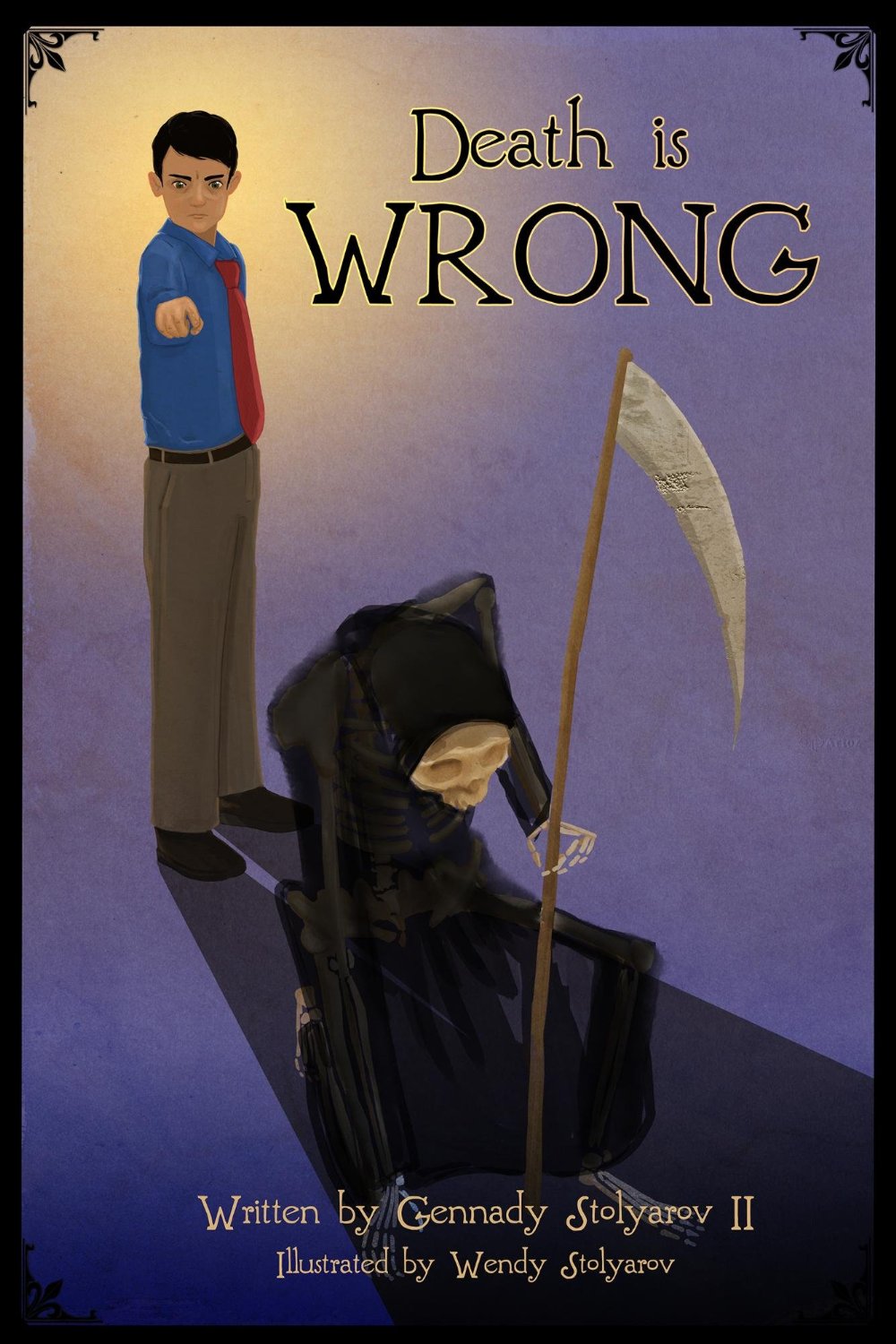
I am proud to have contributed resources to run several ads for MILE that incorporate the core message and the cover image of my children’s book Death is Wrong. These MILE/Death is Wrong ads were designed by my wife and illustrator Wendy Stolyarov and are accompanied by the following text:

Death is WRONG.
Together we can fight it.
Join the Movement for Indefinite Life Extension.

Reaper_MILE_Ad_FBDIW_MILE_AdTo help the MILE reach its Year 2 goal, you can start by clicking the “Like” button on the MILE Facebook page. Beyond that, if you would like to contribute to the advertising campaign and even develop your own custom advertisement that conveys the message of indefinite life extension, this would go a long way toward building the critical mass needed to catalyze public support for life-extension research.

Death is Wrong Book Distribution to Children

DIW_HannaAfter the successful conclusion on April 23, 2014, of my Indiegogo fundraiser to spread over 1,000 copies of the illustrated children’s book Death is Wrong to kids, free of cost to them, I have worked assiduously to coordinate a worldwide distribution effort. Already, 644 out of the 1,029 total available books have been sent to longevity activists throughout the world. Countries where the books have been shipped thus far include the United States, Canada, Mexico, the United Kingdom, the Netherlands, Poland, India, Indonesia, and Singapore. Tens of dedicated longevity supporters have already come forward to request absolutely free shipments of books, but we need more activists to help us distribute the remaining 385 books in their local areas.

Recipients have wide discretion to use their creativity in how to offer the Death is Wrong books to children, as long as the books are made available free of cost and are not resold. Books may be given away to kids directly, lent to multiple kids, given to schools and libraries that will accept them, or used at public readings – among possible other options.

The early successes of the book-distribution effort are among the most heartening and encouraging developments I have observed. Here are some photographs that longevity activists have sent in of their book shipments.

DIW_Amechazurra_ShipmentDIW_Books_Received_CvdB_3
DIW_Books_Received

Here is a charming interview by Aleksander Kelley of his sister Hanna, who is spreading Death is Wrong to the kids she knows.

Help make future scenes like this happen. Requesting a shipment of Death is Wrong books is simple. Send me an e-mail to gennadystolyarovii@gmail.com with (i) your name, (ii) your mailing address, (iii) your statement of support for indefinite life extension, (iv) the number of copies of Death is Wrong requested, and (v) your plan for spreading the books to children, free of cost to them.

Once the shipments arrive, any additional images and videos of the books and events at which they are shared would be most welcome. They can help spread the message of indefinite life extension even further and show the world that the momentum for this cause continues to grow.

Distributed Computing for Medical Science

Would you like to help cure cancer, Alzheimer’s disease, Huntington’s disease, and other deadly ailments, just by running your computer? Most people’s computers spend much time absolutely idle; how about putting that idle time to good use, at minimal additional cost? Distributed computing initiatives such as Folding@home, Rosetta@home, and World Community Grid are absolutely free to join. You just need to download a program that runs the calculations involved in protein-folding simulations and other research efforts while you are not using your computer. Already, these distributed computing initiatives have led to several major medical research breakthroughs, such as this one by Chiba Cancer Center in Japan, which has identified seven drug candidates in the fight against childhood cancer. You can read more about the applications of protein-folding simulations to disease research in this brief post by David Baker of the University of Washington.

While no single medical breakthrough will achieve indefinite lifespans yet, every victory against death and diseases will help us approach that goal. The more of us survive the common killers of our time, the more of us stand a chance of personally witnessing the arrival of longevity escape velocity.

As an additional way to raise the profile of the ideas of indefinite life extension, it is recommended to join a distributed-computing team that explicitly embraces the struggle against senescence and death. On Folding@home, The Longevity Meme team has been folding for years and is ranked 156th out of 220,186 teams as of June 5, 2014. I am spearheading a collaborative effort between The Longevity Meme team, LongeCity, and my online magzine – The Rational Argumentator – to attract renewed participation in Folding@home and The Longevity Meme team among longevity advocates. To provide an additional incentive to join, I am offering a series of five Protein Folding for Life Extension Open Badges, designed by Wendy Stolyarov and available via Badg.us.

FaH-Square-L1 FaH-Square-L2 FaH-Square-L3 FaH-Square-L4 FaH-Square-L5These are badges that you can store and share via Mozilla Backpack to share your achievements with others. The following are the qualifying criteria for each badge:

Level 1: 5,000 points earned on Folding@home;

Level 2: 10,000 points earned on Folding@home;

Level 3: 50,000 points earned on Folding@home;

Level 4: 100,000 points earned on Folding@home;

Level 5: 500,000 points earned on Folding@home.

To request a badge, simply send an e-mail to gennadystolyarovii@gmail.com. Include your user name on Folding@home so that your points earned could be verified. You can earn a badge no matter what team you are on, if any, as everyone’s commitment of resources to the protein-folding effort helps the prospects of indefinite life extension. However, you are also encouraged to join The Longevity Meme team in order to help improve its ranking and raise public awareness of the effort life-extension activists are putting into the fight against disease.

On Rosetta@home, the LongeCity team explicitly embraces the ideas of indefinite life extension. On World Community Grid, the Endthedisease team supports life extension and has been involved in numerous disease-fighting computational efforts since 2007. Later this year, the Endthedisease team is anticipated to begin running contests with prizes for top contributors.

Games to Fight Disease

By flying a spaceship through an asteroid field in a computer game, you can help cancer researchers analyze data at a much faster rate than they could before. Play to Cure: Genes in Space is a mobile game released by Cancer Research UK, which anyone with a tablet or mobile phone can play for free. The stated aim of this game is to hasten the day when all cancers are cured – which is, incidentally, the key objective of one of the seven prongs of Dr. Aubrey de Grey’s SENS approach; Dr. de Grey has emphasized that cancer is by far the predominant way by which age-related nuclear mutations harm us.

You can read about the mechanics of and science behind Play to Cure here and watch this video introduction to the game.

Foldit is another free game that enthusiasts of life-extension research can play in order to add the human touch to protein-folding simulations. In 2011, Foldit players discovered the protein structure of a retroviral protease of the Mason-Pfizer monkey virus, an AIDS-like disease in monkeys.

See this list from the Citizen Science Center for more possibilities regarding games you could play and simultaneously participate in innovative citizen-science initiatives – including many devoted to the fight against disease. Games hold out the promise of enabling monumental contributions to scientific research by the general public. A game designed to be sufficiently engaging could attract thousands of non-scientists to do the work that research scientists could conceivably outsource in order to accelerate the rate at which certain kinds of data analysis are performed. The more quickly scientists can iterate through their experiments as a result, the sooner the cures to major diseases will arrive.

Conclusion

Of course, I would urge all life-extension supporters to donate even modest amounts of money to research and advocacy organizations such as the SENS Research Foundation and the Methuselah Foundation, as well as crowdfunded life-extension research projects that are being undertaken with increasing frequency. Yet, I hope that this overview has led readers to recognize that much can be done in addition to monetary donations. Integrate the active pursuit of indefinite longevity into your life, and you will continue to find easy but extremely important ways to become part of the solution to the most pressing problem of all time. Through our efforts, we will hopefully someday be able to celebrate humankind’s greatest victories in the fight against our mutual enemy: death.

“Death is Wrong” – Book Distribution and Call to Action – May 28, 2014 – Video by G. Stolyarov II

“Death is Wrong” – Book Distribution and Call to Action – May 28, 2014 – Video by G. Stolyarov II

Mr. Stolyarov provides an update regarding the effort to distribute over 1,000 free, paperback copies of Death is Wrong to children.

As of May 28, 2014, 644 books have been sent out, and 385 remain to be distributed, out of an eventual goal of 1,029 books provided to children, free of cost to them.

Instructions for Longevity Activists to Request Copies of “Death is Wrong”

– Send an e-mail to gennadystolyarovii@gmail.com

– Provide (i) your name, (ii) your mailing address, (iii) a statement of your support for indefinite life extension, and (iv) a brief description of your plan to spread the book to children in your local area. Remember that all copies received pursuant to this initiative would need to be offered to children free of charge (as gifts or reading opportunities) and may not be resold.

– Provide the number of copies of Death is Wrong that you are requesting.

– Preferably, provide an indication that you would be willing to send photographs of the books that have been delivered to you as well as events where you will be distributing the books.

References
Death is Wrong on Amazon:
* Paperback version
* Kindle version
Death is Wrong Official Home Page
– “Spreading the Word That Death is Wrong” – Article by Gennady Stolyarov II
Updates Regarding Book-Distribution Effort
– Death is Wrong Book Trailer – Video by Peter Caramico

Gennady Stolyarov II Interviewed on Transhumanism by Rebecca Savastio of Guardian Liberty Voice

Gennady Stolyarov II Interviewed on Transhumanism by Rebecca Savastio of Guardian Liberty Voice

The New Renaissance Hat
G. Stolyarov II
May 26, 2014
******************************
Rebecca Savastio of Guardian Liberty Voice has published an excellent interview with me, which mentions Death is Wrong in its introduction and delves into various questions surrounding transhumanism and emerging technologies. In my responses, I also make reference to writings by Ray Kurzweil, Max More, Julian Simon, and Singularity Utopia. Additionally, I cite my 2010 essay, “How Can I Live Forever: What Does and Does Not Preserve the Self“.
***
I was pleased to be able to advocate in favor of transformative technological progress on multiple fronts.
***
Read Ms. Savastio’s article containing the interview: “Gennady Stolyarov on Transhumanism, Google Glass, Kurzweil, and Singularity“.
Fearless, Provocative, and Inescapably Thought-Provoking: Review of Kyrel Zantonavitch’s “Pure Liberal Fire” – Article by G. Stolyarov II

Fearless, Provocative, and Inescapably Thought-Provoking: Review of Kyrel Zantonavitch’s “Pure Liberal Fire” – Article by G. Stolyarov II

The New Renaissance Hat
G. Stolyarov II
May 16, 2014
******************************
Pure Liberal Fire by Kyrel Zantonavitch is available on Amazon in paperback and Kindle formats.
***
There is perhaps not a single thinker in the world more fearless than Kyrel Zantonavitch. Pure Liberal Fire is the direct, provocative distillation of his thoughts on metaphysics, epistemology, ethics, politics, economics, culture, religion, and the history of philosophy – including Objectivism and Classical Liberalism. Zantonavitch seeks to evoke a pure, true liberalism, and he shows no mercy for ideologies and attitudes that constitute its antithesis. He certainly leaves no doubt in the reader’s mind about where he stands on the issues addressed – and each article within the book employs an abundance of superlative expressions – be they positive or negative. When Zantonavitch praises, he really praises – and the same goes for when he condemns.
***

I give this book a rating of five stars because it invariably makes people think – no matter who they are or what their starting persuasions and assumptions might be. There are many areas in which I strongly agree with Zantonavitch – and quite a few where I strongly disagree as well. He articulates many valid points about the fundamentals of philosophy, the importance of liberty in political theory, atheism, the damage perpetrated by various political movements and policies, and the unfortunate tendencies among historical and current Objectivists toward dogmatism and conformism instead of independent thought and the honest pursuit of truth. Some of our areas of disagreement include war, areas of foreign policy, and, perhaps more generally, the desired mechanisms for achieving societal change.

Zantonavitch’s approach and style would entail achieving a fiery, dramatic, immediate deposition of everything (every person, every policy, every idea) he considers evil, dangerous, or damaging. My view of reform is more surgical, focused on getting the sequence of steps right so as to minimize the damage inflicted during the transition while ridding the world of the disease of bad policies (and, in a more long-term fashion, through persuasion and free-market education, also ridding it of bad thinking of the sort that motivates bad policies).

Zantonavitch combines his no-holds-barred treatment of his subject matters with a unique dialectical technique. There are several places in a book where he characterizes a particular set of ideas (or people) in a strongly negative way – but then later (or earlier) also portrays them as either highly praiseworthy, or at the very least understandable and characterized by redeeming attributes. Two examples that come to mind are (1) his discussions of Objectivism as a brainwashing cult in some places and as the most advanced, best-developed philosophy to date in others, and (2) his characterizations in some places of religious believers as not particularly bad as long as they do not take their belief too seriously – and in other places of anyone who believes in a god or teaches his/her children such beliefs as being guilty of evil and/or abuse. The reader can glimpse in this a deliberate juxtaposition of these opposing characterizations in a dialectical fashion – in an attempt to examine both the positive and the negative aspects of the ideas and behaviors Zantonavitch is writing about. (With regard to Objectivism, there is definitely merit in pointing out both the great strengths and the failures, as I have myself done, for instance.) This also creates a second layer of meaning in Zantonavitch’s work, as his uses of positive and negative superlatives with regard to the same subject are seldom immediately close to one another. While the rest of his writing endeavors to be extremely direct (indeed, provocative) with regard to its meaning, he seems to expect his readers to make their own connections in this respect without him deliberately pointing them out. As a result, with regard to Objectivism especially, Zantonavitch’s readers have the opportunity to acquire a more balanced, nuanced view after having been exposed to both his glorious praise and his scathing condemnation of the philosophy.

Ukraine’s “Territorial Integrity” is Not Worth a Single Human Life – Article by G. Stolyarov II

Ukraine’s “Territorial Integrity” is Not Worth a Single Human Life – Article by G. Stolyarov II

The New Renaissance Hat
G. Stolyarov II
May 12, 2014
******************************

Who likes it when a nation shoots at its own people? We weren’t against being part of Ukraine, but after the latest events, we’ve changed our minds.” ~ Natalia Vasilieva, Retiree in Donetsk, Quoted by the Wall Street Journal

On May 11, 2014, residents of the Donetsk and Luhansk regions voted in favor of independence from Ukraine. Irrespective of questions regarding the legality of this referendum (which can similarly be raised regarding the legality of Ukraine’s current completely unelected interim government) and the possibly biased sample of voters who turned out as compared to the general population of the regions, two facts are undeniable: (1) the turnout was massive, as any glimpse at the many images and videos of the referendum would show, and (2) the voters were overwhelmingly peaceful civilians, merely seeking to express their points of view. A third fact must also confront any reasonable observer of these events in the West: while the voters behaved peacefully, the interim government of President Oleksandr Turchynov and Prime Minister Arseniy Yatseniuk sent troops who fired on crowds of civilians.

NBC News – no propaganda outlet of the Putin regime – reported that soldiers from the Ukrainian “national guard” fired on crowds of peaceful voters in Krasnoarmeisk, Ukraine, and at least two people were observed killed. Irrespective of whether or not a referendum has legitimacy, the act of voting is the act of marking a piece of paper with one’s choice. Casting a ballot, in a valid election or not, is purely an act of free speech. How could casting a vote even remotely be equated to aggression? How could it justify the taking of a human life in any sane, rational person’s mind? How is it that Western politicians fail to denounce the Turchynov/Yatseniuk government’s brazen use of force in reaction to a peaceful, civil action? Has the concept of free speech lost all sanctity for Western leaders as well?

Moreover, how is the attack on crowds of civilians by the Ukrainian “national guard” morally different from the Viktor Yanukovych regime’s attacks on peaceful protesters during its last days? The crowds in Krasnoarmeisk consisted entirely of unarmed civilians trying to cast their ballots. Irrespective of whether or not some of the separatists in the Donetsk and Luhansk region are agents of Vladimir Putin’s regime – as has been alleged – can gatherings of thousands of civilians be said to consist entirely or even largely of Russian special agents or their peons? Or is it likelier that Natalia Vasilieva is right and these crowds are made up of ordinary civilians who originally were not averse to remaining aligned with Ukraine – until the Ukrainian government sent troops, including recruited “civil activists” from known fascist and neo-Nazi groups such as Right Sector (some of whose high-ranking members are also officials in this interim government, as I have written earlier), to kill them and raze their homes? Indeed, as reported by the New York Times, it was a unit staffed by Right Sector “activists”, the Dnepr Brigade (or Dnieper Brigade or Dnieper Battalion), that opened fire on voters in Krasnoarmeisk.

It was also Right Sector “activists” who trapped tens of initially peaceful pro-Russian protesters in the House of Trade Unions in Odessa on May 2, 2014, and threw grenades and Molotov cocktails inside to set it on fire, burning 40 protesters alive – not the same protesters who initially attacked a Ukrainian unity march that day. The Turchynov/Yatseniuk government’s shameful subsequent report on the event blamed the victims, alleging that one of the building’s occupants had dropped a Molotov cocktail onto the roof, thereby setting off the blaze. Even if this happened, how does it remotely excuse the murderous intentions and behaviors of the Right Sector thugs who were caught on video, throwing fiery projectiles at the building? If an armed assailant repeatedly fires at and injures his intended victim, but fails to kill him because the victim dies of a slip and fall in the meantime, does this excuse the assailant from the charge of murder?

Turchynov and Yatseniuk are resorting to forming military units consisting of Right Sector thugs, because sane, reasonable people refuse to fight for them. This is also why the Turchynov/Yatseniuk regime undid Viktor Yanukovych’s sole good action and reinstituted military conscription for young men aged 18 to 25. As I wrote earlier, any government that treats its people as disposable cannon fodder against their will is an evil government that is not worth fighting for. Conscription is murder by lottery, and civilized people can only hope that Ukraine’s young men will engage in mass civil disobedience and dodge this draft in the hopes of preserving their lives and moral innocence. Those Ukrainians who do join the military would do well to follow the example of earlier armored columns that were sent to the Eastern regions and were stopped in their tracks by outraged civilians telling them to lay down their arms and go home. Many of these initial waves of soldiers – the ones sent before the Right Sector units were deployed – saw the folly of fighting their own people and relented.

To all Ukrainians who respect peace and civilization, I say: withdraw from all military operations, refuse to obey your criminal government, and pursue peaceful commerce and amicable daily interactions with your fellow humans – no matter what their language, ethnicity, or spoken political beliefs! No “territorial integrity” is worth the sacrifice of moral integrity, and certainly not the life of a single actual living human being. If a “united Ukraine” can only be preserved through conflagrations and rivers of blood, then it is not worth preserving! What is a set of boundaries drawn on a map ordained by the United Nations (which in many cases does not correspond to de facto political control in any event), compared to a conscious, reasoning being with a rich and irreplaceable internal universe? Borders have been drawn and redrawn time and again throughout history, but a life, once lost, can never be regained.

In the West, all too many leaders and pundits – even some libertarians! – would cast Vladimir Putin’s regime as the antagonist and the culprit for the entirety of the violence that is transpiring in Ukraine. While I have few kind words for Putin, and there is much to condemn about Putin’s own violations of the rights of Russian citizens, it does not appear that the blame placed on him for this crisis corresponds to his actual offenses. As Ron Paul points out, “The US demanded that Russian President Putin stop eastern Ukraine from voting on autonomy, and last week the Russian president did just that: he said that the vote should not be held as scheduled. The eastern Ukrainians ignored him and said they would hold the vote anyway. So much for the US claims that Russia controls the opposition in Ukraine.” And yet Western leaders continue to threaten Russia with escalating economic sanctions over the outcome of the referendum, even though Putin expressly urged delaying it! Even from a sheer pragmatic standpoint, this is an exceedingly unwise tactic; Putin might come to recognize that even his attempts at defusing the situation or disentangling Russia from it would not affect the West’s response, and he would see no reason not to escalate the crisis, if de-escalation does not alleviate any of the punishments that Western governments have in store for him.

Without the resounding endorsements and material support – economic bailouts and shipments of physical resources, paid for by Western taxpayers’ dollars – from the governments of the United States and the countries of the European Union, the Turchynov/Yatseniuk regime would not be able to sustain its crackdowns on its own people. Why do the United States and the European Union support this criminally negligent, civilian-killing government? While I was sympathetic to the deserved overthrow of Viktor Yanukovych, I am deeply ashamed of the US government for aiding the thugs who unfortunately replaced him. Turchynov and Yatseniuk are doing to the population of Eastern Ukraine exactly what Yanukovych did to the Euromaidan protesters who disagreed with his decision to abandon a proposed trade agreement with the European Union. This time, however, the Western governments have taken the side of the oppressors, just because they are perceived to be on “our” side rather than “their” side – “they” being the Russians in the eyes of all those who have not realized that the Cold War is long over and that Cold War thinking must be resolutely abandoned if we are to avoid a hot war that could engulf all of humankind and spoil our chances at achieving radical abundance and unparalleled health and prosperity through technological progress during the next several decades.

To ensure that the progress of human civilization continues without catastrophic setbacks, the crisis in Ukraine must remain localized. Only continued intervention by Western powers would allow it to spread beyond Ukraine’s current borders. It is true that, without American and EU support, the Turchynov/Yatseniuk regime will probably fall – but this will largely be achieved by Ukrainians themselves. Putin might sweep in later and occupy Eastern Ukraine – either annexing it as he did with Crimea (even though he has denied any intent to do so), or treating it much like the autonomous regions of South Ossetia, Abkhazia, and Transdniestria, which broke away from Georgia and Moldova and are currently occupied by Russian troops. If the aftermath of the Crimean annexation is an indicator, this might actually result in fewer civilian deaths than a continuation of the status quo. Also, it need not affect life in the West, or continued efforts by civilians in the West to innovate technologically and raise human standards of living, by one iota. Why does anyone need to lose sleep over the existence of quasi-independent republics named Donetsk, Luhansk, or even Novorossiya? Are they any more threatening to Americans – of whom five-sixths cannot point Ukraine out on a map anyway – than South Ossetia, Abkhazia, and Transdniestria are today? What is threatening to Americans is their own government’s foreign policy, intervening in Ukraine apparently just to oppose any potential expansion of Putin’s power and Russia’s sphere of influence, without any compelling argument for American “national security” to be made under any remotely credible interpretation of that nebulous concept.

A month ago, I wrote that the worst scenario in Ukraine would be an escalation of military conflict, which was unfortunately beginning to occur at the time as the “anti-terrorist” operation was being launched by the Turchynov/Yatseniuk government. At present we clearly see the bloody results of this ongoing operation, as more civilians perish by the day. Of course, unleashing the Ukrainian military and ultra-nationalists within the Donetsk and Luhansk region could not be confined to dislodging armed separatists, and it has turned into a war against the civilians of Eastern Ukraine. Perhaps Turchynov and Yatseniuk did not want this, but they are now desperate, just like Yanukovych was in February 2014, and they see no other way to remain in power. They know that, if they lose, their fates will be at least as unpleasant as that of Yanukovych, and so they are willing to sacrifice the entire country to protect their hold on power. The Western governments need to cut off the lifeline they have given to this criminal regime. While the result would not be optimal from the standpoint of any cosmic justice, any local “solution” to this crisis would certainly be no worse than any “solution” that could be achieved through Western intervention. Furthermore, the effect of complete non-intervention at confining the Ukrainian crisis to a local one would be incalculably beneficial in avoiding the risk of a broader war. Let us look upward to technology and human ingenuity as the path to solving humankind’s problems, and avoid getting bogged down in the sordid muck of Ukraine’s crisis. A bright future requires and demands peace today.

Military Conscription Shows the Evil of Ukraine’s Government – Article by G. Stolyarov II

Military Conscription Shows the Evil of Ukraine’s Government – Article by G. Stolyarov II

The New Renaissance Hat
G. Stolyarov II
May 1, 2014
******************************

I have, in the past, expressed ambivalence regarding the government of Oleksandr Turchynov and Arseniy Yatseniuk in Ukraine, but that government’s decision on May 1, 2014, to impose military conscription for men aged 18 to 25 clearly reveals it to be evil and unworthy of even verbal support, not to mention the material assistance and economic bailouts currently lavished on it by Western governments and the International Monetary Fund.

As I wrote in 2008 in “Why Freedom is Free and Rights Are Right: The Case Against Conscription, Compulsion, and Confiscation”, conscription is murder by lottery: “By fielding an army of conscripts, a government necessarily guarantees that some of those conscripts will be killed – although nobody knows in advance who will die. In effect, this is no different from selecting a large number of fit young men, assigning numbers to each of them, and picking a few of the numbers out of a hat – whereafter those whose numbers have been picked will be shot. Conscription is just such a murder by lottery – except that the picking of numbers is performed by the vicissitudes of the battlefield rather than the luck of a draw. The responsibility for the deaths of millions of young men from conscripted armies throughout world history lies solely on the shoulders of the governments who conscripted them. The enemy soldiers who killed them were mere instruments of murder; they were likely only following orders – and were likely themselves under compulsion to do so. The government officials who drafted the men, however, did so of their own free will and even with enthusiasm.”

It would be a complete contradiction of the principles of liberty and peace to support any government that conscripts its young men to become cannon fodder – disposable pawns in the power struggles of older, powerful leaders who will not themselves bear the physical costs of their desires to dominate over one group of people or another. Vladimir Putin’s regime is evil, too, and so are many of the militants aligned with it, as I have acknowledged previously. But supporting one evil just because it is arrayed against another is neither moral nor effective. American foreign policy engages in this support for the “enemy of the enemy” at almost every available opportunity, and this always comes back to hurt Americans in both the long and the not-so-long term.

Ironically, it was the overthrown Viktor Yanukovych who had abolished conscription in 2013 – perhaps the only good and liberty-friendly decision he made. Yanukovych deserved to be overthrown for instigating the killings of his own people, but this new government of thugs is no better. Indeed, it has managed to undo the one good legacy of Yanukovych’s reign! And yes, it is a government of thugs. This March 5 article from Channel 4 News in the United Kingdom – no Putin mouthpiece! – explains how many of the top posts in the Ukrainian government are occupied by leaders of Svoboda and Right Sector, two ultra-nationalist groups that grew out of explicitly fascist movements that use explicit Nazi symbols such as the Wolfsangel. Here are two images: at the top, Svoboda’s Oleh Tyahnybok delivers a Nazi salute; at the bottom, he poses with arch-interventionist and neoconservative warmonger John McCain. Right Sector’s leader Dmytro Yarosh is Ukraine’s Deputy Secretary of National Security – security, that is, for those who meet Yarosh’s standards of ethnic and linguistic “purity”.

Neither side in the conflict in Eastern Ukraine is just or right, or anything but destructive to the interests of the only innocent parties in the mix – civilians who seek to live and work in peace. No principle, no signal, no feverish nationalistic pride, no set of lines drawn on a map is worth the life of a single human being. As Voltaire poignantly and perceptively expressed it in his Philosophical Dictionary, “It needs twenty years to lead man from the plant state in which he is within his mother’s womb, and the pure animal state which is the lot of his early childhood, to the state when the maturity of the reason begins to appear. It has needed thirty centuries to learn a little about his structure. It would need eternity to learn something about his soul. It takes an instant to kill him.” No worthless, ephemeral power struggles and posturing can ever justify sacrificing the existence of the rich individual universe – the incomparably intricate and sophisticated mind and body – of any actual human being.

The Ukrainian government is forcing young men to kill their fellow Ukrainian and Russian young men, against whom they have no individual grievances. This is vile and reprehensible, and the Ukrainian government deserves to fall. It would be easy for it to fall and would not require active external intervention; the West would just need to withdraw its support and let the situation unfold as it would with only the involvement of local actors. If the West continues to prop it up with aid, this would only prolong the spree of destruction engaged in by people who should never have had a chance at high office in any civilized society, who should have been marginalized much like the Ku Klux Klan and various neo-Nazi parties are treated in the United States today. No government that uses its own people as cannon fodder against their will deserves to exist; no country whose “territorial integrity” must be maintained by a conscript army deserves for its territory to remain intact.

As to the young Ukrainian men about to suffer under the yoke of military conscription, my advice to them can be found in my poem “The Draft Dodger”, written in 2004 but still just as relevant ten years later. As one who proudly escaped Alexander Lukashenko’s Belrusian military conscription myself (I have subsequently become a US citizen – so I am thankfully safe from that particular tyranny), I wish these innocent young men all the best in finding peaceful, prosperous lives outside the heinous havoc which they did not create.

The Draft Dodger (2004)
G. Stolyarov II

I have been sentenced to a war.
And my offense? Naught but my age.
I’ll suffer pestilence and gore,
And die upon a foreign stage.
The verdict has been passed by those
Who wish to equal me to rags,
Plug sand into a breathing nose,
Borrow my life, return dog-tags.

They tell me, “Freedom is not free,”
And thus they seek mine to deprive.
But no! I’ll courage have to flee,
To choose to prosper and survive!
The right that mine was from the womb,
That I had bought with Reason’s gold,
I shall not lay before a tomb,
But will Self’s Shrine from robbers hold.

I claim no more than what is mine;
To rise each morning when I will,
To build, compose, create, refine,
And heed no Congressman’s dread bill,
Whose parasitic voting bloc
My soul as spoils of war would claim,
No noble war of awe and shock,
But rabble-rousers’ power game.

When nations seek me for their slave,
Their cause, their plight shall pass in vain.
Let no man give but what he gave,
Of his own will, for his own gain.
Freedom can’t stand on sacrifice;
With blood and bones I shan’t it craft.
I shall not offer prey to vice,
And, proudly, I shall dodge this draft!

Eternal Life Fan Club Review of “Death is Wrong” – Article and Graphic by Roen Horn

Eternal Life Fan Club Review of “Death is Wrong” – Article and Graphic by Roen Horn

The New Renaissance Hat
Roen Horn
April 28, 2014
******************************
This review was originally posted on the Facebook page of the Eternal Life Fan Club, a community created by Roen Horn to share philosophy, research, and strategies to help humans increase their chances of living forever.
ELFC_Death_is_Wrong

I finally got around to reading the new transhumanist children’s book Death is Wrong. I was impressed with the simplicity and clarity of the message, and my impression was that children could easily digest the information. It’s about time there was a children’s book promoting the message of indefinite life-extension. This book should be mandatory reading in elementary schools. I was pleased to see that the book gave mention to Aubrey de Grey and SENS Research Foundation. Besides explaining the logical reasons for why death is wrong, I was delighted that the book spoke about the frailness of life and the overwhelming sadness of death. The book also specified the importance of vigilantly avoiding dangerous behaviors which would endanger one’s life, and the importance of taking care of one’s health. I think that message is especially important for young children to hear. The book leaves the reader with the optimistic outlook that death does not have to be inevitable. If we know that death is wrong, then we must wage war on death and never give up until we have won this fight. You can find the book on Amazon here.

Wendy Stolyarov, Illustrator of "Death is Wrong", at the Transhuman Visions 2.0 Conference - March 1, 2014

Wendy Stolyarov, Illustrator of Death is Wrong, at the Transhuman Visions 2.0 Conference – March 1, 2014

Transhumanism and Minarchism Are Compatible: A Response to The Sliceman – Article by G. Stolyarov II

Transhumanism and Minarchism Are Compatible: A Response to The Sliceman – Article by G. Stolyarov II

The New Renaissance Hat
G. Stolyarov II
April 27, 2014
******************************

This essay is part of a debate with The Sliceman on whether transhumanism and minarchism are compatible. For prior installments of the conversation, see the following essays:

– “Why I Do Not Adhere to Anarcho-Capitalism” by G. Stolyarov II

– “In Response to G. Stolyarov II and his Transhumanist Minarchism” by The Sliceman

I appreciate that The Sliceman has taken the time to post his thoughts on the question of the compatibility of transhumanism and minarchism, and I thank him for his good words regarding my work. If, as he writes, we agree on 90% of the issues, “with the lone exceptions being minarchy and monogamy”, then we have plenty of common ground that could also be used to reach some points of agreement on the question of transhumanist minarchism.

My aim in this discussion will not be to discredit or refute anarcho-capitalism; instead, I will strive to show that transhumanist minarchism is a fully reasonable and logically consistent position. Empirically, transhumanist anarcho-capitalism also clearly has articulate adherents and holds out promise for the incremental improvement of the human condition. The Sliceman writes of my views, “Your stance is that, [anarcho-capitalism] would be better than normal statism, but not as good as minarchism.” This is correct, meaning that I would see transhumanist anarcho-capitalism as an improvement over the status quo both politically and technologically. However, transhumanist minarchism would be superior still, because it would contain a method for resolving tensions and disputes that would have escalated into violence under transhumanist anarcho-capitalism.

The Sliceman writes in response to my statement that anarcho-capitalism has no practical application in today’s world that “yes, there has never been a practical application of Anarcho-Capitalism replacing a state but there has never been an economic powerhouse minarchy that didn’t evolve into totalitarianism either. We are BOTH in the realm of theory here, my friend.”

In an important way, I agree. I wrote in “Why I Do Not Adhere to Anarcho-Capitalism” that “Neither my position nor the anarcho-capitalists’ has any existing real-world incarnation. The question before us, then, is which of these positions would result in less overall violence and coercive dishonesty if implemented in practice?” However, in another important way, I disagree with the argument that an empirical refutation of minarchism can be offered by observing formerly freer societies that have devolved into totalitarian or near-totalitarian ones. The Sliceman is correct that the United States has undertaken this trajectory over the past 238 years, while in the meantime facilitating considerable prosperity and economic growth through political structures that were freer than most. However, at no point in history was the United States minarchistic – not even by a long shot. The U.S. Constitution and Bill of Rights were closer to the libertarian ideal than the governance structures of 18th-century Europe, to be sure, so they constituted steps in the right direction for their time. But the very language of these documents – including the “Commerce Clause”, the “General Welfare Clause”, and the “Necessary and Proper Clause” – opened the floodgates for extensive centralized intervention as these clauses were interpreted to have increasingly expansive and open-ended meanings. The devolution of the United States to the near-totalitarianism it exhibits today is not the result of minarchism, but israther due to the infusion of non-minarchistic elements into the US political structure at its founding. (The recognition of slavery certainly did not help, either; it paved the way for the bloody Civil War, which led to the first round of attempted totalitarianism by central governments under Abraham Lincoln in the Union and Jefferson Davis in the Confederacy.) I also note that the non-minarchistic nature of the early United States can be clearly seen in such travesties against liberty as the Alien and Sedition Acts of 1798 (which effectively forbade criticism of the government) and even Thomas Jefferson’s Embargo Act of 1807 (which effectively forbade all overseas trade) – neither of which would be conceivable even in today’s United States.

So the historical trajectory of the United States is no more an argument against minarchism than the brutal infighting and miserable standards of living in Somalia today are an argument against anarchism. The argument presented by The Sliceman that bureaucracies tend to try to grab more power for themselves may be true, but, if so, its only implication is that non-minarchistic elements of a government will tend to expand over time, changing the proportions of an initial mix of coercive and non-coercive government functions to be more heavily dominated by the coercive functions over time. However, if a minarchist government lacks the coercive functions (which involve non-retaliatory use of force) to begin with, and both the constitution and public opinion provide strong barriers to the emergence of such coercive functions, then the trajectory toward totalitarianism need not occur.

The Sliceman writes, “In fact, I believe minarchy to be much more theoretical than anarchy. Anarchy can be seen all over the world every day in the form of capitalism and voluntary association and order. Minarchy is almost never seen in all of history.” Both minarchy and anarchy are similarly theoretical, in my view, because, just as there has never been a completely minarchist government in history, there has never been a complete anarcho-capitalism in any society. Because every person encounters some dose of coercion in going about his or her daily life, that coercion necessarily shapes individual incentives and the kinds of markets and goods and services that arise in the society where the coercion exists. It is true, for instance, that unregulated black markets arise virtually everywhere that a government attempts to prohibit a good or service, but the content, environment, and limitations of those black markets are very much determined by the fact that the prohibition exists in the first place, as well as the extent and manner of the prohibition’s enforcement. Just as a true minarchism could only exist if a government did not have any legitimate power to initiate force, so a true anarcho-capitalism could only exist if there were no need to develop workarounds for the limitations imposed by a centralized authority.

This leads me to the conclusion that what matters more is the incremental direction of political change that one advocates – rather than one’s desired theoretical destination. For instance, abolishing NSA surveillance of the general population, dismantling the TSA, repealing the income tax, withdrawing all overseas US troops, halting the War on Drugs, and ending the requirement that the FDA approve all medicines prior to their availability for purchase by the general public, would all be measures favored by both minarchists and anarcho-capitalists. Their implementation would greatly increase the liberty enjoyed by people in practice, and such measures would also dramatically accelerate the rates of technological progress and economic growth. Whether the changes could be best accomplished by working within or outside the political system is an empirical question, and various strategies can be, at their core, compatible with both minarchism and anarcho-capitalism.

The Sliceman writes: “how dare you consider yourself a transhumanist, yet scoff at that which hasnt been tried yet[?] The automobile has not yet been created, but that is no reason to think the future is a faster horse. If history has taught us anything, it’s that someone’s lack of imagination does not deter future technological advancement in the areas of industry, economy, religion, or government.”

My argument regarding the lack of practical application for anarcho-capitalism does not hinge on the fact that it has not been tried yet in its full form. In fact, I would encourage some group of people to try it – perhaps on a seastead, a small island, or a space colony. The results of such an experiment would provide valuable empirical evidence and fuel for further thought and work in political philosophy. As I have previously stated, my preferred political system of minarchism also has not been tried in its consistent form, so my preference for it does not stem from any aversion for the new and untried.

Rather, when I say that anarcho-capitalism has no practical application today, my exact meaning is that I have yet to see a viable proposal for bringing it about through a transition from the status quo. Unlike minarchism, for whose attainment a sequence of political reforms can be articulated, many strains of anarcho-capitalism reject working within the political system, period, so it is unclear how exactly the transformation from a militaristic welfare state to an anarcho-capitalist society is envisioned to occur. As I wrote in “Why I Do Not Adhere to Anarcho-Capitalism”, “I happen to believe that political theory is more than a mind game; it has relevance to the real world, and it ought to have real-world implications for how we act in our own lives. It is not enough to simply state that one would like the world to be a certain way. Rather, a specific, technical, and quite involved series of steps is necessary to transition from the status quo to any state considered desirable. To simply contemplate the end outcome without any idea of how to attain it or even approach it is to divorce one’s political thinking from reality.” It also appears to me that, when an anarcho-capitalist does propose ways of working “outside the system” – including seasteading, cryptocurrencies, informal markets, and digital communities – these ways are also perfectly compatible with minarchism. They involve the use of technological innovation, jurisdictional competition, and civil society to motivate a reduction of political power from without. Yet, unfortunately, too many anarcho-capitalists let the perfect (in their minds) be the enemy of the good, and they reject or resist any attempts at bringing about incremental change (even outside of politics proper), for fear that those attempts are somehow intertwined with and corrupted by the existing political or social order. I do support the practical efforts of anarcho-capitalists to achieve their vision in peaceful ways. However, if and when they do this, they do not engage in any activities that are exclusively anarcho-capitalist or that would require adherence to anarcho-capitalism to pursue. A minarchist could undertake those same actions just as effectively.

I note that the lack of a concrete proposal to achieve anarcho-capitalism is quite different from what one observes with transhumanist projects and aspirations. Virtually every transhumanist vision, from indefinite life extension to various incarnations of the technological Singularity, has an associated detailed sequential plan for attaining it or view of the unfolding events that would bring it about. Consider, as examples of this, Aubrey de Grey’s SENS roadmap to reversing all the types of age-related damage, or Ray Kurzweil’s Law of Accelerating Returns, forecasting the continued exponential growth of emerging technologies. I certainly see the amount of centralized control in a society as capable of having a powerful impact on the rate at which these transhumanist aspirations can be realized; the more centralized control, the slower the rate. However, neither minarchism nor anarcho-capitalism would impose coercive restrictions on transhumanist projects, and so both are, in theory, quite compatible with transhumanism. Minarchism has the added advantage that it more readily embraces incremental political reforms that could help make an existing society more free, even if any given reform will not completely achieve the libertarian ideal. Minarchist activism could therefore be one effective way to increase the rate of technological progress in the near-to-intermediate term, paving the way for massive prosperity in the long term, which would increasingly consign the “social service” role of many welfare states to irrelevance.

The Sliceman writes, “Libertarian Tranhumanism and Minarchism is an extremely rare match. The creed of Transhumanism is to use historical patterns and trends to predict the future. I’m sure this study greatly contributed to your [belief] and support for indefinite life extension. The creed of Libertarianism is to increase liberty, freedom, and the protection of private property by decreasing the institutionalized initiation of the use of force that is the state.”

I disagree with the proposition that libertarian transhumanism and minarchism are a rare match. It is important to keep in mind that, among libertarians today, anarcho-capitalism is still a significant minority position. Transhumanism attracts significant interest from both libertarians and non-libertarians alike, but its affinity with libertarianism is stronger, so a larger proportion of libertarians are transhumanists as compared to non-libertarians. I have seen no evidence to suggest that anarchist libertarians are more inclined toward transhumanism than minarchist libertarians. While I have done no polling on this question (and some empirical research would certainly be extremely interesting here), a more plausible hypothesis is that transhumanism attracts libertarians independently of their views on the question of minarchy versus anarchy. So if X% of libertarians are anarchists, and (100-X)% are minarchists, and Y% of libertarians are attracted to transhumanism, then it would appear that, as long as X% < 50%, then X%*Y% would be less than (100-X)%*Y%, so there would be more minarchist transhumanists than anarcho-capitalist transhumanists. Again, this is only a hypothesis at present, and conducting a scientific poll of libertarian transhumanists would enable a more in-depth exploration of this question.

The Sliceman continues by describing an “exponential curve of liberty” that has unfolded throughout history, as greater technological advancement, especially in communication technology, has increased individual sovereignty. I agree with this general characterization. In fact, it fits with Steven Pinker’s immensely well-researched look in The Better Angels of Our Nature into the decline in rates of human violence over time, as technology, culture, and political liberty have tended to progress. However, Pinker is certainly no anarchist. He points out that hunter-gatherer “stateless” societies experienced per capita rates of violence and murder greatly exceeding those of the most despotic governments or those that were manifested during the two World Wars of the 20th century. Pinker’s view is that even despotic government is preferable to tribalism or lawlessness, while constitutional or limited government is greatly preferable to despotic government in reducing the rates of violence (which are at their lowest point now as compared to any prior era) and maximizing the scope of individual liberty. I have read the entirety of The Better Angels of Our Nature, and it appears that the evidence Pinker presents suggests that technology, commerce, and culture – rather than political structures – offer the greatest contributions to the reduction of violence, perhaps because political structures are very much conditioned by the technological, economic, and cultural environments in which they arise.

The Sliceman writes, “The question here is what kind of liberty this technology will lead us to. Your answer seems to be that the exponential change in liberty will come to a stop at minarchy and we will just stay there, where my answer is that the exponential change will continue and the only logical conclusion is that we will approach 100% liberty with only [a] few tiny fractions of a percent of violence being accounted for by the fact that we are still, in fact, animals, and animals are violent.”

Supposing that exponential increases in liberty through technological progress can be achieved, this is not per se a sufficient argument that all government would disappear. For instance, exponential advances have been made to store data in ever-smaller volumes of physical space. This does not, however, suggest that we will ever arrive at a point where no physical space at all will be required for the storage of data. At most, we could perhaps keep reducing the space required without any lower limit, but we would only asymptotically approach zero space without ever getting there. The same reasoning could apply to government. Indeed, I see in accelerating technological progress our best prospect for minarchism. As advancing technology raises the prevailing levels of prosperity, fewer people will find themselves in need of government services to rectify any perceived deficiencies in their lives. The more the role of the redistributive welfare state dwindles away, the more governments would be relegated to their theoretically justified roles under minarchism – the resolution of disputes and protection against the initiation of force. It is quite feasible that additional private mechanisms for dispute resolution would emerge, and people would become generally more comfortable and less likely to want to engage in violence in the first place – both of which phenomena would reduce the frequency with which the government would resolve disputes in practice or interject its retaliatory force. If many humans receive augmentations to their minds, increasing both their intelligence and their moral sense, then the result will be an even further-reduced inclination to initiate force. But would this trend ever result in the elimination of government altogether? I doubt it – for the simple reason that the ability to have an ultimate arbiter of disputes or an entity that can interject itself to prevent violence would be too valuable for a future society to do away with altogether. 99.9999% of future transhumans may be entirely peaceful and capable of dealing with one another solely through market arrangements. But suppose there is even one person who rejects all transhumanist paths for humankind and who seeks, in some way, to use violence to wage war on the transhumanist society. Maintaining some very minimal government to deter this person would be wise. Furthermore, if the situation improves to the point where no such person exists, then the mechanisms of a minimal government might well lie dormant for a time – but there would be no reason to abolish them. It would be better to keep them available, just in case a future threat of violence arises, and all market-based methods for preventing it fail. After all, what would happen if some barbarous militaristic alien species discovers the transhumanist Earth and simply launches an invasion, with no questions asked?

The Sliceman writes, “You don’t need an ultimate arbiter when you are running your contracts through the Bitcoin Blockchain or its future replacement. You don’t need an ultimate arbiter when everything on Earth is constantly being recorded and a murderer (whose act can be proven 10 ways from Sunday through constant voluntary surveillance i.e.: Google glass, dashcams, and their future equivalents) can be given a voluntary unanimous Yelp review of ‘exile’.” In some cases, technologies such as the blockchain or universal sousveillance might actually generate more of a need for an ultimate arbiter. It is true that those technologies can facilitate more transparency and discovery of facts, but, in some cases, they are just as open to exploitation for nefarious motives. For technologies based on the blockchain, this is evidenced by the many thefts that have occurred from third-party Bitcoin services or the dishonesty and consequent failure of Mt. Gox. For sousveillance, there is an extremely fine but important line between monitoring that can help deter or prevent crime and monitoring that can infringe on individual privacy and deter innocent behaviors that could only occur in private. When such conflict areas arise (as is inevitable with transformative new technologies), it would be nice to have an impartial arbiter that could resolve conflicting legitimate interests and help overcome the “growing pains” of technological change. Of course, today’s archaic and cumbersome legal system is not the answer to this challenge, but a highly streamlined, extremely knowledgeable, and technologically sophisticated minarchist court might be.

The Sliceman writes that “Technology does not stop at minarchy.” I respond that, ultimately, no single form of government can be seen as the final form, upon which there cannot be any improvement. I do not rule out the existence of true anarcho-capitalism at some future time, somewhere. In “Why I Do Not Adhere to Anarcho-Capitalism”, I wrote that “Perhaps the anarcho-capitalist ideal will be realizable in some distant future time, once human beings have progressed morally and technologically to such an extent that the initiation of force is no longer lucrative to anybody.” I would have no quarrel with transhumanists who attempt to implement anarcho-capitalism through emerging technologies – but, at the same time, minarchism appears to be a far more proximate prospect, and, in the next several decades at least, the very same concrete methods that any anarcho-capitalist would effectively pursue, could also be used to pursue minarchism (since societies would be moved in the direction of both ideals by the application of such methods). Perhaps one implication of my argument is that, for the time being, it does not really matter whether one is a minarchist or an anarcho-capitalist, as long as one supports pro-liberty incremental changes. Another implication, however, is that minarchism and transhumanism are fully compatible, at least for the foreseeable future.

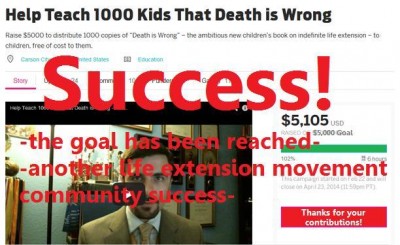
“Death is Wrong” Fundraiser: Another Ship Returns to Harbor after Braving the Seas for the Cause – Article by Eric Schulke

“Death is Wrong” Fundraiser: Another Ship Returns to Harbor after Braving the Seas for the Cause – Article by Eric Schulke

The New Renaissance Hat
Eric Schulke
April 26, 2014
******************************

On December 2nd of 2013, the Movement for Indefinite Life Extension began a contest for people to send in their ideas on how to spend money on outreach for the cause. The following question was asked:

If you were to receive a check in the mail with $5,000 to inform as many people as possible about the desirability and the prospects for indefinite life extension, to get them interested in the people, projects and organizations working directly or indirectly toward indefinite life extension, then how might you spend it?

Six entries were entered into a poll.

The entry with the most votes was Gennady Stolyarov’s entry to distribute 1,000 copies of his and his wife Wendy’s great new children’s book Death is Wrong. Their winning entry won them one of four books that were given away for the contest: a signed copy of The Transhumanist Wager, which was generously contributed to the project by its author, Zoltan Istvan.

A group of us put our heads together and came up with a plan to raise the money. The fundraiser was launched on February 23rd of 2014 and successfully completed on April 23rd of 2014.

It is a great success on multiple levels for the Death is Wrong book and vision in itself, which supports indefinite-life-extension research and philosophy in general, and which is written by one of the many Movement for Indefinite Life Extension leaders, Gennady Stolyarov.

It is also a great success for the Movement for Indefinite Life Extension in general on many levels. It is one of the first major projects the MILE has executed in its upcoming series of projects to work to reach 80,000 “likes” at MILE Facebook page for the Year 3 goal, which begins on July 17th 2014, and tasks us with collectively helping to achieve the group victory of moving from 8,000 likes, to 80,000 likes by the July 17th of the following year, 2015.

Rodney Ashby and Jason Shields helped us get the momentum rolling and did fundraising throughout, and Tonya Scholz gave the project a big hand. Gennady Stolyarov made an amazing media tour for the project, finding himself talking about it in interviews and getting mentions and reports from a variety of sources. Most of them are of his own arranging, some of these outlets picked the story up on their own, and there are some opportunities that I arranged. They include, but are not limited to, the following:

There were 92 contributions from over 80 individuals and one group, including, but not limited to:

There were also at least 13 anonymous donations. I did a count of all of the donors that I brought in. A close, conservative estimate is that I brought in around 70% of them.

We ended up raising $5,141, compounding on the success by $141. That means that we raised enough to distribute 29 more books than projected. Those of us that worked with this didn’t take a single dime as a cut of this. I put a hundred dollars or so in ads into it, and Wendy and Gennady have given countless hours of their time to rewarding donors. Countless others, like general activists and reporters, have put their time and resources into this. The Life Extension Foundation made an inspiring and generous $1,255 dollar donation to close the deal.

Gennady and I have already secured the distribution of 140 copies, and there are now over 1,000 total available for distribution. An order even went out to Aubrey de Grey, whose work is one of the many topics that is talked about in the book. Gennady Stolyarov writes in the Indiegogo update page that,

Update of April 16, 2014: I am delighted to announce that a shipment of 10 Death is Wrong books was made yesterday to Dr. Aubrey de Grey himself at the SENS Research Foundation. Since Dr. de Grey’s work is a crucial inspiration for Death is Wrong and my longevity activism more generally, I am immensely pleased that he has agreed to receive this shipment and make the books available for distribution.

We encourage the distribution of Death is Wrong books to places like schools, libraries, and directly to parents and children. We ask people to order as many copies as they think they may be able to give away to kids and people with kids, at Transhuman and health events, rallies, and similar events. Gennady has instructions on how to order them free of charge:

Instructions for Longevity Activists to Request Copies of Death is Wrong

– Send an e-mail to gennadystolyarovii@gmail.com

– Provide your name, your mailing address, a statement of your support for indefinite life extension, and a brief description of your plan to spread the book to children in your local area. Remember that all copies received pursuant to this initiative would need to be offered to children free of charge (as gifts or reading opportunities) and may not be resold.

– Provide the number of copies of Death is Wrong that you are requesting.

– Preferably, provide an indication that you would be willing to send photographs of the books that have been delivered to you as well as events where you will be distributing the books.

The project has been a great community effort. The Movement for Indefinite Life extension is our collective spirit, not an organization. Together we collect supporters for all of the constructive projects and organizations. There must have been over 150 people involved. More activists flexed their life-extension muscles, and we helped more people that want to get involved to take the first step. If you’ve ever saved money, then you know how incremental change adds up. You cannot achieve the saving of $8,000 unless you first get to $2,000, and $6,000, and so forth.

It’s an example of elements coming together for a movement, like this article says:

A movement occurs when, one, a large number of people have a need that, two, lines up with the necessary ingredients to make it happen, and those two things are sparked by, three, a catalyst.

The need to survive has always been here. The ingredients have been getting added to the mix since the dawn of the Scientific Revolution. The element of the love for life is in the air, thick with explosive properties, fueled by indefinite-life-extension research and outreach from around the world and across time. People are busy working on rallies, conferences, events, interviews, getting the message out, and all the rest. The tools and the ability to make this happen are ripe, and growing more and better yields of produce by the month. Every time you put a match to it, it erupts in indefinite-life-extension activism. Be that spark today and get in on this movement.

We have more projects like this ahead, and there are plenty of others to choose from in the communities, pages, groups, organizations, sites, and other venues, around the world, growing here toward that tipping point where we can have the opportunity to spill across the ticker tapes of screens and the minds of the young and old alike, lighting hearts and minds on fire with desire to chip in together to make this happen. This is an incredible opportunity, this time here, fertile with tools and insights, unleashed capabilities beyond our wildest dreams. People are already capable of tons of incredible things that you don’t even know about yet.

Columbus went on a fantastic voyage. When you think of those times, and how fulfilling and enthralling it must have been for them to be able to be part of that, realize that indefinite life extension, all this Transhumanism, is an even greater frontier, and you are in an even more incredible and glorious position than people like Columbus and his crew. It’s a position here where anybody, where you, can help sail out into these incredible frontiers that are opened up through the ever-expanding fields of science and technology.

Eric Schulke was a director at LongeCity during 2009-2013. He has also been an activist with the Movement for Indefinite Life Extension and other causes for over 13 years.

Death is Wrong - by Gennady Stolyarov II, Illustrated by Wendy Stolyarov