Browsed by
Tag: G. Stolyarov II

0-to-60 Waltz, Op. 74 – Musical Composition by G. Stolyarov II

0-to-60 Waltz, Op. 74 – Musical Composition by G. Stolyarov II

This waltz began with a simple premise: each measure would have one more note than the measure before it. This is the result.

The waltz is inspired by the natural numbers, rational order, and the immensity of connections between mathematics and music.

This composition is played in Finale 2011 software using the Steinway Grand Piano instrument.

Thanks go to Wendy Stolyarov for the design of the cover and the video.

Download the MP3 file of this composition here.

See the index of Mr. Stolyarov’s compositions, all available for free download, here.

Evolution Has No Moral Value; Life Extension Does – Video by G. Stolyarov II

Evolution Has No Moral Value; Life Extension Does – Video by G. Stolyarov II

Mr. Stolyarov responds to two statements by Michael Garfield and makes the case that evolution should not be pursued as a moral goal in itself; rather, the survival and increased longevity of every individual should be pursued, since our rationality, technology, and moral compass allow us to transcend the cruelty of primeval natural selection.

Mr. Stolyarov also refutes the allegation that older people somehow necessarily become resigned to or accepting of their own death. He presents counterexamples of individuals who lived past the age of 80 and who wished to continue living indefinitely.

See Benjamin Franklin’s thoughts on scientific progress and life extension: “The rapid progress true science now makes occasions my regretting sometimes that I was born too soon. It is impossible to imagine the height to which may be carried, in a thousand years, the power of man over matter. We may, perhaps, deprive large masses of their gravity, and give them absolute levity, for the sake of easy transport. Agriculture may diminish its labor and double its produce: all diseases may by sure means be prevented or cured (not excepting even that of old age,) and our lives lengthened at pleasure, even beyond the antediluvian standard. Oh that moral science were in as fair a way of improvement, that men would cease to be wolves to one another, and that human beings would at length learn what they now improperly call humanity.”

References
– “Life as the Origin and Basis of Morality” – Video Series by G. Stolyarov II – Part 1 and Part 2
– “Eliminating Death – Part 1 – Death as Waste” – Video by G. Stolyarov II
– “World’s Oldest Man Wants To Live Forever” – WayOdd
– “Robert Ettinger” – Wikipedia

Review of Edward W. Younkins’s “Exploring Capitalist Fiction” – Article by G. Stolyarov II

Review of Edward W. Younkins’s “Exploring Capitalist Fiction” – Article by G. Stolyarov II

The New Renaissance Hat
G. Stolyarov II
October 12, 2013
******************************

Exploring Capitalist Fiction, a new volume of literary analysis by Dr. Edward W. Younkins, offers perceptive, relevant, and engaging commentaries on 25 works of fiction which portray the business world and its relationship to all areas of human life. The novels, plays, and films featured in the book span 125 years of literary culture – from The Rise of Silas Lapham (1885) by William Dean Howells to the 2010 Oliver Stone film Wall Street: Money Never Sleeps. This volume offers thorough coverage of both works that portray heroic entrepreneurs and economic liberty in a positive light – such as Ayn Rand’s Atlas Shrugged, Garet Garrett’s The Driver, and Henry Hazlitt’s Time Will Run Back – as well as works that are more critical of the business world – including Edward Bellamy’s Looking Backward, Sinclair Lewis’s Babbitt, Frank Norris’s The Octopus, and the Wall Street films. In each of his essays, Younkins provides a sequential summary of the fictional work, interspersed with commentary that highlights the philosophical and economic implications of major elements and integrates them with the historical context of the time period in which the work takes place.

Younkins is to be commended for emphasizing the value of fiction as a teaching tool for both students of business and individuals immersed in the business world. A thorough reading of the book’s Conclusion is highly recommended for attaining an understanding of the unique ability of fiction to communicate memorable lessons rooted in specific, richly detailed situations which render the conflicts, dilemmas, and options faced by individuals in the business world more palpable and engaging than would a sole reliance on lectures, case studies, and outlines of business and economic concepts. In addition, the Conclusion offers a fast-paced chronological overview of many more fictional works which address business themes and which have made their mark on the world of artistic culture.

As with his previous volumes, where Dr. Younkins provided integrated presentations of the thoughts of great philosophers and economists throughout the centuries, this book provides a refreshing focus on human flourishing and the application of the lessons of particular novels, plays, and films toward the improvement of both one’s own condition and the degree of prosperity found in the broader economy. This is not literary analysis for its own sake, but rather a book that highlights the lessons an individual can take from each great work and apply to his or her own life.

Younkins combines his support for free markets, entrepreneurial innovation, individualism, reason, and moral responsibility with an ability to point out the many valuable insights in those works which criticize capitalism as conventionally understood. He utilizes the insights of Austrian economics and his extensive knowledge of economic history to show how the bleak portrayals of businessmen and the business world in these books stem from the consequences of situations where the principles of honest free commerce and individual rights were violated. When critics of capitalism express their objections through fiction, they inevitably portray situations where fraud, corruption, morally questionable manipulation, corporatist special privileges, thoughtless conformity, and zero-sum thinking are involved. All of these are indeed negative attributes from the standpoints of free markets and rational philosophy as well, and Younkins’s analysis shows that the works of the critics do make valid points – provided that one understands that the system they are criticizing is the one that has actually prevailed in the Western world over the past century. This is the system which mixes aspects of capitalist free enterprise with significant aspects of corporatist cronyism as well as central planning. It is a system quite different from the free-market capitalism advocated by Henry Hazlitt, Garet Garrett, and Ayn Rand. Indeed, in Atlas Shrugged, the protagonists go on strike precisely against this sort of cronyist system, though one that is farther-gone than our own. In Tucker: The Man and His Dream, an excellent movie to which Younkins devotes  a chapter, this is also the system which attempts to suppress a genuine forward-thinking capitalist innovator, Preston Tucker, through the use of political force, motivated by the lobbying of the staid Big Three automobile companies.

For readers of all persuasions, Exploring Capitalist Fiction is an excellent means to appreciate the richness and variety of fictional portrayals of business, especially since the Second Industrial Revolution of the late 19th century. The book offers a concise introduction to many works and endeavors to motivate readers to seek out and experience the original novels, plays, and films. Hopefully, it will inspire many people to explore these great works of fiction, as it has already inspired me on multiple occasions.

Disclosure: The author received a free copy of the book in advance of publication.

Support the “Little Mouse” Crowdfunded Life-Extension Research Project! – Post by G. Stolyarov II

Support the “Little Mouse” Crowdfunded Life-Extension Research Project! – Post by G. Stolyarov II

The New Renaissance Hat
G. Stolyarov II
October 4, 2013
******************************

As part of my escalating efforts to advance the prospects of radical life extension through my individual actions, I have donated $50 to an ambitious new crowdfunding project to research longevity-enhancing treatments in mice.

This international project, undertaken by researchers at the Kiev Institute of Gerontology and supported by the Methuselah Foundation and the SENS Research Foundation, has an Indiegogo fundraising page, titled “I am a little mouse and I want to live longer!”, where contributions can be made.

I am proud to donate to this effort to support longevity research through crowdfunding. This project allows those of us who seek longer lifespans, and who wish to advance the science that will get us there, to contribute directly in a manner whereby each of us can make a sizable fraction of the difference for this research effort. I look forward to the great work that this project will accomplish. Achieving statistically significant mouse life extension in the near future could trigger massive public interest and the influx of major research funds to attain increasingly ambitious life-extension goals in higher-order mammals, culminating in us.

The project has already raised $8,673 and has 16 days remaining to reach its $15,000 goal. The Methuselah Foundation will match each $1,000 given with an equivalent donation – so it is possible to double one’s impact by contributing funds to this research effort.

Calico and the Paradigm Shift in the War on Death – Video by G. Stolyarov II

Calico and the Paradigm Shift in the War on Death – Video by G. Stolyarov II

Finally, the war on human senescence and involuntary death has become mainstream. With Google’s announcement of the formation of Calico, a company specifically focused on combating senescence and the diseases it brings about, a large and influential organization has finally taken a stand on the side of longer life.

References
– “Calico and the Paradigm Shift in the War on Death” – Article by G. Stolyarov II
– “Google announces Calico, a new company focused on health and well-being” – Google Press Release – September 18, 2013
– “TIME Feature: CSO Aubrey de Grey on Google’s Newly Launched Anti-Aging Initiative” – SENS Research Foundation – September 18, 2013
– “Google’s Calico: the War on Aging Has Truly Begun” – Aubrey de Grey – TIME Magazine – September 18, 2013
SENS Research Foundation

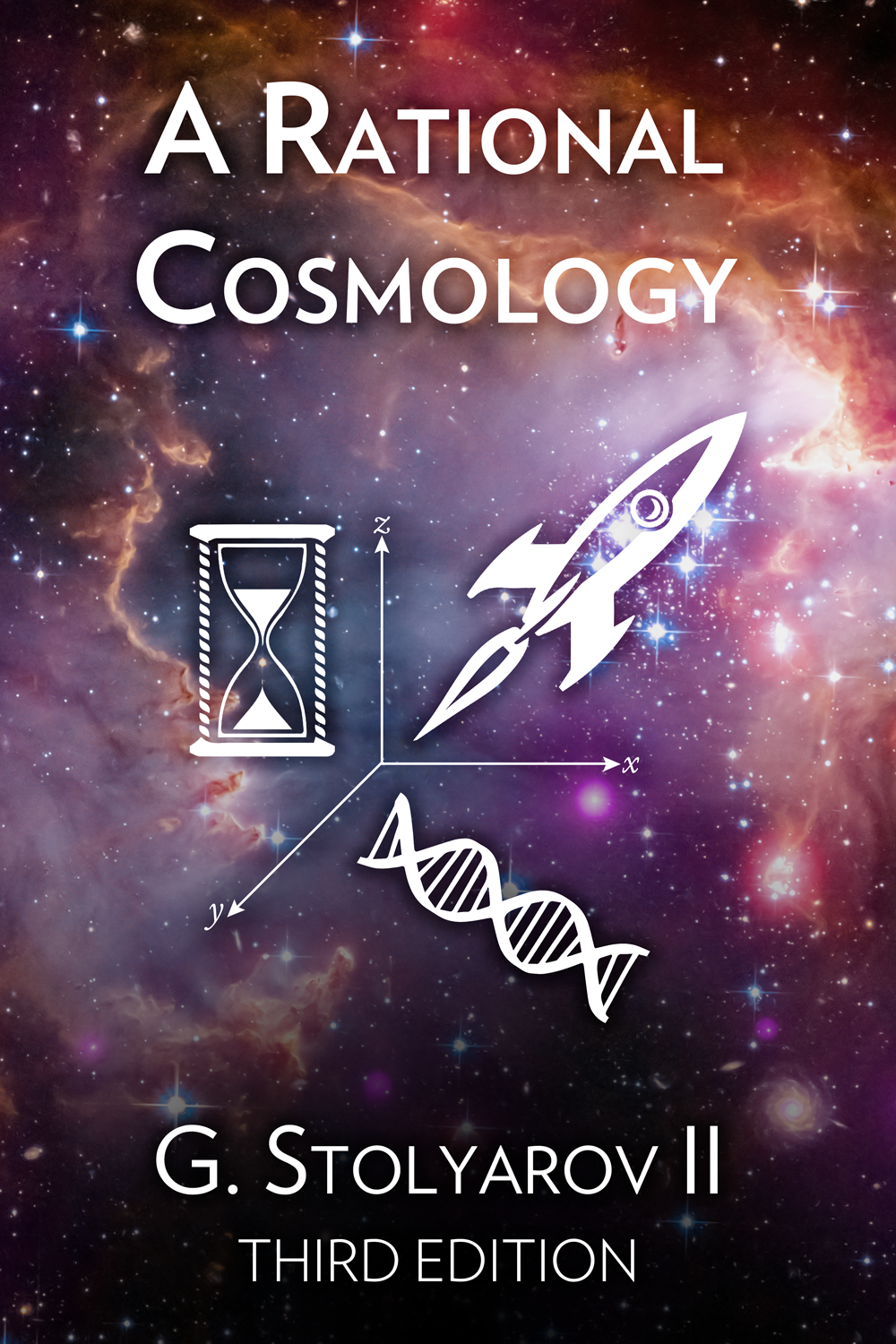
A Rational Cosmology – Treatise by G. Stolyarov II – Third Edition

A Rational Cosmology – Treatise by G. Stolyarov II – Third Edition

A Rational Cosmology - Third Edition - by G. Stolyarov II

A Rational Cosmology – Third Edition – by G. Stolyarov II

Contemporary science does not make as much progress as it could, due the fallacy of empiricism-positivism – the idea that no knowledge is certain beyond refutation and that every claim is contingent on highly narrow, particular, and expensive experiments. A Rational Cosmology, however, provides a thorough refutation of prevalent empiricist-positivist fallacies, both in content and in method. It shatters some of the erroneous philosophical interpretations of theories such as Relativity and Quantum Mechanics. Moreover, it refutes the ex nihilo origin of the universe – including its manifestation in popular views of the Big Bang and Big Crunch – the particle/wave view of light, and a host of other fallacious ideas, using the proper, axiomatic-deductive methodology of identifying those theories’ conceptual flaws and internal contradictions.

As constructive alternatives to these fallacies, A Rational Cosmology presents objective, absolute, rationally grounded views of terms such as universe, matter, volume, space, time, motion, sound, light, forces, fields, and even the higher-order concepts of life, consciousness, and volition. The result is a system verified by ubiquitous observation and common sense, the underpinnings of objective science which demonstrate a knowable, fathomable reality and set the stage for unfettered progress, confidence in reason, and full-scale logical investigation of just about everything existence has to offer.

The Third Edition of A Rational Cosmology has been enhanced and edited, with augmentations and revisions to several of the previous essays. There is a new, beautiful cover design by Wendy D. Stolyarov. Furthermore, there are two additional numbered essays and more recent writings within the Related Essays section.

For the first time, A Rational Cosmology is available for free download in the form of unified files. There are four options to choose from.

Download the PDF version.

Download the MOBI version.

Download the EPUB version.

Download the AZW3 version.

The Rational Argumentator welcomes your reviews of A Rational Cosmology. You can submit them to TRA by sending them to gennadystolyarovii@yahoo.com. You are also encouraged to spread the word by reprinting the information on this page or your own comments concerning the book on other media outlets.

Calico and the Paradigm Shift in the War on Death – Article by G. Stolyarov II

Calico and the Paradigm Shift in the War on Death – Article by G. Stolyarov II

The New Renaissance Hat
G. Stolyarov II
September 19, 2013
******************************

Finally, the war on human senescence and involuntary death has become mainstream. With Google’s announcement of the formation of Calico, a company specifically focused on combating senescence and the diseases it brings about, a large and influential organization has finally taken a stand on the side of longer life. Unlike the cautious, short-term orientation of many more conventional manufacturers of drugs and medical devices, Google’s philosophy of making investments with possible immense payoffs in the distant future offers tremendous hope that this company will be around through the many years it will take to engage in the search for promising treatments and their subsequent testing.

 Aubrey de Grey, one of the chief strategists and key intellectual innovators in the escalating war on senescence, has written that Calico signals that the war on aging has truly begun. De Grey emphasizes that it is no longer necessary to persuade most of academia that this war is a worthwhile endeavor: “With Google’s decision to direct its astronomical resources to a concerted assault on aging, that battle may have been transcended: once financial limitations are removed, curmudgeons no longer matter.” As with its remarkable advances in autonomous vehicles, mobile operating systems, and wearable computing, Google does not need to ask the permission of the entire world to explore the possibilities. Rather, it can simply achieve the breakthroughs, whose momentum and adoption naysayers would be powerless to halt.

Funding has always been a major bottleneck for true life-extending research, but now the resources of Google, as well as the highly skilled researchers who will surely be recruited by Calico, will enable this bottleneck to be overcome. Few details about the company are yet available, and it is likely that several years will elapse before major discoveries are announced. However, the barrier to mainstream acceptability of the war on senescence has been breached. Once significant successes are announced, other companies will hopefully shed some of their current caution and will seek to profit from the burgeoning field of longevity research. A few other companies still may even try to emulate Calico before any results are announced – just so as to remain competitive with Google and stay ahead of the pack, in their view.

The key to the success of any sustainable enterprise focused on life-extension research is to recognize that the sole pursuit of profits next quarter or next year is not a viable strategy for altering the status quo in radical ways. Great innovations require great leaps outside the norm. Such leaps are not often immediately rewarded financially by the broader market, which is why much of the longevity research to date has been sponsored by non-profit institutions such as the SENS Research Foundation and various universities. However, a prudent, forward-looking pursuit of profit can take the radical alteration of the status quo to the next level, by harnessing the immensely powerful motive of self-interest for the purpose of improving human lives. In this case, the improvement from gains to human longevity – and hopefully the ultimate defeat of senescence altogether – would be so immense as to be humankind’s crowning achievement. Google develops technologies with the eventual intent of marketing them to millions of consumers, and the success of Calico would be a triumph not just for longevity research but for the dissemination of cures to age-related diseases, and perhaps to senescence itself.

While anyone of sufficient intellectual courage can have a long-term vision and projects aimed at advancing that vision, Google has the distinct advantage of an extremely viable business in the present, which continues to bring in short-term revenues so that Calico does not need to be concerned with profits next quarter or next year. Instead, Calico will be able to survive on the profits of Google’s many ongoing operations, while devoting the time and effort of world-class researchers to pursuing all of the explorations, experiments, and tests that are needed to ultimately develop marketable cures. Once the cures are out there, though, the profits could be unprecedented, because life is the most precious, the most fundamental value we humans have. Any entity that discovers a way to transcend the current frailties of old age and push back or remove the current limits on human lifespans will become fabulously wealthy beyond comparison.

May Calico usher in Adam Smith’s invisible hand in the realm of longevity medicine – a hand that pushes back senescence and death and creates a world where health and wealth are ours to enjoy indefinitely.

Feedback Loops and Individual Self-Determination – Article by G. Stolyarov II

Feedback Loops and Individual Self-Determination – Article by G. Stolyarov II

The New Renaissance Hat
G. Stolyarov II
September 15, 2013
******************************

I have always been fond of the concept of feedback loops, and it is indeed the case that much of humankind’s progress, and the progress of a given individual, can be thought of as a positive feedback loop. In the technology/reason interaction, human reason leads to the creation of technology, which empowers human reason and raises rational thinking to new heights, which enables still further technology, and so on. This, I think, is a good way of understanding why technological progress is not just linear, but exponential; the rate of progress builds on itself using a positive feedback loop.

Positive Feedback LoopNegative feedback loops also exist, of course. For instance, one eats and feels sated, so one stops eating. One exercises and becomes tired, so one stops exercising. Thomas Malthus’s mistake was to view human economic and technological activity as a negative feedback loop (with the improved life opportunities that technology makes possible defeated in the end by overpopulation and resource scarcity). He did not realize that the population growth made possible by technology is a growth in human reasoning ability (more bright minds out there, including the extreme geniuses who can produce radical, paradigm-shifting breakthroughs), which in turn can result in further technological growth, far outpacing the growth in resource demands caused by increasing population.

***
I do also think that positive feedback loops play a role in the questions surrounding free will and determinism. For instance, the growth trajectory of an individual – the process of intellectual empowerment and skill acquisition – is a positive feedback loop. By learning a skill and doing it well, a person feels better about his situation and becomes more motivated to make further progress in the skill. How does it start? This, I think, is where the substance of the free-will/determinism debate has historically led people to be at odds. In my view, free will plays a crucial role, especially at the beginning of a chain of undertakings, in the individual’s choice to focus on a particular subset of reality – certain entities about which one would like to know more, or certain projects one would want to pursue further.
***
Generally, the choice to focus or not is always under an individual’s control under normal conditions of the brain and body (e.g., adequate rest, lack of physical pain, freedom from pressing demands on one’s time). A young child who chooses to focus on productive, mind-enhancing endeavors essentially sets himself up for a virtuous positive feedback loop that continues throughout life. The first instance of such focus could make a very subtle difference, compared to a child who chooses not to focus, and the other child could possibly catch up by choosing to focus later, but an accumulation of subtle differences in individual decisions could result in very different trajectories due to path-dependencies in history and in individual lives. The good news for all of us is that the decision to focus is always there; as one gets older and the set of possible opportunities expands, the harder decision becomes on what to focus out of a myriad of possibly worthwhile endeavors.
***
This understanding integrates well with the portrayal of free will as compatible with an underlying entirely physical nature of the mind. There is undeniably an aspect of the chemistry of the brain that results in human focus and enables the choice to focus. Yet this kind of physical determination is the same as self-determination or free will, if you will. My physical mind is the same as me, so if it is chemically configured to focus (by me), then this is equivalent to me making the choice to focus, which is how the virtuous cycle of skill acquisition leading to motivation leading to skill acquisition begins.
***
In general, in these kinds of recursive phenomena, it may be possible to legitimately answer the question of what came first if one considers not only the types of phenomena (A leading to B leading to A, etc.), but also qualitative and quantitative distinctions among each instance of the same type of phenomenon (e.g., a small amount of A leading to a little bit of B, leading to somewhat more of A with a slightly different flavor, leading to radically more of B, which opens up entirely new prospects for future feedback loops). We see this sort of development when it comes to the evolution of life forms, of technologies, and of entire human societies. If traced backward chronologically, each of these chains of development will be seen to contain many variations of similar types of phenomena, but also clear beginnings for each sequence of feedback loops (e.g., the philosophy of Aristotle paving the way for Aquinas paving the way for the Renaissance paving the way for the Enlightenment paving the way for transhumanism). History does repeat itself, though always with new and surprising variations upon past themes. In the midst of all this recursion, feedback, and path-dependency, we can chart unique, never-quite-previously-tried paths for ourselves.
Individualism, Objective Reality, and Open-Ended Knowledge – Article by G. Stolyarov II

Individualism, Objective Reality, and Open-Ended Knowledge – Article by G. Stolyarov II

The New Renaissance Hat
G. Stolyarov II
September 11, 2013
******************************

I am an individualist, but not a relativist. While I have no dispute with individuals determining their own meaning and discovering their own significance (indeed, I embrace this), this self-determination needs to occur within an objective physical universe. This is not an optional condition for any of us. The very existence of the individual relies on absolute, immutable physical and biological laws that can be utilized to give shape to the individual’s desires, but that cannot be ignored or wished away. This is why we cannot simply choose to live indefinitely and have this outcome occur. We need to develop technologies that would use the laws of nature to bring indefinite longevity about.

In other words, I am an ontological absolutist who sees wisdom in Francis Bacon’s famous statement that “Nature, to be commanded, must be obeyed.” Individual choice, discovery, and often the construction of personal identity and meaning are projects that I embrace, but they rely on fundamental objective prerequisites of matter, space, time, and causality. Individuals who wish to shape their lives for the better would be wise to take these prerequisites into account (e.g., by developing technologies that overcome the limitations of unaided biology or un-transformed matter). My view is that a transhumanist ethics necessitates an objective metaphysics and a reason-and-evidence-driven epistemology.

This does not, however, preclude an open-endedness to human knowledge and scope of generalization about existence. Even though an absolute reality exists and truth can be objectively known, we humans are still so limited and ignorant that we scarcely know a small fraction of what there is to know. Moreover, each of us has a grasp of different aspects of truth, and therefore there is room for valid differences of perspective, as long as they do not explicitly contradict one another. In other words, it is not possible for both A and non-A to be true, but if there is a disagreement between a person who asserts A and a person who asserts B, it is possible for both A and B to be true, as long as A and B are logically reconcilable. A dogmatic paradigm would tend to erroneously classify too much of the realm of ideas as non-A, if A is true, and hence would falsely reject some valid insights.

These insights illustrate the compatibility of objective physical and biological laws (physicalism) with individual self-determination (volition or free will). There is a similar relationship between ontology and ethics. An objective ontology (based on immutable natural laws) is needed as a foundation for an individualistic ethics of open-ended self-improvement and ceaseless progress.

War in the Middle East is Inherently Collectivist – Article by G. Stolyarov II

War in the Middle East is Inherently Collectivist – Article by G. Stolyarov II

The New Renaissance Hat
G. Stolyarov II
September 8, 2013
******************************

Especially in light of the looming threat of a wasteful, counterproductive US military intervention in Syria, it is necessary to offer a resounding refutation to the recommendations of those who consider themselves individualists to engage in any sort of mass military action – commonly known as war, declared or not – against large numbers of people in the Middle East. Some such persons, especially those affiliated with the Ayn Rand Institute (ARI), advocate a foreign policy more aggressive and, in its consequences, far more destructive than even the actual interventionist measures undertaken by the United States federal government during the Bush and Obama administrations. In a recent speech at the 2013 Steamboat Institute Freedom Conference, Yaron Brook, ARI’s executive director, put forth his recommendation for solving the persistent threat of politicized Islamist regimes and the terrorism that stems therefrom: completely destroy either Iran or Saudi Arabia and threaten the surviving country into submission. Brook also reaffirmed his consideration of General William Tecumseh Sherman, one of the first practitioners of modern “total war” and an instigator of untold damage to the lives and property of innocent civilians during the American Civil War, as his personal hero.  As an advocate of reason, a person of conscience, and a staunch individualist, I strongly, emphatically object to this course of action. As foreign policy goes, I cannot think of one less productive, other than perhaps indiscriminately launching nuclear weapons everywhere.

In March 2012 I made a video, “Refuting Ayn Rand on War”, where I specifically described my objections to Rand’s and Brook’s advocacy of warfare. I refer there to some of Brook’s previously stated views, including his admiration of William T. Sherman, which he again articulated during his Steamboat Institute speech. While most of Brook’s speech is sympathetic in its emphasis on individual freedom and a rolling-back of the economic burdens imposed by the federal government domestically, his foreign policy would clearly undermine this path. Indeed, if one wishes to reduce the scope of the federal government and its intrusiveness into individuals’ lives, deep cuts on both the domestic and foreign fronts are needed. US government debt is already spiraling out of control, and it would not be practically feasible to balance the budget (avoiding increased taxation, inflation, or borrowing) without cutting military spending and eliminating numerous wasteful and deleterious foreign occupations. As long as self-proclaimed individualists, libertarians, and fiscal conservatives resist an enormous reduction in US military budgets and overseas intervention, at least one, and probably all, of the three consequences of continued budget deficits will inevitably occur.

But there is a deeper, moral case to be made against war in general. Some might allege that this time it is different. But when was it ever not different? The regime of the Soviet Union posed a far greater danger to liberty in the 20th century than rag-tag groups of fundamentalist Islamist terrorists and the regimes backing them ever could. Yet war between the United States and the Soviet Union was fortunately averted, aside from some admittedly destructive proxy wars, and billions of innocent people can live in relative peace and comfort today due to the avoidance of nuclear Armageddon through a more restrained foreign policy than the “hawks” of the Cold War era advocated.  I do not oppose targeted strikes that specifically eliminate violent terrorists and only such individuals. A good example of this was the raid that killed Osama bin Laden in 2011. However, a state of war is completely unnecessary to carry out such limited actions.

War attacks not just an armed band of terrorists, not just a regime, but an entire country and its people. This is especially true since the shift in the 19th century away from limited battlefield engagements involving professional armed servants (and mercenaries) of powerful interests competing for natural resources and prestige, and toward “total war” fueled by nationalistic and ideological animosities – where all of a country’s population is considered “the enemy” or at least an asset to “the enemy”. Such warfare is inherently collectivistic in its premise. It fails to recognize that individuals ruled by hostile regimes or terrorized by armed criminals still have minds of their own, that they may disagree with and indeed be oppressed by those regimes and criminals. Targeted assassinations of dictators and terrorist leaders are one matter, but indiscriminate “collateral damage” against peaceful civilians is morally unacceptable for an individualist. Anyone claiming to follow the philosophy of Ayn Rand, including Ayn Rand herself, should know (or, in Rand’s case, should have known) better.

The current case of violent crime fueled by fundamentalist Islamist ideology is no exception. The world has over a billion Muslims, who are overwhelmingly peaceful (like most adherents of all major religious and ideological systems), even if one legitimately considers them mistaken in their theological beliefs. Many prominent Muslims have condemned the attacks of September 11, 2001, and other attacks on peaceful civilians in the West. Some Muslims are secular in their political outlook and, indeed, have made efforts to maintain secular governments in the face of threats by Islamist political parties to implement sharia law and religiously motivated restrictions on personal freedom. The revolutions in Egypt, Tunisia, and Libya, despite their sub-optimal outcomes and the eventual emergence of dominant factions advocating the politicization of religion, were initially driven by freedom-respecting, secular, yet largely Muslim individuals. These people set the spark for the overthrow of the long-standing authoritarian tyrannies of Mubarak, Ben Ali, and Gaddafi. They now contend against political Islam in their troubled countries, but it is essential for any individualist to respect them and their plight, and for any government that even pretends to respect freedom to leave them alive to have any positive influence of which they are capable. Often, the infighting within the turmoil-ridden Middle East results in tragedy on all sides; surely, this ought to be the glaring lesson of the current Syrian situation. However, American bombs, missiles, and drones are surely not the answer. These weapons kill indiscriminately. Even drone attacks allegedly “targeted” toward terror suspects (still often without due process or convincing evidence of their criminal intent) end up killing far more innocent bystanders, including children, than actual would-be terrorists. Are the relatives, friends, and acquaintances of the victims going to acknowledge the “moral legitimacy” of their deaths by the brutal calculus of Yaron Brook and those who think like him? Or, more realistically, are they going to experience a justified outrage and forever despise the government – and, if they are themselves collectivists in mindset – the entire country and people whom they blame for these terrible killings?

There is no quick, easy solution to the turmoil in the Middle East, nor to the violent threats that such turmoil sometimes poses to the lives of people in the Western world. However, there are some clear changes of direction that can gradually curtail the major risks.  First, it is essential for governments in the Western world to refrain from actions that curtail the liberties of their own citizens, allegedly to respond to this threat. In fact, the terrorists and political Islamist regimes have won a greater victory than they could ever have achieved by force of arms, as a result of the pervasive civil-liberties violations instigated by Western governments since September 11, 2001. The omnipresent surveillance, the bodily violations at airports, the increasing militarization of the police force surely have more in common with a totalitarian regime than with the freedom that the fundamentalist terrorists allegedly hate. The more aggressive American military interventions become, the more animosity and blowback they generate, the more inclined Western governments will be to crack down on their own citizens’ freedoms further. Thus, militarism abroad directly causes unfreedom at home – as it has during every major war in American History, from Lincoln’s imprisonment of dissident newspaper editors during the Civil War, to Woodrow Wilson’s World War I propaganda machine and imprisonment of opponents of the military draft, to Franklin Roosevelt’s internment of 110,000 Japanese-Americans during World War II. The present period of the never-ending “War on Terror” is no exception. There is no way for a government to respect individualism and the rights of its own citizens while it turns civilians abroad into fodder for bombs and drone strikes.

Second, it is essential to treat “acts of terror” no differently from “ordinary” crimes – attacks on human lives and property. The criminal-justice system has various ways of dealing with gangsters, murderers, street muggers, arsonists, and common vandals. Domestically, the same standards should apply toward the same acts, no matter whether or not they were motivated by Islamist ideology. A person who bombs a building or a public event is a criminal murderer and should be dealt with accordingly. It is time to dismantle the exceptional category of “terrorist acts” as distinct from ordinary crime. That category is the linchpin by which all of our Constitutional freedoms have been rendered moot. As regards armed military-style groups operating abroad, it is acceptable to use truly targeted strikes limited to neutralizing members of those groups (and not “signature strikes” that attack an entire area, irrespective of the known presence of militants). But this is not war against an entire people or even a government; it is more akin to a targeted action. As former Representative Ron Paul has recommended since the September 11 attacks, issuing Letters of Marque and Reprisal specifically against such militants is a desirable, Constitutionally authorized remedy quite distinct from war.

Finally, to end the threat of militant attacks on Westerners, it is essential for the Middle East itself to become transformed over time, both economically and culturally, into a place where individual rights and intellectual progress are fundamentally respected and appreciated. Bombs could never effectuate such transformation; they only breed hatred and backlash. Instead, individuals and companies in the West should entice the Middle East to join them on a more enlightened trajectory. Commerce and cultural diffusion can bring economic opportunity and prosperity to millions who are currently in dire poverty. Ayn Rand recognized and appreciated the power of free-market capitalism to bring not just peace and prosperity, but moral elevation, to vast numbers of people. This should be the path embraced by decision-makers in the West, echoing the sage advice of Thomas Jefferson: “peace, commerce, and honest friendship with all nations, entangling alliances with none”. Over the coming decades, a steady application of this approach will diminish the militant threat, though not overnight. Still, it is a far preferable alternative to the recommendations of those whose policy of mass destruction would only fuel the fires of militant attacks and reduce Western governments, militaries, and their supporters to the same level of inhuman barbarism against which they are allegedly defending us.  True individualism – indeed, true humanism – would demand no less than a complete rejection of the killing of innocent civilians as a solution to any problem.