Browsed by
Tag: gold

Contrasting the Roles of World-Transforming Business Enterprises in the Novels of Hazlitt, Heinlein, and Istvan – Article by G. Stolyarov II

Contrasting the Roles of World-Transforming Business Enterprises in the Novels of Hazlitt, Heinlein, and Istvan – Article by G. Stolyarov II

The New Renaissance Hat
G. Stolyarov II
December 17, 2014
******************************

Henry Hazlitt’s Time Will Run Back, Robert Heinlein’s Methuselah’s Children, and Zoltan Istvan’s The Transhumanist Wager each portray a different path by which business enterprises can dramatically improve the human condition, catalyzing paradigm shifts in the societies around them. (Follow the hyperlinks above to read my detailed analyses of each novel.) Far from being concerned solely with immediate profits or meeting quarterly earnings goals, the entrepreneurs depicted in these novels endeavor to thrive despite political persecution and manage to escape and overcome outright dystopias.

Among these three novels, Methuselah’s Children shows the tamest business-based route to reform. For centuries the Howard Foundation aims not to transform the broader society, but rather to protect its own beneficiaries and encourage incrementally greater longevity with each subsequent selectively bred generation. The Howard Families adapt to existing legal and cultural climates and prefer keeping a low profile to instigating a revolution. But even their mild outreach to the general public – motivated by the hope for acceptance and the desire to share their knowledge with the world – brings upon them the full force of the supposedly enlightened and rights-respecting society of The Covenant. Rather than fight, the Howard Families choose to escape and pursue their vision of the good life apart from the rest of humanity. Yet the very existence of this remarkable group and its members’ extraordinary lifespans fuels major changes for humanity during the 75 years of the Howard Families’ voyage. By remaining steadfast to its purpose of protecting its members, the Howard Foundation shows humankind that radical life extension is possible, and Ira Howard’s goal is attained for the remainder of humanity, whose pursuit of extended longevity cannot be stopped once society is confronted with its reality.

The path of incremental and experimental – but principled – reform through the use of business is illustrated in Time Will Run Back. Even though Peter Uldanov does not intend to embark on a capitalist world revolution, he nonetheless achieves this outcome over the course of eight years due to his intellectual honesty, lack of indoctrination, and willingness to consistently follow valid insights to their logical conclusions. Peter discovers the universality of the human drive to start small and, later, large enterprises and produce goods and services that sustain and enhance human well-being. Once Peter begins to undo Wonworld’s climate of perpetual terror and micro-regimentation, his citizens use every iota of freedom to engage in mutually beneficial commerce that allows scarce resources to be devoted to their most highly valued uses. Peter, too, must escape political persecution at the hands of Bolshekov, but, unlike the Howard Families, he does not have the luxury of completely distancing himself from his nemesis. Instead, he must form a competing bulwark against Wonworld’s tyranny and, through the superiority in production that free enterprise makes possible, overthrow the socialist dystopia completely. Where Wonworld experienced a century of technological stagnation, Peter’s Freeworld is able to quickly regain lost ground and experience an acceleration of advancement similar to the one that occurred in the Post-World War II period during which Hazlitt wrote Time Will Run Back. Because human creativity and initiative were liberated through free-market reforms, the novel ends with a promise of open-ended progress and a future of ever-expanding human flourishing.

The most explicitly revolutionary use of business as a transformative tool is found in The Transhumanist Wager. Jethro Knights conceives Transhumania specifically as a haven for technological innovation that would lead to the attainment of indefinite lifespans and rapid, unprecedented progress in every field of science and technology. Transhumania is an incubator for Jethro’s vision of a united transhumanist Earth, ruled by a meritocratic elite and completely guided by the philosophy of Teleological Egocentric Functionalism. Like Lazarus Long and the Howard Families, Jethro finds it necessary to escape wider human society because of political persecution, and, like them, he plans an eventual return. He returns, however, without the intent to re-integrate into human society and pursue what Lazarus Long considers to be a universal human striving for ceaseless improvement. Rather, Jethro considers unaltered humanity to be essentially lost to the reactionary influences of Neo-Luddism, religious fundamentalism, and entrenched political and cronyist special interests. Jethro’s goal in returning to the broader world is a swift occupation and transformation of both the Earth and humankind in Jethro’s image.

Jethro’s path is, in many respects, the opposite of Peter Uldanov’s. Peter begins as an inadvertent world dictator and sequentially relinquishes political power in a well-intentioned, pragmatic desire to foster his subjects’ prosperity. Along the way, Peter discovers the moral principles of the free market and becomes a consistent, rights-respecting minarchist libertarian – a transformation that impels him to relinquish absolute power and seek validation through a free and fair election. Jethro, on the other hand, begins as a private citizen and brilliant entrepreneurial businessman who deliberately implements many free-market incentives but, all along, strives to become the omnipotender – and ends up in the role of world dictator where Peter began. The two men are at polar opposites when it comes to militancy. Peter hesitates even to wage defensive war against Bolshekov and questions the propriety of bringing about the deaths of even those who carry out repeated, failed assassination attempts against him and Adams. Jethro does not hesitate to sweep aside his opposition using massive force – as he does when he obliterates the world’s religious and political monuments in an effort to erase the lingering influence of traditional mindsets and compel all humankind to enter the transhumanist age. Jethro’s war against the world is intended to “shock and awe” governments and populations into unconditional and largely bloodless surrender – but this approach cannot avoid some innocent casualties. Jethro will probably not create Wonworld, because he still understands the role of economic incentives and individual initiative in enabling radical technological progress to come about. However, the benefits of the progress Jethro seeks to cultivate will still be disseminated in a controlled fashion – only to those whom Jethro considers useful to his overall goal of becoming as powerful and advanced as possible. Therefore, Jethro’s global Transhumania will not be Freeworld, either.

All three novels raise important questions for us, as human society in the early 21st century stands on the cusp of major advances in biotechnology, nanotechnology, robotics, artificial intelligence, space travel, and hopefully radical life extension. However, reactionary political and cultural forces continue to inflict massive suffering worldwide through brutal warfare, sweeping surveillance and humiliation of innocent people, policies that instill terror in the name of fighting terror, and labyrinthine obstacles to progress established by protectionist lobbying on behalf of politically connected special interests. Indeed, our status quo resembles the long, tense stagnation against which Jethro revolts to a greater extent than either the largely rights-respecting society of The Covenant or the totalitarian regimentation of Wonworld. But can the way toward a brighter future – paved by the next generation of life-improving technologies – be devised through an approach that does not exhibit Jethro’s militancy or precipitate massive conflict? Time will tell whether humankind will successfully pursue such a peaceful, principled path of radical but universally benevolent advancement. But whatever this path might entail, it is doubtless that the trailblazers on it will be the innovative businessmen and entrepreneurs of the future, without whom the development, preservation, and dissemination of new technologies would not be possible.

References

Hazlitt, Henry. [1966.] 2007. Time Will Run Back. New York: Arlington House. Ludwig von Mises Institute. Available at http://library.freecapitalists.org/books/Henry%20Hazlitt/Time%20Will%20Run%20Back.pdf. Accessed December 13, 2014.

Heinlein, Robert A. [1958] 2005. Revolt in 2100 & Methuselah’s Children. New York: Baen.

Istvan, Zoltan. 2013. The Transhumanist Wager. San Bernardino: Futurity Imagine Media LLC.

Henry Hazlitt’s “Time Will Run Back”: Unleashing Business to Improve the Human Condition – Article by G. Stolyarov II

Henry Hazlitt’s “Time Will Run Back”: Unleashing Business to Improve the Human Condition – Article by G. Stolyarov II

The New Renaissance Hat
G. Stolyarov II
December 13, 2014
******************************

The free-market economist, journalist, and editor Henry Hazlitt wrote his novel The Great Idea in 1951; the book was re-released under the title Time Will Run Back in 1966 in order to emphasize the rediscovery of the lost ideas of free-market capitalism by the novel’s protagonists. In addition to being the most rigorous work of fiction available for the teaching of economic ideas, Time Will Run Back highlights the role of business in taking a society from a condition of destitution, misery, and brutality to one of widespread prosperity, progress, and personal fulfillment.

The novel’s hero, Peter Uldanov, is the son of Stalenin, the dictator of Wonworld – a socialist dystopia that, in the year 2100 (282 A.M. – After Marx) spans the entire globe. Peter, raised away from politics by his mother, has not been indoctrinated into Wonworld’s ideology of totalitarian central planning of all aspects of its citizens’ lives. While completely new to politics, Peter is highly intelligent and an accomplished pianist and mathematician. Stalenin is dying and, out of paternal affection, seeks to engineer Peter’s succession. Peter is intellectually honest and is perplexed at the widespread poverty, famines, and shortages of Wonworld, as well as the constant climate of terror in which its subjects live – even though the regime claims to have “liberated” them from oppression by the capitalists of old. Peter attempts to introduce a series of reforms to allow criticism of the government and free elections, but his goal of achieving human liberation fails to take hold so long as the economy remains completely centrally planned. Peter’s nemesis is Stalenin’s second-in-command Bolshekov, who zealously defends the system of command and control while he is the main agent of torture, execution, and mismanagement within it. Peter enlists the assistance of Thomas Jefferson Adams – the third-highest official in Wonworld. Adams is disillusioned with the socialist system and gropes for alternatives but, like Peter, does not have the benefit of the lessons of history – since any works of literature, economics, philosophy, and political theory that disagreed with Marxism-Leninism were purged after Wonworld’s establishment a century earlier. Adams has become cynical by observing decades of attempted “reforms” within Wonworld, which tinkered with specific policies and plans but never challenged the overarching fact of total central planning. Peter, as an outsider with a fresh perspective, is more willing to overhaul the system’s most fundamental features. In the genuine search for greater prosperity and more humane treatment for Wonworld’s population, he begins to dismantle the socialist system piece by piece, at first without even recognizing that this is the effect of his actions.

Much of the novel depicts Peter and Adams groping toward a system of incrementally freer markets and greater individual liberty as they discuss possible reforms and attempt to understand both their direct and secondary, unintended consequences. As a result of their stepwise sequence of liberalizations, Peter and Adams inadvertently rediscover the old system of capitalism that Wonworld sought to stamp out. Adams often acts as a foil to Peter, proposing modified central plans or mixed-economy systems and attempting to posit the arguments made by inflationists and protectionists that emerge as milder obstacles to liberalization once private property, money, and decentralized economic planning by individuals are restored. Peter, however, is sufficiently wise to be able to perceive the secondary consequences of these proposals and to consistently espouse and act in favor of unhampered individual economic liberty.

Peter’s first successful reform is to permit people to exchange ration coupons which they were allocated for various specific commodities. Previously, each citizen of Wonworld received ration coupons that were limited to his personal use, and there was no way to realize any value from coupons for goods that the individual did not wish to personally consume. Initially, the citizens of Wonworld – terrorized for generations – are reluctant to exchange coupons for fear of being tricked into showing disloyalty, but after a few months of encouragement by Peter’s government, exchanges begin to occur:

At first individuals or families merely exchanged ration tickets with other persons or families living in the same room with them. Then in the same house. Then in the same neighborhood or factory. The rates at which the ration tickets exchanged was a matter of special bargaining in each case. They at first revealed no describable pattern whatever. In one tenement or barracks someone would be exchanging, say, one shirt coupon for five bread coupons; next door one shirt coupon might exchange for fifteen bread coupons.

But gradually a distinct pattern began to take form. The man who had exchanged his shirt coupon for five bread coupons would learn that he could have got fifteen bread coupons from someone else; the man who had given up fifteen bread coupons for one shirt coupon would learn that he might have got a shirt coupon for only five bread coupons. So people began to “shop around,” as they called it, each trying to get the highest bid for what he had to offer, each trying to get the greatest number of the coupons he desired for the coupons with which he was willing to part. The result, after a surprisingly short time, was that a uniform rate of exchange prevailed at any given moment between one type of coupon and another. (Hazlitt 1966, 103)

This reform inaugurates a price system, which facilitates rational planning by individuals and the effective allocation of goods to their most highly valued uses. It also leads to the emergence of markets where large volumes of exchanges can take place:

Then another striking thing happened. People had at first shopped around from house to house and street to street, trying to get the best rate in the kind of coupons they valued most for the kind of coupons they valued least. But soon people anxious to trade their coupons took to meeting regularly at certain places where they had previously discovered that they found the most other traders and bidders and could get the best rates in the quickest time. These meeting points, which people took to calling coupon “markets,” tended to become fewer and larger.

Two principal “markets” gradually established themselves in Moscow, one in Engels Square and the other at the foot of Death-to-Trotsky Street. Here large crowds, composed in turn of smaller groups, gathered on the sidewalk and spread into the street. They were made up of shouting and gesticulating persons, each holding up a coupon or sheet of coupons, each asking how much he was bid, say, in beer coupons for his shirt coupon, or offering his shirt coupon for, say, twelve beer coupons, and asking whether he had any takers. (Hazlitt 1966, 103-104)

As markets take hold, professional brokers emerge to handle large numbers of transactions for ordinary people in exchange for a percentage of ration coupons. The brokers quickly become adept at spotting and eliminating discrepancies among exchange rates between any two types of coupons:

Their competitive bids and offers continued until the relationships were ironed out, so that no further profit was possible for anybody as a result of a discrepancy. For the same reason, Peter found, the ratios of exchange in the market at Engels Square were never far out of line for more than a very short period with the ratios of exchange on Death-to-Trotsky Street; for a set of brokers were always running back and forth between the two markets, or sending messengers, and trying to profit from the least discrepancy that arose between the markets in the exchanges or quotations.

A special name—”arbitrage business”—sprang up for this sort of transaction. Its effect was to unify, or to universalize, price relationships among markets between which this freedom of arbitrage existed. (Hazlitt 1966, 105)

By allowing free exchange and permitting private entrepreneurs to take advantage of arbitrage opportunities, Peter enables a solution to emerge for Wonworld’s previously intractable problem of how to make the best use of scarce resources to fulfill as many human needs as possible. Peter recognizes that, even though the adjustments to prices that guide this process of rational resource allocation may appear automatic, they are in fact the effect of the actions of businesspeople seeking to earn a profit:

They took place solely because there was an alert group of people ready to seize upon the slightest discrepancy to make a transaction profitable to themselves. It was precisely the constant alertness and the constant initiative of these specialists that prevented any but the most minute and short-lived discrepancies from occurring. (Hazlitt 1966, 105)

Allowing free exchange of ration tickets leads to the spontaneous emergence of a monetary system as exchange rates begin to be quoted in terms of only a few leading types of coupons and eventually only in terms of cigarette coupons. These are superseded by packages of cigarettes themselves, which are in turn eventually replaced by gold.

The power struggle between Peter and Bolshekov escalates until Bolshekov engineers Stalenin’s assassination and seizes power in Wonworld. Peter and Adams flee to North America, assisted by their loyal Air Force, and establish their own country – Freeworld – where Peter’s economic reforms continue. Private ownership of land and capital goods is introduced, and large factories are privatized through the issuance of transferable shares to their workers, entitling them to receive a percentage of the profits from the enterprise. This greatly raises the incentives for production, responsibility, and prudent management of resources, as the newly empowered citizens inform Peter:

When he asked one of these new peasant-proprietors about his changed attitude, his explanation was simple: “The more work I and my family put into the farm, the better off we are. Our work is no longer offset by the laziness and carelessness of others. On the other hand, we can no longer sit back and hope that others will make up for what we fail to do. Everything depends on ourselves.”

Another farmer-owner put it this way: “The greater the crop we raise this year, the better off my family will be. But we also have to think of next year and the year after that, so we can’t take any risk of exhausting the soil. Every improvement I put into the farm, whether into the soil or into the buildings, is mine; I reap the fruits of it. But there is something that to me is more important still. I am building this for my family; I am increasing the security of my family; I will have something fine to turn over to my children after I am gone. I don’t know how I can explain it to you, Your Highness, but since my family has owned this land for itself, and feels secure in its right and title to stay here undisturbed, we feel not only that the farm belongs to us but that we belong to the farm. It is a part of us, and we are a part of it. It works for us, and we work for it. It produces for us, and we produce for it. You may think it is just a thing, but it seems as alive as any of us, and we love it and care for it as if it were a part of ourselves.” (Hazlitt 1966, 131)

The ability of individuals to own and run their business and earn a profit turns Freeworld into an economic powerhouse. Whereas Wonworld had, for a century, remained at the level of technological advancement approximately resembling that of 1918-1938, Freeworld becomes a haven for invention, the benefits of which disseminate rapidly to the population. Freeworld’s development appears to rapidly catch up to the condition of Hazlitt’s 1950s and 1960s America:

Constant and bewildering improvements were being made in household conveniences, in fluorescent lighting, in radiant heating, in air-conditioning, in vacuum cleaners, in clothes-washing machines, in dishwashing machines, in a thousand new structural and decorative materials. Great forward leaps were now taken in radio. There was talk of the development, in the laboratories, of the wireless transmission, not merely of music and voices, but of the living and moving image of objects and people.

Hundreds of new improvements, individually sometimes slight but cumulatively enormous, were being made in all sorts of transportation—in automobiles and railroads, in ships and airplanes. Inventors even talked of a new device to be called “jet-propulsion,” which would not only eliminate propellers but bring speeds rivaling that of sound itself.

In medicine, marvelous new anesthetics and new lifesaving drugs were constantly being discovered …

“In our new economic system, Adams,” said Peter, “we seem to have developed hundreds of thousands of individual centers of initiative which spontaneously co-operate with each other. We have made more material progress in the last four years, more industrial and scientific progress, than Wonworld made in a century.” (Hazlitt 1966, 153)

Instead of dreading work and needing to be terrorized into toil, the people begin to welcome and yearn for productive innovation:

Peter was struck by the startling change that had come over the whole spirit of the people. They worked with an energy and zeal infinitely greater than anything they had shown before. Peter now found people everywhere who regarded their work as a pleasure, a hobby, an exciting adventure. They were constantly thinking of improvements, devising new gadgets, dreaming of new processes that would cut costs of production, or new inventions and new products that consumers might want. (Hazlitt 1966, 139)

Peter explains to Adams that this “is precisely what economic liberty does. It releases human energy” (Hazlitt 1966, 139). Whereas, previously, only the Central Planning Board could decide how to direct resources,

Now everybody can plan. Now everybody is a center of planning. The worker can plan to shift to another employer or another line of production where the rewards are higher. He can plan to train himself in a new skill that pays better. And anybody who can save or borrow capital, or who can get the co-operation of other workers or offer them more attractive terms of employment than before, can start a new enterprise, make a new product, fill a new need. And this puts a quality of adventure and excitement into most people’s lives that was never there before. In Wonworld, in effect, only the Dictator himself could originate or initiate: everybody else simply carried out his orders. But in Freeworld anybody can originate or initiate. And because he can, he does. (Hazlitt 1966, 139)

Hazlitt frequently emphasizes the connection between the economic empowerment that freedom in business offers and the resulting surge in the quality of life and daily experience – a sense of responsibility, opportunity, self-direction, and the ability to chart one’s own future that permeates an economy where individuals are their own economic masters. While under central planning, no progress occurs unless initiated by the exceptionally rare enlightened rulers at the top, in a free market every businessman and worker can be an agent of human progress. Peter observes that a free-market system is meritocratic and tends to reward contributions to human well-being: “Everyone tends to be rewarded by the consumers to the extent that he has contributed to the needs of the consumers. In other words, free competition tends to give to labor what labor creates, to the owners of money and capital goods what their capital creates, and to enterprisers what their co-ordinating function creates” (Hazlitt 1966, 139). Adams responds that, to the extent a free-market system is able to achieve this, “no group would have the right to complain. You would have achieved an economic paradise” (Hazlitt 1966, 139). In a later discussion, Peter notes that the profits realized by businesspeople in a free-market system cannot be maintained on the whole except in a growing economy where consumers are increasingly better off; a free-market system cannot be called a profit system “in a declining or even in a stationary economy. It is, of course, a profit-seeking system” (Hazlitt 1966, 150), but the search for profit in a free economy will only succeed if human needs are fulfilled by the entrepreneur in the process.

Cultural and esthetic progress, too, are facilitated by the actions of Freeworld’s entrepreneurs. Hazlitt points out that “it was not merely in material progress that Freeworld achieved such amazing triumphs. No less striking were the new dignity and breadth that individual freedom brought about in the whole cultural and spiritual life of the Western Hemisphere” (Hazlitt 1966, 155). By contrast with Wonworld’s regime-monopolized “art” designed to praise the ruling ideology, the outpouring of creativity and variety in Freeworld “showed itself in novels and plays, in criticism and poetry, in painting, sculpture and architecture, in political and economic thinking, in most sciences, in philosophy and religion” (Hazlitt 1966, 155). Even though freedom in artistic production results in catering “to the presumed tastes of a mass public; and the bulk of what was produced was vulgar and cheap” (Hazlitt 1966, 155), there also emerges the opportunity for some artists to pursue lasting greatness:

What counted, as Peter quickly saw, was that each writer and each artist was now liberated from abject subservience to the state, to the political ruling clique. He was now free to select his own public. He did not need to cater to a nebulous “mass demand.” He could, if he wished, write, build, think, compose or paint for a definite cultivated group, or for his fellow specialists, or for a few kindred spirits wherever they could be found. And plays did have a way of finding their own special audience, and periodicals and books of finding their own special readers.

In contrast with the drabness, monotony and dreariness of Wonworld, the cultural and spiritual life of Freeworld was full of infinite variety, flavor, and adventure. (Hazlitt 1966, 155)

The intellectual honesty of Peter Uldanov enables him to transform the role of inadvertent world dictator to that of guardian of individual freedom. Freeworld overcomes Bolshekov’s Wonworld in a largely bloodless military campaign, due to Freeworld’s overwhelming superiority in production and the eagerness of Wonworld’s citizens to throw off Bolshekov’s totalitarian rule. At the novel’s end, Peter decides to hold free elections and subject his own position to the people’s approval. Running against the mixed-economy “Third Way” advocate Wang Ching-li, Peter narrowly wins the election and becomes the first President of Freeworld, even though his preference would be to devote his time to playing Mozart. Peter has the wisdom to unleash the productive forces of free enterprise and then to step aside, except in maintaining a system that punishes aggression, protects private property, and provides a reliable rule of law. The ending of Time Will Run Back is a happy one, but it is made possible by one key tremendously fortunate and unlikely circumstance – the ability of a fundamentally decent person to find himself in a position of vast political power, whose use he deliberately restrains and channels toward liberalization instead of perpetuating the abuses of the old system. Peter is, in effect, a “philosopher-king” who reasons his way toward free-market capitalism, unleashing private business to bring about massive human progress. Without such an individual, Wonworld could have lingered in misery, stagnation, and even decline for centuries. In our world, however, where the vestiges of free enterprise and the history of economic thought are much stronger, we do not need to rediscover sound economic principles from whole cloth, so perhaps existing societies could eventually muddle through toward freer economies, even though no philosopher-kings are to be found. Hazlitt gave us Peter Uldanov’s story to enable us to understand which reforms and institutions can improve the human condition, and which can only degrade it.

Reference

Hazlitt, Henry. [1966.] 2007. Time Will Run Back. New York: Arlington House. Ludwig von Mises Institute. Available at http://library.freecapitalists.org/books/Henry%20Hazlitt/Time%20Will%20Run%20Back.pdf. Accessed December 13, 2014.

How Wilson and the Fed Extended the Great War – Article by Brendan Brown

How Wilson and the Fed Extended the Great War – Article by Brendan Brown

The New Renaissance Hat
Brendan Brown
November 9, 2014
******************************

As the world reflects on the incomprehensible horror of the Great War which erupted 100 years ago there is a question which goes unasked in the media coverage. How was there no peace deal between the belligerents in 1915 or at latest 1916 once it became clear to all — especially after the Battle of the Somme — that the conflict had developed into a stalemate and holocaust of youth?

While there had been some early hopes for peace in 1916, they quickly evaporated as it became clear that the British government would not agree to a compromise deal. The political success of those who opposed compromise was based to a considerable degree on the argument that soon the US would enter the conflict on the Entente’s (Britain and France) side.

Although the US had allowed the Entente (but not the Central Powers) to access Wall Street without restriction during the first two years of the war, the historical evidence shows that President Wilson had been inclined to threaten Britain with the ending of its access to vital US market financing for its war effort if it failed to negotiate seriously for peace. But Wilson was dissuaded from urging peace on the negotiators by his political adviser Colonel House.

A less well-known story is the role of the then-newly created Fed (which opened its doors in 1914) and its allies within the Wilson administration in facilitating Entente finance. Two prominent Fed members — Paul Warburg and Adolph Miller — had fought a rear-guard campaign seeking to restrict their new institution from discounting trade bills or buying acceptances (largely financing munitions) issued by the belligerents (in practice, the Entente Powers). But, they had been thwarted by the persistence of the New York Fed chief Benjamin Strong (closely allied to J.P. Morgan and others who were gaining tremendously from arranging loans to France and Britain) and the Treasury Secretary McAdoo, the son-in-law of President Wilson. (McAdoo, whose railroad company had been bailed out personally by J.P. Morgan, was also a voting member of the Federal Reserve Board).

Milton Friedman has argued that the creation of the Federal Reserve made no difference to the US monetary and economic outcomes during the period of neutrality (up until March 1917) or during the US participation in the war (to November 1918). The difference, Friedman contended, came afterward when the Fed allowed rapid monetary growth to continue for a further year. Under the pre-Fed regime, Friedman argues, the US would also have experienced huge inflows of gold during the period of neutrality and under existing procedures (for official US gold purchases), and these would have fueled rapid growth of high-powered money and hence inflation. In the period of war participation, the Treasury would have printed money with or without the Fed (as indeed had occurred during the Civil War).

There are two big caveats to consider about Friedman’s “the Fed made no difference” case. The first is that the administration and Wall Street’s ability to facilitate the flow of finance to the Entente would have been constricted in the absence of backdoor support (via trade acceptances and bills) by the new “creature of Jekyll Island” (the Fed). The second is that both camps within the Fed (Benjamin Strong on the one hand, and Paul Warburg and Adolph Miller on the other) were united in welcoming the accumulation of gold on their new institutions’ balance sheet. They saw this as strengthening the metallic base of the currency (both were concerned that the Fed’s creation should not be the start of a journey toward fiat money) and also as a key factor in their aims to make New York the number-one financial center in the world, displacing London in that role.

Without those hang-ups it is plausible that the US would have trodden the same path as Switzerland in dealing with the flood of gold from the belligerents and its inflationary potential. That path was the suspension of official gold purchases and effective temporary floating of the gold price. The latter might have slumped to say $10–14 per ounce from the then official level of $21 and correspondingly the dollar (like the Swiss franc) would have surged, while Sterling and the French franc come under intense downward pressure. In effect the Entente Powers would not have been able to finance their war expenditures by dumping gold in the US and having this monetized by the Fed and Treasury — a process which effectively levied an inflation tax on US citizens.

This suspension of gold purchases would have meant a better prospect of there being a gold-standard world being recreated in the ensuing peace. The exhaustion of British gold holdings during the war ruled out the resurrection of Sterling as gold money. Its so-called return to gold in 1925 was in fact a fixed exchange rate link to the US dollar. The US would have been spared much of the cumulative wartime inflation. The Fed would not have been so flush with gold that it could have tolerated the big monetary binge through 1919 before ultimately being forced by a decline in its free gold position to suddenly tighten policy sharply and induce the Great Recession of 1920–21. That episode led on to the Fed focusing during the 1920s on modern monetary management (counter-cyclical policy changes and price stabilization). The consequences of that focus, ultimately fatal to the gold order, were the Great Boom and the Great Depression.

Brendan Brown is an associated scholar of the Mises Institute and is author of Euro Crash: How Asset Price Inflation Destroys the Wealth of Nations and The Global Curse of the Federal Reserve: Manifesto for a Second Monetarist Revolution. See Brendan Brown’s article archives.

This article was published on Mises.org and may be freely distributed, subject to a Creative Commons Attribution United States License, which requires that credit be given to the author.

Abstract Orderism Fractal 61 – Art by G. Stolyarov II

Abstract Orderism Fractal 61 – Art by G. Stolyarov II

Abstract Orderism Fractal 60 - by G. Stolyarov II

Abstract Orderism Fractal 61 – by G. Stolyarov II

Note: Left-click on this image to get a full view of this digital work of fractal art.

This fractal consists of spiral upon radiant spiral, spreading forth in glorious illumination.

This digital artwork was created by Mr. Stolyarov in Apophysis, a free program that facilitates deliberate manipulation of randomly generated fractals into intelligible shapes.

This fractal is an extension of Mr. Stolyarov’s artistic style of Abstract Orderism, whose goal is the creation of abstract objects that are appealing by virtue of their geometric intricacy — a demonstration of the order that man can both discover in the universe and bring into existence through his own actions and applications of the laws of nature.

Fractal art is based on the idea of the spontaneous order – which is pivotal in economics, culture, and human civilization itself. Now, using computer technology, spontaneous orders can be harnessed in individual art works as well.

See the index of Mr. Stolyarov’s art works.

Will the Swiss Vote to Get Their Gold Back? – Article by Ron Paul

Will the Swiss Vote to Get Their Gold Back? – Article by Ron Paul

The New Renaissance Hat
Ron Paul
September 14, 2014
******************************
On November 30th, voters in Switzerland will head to the polls to vote in a referendum on gold. On the ballot is a measure to prohibit the Swiss National Bank (SNB) from further gold sales, to repatriate Swiss-owned gold to Switzerland, and to mandate that gold make up at least 20 percent of the SNB’s assets. Arising from popular sentiment similar to movements in the United States, Germany, and the Netherlands, this referendum is an attempt to bring more oversight and accountability to the SNB, Switzerland’s central bank.
***

The Swiss referendum is driven by an undercurrent of dissatisfaction with the conduct not only of Swiss monetary policy, but also of Swiss banking policy. Switzerland may be a small nation, but it is a nation proud of its independence and its history of standing up to tyranny. The famous legend of William Tell embodies the essence of the Swiss national character. But no tyrannical regime in history has bullied Switzerland as much as the United States government has in recent years.

The Swiss tradition of bank secrecy is legendary. The reality, however, is that Swiss bank secrecy is dead. Countries such as the United States have been unwilling to keep government spending in check, but they are running out of ways to fund that spending. Further taxation of their populations is politically difficult, massive issuance of government debt has saturated bond markets, and so the easy target is smaller countries such as Switzerland which have gained the reputation of being “tax havens.” Remember that tax haven is just a term for a country that allows people to keep more of their own money than the US or EU does, and doesn’t attempt to plunder either its citizens or its foreign account-holders. But the past several years have seen a concerted attempt by the US and EU to crack down on these smaller countries, using their enormous financial clout to compel them to hand over account details so that they can extract more tax revenue.

The US has used its court system to extort money from Switzerland, fining the US subsidiaries of Swiss banks for allegedly sheltering US taxpayers and allowing them to keep their accounts and earnings hidden from US tax authorities. EU countries such as Germany have even gone so far as to purchase account information stolen from Swiss banks by unscrupulous bank employees. And with the recent implementation of the Foreign Account Tax Compliance Act (FATCA), Swiss banks will now be forced to divulge to the IRS all the information they have about customers liable to pay US taxes.

On the monetary policy front, the SNB sold about 60 percent of Switzerland’s gold reserves during the 2000s. The SNB has also in recent years established a currency peg, with 1.2 Swiss francs equal to one euro. The peg’s effects have already manifested themselves in the form of a growing real estate bubble, as housing prices have risen dangerously. Given the action by the European Central Bank (ECB) to engage in further quantitative easing, the SNB’s continuance of this dangerous and foolhardy policy means that it will continue tying its monetary policy to that of the EU and be forced to import more inflation into Switzerland.

Just like the US and the EU, Switzerland at the federal level is ruled by a group of elites who are more concerned with their own status, well-being, and international reputation than with the good of the country. The gold referendum, if it is successful, will be a slap in the face to those elites. The Swiss people appreciate the work their forefathers put into building up large gold reserves, a respected currency, and a strong, independent banking system. They do not want to see centuries of struggle squandered by a central bank. The results of the November referendum may be a bellwether, indicating just how strong popular movements can be in establishing central bank accountability and returning gold to a monetary role.

Ron Paul, MD, is a former three-time Republican candidate for U. S. President and Congressman from Texas.

This article is reprinted with permission from the Ron Paul Institute for Peace and Prosperity.

US Sanctions on Russia May Sink the Dollar – Article by Ron Paul

US Sanctions on Russia May Sink the Dollar – Article by Ron Paul

The New Renaissance Hat
Ron Paul
August 10, 2014
******************************

The US government’s decision to apply more sanctions on Russia is a grave mistake and will only escalate an already tense situation, ultimately harming the US economy itself. While the effect of sanctions on the dollar may not be appreciated in the short term, in the long run these sanctions are just another step toward the dollar’s eventual demise as the world’s reserve currency.

Not only is the US sanctioning Russian banks and companies, but it also is trying to strong-arm European banks into enacting harsh sanctions against Russia as well. Given the amount of business that European banks do with Russia, European sanctions could hurt Europe at least as much as Russia. At the same time the US expects cooperation from European banks, it is also prosecuting those same banks and fining them billions of dollars for violating existing US sanctions. It is not difficult to imagine that European banks will increasingly become fed up with having to act as the US government’s unpaid policemen, while having to pay billions of dollars in fines every time they engage in business that Washington doesn’t like.

European banks are already cutting ties with American citizens and businesses due to the stringent compliance required by recently-passed laws such as FATCA (Foreign Account Tax Compliance Act). In the IRS’s quest to suck in as much tax dollars as possible from around the world, the agency has made Americans into the pariahs of the international financial system. As the burdens the US government places on European banks grow heavier, it should be expected that more and more European banks will reduce their exposure to the United States and to the dollar, eventually leaving the US isolated. Attempting to isolate Russia, the US actually isolates itself.

Another effect of sanctions is that Russia will grow closer to its BRICS (Brazil/Russia/India/China/South Africa) allies. These countries count over 40 percent of the world’s population, have a combined economic output almost equal to the US and EU, and have significant natural resources at their disposal. Russia is one of the world’s largest oil producers and supplies Europe with a large percent of its natural gas. Brazil has the second-largest industrial sector in the Americas and is the world’s largest exporter of ethanol. China is rich in mineral resources and is the world’s largest food producer. Already Russia and China are signing agreements to conduct their bilateral trade with their own national currencies rather than with the dollar, a trend which, if it spreads, will continue to erode the dollar’s position in international trade. Perhaps more importantly, China, Russia, and South Africa together produce nearly 40 percent of the world’s gold, which could play a role if the BRICS countries decide to establish a gold-backed currency to challenge the dollar.

US policymakers fail to realize that the United States is not the global hegemon it was after World War II. They fail to understand that their overbearing actions toward other countries, even those considered friends, have severely eroded any good will that might previously have existed. And they fail to appreciate that more than 70 years of devaluing the dollar has put the rest of the world on edge. There is a reason the euro was created, a reason that China is moving to internationalize its currency, and a reason that other countries around the world seek to negotiate monetary and trade compacts. The rest of the world is tired of subsidizing the United States government’s enormous debts, and tired of producing and exporting trillions of dollars of goods to the US, only to receive increasingly worthless dollars in return.

The US government has always relied on the cooperation of other countries to maintain the dollar’s preeminent position. But international patience is wearing thin, especially as the carrot-and-stick approach of recent decades has become all stick and no carrot. If President Obama and his successors continue with their heavy-handed approach of levying sanctions against every country that does something US policymakers don’t like, it will only lead to more countries shunning the dollar and accelerating the dollar’s slide into irrelevance.

Ron Paul, MD, is a former three-time Republican candidate for U. S. President and Congressman from Texas.

This article is reprinted with permission from the Ron Paul Institute for Peace and Prosperity.

History of the 1848-1853 California Gold Rush (2003) – Essay by G. Stolyarov II

History of the 1848-1853 California Gold Rush (2003) – Essay by G. Stolyarov II

The New Renaissance Hat
G. Stolyarov II
July 20, 2014
******************************
Note from the Author: This essay was originally written in 2003 and published in six parts on Associated Content (subsequently, Yahoo! Voices) in 2007.  The essay earned over 43,500 page views on Associated Content/Yahoo! Voices, and I seek to preserve it as a valuable resource for readers, subsequent to the imminent closure of Yahoo! Voices. Therefore, this essay is being published directly on The Rational Argumentator for the first time.  ***
***
~ G. Stolyarov II, July 20, 2014
***

Background History of the California Gold Rush

***

The real story of the California Gold Rush has to be traced back to the Mexican War, which was fought from 1846 to 1848. The war started out as a dispute over Texas. However, under the Treaty of Guadalupe Hidalgo, America ended up not only with Texas, but also Nevada, Utah, Arizona and California.

During this time period, the country was expanding and its transportation improving. Once gold was discovered in California, waves of fortune-seekers, also known as 49ers (because they came during 1849), came from all over the world to California, thus drastically impacting both the economy and social life of California, which in turn impacted the rest of the nation. Even though few of the 49ers actually made a fortune from mining gold, many found other ways to earn a living, especially once the gold became scarce and xenophobia emerged. Nonetheless the incredible number and diversity of people who came to California seeking an easy fortune influenced Californian and American life.

John Sutter, on whose lands the gold discovery had occurred, moved to California from Switzerland in 1830 and obtained a property charter from the Mexican government. During this time, he established a fort at New Helvetia, at the junction of the American and Sacramento rivers. He strove to build an agricultural empire, but the gold discovery was the beginning of the downfall of his dream. Along with James Marshall, Sutter located gold at his mill in 1848.

It may seem odd that James Marshall and John Sutter were quite displeased upon testing the gold and confirming its identity. But Sutter was barely interested in profits to be made from the discovery; his original plan was to establish an agricultural powerhouse, and he stuck to it. He was afraid, however, that if news of the discovery leaked, his workers would abandon him and try to make a profit of their own from the gold fields. He also feared the competition over land and resources that would ensue if a massive rush of immigrants came to California to seek gold. Thus, he and Marshall agreed to keep the discovery secret until the mill’s completion, so that Sutter would retain the manpower necessary for the job.

Stories circulated the countryside within weeks. However, they were all too often dismissed as wild rumors, until they caught the ears of a new and ambitious Mormon immigrant, Samuel Brannan. Brannan immediately sensed immense riches in store from the potential gold boom, and keenly bought most of the picks, pans, and shovels in California at extremely low prices. Then, after he established a colossal stockpile, he ran through the streets of San Francisco, holding up gold, and shouting “Gold, gold in the American River!” He provided enough empirical evidence to be believed and trigger a massive inflow of immigrants as the news spread east. In just the next nine weeks, by selling mining equipment at prices far higher than his costs, he made $36,000.

Gold Seekers’ Journey Westward During the 1849 California Gold Rush

***

The journey westward during the 1849 California Gold Rush was an arduous ordeal for many. As news of the 1848 discovery at Sutter’s Mill spread, people all over the United States were allured by the prospect of gold, but the pathways from the population centers of the East Coast to California were few and arduous. Two essential choices for forty-niners, the first wave of Gold Rush immigration in 1849 were an overland journey across the 2000 mile stretch of yet unsettled land in between, or a sea route around Cape Horn in South America.

The sea route, preferred by gold seekers from the Eastern states, would often take about six months. It was not a pleasant journey, either. Seasickness and spoilage of food and water were omnipresent.

Some time later, a third route was thought up, though not any less perilous than the other two. Migrants sailed as far south as Panama, disembarked, then made 3-day trip by mule and canoe across land to the Pacific side, where they boarded another ship. Tropical diseases in that part of the world were devastating. Malaria and cholera claimed many lives. Lieutenant Ulysses S. Grant, when journeying to California in 1852, wrote that a third of his regiment was killed or incapacitated by these afflictions. To add to the problems, ships to ferry the immigrants up to San Francisco were rare, and the travelers would often end up being stranded in Panama for months.

Over land, a favorite route of immigrants from the Central states was the Oregon-California Trail, a well-worn path carved out several years earlier by fur trappers. This overland road much shorter than the sea route, but not faster. Its travelers would go for six months by covered wagon through desolate landscapes with scarce supplies of water. The Native Americans along the way, whom many xenophobic settlers initially feared, actually turned out to be helpful, providing supplies, information, and guides. The occasional entrepreneur in the area would also capitalize on the scarcity of water by selling it at prices as high as $100 per drink. Supply and demand worked even in the desert.

Because travelers reached California successfully did not imply that their journey was over. Gold was further inland near Placerville, far from the port of San Francisco where the ships docked. Some travelers were also repulsed upon reaching San Francisco by the sight of numerous bars, gambling places, and saloons, all sites of licentious life that had been taboo in the East. Additionally, many immigrants explored the Sacramento River and its delta for new gold sites to mine.

Key Figures in the California Gold Rush: John Sutter, Richard Barnes Mason, William T. Sherman, and Ulysses S. Grant

***

The 1849 California Gold Rush was a magnet for ambitious personalities: individuals who would later rise to extraordinary heights in American politics, military, and economic life. The Gold Rush ruined the great landowner John Sutter but served as a testing ground for Richard Barnes Mason, Ulysses S. Grant, and William T. Sherman.

John Sutter was, as he had predicted, economically destroyed by the inpouring of gold seekers into California. His ambitions for an expansive enterprise were ruined by the desertion of his laborers and by squatters overrunning his lands after the discovery of gold. Sutter never extensively attempted to benefit from the Gold Rush, except for one half-hearted expedition which he abandoned almost upon arriving at the gold fields. His losses were never officially compensated.

Another key person in Gold Rush history was Colonel, later General, Richard Barnes Mason, who served as the fifth military governor of California from 1847 to 1849. Governors were changed with extreme rapidity during that time period, but Mason served on his post the longest. He was an astute observer who toured the gold fields with his assistant, Lieutenant William Tecumseh Sherman, and reported to Washington first-hand observations of the social and economic conditions in the state. His writings are an excellent primary source for understanding the Gold Rush phenomenon.

Sherman, the Sherman who would become an infamous Civil War general, wrote down his observations in his memoirs. Quite unexpectedly, he became a banker for Lucas, Turner & Co. in September of 1853, and oversaw construction of “Sherman’s Bank,” a building so durable and finely engineered that it still stands in California today.

The California Gold Rush seemed to be a magnet for future great generals. Ulysses Grant, upon arriving in California, also wrote detailed notes for his memoirs. His own experiences however, were not to be as glorious as his later life. Grant struck a deal with his troops to start a potato growing business, which failed miserably.

Grant’s financial failure happened because hundreds of other entrepreneurs got the same idea at the same time. So many potatoes were grown that season that everybody had enough for themselves, and no one wanted to buy any. So Grant and his troops ended up eating a lot of what they grew and letting the rest rot away. As for Grant himself, put simply, he had a drinking problem, which would notoriously feature in his later life. In 1853, he was discharged from his regiment and sent home, though he conveniently omits this fact from his accounts.

Economic and Cultural Leaders During the 1849 California Gold Rush

***

A number of America’s future economic and cultural leaders began their rise to prominence during the 1849 California Gold Rush. Among them were such individuals as Mark Twain, Sam Brannan, Levi Strauss, Phillip Armour, John Studebaker, Henry Wells, and William Fargo.

The Gold Rush was the proving ground for Samuel Clemens, the future Mark Twain. He came to California as an absolute unknown and took a job at the San Francisco Call, one of the two newspapers in the city at the time. He distinguished himself before the world in a rather unorthodox manner, writing a story about a local frog-jumping contest.

As for Sam Brannan, the great businessman who first spread news of gold’s discovery in California, he became the richest man in California without once mining the gold himself. He outmaneuvered the market many times through his publicity skills and adept purchases, eventually owning much of downtown San Francisco and even printing his own currency. Brannan was also disgusted with some of the racist, nativist miners’ oppression of foreigners and new arrivals in the state. He often broke up ethnic clashes and defended the rights of immigrants against the typically racist-slanted legislature. Why did Brannan care about the plight of working immigrants? The simplest answer is that foreigners were a large portion of his customer base, and the more miners were in the business, the more Brannan would profit. The market, and its most skilled representatives, are blind to irrational prejudices of race and nationality.

Levi Strauss, the future inventor of blue jeans, was known during the Gold Rush as a dry goods salesman and tent maker. In 1853, he made what he called “canvas pants” out of tent fabric especially for miners. These gained widespread popularity and earned Strauss a fortune.

Another great businessman who got started during the Gold Rush was Phillip Armour, who came to Placerville, California and opened a meat market there. Later, he moved back to Indiana with his profits and founded the gargantuan Armour Meat Packing Company.

Moreover, John Studebaker, a wagon manufacturer, established a firm in California to provide transportation to Oregon pioneers. It would expand to become a major car producer during the first half of the twentieth century.

Finally, Henry Wells and William Fargo offered a stable, honest banking, transportation, and mail delivery system to miners, something that the uncertainty-faced miners desperately needed. Their venture would also soon expand to a nationwide level.

California’s Colossal Economic Growth During the 1849 Gold Rush

***

The economy of California grew at a phenomenal rate during the days of the 1849 Gold Rush. Much of this growth was made possible by the laissez-faire economic policies of Governor Richard Barnes Mason.

Prices rose dramatically as more people found gold and gold became widely circulated on the market. Seeing that customers would afford it, merchants raised their fees on all sorts of commodities, from real estate to food to transportation. A miner in California may have made about six to ten times as much as his eastern counterpart, but he also had to pay about that many times more for his upkeep.

The following concrete illustration of this trend is useful: a plot of San Francisco real estate that cost $16 in 1847, sold for $45,000 just 18 months later. Imagine investing in real estate during that time period.

The city of San Francisco grew from an isolated village to a thriving city in the five or so years of the Gold Rush. Its population rose from 1000 in 1848 to 35000 in 1850. This contributed dramatically to California’s admission to the Union as a state in 1850. 30 new houses and 2 new murders came about every day. Theaters and newspapers were built and prospered, and eventually only London would have more newspapers than San Francisco. Wages rose with the general standard of living, and great economic expansion and demand for jobs made employment readily available.

The California agricultural boom was another significant economic result of the Gold Rush. Many of the forty-niners and later immigrants contributed to the growing demand for food. Initially, this was satisfied by imports from merchants as far away as Chile or as nearby as Oregon. However, gradually the capacity was developed to grow the food in California itself. Machines were imported into the country to equip an efficient farming industry, and eventually wheat was exported from California to other parts of the U.S.

This phenomenal economic growth was made possible by Governor Richard Barnes Mason’s laissez-faire approach to the economy. Mason recalled of his administration: “I resolved not to interfere, but permit all to work freely, unless broils and crimes should call for interference.”

During the military period, when California’s future within the United States was still uncertain, as it was not yet a state, and governments changed with great frequency, no political factions could emerge to attempt to regulate and restrict the economy. The courts were based on the Anglo-Saxon model, which stressed property rights and the rights of the accused, though occasional acts of “vigilante justice” did occur. The government was highly limited and mainly acted as a second line of defense against crime. People fended for themselves mostly, and did surprisingly well. Unlike the cities, in the mining camps, crime rates were extremely low, lower than even in the relatively peaceful Eastern cities, mainly because almost every miner owned a gun. The principle of “more guns, less crime” was clearly demonstrated there.

Immigration to California During the 1849 Gold Rush

***

The Gold Rush resulted in massive foreign immigration to California from virtually every area of Europe, Asia, and the Pacific. At first, immigrants were accepted by almost everyone, as land, gold, and other resources were plentiful. As those resources became less abundant, however, a minority of white racists played on miners’ fears of foreign competition and came to dominate the legislature, setting up barriers to foreign immigrants. While some immigrants left, many others persisted, and set the stage for the vast cultural diversity seen in California today.

During the 1849 Gold Rush, California’s government was tolerant toward all immigrants under the laissez-faire military administration of Richard Barnes Mason. But as soon as the civilian legislature came along in 1850, a minority of racist white miners, who feared competition with foreign immigrants, influenced the government to abandon laissez-faire and institute the Foreign Miners Tax.

This $20 monthly fee from every foreign miner was intended to “protect” American miners from foreign competition. It was a disaster and was repealed a year later, as many foreign miners quit their careers and crowded the cities, jobless and penniless. Some did not give up and spread into other fields of business, having thus defended their individual rights against the bigoted government.

Mexicans had comprised much of California’s population before the Mexican War. The war unseated them from a dominant social position and many came to the mines, seeking to regain lost wealth and status. Tensions between Mexican miners and racist/nativist interests escalated into the 1850s. An example would be the attempt by racist miners, supported by politicians from the East, to drive Mexicans out of the Calaveras and Tuolumne counties where the Mexican miners had claimed land.

The Chinese migrants to California would shape the state extensively. Once again, the Chinese encountered animosity from racist miners and the legislature. Nevertheless, their industry and persistence enabled them to find jobs as cooks, cigar makers, restaurateurs, vegetable farmers, fortune tellers, and merchants, found temples, gambling halls, theaters, and laundries, and become key contributors to the agricultural boom. Many of them planted crops or built levees.

Women and African Americans also found a new home and opportunities in Gold Rush California. In both conventional and unconventional economic roles, they defied constricting Eastern stereotypes and met with great financial success. As for African-Americans, though many came as slaves, they bought freedom with gold and those already free used gold to free families, fight discrimination and start newspapers, schools, and churches. Upon its admission to the Union, so many were free and economically active that slavery was prohibited in the state.

Sources Used

Chevez, Ken. Part Three: State’s Latinos Lost in the Rush. 1/18/98. Sacramento Bee. October 2003 <http://www.calgoldrush.com/part3/03mexicans.html>

Discovery Of Gold By John A. Sutter. 2003. Virtual Museum Of The City Of San Fransisco. October 2003 <http://www.sfmuseum.org/hist2/gold.html>

Discovery Of Gold Report Of Colonell Mason. 2003. Virtual Museum Of The City Of San Fransisco. October 2003 < http://www.sfmuseum.net/hist6/masonrpt.html>

Gen. William Tecumseh Sherman. 2003. Virtual Museum Of The City Of San Fransisco. October 2003 <http://www.sfmuseum.net/bio/sherman.html>

Gold Fever Discovery. 1998. Oakland Museum of California. October 2003
<http://www.museumca.org/goldrush/fever05.html>

Gold Fever Entertainment. 1998. Oakland Museum of California. October 2003
<http://www.museumca.org/goldrush/fever18.html>

Gold Rush And Anti-Chinese Race Hatred. 2003. Virtual Museum Of The City Of San Fransisco. October 2003 <http://www.sfmuseum.net/hist6/chinhate.html>

Gold Rush: Gold Country. 2003. Idaho State University.
October 2003 <http://www.isu.edu/~trinmich/goldcountry.html>

Hoge, Patrick. Part Three: Justice Wasn’t Pretty- But It Was Quick. 1/18/98. Sacramento Bee. October 2003 <http://www.calgoldrush.com/part3/03justice.html>

Lieutenant Ulysses S. Grant And The Gold Rush. 2003. Virtual Museum Of The City Of San Fransisco. October 2003 < http://www.sfmuseum.net/hist6/shermgold.html>

Magagnini, Steven. Part Three: Chinese Transformed
Gold Mountain. 1/18/98. Sacramento Bee. October 2003
<http://www.calgoldrush.com/part3/03asians.html>

Magagnini, Steven. Part Three: Fortune Smiled on Many Black Miners. 1/18/98. Sacramento Bee. October 2003 <http://www.calgoldrush.com/part3/03blacks.html>

Magagnini, Steven. Part Three: Indian’s Misfortune Was Stamped In Gold. 1/18/98. Sacramento Bee. October 2003 <http://www.calgoldrush.com/part3/03native.html>

Perkins, Kathryn Doré. Part Three: ‘Real Women’ Who Defied Stereotype. 1/18/98. Sacramento Bee. October 2003 <http://www.calgoldrush.com/part3/03women.html>

The Gold Rush: Collision Of Cultures. 2003. PBS. October 2003 <http://www.pbs.org/goldrush/collision.html>

The Gold Rush: Journey. 2003. PBS. October 2003 <http://www.pbs.org/goldrush/journey.html>

William T. Sherman And The Gold Rush. 2003. Virtual Museum Of The City Of San Fransisco. October 2003 <http://www.sfmuseum.net/hist6/shermgold.html>

America: Gone West. Cooke, Alistair. BBC/Time-Life Television, 1973.

French Cartoon. 2003. Oakland Museum of California. October 2003 <http://www.museumca.org/goldrush/curriculum/4g/42103011.html>


Abstract Orderism Fractal LV – Art by G. Stolyarov II

Abstract Orderism Fractal LV – Art by G. Stolyarov II

Abstract Orderism Fractal LV - by G. Stolyarov II

Abstract Orderism Fractal LV – by G. Stolyarov II

Note: Left-click on this image to get a full view of this digital work of fractal art.

This fractal resembles a shield within an inverted shield, with an ornate engraving in between.

This digital artwork was created by Mr. Stolyarov in Apophysis, a free program that facilitates deliberate manipulation of randomly generated fractals into intelligible shapes.

This fractal is an extension of Mr. Stolyarov’s artistic style of Abstract Orderism, whose goal is the creation of abstract objects that are appealing by virtue of their geometric intricacy — a demonstration of the order that man can both discover in the universe and bring into existence through his own actions and applications of the laws of nature.

Fractal art is based on the idea of the spontaneous order – which is pivotal in economics, culture, and human civilization itself. Now, using computer technology, spontaneous orders can be harnessed in individual art works as well.

See the index of Mr. Stolyarov’s art works.

Debt-Ceiling Crises: Imagined and Real – Article by D. W. MacKenzie

Debt-Ceiling Crises: Imagined and Real – Article by D. W. MacKenzie

The New Renaissance Hat
D. W. MacKenzie
October 14, 2013
******************************

The federal government shutdown and impending debt ceiling “deadline” have led to near panic over possible default on the national debt. This imagined “default crisis” is a canard used for demagogic fearmongering. That said, the long-term federal financial issues are all too serious.

If federal officials simply continue on with their current financial plans, the U.S. government could run into trouble in early November. Without a debt ceiling increase, the Treasury would be unable to meet some of its financial obligations. Treasury bills would take a hit in international markets. With T-bills losing value in markets, interest rates—especially short-term interest rates—would start to rise. Rising interest rates would impair recovery from the 2008 financial crisis.

The assertion that a debt crisis would impair an already weak economic recovery is correct. However, any claim that the federal government is up against a hard deadline to meet its legal financial obligations is utterly untrue. The federal government holds vast amounts of property, all of which is available to be sold off. How much is needed to cover federal interest payments?

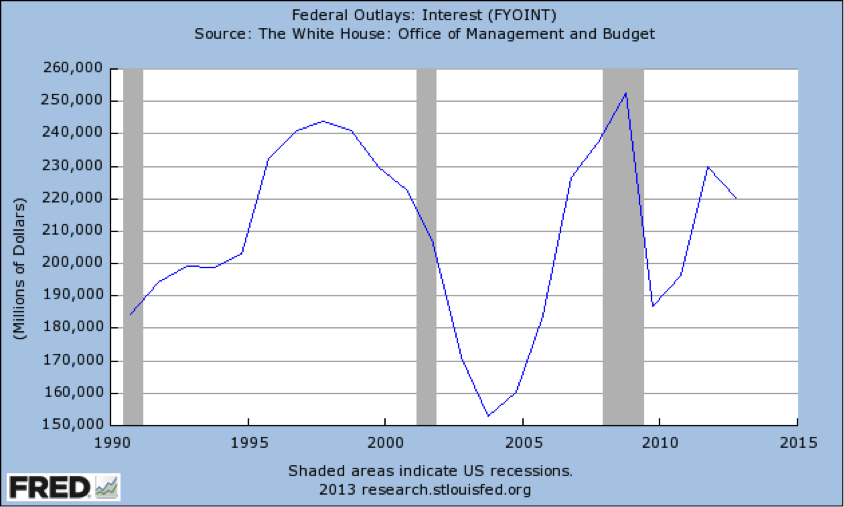
Interest rates are, for the moment, very low. Accordingly, interest payments on the debt are a small percentage of the total federal budget, despite the large size of the national debt.

With annual interest payments at a couple of hundred billion dollars, there is no impending debt-ceiling default crisis.

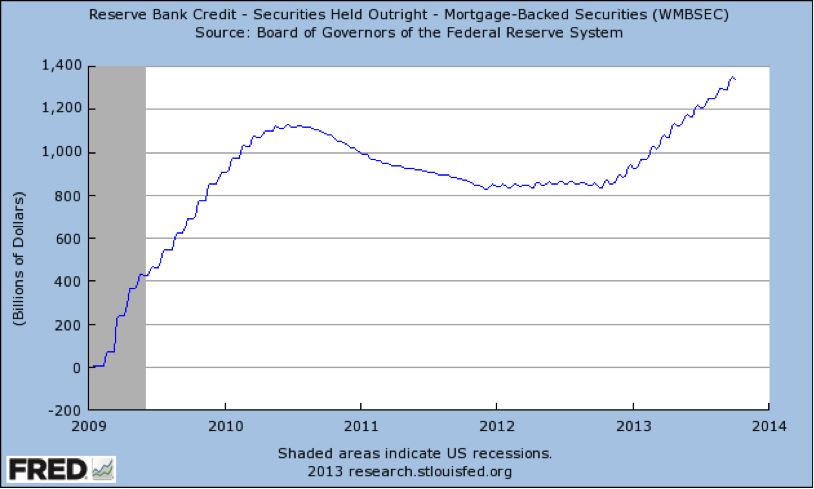
How exactly could the federal government pay interest on the national debt? To start with, the Federal Reserve now holds large numbers of mortgage-backed securities. There is some uncertainty over the market value of these securities, but their face value is immense, well over one trillion dollars. Sales of some of the better quality mortgage-backed securities could fund interest payments in the short term.

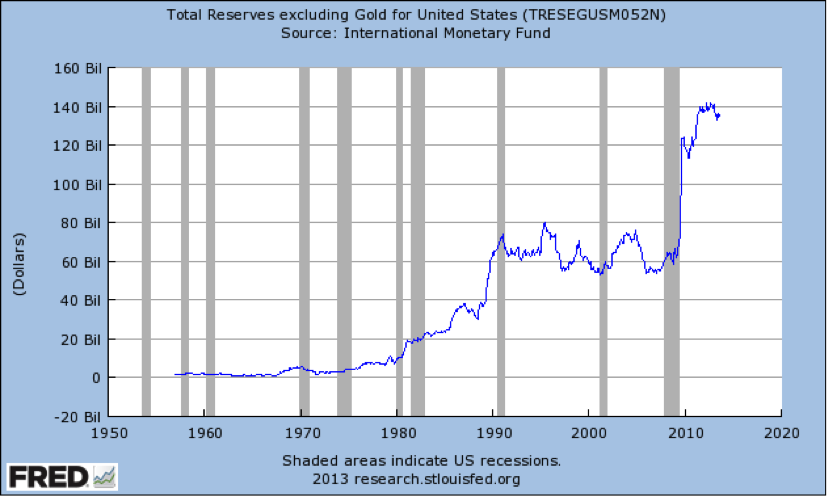
U.S. gold reserves are also substantial. The U.S. holds thousands of tons of gold at Fort Knox and at the New York Federal Reserve.

Sales of a small part of U.S. gold reserves could be used to make immediate interest payments.

The U.S. government also holds large amounts of idle real estate. The federal government spends $8 billion on vacant buildings annually. That’s for an estimated total of 55,000 to 77,000 buildings. The fact that our federal officials aren’t sure how many buildings they manage is itself disturbing, and a sign of incompetence. However, it seems that there are at least over 50,000 such buildings. How many hours would it take for federal employees who “manage” these buildings to post some of them on eBay? Surely sales of these properties would raise enough money to cover federal interest for about a month or two of the next year, even if each of these buildings sold for only a half a million dollars on average.

Efficient, competent public officials could simply announce auctions and begin to sell some of these buildings. Of course, red tape could delay property auctions. However, the Fed could make immediate interest payments by using its discretionary powers to sell mortgage-backed securities and gold reserves. President Obama could, in the meantime, expedite sales of vacant federal buildings—not to mention federal lands—by cutting red tape. (See map of federally managed land.)

The President has already acted in arbitrary—and some would say illegal—ways: by granting special exemptions from the Affordable Care Act to favored corporations, by using drones to kill U.S. citizens, and by targeting unfriendly political groups for audits. If Obama really wants save his beloved federal government from default, why shouldn’t he just use the extraordinary powers that he has already claimed to order the immediate sale of vacant buildings? The point here is not to encourage further illegality on the part of this President (he needs no assistance in such matters). The point here is that Obama does not have his back against a wall; there is no “gun to his head.” Obama has already claimed more than enough discretionary powers to prevent a debt-ceiling default in November. If default does happen it is entirely his choice, given that he has legal options and has already assumed various unconstitutional powers.

Obama has occasionally mentioned that some programs might be trimmed or cut. As Obama put it in 2010, “We cannot sustain a system that bleeds billions of taxpayer dollars on programs that have outlived their usefulness, or exist solely because of the power of a politician, lobbyist, or interest group.” He added, “We simply cannot afford it.”

The federal government holds over 700 million barrels of oil in the Strategic Petroleum Reserve. Obama could raise billions of dollars for interest payments without selling the whole reserve. Some people might see sales of the SPR as irresponsible. However, the oil in this reserve is a small fraction of monthly oil consumption, U.S. oil production is rising, and owners of foreign oil have overwhelming financial interests in continued oil sales to the United States.

The federal government also holds a Strategic Helium Reserve. It was created for “national security,” for blimps used by the military leading up to and during World War II. This program is archaic and the government already sells some helium. It could sell all of it and shut this program down.

Default on the debt is always possible. Obama and his people at the Treasury Department could have refused to pay interest on the national debt last month even though they had this money at hand. They could choose to default next month even though they can get the money—either through legal means or according to Obama’s demonstrated willingness to act illegally. The sale of federal assets and closing of federal programs would do more than just meet short-term interest payments on the national debt. Movement of securities, gold, buildings, oil, and helium would put these resources in the hands of people who would not merely put these resources to better use, but to actual use. The leeway that exists in federal finances points to longer-term financial and economic problems. Why would Obama engage in fearmongering on the national debt when obvious solutions to this problem exist? For that matter, why would federal officials hold so many idle resources for so long?

The reason why the federal government runs deficits nearly every year, despite collecting trillions in annual taxes, is because it wastes vast amounts of money on dysfunctional programs and special-interest payoffs. An efficient government would not need to tax and borrow nearly as much as does the federal government. The gross inefficiency of government has put federal finances in long-term jeopardy.

The real debt ceiling is determined by the ability of all working Americans to pay more taxes. How much more can we pay? Continued structural deficits and rising entitlement spending will result in default on the national debt, but not for a number of years. The existing path of long-term federal spending does surpass the capacity of taxpayers to fund the federal government, as it is currently designed. Future default on the national debt will have severe consequences. However, Obama’s willingness to engage in demagoguery on the immediate debt-ceiling issue is one of many signs that politicians are unwilling to take necessary steps to fix long-term fiscal finances.

The legal debt-ceiling crisis of 2013 is manufactured and phony. Even if Congress refuses to raise the legal debt ceiling this year, there are many ways of avoiding immediate default. The real problem we face is wasteful and irresponsible spending that will make default unavoidable eventually. Long-run default is, of course, avoidable. What we need are real cuts in federal spending, actual sales of federal assets and properties, and rationality in federal finances. Cutting spending and selling assets are easier said than done. Achieving smaller government will require a dramatic shift in public opinion. Americans need to realize that politicians who try to scare us are the ones that we really should fear.

D. W. MacKenzie is an assistant professor of economics at Carroll College in Helena, Montana. 

This article was originally published by The Foundation for Economic Education.
Gold is Good Money – Article by Ron Paul

Gold is Good Money – Article by Ron Paul

The New Renaissance Hat
Ron Paul
October 1, 2012
******************************

Last year the Chairman of the Federal Reserve told me that gold is not money, a position which central banks, national governments, and mainstream economists have claimed is the consensus for decades.  But lately there have been some high-profile defections from that consensus.  As Forbes recently reported, the president of the Bundesbank (Germany’s central bank) and two highly respected analysts at Deutsche Bank have praised gold as good money.

Why is gold good money?  Because it possesses all the monetary properties that the market demands: it is divisible, portable, recognizable and, most importantly, scarce – making it a stable store of value. It is all things the market needs good money to be and has been recognized as such throughout history.  Gold rose to nearly $1800 an ounce after the Fed’s most recent round of quantitative easing because the people know that gold is money when fiat money fails.

Central bankers recognize this too, even if they officially deny it.  Some analysts have speculated that the International Monetary Fund’s real clout is due to its large holdings of gold.  And central banks around the world have increased their gold holdings over the last year, especially in emerging market economies trying to protect themselves from the collapse of Western fiat currencies.

Fiat money is not good money because it can be issued without limit and therefore cannot act as a stable store of value. A fiat monetary system gives complete discretion to those who run the printing press, allowing national governments to spend money without having to suffer the political consequences of raising taxes.  Fiat money benefits those who create it and receive it first, enriching national governments and their cronies.  And the negative effects of fiat money are disguised so that people do not realize that money the Fed creates today is the reason for the busts, rising prices and unemployment, and diminished standard of living tomorrow.

This is why it is so important to allow people the freedom to choose stable money.  Earlier this Congress I introduced the Free Competition in Currency Act (H.R. 1098) to permit people to use gold as money again. By eliminating taxes on gold and other precious metals and repealing legal tender laws, people are given the option between using good money or fiat money. If the federal government persists in debasing the dollar – as money monopolists have always done – then the people would be able to protect themselves by using alternatives such as gold that are both sound and stable.

As the fiat money pyramid crumbles, gold retains its luster.  Rather than being the barbarous relic Keynesians have tried to lead us to believe it is, gold is, as the Bundesbank president put it, “a timeless classic.”  The defamation of gold wrought by central banks and national governments is because gold exposes the devaluation of fiat currencies and the flawed policies of the national government.  National governments hate gold because the people cannot be fooled by it.

Representative Ron Paul (R – TX), MD, was a three-time Republican candidate for U. S. President. See his Congressional webpage and his official campaign website. 

This article has been released by Dr. Paul into the public domain and may be republished by anyone in any manner.