Browsed by
Tag: indefinite life extension

Calico and the Paradigm Shift in the War on Death – Video by G. Stolyarov II

Calico and the Paradigm Shift in the War on Death – Video by G. Stolyarov II

Finally, the war on human senescence and involuntary death has become mainstream. With Google’s announcement of the formation of Calico, a company specifically focused on combating senescence and the diseases it brings about, a large and influential organization has finally taken a stand on the side of longer life.

References
– “Calico and the Paradigm Shift in the War on Death” – Article by G. Stolyarov II
– “Google announces Calico, a new company focused on health and well-being” – Google Press Release – September 18, 2013
– “TIME Feature: CSO Aubrey de Grey on Google’s Newly Launched Anti-Aging Initiative” – SENS Research Foundation – September 18, 2013
– “Google’s Calico: the War on Aging Has Truly Begun” – Aubrey de Grey – TIME Magazine – September 18, 2013
SENS Research Foundation

The Last Generation to Die – Article by Reason

The Last Generation to Die – Article by Reason

The New Renaissance Hat
Reason
September 27, 2013
******************************

The last generation whose members will be forced into death by aging is alive today. It won’t be the youngest of us, born in the past few years – they, most likely, have thousands of years ahead of them. It won’t be the oldest of us either, as even under the plausible best of circumstances we are twenty to thirty years away from a widespread deployment of rejuvenation therapies based on the SENS research program. As to the rest of us, just who is left holding the short straw at the end of the day depends on the speed of progress in medical science: advocacy, fundraising, and the effectiveness of research and development initiatives. Persuasion and money are far more important at this early stage than worrying about how well the researchers are doing their jobs, however.

We live in a world in which the public is only just starting to come around to the idea that aging can be treated, and demonstrations of rejuvenation in the laboratory could be achieved in a crash program lasting ten to twenty years, at a comparatively small cost. But still, most people don’t care about living longer, and most people try not to think about aging, or the future of degeneration and sickness that awaits. They think it is inevitable, but that is no longer true. If you are in early middle age today in the first world, then you have a good shot at living for centuries if the world suddenly wakes up tomorrow and massive funding pours into rejuvenation research. You will age and die on a timescale little different from that of your parents if that awakening persistently fails to happen.

So, roll the dice, or help out and try to swing the odds in your favor. Your choice.

Crowdfunding on Kickstarter and related sites is still the new new thing, the shine not yet worn off. One of the truths that this activity reinforces is that it is far, far easier to raise funding for the next throwaway technological widget than for medical research projects aimed at the betterment of all humanity. Research crowdfunding is a tiny, distant moon orbiting the great mass of comics, games, and devices on Kickstarter, Indiegogo, and others. Hell, it’s easier to crowdfund a short film that points out how close human rejuvenation might be to the present day than it is to crowdfund a project to actually conduct a portion of that research. Is this a reflection of rationality? You decide, though it could be argued either way regarding whether a dollar given to raising awareness is more valuable than a dollar given to the researchers at this point in time. Both research and persuasion need to happen.

The Last Generation To Die – A Short Film

Quote:

Set in the future when science first begins to stop aging, a daughter tries to save her father from natural death. The story takes place roughly 30 years in the future at the moment when science has first figured out how to stop aging through genetics. It is framed around the gulf between generations that would occur with the first release of this technology. A daughter who works for a company called Aperion Life – the first to bring this new technology to the public – wants to save her aging father. She starts him on the trials but he soon stops coming. The film continues with the conflict rising between them as she wants him to live on with her while he feels a natural ending is more human.The film centers itself around the natural conflict that would exist at this divide. Upon developing this story, I’ve asked many people and I’ve found a pretty even 50/50 divide of opinions strongly on one side or the other- either they want to die naturally and believe there is beauty in finality, or they want to see what the future holds and have more time to explore and learn more in life. I’d like to turn the question to you… Which side are you on? Would you want to live on or die naturally?

I feel this is a film that needs to be made. Asking these questions in the form of art and story will help start the discussion. Our world is changing very fast and the rate of technology is speeding up. What does all of this mean for humanity? Everything we know, from a book to a play to a song, ends… What does it mean when there is no ending? Would we be more complacent? Would life be as meaningful? Is there more of a beauty in the way it has always been with our passing or is there more beauty in our bodies and minds staying fresh and alive for many, many years to come? What about social justice and overpopulation? Would life become boring after living on indefinitely or would you find it exhilarating to have time to learn new languages, instruments, subjects – to read more books, to love more – to live several lifetimes? Would it be worth it if some of your most loved friends or relatives passed on and wouldn’t live on with you? Are you interested in seeing what the future brings in technology and social evolution or are you happy to have contributed and be a part of it for a short time?

Tim Maupin’s Film, ‘The Last Generation to Die’, to Explore Longevity and Life Extension

Quote:

Chicago filmmaker Tim Maupin launched a Kickstarter for a short film titled, “The Last Generation to Die.” Maupin thinks now is a great time to start a conversation about life extension. And he’s right. The idea that within decades a genetic fountain of youth may plausibly reverse the aging process, even indefinitely stave off death, seems to be rising up in pop culture. Maupin’s Kickstarter has so far raised over $15,000 – $6,000 more than its initial funding goal. Encouraged by the positive response, they’re dreaming bigger and hope to fund a stretch goal of $25,000 in the last 10 days of the campaign.

Reason is the founder of The Longevity Meme (now Fight Aging!). He saw the need for The Longevity Meme in late 2000, after spending a number of years searching for the most useful contribution he could make to the future of healthy life extension. When not advancing the Longevity Meme or Fight Aging!, Reason works as a technologist in a variety of industries.  

This work is reproduced here in accord with a Creative Commons Attribution license.  It was originally published on FightAging.org.

Editor’s Note from G. Stolyarov II: I am proud to have donated $50 to help make the film The Last Generation to Die a success. I encourage all readers to donate during the remaining nine days in which the Kickstarter project is open to accepting funds.

Calico and the Paradigm Shift in the War on Death – Article by G. Stolyarov II

Calico and the Paradigm Shift in the War on Death – Article by G. Stolyarov II

The New Renaissance Hat
G. Stolyarov II
September 19, 2013
******************************

Finally, the war on human senescence and involuntary death has become mainstream. With Google’s announcement of the formation of Calico, a company specifically focused on combating senescence and the diseases it brings about, a large and influential organization has finally taken a stand on the side of longer life. Unlike the cautious, short-term orientation of many more conventional manufacturers of drugs and medical devices, Google’s philosophy of making investments with possible immense payoffs in the distant future offers tremendous hope that this company will be around through the many years it will take to engage in the search for promising treatments and their subsequent testing.

 Aubrey de Grey, one of the chief strategists and key intellectual innovators in the escalating war on senescence, has written that Calico signals that the war on aging has truly begun. De Grey emphasizes that it is no longer necessary to persuade most of academia that this war is a worthwhile endeavor: “With Google’s decision to direct its astronomical resources to a concerted assault on aging, that battle may have been transcended: once financial limitations are removed, curmudgeons no longer matter.” As with its remarkable advances in autonomous vehicles, mobile operating systems, and wearable computing, Google does not need to ask the permission of the entire world to explore the possibilities. Rather, it can simply achieve the breakthroughs, whose momentum and adoption naysayers would be powerless to halt.

Funding has always been a major bottleneck for true life-extending research, but now the resources of Google, as well as the highly skilled researchers who will surely be recruited by Calico, will enable this bottleneck to be overcome. Few details about the company are yet available, and it is likely that several years will elapse before major discoveries are announced. However, the barrier to mainstream acceptability of the war on senescence has been breached. Once significant successes are announced, other companies will hopefully shed some of their current caution and will seek to profit from the burgeoning field of longevity research. A few other companies still may even try to emulate Calico before any results are announced – just so as to remain competitive with Google and stay ahead of the pack, in their view.

The key to the success of any sustainable enterprise focused on life-extension research is to recognize that the sole pursuit of profits next quarter or next year is not a viable strategy for altering the status quo in radical ways. Great innovations require great leaps outside the norm. Such leaps are not often immediately rewarded financially by the broader market, which is why much of the longevity research to date has been sponsored by non-profit institutions such as the SENS Research Foundation and various universities. However, a prudent, forward-looking pursuit of profit can take the radical alteration of the status quo to the next level, by harnessing the immensely powerful motive of self-interest for the purpose of improving human lives. In this case, the improvement from gains to human longevity – and hopefully the ultimate defeat of senescence altogether – would be so immense as to be humankind’s crowning achievement. Google develops technologies with the eventual intent of marketing them to millions of consumers, and the success of Calico would be a triumph not just for longevity research but for the dissemination of cures to age-related diseases, and perhaps to senescence itself.

While anyone of sufficient intellectual courage can have a long-term vision and projects aimed at advancing that vision, Google has the distinct advantage of an extremely viable business in the present, which continues to bring in short-term revenues so that Calico does not need to be concerned with profits next quarter or next year. Instead, Calico will be able to survive on the profits of Google’s many ongoing operations, while devoting the time and effort of world-class researchers to pursuing all of the explorations, experiments, and tests that are needed to ultimately develop marketable cures. Once the cures are out there, though, the profits could be unprecedented, because life is the most precious, the most fundamental value we humans have. Any entity that discovers a way to transcend the current frailties of old age and push back or remove the current limits on human lifespans will become fabulously wealthy beyond comparison.

May Calico usher in Adam Smith’s invisible hand in the realm of longevity medicine – a hand that pushes back senescence and death and creates a world where health and wealth are ours to enjoy indefinitely.

Aubrey de Grey Comments on the “Hallmarks of Aging” Paper – Article by Reason

Aubrey de Grey Comments on the “Hallmarks of Aging” Paper – Article by Reason

The New Renaissance Hat
Reason
September 8, 2013
******************************

The Hallmarks of Aging paper was published earlier this year. It is an outline by a group of noted researchers that divides up degenerative aging into what they believe are its fundamental causes, with extensive references to support their conclusions, and proposes research strategies aimed at building the means to address each of these causes. This is exactly what we want to see more of in the aging research community: deliberate, useful plans that follow the Strategies for Engineered Negligible Senescence (SENS) model of approaching aging.

Read through the Hallmarks of Aging and you’ll see that it is essentially a more mild-mannered and conservative restatement of the SENS approach to aging – written after more than ten years of advocacy and publication and persuasion within the scientific community by SENS supporters. To my eyes, the appearance of such things shows that SENS is winning the battle of ideas within the scientific community, and it is only a matter of time before it and similar repair-based efforts aimed at human rejuvenation dominate the field. Rightly so, too, and it can’t happen soon enough for my liking. SENS and SENS-like research is the only way we’re likely to see meaningful life extension technologies emerge before those of us in middle age now die, so the more of it taking place the better.

Aubrey de Grey, author of the original SENS proposals and now Chief Science Officer of the SENS Research Foundation that funds and guides rejuvenation research programs, is justifiably pleased by the existence of the Hallmarks of Aging. See this editorial in the latest Rejuvenation Research, for example:

A Divide-and-Conquer Assault on Aging: Mainstream at Last

Quote:

On June 6th, a review appeared concerning the state of aging research and the promising ways forward for the field. So far, so good. But this was not any old review. Here’s why: (a) it appeared in Cell, one of the most influential journals in biology; (b) it is huge by Cell’s standards – 24 pages, with well over 300 references; (c) all its five authors are exceptionally powerful opinion-formers – senior, hugely accomplished and respected scientists; (d) above all, it presents a dissection of aging into distinct (though inter-connected) processes and recommends a correspondingly multi-pronged (“divide and conquer”) approach to intervention.

It will not escape those familiar with SENS that this last feature is not precisely original, and it may arouse some consternation that no reference is made in the paper to that prior work. But do I care? Well, maybe a little – but really, hardly at all. SENS is not about me, nor even about SENS as currently formulated (though a depressing number of commentators in the field persist in presuming that it is). Rather, it is about challenging a profound, entrenched, and insidious dogma that has consumed biogerontology for the past 20 years, and which this new review finally – finally! – challenges (albeit somewhat diplomatically) with far more authority than I could ever muster.

Aging has been shown, over several decades, to consist of a multiplicity of loosely linked processes, implying that robust postponement of age-related ill-health requires a divide-and-conquer approach consisting of a panel of interventions. Because such an approach is really difficult to implement, gerontologists initially adopted a position of such extreme pessimism that all talk of intervention became unfashionable. The discovery of genetic and pharmacological ways to mimic [calorie restriction], after a brief period of confused disbelief, was so seductive as a way to raise the field’s profile that it was uncritically embraced as the fulcrum of translational gerontology for 20 years, but finally that particular emperor has been decisively shown to have no biomedically relevant clothes.

The publication of so authoritative a commentary adopting the “paleogerontological” position, that aging is indeed chaotic and complex and intervention will indeed require a panel of therapies, but now combined with evidence-based optimism as to the prospects for implementing such a panel, is a key step in the elevation of translational gerontology to a truly mature field.

In essence, as de Grey points out, work on aging has been following the wrong, slow, expensive, low-yield path for a couple of decades: the path of deciphering the mechanisms of calorie restriction and altering genes and metabolism to slightly slow down aging. This path cannot result in large gains in life expectancy and long-term health, and it cannot result in therapies that will greatly help people who are already old. What use is slowing down the accumulation of the damage of aging if you are already just a little more damage removed from death, and frail and suffering because of it, and the treatment will meaningfully alter none of that? If we want to add decades or more to our healthy life spans before we die, then rejuvenation and repair of damage are what is needed: ways to reverse frailty, remove suffering, and restore youthful function.

Reason is the founder of The Longevity Meme (now Fight Aging!). He saw the need for The Longevity Meme in late 2000, after spending a number of years searching for the most useful contribution he could make to the future of healthy life extension. When not advancing the Longevity Meme or Fight Aging!, Reason works as a technologist in a variety of industries.  

This work is reproduced here in accord with a Creative Commons Attribution license.  It was originally published on FightAging.org.

Life Expectancy is Growing at the Upper End, Too – Post by G. Stolyarov II

Life Expectancy is Growing at the Upper End, Too – Post by G. Stolyarov II

The New Renaissance Hat
G. Stolyarov II
September 7, 2013
******************************

I was recently asked whether my advocacy of indefinite life extension may be undermined by considering the growth rate in life expectancy at the upper end – for instance, for the oldest 10,000 people alive at any given time, rather than for the general population. Mortality for infants and younger adults has surely declined over the centuries, due to safer environments and considerable reductions in infectious diseases, but what about expansion of the upper bound of lifespans?

It turns out that there, too, considerable progress is being made. In July 2009, the New York Daily News reported, on the basis of a study from the National Institute on Aging, that “The number of centenarians already has jumped from an estimated few thousand in 1950 to more than 340,000 worldwide today, with the highest concentrations in the U.S. and Japan”. In addition to being further evidence that the US is not such a bad place for longevity (if one manages to avoid bad health habits and death from car accidents, both of which are more prevalent in the US than in Europe), this is evidence that a dramatic expansion in lifespans is underway for all age groups. Indeed, centenarians are the fastest-growing segment of all. The 2010 US Census found that the number of centenarians in the US grew by 5.8% from 2000 to 2010.  In Japan, the number of centenarians rose by 3,300 between 2010 and 2011. This trend shows no sign of abating. While Jeanne Calment, who died in 1997, still holds the greatest longevity record (122 years, 164 days), she was clearly a lucky outlier, and a recent one at that, when one considers a broader historical scale.  Statistically, the chances of living longer rise with each passing year. And among human males, the longest-living verified individual, Jiroemon Kimura, died at age 116 years, 54 days, this year (June 12, 2013). I have great hope that his record will be surpassed in the coming years.

Thus, the promise of indefinite life extension is not undermined when considering trends in the upper end of lifespans. There, as with average life expectancy and life expectancy for adults, the growth is apparent.

Combatting the “Longer Life Will Slow Progress” Criticism – Article by Franco Cortese

Combatting the “Longer Life Will Slow Progress” Criticism – Article by Franco Cortese

The New Renaissance Hat
Franco Cortese
September 2, 2013
******************************

We are all still children. As far as the Centenarian is concerned, the only people to have ever lived have been children – and we have all died before our coming of age.

What if humans only lived to age 20? Consider how much less it would be possible to know, to experience, and to do. Most people would agree that a maximum lifespan of 20 years is extremely circumscribing and limiting – a travesty. However, it is only because we ourselves have lived past such an age that we feel intuitively as though a maximum lifespan of 20 years would be a worse state of affairs than a maximum lifespan of 100. And it is only because we ourselves have not lived past the age of 100 that we fail to have similar feelings regarding death at the age of 100. This doesn’t seem like such a tragedy to us – but it is a tragedy, and arguably one as extensive as death at age 20.

Another reason informing our concern with death at age 20 and our relative ease with death at 100 is the notion of living long enough to do enough. Death at age 20 for the most part seems to preclude such experiences as parenthood, to birth a child and watch him grow into personhood, whereas a 100-year-old will have had enough time to have children, to watch them grow, to work and to enjoy the fruits of his or her labor through leisure in retirement. Our ignorance regarding the real scope of possibility, of possible experience and possible modes of existence, also informs our relative unconcern with death at age 100. We feel that there is a limited number of things for one to do in life, or at least things that are qualitatively unique enough to be considered as being truly distinguishable from the rest.

But we couldn’t be more wrong. It’s hard to step outside culture sometimes, and easy to naively look upon a foreign culture as embodying but a very limited number of archetypes and stereotypical caricatures of their true depth and diversity. There are more contemporary cultural traditions and conditions that can be practiced and experienced than there are years to actually do so. Likewise, there is more history to learn about than time available. The current breadth and depth of the world and its past are far too gargantuan to be encompassed by a mere 100 years. If you really think that there are only so many things that can be done in a lifetime, you simply haven’t lived long enough or broadly enough. There is more to the wide whorl of the world than the confines and extents of our own particular cultural narrative and native milieu.

More than this, the startling diversity of the world and stark heterogeneity of history are only set to continue their upward growth into spaces unknown as we move into the plethora of futures before us. More information is being produced than can be kept up with. Culture has always been changing, but today the pace of that change is swifter than ever before. The thought that boredom would ever be an issue to longer-living people is simply laughable. Not only does the world currently contain more than it is possible to know in a single century, but it is accumulating ever more depth and diversity every day, and at an accelerating pace. You couldn’t catch up with history in the first place, and you’re sure to gain more ground to cover than you can possibly encompass, faster than you can get a hold of it, as life expectancy experiences further increases.

Another condition informing our concern with death at 20 and our relative unconcern with death at 100 is the decline of function as we age. Bodily suffering and functional decay increase as one grows with age, and often we look upon the elderly as beings more defined by their encumbrance, by what they have lost, than by what they still possess. What will life be like, we wonder, when bodily motion becomes a battle, and when the simple experience of motion in an embodied world is complimented at every turn and twist by heat, friction, and pain, when living as we once did when young becomes a labor, and leisure is really just that? Or perhaps worse, when our minds begin to fall out from under us, to fail, as we are left to look on in horror from the inside-out, looking in? Lucky for us, we’re wrong; and even if we weren’t, we are still lucky that it is a transient tragedy, a temporary and ultimately remediable one.
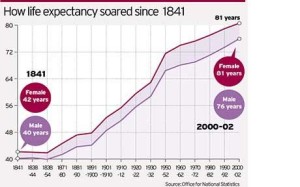
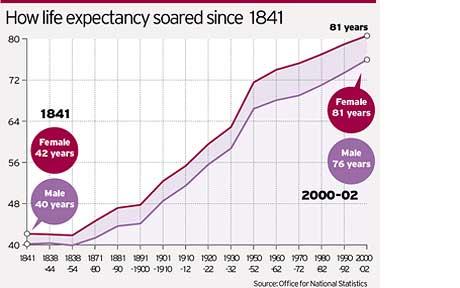
How Life Expectancy Soared Since 1841

These men and women are more than the sum of what they have lost. They are living, breathing, thinking and valuing beings. They are! It’s as simple and stunning as that: they exist! To think that they might be better off, happier, in the rest of death and quiet of last breath – to think that they are beings defined most fundamentally by suffering, and by a comparison of what they no longer are, is not only wrong but perverse. They are living, and life so long as it’s lived should never be defined by suffering, by a lack or comparison of what it isn’t, but rather by what it is and still is. There are exceptions, of course; rapidly debilitating disease, unremitting pain, incomprehensible horror at the slow decay of mind. But I would argue confidently that the elderly are not in constant woe of that which they can no longer do. Like living beings, they deal with it and continue on in the business of being. To consider the elderly as “waiting for the rest and peace of death” is a dangerous and ugly notion, and one very far from the truth.

Luckily, functional decline as a correlate of age is on the way out. We will live to 100 not in a period of decline upon hitting our mid-twenties, but in a continuing period of youthfulness. There are no longevity therapies on the table that offer to truly prolong life indefinitely without actually reversing aging. Death and aging are not separate things or processes; death is when aging has won the battle. Aging is slow death, and a truly-indefinite delaying of death ipso facto necessitates a reversal of aging, and a remediation of the physiological conditions that ultimately lead to death (i.e., what we colloquially call aging). To think that we will be prolonging our lives not as youthful beings of whatever physiological age we so desire but instead as elderly, age-ravaged beings patching new holes and bracing old crutches, is to some extent mistake the cause for the symptom. If we prolong life significantly, we will prolong the healthy portion of our lives first and foremost. The centenarians of next century will look as healthy as the 20-year-olds of last.

Thus, one of the impediments preventing us from seeing death at 100 as a tragedy, as dying before one’s time, will be put to rest as well. When we see a 100-year-old die in future, he or she will have the young face of someone who we feel today has died before their time. We won’t be intuitively inclined to look back upon the gradual loss of function and physiological-robustness as leading to and foretelling this point, thereby making it seem inevitable or somehow natural. We will see a terribly sad 20-year-old, wishing they had more time. We will be able to envision with vivid viscerality the bright and buoyant things they could be doing were they not bedridden and stricken with sickness unto death.

Moreover, that gradual decline into visually apprehensible old age also highlights another impediment to seeing the elderly as continually growing beings with a future to look forward to rather than fight against. The gradual decline of our mental faculties makes it seem that we would be accumulating experience and memory at a deficit, cumulatively losing the ability to think, judge, remember, and experience. Thus old age conjures to mind more senility than wisdom for many people.

This, too, is less true than delusive. Again, this type of thinking is engendered by comparing what they seem to be with what they aren’t or once were. In any case, it will be even less true in the future, when longevity therapies restore our mental health to its youthful glory. Then, the prospect of ever-continuing experience and personal growth, ever-accumulating wisdom and knowledge, ever sharper consideration and discernment, is not so intuitively improbable. The claim that we can in fact continue to grow in how smart, ethical, knowledgeable, and deliberative we are will not be so easily balkable when one’s physiological state ceases to be an indicator of one’s chronological age.

Another common criticism of indefinite longevity in regard to the downfalls of old age comes from Max Planck’s statement that science progresses one funeral at a time; that men and women of a given generation become so attached to their theories that they remain attached in the face of contrary evidence, and it takes their very death for new theories to be embraced by new generations unencumbered by the consideration that “after all this time I might actually be wrong after all”. From this sentiment follows the criticism that significantly extending the average human lifespan will slow progress in science by preventing the death those grafted unflinchingly to a given theory. I would argue that such a sentiment stems from the view of the elderly previously defined and defied, namely as beings more defined by what they have lost than by what they have, as beings fighting against the grain of growth. To view the elderly as continually growing beings forces one to see this criticism as somewhat naïve.

Along another line of argumentation, if we assume that this observation is correct and elderly academics refusing to let their own cherished theories die at the hands of the new is a real concern only aggravated by the coming of longevity therapies, then we still have reason to believe that longevity therapies can change the nature of the game by a large enough extent to negate these problematic concerns.

If some people refuse to consider in light of new evidence or perspective that their theory is wrong, refuse to allow the series of thought leading to the realization that all they have worked for is of lesser importance now, the most obvious cause of discontent would seem to be the notion of their own onrushing death. “If my theory is wrong, there isn’t time – or perhaps just youthful vigor – enough to do it all over again from scratch.” Someone worked his lifetime to achieve recognition in his field, and with his death so close around the corner, he faces the prospect of having all that work and worth be devalued by new developments. It is a scary thought, and the notion that people willingly or subconsciously refuse to consider facts that undermine their theory, and its perceived worth in their field, is least conceivable under such conditions. Thusly considered, Planck’s notion doesn’t appear as naïve as it first seemed.

But this is the very concern set to be alleviated by longevity therapies. If the concern with being wrong is most impacted by one’s impeding death, and the fact that one wouldn’t have the time or energy to create another groundbreaking paradigm upheaval in their chosen field should one’s namesake-theory prove to be mistaken, then the arrival of longevity therapies should not only fail to exasperate and aggravate this situation, but indeed may even ameliorate or negate it, allowing people to let their theories go under the comforting thought that they have all the time in the world to do it again.

My friend and peer Gennady Stolyarov II combats this criticism admirably, arguing that such instances occur due to the functional decline that comes with graceless old age, due to senility and a loss of mental flexibility. I think there is definitely some weight and worth to this consideration. And luckily, this, too, is a concern that is alleviated rather than aggravated by the introduction of longevity therapies. Longevity therapies will increase our healthy lifespans rather than stretch out the slow rot of our old age, as remarked earlier. Thus the longevity therapies that many critics argue could exasperate this progress-stalling state of affairs could, along yet another line of argumentation, constitute the very thing that jolts this state of affairs into reform. If senility and loss of mental flexibility contribute to Planck’s notion that life (or more properly the absence of timely death) forestalls scientific progress, then longevity therapies may constitute the source of senility’s demise and mental flexibility’s restoration.

In any case, even if we accept Plank’s notion as true, and conclude that indefinite longevity will aggravate rather than alleviate this state of affairs, faster progress in the sciences or the humanities is no justification for simply doing nothing to negate physically remediable sources of death and disease.

It seems to me a truism that we get smarter, more ethical, and more deliberative as we age. To think otherwise is in many cases derivative of the notion that physiology and experience alike are on the decline once we “peak” in our mid-twenties, downhill into old age – which does undoubtedly happen, and which inarguably does cause functional decline. But longevity therapies are nothing more nor less than the maintenance of normative functionality; longevity therapies would thus not only negate the functional decline that comes with old age, and with it the source of the problem arguably at the heart of the concern that longer life will slow progress even more, but might even constitute the only foreseeable fix to the problem by definition, because indefinite longevity is defined as (or more properly, synonymous with) the maintenance of normative functionality, a.k.a. the indefinite prevention of functional decline. There is no reason to expect that, in a time when we age without functional decline, the ethicality and experience of each human being wouldn’t increase as we age just as they arguably do as we age from two to twenty to thirty.

Increasing longevity will not bring with it prolonged old-age, a frozen decay and decrepit delay, but will instead prolong our youthful lives and make us continually growing beings, getting smarter and more ethical all the time. Indefinite longevity will not slow progress, it will accelerate it! Instead of having thinking, being beings die after ten decades, they can continue to think and be. They can build upon the edifice of their existence and experience continually, reaching heights unheralded in flighty fits and bounds. Moreover, increasingly more and more people may very well be a boon to the momentum of progress. It could be argued that the increasing rate of progress was aided by the increase in global population that preceded it, providing not only more people to have more thoughts, but more people to challenge existing thought and to provide feedback accordingly in forward fashion. Statistically speaking, more people should mean more ideas, and more ideas should mean more good ideas, all else being equal.

Thus indefinite longevity will better progress, not deter it, and will do so on the scale of both self and society. We will continue to grow, to learn, and to yearn. But more than that – we will continue to be – and that in itself is cause for good pause. In all our worry about stalled progress and boredom, we forget that even if indefinite longevity didn’t bring with it a host of advantages and boons to the boom of progress and exalted strife intrinsic to life, the ability to simply continue being is incommunicably better than the alternative, which does nothing but put an end to all other alternatives.

Franco Cortese is an editor for Transhumanity.net, as well as one of its most frequent contributors.  He has also published articles and essays on Immortal Life and The Rational Argumentator. He contributed 4 essays and 7 debate responses to the digital anthology Human Destiny is to Eliminate Death: Essays, Rants and Arguments About Immortality.

Franco is an Advisor for Lifeboat Foundation (on its Futurists Board and its Life Extension Board) and contributes regularly to its blog.

Transhumanism and Mind Uploading Are Not the Same – Video by G. Stolyarov II

Transhumanism and Mind Uploading Are Not the Same – Video by G. Stolyarov II

In what is perhaps the most absurd attack on transhumanism to date, Mike Adams of NaturalNews.com equates this broad philosophy and movement with “the entire idea that you can ‘upload your mind to a computer'” and further posits that the only kind of possible mind uploading is the destructive kind, where the original, biological organism ceases to exist. Mr. Stolyarov refutes Adams’s equation of transhumanism with destructive mind uploading and explains that advocacy of mind uploading is neither a necessary nor a sufficient component of transhumanism.

References
– “Transhumanism and Mind Uploading Are Not the Same” – Essay by G. Stolyarov II
– “Transhumanism debunked: Why drinking the Kurzweil Kool-Aid will only make you dead, not immortal” – Mike Adams – NaturalNews.com – June 25, 2013
SENS Research Foundation
– “Nanomedicine” – Wikipedia
– “Transhumanism: Towards a Futurist Philosophy” – Essay by Max More
2045 Initiative Website
Bebionic Website
– “How Can I Live Forever?: What Does and Does Not Preserve the Self” – Essay by G. Stolyarov II
– “Immortality: Bio or Techno?” – Essay by Franco Cortese

Heidegger, Cooney, and The Death-Gives-Meaning-To-Life Hypothesis – Article by Franco Cortese

Heidegger, Cooney, and The Death-Gives-Meaning-To-Life Hypothesis – Article by Franco Cortese

The New Renaissance Hat
Franco Cortese
August 10, 2013
******************************
One common argument against indefinite lifespans is that a definitive limit to one’s life – that is, death – provides some essential baseline reference, and that it is only in contrast to this limiting factor that life has any meaning at all. In this article I refute the argument’s underlying premises, and then argue that even if such premises were taken as true, the argument’s conclusion – that eradicating death would negate the “limiting factor” that legitimizes life – is also invalid, because the ever-changing nature of self and society – and the fact that opportunities once here are now gone –  can constitute such a scarcitizing factor just as well as death can.
***
Death gives meaning to life? No! Death is meaninglessness!
***

One version of the argument is given in Brian Cooney’s Posthumanity: Thinking Philosophically about the Future, an introductory philosophical text that uses various futurist scenarios and concepts to illustrate the broad currents of Western philosophy. Towards the end of the book, Cooney makes his argument against immortality, claiming that if we had all the time in the universe to do what we wanted, then we wouldn’t do anything at all. Essentially, his argument boils down to “if there is no possibility of not being able to do something in the future, then why would we ever do it?”

Each chapter of Cooney’s book ends with a dialogue between a fictional human and posthuman, meant to better exemplify the arguments laid out in the chapter and their various interpretations. In the final chapter, “Posthumanity”, Cooney-as-posthuman writes:

Our ancestors realized that immortality would be a curse, and we have never been tempted to bestow it on ourselves… We didn’t want to be like Homer’s gods and goddesses. The Odyssey is saturated with the contrast of mortal human life, the immortality of the gods and the shadow life of the dead in Hades… Aren’t you struck by the way these deities seem to have nothing better to do than be an active audience for the lives and deeds of humans… These gods are going to live forever and there is no scarcity of whatever resources they need for their divine way of life. So (to borrow a phrase from your economists) there is no opportunity cost to their choosing to do one thing rather than another or spend time with one person rather than another. They have endless time and resources to pursue other alternatives and relationships later. Consequently, they can’t take anyone or anything seriously… Moreover, their lives lack meaning because they are condemned to living an unending story, one that can never have narrative unity… That is the fate we avoid by fixing a standard limit to our lives. Immortals cannot have what Kierkegaard called ‘passion’… A mind is aware of limitless possibilities – it can think of itself as doing anything conceivable – and it can think of a limitless time in which to do it all. To choose a life – one that will progress like a story from its beginning to its end – is to give up the infinite for the finite… We consider ourselves free because we were liberated from the possibility of irrationality and selfishness.”   –   (Cooney, 2004, 183-186).
***

Thus we see that Cooney’s argument rests upon the thesis that death gives meaning to life because it incurs finitude, and finitude forces us to choose certain actions over others. This assumes that we make actions on the basis of not being able to do them again. But people don’t make most of their decisions this way. We didn’t go out to dinner because the restaurant was closing down; we went out for dinner because we wanted to go out for dinner. I think that Cooney’s version of the argument is naïve. We don’t make the majority of our decisions by contrasting an action to the possibility of not being able to do it in future.

Cooney’s argument seems to be that if we had a list of all possible actions set before us, and time were limitless, we might accomplish all the small, negligible things first, because they are easier and all the hard things can wait. If we had all the time in the world, we would have no reference point with which to judge how important a given action or objective is. If we really can do every single thing on that ‘listless list’, then why bother, if each is as important as every other? In his line of reasoning, importance requires scarcity. If we can do everything it was possible to do, then there is nothing that determines one thing as being more important than another. Cooney makes an analogy with an economic concept to clarify his position. Economic definitions of value require scarcity; if everything were as abundant as everything else, if nothing were scarce, then we would have no way of ascribing economic value to a given thing, such that one thing has more economic value than another. So too, Cooney argues, with possible choices in life.

But what we sometimes forget is that ecologies aren’t always like economies.

The Grave Dig|nitty of Death

In the essay collection “Transhumanism and its Critics”, Hava Tirosh-Samuelson writes:

Finally, since death is part of the cycle of life characteristic of finite creatures, we will need to concern ourselves with a dignified death… the dying process need not be humiliating or dehumanizing; if done properly, as the hospice movement has shown us, the dying process itself can be dignified by remembering that we are dealing with persons whose life narratives in community are imbued with meaning, and that meaning does not disappear when bodily functions decline or finally cease.”   –  (Tirosh-Samuelson, 2011).
***

She may have provided a line of reasoning for arguing that death need not be indignifying or humiliating (convinced me that death has any dignity whatsoever), but I would say that she’s digging her claim’s own grave by focusing on the nitty-gritty details of humiliation and dignity. It is not the circumstances of death that make death problematic and wholly unsatisfactory; it is the fact that death negates life. Only in life can an individual exhibit dignity or fail by misemphasis. Sure, people can remember you after you have gone, and contributing to larger projects that continue after one’s own death can provide some meaning… but only for those still alive – not for the dead. The meaning held or beheld by the living could pertain to the dead, but that doesn’t constitute meaning to or for the dead, who forfeited the capability to experience, or behold meaning when they lost the ability to experience, or behold anything at all.

Tirosh-Samuelson’s last claim, that death need not be dehumanizing, appears to be founded upon her personal belief in an afterlife more than the claim that meaning doesn’t necessarily have to cease when we die, because we are part of “a community imbued with meaning” and this community will continue after our own death, thus providing continuity of meaning.  Tirosh-Samuelson’s belief in the afterlife also largely invalidates the claims she makes, since death means two completely different things to an atheist and a theist. As I have argued elsewhere (Cortese, 2013, 160-172), only the atheist speaks of death; the theist speaks merely of another kind of life. For a theist, death would not be dehumanizing, humiliating, or indignifying if all the human mental attributes a person possessed in the physical world would be preserved in an afterlife.

Another version of the “limiting factor” argument comes from Martin Heidegger, in his massive philosophical work Being and Time. In the section on being-toward-death, Heidegger claims, on one level, that Being must be a totality, and in order to be a totality (in the sense of being absolute or not containing anything outside of itself) it must also be that which it is not. Being can only become what it is not through death, and so in order for Being to become a totality (which he argues it must in order to achieve authenticity – which is the goal all along, after all), it must become what it is not – that is, death – for completion (Heidegger, 1962). This reinforces some interpretations made in linking truth with completion and completion with staticity.

Another line of reasoning taken by Heidegger seems to reinforce the interpretation made by Cooney, which was probably influenced heavily by Heidegger’s concept of being-toward-death. The “fact” that we will one day die causes Being to reevaluate itself, realize that it is time and time is finite, and that its finitude requires it to take charge of its own life – to find authenticity. Finitude for Heidegger legitimizes our freedom. If we had all the time in the world to become authentic, then what’s the point? It could always be deferred. But if our time is finite, then the choice of whether to achieve authenticity or not falls in our own hands. Since we must make choices on how to spend our time, failing to become authentic by spending one’s time on actions that don’t help achieve authenticity becomes our fault.Can Limitless Life Still Have a “Filling Stillness” and “Legitimizing Limit”?

Perhaps more importantly, even if their premises were correct (i.e., that the “change” of death adds some baseline limiting factor, causing you to do what you would not have done if you had all the time in the world, and thereby constituting our main motivator for motion and metric for meaning), Cooney and Heidegger are still wrong in the conclusion that indefinitely extended life would destroy or jeopardize this “essential limitation”.

The crux of the “death-gives-meaning-to-life” argument is that life needs scarcity, finitude, or some other factor restricting the possible choices that could be made, in order to find meaning. But final death need not be the sole candidate for such a restricting factor.
***
Self: La Petite Mort
***
All changed, changed utterly… A terrible beauty is born. The self sways by the second. We are creatures of change, and in order to live we die by the moment. I am not the same as I once was, and may never be the same again. The choices we prefer and the decisions we are most likely to make go through massive upheaval.The changing self could constitute this “scarcitizing” or limiting factor just as well as death could. We can be compelled to prioritize certain choices and actions over others because we might be compelled to choose differently in another year, month, or day. We never know what we will become, and this is a blessing. Life itself can act as the limiting factor that, for some, legitimizes life.

Society: La Petite Fin du Monde

Society is ever on an s-curve swerve of consistent change as well. Culture is in constant upheaval, with new opportunities opening up(ward) all the time. Thus the changing state of culture and humanity’s upheaved hump through time could act as this “limiting factor” just as well as death or the changing self could. What is available today may be gone tomorrow. We’ve missed our chance to see the Roman Empire at its highest point, to witness the first Moon landing, to pioneer a new idea now old. Opportunities appear and vanish all the time.

Indeed, these last two points – that the changing state of self and society, together or singly, could constitute such a limiting factor just as effectively as death could – serve to undermine another common argument against the desirability of limitless life (boredom) – thereby killing two inverted phoenixes with one stoning. Too often is this rather baseless claim bandied about as a reason to forestall indefinitely extended lifespans – that longer life will lead to increased boredom. The fact that self and society are in a constant state of change means that boredom should become increasingly harder to maintain. We are on the verge of our umpteenth rebirth, and the modalities of being that are set to become available to us, as selves and as societies, will ensure that the only way to entertain the notion of increased boredom  will be to personally hard-wire it into ourselves.

Life gives meaning to life, dummy!

Death is nothing but misplaced waste, and I think it’s time to take out the trash, with haste. We don’t need death to make certain opportunities more pressing than others, or to allow us to assign higher priorities to one action than we do to another. The Becoming underlying life’s self-overcoming will do just fine.

References

Cooney, B. (2004). Posthumanity: Thinking Philosophically about the Future. Rowman & Littlefield. ISBN-10: 0742532933

Cortese, F. (2013). “Religion vs. Radical Longevity: Belief in Heaven is the Biggest Barrier to Eternal Life?!”. Human Destiny is to Eliminate Death: Essays, Arguments and Rants about Immortalism. Ed. Pellissier, H. 1st ed. Niagara Falls: Center for Transhumanity. 160-172.

Heidegger, M., Macquarrie, J., & Robinson, E. (1962). Being and time. Malden, MA: Blackwell.

Tirosh-Samuelson, H. (2011). “Engaging Transhumanism”. Transhumanism and its Critics. Ed. Grassie, W., Hansell, G. Philadelphia, PA: Metanexus Institute.

Franco Cortese is an editor for Transhumanity.net, as well as one of its most frequent contributors.  He has also published articles and essays on Immortal Life and The Rational Argumentator. He contributed 4 essays and 7 debate responses to the digital anthology Human Destiny is to Eliminate Death: Essays, Rants and Arguments About Immortality.
Franco is an Advisor for Lifeboat Foundation (on its Futurists Board and its Life Extension Board) and contributes regularly to its blog.

Transhumanism and Mind Uploading Are Not the Same – Article by G. Stolyarov II

Transhumanism and Mind Uploading Are Not the Same – Article by G. Stolyarov II

The New Renaissance Hat
G. Stolyarov II
July 10, 2013
******************************

In what is perhaps the most absurd attack on transhumanism to date, Mike Adams of NaturalNews.com equates this broad philosophy and movement with “the entire idea that you can ‘upload your mind to a computer’” and further posits that the only kind of possible mind uploading is the destructive kind, where the original, biological organism ceases to exist. Adams goes so far as calling transhumanism a “death cult much like the infamous Heaven’s Gate cult led by Marshal Applewhite.”

I will not devote this essay to refuting any of Adams’s arguments against destructive mind uploading, because no serious transhumanist thinker of whom I am aware endorses the kind of procedure Adams uses as a straw man. For anyone who wishes to continue existing as an individual, uploading the contents of the mind to a computer and then killing the body is perhaps the most bizarrely counterproductive possible activity, short of old-fashioned suicide. Instead, Adams’s article – all the misrepresentations aside – offers the opportunity to make important distinctions of value to transhumanists.

First, having a positive view of mind uploading is neither necessary nor sufficient for being a transhumanist. Mind uploading has been posited as one of several routes toward indefinite human life extension. Other routes include the periodic repair of the existing biological organism (as outlined in Aubrey de Grey’s SENS project or as entailed in the concept of nanomedicine) and the augmentation of the biological organism with non-biological components (Ray Kurzweil’s actual view, as opposed to the absurd positions Adams attributes to him). Transhumanism, as a philosophy and a movement, embraces the lifting of the present limitations upon the human condition – limitations that arise out of the failures of human biology and unaltered physical nature. Max More, in “Transhumanism: Towards a Futurist Philosophy”, writes that “Transhumanism differs from humanism in recognizing and anticipating the radical alterations in the nature and possibilities of our lives resulting from various sciences and technologies such as neuroscience and neuropharmacology, life extension, nanotechnology, artificial ultraintelligence, and space habitation, combined with a rational philosophy and value system.” That Adams would take this immensity of interrelated concepts, techniques, and aspirations and equate it to destructive mind uploading is, plainly put, mind-boggling. There is ample room in transhumanism for a variety of approaches toward lifting the limitations of the human condition. Some of these approaches will be more successful than others, and no one approach is obligatory for those wishing to consider themselves transhumanists.

Moreover, Adams greatly misconstrues the positions of those transhumanists who do support mind uploading. For most such transhumanists, a digital existence is not seen as superior to their current biological existences, but as rather a necessary recourse if or when it becomes impossible to continue maintaining a biological existence. Dmitry Itskov’s 2045 Initiative is perhaps the most prominent example of the pursuit of mind uploading today. The aim of the initiative is to achieve cybernetic immortality in a stepwise fashion, through the creation of a sequence of avatars that gives the biological human an increasing amount of control over non-biological components. Avatar B, planned for circa 2020-2025, would involve a human brain controlling an artificial body. If successful, this avatar would prolong the existence of the biological brain when other components of the biological body have become too irreversibly damaged to support it. Avatar C, planned for circa 2030-2035, would involve the transfer of a human mind from a biological to a cybernetic brain, after the biological brain is no longer able to support life processes. There is no destruction intended in the 2045 Avatar Project Milestones, only preservation of some manner of intelligent functioning of a person whom the status quo would instead relegate to becoming food for worms. The choice between decomposition and any kind of avatar is a no-brainer (well, a brainer actually, for those who choose the latter).

Is Itskov’s path toward immortality the best one? I personally prefer SENS, combined with nanomedicine and piecewise artificial augmentations of the sort that are already beginning to occur (witness the amazing bebionic3 prosthetic hand). Itskov’s approach appears to assume that the technology for transferring the human mind to an entirely non-biological body will become available sooner than the technology for incrementally maintaining and fortifying the biological body to enable its indefinite continuation. My estimation is the reverse. Before scientists will be able to reverse-engineer not just the outward functions of a human brain but also its immensely complex and intricate internal structure, we will have within our grasp the ability to conquer an ever greater number of perils that befall the biological body and to repair the body using both biological and non-biological components.

The biggest hurdle for mind uploading to overcome is one that does not arise with the approach of maintaining the existing body and incrementally replacing defective components. This hurdle is the preservation of the individual’s unique and irreplaceable vantage point upon the world – his or her direct sense of being that person and no other. I term this direct vantage point an individual’s “I-ness”.  Franco Cortese, in his immensely rigorous and detailed conceptual writings on the subject, calls it “subjective-continuity” and devotes his attention to techniques that could achieve gradual replacement of biological neurons with artificial neurons in such a way that there is never a temporal or operational disconnect between the biological mind and its later cybernetic instantiation. Could the project of mind uploading pursue directions that would achieve the preservation of the “I-ness” of the biological person? I think this may be possible, but only if the resulting cybernetic mind is structurally analogous to the biological mind and, furthermore, maintains the temporal continuity of processes exhibited by an analog system, as opposed to a digital system’s discrete “on-off” states and the inability to perform multiple exactly simultaneous operations. Furthermore, only by developing the gradual-replacement approaches explored by Cortese could this prospect of continuing the same subjective experience (as opposed to simply creating a copy of the individual) be realized. But Adams, in his screed against mind uploading, seems to ignore all of these distinctions and explorations. Indeed, he appears to be oblivious of the fact that, yes, transhumanists have thought quite a bit about the philosophical questions involved in mind uploading. He seems to think that in mind uploading, you simply “copy the brain and paste it somewhere else” and hope that “somehow magically that other thing becomes ‘you.’” Again, no serious proponent of mind uploading – and, more generally, no serious thinker who has considered the subject – would hold this misconception.

Adams is wrong on a still further level, though. Not only is he wrong to equate transhumanism with mind uploading; not only is he wrong to declare all mind uploading to be destructive – he is also wrong to condemn the type of procedure that would simply make a non-destructive copy of an individual. This type of “backup” creation has indeed been advocated by transhumanists such as Ray Kurzweil. While a pure copy of one’s mind or its contents would not transfer one’s “I-ness” to a digital substrate and would not enable one to continue experiencing existence after a fatal illness or accident, it could definitely help an individual regain his memories in the event of brain damage or amnesia. Furthermore, if the biological individual were to irreversibly perish, such a copy would at least preserve vital information about the biological individual for the benefit of others. Furthermore, it could enable the biological individual’s influence upon the world to be more powerfully actualized by a copy that considers itself to have the biological individual’s memories, background, knowledge, and personality.  If we had with us today copies of the minds of Archimedes, Benjamin Franklin, and Nikola Tesla, we would certainly all benefit greatly from continued outpourings of technological and philosophical innovation.  The original geniuses would not know or care about this, since they would still be dead, but we, in our interactions with minds very much like theirs, would be immensely better off than we are with only their writings and past inventions at our disposal.

Yes, destructive digital copying of a mind would be a bafflingly absurd and morally troubling undertaking – but recognition of this is neither a criticism of transhumanism nor of any genuinely promising projects of mind uploading. Instead, it is simply a matter of common sense, a quality which Mike Adams would do well to acquire.

Arguing by Induction for an Absence of Boredom in an Ageless, Greatly Extended Healthy Life – Article by Reason

Arguing by Induction for an Absence of Boredom in an Ageless, Greatly Extended Healthy Life – Article by Reason

The New Renaissance Hat
Reason
June 19, 2013
******************************
Originally published on the Fight Aging! website.
***

It is usually the case that the first knee-jerk reaction in opposition to increased human longevity is based on the mistaken belief that life-extension technologies would lead to people being ever more frail and decrepit for a very long time. This is far from the case, and it’s probably not even possible to cost-effectively engineer a society of long-lived frail people – even if that was the goal to hand. If you are frail and decrepit, then you have a high mortality rate due to the level of age-related cellular and molecular damage that is causing the failure and degeneration of your body and its organs. You won’t be around for long. No, the only way to engineer longer healthy life is to extend the period of youth and vitality, a time in which you have little age-related damage and your mortality rate is very low. Most present strategies are aimed to prolong that period of life, either by slowing the rate at which damage occurs (not so good) or finding ways to periodically repair the damage and thus rejuvenate the patient (much better).

Once people grasp that longevity science is the effort to make people younger for far longer, then the second knee-jerk objection arises. This is the belief that a very long-lived individual would become overwhelmed by boredom: they would run out of interest and novelty. This is by far the sillier objection, and there is absolutely no rational basis for it. Even a few moments of thought should convince you that there is far more to do and learn that you could achieve in a thousand life spans – and it’s a little early in the game to be objecting to enhanced longevity on the basis that you can’t think of what to do with life span number number 1001.

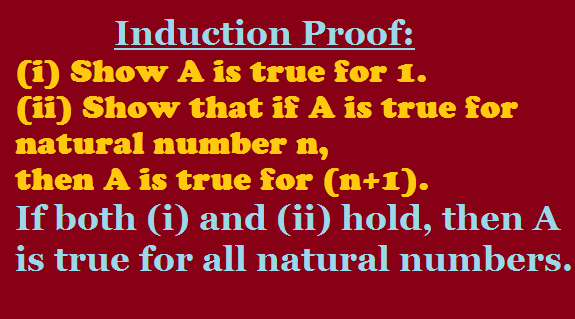
Considering boredom, futility, meaningless, and related matters, I noticed what appears to be an argument by induction in the article below. Mathematical induction is a tool used in formal proofs wherein if you can prove that something is generally true for n and n+1 (where n is a natural number), and then show that it is true for 1, then you can conclude it must be true for all natural numbers. If it is true for 1, then it must be true for 1+1 = 2, and true for 2+1 = 3, and so on.

Basics of an Induction Proof 

Life Extension Leads to Meaningless Days? NO! – by Extropia DaSilva

Person 1 lives a fulfilling and meaningful life for X number of years before that life is terminated by a sudden, massive heart attack. Now, imagine another person whom we shall label (not too creatively) ‘Person 2′. Person 2’s life follows the same general path as that of Person 1, with one exception: It is one day longer than Person 1’s was. Now ask yourself: Is there any reason to suppose that this day – let us assume it is a Tuesday – strikes Person 2 as being meaningless despite the fact that all Tuesdays (and, indeed, every other day in Person 2’s past) seemed worth living? Personally I cannot see any reason to suppose that this Tuesday should not be as worth living through as the previous day was. Person 2’s life was as meaningful as that of Person 1, and the extra day Person 2 lived to see did not negatively affect quality of life (it might have positively affected it, but that is another matter).

OK, so now imagine yet another person who goes by the label of… yes, you guessed it, Person 3. You can probably also guess that Person 3 lives one day longer than Person 2. Once again, I can think of no reason why, where we have two people who live meaningful lives but one lives one day longer, that extra day would not seem worth experiencing. Put another way: If possible, would Persons 2 and 1 rather not be dead on Wednesday (the last day for Person 3) when Monday and all preceding days were worth experiencing? So far as I can see, the answer to that question is, ‘yes’.

There seems to be no reason why this argument should not hold for any number of hypothetical people, each one of which lives one day longer than the last.

Unfortunately you can’t prove conjectures about aspects of human nature with induction (or not yet, at least). What you can do is use it, as above, to mount a more convincing argument. This one is somewhat akin to one of the standard lines in any debate between a person who is in favor of greatly extending healthy life versus someone who isn’t.

Advocate: So you are fine with aging and dying?

Deathist: Yes.

Advocate: So you are fine with dying right now, done and finished?

Deathist: Well, no.

Advocate: Why would you think any differently ten days, or a hundred days, or decades from now, if you still had your health and vigor?

Deathist: Um…

There seems to be a strange disconnect in many people’s minds, in which they are vigorously in favor of being alive right this instant or next week, but they nonetheless believe that their future self of years ahead will be of a different opinion and want to die. Now if you’re on the downhill slope of aging, in great pain, and your body is falling apart, desiring a stopping point is not unreasonable. (With the best of present options for those in that position being cryonics). But in a world of rejuvenation therapies, in which older life is just as healthy, low-risk, and full of possibility as younger life, what mysterious thing is going to make people want to die?

Reason is the founder of The Longevity Meme (now Fight Aging!). He saw the need for The Longevity Meme in late 2000, after spending a number of years searching for the most useful contribution he could make to the future of healthy life extension. When not advancing the Longevity Meme or Fight Aging!, Reason works as a technologist in a variety of industries.  

This work is reproduced here in accord with a Creative Commons Attribution license.  It was originally published on FightAging.org.