Browsed by
Tag: indefinite life extension

Liberty or Death: Why Libertarians Should Proclaim That Death is Wrong – Video by G. Stolyarov II

Liberty or Death: Why Libertarians Should Proclaim That Death is Wrong – Video by G. Stolyarov II

Without intending it, Patrick Henry communicated a truth that is becoming increasingly apparent in our era: we can one day be truly free if humans achieve indefinite life extension; without it, we will be both unfree and eventually dead. Within our lifetimes, we will either have liberty and no death, or death and no liberty. We cannot have both liberty and death.

Donate today to the fundraiser to Help Teach 1000 Kids That Death is Wrong.

References
Death is Wrong on Amazon
* Paperback version
* Kindle version
Death is Wrong Official Home Page

– “Liberty or Death: Why Libertarians Should Proclaim That Death is Wrong” – Essay by G. Stolyarov II
– “Liberty Through Long Life” – Essay by G. Stolyarov II
– “Life Extension and Risk Aversion” – Essay by G. Stolyarov II
– “How the NSA Plans to Infect ‘Millions’ of Computers with Malware” – Ryan Gallagher and Glenn Greenwald – The Intercept – March 12, 2014
– “Longevity Escape Velocity” – Wikipedia
SENS Research Foundation
Movement for Indefinite Life Extension Facebook Page

Those Critical of Indefinite Life Extension Fear Life – Article by Eric Schulke and Wioletta Karkucińska

Those Critical of Indefinite Life Extension Fear Life – Article by Eric Schulke and Wioletta Karkucińska

The New Renaissance Hat
Eric Schulke and Wioletta Karkucińska
March 23, 2014
******************************

What a repugnant, disdainful, knee-jerk flippancy to flop out of one’s mouth to mock anybody for being afraid of death.

If death doesn’t arouse fear, then what is fear?

We know what fear is. It’s having the sense to understand the level of loss that something imposes upon a person. It’s a no-brainer to understand that life provides value that would diminish to an extensive level if it were to be lost.

Let’s make this even clearer by spelling out what the dictionary tells us about fear.

fear

verb \ˈfir\

: to be afraid of (something or someone)

: to expect or worry about (something bad or unpleasant)

: to be afraid and worried

a :  an unpleasant often strong thought caused by anticipation or awareness of danger

b (1) :  an instance of this (2) :  a state marked by this

:  anxious concern :  solicitude

:  reason for alarm :  danger

I don’t have the courage to be robbed or run over; nor should I, or anyone. I have the emotional maturity to understand what my fear is telling me and to equip myself with the courage to join in on the assault on the terrible beast of aging. Watching incredible things unfold in the universe and world, seeing that it is all just the tip of an inconceivably large iceberg, and then seeing that it will be arbitrarily terminated in another of endless, terrible, horrific events for all involved, is alarming. It should concern you that you are standing on the deck of this great star-ship called Earth, and that you might fall off. You should be able to be aware of, and anticipate danger that is ahead. Your stake in the universe is at stake. Your DNA crawled out of your mother’s womb, drove a spike into the universe, asserting a claim in this realm, and death comes along like a miscreant walking up to a land-claim stake, and rips it out and throws it in the river.

“What are you, afraid of death?” They say.

“Don’t be a coward.”

“Because you’re too cowardly to accept death, the rest of us have to help you with your stupid little excursions?”

It’s as though they are saying, “What are you, afraid of cancer? You sissy, your mother and brother have cancer? So what? Don’t act like a wimp. Cancer is what happens. People live, people get cancer. Don’t accept the ice cream and the music if you’re going to whine about the cancer, it’s part of the package. If I could lift a finger to stop people from dying, then I wouldn’t do it.”

Or, it’s like that jerk that you know urging people to walk into woods where there are predators with humans as prey.

“Come on man, walk forty miles through the jungle there. Don’t worry about the lions, mosquitoes, and rhinos. You’ll get through fine, just goooo.” What terrible advice, and what a terrible kind of advice to condone and not discourage!

They are like the trash-talkers on the rodeo machine, where a round of people sit at a teeter-tottering table in the middle of a bull pen while they play cards and talk smack to each other for not continuing to sit in the bull’s eye of imminent death.

Pretending to be fearless in the face of death isn’t some form of heroism. It isn’t reasonable or courageous. It is quite the opposite. It is taking the easy way out.

What’s more is, that although being afraid is a sensible, logical part of it, the overriding part of it is that most of the people that I talk to that want to live long into the future, do it first and foremost because of their love for life. Most of the people that I know have been thwamped over the head with passion bugs of various kinds by flipping over galactic rocks like philosophy stones, quantum particles, history books and science boulders.

Fighting death has been for ages treated as a battle destined to be lost. How many times, when faced with a loss of a loved one, have we heard “Well, that’s the way of life”? How can one NOT notice the bitter irony and hypocrisy of that statement? How can death EVER be called an element of life, something to accept? It’s the very OPPOSITE of life, NOT part of it, and it is high time we should start seeing it as such. Let the blinders fall from our eyes, once and for all.

We appreciate our opportunity. We appreciate the rarity of humanity and the mind-blowing mysteries we have the privilege to continue to be submersed in. We understand that culture and tradition do not govern the big picture of what it means to exist here.

What it means to exist here is that we are the rare opportunities to know existence. What kind of extremely rare miracle would spring out of the mud after eons of nothingness and then declare that fleeting, flippant, empty cultural traditions of intellectually straitjacketed ancestors of itself are the best dictates for how it should face the big picture of the rapidly unfolding, multifaceted, and to-be-unfettered dreams-come-true (multi?)universe? Would you say that your grandmother’s old typewriter manual is the best guide for figuring out how to fix and program your computer?

What kind of jaw-dropping, paradigm-quaking miracle would spring out of the mud, find science and technology, industry and physics, communications superhighways and knowledge warehouses at the ends of high-speed trails, and all the rest – in many cases at its disposal or within reach of it – and then decide that the best thing for this miracle of the universe to do would be to return to the mud? I can’t tell you how disappointing it is to realize that many of our fellow human beings still think that. It’s also hard to understand exactly how they could think that in a world that emphasizes the value in good, positive critical thinking. They know better than that.

Accepting death is in fact choosing it. In the face of recent discoveries and progress in science, medicine, technology – it is a matter of choice.

Some people will smugly respond with the assertion that quality is obviously better than quantity. They say that acquiring more happiness now in exchange for taking away their chance to live for continued decades and centuries, is not irresponsible and wrong.

To them we say, our ancestors toiled and struggled through untold and long-lasting hardships to deliver their progeny, you, here to where you are so you can have the opportunities and the ever-brighter futures the generations of your ancestors hoped for, worked for, and achieved. You and your opportunities are their achievement, and I urge you to keep in mind thoughts of not wanting to let them down. You don’t live it up now and then throw away the chance your ancestors gave you. Your job is to survive first, and build empires later. You accept the tough times so that you may continue to earn opportunities to work to build more and more goodness into your life – be that through the completion of more dreams, the building up of more enterprises, the satiation of more curiosity, the fulfillment of more adventure, etc. The tough times help you to savor the good times more. When the ship is on choppy seas and might go down, you hold on tight and work twice as hard. Our ancestors didn’t raise us to throw in the towel. As far as I have ever seen, modern-day Homo sapiens did not evolve with a gene for quitting.

You are set for all the challenges that fighting for life brings. Let’s repeat it – death really is the easy way out. You fall asleep; you get a bullet; cancer kills you; some choose suicide; some accept aging and its effects as an inexorable given. The hard truth here that we should be prepared to acknowledge is: accepting death is the true cowardice, no matter the circumstances. Fighting it and choosing life is the true courage.

Critics of indefinite life extension, don’t put on a snide, condescending face and tell me that you aren’t afraid of death, because you are, too.

By your own knee-jerk flippancy, reactionary admission, you are also afraid of life. You’re afraid of death, and you’re afraid of life. You say, right to us, all the time, that you don’t want to bear to deal with the drastic changes, you don’t want to live without all your friends and family around, you don’t want to live with war still being a reality anywhere. You can’t stand all the jerks and the dangerous people, and rich people, or tyrants, controlling you for one decade longer than a traditional lifespan. The thought of it makes you want to jump into your grave right now to get away from this big, bad, scary life.

You, my friend, are afraid of life. Living scares you. You think of life and you cower. You see the challenges of life and you’re too scared to face them. You wouldn’t dare form and join teams and initiatives to meet those challenges on the intellectual combat fields of dialectics and action. You don’t have what it takes. Life isn’t for you. It’s not your thing. So love your death, fear your life. Do that if that’s what you want.

I am afraid of death. It scares me to think of losing my life. I value my life. I have no shame in that. That is the reasonable thing to do. What I have shame for is that anybody would think that being afraid of death might possibly be something to mock.

You mock us for being afraid of death. We are afraid of death; it’s a logical and positive thing to be afraid in the face of it. It reminds a person to take action against danger. It’s your being afraid of life that is to be mocked. So stand up and tell us how afraid you are of living. We promise not to look upon you with too much shame, and we promise to lend you a hand if you need help crossing over to the land of reason.

We once thought the Earth was flat or that all planets revolved around Earth. Many people who have threatened to disrupt tradition and the ways things have been at given times in the world’s history, have faced persecution and shunning for their discoveries. The life of helping move the world forward was hard because the work didn’t often ride forward in a parade of activism and public cheer and action. It would ride forward one hard-fought campaign at a time, one shovel-full at a time, at the hands of small groups of dedicated people working hard to ring the bell of freedom at each new level as humanity continued to expand out into the big picture of the universe and existence. They kept their minds fine-tuned and well-oiled with awareness and focus on what it means to be alive, gathered information, moved humanity forward in various ways, and proved the huge number of skeptics wrong. Life must have felt like hell for them, but they held on and won.

They chose to be courageous in their LIVES. Are you ready to open your mind and face some difficulties in the struggle for life? Would you rather fall asleep and miss out on miracles or stay wide awake and live them?

Eric Schulke was a director at LongeCity during 2009-2013. He has also been an activist with the Movement for Indefinite Life Extension and other causes for over 13 years.

Wioletta Karkucińska is an author and longevity activist in Warsaw, Poland.

A Roman Coin from the 330s: The New Oldest Object in Mr. Stolyarov’s Possession

A Roman Coin from the 330s: The New Oldest Object in Mr. Stolyarov’s Possession

The New Renaissance Hat
G. Stolyarov II
March 22, 2014
******************************

At the March 1, 2014, Transhuman Visions 2.0 conference in Piedmont, CA (where Wendy and I gave a presentation on Death is Wrong), I was pleased to meet Neal VanDeRee of The Church of Perpetual Life, an organization promoting the desirability of living without end and inspired by the philosophy of the great Russian Cosmist thinker Nikolai Fedorov (or Fyodorov – a better Anglicization of the Russian “Фёдоров”).

 Mr. VanDeRee organized a drawing of attendees’ business cards, for which the prize was an ancient Roman coin from the 4th century CE. I was thrilled to win the drawing, and I received my coin in the mail today. Here are images (scans on top, photographs on bottom) of both the front (obverse) and back (reverse) sides of the coin.

Mr. Stolyarov's Roman coin from Siscia (330s CE)

Some further research enabled Wendy and me to form a reasonably good understanding regarding the origins of this coin. The “SIS” letters on the bottom indicate that the coin was minted in Siscia (today, Sisak in Croatia), which housed a mint for roman coins between 262 and 383 CE. (Wendy and I are not yet in agreement as to whether the first letter is “A” or “B”. Wendy thinks it is an “A”, while I see a “B” because of the elevated ridge on the bottom of the letter. What do you think?)

This particular coin is a commemorative coin for the city of Constantinople, with a left-facing image of a helmeted emperor (likely Constantine I – Roman emperor from 306 to 337) on the obverse side and a winged Victory goddess with a spear and shield on the reverse side. Here and here are images of two highly similar coins, which are identified on the Dirty Old Coins website as dating from 330-333 CE and 334-335 CE, respectively. Another highly similar coin is listed here on the Portable Antiquities Scheme site from the United Kingdom. That coin is dated to 334-335 CE. Based on our research, Wendy and I are reasonably confident that our coin, too, dates to the 330s CE, prior to Constantine’s death.

In Death is Wrong, I wrote about an 1893 Indian head penny which I found in the hallways of my high school in 2004, when I was gathering spare change found in the “state of nature” in order to donate to the Methuselah Mouse Prize. I am happy to still have this object – older than any living human being today – in my coin collection. This Roman coin from the 330s, though, is older by an order of magnitude. It has existed for approximately 1680 years already, and it is certainly the oldest object I own. May it continue to exist indefinitely, and may all of us humans continue to live indefinitely also!

Mr. Stolyarov Interviewed by RJ Eskow on The Zero Hour Regarding “Death is Wrong”

Mr. Stolyarov Interviewed by RJ Eskow on The Zero Hour Regarding “Death is Wrong”

The New Renaissance Hat
G. Stolyarov II
March 22, 2014
******************************

I was interviewed regarding Death is Wrong by Richard (RJ) Eskow for the March 22, 2014, episode of his Zero Hour radio program (accessible online here and here). The 9.5-minute discussion included a brief introduction to the book, recent reactions to it, the morality of fighting death, how defeating senescence might motivate people to more resolutely combat and avert other perils and risks, and why I aim to spread the ideas of indefinite life extension to children. I was very pleased to have the opportunity to communicate indefinite life extension’s feasibility and desirability in the intelligent, thoughtful, and straightforward forum that Richard’s show provides.

My segment begins at 1:27:19. Watch it here.

If you wish to spread the message of Death is Wrong to more children, I encourage you to support my fundraiser to provide 1000 children with free copies of this paradigm-shifting book.

“Death is Wrong” Discussed on Mashable and Slashdot – Post by G. Stolyarov II

“Death is Wrong” Discussed on Mashable and Slashdot – Post by G. Stolyarov II

The New Renaissance Hat
G. Stolyarov II
March 16, 2014
******************************

I was pleased to see that Mashable’s Rebecca Hiscott wrote a fair, thoroughly researched, and factually accurate piece on Death is Wrong. Ms. Hiscott interviewed me on March 13, 2014, and incorporated my remarks in her new article, “Children’s Book Teaches Kids ‘Death is Wrong’”. I am hopeful that this development will aid in spreading the book’s reach and impact. The book was also listed on Slashdot, where a brief but fair and factual description has triggered quite an intense discussion, with both supportive and contrary arguments.

I am also pleased that the Amazon ranking for Death is Wrong has increased to unprecedented levels.

The book is now ranked #6 in the Kindle store in both Children’s eBooks and Children’s Nonfiction in the category of “Science, Nature & How It Works”, as well as #88 overall in the category of all Children’s Books on Science, Nature & How It Works. Could Death is Wrong become a bestseller? If so, its long-term impact on the culture could be just what I aspired toward – educating the next generation of life-extension researchers and activists, so as to accelerate the arrival of indefinite longevity for us all.

Amazon Kindle Store Ranking on March 16, 2014
Amazon Kindle Store Ranking for Death is Wrong – March 16, 2014

There remains time to donate to the Indiegogo fundraiser to spread Death is Wrong to 1000 children, so as to extend its impact even further.

Slate is Wrong about “Death is Wrong” – Article by Eric Schulke

Slate is Wrong about “Death is Wrong” – Article by Eric Schulke

The New Renaissance Hat
Eric Schulke
March 16, 2014
******************************

There is an article at Slate that talks about the children’s book Death is Wrong and the fundraiser to distribute 1,000 copies of it to children.

The article’s author, Joelle Renstrom, writes,

“In late February, Stolyarov and the Movement for Indefinite Life Extension started an Indiegogo campaign to raise $5,000 to distribute 1,000 free copies to kids. The campaign ends on April 23, and so far the funds fall well short of the goal.”

The goal is 33% funded after 33% of the days. That seems right on track to me. I don’t know why Slate would feel the need to exaggerate that point to make it seem like our funding progress was not favorable to us.

“But there’s a difference between curing grave diseases, which would increase our lifespans, and ‘solving’ death. Stolyarov sells kids an updated myth of pharaohs, the fountain of youth, and Gilgamesh cloaked in the singularity, the theorized point at which technology and superior artificial intelligence fundamentally alter life. He implies that death is the Problem and that solving it will ensure smooth sailing, which is irresponsible at best and disastrous at worst.”

To imply that death isn’t the problem, that you can go through deaths of people you know and then yourself, and that it is not worth smoothing out those parts of the seas of life, and to call it irresponsible and possibly disastrous to do so, is unfounded, self-back-patting – assertive flippancy at its finest. No offense. I’m sure Ms. Renstrom has plenty of redeeming qualities, but that statement is not one of them.

Sure, we fight to keep death at bay indefinitely, but we will be happy if the world’s collective efforts help lead to 500-year lifespans, or 200-year lifespans, or indefinite life spans with 77% of people dying by accident within the first 800 years anyways, etc. We support a variety of potential pathways that could bring about more good futures for more people. We support anti-aging research initiatives like SENS and many others. The critics at Slate think they’re clever for associating what we aim for with the negative image of immortality as portrayed by book and film sensationalists that make up immorality-themed stories. In the movies, it is the unspoken word that Zombies are only supposed to move slowly, but that is irrelevant to life and death causes, too.

Having a trendy, knee-jerk, cynical, superficial response to this life-and-death topic is not acceptable. Think this through more. It is, “life is good; make it work”, not, “life could be bad; justify why it’s good before making it work”.

“Stolyarov rails against acceptance, even when unaccompanied by belief in the afterlife; he rejects the Buddhist position of experiencing pain caused by death while knowing death has released a loved one from suffering. Instead, he targets an audience that could conceivably solve death before he has to stare it down, which is neither braver nor better.”

He is working on one of the most intellectually forward moving projects of our times, and he does it in a world where primary and secondary schools don’t put a lot of critical-thinking coursework into their curricula, and where it shows. It’s a world where 85% of the people claim that they know an invisible pal in the clouds can be telepathically begged to bend the laws of physics for them. Of course what he is doing is great and brave; he stands up in the face of and helps the as-of-yet ungrateful, often antagonistic masses.

“Death Is Wrong makes immortality seem within reach, describing doubling a roundworm’s life via genetic mutation and the cell-rejuvenating Strategies for Engineered Negligible Senescence proposed by bio-gerontologist and anti-aging crusader Aubrey de Grey.”

The tools to do it are here now. It is within reach. For example, diseases that are like the forms of damage that accumulate in and around the cells of our bodies and that cause us to age to death, have already been worked on with success in laboratories around the world. Also, some gene recombination has already stopped some diseases. We know how to work on this kind of stuff. We just have to determine to get it done now. So let’s rally people to this cause rather than directing them away from it.

“Representing a legitimate problem as a solution invites disaster, especially if it means ignoring issues such as overpopulation.”

Population is on a decline in many industrialized countries when you subtract immigration. So there is one of many solutions to a potential overpopulation crisis.

I often have to wonder why life-extensionists have to be the bearers of facts like these to people who use these concepts to try to discredit projects and organizations of life-and-death significance. It’s one thing to work to discredit people; it’s another thing to do it without having your facts straight, and it’s yet another messed-up thing altogether to do all that, but not even inquiringly or half-jestingly, but assertively.

What about the potential underpopulation crisis?

But it doesn’t even matter in this context; death comes first. If you’ve got two problems, and impending death of you and people you know is one of them, then you work on the death as the top priority. Death is definitely not the hands-down, go-to solution when you think about a may-be/could-be population challenge of an unknown form. It’s way down at the bottom of that list, if it’s even on there at all. In the meantime, many groups and organizations continue to work on forecasting for and planning for scenarios like those. It’s a nearly moot alarmist point to say that transhumanists and supporters of indefinite life extension can’t and don’t think of the big picture of things. I like Joelle Renstrom’s concern for it, though, and I encourage her to get involved with one of those organizations, too, and help plan ahead.

“The transhumanist declaration acknowledges technology’s double-edges: “humanity faces serious risks, especially from the misuse of new technologies. … Although all progress is change, not all change is progress.” This consideration is missing from the book. Part of preparing kids for a technological future is teaching them that not all technology is necessary or beneficial, and that we can make technological mistakes.  Putting all our eggs in the “technology will fix everything” basket is even more dangerous than putting them all in the “death is wrong” basket. What if technology doesn’t cure death? What if it, or the rush to develop it, actually causes death?”

What if, in our rush to quadruple-check every “what if”, we forgot to move forward toward the cures, and we all died needlessly? People like me, Gennady Stolyarov, and many others work with projects that help advance our understanding in those regards, too. Why would we even be accused of neglecting those considerations? We don’t support pioneering of new ground by putting on blindfolds and running at full speed through the jungle swinging a machete. Hey wait, I think I just described a straw-man that the author of this article created. I’m calling “straw man” on that point.

The presentations at the conferences we support, the authors of the books we help promote, the organizations we choose to associate with — they talk about, monitor, work with, and report on risks, ethics, sustainability, and related matters all of the time. We or people that we know, work with places like Longecity, SENS Foundation, Methuselah Foundation, Fight Aging, Campaign Against Aging, Coalition to Extend Life, Longevity Alliance, Maximum Life Foundation, Humanity+, Lifeboat Foundation, IEET, Singularity Network, Foresight Institute, Cryonics Network, and many others.

“Stolyarov might argue he’s advocating adaptation, and thus survival, but curing death would constitute artificial selection—a drastic and deliberate change in our own evolution. Inherent in that argument is a troubling notion of human exceptionalism—that we shouldn’t have to play by evolution’s rules. Stolyarov suggests we select ourselves (those who can afford it, anyway), rather than leave it to nature.”

Artificial is a kind of natural. It is natural for humans to use their tools and abilities to do what they can do with them. Human beings are exceptional. The universe didn’t (seemingly) sit empty for millions of years, with dust balls whistling in the wind, comets and cosmic gas flying by, no sentience or record of such, and then have the miraculous occurrence of sentience through human form spring up from that dust—just so that this intellectual power-tool in a land of endless wonder, potential, and mystery, could decide itself to be less significant than the ducks and the trees and allow itself to disassemble from its miraculous, universe-control-potential form, back into inanimate dust and vapor trails. It is important to use our human opportunity to leverage resources to uncover as many of the mysteries of the big picture of existence as possible.

“Kids could grow up not just afraid of death, but also afraid of failing to fix it. Stolyarov makes death a powerful nemesis that could rule their lives—just as it’s ruled his.”

What an insulting and baseless speculation to assert. If you’re going to insult somebody, at least add enough fallacy-free substance to it to hold it up.

People like the author of the Slate article want children to continue growing up afraid of life. They want death to continue to drag down their spirits and traumatize them. They want children to think that wars and the greedy people make death an appealing and noble exit. They tell people that it’s better to be intellectually lazy and forget about working on their challenges, that it’s better to lay down and die, that life is too hard and dreary. They don’t want children to think about fixing death, because they can’t conceive of having a spine when it comes to standing up to tough danger. They want indifference to remain a powerful nemesis that rules children’s minds, so they can’t see the true dangers in death and respond appropriately.

Eric Schulke was a director at LongeCity during 2009-2013. He has also been an activist with the Movement for Indefinite Life Extension and other causes for over 13 years.

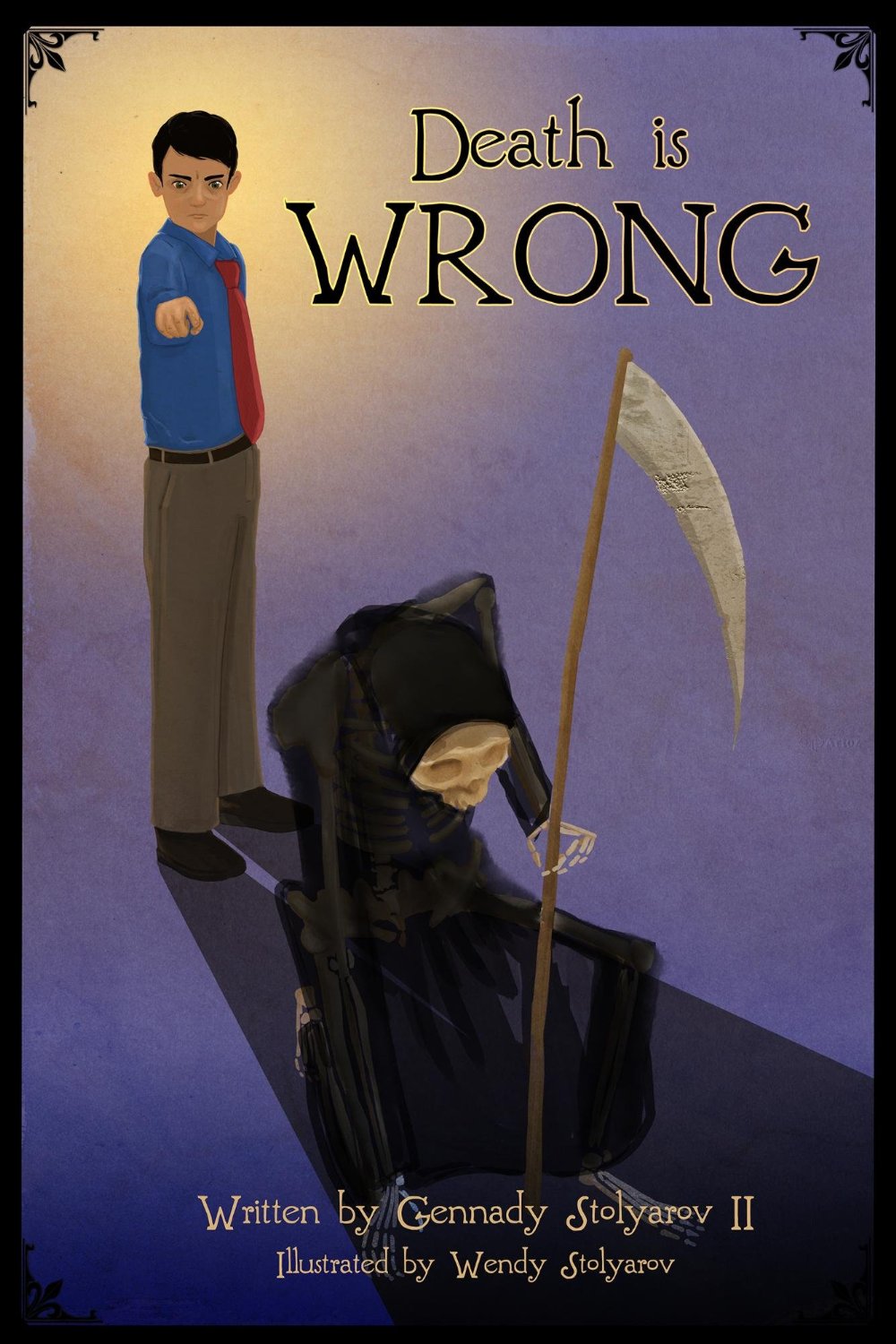
Death is Wrong - by Gennady Stolyarov II, Illustrated by Wendy Stolyarov

Liberty or Death: Why Libertarians Should Proclaim That Death is Wrong – Article by G. Stolyarov II

Liberty or Death: Why Libertarians Should Proclaim That Death is Wrong – Article by G. Stolyarov II

The New Renaissance Hat
G. Stolyarov II
March 14, 2014
******************************

Do you wish to actually live in a free society, rather than just ponder what one would be like? For some, the desire to live in liberty is so strong that they would echo Patrick Henry’s immortal words, “Give me liberty or give me death!” More than just those words should be immortal; in fact, you should be. Without intending it, Patrick Henry communicated a truth that is becoming increasingly apparent in our era: we can one day be truly free if humans achieve indefinite life extension; without it, we will be both unfree and eventually dead. Within our lifetimes, we will either have liberty and no death, or death and no liberty. We cannot have both liberty and death.

Death is Wrong is my new children’s book on indefinite life extension, beautifully illustrated by my wife Wendy Stolyarov.  The book is an educational primer which presents, in a concise, accessible manner the philosophical desirability and scientific feasibility of lifting the upper limit on human lifespans through the application of science and medical technology. We are currently in the midst of an Indiegogo fundraiser to spread this book to 1000 children, free of cost to them.  Death is Wrong does not take any political positions and does not advocate specifically for libertarianism, since we seek to focus on life extension in the book and to attract as universal a base of support as possible. It is certainly feasible to hold almost any political persuasion and to advocate the radical extension of human lifespans. Yet I, as a libertarian, see the defeat of senescence through medical progress to be an indispensable component to achieving liberty.

Death is Wrong - by Gennady Stolyarov II, Illustrated by Wendy Stolyarov

The U.S. Declaration of Independence proclaims that humans have the rights to life, liberty, and the pursuit of happiness. While the right to life is a negative right – the right not to have others infringe on one’s life – it is nonetheless indisputable that the positive condition of life is the prerequisite for the exercise of any kind of liberty and the pursuit of any kind of happiness. If one is dead, there is nothing – no choice, no growth, no self-actualization – and not even a memory of any past deed or previous fulfillment of one’s goals. Without life, liberty is impossible, and yet biological decay propels us all toward the loss of the very potential for liberty. Death obliterates everything: our precious individual universes, full of sensations, insights, thoughts, and aspirations are forever snuffed out, deprived of the possibility of ever fulfilling any goal or actualizing any ideal.

In “Liberty Through Long Life” – written in April 2013 – I described the possibilities for improving the prospects of liberty just on the horizon, facilitated by accelerating technological progress – from emerging methods of online education to cryptocurrencies to seasteading and space colonization. I explained that libertarians should want to live as long as possible in order to see and benefit from the fruits of these tremendous innovations.

Just two months after I wrote “Liberty Through Long Life”, most of us in the Western world found out just how unfree we truly were. Especially in the aftermath of Edward Snowden’s revelations that the U.S. National Security Agency and its counterparts in many Western countries are spying indiscriminately on hundreds of millions of innocents, it has become apparent that the political struggle for liberty in today’s climate has encountered barriers that appear, at present, virtually insurmountable. I am not referring to failure to achieve the libertarian political ideal or even a directional approach toward such an ideal – despite the ardent, passionate, unquestionably dedicated work that activists for liberty have done during and between the past several election cycles. The situation today is worse than that. Even abolishing the Orwellian spying apparatus and penalizing those officials who concealed and then endorsed it appears to be seen as out of the question by the political elite, no matter how great the pressure from the public and how completely useless the mass spying has turned out to be. More than ten months after Snowden’s revelations, all of the powerful people who orchestrated the mass surveillance remain in their offices, and Snowden is a fugitive in Russia. Now it has even been disclosed that the NSA has devised programs to harvest data from private hard drives, webcams, and microphones by infecting personal computers with malware in mass. Can we expect to see an end to what we would have, just one year ago, considered an unimaginably intimate surveillance – or, more likely, will the gatekeepers of the current political order assemble all of their power in the effort to perpetuate it? Achieving mere non-perversity – not to mention liberty – as an immutable principle for contemporary Western political arrangements to follow, would appear to be a Herculean task.

Yet I do not intend to undermine hope. Eventually the world improves, and old oppressions dwindle away. Yet “eventually” can be a long time. It took millennia to put an end to the legal institution of slavery, and during the early 18th century it seemed firmly rooted in the Western world. Yet forward-thinking outliers – from the Quakers to the Enlightenment philosophes – recognized its depravity and articulated the moral case for abolition back when slave labor seemed to be inextricably integrated into the most influential economies and systems of production. William Lloyd Garrison, the great 19th-century abolitionist, recognized that the push to end slavery as soon as possible was necessary to see it ended at all. He wrote, “Urge immediate abolition as earnestly as we may, it will, alas! be gradual abolition in the end. We have never said that slavery would be overthrown by a single blow; that it ought to be, we shall always contend.” [1] Slavery was ultimately abolished through a long sequence of often highly sub-optimal steps – but, were it not for the uncompromising immediate abolitionism of people like Garrison, it might not have been abolished at all, or at least would have been abolished much later. If we argue for liberty today, it will still likely take decades of the most ardent advocacy and activism to undo the harms caused by ongoing and escalating infringements of every natural and constitutional right of even the most law-abiding citizens. Therefore, while I support every effort – conventional or radically innovative – to move our societies and governments in the direction of liberty, it is essential to recognize that the success of such efforts will take an immense amount of time. If you do not remain alive during that time, then you will die without having known true liberty.

Yet we should urge not just the immediate abolition of oppression – but also of death itself. The forward-thinking outliers today – thinkers in the transhumanist and life-extension movements – recognize that transitioning from today’s medical system to one in which humans could achieve longevity escape velocity – where every year lived increases life expectancy by more than one year – will likely take decades of the most dedicated efforts in research and advocacy. Dr. Aubrey de Grey of the SENS Research Foundation, one of the foremost advocates of indefinite life extension, thinks that there exists a 50% chance of reaching longevity escape velocity in 25 years, with adequate funding. Yet, in order to catalyze the culture to embrace, or at least not oppose, the research projects and medical therapies needed, the sentiment that the abolition of death for innocent humans is desirable yesterday is imperative. This is a sentiment with which libertarians can find a close kinship, for they know well the desire for liberty to be here yesterday. This does not mean that we should forsake long-term plans or disdain incremental improvement in lifespans or medical treatments. Quite the contrary, the achievement of the great goal of preserving each innocent life will be made out of a long sequence of such incremental improvements that will save an increasing proportion of people with each new feat of progress. But we should also strive to greatly accelerate progress in biogerontological research and medicine, so that the breakthroughs can come in time to save us and those whom we cherish.

Educating the next generation to work with full dedication toward both liberty and immensely longer lifespans is a key component of this new abolitionism of the 21st century. Every bit of liberty achieved for medical innovators and cutting-edge researchers in biotechnology and nanotechnology will be a boon to the rate of progress. Every bit of lifespan extension will give activists for liberty more time to reverse Western political systems’ gallop toward totalitarianism, or to develop innovative workarounds that bypass the political systems altogether. Death is Wrong breaks with the prevalent traditional approaches of teaching children about death – approaches which either attempt to justify death through arguments that devalue the moral worth of human life entirely, or else endeavor to persuade children to resign themselves to an inevitable if regrettable end and to fill their time with other pursuits to get the thought of death out of their minds.  Instead, the book confronts the predicament of human mortality head on and shows young readers that death is neither insurmountable nor just; instead, it can be defeated, albeit with great effort. My hope is that enough young minds will be motivated by Death is Wrong to acquire the skill sets in science, philosophy, and advocacy needed to accelerate the arrival of indefinite longevity. More generally, I hope that the book will challenge children to break from conventional packages of thinking and engage every single idea critically and actively, eventually arriving at practical and moral worldviews based on principles that correspond to reality rather than the surrounding majority opinion.

Every day approximately 150,000 humans die throughout the world – 100,000 of them from diseases of senescence. Every day by which we can hasten the arrival of indefinite longevity, at least 100,000 precious individual universes will be preserved and will be able to join us in contributing their ideas and actions toward a free, just, humane society that respects and protects the rights of every individual. The contribution of indefinite life extension to human survival rates will likely even be beyond the gains reached solely due to medical progress. As I explained in “Life Extension and Risk Aversion”, the longer people’s lifespans and time horizons become, the more conscientiously they will seek to avoid or diminish physical hazards that could deprive them of hundreds or thousands of years of expected life. Exceptionally long-lived humans will work with far more intensity to reduce the prevalence of accidents, infections, natural disasters, crimes, wars, and – yes – politically motivated physical harm. A society comprised of such young supercentenarians would quickly become one of libertarians.

Libertarians can help by joining the movement for indefinite life extension and supporting the fundraiser to spread Death is Wrong to 1000 children – the next generation whose work may well enable us all to live in true liberty one day. May we have liberty – and defeat death!

[1] Quoted in William H. Pease and Jane H. Pease, eds., The Antislavery Argument (Indianapolis: Bobbs-Merrill Co., 1965), p. xxxv.

Why We Wrote “Death is Wrong” – Gennady and Wendy Stolyarov at Transhuman Visions 2.0

Why We Wrote “Death is Wrong” – Gennady and Wendy Stolyarov at Transhuman Visions 2.0

Gennady Stolyarov II and Wendy Stolyarov present their illustrated children’s book, Death is Wrong, and their fundraiser to spread the book to 1000 children, at the Transhuman Visions 2.0 conference in Piedmont, California, on March 1, 2014.

Hank Pellissier introduces Mr. and Mrs. Stolyarov, after which they deliver a 13-minute presentation.

You can also download presentation slides to follow along with the talk, to better emulate the experience of the audience at Transhuman Visions 2.0. Presentation slides can be downloaded in PDF and in Microsoft PowerPoint formats.

References

Indiegogo Fundraiser: “Help Teach 1000 Kids That Death is Wrong”
– “How Young Is Too Young To Learn About The Singularity?” – Leanne Butkovic – Fast Company
Original Fundraiser Video
Death is Wrong on Amazon
Death is Wrong – Official Home Page
Death is Wrong: Illustrated Children’s Book on Life Extension – Announcement and Short Excerpt  – Video by G. Stolyarov II

Mentions of the Indiegogo Fundraiser for Death is Wrong

– “Join Us in This Project to Tell Children That Death is Wrong” – Article by Eric Schulke – The Rational Argumentator
Institute for Ethics and Emerging Technologies (IEET)
The Wave Chronicle
FightAging.org
Immortal Life
Philly Futurists
The Lifeboat Foundation

Putting “Death is Wrong” in Children’s Hands – Article by G. Stolyarov II

Putting “Death is Wrong” in Children’s Hands – Article by G. Stolyarov II

The New Renaissance Hat
Gennady Stolyarov II
February 25, 2014
******************************

After three days of fundraising (in conjunction with the Movement for Indefinite Life Extension) to provide 1000 children with free copies of my illustrated book on indefinite life extension, Death is Wrong, I am pleased to report some promising and exciting developments.

We have already accumulated $400 in pledges from 22 generous donors. In 5% of the total time for this campaign, we are 8% of the way toward our goal. We hope to maintain this rate of progress and build up the momentum. I invite you to watch this video update where I discuss latest developments.

I am eager to begin sending out copies of Death is Wrong via this initiative as soon as possible. Some of the funds committed thus far have been sent to me via PayPal. (The funds donated via credit-card payments will be made available 15 days after the campaign’s conclusion.) Thus, I already have access to $100 of donated funds – enough to order and ship 20 copies of Death is Wrong to longevity activists who can present a brief but credible discussion of how they aim to spread the book to children in their local areas. Here I offer instructions to any supporters of indefinite life extension who seek to undertake this important project.

Instructions for Longevity Activists to Request Copies of Death is Wrong

  • Send an e-mail to gennadystolyarovii@gmail.com.
  • Provide your name, your mailing address, a statement of your support for indefinite life extension, and a brief description of your plan to spread the book to children in your local area. Remember that all copies received pursuant to this initiative would need to be offered to children free of charge (as gifts or reading opportunities) and may not be resold.
  • Provide the number of copies of Death is Wrong that you are requesting.
  • Preferably, provide an indication that you would be willing to send photographs of the books that have been delivered to you as well as events where you will be distributing the books.

Photographs will be important in highlighting the successes brought about by this campaign. The more visible impact we can demonstrate of the books being delivered to activists and given into children’s hands, the more palpable the cultural transformation brought about by this initiative will become. People who are watching our efforts will realize that, yes, we are taking active measures to beat back the age-old skeletons in humanity’s closet – the excuses, evasions, and rationalizations for death that have led so many to attempt to ignore or justify the most pressing problem facing us all.

Publicity for the Fundraiser

I am looking forward to a major opportunity to raise awareness of this initiative and of the importance of communicating the message of indefinite life extension to children. On March 1, 2014, I will be speaking at the Transhuman Visions 2.0 Conference in Piedmont, CA, along with my wife Wendy Stolyarov, who illustrated Death is Wrong. I am excited to be able to speak directly to over 150 futurists, transhumanists, life-extension advocates, media representatives, and other thinkers who ponder the impact of technology and its accelerating progress. Attendees will be able to purchase autographed copies of Death is Wrong and will also be informed about ways to contribute to the fundraiser.

I was also pleased to be interviewed by Leanne Butkovic of Fast Company earlier this month. Her provocative article, “How Young Is Too Young To Learn About The Singularity?”, has raised the profile of Death is Wrong and has exposed it to new audiences. The article features an extensive question-and-answer component where I offer perspectives regarding my background and its influence on the book, my objectives with regard to the book’s influence on children, and the relationship of the concepts in Death is Wrong to technological and societal evolution more generally.

In addition, I could not be more grateful for the support offered by numerous individuals and organizations in the transhumanist and life-extensionist community – including IEET, Fight Aging!, Immortal Life, The Wave Chronicle, Philly Futurists, the Lifeboat Foundation, and Brighter Brains. The consistent, daily efforts by these pillars of longevity advocacy are what enable the ongoing transformation of the pursuit of indefinite life extension into a genuine social and cultural movement – a cause that changes the world – rather than a mere dream in the minds of some.

In November 2013, Franco Cortese wrote that, for those of us who are not scientists or medical doctors ourselves, “the final objective of increased funding for Radical Longevity and Life Extension research can be more effectively and efficiently achieved through public advocacy for Radical Life Extension than it can by direct funding or direct research, per unit of time or effort.” I am happy to have taken his advice to heart and to have launched myself into the role of an activist for indefinite life extension, advocating for it through writing, speaking, fundraising, and – soon – traveling. I encourage others to join me. Think about your absolute and comparative advantages, your skill sets, your strengths in reaching new demographics and catalyzing progress. We are in the early days of our movement, still. We do not have a hierarchy or a leadership, but you can be a leader through your example, your perseverance, and your hard work. Let us work to reach the goal of indefinite life extension – the grand triumph of humankind over the forces of ruin and decay – in time to avert our own senescence and death.

Fast Company Publishes Article on “Death is Wrong” – Post by G. Stolyarov II

Fast Company Publishes Article on “Death is Wrong” – Post by G. Stolyarov II

The New Renaissance Hat
G. Stolyarov II
February 24, 2014
******************************

Earlier this month I was interviewed by Leanne Butkovic of Fast Company. The result is this article about Death is Wrong – which also mentions the new Indiegogo fundraiser. There is an extensive question-and-answer portion, where the answers were transcribed from our 50-minute Skype conversation.

This is great progress for spreading awareness of the book and increasing its cultural impact.