Browsed by
Tag: inflation

Federal Reserve Steals From the Poor and Gives to the Rich – Article by Ron Paul

Federal Reserve Steals From the Poor and Gives to the Rich – Article by Ron Paul

The New Renaissance Hat
Ron Paul
November 19, 2013
******************************

Last Thursday the Senate Banking Committee held hearings on Janet Yellen’s nomination as Federal Reserve Board Chairman. As expected, Ms. Yellen indicated that she would continue the Fed’s “quantitative easing” (QE) polices, despite QE’s failure to improve the economy. Coincidentally, two days before the Yellen hearings, Andrew Huszar, an ex-Fed official, publicly apologized to the American people for his role in QE. Mr. Huszar called QE “the greatest backdoor Wall Street bailout of all time.”

As recently as five years ago, it would have been unheard of for a Wall Street insider and former Fed official to speak so bluntly about how the Fed acts as a reverse Robin Hood. But a quick glance at the latest unemployment numbers shows that QE is not benefiting the average American. It is increasingly obvious that the Fed’s post-2008 policies of bailouts, money printing, and bond buying benefited the big banks and the politically-connected investment firms. QE is such a blatant example of crony capitalism that it makes Solyndra look like a shining example of a pure free market!

It would be a mistake to think that QE is the first time the Fed’s policies have benefited the well-to-do at the expense of the average American. The Fed’s polices have always benefited crony capitalists and big spending politicians at the expense of the average American.

By manipulating the money supply and the interest rate, Federal Reserve polices create inflation and thereby erode the value of the currency. Since the Federal Reserve opened its doors one hundred years ago, the dollar has lost over 95 percent of its purchasing power —that’s right, today you need $23.70 to buy what one dollar bought in 1913!

As pointed out by the economists of the Austrian School, the creation of new money does not impact everyone equally. The well-connected benefit from inflation, as they receive the newly-created money first, before general price increases have spread through the economy. It is obvious, then, that middle- and working-class Americans are hardest hit by the rising level of prices.

Congress also benefits from the devaluation of the currency, as it allows them to increase welfare- and warfare-spending without directly taxing the people. Instead, the increase is only felt via the hidden “inflation tax.” I have often said that the inflation tax is one of the worst taxes because it is hidden and because it is regressive. Of course, there is a limit to how long the Fed can facilitate big federal spending without causing an economic crisis.

Far from promoting a sound economy for all, the Federal Reserve is the main cause of the boom-and-bust economy, as well as the leading facilitator of big government and crony capitalism. Fortunately, in recent years more Americans have become aware of how the Fed is impacting their lives. These Americans have joined efforts to educate their fellow citizens on the dangers of the Federal Reserve and have joined efforts to bring transparency to the Federal Reserve by passing the Audit the Fed bill.

Auditing the Fed is an excellent first step toward restoring a monetary policy that works for the benefit of the American people, not the special interests. Another important step is to repeal legal tender laws that restrict the ability of the people to use the currency of their choice. This would allow Americans to protect themselves from the effects of the Fed’s polices. Auditing and ending the Fed, and allowing Americans to use the currency of their choice, must be a priority for anyone serious about restoring peace, prosperity, and liberty.

Ron Paul, MD, is a former three-time Republican candidate for U. S. President and Congressman from Texas.

This article is reprinted with permission from the Ron Paul Institute for Peace and Prosperity.

Chained CPI Chains Taxpayers – Article by Ron Paul

Chained CPI Chains Taxpayers – Article by Ron Paul

The New Renaissance Hat
Ron Paul
November 11, 2013
******************************

One of the least discussed, but potentially most significant, provisions in President Obama’s budget is the use of the “chained consumer price index” (chained CPI), to measure the effect of inflation on people’s standard of living. Chained CPI is an effort to alter the perceived impact of inflation via the gimmick of “full substitution.” This is the assumption that when the price of one consumer product increases, consumers will simply substitute a similar, lower-cost product with no adverse effect. Thus, the federal government decides your standard of living is not affected if you can no longer afford to eat steak, as long as you can afford to eat hamburger.

The problem with “full substitution” should be obvious to anyone not on the federal payroll. Since consumers did not choose to buy lower-priced beef before inflation raised the price of steak, they obviously preferred steak. So if the Federal Reserve’s policies create inflation that forces you to purchase hamburger instead of steak, your standard of living is lowered. CPI already uses this sort of substitution to mask the costs of inflation, but chained CPI uses those substitutions more frequently, thereby lowering the reported rate of inflation.

Supporters of chained CPI also argue that the federal government should take into account technology and other advances that enhance the quality of the products we buy. By this theory, increasing prices signal an increase in our standard of living! While it is certainly true that advances in technology improve our standard of living, it is also true that, left undisturbed, market processes tend to lowerthe prices of goods. Remember the mobile phones from the 1980s? They had limited service, constantly needed charging, and were extremely expensive. Today, almost all Americans can easily afford a mobile device to make and receive calls, texts, and e-mails, as well as use the Internet, watch movies, read books, and more.

The same process occurred with personal computers, cars, and numerous other products. If left alone, the operations of the market place will deliver higher quality and lower prices. It is only when the federal government interferes with the operation of the market, especially via fiat money, that consumers must contend with constant price increases.

The goal of chained CPI is to decrease the federal government’s obligation to meet its promise to keep up with the cost of living in programs like Social Security. But it does not prevent individuals who have a nominal increase in income from being pushed into a higher income bracket. Both are achieved without a vote of Congress.

Noted financial analyst Peter Schiff correctly calls chained CPI a measurement of the cost of survival. Instead of using inflation statistics as a political ploy to raise taxes and artificially cut spending, the President and Congress should use a measurement that actually captures the eroding standard of living caused by the Federal Reserve’s inflationary policies. Changing federal statistics to exploit the decline in the American way of life and benefit big-spending politicians and their cronies in the big banks does nothing but harm the American people.

Ron Paul, MD, is a former three-time Republican candidate for U. S. President and Congressman from Texas.

This article is reprinted with permission from the Ron Paul Institute for Peace and Prosperity.

Inflation Has Not Cured Iceland’s Economic Woes – Article by David Howden

Inflation Has Not Cured Iceland’s Economic Woes – Article by David Howden

The New Renaissance Hat
David Howden
November 6, 2013
******************************

No two countries’ responses have polarized commentators over the past five years more than the contrasting post-crisis policies in Iceland and Ireland.

In a paper published in Economic Affairs (available here as a PDF) I contrast the policies enacted by Iceland and Ireland, perhaps the two countries most affected by the liquidity freeze of 2008. A common conclusion has been that one country did everything right and the other did everything wrong, however, I take a more pragmatic approach. There are some positive aspects in each case, and other aspects we can do without.

At the risk of over-simplifying their situations, the key policy differences are:

  1. Iceland allowed substantial swaths of its financial sector to collapse (mostly foreign-domiciled subsidiaries) while Ireland enacted blanket guarantees to keep its financial sector afloat.
  2. Iceland quickly inflated its krona in a bid to regain international competitiveness through depreciation. By being locked in the euro, Ireland was unable to pursue a similar path and instead had to become more attractive to foreigners by lowering its domestic prices (i.e., disinflation or outright deflation).
  3. Iceland stymied a capital flight by enacting monetary controls aimed at keeping investment within the country. By being part of the European Union, Ireland maintained its commitment to free capital markets, and investors were able to enter or exit as they pleased.

The evidence is mixed as to which solution was more effective. Iceland seems to have softened the immediate blow of its recession, but present growth in Ireland is stronger. In a similar way, unemployment in Iceland was less and still remains lower today.

For our purposes here, I want to focus just on the effects of their respective monetary policies, and how the short-term gains from Iceland’s inflationary response now pale in comparison to Ireland’s more subdued response.

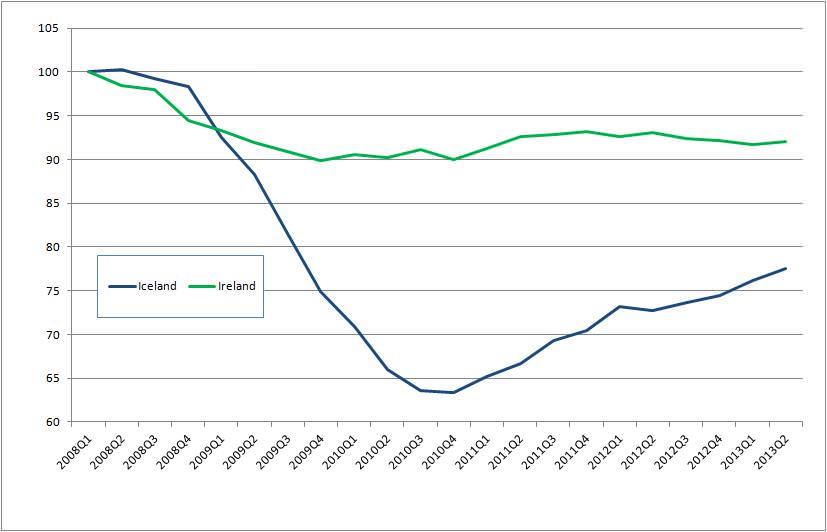
Figure 1: Nominal GDP (2008 = 100) Source: Federal Reserve Bank of St. Louis

Figure 1 shows the common story. Iceland’s inflationary policy stimulated exports, papered over some bad debts, and in general allowed it to exit the storm relatively unscathed. In contrast, Ireland is languishing in slow growth and five years later the country’s income is still 10 percent below its pre-bust peak.

Such an analysis neglects the pernicious effects of inflation on the Icelandic economy. This policy increased the money supply by almost 20 percent in 2008 alone, and lead to an immediate increase in prices.

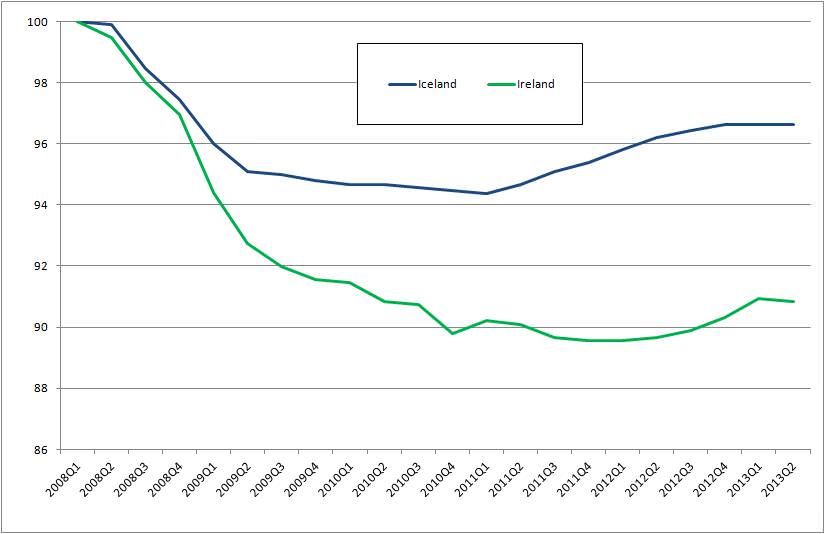
Figure 2: Real GDP (2008 = 100) Source: Federal Reserve Bank of St. Louis

In figure 2 we get a better feel for how the situation felt to the average Icelander or Irishman. As the Central Bank of Iceland inflated the money supply, price inflation raged. Icelanders continually felt their financial security worsen as their purchasing power collapsed. This was not apparent to the rest of the world, fixated as it was on the nominal prices the Icelandic economy posted. By its nadir in late 2010, inflation-adjusted income in Iceland was down over 35 percent.

In Ireland this decline was muted because of price deflation. As domestic prices fell it became easier for Irish citizens to make their declining nominal incomes go further. At its worst, the Irish economy collapsed less than 10 percent in real terms.

This seems to suggest that Ireland had the better solution by not pursuing an inflationary monetary policy. Some will note, however, that Iceland’s recovery since 2010 has been quite strong.

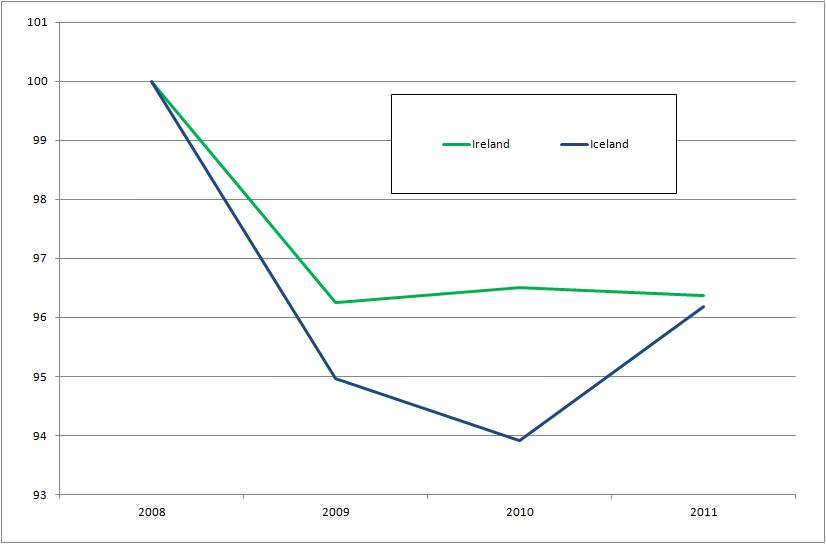
Indeed, if we look at the drop in the employment rate for both countries most probably feel more sympathy for the masses of unemployed Irishmen.

Figure 3: Employment rate (2008 = 1) Source: Federal Reserve Bank of St. Louis

Digging deeper, however, we find that not all is as it seems. Many Icelanders work two jobs to make ends meet. This effect was increasingly pronounced through the recession as inflation made it more difficult to get by with one salary. As a consequence, many Icelanders lost one job during the recession but the unemployment statistics did not reflect this as they were still employed elsewhere. This is notably not the case in Ireland, where not only is one job per worker the norm, but falling prices made it easier for an employed person to make ends meet as the recession continued.

A better way to gauge the employment situation is to look at changes in the hours worked.

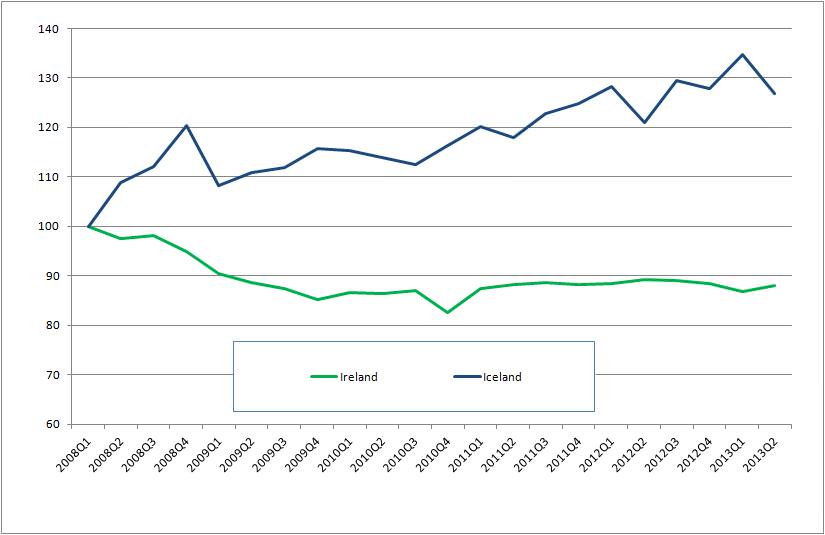
Figure 4: Annual hours worked (2008 = 100) Source: Federal Reserve Bank of St. Louis

Here we can see the situation is reversed. By the recession’s trough in 2010 the number of hours worked by the average Icelander had fallen 6 percent while in Ireland the corresponding drop was only 3.5 percent — almost half as much.

Both countries still have problems. Iceland’s monetary controls are notably stifling needed investment, while Ireland is left with a large debt from bailing out its banks, and this is stalling growth. One thing is clear though — the effects of monetary policy are stark and the proclaimed benefits of Iceland’s inflationary policy were counteracted by the price inflation that ensued.

Don’t let a good crisis go to waste; learn something from it. As the tale of these two countries demonstrates, inflating one’s currency may give the appearance of recovery, but the truth is somewhat less rosy.

David Howden is Chair of the Department of Business and Economics and professor of economics at St. Louis University’s Madrid Campus, Academic Vice President of the Ludwig von Mises Institute of Canada, and winner of the Mises Institute’s Douglas E. French Prize. Send him mail. See David Howden’s article archives.

This article was published on Mises.org and may be freely distributed, subject to a Creative Commons Attribution United States License, which requires that credit be given to the author.

Economies are Not Destroyed in a Day – Article by Nicolás Cachanosky

Economies are Not Destroyed in a Day – Article by Nicolás Cachanosky

The New Renaissance Hat
Nicolás Cachanosky
October 26, 2013
******************************

Earlier this month, Argentina’s leading conservative paper, La Nación published an unsigned editorial comparing the economies of Argentina and Venezuela. The editorial concluded that as economic freedom declines in Argentina, and as Argentina adopts more of what Chavez called “twenty-first century socialism,” it is becoming increasingly similar to Venezuela. Is this true? Will Argentina suffer the same fate as Venezuela where poverty is increasing and toilet paper can be a luxury?

The similarities of regulations and economic problems facing both countries are indeed striking in spite of obvious differences in the two countries. Yet, when people are confronted with the similarities, it is common to hear replies like “but Argentina is not Venezuela, we have more infrastructure and resources.”

Institutional changes, however, define the long-run destiny of a country, not its short-run prosperity.

Imagine that Cuba and North Korea became, overnight, the two most free-market, limited-government countries in the world. The two countries would have immediately gained civil liberties and economic freedom, but they would still have to accumulate wealth and to develop their economies. The institutional change affects the political situation immediately, but a new economy requires time to take shape. For example, as China opened parts of its economy to international markets, the country started to grow, and we are now seeing the effects of decades of relative economic liberalization. It is true that many areas in China continue to lack significant freedoms, but it would be a much different China today had it refused to change its institutions decades ago.

The same occurs if one of the wealthiest and developed countries in the world were to adopt Cuban or North Korean institutions overnight. The wealth and capital does not vanish in 24 hours. The country would shift from capital accumulation to capital consumption and it might take years or even decades to drain the coffers of previous accumulated wealth. In the meantime, the government has the resources to play the game of Bolivarian (i.e., Venezuelan) populist socialism and enjoy the wealth, highways, electrical infrastructure, and communication networks that were the result of the more free-market institutional realities of the past.

Eventually, though, highways start to deteriorate from the lack of maintenance (or trains crash in the station killing dozens of passengers), the energy sector starts to waver, energy imports become unavoidable, and the communication network becomes obsolete. In other words, economic populism is financed with resources accumulated by non-populist institutions.

According to the Fraser Institute’s Economic Freedom of the World project, Argentina ranked 34th-best in the year 2000. By 2011, however, Argentina fell to 137, next to countries like Ecuador, Mali, China, Nepal, Gabon, and Mozambique. There is no doubt that Argentina enjoys a higher rate of development and wealth than those other countries. But, can we still be sure that this will be the situation 20 or 30 years from now? The Argentinean president is known for having said that she would like Argentina to be a country like Germany, but the path to becoming like Switzerland or Germany involves adopting Swiss and German-type institutions, which Argentina is not doing.

The adoption of Venezuelan institutions in Argentina, came along with high growth rates. These growth rates, however, are misleading:

First, economic growth, properly speaking, is not an increase in “production,” but an increase in “production capacity.” The growth in observed GDP after a big crisis is economic recovery, not economic growth properly understood.

Second, you can increase your production capacity by investing in the wrong economic activities. Heavy price regulation, as takes place in Argentina (now accompanied by high rates of inflation), misdirects resource allocation by affecting relative prices. We might be able to see and even touch the new investment, but such capital is the result of a monetary illusion. The economic concept of capital does not depend on the tangibility or size of the investment (i.e, on its physical properties), but on its economic value. When the time comes for relative prices to adjust to reflect real consumer preferences, and the market value of capital goods drops, capital is consumed or destroyed in economic terms even if the physical qualities of capital goods remains unchanged.

Third, production can increase not because investment increases, but because people are consuming invested capital, as is the case when there is an increase in the rate that machinery and infrastructure wear out.

I’m not saying that there is no genuine growth in Argentina, but it remains a fact that a nontrivial share of the Argentinean GDP growth can be explained by: (1) recovery, (2) misdirection of investment, and (3) capital consumption. If that weren’t the case, employment creation wouldn’t have stagnated and the country’s infrastructure should be shining rather than falling into pieces.

Most economists and policy analysts seem to have a superficial reading of economic variables. If an economy is healthy, then economic variables look good, GDP grows, and inflation is low. But the fact that we observe good economic indicators does not imply that the economy is healthy. There’s a reason why a doctor asks for tests from a patient that appears well. Feeling well doesn’t mean there might not be a disease that shows no obvious symptoms at the moment. The economist who refuses to have a closer look and see why GDP grows is like a doctor who refuses to have a closer look at his patient. The Argentinian patient has caught the Bolivarian disease, but the most painful symptoms have yet to surface.

NOTE: This is a translated and expanded version of an original piece published in Economía Para Todos (Economics for Everyone).

Nicolás Cachanosky is Assistant Professor of Economics at Metropolitan State University of Denver. See Nicolás Cachanosky’s article archives.

You can subscribe to future articles by Nicolás Cachanosky via this RSS feed.

This article was published on Mises.org and may be freely distributed, subject to a Creative Commons Attribution United States License, which requires that credit be given to the author.

New Fed Boss Same as the Old Boss – Article by Ron Paul

New Fed Boss Same as the Old Boss – Article by Ron Paul

The New Renaissance Hat
Ron Paul
October 13, 2013
******************************

The news that Janet Yellen was nominated to become the next Chairman of the Board of Governors of the Federal Reserve System was greeted with joy by financial markets and the financial press. Wall Street saw Yellen’s nomination as a harbinger of continued easy money. Contrast this with the hand-wringing that took place when Larry Summers’ name was still in the running. Pundits worried that Summers would be too cautious, too hawkish on inflation, or too close to big banks.

The reality is that there wouldn’t have been a dime’s worth of difference between Yellen’s and Summers’ monetary policy. No matter who is at the top, the conduct of monetary policy will be largely unchanged: large-scale money printing to bail out big banks. There may be some fiddling around the edges, but any monetary policy changes will be in style only, not in substance.

Yellen, like Bernanke, Summers, and everyone else within the Fed’s orbit, believes in Keynesian economics. To economists of Yellen’s persuasion, the solution to recession is to stimulate spending by creating more money. Wall Street need not worry about tapering of the Fed’s massive program of quantitative easing under Yellen’s reign. If anything, the Fed’s trillion dollars of yearly money creation may even increase.

What is obvious to most people not captured by the system is that the Fed’s loose monetary policy was the root cause of the current financial crisis. Just like the Great Depression, the stagflation of the 1970s, and every other recession of the past century, the current crisis resulted from the creation of money and credit by the Federal Reserve, which led to unsustainable economic booms.

Rather than allowing the malinvestments and bad debts caused by its money creation to liquidate, the Fed continually tries to prop them up. It pumps more and more money into the system, piling debt on top of debt on top of debt. Yellen will continue along those lines, and she might even end up being Ben Bernanke on steroids.

To Yellen, the booms and bust of the business cycle are random, unforeseen events that take place just because. The possibility that the Fed itself could be responsible for the booms and busts of the business cycle would never enter her head. Nor would such thoughts cross the minds of the hundreds of economists employed by the Fed. They will continue to think the same way they have for decades, interpreting economic data and market performance through the same distorted Keynesian lens, and advocating for the same flawed policies over and over.

As a result, the American people will continue to suffer decreases in the purchasing power of the dollar and a diminished standard of living. The phony recovery we find ourselves in is only due to the Fed’s easy money policies. But the Fed cannot continue to purchase trillions of dollars of assets forever. Quantitative easing must end sometime, and at that point the economy will face the prospect of rising interest rates, mountains of bad debt and malinvested resources, and a Federal Reserve which holds several trillion dollars of worthless bonds.

The future of the US economy with Chairman Yellen at the helm is grim indeed, which provides all the more reason to end our system of central economic planning by getting rid of the Federal Reserve entirely. Ripping off the bandage may hurt some in the short run, but in the long term everyone will be better off. Anyway, most of this pain will be borne by the politicians, big banks, and other special interests who profit from the current system. Ending this current system of crony capitalism and moving to sound money and free markets is the only way to return to economic prosperity and a vibrant middle class.

Ron Paul, MD, is a former three-time Republican candidate for U. S. President and Congressman from Texas.

This article is reprinted with permission from the Ron Paul Institute for Peace and Prosperity.

Mainstream Economists Prove Krugman Wrong About Hayek and Mises – Article by John P. Cochran

Mainstream Economists Prove Krugman Wrong About Hayek and Mises – Article by John P. Cochran

The New Renaissance Hat
John P. Cochran
September 13, 2013
******************************

Paul Krugman has recently been critical of Friedman (and Phelps), the Phillips curve, and the Natural Unemployment Rate (NUR) theory in the process of arguing that due to the recent Great Recession, the accompanying financial crisis, and Bush-Obama-Fed Great Stagnation, Friedman has vanished from the policy front. Krugman makes this claim despite the fact there is an on-going vigorous debate on rules versus discretion with at least some attention to Friedman’s plucking model. While maligning Friedman’s contributions, Krugman manages a slap at Austrians and claims a renewed practical relevance for Keynes:

What I think is really interesting is the way Friedman has virtually vanished from policy discourse. Keynes is very much back, even if that fact drives some economists crazy; Hayek is back in some sense, even if one has the suspicion that many self-proclaimed Austrians bring little to the table but the notion that fiat money is the root of all evil — a deeply anti-Friedmanian position. But Friedman is pretty much absent.

The Friedman-Phelps hypothesis was the heart of the policy effectiveness debate of the 1970s and early 80s. The empirical evidence developed during the debate over the policy implications of the NUR model, at least temporally, discredited active Keynesian discretionary policy as an effective tool to reduce unemployment in the long run. One result of the debate: monetary policy appeared to improve, especially compared to the Fed’s dismal record in the late 1920s and 1930s and the mid 1960s to the late 1970s. Central banks, à la Friedman, focused on rules-based policy and inflation targeting resulting in what many, following John B. Taylor, call the Great Moderation of the early 1980s to the early 2000s.

Krugman does recognize the “stagflation (of the 1970s) led to a major rethinking of macroeconomics, all across the board; even staunch Keynesians conceded that Friedman/Phelps had been right (indeed, they may have conceded too much [emphasis added]), and the vertical long-run Phillips curve became part of every textbook.”

My early work on Hayek and Keynes (see here and here) argued that this development was important, but misleading. The then current business cycle research and its newer variants could benefit from re-examining the issues at the heart of the Hayek-Keynes debate.

Money, banking, finance, and capital structure were, and still are, for the most part ignored in much of the new (post-Friedman-Phelps) macroeconomics including the new–Keynesian approaches. In this regard, Hayek (and Mises) had then, and has now, more to offer than Keynes.

Recent papers by respected mainstream economists are beginning to recognize that attention to Hayek and Mises can be useful. Guillermo Calvo of Columbia University, in a recent paper [PDF], has even gone so far as to argue, “the Austrian school of the trade cycle was on the right track” and that the Austrian School offered valuable insights and noting that:

There is a growing empirical literature purporting to show that financial crises are preceded by credit booms including Mendoza and Terrones (2008), Schularik and Taylor (2012), Agosin and Huaita (2012), and Borio (2012).

Calvo adds “[t]his was a central theme in the Austrian School of Economics.”

Claudio Borio highlights what Austrians have long argued is a key flaw in inflation-targeting or stable-money policy regimes such as many central banks either adopted or emulated during the 1980-2008 period. This flaw contributed to back-to-back boom-busts of the late 1990s and 2000s:

A monetary policy regime narrowly focused on controlling near-term inflation removes the need to tighten policy when financial booms take hold against the backdrop of low and stable inflation. And major positive supply-side developments, such as those associated with the globalisation of the real side of the economy, provide plenty of fuel for financial booms.

Borio thus recognizes that a time to mitigate a bust is (contra-Keynes) during the boom:

In the case of monetary policy, it is necessary to adopt strategies that allow central banks to tighten so as to lean against the build-up of financial imbalances even if near-term inflation remains subdued.

William R. White, another economist who has worked at the Bank of International Settlements (BIS) and has been influenced by Hayek, has come to similar conclusions as does Calvo, who argues “Hayek’s theory is very subtle and shows that even a central bank that follows a stable monetary policy may not be able to prevent business cycles and, occasionally, major boom-bust episodes.”

In the current environment, many, including Krugman, have argued for a higher inflation target or a higher nominal GDP target to jump start the current sluggish recovery.

Austrian business cycle theory on the other hand, as recognized by Borio and Calvo, provides analysis on why such a policy may be ineffective and if temporarily effective in the short run, harmful if not destructive, in the long run. (See here and here for more.)

An easy money and credit policy impedes necessary re-structuring of the economy and new credit creation begins a new round of misdirection of production leading to an “unfinished recession.” Calvo expounds:

Whatever one thinks of the power of the Hayek/Mises mix as a positive theory of the business cycle, an insight from the theory is that once credit over-expansion hits the real sector, rolling back credit is unlikely to be able to put “Humpty-Dumpty together again.”

It is too bad it took back-to-back harmful boom-bust cycles for the profession at large to begin to again examine Austrian insights, but it does illustrate how foolish Krugman is when he argues Austrians have nothing to bring to the table.

John P. Cochran is emeritus dean of the Business School and emeritus professor of economics at Metropolitan State University of Denver and coauthor with Fred R. Glahe of The Hayek-Keynes Debate: Lessons for Current Business Cycle Research. He is also a senior scholar for the Mises Institute and serves on the editorial board of the Quarterly Journal of Austrian Economics. Send him mail. See John P. Cochran’s article archives.

You can subscribe to future articles by John P. Cochran via this RSS feed.

This article was originally published by the Ludwig von Mises Institute. Permission to reprint in whole or in part is hereby granted, provided full credit is given.

Bernanke’s Farewell Tour – Article by Ron Paul

Bernanke’s Farewell Tour – Article by Ron Paul

The New Renaissance Hat
Ron Paul
August 17, 2013
******************************

In mid-July 2013 Federal Reserve Chairman Ben Bernanke delivered what may well be his last Congressional testimony before leaving the Federal Reserve in 2014. Unfortunately, his farewell performance was full of contradictory comments about the state of the economy and the effects of Fed policies on the market. One thing Bernanke inadvertently made clear was that the needs of Wall Street trump Main Street, the economy, and sound money.

Quantitative easing (QE) and effectively zero interest rates have created paper prosperity, but now the Fed must continuously assure Wall Street that the QE spigot will not be turned off. Otherwise even the illusion of recovery will disappear. So Bernanke made every effort to emphasize that the economy was not doing well enough to end QE, while lauding the success of Fed policies in improving the economy.

Bernanke was also intent on denying that Fed policies directly boost financial markets. However, the money the Fed creates out of nothing in order to buy mortgage-backed securities and government debt for the QE3 program, benefits first and foremost the big banks and the financial class — those people who are invited to the Fed auctions. This new money then fuels stock bubbles, bond bubbles, agricultural land bubbles, and others. The consequences of this are felt by ordinary savers, investors, and retirees whose savings lose value because of the Fed’s zero interest rate policy.

As if Wall Street favoritism and zero returns for savers isn’t bad enough, the Fed wants the rest of America to bear a greater inflation burden. The Fed thinks you should lose two percent of the value of your dollar this year. But Bernanke is not satisfied with having reduced purchasing power by ten percent since the 2008 recession. The inflation picture is actually much worse if we look at the old consumer price index —the one that did not assume that ground beef is a perfect substitute for steak.

Using the old CPI metric, as calculated by John Williams at Shadow Government Statistics, we’ve lost close to 50 percent of the purchasing power of our money in just the last five years. So what you were able to buy with the $20 in your pocket before the financial crisis costs more than $30 today. That might be peanuts to Wall Street, but that’s real money for working Americans. And it’s theft by the Fed. It is a direct consequence of the trillions of new dollars the Fed has “not literally” printed—as Bernanke put it.

Bernanke’s final testimony before Congress confirms that the Fed has blatant disregard for the extra costs and the new bubbles it is creating. The Fed only understands paper prosperity, not how middle-class Americans and the poor suffer the consequences of higher prices, resources misallocations, and distortionary bubbles as well as insidious unemployment.

The only way out of this tailspin of monetary favoritism is to restore sound money, which would end the Fed’s ability to put Wall Street first and to manipulate currency. The Fed has proven over and over again that it has no respect for the real money that preserves the value of people’s labor, their wealth, and their ability to live free and prosperous lives. It is beyond time for the Fed, Wall Street, and the federal government to stop manipulating money and stealing from the American people under the false guise of paper prosperity.

Ron Paul, MD, is a former three-time Republican candidate for U. S. President and Congressman from Texas.

This article is reprinted with permission.

Federal Reserve Blows More Bubbles – Article by Ron Paul

Federal Reserve Blows More Bubbles – Article by Ron Paul

The New Renaissance Hat
Ron Paul
May 5, 2013
******************************

Last week at its regular policy-setting meeting, the Federal Reserve announced it would double down on the policies that have failed to produce anything but a stagnant economy. It was a disappointing, but not surprising, move.

The Fed affirmed that it is prepared to increase its monthly purchases of Treasuries and mortgage-backed securities if things don’t start looking up. But actually the Fed has already been buying more than the announced $85 billion per month. Between February and March, the Fed’s securities holdings increased $95 billion. From March to April, they increased $100 billion. In all, the Fed has pumped more than a half trillion dollars into the economy since announcing its latest round of “quantitative easing” (QE3) in September 2012.

Although many were up in arms when the Fed said it would buy $600 billion in government debt outright for the previous round, QE2, all seems quiet about the magnitude of QE3 because it doesn’t come with huge up-front total price tag. But by year’s end the Fed’s balance sheet could hit $4 trillion.

With no recovery in sight, where’s all this money going? It is creating bubbles. Bubbles in the housing sector, the stock market, and government debt. The national debt is fast approaching $17 trillion, with the Fed monetizing most of the newly issued debt. The stock market has been hitting record highs for the past two months as investors seek to capitalize on the Fed’s easy money. After all, as long as the Fed keeps the spigot open, nominal profits are there for the taking. But this is a house of cards. Eventually, just like in 2008-2009, the market will discipline the bad actions of the Fed and seek to find the real normal.

In the meantime, real families are suffering. While Wall Street and the federal government take advantage of access to the Fed’s new “free” money, the Fed claims there is no inflation. But who hasn’t paid higher prices at the grocery store, the gas pump, for tuition, for insurance? It’s bad enough that household incomes have stagnated, but real purchasing power has declined so much that one in seven Americans, 47.3 million people, are on food stamps. Five million are collecting unemployment insurance with 21.5 million afflicted by unemployment according to the federal government’s own figures. That’s 13.9 percent — close to double the 7.5 percent unemployment number reported last week.

We are certainly not in a recovery. We don’t see the long unemployment and soup-kitchen lines like in the Great Depression, but that’s just because the lines are electronic now.

It is not surprising the Fed has decided to hand the American people more of the same failed policies. But it is disappointing. We know what the real solution is: allow the marketplace to work. Allow entrepreneurs the chance to create instead of stifling innovation with arbitrary regulations. Allow interest rates to rise to equal the risks in the economy. Allow bad debts to be liquidated so we can build on a firm foundation. Stop printing money to benefit the government and big banks. Restore sound money to the economy and the American people. Sound money is the bedrock for prosperity and the best check on big government and crony capitalism.

Ron Paul, MD, is a former three-time Republican candidate for U. S. President and Congressman from Texas.

This article is reprinted with permission.

The Deflationary Spiral Bogey – Article by Robert Blumen

The Deflationary Spiral Bogey – Article by Robert Blumen

The New Renaissance Hat
Robert Blumen
February 23, 2013
******************************

What is deflation? According to dictionary.com, it is “a fall in the general price level or a contraction of credit and available money.”

Falling prices. That sounds good, especially if you have set some cash set aside and are thinking about a major purchase.

But as some additional research with Google would seem to demonstrate, that would be a naïve and simple-minded conclusion. According to received wisdom, deflation is a serious economic disease. As the St. Louis Fed would have us believe,

While the idea of lower prices may sound attractive, deflation is a real concern for several reasons. Deflation discourages spending and investment because consumers, expecting prices to fall further, delay purchases, preferring instead to save and wait for even lower prices. Decreased spending, in turn, lowers company sales and profits, which eventually increases unemployment.

The problem with deflation, then, is that it feeds on itself, destroying the economy along the way. It is the macro equivalent of a roach motel: perilously easy to enter but impossible to leave. The problem, you see, is that deflation reduces consumption, which reduces production, eventually shutting down all economic activity.

Wikipedia explains it this way:

Because the price of goods is falling, consumers have an incentive to delay purchases and consumption until prices fall further, which in turn reduces overall economic activity. Since this idles the productive capacity, investment also falls, leading to further reductions in aggregate demand. This is the deflationary spiral.

Deflation is far worse than its counterpart, inflation, because the Fed can fight inflation by raising interest rates. Deflation is nearly impossible to stop once it has started because interest rates can only be cut to zero, no lower. For this reason, “The Ben Bernank” believes that monetary policy should be biased toward preventing deflation more than preventing inflation.

Economist Mark Thornton cites the prominent New York Times blogger Paul Krugman who compares deflation to a black hole, a type of astrophysical object whose gravitational field is so strong that no matter or energy that comes near it can escape. Krugman writes,

… the economy crosses the black hole’s event horizon: the point of no return, beyond which deflation feeds on itself. Prices fall in the face of excess capacity; businesses and individuals become reluctant to borrow, because falling prices raise the real burden of repayment; with spending sluggish, the economy becomes increasingly depressed, and prices fall all the faster.

In case you’re not already scared straight, the deflationary doomsday has already happened in America when (according to the New York Times) it caused the Great Depression.

Japan, according to Bloomberg “has been battling deflation for more than a decade, with the average annual 0.3 percent decline in prices since 2000 damaging economic growth.” The New York Times reports that Japan’s new prime minister Abe “has galvanized markets by encouraging bold monetary measures to beat deflation.”

I hope that everyone is clear on this.

Now that you understand the basics, I have some questions for the people who came up with this stuff.

Why do falling prices make people expect falling prices?

The observation that prices are falling, means that in the recent past, prices have fallen.

One person noticing that the price of a good, that appears somewhere on their value scale has fallen for some time, might interpret that information and conclude that in the future, the price of that good will be lower. But a second individual might see the same thing and expect the price to level off and stay where it is, and a third might interpret falling prices as an indicator that in the future prices will be higher.

Why should a price having fallen indicate that it will continue to fall? That is only one of three possible future trends. Why should past trends continue indefinitely?

Why will the public mainly choose the first of these three outlooks, more than the other two?

According to economist Jeffrey Herbener, the assumption that falling prices create expectations of more of the same is a feature of certain popular macroeconomic theories in which price expectations are modeled as part of the theory. In his testimony to Congress, Herbener observes that “the downward spiral of prices is merely the logical implication of assumptions about expectations within formal economic models. If you assume that the agents operating in an economic model suffer from expectations that are self-reinforcing, then the model will produce a downward spiral.”

Are expectations self-reinforcing? It would make just as much sense to say that expectations are self-reversing—after people have seen prices go down for a while, they will expect prices to go up.

Are these formal models a good description of human action? Contrary to what these models say, there is no fixed response to an event. In my own experience, I can think of many times I, or someone that I know, jumped on a low price because we did not expect the opportunity to last.

But what about wages?

The postponement theory depends on the assumption that a fall in prices will benefit buyers who wait. This is true if we are talking about people who have lots of cash and can sit on it indefinitely. But most of us have ongoing monthly expenses and we depend on our wages to replenish our cash reserves. Our purchasing power, at the time when we want to make a delayed purchase, comes from our cash savings and our wages. A fall in wages, if substantial, would wipe out any gains in purchasing power realized from lower prices.

If consumers do not buy today because they expect lower prices tomorrow, then what are their expectations about their wages? Do they anticipate that their wages will be the same, higher, or lower? If lower, then by how much? As much as prices have fallen?

If consumers forecast lower prices and stable wages, then why are consumer prices included in the models, but wages are not? Does deflation only affect consumer goods prices, leaving all other prices untouched?

According to the deflationary death spiral theory, decisions not to buy drag the economy into a death spiral. Does anyone expect that could happen without affecting wages?

And what about asset prices?

In addition to cash savings and wages, individuals decide how much to spend and save taking into account the amount that they have already saved. Someone who is trying to save to meet their family’s future needs will feel less comfortable about spending.

Most people hold some of their savings in cash. That portion of their savings increases in purchasing power when prices fall. But people also save by purchasing financial assets, such as stocks and bonds, or real assets such as property, and rental housing. All of these assets have a price, which could rise or fall. Depending on the mix of cash and other assets that an individual holds, a fall in asset prices could wipe out any gains in purchasing power from the cash portion of their savings.

Do people take value of their past savings into account when deciding whether to buy or wait? Or do people form expectations about consumer prices only and ignore what might happen to their savings in a deflation?

If falling consumer prices generate expectations of more of the same, what impact do falling prices have on expectations about asset prices? Do buyers who delay purchases expect the prices of their saved assets to be lower as well? If not, then do they expect that consumer prices will be lower and asset prices will be higher?

If deflation causes the economy to disintegrate, will asset prices be spared?

Is it only buying behavior that is affected?

The deflation death star begins to destroy the earth when buying is postponed.

But is it only buying that is affected by expectations about the future? If buying is affected but not selling, then why not?

If consumers expect lower prices of most things, including things that they already own, it is equally logical that they would sell their possessions and their assets in order to buy them back later at a lower price. Selling your home and renting a similar one would be the place to start. Selling your car and leasing would be the next step. Finally, selling your assets for cash would be equally profitable. Expectations of lower prices should lead to a spiral of selling, driving prices down even faster, leading to more deflationary expectations and more selling until everyone has no possessions and no assets other than cash.

If this happened, then who would buy?

Do prices ever get low enough?

If buyers expect lower prices, then how much lower? Any number in particular? If a buyer expects a specific lower price, and the price reaches that level, will he buy? Or does he always expect prices to go even lower than they are today, no matter how far they have fallen already?

If expectations of lower prices turn out to be correct, and prices drop to even lower levels, then is there any point where a minority of contrarian buyers defect from the consensus and begin to see a bottom, or even an uptrend? Or do these expectations go on forever adapting to lower prices causing prices to drop indefinitely?

The point of delaying a purchase is so that you can make the purchase in the future and have some additional cash left over to make another purchase or to save. What is the point of delaying a purchase that you never make?

We have all had the experience of buying a new computer, or some other device, the day before the next version was released and it costs less and does more. If you knew would you have waited? Maybe, but maybe not. If you need a computer for work, then you will buy it sooner rather than later.

Many people delayed their purchase of the iPhone 4 in order to buy the iPhone 5, then when available they bought the iPhone 5. My iPhone4 was worn out by that time and I needed a new phone.

What about the Law of Demand?

According to the law of demand, a greater quantity of a good is demanded at a lower price than at a higher price. If that were true, then people would buy more, rather than postponing purchases.

What happens to the law of demand in a deflation? It turns out that the law of demand has a loophole: it requires that all other things remain equal. In a deflation death spiral, all things are not equal. Consumer preferences change in response to prices. Stationary supply and demand curves do not exist in such a world. For prices to fall and yet still fail to induce buyers to buy, the quantity demanded must always fall by more than enough to compensate for the lower asking price. The demand curve is always shifting downward faster than the price falls, to prevent an equilibrium price from ever forming. Economist W. H. Hutt calls this “an infinitely elastic demand for money.”

Does this describe the world that we live in, or any world that we could imagine? Do people really react in such a mechanical way to price changes? How do we explain, for example, shoppers competing to buy at low prices?

Why do sellers not lower prices?

Why is it only buyers whose expectations of lower prices are based on falling prices? Are the expectations of sellers included in the model?

If not, is that because the models assume that sellers do not have expectations? Or do the expectations of sellers not match the expectations of buyers?

If sellers have the expectations of lower prices, why do they not lower their prices immediately in order to sell inventory ahead of their competitors?

According to the deflation spiral theory, expectations frustrate market clearing. Yet, as Rothbard argues, speculation about future prices helps prices to converge to market clearing values. If buyers and sellers both expect future prices to be lower, why do market prices not converge upon this new, lower level immediately?

If customers are postponing purchases expecting lower prices in the future, but sellers do not cooperate, then inventories will accumulate. If this began to happen, then why would sellers not lower their prices immediately in order to clear out inventories?

All of us are both buyers and sellers, of different things at different times. To say that only the expectations of buyers are affected by falling prices, is to say that the same person, early in the day, has expectations about his own future purchases, but later the same day, does not have expectations about his own current and future sales. Does the model assume that we have all been lobotomized so the two sides of our brain do not communicate with each other?

Do producers have any control over their costs?

Previously, I asked if sellers could anticipate lower prices as well as buyers. If the producers anticipated lower prices, why did they go ahead and produce the item, or order raw materials with such high costs that they could not make a profit?

If a single business firm is experiencing fewer sales, they may not be able to reduce their costs because a single firm is close to being a price taker in the markets for labor and capital. There are usually alternative uses for their factors that value them more highly, at or close to current prices. But if prices, and sales are falling everywhere, or if everyone expects this to be the case, then why will suppliers not lower their prices if they expect their costs to be lower?

What are people doing with the money that they did not spend?

Suppose that people postpone spending. What do they do with the money they did not spend? Are they increasing their cash holdings? Or are they spending on investment goods? Saving and investing is a form of spending, only the expenditure is for capital goods rather than consumer goods. In this case, there would be no general decline in total spending or employment. Workers would have to change jobs from the consumption industries to capital goods industries, as Hayek explains in his essay “The Paradox of Savings”; but production would continue during the transition.

How much lower prices are necessary to induce people to postpone purchases?

There is a return on the purchase of a consumption good that results in the services provided by the good. This must be balanced against the return on the cash by holding until prices are lower. As noted by the Center for Economic Policy Research (CEPR), a small price change is not much of a motivation to wait, if you need a new product:

[postponement of purchases] would be true for rapid rates of deflation, but Japan’s deflation has almost always been less than 1.0 percent a year. In 2011 its inflation rate was -0.2 percent. This means that if someone was considering buying a $20,000 car, they could save $40 by waiting a year. It is unlikely that this rate of deflation affected the timing of many purchases to any significant extent.

Why do quantities adjust but not costs?

If there is a generalized increase in money demand, then prices need to adjust downward. Why is it that all the quantity of goods bought and the quantity of labor employed can adjust, but prices cannot?

According to The Asia Times, when deflation strikes, factories lay workers off in order to cut costs. Why cannot producers lower their bid prices to their labor force and their suppliers in order to preserve production? If they could lower their costs, then they could produce profitably at a lower price level.

The general price level does not matter to business firms, so long as their costs are below their sale prices. Why does a deflationary meltdown assume that business can not operate profitably at any nominal price level? Why can business not lower costs?

Is this really what caused the Great Depression?

What about the credit bubble of the 1920s?

What about bank failures? The great contraction of the money supply?

The Smoot-Hawley tarrif?

What about regime uncertainty?

How about New Deal wage and price policies that prevented prices from falling, which would have allowed employment to recover?

Conclusion

The deflation death spiral is a theoretical description of a situation but it does not describe the reality of human action, for any number of reasons:

1. There is in reality always a diversity of expectations among the public. While some people will expect prices to continue in the same direction, others will form the opposite view. Everyone’s expectations will change not only in response to changes in the data, but taking into account their entire life experience, their own ideas, and their situation.

2. Expectations are not entirely driven by prices. A broad range of things influences our expectations about price.

3. Lower prices are not always sufficient motivation to delay purchases because everyone prefers to have what they want now, rather than later.

4. Expectations of buyers tend to be met by sellers, if not at first, then fairly soon. In some cases, buyers can hold onto their cash for a bit longer, but most businesses have no choice but to sell their inventories at what the buyer will pay. In other cases, buyers may not be able to delay purchases, or may not wish to, and will pay what they must in order to buy.

5. Everyone—buyers and sellers (and every one of us acts in both of these roles at different times)—has expectations not only about consumer prices, but about wages, employment prospects, even asset prices, the economy in general, the progress of our own life, and the future of our family. A coherent plan of saving and spending takes all of these things into account.

6. Expectations can be met. Buyers have a buying price. Even if not known in advance, they know it when they see it posted. Even if they do not know what they plan to buy in the future, a bargain price will be met by buyers.

7. People only need so much cash. Beyond that, they start to look around for either consumption goods, or investments.

Robert Blumen is an independent enterprise software consultant based in San Francisco. Send him mail. See Robert Blumen’s article archives.

This article was published on Mises.org and may be freely distributed, subject to a Creative Commons Attribution United States License, which requires that credit be given to the author.

Where Is the Inflation? – Article by Mark Thornton

Where Is the Inflation? – Article by Mark Thornton

The New Renaissance Hat
Mark Thornton
January 30, 2013
******************************

Critics of the Austrian School of economics have been throwing barbs at Austrians like Robert Murphy because there is very little inflation in the economy. Of course, these critics are speaking about the mainstream concept of the price level as measured by the Consumer Price Index (i.e., CPI).

Let us ignore the problems with the concept of the price level and all the technical problems with CPI. Let us further ignore the fact that this has little to do with the Austrian business cycle theory (ABCT), as the critics would like to suggest. The basic notion that more money, i.e., inflation, causes higher prices, i.e., price inflation, is not a uniquely Austrian view. It is a very old and commonly held view by professional economists and is presented in nearly every textbook that I have examined.

This common view is often labeled the quantity theory of money. Only economists with a Mercantilist or Keynesian ideology even challenge this view. However, only Austrians can explain the current dilemma: why hasn’t the massive money printing by the central banks of the world resulted in higher prices.

Austrian economists like Ludwig von Mises, Benjamin Anderson, and F.A. Hayek saw that commodity prices were stable in the 1920s, but that other prices in the structure of production indicated problems related to the monetary policy of the Federal Reserve. Mises, in particular, warned that Fisher’s “stable dollar” policy, employed at the Fed, was going to result in severe ramifications. Absent the Fed’s easy money policies of the Roaring Twenties, prices would have fallen throughout that decade.

So let’s look at the prices that most economists ignore and see what we find. There are some obvious prices to look at like oil. Mainstream economists really do not like looking at oil prices, they want them taken out of CPI along with food prices, Ben Bernanke says that oil prices have nothing to do with monetary policy and that oil prices are governed by other factors.

As an Austrian economist, I would speculate that in a free market economy, with no central bank, that the price of oil would be stable. I would further speculate, that in the actual economy with a central bank, that the price of oil would be unstable, and that oil prices would reflect monetary policy in a manner informed by ABCT.

That is, artificially low interest rates generated by the Fed would encourage entrepreneurs to start new investment projects. This in turn would stimulate the demand for oil (where supply is relatively inelastic) leading to higher oil prices. As these entrepreneurs would have to pay higher prices for oil, gasoline, and energy (and many other inputs) and as their customers cut back on demand for the entrepreneurs’ goods (in order to pay higher gasoline prices), some of their new investment projects turn from profitable to unprofitable. Therefore, you should see oil prices rise in a boom and fall during the bust. That is pretty much how things work as shown below.

As you can see, the price of oil was very stable when we were on the pseudo Gold Standard. The data also shows dramatic instability during the fiat paper dollar standard (post-1971). Furthermore, in general, the price of oil moves roughly as Austrians would suggest, although monetary policy is not the sole determinant of oil prices, and obviously there is no stable numerical relationship between the two variables.

Another commodity that is noteworthy for its high price is gold. The price of gold also rises in the boom, and falls during the bust. However, since the last recession officially ended in 2009, the price of gold has actually doubled. The Fed’s zero interest rate policy has made the opportunity cost of gold extraordinarily low. The Fed’s massive monetary pumping has created an enormous upside in the price of gold. No surprise here.

Actually, commodity prices increased across the board. The Producer Price Index for commodities shows a similar pattern to oil and gold. The PPI-Commodities was more stable during the pseudo Gold Standard with more volatility during the post-1971 fiat paper standard. The index tends to spike before a recession and then recede during and after the recession. However, the PPI-Commodity Index has returned to all-time record levels.

High prices seem to be the norm. The US stock and bond markets are at, or near, all-time highs. Agricultural land in the US is at all time highs. The Contemporary Art market in New York is booming with record sales and high prices. The real estate markets in Manhattan and Washington, DC, are both at all-time highs as the Austrians would predict. That is, after all, where the money is being created, and the place where much of it is injected into the economy.

This doesn’t even consider what prices would be like if the Fed and world central banks had not acted as they did. Housing prices would be lower, commodity prices would be lower, CPI and PPI would be running negative. Low-income families would have seen a surge in their standard of living. Savers would get a decent return on their savings.

Of course, the stock market and the bond market would also see significantly lower prices. Bank stocks would collapse and the bad banks would close. Finance, hedge funds, and investment banks would have collapsed. Manhattan real estate would be in the tank. The market for fund managers, hedge fund operators, and bankers would evaporate.

In other words, what the Fed chose to do ended up making the rich, richer and the poor, poorer. If they had not embarked on the most extreme and unorthodox monetary policy in memory, the poor would have experienced a relative rise in their standard of living and the rich would have experienced a collective decrease in their standard of living.

There are other major reasons why consumer prices have not risen in tandem with the money supply in the dramatic fashion of oil, gold, stocks and bonds. It would seem that the inflationary and Keynesian policies followed by the US, Europe, China, and Japan have resulted in an economic and financial environment where bankers are afraid to lend, entrepreneurs are afraid to invest, and where everyone is afraid of the currencies with which they are forced to endure.

In other words, the reason why price inflation predictions failed to materialize is that Keynesian policy prescriptions like bailouts, stimulus packages, and massive monetary inflation have failed to work and have indeed helped wreck the economy.

Mark Thornton is a senior resident fellow at the Ludwig von Mises Institute in Auburn, Alabama, and is the book-review editor for the Quarterly Journal of Austrian Economics. He is the author of The Economics of Prohibition, coauthor of Tariffs, Blockades, and Inflation: The Economics of the Civil War, and the editor of The Quotable Mises, The Bastiat Collection, and An Essay on Economic Theory. Send him mail. See Mark Thornton’s article archives.

You can subscribe to future articles by Mark Thornton via this RSS feed.

Copyright © 2013 by the Ludwig von Mises Institute. Permission to reprint in whole or in part is hereby granted, provided full credit is given.