Browsed by
Tag: innovation

Political Priorities for Achieving Indefinite Life Extension: A Libertarian Approach – Article by G. Stolyarov II

Political Priorities for Achieving Indefinite Life Extension: A Libertarian Approach – Article by G. Stolyarov II

The New Renaissance Hat
G. Stolyarov II
November 22, 2012
******************************

While the achievement of radical human life extension is primarily a scientific and technical challenge, the political environment in which research takes place is extremely influential as to the rate of progress, as well as whether the research could even occur in the first place, and whether consumers could benefit from the fruits of such research in a sufficiently short timeframe. I, as a libertarian, do not see massive government funding of indefinite life extension as the solution – because of the numerous strings attached and the possibility of such funding distorting and even stalling the course of life-extension research by rendering it subject to pressures by anti-longevity special-interest constituencies. (I can allow an exception for increased government medical spending if it comes at the cost of major reductions in military spending; see my item 6 below for more details.) Rather, my proposed solutions focus on liberating the market, competition, and consumer choice to achieve an unprecedented rapidity of progress in life-extension treatments. This is the fastest and most reliable way to ensure that people living today will benefit from these treatments and will not be among the last generations to perish. Here, I describe six major types of libertarian reforms that could greatly accelerate progress toward indefinite human life extension.

1. Repeal of the requirement for drugs and medical treatments to obtain FDA approval before being used on willing patients. The greatest threat to research on indefinite life extension – and the availability of life-extending treatments to patients – is the current requirement in the United States (and analogous requirements elsewhere in the Western world) that drugs or treatments may not be used, even on willing patients, unless approval for such drugs or treatments is received from the Food and Drug Administration (or an analogous national regulatory organization in other countries). This is a profound violation of patient sovereignty; a person who is terminally ill is unable to choose to take a risk on an unapproved drug or treatment unless this person is fortunate enough to participate in a clinical trial. Even then, once the clinical trial ends, the treatment must be discontinued, even if it was actually successful at prolonging the person’s life. This is not only profoundly tragic, but morally unconscionable as well.

As a libertarian, I would prefer to see the FDA abolished altogether and for competing private certification agencies to take its place. But even this transformation does not need to occur in order for the worst current effects of the FDA to be greatly alleviated. The most critical reform needed is to allow unapproved drugs and treatments to be marketed and consumed. If the FDA wishes to strongly differentiate between approved and unapproved treatments, then a strongly worded warning label could be required for unapproved treatments, and patients could even be required to sign a consent form stating that they have been informed of the risks of an unapproved treatment. While this is not a perfect libertarian solution, it is a vast incremental improvement over the status quo, in that hundreds of thousands of people who would die otherwise would at least be able to take several more chances at extending their lives – and some of these attempts will succeed, even if they are pure gambles from the patient’s point of view. Thus, this reform to directly extend many lives and to redress a moral travesty should be the top political priority of advocates of indefinite life extension. Over the coming decades, its effect will be to allow cutting-edge treatments to reach a market sooner and thus to enable data about those treatments’ effects to be gathered more quickly and reliably. Because many treatments take 10-15 years to receive FDA approval, this reform could by itself speed up the real-world advent of indefinite life extension by over a decade.

2. Abolishing medical licensing protectionism. The current system for licensing doctors is highly monopolistic and protectionist – the result of efforts by the American Medical Association in the early 20th century to limit entry into the profession in order to artificially boost incomes for its members. The medical system suffers today from too few doctors and thus vastly inflated patient costs and unacceptable waiting times for appointments. Instead of prohibiting the practice of medicine by all except a select few who have completed an extremely rigorous and cost-prohibitive formal medical schooling, governments in the Western world should allow the market to determine different tiers of medical care for which competing private certifications would emerge. For the most specialized and intricate tasks, high standards of certification would continue to exist, and a practitioner’s credentials and reputation would remain absolutely essential to convincing consumers to put their lives in that practitioner’s hands. But, with regard to routine medical care (e.g., annual check-ups, vaccinations, basic wound treatment), it is not necessary to receive attention from a person with a full-fledged medical degree. Furthermore, competition among certification providers would increase quality of training and lower its price, as well as accelerate the time needed to complete the training. Such a system would allow many more young medical professionals to practice without undertaking enormous debt or serving for years (if not decades) in roles that offer very little remuneration while entailing a great deal of subservience to the hierarchy of some established institution or another. Ultimately, without sufficient doctors to affordably deliver life-extending treatments when they become available, it would not be feasible to extend these treatments to the majority of people. Would there be medical quacks under such a system of privatized certification? There are always quacks, including in the West today – and no regulatory system can prevent those quacks from exploiting willing dupes. But full consumer choice, combined with the strong reputational signals sent by the market, would ensure that the quacks would have a niche audience only and would never predominate over scientifically minded practitioners.

3. Abolishing medical patent monopolies. Medical patents – in essence, legal grants of monopoly for limited periods of time – greatly inflate the cost of drugs and other treatments. Especially in today’s world of rapidly advancing biotechnology, a patent term of 20 years essentially means that no party other than the patent holder (or someone paying royalties to the patent holder) may innovate upon the patented medicine for a generation, all while the technological potential for such innovation becomes glaringly obvious. As much innovation consists of incremental improvements on what already exists, the lack of an ability to create derivative drugs and treatments that tweak current approaches implies that the entire medical field is, for some time, stuck at the first stages of a treatment’s evolution – with all of the expense and unreliability this entails. More appallingly, many pharmaceutical companies today attempt to re-patent drugs that have already entered the public domain, simply because the drugs have been discovered to have effects on a disease different from the one for which they were originally patented. The result of this is that the price of the re-patented drug often spikes by orders of magnitude compared to the price level during the period the drug was subject to competition. Only a vibrant and competitive market, where numerous medical providers can experiment with how to improve particular treatments or create new ones, can allow for the rate of progress needed for the people alive today to benefit from radical life extension. Some may challenge this recommendation with the argument that the monopoly revenues from medical patents are necessary to recoup the sometimes enormous costs that pharmaceutical companies incur in researching and testing the drug and obtaining approval from regulatory agencies such as the FDA. But if the absolute requirement of FDA approval is removed as I recommend, then these costs will plummet dramatically, and drug developers will be able to realize revenues much more quickly than in the status quo. Furthermore, the original developer of an innovation will still always benefit from a first-mover advantage, as it takes time for competitors to catch on. If the original developer can maintain high-quality service and demonstrate the ability to sell a safe product, then the brand-name advantage alone can secure a consistent revenue stream without the need for a patent monopoly.

4. Abolishing software patent monopolies. With the rapid growth of computing power and the Internet, much more medical research is becoming dependent on computation. In some fields such as genome sequencing, the price per computation is declining at a rate even far exceeding that of Moore’s Law. At the same time, ordinary individuals have an unprecedented opportunity to participate in medical research by donating their computer time to distributed computing projects. Software, however, remains artificially scarce because of patent monopolies that have increasingly been utilized by established companies to crush innovation (witness the massively expensive and wasteful patent wars over smartphone and tablet technology). Because most software is not cost-prohibitive even today, the most pernicious effect of software patents is not on price, but on the existence of innovation per se. Because there exist tens of thousands of software patents (many held defensively and not actually utilized to market anything), any inventor of a program that assists in medical, biotechnological, or nanotechnological computations must proceed with extreme caution, lest he run afoul of some obscure patent that is held for the specific purpose of suing people like him out of existence once his product is made known. The predatory nature of the patent litigation system serves to deter many potential innovators from even trying, resulting in numerous foregone discoveries that could further accelerate the rate at which computation could facilitate medical progress. Ideally, all software patents (and all patents generally) should be abolished, and free-market competition should be allowed to reign. But even under a patent system, massive incremental improvements could be made. First, non-commercial uses of a patent should be rendered immune to liability. This would open up a lot of ground for non-profit medical research using distributed computing. Second, for commercial use of patents, a system of legislatively fixed maximum royalties could emerge – where the patent holder would be obligated to allow a competitor to use a particular patented product, provided that a certain price is paid to the patent holder – and litigation would be permanently barred. This approach would continue to give a revenue stream to patent holders while ensuring that the existence of a patent does not prevent a product from coming to market or result in highly uncertain and variable litigation costs.

5. Reestablishing the two-party doctor-patient relationship. The most reliable and effective medical care occurs when the person receiving it has full discretion over the level of treatment to be pursued, while the person delivering it has full discretion over the execution (subject to the wishes of the consumer). When a third party – whether private or governmental – pays the bills, it also assumes the position of being able to dictate the treatment and limit patient choice. Third-party payment systems do not preclude medical progress altogether, but they do limit and distort it in significant ways. They also result in the “rationing” of medical care based on the third party’s resources, rather than those of the patient. Perversely enough, third-party payment systems also discourage charity on the part of doctors. For instance, Medicare in the United States prohibits doctors who accept its reimbursements from treating patients free of charge. Mandates to utilize private health insurance in the United States and governmental health “insurance” elsewhere in the Western world have had the effect of forcing patients to be restricted by powerful third parties in this way. While private third-party payment systems should not be prohibited, all political incentives for third-party medical payment systems should be repealed. In the United States, the pernicious health-insurance mandate of the Affordable Care Act (a.k.a. Obamacare) should be abolished, as should all requirements and political incentives for employers to provide health insurance. Health insurance should become a product whose purchase is purely discretionary on a free market. This reform would have many beneficial effects. First, by decoupling insurance from employment, it would ensure that those who do rely on third-party payments for medical care will not have those payments discontinued simply because they lose their jobs. Second, insurance companies would be encouraged to become more consumer-friendly, since they will need to deal with consumers directly, rather than enticing employers – whose interests in an insurance product may be different from those of their employees. Third, insurance companies would be entirely subject to market forces – including the most powerful consumer protection imaginable: the right of a consumer to exit from a market entirely. Fourth and most importantly, the cost of medical care would decline dramatically, since it would become subject to direct negotiation between doctors and patients, while doctors would be subject to far less of the costly administrative bureaucracy associated with managing third-party payments.

In countries where government is the third-party payer, the most important reform is to render participation in the government system voluntary. The worst systems of government healthcare are those where private alternatives are prohibited, and such private competition should be permitted immediately, with no strings attached. Better yet, patients should be permitted to opt out of the government systems altogether by being allowed to save on their taxes if they renounce the benefits from such systems and opt for a competing private system instead. Over time, the government systems would shrink to basic “safety nets” for the poorest and least able, while standards of living and medical care would rise to the level that ever fewer people would find themselves in need of such “safety nets”. Eventually, with a sufficiently high level of prosperity and technological advancement, the government healthcare systems could be phased out altogether without adverse health consequences to anyone.

6. Replacement of military spending with medical research. While, as a libertarian, I do not consider medical research to be the proper province of government, there are many worse ways for a government to spend its money – for instance, by actively killing people in wasteful, expensive, and immoral wars. If government funds are spent on saving and extending lives rather than destroying them, this would surely be an improvement. Thus, while I do not support increasing aggregate government spending to fund indefinite life extension (or medical research generally), I would advocate a spending-reduction plan where vast amounts of military spending are eliminated and some fraction of such spending is replaced with spending on medical research. Ideally, this research should be as free from “strings attached” as possible and could be funded through outright unconditional grants to organizations working on indefinite life extension. However, in practice it is virtually impossible to avoid elements of politicization and conditionality in government medical funding. Therefore, this plan should be implemented with the utmost caution. Its effectiveness could be improved by the passage of legislation to expressly prohibit the government from dictating the methods, outcomes, or applications of the research it funds, as well as to prohibit non-researchers from acting as lobbyists for medical research. An alternative to this plan could be to simply lower taxes across the board by the amount of reduction in military spending. This would have the effect of returning wealth to the general public, some of which would be spent on medical research, while another portion of these returned funds would increase consumers’ bargaining power in the medical system, resulting in improved treatments and more patient sovereignty.
The Vital Importance of Property in Land: Part 3 – A Rational System of Land Ownership – Article by G. Stolyarov II

The Vital Importance of Property in Land: Part 3 – A Rational System of Land Ownership – Article by G. Stolyarov II

The New Renaissance Hat
G. Stolyarov II
November 11, 2012
******************************

In this third installment of my short series on land and property rights (see my first and second installments), I aim to outline a rational, libertarian system of land ownership that simultaneously respects each individual’s private property and allows each individual ample opportunities to obtain land of his or her own. This is a system that allows every individual his or her inviolate sphere of action and control, while at the same time ensuring that no individual who strives to obtain land through sufficient exertion will be denied the ability to own landed property.

The rational criterion for how land may be initially appropriated from the state of nature is the first-occupier rule. The first person to transform a piece of land from the state of nature becomes that land’s rightful owner – but only if the land is substantively transformed and put to a use that can be reasonably expected not to terminate at any fixed time. In other words, a person may only initially appropriate that land which the person actually uses and does not expect to stop using entirely. The use may be sporadic and intermittent, but as long as the land is not abandoned altogether and the reasonable possibility of using it remains, the right to ownership remains with the person who first transformed it. A person can indirectly “use” the land by hiring others to work on it or manage it. As long as there exists an economic connection back to the owner, the use criterion is met. The land’s original owner may sell it to others or give the land as a gift. At that time, the new owner obtains the same prerogatives as the original owner had.

The use criterion prevents arbitrary claims over un-transformed land and also minimizes the possibility of conflict by reference to a criterion that relies on an ongoing state of use of the land. If a piece of land becomes completely abandoned by its owner, in the sense that the owner does not himself, or through the employment of others, perform or intend to realistically perform any physical actions on or pertaining to the land, then this land reverts to the state of nature and legitimately may be claimed by any subsequent first occupant. The use criterion distinguishes the libertarian view of land ownership from certain arbitrary legal precedents in many parts of the world – e.g., the “right” of kings in various Medieval and Early Modern European countries to all of the prime forests of those countries, which denied their subjects the ability to obtain any of the produce of the forests without special permission, or the “right” of certain Latin American potentates to vast tracts of completely undeveloped land, on which thousands of people have lived for generations as “squatters” who possess the land de facto but not de jure. The use criterion suggests that it may be the case that laws treat as private property land which should, in fact, be considered a part of the state of nature and opened to be claimed by future first occupants in substance.  This could, in practice, result in considerable upward economic mobility and improvements in standards of living for many people.

In an ideal libertarian system, owned land is truly owned – i.e., it is free of any encumbrances that the owner has not voluntarily entered into. The owner has the complete right to utilize the property as he sees fit, as long as he does not infringe on others’ rights to life, liberty, and property. There may be some role for the law to restrict the use of certain activities that necessarily infringe on others’ rights, such as spilling sewage into a river that runs adjacent to numerous owned plots of land – or emitting disease-causing chemicals into the air. These activities with negative external effects may be permissible in some cases if the affected other individuals consented to their conduct (with their consent possibly accompanied by compensation from the person engaging in the negative-externality-causing activity). Furthermore, the first occupier of a region has a greater prerogative to engage in such activities if the adversely affected neighbors voluntarily move in after the activity was known to be underway. (In other words, the neighbors could have avoided the adverse effects by going elsewhere, but they knowingly chose to move in anyway.)

An ideal libertarian system would have no property taxes or any other taxes that depend on one’s present wealth in any way. Irrespective of what other taxes may exist (and I have elsewhere argued for a system that can fund the government without relying on compulsory taxation at all), the concept of ownership should not be tied with any ongoing payment, unless the property was purchased by means of assuming a debt obligation. Even with regard to debt obligations, foreclosure on a property should be prohibited until the purchaser’s equity has been reduced to zero by an accumulation of amounts equal to the sum of delinquent payments, plus interest at the agreed-upon loan rates.

An owner of land may agree to an easement on the land in the form – for instance – of allowing a utility to place its infrastructure there, or allowing public traffic through a portion of the land. This easement should be entirely voluntary on the part of the owner, and it is legitimate for the owner to request compensation for granting the easement if he wishes. Likewise, the owner may rent the property to others at a mutually agreed-upon price, or, at his discretion, allow others to use or live on the property at no cost. A contractually conferred easement or tenancy may limit the owner’s subsequent ability to deny certain prerogatives to the tenants or parties using the easement, and a free market would facilitate the evolution of contracts that allow such parties the ability to use the land, subject to certain basic conditions, without fear of unilateral or arbitrary cessation of an arrangement on which they rely.

How would roads be built in such a world? How would utility lines be laid? Perhaps a contractually irrevocable perpetual easement might be the way to facilitate such arrangements while fully respecting private property. Instead of being bullied by eminent-domain legislation to sell the land or grant the easement, the owner may be enticed to collect a perpetual stream of income from the private road company or private utility. The road easement would be priced at prevailing market rates – not through a judicial fiat determining “fair market value,” but rather through negotiations based on millions of data points regarding what owners of similar land used for roads have been willing to accept without any compulsion.

As Roderick Long points out, it is also possible for a libertarian view to accommodate a type of “common” land which is neither private nor governmentally owned. This category of commons could be created by means of a private owner opening his land to common use in perpetuity – as in a landowner designating his property a public park or thoroughfare. Such common land does not revert to the state of nature, because it continues to be used regularly – e.g., by means of moving through it. The latest private owner retains a certain degree of rights to the land, in the sense that his designation for how the land may be used must be respected. However, as long as this designation’s terms are obeyed, the latest owner has surrendered his discretion over any particular instance of the common land’s use. The ability of common land to arise could be facilitated by the formation of voluntary cooperatives that purchase private land and declare it to be common. These cooperatives could then also supply services to keep the land in proper order for the purpose to which it is intended to be put. An example of this might be a group of shop owners in a busy urban area deciding to render the street adjacent to the shops to be common, so that any person could approach the shops without paying fees to any party, or being otherwise restricted. The shop owners could form a cooperative to purchase the land constituting the street. The cooperative would then declare such land to be common and would provide maintenance and security services to ensure that the street remains clean and accessible, and that no one significantly obstructs passage.

A true libertarian system would likely lead to the creation of numerous common spaces that would give people without substantial wealth the ability to use land for certain purposes which may bring them economic benefit and enrichment. For instance, it is conceivable that a common working area could be established, where individuals may bring their tools and utilize certain space for the period of their presence – on a first-come, first-served basis.

A legitimate question may arise as to how far up and down a right to legitimately acquired land extends. Again, the boundaries of such ownership should be circumscribed by considerations of use, as well as considerations of personal safety. It is reasonable to conclude that one’s owned airspace does not extend 10,000 meters into the air – which would have restricted the ability of airplanes to pass overhead. However, it is also reasonable to conclude that airplanes should be prohibited from flying at 50 meters above a residential area – even if they do not directly damage any property during a particular flight – because the risk of such damage is too great. The precise amount of owned airspace cannot be given a priori through philosophical argument – but use and safety do set some minimum bounds for the owner to rely on, and a rational legal system would work out the implications of these principles for various types of situations and technological possibilities.

Similarly, to what extent could a land owner lay claim to resources underneath the land? Clearly, one owns the land on which one’s house stands, to a depth that is sufficient to ensure that the house would not subside into the earth. However, does a land owner have the right to a mineral deposit 5 kilometers underneath the land? Perhaps so, if extracting the mineral would require transformation at the surface of the land. However, if a vast underground cave network leads to the mineral deposit from an entrance external to the land’s surface – or if such an access route can be created without any risk to the land on the surface (or the health, safety, or comfort of the owner), then does the owner still have a property right to the mineral – particularly if the owner does not intend to do anything with it and lacks the technical skills in any event? This is again a question that can only be addressed fully by considering the technological possibilities at hand, as well as the circumstances of a particular case. The general principles of use and safety would, however, result in the land owner receiving some claim to most underground resources in most real-world situations.

A libertarian system would penalize violations of others’ private property using Murray Rothbard’s “two teeth for a tooth” rule. In other words, a person who has infringed on another’s rights to property owes the victim twice the amount of the economic harm inflicted. A person who steals a television owes the victim two televisions (or the market value thereof). A person who breaks a window owes the cost of replacing two windows. This treatment both fully compensates the victim and punishes the violator by having the violator forfeit an equivalent item to the item of which the rightful owner was unjustly deprived. Monetary compensation may often be an appropriate way to address this when the property damaged could not easily be conceived of as a discrete unit.  It is important for the punishments for violations of property rights to be proportionate and only directed toward true violators. In other words, there are limits to the kind and degree of force that a property owner may wield to protect his property – depending on the circumstances and the nature of the threat. However, deadly force may be used if the property owner has justifiable reason to believe that his life or the lives of others on his property are threatened. When only inanimate property is threatened, incapacitation of the violator should be pursued instead of deadly force.

The great opportunity-promoting effects of a true libertarian system of land ownership would arise from the absence of any zoning laws and building restrictions – or restrictions of any sort on land use that does not pose negative externalities. Even private associations that attempt to foist such restrictions would be limited by law from prohibiting non-coercive, non-damaging uses of unencumbered property, over which the owner would remain sovereign. Thus, the tyranny of zoning and the tyranny of homeowners’ associations would both be absent in a libertarian system. Rapid economic growth and a flowering of individual expression on private property would result. Furthermore, more convenient economic arrangements  would arise – such as the pre-zoning-era practice of a store owner living with his family on the second floor above the store he owns on the first.  A libertarian system of true private land ownership would result in many more “mixed-use” areas arising, where functions of life and business are not artificially segmented from one another, but rather occur together in such a manner as is most convenient to the residents. Travel times to one’s place of employment would be greatly reduced, resulting in immense savings on transportation costs and improvements in personal safety. More rapid construction would occur, as building permits would not be required.

Under a libertarian system along the lines described above, much land currently in the state of nature would be converted to useful purposes, including the construction of residences for people who find the currently available stock of housing to be too expensive. The massive increase in the supply of housing would cause prices to fall to truly affordable levels for most. Furthermore, the freedom to build would result in an increased and accelerating rate of technological and design innovation – since no third party would be permitted to prohibit a structure for employing unusual esthetic elements or a method of construction that differs from what prevails in the area. More generally, esthetic criteria would never justify coercive prohibition of property use in a libertarian system; only physical harm to other persons would. Ultimately, the result of recognizing a genuine, rational regime of property rights would vastly enhance individuals’ standards of living not just through increased material prosperity, but through the improved satisfaction of living as a true master of one’s own sphere of life and activity.

The Vital Importance of Property in Land: Part 2 – An Analysis of the Georgist Land-Value Tax – Article by G. Stolyarov II

The Vital Importance of Property in Land: Part 2 – An Analysis of the Georgist Land-Value Tax – Article by G. Stolyarov II

The New Renaissance Hat
G. Stolyarov II
October 16, 2012
******************************

In this second installment of my short series on land and property rights (see my first installment here), I begin to respond to “We Can Have It All: The Beauty of Value Capture” by Edward Miller. In particular, I focus on the idea of the single tax on the value of land, as originated by Henry George. Mr. Miller, a contemporary representative of the Georgist position, states that “We can eliminate taxes and debt, poverty and special privilege. Contrary to the dour pronouncements from the curators of the dismal science, we can have it all.” Mr. Miller advocates doing this by advocating the elimination of “no-strings-attached sovereignty” over land and replacing it with what he calls “Value Capture” and which many others would call a land-value tax. Mr. Miller states that this “is a tax only in the sense that Pigovian ‘Taxes’ are. It is not a tax on production, and thus there is nothing objectionable about it from the perspective of classical liberalism. Indeed, I’d argue that without it, classical liberalism is a cruel joke. Value capture is simply a reconceptualization of who owns the value of the access rights over the Earth.” In this installment, I will focus on the Pigovian/Georgist land-value tax idea in particular. In subsequent installments, I will address what I consider to be a more desirable approach to land in a free-market, classically liberal manner that seeks to facilitate economic growth and the continual improvement of living standards.

I am not a supporter of a land-value tax (however it may be termed) or of Pigovian taxation in general. The idea of a Pigovian tax (however called) seems to me rather contrived, in that it assumes a perfect knowledge on the part of the taxing authority of not just which activities create negative externalities, but also the precise extent to which a particular instance of such activities creates those externalities – and, correspondingly, the precise extent of taxation needed to take the “social cost” of these activities into account. The economic distortions of taxation, relative to a tax-free free-market situation, cannot be avoided in practice, no matter what form the tax takes – though, admittedly, it can be said that some types of taxes produce greater distortions or different kinds of distortions than others. Furthermore, the idea of a Pigovian tax is unworkable in practice, because political incentives and the influence of special-interest pressure groups would surely distort the incidence of the tax to benefit those with lobbying clout. In other words, even if the exact “social cost” of every activity could be calculated, the influence of lobbyists on elected officials would result in the incidence of the tax departing from a proper reflection of that “social cost.”

The elimination of all other possible taxes would be a definite advantage of the Georgist system, though – in practice – attempts to introduce a new type of tax have seldom supplanted existing taxes but have merely resulted in yet another kind of tax alongside all others. In fact, in the United States today, we might consider the current system of property taxation to be a partially Georgist system – but the property taxes are paid alongside income, sales, excise, gift, estate, fuel, and numerous other taxes – not to mention a myriad of fees to fund specific government services.

However, let us assume that it is politically feasible to enact a single land-value tax that supplants all other taxes. Perhaps an added advantage of this simplified approach would be the reduction in the overall cost of administering tax determination and collection – which the most benevolent conceivable government would entirely pass on to the people in the form of a lower tax rate. Even in this ideal situation, why might a land-value tax still be less favorable than other possible taxes?

Consider that certain kinds of taxes can be avoided by a property-owning individual entirely. He only needs to pay an income tax if he earns taxable income. He only needs to pay a sales tax if he purchases taxable goods. He can avoid gift taxes by not giving gifts (beyond the tax-exempt amounts). If he has enough money saved up to live on, grows/produces all of his own goods, and keeps his property largely to himself, he can avoid all such taxes in theory (even though, in practice, he would admittedly be part of a small minority of the population). The similarity among these taxes (no matter their other flaws, of which there are many) is that they do not reduce current wealth kept for personal use. Property taxes are different in that they are able to actually diminish a person’s stock of wealth without that person undertaking any positive action. As long as a person owns a house, or a commercial building, or even a stretch of land for recreational use, he cannot avoid the diminution of his wealth through taxation solely due to the passage of time. An income tax only reduces one’s potential earning opportunities. A sales tax only reduces one’s potential purchasing power if one chooses to make purchases. A property tax, however, reduces one’s existing stock of wealth, no matter what one chooses to do. Thus, with all other things (including the total tax collected) being equal, a property tax is more adverse to an individual because it compels him to engage in positive actions in order to maintain his present wealth, rather than merely discouraging the individual from undertaking certain additional activities that might be taxed to a greater extent than he might prefer.

A Georgist land-value tax is different from the current American property tax in that it taxes the land only and not the manmade improvements on that land. In this respect, the land-value tax is superior. It would probably encourage significant vertical building by landowners/occupants in order to increase the amount of improvements per unit of land. However, it would also probably result in large stretches of land being unoccupied and unused, because there would be a sub-optimal level of interest in developing that land, as the owners/occupants would be responsible for paying tax. This may make the unfortunate phenomenon of urban congestion common even in less populated areas.

Furthermore, one can conceive of a supremely sub-optimal outcome of the single land-value tax, which would be the result of a perverse incentive indeed. This is the scenario where most individuals decide that it is not worth the trouble to own land (or partially own it or “rent” it from the community – however this might be described legally). Instead, large landholding corporations would emerge and purchase most or all of the land. Their owners (probably a lot of dispersed shareholders beholden to an entrenched management and thereby subject to numerous principal-agent problems) would be willing to absorb the costs of the land-value tax in exchange for collecting rents from everyone else who lives and works on that land. Many ordinary people might think that they are getting a good deal by avoiding all legal incidence of taxation – but in reality, the amount of rent they would pay to the landholding corporations would be higher to reflect the taxes those corporations have to pay. In other words, the cost of the land-value tax would be at least partially passed on to the renters/majority of people in the community by the landholding corporations. Economically, this is identical to the scenario that the Georgist proposal seeks to avoid – the situation where (whether or not this is indeed the case) it is alleged that most of people are beholden to a minority of landowners or lienholders by means of payment of rent or repayment of expensive mortgages.

One significant downside of this scenario, relative to the status quo, is that the possibility of “free and clear” ownership of property would be more definitively off-limits to everybody – even in theory. Another even greater concern is that the landholding corporations would essentially behave like supercharged homeowners’ associations – with even more power to micromanage people’s lives and impose arbitrary restraints on the use of personal property and the improvement of land. They would be able to conduct this abuse with impunity, because there would be fewer of them in any given geographical area, compared to today’s homeowners’ associations. This would give the landholding corporations the oligopoly (and sometimes monopoly) power that enables many similar entities to disregard consumer preferences and extract large amounts of unearned money.

The reality is that the market always seeks to correct for economic distortions that are the result of confiscatory or redistributive policies. The correction is always imperfect, because real wealth is in fact appropriated through taxation. However, changing the tax structure cannot, by itself, solve the whole distortion – without addressing how much wealth is kept by private citizens and what they are legally able to do with that wealth. There may, however, be a valid argument for changing a tax structure if this inherently results in a lower total proportion of tax collected, relative to the wealth that exists among the general population. This, of course, depends on the real rates of tax selected for each alternative under consideration. For instance, I would wholeheartedly support (as an unambiguous directional improvement relative to the status quo) a single land-value tax whose entire collections would be a mere 0.5% of the Gross Domestic Product. Irrespective of any concerns about the incentive effects of the tax, those would be dwarfed by the sheer amount of wealth that individuals would be able to keep compared to today’s tax regime. In this situation, though, I would still strongly prefer that the legal concept of full ownership of land be retained and that the land-value tax be administered similarly to today’s property taxes – as opposed to treating the occupant of the land as a “tenant” who owes a “rent” to “the community.”

There may also be a valid argument for changing a tax structure if doing so results in more wealth-generating behavior and increased productivity. However, I cannot find a system that allows for the diminution of current wealth through taxation to be more encouraging of productivity than a system that merely takes a share of future active production or consumption. If one cannot be guaranteed the peaceful and total enjoyment of the wealth one has already earned, then earning more seems less attractive from a psychological (in addition to a purely economic) perspective. Productivity is simply not as enjoyable if one views it as a chore to be done in order to remain in one’s present situation and prevent a decline – rather than an ambitious endeavor of self-improvement and possible enrichment.

Next, I will address how land might properly be approached from a libertarian/classical liberal standpoint, with beneficial practical consequences to most and the avoidance of effects that might stifle economic growth or decrease individual opportunities.

The Vital Importance of Property in Land: Part 1 – Arguments for Land as Property – Article by G. Stolyarov II

The Vital Importance of Property in Land: Part 1 – Arguments for Land as Property – Article by G. Stolyarov II

The New Renaissance Hat
G. Stolyarov II
October 14, 2012
******************************

In this small series on land and private property, I hope to counter the claims of Henry George and his contemporary followers, who generally support a libertarian view with respect to all property except land – which they do not consider to be legitimate property. I, on the contrary, see the ability to own property in land (based on a true Lockean understanding of “mixing one’s labor” with rightfully owned land, or legitimately acquiring it from those who did) as indispensable to the existence of other property rights – as well as, more generally, to the expression of human individuality and the improvement of the human condition.

Why is property in land essential for the exercise of all other property rights? In this first installment, I provide six arguments.

Argument 1: Use of Personal Property: If there is no property in land, one cannot be guaranteed the ability to set one’s personal property in any location for its use and enjoyment. This means, ultimately, the use and enjoyment of one’s personal property is always at the discretion – and with the permission – of whichever governing authority or collective decision-making would supplant the right of private property in land. This is not liberty; the best that it can be is a kind of benign neglect from the persons or committees who have the power to dispose of the land and what is on it.

Argument 2: Complete Ownership: If there is no property in land, then there is never an ability – even in theory – to enjoy the use of land “free and clear” – without paying some sort of rent or “usage fee” to someone. Ignoring property taxes (whose absence is wholly conceivable and would be tremendously beneficial – even if other types of taxes are kept in place), it is possible today for people to pay off any mortgages and liens on their property and to enjoy it outright, without fear of losing the property if they do not pay a continuous stream of money to a third party.  The greatest value of private property comes about precisely when the ownership of that property is absolute – not contingent upon future services or payments rendered to other people.

Argument 3: Opportunity to Choose Leisure or Work: If there is no property in land, and one must continuously and inescapably pay a stream of money to a third party in order to avoid losing the property, then this means that one must continuously earn a sizable income to support that stream of payments. The ability to lead a life of leisure (after having made adequate provision for one’s other needs) is forever closed off to most people (unless they are beneficiaries of trust funds or a fortuitous investment strategy). Whatever the relative merits of work versus leisure might be in any particular situation, a libertarian would hold that the choice to pursue either (or any combination of each) should be up to the individual. Restrictive institutions should not permanently foreclose individuals (in multiple senses of that word) from pursuing one of these alternatives or the other. My own ambition, for instance, is to pay off the mortgage on my house while I am still relatively young. I would continue to engage in paid employment (and hopefully earn decent money) for many decades thereafter, but a lot of the economic pressure would be removed by getting rid of the largest recurring expense, and the same amount of earnings could achieve a much higher standard of living in other respects.

 Argument 4: Incentives for Improvement: If there is no property in land, then there is little incentive (other than sheer benevolence) for the occupant to improve the land by the addition of permanent fixtures, for someone else (or “the community at large”) would capture the values of the improvements, while the occupant would spend his personal resources on the improvements. This is the classic case of a “positive externality” not being realized – or, alternatively, a “tragedy of the commons” situation arising from the community laying claim to a resource that becomes over-exploited and insufficiently maintained. If one wishes for private residential lots to begin to resemble the public roads of a large city in appearance, then doing away with land ownership is an excellent means to that dubious goal.

Argument 5: Individuality: Only through the exercise of the right of private property can a person truly actualize his individual aspirations and distinctive esthetic. True private property enables an individual to act within his own realm as he pleases, as long as he does not infringe on the identical prerogatives of all others with their property. Only private property in land can give an individual the unfettered ability to paint a house with the colors and patterns of one’s choice, to determine the surrounding landscaping, to select the appliances and amenities therein, and to decorate it (which is a right that should not be undervalued, lest we lose it in the age of draconian busybody “homeowners’ associations”). An individual who owns land can truly turn the land and the improvements on it into reflections of himself, rather than just another barren, drab, or cookie-cutter plot (though any of those are within his prerogative as well, if he wishes to be unimaginative). True innovators are always in the minority and always unconventional. If they do not have a sphere where they can act unfettered, then many of their creations may never come to be.

Argument 6: Owned Land versus Land in the State of Nature: While I do not support arbitrary claims of ownership to undeveloped land, I do hold to the Lockean view that a person comes to own land by mixing his labor with it as the first occupant – and only to the extent that he does so. Locke himself argued that a person’s legitimate claim to land extends only to whatever land this person (or others acting on his behalf, through the voluntary exchange or offering of their services) was able to transform with his labor and put to use. Any other (undeveloped) land remains in the state of nature, free for others to claim. This is why Locke opposed arbitrary claims of the King of England to all of the prime forests of that country as the King’s “hunting grounds”. Likewise, one might question whether a Lockean view of property rights would allow national governments today to lay claim to vast undeveloped territories and to preclude development thereon (or sell “development rights” or “resource rights” to those territories). A fully libertarian system of property law would recognize the right of the first occupant and user of a property to be its owner, but only with respect to the land which is truly inextricably involved with such occupancy or use – i.e., land that has been improved and transformed. This is a consistent and universalizable standard for legitimate ownership, and it is a standard that follows directly from the desire to use and transform objects in nature for the improvement of human well-being. Such improvement and transformation are precisely what differentiates owned land from land in the state of nature. Owned land is much more usable and often dedicated to specific purposes, whereas land in the state of nature remains to be adapted to human needs. In practice, the two would look quite different and would enable natural demarcations of private land holdings.

TANSTAAFL and Saving: Not the Whole Story – Article by Sanford Ikeda

TANSTAAFL and Saving: Not the Whole Story – Article by Sanford Ikeda

The New Renaissance Hat
Sanford Ikeda
October 3, 2012
******************************

How often have you heard someone say, “There ain’t no such thing as a free lunch,” or, “Saving is the path to economic development”?  Many treat these statements as the alpha and omega of economic common sense.

The problem is they are myths.

Or, at least, popular half-truths.  And they aren’t your garden-variety myths because people who favor the free market tend to say them all the time.  I’ve said them myself, because they do contain more than a grain of truth.

“There ain’t no such thing as a free lunch” (or TANSTAAFL) means that, with a limited budget, choosing one thing means sacrificing something else.  Scarcity entails tradeoffs.  It also implies that efficiency means using any resource so that no other use will give a higher reward for the risk involved.

That saving is necessary for rising labor productivity and prosperity also contains an economic truth.  No less an authority than the great Austrian economist Ludwig von Mises has stated this many times.  In an article published in The Freeman in 1981, for example, he said:

The fact that the standard of living of the average American worker is incomparably more satisfactory than that of the average [Indian] worker, that in the United States hours of work are shorter and children sent to school and not to the factories, is not an achievement of the government and the laws of the country. It is the outcome of the fact that the capital invested per head of the employees is much greater than in India and that consequently the marginal productivity of labor is much higher.

The Catalyst

But the statement is true in much the same way that saying breathable air is necessary for economic development is true.  Saving and rising capital accumulation per head do accompany significant economic development, and if we expect it to continue, people need to keep doing those activities.  But they are not the source–the catalyst, if you will–of the prosperity most of the world has seen in the past 200 years.

What am I talking about?  Deirdre McCloskey tells us in her 2010 book, Bourgeois Dignity: Why Economics Can’t Explain the World:

Two centuries ago the world’s economy stood at the present level of Bangladesh. . . .  In 1800 the average human consumed and expected her children and grandchildren and great-grandchildren to go on consuming a mere $3 a day, give or take a dollar or two [in today’s dollars]. . . .

By contrast, if you live nowadays in a thoroughly bourgeois country such as Japan or France you probably spend about $100 a day.  One hundred dollars as against three: such is the magnitude of modern economic growth.

(Hans Rosling illustrates this brilliantly in this viral video.)

That is unprecedented, historic, even miraculous growth, especially when you consider that $3 (or less) a day per person has been the norm for most of human history.  What is the sine qua non of explosive economic development and accelerating material prosperity?  What was missing for millennia that prevented the unbelievable takeoff that began about 200 years ago?

A More Complete Story

Economics teaches us the importance of TANSTAAFL and capital investment.  Again, the trouble is they are not the whole truth.

As I’ve written before, however, there is such a thing as a free lunch, and I don’t want to repeat that argument in its entirety.  The basic idea is that what Israel M. Kirzner calls “the driving force of the market” is entrepreneurship.  Entrepreneurship goes beyond working within a budget–it’s the discovery of novel opportunities that increase the wealth and raises the budgets of everyone in society, much as the late Steve Jobs or Thomas Edison or Madam C.J. Walker (probably the first African-American millionaire) did.  Yes, those innovators needed saving and capital investment by someone–most innovators were debtors at first–but note: Those savings could have been and were invested in less productive investments before these guys came along.

As McCloskey, as well as Rosenberg and Birdzell, have argued, it isn’t saving, capital investment per se, and certainly not colonialism, income inequality, capitalist exploitation, or even hard work that is responsible for the tremendous rise in economic development, especially since 1800.

It is innovation.

And, McCloskey adds, it is crucially the ideas and words that we use to think and talk about the people who innovate–the chance takers, the rebels, the individualists, the game changers–and that reflect a respect for and acceptance of the very concept of progress.  Innovation blasts the doors off budget constraints and swamps current rates of savings.

Doom to the Old Ways

Innovation can also spell doom to the old ways of doing things and, in the short run at least, create hardship for the people wedded to them.  Not everyone unambiguously gains from innovation at first, but in time we all do, though not at the same rate.

So for McCloskey, “The leading ideas were two: that the liberty to hope was a good idea and that a faithful economic life should give dignity and even honor to ordinary people. . . .”

There’s a lot in this assertion that I’ll need to think through.  But I do accept the idea that innovation, however it arises, trumps efficiency and it trumps mere savings.  Innovation discovers free lunches; it dramatically reduces scarcity.

Indeed, innovation is perhaps what enables the market economy to stay ahead of, for the time being at least, the interventionist shackles that increasingly hamper it.  You want to regulate landline telephones?  I’ll invent the mobile phone!  You make mail delivery a legal monopoly?  I’ll invent email!  You want to impose fixed-rail transport on our cities?  I’ll invent the driverless car!

These aren’t myths. They’re reality.

Sanford Ikeda is an associate professor of economics at Purchase College, SUNY, and the author of The Dynamics of the Mixed Economy: Toward a Theory of Interventionism.

This article was published by The Foundation for Economic Education and may be freely distributed, subject to a Creative Commons Attribution United States License, which requires that credit be given to the author.

Anthropogenic Global Warming, Liberty, and Technology – Video by G. Stolyarov II

Anthropogenic Global Warming, Liberty, and Technology – Video by G. Stolyarov II

Mr. Stolyarov argues that, whether or not anthropogenic global warming is real, political interference is not the proper way to address it. The solution is maximum individual liberty and freedom for entrepreneurs to innovate and develop improved technologies.

Remember to LIKE, FAVORITE, and SHARE this video in order to spread rational discourse on this issue.

Automation, Jobs, and Human Prosperity – Video by G. Stolyarov II

Automation, Jobs, and Human Prosperity – Video by G. Stolyarov II

Contrary to popular belief, automation does not lead to the loss of jobs. Automation is humankind’s best friend in terms of raising standards of living and freeing up human efforts to be devoted to truly creative and innovative tasks. Furthermore, Mr. Stolyarov argues that jobs are not in themselves a desirable goal; higher prosperity is – and higher prosperity allows humans to enjoy greater leisure while producing more than their ancestors could with more primitive tools.

Remember to LIKE, FAVORITE, and SHARE this video in order to spread rational discourse on this issue.

Droughts, Famines, and Markets – Article by Steven Horwitz

Droughts, Famines, and Markets – Article by Steven Horwitz

The New Renaissance Hat
Steven Horwitz
August 28, 2012
******************************

As I write, many high school students all over the United States, my daughter included, are reading John Steinbeck’s The Grapes of Wrath, with its portrayal of the 1930s Dust Bowl, in preparation for literature courses in the fall.  Steinbeck’s fictional account vividly captures the suffering endured by many Americans due to the severe drought, poor farming techniques, and ensuing dust storms in Texas, Oklahoma, and other states.

With the U.S. Midwest stricken by drought this summer, it’s worth considering why the crop failures there have not led to food shortages and other serious problems.

It’s also worth considering why famines, which occurred with regularity for most of human history, have all but disappeared in the last 100 years or so.

The answer is: the market and globalization.  This combination, for reasons I explore below, enables humanity to be far less at the mercy of the weather and provides us with ways to ensure that food gets to where it needs to go.

Markets help us avoid famines in two ways.  First, the innovation made possible by the search for profit and the relative freedom of markets in the western world have increased agricultural productivity by an order of magnitude.  We feed a planet of almost 7 billion reasonably well–although not as well as we might like–and we do it with a decreasing number of people and acres of land.  The United States can feed its own population and still export grain to the rest of the world–even as farmers are forced to divert corn to boondoggles like ethanol.  We are at less risk for famines simply because we can produce more food with fewer resources, and even if one large crop fails, we have more large crops elsewhere to make up the loss.

Signals

The second way markets help is that price and profit signals inform producers where foodstuffs are in short supply and simultaneously provide incentives to get the food there.  Prices are an incentive wrapped in knowledge, enabling them to serve as traffic signals to ensure that no one goes without. True, food may be more expensive during a drought, but that is far better than no food at all, as was often the case in human history.

We see these processes at work right now.  The drought in the middle of America destroyed a good deal of the corn crop in Indiana and Iowa.  Meanwhile, farmers in places like Washington state and Virginia have largely escaped unscathed.  The short supply in the Midwest drives up prices and signals to producers elsewhere that profit opportunities exist in those places; the incentive associated with that signal leads farmers to get their crops to where the demand is.  Yes, the higher prices mean that folks will be a little worse off, but corn is in fact more scarce, so those higher prices are not the result of farmers exploiting the drought, but rather a reflection of genuinely shorter supply.

The price signals might also cause corn producers to divert some corn from other uses to food for humans. Such substitution is only possible because market prices provide the needed knowledge and incentives. In a world without markets, producers could not get information so easily and effectively; nor would they have the incentive to respond appropriately. More famines would result.

Globalization

Finally, globalization has nearly eradicated famines.  All the market processes I have identified are even more effective when the area of trade expands.  When commodity markets are global, countries facing droughts and bad harvests have a whole world from which they can attract new supplies.  The United States is not limited to tapping farmers in Washington and Virginia. It can attract corn from around the world.  In fact, Canadian farmers have had a much better year and are already seeing higher prices for their exports to the United States.  Canadians will pay a bit more for their grains as a result, but prices in the United States will be significantly lower than they would be without the Canadian imports.

As Pierre Desrochers and Hiroko Shimizu point out in their wonderful new book, The Locavore’s Dilemma, the belief that making food production and distribution more local and less global will increase “food security” has it exactly backward.  The most important thing we can do to ensure a secure food supply in the face of droughts and other threats to the harvest is to allow markets to work freely and extend that freedom globally.

We cannot control the weather, so the threat of drought is always present. But we can unleash the market and further globalize food production to avoid the human disaster of famines when harvests go bad.  The conquering of famine is one of the great human accomplishments of the last century.  That no one is starving because of the drought this summer is evidence of that victory.  Let’s not let the forces of locavorism reverse those gains.

Steven Horwitz is the Charles A. Dana Professor of Economics at St. Lawrence University and the author of Microfoundations and Macroeconomics: An Austrian Perspective, now in paperback.

This article was published by The Foundation for Economic Education and may be freely distributed, subject to a Creative Commons Attribution United States License, which requires that credit be given to the author.

Today’s Skyscrapers Uplift Humanity – Post by G. Stolyarov II

Today’s Skyscrapers Uplift Humanity – Post by G. Stolyarov II

The New Renaissance Hat
G. Stolyarov II
August 4, 2012
******************************

I was asked the following recently, with regard to whether our era continues to produce architectural accomplishments of a refined, uplifting, and glorious character: “But do we have anything that really compares to Chartres Cathedral?”

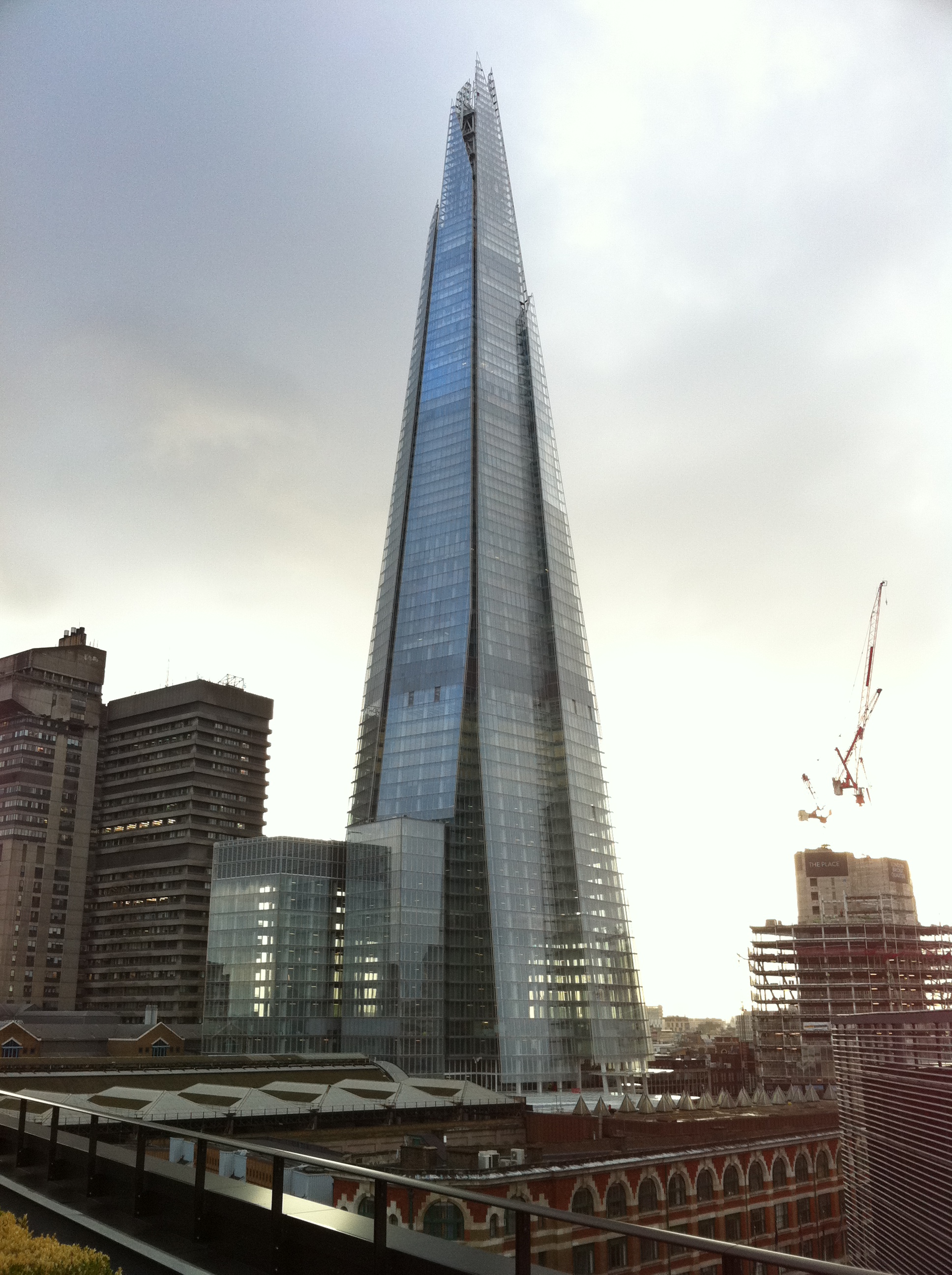
While the Chartres Cathedral is undoubtedly a creation of great beauty and impeccable skill, I think that the Burj Khalifa and The Shard are, in fact, more impressive – and far more functional and directly relevant to the improvement of human life. As Howard Roark put it in Ayn Rand’s The Fountainhead with respect to the emergence of great skyscrapers, “Mankind will never destroy itself… Nor should it think of itself as destroyed. Not so long as it does things such as this.” It always exhilarates me to read of new height records broken by skyscrapers in our time – and to see the new structures depart in increasingly creative ways from the “glass box” paradigm. As long as this kind of innovation keeps taking place, there is hope for our civilization.

The Shard, London Bridge: Photo by Bjmullan, Originally found here.
Shared pursuant to Creative Commons License.
Unconventional Thinking and Pluralistic Societies – Post by G. Stolyarov II

Unconventional Thinking and Pluralistic Societies – Post by G. Stolyarov II

The New Renaissance Hat
G. Stolyarov II
August 3, 2012
******************************

I was recently asked whether, with respect to those of us in today’s Western world who think unconventionally, “even if we wouldn’t be physically persecuted, aren’t there certain ‘sacred cows’ that must be respected even to get a hearing in today’s society?”

This is somewhat true, though increasingly less so as there come to be more diverse outlets for intellectual expression. This is where a pluralistic society actually greatly benefits individual creativity and freedom: if one outlet is closed (because one’s views are deemed “politically incorrect” or some other variant of “incorrect”), others may still welcome one’s ideas. I have seen this a lot with economics in recent years, as alternatives to the conventional Keynesian and Neoclassical schools are becoming more prominent and respected.

Furthermore, different thinkers may be deterred by “soft” censure to different degrees. Some people could not care less and would be content to be pariahs, as long as they were permitted to pursue their work in peace. Others will try to be more diplomatic and tiptoe around the “sacred cows” while subtly injecting their own ideas into public discussion. Others still will try to obtain independent sources of support, outside the paradigm they are trying to influence, and in this way “buy” themselves time and influence. It is true that being outside of the “mainstream” today will probably deny one certain opportunities – but virtually every major intellectual or career choice will do the same. One trades some possibilities for others; the important question is whether those tradeoffs are palatable in the sense of achieving one’s own goals while enabling one to lead a reasonably comfortable life.