Browsed by
Tag: liberty

Universal Physical and Moral Laws, With No Lawgiver – Article by G. Stolyarov II

Universal Physical and Moral Laws, With No Lawgiver – Article by G. Stolyarov II

The New Renaissance Hat
G. Stolyarov II
May 13, 2015
******************************

Here I endeavor to refute the common argument that any law, be it a physical law or a law of morality or justice, requires a lawgiver – an intelligent entity that brought the law into being. While some laws (termed manmade or positive laws) do indeed have human lawmakers, a much more fundamental class of laws (termed universal or natural laws) arise not due to promulgation by any intelligent being, but rather due to the basic properties of the entities these laws concern, and the relations of those entities to one another. To the extent that positive laws are enacted by humans, the purpose of such positive laws should be to reflect and effectuate the beneficial consequences of objectively valid natural laws. For instance, it is a natural law that each human being possesses a right to life. A positive law that prohibits and punishes murder of one human being by another would reflect the natural law and therefore be desirable. On the other hand, if any positive law were to mandate murder (as various edicts by tyrannical regimes throughout history, targeting political dissidents or disfavored minority groups, have done), then that positive law would be contrary to the natural law and therefore illegitimate and harmful.

The physical laws of nature pertain to all entities, including humans, and describe the regularities with which these entities will behave within applicable situations. Examples of physical laws include Newton’s Three Laws of Motion, the law of gravitation, the law of conservation of matter and energy, and the law of conservation of momentum. If it is asserted that these laws require a lawgiver, then the lawgiver would hypothetically be able to alter these laws on a whim at any time, thereby depriving them of their universality and predictable application. Such a state of affairs would not only be highly inconvenient (to say the least), but also completely incompatible with the reality that these laws are derived from the nature of entities as they are.

We can draw upon ubiquitous observation and the fact that these laws of nature can indeed be harnessed so precisely that every functional technology ever invented works because it takes advantage of them. The argument that the laws of nature could change tomorrow depends on a false perception of what those laws are – a kind of Platonic view that the laws of nature are superimposed upon the world of objects. In reality, however, objects (entities) and their qualities and relationships are all that exist at the most basic level. The laws of nature are relationships that are derived from the very properties inherent to objects themselves; they are not some higher layer of reality on top of the objects that leads the objects to behave in a certain way. That is, the laws of nature are what they are because the things whose behavior they describe are what they are.

The truth that the laws of nature are a function of the objects whose behavior they describe pertains to fundamental physical laws, such as the law of gravitation. While the law of gravitation and the equation [1] describing that law apply universally, the very existence of the law is dependent on the existence of entities that have mass and therefore exhibit gravitational attraction. Were there no entities or no entities with mass (incidentally, both logically impossible scenarios), then the concept of gravity would not have any relevance or applicability. Likewise, the amount of mass of particular entities and their distance of separation from one another will determine the extent of the gravitational force exerted by those entities upon one another. The gravitational force arises because the entities are as massive as they are and located where they are relative to one another; it does not arise because a supernatural lawgiver imposed it upon entities who would otherwise be completely static or random in their behavior in relation to one another.

The key parallel with the laws of morality is that, as the laws of gravitation stem from the objective properties of entities themselves (i.e., that they have mass – which is a universal property of all entities), so do the laws of morality stem from the objective properties of human beings themselves – namely, the biological and physical prerequisites of human survival and flourishing. Different specific decisions may be the appropriate moral decisions in different contexts, but because of the essential similarities of humans along many key dimensions, certain general moral truths will hold universally for all humans.  But again, were there no humans (or similar rational, sentient, volitional beings) with these essential attributes, the concept of morality would have no relevance.

Neither morality nor gravitation require the existence of entities outside of those exhibiting moral behavior or gravitational attraction. A system of physical or moral laws is not dependent on an outside “lawgiver” but rather on the objective natures of the entities partaking in the system. Objective moral laws include the principles of ethics, which address how a person should behave to maximize possible well-being, as well as the principles of justice, which address how people should relate to one another in respecting one another’s spheres of legitimate action, rewarding meritorious conduct, and punishing destructive conduct against others. There is a natural harmony between adherence to objective moral laws and the attainment of beneficial consequences for one’s own life, material prosperity, and happiness – provided that one adheres to a view of long-term, enlightened, rational self-interest, which does not allow one to sacrifice the lives, liberty, or property of others to achieve a short-term gain.

Some would assert that principles of behavior that tend to maximize well-being and serve one’s rational self-interest may be part of prudent or practical conduct, but are not the same as morality. In the minds of these individuals, morality (typically, in their view, willed by an external lawgiver) is independent of practical means or consequences and often (as, for instance, in Immanuel Kant’s outlook on morality) inherently divorced from actions conducive to self-interest. I, however, strongly reject any notion that there might be a dichotomy between morality and practicality, happiness, or prosperity – when a long-term, enlightened, and multifaceted outlook on the latter conditions is considered. Some might be so short-sighted as to mistake some temporary advantage or fleeting pleasure for true fulfillment or happiness, but the objective cause-and-effect relationships within our physical reality will eventually disappoint them (if they live long enough – and if not, their punishment – death – will be even greater). If some or even many humans might be drawn toward certain pleasurable feelings for their own sake (which is an evolutionary relic of a very different primeval environment inhabited by our ancestors – but a tendency ill-adapted to our current environment), this is not the same as achieving truly sustainable prosperity and happiness by using reason to thrive in our current environment (or to create a better environment for human flourishing). One of the objectives of a good moral system is to guide people toward the latter outcome. My essay and video “Commonly Misunderstood Concepts: Happiness” offer more detailed thoughts on key elements of a life of flourishing and the concept of eudaemonia – the actualization of one’s full potential, as Aristotle and later virtue-oriented philosophers described it.

Objective moral law, derived from the fundamental value of every innocent rational, sentient being’s life, posits an essential harmony of the long-term, enlightened self-interests of all who earnestly pursue truth and goodness. Unlike many proponents of an externally legislated moral framework (for which the alleged lawgiver might be a supernatural being, a single human ruler, or a collective of humans), I would not consider self-sacrifice to be a component of morality. I align more with Ayn Rand’s view of sacrifice as a surrender of a greater value (e.g., one’s life) to a lesser value (e.g., abstractions such as nation-states, religions, or perceived slights from another nation-state or religious or cultural group). A person can behave morally – promoting his own life, respecting the rights of others, and contributing to human flourishing – without ever surrendering anything he values (except as an instrument for obtaining outcomes he might justifiably value more). Morality should therefore not be seen as the subordination of the individual to some higher ideal, be it a divine order or a manmade one. Rather, the individual is the ideal for which moral behavior is the path to fulfillment.

A person who behaves morally advances himself while fully respecting the legitimate prerogatives of others. He improves his own life without damaging anybody else’s. In the process of pursuing enlightened self-interest, he also benefits the lives of others through value-adding interactions. Indeed, he may enter into an extensive network of both formal and informal reciprocal obligations with others that result in his actions being a constant, sustainable source of improvement in others’ lives. The virtue of honesty is part of objective ethics and impels a moral individual to strive to honor all commitments once they have been made. The key to a morality based on objective, natural law, however, is that these obligations be entered into freely and not as a result of the self being compromised in favor of an alleged higher ideal. Consequently, a key component of natural law is the liberty of an individual to evaluate the world in accordance with his rational faculty and to decide which undertakings are consistent with his enlightened self-interest. When positive laws are crafted so as to interfere with that liberty, positive law becomes at odds with natural law, leading to warped incentives, institutionalized sacrifices, and painful tradeoffs that many individuals must make if they seek to abide by both natural and positive laws.

Objective natural laws – both physical and moral – do not require a lawgiver and antecede manmade, positive laws. Some natural laws, however, may require positive laws – such as prohibitions on murder, theft, and slavery – in order for the desirable outcome brought about by the natural laws to be reflected in actual (rather than simply hoped-for) human behavior. In order to improve human well-being, positive laws should be developed to advance and effectuate natural laws, instead of attempting to resist them or contravene them. Just as a law that redefines the value of pi as 3.2 (one actually unsuccessfully attempted in Indiana in 1897) is rightly seen as absurd on its face, even if a majority votes to enact it, and would result in many failed constructions if implemented by engineers and designers of machines, so would a law that abrogates the natural liberty of individuals to peacefully pursue their own flourishing result in damage to good human beings and increases in physical harm, suffering, and injustice. A good human lawmaker should respect pre-existing objective natural laws and not attempt to contradict them.

[1] F = G*m1*m2/r2, with F being the force between two masses, m1 and m2 being the two masses, r being the distance between the centers of the two masses, and G being the universal gravitational constant.

This article may be freely distributed, subject to a Creative Commons Attribution 4.0 International License, which requires that credit be given to the author. See Mr. Stolyarov’s biographical information here.
NSA Spying Ruled Illegal, But Will Congress Save the Program Anyway? – Article by Ron Paul

NSA Spying Ruled Illegal, But Will Congress Save the Program Anyway? – Article by Ron Paul

The New Renaissance Hat
Ron Paul
May 11, 2015
******************************
This week the Sixth Circuit Court of Appeals ruled that the NSA’s metadata collection program was not authorized in US law. The PATRIOT Act, under which the program began, was too vague, the court found. But the truth is the Act was intended to be vague so that the federal government could interpret it in the broadest possible way. But this is really more of a technicality, because illegality and unconstitutionality are really two very different things. Even if Congress had explicitly authorized the federal government to collect our phone records, that law would still be unconstitutional because the Constitution does not grant government the power to access our personal information without a valid search warrant.
**

Even though the court found the NSA program illegal, it did not demand that the federal government stop collecting our information in this manner. Instead, the court kicked the ball back in Congress’s court, as these provisions of the PATRIOT Act are set to expire at the end of the month and the Appeals Court decided to let Congress decide how to re-authorize this spying program.

Unfortunately, this is where there is not much to cheer. If past practice is any lesson, Congress will wait until the spying program is about to expire and then in a panic try to frighten Americans into accepting more intrusions on their privacy. Senate Majority Leader Mitch McConnell has already put forth a new bill as a stop-gap measure to allow time for a fuller debate on the issue. His stop-gap? A five year re-authorization with no changes to the current program!

The main reform bill being floated, the FREEDOM Act, is little better. Pretending to be a step in the right direction, the FREEDOM Act may actually be worse for our privacy and liberties than the PATRIOT Act!

One silver lining in the court decision is that it should exonerate Ed Snowden, who risked it all to expose what the courts have now found was illegal US government activity. That is the definition of a whistleblower. Shouldn’t he be welcomed back home as a hero instead of being threatened with treason charges? We shouldn’t hold our breath!

This week Snowden addressed a conference in Melbourne, Australia, informing citizens that the Australian government watches all its citizens “all the time.” Australia’s program allows the government to “collect everyone’s communications in advance of criminal suspicion,” he told the conference. That means the government is no longer in the business of prosecuting crimes, but instead is collecting information in case crimes someday occur.

How is it that the Australian government can collect and track “pre-crime” information on its citizens? Last month Australia passed a law requiring telecommunications companies to retain metadata information on their customers for two years.

Why do Australia’s oppressive laws matter to us? Because the NSA “reform” legislation before Congress, the FREEDOM Act, does exactly what the Australian law does: it mandates that US telecommunications companies retain their customers’ metadata information so that the NSA can access the information as it wishes.

Some argue that this metadata information is harmless and that civil libertarians are over-reacting. But, as Ed Snowden told the Melbourne conference, “under these mandatory metadata laws you can immediately see who journalists are contacting, from which you can derive who their sources are.”

This one example of what happens when the government forces corporations to assist it in spying on the people should be a red flag. How can an independent media exist in the US if the federal government knows exactly whom journalists contact for information? It would be the end of any future whistleblowers.

The only reform of the PATRIOT Act is a total repeal. Accept nothing less.

Ron Paul, MD, is a former three-time Republican candidate for U. S. President and Congressman from Texas.

This article is reprinted with permission from the Ron Paul Institute for Peace and Prosperity.

The Costs of Hysteria: How Economists are Misleading the Public on Climate-Change Policy – Article by Robert P. Murphy

The Costs of Hysteria: How Economists are Misleading the Public on Climate-Change Policy – Article by Robert P. Murphy

The New Renaissance Hat
Robert P. Murphy
May 5, 2015
******************************

Suppose the “scientific consensus” on climate change is right. Let’s also stipulate, for the sake of argument, that the computer projections used by the United Nations and the US government are correct, and that economists are able to translate those data into meaningful projections about costs and benefits to people living in the future with climate change.

Despite what the public has been led to believe, the situation is not a crisis at all — and certainly not something that demands drastic government actions to avert serious damage to the environment. In fact, implementing the wrong policy can cause far more damage than it can prevent.

It’s understandable that the public has no idea of the real state of the literature on climate change policy, because even professional economists use utterly misleading rhetoric in this arena. To show what I mean, first, let’s quote from a recent Noah Smith Bloomberg article, which urges left-liberals to support the Trans-Pacific Partnership (TPP) trade deal:

One of the bigger economic issues under debate right now is the Trans-Pacific Partnership (TPP), the multilateral trade deal that would include most countries in the Asia-Pacific region as well as the US. Many people both here and abroad are suspicious of trade deals, while economists usually support them. This time around, however, the dynamic is a little bit different — the TPP is getting some pushback from left-leaning economists such as Paul Krugman.

Krugman’s point is that since US trade is already pretty liberalized … the effect of further liberalization will be small.… I’m usually more of a free-trade skeptic than the average economist.… But in this case, I’m strongly on the pro-TPP side. There are just too many good arguments in favor.

University of California-Berkeley economist Brad DeLong does some quick back-of-the-envelope calculations, and estimates that the TPP would increase the world’s wealth by a total of $3 trillion. Though that’s not a big deal in the grand scheme of things, it’s one of the best reforms that’s feasible in the current polarized political situation. (emphasis added)

To summarize the flavor of Smith’s discussion, he thinks the TPP is “one of the bigger economic issues” today, and that its potential windfall to humanity of $3 trillion is “not a big deal in the grand scheme of things” but certainly worth pursuing if attainable. Krugman disagrees with Smith’s assessment, but their differences are clearly quibbles over numbers and strategies; it’s not as if Smith thinks Krugman is a “Ricardo denier” or accuses Krugman of hating poor Asians by opposing the trade deal.

We get a much different tone if instead we look at Smith discussing climate-change policy. For example, in June 2014, Smith wrote a Bloomberg piece on five ways to fight global warming. In the interest of brevity, let me simply quote Smith’s concluding paragraph:

If we do these five things, then the US can still save the world from global warming, even though we’re no longer the main cause of the problem. And the short-run cost to our economy will be very moderate. Saving the world on the cheap sounds like a good idea to me. (emphasis added)

Clearly, there is a chasm in the rhetoric between Smith’s two Bloomberg pieces. When discussing the TPP, it’s an honest disagreement between experts over a trade agreement that Smith thinks is definitely worthwhile, but in the grand scheme is not that big a deal. In contrast, government policies concerning climate change literally involve the fate of the planet.

At this point, most readers would wonder what the problem is. After all, isn’t man-made climate change a global crisis? Why shouldn’t Smith use much stronger rhetoric when describing it?

I am making this comparison because according to one of the pioneers in climate-change economics, William Nordhaus, even if all governments around the world implemented the textbook-perfect carbon tax, the net gain to humanity would be … drumroll please … $3 trillion. In other words, one of the world’s experts on the economics of climate change estimates that the difference to humanity between (a) implementing the perfect carbon-tax policy solution and (b) doing absolutely nothing was about the same difference as DeLong estimated when it comes to the TPP.

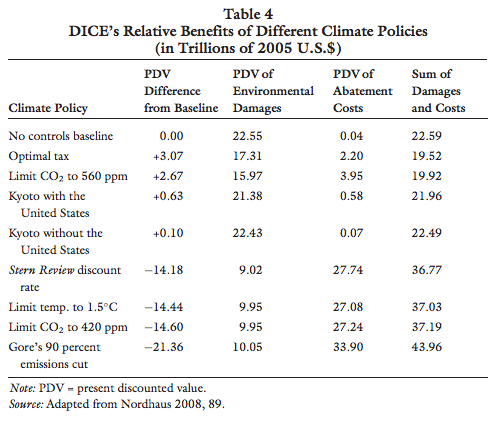
To be more specific, the $3 trillion Nordhaus estimate comes from the 2008 calibration of his Dynamic Integrated Climate-Economy (DICE) model. (The numbers have gone up since then, but I studied his 2008 calibration in great detail.) Note that this isn’t some “denier” computer simulation, rejected by the serious scientists. On the contrary, Nordhaus’s DICE model was one of only three chosen by the Obama administration when it set up a working group to estimate the monetary damages of carbon dioxide emissions. To help the reader understand the trade-offs humanity faces when it comes to climate change, let me reproduce table 4 from my Independent Review article that critically evaluated Nordhaus’s model:    

The table shows Nordhaus’s estimates (made in 2008 based on the “consensus” scientific assessments of the time) of the net benefits of various possible governmental climate policy approaches. The first row shows what happens if governments do nothing. There will be $22.55 trillion (in present value terms, and quoted in 2005 dollars) of environmental damage, but virtually no economic costs of complying with regulations, for a total harm of $22.59 trillion.

In contrast, if governments around the world implemented Nordhaus’s recommended “optimal” carbon tax, the world would be spared a little more than $5 trillion in future environmental damage, while future economic output would be $2.2 trillion lower due to complying with the carbon tax. Adding it all up, humanity would suffer total harms of $19.52 trillion, meaning the world would be $3.07 trillion wealthier with the optimal, global carbon tax (because $22.59 − $19.52 = $3.07).

Central to the economic way of thinking is the concept of trade-offs. Every possible policy — including a policy of doing nothing — comes with costs. But the public tends to hear about only one set of costs, not the full array. For example, as the earlier table shows, the wrong climate policy can be much, much worse than doing nothing. Nordhaus evaluated Al Gore’s suggestion to cut emissions by 90 percent, and estimated that it would make humanity some $21 trillion poorer compared to the do-nothing baseline — a net harm seven times greater than the net benefits of the textbook-optimal approach.

My point here is not to trumpet Nordhaus’s numbers as being gospel. (My Independent Review article was a full-blown critique of his model.) Rather, I am pointing out that even one of the leading models that underpins the so-called consensus on climate-change activism shows that this is hardly the planetary crisis that the rhetoric of Smith and others would suggest. The actual numbers are in the same ballpark as those of trade deals — and nobody thinks the fate of the planet hangs on the passage of a trade deal.

More generally, what even most economists have failed to convey to the public is that climate-change policies at best will affect things on the margin. Nordhaus’s table beautifully illustrates this. The optimal carbon tax doesn’t eliminate the climate-change damage that his computer simulations predict. On the contrary, the carbon tax only reduces it from about $23 trillion down to $17 billion. The reason it doesn’t make sense to enact a more aggressive carbon tax is that the (marginal) harm to the conventional economy would exceed the (marginal) environmental benefit. There are several policies in the table that reduce environmental damage below the $17 trillion mark, but they hurt the economy so much more that, on net, they are inferior approaches.

It is understandable that noneconomists would fail to employ marginal analysis and would engage in overblown rhetoric when discussing something as controversial as climate-change policy. However, too many professional economists have also fallen into this bad habit, including not just Smith but also Krugman and many others.

Robert P. Murphy has a PhD in economics from NYU. He is the author of The Politically Incorrect Guide to Capitalism and The Politically Incorrect Guide to The Great Depression and the New Deal.

This article was originally published by The Foundation for Economic Education and may be freely distributed, subject to a Creative Commons Attribution 4.0 International License, which requires that credit be given to the author.

Speaking Truth to Power: Jimmy Lai – Article by Lawrence W. Reed

Speaking Truth to Power: Jimmy Lai – Article by Lawrence W. Reed

The New Renaissance Hat
Lawrence W. Reed
May 4, 2015
******************************

For years, a bust of John James Cowperthwaite sat prominently in the foyer of Jimmy Lai’s Next Media office in Hong Kong, along with others of economists F.A. Hayek and Milton Friedman. If that’s all you ever knew about Jimmy Lai, you could at least surmise that he loves liberty and free markets.

Cowperthwaite had been the architect of Hong Kong’s free-market miracle. He started with a destitute rock and turned it into one of the world’s freest and most prosperous economies. (Indeed, I’ve suggested that he deserves to be recognized annually and everywhere with a Cowperthwaite Day on the anniversary of his birthdate, April 25.) Jimmy Lai is precisely the sort of individual that Cowperthwaite had in mind when he decided that entrepreneurs, not central planners, should drive an economy. Because of what Cowperthwaite had done, Jimmy Lai found a hero himself. And Lai, too, would go on to do great things.

Of the characteristics most often identified with successful entrepreneurship, Jimmy Lai possesses them all in abundance. He is a self-starter who takes initiative (and risk) with enthusiasm. He’s creative and intuitive. He’s passionate and tenacious. Where others see problems, he sees opportunity. He’s a visionary, both in business endeavors and for society at large. He doesn’t hesitate to defy conventional wisdom when it points to a dead end. Whatever he undertakes, he musters the courage to act. He puts his all — money, time, and energy — where his mouth is (and where his convictions are).

On paper, Lai’s early life would seem unlikely to produce a “real hero.” He was born in China the year before it fell under Mao Zedong’s dictatorial rule. Lai was smuggled out of the country and into Hong Kong at age 12. In the absence of child-labor laws, which would have ensured his deprivation there, too, Lai went to work in a garment factory for $8 a month. Fifteen years later, he bought his own garment factory and built it into the giant known as Giordano, now a leading international retailer. Lai’s boundless entrepreneurial zeal, free to operate within Hong Kong’s laissez-faire business environment, yielded jobs for thousands and consumer goods for millions.

But in 1989, Beijing’s infamous Tiananmen Square massacre set Jimmy Lai on a new course. With Hong Kong scheduled to be transferred from British to Chinese rule in just eight years, Lai knew that maintaining traditional freedoms under Beijing’s rule would be a challenge. So he ventured into media, creating what soon became the territory’s largest-circulation magazines, Sudden Weekly and Next. In spite of Beijing’s coercion of advertisers, Jimmy Lai’s tabloid-style newspaper, Apple Daily, is still the premier voice in Asia for the freedoms of speech, press, and enterprise.

Jimmy Lai does not shrink from controversy. The Communist Party of China, he wrote in a 1994 column, is “a monopoly that charges a premium for a lousy service.” He defended the student demonstrators when they went into the streets by the hundreds of thousands in late 2014 in defense of democracy. He routinely exposed corruption in both government and business, including the especially toxic brand of corruption that arises when the two get in bed together. He sold Giordano, the apparel firm he founded, to save it from Beijing’s intense pressure, but he refuses to this day to renounce his principles.

In December 2014, he revealed that he was stepping down as publisher of Apple Daily and chairman of Next Media to devote more time to family and personal interests. A month later, and for the second time, unknown assailants firebombed his home. He remains under intense scrutiny from Beijing, which regularly employs ugly rumors, threats of litigation, and other nefarious means to undermine his influence.

Earlier this year, Lai told the New York Times that he never planned to make his media empire into a family dynasty. His six children (ages 8 to 37) are not in line as heirs to that business or its leadership positions. “I don’t think I should ask my kids to inherit my business, because they can’t start where I did,” he said. “I was from the street. I’m a very different make of person. I’ve been a fighter all my life.”

Whatever the future holds for Jimmy Lai, friends of liberty everywhere can count him as one very brave man.

For additional information:

In the Freeman:

Lawrence W. (“Larry”) Reed became president of the Foundation for Economic Education (FEE) in 2008. Prior to that, he was a founder and president for twenty years of the Mackinac Center for Public Policy in Midland, Michigan. He also taught Economics full-time and chaired the Department of Economics at Northwood University in Michigan from 1977 to 1984.

He holds a B.A. degree in Economics from Grove City College (1975) and an M.A. degree in History from Slippery Rock State University (1978), both in Pennsylvania. He holds two honorary doctorates, one from Central Michigan University (Public Administration—1993) and Northwood University (Laws—2008).

This article was originally published by The Foundation for Economic Education and may be freely distributed, subject to a Creative Commons Attribution 4.0 International License, which requires that credit be given to the author.
USA FREEDOM Act: Just Another Word for Lost Liberty – Article by Ron Paul

USA FREEDOM Act: Just Another Word for Lost Liberty – Article by Ron Paul

The New Renaissance Hat
Ron Paul
May 4, 2015
******************************
Apologists for the National Security Agency (NSA) point to the arrest of David Coleman Headley as an example of how warrantless mass surveillance is necessary to catch terrorists. Headley played a major role in the 2008 Mumbai terrorist attack that killed 166 people.While few would argue that bringing someone like Headley to justice is not a good thing, Headley’s case in no way justifies mass surveillance. For one thing, there is no “terrorist” exception in the Fourth Amendment. Saying a good end (capturing terrorists) justifies a bad means (mass surveillance) gives the government a blank check to violate our liberties.
***

Even if the Headley case somehow justified overturning the Fourth Amendment, it still would not justify mass surveillance and bulk data collection. This is because, according to an investigation by ProPublica, NSA surveillance played an insignificant role in catching Headley. One former counter-terrorism official said when he heard that NSA surveillance was responsible for Headley’s capture he “was trying to figure out how NSA played a role.”

The Headley case is not the only evidence that the PATRIOT Act and other post-9/11 sacrifices of our liberty have not increased our security. For example, the NSA’s claim that its surveillance programs thwarted 54 terrorist attacks has been widely discredited. Even the president’s Review Group on Intelligence and Communications Technologies found that mass surveillance and bulk data collection was “not essential to preventing attacks.”

According to the congressional Joint Inquiry into Intelligence Activities before and after the Terrorist Attacks of September 11, 2001 and the 9/11 Commission, the powers granted the NSA by the PATRIOT Act would not have prevented the 9/11 attacks. Many intelligence experts have pointed out that, by increasing the size of the haystack government agencies must look through, mass surveillance makes it harder to find the needle of legitimate threats.

Even though mass surveillance threatens our liberty, violates the Constitution, and does nothing to protect us from terrorism, many in Congress still cling to the fiction that the only way to ensure security is to give the government virtually unlimited spying powers. These supporters of the surveillance state are desperate to extend the provisions of the PATRIOT Act that are set to expire at the end of the month. They are particularly eager to preserve Section 215, which authorizes many of the most egregious violations of our liberties, including the NSA’s “metadata” program.

However, Edward Snowden’s revelations have galvanized opposition to the NSA’s ongoing violations of our liberties. This is why Congress will soon vote on the USA FREEDOM Act. This bill extends the expiring surveillance laws. It also contains some “reforms” that supposedly address all the legitimate concerns regarding mass surveillance.

However, a look at the USA FREEDOM Act’s details, as opposed to the press releases of its supporters, shows that the act leaves the government’s mass surveillance powers virtually untouched.

The USA FREEDOM Act has about as much to do with freedom as the PATRIOT Act had to do with patriotism. If Congress truly wanted to protect our liberties it would pass the Surveillance State Repeal Act, which repeals the PATRIOT Act. Congress should also reverse the interventionist foreign policy that increases the risk of terrorism by fostering resentment and hatred of Americans.

Fourteen years after the PATRIOT Act was rushed into law, it is clear that sacrificing liberty does little or nothing to preserve security. Instead of trying to fool the American people with phony reforms, Congress should repeal all laws that violate the Fourth Amendment, starting with the PATRIOT Act.

Ron Paul, MD, is a former three-time Republican candidate for U. S. President and Congressman from Texas.

This article is reprinted with permission from the Ron Paul Institute for Peace and Prosperity.

Michel Chevalier’s Case Against the Patent System – Article by Louis Rouanet

Michel Chevalier’s Case Against the Patent System – Article by Louis Rouanet

The New Renaissance Hat
Louis Rouanet
April 17, 2015
******************************

Michel Chevalier (1806–1879) was a very influential French economist during the second half of the nineteenth century. He is still widely known in France for being the architect of the Cobden-Chevalier Treaty of 1860 which was the free-trade agreement between France and Great Britain. Michel Chevalier is, however, less known for his major contribution to the intellectual property debate. [1] Contrary to Jean Baptiste Say, Gustave de Molinari, and many other French economists, Chevalier fiercely opposed the patent system. As Fritz Machlup remarked: “Among French economists, Michel Chevalier was probably the most emphatic in the joint antagonism to tariffs and patents, declaring that both ‘stem from the same doctrine and result in the same abuses.’”

Taking a fresh look at Michel Chevalier’s major work, Les Brevets d’invention (1878), we find it to be not only a well-written and powerful book, but also has remained impressively relevant. The arguments advanced by Chevalier anticipate the current arguments of the present opponents of intellectual property.

Patents as Contrary to Freedom and Economic Progress

Michel Chevalier argues that patents cannot be justified if they are contrary to freedom, even if beneficial to technological change. For him “From the moment we can make effective the patent only through inquisitorial expedients, violence, and subversion of liberty of labor, it is proof that we must renounce patents.” Chevalier rejects utilitarianism as a sufficient method to justify or refute the patent system. Chevalier’s opposition to patents, however, is not just based on moral arguments but shows the disastrous effects of this system for both foreign trade and the economy in general.

According to Chevalier, patents are of the same nature as privileges and monopolies which were prevalent during the Ancien Régime. They are also comparable in their effects to protectionist policies:

In absolute terms, patents diminish the productive power of nations that recognize them: evident proposition for those who believe that freedom, free competition, is the great lever of industrial progress.

Chevalier goes on to note the conservative and anti-innovation nature of monopolies and gives many examples of monopolies during the Ancien Régime. According to him, the innovators during the Ancien Régime weren’t rewarded, not because of the absence of patents, but because of the corporation guild system which was destroying competition and freedom to entry into markets. Thus, the innovators were constantly sued by guilds and consumers rarely benefited from their inventions. This argument is still relevant today. Indeed, companies protected from competition and government-owned corporations are often less innovative and more subject to conservative measures. Sectors typically run by government such as schools experience very little technological progress. On the other hand, the competitive process of the market gives incentives for the actors to differentiate from the other producers. As Pascal Salin stated, the company which makes the highest profits on a free market is the company which is the best positioned to “invent the future.” The essential virtue of competition is that it encourages producers to innovate in order to better serve the needs of consumers.

As one of his more striking examples, Chevalier examines the case of aniline — a dye and major innovation in the chemical industry — and shows how monopoly, resulting from patents, leads to hampered innovation. His interpretation of the problems caused by patents in the chemical industry at the time is consistent with more recent studies done by Boldrin and Levine in Against Intellectual Monopoly, now the seminal work on the topic.

Innovation as a Process

Chevalier understood that innovation is, above all, a process and that giving privileges to the innovator will destroy this process, leading to less and not more inventions. He wrote:

Every industrial discovery is the product of the general ferment of ideas, the result of an internal work which was accomplished with the support of a large number of successive or simultaneous collaborators in society, often for centuries.

This argument regarding the cumulative nature of innovation is still the most powerful argument against intellectual monopoly today and has also been the theme of several recent studies.2 Similar to Chevalier, Hayek saw innovation as a process and stated that “it is not obvious that such forced scarcity [intellectual property] is the most effective way to stimulate the human creative process.”

In an 1862 debate in the Académe des Sciences Morales et Politiques, Chevalier gave the example of Louis Daguerre, one of the inventors of photography, who didn’t seek a patent for his system of photography. According to Chevalier, the absence of a patent led to necessary improvements of the daguerreotype and fostered its widespread use. His conclusion is the following:

The spirit of man proceeds only by successive trials and repeated attempts. Discoveries do not arrive with a single bound to the degree of perfection or completion, which is reserved for them; there must be renewed, persevering efforts, cut by breaks that allow, so to speak, to breath. … If it is true that the invention must pass through the hands of twenty people before reaching its final state, it follows that the exclusive privilege granted to the first patented, and to each of his followers, prevents this practical result rather than facilitate it.

The Increasing Number of Patents and Negative Consequences

Already during the nineteenth century, legal instability and uncertainty challenged the actual efficiency of the patent system and the economists were very much aware of this problem. Chevalier warned that the patent system would lead to legal uncertainty for the companies and would lead the industry back to a guild system where no entrepreneur would dare to enter a market for fear of being sued by patent holders. Chevalier was ahead of his time by denouncing what can be considered the ancestors of today’s patent trolls.

Chevalier concluded his 1862 article by stating: “I think I have said enough to show that the patent legislation has been an eccentricity of the legislator.” He went further in 1863 and added that “[a]ll friends of industrial and social progress must work together to rescue the industry of obstacles, obsolete remains of the past. Patents must disappear first.” [3]

1. Fritz Machlup and Edith Penrose briefly discussed Michel Chevalier in “The Patent Controversy in the Nineteenth Century,” Journal of Economic History, 1950.

2. See Alberto Galasso et Mark Schankerman, “Patents and Cumulative Innovation: Causal Evidence from the Courts”, NBER working paper, 21 June 2014 ; and also, Alessandro Nuvolari, “Collective Invention during the British Industrial Revolution: The Case of the Cornish Pumping Engine,” Cambridge Journal of Economics 28, No. 3 (2004).

3. Quoted in Eugène Pouillet, “Traité théorique et pratique des brevets d’invention et de la contrefaçon,” 1909, pp. x–xi.

Louis Rouanet is a student at Sciences Po Paris (Institute of Political Studies) where he studies economics and political science.

This article was originally published by the Ludwig von Mises Institute. Permission to reprint in whole or in part is hereby granted, provided full credit is given.

The Ukrainian Regime’s Censorship Spreads West to Canada, and Political Correctness is to Blame – Article by G. Stolyarov II

The Ukrainian Regime’s Censorship Spreads West to Canada, and Political Correctness is to Blame – Article by G. Stolyarov II

The New Renaissance Hat
G. Stolyarov II
April 14, 2015
******************************

There is nothing friendly to liberty or to Western values about the government of Petro Poroshenko and Arseniy Yatseniuk in Ukraine – a regime completely incapable of understanding the principle of individual rights or the freedoms of speech, property, and conviction that this principle entails. The Ukrainian government has just enacted a law prohibiting the private expression of Communist symbols and ideology, while elevating to “national hero” status the Ukrainian Insurgent Army of Stepan Bandera, who collaborated with the Nazi army during World War II and committed systematic acts of genocide against Russian, Belarusian, Polish, and Jewish civilians. Bandera serves as an explicit inspiration for the neo-Nazi Right Sector paramilitary organization, whose fighters have been documented by Amnesty International to have committed extensive war crimes against civilians in the Donbass region, and whose leader Dmytro Yarosh now holds a prominent position as advisor to the Ukrainian Commander-in-Chief.

Criticism of Bandera and his Ukrainian Insurgent Army is now illegal in Ukraine. According to UaPosition, a Ukrainian website aimed at informing non-Ukrainians about Ukraine, the text of the law legitimizing Bandera’s thugs reads as follows: “Public denial of the legitimacy of the struggle for the independence of Ukraine in the twentieth century [is] recognized [as an] insult to the memory of fighters for independence of Ukraine in the XX century [and as] disparagement of the Ukrainian people and is illegal.”

As David Boaz put it, “One difference between libertarianism and socialism is that a socialist society can’t tolerate groups of people practicing freedom, but a libertarian society can comfortably allow people to choose voluntary socialism.” No libertarian or even remotely quasi-libertarian society would censor the expression of even the most strident socialist or communist viewpoints. On the other hand, legal censorship of opposing viewpoints was indeed a hallmark of the former Soviet Union. A government that attempts to censor the ideas that, at least ostensibly, animated Soviet policies, becomes just a mirror image of the Soviet regime by adopting the very same policies in essence. In addition, the Ukrainian regime has prohibited films alleged to “glorify” the Russian military and has imprisoned journalists and activists who criticized military conscription, such as Ruslan Kotsaba.

The Poroshenko/Yatseniuk government has assumed the worst characteristics of the former USSR regime without any of its few decent attributes. By validating both historical genocidal ethnic nationalism and its neo-Nazi successor movements, the Ukrainian regime has departed from one of the most important admirable aspects of the post-1941 USSR: its adamant opposition to Nazism and to the plethora of ethnically tinged fascist movements that arose in the wake of Hitler’s invasions of Eastern Europe. Indeed, one of the reasons why so many Soviet subjects of diverse ethnicities acquiesced to the tyranny of Stalin and his successors was the fact that the Soviet regime did act to protect them against the worse threat of genocide by Hitler and his petty nationalist allies. The prohibition on criticism of the Banderites is, in the eyes of many Ukrainians, Russians, and Belarusians, a prohibition on criticism of the armed gangs who murdered or tried to murder their grandparents.

Even more troubling, however, is that the zeal of “pro-Ukrainian” activists in the West is creating a chilling effect on speech and criticism of the Ukrainian regime even in Canada. Valentina Lisitsa, a world-renowned pianist born in Ukraine who became a US citizen and is currently residing in Paris, has become the latest victim of the campaign to silence those who disagree with militant Ukrainian nationalism. Lisitsa’s performances of classical compositions (see and hear examples here, here, here, and here) are completely apolitical and have attracted tens of millions of views on her YouTube channel. She was due to play Rachmaninoff’s Concerto #2 (earlier recordings are here, here, and here) at the Toronto Symphony Orchestra, before her appearance was cancelled at the behest of anonymous Ukrainian nationalist activists, who also fueled a social-media outcry against Lisitsa. The reason? Lisitsa posted on her Twitter account satirical, often scathing criticism of the Ukrainian government and its war against separatists in the Donbass – specifically condemning the neo-Nazi and genocidal strains among the Ukrainian government’s paramilitary supporters. She has remained steadfast in defending her posts as free expression – and rightfully so, as her liberty to express her views does not require those views or the manner of their expression to be inoffensive or universally agreeable to all. Furthermore, any manner of words or imagery she used pales in comparison to the real deaths of over 6,000 civilians (and likely many more) in the Donbass, many at the hands of the Ukrainian army and its allied “volunteer” paramilitary battalions. Lisitsa was outraged at the people and policies that brought about the deaths of these innocents, and she was right to proclaim her outrage.

But whether or not one agrees with Lisitsa or with the manner in which she expressed her views, her performance of Rachmaninoff had no relationship to any of her political activities – and none of her other classical performances over the course of many years had even the remotest political aspect. By successfully pressuring the Toronto Symphony Orchestra to cancel Lisitsa’s appearance, the Ukrainian nationalist activists recreated in Canada the same politicization of classical music for which Stalin’s Soviet Union was infamous. Some of the most innovative 20th-century composers – including Sergei Prokofiev, Dmitri Shostakovich, and Aram Khachaturian – were often victims of Stalin’s denunciations and sometimes came perilously close to imprisonment or worse. In a free society, it is generally recognized that a person’s artistic prowess and political positions are separate matters unless the artist wishes to intentionally combine the two – as, for instance, in a work of explicitly politically motivated art. Preventing the performance of art that is inherently apolitical, on the grounds of the artist’s outside political activities, creates a chilling effect on both art and peaceful political activism. Artists, fearing that their livelihoods would be denied to them if they became too vocal about current events and ran afoul of one pressure group or another, would be incentivized to stick only to bland, uncontroversial statements or avoid discussing any subjects where significant disagreements might arise. Art would suffer, as works of technical and esthetic merit would become more difficult for audiences to access, given that anybody with controversial political views would be shut out of the talent pool.

The cultural reign of political correctness in the West further exacerbates the threat of the chilling effect on art and speech. The political repression of art in the contemporary West would come not from a top-down decree by a government, but rather due to any sufficiently vocal special interest claiming to be “offended” – not just by an idea contrary to its own agenda, but by the whole person expressing that idea. It then becomes the case that no Stalin is necessary – but the effect is the same: ideologically motivated threats cowing artists into acquiescence to the popular political agenda of the day. A person can become widely denounced, blacklisted, and shut out from opportunities that should be determined by artistic merit alone – not due to any conspiracy, but rather because the typical, middle-of-the-road decision makers in private as well as public institutions become fearful of the special interests’ ire. Political correctness is not primarily a problem of governments, but rather a problem of a deeply broken societal and intellectual culture, where not giving offense is prioritized over the pursuit of truth and justice. In the case of Lisitsa, as usual, the politically correct prohibition on offense results in the most offensive possible ideologies having a free hand to shut down dissenting views. What “offended” fundamentalist Islam has been able to perpetrate in shutting down debate in Europe for over a decade, “offended” Ukrainian nationalism is beginning to inflict in Canada now, often with the vociferous support of media commentators crusading against “hate speech” – a phrase which can mean anything they want it to mean.

The Ukrainian nationalists are able to export their agenda of censorship and intimidation to the West as parasites taking advantage of a weakened host. Political correctness is the disease that renders Western public discourse vulnerable to their arguments, while endangering the vital critical voices who need to be heard in order to prevent a tragic Western-led escalation of the Ukrainian civil war. It seems that the only way the Ukrainian regime and its nationalist allies will be able to render Ukraine more Western is to render the West more like Ukraine. We in the West need to strengthen our defenses and develop an immunity against this incursion of illiberalism by reaffirming the values of individual rights, open discourse and debate on controversial ideas, free expression of dissenting views, and resistance to the dependence of art on political orthodoxy.

The New Militarism – Who Profits? – Article by Ron Paul

The New Militarism – Who Profits? – Article by Ron Paul

The New Renaissance Hat
Ron Paul
April 14, 2015
******************************
Militarism and military spending are everywhere on the rise, as the new Cold War propaganda seems to be paying off. The new “threats” that are being hyped bring big profits to military contractors and the network of think tanks they pay to produce pro-war propaganda. Here are just a few examples:
***

The German government announced last week that it would purchase 100 more “Leopard” tanks – a 45 percent increase in the country’s inventory. Germany had greatly reduced its inventory of tanks as the end of the Cold War meant the end of any threat of a Soviet ground invasion of Europe. The German government now claims these 100 new tanks, which may cost nearly half a billion dollars, are necessary to respond to the new Russian assertiveness in the region. Never mind that Russia has neither invaded nor threatened any country in the region, much less a NATO member country.

The US Cold War-era nuclear bunker under Cheyenne Mountain, Colorado, which was all but shut down in the 25 years since the fall of the Berlin Wall, is being brought back to life. The Pentagon has committed nearly a billion dollars to upgrading the facility to its previous Cold War-level of operations. US defense contractor Raytheon will be the prime beneficiary of this contract. Raytheon is a major financial sponsor of think tanks like the Institute for the Study of War, which continuously churn out pro-war propaganda. I am sure these big contracts are a good return on that investment.

NATO, which I believe should have been shut down after the Cold War ended, is also getting its own massively expensive upgrade. The Alliance commissioned a new headquarters building in Brussels, Belgium, in 2010, which is supposed to be completed in 2016. The building looks like a hideous claw, and the final cost – if it is ever finished – will be well over one billion dollars. That is more than twice what was originally budgeted. What a boondoggle! Is it any surprise that NATO bureaucrats and generals continuously try to terrify us with tales of the new Russian threat? They need to justify their expansion plans!

So who is the real enemy? The Russians?

No, the real enemy is the taxpayer. The real enemy is the middle class and the productive sectors of the economy. We are the victims of this new runaway military spending. Every dollar or euro spent on a contrived threat is a dollar or euro taken out of the real economy and wasted on military Keynesianism. It is a dollar stolen from a small business owner that will not be invested in innovation, spent on research to combat disease, or even donated to charities that help the needy.

One of the most pervasive and dangerous myths of our time is that military spending benefits an economy. This could not be further from the truth. Such spending benefits a thin layer of well-connected and well-paid elites. It diverts scarce resources from meeting the needs and desires of a population and channels them into manufacturing tools of destruction. The costs may be hidden by the money-printing of the central banks, but they are eventually realized in the steady destruction of a currency.

The elites are terrified that peace may finally break out, which will be bad for their profits. That is why they are trying to scuttle the Iran deal, nix the Cuba thaw, and drum up a new “Red Scare” coming from Moscow. We must not be fooled into believing their lies.

Ron Paul, MD, is a former three-time Republican candidate for U. S. President and Congressman from Texas.

This article is reprinted with permission from the Ron Paul Institute for Peace and Prosperity.

How Embargoes Destroy Freedom – Article by Ryan W. McMaken

How Embargoes Destroy Freedom – Article by Ryan W. McMaken

The New Renaissance Hat
Ryan W. McMaken
February 12, 2015
******************************

In the wake of the Obama administration’s partial normalization of relations with Cuba, proponents of the embargo condemned the move, with National Review publishing an unsigned editorial claiming that allowing Americans to trade freely with the island nation amounts to giving comfort to murderous dictators. NR’s editors concluded with:

The Cuban government is not legitimate, and never has been. It is a one-party dictatorship with a gulag, an archipelago of prisons into which democrats and dissidents are thrown. We hope that the new American policy — Obama’s policy — does not benefit the Cuban dictatorship and harm Cuban democrats. We fear that yesterday was a good day for the Castros and a bad day for the Cuban people, and for American foreign policy.

This is all very interesting from an international relations perspective, and there is no doubt that the Cuban regime is a brutal regime. On the other hand, why does the brutality of the Cuban regime make it alright for the US regime to jail and persecute private American citizens who attempt to trade with people in Cuba?

That is, after all, the position of those who favor the embargo. Embargoes are not something where a magic fairy waves her wand and Cuba suddenly becomes invisible to Americans.

No, supporting an embargo means supporting the government when it fines, prosecutes, and jails peaceful citizens who attempt to engage in truly free trade. Support for an embargo also requires support for a customs bureaucracy that spies on merchants and consumers, and the whole panoply of enforcement programs necessary to punish those who run afoul of the government’s arbitrary pronouncements on what kind of trade is acceptable, and what kind is verboten. Naturally, this is all paid for by the taxpayers.

How the American Federal Government Punishes Trade

To get a taste of the reality of embargoes, one need only consult the Treasury Department’s summary of the Cuban embargo as administered by the “Office of Foreign Assets Control.”

For those who think the embargo has something to do with freedom, they might wish to consult the section on punishments for trading with people in Cuba:

Criminal penalties for violating the Regulations range up to 10 years in prison, $1,000,000 in corporate fines, and $250,000 in individual fines. Civil penalties up to $65,000 per violation may also be imposed. The Regulations require those dealing with Cuba (including traveling to Cuba) to maintain records for five years and, upon request from OFAC, to furnish information regarding such dealings.

Nothing says “freedom” like $250,000 fines and mandatory presentation of five years of private records upon demand from the federal government.

Private companies, of course, regard such potentially draconian sanctions as no joke, and companies must spend time and resources training employees and business associates to be sure that they do not find themselves in violation of federal law. This manual from Snap-on Tools is one example of how private companies must stay up to date on details such as this:

The U.S. Treasury Department’s Office of Foreign Assets Control (OFAC) maintains strict embargoes banning, and lesser sanctions limiting U.S companies and their foreign subsidiaries from entering into commercial transactions with specified foreign countries, persons and business entities. Congress recently quintupled the maximum civil fines per violation of many of these sanctions from $11,000 to $50,000 (each unlawful shipment constitutes a violation), and doubled maximum potential criminal penalties assessed willful violations from 10 years to 20 years in prison. Moreover, enforcement is being given a much higher priority…

It’s easy to see why those who favor greater government intervention in the economy would have no problem with such a program, but it’s alleged defenders of free markets like the editors at National Review who appear to be most insistent that the US government keep all its agents armed and ready, and a prison cell open for anyone who violates their federal programs of choice.

Embargoes as Mercantilist Prohibition

At their heart, embargoes are nothing but a specific type of prohibition. Sometimes, the government imposes prohibitions on transactions involving certain goods, such as cannabis. Other times, the prohibition extends to all transactions with people in a certain place. The fundamentals are the same, however, in that they prohibit peaceful exchange, with heavy penalties for violators.

Moreover, embargoes are a throwback to the mercantilism of the days of yore when economic policy was viewed as a tool of international affairs, and should be designed, at least in part, to benefit the regime of the home country.

Historically, the mercantilist regimes of old tightly controlled trade opportunities which were debated as part of armistice agreements, such as the Peace of Utrech (1713) when the British were able to force the Spanish to allow exactly one ship of merchandise annually into Spanish colonies. At home, during the same era, the British state forbade its own citizens with valuable engineering knowledge from leaving the country, lest they emigrate to a foreign land and share their knowledge with foreigners. The economic needs of the state superceded those of the individual.

This is the type of economic policy that precipitated the American Revolution, when Americans in the colonies were allowed to trade with only specified nation-states and territories in such a way that was seen as advantageous to the British Crown. The freedom fighters in that conflict engaged in rampant smuggling throughout eastern North America to avoid taxes and to trade with the French and the Spanish who were hardly paragons of democratic liberalism.

Unfortunately, the Americans did not learn their lesson in the revolution, and got to work erecting their own trade restrictions by the late eighteenth century. The greatest crime of the era, however, was Thomas Jefferson’s embargo against the British which crippled the shipping and shipbuilding industries in the United States. Naturally, it was pointed out at the time that the Constitution did not permit any such action on the part of the federal government. No such quaint considerations restrain the American state or its pro-embargo allies today.

Cuba is not the only country subject to embargoes handed out by the American state, and North Korea, Iran, and Syria are in similar positions. The question is often asked as to whether or not these sanctions work. I would certainly claim that they do not work in accomplishing their stated purposes, but whether or not they work is really beside the point. Those who advocate for such embargoes need to back up a step and first prove that it is moral and legitimate for nation-states to dictate to the people who pay the bills (i.e., the taxpayers) with whom they are allowed to trade. A society that actually respects private property rights, of course, will accept no such proposition and will respect the right of private citizens to dispose of their property as they see fit. On the other hand, those who believe that it’s the prerogative of governments to micromanage private property and throw violators in prison are encouraged to move somewhere that the government can take a robust and active role in such things. Cuba, for instance.

Ryan W. McMaken is the editor of Mises Daily and The Free Market. He has degrees in economics and political science from the University of Colorado, and was the economist for the Colorado Division of Housing from 2009 to 2014. He is the author of Commie Cowboys: The Bourgeoisie and the Nation-State in the Western Genre. 
***
This article was published on Mises.org and may be freely distributed, subject to a Creative Commons Attribution United States License, which requires that credit be given to the author.
We Must Proudly Reassert Free Speech and Universal Western Values – Video by G. Stolyarov II

We Must Proudly Reassert Free Speech and Universal Western Values – Video by G. Stolyarov II

The New Renaissance Hat
G. Stolyarov II
January 12, 2015
******************************

The horror of the attack on the Charlie Hebdo magazine – the murder of 17 people – journalists, policemen, and ordinary shoppers – by Wahhabist Islamist fanatics in Paris on January 7-9, 2015, highlights the stark threat that religious fanaticism poses to Western civilization. The perpetrators of this barbarism have thankfully been eliminated due to the concerted, decisive, and careful work of French police, who managed to destroy the murderers and hostage-takers without harming or terrorizing innocent, peaceful civilians in the process. But unless the Western world resolutely affirms the untrammeled right of free expression of ideas, the already commonplace heckler’s veto over speech will turn into the murderer’s veto.

Mr. Stolyarov explains the need for an assertive revival of Western Enlightenment values (which are also universal human values) and a widespread, unconditional defense of freedom of speech – in order to prevent humankind from relapsing into the muck of barbarism.

References

– “We Must Proudly Reassert Free Speech and Universal Western Values” – Article by G. Stolyarov II – January 12, 2015
– “Excellent News from Turkey Regarding the Possibility of a More Humane Islam” – Post by G. Stolyarov II – November 28, 2008 – Excellent News from Turkey Regarding the Possibility of a More Humane Islam
– “German Newspaper Attacked After Publishing Charlie Hebdo Cartoons” – The World Post – Kirsten Grieshaber – January 11, 2015
– “These Are The Charlie Hebdo Cartoons That Terrorists Thought Were Worth Killing Over” – The Huffington Post – Catherine Taibi – January 7, 2015
– “Transhumanism” – Wikipedia
– “Wahhabism” – Wikipedia