A free PDF version of «Смерть неправильна!» – the Russian translation of Death is Wrong – is now available for download from The Rational Argumentator. You can obtain your copy here and may spread it to Russian-speaking audiences as widely as you wish.
«Смерть неправильна!» was translated into Russian by Marcus Baylin.
«Смерть неправильна!» – Russian Translation of “Death is Wrong” – Translated by Marcus Baylin – Post by G. Stolyarov II
The Russian translation of Death is Wrong – «Смерть неправильна!» – generously translated by Marcus Baylin – is now available via Google Books. You can see a complete preview here.
A paperback version can be obtained from Createspace for $11.23 here.
Amazon has begun to carry the paperback version here.
For some reason, the Amazon Kindle format does not yet support Cyrillic characters, so I have instead decided to offer an electronic version through Google Play.
The electronic version will be downloadable for FREE on Google Play within the next 24 hours on this page.
You have my permission to spread the electronic version of the book to Russian-speaking audiences as widely as possible, with no strings attached.
We can also send some free paperback Russian books to anyone who is willing to distribute them to Russian-speaking children. (This offer is good while supplies last; we have resources to ship 171 copies of Death is Wrong in either English or Russian. If you are interested, e-mail me at gennadystolyarovii@gmail.com with (i) your name, (ii) your MAILING ADDRESS, (iii) your support for indefinite life extension, (iv) the NUMBER OF COPIES of Death is Wrong requested, and (v) your plan for spreading the books to children, free of cost to them.)
“Protein Folding for Life Extension” Open Badges for Folding@home Participation – Post by G. Stolyarov II
I am pleased to offer five levels of Open Badges as rewards for contributing computing power to the Folding@home project at http://folding.stanford.edu/, which enables anyone in the world to devote computational resources to protein-folding simulations that help advance the fight against a multitude of diseases – such as Alzheimer’s Disease, Parkinson’s Disease, and many cancers. The Longevity Meme Folding@home team seeks to promote increased participation in Folding@home as one way to combat disease and help dramatically lengthen human lifespans within our lifetimes, with the goal of enabling humans to live lives without any upper limit.
These badges were designed by the artist and illustrator Wendy Stolyarov and is issued by The Rational Argumentator, in conjunction with LongeCity and the Longevity Meme Folding@home team.
You can store these digital badges and share them via Mozilla Backpack to display your achievements to others. The following are the qualifying criteria for each badge:
To request a badge, simply send an e-mail to gennadystolyarovii@gmail.com. Include your user name on Folding@home so that your points earned could be verified. You can earn a badge no matter what team you are on, if any, as everyone’s commitment of resources to the protein-folding effort helps the prospects of indefinite life extension. However, you are also encouraged to join The Longevity Meme team in order to help improve its ranking and raise public awareness of the effort life-extension activists are putting into the fight against disease.
Life-Extension Activism Opportunities for All – Article by G. Stolyarov II
You do not need to be a biologist or medical doctor to help hasten the arrival of indefinite life extension. An important array of activist endeavors, which are laying the groundwork for the eventual achievement of unlimited lifespans, can be implemented by anybody. They range from giving out books to playing games to simply running one’s computer – all the while making important contributions to scientific progress and the receptiveness of the general culture to the feasibility and desirability of indefinite longevity.
In this article, I offer a more detailed overview of some immediately available activism options that anyone can pursue. The time commitment involved in each ranges from minimal to modest, but virtually any of them can fit into the schedule of anyone who recognizes the value of this amazing life we have and the importance of prolonging it as far as possible.
Movement for Indefinite Life Extension (MILE)
The Movement for Indefinite Life Extension (MILE) is not a formal organization, but rather a coalition of activists working toward the common goal of achieving indefinite lifespans for people alive today. The MILE coordinates projects and shares articles, images, and news stories via its Facebook group – also accessible using the URL http://themile.info. One of the MILE’s major purposes is to raise awareness of the feasibility and desirability of indefinite life extension and to create a critical mass of support for this most vital of goals. The number of “likes” on the MILE Facebook page is a concise indicator of the movement’s reach, and the eventual goal of the MILE is to achieve 8 million likes by July 17, 2017. Following an incremental approach, the MILE seeks to raise its support by an order of magnitude each year. The goal of 800 supporters was readily exceeded prior to July 17, 2013, and the MILE has launched a concerted effort to reach its Year 2 goal of 8,000 supporters by July 17, 2014. Eric Schulke, who spearheads and coordinates the efforts of the MILE, has launched the MILE Year 2 Goal Fundraiser to fund hundreds of dollars of Facebook advertisements that have already shown success in spreading the message of indefinite life extension to new demographics.
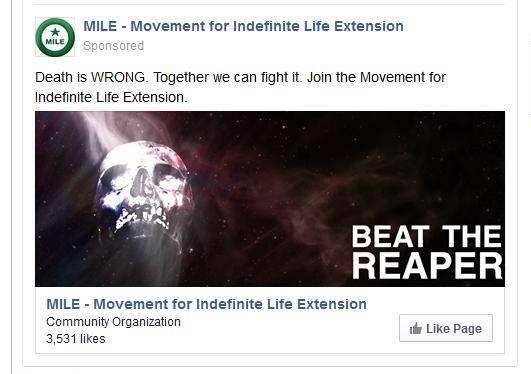
I am proud to have contributed resources to run several ads for MILE that incorporate the core message and the cover image of my children’s book Death is Wrong. These MILE/Death is Wrong ads were designed by my wife and illustrator Wendy Stolyarov and are accompanied by the following text:
Death is WRONG. Together we can fight it. Join the Movement for Indefinite Life Extension.
To help the MILE reach its Year 2 goal, you can start by clicking the “Like” button on the MILE Facebook page. Beyond that, if you would like to contribute to the advertising campaign and even develop your own custom advertisement that conveys the message of indefinite life extension, this would go a long way toward building the critical mass needed to catalyze public support for life-extension research.
Death is Wrong Book Distribution to Children
After the successful conclusion on April 23, 2014, of my Indiegogo fundraiser to spread over 1,000 copies of the illustrated children’s book Death is Wrongto kids, free of cost to them, I have worked assiduously to coordinate a worldwide distribution effort. Already, 644 out of the 1,029 total available books have been sent to longevity activists throughout the world. Countries where the books have been shipped thus far include the United States, Canada, Mexico, the United Kingdom, the Netherlands, Poland, India, Indonesia, and Singapore. Tens of dedicated longevity supporters have already come forward to request absolutely free shipments of books, but we need more activists to help us distribute the remaining 385 books in their local areas.
Recipients have wide discretion to use their creativity in how to offer the Death is Wrong books to children, as long as the books are made available free of cost and are not resold. Books may be given away to kids directly, lent to multiple kids, given to schools and libraries that will accept them, or used at public readings – among possible other options.
The early successes of the book-distribution effort are among the most heartening and encouraging developments I have observed. Here are some photographs that longevity activists have sent in of their book shipments.
Here is a charming interview by Aleksander Kelley of his sister Hanna, who is spreading Death is Wrong to the kids she knows.
Help make future scenes like this happen. Requesting a shipment of Death is Wrong books is simple. Send me an e-mail to gennadystolyarovii@gmail.com with (i) your name, (ii) your mailing address, (iii) your statement of support for indefinite life extension, (iv) the number of copies of Death is Wrong requested, and (v) your plan for spreading the books to children, free of cost to them.
Once the shipments arrive, any additional images and videos of the books and events at which they are shared would be most welcome. They can help spread the message of indefinite life extension even further and show the world that the momentum for this cause continues to grow.
Distributed Computing for Medical Science
Would you like to help cure cancer, Alzheimer’s disease, Huntington’s disease, and other deadly ailments, just by running your computer? Most people’s computers spend much time absolutely idle; how about putting that idle time to good use, at minimal additional cost? Distributed computing initiatives such as Folding@home, Rosetta@home, and World Community Grid are absolutely free to join. You just need to download a program that runs the calculations involved in protein-folding simulations and other research efforts while you are not using your computer. Already, these distributed computing initiatives have led to several major medical research breakthroughs, such as this one by Chiba Cancer Center in Japan, which has identified seven drug candidates in the fight against childhood cancer. You can read more about the applications of protein-folding simulations to disease research in this brief post by David Baker of the University of Washington.
While no single medical breakthrough will achieve indefinite lifespans yet, every victory against death and diseases will help us approach that goal. The more of us survive the common killers of our time, the more of us stand a chance of personally witnessing the arrival of longevity escape velocity.
As an additional way to raise the profile of the ideas of indefinite life extension, it is recommended to join a distributed-computing team that explicitly embraces the struggle against senescence and death. On Folding@home, The Longevity Meme team has been folding for years and is ranked 156th out of 220,186 teams as of June 5, 2014. I am spearheading a collaborative effort between The Longevity Meme team, LongeCity, and my online magzine – The Rational Argumentator – to attract renewed participation in Folding@home and The Longevity Meme team among longevity advocates. To provide an additional incentive to join, I am offering a series of five Protein Folding for Life Extension Open Badges, designed by Wendy Stolyarov and available via Badg.us.
These are badges that you can store and share via Mozilla Backpack to share your achievements with others. The following are the qualifying criteria for each badge:
To request a badge, simply send an e-mail to gennadystolyarovii@gmail.com. Include your user name on Folding@home so that your points earned could be verified. You can earn a badge no matter what team you are on, if any, as everyone’s commitment of resources to the protein-folding effort helps the prospects of indefinite life extension. However, you are also encouraged to join The Longevity Meme team in order to help improve its ranking and raise public awareness of the effort life-extension activists are putting into the fight against disease.
On Rosetta@home, the LongeCity team explicitly embraces the ideas of indefinite life extension. On World Community Grid, the Endthedisease team supports life extension and has been involved in numerous disease-fighting computational efforts since 2007. Later this year, the Endthedisease team is anticipated to begin running contests with prizes for top contributors.
Games to Fight Disease
By flying a spaceship through an asteroid field in a computer game, you can help cancer researchers analyze data at a much faster rate than they could before. Play to Cure: Genes in Space is a mobile game released by Cancer Research UK, which anyone with a tablet or mobile phone can play for free. The stated aim of this game is to hasten the day when all cancers are cured – which is, incidentally, the key objective of one of the seven prongs of Dr. Aubrey de Grey’s SENS approach; Dr. de Grey has emphasized that cancer is by far the predominant way by which age-related nuclear mutations harm us.
You can read about the mechanics of and science behind Play to Cure here and watch this video introduction to the game.
Foldit is another free game that enthusiasts of life-extension research can play in order to add the human touch to protein-folding simulations. In 2011, Foldit players discovered the protein structure of a retroviral protease of the Mason-Pfizer monkey virus, an AIDS-like disease in monkeys.
See this list from the Citizen Science Center for more possibilities regarding games you could play and simultaneously participate in innovative citizen-science initiatives – including many devoted to the fight against disease. Games hold out the promise of enabling monumental contributions to scientific research by the general public. A game designed to be sufficiently engaging could attract thousands of non-scientists to do the work that research scientists could conceivably outsource in order to accelerate the rate at which certain kinds of data analysis are performed. The more quickly scientists can iterate through their experiments as a result, the sooner the cures to major diseases will arrive.
Conclusion
Of course, I would urge all life-extension supporters to donate even modest amounts of money to research and advocacy organizations such as the SENS Research Foundation and the Methuselah Foundation, as well as crowdfunded life-extension research projects that are being undertaken with increasing frequency. Yet, I hope that this overview has led readers to recognize that much can be done in addition to monetary donations. Integrate the active pursuit of indefinite longevity into your life, and you will continue to find easy but extremely important ways to become part of the solution to the most pressing problem of all time. Through our efforts, we will hopefully someday be able to celebrate humankind’s greatest victories in the fight against our mutual enemy: death.
What Anyone Can Do to Advance Indefinite Life Extension – Video by G. Stolyarov II
Mr. Stolyarov provides a quick overview of ideas that anyone can implement to accelerate the pace of technological progress and bring about indefinite life extension for many who are alive today.
We are collecting $100 pledges for this Movement for Indefinite Life Extension Year Two Goal Advertisement Fundraiser (MILE y2 Fund). At this time there is a total of $600 pledged. If you want to get in on this, then send us a message at the Movement for Indefinite Life Extension Facebook page. The deadline for making pledges is 20:00 CST, June 15th 2014. You can either have us place the ads for you by sending the money in via PayPal, or you can request to place your own, and we will set you up with the basics.
The Movement for Indefinite Life Extension, which is more like a group spirit that promotes everybody, rather than something like a Foundation or Corporation, is pushing a 5-year goal to inform 8 million people about the individuals, projects, and organizations that are working directly or indirectly toward the goal of indefinite life extension. It is executed in 5 progressive steps.
Year One, which was completed on July 17th of last year, 2013, had the goal of reaching 800 “likes” in this awareness driving campaign.
We are now on our way to the Year Two goal of 8,000 “likes”, with the goal’s deadline coming up soon on July 17, 2014. We are right on schedule with saturation of organic likes and are confident that we can come in on time with the goal of 8,000, and probably exceed it, by the deadline, with around $1,000 in Facebook ads that are targeted to like-minded people and groups. (Of course, the more donations, the better. We’re all working to drive awareness to a critical mass of at least 8 million people for the final goal.)
Millions of people are hearing and learning about the work that is going on to make indefinite healthy life spans a reality, through all the press, events, projects, and endeavors that people around the world have been working on over the decades. With advertisements, we can find more of them and get them to consider putting their weight behind the general movements of transhumanism and indefinite life extension. The rate at which we grow to critical mass, and generate awareness, matters. The clock is ticking.
The important cause of life is the incentive. In addition to that, there is the small incentive that the group of people that pledges to this Movement for Indefinite Life Extension Year Two Goal Fundraiser, will be written about as instrumental leaders in the success of the Movement for Indefinite Life Extension Year Two Goal, and in the movement in general.
Mr. Stolyarov provides an update regarding the effort to distribute over 1,000 free, paperback copies of Death is Wrong to children.
As of May 28, 2014, 644 books have been sent out, and 385 remain to be distributed, out of an eventual goal of 1,029 books provided to children, free of cost to them.
Instructions for Longevity Activists to Request Copies of “Death is Wrong”
– Provide (i) your name, (ii) your mailing address, (iii) a statement of your support for indefinite life extension, and (iv) a brief description of your plan to spread the book to children in your local area. Remember that all copies received pursuant to this initiative would need to be offered to children free of charge (as gifts or reading opportunities) and may not be resold.
– Provide the number of copies of Death is Wrong that you are requesting.
– Preferably, provide an indication that you would be willing to send photographs of the books that have been delivered to you as well as events where you will be distributing the books.
Most people want to die of in their sleep, in peace, of old age, without pain and surrounded by their family and loved ones after achieving success and after having done something worthwhile.But the facts suggest, that such a peaceful end is granted to very few people, while most people have to endure different disabilities and diseases associated with aging and terrible pain and decreased function, performance, and the lack of joy coming with it.The Global Burden of Disease (GBD) project originated in 1990 in a collaboration between the World Health Organization, Harvard School of Public Health, the Institute for Health Metrics and Evaluation (IHME), and the World Bank.
The focus of the Global Burden of Disease Study is to provide a detailed statistical analysis of the impact of diseases leading to death and disability across various regions around the world. The purpose of the study is to reveal gaps between current and ideal health circumstances and develop strategies to reduce this gap.
The 2010 Global Burden of Disease study reveals a significant shift in the nature of disease worldwide. There has been a significant increase in chronic disease worldwide. This is due to demographics of aging, and the subsequent increase of age-related disease.
Worldwide, the contribution of different risk factors to disease burden has changed substantially, with a shift away from risks for communicable diseases in children towards those for non-communicable diseases in adults.
As life expectancy has increased, the number of healthy years lost to disability has also increased in most countries, consistent with the expansion of morbidity hypothesis, which has implications for health planning and health-care expenditure.One of the key findings reveals that we are living longer, but under an increased burden of chronic disease that impairs our quality of life.These results are distressing: men can expect to spend an average of 9.2 years and women 11.5 years with some form of a chronic disability. In other words, during the last decade of lives, on average, our quality of life might become significantly impaired by the presence of a chronic disease.
The paradox, then – the fact that people want to be actively saved if they are near or at the moment of death, but also want to die peacefully – seems to be rooted in a pretty profound medical illiteracy.
Healthy people don’t die in their sleep, “peacefully” or otherwise. You don’t hear about too many 25-year-olds dying suddenly of heart attacks or strokes during their nightly slumber.
When people in their twenties die, it’s usually considered tragic. When babies are found dead in their cribs, it’s referred to by a name (“Sudden Infant Death Syndrome”). But when elderly people die, in bed or otherwise, there tends to be a curious tone of, “Well, at least they went peacefully.”
The increase in life expectancy and the resulting growth of the elderly population are also thought to be driving up the number of elderly people with disabilities.
Typically in the case of dying in your sleep due to old age, an autopsy can determine exactly what went wrong, or what stopped working. For example, your heart could simply get tired and stop beating, because it’s been working hard for the past eighty or ninety years.
The phrase “natural causes” or dying “of old age” is a very strange one really. Ultimately what it means is that someone who dies of natural causes, dies of aging in a way that has not been given an additional name; so really it’s just a matter of terminology. The difference is between dying of “natural causes” and dying of some other specifically named thing that doesn’t really often affect young adults.
Searching for a cure for age-related ill health, a problem that kills more people than all other causes combined, is a moral imperative. The Advocate for Negligible Senescence publishes articles that discuss and educate the public about research to combat senescence. See the Advocate’s Facebook page.
Motivated Time Prospectors – Article by Eric Schulke
Think of all the people’s lots in life that you don’t have. You will regret not having more chances to stand here as you are now. It is said that if everybody put their worries into a pile and then took an equal share from the pile, then most people would be content to take back their own share of them. I was reading an article that said,
“To be sick and dying in Vegas has its own existential horror. Not only do you realize that you are going to die and that you don’t matter to the world, but you also realize that much of the world is awful and yet you still would do anything to live.”
Struggling to survive on this planet can be miserable, and yet we continue to stick with it. Why? Because we know that with life there is a chance to engage in more experience. It seems that a person can live, in part, on the desire for continued experience. That chance drives us to keep reaching for achievement and progress.
What does one want to experience in life? What does that honest-to-life list look like? If you had to draw up a complete list, could you do it, or describe the nature of it? The active wanting of experience, it seems, is a major cure to indifference toward death. It seems that it might be a life-or-death question.
We have become really good at being indifferent to the most widespread forms of death, in order to spare ourselves from stressing out on futilely trying to do something about it. Now that we have the tools and techniques, and the times have changed, we have to change that way of thinking from indifference back toward letting that horror affect us. Horror benefits us in that it is our cue to be driven to action to make sure that the horror can’t happen again. If a poltergeist starts ravaging your house, that’s your signal to get out of there, in the same way that the horror that general death, aging, and other diseases are your signal to get death, aging, and other diseases away from you and out of your cells.
Carl Sagan’s daughter once related his words that “there was nothing he would like more in the world than to see his mother and father again.” I was thinking about what an insult added to injury he must have felt in his final days, to have the paralyzing misery of impending death heaped on top of crushing pain. Let that kind of pain course through your mind, face it, bring it to a steaming rage, and let the energy power you to help execute any of the various assaults on aging and disease that are underway in laboratories in various places around the world.
In another article, I was reading about a guy whose daughter went missing in 1971, and was never found. He lived to be 102 and died in the fall of 2013. He had stated that one of the hardest burdens for him was never knowing what happened to his daughter. What misery, for all those years… Think of that… Then five days after he died, his daughter’s car was found upside down in a river; she was the apparent victim of a decades-old car crash.
I can’t fathom that life could inflict such a bitter spite upon somebody. That story stirs up the kind of despair and anguish that each death seems to deserve. It’s the kind of anguish you need to figure out how to allow in, in order to have the right kinds of drive to help pull the Movement for Indefinite Life Extension forward with us.
So once we get there, back to that place where we stand amidst realization of the horror of death, how do we face it? One good basic and natural way to do so, it seems, is to purposefully enjoy the good parts of life, and strategize and take action in helping to fix the worst of the broken things. It’s fun and fulfilling. Life isn’t bad, it’s an adventure. A tough challenge is like a choppy sea, like two armies clashing, or mountain climbers fighting the elements. The implementation of the solution of each challenge is like a Renaissance of scale, some miniature, some very large, like Caesar vs. Vercingetorix, or Charlemagne vs. the Vikings. It’s like the writings of Caesar, the writing-resurgence work of the Carolingians, Vercingetorix and the fate of an entire Celtic confederation, or the first times the Vikings set sail out beyond Greenland.
A few days ago I was thinking about a typical farm hand of Medieval times, walking outside to smell the heavy wet grass and earth of a cold wet spring day. How did they remember the great Lombard migrations, or Scandinavian raiders docking at Pisa? Who was Charlemagne to people before negationists took hold? What did they think might become of the future? Many of them must have felt lost at that kind of thought.
Focus on your heartbeat, feel it pulsing. Theirs pulsed like that. They thought of their hearts stopping and of how it couldn’t possibly be lost to the dust of history anytime soon. You think that, too. Their hearts are lost to the dust of history. Yours is next.
What does every year, and every moment mean to the history of everything? I read recently that if you throw a pebble, it could be offsetting the center of gravity of the universe. Every moment means everything, every moment is everything. Every moment is a world in itself, a great painting, a great work of art, a great burning torch, a water well built in inhospitable lands. Think of how many heartbeats have come to a stop, how many paintings have been burned… So many tangled groves in forests have had the wind blowing through them for all of these years, without one person, without one spoken word, in a place near a stream, where there was once a mighty, crackling stone fireplace that warmed multiple generations of families across the 6th through 8th centuries. It was a place that hosted countless memories which later tormented the souls of dying, now long-dead grandfathers.
They don’t deserve to be dead. They deserve what they earned: the world that is paying exponentially exciting, satiating, and fullfillingly valuable dividends today. This is an incredibly motivating and driving factor in what pushes me to pursue indefinite life extension. People take on a variety of diverse augmentations over time, becoming unique collections of intriguing insight – dynamic power tools for slicing and dicing the elements. We can’t afford for these wealths of rare and powerful abilities and resources to be pillaged and killed off. Sometimes it seems as if life-extensionists like me have to explain to people why it’s bad to let people be killed before we can get down to business in a worldwide effort to reach the goals that can get this done.
We are like the union for the people that make a profession out of being human. We are creating better and better pay, and we demand longer hours. I want every feasible remedy that can restore and maintain life to be a permanent fixture in this reality, for it to be harvested like air. There is no reason a heart has to give out. There is no reason we cannot prevent tangles from forming in the brain. Our organs and cells don’t have to degrade. We have tools, techniques, and brains. We will make it through these obstacles.
How long will it be before our times are old, before 2015 cars look like old classics, and thoughts of our times are most often associated with the smell of the pages of books that have been moved from their years of service on shelves, to boxes of outdated material in back rooms? Many experiences and voyages that could have happened, and could have been chronicled in those boxes, can never exist.
That’s the problem, it seems: There are experiences that could have existed, but that now never can. Thoughtful experience – there is no reason to forgo it or allow it to be lost – hence the basic, inherent reasoning for supporting indefinite life extension, it seems.
Every moment is the gold, the thing to be mined, the thing to be in awe of, to seek, pursue, and strategize toward, to work for, to feel victorious for possessing. Let’s mine more time: support the Movement for Indefinite Life Extension. Don’t be distracted by fool’s gold while the most valuable gold, time, slips through your fingers.
One of these days, we will put funeral homes across the world out of business, and it will be a great victory. We will celebrate, and the festivities will be grand. But we must get a move on now, because our chances are turning into sand.
There are numerous examples of studies that use mice genetically engineered to suffer forms of shortened life span with the appearance of accelerated aging. One has to be very cautious in reading anything into this sort of work, however: it is rarely of any great relevance to normal aging, as it creates and then attempts to ameliorate an entirely artificial situation. The appearance of accelerated aging is not in fact accelerated aging, but is rather often caused by mechanisms that are of little importance in normal aging. Even when the mechanisms are relevant, the overall metabolic circumstances can render it impossible to determine whether or not a partial treatment will be of any use in normal aging. The gold standard for relevance when evaluating new methods is the extension of life in unmodified mice, but unfortunately this is expensive and slow.
The publicity materials quoted below are a good example of research in animals exhibiting shortened life spans. Here scientists are investigating a protein involved in the induction of cellular senescence. As is often the case, however, from the structure of the work it is impossible to tell whether or not their drug candidate will be of any use as a treatment to lower levels of cellular senescence in normal aging and thus produce benefits such as extended health and life span. Those tests will still have occur:
Quote:
When cells or tissue age – called senescence – they lose the ability to regenerate and secrete certain proteins, like a distinctive fingerprint. One of those proteins, PAI-1 (plasminogen activator inhibitor) has been [a focus of] research, originally as it relates to cardiovascular disease. “We made the intellectual leap between a marker of senescence and physiological aging. We asked is this marker for cell aging one of the drivers or mechanisms of rapid physiological aging?”
For the study, [researchers] used mice bred to be deficient in a gene (Klotho) that suppresses aging. These mice exhibit accelerated aging in the form of arteriosclerosis, neurodegeneration, osteoporosis and emphysema and have much shorter life spans than regular mice. [These] rapidly aging mice produce increased levels of PAI-1 in their blood and tissue.
Then scientists fed the rapidly aging mice TM5441 – the experimental drug – in their food every day. The result was a decrease in PAI-1 activity, which quadrupled the mice’s life span and kept their organs healthy and functioning. “This is a completely different target and different drug than anything else being investigated for potential effects in prolonging life. It makes sense that this might be one component of a cocktail of drugs or supplements that a person might take in the future to extend their healthy life.”
Reason is the founder of The Longevity Meme (now Fight Aging!). He saw the need for The Longevity Meme in late 2000, after spending a number of years searching for the most useful contribution he could make to the future of healthy life extension. When not advancing the Longevity Meme or Fight Aging!, Reason works as a technologist in a variety of industries.
***
This work is reproduced here in accord with a Creative Commons Attribution license. It was originally published on FightAging.org.