Browsed by
Tag: Mises institute

Portugal’s Experiment in Drug Decriminalization Has Been a Success – Article by Mark Thornton

Portugal’s Experiment in Drug Decriminalization Has Been a Success – Article by Mark Thornton

The New Renaissance HatMark Thornton
July 10, 2015
******************************
This month, Portugal celebrates fourteen years of drug decriminalization. The grand experiment is now considered a happy success considering it was adopted out of desperation and in the face of dire warnings from proponents of the global drug war.

What Led to Decriminalization

During the mid-twentieth century, Portugal experienced fifty years of military dictatorship, and when leftist democratic control was reestablished in 1974, many expatriate Portuguese returned to Portugal from its colonies. Of course, many of these people were dissidents, outsiders, and outcasts, and many of them used illegal drugs.

Over the next twenty-five years, there was a surge in drug use, drug abuse, addiction, overdoses, and eventually a very substantial prevalence of HIV/AIDS and other dirty-needle-related diseases. At the peak of this drug epidemic the rate of drug addiction and HIV/AIDS infection was “considerably higher” than the rest of Europe according to Dr. João Goulão, the longtime drug czar of Portugal.

Goulão was on the eleven member anti-drug commission that formulated law 30/2000 which decriminalized all drugs starting July 1, 2001.

The “grand experiment” seems to be the result of two factors. The first is that Portugal is a relatively poor European country and was unable to fight the war on drugs on every front.

The second factor is that the commission was relatively non-partisan and simply adopted the common sense notion that drug abuse and addiction are not criminal problems for the police to solve. Drug abuse and addiction are medical and psychological problems that are better solved by the individual with the help of professionals and social pressures.

Baby Steps Away from the Drug War

Decriminalization is just one baby step away from the war on drugs, and drug smugglers and dealers are still sought out and punished. Individuals are only permitted to possess very small amounts of illegal drugs without being punished as a dealer. Under current laws, you can still be arrested and sent to counselors, but you do not face imprisonment unless you are an uncooperative multiple offender.

While certainly not ideal, decriminalization has straightforward benefits over complete prohibition. First, otherwise law-abiding citizens will not be criminalized for possessing illegal drugs. Second, drug addicts will be more likely to seek professional help when government treats addiction as a medical rather than criminal problem. Third, the police will have more resources to address real crimes and possibly to provide subsidies for drug treatment programs. Fourth, drug addicts will turn away from dangerous synthetic drug substitutes and turn more to the natural illegal drugs like marijuana and cocaine. Fifth, if needles are legal too, then you should see fewer cases of diseases such as HIV/AIDS and hepatitis. Sixth, junkie ghettos will shrink in size and visibility. In sum, decriminalization should result in fewer people dying and being sent to prison and more people living “normal” lives.

Of course, the biggest concern prior to decriminalization was the quantity of illegal drugs consumed. That concern is even more dominant when discussing outright legalization of drugs. Back when Portugal was considering decriminalization, I was interviewed by the “Time Magazine of Portugal,” and the reporter stressed that this was the prime concern in Portugal at the time. I responded that you cannot know the answer to that question in advance, that you will never know the answer to that question, and that the question was unimportant.

Too many factors impact the markets for illegal drugs to be able to say definitively that drug consumption will increase or decrease after decriminalization. Factually, statistics on drug consumption are necessarily imprecise. This is true for statistics prior to and after decriminalization. The existing statistics are based either on things like surveys and educated guesswork with the actual facts mired in the secretive world of the black market. Consumption aside, the real question is whether prohibition does more harm than decriminalization and the answer is yes.

When I was pressed by the reporter for a guess, I responded that overall consumption would not change much; it might increase some in the short run and would decrease in the long run, unless the drugs were legalized in the future for medical or recreational uses. However, I stressed that there are undeniable benefits (listed above) and there is no reason that consumption would explode due to decriminalization.

Many Still Refuse to See the Success

It is hard to blame the Portuguese for their concerns at that time. Decriminalization was considered a dangerous experiment and a dodge of the United Nations’ rules of the global war on drugs. However, mainstream drug policy experts remained “skeptical” of the Portuguese experiment even after nearly eight years of experience.

Mark Kleiman, director of the drug policy analysis program at UCLA, claims that Portugal was an unrealistic model. Peter Reuter, another leading drug policy expert, claimed that despite achieving its central goal (decreased consumption) it could be explained by the fact that Portugal was a small country and that drug abuse is cyclical in nature.

Remarkably, Dr. Goulão, who helped design and oversee the new law seems uninformed and perplexed at the positive outcomes even to this very day. He was recently quoted as saying: “it’s very difficult to identify a causal link between decriminalization by itself and the positive tendencies we have seen.”

One picture that sums up the Portuguese success story shows that Portugal has the second lowest death rate from illegal drugs in all of Europe after experiencing one of the worst rates with prohibition.

Drug-induced deaths in Portugal
It is also interesting to note that the European Monitoring Center for Drugs and Drug Addiction (EMCDDA) is headquartered in Lisbon. One analyst who works at EMCDDA, Frank Zobel, calls Portugal’s policy “the greatest innovation in this field” and “that the policy is working. Drug consumption has not increased severely. There is no mass chaos. For me as an evaluator, that’s a very good outcome.”

It is a happy anniversary for the Portuguese, but a scary one for all the drug warriors around the world whose incomes and power depend on continued ignorance about the effects of prohibition.

Mark Thornton is a senior resident fellow at the Ludwig von Mises Institute in Auburn, Alabama, and is the book review editor for the Quarterly Journal of Austrian Economics. He is the author of The Economics of Prohibition, coauthor of Tariffs, Blockades, and Inflation: The Economics of the Civil War, and the editor of The Quotable Mises, The Bastiat Collection, and An Essay on Economic Theory. Send him mail. See Mark Thornton’s article archives.

This article was published on Mises.org and may be freely distributed, subject to a Creative Commons Attribution United States License, which requires that credit be given to the author.

Frédéric Bastiat’s “Economic Sophisms” Is Now More Important Than Ever – Article by Julian Adorney and Matt Palumbo

Frédéric Bastiat’s “Economic Sophisms” Is Now More Important Than Ever – Article by Julian Adorney and Matt Palumbo

The New Renaissance HatJulian Adorney and Matt Palumbo
June 29, 2015
******************************

The great economist Frédéric Bastiat would have turned 214 today. His contributions to liberty have been many, but while so many advocates of free markets focus on The Law, there is another book that represents his legacy even better: Economic Sophisms. This short work of essays epitomizes perhaps his most important contribution: using taut logic and compelling prose to bring the dry field of economics to hundreds of thousands of laymen. Bastiat did not, generally, clear new ground in the field of economics. He read Adam Smith and Jean-Baptiste Say and found little to add to these giants of economic thought. But Bastiat possessed a keen wit and a clear, pithy writing style. His writings have become immensely popular. One-hundred-and-fifty years after his death, essays like “A Petition” are still circulated as an effective counter to progressive economics. Bastiat makes three central contributions in Economic Sophisms. First, he reminds us that we should care about the consumer, not just the producer. Second, he dismantles the argument that there are no economic laws. Third, and more generally, he is one of the few politicians and writers who thought with his head, not with his heart. Bastiat used logic to clearly lay out the consequences of political actions instead of hiding behind good intentions.

Surplus, Not Scarcity

Economic Sophisms expresses a common theme over and over again: we should craft policies that focus on consumers, not on producers.When Bastiat uses these phrases, it can be easy to misinterpret him. Keynes, writing 100 years after Bastiat, hijacked the terms. But Bastiat wasn’t a Keynesian. When he discusses how consumption is the end goal of the economy, what he means is: having goods (which benefits consumers) is more important than making goods (which benefits producers). Put another way, producers prefer scarcity, because it drives up prices. Consumers prefer surplus for the opposite reason. Producers advocate all sorts of methods for reducing the total quantity of goods (theirs excepted, of course). Producers seek to tax goods from other countries that compete with their own. They outlaw machines that would replace them. Producers even favor policies like burning food to drive up food prices, a policy that caused much starvation when it was enacted in the United States during the Great Depression. Consumers, by contrast, prefer abundance. They are happiest when they have a plethora of goods to choose from at a low price. Bastiat points out that we are all consumers, including the producers. The man who produces railroads also uses his wages to buy goods. One can imagine a world with no producers, a paradise in which man’s every need is fulfilled by nature or a benevolent God. But one cannot imagine a world with no consumption. In such a world, man would not eat or drink, have clothing or buy luxuries. Consumption, and quality of life, is the essential yardstick to measure a society’s economic prosperity.

When we enact producer-backed measures like tariffs, Bastiat argues, we favor producers’ interests over consumers’. We show that we’d rather have scarcity than surplus. Taken to its logical extreme, such a policy is absurd. Would anyone truly argue that total scarcity is preferable to having plenty?

The Principle of No Principles

In Bastiat’s day, it was fashionable to claim that no real principles exist. X may cause Y, but a smaller X needn’t cause a smaller Y; it could cause Z instead, or A. Today, we see the same logic: people who claim, for instance, that a minimum wage hike to $100 would kill jobs but that a hike to $10.10 would somehow create them. In essay after essay, Bastiat destroys this myth. Economics is not a foggy morass where up is sometimes down, left can be right, and there are no absolute truths. Economics is not like nutrition, where a glass of wine can heal while two gallons can kill.In economics, a cause will produce a correlational effect, regardless of how large the cause is. If small X causes small Y, large X causes large Y. A minimum wage hike to $100 will kill many jobs; a minimum wage hike to $10.10 will still kill some. The effect does not vary, only the size of it. Indeed, one of Bastiat’s most common argumentative tools is reductio ad absurdum, or carrying a concept to its logical conclusion. Opponents of mechanization want to force railroads to stop at one city and unload goods, thereby generating work for the porters? Very well, says Bastiat. Why not have them stop at three cities instead? Surely that would generate even more work for the porters. Why not stop at twenty cities? Why not have a railroad composed of nothing but stops that will make work for the porters?

By carrying concepts to their logical conclusion, Bastiat provides a firm antidote to the fuzzy thinking of protectionist advocates.

Think with Your Head

In Bastiat’s time, just as today, it was popular to think with one’s heart. “We must do something!” went the rallying cry; never mind the consequences. Good intentions were enough. Make-work, for instance, has always been a favorite policy of those who think with their hearts. They see men and women unemployed and demand government take action. Often, this action takes the form of impeding human progress: using porters instead of railroads, for instance. The initial consequence, for the porters, is positive: more end up employed. But Bastiat recognizes that such policies, while they may protect the porters, harm the economy as a whole. They raise prices and create scarcity. Bastiat looked at more than just the direct consequence of an action. He examined all the outcomes, using taut chains of logic to demonstrate how each policy would impact those whom he was most focused on — the consumer.

Bastiat’s Legacy

Bastiat did not invent any new economic tools or schools of thought. But the clear logic with which he thought through economic ideas, and the clear and witty prose with which he lambasted those who did not do so, have made him one of the most popular economic figures of all time. Bastiat’s ideas in this text have been borrowed, rehashed, and republished for over 150 years. His insights have been appropriated by dozens of prominent thinkers. Most famously, Henry Hazlitt based Economics in One Lesson largely on the essays in Economic Sophisms. As we make note of his 214th birthday, perhaps we should raise a toast to the man whose ideas — in all their adopted formats — have done so much for the cause of liberty.

Julian Adorney is an economic historian, entrepreneur, and fiction writer.

Matt Palumbo is the author of The Conscience of a Young Conservative and In Defense of Classical Liberalism.

This article was published on Mises.org and may be freely distributed, subject to a Creative Commons Attribution United States License, which requires that credit be given to the author.


Fact-Checking Paul Krugman’s Claim To Be “Right About Everything” – Article by Andrew Syrios

Fact-Checking Paul Krugman’s Claim To Be “Right About Everything” – Article by Andrew Syrios

The New Renaissance Hat
Andrew Syrios
June 10, 2015
******************************

But can the debate really be as one-sided as I portray it? Well, look at the results: again and again, people on the opposite side prove to have used bad logic, bad data, the wrong historical analogies, or all of the above. I’m Krugtron the Invincible!

Thus wrote the great Paul Krugman. A man so modest as to proclaim that “I think I can say without false modesty, a huge win; I (and those of like mind) have been right about everything.”

Quite a claim. Indeed, predictions are extraordinarily difficult. Even to an expert in a subject who has dedicated his life to a field of study, predicting the future proves elusive. Daniel Kahneman referenced a study of 284 political and economic “experts” and their predictions and found that “The results were devastating. The experts performed worse than they would have if they had simply assigned equal probabilities to each of three potential outcomes.”

A whole book of such wildly inaccurate predictions by experts was compiled into the very humorous The Experts Speak with such prescient predictions as Dr. Alfred Velpeau’s “The abolishment of pain in surgery is a chimera. It is absurd to go on seeking it” and Arthur Reynolds belief that “This crash [of 1929] is not going to have much effect on business.” Indeed, a foundational block of Austrian economics (that some Austrians unfortunately forgot regarding premature predictions of hyperinflation) is that the sheer number of variables in the world at large makes accurate forecasting extraordinarily difficult.

So it must be a rare man indeed that can be right about everything. And this man, Paul Krugman is not.

Predicting a Bubble He Recommended

Paul Krugman likes to reference the fact that he predicted the housing bubble. Of course, he also sort of recommended it. From a 2002 column of his,

To fight this recession the Fed needs more than a snapback; it needs soaring household spending to offset moribund business investment. And to do that, as Paul McCulley of Pimco put it, Alan Greenspan needs to create a housing bubble to replace the Nasdaq bubble.

In 2009, when this came out, he denied its obvious implication and wrote, “It wasn’t a piece of policy advocacy, it was just economic analysis. What I said was that the only way the Fed could get traction would be if it could inflate a housing bubble. And that’s just what happened.” So that doesn’t count as a recommendation? It certainly sounded like he was agreeing with Paul McCulley on inflating a housing bubble. And he verified that that’s exactly what he meant in a 2006 interview where he said,

As Paul McCulley of PIMCO remarked when the tech boom crashed, Greenspan needed to create a housing bubble to replace the technology bubble. So within limits he may have done the right thing. But by late 2004 he should have seen the danger signs and warned against what was happening; such a warning could have taken the place of rising interest rates. He didn’t, and he left a terrible mess for Ben Bernanke.

The best Krugman can possibly say is that he thought Greenspan went too far with the housing bubble he recommended.

Deflation is Around the Corner

While running victory laps because the United States hasn’t seen massive price inflation, Krugman seems to have forgotten what his prediction actually was. In 2010 he wrote, “And what these measures show is an ongoing process of disinflation that could, in not too long, turn into outright deflation … Japan, here we come.”

Robert Murphy called him on this and noted Krugman’s response,

… Krugman himself … said of his 2010 analysis: “(In that post, I worried about deflation, which hasn’t happened; I’ve written a lot since about why).”

Note the parenthetical aside, and the timing: Krugman in April 2013 is mentioning in parentheses to his reader that oh yes, as of February 2010 he was “worried about deflation, which hasn’t happened.” In other words, Krugman entered this crisis with a model that predicted how prices would move in response to the economic situation, and chose his policies of government stimulus accordingly. He was wrong, and yet maintains the same policy recommendations.

But of course to Krugman, anyone who predicted price inflation can’t explain why that hasn’t happened. Such people are just those “… who take a position and refuse to alter that position no matter how strongly the evidence refutes it.” Krugman is different.

Europe Will Do Better Than the United States

In 2008, Krugman wrote:

… tales of a moribund Europe are greatly exaggerated. … The fact is that Europe’s economy looks a lot better now — both in absolute terms and compared with our economy.”

Later he noted that “Americans will face increasingly strong incentives to start living like Europeans” and that “he has seen the future and it works.” (I should probably note that that is a quote he borrowed from Lincoln Steffens about the Soviet Union.)

Then Greece went bankrupt and the international consensus is unquestionably that the crisis hit Europe harder.

The Euro Will Collapse

Niall Ferguson counted eleven different times between April of 2010 and July 2012 that Krugman wrote about the imminent breakup of the euro. For example, on May 17th, 2012, Krugman wrote,

Apocalypse Fairly Soon. … Suddenly, it has become easy to see how the euro — that grand, flawed experiment in monetary union without political union — could come apart at the seams. We’re not talking about a distant prospect, either. Things could fall apart with stunning speed, in a matter of months, not years. And the costs — both economic and, arguably even more important, political — could be huge.

Most of these predictions are laced with weasel words such as “might,” “probably,” and “could” (more on that shortly). Still, while I’m no fan of the euro, and it might still collapse, as of today, three years later, it has not. If the word “imminent” means anything at all, Krugman was wrong.

The Sequester Will Doom Us All

Paul Krugman at least admitted the sequester was “relatively small potatoes.” But for “relatively small potatoes” he makes a big deal about it, referring to it as “one of the worst policy ideas in our nation’s history.” And it “will probably cost ‘only’ around 700,000 jobs.” (Note the word “probably” again.)

Then later, he decided that these were actually quite large potatoes, stating,

And, somehow, both sides decided that the way to buy time was to create a fiscal doomsday machine that would inflict gratuitous damage on the nation through spending cuts unless a grand bargain was reached. Sure enough, there is no bargain, and the doomsday machine will go off at the end of next week.

The economy has done quite well since then actually. Indeed, how $85.4 billion dollars in “cuts” (from the next year’s budget not the previous year’s spending) could affect anything in a $17 trillion dollar economy is simply beyond me. And of course, it didn’t.

Interest Rates Can’t Go Below Zero

In March of this year, Krugman wrote in regard to some European bonds with negative nominal yields,

We now know that interest rates can, in fact, go negative; those of us who dismissed the possibility by saying that people could simply hold currency were clearly too casual about it.”

But as Robert Murphy points out, “The foundation for the Keynesian case for fiscal stimulus rests on an assumption that interest rates can’t go negative.” Murphy also points out that Krugman should admit he was wrong again because back in 2009, Krugman wrote,

And the reason we’re all turning to fiscal policy is that the standard rule, which is that monetary policy plus automatic stabilizers should do the work of smoothing the business cycle, can’t be applied when we’re hard up against the zero lower bound. [i.e. zero percent interest]

“Inflation Will be Back”

In 1998, Paul Krugman predicted “Inflation will be back.”

Nope.

“The Rate of Technological Change in Computing Slows”

Same article as the last one, “… the number of jobs for IT specialists will decelerate, then actually turn down.”

Aside from a short dip after the 2001 recession, the answer would be nope again.

Weasel Words and “Accurate Predictions”

Let’s take a look at Paul Krugman’s “accurate prediction” of the financial crisis. On March 2nd, 2007, he predicted the following explanation would be given a year from then for the financial crisis he was sort of predicting,

The great market meltdown of 2007 began exactly a year ago, with a 9 percent fall in the Shanghai market, followed by a 416-point slide in the Dow. But as in the previous global financial crisis, which began with the devaluation of Thailand’s currency in the summer of 1997, it took many months before people realized how far the damage would spread.

So the crisis would begin in China? Almost.

He concluded that column by saying, “I’m not saying that things will actually play out this way. But if we’re going to have a crisis, here’s how.”

That’s a good hedge, just like with the euro. He can say he got the financial crisis right (albeit happening in a different way than he expected), but then say he didn’t get the euro wrong because he added “probably” before any prediction about it.

Normally, there would be nothing wrong with these weasel words. Given the nature of predictions, any prediction that is made should have a qualifier in front of it. It’s simply an admission that you aren’t omniscient. But you can’t eat your cake and have it too. Either Krugman was right about the crisis (sort of) and wrong about the euro (and many other things) or neither should count at all.

Or course, this doesn’t refute Krugman’s theories. But then again, Krugman may want to slow down on his victory laps.

Andrew Syrios is a partner in the real estate investment firm Stewardship Properties. He graduated from the University of Oregon with a degree in Business Administration and a Minor in History.

This article was published on Mises.org and may be freely distributed, subject to a Creative Commons Attribution United States License, which requires that credit be given to the author.

Technology Needs Capital To Produce Economic Growth – Article by Frank Shostak

Technology Needs Capital To Produce Economic Growth – Article by Frank Shostak

The New Renaissance Hat
Frank Shostak
June 8, 2015
******************************

In his article “The Big Meh” Paul Krugman complains that despite all the information technology advances the effect so far has been negligible as far as economic growth is concerned.

Krugman writes “That the whole digital era, spanning more than four decades, is looking like a disappointment. New technologies have yielded great headlines but modest economic results. Why? … The answer is that I don’t know — but neither does anyone else.”

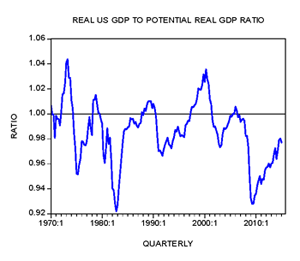
Indeed if one looks at the real gross domestic product to the potential real gross domestic product ratio the economy does appear to be hovering below potential with the ratio of 0.977 registered in Q1 this year.

shostak_june 8 300_1

Contrary to Krugman, we suggest that economists such as Ludwig von Mises and Murray Rothbard have provided a clear answer to the issue of technology and economic growth.

In Man, Economy, and State, Rothbard says that technology, while important, must always work through the investment of capital in order to generate economic growth.

On this issue, Rothbard quotes Mises who says,

What is lacking in (underdeveloped counties) is not knowledge of Western technological methods (“know how”); that is learned easily enough. The service of imparting knowledge, in person or in book form, can be paid for readily. What is lacking is the supply of saved capital needed to put the advanced methods into effect.

Most modern theories that emphasize the importance of new ideas and new technologies give the impression that these ideas and technologies have a “life of their own.” Many experts hold that because of the limited amounts of capital and labor, without technological progress, the opportunities for growth will eventually run out.

We Need Funding To Implement New Ideas

Ideas, unlike material inputs, are not themselves scarce. Consequently, it is argued, new ideas for more efficient processes and new products can make continuous growth possible.

We suggest that regardless of how many ideas people have, what matters is whether these ideas can be implemented. What always limits the implementation of various new techniques is the availability of funding. While ideas and new techniques can result in a better use of scarce resources, they can however, do very little without the pool of real savings.

So regardless of how clever we are and regardless of various technological ideas, without an adequate pool of funding nothing will emerge. It is through the expansion in the pool of real savings that an increase in the stock of capital goods is possible. And it is the increase in the capital goods per worker that permits economic growth to emerge.

To Get More Funding, We Need Savings

Obviously, new ideas and new technology can be introduced during the production of new capital goods (i.e., new technology) and will be imbedded in the capital goods stock. The crux of the matter however, is that capital goods cannot emerge without a prior increase in the pool of funding or pool of real savings.

Take, for instance, a baker John who produced ten loaves of bread. He consumes two loaves of bread whilst the other two loaves — his real savings — he employs to purchase a new part to improve his oven. With a better oven he can now raise the output of bread to twenty loaves. If he still consumes only two loaves, then with a larger savings (now stands at eighteen loaves) he can enhance further his oven by introducing new parts, which will enable the introduction of new technology. Note that all this is made possible on account of real savings.

We suggest that despite new technologies, a major impediment to economic growth has been the relentless central bank tampering with financial markets.

Since 2008 this tampering was made manifest in the extremely loose monetary policy of the Fed that resulted in the massive monetary expansion of the Fed’s balance sheet and the lowering of interest rates to almost nil.

These policies have been responsible for a severe erosion of the pool of real savings and thus a weakening of the process of capital formation. This in turn has undermined real economic growth notwithstanding new information technology.

For Krugman and his followers savings is bad news — it is seen as less demand — hence one shouldn’t be surprised that Krugman is puzzled as to why new ideas haven’t manifested in a more robust economic growth. Contrary to Krugman, boosting so-called aggregate demand whilst undermining the capital formation process, and hence the ability to produce goods and services, cannot strengthen economic growth over time. In fact this way of thinking results in the notion that something can be generated out of nothing.

Frank Shostak is an adjunct scholar of the Mises Institute and a frequent contributor to Mises.org. His consulting firm, Applied Austrian School Economics, provides in-depth assessments and reports of financial markets and global economies.

This article was originally published by the Ludwig von Mises Institute. Permission to reprint in whole or in part is hereby granted, provided full credit is given.

Michel Chevalier’s Case Against the Patent System – Article by Louis Rouanet

Michel Chevalier’s Case Against the Patent System – Article by Louis Rouanet

The New Renaissance Hat
Louis Rouanet
April 17, 2015
******************************

Michel Chevalier (1806–1879) was a very influential French economist during the second half of the nineteenth century. He is still widely known in France for being the architect of the Cobden-Chevalier Treaty of 1860 which was the free-trade agreement between France and Great Britain. Michel Chevalier is, however, less known for his major contribution to the intellectual property debate. [1] Contrary to Jean Baptiste Say, Gustave de Molinari, and many other French economists, Chevalier fiercely opposed the patent system. As Fritz Machlup remarked: “Among French economists, Michel Chevalier was probably the most emphatic in the joint antagonism to tariffs and patents, declaring that both ‘stem from the same doctrine and result in the same abuses.’”

Taking a fresh look at Michel Chevalier’s major work, Les Brevets d’invention (1878), we find it to be not only a well-written and powerful book, but also has remained impressively relevant. The arguments advanced by Chevalier anticipate the current arguments of the present opponents of intellectual property.

Patents as Contrary to Freedom and Economic Progress

Michel Chevalier argues that patents cannot be justified if they are contrary to freedom, even if beneficial to technological change. For him “From the moment we can make effective the patent only through inquisitorial expedients, violence, and subversion of liberty of labor, it is proof that we must renounce patents.” Chevalier rejects utilitarianism as a sufficient method to justify or refute the patent system. Chevalier’s opposition to patents, however, is not just based on moral arguments but shows the disastrous effects of this system for both foreign trade and the economy in general.

According to Chevalier, patents are of the same nature as privileges and monopolies which were prevalent during the Ancien Régime. They are also comparable in their effects to protectionist policies:

In absolute terms, patents diminish the productive power of nations that recognize them: evident proposition for those who believe that freedom, free competition, is the great lever of industrial progress.

Chevalier goes on to note the conservative and anti-innovation nature of monopolies and gives many examples of monopolies during the Ancien Régime. According to him, the innovators during the Ancien Régime weren’t rewarded, not because of the absence of patents, but because of the corporation guild system which was destroying competition and freedom to entry into markets. Thus, the innovators were constantly sued by guilds and consumers rarely benefited from their inventions. This argument is still relevant today. Indeed, companies protected from competition and government-owned corporations are often less innovative and more subject to conservative measures. Sectors typically run by government such as schools experience very little technological progress. On the other hand, the competitive process of the market gives incentives for the actors to differentiate from the other producers. As Pascal Salin stated, the company which makes the highest profits on a free market is the company which is the best positioned to “invent the future.” The essential virtue of competition is that it encourages producers to innovate in order to better serve the needs of consumers.

As one of his more striking examples, Chevalier examines the case of aniline — a dye and major innovation in the chemical industry — and shows how monopoly, resulting from patents, leads to hampered innovation. His interpretation of the problems caused by patents in the chemical industry at the time is consistent with more recent studies done by Boldrin and Levine in Against Intellectual Monopoly, now the seminal work on the topic.

Innovation as a Process

Chevalier understood that innovation is, above all, a process and that giving privileges to the innovator will destroy this process, leading to less and not more inventions. He wrote:

Every industrial discovery is the product of the general ferment of ideas, the result of an internal work which was accomplished with the support of a large number of successive or simultaneous collaborators in society, often for centuries.

This argument regarding the cumulative nature of innovation is still the most powerful argument against intellectual monopoly today and has also been the theme of several recent studies.2 Similar to Chevalier, Hayek saw innovation as a process and stated that “it is not obvious that such forced scarcity [intellectual property] is the most effective way to stimulate the human creative process.”

In an 1862 debate in the Académe des Sciences Morales et Politiques, Chevalier gave the example of Louis Daguerre, one of the inventors of photography, who didn’t seek a patent for his system of photography. According to Chevalier, the absence of a patent led to necessary improvements of the daguerreotype and fostered its widespread use. His conclusion is the following:

The spirit of man proceeds only by successive trials and repeated attempts. Discoveries do not arrive with a single bound to the degree of perfection or completion, which is reserved for them; there must be renewed, persevering efforts, cut by breaks that allow, so to speak, to breath. … If it is true that the invention must pass through the hands of twenty people before reaching its final state, it follows that the exclusive privilege granted to the first patented, and to each of his followers, prevents this practical result rather than facilitate it.

The Increasing Number of Patents and Negative Consequences

Already during the nineteenth century, legal instability and uncertainty challenged the actual efficiency of the patent system and the economists were very much aware of this problem. Chevalier warned that the patent system would lead to legal uncertainty for the companies and would lead the industry back to a guild system where no entrepreneur would dare to enter a market for fear of being sued by patent holders. Chevalier was ahead of his time by denouncing what can be considered the ancestors of today’s patent trolls.

Chevalier concluded his 1862 article by stating: “I think I have said enough to show that the patent legislation has been an eccentricity of the legislator.” He went further in 1863 and added that “[a]ll friends of industrial and social progress must work together to rescue the industry of obstacles, obsolete remains of the past. Patents must disappear first.” [3]

1. Fritz Machlup and Edith Penrose briefly discussed Michel Chevalier in “The Patent Controversy in the Nineteenth Century,” Journal of Economic History, 1950.

2. See Alberto Galasso et Mark Schankerman, “Patents and Cumulative Innovation: Causal Evidence from the Courts”, NBER working paper, 21 June 2014 ; and also, Alessandro Nuvolari, “Collective Invention during the British Industrial Revolution: The Case of the Cornish Pumping Engine,” Cambridge Journal of Economics 28, No. 3 (2004).

3. Quoted in Eugène Pouillet, “Traité théorique et pratique des brevets d’invention et de la contrefaçon,” 1909, pp. x–xi.

Louis Rouanet is a student at Sciences Po Paris (Institute of Political Studies) where he studies economics and political science.

This article was originally published by the Ludwig von Mises Institute. Permission to reprint in whole or in part is hereby granted, provided full credit is given.