Browsed by
Tag: Mises.org

Keeping the Bubble-Boom Going – Article by Thorsten Polleit

Keeping the Bubble-Boom Going – Article by Thorsten Polleit

The New Renaissance HatThorsten Polleit
August 19, 2015

******************************

The US Federal Reserve is playing with the idea of raising interest rates, possibly as early as September this year. After a six-year period of virtually zero interest rates, a ramping up of borrowing costs will certainly have tremendous consequences. It will be like taking away the punch bowl on which all the party fun rests.

Low Central Bank Rates have been Fueling Asset Price Inflation

The current situation has, of course, a history to it. Around the middle of the 1990s, the Fed’s easy monetary policy — that of Chairman Alan Greenspan — ushered in the “New Economy” boom. Generous credit and money expansion resulted in a pumping up of asset prices, in particular stock prices and their valuations.

US Federal Funds Rate in Percent and the S&P 500 Stock Market Index

A Brief History of Low Interest Rates

When this boom-bubble burst, the Fed slashed rates from 6.5 percent in January 2001 to 1 percent in June 2003. It held borrowing costs at this level until June 2004. This easy Fed policy not only halted the slowdown in bank credit and money expansion, it sowed the seeds for an unprecedented credit boom which took off as early as the middle of 2002.

When the Fed had put on the brakes by having pushed rates back up to 5.25 percent in June 2006, the credit boom was pretty much doomed. The ensuing bust grew into the most severe financial and economic meltdown seen since the late 1920s and early 1930s. It affected not only in the US, but the world economy on a grand scale.

Thanks to Austrian-school insights, we can know the real source of all this trouble. The root cause is central banks’ producing fake money out of thin air. This induces, and necessarily so, a recurrence of boom and bust, bringing great misery for many people and businesses and eventually ruining the monetary and economic system.

Central banks — in cooperation with commercial banks — create additional money through credit expansion, thereby artificially lowering the market interest rates to below the level that would prevail if there was no credit and money expansion “out of thin air.”

Such a boom will end in a bust if and when credit and money expansion dries up and interest rates go up. In For A New Liberty (1973), Murray N. Rothbard put this insight succinctly:

Like the repeated doping of a horse, the boom is kept on its way and ahead of its inevitable comeuppance by repeated and accelerating doses of the stimulant of bank credit. It is only when bank credit expansion must finally stop or sharply slow down, either because the banks are getting shaky or because the public is getting restive at the continuing inflation, that retribution finally catches up with the boom. As soon as credit expansion stops, the piper must be paid, and the inevitable readjustments must liquidate the unsound over-investments of the boom and redirect the economy more toward consumer goods production. And, of course, the longer the boom is kept going, the greater the malinvestments that must be liquidated, and the more harrowing the readjustments that must be made.

To keep the credit-induced boom going, more credit and more money, provided at ever lower interest rates, are required. Somehow central bankers around the world seem to know this economic insight, as their policies have been desperately trying to encourage additional bank lending and money creation.

Why Raise Rates Now?

Why, then, do the decision makers at the Fed want to increase rates? Perhaps some think that a policy of de facto zero rates is no longer warranted, as the US economy is showing signs of returning to positive and sustainable growth, which the official statistics seem to suggest.

Others might fear that credit market investors will jump ship once they convince themselves that US interest rates will stay at rock bottom forever. Such an expectation could deal a heavy, if not deadly, blow to credit markets, making the unbacked paper money system come crashing down.

In any case, if Fed members follow up their words with deeds, they might soon learn that the ghosts they have been calling will indeed appear — and possibly won’t go away. For instance, higher US rates will suck in capital from around the word, pulling the rug out from under many emerging and developed markets.

What is more, credit and liquidity conditions around the world will tighten, giving credit-hungry governments, corporate banks, and consumers a painful awakening after having been surfing the wave of easy credit for quite some time.

China, which devalued the renminbi exchange rate against the US dollar by a total of 3.5 percent on August 11 and 12, seems to have sent the message that it doesn’t want to follow the Fed’s policy — and has by its devaluation made the Fed’s hiking plan appear as an extravagant undertaking.

A normalization of interest rates, after years of excessively low interest rates, is not possible without a likely crash in production and employment. If the Fed goes ahead with its plan to raise rates, times will get tough in the world’s economic and financial system.

To be on the safe side: It would be the right thing to do. The sooner the artificial boom comes to an end, the sooner the recession-depression sets in, which is the inevitable process of adjusting the economy and allowing an economically sound recovery to begin.

Dr. Thorsten Polleit is the Chief Economist of Degussa (www.degussa-goldhandel.de) and Honorary Professor at the University of Bayreuth. He is the winner of the O.P. Alford III Prize in Political Economy and has been published in the Austrian Journal of Economics. His personal website is www.thorsten-polleit.com.

This article was published on Mises.org and may be freely distributed, subject to a Creative Commons Attribution United States License, which requires that credit be given to the author.

Central Banks and Our Dysfunctional Gold Markets – Article by Marcia Christoff-Kurapovna

Central Banks and Our Dysfunctional Gold Markets – Article by Marcia Christoff-Kurapovna

The New Renaissance Hat
Marcia Christoff-Kurapovna
July 23, 2015
******************************

Many investors still view gold as a safe-haven investment, but there remains much confusion regarding the extent to which the gold market is vulnerable to manipulation through short-term rigged market trades, and long-arm central bank interventions. First, much of the gold that is being sold as shares, in certificates, or for physical hoarding in dubious “vaults” just isn’t there. Second, paper gold can be printed into infinity just like regular currency. Third, new electronic gold pricing — replacing, as of this past February, the traditional five-bank phone-call of the London Gold Fix in place since 1919 — has not necessarily proved a more trustworthy model. Fourth, there looms the specter of the central bank, particularly in the form of volume trading discounts that commodity exchanges offer them.

The Complex World of Gold Investments

The question of rigging has been brought to media attention in the past few months when ten banks came under investigation by the US Commodity Futures Trading Commission (CFTC) and the US Department of Justice in price-manipulation probes. Also around that time, the Swiss regulator FINMA settled a currency manipulation case in which UBS was accused of trading ahead of silver-fix orders. Then, the UK Financial Conduct Authority, which regulates derivatives, ordered Barclays to pay close to $45 million in fines against a trader who artificially suppressed the price of gold in 2012 to avoid payouts to clients. Such manipulations are not limited to the precious-metals market: in November of last year, major banks had to pay several billion dollars in fines related to the rigging of foreign-exchange benchmarks, including LIBOR and other interest-rate benchmarks.These cases followed on the heels of a set of lawsuits in May 2014 filed in New York City in which twenty-five plaintiffs consisting of hedge funds, private citizens, and public investors (such as pension funds) sued HSBC, Barclays, Deutsche Bank, Bank Scotia, and Société Génerale (the five traditional banks of the former London Gold Fix) on charges of rigging the precious-metals and foreign-exchange markets. “A lot of conspiracy theories have turned out to be conspiracy fact,” said Kevin Maher, a former gold trader in New York who filed one of the lawsuits that May, told The New York Times.

Central Banks at the Center of Gold Markets

The lawsuits were given more prominence with the introduction of the London Bullion Market Association (LBMA) on February 20, 2015. The new price-fixing body was established with seven banks: Goldman Sachs, J.P. Morgan, UBS, HSBC, Barclays, Bank Scotia and Société Génerale. (On June 16, the Bank of China announced, after months of speculation, that it would join.)While some economists have deemed the new electronic fix a good move in contrast to behind-closed-door, phoned-in price-fixing, others beg to differ. Last year, the commodities exchange CME Group came under scrutiny for allowing volume trading discounts to central banks, raising the question of how “open” electronic pricing really is. Then, too, the LBMA is itself not a commodities exchange but an Over-The-Counter (OTC) market, and does not publish — does not have to publish — comprehensive data as to the amount of metal that is traded in the London market.According to Ms. Ruth Crowell, the chairman of LBMA, writing in a report to that group: “Post-trade reporting is the material barrier preventing greater transparency on the bullion market.” In the same report, Crowell states: “It is worth noting that the role of the central banks in the bullion market may preclude ‘total’ transparency, at least at the public level.” To its credit, the secretive London Gold Fix (1919–2015) featured on its website tracking data of the daily net volume of bars traded and the history of gold trades, unlike current available information from the LBMA as one may see here (please scroll down for charts).

The Problem with Paper Gold

There is further the problem of what is being sold as “paper” gold. At first glance, that option seems a good one. Gold exchange-traded funds (ETFs), registered with The New York Stock Exchange, have done very well over the past decade and many cite this as proof that paper gold, rather than bars in hand, is just as sure an investment. The dollar price of gold rose more than 15.4 percent a year between 1999 and December 2012 and during that time, gold ETFs generated an annual return of 14 percent (while equities registered a loss).As paper claims on trusts that hold gold in bank vaults, ETFs are for many, preferable to physical gold. Gold coins, for instance, can be easily faked, will lose value when scratched, and dealers take high premiums on their sale. The assaying of gold bars, meanwhile, with transport and delivery costs, is easy for banking institutions to handle, but less so for individuals. Many see them as trustworthy: ETF Securities, for example, one of the largest operators of commodity ETFs with $21 billion in assets, stores their gold in Zurich, rather than in London or Toronto. These last two cities, according to one official from that company, “could not be trusted not to go along with a confiscation order like that by Roosevelt in 1933.”Furthermore, shares in these entities represent only an indirect claim on a pile of gold. “Unless you are a big brokerage firm,” writes economist William Baldwin, “you cannot take shares to a teller and get metal in exchange.” ETF custodians usually consist of the likes of J.P. Morgan and UBS who are players on the wholesale market, says Baldwin, thus implying a possible conflict of interest.

Government and Gold After 1944: A Love-Hate Relationship

Still more complicated is the love-hate relationship between governments and gold. As independent gold analyst Christopher Powell put it in an address to a symposium on that metal in Sydney, October 2013: “It is because gold is a competitive national currency that, if allowed to function in a free market, will determine the value of other currencies, the level of interest rates and the value of government bonds.” He continued: “Hence, central banks fight gold to defend their currencies and their bonds.”It is a relationship that has had a turbulent history since the foundation of the Bretton Woods system in 1944 and up through August 1971, when President Nixon declared the convertibility of the dollar to gold suspended. During those intervening decades, gold lived a kind of strange dual existence as a half state-controlled, half free market-driven money-commodity, a situation that Nobel Prize economist Milton Friedman called a “real versus pseudo gold standard.”The origin of this cumbersome duality was the post-war two-tiered system of gold pricing. On the one hand, there was a new monetary system that fixed gold at $35 an ounce. On the other, there was still a free market for gold. The $35 official price was ridiculously low compared to its free market variant, resulting in a situation in which IMF rules against dealing in gold at “free” prices were circumvented by banks that surreptitiously purchased gold from the London market.

The artificial gold price held steady until the end of the sixties, when the metal’s price started to “deny compliance” with the dollar. Still, monetary doctrine sought to keep the price fixed and, at the same time, to influence pricing on the free market. These attempts were failures. Finally, in March 1968, the US lost more than half its reserves, falling from 25,000 to 8,100 tons. The price of other precious metals was allowed to move freely.

Gold Retreats Into the Shadows

Meawhile, private hoarding of gold was underway. According to The Financial Times of May 21, 1966, gold production was rising, but it was not going to official gold stocks. This situation, in turn, fundamentally affected the gold clauses of the IMF concerning repayments in currency only in equal value to the gold value of such at the time of borrowing. This led to a rise in “paper gold planning” as a substitution for further increases in IMF quotas. (Please see “The Paper Gold Planners — Alchemists or Conjurers?” in The Financial Analysts Journal, Nov–Dec 1966.)By the late 1960s, Vietnam, poverty, the rise in crime and inflation were piling high atop one another. The Fed got to work doing what it does best: “Since April [1969],” wrote lawyer and economist C. Austin Barker in a January 1969 article, “The US Money Crisis,” “the Fed has continually created new money at an unusually rapid rate.” Economists implored the IMF to allow for a free market for gold but also to set the official price to at least $70 an ounce. What was the upshot of this silly system? That by 1969 Americans were paying for both higher taxes and inflation. The rest, as they might say, is the history of the present.Today, there is no “official” price for gold, nor any “gold-exchange standard” competing with a semi-underground free gold market. There is, however, a material legacy of “real versus pseudo” gold that remains a terrible menace. Buyer beware of the pivotal difference between the two.

Marcia Christoff-Kurapovna is at work on the biography of a prominent European head of state and businessman.  Her work has appeared in such publications as The Wall Street Journal, The Economist and Foreign Affairs.

This article was originally published by the Ludwig von Mises Institute. Permission to reprint in whole or in part is hereby granted, provided full credit is given.

Portugal’s Experiment in Drug Decriminalization Has Been a Success – Article by Mark Thornton

Portugal’s Experiment in Drug Decriminalization Has Been a Success – Article by Mark Thornton

The New Renaissance HatMark Thornton
July 10, 2015
******************************
This month, Portugal celebrates fourteen years of drug decriminalization. The grand experiment is now considered a happy success considering it was adopted out of desperation and in the face of dire warnings from proponents of the global drug war.

What Led to Decriminalization

During the mid-twentieth century, Portugal experienced fifty years of military dictatorship, and when leftist democratic control was reestablished in 1974, many expatriate Portuguese returned to Portugal from its colonies. Of course, many of these people were dissidents, outsiders, and outcasts, and many of them used illegal drugs.

Over the next twenty-five years, there was a surge in drug use, drug abuse, addiction, overdoses, and eventually a very substantial prevalence of HIV/AIDS and other dirty-needle-related diseases. At the peak of this drug epidemic the rate of drug addiction and HIV/AIDS infection was “considerably higher” than the rest of Europe according to Dr. João Goulão, the longtime drug czar of Portugal.

Goulão was on the eleven member anti-drug commission that formulated law 30/2000 which decriminalized all drugs starting July 1, 2001.

The “grand experiment” seems to be the result of two factors. The first is that Portugal is a relatively poor European country and was unable to fight the war on drugs on every front.

The second factor is that the commission was relatively non-partisan and simply adopted the common sense notion that drug abuse and addiction are not criminal problems for the police to solve. Drug abuse and addiction are medical and psychological problems that are better solved by the individual with the help of professionals and social pressures.

Baby Steps Away from the Drug War

Decriminalization is just one baby step away from the war on drugs, and drug smugglers and dealers are still sought out and punished. Individuals are only permitted to possess very small amounts of illegal drugs without being punished as a dealer. Under current laws, you can still be arrested and sent to counselors, but you do not face imprisonment unless you are an uncooperative multiple offender.

While certainly not ideal, decriminalization has straightforward benefits over complete prohibition. First, otherwise law-abiding citizens will not be criminalized for possessing illegal drugs. Second, drug addicts will be more likely to seek professional help when government treats addiction as a medical rather than criminal problem. Third, the police will have more resources to address real crimes and possibly to provide subsidies for drug treatment programs. Fourth, drug addicts will turn away from dangerous synthetic drug substitutes and turn more to the natural illegal drugs like marijuana and cocaine. Fifth, if needles are legal too, then you should see fewer cases of diseases such as HIV/AIDS and hepatitis. Sixth, junkie ghettos will shrink in size and visibility. In sum, decriminalization should result in fewer people dying and being sent to prison and more people living “normal” lives.

Of course, the biggest concern prior to decriminalization was the quantity of illegal drugs consumed. That concern is even more dominant when discussing outright legalization of drugs. Back when Portugal was considering decriminalization, I was interviewed by the “Time Magazine of Portugal,” and the reporter stressed that this was the prime concern in Portugal at the time. I responded that you cannot know the answer to that question in advance, that you will never know the answer to that question, and that the question was unimportant.

Too many factors impact the markets for illegal drugs to be able to say definitively that drug consumption will increase or decrease after decriminalization. Factually, statistics on drug consumption are necessarily imprecise. This is true for statistics prior to and after decriminalization. The existing statistics are based either on things like surveys and educated guesswork with the actual facts mired in the secretive world of the black market. Consumption aside, the real question is whether prohibition does more harm than decriminalization and the answer is yes.

When I was pressed by the reporter for a guess, I responded that overall consumption would not change much; it might increase some in the short run and would decrease in the long run, unless the drugs were legalized in the future for medical or recreational uses. However, I stressed that there are undeniable benefits (listed above) and there is no reason that consumption would explode due to decriminalization.

Many Still Refuse to See the Success

It is hard to blame the Portuguese for their concerns at that time. Decriminalization was considered a dangerous experiment and a dodge of the United Nations’ rules of the global war on drugs. However, mainstream drug policy experts remained “skeptical” of the Portuguese experiment even after nearly eight years of experience.

Mark Kleiman, director of the drug policy analysis program at UCLA, claims that Portugal was an unrealistic model. Peter Reuter, another leading drug policy expert, claimed that despite achieving its central goal (decreased consumption) it could be explained by the fact that Portugal was a small country and that drug abuse is cyclical in nature.

Remarkably, Dr. Goulão, who helped design and oversee the new law seems uninformed and perplexed at the positive outcomes even to this very day. He was recently quoted as saying: “it’s very difficult to identify a causal link between decriminalization by itself and the positive tendencies we have seen.”

One picture that sums up the Portuguese success story shows that Portugal has the second lowest death rate from illegal drugs in all of Europe after experiencing one of the worst rates with prohibition.

Drug-induced deaths in Portugal
It is also interesting to note that the European Monitoring Center for Drugs and Drug Addiction (EMCDDA) is headquartered in Lisbon. One analyst who works at EMCDDA, Frank Zobel, calls Portugal’s policy “the greatest innovation in this field” and “that the policy is working. Drug consumption has not increased severely. There is no mass chaos. For me as an evaluator, that’s a very good outcome.”

It is a happy anniversary for the Portuguese, but a scary one for all the drug warriors around the world whose incomes and power depend on continued ignorance about the effects of prohibition.

Mark Thornton is a senior resident fellow at the Ludwig von Mises Institute in Auburn, Alabama, and is the book review editor for the Quarterly Journal of Austrian Economics. He is the author of The Economics of Prohibition, coauthor of Tariffs, Blockades, and Inflation: The Economics of the Civil War, and the editor of The Quotable Mises, The Bastiat Collection, and An Essay on Economic Theory. Send him mail. See Mark Thornton’s article archives.

This article was published on Mises.org and may be freely distributed, subject to a Creative Commons Attribution United States License, which requires that credit be given to the author.
Let’s Hope Machines Take Our Jobs: We Want Wealth, Not Jobs – Article by Peter St. Onge

Let’s Hope Machines Take Our Jobs: We Want Wealth, Not Jobs – Article by Peter St. Onge

The New Renaissance Hat
Peter St. Onge
June 11, 2015
******************************

The job-threatening rise of the machines is an economically illiterate meme that refuses to die. We’re actually probably in the early stages of it, a bull-market in neo-luddism, if you will. Bastiat’s “Candlemakers’ Petititon” answered this one long ago, but today I’ll run a little thought experiment that owes it all to good old Bastiat.

Let’s say Weird Al Yankovic invents a machine capable of making everything with a single push of a button. The first thing he does is print up a bunch of machines and sell them for a ton. Weird Al is now a billionaire, and there are thousands of make-everything machines.

This diffusion of Weird Al’s new technology replicates the market process, where new tech spreads in proportion to its usefulness. If you doubt this, because of patents, for example, check out Brazil’s experience with AIDS drugs, where they tore up the patents on humanitarian grounds.

Weird Al’s machines will, at a minimum, be mass produced in Brazil. Or China. Or Mozambique.

So, one way or another, we get a bunch of make-everything machines.

What happens to the jobs? We’re getting everything for near-free now. So all the production jobs disappear. There are still lots of jobs, of course — child care, gardeners, musicians. But all the production jobs have vanished — something like 20 percent of jobs, maybe up to 50 percent when you include knock-on replacement of people by capital (truck drivers, robot bartenders). Heck, let’s go crazy and say 90 percent of the jobs vanished. Nobody’s got a job outside of preschool or performing on a stage. It’s the end of the world, right?

Well, the key is that, now that everything is made with the push of a button, everything’s extremely cheap. For example, a sixteen-bedroom house or a Lamborghini costs almost nothing. Let’s say they now cost ten cents.

The main expense in such a world is probably surface space. All those dime-a-dozen cars have to park somewhere. It’d take a while to “run out” of space, though — divide the world by the people and you get about twenty acres (eight hectares) for a family of four — about 100 large surburban yards. Add in the oceans — floating islands cost nothing, remember — and triple that. We end up with about 300 homes’ worth of space per family.

What about those unemployed people? Well, when a house or a year’s food costs a dime, they’ll be willing to work really cheap. We’ll work for a penny a day. After all, that’s a new house or a year’s food every two weeks.

Who would hire these workers for a penny? Plenty of people. Heck, if workers cost a penny a day I’d hire several for each of my children, just to keep the kids from getting bored. I’d hire another to cook, one to clean, one to run errands. One to keep track of my mail. One to check Facebook for me. At a penny a day I’d personally hire 100 people, easy. You would too — a buck a day’s nothing.

So the remaining 10 percent of workers who didn’t lose their jobs — babysitters, baristas, musicians — would want 100 workers each. Even at a penny, they’d take them all, and they’d be paying an outrageous rate — a tenth-house per day! That’s a daily rate of $15,000 in today’s terms.

Now, those who kept their jobs would, of course, see dropping wages. A barista who made $12 an hour in the old days would have to compete with the hordes of unemployed workers. Maybe her wage would drop to a penny, too. But, remember, a penny now buys $15,000 worth of stuff.

When the smoke clears, most people would make some extremely low wages — a penny a day. And that extremely low wage would be worth an awful lot — $15,000 a day, implying an annual income north of several million dollars in today’s values. Some lucky few would make a dollar a day — probably the people who are good at things machines cannot do: entertainment, child care, being a good listener, strumming the guitar at the retirement home, and laughing at jokes. At a dollar a day, this super-rich elite that excels at human skills — such as making us laugh — would be billionaires in today’s values.

Either way, there would be nothing we think of even remotely as “poverty.” Sure, there’ll be inequality, but it’ll be relative: “Sarah’s got 200 Lamborghinis and I’ve only got 40.”

The upshot is that wages plunge, but production costs plunge even more. Of course, this is based on the ridiculous Weird Al machine. Why do this? To illustrate the absolute worst-case scenario, when machines make everything for near-nothing.

What about going one step further: That the machine destroys all jobs in the whole world — it makes every single thing for us free, and it even keeps the folks entertained and the warm fuzzies flowing at the old folks’ home.

Well, we’ve already got a case study there — the sun. It gives us warmth and mangos for free. And how do we respond? We sit around and lazily enjoy it. So a machine that truly replaced all jobs would simply mean nobody works anymore — life’s somewhere between a non-stop party and a non-stop pleasant walk in the woods followed by a nice bonfire with friends and chardonnay.

We should all be so lucky that the machines do actually take every last job there is.

Peter St. Onge is an assistant professor at Taiwan’s Fengjia University College of Business. He blogs at Profits of Chaos.
***
This article was published on Mises.org and may be freely distributed, subject to a Creative Commons Attribution United States License, which requires that credit be given to the author.
Fact-Checking Paul Krugman’s Claim To Be “Right About Everything” – Article by Andrew Syrios

Fact-Checking Paul Krugman’s Claim To Be “Right About Everything” – Article by Andrew Syrios

The New Renaissance Hat
Andrew Syrios
June 10, 2015
******************************

But can the debate really be as one-sided as I portray it? Well, look at the results: again and again, people on the opposite side prove to have used bad logic, bad data, the wrong historical analogies, or all of the above. I’m Krugtron the Invincible!

Thus wrote the great Paul Krugman. A man so modest as to proclaim that “I think I can say without false modesty, a huge win; I (and those of like mind) have been right about everything.”

Quite a claim. Indeed, predictions are extraordinarily difficult. Even to an expert in a subject who has dedicated his life to a field of study, predicting the future proves elusive. Daniel Kahneman referenced a study of 284 political and economic “experts” and their predictions and found that “The results were devastating. The experts performed worse than they would have if they had simply assigned equal probabilities to each of three potential outcomes.”

A whole book of such wildly inaccurate predictions by experts was compiled into the very humorous The Experts Speak with such prescient predictions as Dr. Alfred Velpeau’s “The abolishment of pain in surgery is a chimera. It is absurd to go on seeking it” and Arthur Reynolds belief that “This crash [of 1929] is not going to have much effect on business.” Indeed, a foundational block of Austrian economics (that some Austrians unfortunately forgot regarding premature predictions of hyperinflation) is that the sheer number of variables in the world at large makes accurate forecasting extraordinarily difficult.

So it must be a rare man indeed that can be right about everything. And this man, Paul Krugman is not.

Predicting a Bubble He Recommended

Paul Krugman likes to reference the fact that he predicted the housing bubble. Of course, he also sort of recommended it. From a 2002 column of his,

To fight this recession the Fed needs more than a snapback; it needs soaring household spending to offset moribund business investment. And to do that, as Paul McCulley of Pimco put it, Alan Greenspan needs to create a housing bubble to replace the Nasdaq bubble.

In 2009, when this came out, he denied its obvious implication and wrote, “It wasn’t a piece of policy advocacy, it was just economic analysis. What I said was that the only way the Fed could get traction would be if it could inflate a housing bubble. And that’s just what happened.” So that doesn’t count as a recommendation? It certainly sounded like he was agreeing with Paul McCulley on inflating a housing bubble. And he verified that that’s exactly what he meant in a 2006 interview where he said,

As Paul McCulley of PIMCO remarked when the tech boom crashed, Greenspan needed to create a housing bubble to replace the technology bubble. So within limits he may have done the right thing. But by late 2004 he should have seen the danger signs and warned against what was happening; such a warning could have taken the place of rising interest rates. He didn’t, and he left a terrible mess for Ben Bernanke.

The best Krugman can possibly say is that he thought Greenspan went too far with the housing bubble he recommended.

Deflation is Around the Corner

While running victory laps because the United States hasn’t seen massive price inflation, Krugman seems to have forgotten what his prediction actually was. In 2010 he wrote, “And what these measures show is an ongoing process of disinflation that could, in not too long, turn into outright deflation … Japan, here we come.”

Robert Murphy called him on this and noted Krugman’s response,

… Krugman himself … said of his 2010 analysis: “(In that post, I worried about deflation, which hasn’t happened; I’ve written a lot since about why).”

Note the parenthetical aside, and the timing: Krugman in April 2013 is mentioning in parentheses to his reader that oh yes, as of February 2010 he was “worried about deflation, which hasn’t happened.” In other words, Krugman entered this crisis with a model that predicted how prices would move in response to the economic situation, and chose his policies of government stimulus accordingly. He was wrong, and yet maintains the same policy recommendations.

But of course to Krugman, anyone who predicted price inflation can’t explain why that hasn’t happened. Such people are just those “… who take a position and refuse to alter that position no matter how strongly the evidence refutes it.” Krugman is different.

Europe Will Do Better Than the United States

In 2008, Krugman wrote:

… tales of a moribund Europe are greatly exaggerated. … The fact is that Europe’s economy looks a lot better now — both in absolute terms and compared with our economy.”

Later he noted that “Americans will face increasingly strong incentives to start living like Europeans” and that “he has seen the future and it works.” (I should probably note that that is a quote he borrowed from Lincoln Steffens about the Soviet Union.)

Then Greece went bankrupt and the international consensus is unquestionably that the crisis hit Europe harder.

The Euro Will Collapse

Niall Ferguson counted eleven different times between April of 2010 and July 2012 that Krugman wrote about the imminent breakup of the euro. For example, on May 17th, 2012, Krugman wrote,

Apocalypse Fairly Soon. … Suddenly, it has become easy to see how the euro — that grand, flawed experiment in monetary union without political union — could come apart at the seams. We’re not talking about a distant prospect, either. Things could fall apart with stunning speed, in a matter of months, not years. And the costs — both economic and, arguably even more important, political — could be huge.

Most of these predictions are laced with weasel words such as “might,” “probably,” and “could” (more on that shortly). Still, while I’m no fan of the euro, and it might still collapse, as of today, three years later, it has not. If the word “imminent” means anything at all, Krugman was wrong.

The Sequester Will Doom Us All

Paul Krugman at least admitted the sequester was “relatively small potatoes.” But for “relatively small potatoes” he makes a big deal about it, referring to it as “one of the worst policy ideas in our nation’s history.” And it “will probably cost ‘only’ around 700,000 jobs.” (Note the word “probably” again.)

Then later, he decided that these were actually quite large potatoes, stating,

And, somehow, both sides decided that the way to buy time was to create a fiscal doomsday machine that would inflict gratuitous damage on the nation through spending cuts unless a grand bargain was reached. Sure enough, there is no bargain, and the doomsday machine will go off at the end of next week.

The economy has done quite well since then actually. Indeed, how $85.4 billion dollars in “cuts” (from the next year’s budget not the previous year’s spending) could affect anything in a $17 trillion dollar economy is simply beyond me. And of course, it didn’t.

Interest Rates Can’t Go Below Zero

In March of this year, Krugman wrote in regard to some European bonds with negative nominal yields,

We now know that interest rates can, in fact, go negative; those of us who dismissed the possibility by saying that people could simply hold currency were clearly too casual about it.”

But as Robert Murphy points out, “The foundation for the Keynesian case for fiscal stimulus rests on an assumption that interest rates can’t go negative.” Murphy also points out that Krugman should admit he was wrong again because back in 2009, Krugman wrote,

And the reason we’re all turning to fiscal policy is that the standard rule, which is that monetary policy plus automatic stabilizers should do the work of smoothing the business cycle, can’t be applied when we’re hard up against the zero lower bound. [i.e. zero percent interest]

“Inflation Will be Back”

In 1998, Paul Krugman predicted “Inflation will be back.”

Nope.

“The Rate of Technological Change in Computing Slows”

Same article as the last one, “… the number of jobs for IT specialists will decelerate, then actually turn down.”

Aside from a short dip after the 2001 recession, the answer would be nope again.

Weasel Words and “Accurate Predictions”

Let’s take a look at Paul Krugman’s “accurate prediction” of the financial crisis. On March 2nd, 2007, he predicted the following explanation would be given a year from then for the financial crisis he was sort of predicting,

The great market meltdown of 2007 began exactly a year ago, with a 9 percent fall in the Shanghai market, followed by a 416-point slide in the Dow. But as in the previous global financial crisis, which began with the devaluation of Thailand’s currency in the summer of 1997, it took many months before people realized how far the damage would spread.

So the crisis would begin in China? Almost.

He concluded that column by saying, “I’m not saying that things will actually play out this way. But if we’re going to have a crisis, here’s how.”

That’s a good hedge, just like with the euro. He can say he got the financial crisis right (albeit happening in a different way than he expected), but then say he didn’t get the euro wrong because he added “probably” before any prediction about it.

Normally, there would be nothing wrong with these weasel words. Given the nature of predictions, any prediction that is made should have a qualifier in front of it. It’s simply an admission that you aren’t omniscient. But you can’t eat your cake and have it too. Either Krugman was right about the crisis (sort of) and wrong about the euro (and many other things) or neither should count at all.

Or course, this doesn’t refute Krugman’s theories. But then again, Krugman may want to slow down on his victory laps.

Andrew Syrios is a partner in the real estate investment firm Stewardship Properties. He graduated from the University of Oregon with a degree in Business Administration and a Minor in History.

This article was published on Mises.org and may be freely distributed, subject to a Creative Commons Attribution United States License, which requires that credit be given to the author.

Technology Needs Capital To Produce Economic Growth – Article by Frank Shostak

Technology Needs Capital To Produce Economic Growth – Article by Frank Shostak

The New Renaissance Hat
Frank Shostak
June 8, 2015
******************************

In his article “The Big Meh” Paul Krugman complains that despite all the information technology advances the effect so far has been negligible as far as economic growth is concerned.

Krugman writes “That the whole digital era, spanning more than four decades, is looking like a disappointment. New technologies have yielded great headlines but modest economic results. Why? … The answer is that I don’t know — but neither does anyone else.”

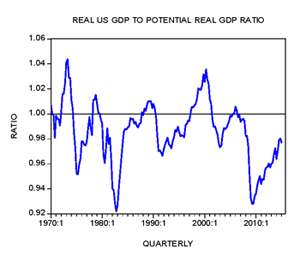
Indeed if one looks at the real gross domestic product to the potential real gross domestic product ratio the economy does appear to be hovering below potential with the ratio of 0.977 registered in Q1 this year.

shostak_june 8 300_1

Contrary to Krugman, we suggest that economists such as Ludwig von Mises and Murray Rothbard have provided a clear answer to the issue of technology and economic growth.

In Man, Economy, and State, Rothbard says that technology, while important, must always work through the investment of capital in order to generate economic growth.

On this issue, Rothbard quotes Mises who says,

What is lacking in (underdeveloped counties) is not knowledge of Western technological methods (“know how”); that is learned easily enough. The service of imparting knowledge, in person or in book form, can be paid for readily. What is lacking is the supply of saved capital needed to put the advanced methods into effect.

Most modern theories that emphasize the importance of new ideas and new technologies give the impression that these ideas and technologies have a “life of their own.” Many experts hold that because of the limited amounts of capital and labor, without technological progress, the opportunities for growth will eventually run out.

We Need Funding To Implement New Ideas

Ideas, unlike material inputs, are not themselves scarce. Consequently, it is argued, new ideas for more efficient processes and new products can make continuous growth possible.

We suggest that regardless of how many ideas people have, what matters is whether these ideas can be implemented. What always limits the implementation of various new techniques is the availability of funding. While ideas and new techniques can result in a better use of scarce resources, they can however, do very little without the pool of real savings.

So regardless of how clever we are and regardless of various technological ideas, without an adequate pool of funding nothing will emerge. It is through the expansion in the pool of real savings that an increase in the stock of capital goods is possible. And it is the increase in the capital goods per worker that permits economic growth to emerge.

To Get More Funding, We Need Savings

Obviously, new ideas and new technology can be introduced during the production of new capital goods (i.e., new technology) and will be imbedded in the capital goods stock. The crux of the matter however, is that capital goods cannot emerge without a prior increase in the pool of funding or pool of real savings.

Take, for instance, a baker John who produced ten loaves of bread. He consumes two loaves of bread whilst the other two loaves — his real savings — he employs to purchase a new part to improve his oven. With a better oven he can now raise the output of bread to twenty loaves. If he still consumes only two loaves, then with a larger savings (now stands at eighteen loaves) he can enhance further his oven by introducing new parts, which will enable the introduction of new technology. Note that all this is made possible on account of real savings.

We suggest that despite new technologies, a major impediment to economic growth has been the relentless central bank tampering with financial markets.

Since 2008 this tampering was made manifest in the extremely loose monetary policy of the Fed that resulted in the massive monetary expansion of the Fed’s balance sheet and the lowering of interest rates to almost nil.

These policies have been responsible for a severe erosion of the pool of real savings and thus a weakening of the process of capital formation. This in turn has undermined real economic growth notwithstanding new information technology.

For Krugman and his followers savings is bad news — it is seen as less demand — hence one shouldn’t be surprised that Krugman is puzzled as to why new ideas haven’t manifested in a more robust economic growth. Contrary to Krugman, boosting so-called aggregate demand whilst undermining the capital formation process, and hence the ability to produce goods and services, cannot strengthen economic growth over time. In fact this way of thinking results in the notion that something can be generated out of nothing.

Frank Shostak is an adjunct scholar of the Mises Institute and a frequent contributor to Mises.org. His consulting firm, Applied Austrian School Economics, provides in-depth assessments and reports of financial markets and global economies.

This article was originally published by the Ludwig von Mises Institute. Permission to reprint in whole or in part is hereby granted, provided full credit is given.

Why Do We Celebrate Rising Home Prices? – Article by Ryan McMaken

Why Do We Celebrate Rising Home Prices? – Article by Ryan McMaken

The New Renaissance Hat
Ryan McMaken
May 26, 2015
******************************

In recent years, home price indices have seemed to proliferate. Case-Shiller, of course, has been around for a long time, but over the past decade, additional measures have been marketed aggressively by Trulia, CoreLogic, and Zillow, just to name a few.

Measuring home prices has taken on an urgency beyond the real estate industry because for many, home price growth has become something of an indicator of the economy as a whole. If home prices are going up, it is assumed, “the economy” must be doing well. Indeed, we are encouraged to relax when home prices are increasing or holding steady, and we’re supposed to become concerned if home prices are going down.

This is a rather odd way of looking at the price of a basic necessity. If the price of food were going upward at the rate of 7 or 8 percent each year (as has been the case with houses in many markets in recent years) would we all be patting ourselves on the back and telling ourselves how wonderful economic conditions are? Or would we be rightly concerned if incomes were not also going up at a similar rate? Would we do the same with shoes and clothing? How about with education?

With housing, though, increases in prices are to be lauded, we are told, even if they outpace wage growth.

We’re Told to Want High Home Prices

But in today’s economy, if home prices are outpacing wage growth, then housing is becoming less affordable. This is grudgingly admitted even by the supporters of ginning up home prices, but the affordability of housing takes a back seat to the insistence that home prices be preserved at all costs.

Behind all of this is the philosophy that even if the home-price/household-income relationship gets out of whack, most problems will nevertheless be solved if we can just get people into a house. Once someone becomes a homeowner, the theory goes, he’ll be sitting on a huge asset that (almost) always goes up in price, meaning that any homeowner will increase in net worth as the equity in his home increases.

Then, the homeowner can use that equity to buy furniture, appliances, and a host of other consumer goods. With all that consumer spending, the economy takes off and we all win. Rising home prices are just a bump in the road, we are told, because if we can just get everyone into a home, the overall benefit to the economy will be immense.

Making Homes Affordable with More Cheap Debt

Not surprisingly, we find a sort of crude Keynesianism behind this philosophy. In this way of thinking, the point of homeownership is not to have shelter, but to acquire something that will encourage more consumer spending. In other words, the purpose of homeownership is to increase aggregate demand. The fact that you can live in the house is just a fringe benefit. This macro-obsession is part of the reason why the government has pushed homeownership so aggressively in recent decades.

The fly in the ointment, of course, is if home prices keep going up faster than wages — ceteris paribus — fewer people will be able to save enough money to come up with either the full amount or even a sizable down payment on a loan.

Not to worry, the experts tell us. We’ll just make it easier, with the help of inflationary fiat money, to get an enormous loan that will allow you to buy a house. Thus, rock-bottom interest rates and low down payments have been the name of the game since the late 1980s.

We started to see the end game at work during the last housing bubble when Fannie Mae introduced the 40-year mortgage in 2005, which just emphasized that when it comes to being a homeowner, the idea is not to pay off the mortgage, but to “buy” a house and just pay the monthly payment until one moves to another house and gets a new thirty- or forty-year loan.

It Pays To Be in Debt

On the surface of it, it’s hard to see how this scenario is fundamentally different from just paying rent every month. If the homeowner stops paying the monthly payment, he’s out on the street, and the bank keeps the house, which is very similar to the scenario in which a renter stops paying a landlord. There’s (at least) one big difference here, however. It makes sense for the homeowner to get a home loan rather than rent an apartment because — if it’s a fixed-rate loan — price inflation ensures the real monthly payment will go down every month. Residential rents, on the other hand, tend to keep up with inflation.

But why would any lending institution make these sorts of long-term loans if the payment in real terms keeps getting smaller? After all, thirty years is a long time for something to go wrong.

Lenders are willing and able to do this because the loans are subsidized and underwritten through government creations like Fannie Mae (which buys up these loans on the secondary market), through bailouts, and through a myriad of other federal programs such as FHA. Naturally, in an unhampered market, a loan of such a long term would require high interest rates to cover the risk. But, Congress and the Fed have come to the rescue with promises of bailouts and easy money, meaning cheap thirty-year loans continue to live on.

So, what we end up with is a complex system of subsidies and favoritism on the part of lenders, homeowners, government agencies, and the Fed. The price of homes keeps going up, increasing the net worth of homeowners, and banks can make long-term loans on fairly risky terms because they know bailouts of various sorts will come if things go wrong.

But problems begin to arise when increases in home prices begin to outpace access to easy money and cheap loans. Indeed, we’re now seeing that homeownership rates are going down in spite of low interest rates, and vacancy rates in rental housing are at a twenty-year low. Meanwhile, new production in housing units is at 1992 levels, offering little relief from rising prices and rents. Obviously, something isn’t going according to plan.

Who Loses?

The old debt-based tricks that once kept homeownership climbing and accessible in the face of rising home prices are no longer working.

From a free market’s perspective, renting a home is neither good nor bad, but American policymakers long ago decided to favor homeowners over renters. Consequently, we’re faced with an economic system that pushes renters toward homeownership — price inflation and the tax code punishes renters more than owners — while simultaneously pushing home prices higher and higher.

During the last housing bubble, however, as homeownership levels climbed, few noticed or cared about this. So many renters became homeowners that rental vacancies climbed to record highs from 2004 to 2009. But in our current economy, one cannot avoid rising rents or hedge against inflation by easily leaving rental housing behind.

This time around, the cost of purchasing housing is going up by 6 to 10 percent per year, but few renters can join the ranks of the homeowners to enjoy the windfall. Instead, they just face record-high rent increases and a record-low inventory in for-sale houses.

There once was a time when rising home prices and rising homeownership rates could happen at the same time; it was possible for the government to stick to its unofficial policy of propping up home prices while also claiming to be pushing homeownership. We no longer live in such a time.

Ryan W. McMaken is the editor of Mises Daily and The Free Market. He has degrees in economics and political science from the University of Colorado, and was the economist for the Colorado Division of Housing from 2009 to 2014. He is the author of Commie Cowboys: The Bourgeoisie and the Nation-State in the Western Genre. 

This article was published on Mises.org and may be freely distributed, subject to a Creative Commons Attribution United States License, which requires that credit be given to the author.

Will the Fed Let Innovation Work Its Magic? – Article by Edin Mujagic

Will the Fed Let Innovation Work Its Magic? – Article by Edin Mujagic

The New Renaissance Hat
Edin Mujagic
April 21, 2015

******************************

Sometimes one finds true gems in one’s archives. Recently I came across a speech by then-chairman of the Fed, Ben Bernanke, from May 18, 2013. It was the commencement speech at Bard College at Simon´s Rock, in Great Barrington, Massachusetts. In it, Bernanke chose to forget for a while the dire straits the Western economy is in and focused on prospects for economic growth in the long run, which he defined as “measured in decades, not months or quarters.”

In short, Bernanke focused on scientific and technological progress, more commonly described as innovation. He envisaged a fourth wave of innovation — the first three being the early industrial era (mid-1700s until mid-1800s), the modern industrial era (from 1880 onwards), and the IT-revolution.

His commencement speech was a speech of hope and of encouragement. But Bernanke did not tell the whole story. The then-Fed chairman failed to mention that living standards will depend on more than innovation. At least as important is the role of the very institution he chaired, the Federal Reserve, and what it does or does not do. If it allows high inflation to take hold — either through action or inaction — that would annihilate a very substantial part of the increase in living standards due to innovation.

And yet, recent history strongly suggests that the Fed will end up destroying a large part of the increase in living standards of those graduates Bernanke was speaking to. For example, at the beginning of 2013 Bernanke spoke at another American college. During the Q&A session, he said that “the worst mistake the Fed can make is to tighten monetary policy too soon.” In other words, the then-chairman essentially promised to raise interest rates too late. Nowadays, Bernanke may be gone from the Fed, but his line of thinking on monetary policy certainly has not, and indeed, this line of thinking reflects dominant Fed policy well beyond the Bernanke years.

Innovation and Living Standards

Bernanke, like Greenspan before him, is counting on innovation to keep the economy moving. As well he should. Technological innovation often leads to more efficient production and greater worker productivity which leads to higher wages and more affordable goods.

But if Bernanke is going to tell students that technology will make their lives better, he should also mention the role that he himself and other central bankers play in stifling the positive effects of innovation.

We can see multiple examples of this phenomenon in recent decades. For example, if we consider the effect that China’s entrance into the global economy should have had on living standards in the US, we find the actual results to be somewhat underwhelming. We should have witnessed growth in living standards similar to what we witnessed toward the end of the nineteenth century as the US industrialized. But in fact, the record of growth in real wealth in the US has been disappointing at best.

For example, technological progress due to the Industrial Revolution and globalization in the late nineteenth century led to continuous deflation in the US, and hence unprecedented increases in welfare. Research by Michael Bordo at Rutgers, shows that on average, prices fell by 1.2 percent each year between 1870 and 1896. Real living standards increased substantially over the same time period. Labor market economists in the United States have been able to reconstruct wage development in the United States since 1830. In every decade the real wage was higher than the preceding decade. That is, until the 1970s.

In contrast, in the decades since the early 1980s, as Asia was joining the world with its own industrial revolution, each year prices increased in the US by more than 2 percent. According to the statistics available from US Census, real median household income in the United States (i.e., income adjusted for inflation) barely moved between 1980 and 2012. This is odd, given the fact that economic growth averaged some 3 percent per annum and labor productivity soared by some 50 percent in total. A working American male earned approximately $48,000 in 1969. Adjusted for inflation, his income had barely grown by the time the current economic crisis started.

The main difference between the two periods is that in 1800s there was no Federal Reserve, and the money supply, while certainly not completely non-inflationary, was restrained by the absence of a central bank.

Lost Opportunities

In an unhampered market, technological progress, innovation, and globalization in the decades before the current crisis should have led to three things: slower wage growth, larger profits, and lower prices. In other words, what firms like Apple accomplished (i.e., the creation of innovative, labor-saving products made available at ever-lower prices) on a micro scale, should have happened on the macro-level as well. Slower wage growth would have been inevitable because of increased global competition in the labor market and the constant and increasing threat of jobs being offshored. Larger profits would have occurred economy-wide because of this fact, and the fact that production costs fell. And finally, lower prices would have spread throughout the economy because, due to technological progress, globalization, falling wages, and falling transportation costs.

The first two effects manifested themselves. As mentioned, real income barely budged in the last few decades in the United States. This becomes evident when we take a look at the total employee compensation in the United States. Measured as a share of GDP, US wages in recent years have been lower than during any other period since World War II. At the end of the war, the ratio was 53.6 percent. Nowadays, we find it below 45 percent.

Moreover, as a rule of thumb, the lower the share of wages in any country’s GDP, the higher the share of profits. So we find the second effect evident as well: profits increased.The third effect, however, falling prices, has been largely prevented by the intervention of the central bank. In fact, the Fed aimed for, and continues to aim for some 2 percent inflation per annum. The Fed has been very successful in preventing prices from falling even when the downward pressure on prices was strong, due to the aforementioned combination of technological progress, innovation, globalization, and free trade.

In more than a century before the inception of the Fed in 1913, cumulative inflation in the United States was approximately 0 percent. Between January 1, 1914 and July 2013, cumulative inflation in the United States stood at 2,236 percent, prompting Milton Friedman to write — way back in 1988 —that “no major institution in the US has so poor a record of performance over so long a period, yet so high a public reputation.”

A logical consequence of any “fourth wave” of innovation should be deflation, or falling prices. Then and only then will the living standards of those graduates who were listening to Bernanke indeed increase strongly. It will not happen as long as the Fed continues to aim for inflation every year and certainly not if the Fed continues to follow its current policy that will, according to many, cause even higher inflation in years to come.

Edin Mujagic has a Master’s degree in macro and monetary economics from Tilburg University (The Netherlands) and is an independent macro-economist and author of Money Murder: How the Central Banks Are Destroying Our Money (published in Dutch, as Geldmoord). He is the youngest-ever member of the Monetaire Kring (Monetary Circle) in the Netherlands, a by-invitation-only policy forum of university professors and senior officials at the central bank, ministry of Finance, banks, pension funds and other financial institutions.

This article was published on Mises.org and may be freely distributed, subject to a Creative Commons Attribution United States License, which requires that credit be given to the author.

A Portrait of the Classical Gold Standard – Article by Marcia Christoff-Kurapovna

A Portrait of the Classical Gold Standard – Article by Marcia Christoff-Kurapovna

The New Renaissance Hat
Marcia Christoff-Kurapovna
April 15, 2015
******************************

“The world that disappeared in 1914 appeared, in retrospect, something like our picture of Paradise,” wrote the economist Cecil Hirsch in his June 1934 review of R.W. Hawtrey’s classic, The Art of Central Banking (1933). Hirsch bemoaned the loss of the far-sighted restraint that had once prevailed among the “bankers’ banks” of the West, concluding that modern times “had failed to attain the standard of wisdom and foresight that prevailed in the 19th century.”That wisdom and foresight was once upon a time institutionalized throughout an international monetary culture — gold-based, wary of credit, and contemptuous of debt, public or private. This world included central banks including the Bank of England, the Bank of France, the Swiss National Bank, the early Federal Reserve, the Imperial Bank of Austria-Hungary, and the German Reichsbank. But the entrenched hard-money ideology of the time restrained all of them. The Bank of Russia, for example, which once required 50 percent to 100 percent gold backing of all notes issued, possessed the second largest gold reserves on the planet at the turn of the twentieth century.

“The countries that were tied together in the gold standard system represented to a not inconsiderable degree a community of interest in and responsibility for the maintenance of economic and financial stability throughout the world,” recounted Aldoph C. Miller, member of the Federal Reserve Board from 1914 to 1936, in The Proceedings of the Academy of Political Science, in May 1936. “The gold standard was the one outstanding symbol of unity and economic solidarity which the nineteenth century world had developed.”

It was a time when “automatic market forces,” as economists of the day referred to them, prevailed over monetary management. Redeemability of money in (fine) gold ensured, within limits, stability in foreign exchange rates. Credit was extended only as far as reserve ratios would allow, and central banks were required to keep fixed reserves of gold against notes-in-circulation and against demand deposits.

When Markets Dominated Monetary “Policy”

Gold flows regulated international price relationships through markets, which adjusted themselves accordingly: prices rose when there was an influx of gold — for example, when one country received a debt payment from another country (always in gold), or during such times as the California or Australian gold rushes of the 1870s. These inflows meant credit expansion and a rise in prices. An outflow of gold meant credit was contracted and price deflation followed.

The efficiency of that standard was not impeded by the major central banks in such a way that “any disturbance of economic or financial character originating at any point in the world which might threaten the continued maintenance of economic equilibrium was quickly detected by foreign exchanges,” Miller, the Federal Reserve board member, noted in his paper. “In this way, the gold standard system became in a very real sense a regime or rule of economic health, a method of catching economic disturbances in the bud.”

The Bank of England, the grand master of them all, was the financial center of the universe, whose tight handle on its credit policies was so disciplined that the secured the top spot while not even holding the largest gold reserves. Consistent in its belief that protection of reserves was the chief, and only important, criterion of credit policy, England became the leading exporter of capital, the free market for gold, the international discount market, and international banker for the trade of other countries, as well as her own. The world was in this sense on the sterling standard.

The Bank of France, wisely admonished by its founder, Napoleon, to make sure France was always a creditor country, was so replete with reserves it made England a 500 million franc loan (in 1915 numbers) at the onset of the World War I. Switzerland, perhaps the last “19th-century-style” hold-out today with unlimited-liability private bankers and strict debt-ceiling legislation, also required high standards of its National Bank, founded in 1907. By the 1930s that country had higher banking reserves than the US; the Swiss franc was never explicitly devalued, unlike nearly every other Western nation’s currency, and the country’s domestic price level remained the most stable in the world.

For a time, the disciplined mindset of these banks found its way across the Atlantic, where the idea of a central bank had been long the subject of hot debate in the US. The economist H. Parker Willis, writing about the controversy in The Journal of the Proceedings of the Academy of Political Science, October 1913, admonished: “The Federal Reserve banks are to be ‘bankers’ banks,’ and they are intended to do for the banker what he himself does for the public.”

At first, the advice was heeded: in September 1916, almost two years after its founding on December 23,1913, the fledgling Fed worked out an amendment to its gold policy on the basis of a very conservative view of credit. This new policy sought to restrain “the undue and unnecessary expansion of credit,” wrote Fed board member Miller, in an article for The American Economic Review, in June 1921.

The Bank of Russia, during the second half of the nineteenth century steered itself through the Crimean War, the Russo-Turkish War, the Russo-Japanese War, impending Balkan wars — not to mention all that was to follow — and managed to emerge with sound fiscal policies and massive gold reserves. According to The Economist of May 20, 1899, Russian holdings were 95 million pounds sterling of gold, while the Bank of France held 78 million sterling worth. (Austria-Hungary held 30 million sterling worth of gold and the Bank of England 30 million sterling worth of both gold and silver.) “Russia up to the very moment of rupture [with Japan, 1904–1905], was working imperturbably at the progressive consolidation of her finances,” reported Karl Helfferich of the University of Berlin, at a meeting of The Royal Economic Society [UK] in December 1904. “Even in years of industrial crises and defective harvest, her foreign trade showed an excess of exports over imports more than sufficient to compensate payments sent abroad. And, as guarantee her monetary system she has succeeded in a amassing and maintaining a vast reserve of gold.”

These banks, in turn, drew on the medieval/Renaissance and Baroque-era banking traditions of the Hanseatic League, the Bank of Venice, and Amsterdam banks. Payment-on-demand “in good and heavy gold” was like a blood-oath binding the banker-client relationship. The transfer of credit “did not arise from any such substitution of credit for money,” noted Charles F. Dunbar, in The Quarterly Journal of Economics of April 1892, “but from the simple fact that the transfer in-bank saved the necessity of counting coin and manual delivery of every transaction.”

Bankers were forbidden to deal in certain commodities, could not make loans or create credit for the purchase of such commodities, and forbade both foreigners and citizens from buying silver on credit unless the same amount in cash was in the bank. According to Dunbar, a Venetian law of 1403 on reserve requirements became the basis of US banking law on the deposits of public securities in the late 1800s.

After the fall of bi-metallism in the 1870s, gold continued to perform monetary functions among the main countries of the Western world (and the well-administered Bank of Japan). It was the only medium of exchange and the only currency with unrestricted legal tender. It became the vaunted “measure of value.” Bank currency notes were simply used as auxiliary to gold and, in general, did not enjoy the privilege of legal tender.

The End of An Era

It was certainly not a flawless system, or without periodic crises. But central banks had to act in an exceptionally prudent manner given the all-over public distrust of paper money.

As economist Andrew Jay Frame of the University of Chicago, writing in The Journal of Political Economy, in January 1912, noted: “During panics in Britain in 1847 and 1866, when cash payments were suspended, the floodgates of cash were opened [by The Bank of England], the governor sent word to the street that solvent banks would be accommodated, and the panic was relieved.” Frame then adds: “However, this extra cash and the increased loans that went with it were very quickly put to an end to avoid credit expansion.”

The US was equally confident of its prudent attitude. Aldoph Miller, writing of Federal Reserve policy, remarked: “The three chief elements of the policy of a central bank or system of reserve holding institutions are best disclosed in connection with the attitude towards 1) gold 2) currency 3) credit.” He noted proudly: “The federal reserve system has met [these] tests on the whole with remarkable success.”

But after World War I, a different international landscape was left behind. England had been displaced as the center of international finance; the US and France emerged as the chief post-war creditor countries. The mechanism of the gold standard to which depreciated currencies could be related no longer existed. Only the US was left with a full gold standard. England and France had a gold bullion standard and other countries (Germany, primarily) had a gold-exchange standard.

A matrix of unbalanced trade relationships began to saturate the international economy. Then, with so many foreign countries attendant upon its speculative boom, the US manipulated its own domestic credit policies to ease credit and exchange-standard controls. This eventually culminated in an international financial crisis of 1931. Under Bretton Woods (1944), the gold standard was effectively abandoned: domestic convertibility was illegal and the role of gold was very constrained in favor of the dollar.

“It was, at least in theory, simple enough in the old days,” wrote a wistful W. Randolph Burgess, head of the New York Federal Reserve, in 1938. “In the present strange new world, where the old gold portents have lost their former meaning, where is the radio beam which the central banker may follow? What is the equivalent of gold?”

The men of his era and of the late nineteenth century understood the meaning of such a question and, more importantly, why it is one that must be asked. But theirs was a different world, indeed — one without “QE,” ZIRP,” or “Unknown Knowns” as fiscal policy. And there were no helicopters, either.

Marcia Christoff-Kurapovna is at work on the biography of a prominent European head of state and businessman.  Her work has appeared in such publications as The Wall Street Journal, The Economist and Foreign Affairs.

This article was originally published by the Ludwig von Mises Institute. Permission to reprint in whole or in part is hereby granted, provided full credit is given.