Browsed by
Tag: money

The End of Quantitative Easing Is Not the End of Bad Policy – Article by John P. Cochran

The End of Quantitative Easing Is Not the End of Bad Policy – Article by John P. Cochran

The New Renaissance Hat
John P. Cochran
November 7, 2014
******************************

Recently the financial press and media has been abuzz as the Federal Reserve moved closer to the anticipated end to its massive bond and mortgage backed securities purchases known as quantitative easing. James Bullard, President of the St. Louis Federal Reserve Bank, stirred controversy last week when he suggested the Fed should consider continuing the bond buying program after October. But at the October 29th meeting, the policy makers did as anticipated and “agreed to end its asset purchase program.” However one voting member agreed with Mr. Bullard. Per the official press release, “Voting against the action was Narayana Kocherlakota, who believed that, in light of continued sluggishness in the inflation outlook and the recent slide in market-based measures of longer-term inflation expectations, the Committee should commit to keeping the current target range for the federal funds rate at least until the one-to-two-year ahead inflation outlook has returned to 2 percent and should continue the asset purchase program at its current level” (emphasis added).

The action yesterday completes the phase out, which began in January 2014, of the controversial QE3 under the leadership of Ben Bernanke and continued unabated under Janet Yellen.

“Not the End of Monetary Easing”

While the headline in the Wall Street Journal highlighted the action as closing a “chapter on easy money,” a closer look illustrates this is perhaps not the case. The Journal, on the editorial page the same day offers a better perspective, supported by data and the rhetoric in the press release. Much to the determent of future economic prosperity, “The end of Fed bond buying is not the end of monetary easing.”

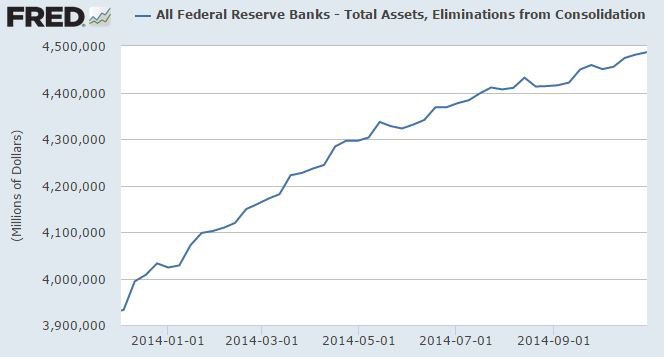
While quantitative easing has contributed to the massive expansion of the Fed balance sheet — now nearly $4.5 trillion in assets — it is not the whole story. Even as the Fed ends new buying of favored assets, the Fed balance sheet will not shrink. As pointed out by the Wall Street Journal, “QE is not over, and the Fed will still reinvest the principal payments from its maturing securities.” Even more relevant, during the phase out there was a continuing expansion of three broad measures of Fed activity; St. Louis Fed adjusted reserves (Figure 1), the monetary base (Figure 2), and Federal Reserve Banks — Total Assets, Eliminations from Consolidation program (Figure 3). (All data from FRED economic data series St. Louis Federal Reserve. Calculations are mine.)

Figure 1: St. Louis Fed Adjusted Reserves
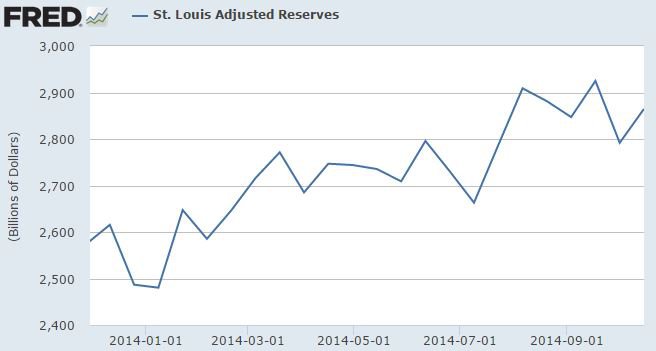
Figure 2: The Monetary Base
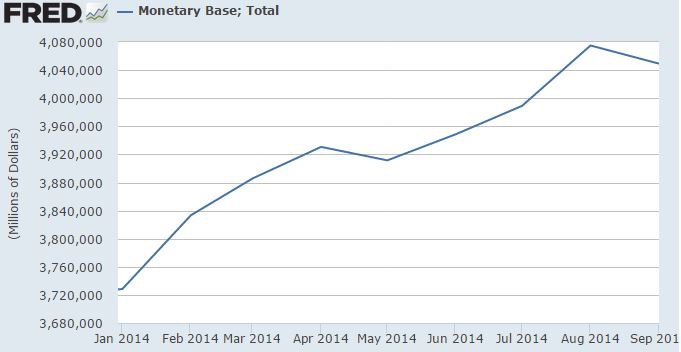
Figure 3: Federal Reserve Banks — Total Assets, Eliminations from Consolidation
The Fed’s Balance Sheet Continues to Expand

Despite some ups and downs, adjusted reserves increased 15.8 percent from January 2014 through September 2014, the monetary base by 8.6 percent, and consolidated assets by 10.7 percent. Given QE purchases were $85 billion per month at their peak, this continuing expansion of the Fed balance sheet and the other relevant monetary aggregates, the phase out and end of quantitative easing represents not a change in policy stance, but only a shift in tools. Monetary distortion has continued unabated. The only plus in the change is that more traditional tools of monetary manipulation create only the traditional market distortions; Cantillon effects, false relative prices, particularly interest rates, and the associated misdirection of production and malinvestments. Temporarily gone is the more dangerous Mondustrial Policy where the central bankers further distort credit allocation by picking winners and losers.

As illustrated by the Fed speak in the press release, post QE3-forward policy will, despite John Taylor’s optimism that this would not be the case, continued to be biased against a return to a more balanced, less potentially self-defeating rules-based policy. Instead driven by the Fed’s unwise dual mandate and the strong belief by Fed leadership in Tobin Keynesianism, policy will continue to “foster maximum employment.” This despite strong theoretical arguments (Austrian business cycle theory and the more mainstream natural unemployment rate hypothesis)[1] and good empirical evidence that any short-run positive impact monetary policy may have on employment and production is temporary and in the long run, per Hayek, cause greater instability and potentially even higher unemployment.

The Lasting Legacy of QE

As pointed out by David Howden in “QE’s Seeds Are Already Sown,” and as emphasized by Hayek (in Unemployment and Monetary Policy: Government as Generator of the “Business Cycle”), and recently formalized by Ravier (in “Rethinking Capital-Based Macroeconomics”), the seeds of easy money and credit creation, even when sown during times with unused capacity, bring forth the weeds of instability, malinvestment, bust, and economic displacement. They do not bring the promised return to prosperity, sustainable growth, and high employment.

Since the phase-out is only apparent, and not a real change in policy direction, Joe Salerno’s warning (“A Reformulation of Austrian Business Cycle Theory in Light of the Financial Crisis,” p. 41) remains relevant:

(G)iven the unprecedented monetary interventions by the Fed and the enormous deficits run by the Obama admin­istration, ABCT also explains the precarious nature of the current recovery and the growing probability that the U.S economy is headed for a 1970s-style stagflation.

While highly unlikely there is still time to do the right thing, follow the policy advice of Rothbard and the Austrians, as argued earlier in more detail here and here. Despite some short run costs which are likely small compared to the cost of a decade of stagnation, such a policy is the only reliable route to return the economy to sustainable prosperity.

John P. Cochran is emeritus dean of the Business School and emeritus professor of economics at Metropolitan State University of Denver and coauthor with Fred R. Glahe of The Hayek-Keynes Debate: Lessons for Current Business Cycle Research. He is also a senior scholar for the Mises Institute and serves on the editorial board of the Quarterly Journal of Austrian Economics. Send him mail. See John P. Cochran’s article archives.

This article was published on Mises.org and may be freely distributed, subject to a Creative Commons Attribution United States License, which requires that credit be given to the author.

Inflation’s Not the Only Way Easy Money Destroys Wealth – Article by Frank Shostak

Inflation’s Not the Only Way Easy Money Destroys Wealth – Article by Frank Shostak

The New Renaissance Hat
Frank Shostak
October 14, 2014
******************************

The US Federal Reserve can keep stimulating the US economy because inflation is posing little threat, Federal Reserve Bank of Minneapolis President Kocherlakota said. “I am expecting an inflation rate to run below two percent for the next four years, through 2018,” he said. “That means there is more room for monetary policy to be helpful in terms of … boosting demand without running up against generating too much inflation.”

The yearly rate of growth of the official consumer price index (CPI) stood at 1.7 percent in August against two percent in July. According to our estimate, the yearly rate of growth of the CPI could close at 1.4 percent by December. By December next year we forecast the yearly rate of growth of 0.6 percent.

Does Demand Create More Supply?

It seems that the Minneapolis Fed President holds that by boosting the demand for goods and services — by means of additional monetary pumping — it is possible to strengthen economic growth. He believes that by means of strengthening the demand for goods and services the production of goods and services will follow suit. But why should that be so?

If by means of monetary pumping one could strengthen the economic growth then it would imply that — by means of monetary pumping — it is possible to create real wealth and generate an everlasting economic prosperity.

This would also mean that world wide poverty should have been erased a long time ago. After all, most countries today have central banks that possess the skills to create money in large amounts. Yet world poverty remains intact.

Despite massive monetary pumping since 2008, and the policy interest rate of around zero, Fed policymakers seem to be unhappy with the so-called economic recovery. Note that the Fed’s balance sheet, which stood at $0.86 trillion in January 2007 jumped to $4.4 trillion by September this year.

Production Comes Before Demand

We suggest that there is no such thing as an independent category called demand. Before an individual can exercise demand for goods and services, he/she must produce some other useful goods and services. Once these goods and services are produced, individuals can exercise their demand for the goods they desire. This is achieved by exchanging things that were produced for money, which in turn can be exchanged for goods that are desired. Note that money serves here as the medium of exchange — it produces absolutely nothing. It permits the exchange of something for something. Any policy that results in monetary pumping leads to an exchange of nothing for something. This amounts to a weakening of the pool of real wealth — and hence to reduced prospects for the expansion of this pool.

What is required to boost the economic growth — the production of real wealth — is to remove all the factors that undermine the wealth generation process. One of the major negative factors that undermine the real wealth generation is loose monetary policy of the central bank, which boosts demand without the prior production of wealth. (Once the loopholes for the money creation out of “thin air” are closed off the diversion of wealth from wealth generators towards non-productive bubble activities is arrested. This leaves more real funding in the hands of wealth generators — permitting them to strengthen the process of wealth generation (i.e., permitting them to grow the economy).

Artificially Boosted Demand Destroys Wealth

Now, the artificial boosting of the demand by means of monetary pumping leads to the depletion of the pool of real wealth. It amounts to adding more individuals that take from the pool of real wealth without adding anything in return — an economic impoverishment.

The longer the reckless loose policy of the Fed stays in force the harder it gets for wealth generators to generate real wealth and prevent the pool of real wealth from shrinking.

Finally, the fact that the yearly rate of growth of the CPI is declining doesn’t mean that the Fed’s monetary pumping is going to be harmless. Regardless of price inflation monetary pumping results in an exchange of nothing for something and thus, impoverishment.

Frank Shostak is an adjunct scholar of the Mises Institute and a frequent contributor to Mises.org. His consulting firm, Applied Austrian School Economics, provides in-depth assessments and reports of financial markets and global economies. See Frank Shostak’s article archives.

This article was published on Mises.org and may be freely distributed, subject to a Creative Commons Attribution United States License, which requires that credit be given to the author.

The Japanese Deflation Myth and the Yen’s Slump – Article by Brendan Brown

The Japanese Deflation Myth and the Yen’s Slump – Article by Brendan Brown

The New Renaissance Hat
Brendan Brown
October 4, 2014
******************************

The slide of the yen since late summer has brought it to a level some 40 percent lower against the euro and US dollar than just two years go. Yet still Japan’s Prime Minister Shinzo Abe and his central bank chief Haruhiko Kuroda warn that they have not won the battle against deflation. That caution is absurd — all the more so in view of the fact that there was no deflation in the first place.

Some cynics suggest that Abe’s and Haruhiko’s battle cry against this phoney phantom is simply a ruse to gain Washington’s acquiescence in a big devaluation. But whatever the truth about their real intent, Japan’s monetary chaos is deepening.

Japanese Prices Have Been Stable

The CPI in Japan at the peak of the last cycle in 2007 was virtually at the same level as at the trough of the post-bubble recession in 1992, and up a few percentage points from the 1989 cycle peak. Hence, Japan alone has enjoyed the sort of price stability as might be enjoyed in a gold-standard world. Prices have fallen during recessions or during periods of especially-rapid terms-of-trade improvement or productivity growth. They have risen during cyclical booms or at times of big increases in the price of oil.

If price-indices in Japan were adjusted fully to take account of quality improvements they would have been falling slightly throughout, but that would also have been the case under the gold standard and was fully consistent with economic prosperity.

yenslumpSuch swings in prices are wholly benign. For example, lower prices during recession coupled with expectation of higher prices in expansion induce businesses and households to spend more. A valid criticism of the Japanese price experience of the past two decades has been that these swings have lacked vigour due to various rigidities. Particularly valid is the claim that price falls should have been larger during the post-bubble recession of 1990-93 and subsequent potential for recovery would have been correspondingly larger.

Prices in Japan did fall steeply during the Great Recession (2008-10) but the perceived potential for recovery was squeezed by the Obama Monetary Experiment (the Fed’s QE) which meant an immediate slide of the US dollar. It was in response to the related spike of the yen that Prime Minister Abe prepared his counter-stroke. This involved importing the same deflation-phobic inflation-targeting policies that the Obama Federal Reserve was pursuing. Washington could hardly criticize Tokyo for imitating its own monetary experiment.

Deflation and “The Lost Decade”

The architects of the Obama Monetary Experiment have cited as justification Japan’s “lost decade” and the supposed source in deflation. In fact, though, the only period during which the Japanese economy underperformed other advanced economies (as measured by the growth of GDP per capita) was from 1992-97. The underperformance of that period had everything to do with insufficient price and wage flexibility downward, the Clinton currency war, and the vast malinvestment wrought by the prior asset price inflation, coupled with a risk-appetite in Japan shrunken by the recent experience of bust.

Moreover, as time went on, from the early 1990s, huge investment into the Tokyo equity market from abroad compensated for ailing domestic risk appetites. Yes, Japan’s economy could have performed better than the average of its OECD peers if progress had been made in de-regulation, and if Japan had had a better-designed framework of monetary stability to insulate itself from the Greenspan-Bernanke asset price inflation virus of the years 2002-07. (The Greenspan-Bernanke inflation caused speculative temperatures in the yen carry trade to reach crazy heights.) But deflation was never an actual or potential restraint on Japanese prosperity during those years.

True, there was a monetary malaise. Japan’s price stability was based on chance, habit, and economic sclerosis rather than the wisdom of its monetary policy. It had been the huge appreciation of the yen during the Clinton currency war that had snuffed out inflation. Then the surge of cheap imports from China had worked to convince the Japanese public that inflation had indeed come to an end. Lack of economic reform meant that the neutral rates of interest remained at a very low level and so the Bank of Japan’s intermittent zero rate policies did not stimulate monetary growth.

The monetary system in Japan had no secure pivot in the form of high and stable demand for non-interest bearing high-powered money. In Japan the reserve component of the monetary base is virtually indistinguishable from a whole range of close substitutes and banks had no reason to hold large amounts of this (given deposit insurance and the virtual assurance of too-big-to-fail help in need). Monetary policy-making in Japan meant highly discretionary manipulation of short-term interest rates in the pursuance of fine-tuning the business cycle rather than following a set of rules for monetary base expansion.

The Yen After Abenomics

When Prime Minister Abe effected his coup against the old guard at the Bank of Japan there was no monetary constitution to flout. Massive purchases of long-dated Japanese government bonds by the Bank of Japan are lowering the proportion of outstanding government debt held by the public in fixed-rate form. But this is all a slow-developing threat given a gross government debt to GDP ratio of around 230 percent and a current fiscal deficit of 6 percent of GDP. Bank of Japan bond-buying has strengthened irrational forces driving 10-year yields down to almost 0.5 percent despite underlying inflation having risen to 1 percent per annum.

It is doubtless the possibility of an eventual monetization of government debt has been one factor in the slump of the yen. More generally, as the neutral level of interest rates in Japan rises in line with demographic pressures (lower private savings, increased social expenditure) one might fear that BoJ manipulation of rates will eventually set off inflation. Part of the yen’s slump, though, is due to a tendency for that currency to fall when asset price inflation is virulent in the global economy. This stems from the huge carry trade in the yen.

The yen could indeed leap when the global asset price-inflation disease — with its origins in Fed QE — moves to its next phase of steep speculative temperature fall. The yen is now in real effective exchange rate terms at the record low point of the Japan banking crisis in 1997 or the global asset inflation peak of 2007. So, the challenge for investors is to decide when the Abe yen has become so cheap in real terms that its hedge properties make it a worthwhile portfolio component.

Brendan Brown is an associated scholar of the Mises Institute and is author of Euro Crash: How Asset Price Inflation Destroys the Wealth of Nations and The Global Curse of the Federal Reserve: Manifesto for a Second Monetarist Revolution. See Brendan Brown’s article archives.

This article was published on Mises.org and may be freely distributed, subject to a Creative Commons Attribution United States License, which requires that credit be given to the author.

The Great Fact: A Review of Deirdre McCloskey’s “Bourgeois Dignity” – Article by Bradley Doucet

The Great Fact: A Review of Deirdre McCloskey’s “Bourgeois Dignity” – Article by Bradley Doucet

The New Renaissance Hat
Bradley Doucet
September 20, 2014
******************************
We live in astonishing times. We take it for granted, of course, which is good in a way because, well, we have to get on with the business of living and can’t spend every waking moment going, “Oh my God! This is amazing!” But it’s a good idea to stop and take stock from time to time in order to appreciate just how far we’ve come in the past 200 years or so—to show gratitude for just how much richer the average person is today thanks to the Industrial Revolution.
***

“In 1800, the average human consumed and expected her children and grandchildren and great-grandchildren to go on consuming a mere $3 a day, give or take a dollar or two,” writes economist and historian Deirdre McCloskey in her excellent 2010 book, Bourgeois Dignity: Why Economics Can’t Explain the Modern World. That’s in modern-day, US prices, corrected for cost of living. Apart from a comparatively few wealthier lords, bishops, and the odd rich merchant, people were dirt poor, barely subsisting, unable to afford luxuries like elementary education for their kids—who had a 50% chance at birth of not making it past the age of 30. That’s the way it was, the way it had always been, and as far as anyone could tell, the way it always would be.

More Than 16 Times Richer

But thankfully, things turned out a little differently. There are seven times as many of us on the planet today, but we’re many times richer on average, despite pockets of enduring dire poverty here and there. According to McCloskey, “Real income per head nowadays exceeds that around 1700 or 1800 in, say, Britain and in other countries that have experienced modern economic growth by such a large factor as sixteen, at least.” And this is a very conservative estimate of material improvement, not taking into account such novelties as jet travel, penicillin, and smartphones.

This radical, positive change brought about by the Industrial Revolution is the “Great Fact” about the modern world. “No competent economist, regardless of her politics, denies the Great Fact,” writes McCloskey. But it does require explanation, and here there are many theories. What caused it? Why did it happen where and when it happened—starting in northern Europe around 1800—instead of in some other place, at some other time? And although modern economic growth has at least begun to reach most of the world, including now China and India, if we had a better understanding of its causes, perhaps we could do a better job of encouraging it to spread to the relatively few remaining holdouts.

What changed, argues McCloskey, is the way people thought about markets and innovation and the people who were engaged in the business of making new things and buying and selling them. “More or less suddenly the Dutch and British and then the Americans and the French began talking about the middle class, high or low—the “bourgeoisie”—as though it were dignified and free. The result was modern economic growth.” In other words, the material, economic fact has a non-material, rhetorical cause, which is why economics can’t explain the modern world. Our ideas changed, and we started innovating like never before, and an explosion of innovation drove the rapid economic growth of the past 200 years.

What Didn’t Cause the Industrial Revolution

Bourgeois Dignity is the second book of a trilogy. The first book, The Bourgeois Virtues (2006), which I have not read but now plan to, argued for the positive ethical status of a bourgeois life. The third book, Bourgeois Equality, due out in 2015, will present the positive case for the claim that it is a change in ideas and rhetoric that made the modern world—and that ideas and rhetoric could unmake it, too. As for this second book in the series, it presents the negative case by examining the materialist explanations for the Great Fact offered up by economists and historians from both the left and the right, and finding them all to be lacking.

Imperialism, for instance, did not bring about the modern world. The average European did not become spectacularly wealthy by historical standards simply by taking Africa’s and America’s wealth. Imperialism did happen, and it did make a few people rich and hurt a lot of people, especially in places like the Belgian Congo. But it did not raise the standard of living of average Europeans, who would have been better off if their leaders had allowed trade to flourish instead of supporting the subjugation of people in foreign lands. Besides which, empires had existed in other times and places without bringing about an Industrial Revolution. A unique effect cannot be the result of a routine cause. And it cannot either simply be the case that wealth was moved from one place to another, because there is much more wealth per person today than ever before, despite there being many more of us around.

International trade did not do it either, according to McCloskey. Trade is a good thing, as imperialism is a bad thing, but its effects are relatively small. And extensive trade, too, existed long before the 1800s, in places other than Europe and the United States, without launching the rapid material betterment of all. And for similar reasons, it wasn’t the case that people began saving more, or finally accumulated enough, or got greedier all of a sudden, or discovered a Protestant work ethic, or finally built extensive transportation infrastructure, or formed unions, or suddenly started respecting private property, or any of dozens of other explanations presented by economists and historians over the years.

Respect for Innovation and Making Money

Only innovation has the power to make people radically better off by radically increasing the output produced from given inputs, and only innovation was a truly novel cause, to the extent that it was taking place on an unprecedented scale two hundred years ago in northern Europe. And the reason that it began happening there and then like never before was a change in rhetoric—a newfound liberty, yes, but also a newfound dignity previously reserved for clergy and warriors. For the first time, in the 17th and 18th centuries, it became respectable, even honourable, to figure out new ways of doing things and to make money selling those innovations to other people, and so innovation and business were encouraged, and much of humanity was lifted out of dire poverty for the first time in history starting in the 19th century.

Ideas matter. Supported by bourgeois dignity, and despite the betrayal of a portion of the intellectual elite as of around 1848, we have continued to innovate and make money and lift more and more people out of poverty. There have been significant setbacks due to communism and fascism and two world wars, but almost everyone is much better off today than anyone dreamed was possible just a few short centuries ago. In order to continue spreading the wealth, and the opportunities for human flourishing that go with it, we need to defend the idea that business and innovation deserve to be free and respected, as Deirdre McCloskey herself has so admirably done in this fine volume.

Bradley Doucet is Le Québécois Libre‘s English Editor and the author of the blog Spark This: Musings on Reason, Liberty, and Joy. A writer living in Montreal, he has studied philosophy and economics, and is currently completing a novel on the pursuit of happiness. He also writes for The New Individualist, an Objectivist magazine published by The Atlas Society, and sings.
Will the Swiss Vote to Get Their Gold Back? – Article by Ron Paul

Will the Swiss Vote to Get Their Gold Back? – Article by Ron Paul

The New Renaissance Hat
Ron Paul
September 14, 2014
******************************
On November 30th, voters in Switzerland will head to the polls to vote in a referendum on gold. On the ballot is a measure to prohibit the Swiss National Bank (SNB) from further gold sales, to repatriate Swiss-owned gold to Switzerland, and to mandate that gold make up at least 20 percent of the SNB’s assets. Arising from popular sentiment similar to movements in the United States, Germany, and the Netherlands, this referendum is an attempt to bring more oversight and accountability to the SNB, Switzerland’s central bank.
***

The Swiss referendum is driven by an undercurrent of dissatisfaction with the conduct not only of Swiss monetary policy, but also of Swiss banking policy. Switzerland may be a small nation, but it is a nation proud of its independence and its history of standing up to tyranny. The famous legend of William Tell embodies the essence of the Swiss national character. But no tyrannical regime in history has bullied Switzerland as much as the United States government has in recent years.

The Swiss tradition of bank secrecy is legendary. The reality, however, is that Swiss bank secrecy is dead. Countries such as the United States have been unwilling to keep government spending in check, but they are running out of ways to fund that spending. Further taxation of their populations is politically difficult, massive issuance of government debt has saturated bond markets, and so the easy target is smaller countries such as Switzerland which have gained the reputation of being “tax havens.” Remember that tax haven is just a term for a country that allows people to keep more of their own money than the US or EU does, and doesn’t attempt to plunder either its citizens or its foreign account-holders. But the past several years have seen a concerted attempt by the US and EU to crack down on these smaller countries, using their enormous financial clout to compel them to hand over account details so that they can extract more tax revenue.

The US has used its court system to extort money from Switzerland, fining the US subsidiaries of Swiss banks for allegedly sheltering US taxpayers and allowing them to keep their accounts and earnings hidden from US tax authorities. EU countries such as Germany have even gone so far as to purchase account information stolen from Swiss banks by unscrupulous bank employees. And with the recent implementation of the Foreign Account Tax Compliance Act (FATCA), Swiss banks will now be forced to divulge to the IRS all the information they have about customers liable to pay US taxes.

On the monetary policy front, the SNB sold about 60 percent of Switzerland’s gold reserves during the 2000s. The SNB has also in recent years established a currency peg, with 1.2 Swiss francs equal to one euro. The peg’s effects have already manifested themselves in the form of a growing real estate bubble, as housing prices have risen dangerously. Given the action by the European Central Bank (ECB) to engage in further quantitative easing, the SNB’s continuance of this dangerous and foolhardy policy means that it will continue tying its monetary policy to that of the EU and be forced to import more inflation into Switzerland.

Just like the US and the EU, Switzerland at the federal level is ruled by a group of elites who are more concerned with their own status, well-being, and international reputation than with the good of the country. The gold referendum, if it is successful, will be a slap in the face to those elites. The Swiss people appreciate the work their forefathers put into building up large gold reserves, a respected currency, and a strong, independent banking system. They do not want to see centuries of struggle squandered by a central bank. The results of the November referendum may be a bellwether, indicating just how strong popular movements can be in establishing central bank accountability and returning gold to a monetary role.

Ron Paul, MD, is a former three-time Republican candidate for U. S. President and Congressman from Texas.

This article is reprinted with permission from the Ron Paul Institute for Peace and Prosperity.

US Sanctions on Russia May Sink the Dollar – Article by Ron Paul

US Sanctions on Russia May Sink the Dollar – Article by Ron Paul

The New Renaissance Hat
Ron Paul
August 10, 2014
******************************

The US government’s decision to apply more sanctions on Russia is a grave mistake and will only escalate an already tense situation, ultimately harming the US economy itself. While the effect of sanctions on the dollar may not be appreciated in the short term, in the long run these sanctions are just another step toward the dollar’s eventual demise as the world’s reserve currency.

Not only is the US sanctioning Russian banks and companies, but it also is trying to strong-arm European banks into enacting harsh sanctions against Russia as well. Given the amount of business that European banks do with Russia, European sanctions could hurt Europe at least as much as Russia. At the same time the US expects cooperation from European banks, it is also prosecuting those same banks and fining them billions of dollars for violating existing US sanctions. It is not difficult to imagine that European banks will increasingly become fed up with having to act as the US government’s unpaid policemen, while having to pay billions of dollars in fines every time they engage in business that Washington doesn’t like.

European banks are already cutting ties with American citizens and businesses due to the stringent compliance required by recently-passed laws such as FATCA (Foreign Account Tax Compliance Act). In the IRS’s quest to suck in as much tax dollars as possible from around the world, the agency has made Americans into the pariahs of the international financial system. As the burdens the US government places on European banks grow heavier, it should be expected that more and more European banks will reduce their exposure to the United States and to the dollar, eventually leaving the US isolated. Attempting to isolate Russia, the US actually isolates itself.

Another effect of sanctions is that Russia will grow closer to its BRICS (Brazil/Russia/India/China/South Africa) allies. These countries count over 40 percent of the world’s population, have a combined economic output almost equal to the US and EU, and have significant natural resources at their disposal. Russia is one of the world’s largest oil producers and supplies Europe with a large percent of its natural gas. Brazil has the second-largest industrial sector in the Americas and is the world’s largest exporter of ethanol. China is rich in mineral resources and is the world’s largest food producer. Already Russia and China are signing agreements to conduct their bilateral trade with their own national currencies rather than with the dollar, a trend which, if it spreads, will continue to erode the dollar’s position in international trade. Perhaps more importantly, China, Russia, and South Africa together produce nearly 40 percent of the world’s gold, which could play a role if the BRICS countries decide to establish a gold-backed currency to challenge the dollar.

US policymakers fail to realize that the United States is not the global hegemon it was after World War II. They fail to understand that their overbearing actions toward other countries, even those considered friends, have severely eroded any good will that might previously have existed. And they fail to appreciate that more than 70 years of devaluing the dollar has put the rest of the world on edge. There is a reason the euro was created, a reason that China is moving to internationalize its currency, and a reason that other countries around the world seek to negotiate monetary and trade compacts. The rest of the world is tired of subsidizing the United States government’s enormous debts, and tired of producing and exporting trillions of dollars of goods to the US, only to receive increasingly worthless dollars in return.

The US government has always relied on the cooperation of other countries to maintain the dollar’s preeminent position. But international patience is wearing thin, especially as the carrot-and-stick approach of recent decades has become all stick and no carrot. If President Obama and his successors continue with their heavy-handed approach of levying sanctions against every country that does something US policymakers don’t like, it will only lead to more countries shunning the dollar and accelerating the dollar’s slide into irrelevance.

Ron Paul, MD, is a former three-time Republican candidate for U. S. President and Congressman from Texas.

This article is reprinted with permission from the Ron Paul Institute for Peace and Prosperity.

Commonly Misunderstood Concepts: Employment (2009) – Article by G. Stolyarov II

Commonly Misunderstood Concepts: Employment (2009) – Article by G. Stolyarov II

The New Renaissance Hat
G. Stolyarov II
Originally Published November 26, 2009
as Part of Issue CCXX of The Rational Argumentator
Republished July 24, 2014
******************************
Note from the Author: This essay was originally published as part of Issue CCXX of The Rational Argumentator on November 26, 2009, using the Yahoo! Voices publishing platform. Because of the imminent closure of Yahoo! Voices, the essay is now being made directly available on The Rational Argumentator.
~ G. Stolyarov II, July 24, 2014
****
****

The mistaken identification of wealth with money, which I refuted in an earlier installment of this series, results in yet another damaging fallacy: the idea that the only legitimate “employment” is work performed for somebody else in exchange for money. This cultural confusion has become so deep-rooted that even people who own their own businesses or function as independent contractors are classified as “self-employed” – which, despite the second component of that term, is somehow seen as distinct from being “employed,” which has become in the minds of many identical to working for a formal organization on a fixed schedule for largely fixed compensation. There is nothing wrong with the latter kind of employment; indeed, I am currently engaged in it, and it pays well. It is a practical and a tremendously useful way to earn a living for many. But the societal stigma against many individuals who choose not to pursue that path needs to end.

I am not here seeking to justify individuals who refuse to work out of sloth or rebelliousness – or individuals who choose to subsist off of the welfare system. Indeed, I am not at all seeking to justify individuals who refuse to work at all. Rather, I seek to effectuate a cultural re-identification of employment with doing actual useful work – physical or mental – irrespective of how much, or how little, money that work earns. If wealth is not money but rather useful goods and services, then useful employment is any activity that generates useful goods and services. Some such activities happen to be highly compensated with money, either because there is large market demand for them or because they are subsidized by private institutions or governments. But other such activities arise out of individuals’ volunteer efforts, hobbies and interests, and desires to improve their immediate environment. An individual who devotes himself or herself primarily to the latter sorts of activities can be as worthy of respect and just as productive as an individual who makes a six-figure monetary income.

First, it is essential to recognize that either market value or institutional advantages that result in monetary subsidies are not necessarily a reflection of genuine wealth creation or usefulness. For instance, numerous products of high culture – including philosophy, literature, and classical music – are not in high demand among the masses, who simply do not understand such products. The creators of high culture will not earn as great an income on the market as the creators of light magazines and popular music. However, these same creators will contribute a much longer-lasting value to human knowledge, refinement, and moral standards for generations to come, whereas the creators of more popular works are unlikely to remain in demand for more than two generations. There is nothing wrong with this differential in compensation, per se, as people who do not appreciate high culture are entitled to vote with their dollars however they please. But this state of affairs does invalidate any notion that the amount of money one receives from one’s work is in any manner connected with one’s worth as a human being or one’s contribution to improving one’s own life and the lives of others – both in the short term and in the long term. Many creators of more refined works have even decided that it is unwise to try to make a living from such works and depend on their approval by a mass audience; instead, they have decided to subsidize their own creations and the dissemination of these works by means of a monetary income they earn from another occupation. This allows for works of high culture to be created exactly as the author intended them to be; if the author is talented and has a consistent vision, such works will be much more likely to endure long into the future.

Another important recognition is that some work is either impossible to transfer to the market given present technology or is prohibitively expensive to transfer. For instance, if I wish to go into my kitchen and get myself a beverage, it would be highly impractical for me to hire another individual to do this for me. If I get the beverage myself, I do not either collect or spend any money – provided that I already own the beverage, the glass, and the living space. But it cannot be denied that the act of getting the beverage was desirable to me and improved the quality of my life. Likewise, numerous actions that an individual performs to improve his or her own skills – such as reading books, practicing musical instruments, and doing mathematical problems – cannot be outsourced to other individuals and retain their value for the individual, which arises from the act of learning new skills that the individual himself would be able to use in the future. Indeed, it is true that all of us, if we have even the slightest desire to live well, will perform a wide variety of work every day for which we receive no monetary compensation at all! If we did not perform this work, it is unlikely that we would be in any position to earn any money, either.

A popular source of contempt in contemporary culture is the individual who, instead of leaving the home to work for money, chooses to remain at home and maintain it in good working order. This is, in my judgment, the single most egregious consequence of the fallacy that employment is the same as working for money. Working within the home – especially when supported by the monetary income of another family member – is a tremendously useful and life-affirming occupation; it facilitates a division of labor where various family members can specialize in the tasks they are most skilled at performing, thereby making good use of the principle of comparative advantage. Moreover, it enables a greater degree of care for any children in the household and provides a source of relief for those individuals who simply do not like working outside the home on a fixed schedule.

I note that there is nothing in this implying that any particular gender of individual should choose to stay at home, or that a family cannot function well if all of its members choose to work outside the home. Rather, I argue that a productive family can exist irrespective of which of its members do or do not choose to work for money. Indeed, for a family which has accumulated sufficient money and physical goods, it is possible to maintain productivity and a high standard of living even if none of its members earns a regular monetary income. Even if an individual has never earned any money in his or her life and, say, lives off a vast inheritance, it is still possible for that individual to perform useful and productive work. Indeed, one of the arguments that the great Austrian economist Friedrich Hayek made for the right of inheritance can be summarized as follows. Even if the vast majority of people who inherit their money will spend it unwisely, it is enough for one out of a thousand inheritors to be a great thinker and innovator. This individual, through his inheritance, will have the time and leisure to bring his vision to fruition, without needing to worry about providing for his day-to-day subsistence. The result could be a tremendous philosophical, technological, or artistic breakthrough that improves the lives of millions for centuries to come – and this result is worth the wasteful spending any other heirs might engage in.

Of course, the manner of productive work one does is often constrained by one’s current material situation. Many people will work for money, even if they wish to do something else, because they need the money to maintain the standard of living they wish to have. Increases in monetary income can go a long way toward improving both one’s access to leisure and one’s level of security and comfort. On the other hand, the same goals can also be achieved in part by spending less of the money one already earns and by living within one’s means – never letting one’s expenses exceed one’s income, which is akin to deficit spending for individuals, and not taking out interest-bearing debt, unless there is no other option, and the good the debt would fund could be seen as a necessity – such as a house. Devoting some time to managing one’s spending and establishing less expensive lifestyle choices is just productive as working to earn a salary increase.

If you wish to work to earn money, by all means do so. If you would rather focus on working in the home or doing volunteer work of any sort, this is excellent as well. Provided that one works and has useful outcomes to show for it, there is no need to feel any inferiority in one’s own case or any disrespect for others.

Read other articles in The Rational Argumentator’s Issue CCXX.

Commonly Misunderstood Concepts: Wealth (2009) – Article by G. Stolyarov II

Commonly Misunderstood Concepts: Wealth (2009) – Article by G. Stolyarov II

The New Renaissance Hat
G. Stolyarov II
Originally Published November 16, 2009
as Part of Issue CCXVIII of The Rational Argumentator
Republished July 24, 2014
******************************
Note from the Author: This essay was originally published as part of Issue CCXVIII of The Rational Argumentator on November 16, 2009, using the Yahoo! Voices publishing platform. Because of the imminent closure of Yahoo! Voices, the essay is now being made directly available on The Rational Argumentator.
~ G. Stolyarov II, July 24, 2014
****

****

Many of the economic and personal fallacies of our time arise from the mistaken belief that wealth and money are identical. In fact, while money is in many cases an important gateway to wealth, it does not even approach describing what wealth truly is.

In our time, money may be equated to wealth even less justifiably than it could have been in times past – when most money was identified with precious metals, such as gold and silver, which had uses other than as media of exchange. Currently, money in virtually all countries consists of pieces of paper which are decreed to be money by government fiat. Legal tender laws force individuals to accept these special pieces of paper as payment for products, services, or debts. The supply of these pieces of paper is controlled by the government’s printing press – typically located at either the central bank or the treasury department.

Why do people seek and hold this money? They do so because they expect to be able to purchase with it actual goods and services – either now or in the future. This means that the money is not seen as valuable in itself; it is seen as valuable because of the other things it can obtain. However, the supply of these other things is not dependent on the number of pieces of paper in circulation. Rather, it is dependent on real factors that affect individuals’ and businesses’ abilities to produce actual goods and services. Thus, having more pieces of paper does not automatically make one wealthier. If the government simply chooses to print more of them, while no external factors affect the production of goods and services, then there will simply be more pieces of paper for the same amount of real goods and services. We would therefore get inflation: prices in terms of the pieces of paper will increase in proportion to the volume of new pieces of paper introduced. Of course, inflation has disastrous impacts on individuals’ existing savings, incentives for frugality, and transaction costs. It also constitutes an unjustified redistribution of wealth from the producers who earn it to the politically connected elites who get priority access to the new pieces of paper. Creating more “money” can often destroy actual wealth and productivity.

But there is another respect in which money is not equivalent to wealth. Consider the fact that, even without inflation, the same amount of money will not purchase the same goods and services in every area. Indeed, a tiny, cramped apartment in the center of a major city may often cost more money than a spacious house in a small town. An individual earning the same amount of money in each area would be able to have a much higher standard of living in the small town. It is quite possible that the individual’s opportunities to earn more money in a big city will be greater, but the prices of goods will not increase in a one-to-one ratio with that individual’s relative salary increase. Rather, the prices are most likely to be higher in a ratio that is greater or smaller than the individual’s ratio of salaries – thereby making life in the city either less or more attractive to the individual. How much money one makes is not an indicator of the rate at which one accumulates wealth; a better indicator is what one can buy for one’s money.

These thoughts should give pause to both advocates of the government’s power of the printing press and to indiscriminate salary chasers. Both may be devoting their time and energy to the pursuit of numerical illusions rather than substantive benefits. A much more sophisticated and nuanced understanding of wealth is needed in order to truly thrive and lead a good life.

To achieve an understanding of wealth, we need to ask ourselves why we seek money in the first place. Ultimately, every unit of money – even one saved or invested for many years – goes to fund some human consumption. Money can pay for either goods – material objects – or services – human behaviors performed for the benefit of the payer. It is actual goods and services that constitute wealth, not the money. Moreover, the money price of these goods and services is irrelevant from the standpoint of the wealth of the person who owns them. If I have a table, I am no less wealthy if I cannot sell the table at all – nor am I any wealthier just because I have the potential to sell it for five million dollars. I still have the same table, and its physical qualities are unchanged. If I actually do sell it, I might become wealthier, but only insofar as my five million dollars would enable me to purchase more tables, better tables, or other goods and services I value. The important principle to recognize is that one either has potential wealth in the form of money or actual wealth in the form of the goods and services one has purchased. One does not have both at the same time in the same object. Fiat money is wealth only insofar as it can reasonably be expected to procure actual goods and services. Goods and services constitute wealth in themselves while they last. Capital goods that can produce other goods can also be described as potential wealth – but it is also true that they are not money while one owns them as goods.

A further distinction should be made. Not all material objects are goods, and not all human behaviors are services. Some material objects – such as clouds of poison gas in one’s living room – are active bads. Likewise, some human behaviors – such as people raping or murdering one another – are active disservices. The only way to comprehensively define wealth is with regard to a standard by which goods and services can be identified. The most fundamental standard from both a moral and a practical standpoint is the principle that the life of every innocent individual is the greatest and most basic good – where an innocent individual is one who has not violated this principle through actions such as murder or the attempt at murder. Thus, any object that promotes any individual’s life is a good; any behavior that promotes any individual’s life is a service. The more life-promoting objects one has – and the more life-promoting behaviors one either is able to elicit from others or is able to initiate oneself – the wealthier one is.

Everything else is a matter of means and context. How one gets wealth – whether it be through money, barter, gifts, or one’s own work and transformation of raw materials – has no bearing on the nature of that wealth; all of us who are not self-destructive pursue a wide variety of means that fundamentally aim at the goal of improving our lives. Ethically, the means ought to be non-coercive; we must not intrude on other people’s prerogatives to control their lives just like they must not intrude on ours. Wealth is still wealth, even if acquired through dishonest or evil means – but immoral means of wealth acquisition will destroy other wealth on net, through damage to property and human beings and their incentives to produce.

Moreover, it is possible for the same object to be beneficial in some circumstances and harmful in others. For instance, a piece of rope used to tie a knot may be extremely useful, while the same piece of rope strung across the floor of a room might be a tripping hazard. However, the same item or behavior in the exact same context should produce the same results; actual situations are never precisely repeatable, but we can at least estimate an object’s usefulness or lack thereof by analyzing situations where it has been applied in similar ways.

This view has practical implications beyond the scope of one’s views on economics or politics. Most items in our lives should be viewed not in terms of how we might be able to resell them to others, but rather in terms of what use they are to us personally. There is nothing wrong with resale as such, but it is not a behavior that can be imposed on all objects – and, indeed, economic bubbles are created when the expectation of resale for continually rising prices is applied by enough people to too many commodities. Those of us who acquire an item for our own use – which includes our purchases of art, furniture, automobiles, and yes, even houses – are not in the same position as businessmen who produce or acquire items for the specific purpose of reselling them at a profit. Businessmen see their inventories as potential money generators – an indirect route to greater wealth; consumers ought to see their property as useful in itself and any resale as incidental or fortuitous – a kind of loss mitigation once one is no longer able or willing to make good use of the property. We have adjusted quite well to the idea that the resale value of an automobile or a computer is virtually always much lower than its purchase price. In the role of consumers, we should adopt the same default expectation for houses – and for everything else. But the silly notion that one is entitled to resell any property at a higher price than one purchased it must be discarded, as it results in the foolish pursuit of higher-priced items in the vain hope of their further appreciation in price – without any expert knowledge of how markets in these items actually work. This turns many a layman into a speculator, while enticing him to take out loans with his fanciful expectations as collateral – as happened all too often during the housing bubble. Moreover, it engenders the disastrous attitude that price decreases – which make goods such as houses more affordable for people – are in some manner harmful. But one cannot destroy wealth by making goods easier to earn through honest work – nor can one create wealth by piggybacking off of others’ expectations of price increases.

Leave the house-flipping to the experts, and buy a house that you would want to live in, just as you buy clothes you want to wear and computers you want to use. That house would constitute real wealth for you, irrespective of its market price, and it will be there irrespective of financial market or currency value fluctuations – if you actually own the house or have a fixed-rate mortgage. To maximize your wealth, you should act in such a manner as to improve your access to actual goods and services that you value. Pieces of paper and expectations can only get you so far. And remember that your own ability to do useful work – including work that does not bring immediate monetary returns – is one of your most reliable gateways to wealth.

Read other articles in The Rational Argumentator’s Issue CCXVIII.

Dispelling Popular Great Depression Myths: Robert Murphy’s “The Politically Incorrect Guide to the Great Depression and the New Deal” (2009) – Article by G. Stolyarov II

Dispelling Popular Great Depression Myths: Robert Murphy’s “The Politically Incorrect Guide to the Great Depression and the New Deal” (2009) – Article by G. Stolyarov II

The New Renaissance Hat
G. Stolyarov II
Originally Published November 25, 2009
as Part of Issue CCXIX of The Rational Argumentator
Republished July 23, 2014
******************************
Note from the Author: This essay was originally published as part of Issue CCXIX of The Rational Argumentator on November 25, 2009, using the Yahoo! Voices publishing platform. Because of the imminent closure of Yahoo! Voices, the essay is now being made directly available on The Rational Argumentator.
~ G. Stolyarov II, July 23, 2014
***

Download a free audio recording of this essay here.

We live in times when fact and propaganda are all too easily – and often deliberately – conflated. I recall, a long time ago, sitting in my public high school’s Advanced Placement US History course, when the instructor explicitly mentioned “lack of government regulation” as one of the causes of the Great Depression. The odd aspect was that he prefaced this explanation with an explicit warning to me that I would not like what he was about to say.

It was as if he knew that he was presenting an ideologically charged position as fact – and he did it anyway, because, in his mind, no other interpretation of the Great Depression was possible. He and millions like him would benefit immensely from reading Robert P. Murphy’s The Politically Incorrect Guide to the Great Depression and the New Deal.

The myth of the Great Depression being caused by laissez-faire capitalism – and being solved by either the New Deal, World War II, or both – is so prevalent that in popular-opinion surveys, Franklin Delano Roosevelt routinely appears in the top five of all US presidents, while the name of Herbert Hoover has become synonymous with government inaction during an economic crisis. Hundreds of books, essays, and even works of fiction have been published to challenge these notions – but somehow the fallacies have prevailed; and they have been eagerly exploited by the would-be FDRs of the past seven decades.

For millions of Americans who have not studied Austrian economics and the Mises/Hayek theory of the business cycle, or read the brilliant critiques of the New Deal by H.L. Mencken, Isabel Paterson, Albert Jay Nock, Garet Garrett, and John T. Flynn, the commonplace myth of laissez-faire as ruinous and FDR as savior appears true, self-evident, and incontestable. Unfortunately, many of these same people vote for politicians and policies that promise a “New New Deal.” Such a plan would further exacerbate the current economic crisis, which is fueled by hyperregulation, Federal Reserve manipulation of the money supply, and the unforeseen consequences of prior interventions, including the original New Deal.

Murphy’s work seeks to correct popular misunderstandings of the Great Depression by attacking them directly. Virtually every single commonly encountered assertion – that the Depression was caused by the excesses of capitalism, that Hoover exacerbated the Depression by “doing nothing,” that the New Deal revitalized economic activity and mitigated unemployment, and that World War II energized the United States into recovery – is refuted at length. In the course of this debunking, the reader is treated to concise, elegant explanations of the Austrian theory of the business cycle, the economics of tax reduction, the virtues of the gold standard and the dangers of fiat currencies, and to discussions of the errors both in Keynesian prescriptions for deficit spending and in the Chicago School’s suggestion that the Federal Reserve triggered the Great Depression by failing to inflate sufficiently.

To add flavor to the book and enable readers to identify with more concrete aspects of the policies it criticizes, Murphy discusses many of the follies and corruptions of the New Deal: FDR’s use of “lucky numbers” to set the price of gold, the persecution of the Schechter brothers for defying the National Recovery Administration’s restrictions on poultry production, FDR’s attempt to pack the Supreme Court with his supporters after the court ruled in favor of the Schechter brothers, the confiscation of private citizens’ gold holdings, and the New Dealers’ pervasive use of government funding to bribe and intimidate constituencies into supporting FDR’s policies.

Murphy skillfully reminds us that the politicians who seek to suppress our economic and political liberties in favor of a central plan are neither omniscient nor benevolent; they quite frequently pull policy prescriptions out of thin air and they are anything but evenhanded, tolerant, or concerned for objective human wellbeing. Behind the lofty rhetoric and faux amiability of men like FDR stands the harsh, impatient, implacable, and often indiscriminate enforcer, in the mold of those thugs who broke into peaceful men’s homes to ensure that they were not violating the National Industrial Recovery Act by sewing clothes at night.

If there is any hope for an intellectual rejection of New Deal ideology in the United States, Murphy’s book will be one of the crucial elements motivating it. Murphy bridges the gulf between high theory and the concerns accessible to the majority of readers. While it is unfortunate that, given the state of education in our time, most Americans would not be able to immunize themselves against common economic fallacies by directly reading Menger, Mises, Hayek, and Rothbard, Murphy helps bring some of the key ideas of these thinkers into a format more accessible to a layman with no formal economic training.

Murphy also incorporates the work of such historians as Burton Folsom and Paul Johnson, and he draws on biographical information to shed light on the lives, motivations, and personalities of Calvin Coolidge, Herbert Hoover, and other key figures of the 1920s and 1930s. Murphy does for the popular understanding of the Great Depression in the early 21st century what Frederic Bastiat did for free trade in the mid-19th and what Leonard Read and Henry Hazlitt did for basic economic principles in the 20th.

I am a former student of Murphy, and I can credit his instruction for enabling me to advance from a basic understanding of Austrian economics to the publication of a paper in the Quarterly Journal of Austrian Economics. From personal experience, I know him to be well-read, cosmopolitan, sophisticated, and capable of articulating the arguments – and recognizing the strengths and weaknesses – of an immense variety of theories and worldviews. At the same time, he possesses a talent for communicating complex and challenging ideas, connecting them to concrete phenomena, and even joking about them.

As such, he is eminently suited to bringing some of the most important economic and historical insights of the 20th century to a mass audience. Indeed, it might reasonably be hoped that thousands of readers of this book will use it as a gateway to discovering the works of the many free-market thinkers cited therein. The lists of suggested readings (“Books You’re Not Supposed to Read”) peppered throughout the text make it a worthwhile purchase by themselves.

Perhaps someday my old US history teacher, and men like him, will use The Politically Incorrect Guide to the Great Depression in their courses to balance the many explicitly pro-New Deal and prointerventionist texts and presentations that dominate public-school curricula today. If this is too much to hope for, then at least this book has the potential to appeal to many young students and be sought out by them on their own initiative – as an antidote to the fallacies they encounter from “mainstream” sources.

Read other articles in The Rational Argumentator’s Issue CCXIX.

The Rational Argumentator Accepts Litecoin Donations – Post by G. Stolyarov II

The Rational Argumentator Accepts Litecoin Donations – Post by G. Stolyarov II

The New Renaissance Hat
G. Stolyarov II
June 28, 2014
******************************

Litecoin_LogoI am pleased to announce that The Rational Argumentator now accepts Litecoin donations, in addition to the previously accepted Bitcoin and Dogecoin donations. This development is in accord with TRA’s welcoming stance toward all cryptocurrencies and support for innovative approaches to creating truly decentralized media of exchange and stores of value.

You can donate Litecoin to The Rational Argumentator using the following donation address (also found in the “Cryptocurrency Donations” section of the sidebar of TRA’s interface): LbmbsP92kruVoAEcWD29PL1cQUnNdjhqzR