Browsed by
Tag: united states

As Ukraine Collapses, Europeans Tire of US Interventions – Article by Ron Paul

As Ukraine Collapses, Europeans Tire of US Interventions – Article by Ron Paul

The New Renaissance HatRon Paul
******************************
On Sunday Ukrainian prime minister Yatsenyuk resigned, just four days after the Dutch voted against Ukraine joining the European Union. Taken together, these two events are clear signals that the US-backed coup in Ukraine has not given that country freedom and democracy. They also suggest a deeper dissatisfaction among Europeans over Washington’s addiction to interventionism.

According to US and EU governments – and repeated without question by the mainstream media – the Ukrainian people stood up on their own in 2014 to throw off the chains of a corrupt government in the back pocket of Moscow and finally plant themselves in the pro-west camp. According to these people, US government personnel who handed out cookies and even took the stage in Kiev to urge the people to overthrow their government had nothing at all to do with the coup.

When Assistant Secretary of State Victoria Nuland was videotaped bragging about how the US government spent $5 billion to “promote democracy” in Ukraine, it had nothing to do with the overthrow of the Yanukovich government. When Nuland was recorded telling the US Ambassador in Kiev that Yatsenyuk is the US choice for prime minister, it was not US interference in the internal affairs of Ukraine. In fact, the neocons still consider it a “conspiracy theory” to suggest the US had anything to do with the overthrow.

I have no doubt that the previous government was corrupt. […] But according to Transparency International, corruption in the Ukrainian government is about the same after the US-backed coup as it was before. So the intervention failed to improve anything, and now the US-installed government is falling apart. Is a Ukraine in chaos to be considered a Washington success story?

This brings us back to the Dutch vote. The overwhelming rejection of the EU plan for Ukrainian membership demonstrates the deep level of frustration and anger in Europe over EU leadership following Washington’s interventionist foreign policy at the expense of European security and prosperity. The other EU member countries did not even dare hold popular referenda on the matter – their parliaments rubber-stamped the agreement.

Brussels backs US bombing in the Middle East and hundreds of thousands of refugees produced by the bombing overwhelm Europe. The people are told they must be taxed even more to pay for the victims of Washington’s foreign policy.

Brussels backs US regime change plans for Ukraine and EU citizens are told they must bear the burden of bringing an economic basket case up to European standards. How much would it cost EU citizens to bring in Ukraine as a member? No one dares mention it. But Europeans are rightly angry with their leaders blindly following Washington and then leaving them holding the bag.

The anger is rising and there is no telling where it will end. In June, the United Kingdom will vote on whether to exit the European Union. The campaign for an exit is broad-based, bringing in conservatives, populists, and progressives. Regardless of the outcome, the vote should be considered very important. Europeans are tired of their unelected leaders in Brussels pushing them around and destroying their financial and personal security by following Washington’s foolish interventionism. No one can call any of these recent interventions a success, and the Europeans know it.

One way or the other, the US empire is coming to an end. Either the money will go or the allies will go, but it cannot be sustained. The sooner the American people demand an end to these foolish policies the better.

Ron Paul, MD, is a former three-time Republican candidate for U. S. President and Congressman from Texas.

This article is reprinted with permission from the Ron Paul Institute for Peace and Prosperity.

Vietnam War at 50: Have We Learned Nothing? – Article by Ron Paul

Vietnam War at 50: Have We Learned Nothing? – Article by Ron Paul

The New Renaissance HatRon Paul
******************************

Last week Defense Secretary Ashton Carter laid a wreath at the Vietnam Veterans Memorial in Washington in commemoration of the “50th anniversary” of that war. The date is confusing, as the war started earlier and ended far later than 1966. But the Vietnam War at 50 commemoration presents a good opportunity to reflect on the war and whether we have learned anything from it.

Some 60,000 Americans were killed fighting in that war more than 8,000 miles away. More than a million Vietnamese military and civilians also lost their lives. The US government did not accept that it had pursued a bad policy in Vietnam until the bitter end. But in the end the war was lost and we went home, leaving the destruction of the war behind. For the many who survived on both sides, the war would continue to haunt them.

It was thought at the time that we had learned something from this lost war. The War Powers Resolution was passed in 1973 to prevent future Vietnams by limiting the president’s ability to take the country to war without the Constitutionally mandated Congressional declaration of war. But the law failed in its purpose and was actually used by the war party in Washington to make it easier to go to war without Congress.

Such legislative tricks are doomed to failure when the people still refuse to demand that elected officials follow the Constitution.

When President George H. W. Bush invaded Iraq in 1991, the warhawks celebrated what they considered the end of that post-Vietnam period where Americans were hesitant about being the policeman of the world. President Bush said famously at the time, “By God, we’ve kicked the Vietnam Syndrome once and for all.”

They may have beat the Vietnam Syndrome, but they learned nothing from Vietnam.

Colonel Harry Summers  returned to Vietnam in 1974 and told his Vietnamese counterpart Colonel Tsu, “You know, you never beat us on the battlefield.” The Vietnamese officer responded, “That may be so, but it is also irrelevant.”

He is absolutely correct: tactical victories mean nothing when pursuing a strategic mistake.

Last month was another anniversary. March 20, 2003, was the beginning of the second US war on Iraq. It was the night of “shock and awe” as bombs rained down on Iraqis. Like Vietnam, it was a war brought on by the US federal government’s lies and propaganda, amplified by a compliant media that repeated the lies without hesitation.

Like Vietnam, the 2003 Iraq war was a disaster. More than 5,000 Americans were killed in the war and as many as a million or more Iraqis lost their lives. There is nothing to show for the war but destruction, trillions of dollars down the drain, and the emergence of al-Qaeda and ISIS.

Sadly, unlike after the Vietnam fiasco there has been almost no backlash against the US empire. In fact, President Obama has continued the same failed policy and Congress doesn’t even attempt to reign him in. On the very anniversary of that disastrous 2003 invasion, President Obama announced that he was sending US Marines back into Iraq! And not a word from Congress.

We’ve seemingly learned nothing.

There have been too many war anniversaries! We want an end to all these pointless wars. It’s time we learn from these horrible mistakes.

Ron Paul, MD, is a former three-time Republican candidate for U. S. President and Congressman from Texas.

This article is reprinted with permission from the Ron Paul Institute for Peace and Prosperity.

The US Two-Party System Made Donald Trump’s Fascist Campaign Possible – Video by G. Stolyarov II

The US Two-Party System Made Donald Trump’s Fascist Campaign Possible – Video by G. Stolyarov II

The New Renaissance Hat
G. Stolyarov II
******************************

Were it not for the deeply fallacious and self-defeating mindset of voting for the “lesser evil”, the rise of a demagogue such as Trump would have been impossible in the United States.

Though it may be alleged that economic fascism has characterized America’s “mixed economy” since at least the New Deal of the 1930s, the resurgence of cultural fascism would have been unthinkable even during the 2012 Presidential Election. Yet it is here in the form of Donald Trump’s campaign. Mr. Stolyarov considers what made possible this frightening resurgence of the worst tendencies in American politics. He concludes that the biggest underlying facilitator of Trump’s frightening rise is the very two-party political system in the United States and the “lesser evil” trap it engenders in the minds of many voters.

References

– “The US Two-Party System Made Donald Trump’s Fascist Campaign Possible” – Article by G. Stolyarov II
– “Why Republicans Deserved a Crushing Defeat in the 2012 Presidential Election” – Article by G. Stolyarov II –
– “Black students ‘outraged’ after being escorted from Trump rally” – Article by Lindsey Bever – The Washington Post and Chicago Tribune
– “Technically, it is illegal to protest inside of Trump rallies” – Article by Colin Daileda – Mashable –
– “Rejecting the Purveyors of Pull: The Lessons of Atlas Shrugged: Part II” – Article by G. Stolyarov II
– “Trump is Phony, a Fraud” – Speech by Mitt Romney – PBS NewsHour
– “Hating the Establishment Is Not the Same as Supporting Liberty” – Article by Jeffrey Tucker
– “On Moral Responsibility in General and in the Context of Voting” – Article by G. Stolyarov II
– “The Importance of Zoltan Istvan’s Transhumanist Presidential Campaign” – Article by G. Stolyarov II

Demagoguery vs. Data on Employment in America – Article by Tyler Watts

Demagoguery vs. Data on Employment in America – Article by Tyler Watts

The New Renaissance Hat
Tyler Watts
******************************

Demagogue politicians love to play on popular fears that low-wage foreigners are “stealing” good-paying American jobs by way of outsourcing and globalization. The claim is made by nativists and protectionists of all political stripes, whether leftists complaining of a “rigged economy” or rightists speaking of other countries “beating us” economically.

A sound economic analysis of the claim about job losses due to international trade should address two questions: First, is it true that the US has lost jobs due to trade (or other factors)? Second, is this phenomenon good or bad overall for the US and world economies?

On the first point, it can appear as though the US has lost jobs. For example, as Figure 1 shows, manufacturing employment in the US has declined by about 2 million from pre-Great Recession levels, and is down by over 7 million, or 37 percent, from the all-time high reached in 1979.

Figure 1: Total Manufacturing Employment, 1940–2016

watts1

The problem, though, is that by looking at manufacturing in terms of jobs, we’re missing the full picture of industrial production.

Nevertheless, the demagogues still argue that, even though high-paying service sector jobs have more than replaced lost factory jobs, “we don’t make things here anymore” and we should lament this. This oft-heard refrain is patently false. We don’t make certain things, such as garments, toys or electronics, because global free trade and technological advances tend to shift America’s output into those industries in which our comparative advantage is greatest. But Americans do indeed make things — quite valuable things.

This can be seen in Figure 2, which shows the US Industrial Production Index for the “de-industrialization” period. After the expected steep decline following the Great Recession of 2008–2009, US manufacturing has slowly bounced back and is now producing more products, in value-added terms, than ever before. Indeed, this index, which consists mainly of manufacturing, has grown by over 100 percent since the 1979 peak in manufacturing employment.

Figure 2: Industrial Production Index for the United States, 1979–2016

watts2

In other words, thanks to productivity gains, we need fewer workers to make more stuff.

From an economic perspective, nothing could be better news. US manufacturing creates 100 percent more value with 37 percent fewer workers. Creating more value with fewer workers means we’re more efficient than ever, or put another way, more productive than ever. These awesome productivity gains have many sources, especially in the form of technological advances in areas like software, robotics, and communications. Globalization and outsourcing have also played a role, as they allow American workers a greater degree of specialization in those sectors where our productivity edge is largest.

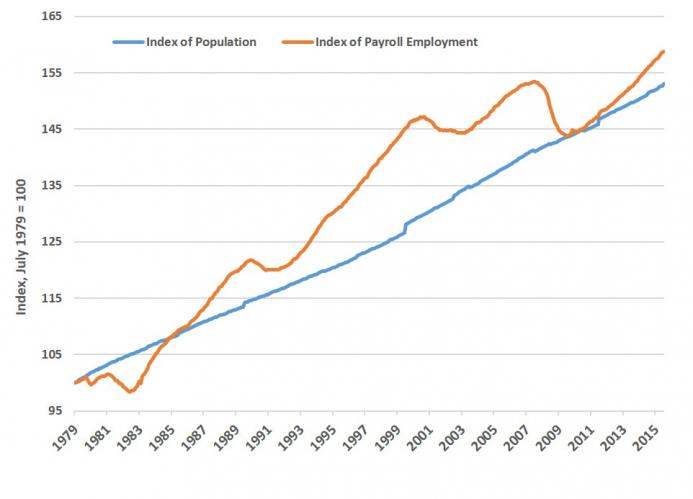
The good news gets better, though: not only have we gained jobs on net, but jobs have grown faster than the population over time. Since the 1979 peak in manufacturing employment, the US adult population grew by 53 percent, whereas employment grew by 59 percent, as shown in Figure 3.

Figure 3: Population Growth vs. Employment Growth Since 1979

watts3Source: Federal Reserve Economic Data

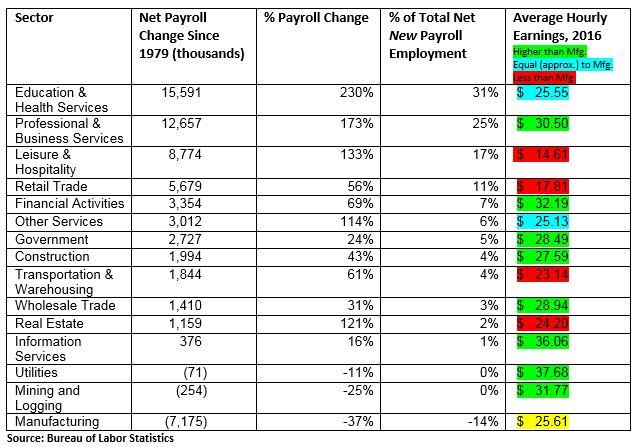
Despite these generally positive facts, some still contend that we’ve replaced “good” manufacturing jobs with lousy service sector jobs. Well, of course it must be true that, if we’ve lost manufacturing jobs, but gained jobs overall, then all of the job gains must have come from non-manufacturing sectors. And indeed the service sector, broadly defined, has seen employment growth of 90 percent since our 1979 benchmark. But beware of making hasty earnings assumptions about a sector that employs nearly 124 million people. To see whether the newly-created “service sector” jobs really don’t pay as well as the vaunted manufacturing jobs, we need to drill down into the employment and earnings data. What we’ll find is that a large majority of the new service sector jobs pay just as well or much better than manufacturing jobs.

Table 1 presents Bureau of Labor Statistics data on the 15 largest sectors and sub-sectors of the US economy, which together represent over 96 percent of the total net increase in payroll employment for the post-peak manufacturing jobs era (1979 to 2016). This might come as a surprise to the anti-globalization crowd: despite the loss of 7 million manufacturing jobs (and some mining, logging, and utilities sector jobs), we’ve seen a net increase of nearly 53 million total jobs. Of these net new jobs, fully 62 percent of them feature, as of January 2016, average hourly earnings equal to or greater than current average hourly manufacturing earnings. In other words, most of the 53 million new jobs pay the same or better wages than the demagogues’ benchmark “good” manufacturing jobs. So we lost 7 million good jobs, only to gain about 32 million equal or better-paying jobs, along with about 19 million lower-paying jobs (about 38 percent of net new jobs pay less than manufacturing).

Table 1: Employment Changes and Current Earnings by Sector

watts4Source: Bureau of Labor Statistics

We’ve established that, despite a major decrease in employment in the manufacturing sector, we’ve gained many more jobs than we’ve lost in the past 35 years or so, and that most of these new jobs pay better to boot. Economic changes, while painful in the short run, have brought gains in output and employment not only for the US, but for the rest of the world as well. Overall, this is good news for the US and world economies.

So, as the campaign season heats up, let’s not be misled by baseless arguments about America “losing jobs” or other countries “beating us” at trade. Trade is a positive sum game, and the benefits for both the US and world economies are, shall we say, “yuge.”

Tyler Watts earned his PhD in economics at George Mason University in 2010. He currently teaches economics at East Texas Baptist University and runs the Institute for Economic Education (see YouTube channel here), a public outreach focused on integrating economics with a Biblical worldview and providing unique teaching tools for high school and college economics students.

This article was published on Mises.org and may be freely distributed, subject to a Creative Commons Attribution United States License, which requires that credit be given to the author.

The US Two-Party System Made Donald Trump’s Fascist Campaign Possible – Article by G. Stolyarov II

The US Two-Party System Made Donald Trump’s Fascist Campaign Possible – Article by G. Stolyarov II

The New Renaissance Hat
G. Stolyarov II
******************************

                It is disconcerting to watch as the front-runner for the 2016 Republican Presidential nomination in the United States espouses a genuinely fascistic agenda – not just in terms of protectionism, economic nationalism, militarism, and the desire to centrally plan economic greatness – but also in terms of the overtly uglier sides of historical fascism: the xenophobia, racism, advocacy of torture and blood guilt, desire to silence political opponents, and incitements to violence against protesters and dissenters. Yet this is precisely what Donald Trump has done, unleashing the long-dormant worst tendencies of American politics. He has emboldened the crudest, least enlightened, most hide-bound enemies of tolerance, cosmopolitanism, and liberty to emerge from well-deserved disgrace to fuel the campaign of a cynical, unprincipled opportunist who thrives by pandering to their lowest impulses. Trump is vulgar, volatile, and unhinged. He has already turned his rallies into miniature versions of the police state he would create if elected – evicting even protesters who simply stand there with signs or clothing that express disagreement with Trump, or even individuals who attract the ire of the frenzied Trumpists for having the “wrong” color of skin or the “wrong” incidental expressions. Because of a bizarre law (H. R. 347, enacted in 2012), it is illegal to protest inside Trump rallies (or rallies of any candidate that receives Secret Service protection), so Trump is already utilizing coercive police powers to suppress dissent.

                Though it may be alleged that economic fascism has characterized America’s “mixed economy” since at least the New Deal of the 1930s, the resurgence of cultural fascism would have been unthinkable even during the 2012 Presidential Election. Mitt Romney, who seemed to me at the time to represent a paradigm of crony capitalism that inched toward overarching totalitarianism, now appears to be a gentleman and an intellectual – a voice of reason, class, and prudence in his eloquent denunciation of Donald Trump. Romney, as President, would have been unlikely to avert an incremental descent into fascism (although, in retrospect, he seems to be a decent human being), and his own candidacy was marred by manipulations at various State Republican Conventions, but, compared to Trump, Romney is a model of civility and good sense. Romney, if elected, would primarily have been the next status-quo President, overseeing a deeply flawed and deteriorating but endurable economic, political, and civil-liberties situation. Trump, however, would plunge the United States into an abyss where the remnants of personal liberty will suffocate.

                And yet the manipulations that occurred in 2012 to aid Romney paved the way for a Trump candidacy and its widely perceived “unstoppable” momentum. (Let us hope that this perception is premature!) I was a delegate to the Nevada State Republican Convention in 2012, where I helped elect a pro-Ron Paul delegation to the Republican National Convention. However, upon learning of the events at the National Convention, I became forever disillusioned with the ability of the Republican Party to become receptive to the advocacy of individual freedom. I wrote after Romney’s electoral defeat that

the rule change enacted by the party establishment at the National Convention, over the vociferous objections of the majority of delegates there, has permanently turned the Republican Party into an oligarchy where the delegates and decision-makers will henceforth be picked by the ‘front-runner’ in any future Presidential contest. Gone are the days when people like me could, through grass-roots activism and participation at successive levels of the party conventions, become delegates to a state convention and exert some modicum of influence over how the party is governed and intellectually inclined.

                The Republican Party establishment intended its rule change to prevent the ability of motivated grass-roots activists to elect delegates at State Conventions who would vote against the “presumptive nominee” and in favor of an upstart – presumably more libertarian – contender such as Ron Paul. Little did the establishment expect that this rule change would prevent its own favored candidates from effectively contesting Donald Trump’s nomination if Trump continues to win popular votes, especially in “winner-take-all” primaries, and approaches a majority of the total delegates. The most that the Republican Party elites can hope for now is that a candidate such as Ted Cruz eventually overtakes Trump, or that the remaining candidates – Cruz, Marco Rubio, and John Kasich – split enough of the delegates to deny Trump the majority and lead to a brokered convention. But as the narrative of inevitability continues to be spun in Trump’s favor and he amasses prominent endorsements and even promises from the other candidates that they would support him if he were the nominee, these damage-control plans seem quite vulnerable. Blind party loyalty, combined with a bandwagon mentality, appears to be driving the Republican establishment to a reluctant capitulation to Trump – which would be political suicide, but they are apt to do it anyway.

                If Trump trumps the old Republican Party establishment, however, this would be nothing to cheer. It would be a replacement of a defunct, cronyist, and backroom-dealing oligarchy – but one considerably tempered by satiation from its own decades of comfortable dominance and the remaining checks and balances of the political system – with a vicious, crass, completely unrestrained new oligarchy headed by Trump himself, and fueled by populistic pandering to masses about whom Trump personally could not care less. Trump asserts that he is incorruptible because he is funding his own campaign. However, the truth is that he does not need to pay anyone off for special political privileges, because he is the special interest that would be garnering the favors during “normal times”. If elected, he will simply do so without the intermediaries of the traditional political class. As Jeffrey Tucker eloquently explains,

many have fallen for Donald Trump’s claim that he deserves support solely because he owes nothing to anyone. Therefore, he is not part of the establishment. Why is that good for liberty? He has said nothing about dismantling power. […] He wants surveillance, controls on the internet, religious tests for migration, war-like tariffs, industrial planning, and autocratic foreign-policy power. He’s praised police power and toyed with ideas such as internment and killings of political enemies. His entire governing philosophy boils down to arbitrary, free-wheeling authoritarianism.

                Yet the biggest underlying facilitator of Trump’s frightening rise is the very two-party political system in the United States. Had the ballot-access laws not been rigged against “third” political parties and independent candidates, and had representation been determined on a proportional rather than a “winner-take-all” basis, there would have been genuine alternatives for voters to choose from. At present, however, every recent election season has degenerated into a spectacle of demonizing “the other side” – even if that side is just a different wing of the same political establishment. Far too many people vote for “the lesser evil” in their view, rather than the candidate with whom they agree most (who will most likely be a minor-party or independent candidate, since both the Republican and Democratic Parties are widely perceived as ineffectual and misguided once actually in power). Instead of evaluating specific candidates based on their stances on the issues as well as their personal record of integrity (or lack thereof), too many voters have learned to viscerally hate “the other” party’s brand and exhibit unconditional loyalty to their own. During the primary process, even voters who prefer the candidates who did not become the nominee will often capitulate and embrace a deeply flawed frontrunner. If too many Republican voters come to believe that Hillary Clinton or Bernie Sanders would be intolerable choices for President, then they may come to rally behind Trump even if they personally would have preferred Rubio, Cruz, or Kasich – and that is how a fascistic campaign could elicit the support of even the many non-fascists who simply cannot distance themselves from the “R” next to a candidate’s name.

                The only way in the long term to defeat Trump and those like him (because, in the wake of Trump’s bewildering popularity, others will emerge to imitate his tactics) is to renounce the two-party political system and judge each candidate solely on his or her policies, record, and personal merits or demerits. As I pointed out in 2012 in “On Moral Responsibility in General and in the Context of Voting”,

The most reliable way to avoid adverse moral responsibility in voting is to vote for a candidate whom one considers to be an improvement over the status quo in absolute, not relative, terms – and without regard for how others might vote. Morality is not based on consensus, but on objective truth. One’s own understanding of objective truth, and the continual pursuit of improving that understanding, is the best path to moral action and the habits of thought that facilitate it.

More recently, in 2015, I explained that

voters who are caught in the expectations trap will tend to vote for the “lesser evil” (in their view) from one party, because they tend to think that the consequences of the election of the candidate from the other party will be dire indeed, and they do not want to “take their vote away” from the slightly less objectionable candidate. This thinking rests on the false assumption that a single individual’s vote, especially in a national election, can actually sway the outcome. Given that the probabilities of this occurring are negligible, the better choice – the choice consistent with individual autonomy and the pursuit of principle – is to vote solely based on one’s preference, without any regard for how others will vote or how the election will turn out.

             Had Trump been one candidate among tens of independent contenders, he would have been rightly recognized as a demagogue whose base of support is a xenophobic, poorly educated fringe. Had numerous political parties been able to compete without major barriers to entry, today’s “moderate” establishment Republicans and movement conservatives would have had no need to fight with Trump over a particular party’s nomination, since they – having little in common – would have likely fielded multiple candidates of their own from multiple parties. As it stands now, however, the two-party system has destroyed the checks that would exist in a truly politically competitive system to prevent a fascistic demagogue’s meteoric rise. Only the consciences of voters stand between Trump and the Republican nomination, as well as the Presidency. Now, more than ever, it is imperative to vote solely on principle and escape the “lesser evil” trap, lest the greater evil of untrammeled illiberalism trap us forever.

This essay may be freely reproduced using the Creative Commons Attribution Share-Alike International 4.0 License, which requires that credit be given to the author, G. Stolyarov II. Find out about Mr. Stolyarov here.

Will Trump Boycott Grocery Stores for Their Unfair Trade? – Article by Edward Hudgins

Will Trump Boycott Grocery Stores for Their Unfair Trade? – Article by Edward Hudgins

The New Renaissance HatEdward Hudgins
******************************

Donald Trump’s stump thump against Mexico is that it runs a $58 billion annual trade surplus with the United States. Trump somehow thinks this leaves America the poorer.

He claims that it is out of that money, presumably sitting in some giant vault in Tijuana, that Mexico will pay for the border fence he wants to build to keep immigrants from entering the United States illegally. Trump’s pronouncements only demonstrate how he keeps facts and reason from entering his thoughts and, how he would keep Americans from making their own free choices in a free market.

International free trade is win-win
Trump’s very language reveals a glaring error concerning trade. Mexico and America do not trade. Mexicans and Americans do. Mexicans have $58 billion more in cash (pieces of paper with George Washington’s picture on them or the equivalent credits on bank ledgers) and Americans have $58 billion more in goods (electrical equipment, Trump-themed apparel).

And Trump doesn’t bother to ask, what are those Mexicans supposed to do with those pieces of paper? If they don’t spend them in America, they’ve got nothing but useless paper. So the Mexican trade surplus also means that Mexicans are investing an equivalent amount in America, helping the U.S. economy grow.

Further, the fundamental nature of trade between individuals is a win-win situation. Someone who buys an orange Donald hat for $20 to show his support for the former host of “The Apprentice” values the hat more than the twenty. And the manufacturer in Mexico who has a warehouse full of said head gear prefers the $20.

If The Donald slaps a 30% tariff on all goods coming from Mexico, maybe his starry-eyed supporters would shell out $26, the higher cost of the hat. But a poor mother with five kids seeing the price of a pair of shoes jump from $20 to $26 might be hard-pressed to afford the extra $30 she’d need to cover the feet of all her five little ones. But Trump doesn’t care. He wants to get rid of that pesky trade imbalance and what better way than to discourage that mom from buying Mexican-made shoes for her family! On the other hand, maybe he will notice when Mexican investors pull out of his latest golf resort or skyscraper projects, because his policies have destroyed their profits.

Trump’s grocery store trade deficit
If Trump is so against trade deficits, he should have a serious problem in his own household. Trump no doubt runs a huge trade deficit with his grocery store. He gives them piles of money when he buys food—no doubt top-priced cuisine—but the store never buys anything from him. Maybe he should boycott it. Maybe we should all boycott our local grocery stores lest we be victims of a trade deficit. Maybe if elected president, Trump will slap a 30 percent “grocery tariff” on everything that those stores try to sell to us poor, exploited schleps until those stores start purchasing stuff from us.

Trumps versus liberty
Trump poses as a friend of the people, but he wants to use government to prohibit the Americans from purchasing goods from whomever they wish—including Mexicans. The Donald presumes to know better what individual Americans should buy with their own money and at what price than they do. He’s determined to drive up the prices for Americans buying from Mexicans to teach those Mexicans a lesson. So what if American consumers and businesspeople are collateral damage.

Trump’s policies would only add more instability to an already unstable world. Ayn Rand explained that “The essence of capitalism’s foreign policy is free trade—i.e., the abolition of trade barriers… the opening of the world’s trade routes to free international exchange and competition among the private citizens of all countries dealing directly with one another. During the nineteenth century, it was free trade that liberated the world, undercutting and wrecking the remnants of feudalism and the statist tyranny of absolute monarchies.”

When governments take away the liberty of individuals to pursue their self-interest by trading freely with other individuals—a win-win situation—they set the stage for conflicts and even wars between countries. Trump’s proposed trade war is really a war on the American people.

Dr. Edward Hudgins directs advocacy and is a senior scholar for The Atlas Society, the center for Objectivism in Washington, D.C.

Copyright The Atlas Society. For more information, please visit www.atlassociety.org.

Free Trade Is the Path to Prosperity – Article by Georgi Vuldzhev

Free Trade Is the Path to Prosperity – Article by Georgi Vuldzhev

The New Renaissance HatGeorgi Vuldzhev
******************************

The political circus of the 2016 presidential election has revived and reinvigorated popular belief in age-old protectionist fallacies. Currently Donald Trump and Bernie Sanders are both in favor of expanding protectionist trade policy, with both of them arguing that free trade “destroys” jobs and hurts domestic workers and producers by exposing them to foreign competition. Both candidates espouse an utterly misguided zero-sum view of economics, in which one side to an exchange wins only when the other side loses. Both men are, of course, completely wrong.

Free Trade Does Not Destroy Jobs

It is true that greater competition between domestic and foreign workers can lead to a decline in wage rates and possibly unemployment in some sectors of the economy. But this is only a short-term effect. Free competition between foreign and domestic producers also naturally leads to lower prices for the goods and services which can now be freely imported from abroad. So, while nominal wage rates are pushed down in some sectors, real wage rates rise overall for everyone in the economy because of the decline in prices.

Thanks to free trade consumers spend less money on certain goods and services and this allows them to spend more money on others, which leads to rising demand and thus profits in the sectors providing the latter, and consequently leads also to more investment by entrepreneurs. This higher rate of investment naturally leads to the creation of more jobs in these sectors and thus offsets any original rise in unemployment that might have occurred.

Alternatively, the consumers may choose to save the extra disposable income that was freed up by the decline in prices. This rise in the savings rate will lead to a decline in interest rates, which makes profitable certain long-term capital-intensive projects which were not profitable beforehand. Seizing the opportunity presented by this increase in savings, entrepreneurs will start borrowing and investing in those long-term capital intensive projects, which on its own already creates more jobs, but it also leads to a rise in demand for capital goods, which raises profits in the capital goods industries and consequently leads to more investment and job openings in those sectors.

Free Trade Is Win-Win

Free trade not only doesn’t “destroy” jobs, but it also promotes specialization between nations, which improves the efficiency and productivity of workers, and leads to a rise in living standards for all. Trade is not some kind of a zero-sum game in which if one side wins, the other has to lose.

When two countries such as the United States and China, for example, trade freely with one another, their citizens are incentivized to specialize in those lines of production in which they have a comparative advantage. Due to the difference in factors of production endowments it is best for different countries to specialize in producing those types of goods and services which they can produce most efficiently in comparative terms. A higher level of specialization, through the effect of economies of scale, makes production more cost-efficient.

By specializing in a certain line of production and then exchanging the goods and services produced for those that others are specialized in producing, the people of a given country can substantially raise their living standards because the gains in productivity are naturally followed by an increasing supply of goods and services and thus rising real incomes. This way free trade allows for the flourishing of what can be called an “international” division of labor. Just like a greater degree of division of labor can lead to big gains in productivity and thus real incomes on an intra-national (i.e., internal for a given country) level it can also do so on an international level.

Protectionism Makes You Poor

When international trade is restricted, for example, by protectionist legislation which places tariffs on certain imports, this process of specialization is hindered and thus the gains in productive efficiency are diminished. By artificially raising the price of imports, tariffs allow otherwise uncompetitive and inefficient domestic businesses to remain in operation. Consumers are forced to pay higher prices for the goods the importation of which is penalized by tariffs, and this effectively constitutes a redistribution of resources from the consumers to the domestic producers.

More importantly, protectionism hinders the process of specialization described in the previous section and thus prevents living standards from rising in the long-term, or worse — it can even lead to their decline. By propping up the profits of comparatively inefficient domestic producers and keeping in business, tariffs prevent the labor shift from those inefficient sectors, to more comparatively efficient ones. Consequently, because this prevents a higher degree of specialization from taking place, or even reverses it, the benefits that specialization leads to cannot be obtained. Productivity does not increase (or at least not to the same degree as it could) and thus real incomes do not rise.

Contrary to the popular political rhetoric nowadays, free trade does not “destroy jobs.” It can only lead to a shift of resources (labor, capital, and other factors) from one comparatively inefficient sector or group of sectors in the domestic economy to another more comparatively efficient one. This process of specialization in the comparatively advantageous lines of production not only does not destroy jobs, but it also enables big gains in efficiency and productivity to take place, which leads to a rise in real incomes. This is how, far from somehow hurting the domestic workers, free trade actually does the opposite — it makes them richer. It is, in fact, protectionism which makes us all poorer, workers included, by artificially propping up inefficient businesses, leading to a misallocation of resources and a decline in standards of living for us all.

Georgi Vuldzhev is a student and an intern at the Institute for Market Economics in Sofia, Bulgaria. He has written articles on economics and politics for the European Students for Liberty blog, where he is a regular contributor, and various Bulgarian publications. His main interests are Austrian economics and libertarian political theory.

This article was published on Mises.org and may be freely distributed, subject to a Creative Commons Attribution United States License, which requires that credit be given to the author.

A Conversation with My Neighbor “Sam” – Article by Mark Brandly

A Conversation with My Neighbor “Sam” – Article by Mark Brandly

The New Renaissance HatMark Brandly
******************************

Lately, I’ve wondered how my neighbor, Sam, affords to buy so much stuff. He appears to have an unlimited budget. When I asked him about this, Sam asked, “Do you think I’m spending too much?”

“That depends,” I said, “How much money do you make?”

“I take home $100,000 a year.”

That surprised me. I would guess that he’s spending more than that. But I tried to be encouraging, “That sounds like plenty of income. With a little planning, you should be able to budget your spending and be financially stable.”

“But my finances are a mess,” Sam replied. “I spend more than I take home. Last year I had to borrow $12,000 just to cover my spending.”

“Well maybe things will be better this year,” I said, hoping that Sam’s spending issues was a one year problem.

“No,” Sam replied. “Actually, in the first three months of this year, I’ve already spent $19,000 more than I’ve made. It looks like my budget deficit this year will be much worse than it was last year.”

Now I was starting to worry. “Have you been borrowing money to cover your spending for a long time?”

“Oh yes. I have a lot of debt. Part of the problem is that I owe myself $150,000.”

I wondered if Sam misspoke, “Wait, wait, wait, you owe yourself $150,000? Why do you think that you’re in debt to yourself?”

“Well you see, over the years I promised myself that I was going to use my paychecks to pay for a fund for my children’s education, but instead of spending $150,000 on colleges, I spent the money on other expenses. So I figure that I owe myself this money so that I can pay for my children’s college tuitions.”

Obviously Sam doesn’t understand the definition of the word “debt.”

I tried to be polite in my response: “That doesn’t make any sense. It’s true that you’ve made some horrible decisions regarding your spending, but it’s ridiculous to claim that you owe yourself money. A debt occurs when one person owes another person money. Just because you changed your mind about how to spend your paychecks doesn’t mean that you’ve borrowed money from yourself.

“So the first thing you need to do is to think clearly about the amount of debt you have. You don’t owe yourself any money. Now, forgetting about this ridiculous notion of self-debt, how much do you owe?”

“Alright, I think I see your point. Let’s just talk about the rest of my debt. I owe various banks about $420,000. This debt is more than four times my take-home income.”

Sam often lies about his income and spending issues, but he always understates his budget problem. If he’s lying now, then I can be sure that the problem is even greater than he says. I wanted more information.

“That a pretty high debt to income ratio. But that might be somewhat manageable, although unwise, if you’ve borrowed that money at low interest rates.”

“I have some good news and some bad news,” Sam said. “Interest rates are low. In fact, in the last fourteen years, my debt has more than quadrupled, but my interest payments have increased less than 50 percent. That’s because interest rates have collapsed during that time. Isn’t that good news?”

“I suppose, but do you know that interest rates are going to increase over the next several years?”

“Yes, that’s the bad news. In the past year, I only paid $7,000 of interest, but within ten years my debt will increase over 50 percent, and possibly much more, and with higher interest rates I expect to be paying at least four to five times that much in interest annually.”

“That’s a huge problem. So to be able to make your loan payments, I assume that you’ve taken out some long-term loans.”

“No, no, no. In order to take advantage of the low interest rates, most of my borrowing is short term. I rollover my loans quickly. In the past year my principal payments on these loans totaled $207,000.”

“Let me get this straight. Your loan payments, including principal and interest, are well over twice your take home pay?”

“Yes, I take home a little over $8,000 per month and my loan payments are over $17,000 per month. But it’s no problem. In the past year I borrowed $223,000 to cover everything.”

Shocked, I said “How can you say borrowing more than twice your income is not a problem?”

“I simply borrow all the money I need to make all of my loan payments. I never pay any of the loans down. I’ve been doing this for years, ever since I started spending more than I make.”

“Okay. Most of your borrowing goes to cover your increasingly large principal and interest payments. And as interest rates rise, interest payments will become a bigger percentage of your spending. When that happens, your total debt will increase faster than your income. What is your plan, say in the next ten years, to correct this situation?”

“Well I don’t have a plan for correcting anything, because I don’t see how I can cut my spending.”

“What if the banks stop loaning you money to make your payments on your loans? What happens then?”

“I guess I’m assuming that won’t happen.”

Sam’s Budget Situation in Real Numbers
If one of our neighbors budgeted in this manner, we would obviously conclude that the guy is crazy. No such plan could work. Eventually lenders would refuse to fund Sam’s spending.

However, Sam’s situation looks a lot like the federal government budget plan. Take a look at some recent federal budget information and some Congressional Budget Office projections:

  • In FY (fiscal year) 2015, the feds had a budget deficit, counting only debt held by the public, of $339 billion, which is about 10 percent of their tax revenues of $3,248 billion. The deficit has been declining the last few years, but that is now changing.
  • In fact, in the first three months of FY 2016, according to the Treasury Department, federal debt held by the public increased $548 billion. Admittedly, some of this debt was due to the fact that the feds were cooking the books in FY 2015 when they hit the debt ceiling limit. Nonetheless, the first quarter 2016 deficit is already 60 percent larger than the overall 2015 deficit.
  • The federal government claims to owe itself over $5 trillion (they call it intragovernmental debt here). This $5 trillion represents tax revenues that were earmarked for specific spending programs, such as Social Security, but were spent on other programs. Since the feds collected taxes to pay for Social Security, but spent the money on something else, they conclude that they owe it to themselves to collect those tax revenues again. That’s the essence of intragovernmental debt. We should not count this as debt. Give the Treasury Department credit for ignoring this type of “debt” in their Daily Treasury Statements and in their end of the year debt reports.
  • As of September 30, 2015, the feds had $13.1 trillion of debt owed to the public. FY 2015 tax revenues totaled $3.248 trillion. So just like Sam the government has a 4-to-1 debt-to-tax-revenue ratio.
  • In the past fourteen years, from September 30, 2001 (the start of George Bush’s first budget) to September 30, 2015 (the end of Barack Obama’s sixth budget), debt owed to the public increased from $3,339.3 billion to $13,123.8 billion. That’s an increase of 293 percent.
  • According to the Daily Treasury Statements, in the past fourteen years, interest on treasury securities increased from $162.5 billion in fiscal year 2001 to $233.1 billion in fiscal year 2015. That’s a 44 percent increase during the same period when federal debt owed to the public almost quadrupled.
  • In FY 2015, again according to the Daily Treasury Statements, the feds borrowed $7,251.4 billion (see the Public Debt Cash Issues for September 30, 2015), an average of almost $20 billion per day. They spent $6,740.3 billion of this borrowing rolling over their debt. So, Federal principal and interest payments are more than double federal tax revenues.
  • According to the Congressional Budget Office’s baseline projections, debt held by the public in 2025 should exceed $21 trillion and during that time interest rates are expected to increase. Interest rates have been kept artificially low for years. If interest rates return to a more normal level, say to the rates they were paying when George Bush took office fifteen years ago, then interest payments in 2025 will exceed $1.2 trillion. That’s over a 400 percent increase compared to the FY 2015 interest payments. I should note here that the baseline budget projections are optimistic. We should expect the debt situation in 2025 to be significantly worse than these projections.

The federal government’s debt has exploded under the Bush and Obama administrations. Low interest payments due to the low interest rates have masked their budget problems. As interest rates and the spending gap on entitlement programs such as Social Security both increase, the budget problem will compound.

The federal government’s plan is to borrow all of the money they need to pay all of their principal and interest payments and to also pay for the budget deficits in their spending programs. The question we should ask is: what’s going to happen when the world’s lenders refuse to bankroll DC’s spending schemes?

Mark Brandly is a professor of economics at Ferris State University and an adjunct scholar of the Ludwig von Mises Institute.

This article was published on Mises.org and may be freely distributed, subject to a Creative Commons Attribution United States License, which requires that credit be given to the author.

Do We Need To ‘Rebuild The Military’? – Article by Ron Paul

Do We Need To ‘Rebuild The Military’? – Article by Ron Paul

The New Renaissance HatRon Paul
******************************

The Republican presidential debates have become so heated and filled with insults, it almost seems we are watching a pro wrestling match. There is no civility, and I wonder whether the candidates are about to come to blows. But despite what appears to be total disagreement among them, there is one area where they all agree. They all promise that if elected they will “rebuild the military.”

What does “rebuild the military” mean? Has the budget been gutted? Have the useless weapons programs like the F-35 finally been shut down? No, the United States still spends more on its military than the next 14 countries combined. And the official military budget is only part of the story. The total spending on the US empire is well over one trillion dollars per year. Under the Obama Administration the military budget is still 41 percent more than it was in 2001, and seven percent higher than at the peak of the Cold War.

Russia, which the neocons claim is the greatest threat to the United States, spends about one-tenth what we do on its military. China, the other “greatest threat,” has a military budget less than 25 percent of ours.

Last week the Pentagon announced it is sending a small naval force of US warships to the South China Sea because, as Commander of the US Pacific Command Adm. Harry Harris told the House Armed Services Committee, China is militarizing the area. Yes, China is supposedly militarizing the area around China, so the US is justified in sending its own military to the area. Is that a wise use of the US military?

The US military maintains over 900 bases in 130 countries. It is actively involved in at least seven wars right now, including in Iraq, Syria, Pakistan, and elsewhere. US Special Forces are deployed in 134 countries across the globe. Does that sound like a military that has been gutted?

I do not agree with the presidential candidates, but I do agree that the military needs to be rebuilt. I would rebuild it in a very different way, however. I would not rebuild it according to the demands of the military-industrial complex, which cares far more about getting rich than about protecting our country. I would not rebuild the military so that it can overthrow more foreign governments who refuse to do the bidding of Washington’s neocons. I would not rebuild the military so that it can better protect our wealthy allies in Europe, NATO, Japan, and South Korea. I would not rebuild the military so that it can better occupy countries overseas and help create conditions for blowback here at home.

No. The best way to really “rebuild” the US military would be to stop abusing the military in the first place. The purpose of the US military is to defend the United States. It is not to make the world safe for oil pipelines, or corrupt Gulf monarchies, or NATO, or Israel. Unlike the neocons who are so eager to send our troops to war, I have actually served in the US military. I understand that to keep our military strong we must constrain our foreign policy. We must adopt a policy of non-intervention and a strong defense of this country. The neocons will weaken our country and our military by promoting more war. We need to “rebuild” the military by restoring as its mission the defense of the United States, not of Washington’s overseas empire.

Ron Paul, MD, is a former three-time Republican candidate for U. S. President and Congressman from Texas.

This article is reprinted with permission from the Ron Paul Institute for Peace and Prosperity.

First They Came For the iPhones… – Article by Ron Paul

First They Came For the iPhones… – Article by Ron Paul

The New Renaissance HatRon Paul
******************************
The FBI tells us that its demand for a back door into the iPhone is all about fighting terrorism, and that it is essential to break in just this one time to find out more about the San Bernardino attack last December. But the truth is they had long sought a way to break Apple’s iPhone encryption and, like 9/11 and the PATRIOT Act, a mass murder provided just the pretext needed. After all, they say, if we are going to be protected from terrorism we have to give up a little of our privacy and liberty. Never mind that government spying on us has not prevented one terrorist attack.

Apple has so far stood up to a federal government’s demand that it force its employees to write a computer program to break into its own product. No doubt Apple CEO Tim Cook understands the damage it would do to his company for the world to know that the US government has a key to supposedly secure iPhones. But the principles at stake are even higher. We have a fundamental right to privacy. We have a fundamental right to go about our daily life without the threat of government surveillance of our activities. We are not East Germany.

Let’s not forget that this new, more secure iPhone was developed partly in response to Ed Snowden’s revelations that the federal government was illegally spying on us. The federal government was caught breaking the law but instead of ending its illegal spying is demanding that private companies make it easier for it to continue.

Last week we also learned that Congress is planning to join the fight against Apple – and us. Members are rushing to set up yet another federal commission to study how our privacy can be violated for false promises of security. Of course they won’t put it that way, but we can be sure that will be the result. Some in Congress are seeking to pass legislation regulating how companies can or cannot encrypt their products. This will suppress the development of new technology and will have a chilling effect on our right to be protected from an intrusive federal government. Any legislation Congress writes limiting encryption will likely be unconstitutional, but unfortunately Congress seldom heeds the Constitution anyway.

When FBI Director James Comey demanded a back door into the San Bernardino shooter’s iPhone, he promised that it was only for this one, extraordinary situation. “The San Bernardino litigation isn’t about trying to set a precedent or send any kind of message,” he said in a statement last week. Testifying before Congress just days later, however, he quickly changed course, telling the Members of the House Intelligence Committee that the court order and Apple’s appeals, “will be instructive for other courts.” Does anyone really believe this will not be considered a precedent-setting case? Does anyone really believe the federal government will not use this technology again and again, with lower and lower thresholds?

According to press reports, Manhattan district attorney Cyrus Vance, Jr., has 175 iPhones with passcodes that the City of New York wants to access. We can be sure that is only the beginning.

We should support Apple’s refusal to bow to the FBI’s dangerous demands, and we should join forces to defend of our precious liberties without compromise. If the people lead, the leaders will follow.

Ron Paul, MD, is a former three-time Republican candidate for U. S. President and Congressman from Texas.

This article is reprinted with permission from the Ron Paul Institute for Peace and Prosperity.