Browsed by
Tag: united states

Our Economic Malaise Is Impacting Young Workers the Most – Article by Ryan McMaken

Our Economic Malaise Is Impacting Young Workers the Most – Article by Ryan McMaken

The New Renaissance Hat
Ryan McMaken
******************************

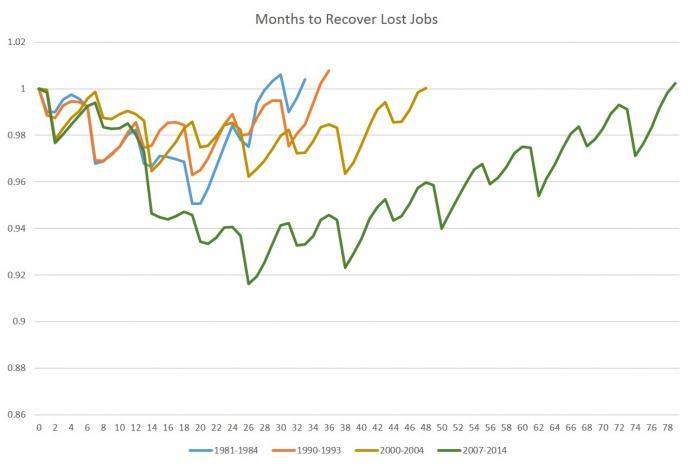
In the wake of the 2007-2009 recession, 78 months passed before employment returned to where it had been before the crisis. This was, by far, the longest period needed to recover from job losses in decades. The second-longest period needed to recover jobs occurred after the 2002 recession when about 50 months were needed to recover lost jobs:

economic_malaise_young_people_1

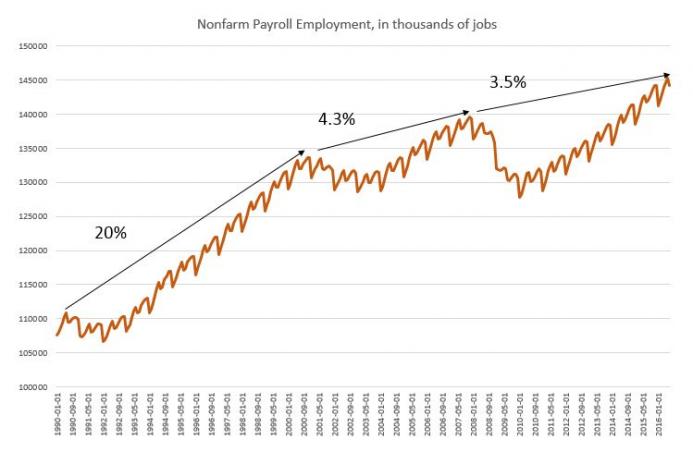
Moreover, we see that in recent cycles, job growth during each recovery has been getting weaker and weaker over time:

economic_malaise_young_people_2

Some observers of the rose-colored-glasses-wearing variety have attempted to explain away the most recent malaise in job gains by claiming that fewer jobs are needed because so many Baby Boomers are aging out of the work force, and because people are so much wealthier, they argue, workers are leaving the labor force for non-economic reasons. That is, people are leaving the labor force for reasons other than being discouraged workers.

These claims are plausible, but the empirical data we have does not support them.

Keep in mind that ever since the 2007-2009 recession, the U-6 unemployment rate, which includes underemployed workers (i.e., involuntary part timers) and discourage workers, has reached multi-decade highs in recent years, and even now, is only at levels seen during the worst of the last recession:

economic_malaise_young_people_3

This is not simply a matter of fewer jobs being created because workers are going away.

To get a sense of the situation, we have to first look at the demographics of the working age population and the labor force.

(This demographic data on the working-age population is only currently available through the first quarter of 2015, so the time series ends in early 2015.)

economic_malaise_young_people_4

The top line is the total working age population (ages 15-65) published by the OECD and the World Bank. According to this measure, there is no decline in the working age population.

If people were aging out of the work force in droves to the point of driving a net exodus, we would see a downturn in the blue line. We don’t see that. In fact, from the beginning of the last recession at the end of 2007 to the first quarter of 2015, the working age population increased by 7.5 million people.

During that same period, the US economy added 801,000 jobs. That is, after the initial loss of 10 million jobs, the US economy began to add jobs again, but after more than seven full years, had only added a net of 801,000 jobs.

But maybe only 801,000 jobs were added because very few of those 7.5 million people wanted to be in the work force.

Well, it’s a safe bet that not all of them wanted to be in the work force, but we do know that using the standard BLS measure for the work force that 2.4 million people entered the work force during the period when only 801,000 jobs were added. (See the green line above.) That means over that time period, you had 1.6 million new people in the labor force while half that many jobs were added.

And this labor force measure only takes into account active job seekers and employed people. It ignores discouraged workers and involuntary part timers.

So we find that both the official labor force and the working age population were increasing at levels substantially above the employment levels.

Indeed, the only way we can find a number that suggests more jobs were added than workers is to look at the working-age population for ages between 25 and 54. That is, if we exclude all potential workers under 25 and all above 54, then yes, the working age population did decline by 1 million jobs. (See the red line above.)

In real life, though, the work force includes quite a few people who are, say, 22 years old, and quite a few who are 60 years old. If those people are included, the working age population is growing considerably.

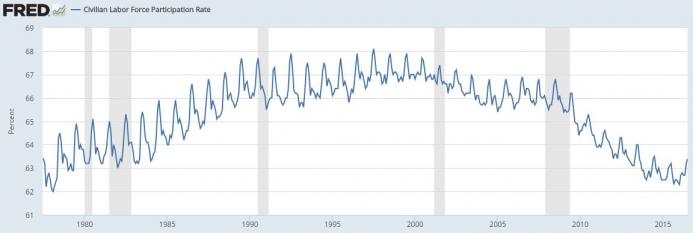
Meanwhile, workforce participation has been falling for a number of years, and is now at some of the lowest levels that have been seen in more than 30 years. From 2014 to 2016, work force participation ranged from about 62 percent to 64 percent. That’s the lowest participation rate seen since the the early 1980s.

economic_malaise_young_people_5

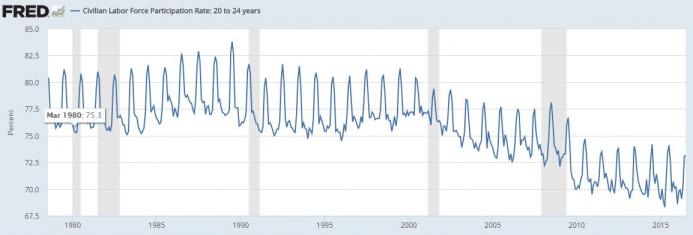
Many have assumed this means that many older workers are leaving the work force. Unfortunately, it seems that it is young workers who are most likely to leave the labor force, which is problematic for future productivity. For young workers in the 20-24 age range, work force participation has been falling for more than a decade, and fell off significantly during the last recession:

economic_malaise_young_people_6

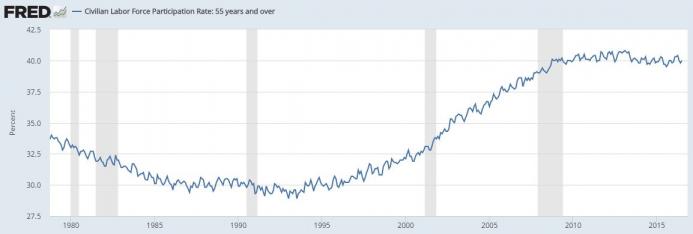
Meanwhile, labor force participation for 55-and-older individuals has held steady:

economic_malaise_young_people_7

It appears unlikely that it is now unnecessary to add jobs at a rate comparable to past recoveries because so many older workers are leaving the work force. Nor is it likely that young people are leaving the work force because they are so prosperous. It’s more likely that young people are leaving the work force as discouraged workers.

This supposition is further strengthened by the fact that the unemployment rate in the 16-24 age range has been above 10 percent for the past nine years. It was especially high even before the last recession.

But, unemployment among over-55 workers is among the lowest of all demographic groups, with a rate between 3 percent and 4 percent in recent years.

In other words, older workers are sticking around and doing relatively well. It appears that younger workers, meanwhile, are more likely to be unemployed, underemployed, or even totally out of the workforce as discouraged workers.

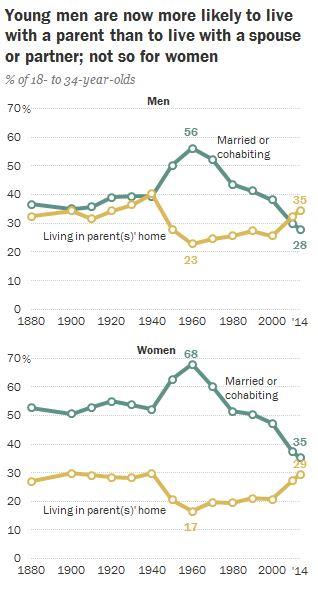
One phenomenon that gives us a reason to think this is the fact that the number of young people living with their parents has reached historic highs in the United States. As Pew recently reported:

In 2014, for the first time in more than 130 years, adults ages 18 to 34 were slightly more likely to be living in their parents’ home than they were to be living with a spouse or partner in their own household.

Living at home is more likely for men than for women, but in both cases, more young people are living with their parents than during any other period since World War II:

economic_malaise_young_people_8

Those who attempt to spin the current job numbers as simply the effects of people happily leaving the work force appear to be mistaken in assuming that older workers are leaving, and that younger workers need not work because they’re so unusually productive.

If young workers were so productive, is it too much to believe that they would choose to rent an apartment rather than live with their parents?

Once we look a the demographics behind the current job numbers, we actually find the situation is more alarming that we might have thought otherwise. We seem to be in a situation where younger workers are participating in the work force less, and putting off acquiring essential job skills that will lead to more productivity later.

Older workers are still sticking around in numbers large enough to keep the overall labor force number growing.

However, while both the working age population and the labor force are growing, overall job creation simply is not keeping up.

At some point, those 30-year olds living with their parents are doing to need full-time work, but will they have the job experience necessary (and thus the productivity) necessary to support the lifestyle to which they have become accustomed?

Or, will they simply enter the workforce with few job skills following a decade of part-time work or no work forced on them by our weak economy? When that happens, we’re likely to see a continued decline in the household and personal incomes.

Ryan W. McMaken is the editor of Mises Daily and The Free Market. He has degrees in economics and political science from the University of Colorado, and was the economist for the Colorado Division of Housing from 2009 to 2014. He is the author of Commie Cowboys: The Bourgeoisie and the Nation-State in the Western Genre. 

This article was published on Mises.org and may be freely distributed, subject to a Creative Commons Attribution United States License, which requires that credit be given to the author.

How the Education System Destroys Social Networks – Article by Jeffrey A. Tucker

How the Education System Destroys Social Networks – Article by Jeffrey A. Tucker

The New Renaissance HatJeffrey A. Tucker
******************************

I was at a restaurant for lunch and had time to visit with the waitress, who turns out to be a college graduate from a good institution. She has a degree in European languages. Here she is waiting tables with nondegreed people, some five years her junior, some 10 years her elder.

She is making good money, but so are her co-workers. You have to wonder: given her position, what was the professional advantage to her of those four hard years in school and the $100K spent on them? What were the opportunity costs?

This is not another article to disparage the value of a college degree. I would like to raise a more fundamental question. It concerns the strange way in which our education system has overly segmented our lives into a series of episodic upheavals, each of which has little to do with the other, the value of one accomplishment being oddly disconnected from the next stage, and none of them directly connecting to our professional goals except in the unusual case.

From the earliest age until adulthood, we’ve been hurled from institution to institution in a way that eventually sets young people back from developing continuity of plans and a social support system to realize their goals. At the end of it all, people find themselves back where they started: figuring out their market worth and trying to find a buyer for their services.

Instead of drawing down on accumulated capital, they end up starting fresh at age 22. Even after years of building social capital, they are drawing down on a nearly empty account.

There is something seriously wrong with this system. Shouldn’t our investments in our friendship networks extend across and beyond the stages of our development to make more of a difference in our lives?

The post-graduation diaspora

In a couple of months, for example, many millions of high school students will graduate. Celebration! Sort of. It’s great to finish school. But what’s next?

Many students find themselves devastated to lose the only social group and friendship network they’ve ever known. They worked for years to cultivate it, and in an instant, it is blown apart. They are left with a piece of paper, a yearbook of memories, a transcript, and, perhaps a few recommendation letters from teachers — recommendations that do them little good in the marketplace.

“Don’t ever change,” they write in each other’s yearbooks. The sentiment expresses a normal longing to hold on to the investment the students make in each other’s lives, even as everything about the system tries to take that investment from them.

Is this the way it should be?

Then, the same group, or at least many among them, look forward to college, where they are mostly, again, starting from scratch in a social sense. It can be very scary. College students begin their new experience isolated. They work for another four years to develop a network — a robust social group — to find their footing and to establish both a reputation and sense of self. This is the only world they’ve known for years, and they have invested their hearts and souls into the experience.

The social fabric ends up rich and wonderful, with intense friendships based on shared lives.

Finally, after four years, the graduation march plays, the tassel is moved from one side of the cap to the other, and the whole social apparatus goes up in smoke — again. Then, another diaspora.

Once again, students find themselves nearly alone, with few hooks into the world of commerce and employment. They have a degree but few opportunities to monetize it. Their social network is of limited use to them. All they have, yet again, is a piece of paper. Plus they have recommendation letters from professors that still do them little good in the marketplace.

This not always the case. There are workarounds, and digital networking is helping. People join fraternities and social clubs, and those can be useful going forward. But it might take years for these connections to yield results. The more immediate question is this: What do I do now? Lacking a broad sense of the way the world works, and missing any influential hooks into prevailing networks, a college grad can often find herself feeling isolated once again, starting over for the third time.

The failure of the central plan

This is the system that the civic culture has created for us. For the years from the ages of 14 through 22, students’ primary focus of personal investment and social capital building is centered on their peers. But their peers are just the same as they are: hoping for a good future but having few means to get from here to there.

Why does this keep happening? Looking at the big picture, you can start to see a serious problem with the educational system politicians have built for us. It is keeping people “on track” — but is it a track that prepares people for the future?

A core principle of the education system, as owned and controlled by government, is Stay in school and stay with your class. This is the emphasis from the earliest grades all the way through the end of college. The accidents of birth determine your peer group, your primary social influences, and the gang you rely on for social support.

To be “held back” is considered disgraceful, and to be pushed forward a grade is considered dangerous for personal development. Your class rank is your world, the definition of who you are — and it stays with you for decades. Everyone is on a track as defined by a ruling class: here is what you should and must know when. All your peers are with you.

Many factors entrench this reality. The public school system is organized on the assumption of homogeneity, a central plan imposed from the top down. It didn’t happen all at once. It came about slowly over the course of 100-plus years, from the universalization of compulsory schooling, to the prohibition of youth work, to the gradual nationalization of curricula.

In the end, we find the lives of young people strictly segmented by stages that are strangely discontinuous. Where are the professional contacts that result? Where are the friends who can smooth your way into the world of professional work? They aren’t among your former classmates. Your peers are all in the same position you are in.

Laws that lock people out

The workplace might help to mitigate this problem, but it’s incredibly difficult for young people to get a regular job thanks to “child labor” laws that exclude teens from the workforce. For this reason, only one in four high school kids has any real experience outside their peer group. They miss all the opportunities to learn and grow that come from the workplace — learning from examples of personal initiative, responsibility, independence, and accountability.

There are extremely narrow conditions under which a 14-year-old can find legal employment, but few businesses want to bother with the necessary documentation and restrictions. A 16-year-old has a few more opportunities, but, even here, these young people can’t work in kitchens or serve alcohol. The full freedom to engage a larger community outside the segmented class structure doesn’t come until after you graduate high school.

By the time the opportunity comes around to do authentic remunerative work, a student’s life is filled with other interests, mostly social, but also extracurricular. Instead of working a job, people are doing a thousand other things, and there seems to be no time left. It’s not uncommon for people to graduate with no professional experiences whatsoever to draw on. Their peers are their only asset, their only really valuable relationships, but these relationships have little commercial value.

How natural is any of this?

If you look at the social structure of homeschooling co-ops, for example, younger kids and older kids mix it up in integrated social environments, and they learn from each other. Parents of all ages are well integrated too, and it creates a complex social environment. The parents know all the kids and, together, they form a diverse microsociety of mutual interests. This is one reason that homeschooled kids can seem remarkably precocious and poised around people of all ages. They are not being artificially pegged into slots and held there against their will.

A better way

When you read about the experiences of successful people in the late 19th century, they talk of their exciting and broad experiences in life, working in odd jobs, meeting strange people of all ages and classes, performing tasks outside their comfort zone, encountering adult situations in business that taught them important lessons. They didn’t learn these things from sitting in a desk, listening to a teacher, repeating facts on tests, and staying with their class. They discovered the world through mixing it up, having fabulous and sometimes weird experiences, being with people who are not in their age cohort. They drew on these experiences for years following.

The system to which we have become accustomed is not of our choosing, and it certainly isn’t organic to the social order. It has been inflicted on us, one piece of legislation at a time. It is the result of an imposed, rather than evolved, order. Why wait until age 22 to get serious about your life?  Why stick with only one career choice in the course of your appointed 40 years in professional life? Why retire at the young age of 65, just because the federal government wants you to do so?

Think about this the next time you attend a graduation. Are the students shedding only tears of joy? Or, in the sudden mixture of emotions, is there also the dawning realization that they are witnessing the destruction of a social order they worked so hard to cultivate? Are they also overwhelmed with the knowledge that, in short order, they will have to recreate something entirely new again? Where is the continuity? Where is the evidence of an evolved and developing order of improved opportunities?

The most important question is this: What are the alternatives?

Bring back apprenticeships. Bring back remunerative work for the young. Look beyond the central plan, and don’t get trapped. Rethink the claim that staying in school is an unmitigated good. Find other ways to prevent your heavy investments in others from dissipating; ensure instead that they will pay more immediate returns. Our friends should remain in our lives — and yield a lifetime of returns.

Jeffrey Tucker

Jeffrey Tucker

Jeffrey Tucker is Director of Content for the Foundation for Economic Education and CLO of the startup Liberty.me. Author of five books, and many thousands of articles, he speaks at FEE summer seminars and other events. His latest book is Bit by Bit: How P2P Is Freeing the World.  Follow on Twitter and Like on Facebook. Email. 

This article was originally published on FEE.org. Read the original article.

The ADA Attack on Online Courses Hurts the Disabled, Too – Article by Alex Tabarrok

The ADA Attack on Online Courses Hurts the Disabled, Too – Article by Alex Tabarrok

The New Renaissance HatAlex Tabarrok
******************************

The Department of Justice has sent a letter to UC Berkeley threatening a lawsuit unless the university modifies all of its free online educational materials to meet conditions of accessibility. In response the Vice Chancellor for Undergraduate Education writes:

…we have attempted to maximize the accessibility of free, online content that we have made available to the public. Nevertheless, the Department of Justice has recently asserted that the University is in violation of the Americans with Disabilities Act because, in its view, not all of the free course and lecture content UC Berkeley makes available on certain online platforms is fully accessible to individuals with hearing, visual or manual disabilities.

…We look forward to continued dialog with the Department of Justice regarding the requirements of the ADA and options for compliance. Yet we do so with the realization that, due to our current financial constraints, we might not be able to continue to provide free public content under the conditions laid out by the Department of Justice to the extent we have in the past.

In many cases the requirements proposed by the department would require the university to implement extremely expensive measures to continue to make these resources available to the public for free. We believe that in a time of substantial budget deficits and shrinking state financial support, our first obligation is to use our limited resources to support our enrolled students. Therefore, we must strongly consider the unenviable option of whether to remove content from public access.

In short, the DOJ is saying that unless all have access, none can and UC Berkeley is replying that none will. I sympathize with UC Berkeley’s position. The cost of making materials accessible can be high and the cost is extremely high per disabled student. It would likely be much cheaper to help each disabled student on an individual basis than requiring all the material to be rewritten, re-formatted and reprogrammed (à la one famous example).

An even greater absurdity is that online materials are typically much easier to access than classroom materials even when they do not fully meet accessibility rules. How many teachers, for example, come with captions? (And in multiple languages?) How about volume control? How easy is it for the blind to get to campus? In theory, in-class materials are also subject to the ADA but in practice everyone knows that that is basically unworkable. I guarantee, for example, that professors throughout the UC-system routinely show videos or use powerpoints that do not meet accessibility guidelines. Thus, by raising the costs of online education, the most accessible educational format, the ADA may have the unintended consequence of slowing access. Put simply, raising the costs of online education makes it more difficult for anyone to access educational materials including the disabled.

Addendum: By the way, if you are wondering, all of MRU’s videos for our Principles of Microeconomics and Principles of Macroeconomics courses are captioned in English and most are also professionally captioned in Spanish, Arabic and Chinese.

This post first appeared at Marginal Revolution.

Alex Tabarrok is a professor of economics at George Mason University. He blogs at Marginal Revolution with Tyler Cowen.

George Washington’s Letter to the Jews – Article by Sarah Skwire

George Washington’s Letter to the Jews – Article by Sarah Skwire

The New Renaissance HatSarah Skwire
******************************

In August of 1790, George Washington wrote a brief letter to the Hebrew Congregation of Newport, Rhode Island. If anything, it is more timely than ever as we continue to struggle with questions of toleration and bigotry, and of the joys and dangers of insisting on freedom of conscience in our nation and in our lives.

Gentlemen:

While I received with much satisfaction your address replete with expressions of esteem, I rejoice in the opportunity of assuring you that I shall always retain grateful remembrance of the cordial welcome I experienced on my visit to Newport from all classes of citizens.

The reflection on the days of difficulty and danger which are past is rendered the more sweet from a consciousness that they are succeeded by days of uncommon prosperity and security.

If we have wisdom to make the best use of the advantages with which we are now favored, we cannot fail, under the just administration of a good government, to become a great and happy people.

The citizens of the United States of America have a right to applaud themselves for having given to mankind examples of an enlarged and liberal policy—a policy worthy of imitation. All possess alike liberty of conscience and immunities of citizenship.

It is now no more that toleration is spoken of as if it were the indulgence of one class of people that another enjoyed the exercise of their inherent natural rights, for, happily, the Government of the United States, which gives to bigotry no sanction, to persecution no assistance, requires only that they who live under its protection should demean themselves as good citizens in giving it on all occasions their effectual support.

It would be inconsistent with the frankness of my character not to avow that I am pleased with your favorable opinion of my administration and fervent wishes for my felicity.

May the children of the stock of Abraham who dwell in this land continue to merit and enjoy the good will of the other inhabitants—while every one shall sit in safety under his own vine and fig tree and there shall be none to make him afraid.

May the father of all mercies scatter light, and not darkness, upon our paths, and make us all in our several vocations useful here, and in His own due time and way everlastingly happy. ~ G. Washington

Washington came to Newport for a visit on August 17th, 1790  and was addressed by Moses Seixas, one of the officials of the long-established Jewish congregation of Newport. Seixas noted that, given the grim history of the Jews, America was a particularly important place, for:

Deprived as we heretofore have been of the invaluable rights of free Citizens, we now (with a deep sense of gratitude to the Almighty disposer of all events) behold a Government, erected by the Majesty of the People—a Government, which to bigotry gives no sanction, to persecution no assistance—but generously affording to All liberty of conscience, and immunities of Citizenship: deeming every one, of whatever Nation, tongue, or language, equal parts of the great governmental Machine…

While I suspect many reader will find, as I do, the notion of being a part of the “great governmental machine” far less appealing than Seixas did, his main point remains a vital one. For a people who had been chased from their homes by persecution, forced conversions, violence, and governmental theft of their property, the American promise of toleration was an almost incomprehensible blessing.

Toleration in Rhode Island

When I visited the Touro synagogue—home of the Jewish congregation Washington addressed—last week, my tour guide reminded me that Rhode Island’s version of religious toleration was particularly impressive, even within the wider American context.

Founded by the famously ornery Roger Williams, who was banished from the Massachusetts Bay Colony for spreading “new and dangerous opinions,” and established by a charter from King Charles II,  Rhode Island was based on principles of complete religious toleration from its very beginning. The 1663 founding charter notes that Rhode Island is meant to be:

a lively experiment, that a most flourishing civil state may stand and best be maintained…with a full liberty in religious concernments… our royal will and pleasure is, that no person within the said colony, at any time hereafter shall be any wise molested, punished, disquieted, or called in question, for any differences in opinion in matters of religion, and do not actually disturb the civil peace of our said colony; but that all and every person and persons may, from time to time, and at all times hereafter, freely and fully have and enjoy his and their own judgments and consciences, in matters of religious concernments, throughout the tract of land hereafter mentioned, they behaving themselves peaceably and quietly, and not using this liberty to licentiousness and profaneness, nor to the civil injury or outward disturbance of others, any law, statute, or clause therein contained, or to be contained, usage or custom of this realm, to the contrary hereof, in any wise notwithstanding.

Even the structure of Newport echoes the words of its royal charter. The city’s churches are not next to the statehouse, but clustered behind it, emphasizing their equality with one another and the separation between church and state.

It is hard for a modern reader to understand exactly how astonishing this promise of complete freedom of religious conscience was for the time. Perhaps the best way to think about it is that, when this royal charter was drawn up, Europe had suffered through more than 120 years of near-constant religious warfare. The death toll from that religiously motivated violence totaled somewhere between 5.6 and 18.5 million, depending on which historians you read and whether or not you count deaths caused by diseases and famine resulting from warfare.

Rhode Island must have seemed like a miracle to any 17th-century citizen. And for the Jews of Spain and Portugal, making their way to Newport via Amsterdam, the promise of such freedom must have been tantalizing and a little terrifying. Could they really trust that non-Christian religions would be included in these promises? Would they really be safe?

They would.

And the letter that Seixas read to George Washington makes that sense of security perfectly clear. Seixas did not speak of toleration and freedom as promises made in hopes of some much-desired future. He spoke of them as established truths that were in place then and there, as he was writing. “We now …behold a Government, erected by the Majesty of the People—a Government, which to bigotry gives no sanction, to persecution no assistance.”

Freedom Works

Washington’s response to Seixas and the other Jews of Newport is similarly focused on the success of the American experiment in toleration. He writes:

The citizens of the United States of America have a right to applaud themselves for having given to mankind examples of an enlarged and liberal policy—a policy worthy of imitation. All possess alike liberty of conscience and immunities of citizenship.

The Revolution is over. The Constitution is in place. The Republic has not fallen apart in its first years. There is reason to be proud, says Washington.

More importantly, he argues that toleration is not a question of an elite extending a favor to a lower and less worthy class. Toleration is about the equal treatment of all. The Jews of Newport are not “tolerated” the way that one learns to live with a leaky faucet or a small ding on your car bumper. Their differences are tolerated because their persons are equal.

It is now no more that toleration is spoken of as if it were the indulgence of one class of people that another enjoyed the exercise of their inherent natural rights, for, happily, the Government of the United States, which gives to bigotry no sanction, to persecution no assistance, requires only that they who live under its protection should demean themselves as good citizens in giving it on all occasions their effectual support.

Repeating Seixas’s phrasing back to him, in words that have become a crucial part of American thinking, Washington reassures him, and all the Jews of Newport, that he and they are of one mind on the subject of toleration.

We should think, today, about that phrase that Seixas originated and Washington repeated. It makes a fine model for how we should behave in the increasingly fraught religious tensions of the 21st century.

A civil society should give to bigotry no sanction, and to persecution no assistance. That means that those of us who are already here may not use our position to persecute newcomers, nor may we use their differences as an excuse for hatred and ill-treatment. But this is a covenant that must work in both directions. To enter into a civil society, one must make those promises as well.

Old hatreds, old prejudices, and old patterns of persecution must be left on the doormat of a civil society—discarded, like a pair of muddy boots, before you come in.

Only then can we regain the pride that Seixas and Washington had in a toleration that they felt was secured. Only then can we close our letters as Washington closed his, with the conviction that now, “every one shall sit in safety under his own vine and fig tree and there shall be none to make him afraid.”

Sarah Skwire is the poetry editor of the Freeman and a senior fellow at Liberty Fund, Inc. She is a poet and author of the writing textbook Writing with a Thesis. She is a member of the FEE Faculty Network.

This article was published by The Foundation for Economic Education and may be freely distributed, subject to a Creative Commons Attribution 4.0 International License, which requires that credit be given to the author.

The Two-Party Crackup Could Be Upon Us – Article by Stephen Weese

The Two-Party Crackup Could Be Upon Us – Article by Stephen Weese

The New Renaissance HatStephen Weese
******************************

Imagine living in a world where there are only two choices. Chocolate or vanilla. Hot or cold. Light or darkness. There are no in-betweens. No “shades of gray.” You must explain everything as a “yes or no” dichotomy. On or off. False or true. This binary reality leaves little room for human diversity or creativity – yet it is in this exact reality we find ourselves trapped with the US political system.

Prelude to Deception

The parties are divided and their candidates are weak.It all starts with a sociological phenomenon created due to our political election process. First Past the Post means that in our elections, winner takes all and the loser gets nothing. We are told that if we do not vote for one of the two major parties, our vote is wasted. (I mathematically analyzed this myth in a previous article.)

The concept that underlies the two party phenomenon is not only mathematical in principle, it is sociological. Duverger’s law assumes that people faced with more than two choices in a First Past the Post election will vote against the most radical or undesired opponent, instead of for the candidate they most desire. This demonstrates what is called a “negative” vote – it could be more precisely described as a vote made out of fear of the worst candidate.

Another principle of Duverger’s law is that it filters out “weaker” parties in that people will not vote for a party that has no chance of winning. This weakness is only psychologically defined; a party could appear weaker simply due to less publicity. Certainly a third party could have better ideas than the main two – but if the ideas are not heard, then no one can know about them. The purely cognitive illusion that there are only two “worthy” parties is perpetuated by lack of media coverage and the false appeal to common practice that it’s the “way things always have been done.”

The simple truth is, Duverger’s law depends on the psychological basis of fear and ignorance. Without these factors in society, the mathematical differences would disappear.

The Two Major Parties are Weak

People only think of politics as “right” or “left” because this is all they have ever known.At this point, the two major candidates for election, Donald Trump and Hillary Clinton, have historically high negative numbers. In fact, the two frontrunners have the highest unfavorable ratings since those numbers have been tracked: Trump is net negative 33, and Clinton negative 21.

More voters see these candidates in an unfavorable light than a favorable one. This would be a perfect time for the rise of a third party, even according to Duverger’s law. It only takes a cursory look at the news to see the large anti-Trump movement among major Republicans as well as the staunch Sanders wing of the Democratic party. The parties are divided and their candidates are weak, as shown by the polls above.

The Electorate Is Polarized

If you have the feeling that in the last decade partisan politics has become more extreme and vitriolic you’d be correct – Pew research has been tracking this phenomenon. Both the extremity of Democratic and Republican views have increased, as well as dislike and intolerance for the “other” party. At this point, 92% of Republicans are to the right of the median Democrat, and 94% of Democrats are to the left of the median Republican.

There are double the amount of pure liberals and conservatives than a decade ago, and the fear of the opposing party has doubled as well. Twice as many people think that the alternate party threatens the “nation’s well-being.”

If people could overcome the fear of the “worst” candidate and voted for what they believed in, the facade would begin to crumble. This polarization affects people’s choices of where to live, shop, and travel, and even goes to the extent of opposition to a family member marrying someone of the opposing party. The Pew study also shows that those on the extreme ends of the spectrum are the most politically active – writing letters, posting on social media, travelling to political events (though this is hardly surprising.) The effect of this of course is that these parties are represented more by their extreme elements.

This polarization also results in one-dimensional thinking. People only think of politics as “right” or “left” because this is all they have ever known. As humans, are we only one-dimensional? Aren’t there more ways to look at solving the problems of a nation than just left and right?

Most of us are trapped in this one-dimensional illusory world, like a train stuck on a single track. The mere idea that we could travel in a completely different direction is a foreign concept. Even a middle-school student can tell you that we live in a world with three dimensions, that we can travel in an infinite variety of paths. Yet we find ourselves confined to this oversimplified model of reality that goes counter to our interests and only allows us choices that leave most dissatisfied.

Majority in the Middle

Another effect of this polarization is that moderate Americans find themselves in the middle of this extremism. Most voters do not view the other party as a threat to the nation and are not 100% liberal or conservative in their views. There are actually more people in the middle, yet they find themselves forced to choose to side with one extreme or the other. In 2014, the “mixed” electorate (holding views from both sides) was 39%.

There are less of them now, due to extremism, yet this 39% in the middle is enough to completely take over an election, if they only had a different option to choose from. Unfortunately, the Pew data also shows that the people in the middle are less likely to vote and participate in the election process. Duverger’s law is working here because these moderates do not know that they are a huge bloc that could elect a moderate candidate with ease.

Overcoming Ignorance and Fear

We live in the age of new media – a social movement can begin online without the backing of a major television or news network. As we have seen, voting tendencies in our system are predicated on fear of a radical candidate as well as ignorance of third-party platforms or even their existence. This is the one-dimensional illusion we live in. If we continue to be more polarized, more and more of the electorate will hate the other half.

If nothing stops this progress, those in the middle will be forced to choose a side as the tolerance for opposing views decreases. Others could stand up and speak and become a driving force pulling opinions back toward some sense of centrism – or even better, they could propose ideas outside of the traditional “left vs. right” paradigm.

The truth is, if people could overcome the fear of the “worst” candidate and voted for what they believed in, the facade would begin to crumble. If the media and others covered third parties more, unaligned voters – for example, people who believe in peace and freedom – would have a new incentive to participate and give a positive vote.

Fortunately, we now live in the age of new media – a social movement can begin online without the backing of a major television or news network. This election is the most opportune time for this to happen given the record negative views of both candidates. Thus it behooves the unaligned voter to find her or his voice in this election. If these voters together decided that “enough is enough” and realized that they are actually the most powerful voting bloc, they could simply say “no” to the two major parties – and nothing could stop them.

Stephen_WeeseStephen Weese

Stephen Weese has an undergraduate degree in Computer Science from George Mason University, and a Masters in Computer Information Technology from Regis University. Stephen teaches college Math and Computer courses. He is also a speaker, a film and voice actor, and a nutrition coach.

This article was originally published on FEE.org. Read the original article.


How Not To Waste Your Vote: A Mathematical Analysis – Article by Stephen Weese

How Not To Waste Your Vote: A Mathematical Analysis – Article by Stephen Weese

The New Renaissance HatStephen Weese
******************************

During this especially contested election, a lot of people are talking about people “wasting” or “throwing away” votes. However, many people who say this do not have a complete grasp of the full mathematical picture – or worse, they are only mentioning the part that supports their position. First let’s define what a “wasted” vote is.

Mathematical Definition of Wasted Votes

A wasted vote is a vote that provides no determination or effect on the final outcome of the election. According to Wikipedia: “Wasted votes are votes cast for losing candidates or votes cast for winning candidates in excess of the number required for victory. For example, in the UK general election of 2005, 52% of votes were cast for losing candidates and 18% were excess votes – a total of 70% wasted votes.”

There are two kinds of wasted votes that mathematically have no effect on the final election:

  1. Votes cast for candidates who did not win
  2. Excess votes cast for winning candidates

Clearly, neither of these kinds of votes statistically affect the election. However, many arguments only mention the first type without mentioning the second. Mathematically and logically, both categories are ineffectual votes.

First Past the Post

The value of your vote is what you give it. Should you spend it on a candidate you don’t believe in?The United States, along with several other nations, uses the First Past the Post (FPTP) or “winner take all” election. This method is defined as “the candidate who receives more votes than any other candidate wins.”

This is one of the reasons that many people mention wasted votes – our system creates that result. Sociologically speaking, the FPTP system tends to favor a two-party system. The French sociologist Maurice Duverger created “Duverger’s Law” which says just that.

The Electoral College

For U.S. Presidential elections, a state-by-state system is used called the Electoral College. Each state gets a proportional amount of electoral votes which are then used to find a majority for president. Interestingly, what happens in each separate state is a smaller FPTP election, followed by a counting of electoral votes.

The Electoral College is slightly different from a pure FPTP system because it requires an actual number threshold (currently 270 electoral votes) for a candidate to win instead of a simple majority of the votes.

We can sum things up as follows:

  1. States hold “winner take all” FPTP elections for electoral votes
  2. Electoral votes are counted
  3. The winner must have 270 electoral votes
  4. If there is no candidate that reaches it, the House of Representatives chooses the president

These distinctions are important, because they can change the math and the concept of the “wasted” vote phenomenon.

Wasted Votes in Presidential Elections

The general concept that is proposed by many is that you must always vote for a Republican or a Democrat because you must stop the worst candidate from winning. In a sense, you are voting a negative vote – against someone – rather than for a candidate of your choice. However, this actually depends on the scenario of the vote. Let’s look at some examples.

Bush vs. Gore: 2000

People voting out of fear of the worst candidate is a self-perpetuating cycle. Let’s examine a common example used in this discussion.

Following the extremely close 2000 U.S. presidential election, some supporters of Democratic candidate Al Gore believe that one reason he lost the election to Republican George W. Bush is because a portion of the electorate (2.7%) voted for Ralph Nader of the Green Party, and exit polls indicated that more of these voters would have preferred Gore (45%) to Bush (27%), with the rest not voting in Nader’s absence.

The argument for this case is even more pronounced because the election was ultimately decided on the basis of the election results in Florida where Bush prevailed over Gore by a margin of only 537 votes (0.009%), which was far exceeded by the number of votes, 97,488 (0.293%), that Nader received. (Wikipedia)

At first, this may look like a clear example of the need to vote for a major party. However, let’s break this situation down mathematically. In every single state election, Bush or Gore won. There were millions of mathematically wasted votes in this election of both types.

In California, Gore won by 1,293,774 votes. Mathematically speaking, there were over one million wasted votes for Gore in this state alone. None of these excess votes could have helped Gore, since he had already mathematically won the state. The California votes didn’t matter in Florida. In fact, the votes in Florida have much more relevance than any other state.

Conclusions: Sometimes a vote for a major party winner is wasted anyway. Sometimes everything will come down to one state. However, there is no way to predict in advance which votes will be this important. If the parties knew that Florida would have been the deal breaker, then they would have acted differently. However, we simply don’t know the future well enough to predict that.

We do know that battleground states are generally more important than “safe” states for each candidate, but it is hard to know exactly which state might matter. (There are plenty of scenarios you can research online about possibly electoral outcomes, I encourage you to do so.) This leads us into our next example.

Clinton vs. Trump 2016

Let’s do some math about the state of California and our current presidential election. The average RCP poll has Hillary Clinton ahead by 22.2 percent. The registered voters in California add up to 17.7 million. Not all of them will vote, but we can use the 2012 presidential election as a predictor, where 13.2 million people voted.

Out of those 13.2 million, according to current predictions, 52.6% will vote for Clinton. However, Clinton only needs about 31% to beat Trump. The other 21% of excess votes for Clinton will be wasted. This means that approximately 3 million votes for Clinton in California will be wasted. Now, this is only a mathematical model, but we have several reasons to believe in it.

  1. California has a history of being a heavily Democratic state
  2. Polls usually swing within a single digit margin of error
  3. 21% is quite a large margin of leeway

Even if the polling changes significantly, we are still looking at millions of wasted Clinton votes in California.

Now let’s throw Jill Stein into the math. As part of the Green Party, she is to the left politically of Hillary, so we will assume that votes for her will be taken from Clinton’s pool. (Though this isn’t always a true assumption, as we will see later.) Right now she is polling at around 4%, but we could even give her 5%. If you take away 5% from Hillary’s margin of 22.2%, that leaves a huge margin of 17.2%: still millions of votes. The takeaway from this: you can safely vote for Jill Stein in California without fear of changing the state election results. Therefore, it will not affect the national vote either.

Since we have the Electoral College, your votes will have no influence beyond the state to change other vote counts. Those who prefer Jill Stein can with a clear conscience vote for her, since it will make no difference mathematically. Later we will look at the ethics of voting as it relates to this math.

Mathematical Importance of a Single Vote

There are a few theories on voting power calculations; we will look at two of them here. John F. Banzhaf III created a probabilistic system for determining individual voting power in a block voting system, such as the Electoral College. According to his calculations, because of differences in each state, it gives different voters different amounts of “voting power.”

A computer science researcher at UNC ran the Banzhaf power numbers for the 1990 U.S. Presidential election and determined that the state of California had the voters with the highest power index: 3.3. This index is measured as a multiple of the weakest voting state, which was Montana (1.0 voting power).

A newer method of measuring voting power was created by a research team from Columbia University using a more empirical (based on existing data) and less randomized model. They concluded that the smaller states had more mathematical voting power due to the fact that they received 2 votes minimum as a starting point. This model tends to generate smaller multipliers for voting power but more accurately matches empirical data from past elections.

Using these power ratings as a guide, we can estimate an estimated maximum voting power for each vote. We will be making some assumptions for this calculation.

  1. The minimum voting power multiplier is 1
  2. The highest multiplier from both models will be used as a maximum

Starting numbers

In the United States there are currently 218,959,000 eligible voters with 146,311,000 actual registered voters. In the 2012 Presidential election, 126,144,000 people actually voted. This is our voting pool.

Each vote, legally speaking, has the same weight. So if we start from that assumption, taking into account a probable amount of voters (126 million), the power of your vote is:

1
_____

126 million

This is: 0.0000000079 or 0.00000079%. That is the weight of your vote mathematically. Now we can multiply it by the highest power index to show the highest potential of your vote. Our California historical data from 1990 shows a 3.3 index, but to be conservative we will raise it to 4. So now the power is: 0.00000317%

Using probabilistic equations and analysis, this is the result. This is how powerful your vote is in the U.S. Presidential election is if you end up in the most heavily weighted state.

Addressing Weighted Vote Fallacies

As we have seen, many people argue that we should not “waste” votes, yet many millions of votes for the winner are wasted every year. It is difficult to predict whether a vote will end up in either wasted category. We’ve also seen past and possible scenarios where voting third party or major party can have no influence on the final election.

Fallacy 1: Treating Single Voters as One Block

A false assumption that people make about voting is treating a single vote as a block. For instance, let’s use our current election again as an example.

Someone insists that if you do not vote for Hillary, then you are helping Trump to be elected. (The reverse of this can also apply here.) You claim that you wish to vote for Gary Johnson, the Libertarian candidate. You’re then told that the current national poll with all parties shows that Johnson is polling at 7%, which is less than the difference between Clinton (39%) and Trump (40%). Therefore, you must vote for Clinton to make up that difference.

There are several problems with this proposal. It does not take each state into consideration. It assumes all Gary Johnson supporters have Clinton as their second choice. And it treats your single vote as the entire 7%.

As we have seen, the current picture in California shows that Clinton has a huge margin. If this voter lived in California, a vote for Gary Johnson would not help Trump and also would not hurt Hillary, even if the entire 7% voted for Johnson. Anyone who says it is your duty to vote negative in this scenario does not know the math of this state.

This also assumes that all Johnson votes would choose Hillary as the second choice, but given that Libertarians take some platform elements from both the Left and the Right, this assumption would be highly unlikely. The same would go for Trump.

When people look at the 7% and tell you that you must vote a certain way, it is assuming you will somehow influence the entire 7%. However, we have seen that you are just one voter, and that your voting power is a very tiny number by itself. You cannot be entirely responsible for a candidate winning or losing with your single vote. In theory, it’s mathematically possible for one vote to decide an election, but given there are an exponential number of possible scenarios with millions of voters (imagine raising a few million to an exponent), it’s astronomically unlikely, especially if you live in a non-battleground state.

It’s also astronomically unlikely that all 7% (8,820,000 people) would vote for who they polled for. Even if you gave each voter a 99% chance of voting for who they polled for, the chance that all of them would vote the way they polled is (0.99) to the power of 8,820,000, which is less than 0.000000000000000000000000000000000000000000000000001%

Individuals are not entire blocks of voters, and it’s problematic to treat them as such.

Fallacy 2: Third Party Votes Have No Value

If enough people vote their conscience and vote for what they believe in, things can change.On the surface, this might appear to be true. A third party candidate for President has never won an election. We also have Duverger’s law that states our FPTP favors two party systems. However, it is mathematically possible for a third party to win, and there are also other measurable gains for voting for a third party.

Part of this fallacy is the “winner take all” perspective. In other words, if you don’t win the presidency, you’ve wasted your time.

However, there are many benefits of voting third party, even for president. It makes a political statement to the majority parties. It helps local politicians of that party in elections. It can help change platforms to include third-party elements. And it provides recognition for the party among voters as a viable alternative.

Third party candidates can and have won local and state elections in the past. This is a fact.

In 1968, George Wallace ran as a third party option for President. He received nine million votes and 45 electoral votes. Though he did not expect to win the popular vote, one of his aims was to force the House of Representatives to choose the President by denying either candidate the 270 electoral votes needed to win – and he nearly succeeded. Since our system is not a true First Past the Post, but a hybrid, this kind of situation is possible. In fact, calculations have been done showing that Gary Johnson could in fact force that situation this year. It is very unlikely, but it is possible.

Regardless of his loss, the impact of the Wallace campaign was substantial. He was able to affect the dialogue and events of that election significantly. (This is meant in no way as an endorsement of George Wallace’s political positions.) If his supporters had mostly voted for a majority party, his impact would have been less significant.

In most scenarios given by the “wasted” vote crowd, all of the votes that are considered are ones from the current voting electorate. Yet we have seen from figures previously mentioned that over 50 million eligible voters are not registered. Even among registered voters, almost 20 million didn’t vote in the last election. These potential votes are never placed into the scenario.

The simple truth is, there are millions of uninterested voters out there, yet candidates are not inspiring them to vote. If candidate X or Y were truly worthy of votes, would not some of these voters decide to register? And another question, would it be easier to get a third party voter to choose a majority candidate, or a non-voter? These are not mathematical questions, but they are logical. The fact is, with this many votes at stake, if these non-voters could be encouraged to register, they would undoubtedly change the election as they make up one-third of total eligible voters.

Ethics and Math

It has been demonstrated that the potential individual power of a vote is mathematically very small. It also has been shown that wasted votes can be cast for the winner of an election as well as the losers, as well as demonstrating that it is sometimes hard to predict exactly which vote will be wasted. Given this information, where do we derive the value of a vote?

It’s hard to get it purely from the math or practicality. In fact, it would seem our single vote is of very little import at all. Therefore, we must find meaning and value for our votes outside of the math.

Certainly, the Founders never envisioned an endless cycle of US citizens voting for the “lesser of two evils.”Certainly, the Founders never envisioned an endless cycle of United States citizens voting for the “lesser of two evils,” as the argument is often presented. The idea was for free and open elections where the people’s voice would be heard. It was simple: the candidate who best represented your interests earned your vote.

Your vote is, therefore, an expression of yourself and your beliefs. Your vote has power as a statement. People voting out of fear of the worst candidate is a self-perpetuating cycle. If no one ever has the courage to vote outside of the two main parties, it will never be broken. However, if enough people vote and it shows in the total election count, it will give cause for us to reconsider and embolden even more to vote outside of the two parties.

Yes, our current electoral system has some serious mathematical flaws. It simply does not encourage people to vote for their conscience – but we have seen that things are not as bad as we would be led to believe by some. The true value of a vote is in the people.

The Value of Your Vote

The value of your vote is what you give it. Should you spend it on a candidate you don’t believe in? Should it be an exercise in fear? It’s up to you. It is my hope that these mathematical calculations will bring you freedom from the idea that only majority party votes matter. A vote is a statement, a vote is personal, a vote is an expression of your citizenship in this country. If enough people vote their conscience and vote for what they believe in, things can change.

If you are already a staunch supporter of a major party, then you should vote that way. This paper is not against the major parties at all – but rather against the concept that votes somehow “belong” to only Democrats or Republicans. Votes belong to the voter. There has never been a more important time to vote your conscience.

Stephen_WeeseStephen Weese

Stephen Weese has an undergraduate degree in Computer Science from George Mason University, and a Masters in Computer Information Technology from Regis University. Stephen teaches college Math and Computer courses. He is also a speaker, a film and voice actor, and a nutrition coach.

This article was originally published on FEE.org. Read the original article.

Americans Are Going to be Disappointed in Election Outcome – Article by Ron Paul

Americans Are Going to be Disappointed in Election Outcome – Article by Ron Paul

The New Renaissance HatRon Paul
******************************
It is a sad commentary on the state of political life in the United States that our political conventions have become more like rock music festivals than competitions of ideas. There has been a great deal of bombast, of insults, of name-calling, and of chest-beating at both party conventions, but what is disturbingly absent is any mention of how we got to this crisis and how we can get out. From the current foreign-policy mess to the looming economic collapse, all we hear is both party candidates saying they will fix it, no problem.

In her convention speech Hillary Clinton promised that she would “fight terrorism” and defeat ISIS by doing more of what we have been doing all along: bombing. In fact we have dropped more than 50,000 bombs on ISIS in Iraq and Syria over the past two years and all she can say is that she will drop more. How many more bombs will defeat ISIS? How many more years will she keep us in our longest war, Afghanistan? She doesn’t say.

In fact, the New York Times – certainly not hostile to the Clintons – wrote that it was almost impossible to fact-check Hillary’s speech because, “she delivered a speech that was remarkably without hard facts.”

Clinton’s top foreign policy advisor said just a day after her convention speech that her big plan for Syria was to go back to square one and concentrate on overthrowing its secular president. How many more thousands more will die if she gets her way? And won’t she eventually be forced to launch a massive US ground invasion that will also kill more Americans?

Clinton does not understand that a policy of endless interventionism has brought us to our knees and made us far weaker. Does she really expect us to be the policemen of the world with $20 trillion in debt?

Likewise, Republican candidate Donald Trump misses the point. He promises to bring back jobs to America without any understanding of the policies that led to their departure in the first place. Yes, he is correct that the middle class is in worse shape than when Obama took office, but not once did he mention how it happened: the destructive policies of the Federal Reserve; the financing of our warfare/welfare state through the printing of phony money; distorted interest rates that encourage consumption and discourage saving and investment.

Trump tweeted this week that home ownership is at its lowest rate in 51 years. He promised that if elected he will bring back “the American dream.” He seems to have no idea that home ownership is so low because the Fed-created housing bubble exploded in 2007-2008, forcing millions of Americans who did not have the means to actually purchase a home to lose their homes. Not a word about the Fed from Trump.

How are these candidates going to fix the problems we face in America if they have absolutely no idea what caused the problems? No matter who is elected, Americans are going to be very disappointed in the outcome. The warfare/welfare state is going to proceed until we are bankrupt. There is hope, however. It is up to us to focus on the issues, to focus on educating ourselves and others, and to demand that politicians listen.

Ron Paul, MD, is a former three-time Republican candidate for U. S. President and Congressman from Texas.

This article is reprinted with permission from the Ron Paul Institute for Peace and Prosperity.

“The Line” for Green Cards Is So Long, You Might Die of Old Age Waiting – Article by David Bier

“The Line” for Green Cards Is So Long, You Might Die of Old Age Waiting – Article by David Bier

The New Renaissance Hat
David Bier
******************************

Immigrants are often told to “get in line” if they want to stay in the United States. This demand is disingenuous for many reasons. Many immigrants have no line to get into. And even if they do, we are telling them to join these lines when no one even knows how long they are. In many cases, we could be asking immigrants to join a line that they will literally never live to see the end of.

Immigrants might face a line they will literally never live to see the end of. We don’t know much about who’s in these lines until they get to the front, but here’s what we do: Thousands of immigrants come to the United States each year on temporary work visas. While working in temporary status, some of their employers petition on their behalf to obtain green cards for them to stay permanently. If the employer has jumped through all the appropriate hoops, the worker can then apply for a visa, if — and this is a big if — the limit on visas that year has not been reached.

This is where the line — and the waiting — starts. For lawmakers trying to fix the immigration system, figuring out how many people are at this point in the process is critical. But even they don’t know.

5 million people are waiting abroad.We do have a good idea how many people are waiting overseas. The State Department keeps track of those numbers and publishes them annually, and we’re quickly approaching 5 million immigrants waiting abroad, which is an astounding number on its own.

But for temporary immigrants already in the United States, the Department of Homeland Security doesn’t keep track — or doesn’t publish — the number of applicants who are prevented from receiving a green card due to the limits.

The State Department publishes a monthly visa bulletin that tells people in either line — here or abroad — whether they can apply for a green card. It lists a date, as seen below, next to a visa category. This date is the cutoff. If your employer’s petition was filed after the date listed, you cannot apply for a green card yet.

Figure 1: Visa Bulletin — Application Final Action Dates for Employment-Based PreferencesvisabulletinSource: State Department

These dates can sometimes create the misleading impression that immigrants from India, for example, will have “only” twelve years to wait for a green card. But that’s not right. That’s just how long immigrants who are currently receiving their green cards today have been waiting. We simply don’t know how many people applied since October 2004, so we don’t know how long someone applying today will have to wait.

Even the State Department doesn’t know who’s in line.Apparently, even the State Department doesn’t know who is in the line. When the department moves up the dates, it basically guesses how many people applied between the current date and the new date. When it moved the dates up for EB-2 and EB-3 categories from India (workers who have a Master’s or a Bachelor’s degree) to 2010 and 2007, the government was flooded with more applications than there were visas available, and so it moved the dates back again to 2004.

This mistake, however, gave us some small insight into who is waiting.

We cannot know for sure whether everyone who could apply submitted an application before the date moved back, but the Department of Homeland Security lists 46,098 Indians currently waiting at this stage. The State Department also lists almost 30,000 more waiting for employment-based green cards abroad, for a grand total of nearly 76,000 Indians. Because each country is limited to no more than 2,800 visas in each category, clearing just this backlog alone will take almost 10 years for EB-2 and more than 14 years for EB-3.

But that only gets us up to 2007 and 2010 for those categories. We simply have no idea how many people could be waiting beyond those dates. It would be nice to be able to estimate the number based on green card applications filed before those dates, but the list only gives us the number pending at any given time. It doesn’t show the total number submitted in a year. Some may have already been processed. Others may have been submitted later, after other older applications passed through.

A rough estimate shows 230,000 people in line, a fifty year wait.We know that in 2008, there were at least 19,512 green card applications under EB-2. For EB-3, the numbers haven’t gotten up to 2008 yet, but in 2006, there were at least 12,708 filed for that category. Simply carrying these numbers forward for each unknown year, there would be roughly 230,000 people in line, which would translate into an almost 50-year wait.

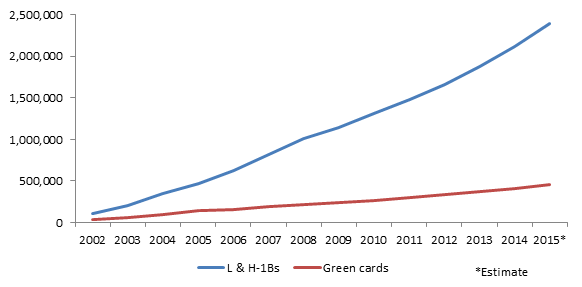
The situation is likely worse than that. We know that the number of Indian temporary workers has increased dramatically relative to the number of green cards issued to them in the past couple decades (Figure 2). We also know that roughly half of all employment-based labor certifications (the step employers complete prior to submitting most EB-2 and EB-3 green card petitions) are for Indian workers.

Figure 2: Total Cumulative Green Cards and L or H-1B Visas Issued to Indians Since 2007
h1bslsgreencardsSources: H-1B/Ls: USCIS/State Department; Green cards: DHS

Since 2002, 450,000 Indians received a green card, while roughly 2.4 million high-skilled immigrants from India and their families have entered under the H visa or L visa (for employees transferring to a U.S. branch of their company). Some portion of these workers could have been beneficiaries of an EB-3 green card petition after 2007, the last date on which we know anything about who is in line.

They’ll be waiting somewhere between 50 and 350 years. All we know is this: somewhere between 230,000 and 2 million Indian workers are in the backlog, so they’ll be waiting somewhere between half a century and three and a half centuries. It is entirely possible that many of these workers will be dead before they receive their green cards. And that’s just one country. The backlogs for Chinese immigrants and immigrants from the Philippines continue to grow as well.

America’s immigration system is broken worse than anyone can even know.

David_BierDavid Bier

David Bier is an immigration policy analyst at the Cato Institute’s Center for Global Liberty and Prosperity.

This article was originally published on FEE.org. Read the original article.

One of the Greatest Entrepreneurs in American History – Article by Daniel Oliver and Lawrence W. Reed

One of the Greatest Entrepreneurs in American History – Article by Daniel Oliver and Lawrence W. Reed

The New Renaissance HatDaniel Oliver and Lawrence W. Reed
******************************
Introduction by Lawrence W. Reed
***

One hundred years ago this May, James J. Hill, the subject of this fine 2001 essay by Daniel Oliver, passed away. Hill was 77 when he died on May 29, 1916, leaving a legacy of achievement surpassed only by a handful of the many great entrepreneurs in American history. He defied the now-infamous epithet, “You didn’t build that.”

James J. Hill was a “1 percenter” of his day who improved the lives of others not by giving speeches but by creating wealth.  

Hill was no Leland Stanford, who used his political connections to get the California legislature to ban competition with his Central Pacific Railroad. Hill was happy to compete because he knew he could. Perhaps he also had the conscience and good character that political entrepreneurs often lack. He built the only privately funded transcontinental railroad in American history. Unlike the ones that he competed with and that were government subsidized, his operation never went bankrupt.

Thirty years ago, I wrote a newspaper column about Hill. One of the papers that published it was the Havre Daily News in northern Montana. It turned out that the little town of Havre was the headquarters of the western division of the Burlington Northern, the successor railroad to Hill’s Great Northern. The division’s president contacted me to express appreciation and to invite me to give a couple of speeches in town. If I accepted, he promised to put me up in an old but restored executive rail car that Hill had built himself. How could I say no?!

For two nights, I lodged on the tracks in that beautiful car, marveling at its turn-of-the-19th-century fixtures and thinking how cool it was that all around me were vestiges of Hill himself. Only two other people were housed in the car during my stay — the cook who prepared my breakfasts and a security guard. After my speeches, Burlington Northern workers hooked the car to a locomotive. Accompanied by the division president and the local newspaper editor, I then experienced one of the most memorable rides of my life — west across northern Montana, through the Marias Pass that Hill himself chose as the best route for his tracks, ultimately arriving and disembarking at the town of Whitefish.

As Oliver explains, Hill deserves to be remembered as a builder, a risk-taker, and an innovator. He was a “1 percenter” of his day who immeasurably improved the lives of others not by giving speeches but by creating wealth.

— Lawrence W. Reed
President, Foundation for Economic Education


In 1962, Ayn Rand gave a lecture titled “America’s Persecuted Minority: Big Business” (collected in Capitalism: The Unknown Ideal), in which she identified two types of businessmen. Burton W. Folsom Jr. later called these “economic and political businessmen.” The first were self-made men who earned their wealth through hard work and free trade; the second were men with political connections who made their fortunes through privileges from the government.

Never before had someone tried to build a railroad without government land and grants. 

James Jerome Hill, builder of the Great Northern Railroad, was the only 19th century railroad entrepreneur who received no federal subsidies to build his railroads. All other builders, such as Cornelius Vanderbilt, received aid. Perhaps more than any other American, Hill helped to transform the American Northwest by opening it to widespread settlement, farming, and commercial development. In the process, he became one of the wealthiest men of the Gilded Age, amassing a fortune estimated at $63 million.

Some critics have charged that Hill did indeed receive federal subsidies to construct the Great Northern. But this charge confuses federal subsidies with land grants. Unlike a taxpayer subsidy, a land grant is the ceding of unimproved government land to a private developer. Critics wrongly assume that government has the power to acquire land by non-Lockean means — that is, by simply claiming to own it without “mixing one’s labor with the land.”

Early Career

Hill was born in the small town of Rockwood in southern Ontario, on September 16, 1838. Because his father died when Hill was young, he had to temporarily forgo formal education to help with family finances. Showing academic ability, however, he received free tuition at Rockwood Academy. Hill later lost an eye to an accidental arrow shot, which prevented him from pursuing the career in medicine that his parents had hoped for.

At age 18, Hill became interested in the Far East and decided on a career in trade. He headed west in hopes of joining a team of trappers, arriving by steamboat in St. Paul, a major fur-trading center, on July 21, 1856. However, Hill missed the last brigade of the year and had to stay in the city. Nonetheless, he grew to like St. Paul and decided to remain there.

Hill’s first job was as a forwarding agent for the Mississippi River Steamboat Company. He set freight and passenger rates and learned about steamboat operations. Unable to fight in the War between the States because of his eye, Hill organized the First Minnesota Volunteers. He also worked as a warehouseman, pressing and selling hay for the troops’ horses. It was there that he learned how to buy and sell goods at a profit and use the least expensive method to ship goods.

After the war, Hill became an agent for the First Division of the St. Paul & Pacific Railroad. At the time, the line used wood for fuel. Hill believed rightly that coal would be cheaper, so he made a contract with the company to supply it. He also formed a business with Chauncey W. Griggs, a Connecticut man in the wholesale grocery business. Together, they created Hill, Griggs & Company, a fuel, freighting, merchandising, and warehouse company.

Hill later became interested in the Red River of the North that flows north to Lake Winnipeg. Since Fort Garry (now Winnipeg) was an important Hudson’s Bay Company trading post, Hill began transporting personal belongings there. Later, Hudson’s Bay employee Norman Kittson left the company to join Hill in forming the Red River Transportation Company.

In 1870, Hill traveled up the Red River to investigate a French and Indian mob that had captured Fort Garry. During that trip and others, Hill saw the region’s rich soil while observing the St. Paul & Pacific’s steady decline. He became convinced that he could make the line profitable by extending it to Fort Garry. When the panic of 1873 put the railroad under receivership, he saw his chance to buy it and other lines in crisis.

Hill and Kittson went to Donald Smith of the Hudson’s Bay Company and told him their plan. Smith offered money and approached George Stephen, president of the Bank of Montreal. Together, the four bought the St. Paul & Pacific for $280,000 (millions in today’s dollars), which Hill estimated as only 20 percent of its real value.

Hill purchased rails, rolling stock, and locomotives and hired laborers who laid more than a mile of track a day. In 1879, the tracks were connected at St. Vincent, Minnesota, to a Canadian Pacific branch from Fort Garry. Since the Canadian Pacific’s transcontinental route was not yet completed, all traffic through Fort Garry had to use Hill’s route. He received two million acres of land through the Minnesota Land Grant for completing the rail line on time. He also renamed his railroad the St. Paul, Minneapolis, & Manitoba. His timing was perfect since the area experienced two exceptional harvests that brought extra business. In addition, a major increase of immigrants from Norway and Sweden allowed Hill to sell homesteads from the land grant for $2.50 to $5.00 an acre.

Expanding the Line

While planning the St. Paul, Minneapolis, & Manitoba, Hill was also involved in constructing the Canadian Pacific Railway. While Donald Smith and George Stephen led this transcontinental route, Hill gave advice about selecting routes and construction techniques. But because the Canadian Pacific would soon compete with his own planned transcontinental route, Hill resigned from the business and sold all his stock in 1882.

Only a year after purchasing the St. Paul & Pacific, Hill decided to extend his railroad to the Pacific. Many thought that he could never do it. Never before had someone tried to build a railroad without government land and grants. Railroads like the Union Pacific, Central Pacific, and Northern Pacific were all given millions of acres of government land to build their transcontinental routes. People thought that even if Hill could achieve his dream, he wouldn’t be able to compete with government-funded lines. His quest came to be known as “Hill’s Folly.”

The St. Paul, Minneapolis, & Manitoba reached Minot, North Dakota, in 1886. Because the Northern Pacific had steep grades and high interest charges and was saddled by high property taxes, the new railroad resulted in a much more profitable route.

A railroad line would obviously help the economy of any town it passed, so Hill was able to get good rights of way. However, one town, Fort Benton, Montana, rejected Hill’s request for a right of way. He decided to cut the town off by building around it. Showing his attitude toward those who tried to stand in his way, Hill left Fort Benton one mile from the railroad.

After speedy construction using 8,000 men and 3,300 teams of horses, the St. Paul, Minneapolis, & Manitoba reached Great Falls in October 1887. Hill connected it there with the Montana Central Railroad, which went on to Helena, bringing lots of new business. In 1890, he consolidated his railroad into the Great Northern Railroad Company.

Hill also encouraged settlement along the lines by letting immigrants travel halfway across the country for $10. In addition, he rented cheap freight cars to entire families. These strategies, rarely used by other railroads, encouraged even more business.

People thought Hill wouldn’t be able to compete with government-funded lines.

In 1893, the St. Paul, Minneapolis, & Manitoba reached Puget Sound at Everett, Washington. However, during the same year, a panic put the Northern Pacific as well as the Santa Fe and Union Pacific into receivership. Hill made an agreement with businessman Edward Tuck and Bank of Montreal associate Lord Mount Stephen to buy the Northern Pacific. A stockholder objected, however, arguing the deal would violate Minnesota law, and the agreement was stopped. But Hill got around this by having his associates help buy Northern Pacific stock as individuals instead of as a company. The Northern Pacific became part of the Great Northern in 1896. The lines came to be widely known as the “Hill Lines.”

Hill realized that the only eastbound traffic for the first few years would be lumber, and this limitation would make the line less profitable than it might be. Wishing to acquire a line to Chicago and St. Louis, where he could deliver the lumber, Hill researched the Chicago, Burlington, & Quincy railroad that stretched from the Great Lakes to the Rocky Mountains. This acquisition would also give him a line that could haul cotton to St. Louis and Kansas City and connect to the smelters of Denver and the Black Hills. The trains would be kept full at all times. Working with J.P. Morgan, Hill purchased the Chicago, Burlington, & Quincy.

Hill began to expand his shipping empire internationally via Seattle. He supplied Japan with cotton from the south and shipped New England cotton goods to China. He also shipped northern goods such as Minnesota flour and Colorado metals to Asia.

Hill continued to expand his railroads in the early 20th century. He bought the Spokane, Portland, & Seattle Railway and added a 165-mile line from Columbia along the Deschutes River to the town of Bend. He also purchased several electric rail lines to compete with the Southern Pacific, and an ocean terminal at the mouth of the Columbia River near Astoria. He had two large steamships that operated between the terminal and San Francisco. This proved to be good competition for the Southern Pacific.

Conservation

Hill had many other business interests, including coal and iron-ore mining, shipping on the Great Lakes, finance, and milling. A major related interest was farmland conservation. Hill was widely known in his day as a leader in this area. Unlike most environmentalists today, Hill believed that natural resources should be privately owned and locally controlled, although in some cases he believed state-level ownership was justifiable. He considered the federal government too distant to competently manage resources. Indeed, he once criticized the US Forest Service, saying that “The worst scandals of state land misappropriation, and there were many, are insignificant when compared with the record of the nation.”

His interest in conservation stemmed both from his concern for the nation’s food supply, a popular philanthropic cause at the time, and from business concerns. Since his railroads largely transported agricultural products, Hill paid close attention to fluctuations in the grain markets. Falling grain yields in the Great Plains would mean fewer goods to transport.

Believing that better farming methods would both increase yields and conserve soil quality, Hill used his own resources for agricultural research and for the dissemination of findings to farmers. He even had his own greenhouse that served as a laboratory. He hired agronomy professor Frederick Crane to do soil analyses in Minnesota, Montana, and North and South Dakota. Farmers were paid to cultivate experimental plots on their land according to Crane’s instructions. These were a tremendous success, yielding 60 to 90 percent more than the conventional acreage of the time.

In a speech, Hill once said,

Out of the conservation movement in its practical application to our common life may come wealth greater than could be won by the overthrow of kingdoms and the annexation of provinces; national prestige and individual well-being; the gift of broader mental horizons, and best and most necessary of all, the quality of a national citizenship which has learned to rule its own spirit and to rise by the control of its desires.

In 1908, President Theodore Roosevelt invited Hill to a governors’ conference on conservation and appointed him to a lands commission. Hill was never pleased with the position, preferring action to talking, but he did make his views known.

Hill was also a major philanthropist. He supported the Roman Catholic seminary in St. Paul and endowed the Hill Reference Library, which operates to this day.

Views on Government

Hill was a great champion of free markets. He was particularly critical of tariffs, calling them “a great enemy of conservation” and pointing out that by prohibiting imports of such products as timber from other countries, the United States was accelerating the depletion of its own. Regarding the federal government’s ability to conserve resources, he once said, “The machine is too big and too distant, its operation is slow, cumbrous and costly.”

A 1910 speech to the National Conservation Congress in St. Paul summarizes Hill’s views on government. He remarked,

Shall we abandon everything to centralized authority, going the way of every lost and ruined government in the history of the world, or meet our personal duty by personal labor through the organs of local self-government, not yet wholly atrophied by disuse…? Shall we permit the continued increase of public expenditure and public debt until capital and credit have suffered in the same conflict that overthrew prosperous and happy nations in the past, or insist upon a return to honest and practical economy?

Hill once said, “The wealth of the country, its capital, its credit, must be saved from the predatory poor as well as the predatory rich, but above all from the predatory politician.”

A Classic Entrepreneur

In 1907, at the age of 69, Hill turned over leadership of the Great Northern to his son, Louis W. Hill. But he remained active in running his railroads and went to his office in St. Paul every day.

In May 1916, Hill became ill with an infection that quickly spread. He went into a coma and died on May 29 at the age of 77. At 2:00 p.m. on May 31, the time of his funeral, every train and steamship of the Great Northern came to a stop for five minutes to honor him.

“Shall we abandon everything to centralized authority, going the way of every lost and ruined government in the history of the world?” — James J. Hill  

Hill exhibited the classic traits of a successful entrepreneur. He diligently studied all aspects of his businesses, such as which mode of transport was best for carrying track to be laid: caboose, handcar, horse, locomotive, or passenger coach. He did all the analyses of grades and curves himself and often argued with his engineers and track foremen, demanding changes that he felt necessary. He insisted on building strong bridges made with thick granite and on using the biggest locomotives and the best quality steel.

At the end of his life, a reporter asked Hill to explain the reason for his success. He replied simply that it was due to hard work. His hard work earned him the title “the Empire Builder,” and at the 1915 Panama-Pacific Exposition in San Francisco, he was named Minnesota’s greatest living citizen.

Hill was remarkable because he developed an area that most people thought never could be developed. His railroads made Minnesota and the Dakotas major destinations for huge waves of immigrants. In fact, Hill sent employees to Europe to show slides of western farming in efforts to urge Scotsmen, Englishmen, Norwegians, and Swedes to settle in the Pacific Northwest. As a result, more than six million acres of Montana were settled in two years. And because of Hill, the small town of Seattle, Washington, became a major international shipping port.

James Jerome Hill has rightly earned a place as one of the greatest entrepreneurs in American history.


Daniel Oliver

Daniel Oliver is a research associate at the Washington, DC-based Capital Research Center and a freelance writer. 

Lawrence W. Reed

Lawrence W. Reed is President of the Foundation for Economic Education and the author of the forthcoming book, Real Heroes: Inspiring True Stories of Courage, Character and Conviction. Follow on Twitter and Like on Facebook.

This article was originally published on FEE.org. Read the original article.

Brazil’s Lost Decade: We Must Free Our Economy – Article by Felipe Capella

Brazil’s Lost Decade: We Must Free Our Economy – Article by Felipe Capella

The New Renaissance HatFelipe Capella
******************************

It was a lost decade for Latin America. Years of populist governments combined with a commodity boom turned out to be our oil curse, our Dutch Disease. This disastrous mix made bad public policies look like temporary successes, pushing developing countries to an unsustainable path. The collectivist ideology monopolized the debate for more than 10 years, and now that the natural resource party is over, the harm of these policies have become clearer: deep economic crisis generated by a utopia whose greatest achievement was turning toilet paper into a rare-earth product.

Populist and authoritarian South American regimes have set up government bureaucracies aimed at pleasing special interest groups that provide political support while tirelessly harming the population as a whole. These groups are divided into several small groups with special rights and privileges: judges, civil servants, members of parliament, friendly businessmen. These factions are getting their more-than-fair share while the unprivileged citizen foots the bill.

Latin American politicians played it very well during these favorable times. Cronyism and populism greatly benefited some chosen groups, while the harms were diffused enough throughout the whole country and difficult to measure during favorable economic winds. Brazil is just the biggest and clearest example of that.

How We Got Here 

For many years Brazil’s road to serfdom was being paved by the left through a combination of the world’s worst ideas: a Venezuelan-like project to subordinate decisions of the Supreme Court to the ratification of Congress; an Ecuadorian will to regulate and control the free press; a Russian compassion for cronies handpicked by the executive; Greek style benefits for public servants; Southern European pension costs (for a much younger population); Argentinean barriers for international trade, and an American/EU taste for subsidies.

The former — and now failed — cherry-picked billionaire darling of the regime Eike Batista was showered with tax funds while ordinary entrepreneurs lacked governmental support; friendly national industries were heavily protected, while people were taxed up to 50 percent on food and health supplies. Oi Telecom, a multibillion dollar mobile company, is just the most recent example of Lula’s national-champion policy (the company has just filed for bankruptcy, with 17 percent of its debt held by state-owned banks).

That was the result of 10 years of left-populist government in Brazil, all of them enjoying the applause of the international press. For years The New York Times constantly published articles with a pro-Dilma/Lula tone. Right after Dilma’s reelection — which is now known to have been funded by money siphoned from state-owned companies — The NYT published a piece half-mocking 48 percent of voters that were concerned about Dilma’s economic and political approaches.

The good thing about bad journalism is that reality eventually catches up with it. Since that 2014 article, Dilma has since lost her job and is about to be impeached for illegal budgetary schemes and deep corruption. Her top aides are all in jail or about to be thrown there, accused of stealing dozens of billions of dollars, including former Ministers and three former treasurers of her Labor Party (which some people now deem to be the most dangerous job in the world). Brazil is in its worst economic crisis since the 1930s, which has been worsening since 2014 (while Dilma was coming up with her now-famous accounting tricks to fool the Brazilian voters). Lula had even become a frequent contributor of The Times after his presidency, but now faces criminal charges and has seen the federal police knock on his door with a coercive trip to the criminal courts.

In its recent opinion page about the failed Rio Olympic Games preparation, The NYT’s favorite Brazilian correspondent Vanessa Barbara wrote that “political turmoil has paralyzed the country and frozen the economy.” This rhetoric of blaming “political turmoil” for Latin American calamities does not help to set the record straight. The problems with the Olympic games stem directly from Dilma’s and Lula’s incompetence and corruption. But the problem also lies on media vehicles like The Times, always ready to turn a blind eye to mismanagement and corruption in the name of ideology.

So here we are. Brazil is a failing state after a decade of populist presidents, misguided policies and commodity boom, all under the auspices of the progressive press.

The Need for Laissez-Faire Liberalism

For a long time, Brazil has been a place where liberalism (i.e., the ideology of freedom and free markets) was mostly marginalized, despite its positive track-record. In the minds of most Brazilians, being liberal was conspiring for the wealthy, being socialist is taking care of the poor.

But if The Times does not want to recognize its mistakes, apparently the Brazilian population is more willing to deal with self-criticism. There is now a strong resurgence of liberalism throughout the country.

Partido Novo (“New Party”) is a new political party created with a clear liberal approach to the economy, and it is just one of the recent examples of how liberalism is growing in the country, waking up millions of Brazilians who were orphans of a liberal political leadership. Many creative and hardworking people that do not think that socialism (or heavy-handed South American social democracy) will make our countries more prosperous. There are substantial constituencies that want public policies driven by research, metrics and actual public interest.

Free Trade Is the Key

The European Union has no appetite and no urgency to negotiate any comprehensive trade agreement with Mercosur or other Latin American countries. The United States faces a choice between a populist protectionist and a trade-dubious democrat (to put it mildly).

It is essential for the world that someone — anyone — pushes forward the liberal pro-trade agenda. As we natives well know, it is never wise to bet on Brazil as a global force for good. But maybe — just maybe — because we are suffering first-hand the harms of a decade of interventionist, protectionist, and corrupted government, we can somehow understand that populism is an illusory lucky charm that actually curses a country for years to come; and maybe — just maybe — we can do something to redeem ourselves.

Now that international trade seems under constant attack from all places and political spectrums, and no big world economy wants to step up and bluntly defend the liberal track record — including the United States — maybe Brazil could become the champion of good policy at last, pushing for reforms throughout Latin America and holding the liberal torch high in these dark times.

As Roberto Campos advised decades ago, for us Brazilians there are only three ways out of the current mess: Rio’s airport, Sao Paulo’s airport, and Liberalism.

Felipe Capella is an attorney turned entrepreneur. He is a former law professor at the Federal University of Santa Catarina (Brazil), former attorney at Sullivan & Cromwell (New York) and the Inter-American Development Bank (Washington, DC), has Master degrees from UPenn/Wharton and Universidad Francisco de Vitoria (Spain), and holds an MBA from FGV (Brazil).

This article was published on Mises.org and may be freely distributed, subject to a Creative Commons Attribution United States License, which requires that credit be given to the author.