Three Specters of Immortality: A Talk from the Radical Life-Extension Conference in Washington D.C. – Article by Franco Cortese

Three Specters of Immortality: A Talk from the Radical Life-Extension Conference in Washington D.C. – Article by Franco Cortese

The New Renaissance Hat
Franco Cortese
October 20, 2013
******************************

Author’s Note: The following is a transcript of a talk given at the recent Radical Life Extension Conference held in the U.S. Capitol on September 22,2013. Talks were also given by Antonei B. Csoka, Gabriel Rothblatt, Tom Mooney, Mark Waser, Gray Scott, Josh Mitteldorf, Maitreya One, Jennifer ‘Dotora’ Huse and Apneet Jolly. A special thanks to David Pizer for making this article available for distribution at the upcoming Society for Venturism 2013 Cryonics Conference in Laughlin, Nevada, on October 25-27th.

Introduction

I would like to address what I consider to be three common criticisms against the desirability and ethicality of life-extension I come across all too often – three specters of immortality, if you will. These will be (1) overpopulation (the criticism that widely available life-extension therapies will cause unmanageable overpopulation), (2) naturality (the criticism that life extension is wrong because it is unnatural), and (3) selfishness (the criticism that life-extension researchers, activists, and supporters are motivated by a desire to increase their own, personal lifespans rather than by a desire to decrease involuntary suffering in the world at large).

But first I would like to comment on why this would be important. I would consider two of the three critiques – namely the naturality critique and the selfishness critique – to be largely unfounded and vacuous; I don’t think they will be real worries when comprehensive life-extension therapies arrive. I think that the overpopulation critique does have some weight to it; we do in fact need to plan for and manage the effects of a growing population. However, the overpopulation critique is wrong in assuming that such affects will be unmanageable.

So if at least 2 of these 3 critiques are largely unfounded, then what’s the worry? Won’t they simply disappear when life extension is achieved, if they are really so baseless? Well, yes, but the possibility of their turning out to be right at the end of the day is not what makes them worrying.

What makes them worrying is the fact that they deter widespread support of life extension from the general public, because they stop many people from seeing the advantage and desirability of life extension today. A somewhat common, though thankfully not predominant, attitude I find from some longevity supporters is that work is being done, progress is being made, and that the best course of action for those who want to be around to benefit from the advances in medicine already on the developmental horizon is simply to live as healthily as we can today while waiting for tomorrow’s promise. I don’t think this attitude necessarily deters progress in the life-extension field, but I certainly don’t think it helps it very much either. I think such people are under the pretense that it will take as long as it needs to, and that there is nothing the average person can really do to speed things up and hasten progress in the field. Quite to the contrary, I think every man and woman in this room can play as central a role in hastening progress in the field of life extension as researchers and scientists can.

This is largely due to the fact that just what is considered worthy of scientific study is to a very large extent out of the hands of the average scientist. The large majority of working-day scientists don’t have as much creative license and choice over what they research as we would like to think they do. Scientists have to make their studies conform to the kinds of research that are getting funded. In order to get funding, more often than not they have to do research on what the scientific community considers important or interesting, rather than on what they personally might find the most important or interesting. And what the scientific community considers important and worthy of research is, by and large, determined by what the wider public considers important.

Thus if we want to increase the funding available to academic projects pertaining to life extension, we should be increasing public support for it first and foremost. We should be catalyzing popular interest in and knowledge of life extension. Strangely enough, the objective of increased funding can be more successfully and efficiently achieved, per unit of time or effort, by increasing public support and demand via activism, advocacy, and lobbying, rather than by, say, direct funding, period.

Thus, even if most of these three criticisms, these specters of immortality, are to some extent baseless, refuting them is still important insofar as it increases public support for life extension, thereby hastening progress in the field. We need massive amounts of people to wake up and very explicitly communicate their desire for increased funding in biomedical gerontology, a.k.a. life extension. I think that this is what will catalyze progress in the field – very clear widespread demand for increased funding and attention for life extension.

This is something I think each and every man and woman here today can do – that is, become a life-extension activist and advocate. It is not only one of the easiest ways in which you can contribute to the movement – it may very well be the most important and effective ways that you can contribute to the movement as well. Send an email to the International Longevity Alliance (info@longevityalliance.org), an organization dedicated to social advocacy of life extension, which is compiling a list of life-extension advocates and networking them together. Arrange and organize your own local life-extension rally or demonstration, like the one held last year in Brussels. This could be as easy as holding up signs supporting scientific research into aging in the most traffic-dense location in your local area, recording it, and posting it on YouTube.

And so, without further ado, I’d like to move on to the three specters of immortality.

1. The Unmanageable-Overpopulation Critique

Firstly, I’d like to turn a critique of the possible undesirable societal and demographic repercussions of life extension. The most prominent among these kinds of critiques is that of overpopulation – namely that the widespread availability of life-extension therapies will cause unmanageable overpopulation and a rapid depletion of our scarce resources.

I think this critique, out of those three critiques addressed here, is really the only one that is a real worry. That is because potential negative societal repercussions of life extension are a real possibility, and must be appropriately addressed if they are to be avoided or mitigated. And don’t get me wrong – they are manageable problems that can be handled if we make sure to plan for them sufficiently, and allocate enough attention to them before their effects are upon us.

According to some studies, such as one performed by S. Jay Olshanksy, a member of the board of directors for the American Federation of Aging Research (and the foremost advocate and promulgator of the Longevity Dividend), if the mortality rate dropped to zero tomorrow – that is, if everyone in the world received life-extension therapies comprehensive enough to extend their lives indefinitely – we would experience a rise in population less than the growth in population we experienced following the Post-World-War-II baby-boom. Global society has experienced dramatic increases in population growth before – and when that happened we extended and added to our infrastructure accordingly in order to accommodate them. When significant increases in life extension begin to happen, I expect that we will do the same. But we must make sure to plan ahead. Overpopulation will be an insoluble problem only if we ignore it until its perceptible effects are upon us.

Luckily, there are a number of existing solution-paradigms to other, somewhat related problems and concerns that can be leveraged to help mitigate the scarcitizing effects of overpopulation on resources and living-space.

Contemporary concerns over the depletion of non-renewable resources, such as but not limited to climate change, can be leveraged to help lessen the detrimental effect overpopulation might have on non-renewable resources.

Another contemporary solution paradigm we can leverage to help mitigate the detrimental effects of overpopulation on living space is seasteading. This is the notion of creating permanent dwellings and structures at sea, essentially floating cities, outside of the territory of governments – more often than not to get around legal complications relating to whatever the prospective seasteaders wish to do. This movement is already bringing about designs and feasibility studies relating to the safe construction of very large floating cities.

The most common solution-paradigms proposed to combat the problems of resources and living space are space colonization and regulating how many children people can have. I think that long before we turn to these options, we will begin to better maximize the existing living space we have. 75% of the earth’s surface area is water. I think that we will colonize the oceans long before space colonization becomes a more economically optimal option. Further, we currently don’t use the living space we have very well. We live on the surface of a sphere, after all. There is nothing in principle preventing us from building taller and building deeper. We can take from existing proposals and feasibility studies pertaining to megastructures – that is, very large man-made structures – to build much bigger than we currently do.

Another existing field that can help lessen the potential resource-depleting effects of a growing global population is agricultural labs, indoor farming systems, and vertical farms. Such systems are in use today for large-scale food production. This would allow us to take all the space we currently have devoted to agriculture (roughly 40% of earth’s total land-area according to some estimates – see here and here) and move it underground or indoors.

Thus overpopulation is a real worry, but we have the potential solutions to its problematic effects today. We can leverage several existing solution-paradigms proposed to combat several contemporary problems and concerns in order to manage the scarcitizing effects of overpopulation on resources and living space.

2. The Naturality Critique

I’d like to turn to the Naturality criticism now – the criticism that life-extension is unnatural, dehumanizing and an affront to our human dignity.  – This could not be farther from the truth. The stanch revulsion we have of death is right; appropriate; a perfectly natural response.

Besides which, “naturality,” insofar as it pertains to humans, is an illegitimate notion to begin with. For us human beings, naturality is unnatural. It is we who have cast off animality in the name of mind, we who have ripped dead matter asunder to infuse it with the works of our mind – we who have crafted clothes, codes, cities, symbols, and culture. Since the very inception of human civilization, we have very thoroughly ceased to be natural, and to such an extent that unnaturality has become our first nature.

Firstly, one thing that I think undercuts the critique of naturality rather well is the known existence of biologically immortal organisms. There are in fact known organisms where the statistical probability of mortality does not increase with age. Meaning that if one kept these organisms healthily fed and in a good environment for them, then they simply shouldn’t die. Not only are there proofs of concept for biological immortality – but it can be found in nature unmodified by man.

Hydras, small freshwater organisms, do not undergo cellular senescence and are able to maintain their telomere lengths throughout continued cell division. The jellyfish Turritopsis Nutricula can, through a process called cellular transdifferentiation, revert back to the polyp stage (an earlier stage in its developmental cycle) a potentially indefinite number of times. Planarian Flatworms also appear to be biologically immortal, and can maintain their telomere lengths through a large population of highly proliferative adult stem cells. And if you can believe it, an organism as commonplace as the lobster also appears to be biologically immortal. Older lobsters are more fertile than young lobsters, and they don’t appear to weaken or slow down with age.

There is then such a thing as biological immortality. In biology it’s defined as a stable or decreasing rate or mortality from cellular senescence as a function of chronological age. Meaning that barring such accidents as being eaten by prey, such organisms should continue to live indefinitely.

I also think that this is great proof of concept for people who automatically associate the magnitude of the endeavor with its complexity or difficulty, and assume that achieving biological immortality is technically infeasible simply due to the sheer profundity of the objective. But in regards to naturality, I think the existence of such biologically immortal organisms goes to show that there is nothing necessarily unnatural about biological immortality – because it has already been achieved by blind evolution in various naturally-occurring biological organisms.

Secondly, I think that the long history of seminal thinkers who have contemplated the notion of human biological immortality, the historical antecedents of the contemporary life-extension movement, help to combat the naturality criticism as well. Believe it or not, people have been speculating about the scientific abolition of involuntary death for hundreds of years at least.

As early as 1795, nearly 220 years ago, Marquis de Condorcet wrote

“Would it be absurd now to suppose that the improvement of the human race should be regarded as capable of unlimited progress? That a time will come when death would result only from extraordinary accidents or the more and more gradual wearing out of vitality, and that, finally, the duration of the average interval between birth and wearing out has itself no specific limit whatsoever? No doubt man will not become immortal, but cannot the span constantly increase between the moment he begins to live and the time when naturally, without illness or accident, he finds life a burden?”

Here we see one of the fathers of the enlightenment tradition speculating on whether it is really that absurd to contemplate the notion of a continually-increasing human lifespan.

In 1773, 240 years ago, Benjamin Franklin wrote in a letter to Jacques Duborg, first praising the sagacity and humanity demonstrated by his attempt to bring animals back from the dead, and then describing what can only be a harkening of cryonics and suspended animation, where he wishes that there were a way for him to be revived a century hence, and witness the progress in science that had been made since the time of his death.

“Your observations on the causes of death, and the experiments which you propose for recalling to life those who appear to be killed by lightning, demonstrate equally your sagacity and your humanity. It appears that the doctrine of life and death in general is yet but little understood…

I wish it were possible… to invent a method of embalming drowned persons, in such a manner that they might be recalled to life at any period, however distant; for having a very ardent desire to see and observe the state of America a hundred years hence, I should prefer to an ordinary death, being immersed with a few friends in a cask of Madeira, until that time, then to be recalled to life by the solar warmth of my dear country! But… in all probability, we live in a century too little advanced, and too near the infancy of science, to see such an art brought in our time to its perfection…”

Thus the notion of human biological immortality through science and medicine is not as new as most of us are probably quick to presume. Men of stature and intellect, respected and admired historical figures, have been contemplating the prospect for hundreds of years at least.

Thirdly, I think that religion itself exemplifies our desire for indefinite lifespans. This may seem counter-intuitive considering that many criticisms of life extension come from underlying religious arguments and worldviews – for instance that we shouldn’t be playing god, or messing with the way god created us. But the fact is that most religions have a conception of the afterlife – i.e., of eternal life following the physical death of the body. The fact that belief in an afterlife is a feature shared by almost all historical religions, that belief in an afterlife was conceived in a whole host of cultures independent of one another, shows that indefinite lifespans is one of humanity’s most deep-rooted and common longings and desires – indeed, one so deep-rooted that it transcends cultural distance and deep historical time.

3. The Selfishness Critique

Now I’d like to turn to the third specter of immortality – the criticism of selfishness. Whereas the first specter of immortality was a critique of the ethicality of life extension, this second specter is more a moralistic critique of the worthiness of actually spending one’s time trying to further progress in the field today.

The view that life-extension researchers, activists and supporters are arrogant for thinking that we somehow deserve to live longer than those that came before us – as though we were trying to increase public support for and interest in life extension merely for the sake of continuing our own lives. This, too, is, I think, a rather baseless criticism. Every life-extension researcher, activist, scholar and supporter I know does it not solely for the sake of their own lives but for the sake of the 100,000 people that die every day due to age-correlated causes. That’s right, ladies and gentlemen, 100,000 people will die from aging today, lost forever to causes that are in principle preventable and ultimately unnecessary. There are roughly 86,000 seconds in a day. That works out to a little more than one death per second. That’s about equal to the entire population of Washington, DC, dying every week, 3 million preventable deaths per month, and 36.5 million deaths per year. A group larger than the entire population of Canada will die from aging this year – and the fact that it sickens so few of us is incredibly sickening to me. This is an untenable situation for a civilization as capable as ours – we who have reshaped the world over, we who have gone to the moon, we who have manipulated atoms despite out fat monkey fingers. Humanity is an incredibly powerful and unprecedented phenomenon, and to say that we simply cannot do anything about death is to laugh in the face of history to some extent. Recall that very learned and esteemed men once said that heavier-than-air flying machines – and a great many other things we take for granted today – are impossible.

We cringe and cry when we hear of acts of genocide or horrible accidents killing thousands. But this occurs every day, on the toll of 100,000 deaths per day, right under our noses.

Doing something about this daily cataclysm is what drives my own work, and the work of most every life-extension supporter I know. The life-extension movement is about decreasing the amount of involuntary suffering in the world, and only lastly about our own, personal longevity, if at all. The eradication of involuntary death via science and medicine is nothing less than the humanitarian imperative of our times!

And again, this is something that I think each and every one of you can take part in. Become a life-extension supporter, advocate and activist. It may be not only the easiest way that you can contribute to hastening progress in the field of life extension, but the most effective way as well. Thank you.

###

Franco Cortese is a futurist, author, editor, Affiliate Scholar at the Institute for Ethics & Emerging Technologies, Ambassador at The Seasteading Institute, Affiliate Researcher at ELPIs Foundation for Indefinite Lifespans, Fellow at Brighter Brains Institute, Advisor at the Lifeboat Foundation (Futurists Board Member and Life Extension Scientific Advisory Board Member), Director of the Canadian Longevity Alliance, Activist at the International Longevity Alliance, Canadian Ambassador at Longevity Intelligence Communications, an Administrator at MILE (Movement for Indefinite Life Extension), Columnist at LongeCity, Columnist at H+ Magazine, Executive Director of the Center for Transhumanity, Contributor to the Journal of Geoethical Nanotechnology, India Future Society, Serious Wonder, Immortal Life and The Rational Argumentator. Franco edited Longevitize!: Essays on the Science, Philosophy & Politics of Longevity, a compendium of 150+ essays from over 40 contributing authors.

Transhumanism as the Logical Extrapolation of Humanism – Video by G. Stolyarov II

Transhumanism as the Logical Extrapolation of Humanism – Video by G. Stolyarov II

Mr. Stolyarov explains why transhumanism is humanism taken to its full logical extent by recognizing the possibilities unleashed by technology for improving human potential.

References
– “Transhumanism as the Logical Extrapolation of Humanism” – Post by G. Stolyarov II
– “Human Nature is Tautological” – Video by G. Stolyarov II
– “Human Nature is Tautological” – Essay by G. Stolyarov II
– “Humanism” – Wikipedia

Free Your Talent and the Rest Will Follow – Article by Orly Lobel

Free Your Talent and the Rest Will Follow – Article by Orly Lobel

The New Renaissance Hat
Orly Lobel
October 17, 2013
******************************

Imagine two great cities. Both are blessed with world-class universities, high-tech companies, and a concentration of highly educated professionals. Which will grow faster? Which will become the envy and aspiration for industrial hubs all around the world?

Such was the reality for two emerging regions in the 1970s: California’s Silicon Valley and the high-tech hub of Massachusetts Route 128. Each region benefited from established cities (San Francisco and Boston), strong nearby universities (University of California-Berkeley/Stanford and Harvard/MIT), and large pools of talented people.

We’ve all heard about Silicon Valley, but not so much Route 128. Despite their similarities, and despite the Bostonian hub having three times more jobs than Silicon Valley in the 1970s, Silicon Valley eventually overtook Route 128 in number of start-ups, number of jobs, salaries per capita, and invention rates.

The distinguishing factor for Silicon Valley was an economic environment of openness and mobility. For more than a century, dating back to 1872, California has banned post-employment restrictions. The California Business and Professions Code voids every contract that restrains someone from engaging in a lawful profession, trade, or business. This means that unlike most other states, California’s policy favors open competition and the right to move from job to job without constraint. California courts have repeatedly explained that this ban is about freeing up talent, allowing skilled people to move among ventures for the overall gain of California’s economy.

The data confirm this intuition: Silicon Valley is legendary for the success of employees leaving stable jobs to work out of their garages, starting new ventures that make them millionaires overnight. Stories are abundant of entire teams leaving a large corporation to start a competitive firm. Despite these risks, California employers don’t run away. On the contrary, they seek out the Valley as a prime location to do business. Despite not having the ability to require non-compete clauses from their employees, California companies compete lucratively on a global scale. These businesses think of the talent wars as a repeat game and find other ways to retain the talent they need most.

In fact, the competitive talent policy is also supported by a market spirit of openness and collaboration. Even when restrictions are legally possible—for example, in trade secret disputes—Silicon Valley firms frequently choose to look the other way. Sociologist Annalee Saxenian, who studied the industrial cultures of both Silicon Valley and Route 128 in Massachusetts, found that while Boston’s Route 128 developed a culture of secrecy, hierarchy, and a conservative attitude that feared exchanges and viewed every new company as a threat, Silicon Valley developed an opposing ethos of fluidity and networked collaborations. These exchanges of the Valley gave it an edge over the autarkic environment that developed on the East Coast. In Massachusetts, firms are more likely to be vertically integrated—or to have internalized most production functions—and employee movement among firms occurs less frequently.

New research considering these different attitudes and policy approaches toward the talent wars supports California’s modus operandi.

A recent study by the Federal Reserve and the National Bureau of Economic Research examined job mobility in the nation’s top 20 metropolitan areas and found that high-tech communities throughout California—not only Silicon Valley—have greater job mobility than equivalent communities in other states. Network mapping of connections between inventors also reveals that Silicon Valley has rapidly developed denser inventor networks than other high-tech hubs have.

Researching over two million inventors and almost three million patents over three decades, a 2007 Harvard Business School study by Lee Fleming and Keon Frenken observes a dramatic aggregation of the Silicon Valley regional networks at the beginning of the 1990s. Comparing Boston to Northern California, the study finds that Silicon Valley mushroomed into a giant inventor network and a dense superstructure of connectivity, as small isolated networks came together. By the new century, almost half of all inventors in the area were part of the super-network. By contrast, the transition in Boston occurred much later and much less dramatically.

Michigan provides a natural experiment for understanding the consequences of constraining talent mobility. Until the mid-1980s, Michigan, like California, had banned non-competes. In 1985, as part of an overarching antitrust reform, Michigan began allowing non-competes, like most other states. Several new studies led by MIT Sloan professor Matt Marx look at the effects of this change on the Michigan talent pool. The studies find that not only did mobility drop, but that also once non-competes became prevalent, the region experienced a continuous brain drain: Its star inventors became more likely to move elsewhere, mainly to California. In other words, California gained twice: once from its intra-regional mobility supported by a strong policy that favors such flows, and once from its comparative advantage over regions that suppress mobility.

A virtuous cycle can be put into motion geographically where talent mobility supports professional networks, which in turn enhance regional innovation. Firms can learn to love these environments of high risk and even higher gain. Rather than thinking of every employee who leaves the company as a threat and an enemy, smart companies are beginning to think of their former employees as assets, just as universities wish for the success of their alumni. Companies like Microsoft and Capital One have established networks of alumni. They showcase their former employees’ achievements and practicing rehiring of their best talent, hoping that at least some of those who leave will soon realize that the grass is not always greener elsewhere.

Most importantly, motivation and performance are triggered by commitment and positive incentives to stay, rather than threats and legal restrictions against leaving. In behavioral research I’ve conducted with my co-author On Amir, we find that restrictions over mobility can suppress performance and cause people to feel less committed to the task. Cognitive controls over skill, knowledge, and ideas are worse than controls over other forms of intellectual property because they prevent people from using their creative capacities, they don’t just prevent firms from using inventions that are already out there. So instead of requiring non-competes or threatening litigation over intellectual property, California companies use rewards systems, creating the kind of corporate cultures where employees want to work and do well. Again, a double victory.

Unsurprisingly, when Forbes recently looked at the most inventive cities in the country for 2013 using OECD data, the two top cities were in California: bio-tech haven San Diego, and the legendary home of Silicon Valley, San Francisco. Boston, still vibrant and highly innovative despite its most restrictive attitudes, came in third. Competition is the lifeblood of any economy, and fierce competition over people is the essence of the knowledge economy.

Orly Lobel is the Don Weckstein Professor of Law at the University of San Diego and founding faculty member of the Center for Intellectual Property and Markets. Her latest book is Talent Wants to be Free: Why We Should Learn to Love Leaks, Raids, and Free-Riding (Yale University Press, September 2013).

This article was originally published by The Foundation for Economic Education.
Evolution Has No Moral Value; Life Extension Does – Video by G. Stolyarov II

Evolution Has No Moral Value; Life Extension Does – Video by G. Stolyarov II

Mr. Stolyarov responds to two statements by Michael Garfield and makes the case that evolution should not be pursued as a moral goal in itself; rather, the survival and increased longevity of every individual should be pursued, since our rationality, technology, and moral compass allow us to transcend the cruelty of primeval natural selection.

Mr. Stolyarov also refutes the allegation that older people somehow necessarily become resigned to or accepting of their own death. He presents counterexamples of individuals who lived past the age of 80 and who wished to continue living indefinitely.

See Benjamin Franklin’s thoughts on scientific progress and life extension: “The rapid progress true science now makes occasions my regretting sometimes that I was born too soon. It is impossible to imagine the height to which may be carried, in a thousand years, the power of man over matter. We may, perhaps, deprive large masses of their gravity, and give them absolute levity, for the sake of easy transport. Agriculture may diminish its labor and double its produce: all diseases may by sure means be prevented or cured (not excepting even that of old age,) and our lives lengthened at pleasure, even beyond the antediluvian standard. Oh that moral science were in as fair a way of improvement, that men would cease to be wolves to one another, and that human beings would at length learn what they now improperly call humanity.”

References
– “Life as the Origin and Basis of Morality” – Video Series by G. Stolyarov II – Part 1 and Part 2
– “Eliminating Death – Part 1 – Death as Waste” – Video by G. Stolyarov II
– “World’s Oldest Man Wants To Live Forever” – WayOdd
– “Robert Ettinger” – Wikipedia

Debt-Ceiling Crises: Imagined and Real – Article by D. W. MacKenzie

Debt-Ceiling Crises: Imagined and Real – Article by D. W. MacKenzie

The New Renaissance Hat
D. W. MacKenzie
October 14, 2013
******************************

The federal government shutdown and impending debt ceiling “deadline” have led to near panic over possible default on the national debt. This imagined “default crisis” is a canard used for demagogic fearmongering. That said, the long-term federal financial issues are all too serious.

If federal officials simply continue on with their current financial plans, the U.S. government could run into trouble in early November. Without a debt ceiling increase, the Treasury would be unable to meet some of its financial obligations. Treasury bills would take a hit in international markets. With T-bills losing value in markets, interest rates—especially short-term interest rates—would start to rise. Rising interest rates would impair recovery from the 2008 financial crisis.

The assertion that a debt crisis would impair an already weak economic recovery is correct. However, any claim that the federal government is up against a hard deadline to meet its legal financial obligations is utterly untrue. The federal government holds vast amounts of property, all of which is available to be sold off. How much is needed to cover federal interest payments?

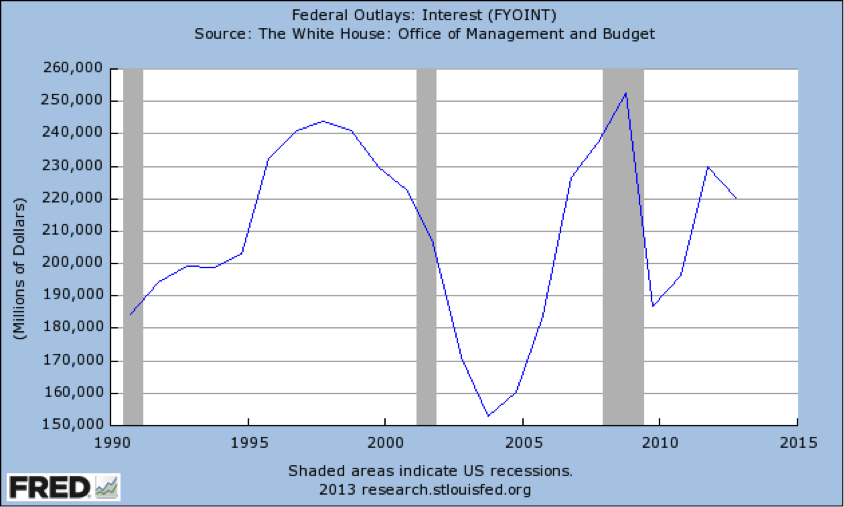
Interest rates are, for the moment, very low. Accordingly, interest payments on the debt are a small percentage of the total federal budget, despite the large size of the national debt.

With annual interest payments at a couple of hundred billion dollars, there is no impending debt-ceiling default crisis.

How exactly could the federal government pay interest on the national debt? To start with, the Federal Reserve now holds large numbers of mortgage-backed securities. There is some uncertainty over the market value of these securities, but their face value is immense, well over one trillion dollars. Sales of some of the better quality mortgage-backed securities could fund interest payments in the short term.

U.S. gold reserves are also substantial. The U.S. holds thousands of tons of gold at Fort Knox and at the New York Federal Reserve.

Sales of a small part of U.S. gold reserves could be used to make immediate interest payments.

The U.S. government also holds large amounts of idle real estate. The federal government spends $8 billion on vacant buildings annually. That’s for an estimated total of 55,000 to 77,000 buildings. The fact that our federal officials aren’t sure how many buildings they manage is itself disturbing, and a sign of incompetence. However, it seems that there are at least over 50,000 such buildings. How many hours would it take for federal employees who “manage” these buildings to post some of them on eBay? Surely sales of these properties would raise enough money to cover federal interest for about a month or two of the next year, even if each of these buildings sold for only a half a million dollars on average.

Efficient, competent public officials could simply announce auctions and begin to sell some of these buildings. Of course, red tape could delay property auctions. However, the Fed could make immediate interest payments by using its discretionary powers to sell mortgage-backed securities and gold reserves. President Obama could, in the meantime, expedite sales of vacant federal buildings—not to mention federal lands—by cutting red tape. (See map of federally managed land.)

The President has already acted in arbitrary—and some would say illegal—ways: by granting special exemptions from the Affordable Care Act to favored corporations, by using drones to kill U.S. citizens, and by targeting unfriendly political groups for audits. If Obama really wants save his beloved federal government from default, why shouldn’t he just use the extraordinary powers that he has already claimed to order the immediate sale of vacant buildings? The point here is not to encourage further illegality on the part of this President (he needs no assistance in such matters). The point here is that Obama does not have his back against a wall; there is no “gun to his head.” Obama has already claimed more than enough discretionary powers to prevent a debt-ceiling default in November. If default does happen it is entirely his choice, given that he has legal options and has already assumed various unconstitutional powers.

Obama has occasionally mentioned that some programs might be trimmed or cut. As Obama put it in 2010, “We cannot sustain a system that bleeds billions of taxpayer dollars on programs that have outlived their usefulness, or exist solely because of the power of a politician, lobbyist, or interest group.” He added, “We simply cannot afford it.”

The federal government holds over 700 million barrels of oil in the Strategic Petroleum Reserve. Obama could raise billions of dollars for interest payments without selling the whole reserve. Some people might see sales of the SPR as irresponsible. However, the oil in this reserve is a small fraction of monthly oil consumption, U.S. oil production is rising, and owners of foreign oil have overwhelming financial interests in continued oil sales to the United States.

The federal government also holds a Strategic Helium Reserve. It was created for “national security,” for blimps used by the military leading up to and during World War II. This program is archaic and the government already sells some helium. It could sell all of it and shut this program down.

Default on the debt is always possible. Obama and his people at the Treasury Department could have refused to pay interest on the national debt last month even though they had this money at hand. They could choose to default next month even though they can get the money—either through legal means or according to Obama’s demonstrated willingness to act illegally. The sale of federal assets and closing of federal programs would do more than just meet short-term interest payments on the national debt. Movement of securities, gold, buildings, oil, and helium would put these resources in the hands of people who would not merely put these resources to better use, but to actual use. The leeway that exists in federal finances points to longer-term financial and economic problems. Why would Obama engage in fearmongering on the national debt when obvious solutions to this problem exist? For that matter, why would federal officials hold so many idle resources for so long?

The reason why the federal government runs deficits nearly every year, despite collecting trillions in annual taxes, is because it wastes vast amounts of money on dysfunctional programs and special-interest payoffs. An efficient government would not need to tax and borrow nearly as much as does the federal government. The gross inefficiency of government has put federal finances in long-term jeopardy.

The real debt ceiling is determined by the ability of all working Americans to pay more taxes. How much more can we pay? Continued structural deficits and rising entitlement spending will result in default on the national debt, but not for a number of years. The existing path of long-term federal spending does surpass the capacity of taxpayers to fund the federal government, as it is currently designed. Future default on the national debt will have severe consequences. However, Obama’s willingness to engage in demagoguery on the immediate debt-ceiling issue is one of many signs that politicians are unwilling to take necessary steps to fix long-term fiscal finances.

The legal debt-ceiling crisis of 2013 is manufactured and phony. Even if Congress refuses to raise the legal debt ceiling this year, there are many ways of avoiding immediate default. The real problem we face is wasteful and irresponsible spending that will make default unavoidable eventually. Long-run default is, of course, avoidable. What we need are real cuts in federal spending, actual sales of federal assets and properties, and rationality in federal finances. Cutting spending and selling assets are easier said than done. Achieving smaller government will require a dramatic shift in public opinion. Americans need to realize that politicians who try to scare us are the ones that we really should fear.

D. W. MacKenzie is an assistant professor of economics at Carroll College in Helena, Montana. 

This article was originally published by The Foundation for Economic Education.
Illiberal Belief #22: Persuasion is Force – Article by Bradley Doucet

Illiberal Belief #22: Persuasion is Force – Article by Bradley Doucet

The New Renaissance Hat
Bradley Doucet
October 13, 2013
******************************
I must admit, I love a good television commercial. The creativity that goes into the best TV ad is as impressive and enjoyable to me as a quality drama, comedy, or documentary. “You feel sad for the Moo Cow Milker? That is because you are crazy. Tacky items can easily be replaced with better IKEA.” But damn those clever Swedes! They have, through the alchemy of advertising, forced me into outfitting my entire apartment with their stylish yet affordable household items.I kid, of course; but there is a certain line of thought out there that cannot abide advertising, and that credits it with all manner of evil. Advertising, they say, makes us fat by brainwashing us into wanting fast food and sugary cereal. It makes men want to buy beer, fancy cars, or anything else associated with hot women. (A current TV commercial makes fun of the “scantily-clad women washing car” cliché by having a group of sumo wrestlers wash a new Subaru.) Advertising makes women dissatisfied with their appearance and hence creates a need for fashion and beauty products that would not otherwise exist. Yes, because as we all know, humans do not naturally enjoy fatty, sugary foods, men would not drink beer or drive fancy cars in the absence of advertising, and women need corporations to teach them to care about their looks. Puh-lease.

Think of the Children

Advertising is about the transmission of information, and it is also about convincing people to buy something. In other words, it is a form of persuasion, but this use of persuasion is implicitly equated with the use of force by its detractors. Sometimes, as in the case of the French website RAP (“Résistance à l’Agression Publicitaire” or “Resistance to Advertising Aggression”), the equating of persuasion and force is explicit. The site features an illustration of a police officer brandishing a billy club accompanied by the slogan, “Ne vous laissez pas matraquer par la pub,” which translates, “Don’t let yourself be bludgeoned by advertising.”

Usually, though, the message is less overt, as it is on Commercial Alert’s website, whose slogan is “Protecting communities from commercialism.” The site complains about the psychology profession “helping corporations influence children for the purpose of selling products to them.” Here, the word “influence” seems none too menacing, but its effect is quickly bolstered by the words “crisis,” “epidemic,” “complicity,” and “onslaught.” Force may not be explicitly mentioned, but these words bring to mind infectious disease, crime, and violent conquest. Without coming right out and saying it, the implication is clear―although one could argue, ironically enough, that this effect was meant to be subliminal.

Now, are children more vulnerable than adults to the persuasive nature of advertising? Of course they are, especially when very young. But it is part of the job of parents (and later, teachers) to equip children with the tools necessary to judge competing claims and see through manipulative techniques. I’ll be the first to admit that there is room for improvement in this area―and a free market in education would go a long way toward providing that improvement―but as far as advertising goes, most kids are savvy to the more outlandish claims well before they even reach adolescence. As people grow up, they learn through experience that beer doesn’t bring babes (though a little may beneficially lower one’s own inhibitions) and that makeup will only get you so far. At any rate, treating all adults like children is hardly a fair way to deal with the fact that some minority of people will remain gullible their entire lives.

Of Words and Bullets

Many of those who really hate advertising share a worldview that involves rich, powerful corporations controlling everything. In fact, there is a sense in which this view has some merit, for it is true that large corporations often gain unfair advantage over their competitors, suppliers, and customers. When this happens, though, it happens through the gaining of political influence, which means the use of actual, legally sanctioned force to hogtie the competition, restrict consumers’ choices, or extract taxpayers’ hard-earned income. In a truly free market, the government would not have the authority to dole out special privileges, as it does in our mixed economies. Without any goodies to fight over, corporations would have no legal means of squashing competitors and could only succeed by being as efficient as possible and persuading customers to buy their products (and if their products do not satisfy, they will not get many repeat customers). To target this persuasion as a serious problem when actual, legal force is being used surely reveals an inverted sense of priorities, or at least a serious misunderstanding about the sources of society’s woes.

Another example of the implicit equating of persuasion with force is the thinking behind legislated limits on the amounts individuals can spend expressing their political views during an election―in essence, limits on political advertising. Here, as in commercial advertising, the purpose is clear: if persuasion is force, then the government is perfectly justified in countering that initiation of force with retaliatory force. If words are bullets, then words can be met with bullets. But it is clear what happens to free speech in such a scenario. Instead of competing voices clamouring for your attention, one monolithic government propaganda machine decides what can and cannot be said. In the political realm, this works against new or historically small parties trying to break through since they have a disproportionately hard time attracting many small contributions in order to pay for ads to get their message out. This leads to a situation in which a couple of largely indistinguishable parties become more and more firmly entrenched.

In fact, the notion that persuasion is force brings to mind nothing so much as George Orwell’s novel, 1984, in which the government has destroyed the precision of words by continually reinforcing its contradictory slogans: war is peace, freedom is slavery, ignorance is power, and love is hate. It is shocking to observe the smug self-righteousness of those who hold forth on the enormous manipulative power of advertising and who are so sure that they, of all people, have not been brainwashed. But in fact, it is they who have been, if not brainwashed, then at least misled about the relative power of advertising versus the average Joe’s ability to think and judge for himself. They have bought, hook, line, and sinker, the most superficial critique of capitalism, when our mixed form of capitalism has plenty of real abuses crying out for correction.

The Power of Persuasion

The point is not that persuasion is powerless. I am engaged in trying to persuade you of something right now, and if I didn’t think I had a chance of succeeding, I wouldn’t waste my time. The point, rather, is that persuasion must be met with persuasion, words and rhetorical techniques must be answered with more words and more rhetoric. If free competition is allowed in the marketplace of ideas, no one’s victory is assured, and we needn’t fret too much over the use of psychological tricks, because the trickster’s competitors can use them too, or overtly challenge them instead. (See Gennady Stolyarov II’s article “The Victory of Truth Is Never Assured!” for a related call to action.)

If we are still worried, though, it is undeniable that better education―freer education―would produce a less pliant population, especially important for the issue of political persuasion. The other thing that would help is fighting for full freedom of competition, in both commerce (no special government privileges) and politics (no limits on political speech). In other words, we need to eliminate the government’s use of force in the realms of education, commerce, and political campaigning. Agitating for the government to solve our problems for us with the use of more force will only make matters worse, and further infantilize us in the process.

Bradley Doucet is Le Québécois Libre‘s English Editor. A writer living in Montreal, he has studied philosophy and economics, and is currently completing a novel on the pursuit of happiness. He also writes for The New Individualist, an Objectivist magazine published by The Atlas Society, and sings.
New Fed Boss Same as the Old Boss – Article by Ron Paul

New Fed Boss Same as the Old Boss – Article by Ron Paul

The New Renaissance Hat
Ron Paul
October 13, 2013
******************************

The news that Janet Yellen was nominated to become the next Chairman of the Board of Governors of the Federal Reserve System was greeted with joy by financial markets and the financial press. Wall Street saw Yellen’s nomination as a harbinger of continued easy money. Contrast this with the hand-wringing that took place when Larry Summers’ name was still in the running. Pundits worried that Summers would be too cautious, too hawkish on inflation, or too close to big banks.

The reality is that there wouldn’t have been a dime’s worth of difference between Yellen’s and Summers’ monetary policy. No matter who is at the top, the conduct of monetary policy will be largely unchanged: large-scale money printing to bail out big banks. There may be some fiddling around the edges, but any monetary policy changes will be in style only, not in substance.

Yellen, like Bernanke, Summers, and everyone else within the Fed’s orbit, believes in Keynesian economics. To economists of Yellen’s persuasion, the solution to recession is to stimulate spending by creating more money. Wall Street need not worry about tapering of the Fed’s massive program of quantitative easing under Yellen’s reign. If anything, the Fed’s trillion dollars of yearly money creation may even increase.

What is obvious to most people not captured by the system is that the Fed’s loose monetary policy was the root cause of the current financial crisis. Just like the Great Depression, the stagflation of the 1970s, and every other recession of the past century, the current crisis resulted from the creation of money and credit by the Federal Reserve, which led to unsustainable economic booms.

Rather than allowing the malinvestments and bad debts caused by its money creation to liquidate, the Fed continually tries to prop them up. It pumps more and more money into the system, piling debt on top of debt on top of debt. Yellen will continue along those lines, and she might even end up being Ben Bernanke on steroids.

To Yellen, the booms and bust of the business cycle are random, unforeseen events that take place just because. The possibility that the Fed itself could be responsible for the booms and busts of the business cycle would never enter her head. Nor would such thoughts cross the minds of the hundreds of economists employed by the Fed. They will continue to think the same way they have for decades, interpreting economic data and market performance through the same distorted Keynesian lens, and advocating for the same flawed policies over and over.

As a result, the American people will continue to suffer decreases in the purchasing power of the dollar and a diminished standard of living. The phony recovery we find ourselves in is only due to the Fed’s easy money policies. But the Fed cannot continue to purchase trillions of dollars of assets forever. Quantitative easing must end sometime, and at that point the economy will face the prospect of rising interest rates, mountains of bad debt and malinvested resources, and a Federal Reserve which holds several trillion dollars of worthless bonds.

The future of the US economy with Chairman Yellen at the helm is grim indeed, which provides all the more reason to end our system of central economic planning by getting rid of the Federal Reserve entirely. Ripping off the bandage may hurt some in the short run, but in the long term everyone will be better off. Anyway, most of this pain will be borne by the politicians, big banks, and other special interests who profit from the current system. Ending this current system of crony capitalism and moving to sound money and free markets is the only way to return to economic prosperity and a vibrant middle class.

Ron Paul, MD, is a former three-time Republican candidate for U. S. President and Congressman from Texas.

This article is reprinted with permission from the Ron Paul Institute for Peace and Prosperity.

Review of Edward W. Younkins’s “Exploring Capitalist Fiction” – Article by G. Stolyarov II

Review of Edward W. Younkins’s “Exploring Capitalist Fiction” – Article by G. Stolyarov II

The New Renaissance Hat
G. Stolyarov II
October 12, 2013
******************************

Exploring Capitalist Fiction, a new volume of literary analysis by Dr. Edward W. Younkins, offers perceptive, relevant, and engaging commentaries on 25 works of fiction which portray the business world and its relationship to all areas of human life. The novels, plays, and films featured in the book span 125 years of literary culture – from The Rise of Silas Lapham (1885) by William Dean Howells to the 2010 Oliver Stone film Wall Street: Money Never Sleeps. This volume offers thorough coverage of both works that portray heroic entrepreneurs and economic liberty in a positive light – such as Ayn Rand’s Atlas Shrugged, Garet Garrett’s The Driver, and Henry Hazlitt’s Time Will Run Back – as well as works that are more critical of the business world – including Edward Bellamy’s Looking Backward, Sinclair Lewis’s Babbitt, Frank Norris’s The Octopus, and the Wall Street films. In each of his essays, Younkins provides a sequential summary of the fictional work, interspersed with commentary that highlights the philosophical and economic implications of major elements and integrates them with the historical context of the time period in which the work takes place.

Younkins is to be commended for emphasizing the value of fiction as a teaching tool for both students of business and individuals immersed in the business world. A thorough reading of the book’s Conclusion is highly recommended for attaining an understanding of the unique ability of fiction to communicate memorable lessons rooted in specific, richly detailed situations which render the conflicts, dilemmas, and options faced by individuals in the business world more palpable and engaging than would a sole reliance on lectures, case studies, and outlines of business and economic concepts. In addition, the Conclusion offers a fast-paced chronological overview of many more fictional works which address business themes and which have made their mark on the world of artistic culture.

As with his previous volumes, where Dr. Younkins provided integrated presentations of the thoughts of great philosophers and economists throughout the centuries, this book provides a refreshing focus on human flourishing and the application of the lessons of particular novels, plays, and films toward the improvement of both one’s own condition and the degree of prosperity found in the broader economy. This is not literary analysis for its own sake, but rather a book that highlights the lessons an individual can take from each great work and apply to his or her own life.

Younkins combines his support for free markets, entrepreneurial innovation, individualism, reason, and moral responsibility with an ability to point out the many valuable insights in those works which criticize capitalism as conventionally understood. He utilizes the insights of Austrian economics and his extensive knowledge of economic history to show how the bleak portrayals of businessmen and the business world in these books stem from the consequences of situations where the principles of honest free commerce and individual rights were violated. When critics of capitalism express their objections through fiction, they inevitably portray situations where fraud, corruption, morally questionable manipulation, corporatist special privileges, thoughtless conformity, and zero-sum thinking are involved. All of these are indeed negative attributes from the standpoints of free markets and rational philosophy as well, and Younkins’s analysis shows that the works of the critics do make valid points – provided that one understands that the system they are criticizing is the one that has actually prevailed in the Western world over the past century. This is the system which mixes aspects of capitalist free enterprise with significant aspects of corporatist cronyism as well as central planning. It is a system quite different from the free-market capitalism advocated by Henry Hazlitt, Garet Garrett, and Ayn Rand. Indeed, in Atlas Shrugged, the protagonists go on strike precisely against this sort of cronyist system, though one that is farther-gone than our own. In Tucker: The Man and His Dream, an excellent movie to which Younkins devotes  a chapter, this is also the system which attempts to suppress a genuine forward-thinking capitalist innovator, Preston Tucker, through the use of political force, motivated by the lobbying of the staid Big Three automobile companies.

For readers of all persuasions, Exploring Capitalist Fiction is an excellent means to appreciate the richness and variety of fictional portrayals of business, especially since the Second Industrial Revolution of the late 19th century. The book offers a concise introduction to many works and endeavors to motivate readers to seek out and experience the original novels, plays, and films. Hopefully, it will inspire many people to explore these great works of fiction, as it has already inspired me on multiple occasions.

Disclosure: The author received a free copy of the book in advance of publication.

Radical Life Extension Won’t Cause Resource Shortages – Article by Reason

Radical Life Extension Won’t Cause Resource Shortages – Article by Reason

The New Renaissance Hat
Reason
October 6, 2013
******************************

That overpopulation exists at all is one of the most prevalent delusions in the modern world: thanks to the environmentalist movement, a cause that has ascended near to the status of civic religion, the average fellow in the street thinks that there are too many people alive today, that resources are stretched to breaking point, that the future is one of Malthusian decline, and that horrible poverty in the third world is caused by the existence of too many people. All of these points are flat-out wrong. Humanity is wealthier and has greater access to resources today than at any time in history, the variety and amounts of available resources are growing at an accelerating pace due to technological progress, the earth could support many times more people than are alive today, and where there is poverty it exists due to terrible, predatory governance and the inhumanity of man – it exists due to waste and aggression amidst the potential for plenty.

Even this pro-longevity piece by George Dvorsky subscribes, as many do, to the false idea that somehow we are consuming too many resources and will run out. This is silly: resources are infinite, because through technological progress we constantly develop new ones. People live in an age of change, with each new decade clearly different from the last, and yet live under the assumption that everything will remain the same going forward. Being worried about running out of anything that we use today is like being worried about running out of candle wax in 1810, or running out of room for horse breeding operations in 1840, or running out of food in 1940. All false concerns, and all false for exactly the same reasons: we are not static consumers of resources, we are net producers of resources.

Quote:

Make no mistake, it’ll take us a long, long time to get there, but we’ll eventually find a way to halt the aging process. Owing to advanced medical, regenerative, and cybernetic technologies, future humans will enter into a state of “negligible senescence,” a condition marked by the cessation of aging and the onset of everlasting youth. It sounds utopian, but as biogerontologist Aubrey de Grey has repeatedly noted, it’s simply an engineering problem – one that’s not intractable.

I’ve been debating this issue for the better part of a decade, and I’ve heard virtually every argument there is to be said both in favor of and in condemnation of the possibility. I’m not going to go over all of them here. But without a doubt the single most prominent argument set against radical life extension is the issue of overpopulation and environmental sustainability.

As a final note, there’s a certain inevitability to radical life extension. It’s the logical conclusion to the medical sciences. So rather than futilely argue against it, we should come up with constructive solutions to ensure that it unfolds in the most non-disruptive way possible.

Link: http://io9.com/no-extreme-human-longevity-won-t-destroy-the-planet-1440148751

Reason is the founder of The Longevity Meme (now Fight Aging!). He saw the need for The Longevity Meme in late 2000, after spending a number of years searching for the most useful contribution he could make to the future of healthy life extension. When not advancing the Longevity Meme or Fight Aging!, Reason works as a technologist in a variety of industries.  

This work is reproduced here in accord with a Creative Commons Attribution license.  It was originally published on FightAging.org.

This Isn’t the Way To Do Business: Review of John O’Hara’s “From the Terrace” – Article by Sarah Skwire

This Isn’t the Way To Do Business: Review of John O’Hara’s “From the Terrace” – Article by Sarah Skwire

The New Renaissance Hat
Sarah Skwire
October 6, 2013
******************************
John O’Hara. From the Terrace. New York: Carroll and Graff, [1959] 1999. 897 pages.

John O’Hara’s From the Terrace, a sprawling novel of business and politics, traces the career of Alfred Eaton from his boyhood in small-town Pennsylvania to his work in business, banking, D.C. politics, and, finally, to his retirement in California. As Howard Thompson observed in his New York Times review of the 1960 film adaptation, its director “logically . . . settled for about fifteen years” of the story. And I’d like to focus in even more closely—on a single conversation.

After college and World War I, Alfred and his friend Lex Porter decide to start an aviation company. Lex and his family will contribute the funding, Alfred will serve as the business manager, and they will hire an outside designer. Their goal is to do for airplanes what Ford, Dodge, and others have done for cars. As Alfred explains in a conversation with his father:

“We’re not deceiving ourselves. All we know is that aviation is the coming industry in this country. In ten years everybody’s going to want aeroplanes.”

“Personally, I’d rather have some Dodge Brothers, common or preferred.”

“Who wouldn’t? That’s a sure thing, for those who like sure things, and I like sure things, too. But we’re hoping to be Dodges.”

With the perfect hindsight the 21st century offers, we know the enterprise is doomed from the moment we hear about it. Personal planes still haven’t replaced the car and aren’t likely to. But from the standpoint of an entrepreneur in 1920, it’s a pretty good idea.

It’s a pretty good idea, that is, until Alfred, Lex, and their designer Von Elm try to get down to business. While they begin with a fairly clear plan to “build a small aeroplane of up-to-the-minute design and highest quality workmanship, built to sell to men who could afford Rolls-Royce automobiles,” they rapidly move away from this plan into a deadlock between the demands of practicality and the desire for perfect design. Lex, who wants to experiment and constantly change designs, argues, “If we sell an aeroplane in, say, November 1921, and another one in December 1921, the December one may be so different that you wouldn’t recognize it as coming from the same maker.”

Alfred quite rightly protests that this is no way to do business:

Let’s not think we’re going to build custom-made aeroplanes. I don’t care how much we charge for the aeroplane, we’re not going to start making money until we can produce it in some quantity. We ought to build next November’s aeroplane and manufacture it, produce it, till we have, say, fifty sold. And a year later we manufacture the new model, with all those refinements you speak of. We don’t sit around waiting for some guy to come and ask us to build a special ship for him. We make fifty and sell them.

As he later points out, all this chopping and changing requires only one thing—and that isn’t entrepreneurship or business acumen. It’s an “inexhaustible bank account.” Lex’s response to such critiques is telling: “Jesus H. Christ! Are we going to build Dodges? I thought we were going to build a fine aeroplane.”

This criticism of the very company that Alfred calls a “sure thing” and that he takes as his model, along with the conflict the criticism suggests, are at the very center of their business. It leads to Lex and Von Elm buying expensive engines without Alfred’s approval. It leads to a rift in their perceptions of the business and their plans for its future, and it leads to the company’s eventual collapse.

In my last column I praised the entrepreneurial spirit. And I am an enormous fan of the guts and drive, the expertise and steadfastness necessary in order to start and run one’s own company. But not everyone should do it. Lex shouldn’t do it. He wants to build planes. He wants to design planes. He doesn’t care if he sells them.

We’ve heard a lot lately in the media about how everyone doesn’t need to go to college, and how the ever-growing burden of student loan debt sometimes turns out to have been a bad risk for students, particularly in our sluggish economy. But while I am deeply concerned about that, I am equally concerned about glossing over the rigors of starting, running, and maintaining a business. It would be irresponsible, no matter how much we love entrepreneurship, to let students think that it is somehow a sure road to success, or a straight line to the top, or easier and more certain than a college education. And not only is it irresponsible, it’s insulting to the entrepreneurs who know exactly how much work it takes to get to the top—or even the middle—of an industry.

Expertise in entrepreneurship, like expertise in metaphysical poetry or string theory, is hard to come by. You have to study it, work at it, fail at it, and then do it some more until you get it right. It is a great road for those who are drawn to it. But like metaphysical poetry or string theory, it’s not a road for everyone.

Sarah Skwire is a fellow at Liberty Fund, Inc. She is a poet and author of the writing textbook Writing with a Thesis.
***
This article was originally published by The Foundation for Economic Education.