Life Expectancy is Growing at the Upper End, Too – Post by G. Stolyarov II

Life Expectancy is Growing at the Upper End, Too – Post by G. Stolyarov II

The New Renaissance Hat
G. Stolyarov II
September 7, 2013
******************************

I was recently asked whether my advocacy of indefinite life extension may be undermined by considering the growth rate in life expectancy at the upper end – for instance, for the oldest 10,000 people alive at any given time, rather than for the general population. Mortality for infants and younger adults has surely declined over the centuries, due to safer environments and considerable reductions in infectious diseases, but what about expansion of the upper bound of lifespans?

It turns out that there, too, considerable progress is being made. In July 2009, the New York Daily News reported, on the basis of a study from the National Institute on Aging, that “The number of centenarians already has jumped from an estimated few thousand in 1950 to more than 340,000 worldwide today, with the highest concentrations in the U.S. and Japan”. In addition to being further evidence that the US is not such a bad place for longevity (if one manages to avoid bad health habits and death from car accidents, both of which are more prevalent in the US than in Europe), this is evidence that a dramatic expansion in lifespans is underway for all age groups. Indeed, centenarians are the fastest-growing segment of all. The 2010 US Census found that the number of centenarians in the US grew by 5.8% from 2000 to 2010.  In Japan, the number of centenarians rose by 3,300 between 2010 and 2011. This trend shows no sign of abating. While Jeanne Calment, who died in 1997, still holds the greatest longevity record (122 years, 164 days), she was clearly a lucky outlier, and a recent one at that, when one considers a broader historical scale.  Statistically, the chances of living longer rise with each passing year. And among human males, the longest-living verified individual, Jiroemon Kimura, died at age 116 years, 54 days, this year (June 12, 2013). I have great hope that his record will be surpassed in the coming years.

Thus, the promise of indefinite life extension is not undermined when considering trends in the upper end of lifespans. There, as with average life expectancy and life expectancy for adults, the growth is apparent.

Transhumanism as the Logical Extrapolation of Humanism – Post by G. Stolyarov II

Transhumanism as the Logical Extrapolation of Humanism – Post by G. Stolyarov II

The New Renaissance Hat
G. Stolyarov II
September 6, 2013
******************************

When discussing the relationship between transhumanism and humanism, some would claim that transhumanism rejects humanism due to the latter’s limiting aspects, while others hold that transhumanism is the logical extrapolation of humanism. I firmly adhere to the latter view.

The Wikipedia definition of humanism is rather broad: “Humanism is a group of philosophies and ethical perspectives which emphasize the value and agency of human beings, individually and collectively, and generally prefers individual thought and evidence (rationalism, empiricism) over established doctrine or faith (fideism).” Historically, the advocacy of human agency and value has often led to humanists resisting static definitions of “human nature” (for instance, as advocated by various premodern religions) in favor of a melioristic view of progress and human potential. My own essay, “Human Nature is Tautological” (also available in video form) is an example of this position.

Indeed, I have often thought that humanism and transhumanism are separated only by the degree of emphasis on human improvability. Transhumanism takes the melioristic aspirations of humanism to a new level by emphasizing the power of technology to radically transform human lives by lifting age-old limitations. But nothing in humanism per se would resist such a radical transformation. Transhumanism, in my view, accepts the core values of humanism and takes them further in light of the recognition of technological possibilities, particularly as regards radical life extension and extension of human reach to both the mega-scale (space colonization and giant construction projects) and to the nano-scale (nanotechnology and its applications to manufacturing and medicine).

Responses to an Inquiry on Ethics, Human Purpose, and the Future of Humanity – Article by G. Stolyarov II

Responses to an Inquiry on Ethics, Human Purpose, and the Future of Humanity – Article by G. Stolyarov II

The New Renaissance Hat
G. Stolyarov II
September 5, 2013
******************************

A recent philosophical exchange with reader Elu Sive on TRA’s “About Mr. Stolyarov” page was sufficiently interesting and constructive that I have decided to post it here for a general audience. Elu Sive raised ten points of view and requested my feedback, which I subsequently provided. Here, I will cite each of the points and my response.

Elu Sive Point 1: “There is an objective reality.”

My Response: I agree in full.

Elu Sive Point 2: “The purpose of democracy is mainly a means of fighting corruption and promoting the interests of the people as opposed to those in power. It is not a valid method to select the correct answer among alternatives and should never be used as such.”

My Response: I agree. The will of the majority does not determine truth, nor does it necessarily coincide with good policy. Moreover, most decisions should be left up to individuals to implement, so long as such implementation can be done non-coercively. Democracy is only useful in the highly limited context where conflicts of preference are unavoidable and necessarily involve some people’s preferences being overridden. For instance, if only one person can be the neighborhood sheriff, then it makes sense to put the issue to a majority vote. However, even then, the powers of the neighborhood sheriff should be highly limited to the protection of individual rights, and not their violation.

Elu Sive Point 3: “Science is the best method we have for evaluating what is true and not.”

My Response: I agree, especially when science is defined broadly to include logic and mathematics. More generally, rational inquiry based on real-world observation and logical deduction therefrom is the best method we have for evaluating what is true and not.

Elu Sive Point 4: “Our human existence is only meaningful in our social contexts, to our selves and to future generations (our existence is not meaningful in universal or spiritual fashion).”

My Response: Here I disagree. Our existence is meaningful per se and as the antecedent to all meaning and value. My video series “Life as the Basis of Morality” (see Part 1 and Part 2) explains my reasoning. I agree with Ayn Rand’s statement: “I need no warrant for being, and no word of sanction upon my being. I am the warrant and the sanction.”

Elu Sive Point 5: “We should place a greater emphasis on our social context and future generations than on our selves. We should favor altruism over self-reliance.”

My Response: Here I also disagree. While I advocate considering the future and taking a longer-term view of one’s actions, as well as considering one’s impact on the world and on others, all of this should be done to promote one’s own enlightened, rational self-interest, particularly in the continuation of one’s own life and flourishing. Each individual is, by nature, best suited to promote his own well-being. In promoting his own well-being, the individual should be concerned about the well-being of others and should seek ways to exchange values with others to promote mutual flourishing. Complete autarky is impossible and undesirable; we can gain great values and improve our lives tremendously by interacting with others. However, each individual’s moral self-reliance – in the sense of thinking for oneself, acting out of one’s own initiative, and valuing one’s own productive work and independence from subjugation to the arbitrary dictates of others – is paramount for creating a world where human flourishing is maximized to the extent possible.

Elu Sive Point 6: “What classifies as common good depends on circumstances and must be continuously re-evaluated.”

My Response: What is good for people does depend on the specific context, but it is still rooted in objective requirements of human survival and flourishing. As a simple example, there are some items that can give our bodies energy if we consume them, while there are others that would poison us. The objective requirements of human survival and flourishing depend on the laws of nature, which are universally valid, though their applicability will differ based on the context. The correct answer in a given situation is like the correct choice of tool for constructing a building; it depends on what part you are working on, with what materials, in what setting, and for what goal (in terms of the values you are trying to realize). Multiple answers will be good enough for a particular problem, but some answers are clearly superior to others in achieving human survival and flourishing. That being said, it is important to continually use one’s rational faculty to evaluate the soundness of possible approaches on a case-by-case basis.

Elu Sive Point 7: “Our social context is only meaningful in the long-term context of supporting and improving human civilization, or a possible post-human civilization.”

My Response: I agree with the goal of improving human and possibly post-human civilization (though I prefer the term “transhuman”, since I think that technological transformations will amplify and supplement our humanity, enabling us to transcend existing limitations, rather than take our humanity away). I think that human societal interactions can serve multiple valuable purposes both in the immediate term and in the long term. In the immediate term, it is certainly good that grocery stores exist in one’s vicinity to enable one to obtain food and other conveniences. The shorter-term interactions, as long as they are compatible with long-term perspectives and values, can certainly be of value as well.

Elu Sive Point 8: “The defining character of our age as judged by future civilization will be: short-shortsightedness and extreme individualism.”

My Response: I agree that there is considerable short-sightedness in our era, though it is probably less than in previous eras, when the average human lifespan was several times shorter than today. The extreme individualism, though, is not a phenomenon that I observe. I see all too many people bound by thoughtless traditions and norms, while refusing to think about matters on principle (instead of being attached to the concrete institutions and thought patterns that are fed to them by “opinion leaders” and the surrounding culture). The true individualist, who takes charge of his own life and is willing to engage in innovative thinking which transforms the world, is quite rare still. If asked to characterize our era, I would describe it as a time when the knowledge to solve many of the world’s problems is already available and accessible, but the willpower to solve these problems and overcome the constraints of obsolete institutions is lacking. I also see our era as characterized by a race between accelerating technological progress and increasingly outrageous authoritarian intervention.

Elu Sive Point 9: “We should practice future-oriented altruism: just as we care for others in our immediate vicinity in order to create a better life for everyone, we should care for our [descendants] as predecessors have, or we wish them to have had.”

My Response: I agree that we should look forward into the future and consider how life would be then, and how our current actions would affect future living conditions. I do not think that our focus should solely be on future beings, though. I hope to personally see a better future, and to structure my actions to maximize my chances. I am, though, happy to have been born into a world where the many generations of humans before me have already created an infrastructure of knowledge and capital to enable a relatively comfortable way of life. The great challenge of our time is to secure our lives against the still-omnipresent forces of ruin, death, and decay.

Elu Sive Point 10: “We should aim to replace humanity with post-human beings, remedied from most of the flaws that plague the human psyche and physiology today and in the past.”

My Response: I agree with remedying existing human flaws and transcending human limitations, with the important caveat that I consider such actions to be consistent with and to amplify humanity. Importantly, I think that we ourselves should be the beneficiaries of these improvements, through new medical treatments and augmentations (especially radical life extension), as well as the eventual integration of biological and non-biological components.

Combatting the “Longer Life Will Slow Progress” Criticism – Article by Franco Cortese

Combatting the “Longer Life Will Slow Progress” Criticism – Article by Franco Cortese

The New Renaissance Hat
Franco Cortese
September 2, 2013
******************************

We are all still children. As far as the Centenarian is concerned, the only people to have ever lived have been children – and we have all died before our coming of age.

What if humans only lived to age 20? Consider how much less it would be possible to know, to experience, and to do. Most people would agree that a maximum lifespan of 20 years is extremely circumscribing and limiting – a travesty. However, it is only because we ourselves have lived past such an age that we feel intuitively as though a maximum lifespan of 20 years would be a worse state of affairs than a maximum lifespan of 100. And it is only because we ourselves have not lived past the age of 100 that we fail to have similar feelings regarding death at the age of 100. This doesn’t seem like such a tragedy to us – but it is a tragedy, and arguably one as extensive as death at age 20.

Another reason informing our concern with death at age 20 and our relative ease with death at 100 is the notion of living long enough to do enough. Death at age 20 for the most part seems to preclude such experiences as parenthood, to birth a child and watch him grow into personhood, whereas a 100-year-old will have had enough time to have children, to watch them grow, to work and to enjoy the fruits of his or her labor through leisure in retirement. Our ignorance regarding the real scope of possibility, of possible experience and possible modes of existence, also informs our relative unconcern with death at age 100. We feel that there is a limited number of things for one to do in life, or at least things that are qualitatively unique enough to be considered as being truly distinguishable from the rest.

But we couldn’t be more wrong. It’s hard to step outside culture sometimes, and easy to naively look upon a foreign culture as embodying but a very limited number of archetypes and stereotypical caricatures of their true depth and diversity. There are more contemporary cultural traditions and conditions that can be practiced and experienced than there are years to actually do so. Likewise, there is more history to learn about than time available. The current breadth and depth of the world and its past are far too gargantuan to be encompassed by a mere 100 years. If you really think that there are only so many things that can be done in a lifetime, you simply haven’t lived long enough or broadly enough. There is more to the wide whorl of the world than the confines and extents of our own particular cultural narrative and native milieu.

More than this, the startling diversity of the world and stark heterogeneity of history are only set to continue their upward growth into spaces unknown as we move into the plethora of futures before us. More information is being produced than can be kept up with. Culture has always been changing, but today the pace of that change is swifter than ever before. The thought that boredom would ever be an issue to longer-living people is simply laughable. Not only does the world currently contain more than it is possible to know in a single century, but it is accumulating ever more depth and diversity every day, and at an accelerating pace. You couldn’t catch up with history in the first place, and you’re sure to gain more ground to cover than you can possibly encompass, faster than you can get a hold of it, as life expectancy experiences further increases.

Another condition informing our concern with death at 20 and our relative unconcern with death at 100 is the decline of function as we age. Bodily suffering and functional decay increase as one grows with age, and often we look upon the elderly as beings more defined by their encumbrance, by what they have lost, than by what they still possess. What will life be like, we wonder, when bodily motion becomes a battle, and when the simple experience of motion in an embodied world is complimented at every turn and twist by heat, friction, and pain, when living as we once did when young becomes a labor, and leisure is really just that? Or perhaps worse, when our minds begin to fall out from under us, to fail, as we are left to look on in horror from the inside-out, looking in? Lucky for us, we’re wrong; and even if we weren’t, we are still lucky that it is a transient tragedy, a temporary and ultimately remediable one.
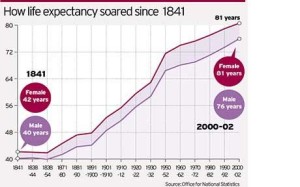
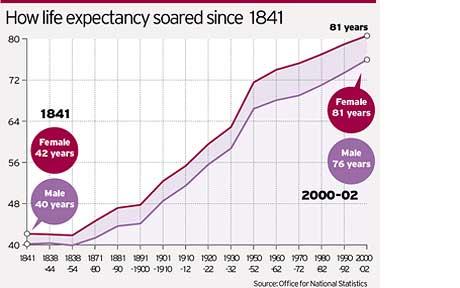
How Life Expectancy Soared Since 1841

These men and women are more than the sum of what they have lost. They are living, breathing, thinking and valuing beings. They are! It’s as simple and stunning as that: they exist! To think that they might be better off, happier, in the rest of death and quiet of last breath – to think that they are beings defined most fundamentally by suffering, and by a comparison of what they no longer are, is not only wrong but perverse. They are living, and life so long as it’s lived should never be defined by suffering, by a lack or comparison of what it isn’t, but rather by what it is and still is. There are exceptions, of course; rapidly debilitating disease, unremitting pain, incomprehensible horror at the slow decay of mind. But I would argue confidently that the elderly are not in constant woe of that which they can no longer do. Like living beings, they deal with it and continue on in the business of being. To consider the elderly as “waiting for the rest and peace of death” is a dangerous and ugly notion, and one very far from the truth.

Luckily, functional decline as a correlate of age is on the way out. We will live to 100 not in a period of decline upon hitting our mid-twenties, but in a continuing period of youthfulness. There are no longevity therapies on the table that offer to truly prolong life indefinitely without actually reversing aging. Death and aging are not separate things or processes; death is when aging has won the battle. Aging is slow death, and a truly-indefinite delaying of death ipso facto necessitates a reversal of aging, and a remediation of the physiological conditions that ultimately lead to death (i.e., what we colloquially call aging). To think that we will be prolonging our lives not as youthful beings of whatever physiological age we so desire but instead as elderly, age-ravaged beings patching new holes and bracing old crutches, is to some extent mistake the cause for the symptom. If we prolong life significantly, we will prolong the healthy portion of our lives first and foremost. The centenarians of next century will look as healthy as the 20-year-olds of last.

Thus, one of the impediments preventing us from seeing death at 100 as a tragedy, as dying before one’s time, will be put to rest as well. When we see a 100-year-old die in future, he or she will have the young face of someone who we feel today has died before their time. We won’t be intuitively inclined to look back upon the gradual loss of function and physiological-robustness as leading to and foretelling this point, thereby making it seem inevitable or somehow natural. We will see a terribly sad 20-year-old, wishing they had more time. We will be able to envision with vivid viscerality the bright and buoyant things they could be doing were they not bedridden and stricken with sickness unto death.

Moreover, that gradual decline into visually apprehensible old age also highlights another impediment to seeing the elderly as continually growing beings with a future to look forward to rather than fight against. The gradual decline of our mental faculties makes it seem that we would be accumulating experience and memory at a deficit, cumulatively losing the ability to think, judge, remember, and experience. Thus old age conjures to mind more senility than wisdom for many people.

This, too, is less true than delusive. Again, this type of thinking is engendered by comparing what they seem to be with what they aren’t or once were. In any case, it will be even less true in the future, when longevity therapies restore our mental health to its youthful glory. Then, the prospect of ever-continuing experience and personal growth, ever-accumulating wisdom and knowledge, ever sharper consideration and discernment, is not so intuitively improbable. The claim that we can in fact continue to grow in how smart, ethical, knowledgeable, and deliberative we are will not be so easily balkable when one’s physiological state ceases to be an indicator of one’s chronological age.

Another common criticism of indefinite longevity in regard to the downfalls of old age comes from Max Planck’s statement that science progresses one funeral at a time; that men and women of a given generation become so attached to their theories that they remain attached in the face of contrary evidence, and it takes their very death for new theories to be embraced by new generations unencumbered by the consideration that “after all this time I might actually be wrong after all”. From this sentiment follows the criticism that significantly extending the average human lifespan will slow progress in science by preventing the death those grafted unflinchingly to a given theory. I would argue that such a sentiment stems from the view of the elderly previously defined and defied, namely as beings more defined by what they have lost than by what they have, as beings fighting against the grain of growth. To view the elderly as continually growing beings forces one to see this criticism as somewhat naïve.

Along another line of argumentation, if we assume that this observation is correct and elderly academics refusing to let their own cherished theories die at the hands of the new is a real concern only aggravated by the coming of longevity therapies, then we still have reason to believe that longevity therapies can change the nature of the game by a large enough extent to negate these problematic concerns.

If some people refuse to consider in light of new evidence or perspective that their theory is wrong, refuse to allow the series of thought leading to the realization that all they have worked for is of lesser importance now, the most obvious cause of discontent would seem to be the notion of their own onrushing death. “If my theory is wrong, there isn’t time – or perhaps just youthful vigor – enough to do it all over again from scratch.” Someone worked his lifetime to achieve recognition in his field, and with his death so close around the corner, he faces the prospect of having all that work and worth be devalued by new developments. It is a scary thought, and the notion that people willingly or subconsciously refuse to consider facts that undermine their theory, and its perceived worth in their field, is least conceivable under such conditions. Thusly considered, Planck’s notion doesn’t appear as naïve as it first seemed.

But this is the very concern set to be alleviated by longevity therapies. If the concern with being wrong is most impacted by one’s impeding death, and the fact that one wouldn’t have the time or energy to create another groundbreaking paradigm upheaval in their chosen field should one’s namesake-theory prove to be mistaken, then the arrival of longevity therapies should not only fail to exasperate and aggravate this situation, but indeed may even ameliorate or negate it, allowing people to let their theories go under the comforting thought that they have all the time in the world to do it again.

My friend and peer Gennady Stolyarov II combats this criticism admirably, arguing that such instances occur due to the functional decline that comes with graceless old age, due to senility and a loss of mental flexibility. I think there is definitely some weight and worth to this consideration. And luckily, this, too, is a concern that is alleviated rather than aggravated by the introduction of longevity therapies. Longevity therapies will increase our healthy lifespans rather than stretch out the slow rot of our old age, as remarked earlier. Thus the longevity therapies that many critics argue could exasperate this progress-stalling state of affairs could, along yet another line of argumentation, constitute the very thing that jolts this state of affairs into reform. If senility and loss of mental flexibility contribute to Planck’s notion that life (or more properly the absence of timely death) forestalls scientific progress, then longevity therapies may constitute the source of senility’s demise and mental flexibility’s restoration.

In any case, even if we accept Plank’s notion as true, and conclude that indefinite longevity will aggravate rather than alleviate this state of affairs, faster progress in the sciences or the humanities is no justification for simply doing nothing to negate physically remediable sources of death and disease.

It seems to me a truism that we get smarter, more ethical, and more deliberative as we age. To think otherwise is in many cases derivative of the notion that physiology and experience alike are on the decline once we “peak” in our mid-twenties, downhill into old age – which does undoubtedly happen, and which inarguably does cause functional decline. But longevity therapies are nothing more nor less than the maintenance of normative functionality; longevity therapies would thus not only negate the functional decline that comes with old age, and with it the source of the problem arguably at the heart of the concern that longer life will slow progress even more, but might even constitute the only foreseeable fix to the problem by definition, because indefinite longevity is defined as (or more properly, synonymous with) the maintenance of normative functionality, a.k.a. the indefinite prevention of functional decline. There is no reason to expect that, in a time when we age without functional decline, the ethicality and experience of each human being wouldn’t increase as we age just as they arguably do as we age from two to twenty to thirty.

Increasing longevity will not bring with it prolonged old-age, a frozen decay and decrepit delay, but will instead prolong our youthful lives and make us continually growing beings, getting smarter and more ethical all the time. Indefinite longevity will not slow progress, it will accelerate it! Instead of having thinking, being beings die after ten decades, they can continue to think and be. They can build upon the edifice of their existence and experience continually, reaching heights unheralded in flighty fits and bounds. Moreover, increasingly more and more people may very well be a boon to the momentum of progress. It could be argued that the increasing rate of progress was aided by the increase in global population that preceded it, providing not only more people to have more thoughts, but more people to challenge existing thought and to provide feedback accordingly in forward fashion. Statistically speaking, more people should mean more ideas, and more ideas should mean more good ideas, all else being equal.

Thus indefinite longevity will better progress, not deter it, and will do so on the scale of both self and society. We will continue to grow, to learn, and to yearn. But more than that – we will continue to be – and that in itself is cause for good pause. In all our worry about stalled progress and boredom, we forget that even if indefinite longevity didn’t bring with it a host of advantages and boons to the boom of progress and exalted strife intrinsic to life, the ability to simply continue being is incommunicably better than the alternative, which does nothing but put an end to all other alternatives.

Franco Cortese is an editor for Transhumanity.net, as well as one of its most frequent contributors.  He has also published articles and essays on Immortal Life and The Rational Argumentator. He contributed 4 essays and 7 debate responses to the digital anthology Human Destiny is to Eliminate Death: Essays, Rants and Arguments About Immortality.

Franco is an Advisor for Lifeboat Foundation (on its Futurists Board and its Life Extension Board) and contributes regularly to its blog.

Will Congress Endorse Obama’s War Plans? Does It Matter? – Article by Ron Paul

Will Congress Endorse Obama’s War Plans? Does It Matter? – Article by Ron Paul

The New Renaissance Hat
Ron Paul
September 1, 2013
******************************
President Obama announced this weekend that he has decided to use military force against Syria and would seek authorization from Congress when it returned from its August break. Every Member ought to vote against this reckless and immoral use of the US military. But even if every single Member and Senator votes for another war, it will not make this terrible idea any better because some sort of nod is given to the Constitution along the way.  Besides, the president made it clear that Congressional authorization is superfluous, asserting falsely that he has the authority to act on his own with or without Congress. That Congress allows itself to be treated as window dressing by the imperial president is just astonishing.
***

The President on Saturday claimed that the alleged chemical attack in Syria on August 21 presented “a serious danger to our national security.” I disagree with the idea that every conflict, every dictator, and every insurgency everywhere in the world is somehow critical to our national security. That is the thinking of an empire, not a republic. It is the kind of thinking that this president shares with his predecessor, and it is bankrupting us and destroying our liberties here at home.

According to recent media reports, the military does not have enough money to attack Syria and would have to go to Congress for a supplemental appropriation to carry out the strikes. It seems our empire is at the end of its financial rope. The limited strikes that the president has called for in Syria would cost the US in the hundreds of millions of dollars. Joint Chiefs Chairman Gen. Martin Dempsey wrote to Congress last month that just the training of Syrian rebels and “limited” missile and air strikes would cost “in the billions” of dollars. We should clearly understand what another war will do to the US economy, not to mention the effects of additional unknown costs such as a spike in fuel costs as oil skyrockets.

I agree that any chemical attack, particularly one that kills civilians, is horrible and horrendous. All deaths in war and violence are terrible and should be condemned. But why are a few hundred killed by chemical attack any worse or more deserving of US bombs than the 100,000 already killed in the conflict? Why do these few hundred allegedly killed by Assad count any more than the estimated 1,000 Christians in Syria killed by US allies on the other side? Why is it any worse to be killed by poison gas than to have your head chopped off by the US allied radical Islamists, as has happened to a number of Christian priests and bishops in Syria?

For that matter, why are the few hundred civilians killed in Syria by a chemical weapon any worse than the 2000-3000 who have been killed by Obama’s drone strikes in Pakistan? Does it really make a difference whether a civilian is killed by poison gas or by drone missile or dull knife?

In “The Sociology of Imperialism,” Joseph Schumpeter wrote of the Roman Empire’s suicidal interventionism:

“There was no corner of the known world where some interest was not alleged to be in danger or under actual attack. If the interests were not Roman, they were those of Rome’s allies; and if Rome had no allies, then allies would be invented. When it was utterly impossible to contrive an interest – why, then it was the national honour that had been insulted.”

Sadly, this sounds like a summary of Obama’s speech over the weekend. We are rapidly headed for the same collapse as the Roman Empire if we continue down the president’s war path. What we desperately need is an overwhelming Congressional rejection of the president’s war authorization. Even a favorable vote, however, cannot change the fact that this is a self-destructive and immoral policy.

Ron Paul, MD, is a former three-time Republican candidate for U. S. President and Congressman from Texas.

This article is reprinted with permission from the Ron Paul Institute for Peace and Prosperity.

The Rational Argumentator’s Eleventh Anniversary Manifesto

The Rational Argumentator’s Eleventh Anniversary Manifesto

The New Renaissance Hat
G. Stolyarov II
August 31, 2013
******************************

In another productive and transformative year for The Rational Argumentator, I have been able to realize a series of long-held ambitions. New and improved editions of Eden against the Colossus, The Best Self-Help is Free, and Implied Consent have all been released since TRA celebrated its tenth anniversary last year. In addition, the Guide to Stolyarovian Shorthand renders my unique system of efficient note-taking available to the public for the first time. Furthermore, numerous new articles, YouTube videos, and links to Resources on Indefinite Life Extension have been created and published, along with several new and even more remastered musical compositions.  This has been a year of rejuvenating the accomplishments of the past while also shaping the future with new creations. I continue to experiment with and implement new approaches for spreading rational enlightenment to all who are willing. My Open Badges on Indefinite Life Extension are a proof of concept of what could be possible when it comes to motivating free, open-source education that produces externally verifiable outcomes. Of course, developing and expanding the system of Open Badges in any range of conceivable subjects will require a considerable amount of time and exertion of effort. However, TRA now has an embedded system for developing multiple-choice quizzes whose completion will result in the awarding of an Open Badge.

Total eleventh-year visitation for all TRA features was 1,077,192 page views, compared to 1,302,774 during the tenth year and the peak of 1,398,438 during the ninth year. While this was a decrease, it is still a higher number than was observed during any of the first eight years of TRA’s existence. TRA’s lifetime visitation stands at 6,746,360 page views.

I attribute the recent trend in reduced visitation to a decrease in new publication activity. During its eleventh year, TRA published 208 features, compared to 306 during its tenth year. The rate of publication slowed because of an unusually turbulent year, both in terms of events that affected me directly and took me away from a more steady publication regimen, and in terms of larger attention-absorbing, paradigm-shattering developments on a world scale, such as the recent revelations of Orwellian NSA surveillance of the general population.

Still, the fact that visitation slipped by less (a decrease of 22.97%) than the number of published features (a decrease of 32.03%) shows that TRA’s content remains sought-after and relevant, perhaps especially so in light of the very troubled and troubling era in which we live, when the direct threats to our personal liberty and privacy continue to mount and to become unavoidably palpable. The message that individuals have rights, that their lives have inherent value, that no “national security” or “greater good” can trump that value, needs to be proclaimed with renewed urgency and commitment. An alternative to the status quo needs to emerge through intellectual, technological, and political innovation, and it needs to emerge sufficiently soon that the Orwellian boot on the face of mankind does not stamp it out forever. The comprehensive surveillance regime unleashed in secret by the Bush and Obama administrations has no historical parallels; it is what the totalitarian regimes of the 20th century could only have dreamed of. At the same time, an increasing disconnect has occurred between the actions of national-government politicians and anything resembling what the people actually think: witness the rampant war hysteria that the Obama administration is currently attempting to stir up for a pointless, counterproductive invasion of Syria that would already be one of the least popular military undertakings in US history.

What can be done to change the political and cultural status quo to anything resembling sanity – even the kind of sanity that could have been said to characterize the 1990s in the United States? Hundreds of distinct approaches, implemented by millions of individuals, are most certainly required.  This problem is not easy; the world took a wrong turn, probably sometime around September 11, 2001, when the fear of “terrorism” led the political leaders of the Western World to use an infinitesimal threat to justify restrictions and invasions of personal liberty and even bodily integrity, which would have been unthinkable in any other context. After the economic collapse of 2008 and the subsequent bailouts of politically connected cronies, it seemed clear that the national governments of the world have sided with the “men of pull” – as Ayn Rand would have called them – against everybody else.  A free system which rewards merit and undermines stagnant hierarchies of rent-seeking privilege was not allowed to manifest itself. Instead, the very people who caused the world to take a wrong turn remain in charge.

While changing the current state of affairs is no easy task, I can confidently say that, in a hypothetical world where all humans were philosophically inclined, informed on current events, concerned with questions of morality, and interested in continual learning and self-improvement, the wrong turn would never have been taken. In a world that suddenly found itself filled with such enlightened individuals, the harms of the status quo would quickly be undone. The goal of The Rational Argumentator is to assist such enlightened individuals, both those who already are and those who might become enlightened through their independent intellectual explorations. While we are far from a world filled with purveyors of philosophical enlightenment (in the 18th-century sense of that term), every individual who becomes a true rational intellectual and a person of moral conscience can take us one step closer in that direction.

Pervasive NSA surveillance, fortunately, is no threat to TRA, because TRA has always been a publicly accessible endeavor. As I have written previously, if  those employed by the NSA and other spy agencies throughout the world were to read information on The Rational Argumentator, this could only benefit humanity by possibly exposing these individuals to ideas of rationality and moral conscience. The truly troubling aspect of universal surveillance is that it seeks to pry into the communications that we do not wish to disclose to anyone and everyone – private e-mails, phone calls, social-media conversations, financial transactions, and search terms. It is reasonable and justified for individuals who wish to preserve a shred of privacy to change their approach toward such communications. However, as far as TRA is concerned, its work can proceed unimpeded, for its message is meant to reach as many people as possible, NSA agents or not.

However, the recent revelations of NSA spying did lead me to reconsider one matter from my March 2012 statement, “A New Era for The Rational Argumentator”. I no longer consider social-networking sites, such as Facebook or Google+, to be effective ways for individuals to create custom repositories of knowledge. While it is still the case that individuals can access content somewhat tailored to their interests through such networks, the fact remains that the networks have been co-opted through NSA backdoors into their systems. The companies running these networks are no longer benign free-market entities whose goal is to exchange value for value with their customers. Rather, the original market-oriented purpose of these companies has been subverted in favor of becoming privatized arms of the surveillance state. Perhaps these companies had little choice but to comply with requests to spy on their users; observe the fate of Lavabit, whose founder tried to stand on principle and refuse such intrusions. The fact remains, though, that it is not prudent to rely for one’s information and philosophical development solely on sources whose role to gather information about one can affect one’s life far more than any of their incidental ability to give information to one. Does this mean that one should abandon all social networks or even Facebook and Google+? I am not advocating this, though I do advocate extreme prudence on these networks. The path-dependency and network effects are too great at present for such abandonment to be a practical choice for many people, myself included. Rather, I wish to emphasize the continued importance of self-contained online information repositories that do not vary based on the visitor and do not seek to do anything to the visitor other than provide content and elicit feedback in public comments. The Rational Argumentator is just such a source, and I hope in the coming months and years to increase its rate of publication and resume its previous modus operandi of publishing both original content and some of the most thought-provoking content that has appeared elsewhere, relying on TRA’s excellent network of authors and articles published under the Creative Commons License. If I can convince you to access TRA directly (rather than only through a social network) on a routine basis as part of your quest for knowledge and edification, then my planned endeavors will be successful.

You will see, in the coming months, the realization of still more ambitious projects, some of which are presently underway. Through all of the changes, improvements, and revitalizations of past materials, I can make you the same promises that I have made throughout TRA’s lifetime: that I will retain all content ever published on TRA; that I will continue to vigorously promote the ideas of liberty, reason, and technological progress; and that this site shall always remain a haven for high intellectualism and civilized discourse. In whatever way I can, I hope to make this magazine a valuable asset to those of us who have the most at stake in the outcome of the continuing and accelerating race between technological progress and authoritarian intervention.

Abrupt Insights, Op. 73 – Composition for Classical Guitar and Harpsichord (2013) – G. Stolyarov II

Abrupt Insights, Op. 73 – Composition for Classical Guitar and Harpsichord (2013) – G. Stolyarov II

A work that is both classical and experimental, this piece for two classical acoustic guitars and three harpsichords is intended to evoke the process of arriving at new ideas or making progress on a major project in a staggered fashion. Each advance is a leap forward, but, on a larger scale, there remain an order and coherence of the greater task or discovery being achieved. This work follows a theme-and-variations format and utilizes harmonies reminiscent of the Spanish classical guitar compositions of the late 18th and early 19th centuries.

Length: 3:25

This composition is played in Finale 2011 software.

Download the MP3 file of this composition here.

See the index of Mr. Stolyarov’s compositions, all available for free download, here.

The cover page was designed by Wendy Stolyarov.

The artwork is Mr. Stolyarov’s Abstract Orderism Fractal 8, available for download here and here.

Remember to LIKE, FAVORITE, and SHARE this video in order to spread rational high culture to others.

Labels and Ideological Bubbles – Article by Sanford Ikeda

Labels and Ideological Bubbles – Article by Sanford Ikeda

The New Renaissance Hat
Sanford Ikeda
August 30, 2013
******************************

Be mindful of how you label the people with whom you disagree.

***
When I engage in an ideological discussion I try to be sensitive to how I ideologically label the person with whom I’m talking and how she labels me. I’m not talking about dismissive or openly pejorative words (e.g. evil, stupid, silly), but proper terms of discourse. More than just good manners, how we habitually label our opponents in ideological dialogue could reveal something unpleasant about the ideological world we inhabit.
***

Getting the Label Right

***
Now, some people argue that “ideas matter, labels don’t.” When we’re talking about specific ideas, such as for example military intervention in the Middle East, then yes calling it liberal, libertarian, progressive, socialist, or whatever may add nothing to the discussion. But when referring to the worldview of a particular person or group of like-minded persons, especially in the context of a public debate, then how we label ourselves and others can matter a great deal. If the goal is to promote constructive dialogue then it’s important to get the labels right.
***
We prefer in such cases to be called by the label that we identify ourselves with. I don’t like being called a conservative or a liberal because those labels signify sets of ideas and policies, many of which I do not hold. I prefer to be called a libertarian. (Classical liberal might be better but no one in the mainstream knows what that is.)
***
Colleagues I’ve known for decades at my college assume that I’m a conservative because I’ve come out publicly against nationalized healthcare, from which they wrongly infer that I oppose same-sex marriage and that I “support our troops” in foreign wars. Readers of The Freeman have, I’m sure, had to defend themselves against the charge of being “pro-business” because of our skepticism of regulation and high taxes. We have to explain that upholding the free-market is not pro-business, pro-consumer, or pro-labor (although the free-market position is in a sense “pro” all those things and more). That kind of mislabeling, however annoying, can be the result of an honest mistake—one I know I make myself.
***
Mistakenly mislabeling someone is one thing: conservative for libertarian, marxist for progressive. Another is deliberately mislabeling your opponent, a trick that forces her to waste time defending herself against the false charge. But there’s a third kind of mislabeling that reflects a deeper sort of error, one that issues from exclusivity and insularity.
***

Who calls herself a Neoliberal or a Statist?

***
For example, I’m reviewing a book about cities whose author uses the word “neoliberal” a lot. It’s used mostly by Europeans on the political “left”—e.g., social democrats, progressives, socialists, greens—to refer to people or groups who hold some sort of “libertarian” views. I’ll explain in a moment why I’m using scare quotes here.
***
From what I’ve been able to gather from my European colleagues, however, no one actually identifies herself as a “neoliberal.” Neoliberal is apparently a term some attach to positions “on the (extreme) right,” which apparently includes people thought to have an anti-union or pro-business agenda. There are such people, of course, but there’s a reason no one self-identifies as a neoliberal.
***
As Stanley Fish explained a few years ago in The New York Times: “…neoliberalism is a pejorative way of referring to a set of economic/political policies based on a strong faith in the beneficent effects of free markets.” So “neoliberal” is pejorative.
***
And before libertarians get too indignant, let me point out that we sling words like “collectivist” and “statist” when describing our opponents, and to my knowledge no one self-identifies with those terms, either. To be sure, among our ideological comrades, they may have a fairly clear meaning and may spark a certain esprit de corps. But consistently using a word, over a wide range of venues, to describe others that no one ever uses to self-identify is a pretty good sign that you live in an ideological bubble.
***
Evidently, while the author of the book I’m reviewing says she’s writing for “an interdisciplinary readership,” she takes it for granted that it will be an ideologically sympathetic one.
***

Our Ideological Bubbles

***
An ideological bubble, as I’m using the term, is a social network with shared ideological understandings that closes its members off to others with opposing views. You can be a staunch market-anarchist, for example, but still be willing to have a serious, civil conversation with people with whom you strongly disagree. Put simply, you live in an ideological bubble if the only people whom you will talk to seriously about ideology are those you already agree with.
***
An ideological bubble insulates us from real-time criticisms of our principles and positions, retarding our intellectual growth. It gives us a false sense of security and breeds self-satisfaction, off-putting harshness, and intolerance—things destructive to civility. Also, keep in mind that it’s often the bystanders to a debate whom we want to persuade, and they will consider our language and conduct when judging our ideas.
***
One of the things I’ve learned from my great teacher Israel Kirzner is that we can’t realistically be aware of all of our current limitations because we simply don’t know all that we don’t know. We have blind spots, and that means intellectual bubbles of all sorts are inevitable.  But that doesn’t mean that they have to remain invisible to us. Kirzner also taught us that creative discovery is possible. The signs are there, and keeping an eye open to them will give us a chance to make them at least a little more permeable.
***
Sanford Ikeda is an associate professor of economics at Purchase College, SUNY, and the author of The Dynamics of the Mixed Economy: Toward a Theory of Interventionism.
***
This article was originally published by The Foundation for Economic Education.
Free Will and Self-Causation – Article by Leonid Fainberg

Free Will and Self-Causation – Article by Leonid Fainberg

The New Renaissance Hat
Leonid Fainberg
August 26, 2013
******************************

Homo liber nulla de re minus quam de morte cogitat; et ejus sapientia non mortis sed vitae meditatio est.

~ SPINOZA’S Ethics, Pt. IV, Prop. 67

(There is nothing over which a free man ponders less than death; his wisdom is, to meditate not on death but on life.)

Reductionism and its corollary, Determinism, are deeply enrooted in the fabric of the modern mainstream philosophy. These are leftovers of the Cartesian mind-body dichotomy. Instead of rejecting this notion altogether, Reductionists simply choose the other, bodily side of this loaded coin. Now they have reached a blind alley in their attempts to explain life in terms of lifelessness. As Hans Jonas observed:

“Vitalistic monism is replaced by mechanistic monism, in whose rules of evidence the standard of life is exchanged for that of death.” (The Phenomenon of Life, pg. 11).

Since Mind and Free Will are biological phenomena which cannot be explained in terms of non-life, Reductionists are necessarily Determinists. Hard Determinists reject the notion of Free Will (and therefore Mind) completely; soft Determinists and Compatibilists are still trying to find explanation of Free Will in the indeterminate realm of Quantum mechanics, in stochastic rules of Chaos theory, or in the mystical realm of Tao. I maintain that Free Will is a manifestation on the conceptual level of the very essential property of life itself, which is biological self-causation.

“Freedom must denote an objectively discernible mode of being, i.e., a manner of executing existence, distinctive of the organic per se.” (Ibid, pg. 3).

The Law of Causality is the Law of Identity applied to action (Ayn Rand). Since biological action is a self-generated, goal-orientated response (SIGOR) to environmental challenges, such an action cannot be predetermined by any antecedent cause. On the contrary, any antecedent or proximate action could be only detrimental to the healthy living process.

As Rosen put it:

“[I]t is perfectly respectable to talk about a category of final causation and to a component as the effect of its final cause… In this sense, then, a component is entailed by its function… a material system is an organism if and only if it is closed to efficient causation.” (Life Itself, pg. 135).

In other words the process of biological causation is a process in which a final cause (a goal), becomes its efficient cause.  Traditionally, the notion of the final cause associated with Aristotle’s primary mover, some divine, supernatural source.  However, this is not a case of mysticism, far from it.

Life emerged as a result of self-organization of abiotic elements. How that happened we don’t know yet. However, some researchers think that this is a thermodynamically inevitable event.

“Life is universally understood to require a source of free energy and mechanisms with which to harness it. Remarkably, the converse may also be true: the continuous generation of sources of free energy by abiotic processes may have forced life into existence as a means to alleviate the buildup of free energy stresses….” (Energy Flow and the Organization of Life. Harold Morowitz and Eric Smith, 2006).

But does this mean that life is a determined process? I don’t think so. Life is an emergent phenomenon, and as such it possesses new properties which its precursors don’t have. In their book Biological Self-organization Camazine et al. (2001: 8) define self-organization “as a process in which pattern at the global level of a system emerges solely from numerous interactions among the lower-level components of the system. The system has properties that are emergent, if they are not intrinsically found within any of the parts, and exist only at a higher level of description….’’

From this definition it follows that (1) a process of self-organization doesn’t have an antecedent cause; and (2) emergent properties of such a system are different from the properties of its components and therefore cannot be explained by means of reductionism. In other words, properties of such a system are not defined by antecedent cause. Life is a self-organizing, self-regulated material structure which is able to produce self-generated, goal-orientated action when the goal is preservation and betterment of itself. This new emergent identity which applied to biotic action defines new type of causation: self-causation.

Harry Binswanger observed that “All levels of living action, from a cell’s protein-synthesis to a scientist’s investigations, are goal-directed. In vegetative action, past instances of the ‘final cause’ act as ‘efficient cause.’” (1992).

This is the mechanism of self-causation. Now it is clear why any action imposed on the organism and driven by antecedent cause could be only detrimental: it inevitably would interfere with the self-generated action of the organism. Each and every organism is its own primary mover. In the low organisms the degree of freedom of action is limited by their genetic setup. However, even low organisms, like fungi for example, able to overcome this genetic determinism.

“During a critical period, variability is generated by the fact that a system becomes conditioned by all the factors influencing the spontaneous emergence of a symmetry-breaking event. In such a context variability does not reflect an environmental perturbation in expression of a pre-existing (genetic) program of development…It is expression of a process of individuation.” (Trewavas, 1999)

SIGOR is limited by an organism’s perceptual ability and capacity to process the sensory input. The process of evolution is a process of development of these qualities, since the organism’s survival depends on them. More freedom of action means better chances of survival. The end product of such a process is Free Will and self-awareness – that is, human mind. Free Will therefore is an expression of self-causation on conceptual level.

As Rodrigues observed: “Cerebral representations result from self-emergence of networks of interactions between modules of neurons stimulated by sensorial perception.” (Rodriguez at al., 1999)

The human abilities to choose goals consciously and to act rationally in order to achieve them lead us from biology to ethics. But the origin of these abilities lies in the very fundamental property of any living being. This property is self-generated, goal-orientated action driven by self-causation. Any attempt to reduce this property to the set of biochemical reactions or to undetermined behavior of subatomic particles is doomed to fail. Ayn Rand profoundly summarized the meaning of life in We, The Living: “I know what I want, and to know HOW TO WANT – isn’t it life itself?”

Leonid Fainberg is an Objectivist philosopher and contributor to The Rational Argumentator.

Bookstore Wars: Creativity versus Scale – Article by Sanford Ikeda

Bookstore Wars: Creativity versus Scale – Article by Sanford Ikeda

The New Renaissance Hat
Sanford Ikeda
August 22, 2013
******************************

Independent bookstores appear to be making a comeback after several years of decline. As reported by MSNBC, the number of independent bookstores has risen significantly.

Some 1,000 independent bookstores went out of business between 2000 and 2007, according to the American Booksellers Association (ABA), as consumers turned to online buying, downloading e-books, or flocking to Barnes & Noble and (now defunct) Borders. But the ABA said that since 2009, the number of independent bookstores has risen 19 percent, to 1,971.

If my arithmetic is right, that still means the industry hasn’t rebounded to where it was in 2000 (about 2,600 stores), but it’s not bad. Meanwhile e-book sales, which had been rising at triple-digit rates, have evidently lost a bit of steam, last year growing at about 5 percent overall.

These facts perhaps illustrate two important lessons:  First, the scale of a business’s operations is not the same thing as its competitiveness; and second, the kind of competition that counts in free markets has much less to do with efficiency than with creativity.  Selling books and digital media in massive volume seems to make firms sluggish in addressing customer preferences for more personalized service and responsiveness.

Efficiency and Scale Are Important

Free-market economists are typically painted by friends and foes alike as cheerleaders for efficiency. Indeed, many economists do tout efficiency as the prime virtue of the free market, keeping prices low and employment high. In standard economics, efficiency refers to using the lowest-cost means to reach a given end.

If Jack is in New York and wants to be in Philadelphia, then among the alternative means available to him—walking, boating, flying, driving, or taking the train—efficiency implies that Jack chooses the one that minimizes the cost to him of getting to Philadelphia. In manufacturing, the production process that, other things equal, produces a given rate of output at the lowest cost is the efficient one.

(Note:  Cost, like benefit, always refers to the cost to someone of doing something.  Sometimes the chooser experiences the costs, sometimes someone else does, but neither costs nor benefits are ever disembodied.)

One form of efficiency is economies of scale. Economies of scale occur when using more of all inputs (scaling up) increases output so much that the cost per unit of output falls. (In econ-speak that’s when the long-run average-cost curve slopes downward.) Critics pick up on this and argue that the free market therefore necessarily favors big businesses over small businesses because the bigger a firm is, the more efficient in terms of unit costs it tend to be, and that allows it to charge lower prices and drive smaller firms out of the market.

But Not as Important as Competition

That story, however, only looks at the relative efficiencies of existing firms and markets. If the fundamental goal is to improve the well-being of people as they see it, then you have to pay more attention to competition, particularly entrepreneurial competition. In that sense, competition trumps efficiency (as Israel M. Kirzner has explained).

That’s because, again, efficiency means choosing from among given alternatives the one that achieves a given goal at the lowest cost. Where the standard economic concept of efficiency falls short is that in the real world neither ends nor means are simply given to anyone. Ends and means, outputs and inputs, have at some point to be discovered by someone. Yes, efficiency is a good thing, like having a clean and orderly workplace, but it’s entrepreneurship in the competitive process that does the heavy lifting of finding the work to be done and putting you in a position to do it.

The resurgence of independent bookshops in the face of book megastores, I think, is an example of how creative competition overcomes the scale efficiency of providing a particular product. There’s nothing inherently wrong or uncompetitive about megastores or inherently virtuous about small businesses. Big and small businesses have their niches, whether online or in brick-and-mortar shops. But central to the competitive process is the ability, whatever your size, to be aware of changing circumstances and to adjust appropriately to them. The MSNBC article quotes an independent bookseller as saying, “We learned how to get books that people couldn’t find online, and to cater as much as we could to the customer. When a customer walks in, we try to make them feel wanted and at home.”

Scale economies in both the online and brick-and-mortar parts of the industry do little to win over customers who prefer personalized service or the intangibles of local businesses. Independent bookstores are more flexible, for example, at staging readings of local authors and other neighborhood events. The giant bookseller Borders Books, one of the pioneers of book retailing, apparently didn’t do a good job adjusting and closed a couple of years ago (I wrote about it here). Today Barnes & Noble scrambles to cope with competition from the e-book, Amazon.com, and, it seems, local bookshops.

While the diminished growth of e-book sales is hardly a harbinger of decline—5 percent is nothing to sneeze at—it does suggest that sometimes the demand side of the market doesn’t change quite as fast as the supply side—that is, a lot of innovation is just discovering better ways to satisfy fairly stable tastes. Still, it’s competition—for new markets, new techniques, new resources, and yes, new tastes—and not efficiency that drives, and is driven by, the creative discovery of ends and of means.

The Lesson Applied

The other day a friend told me that, when she told her fiancé she couldn’t understand why a mildly alcoholic beverage called “Chu-hi,” which is very popular in Japan, isn’t sold in stores here, his response was something like, “If there were a demand for it, it would be.” Knowing that I write this column she then said to me, “That’s the free market, right?”

Okay, class, what do you say?

Sanford Ikeda is an associate professor of economics at Purchase College, SUNY, and the author of The Dynamics of the Mixed Economy: Toward a Theory of Interventionism.
***
This article was originally published by The Foundation for Economic Education.