The Two-Party Crackup Could Be Upon Us – Article by Stephen Weese

The Two-Party Crackup Could Be Upon Us – Article by Stephen Weese

The New Renaissance HatStephen Weese
******************************

Imagine living in a world where there are only two choices. Chocolate or vanilla. Hot or cold. Light or darkness. There are no in-betweens. No “shades of gray.” You must explain everything as a “yes or no” dichotomy. On or off. False or true. This binary reality leaves little room for human diversity or creativity – yet it is in this exact reality we find ourselves trapped with the US political system.

Prelude to Deception

The parties are divided and their candidates are weak.It all starts with a sociological phenomenon created due to our political election process. First Past the Post means that in our elections, winner takes all and the loser gets nothing. We are told that if we do not vote for one of the two major parties, our vote is wasted. (I mathematically analyzed this myth in a previous article.)

The concept that underlies the two party phenomenon is not only mathematical in principle, it is sociological. Duverger’s law assumes that people faced with more than two choices in a First Past the Post election will vote against the most radical or undesired opponent, instead of for the candidate they most desire. This demonstrates what is called a “negative” vote – it could be more precisely described as a vote made out of fear of the worst candidate.

Another principle of Duverger’s law is that it filters out “weaker” parties in that people will not vote for a party that has no chance of winning. This weakness is only psychologically defined; a party could appear weaker simply due to less publicity. Certainly a third party could have better ideas than the main two – but if the ideas are not heard, then no one can know about them. The purely cognitive illusion that there are only two “worthy” parties is perpetuated by lack of media coverage and the false appeal to common practice that it’s the “way things always have been done.”

The simple truth is, Duverger’s law depends on the psychological basis of fear and ignorance. Without these factors in society, the mathematical differences would disappear.

The Two Major Parties are Weak

People only think of politics as “right” or “left” because this is all they have ever known.At this point, the two major candidates for election, Donald Trump and Hillary Clinton, have historically high negative numbers. In fact, the two frontrunners have the highest unfavorable ratings since those numbers have been tracked: Trump is net negative 33, and Clinton negative 21.

More voters see these candidates in an unfavorable light than a favorable one. This would be a perfect time for the rise of a third party, even according to Duverger’s law. It only takes a cursory look at the news to see the large anti-Trump movement among major Republicans as well as the staunch Sanders wing of the Democratic party. The parties are divided and their candidates are weak, as shown by the polls above.

The Electorate Is Polarized

If you have the feeling that in the last decade partisan politics has become more extreme and vitriolic you’d be correct – Pew research has been tracking this phenomenon. Both the extremity of Democratic and Republican views have increased, as well as dislike and intolerance for the “other” party. At this point, 92% of Republicans are to the right of the median Democrat, and 94% of Democrats are to the left of the median Republican.

There are double the amount of pure liberals and conservatives than a decade ago, and the fear of the opposing party has doubled as well. Twice as many people think that the alternate party threatens the “nation’s well-being.”

If people could overcome the fear of the “worst” candidate and voted for what they believed in, the facade would begin to crumble. This polarization affects people’s choices of where to live, shop, and travel, and even goes to the extent of opposition to a family member marrying someone of the opposing party. The Pew study also shows that those on the extreme ends of the spectrum are the most politically active – writing letters, posting on social media, travelling to political events (though this is hardly surprising.) The effect of this of course is that these parties are represented more by their extreme elements.

This polarization also results in one-dimensional thinking. People only think of politics as “right” or “left” because this is all they have ever known. As humans, are we only one-dimensional? Aren’t there more ways to look at solving the problems of a nation than just left and right?

Most of us are trapped in this one-dimensional illusory world, like a train stuck on a single track. The mere idea that we could travel in a completely different direction is a foreign concept. Even a middle-school student can tell you that we live in a world with three dimensions, that we can travel in an infinite variety of paths. Yet we find ourselves confined to this oversimplified model of reality that goes counter to our interests and only allows us choices that leave most dissatisfied.

Majority in the Middle

Another effect of this polarization is that moderate Americans find themselves in the middle of this extremism. Most voters do not view the other party as a threat to the nation and are not 100% liberal or conservative in their views. There are actually more people in the middle, yet they find themselves forced to choose to side with one extreme or the other. In 2014, the “mixed” electorate (holding views from both sides) was 39%.

There are less of them now, due to extremism, yet this 39% in the middle is enough to completely take over an election, if they only had a different option to choose from. Unfortunately, the Pew data also shows that the people in the middle are less likely to vote and participate in the election process. Duverger’s law is working here because these moderates do not know that they are a huge bloc that could elect a moderate candidate with ease.

Overcoming Ignorance and Fear

We live in the age of new media – a social movement can begin online without the backing of a major television or news network. As we have seen, voting tendencies in our system are predicated on fear of a radical candidate as well as ignorance of third-party platforms or even their existence. This is the one-dimensional illusion we live in. If we continue to be more polarized, more and more of the electorate will hate the other half.

If nothing stops this progress, those in the middle will be forced to choose a side as the tolerance for opposing views decreases. Others could stand up and speak and become a driving force pulling opinions back toward some sense of centrism – or even better, they could propose ideas outside of the traditional “left vs. right” paradigm.

The truth is, if people could overcome the fear of the “worst” candidate and voted for what they believed in, the facade would begin to crumble. If the media and others covered third parties more, unaligned voters – for example, people who believe in peace and freedom – would have a new incentive to participate and give a positive vote.

Fortunately, we now live in the age of new media – a social movement can begin online without the backing of a major television or news network. This election is the most opportune time for this to happen given the record negative views of both candidates. Thus it behooves the unaligned voter to find her or his voice in this election. If these voters together decided that “enough is enough” and realized that they are actually the most powerful voting bloc, they could simply say “no” to the two major parties – and nothing could stop them.

Stephen_WeeseStephen Weese

Stephen Weese has an undergraduate degree in Computer Science from George Mason University, and a Masters in Computer Information Technology from Regis University. Stephen teaches college Math and Computer courses. He is also a speaker, a film and voice actor, and a nutrition coach.

This article was originally published on FEE.org. Read the original article.


Playing Politics Can Be Fun until It Unleashes Hell – Article by Joey Clark

Playing Politics Can Be Fun until It Unleashes Hell – Article by Joey Clark

The New Renaissance HatJoey Clark
******************************

Most politicians and their followers are not cynical enough about politics. They hate the players but not the game. Unlike me, they are cynical sentimentalists, i.e. they idealize politics yet are cynical towards any suggestion human beings should be set free from political control.

Though it may smack of paradox, I consider myself a hopeful cynic – hopeful in man’s spirit but not his politics. Accordingly, my political cynicism flows from my disappointed sentimentality.

Most politicians are not cynical enough about politics. They hate the players but not the game. As Oscar Wilde wrote in Lady Windermere’s Fan, a cynic is “a man who knows the price of everything, and the value of nothing” and a sentimentalist “is a man who sees an absurd value in everything and doesn’t know the market price of any single thing.” Together the two bring harmony.

Torn apart, they are blind in their own unique way, and in this way, the 2016 political season has rendered much of the American populace sightless. Some wish to present this presidential election as a clear-cut contest between cynical pachyderms and sentimental jackasses, but the truth, to steal another line from Wilde, is rarely so pure and never so simple.

As much as they will deny it, political factions are motivated by a mix of cynicism and sentimentality, sometimes within the very same individuals.

Even the most sentimental nincompoops – those who shed tears or fall into fits of hosannas upon hearing the most platitudinous political speech – turn cynical and stone-faced when confronted by their political opponents.

Even the most cynical demagogues – those who spit piss and vinegar in response to the most innocuous statements from their enemies – turn sentimental and misty-eyed in the presence of a president they love.

It seems one politico’s hopes are another politico’s fears. They appraise their enemy’s price as too high yet see absurd value in their champions.

The Donald’s Sentimentality

For example, even Donald Trump is not cynical enough about politics. Trump may very well be cynical and downright churlish towards, well, almost anyone (even babies) on any given day, but he is certainly a believer in the need for strong government leadership. Trump has, indeed, boosted his popularity by stoking the flames of resentment, but the essence of this resentment is the betrayed sentimentality of “the people.”

Trump and his supporters idealize America just as much as the next group. Holding true to a golden age image of the country, they are disappointed by an ever-changing world that continually shatters their “perfect” picture of the nation. They are cynical of what they see as “un-American,” and they have hitched their hopes to Trump’s politics to save their culture as they see it.

Thus, Trump’s slogan may not be “Burn America Down” as Democrats would have you believe, but he is certainly a flaming nationalist. His program may not be great for many people living in America, but “America” is, indeed, the ultimate standard of good and evil on the Trump train. One cannot be cynical about politics qua politics and a nationalist at the same time. No, nationalism is for the teary-eyed evangelicals and patriotic bomb throwers, Trump being the latter. But how about the former?

Enter Hillary Clinton.

Hillary’s Cynicism

Hillary Clinton, like most progressives, prides herself on her forward-looking and optimistic approach. She and her ilk apparently claim to loathe cynicism. As Senator Cory Booker said at the Democratic National Convention surrounded by a friendly mob of fellow sentimentalists, “Cynicism is a refuge for cowards.” Of course, by “cynicism” Cory, Hillary, and their do-gooder cronies mean anyone who does not wish to consent to their progressive plans to save the world. To hear them speak about peace, love, and community one would think such things were impossible without the imposition of the state.

What makes progressives so sentimental about people using state power yet cynical towards people acting voluntarily, I will never truly know.What makes progressives so sentimental about people using state power yet cynical towards people acting voluntarily, I will never truly know, but I suspect they do not trust the motives of many of their fellow men, especially not Donald Trump. Their assessment of Trump may be correct, but their appraisal of their own sentiments is utterly lacking. Their worship at the altar of state power seems to have turned them blind to the ironies of the “progressive” history and project.

For instance, of all the ways Hillary could take down Trump’s fear-mongering, she chose to say this in her acceptance speech at the Democratic Convention:“Well, a great Democratic President, Franklin Delano Roosevelt, came up with the perfect rebuke to Trump more than eighty years ago, during a much more perilous time. ’The only thing we have to fear is fear itself.’”

Yes, Hillary, how wise of you to quote a man who brought us Japanese internment camps, turned away Jewish refugees fleeing Nazi Germany, and set the price of gold based on “lucky numbers.” But, I suppose, since FDR is a demigod in the progressive civic religion, his cynicism and quackery can be overlooked, as can the ugly, cynical history of progressive policies such as the minimum wage.

Again, if only Hillary, Donald and their respective acolytes were more cynical about politics qua politics, we would all be better off. But what about the most cynical bunch in American politics today, the alt-right meme team?  How could a group of folks who “pretend” to be Nazis ever be helped by more political cynicism?

And why would one ever want to pretend to be a Nazi anyway?

Pretend Nazis Need Cynicism Too

Enter Charles Bukowski:

“At L.A. City College just before World War II, I posed as a Nazi. I hardly knew Hitler from Hercules and cared less. It was just that sitting in class and hearing all the patriots preach how we should go over and do the beast in, I grew bored. I decided to become the opposition. I didn’t even bother to read up on Adolf, I simply spouted anything that I felt was evil or maniacal.

However, I really didn’t have any political beliefs. It was a way of floating free.”

This is how Bukowski’s short story, “Politics”, begins, and his reasons for his posing as a Nazi – ”boredom” and “floating free” – sound quite similar to those prescribed to the alt-right “meme team” by that frivolous troll, Milo Yiannopoulos, and his colleague, Allum Bokhari, in their crash course on the alt-right:

These young rebels, a subset of the alt-right, aren’t drawn to it because of an intellectual awakening, or because they’re instinctively conservative. Ironically, they’re drawn to the alt-right for the same reason that young Baby Boomers were drawn to the New Left in the 1960s: because it promises fun, transgression, and a challenge to social norms they just don’t understand.

If this parallel continues into the future, things will probably not end well, at least not with mere lulz.

As Bukowski later relays in the story, his Nazi antics earned him disciples, but his acolytes took the whole charade much more seriously than he. After stumbling upon a Communist speaker outside of campus, one of his followers approached him with a bag of rotten tomatoes. Upon being told to put the tomatoes away, his follower said, “I wish they were hand grenades.”

“It occurred to me suddenly that my disciples hadn’t been listening to the speaker, or even if they had been, nothing he had said would matter,” writes Bukowski, “Their minds were made up. Most of the world was like that… I lost control of my disciples that day, and walked away as they started hurling their rotten tomatoes.”

The alt-right don’t want to get rid of the establishment; they want to replace it.I must hand it to the alt-right trolls – they are quite creative and prolific and, at times, hilarious in their cynical pose – but there is a difference between political cynicism and a general cynicism about the culture at large. One must be careful not to let those rotten tomatoes turn into hand grenades. Sadly, the alt-right purveyors of “ironic bigotry” may think they are simply having a little cynical fun, but their actions seem directed only towards the political establishment without rejecting the whole paradigm of political action.

They don’t want to get rid of the establishment; they want to replace it. In particular, if one is to fight, say, the excesses of political correctness for the sake of liberty (a worthy endeavor in my opinion,) the focus should be on neutering the “political” aspects of that equation rather than letting basic human decency fall into the abyss of reactionary nonsense or a babyish nihilism, all the while serving the ends of just another political faction.

Politics Pollutes Culture

Yes, politics may often be downstream from culture as Andrew Breitbart said, but it can also pollute the river of culture if allowed to become too permeating. Once politics comes to define a people, all that is left is an impending battle over whose culture will be imposed through the power of the state. In the face of such a looming war, it is understandable that people often despair only to hurl invective and material threats towards “the others” seen as the source of their angst. In such a world dominated by political power, it is understandable that politicos see anyone who is cynical about their projects as a threat to human solidarity.

But the true root of the problem is not the other nor political cynicism; it is the lust to dominate and control others within each of us. The tyrant in you is the tyrant in me, and if we are not careful, even our so-called reactions against tyranny can mutate into movements to destroy something beautiful for destruction’s sake.

What if we all become hopeful cynics – cynical of man’s lust to dominate his fellows, yet lovers of man all the same? That said, we should recognize even our enemies’ capacity for creative action and fellowship in their darkest hours. If such qualities can provide solace, even in sardonic and sadistic forms, to a select few in their most despairing moments, what can creative action and fellowship provide when we direct our cynical pose toward politics in general instead of just our opponents? What if we all become hopeful cynics – cynical of man’s lust to dominate his fellows, yet lovers of man all the same?

If I am being honest, I do not know what this pose would bring about, but this is exactly why hope is a virtue. Bukowski might disagree; he wrote in his short story, “I promise you, this will hardly be the last war. As soon as one enemy is eliminated somehow another is found. It’s endless and meaningless. There’s no such thing as a good war or a bad war.” Maybe he’s right, and the war of all against all is inevitable, but I hope not. Nor do I wish to save the world. That is much too idealistic. As our dirty old man poet says elsewhere in his novel Women, “You begin saving the world by saving one man at a time; all else is grandiose romanticism or politics.”

Maybe, just maybe, each of us can first save ourselves and then others, one by one, with a hope in the uncertain beyond for man’s society if not his politics.

Joey ClarkJoey Clark

Joey Clark is a budding wordsmith and liberty lover. He blogs under the heading “The Libertarian Fool” at joeyclark.liberty.me. Follow him on Facebook.

This article was originally published on FEE.org. Read the original article.

How Not To Waste Your Vote: A Mathematical Analysis – Article by Stephen Weese

How Not To Waste Your Vote: A Mathematical Analysis – Article by Stephen Weese

The New Renaissance HatStephen Weese
******************************

During this especially contested election, a lot of people are talking about people “wasting” or “throwing away” votes. However, many people who say this do not have a complete grasp of the full mathematical picture – or worse, they are only mentioning the part that supports their position. First let’s define what a “wasted” vote is.

Mathematical Definition of Wasted Votes

A wasted vote is a vote that provides no determination or effect on the final outcome of the election. According to Wikipedia: “Wasted votes are votes cast for losing candidates or votes cast for winning candidates in excess of the number required for victory. For example, in the UK general election of 2005, 52% of votes were cast for losing candidates and 18% were excess votes – a total of 70% wasted votes.”

There are two kinds of wasted votes that mathematically have no effect on the final election:

  1. Votes cast for candidates who did not win
  2. Excess votes cast for winning candidates

Clearly, neither of these kinds of votes statistically affect the election. However, many arguments only mention the first type without mentioning the second. Mathematically and logically, both categories are ineffectual votes.

First Past the Post

The value of your vote is what you give it. Should you spend it on a candidate you don’t believe in?The United States, along with several other nations, uses the First Past the Post (FPTP) or “winner take all” election. This method is defined as “the candidate who receives more votes than any other candidate wins.”

This is one of the reasons that many people mention wasted votes – our system creates that result. Sociologically speaking, the FPTP system tends to favor a two-party system. The French sociologist Maurice Duverger created “Duverger’s Law” which says just that.

The Electoral College

For U.S. Presidential elections, a state-by-state system is used called the Electoral College. Each state gets a proportional amount of electoral votes which are then used to find a majority for president. Interestingly, what happens in each separate state is a smaller FPTP election, followed by a counting of electoral votes.

The Electoral College is slightly different from a pure FPTP system because it requires an actual number threshold (currently 270 electoral votes) for a candidate to win instead of a simple majority of the votes.

We can sum things up as follows:

  1. States hold “winner take all” FPTP elections for electoral votes
  2. Electoral votes are counted
  3. The winner must have 270 electoral votes
  4. If there is no candidate that reaches it, the House of Representatives chooses the president

These distinctions are important, because they can change the math and the concept of the “wasted” vote phenomenon.

Wasted Votes in Presidential Elections

The general concept that is proposed by many is that you must always vote for a Republican or a Democrat because you must stop the worst candidate from winning. In a sense, you are voting a negative vote – against someone – rather than for a candidate of your choice. However, this actually depends on the scenario of the vote. Let’s look at some examples.

Bush vs. Gore: 2000

People voting out of fear of the worst candidate is a self-perpetuating cycle. Let’s examine a common example used in this discussion.

Following the extremely close 2000 U.S. presidential election, some supporters of Democratic candidate Al Gore believe that one reason he lost the election to Republican George W. Bush is because a portion of the electorate (2.7%) voted for Ralph Nader of the Green Party, and exit polls indicated that more of these voters would have preferred Gore (45%) to Bush (27%), with the rest not voting in Nader’s absence.

The argument for this case is even more pronounced because the election was ultimately decided on the basis of the election results in Florida where Bush prevailed over Gore by a margin of only 537 votes (0.009%), which was far exceeded by the number of votes, 97,488 (0.293%), that Nader received. (Wikipedia)

At first, this may look like a clear example of the need to vote for a major party. However, let’s break this situation down mathematically. In every single state election, Bush or Gore won. There were millions of mathematically wasted votes in this election of both types.

In California, Gore won by 1,293,774 votes. Mathematically speaking, there were over one million wasted votes for Gore in this state alone. None of these excess votes could have helped Gore, since he had already mathematically won the state. The California votes didn’t matter in Florida. In fact, the votes in Florida have much more relevance than any other state.

Conclusions: Sometimes a vote for a major party winner is wasted anyway. Sometimes everything will come down to one state. However, there is no way to predict in advance which votes will be this important. If the parties knew that Florida would have been the deal breaker, then they would have acted differently. However, we simply don’t know the future well enough to predict that.

We do know that battleground states are generally more important than “safe” states for each candidate, but it is hard to know exactly which state might matter. (There are plenty of scenarios you can research online about possibly electoral outcomes, I encourage you to do so.) This leads us into our next example.

Clinton vs. Trump 2016

Let’s do some math about the state of California and our current presidential election. The average RCP poll has Hillary Clinton ahead by 22.2 percent. The registered voters in California add up to 17.7 million. Not all of them will vote, but we can use the 2012 presidential election as a predictor, where 13.2 million people voted.

Out of those 13.2 million, according to current predictions, 52.6% will vote for Clinton. However, Clinton only needs about 31% to beat Trump. The other 21% of excess votes for Clinton will be wasted. This means that approximately 3 million votes for Clinton in California will be wasted. Now, this is only a mathematical model, but we have several reasons to believe in it.

  1. California has a history of being a heavily Democratic state
  2. Polls usually swing within a single digit margin of error
  3. 21% is quite a large margin of leeway

Even if the polling changes significantly, we are still looking at millions of wasted Clinton votes in California.

Now let’s throw Jill Stein into the math. As part of the Green Party, she is to the left politically of Hillary, so we will assume that votes for her will be taken from Clinton’s pool. (Though this isn’t always a true assumption, as we will see later.) Right now she is polling at around 4%, but we could even give her 5%. If you take away 5% from Hillary’s margin of 22.2%, that leaves a huge margin of 17.2%: still millions of votes. The takeaway from this: you can safely vote for Jill Stein in California without fear of changing the state election results. Therefore, it will not affect the national vote either.

Since we have the Electoral College, your votes will have no influence beyond the state to change other vote counts. Those who prefer Jill Stein can with a clear conscience vote for her, since it will make no difference mathematically. Later we will look at the ethics of voting as it relates to this math.

Mathematical Importance of a Single Vote

There are a few theories on voting power calculations; we will look at two of them here. John F. Banzhaf III created a probabilistic system for determining individual voting power in a block voting system, such as the Electoral College. According to his calculations, because of differences in each state, it gives different voters different amounts of “voting power.”

A computer science researcher at UNC ran the Banzhaf power numbers for the 1990 U.S. Presidential election and determined that the state of California had the voters with the highest power index: 3.3. This index is measured as a multiple of the weakest voting state, which was Montana (1.0 voting power).

A newer method of measuring voting power was created by a research team from Columbia University using a more empirical (based on existing data) and less randomized model. They concluded that the smaller states had more mathematical voting power due to the fact that they received 2 votes minimum as a starting point. This model tends to generate smaller multipliers for voting power but more accurately matches empirical data from past elections.

Using these power ratings as a guide, we can estimate an estimated maximum voting power for each vote. We will be making some assumptions for this calculation.

  1. The minimum voting power multiplier is 1
  2. The highest multiplier from both models will be used as a maximum

Starting numbers

In the United States there are currently 218,959,000 eligible voters with 146,311,000 actual registered voters. In the 2012 Presidential election, 126,144,000 people actually voted. This is our voting pool.

Each vote, legally speaking, has the same weight. So if we start from that assumption, taking into account a probable amount of voters (126 million), the power of your vote is:

1
_____

126 million

This is: 0.0000000079 or 0.00000079%. That is the weight of your vote mathematically. Now we can multiply it by the highest power index to show the highest potential of your vote. Our California historical data from 1990 shows a 3.3 index, but to be conservative we will raise it to 4. So now the power is: 0.00000317%

Using probabilistic equations and analysis, this is the result. This is how powerful your vote is in the U.S. Presidential election is if you end up in the most heavily weighted state.

Addressing Weighted Vote Fallacies

As we have seen, many people argue that we should not “waste” votes, yet many millions of votes for the winner are wasted every year. It is difficult to predict whether a vote will end up in either wasted category. We’ve also seen past and possible scenarios where voting third party or major party can have no influence on the final election.

Fallacy 1: Treating Single Voters as One Block

A false assumption that people make about voting is treating a single vote as a block. For instance, let’s use our current election again as an example.

Someone insists that if you do not vote for Hillary, then you are helping Trump to be elected. (The reverse of this can also apply here.) You claim that you wish to vote for Gary Johnson, the Libertarian candidate. You’re then told that the current national poll with all parties shows that Johnson is polling at 7%, which is less than the difference between Clinton (39%) and Trump (40%). Therefore, you must vote for Clinton to make up that difference.

There are several problems with this proposal. It does not take each state into consideration. It assumes all Gary Johnson supporters have Clinton as their second choice. And it treats your single vote as the entire 7%.

As we have seen, the current picture in California shows that Clinton has a huge margin. If this voter lived in California, a vote for Gary Johnson would not help Trump and also would not hurt Hillary, even if the entire 7% voted for Johnson. Anyone who says it is your duty to vote negative in this scenario does not know the math of this state.

This also assumes that all Johnson votes would choose Hillary as the second choice, but given that Libertarians take some platform elements from both the Left and the Right, this assumption would be highly unlikely. The same would go for Trump.

When people look at the 7% and tell you that you must vote a certain way, it is assuming you will somehow influence the entire 7%. However, we have seen that you are just one voter, and that your voting power is a very tiny number by itself. You cannot be entirely responsible for a candidate winning or losing with your single vote. In theory, it’s mathematically possible for one vote to decide an election, but given there are an exponential number of possible scenarios with millions of voters (imagine raising a few million to an exponent), it’s astronomically unlikely, especially if you live in a non-battleground state.

It’s also astronomically unlikely that all 7% (8,820,000 people) would vote for who they polled for. Even if you gave each voter a 99% chance of voting for who they polled for, the chance that all of them would vote the way they polled is (0.99) to the power of 8,820,000, which is less than 0.000000000000000000000000000000000000000000000000001%

Individuals are not entire blocks of voters, and it’s problematic to treat them as such.

Fallacy 2: Third Party Votes Have No Value

If enough people vote their conscience and vote for what they believe in, things can change.On the surface, this might appear to be true. A third party candidate for President has never won an election. We also have Duverger’s law that states our FPTP favors two party systems. However, it is mathematically possible for a third party to win, and there are also other measurable gains for voting for a third party.

Part of this fallacy is the “winner take all” perspective. In other words, if you don’t win the presidency, you’ve wasted your time.

However, there are many benefits of voting third party, even for president. It makes a political statement to the majority parties. It helps local politicians of that party in elections. It can help change platforms to include third-party elements. And it provides recognition for the party among voters as a viable alternative.

Third party candidates can and have won local and state elections in the past. This is a fact.

In 1968, George Wallace ran as a third party option for President. He received nine million votes and 45 electoral votes. Though he did not expect to win the popular vote, one of his aims was to force the House of Representatives to choose the President by denying either candidate the 270 electoral votes needed to win – and he nearly succeeded. Since our system is not a true First Past the Post, but a hybrid, this kind of situation is possible. In fact, calculations have been done showing that Gary Johnson could in fact force that situation this year. It is very unlikely, but it is possible.

Regardless of his loss, the impact of the Wallace campaign was substantial. He was able to affect the dialogue and events of that election significantly. (This is meant in no way as an endorsement of George Wallace’s political positions.) If his supporters had mostly voted for a majority party, his impact would have been less significant.

In most scenarios given by the “wasted” vote crowd, all of the votes that are considered are ones from the current voting electorate. Yet we have seen from figures previously mentioned that over 50 million eligible voters are not registered. Even among registered voters, almost 20 million didn’t vote in the last election. These potential votes are never placed into the scenario.

The simple truth is, there are millions of uninterested voters out there, yet candidates are not inspiring them to vote. If candidate X or Y were truly worthy of votes, would not some of these voters decide to register? And another question, would it be easier to get a third party voter to choose a majority candidate, or a non-voter? These are not mathematical questions, but they are logical. The fact is, with this many votes at stake, if these non-voters could be encouraged to register, they would undoubtedly change the election as they make up one-third of total eligible voters.

Ethics and Math

It has been demonstrated that the potential individual power of a vote is mathematically very small. It also has been shown that wasted votes can be cast for the winner of an election as well as the losers, as well as demonstrating that it is sometimes hard to predict exactly which vote will be wasted. Given this information, where do we derive the value of a vote?

It’s hard to get it purely from the math or practicality. In fact, it would seem our single vote is of very little import at all. Therefore, we must find meaning and value for our votes outside of the math.

Certainly, the Founders never envisioned an endless cycle of US citizens voting for the “lesser of two evils.”Certainly, the Founders never envisioned an endless cycle of United States citizens voting for the “lesser of two evils,” as the argument is often presented. The idea was for free and open elections where the people’s voice would be heard. It was simple: the candidate who best represented your interests earned your vote.

Your vote is, therefore, an expression of yourself and your beliefs. Your vote has power as a statement. People voting out of fear of the worst candidate is a self-perpetuating cycle. If no one ever has the courage to vote outside of the two main parties, it will never be broken. However, if enough people vote and it shows in the total election count, it will give cause for us to reconsider and embolden even more to vote outside of the two parties.

Yes, our current electoral system has some serious mathematical flaws. It simply does not encourage people to vote for their conscience – but we have seen that things are not as bad as we would be led to believe by some. The true value of a vote is in the people.

The Value of Your Vote

The value of your vote is what you give it. Should you spend it on a candidate you don’t believe in? Should it be an exercise in fear? It’s up to you. It is my hope that these mathematical calculations will bring you freedom from the idea that only majority party votes matter. A vote is a statement, a vote is personal, a vote is an expression of your citizenship in this country. If enough people vote their conscience and vote for what they believe in, things can change.

If you are already a staunch supporter of a major party, then you should vote that way. This paper is not against the major parties at all – but rather against the concept that votes somehow “belong” to only Democrats or Republicans. Votes belong to the voter. There has never been a more important time to vote your conscience.

Stephen_WeeseStephen Weese

Stephen Weese has an undergraduate degree in Computer Science from George Mason University, and a Masters in Computer Information Technology from Regis University. Stephen teaches college Math and Computer courses. He is also a speaker, a film and voice actor, and a nutrition coach.

This article was originally published on FEE.org. Read the original article.

Americans Are Going to be Disappointed in Election Outcome – Article by Ron Paul

Americans Are Going to be Disappointed in Election Outcome – Article by Ron Paul

The New Renaissance HatRon Paul
******************************
It is a sad commentary on the state of political life in the United States that our political conventions have become more like rock music festivals than competitions of ideas. There has been a great deal of bombast, of insults, of name-calling, and of chest-beating at both party conventions, but what is disturbingly absent is any mention of how we got to this crisis and how we can get out. From the current foreign-policy mess to the looming economic collapse, all we hear is both party candidates saying they will fix it, no problem.

In her convention speech Hillary Clinton promised that she would “fight terrorism” and defeat ISIS by doing more of what we have been doing all along: bombing. In fact we have dropped more than 50,000 bombs on ISIS in Iraq and Syria over the past two years and all she can say is that she will drop more. How many more bombs will defeat ISIS? How many more years will she keep us in our longest war, Afghanistan? She doesn’t say.

In fact, the New York Times – certainly not hostile to the Clintons – wrote that it was almost impossible to fact-check Hillary’s speech because, “she delivered a speech that was remarkably without hard facts.”

Clinton’s top foreign policy advisor said just a day after her convention speech that her big plan for Syria was to go back to square one and concentrate on overthrowing its secular president. How many more thousands more will die if she gets her way? And won’t she eventually be forced to launch a massive US ground invasion that will also kill more Americans?

Clinton does not understand that a policy of endless interventionism has brought us to our knees and made us far weaker. Does she really expect us to be the policemen of the world with $20 trillion in debt?

Likewise, Republican candidate Donald Trump misses the point. He promises to bring back jobs to America without any understanding of the policies that led to their departure in the first place. Yes, he is correct that the middle class is in worse shape than when Obama took office, but not once did he mention how it happened: the destructive policies of the Federal Reserve; the financing of our warfare/welfare state through the printing of phony money; distorted interest rates that encourage consumption and discourage saving and investment.

Trump tweeted this week that home ownership is at its lowest rate in 51 years. He promised that if elected he will bring back “the American dream.” He seems to have no idea that home ownership is so low because the Fed-created housing bubble exploded in 2007-2008, forcing millions of Americans who did not have the means to actually purchase a home to lose their homes. Not a word about the Fed from Trump.

How are these candidates going to fix the problems we face in America if they have absolutely no idea what caused the problems? No matter who is elected, Americans are going to be very disappointed in the outcome. The warfare/welfare state is going to proceed until we are bankrupt. There is hope, however. It is up to us to focus on the issues, to focus on educating ourselves and others, and to demand that politicians listen.

Ron Paul, MD, is a former three-time Republican candidate for U. S. President and Congressman from Texas.

This article is reprinted with permission from the Ron Paul Institute for Peace and Prosperity.

“The Line” for Green Cards Is So Long, You Might Die of Old Age Waiting – Article by David Bier

“The Line” for Green Cards Is So Long, You Might Die of Old Age Waiting – Article by David Bier

The New Renaissance Hat
David Bier
******************************

Immigrants are often told to “get in line” if they want to stay in the United States. This demand is disingenuous for many reasons. Many immigrants have no line to get into. And even if they do, we are telling them to join these lines when no one even knows how long they are. In many cases, we could be asking immigrants to join a line that they will literally never live to see the end of.

Immigrants might face a line they will literally never live to see the end of. We don’t know much about who’s in these lines until they get to the front, but here’s what we do: Thousands of immigrants come to the United States each year on temporary work visas. While working in temporary status, some of their employers petition on their behalf to obtain green cards for them to stay permanently. If the employer has jumped through all the appropriate hoops, the worker can then apply for a visa, if — and this is a big if — the limit on visas that year has not been reached.

This is where the line — and the waiting — starts. For lawmakers trying to fix the immigration system, figuring out how many people are at this point in the process is critical. But even they don’t know.

5 million people are waiting abroad.We do have a good idea how many people are waiting overseas. The State Department keeps track of those numbers and publishes them annually, and we’re quickly approaching 5 million immigrants waiting abroad, which is an astounding number on its own.

But for temporary immigrants already in the United States, the Department of Homeland Security doesn’t keep track — or doesn’t publish — the number of applicants who are prevented from receiving a green card due to the limits.

The State Department publishes a monthly visa bulletin that tells people in either line — here or abroad — whether they can apply for a green card. It lists a date, as seen below, next to a visa category. This date is the cutoff. If your employer’s petition was filed after the date listed, you cannot apply for a green card yet.

Figure 1: Visa Bulletin — Application Final Action Dates for Employment-Based PreferencesvisabulletinSource: State Department

These dates can sometimes create the misleading impression that immigrants from India, for example, will have “only” twelve years to wait for a green card. But that’s not right. That’s just how long immigrants who are currently receiving their green cards today have been waiting. We simply don’t know how many people applied since October 2004, so we don’t know how long someone applying today will have to wait.

Even the State Department doesn’t know who’s in line.Apparently, even the State Department doesn’t know who is in the line. When the department moves up the dates, it basically guesses how many people applied between the current date and the new date. When it moved the dates up for EB-2 and EB-3 categories from India (workers who have a Master’s or a Bachelor’s degree) to 2010 and 2007, the government was flooded with more applications than there were visas available, and so it moved the dates back again to 2004.

This mistake, however, gave us some small insight into who is waiting.

We cannot know for sure whether everyone who could apply submitted an application before the date moved back, but the Department of Homeland Security lists 46,098 Indians currently waiting at this stage. The State Department also lists almost 30,000 more waiting for employment-based green cards abroad, for a grand total of nearly 76,000 Indians. Because each country is limited to no more than 2,800 visas in each category, clearing just this backlog alone will take almost 10 years for EB-2 and more than 14 years for EB-3.

But that only gets us up to 2007 and 2010 for those categories. We simply have no idea how many people could be waiting beyond those dates. It would be nice to be able to estimate the number based on green card applications filed before those dates, but the list only gives us the number pending at any given time. It doesn’t show the total number submitted in a year. Some may have already been processed. Others may have been submitted later, after other older applications passed through.

A rough estimate shows 230,000 people in line, a fifty year wait.We know that in 2008, there were at least 19,512 green card applications under EB-2. For EB-3, the numbers haven’t gotten up to 2008 yet, but in 2006, there were at least 12,708 filed for that category. Simply carrying these numbers forward for each unknown year, there would be roughly 230,000 people in line, which would translate into an almost 50-year wait.

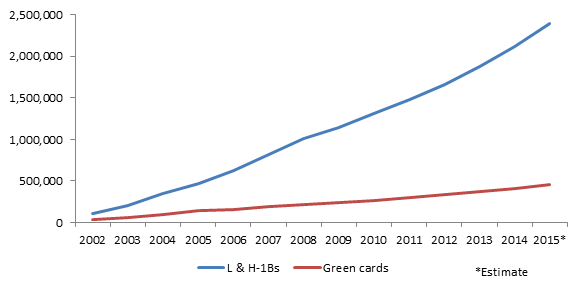
The situation is likely worse than that. We know that the number of Indian temporary workers has increased dramatically relative to the number of green cards issued to them in the past couple decades (Figure 2). We also know that roughly half of all employment-based labor certifications (the step employers complete prior to submitting most EB-2 and EB-3 green card petitions) are for Indian workers.

Figure 2: Total Cumulative Green Cards and L or H-1B Visas Issued to Indians Since 2007
h1bslsgreencardsSources: H-1B/Ls: USCIS/State Department; Green cards: DHS

Since 2002, 450,000 Indians received a green card, while roughly 2.4 million high-skilled immigrants from India and their families have entered under the H visa or L visa (for employees transferring to a U.S. branch of their company). Some portion of these workers could have been beneficiaries of an EB-3 green card petition after 2007, the last date on which we know anything about who is in line.

They’ll be waiting somewhere between 50 and 350 years. All we know is this: somewhere between 230,000 and 2 million Indian workers are in the backlog, so they’ll be waiting somewhere between half a century and three and a half centuries. It is entirely possible that many of these workers will be dead before they receive their green cards. And that’s just one country. The backlogs for Chinese immigrants and immigrants from the Philippines continue to grow as well.

America’s immigration system is broken worse than anyone can even know.

David_BierDavid Bier

David Bier is an immigration policy analyst at the Cato Institute’s Center for Global Liberty and Prosperity.

This article was originally published on FEE.org. Read the original article.

Public Opposition to Biotech Endangers Your Life and Health – Article by Edward Hudgins

Public Opposition to Biotech Endangers Your Life and Health – Article by Edward Hudgins

The New Renaissance HatEdward Hudgins
******************************

Do you want to be smarter, healthier, and live longer? Remarkably, a new Pew survey found that most Americans answer “No!” if it requires using certain new technologies. This is a wakeup call for scientists, Silicon Valley entrepreneurs, transhumanists, and all of us who value our lives: we must fight for our lives on the battlefield of values.

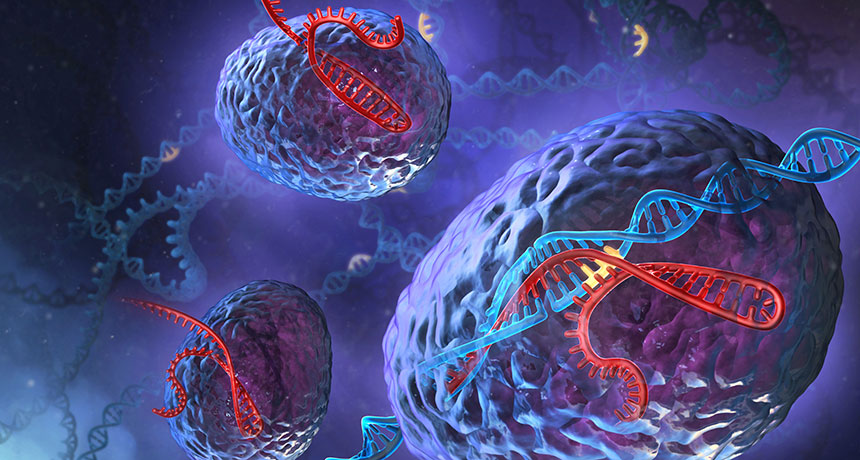
CRISPRWorries about human enhancement

We all understand how information technology has transformed our world with PCs, smartphones, the Internet, and Google. Nanotech, robotics, artificial intelligence, and, especially, genetic engineering are poised to unleash the next wave of wealth creation and improvements of the human condition.

But a new Pew survey entitled U.S. Public Wary of Biomedical Technologies to “Enhance” Human Abilities found that “Majorities of U.S. adults say they would be ‘very’ or ‘somewhat’ worried about gene editing (68%), brain chips (69%) and synthetic blood (63%),” technologies that in years to come could make us healthier, smarter, and stronger. While some say they “would be both enthusiastic and worried … overall, concern outpaces excitement.” Further, “More say they would not want enhancements of their brains and their blood (66% and 63%, respectively) than say they would want them (32% and 35%).”

Simply a reflection of individuals making decisions about their own lives, as is their right? Not quite. Their concerns about technology are already causing cultural and political pushback from left and right that could derail the advances sought by those of us who want better lives.

The Pew data reveals two ideological sources of opposition to new technologies.

Religion and meddling with nature

brain.chip_.grids_The survey found that 64% of Americans with a high religious commitment say “gene editing giving babies a much reduced disease risk” is “meddling with nature and crosses a line we should not cross.” Are you stunned that anyone could prefer to expose their own babies to debilitating or killer diseases when a prevention is possible?

And 65% with such a commitment have a similar opinion of “brain chip implants for much improved cognitive abilities.” Better to remain ignorant when a way to more knowledge is possible?

Obsession with inequality of abilities

When asked if “gene editing giving babies a much reduced disease risk” is an appropriate use of technology, 54% answered “Yes” if it results in people “always equally healthy as the average person.” But only 42% approved if it results in people “far healthier than any human known to date.” Similarly, 47% approved of synthetic blood if it results in physical improvements in individuals “equal to their own peak ability,” while only 28% approved if it results in improvements “far above that of any human known to date.”

Here we see the ugly side of egalitarianism. Better for everyone to be less healthy than for some to be healthier than others.

synthetic_blood-alamy_SmallThis inequality concern is another aspect of warped values we find in economic discussions. What if everyone enjoys rising levels of prosperity in a free-market system, but some individuals—Steve Jobs? Mark Zuckerberg?—become much wealthier than others through their own productive efforts? It’s win-win! But many would punish and demonize such achievers because they are the “top 1 percent,” even if such treatment means that those achievers produce less and, thus, everyone is less prosperous. Better we’re all poorer but more equal.

A disappearing digital divide

We saw this inequality concern in the 1990s when desktop PCs and the Internet were taking off. Some projected a “digital divide.” There would be more intelligent and advantaged individuals because they could access a universe of information through these technologies. And there would be those with little access who would fall further behind. Of course, what fell was the price of those technologies, which even then were accessible for free at most local libraries and now are in laptops, tablets, and smartphones, and affordable to most low-income individuals. The divide disappeared.

 Computers

There were early adopters prosperous enough to try new information technologies. Similarly, there will be early adopters of biomedical tech, which later will become accessible to all—but only if enough people value it rather than fear it and demand that the government stop it.

The fight for values

In a companion piece to the Pew survey, entitled Human Enhancement: The Scientific and Ethical Dimensions of Striving for Perfection, Pew senior writer David Masci offers a good overview of serious moral issues raised by biotech and other exponential technologies. And those of us who welcome these technologies must fight for the moral values on which they are based.

We truly value our lives, and the happiness and flourishing that we as individuals can get out of them through our own achievements. We must shake others out of their spiritual lethargy so that they too will not let their precious lives waste away.

We must promote the values of reason and science as the means to better technology and as guides for our individual lives. Misguided dogmas, whether religious or political, lead to social and personal stagnation.

We must develop and implement strategies to promote human achievement, including enhancement of our capacities, as a value in our culture through our institutions—schools, media—and our aesthetics—movies, art, music.

We must offer an exciting and compelling vision of a fantastic, nonfiction future, of a world as it can be and should be, especially to young people who thirst for a future that will be worth living.

The values on which this future is based will not sell themselves. We must not only create the technology that will allow us to live healthier, smarter and stronger. We must also create the culture that will encourage and celebrate the creation and use of such technology.

Edward Hudgins is the director of advocacy for The Atlas Society and the editor and author of several books on politics and government policy.

Copyright The Atlas Society. For more information, please visit www.atlassociety.org.

What Goes On In The Depths Of Space? – Art by Alastair Temple

What Goes On In The Depths Of Space? – Art by Alastair Temple

what_goes_on_in_the_depths_of_space__by_smiling_demon-d8wnz3yNote: Left-click on this image to get a full view of this digital work of art.

Created by digital artist Alastair Temple, this art was featured in the 26th Exhibition of The Luminarium, “Depth”. The entire exhibit can be viewed here.

Visit Alastair Temple’s DeviantArt page and view his other art.

This work is licensed under a Creative Commons Attribution-Noncommercial-No Derivative Works 3.0 License.

Towards a Greater Knowledge of Mitochondrial DNA Damage in Aging – Article by Reason

Towards a Greater Knowledge of Mitochondrial DNA Damage in Aging – Article by Reason

The New Renaissance HatReason
******************************

Today I’ll point out a very readable scientific commentary on mutations in mitochondrial DNA (mtDNA) and the importance of understanding how these mutations spread within cells. This is a topic of some interest within the field of aging research, as mitochondrial damage and loss of function is very clearly important in the aging process. Mitochondria are, among many other things, the power plants of the cell. They are the evolved descendants of symbiotic bacteria, now fully integrated into our biology, and their primary function is to produce chemical energy store molecules, adenosine triphosphate (ATP), that are used to power cellular operations. Hundreds of mitochondria swarm in every cell, destroyed by quality control processes when damaged, and dividing to make up the numbers. They also tend to promiscuously swap component parts among one another, and sometimes fuse together.

Being the descendants of bacteria, mitochondria have their own DNA, distinct from the nuclear DNA that resides in the cell nucleus. This is a tiny remnant of the original, but a very important remnant, as it encodes a number of proteins that are necessary for the correct operation of the primary method of generating ATP. DNA in cells is constantly damaged by haphazard chemical reactions, and equally it is constantly repaired by a range of very efficient mechanisms. Unfortunately mitochondrial DNA isn’t as robustly defended as nuclear DNA. Equally unfortunately, some forms of mutation, such as deletions, seem able to rapidly spread throughout the mitochondrial population of a single cell, even as they make mitochondria malfunction. This means that over time a growing number of cells become overtaken by malfunctioning mitochondria and fall into a state of dysfunction in which they pollute surrounding tissues with reactive molecules. This can, for example, increase the level of oxidized lipids present in the bloodstream, which speeds up the development of atherosclerosis, a leading cause of death at the present time.

The question of how exactly some specific mutations overtake a mitochondrial population so rapidly is still an open one. There is no shortage of sensible theories, for example that it allows mitochondria to replicate more rapidly, or gives them some greater resistance to the processes of quality control that normally cull older, damaged mitochondria. The definitive proof for any one theory has yet to be established, however. In one sense it doesn’t actually matter all that much: there are ways to address this problem through medical technology that don’t require any understanding of how the damage spreads. The SENS Research Foundation, for example, advocates the path of copying mitochondrial genes into the cell nucleus, a gene therapy known as allotopic expression. For so long as the backup genes are generating proteins, and those proteins make it back to the mitochondria, the state of the DNA inside mitochondria doesn’t matter all that much. Everything should still work, and the present contribution of mitochondrial DNA damage to aging and age-related disease would be eliminated. At the present time there are thirteen genes to copy, a couple of which are in commercial development for therapies unrelated to aging, another couple were just this year demonstrated in the lab, and the rest are yet to be done.

Still, the commentary linked below is most interesting if you’d like to know more about the questions surrounding the issue of mitochondrial DNA damage and how it spreads. This is, as noted, a core issue in the aging process. The authors report on recent research on deletion mutations that might sway the debate on how these mutations overtake mitochondrial populations so effectively.

Expanding Our Understanding of mtDNA Deletions

A challenge of mtDNA genetics is the multi-copy nature of the mitochondrial genome in individual cells, such that both normal and mutant mtDNA molecules, including selfish genomes with no advantage for cellular fitness, coexist in a state known as “heteroplasmy.” mtDNA deletions are functionally recessive; high levels of heteroplasmy (more than 60%) are required before a biochemical phenotype appears. In human tissues, we also see a mosaic of cells with respiratory chain deficiency related to different levels of mtDNA deletion. Interestingly, cells with high levels of mtDNA deletions in muscle biopsies show evidence of mitochondrial proliferation, a compensatory mechanism likely triggered by mitochondrial dysfunction. In such circumstances, deleted mtDNA molecules in a given cell will have originated clonally from a single mutant genome. This process is therefore termed “clonal expansion.”

The accumulation of high levels of mtDNA deletions is challenging to explain, especially given that mitophagy should provide quality control to eliminate dysfunctional mitochondria. Studies in human tissues do not allow experimental manipulation, but large-scale mtDNA deletion models in C. elegans have proved to be helpful, showing some conserved characteristics that match the situation in humans, as well as some divergences. Researchers have used a C. elegans strain with a heteroplasmic mtDNA deletion to demonstrate the importance of the mitochondrial unfolded protein response (UPRmt) in allowing clonal expansion of mutant mtDNAs to high heteroplasmy levels. They demonstrate that wild-type mtDNA copy number is tightly regulated, and that the mutant mtDNA molecules hijack endogenous pathways to drive their own replication.

The data suggests that the expansion of mtDNA deletions involves nuclear signaling to upregulate the UPRmt and increase total mtDNA copy number. The nature of the mito-nuclear signal in this C. elegans model may have been the transcription factor ATFS-1 (activating transcription factor associated with stress-1), which fails to be imported by depolarized mitochondria, mediates UPRmt activation by mtDNA deletions. A long-standing hypothesis proposes that deleted mtDNA molecules clonally expand because they replicate more rapidly due to their smaller size. To address this question, researchers examined the behavior of a second, much smaller mtDNA deletion molecule. They found no evidence for a replicative advantage of the smaller genome, and clonal expansion to similar levels as the larger deletion. In human skeletal muscle, mtDNA deletions of different sizes also undergo clonal expansion to the same degree. Furthermore, point mutations that do not change the size of the total mtDNA molecule also successfully expand to deleterious levels, indicating that clonal expansion is not driven by genome size. Thus, similar mechanisms may be operating across organisms. In the worm, this involves mito-nuclear signaling and activation of the UPRmt.

There is some debate over interpretation of results. One paper indicates that UPRmt allows the mutant mtDNA molecules to accumulate by reducing mitophagy. Another demonstrates that the UPRmt induces mitochondrial biogenesis and promotes organelle dynamics (fission and fusion). Both papers show that by downregulating the UPRmt response, mtDNA deletion levels fall, which may allow a therapeutic approach in humans. Could there be a similar mechanism in humans, especially since some features detected in C. elegans are also present in human tissues, including the increase in mitochondrial biogenesis and the lack of relationship between mitochondrial genome size and expansion? It is likely that there will be a similar mechanism to preserve deletions since, as in the worm, deletions persist and accumulate in human tissues, despite an active autophagic quality-control process. Although the UPRmt has not been characterized in humans as it has in the worm, and no equivalent protein to ATFS-1 has been identified in mammals, proteins such as CHOP, HSP-60, ClpP, and mtHSP70 appear to serve similar functions in mammals as those in C. elegans and suggest that a similar mechanism may be present.

Reason is the founder of The Longevity Meme (now Fight Aging!). He saw the need for The Longevity Meme in late 2000, after spending a number of years searching for the most useful contribution he could make to the future of healthy life extension. When not advancing the Longevity Meme or Fight Aging!, Reason works as a technologist in a variety of industries.
This work is reproduced here in accord with a Creative Commons Attribution license. It was originally published on FightAging.org.
One of the Greatest Entrepreneurs in American History – Article by Daniel Oliver and Lawrence W. Reed

One of the Greatest Entrepreneurs in American History – Article by Daniel Oliver and Lawrence W. Reed

The New Renaissance HatDaniel Oliver and Lawrence W. Reed
******************************
Introduction by Lawrence W. Reed
***

One hundred years ago this May, James J. Hill, the subject of this fine 2001 essay by Daniel Oliver, passed away. Hill was 77 when he died on May 29, 1916, leaving a legacy of achievement surpassed only by a handful of the many great entrepreneurs in American history. He defied the now-infamous epithet, “You didn’t build that.”

James J. Hill was a “1 percenter” of his day who improved the lives of others not by giving speeches but by creating wealth.  

Hill was no Leland Stanford, who used his political connections to get the California legislature to ban competition with his Central Pacific Railroad. Hill was happy to compete because he knew he could. Perhaps he also had the conscience and good character that political entrepreneurs often lack. He built the only privately funded transcontinental railroad in American history. Unlike the ones that he competed with and that were government subsidized, his operation never went bankrupt.

Thirty years ago, I wrote a newspaper column about Hill. One of the papers that published it was the Havre Daily News in northern Montana. It turned out that the little town of Havre was the headquarters of the western division of the Burlington Northern, the successor railroad to Hill’s Great Northern. The division’s president contacted me to express appreciation and to invite me to give a couple of speeches in town. If I accepted, he promised to put me up in an old but restored executive rail car that Hill had built himself. How could I say no?!

For two nights, I lodged on the tracks in that beautiful car, marveling at its turn-of-the-19th-century fixtures and thinking how cool it was that all around me were vestiges of Hill himself. Only two other people were housed in the car during my stay — the cook who prepared my breakfasts and a security guard. After my speeches, Burlington Northern workers hooked the car to a locomotive. Accompanied by the division president and the local newspaper editor, I then experienced one of the most memorable rides of my life — west across northern Montana, through the Marias Pass that Hill himself chose as the best route for his tracks, ultimately arriving and disembarking at the town of Whitefish.

As Oliver explains, Hill deserves to be remembered as a builder, a risk-taker, and an innovator. He was a “1 percenter” of his day who immeasurably improved the lives of others not by giving speeches but by creating wealth.

— Lawrence W. Reed
President, Foundation for Economic Education


In 1962, Ayn Rand gave a lecture titled “America’s Persecuted Minority: Big Business” (collected in Capitalism: The Unknown Ideal), in which she identified two types of businessmen. Burton W. Folsom Jr. later called these “economic and political businessmen.” The first were self-made men who earned their wealth through hard work and free trade; the second were men with political connections who made their fortunes through privileges from the government.

Never before had someone tried to build a railroad without government land and grants. 

James Jerome Hill, builder of the Great Northern Railroad, was the only 19th century railroad entrepreneur who received no federal subsidies to build his railroads. All other builders, such as Cornelius Vanderbilt, received aid. Perhaps more than any other American, Hill helped to transform the American Northwest by opening it to widespread settlement, farming, and commercial development. In the process, he became one of the wealthiest men of the Gilded Age, amassing a fortune estimated at $63 million.

Some critics have charged that Hill did indeed receive federal subsidies to construct the Great Northern. But this charge confuses federal subsidies with land grants. Unlike a taxpayer subsidy, a land grant is the ceding of unimproved government land to a private developer. Critics wrongly assume that government has the power to acquire land by non-Lockean means — that is, by simply claiming to own it without “mixing one’s labor with the land.”

Early Career

Hill was born in the small town of Rockwood in southern Ontario, on September 16, 1838. Because his father died when Hill was young, he had to temporarily forgo formal education to help with family finances. Showing academic ability, however, he received free tuition at Rockwood Academy. Hill later lost an eye to an accidental arrow shot, which prevented him from pursuing the career in medicine that his parents had hoped for.

At age 18, Hill became interested in the Far East and decided on a career in trade. He headed west in hopes of joining a team of trappers, arriving by steamboat in St. Paul, a major fur-trading center, on July 21, 1856. However, Hill missed the last brigade of the year and had to stay in the city. Nonetheless, he grew to like St. Paul and decided to remain there.

Hill’s first job was as a forwarding agent for the Mississippi River Steamboat Company. He set freight and passenger rates and learned about steamboat operations. Unable to fight in the War between the States because of his eye, Hill organized the First Minnesota Volunteers. He also worked as a warehouseman, pressing and selling hay for the troops’ horses. It was there that he learned how to buy and sell goods at a profit and use the least expensive method to ship goods.

After the war, Hill became an agent for the First Division of the St. Paul & Pacific Railroad. At the time, the line used wood for fuel. Hill believed rightly that coal would be cheaper, so he made a contract with the company to supply it. He also formed a business with Chauncey W. Griggs, a Connecticut man in the wholesale grocery business. Together, they created Hill, Griggs & Company, a fuel, freighting, merchandising, and warehouse company.

Hill later became interested in the Red River of the North that flows north to Lake Winnipeg. Since Fort Garry (now Winnipeg) was an important Hudson’s Bay Company trading post, Hill began transporting personal belongings there. Later, Hudson’s Bay employee Norman Kittson left the company to join Hill in forming the Red River Transportation Company.

In 1870, Hill traveled up the Red River to investigate a French and Indian mob that had captured Fort Garry. During that trip and others, Hill saw the region’s rich soil while observing the St. Paul & Pacific’s steady decline. He became convinced that he could make the line profitable by extending it to Fort Garry. When the panic of 1873 put the railroad under receivership, he saw his chance to buy it and other lines in crisis.

Hill and Kittson went to Donald Smith of the Hudson’s Bay Company and told him their plan. Smith offered money and approached George Stephen, president of the Bank of Montreal. Together, the four bought the St. Paul & Pacific for $280,000 (millions in today’s dollars), which Hill estimated as only 20 percent of its real value.

Hill purchased rails, rolling stock, and locomotives and hired laborers who laid more than a mile of track a day. In 1879, the tracks were connected at St. Vincent, Minnesota, to a Canadian Pacific branch from Fort Garry. Since the Canadian Pacific’s transcontinental route was not yet completed, all traffic through Fort Garry had to use Hill’s route. He received two million acres of land through the Minnesota Land Grant for completing the rail line on time. He also renamed his railroad the St. Paul, Minneapolis, & Manitoba. His timing was perfect since the area experienced two exceptional harvests that brought extra business. In addition, a major increase of immigrants from Norway and Sweden allowed Hill to sell homesteads from the land grant for $2.50 to $5.00 an acre.

Expanding the Line

While planning the St. Paul, Minneapolis, & Manitoba, Hill was also involved in constructing the Canadian Pacific Railway. While Donald Smith and George Stephen led this transcontinental route, Hill gave advice about selecting routes and construction techniques. But because the Canadian Pacific would soon compete with his own planned transcontinental route, Hill resigned from the business and sold all his stock in 1882.

Only a year after purchasing the St. Paul & Pacific, Hill decided to extend his railroad to the Pacific. Many thought that he could never do it. Never before had someone tried to build a railroad without government land and grants. Railroads like the Union Pacific, Central Pacific, and Northern Pacific were all given millions of acres of government land to build their transcontinental routes. People thought that even if Hill could achieve his dream, he wouldn’t be able to compete with government-funded lines. His quest came to be known as “Hill’s Folly.”

The St. Paul, Minneapolis, & Manitoba reached Minot, North Dakota, in 1886. Because the Northern Pacific had steep grades and high interest charges and was saddled by high property taxes, the new railroad resulted in a much more profitable route.

A railroad line would obviously help the economy of any town it passed, so Hill was able to get good rights of way. However, one town, Fort Benton, Montana, rejected Hill’s request for a right of way. He decided to cut the town off by building around it. Showing his attitude toward those who tried to stand in his way, Hill left Fort Benton one mile from the railroad.

After speedy construction using 8,000 men and 3,300 teams of horses, the St. Paul, Minneapolis, & Manitoba reached Great Falls in October 1887. Hill connected it there with the Montana Central Railroad, which went on to Helena, bringing lots of new business. In 1890, he consolidated his railroad into the Great Northern Railroad Company.

Hill also encouraged settlement along the lines by letting immigrants travel halfway across the country for $10. In addition, he rented cheap freight cars to entire families. These strategies, rarely used by other railroads, encouraged even more business.

People thought Hill wouldn’t be able to compete with government-funded lines.

In 1893, the St. Paul, Minneapolis, & Manitoba reached Puget Sound at Everett, Washington. However, during the same year, a panic put the Northern Pacific as well as the Santa Fe and Union Pacific into receivership. Hill made an agreement with businessman Edward Tuck and Bank of Montreal associate Lord Mount Stephen to buy the Northern Pacific. A stockholder objected, however, arguing the deal would violate Minnesota law, and the agreement was stopped. But Hill got around this by having his associates help buy Northern Pacific stock as individuals instead of as a company. The Northern Pacific became part of the Great Northern in 1896. The lines came to be widely known as the “Hill Lines.”

Hill realized that the only eastbound traffic for the first few years would be lumber, and this limitation would make the line less profitable than it might be. Wishing to acquire a line to Chicago and St. Louis, where he could deliver the lumber, Hill researched the Chicago, Burlington, & Quincy railroad that stretched from the Great Lakes to the Rocky Mountains. This acquisition would also give him a line that could haul cotton to St. Louis and Kansas City and connect to the smelters of Denver and the Black Hills. The trains would be kept full at all times. Working with J.P. Morgan, Hill purchased the Chicago, Burlington, & Quincy.

Hill began to expand his shipping empire internationally via Seattle. He supplied Japan with cotton from the south and shipped New England cotton goods to China. He also shipped northern goods such as Minnesota flour and Colorado metals to Asia.

Hill continued to expand his railroads in the early 20th century. He bought the Spokane, Portland, & Seattle Railway and added a 165-mile line from Columbia along the Deschutes River to the town of Bend. He also purchased several electric rail lines to compete with the Southern Pacific, and an ocean terminal at the mouth of the Columbia River near Astoria. He had two large steamships that operated between the terminal and San Francisco. This proved to be good competition for the Southern Pacific.

Conservation

Hill had many other business interests, including coal and iron-ore mining, shipping on the Great Lakes, finance, and milling. A major related interest was farmland conservation. Hill was widely known in his day as a leader in this area. Unlike most environmentalists today, Hill believed that natural resources should be privately owned and locally controlled, although in some cases he believed state-level ownership was justifiable. He considered the federal government too distant to competently manage resources. Indeed, he once criticized the US Forest Service, saying that “The worst scandals of state land misappropriation, and there were many, are insignificant when compared with the record of the nation.”

His interest in conservation stemmed both from his concern for the nation’s food supply, a popular philanthropic cause at the time, and from business concerns. Since his railroads largely transported agricultural products, Hill paid close attention to fluctuations in the grain markets. Falling grain yields in the Great Plains would mean fewer goods to transport.

Believing that better farming methods would both increase yields and conserve soil quality, Hill used his own resources for agricultural research and for the dissemination of findings to farmers. He even had his own greenhouse that served as a laboratory. He hired agronomy professor Frederick Crane to do soil analyses in Minnesota, Montana, and North and South Dakota. Farmers were paid to cultivate experimental plots on their land according to Crane’s instructions. These were a tremendous success, yielding 60 to 90 percent more than the conventional acreage of the time.

In a speech, Hill once said,

Out of the conservation movement in its practical application to our common life may come wealth greater than could be won by the overthrow of kingdoms and the annexation of provinces; national prestige and individual well-being; the gift of broader mental horizons, and best and most necessary of all, the quality of a national citizenship which has learned to rule its own spirit and to rise by the control of its desires.

In 1908, President Theodore Roosevelt invited Hill to a governors’ conference on conservation and appointed him to a lands commission. Hill was never pleased with the position, preferring action to talking, but he did make his views known.

Hill was also a major philanthropist. He supported the Roman Catholic seminary in St. Paul and endowed the Hill Reference Library, which operates to this day.

Views on Government

Hill was a great champion of free markets. He was particularly critical of tariffs, calling them “a great enemy of conservation” and pointing out that by prohibiting imports of such products as timber from other countries, the United States was accelerating the depletion of its own. Regarding the federal government’s ability to conserve resources, he once said, “The machine is too big and too distant, its operation is slow, cumbrous and costly.”

A 1910 speech to the National Conservation Congress in St. Paul summarizes Hill’s views on government. He remarked,

Shall we abandon everything to centralized authority, going the way of every lost and ruined government in the history of the world, or meet our personal duty by personal labor through the organs of local self-government, not yet wholly atrophied by disuse…? Shall we permit the continued increase of public expenditure and public debt until capital and credit have suffered in the same conflict that overthrew prosperous and happy nations in the past, or insist upon a return to honest and practical economy?

Hill once said, “The wealth of the country, its capital, its credit, must be saved from the predatory poor as well as the predatory rich, but above all from the predatory politician.”

A Classic Entrepreneur

In 1907, at the age of 69, Hill turned over leadership of the Great Northern to his son, Louis W. Hill. But he remained active in running his railroads and went to his office in St. Paul every day.

In May 1916, Hill became ill with an infection that quickly spread. He went into a coma and died on May 29 at the age of 77. At 2:00 p.m. on May 31, the time of his funeral, every train and steamship of the Great Northern came to a stop for five minutes to honor him.

“Shall we abandon everything to centralized authority, going the way of every lost and ruined government in the history of the world?” — James J. Hill  

Hill exhibited the classic traits of a successful entrepreneur. He diligently studied all aspects of his businesses, such as which mode of transport was best for carrying track to be laid: caboose, handcar, horse, locomotive, or passenger coach. He did all the analyses of grades and curves himself and often argued with his engineers and track foremen, demanding changes that he felt necessary. He insisted on building strong bridges made with thick granite and on using the biggest locomotives and the best quality steel.

At the end of his life, a reporter asked Hill to explain the reason for his success. He replied simply that it was due to hard work. His hard work earned him the title “the Empire Builder,” and at the 1915 Panama-Pacific Exposition in San Francisco, he was named Minnesota’s greatest living citizen.

Hill was remarkable because he developed an area that most people thought never could be developed. His railroads made Minnesota and the Dakotas major destinations for huge waves of immigrants. In fact, Hill sent employees to Europe to show slides of western farming in efforts to urge Scotsmen, Englishmen, Norwegians, and Swedes to settle in the Pacific Northwest. As a result, more than six million acres of Montana were settled in two years. And because of Hill, the small town of Seattle, Washington, became a major international shipping port.

James Jerome Hill has rightly earned a place as one of the greatest entrepreneurs in American history.


Daniel Oliver

Daniel Oliver is a research associate at the Washington, DC-based Capital Research Center and a freelance writer. 

Lawrence W. Reed

Lawrence W. Reed is President of the Foundation for Economic Education and the author of the forthcoming book, Real Heroes: Inspiring True Stories of Courage, Character and Conviction. Follow on Twitter and Like on Facebook.

This article was originally published on FEE.org. Read the original article.
Brazil’s Lost Decade: We Must Free Our Economy – Article by Felipe Capella

Brazil’s Lost Decade: We Must Free Our Economy – Article by Felipe Capella

The New Renaissance HatFelipe Capella
******************************

It was a lost decade for Latin America. Years of populist governments combined with a commodity boom turned out to be our oil curse, our Dutch Disease. This disastrous mix made bad public policies look like temporary successes, pushing developing countries to an unsustainable path. The collectivist ideology monopolized the debate for more than 10 years, and now that the natural resource party is over, the harm of these policies have become clearer: deep economic crisis generated by a utopia whose greatest achievement was turning toilet paper into a rare-earth product.

Populist and authoritarian South American regimes have set up government bureaucracies aimed at pleasing special interest groups that provide political support while tirelessly harming the population as a whole. These groups are divided into several small groups with special rights and privileges: judges, civil servants, members of parliament, friendly businessmen. These factions are getting their more-than-fair share while the unprivileged citizen foots the bill.

Latin American politicians played it very well during these favorable times. Cronyism and populism greatly benefited some chosen groups, while the harms were diffused enough throughout the whole country and difficult to measure during favorable economic winds. Brazil is just the biggest and clearest example of that.

How We Got Here 

For many years Brazil’s road to serfdom was being paved by the left through a combination of the world’s worst ideas: a Venezuelan-like project to subordinate decisions of the Supreme Court to the ratification of Congress; an Ecuadorian will to regulate and control the free press; a Russian compassion for cronies handpicked by the executive; Greek style benefits for public servants; Southern European pension costs (for a much younger population); Argentinean barriers for international trade, and an American/EU taste for subsidies.

The former — and now failed — cherry-picked billionaire darling of the regime Eike Batista was showered with tax funds while ordinary entrepreneurs lacked governmental support; friendly national industries were heavily protected, while people were taxed up to 50 percent on food and health supplies. Oi Telecom, a multibillion dollar mobile company, is just the most recent example of Lula’s national-champion policy (the company has just filed for bankruptcy, with 17 percent of its debt held by state-owned banks).

That was the result of 10 years of left-populist government in Brazil, all of them enjoying the applause of the international press. For years The New York Times constantly published articles with a pro-Dilma/Lula tone. Right after Dilma’s reelection — which is now known to have been funded by money siphoned from state-owned companies — The NYT published a piece half-mocking 48 percent of voters that were concerned about Dilma’s economic and political approaches.

The good thing about bad journalism is that reality eventually catches up with it. Since that 2014 article, Dilma has since lost her job and is about to be impeached for illegal budgetary schemes and deep corruption. Her top aides are all in jail or about to be thrown there, accused of stealing dozens of billions of dollars, including former Ministers and three former treasurers of her Labor Party (which some people now deem to be the most dangerous job in the world). Brazil is in its worst economic crisis since the 1930s, which has been worsening since 2014 (while Dilma was coming up with her now-famous accounting tricks to fool the Brazilian voters). Lula had even become a frequent contributor of The Times after his presidency, but now faces criminal charges and has seen the federal police knock on his door with a coercive trip to the criminal courts.

In its recent opinion page about the failed Rio Olympic Games preparation, The NYT’s favorite Brazilian correspondent Vanessa Barbara wrote that “political turmoil has paralyzed the country and frozen the economy.” This rhetoric of blaming “political turmoil” for Latin American calamities does not help to set the record straight. The problems with the Olympic games stem directly from Dilma’s and Lula’s incompetence and corruption. But the problem also lies on media vehicles like The Times, always ready to turn a blind eye to mismanagement and corruption in the name of ideology.

So here we are. Brazil is a failing state after a decade of populist presidents, misguided policies and commodity boom, all under the auspices of the progressive press.

The Need for Laissez-Faire Liberalism

For a long time, Brazil has been a place where liberalism (i.e., the ideology of freedom and free markets) was mostly marginalized, despite its positive track-record. In the minds of most Brazilians, being liberal was conspiring for the wealthy, being socialist is taking care of the poor.

But if The Times does not want to recognize its mistakes, apparently the Brazilian population is more willing to deal with self-criticism. There is now a strong resurgence of liberalism throughout the country.

Partido Novo (“New Party”) is a new political party created with a clear liberal approach to the economy, and it is just one of the recent examples of how liberalism is growing in the country, waking up millions of Brazilians who were orphans of a liberal political leadership. Many creative and hardworking people that do not think that socialism (or heavy-handed South American social democracy) will make our countries more prosperous. There are substantial constituencies that want public policies driven by research, metrics and actual public interest.

Free Trade Is the Key

The European Union has no appetite and no urgency to negotiate any comprehensive trade agreement with Mercosur or other Latin American countries. The United States faces a choice between a populist protectionist and a trade-dubious democrat (to put it mildly).

It is essential for the world that someone — anyone — pushes forward the liberal pro-trade agenda. As we natives well know, it is never wise to bet on Brazil as a global force for good. But maybe — just maybe — because we are suffering first-hand the harms of a decade of interventionist, protectionist, and corrupted government, we can somehow understand that populism is an illusory lucky charm that actually curses a country for years to come; and maybe — just maybe — we can do something to redeem ourselves.

Now that international trade seems under constant attack from all places and political spectrums, and no big world economy wants to step up and bluntly defend the liberal track record — including the United States — maybe Brazil could become the champion of good policy at last, pushing for reforms throughout Latin America and holding the liberal torch high in these dark times.

As Roberto Campos advised decades ago, for us Brazilians there are only three ways out of the current mess: Rio’s airport, Sao Paulo’s airport, and Liberalism.

Felipe Capella is an attorney turned entrepreneur. He is a former law professor at the Federal University of Santa Catarina (Brazil), former attorney at Sullivan & Cromwell (New York) and the Inter-American Development Bank (Washington, DC), has Master degrees from UPenn/Wharton and Universidad Francisco de Vitoria (Spain), and holds an MBA from FGV (Brazil).

This article was published on Mises.org and may be freely distributed, subject to a Creative Commons Attribution United States License, which requires that credit be given to the author.