CBO: Tangled Web of Welfare Programs Creates High Tax Rates on Participants – Article by Charles Hughes

CBO: Tangled Web of Welfare Programs Creates High Tax Rates on Participants – Article by Charles Hughes

The New Renaissance HatCharles Hughes
******************************

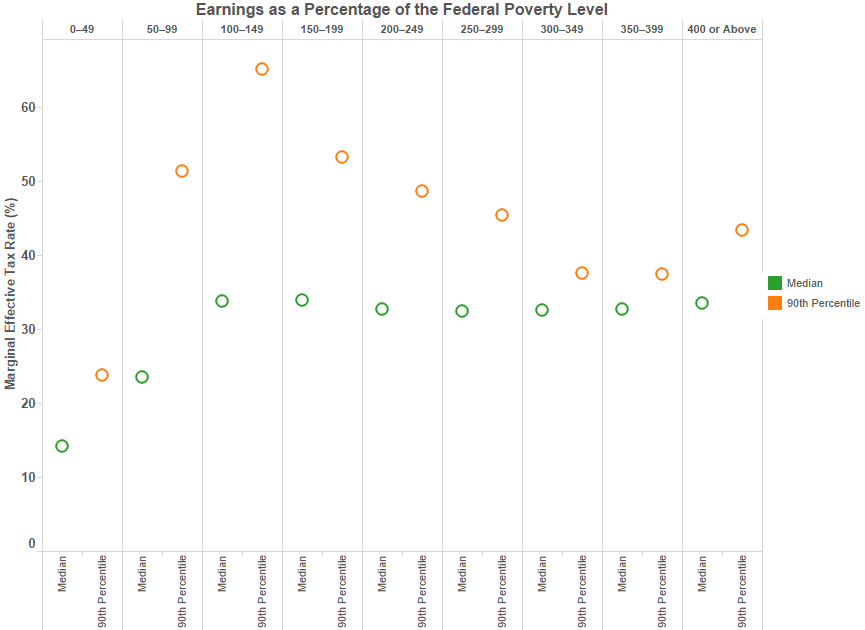
The dozens of different programs that form our tangled welfare system often impose high effective marginal tax rates that make it harder for low-income people to transition out of these programs and lift of those programs and into the middle class. As the people in these programs enter the workforce, get a promotion, or work more hours, they can lose a significant portion of those earnings through reduced benefits and increased taxes. A new report from the Congressional Budget Office (CBO) illustrates this predicament: many households hovering around the poverty level face steeper effective marginal tax rates than even the highest earners. These prohibitively high tax rates can discourage work and limit their prospects, ultimately making them less likely to escape poverty.

Marginal Tax Rates at the Median and 90th Percentiles by Earnings Group, 2016

cbo_tableau_marginal

Source: Congressional Budget Office, “Effective Marginal Tax Rates for Low- and Moderate-Income Workers in 2016,” November 19, 2015.

Note: Figure created using Tableau. 

CBO’s analysis looks at the range of effective marginal tax rates households face at different levels of income. The median marginal tax rate for households just above the poverty level is almost 34 percent, the highest for any income level. Some households that receive larger benefits or higher state taxes have even higher effective rates: 10 percent of households just above the poverty line face a marginal rate higher than 65 percent. For each additional dollar earned in this range, these households would lose almost two-thirds to taxes or lost benefits. The comparable rate for the highest earners, households above 400 percent of the poverty level, is only 43.4 percent. If anything this analysis might understate how steep the effective marginal rates are for some households. CBO only considers the combined effect of income taxes, payroll taxes, SNAP and ACA exchange subsidies, so households that participate in other programs like TANF or housing assistance could face even higher rates. These results mirror some of Cato’s past work investigating the issues and trade-offs involved with these welfare programs.

The nature of the welfare system contributes to the prevalence of these poverty traps. A House and Ways Human Resources Subcommittee recently held a hearing on issue and released a chart illustrating the complex, labyrinthine nature of the welfare system.

WM-Welfare-Chart-AR-amendment-110215-jpegClick on the image for a full-sized view.

New programs were grafted onto the existing system over time, each intended to address a perceived problem afflicting people in poverty, but they can interact in ways that can deter people from striving to create a better life for their families. That’s part of the reason the status quo system, which the Government Accountability Office estimates spends $742 billion at the federal level each year, has achieved such lackluster results to date.

While these shortcomings would seem to indicate that the welfare system is in need of reform, this tangled web has proved resistant to change. One of the last major reforms happened in 1996, when Temporary Assistance for Needy Families (TANF) replaced Aid to Families with Dependent Children (AFDC). Even that reform only addressed one strand of the dozens that make up our tangled system, so while it might have improved that one aspect the larger flaws with the welfare system as a whole have to some extent continued unabated. Even within this one strand there has been little discussion of reform in the past two decades, TANF hasn’t even been properly reauthorized since the Deficit Reduction Act of 2005, it is usually thrown into short-term continuing resolutions or broader omnibus appropriations acts that do not incorporate any meaningful attempts to address the program’s problems. Absent comprehensive, the flawed current system will continue to fall short even as the government funnels hundreds of billions of dollars into it each year.

If the federal government is going to finance a welfare system, it should foster an environment that encourages work and makes it easier for participants to transition out of these programs as they strive to create a better life. The current system falls far short in that regard and needs comprehensive reforms.

Charles Hughes is a research associate at the Cato Institute, where he focuses on federal budget policy, poverty, entitlement reform, and general economics.  Originally from Texas, Hughes joined Cato in 2011 after graduating from the University of Chicago with degrees in Economics and Public Policy.

This work by Cato Institute is licensed under a Creative Commons Attribution-NonCommercial-ShareAlike 3.0 Unported License.

3 Kinds of Economic Ignorance – Article by Steven Horwitz

3 Kinds of Economic Ignorance – Article by Steven Horwitz

The New Renaissance HatSteven Horwitz
******************************

Do you know what you don’t know?

Nothing gets me going more than overt economic ignorance.

I know I’m not alone. Consider the justified roasting that Bernie Sanders got on social media for wondering why student loans come with interest rates of 6 or 8 or 10 percent while a mortgage can be taken out for only 3 percent. (The answer, of course, is that a mortgage has collateral in the form of a house, so it is a lower-risk loan to the lender than a student loan, which has no collateral and therefore requires a higher interest rate to cover the higher risk.)

When it comes to economic ignorance, libertarians are quick to repeat Murray Rothbard’s famous observation on the subject:

It is no crime to be ignorant of economics, which is, after all, a specialized discipline and one that most people consider to be a “dismal science.” But it is totally irresponsible to have a loud and vociferous opinion on economic subjects while remaining in this state of ignorance.

Economic ignorance comes in different forms, and some types of economic ignorance are less excusable than others. But the most important implication of Rothbard’s point is that the worst sort of economic ignorance is ignorance about your economic ignorance. There are varying degrees of blameworthiness for not knowing certain things about economics, but what is always unacceptable is not to recognize that you may not know enough to be speaking with authority, nor to understand the limits of economic knowledge.

Let’s explore three different types of economic ignorance before we return to the pervasive problem of not knowing what you don’t know.

1. What Isn’t Debated

Let’s start with the least excusable type of economic ignorance: not knowing agreed-upon theories or results in economics. There may not be a lot of these, but there are more than nonspecialists sometimes believe. Bernie Sanders’s inability to understand why uncollateralized loans have higher interest rates would fall into this category, as this is an agreed-upon claim in financial economics. Donald Trump’s bashing of free trade (and Sanders’s, too) would be another example, as the idea that free trade benefits the trading countries on the whole and over time is another strongly agreed-upon result in economics.

Trump and Sanders, and plenty of others, who make claims about economics, but who remain ignorant of basic teachings such as these, should be seen as highly blameworthy for that ignorance. But the deeper failing of many who make such errors is that they are ignorant of their ignorance. Often, they don’t even know that there are agreed-upon results in economics of which they are unaware.

2. Interpreting the Data

A second type of economic ignorance that is, in my view, less blameworthy is ignorance of economic data. As Rothbard observed, economics is a specialized discipline, and nonspecialists can’t be expected to know all the relevant theories and facts. There are a lot of economic data out there to be searched through, and often those data require careful statistical interpretation to be easily applied to questions of public policy. Economic data sources also require theoretical interpretation. Data do not speak for themselves — they must be integrated into a story of cause and effect through the framework of economic theory.

That said, in the world of the Internet, a lot of basic economic data are available and not that hard to find. The problem is that many people believe that certain empirical facts are true and don’t see the need to verify them by actually checking the data. For example, Bernie Sanders recently claimed that Americans are routinely working 50- and 60-hour workweeks. No doubt some Americans are, but the long-term direction of the average workweek is down, with the current average being about 34 hours per week. Longer lives and fewer working years between school and retirement have also meant a reduction in lifetime working hours and an increase in leisure time for the average American. These data are easily available at a variety of websites.

The problem of statistical interpretation can be seen with data on economic inequality, where people wrongly take static snapshots of the shares of national income held by the rich and poor to be evidence of the decline of the poor’s standard of living or their ability to move up and out of poverty.

People who wish to opine on such matters can, again, be forgiven for not knowing all the data in a specialized discipline, but if they choose to engage with the topic, they should be aware of their own limitations, including their ability to interpret the data they are discussing.

3. Different Schools of Thought

The third type of economic ignorance, and the least blameworthy, is ignorance of the multiple perspectives within the discipline of economics. There are multiple schools of thought in economics, and many empirical questions and historical facts have a variety of explanations. So a movie like The Big Short that clearly suggests that the financial crisis and Great Recession were caused by a lack of regulation might be persuasive to people who have never heard an alternative explanation that blames the combination of Federal Reserve policy and misguided government intervention in the housing market for the problems. One can make similar points about the Great Depression and the difference between Hayekian and Keynesian explanations of business cycles more generally.

These issues involving schools of thought are excellent examples of Rothbard’s point about the specialized nature of economics and what the nonspecialist can and cannot be expected to know. It is, in fact, unrealistic to expect nonexperts to know all of the arguments by the various schools of thought.

Combining Ignorance and Arrogance

What is missing from all of these types of economic ignorance — and what is often missing from knowledgeable economists themselves — is what we might call “epistemic humility,” or a willingness to admit how little we know. Noneconomists are often unable to recognize how little they know about economics, and economists are often unable to admit how little they know about the economy.

Real economic “expertise” is not just mastery of theories and facts. It is a deeper understanding of the variety of interpretations of those theories and facts and humility in the face of our limits in applying that knowledge in attempting to manage an economy. The smartest economists are the ones who know the limits of economic expertise.

Commentators with opinions on economic matters, whether presidential candidates or Facebook friends, could, at the very least, indicate that they may have biases or blind spots that lead to uses of data or interpretive frameworks with which experts might disagree.

The worst type of economic ignorance is the type of ignorance that is the worst in all fields: being ignorant of your own ignorance.

Steven Horwitz is the Charles A. Dana Professor of Economics at St. Lawrence University and the author of Hayek’s Modern Family: Classical Liberalism and the Evolution of Social Institutions. He is a member of the FEE Faculty Network.

This article was published by The Foundation for Economic Education and may be freely distributed, subject to a Creative Commons Attribution 4.0 International License, which requires that credit be given to the author.

Venezuela’s Bizarre System of Exchange Rates – Article by Emiliana Disilvestro & David Howden

Venezuela’s Bizarre System of Exchange Rates – Article by Emiliana Disilvestro & David Howden

The New Renaissance HatEmiliana Disilvestro & David Howden
******************************

Venezuela is currently going through its worst crisis in history, replete with an endless list of interesting problems. Foremost among these are severe shortages in even the most basic of necessities. Economists have used these shortages as textbook examples to illustrate the pernicious effects of price controls.

Few people, however, are aware that many of the country’s problems are caused by a complex monetary arrangement that makes use of four different exchange rates simultaneously. The result is that Venezuela can either be extremely cheap, or unbearably expensive, depending on the rate used.

Monetary chaos began in 2003 when the late President Hugo Chavez imposed currency controls to stem capital flight after an oil strike. At the time, one US dollar could fetch 1.6 Venezuelan bolivars. Today, barely ten years later, that same dollar can buy 172 bolivars, a devaluation of over 99 percent! Of course, that is in the official (i.e., government regulated) market. On the black market, the exchange rate is currently nearly 900 bolivars to the US dollar. That is, if you can find anyone selling dollars, or more importantly, looking to buy the badly tarnished Venezuelan currency.

This devaluation is in and of itself a large problem, both for consumers who must deal with high degrees of price inflation and for businesses that must undergo long-term capital planning decisions with a constantly moving monetary unit. However, it is the volatility of the exchange rate caused by the government’s continuous changes to currency restrictions and official rates that is proving the most cumbersome problem.

A Very Complex System of Exchange Rates

Currently there are four exchange rates: First is the official one, called CENCOEX, and which charges 6.30 bolivars to the dollar. It is only intended for the importation of food and medicine.

The next two exchange rates are SICAD I (12 bolivars per dollar) and SICAD 2 (50 bolivars per dollar); they assign dollars to enterprises that import all other types of goods. Because of the fact that US dollars are limited, coupons are auctioned only sporadically; usually weekly in the case of SICAD 1 and daily for SICAD 2. However, due to the economic crisis, no dollars have been allocated for these foreign exchange transactions and there hasn’t been an auction since August 18, 2015. As of November 2015, the Venezuelan government held only $16 billion in foreign exchange reserves, the lowest level in over ten years, and an amount that will dry up completely in four years time at the current rate of depletion.

The last and newest exchange rate is the SIMADI, currently at 200 bolivars per dollar. This rate is reserved for the purchase and sale of foreign currency to individuals and businesses.

There are many problems in Venezuela as a result of this complex system. The most obvious is the near impossibility to actually get assigned to these rates due to the complex bureaucratic process one must navigate to apply for them. In response to these difficulties, Venezuelans must rely on the black market to meet their demands for foreign currency. Therefore, people naturally rely on the black market rate, which although it is much less advantageous (at 900 vs. anywhere from 6.3 to 200 bolivars per dollar on the “official” market), at least offers the possibility to procure the much needed foreign exchange.

Corruption, which is a main characteristic of Venezuela’s political regime, is another problem derived from this complex monetary system. Officials within the government and those connected to it have taken advantage of their positions of power and influence to mismanage the money assigned for other, productive and necessary, institutions. Thus, well-connected individuals obtain US dollars through the legal channels and then sell them on the black market at a higher price. (This activity is one of the only ways to consistently earn high levels of profits in the beleaguered Venezuelan economy, and is only available to those privileged few who are connected to the proper government officials.)

This point is especially important when studying the vast array of shortages. The embezzlement of foreign currency intended for importing basic goods, e.g., foreign exchange reserved for the CENCOEX and SICAD exchange rates, leave legitimate businessmen with no options to obtain legally the necessary currencies to import goods. Owing to the rapidly depreciating bolivar, US dollars are hoarded as a means of savings, thus further exacerbating the foreign exchange shortage for importers. As a consequence, imports are unable to be paid for, leading to shortages on top of those already caused by extensive and damaging price controls.

The Poor Suffer the Most

These problems affect directly all citizens, but are especially pernicious to lower-income individuals. Many suppliers will only sell what few goods they have for US dollars, eschewing accepting bolivars in the payment of their wares. Black market currency sellers set up shop outside supermarkets to accommodate this phenomenon, but it must be noted that only the upper-middle and higher income earners are able to afford to pay the black market rate. The result is that the lower-income segment of Venezuelan society, those who price and currency controls are supposedly helping, are not able to obtain the currency necessary to buy simple goods and services (and the wealthy can only do so at a high price).

Although the business community demands to be paid in US dollars this harms lower-income individuals unduly and is a completely rational response. If businesses kept selling their scarce supply of goods at the official rate their shelves would deplete faster than they already do. Venezuelans earn income at the official rate of 6.30 bolivars to the US dollar while businesses must pay a much higher rate in order to import goods. This difference must be accounted for by stores asking for prices commensurate with what they must pay to stock their shelves.

The complex exchange rate system in Venezuela is not only a good example of unnecessary government meddling in the economy, but also explains why a corrupt political regime has been able to retain power for so long despite more than a decade of hardship imposed on the country. The use of several exchange rates has made it easy for the Chávez and Maduro governments and their followers to make enormous profits by embezzling the money assigned to the business community and individuals. By doing so, they have completely devalued the bolivar and impoverished what was once one of the richest countries in the world.

Emiliana Disilvestro studies international business at Saint Louis University at its Madrid campus.

David Howden is Chair of the Department of Business and Economics and professor of economics at St. Louis University’s Madrid Campus, and Academic Vice President of the Ludwig von Mises Institute of Canada.

This article was published on Mises.org and may be freely distributed, subject to a Creative Commons Attribution United States License, which requires that credit be given to the author.

One Bill Could Massively Improve Access to Lifesaving Drugs – Article by Alex Tabarrok

One Bill Could Massively Improve Access to Lifesaving Drugs – Article by Alex Tabarrok

The New Renaissance HatAlex Tabarrok
******************************

Reciprocity is an effective and common-sense idea

Senators Ted Cruz (R-Texas) and Mike Lee (R-Utah) have just introduced a bill that would implement an idea that I have long championed: making drugs, devices, and biologics that are approved in other developed countries also approved for sale in the United States.

Highlights of the “Reciprocity Ensures Streamlined Use of Lifesaving Treatments Act (S. 2388), or the RESULT Act,” include:

  • Amending the Food, Drug and Cosmetic Act to allow for reciprocal approval of drugs, devices and biologics from foreign sponsors in certain trusted, developed countries including EU member countries, Israel, Australia, Canada and Japan.
  • Encouraging the FDA to expeditiously review life-saving drug and device applications, this legislation would provide the FDA with a 30-day window to approve or deny a sponsor’s application….
  • The HHS Secretary is instructed to approve a drug, device or biologic if the FDA confirms the product is:
    • Lawfully approved for sale in one of the listed countries;
    • Not a banned device by current FDA standards;
    • There is a public health or unmet medical need for the product.
  • If a promising application for a life-saving drug is declined Congress is granted the authority to disapprove of a denied application and override an FDA decision with a majority vote via a joint resolution.

In explaining why he introduced the bill, Senator Cruz argued:

We continue to lose far too many of our loved ones to the “invisible graveyard,” as economist Alex Tabarrok has described: lives that could have been saved but for a bureaucratic barrier that rejects medical cures and innovation…

The bill I am introducing takes the first step to reverse this trend. It provides for reciprocal drug approval, so that cures and medical devices that are already approved in other countries can more expeditiously come to the U.S.

This post first appeared at Marginal Revolution.

Alex Tabarrok is a professor of economics at George Mason University. He blogs at Marginal Revolution with Tyler Cowen.

Good News, Bernie Sanders: Average Workweeks Are Getting Shorter – Article by Chelsea Follett

Good News, Bernie Sanders: Average Workweeks Are Getting Shorter – Article by Chelsea Follett

The New Renaissance HatChelsea Follett
******************************

Capitalism is letting people choose more leisure

Senator Bernie Sanders recently tweeted the following:

sanders.tweetFortunately, the gruelingly long workweek described by Sanders is not the norm. In fact, leisure time has been on the rise. In 1950, an average U.S. worker worked 1,984 hours a year, or about 38 hours a week. In 2015, an average American worker worked 1,767 hours, or about 34 hours a week.

workhours

That means that the average U.S. worker had 217 more hours for leisure or other pursuits in 2015 than in 1950. That is about 9 days of extra time.

The 50-hour workweek described by Sanders is more common in China, where the average worker worked 2,432 hours in 2015, or around 47 hours a week.

This post first appeared at HumanProgress.org.
Compare other countries over time with their interactive dataset.

Chelsea Follett (Chelsea German) works at the Cato Institute as a Researcher and Managing Editor of HumanProgress.org.

This article was published by The Foundation for Economic Education and may be freely distributed, subject to a Creative Commons Attribution 4.0 International License, which requires that credit be given to the author.

Safe Spaces Can’t Be Diverse – And Vice Versa – Article by Kevin Currie-Knight

Safe Spaces Can’t Be Diverse – And Vice Versa – Article by Kevin Currie-Knight

The New Renaissance Hat
Kevin Currie-Knight
******************************

I’m a fan of the LGBT center on the campus where I teach. It offers a space where gay, lesbian, bisexual, and transgender students can be among students, faculty, and staff without fear of harassment, bullying, or negative judgment. There, they do not have to worry about passing (pretending to be straight) or covering (having to signal to others that they are still “normal” despite who they are).

But do you know what spaces like this are not? Diverse.

Or rather, they are not diverse in the types of attitudes permitted to exist there. One cannot, say, believe that homosexuality is a sin and feel welcome at an LGBT center. One cannot believe that transgender people are mentally ill and find LGBT centers to be congenial.

This lack of diversity is not wrong; it is by design and has a good purpose. A safe space is one where people with certain identities that don’t fit in elsewhere can find safety through homogeneity and solidarity.

We don’t need to dismiss either ideal to recognize that a space’s safety and its diversity will be inversely related. The more you have of one, the less you must have of the other.

But you can have spaces and contexts that allow for either ideal, or varying degrees of compromise between them — unless activists succeed in their current quest to convert entire universities into safe spaces.

The Yale case is well known by now. Erika Christakis, a lecturer in early child development, voiced concern in an email to Yale students and residence-life folks urging them to rethink the university’s heavy-handed approach to advising students on which Halloween costumes to avoid. Her note ignited controversy and protest on campus — with some even calling for Christakis’s resignation — because the possibility of students wearing offensive Halloween costumes makes the campus a potentially unsafe space.

In another recent example, the University of Missouri has been experiencing protests regarding alleged racist speech and treatment of minority students. During one of these protests, a journalist trying to cover the event was evidently shouted down and intimidated because his (journalistic) presence at the protest allegedly threatened the protesters’ safe space. (Think about how odd it is to describe the site of a vigorous protest as a safe space).

One journalist described a video of the events as follows:

In the video of Tim Tai trying to carry out his ESPN assignment, I see the most vivid example yet of activists twisting the concept of “safe space” in a most confounding way. They have one lone student surrounded. They’re forcibly preventing him from exercising a civil right. At various points, they intimidate him. Ultimately, they physically push him. But all the while, they are operating on the premise, or carrying on the pretense, that he is making them unsafe.

If people who regularly find their campuses (or other places) to be inhospitable, it may do them good to have social spaces where they are assured some level of relief, probably with people they are comfortable with. But think about what that means for diversity.

Increasing diversity is another aspiration at universities and other organizations, but safe spaces demand that the people in the space have a certain degree of homogeneity. For Yale to be a safe space, the university must disallow a diversity of Halloween costumes.

Why did the Missouri protesters suggest that Tai’s presence threatened to turn their protest into an unsafe space? Because there was a possibility that the narrative this journalist would construct might not be one the homogeneous protesters would approve of. Tai threatened the homogeneity and solidarity of the protest.

Let’s go back to the example of LGBT centers. That these students have somewhere they can go where they do not feel pressures to hide or “tone down” their identities is important, and any society that promotes freedom of association will have many such centers, whether official or not. But the only way for an entire university to become a safe space for LGBT students is to sacrifice diversity by, for example, demanding that religious students not believe (at least openly) that homosexuality is sinful. The converse is also true: LGBT centers could no longer function as safe spaces for LGBT students if they became sites of more diversity, where those religious students could regularly voice their beliefs.

Diversity cannot thrive in a world that is one big safe space.

Why? Because diversity means difference. Difference means that people will invariably see things in different ways, and we will sometimes anger each other. It’s not a bug, but a feature. To eliminate the possibility that some of us could deeply offend others of us would be to require everyone to live only in ways acceptable to all.

Diversity means a world where black-power advocates can live openly and in ways that anger white people — and where white-power advocates can live openly and thus anger black people. A world of diversity is one where people with different tastes, comfort levels, and senses of humor can wear Halloween costumes that may offend others.

The best resolution is to allow people on college campuses and elsewhere to create safe spaces. If we believe others’ Halloween costumes may deeply offend us, or that people may say derogatory and racist things to us, we can go to one of those spaces. But leave the university as a diverse space — don’t force it to become a safe space.

Diversity and emotional safety are values at odds with each other. They can coexist in tension, but the expansion of one can only come at the expense of the other.

Kevin Currie-Knight teaches in East Carolina University’s Department of Special Education, Foundations, and Research. He is a member of the FEE Faculty Network.

This article was originally published by The Foundation for Economic Education and may be freely distributed, subject to a Creative Commons Attribution 4.0 International License, which requires that credit be given to the author.

Does DC’s Curfew Prevent Crime – Or Increase It? – Article by Alex Tabarrok

Does DC’s Curfew Prevent Crime – Or Increase It? – Article by Alex Tabarrok

The New Renaissance HatAlex Tabarrok
******************************

Another for the “unintended consequences” file

Washington, DC, has a juvenile curfew law. Anyone “under the age of 17 cannot remain in or on a street, park or other outdoor public place, in a vehicle or on the premises of any establishment within the District of Columbia during curfew hours.” There are exemptions for juveniles accompanied by a parent and for travel for jobs (no detours allowed.)

Curfew laws keep some juveniles off the streets during curfew hours, but which ones? The criminals seem the least likely to be deterred, and with fewer people on the street, perhaps the criminals are emboldened.

The DC curfew switches from midnight to 11 pm on Sept 1 of every year. In a working paper, Jennifer L. Doleac and Jillian Carr test the effect of DCs juvenile curfew on gun violence by looking at the number of gunshots heard in the 11pm to midnight “switching hour” just before and just after Sept 1. From a summary:

The September 1 change provides a clean natural experiment. If curfews reduce gun violence, then when the curfew shifts to 11:00 p.m. rather than midnight, gunfire between 11:00 p.m. and midnight should go down. Does it?

Just the opposite. Using data on gunfire incidents from ShotSpotter (acoustic gunshot sensors that cover the most violent neighborhoods in D.C.), we find that after the curfew switches from midnight to 11:00 p.m., the number of gunshot incidents increases by 150 percent during the 11:00 p.m. hour.

This amounts to 7 additional gunfire incidents city-wide per week, during that hour alone. Jane Jacobs was right: the deterrent effect of having lots of people out on the streets is powerful. This makes juvenile curfew policies counter-productive.

The use of ShotSpotter data is innovative and avoids some problems with issues of police enforcement. Calls to 911, however, don’t show the same pattern as the ShotSpotter data, which is worrying.

I’d also like to see more information on the proposed mechanism. Is it really the case that significantly fewer people are out on the streets at say 11:30 pm after the curfew has been lowered to 11 pm than when the curfew was set at midnight? The curfew only directly affects people under 17 and, as noted above, there are quite a few exemptions. Also what are the ages of those typically arrested on the basis of ShotSpotter alerts?

By the way, on a typical day in DC there are almost 15 gunfire incidents heard by ShotSpotter (data here, the authors report 8 but that may be from a restricted sample). A lot of gunfire is heard around a handful of schools. The ShotSpotter system is quite accurate. Although it misses some shots it distinguishes shots from car backfires better than people do. I also found this note from the Washington Post amusing, in a frightening way:

About a third of detected gunshot incidents in the city happen on New Year’s Eve or around July 4. Officials explain the high rate as celebratory gunfire.

This post first appeared at Marginal Revolution.

Alex Tabarrok is a professor of economics at George Mason University. He blogs at Marginal Revolution with Tyler Cowen.

The Role of Aging in Society – Article by Demian Zivkovic

The Role of Aging in Society – Article by Demian Zivkovic

The New Renaissance HatDemian Zivkovic
******************************
Take the following situation. We discover an extremely contagious virus. It infects you and your loved ones, and quickly propagates through all of mankind. As a result, 150,000 people die every day. It kills more than twice the number killed in the Holocaust every three months, and in 30 years, it will have killed 1.5 billion, around one in six people. How high would this score on a list of global priorities? There’s no doubt the situation would be grave. Most people would demand immediate action.
***
But that’s just a thought experiment, right? Not really. Every day, 150,000 people do die from age-related disease. Not only the cost in lives is monumental; societal and economic costs are also on the rise. According to the Dutch Statistics Authority (the CBS), the amount of people older than 65 (retirement age) will have increased to 27% in 2040, from the current 19%. As more people are born, this also means more people die from age-related disease, taking all their knowledge, expertise, and productivity with them. In short: If we don’t do anything about the consequences of our aging population, we face severe consequences.
 *** 

So what is the best way to deal with the problem of our society aging?

There is no simple solution. More conventional healthcare barely improves quality of life, while just letting people die is not an ethical option. Rutger Bregman, a Dutch historian and philosopher, argues for thinking more radically about solutions to societal problems. According to his essay “Een pleidooi voor de utopie” (A plea for utopia) in the Dutch magazine “De groene Amsterdammer”, we have lost the ability to think in such a way; We only look at marginal improvements, instead of looking at changes that could radically improve and change our society. So if we do explore more radical solutions, what can we do?

Professor Aubrey de Grey, Ph.D. in biology, Chief Science Officer of the prestigious SENS Research Foundation, and partner at the Gerontological Society of America, argues that we could look at a radical intervention in human aging. According to de Grey, the best way of solving many of these problems is to cure aging at its source. De Grey is not the only one who holds that opinion. Alphabet, Inc.‘s biotechnology subsidiary (Calico) also views the problem from this position. This point of view obviously raises quite a few questions. Critics claim that de Grey’s vision is impossible or undesirable. Proponents point to the massive advantages of curing age-related disease.

One of the arguments put forward is that short-term thinking causes many economical and societal problems. Economist Joseph Stiglitz speaks about rent-seeking (“Rent-Seeking and the Making of an Unequal Society”, 2014), economically destructive behaviour in which an individual or business enriches itself while harming the entire economy in the process. Environmental concerns are also a very large issue. Since people (if they are lucky) don’t get to live much longer than a hundred years old, many people find it very uninteresting to think about what our behaviour is doing to the environment on the long term. But what will it mean for these problems if we have to let go of short-term thinking, because we live for a much longer time? One thing is for sure: If de Grey’s vision becomes reality, a lot will change in our society.

Economy, Environment, and Overpopulation
 *** 

Short-term thinking has a catastrophic effect on our economy and environment.

The previously mentioned economist Joseph Stiglitz claims in his article that our economy is suffering serious problems, since rent-seeking is causing society-wide destruction and inequality. For centuries, economists, philosophers, and ethicists have been considering how to stop such unethical behavior. Usually, they looked at different moral developments, better regulations, or restructuring society as solutions.

In his work “The Power of Context”, Malcolm Gladwell makes the claim that the environment and the context we live in have a large impact on our behaviour. Human life knows a few certainties; one of them is that you will die within a century. One may have children or grandchildren, but very few people are concerned about the fate of their heir several hundred generations down the road. In my interview with him (2014, Nakedbutsafe magazine), Professor de Grey argues that many people would be much more concerned with the long term if they knew they would still be around in several centuries, and there’s a lot to be said about that. Instead of waging a fruitless and hopeless war on selfishness, it may be more prudent to use it to improve the world.

De Grey’s solution essentially means inventing the fountain of youth through advanced biotechnology. He wants to do this through a method called “Strategies for Engineered Negligible Senescence” or SENS. SENS essentially involves periodically repairing accumulated damage from aging, so it never reaches a critical point where it turns into a specific illness. De Grey is not the only one who is looking for a solution for aging: Google Ventures heavily invests in such technology.

In 2013, Google founded a company called Calico, which entered a partnership with AbbVie. With a record investment of two billion dollars, most money ever put into a start-up, the ambitious firm wants to create a fundamental understanding of aging and use said understanding to eventually cure said aging. Bill Maris, president of Google Ventures, has already made the famous claim we will be able to have technology to live 500 years within our lifetimes. Another actor in the corporate sector is BioViva, whose CEO, Elizabeth Parrish, has become the first human on the planet to get treated with a combination of in vivo gene therapies to slow down aging.

The approaches of Calico, SENS, and BioViva look at the problem from different angles, but they have one thing in common: they are not looking at ways to extend the lives of sick, disabled seniors. Instead, they are looking at a method to not simply extend life, but to extend health. They are looking at methods to stop this biological aging from happening. Life extension is merely a side effect. After all, if a 200-year-old has the vitality of a 40-year-old, why would an aging population be a problem? Even though the population will age, the percentage of “elderly” people will decrease, and so will age-related suffering and related economic pressure.

However, not everyone is optimistic about these changes. Critics are concerned about what a radically extended life will mean for overpopulation. They argue that if nobody dies, we will have so many people that we will either have to kill people, or make reproduction illegal. While such a top-down approach may seem like “common sense”, there’s a lot to be said about why such drastic top-down measures will be unnecessary. Steven Johnson, a best-selling popular science author and media theorist, introduces the concept of emergence (Emergence: The Connected Lives of Ants, Brains, Cities, and Software, 2001). Emergence refers to patterns in complex systems which can’t be reduced to the properties or behaviours of an individual element of the system. Johnson uses the ant colony as an example: while no single ant coordinates the behaviour of the colony, the entire system is self-organizing and thus functions perfectly. An ant colony, but even more so human society, is a good example of an emergent system.

A simple example of this self-organization is the distribution of bread. There is no central authority that plants where bakeries should be located, how much grain should be produced, what logistic solutions should be used for bread transport to people’s homes, or what bread prices ought to be. In fact, such central planning has been tried several times in history. In communist dictatorships such as the Soviet Union and North Korea, centralized attempts at steer society have had catastrophic results. However, if emergence of self-organisation does its job, a society flourishes. We can see this same effect work on overpopulation and birth rates. According to the World Health Organisation, the fertility rates plummet as life expectancy skyrockets. Countries that have the highest life expectancies have the lowest birth rates. Japan, which has one of the highest life expectancies has a negative birth rate; its population is in decline, even though no central planning has intervened in any way.

This hypothesis is also supported by virtually all historic trends. Every widespread average life-expectancy spike was met with a plummet in birth rates. When our life expectancy went up because of the invention of antibiotics, our birth rates hit historic lows. We see the opposite in countries where life expectancy is very low. The country with the highest birth rate is Nigeria, while it’s one of the poorest countries in the world. The average life expectancy in Nigeria is below 55. According to the United Nations, countries with low life expectancy have by far the largest effect on overpopulation.

Regulation of population is therefore unnecessary; a complex system such as modern society self-regulates and corrects itself. This idea is in line with Gladwell’s theory of context-dependent behavior; the context largely defines our behavior. And as a self-organizing system, society demonstrably changes the context to steer our behavior in effective patterns. A dystopia where government has to regulate reproduction or death is very unlikely.

Philosophical Arguments

If Gladwell is right about context as catalyst of behaviour, what will the effects of a society devoid of biological aging be on our humanity? Not all arguments against radical life extension are pragmatic in nature. The conservative bioethicist Leon Kass is one of the opponents of radical life extension pondering this question. He argues that indefinite life extension is unnatural and thus undesirable. Kass also claims that we won’t appreciate life if we life “forever.”

“Time is a gift, but the perception of endless time or of time without bound in fact has the possibility of undermining the degree to which we take time seriously and make it count.”

~ Leon Kass (Aging Research, 2004).

Kass makes a comparison with the ancient Greek gods to argument why life’s shortness gives it purpose.

“Homer in The Iliad and The Odyssey presents human beings whom he names as mortals. That is their definition in contrast to the immortals. And the immortals for their agelessness and their beauty live sort of shallow and frivolous lives. Indeed, they depend for their entertainment on watching the mortals who, precisely because they know that their time is limited, and that they go around only once, are inclined to make time matter and to aspire to something great for themselves.”

~ Leon Kass (Aging Research, 2004)

While these arguments may seem somewhat of a philosophical take on many common criticisms, they are easily debunked. Elizabeth Parrish, CEO of BioViva and a pioneering entrepreneur in the field of gene therapy, argues against the idea that we should accept something because it’s considered “normal.” (“Liz Parrish speaks at People Unlimited on transcending the aging paradigm with gene therapy”, 2015). She argues that “normal” is a situational opinion which constantly changed throughout the entirety of history. In 1665, dying of infectious disease was normal. During this time only one percent of all humans died from aging: Infectious diseases were responsible for more than three quarters of all deaths before we developed the first immunization therapies – the development of which is similar to the process to defeat aging with gene therapy today. Just like today, there was criticism of the development of vaccines and antibiotics, even though lifespans and health were greatly improved by the use of these advancements – and the arguments have stayed very much the same.

Parrish is not the only one who provides a strong argument against the vision of Kass. Reason, creator of the Fight Aging! blog, is another intellectual who is very skeptical about Kass’s position. In his rebuttal of Kass (“Leon Kass, Mystic” by Reason, 2004), he compares Kass with an alchemist, a modern mystic:

“The alchemists of old stood atop what little knowledge of chemistry they had and built a speculative religion of hermetic magic, transient wishes, celestial signs and hidden gold. Leon Kass stands atop what little biotechnology we have today (and seems to have a good grasp thereof), building his own structures of fanciful thought, equally disconnected from the real world. 

All of Kass’ arguments against longer, healthier lives are essentially mystical and devoid of real substance.”

In “Leon Kass, Mystic” (2004), Reason wonders if Kass’s philosophical musings are enough of a reason to condemn billions of people to a slow and painful death. Just like the alchemists, Reason argues, Kass’s vision is based upon ancient texts and his own subjective knee-jerk reactions, instead of researching the world around him. Reason postulates that this is the fundamental difference between a mystic and a scientist: The mystic is immune to impractical facts, consequences, and reality.

De Grey also argues against the bioconservative position. He rejects the idea that longer lives will somehow lower our appreciation of life. We will be able to start a new major when we are fifty years old, or a new career when we’re a hundred and fifty. The very fact that we have so little time causes us to experience “lock-in” in our careers and choices. This causes boredom and stress. The amount of time we lose switching to doing something we may enjoy a lot more is too radical, because we have so little time to begin with. Radical life extension seems more likely to actually cure the problems its critics claim it will cause (such as boredom, stress, or disenchantment with life).

Conclusion

Treatments for age-related diseases are on their way, and curing aging is big business. The first people are already getting early treatments, and the prognoses are positive. Society will have to adapt to the changes that come with these treatments. It is very important to explore options for adequately engaging public opinion in favor of curing age-related disease, to mitigate massive economic and human losses that these diseases currently cause, and to create the legislation and framework needed to implement these technologies in a fair, responsible, and sane way.

Bibliography

Bregman, Rutger (2013). Dromen is niet eng; Essay Pleidooi voor de utopie. De Groene Amsterdammer, jaar 137, week 20. https://www.groene.nl/artikel/pleidooi-voor-de-utopie.

Gladwell, Malcolm (2000). The Power of Context. In R.E. Miller & Spellmeyer (Eds.), The New Humanities Reader (Fifth Edition, pp. 148-167). Print.
 *** 
Stiglitz, J. E. (2012). Rent Seeking and the Making of an Unequal Society. In R.E. Miller & Spellmeyer (Eds.), The New Humanities Reader (Fifth Edition, pp. 148-167). Print.
 *** 

Johnson, Steven. ‘Emergence: The connected Lives of Ants, Brains, Cities, and Software’, 2001. In ‘The New Humanities Reader’, Richard E. Miller, Kurt Spellmeyer, Wadsworth, 2011, pp. 151 – 165

De Grey, Aubrey D. N. J. (2005). Resistance to debate on how to postpone ageing is delaying progress and costing lives. EMBO Reports, 6(Suppl 1), S49–S53. http://doi.org/10.1038/sj.embor.7400399

Kass, Leon (2004). Aging Research.  http://agingresearch.org/sage/Default.aspx?tabid=60

Reason (2004). Leon Kass, Mystic. FightAging.org. https://www.fightaging.org/archives/2004/04/leon-kass-mysti.php
 *** 
Parrish, Elizabeth (2015). Liz Parrish speaks at People Unlimited on transcending the aging paradigm with gene therapy. https://www.youtube.com/watch?v=87OUb8TBwX0
 *** 

Demian Zivkovic is the president of the Institute of Exponential Sciences  (Facebook  / Meetup) – an international transhumanist think tank / education institute comprised of a group of transhumanism-oriented scientists, professionals, students, journalists, and entrepreneurs interested in the interdisciplinary approach to advancing exponential technologies and promoting techno-positive thought. He is also an entrepreneur and student of artificial intelligence and innovation sciences and management at the university of Utrecht.

Demian and the IES have been involved in several endeavors, such as organizing lectures on exponential sciences, interviewing experts such as Aubrey de Grey, joining several of Mr. Stolyarov’s futurism panels, and spreading Death is Wrong – Mr. Stolyarov’s illustrated children’s book on indefinite life extension – in The Netherlands.

Demian Zivkovic is a strong proponent of healthy life extension and cognitive augmentation. His interests include hyperreality, morphological freedom advocacy, postgenderism, and hypermodernism. He is currently working on his ambition of raising enough capital to make a real difference in life extension and transhumanist thought.

Comparative Advantage: An Idea Whose Time Has Passed – Article by Michael Munger

Comparative Advantage: An Idea Whose Time Has Passed – Article by Michael Munger

The New Renaissance HatMichael Munger
******************************

The Division of Labor Is the Engine That Drives Prosperity

Many economists will tell you that the most important principle in economics is comparative advantage — the idea that it is expensive to grow oranges in Alaska or to flood rice paddies in Saudi Arabia, so Alaska and Saudi Arabia should import oranges and rice, respectively, and base local production on the advantages of local conditions. We got this idea from classical economist David Ricardo, who famously observed in 1821 that England and Portugal would both be wealthier if Portugal exported its wine and imported England’s textiles, and vice versa.

Ricardo’s principle even demonstrated the advantages of trading with those who are less productive at everything. For example, my wife is an attorney. She is also a fast and accurate typist. Yet she hires a secretary who is considerably slower at typing. Secretaries get paid less than attorneys, so if my wife specializes in law and the secretary specializes in typing, my wife can earn more for her firm and a secretary gets a job. Both end up better off. That’s true even though my wife is better at both jobs: comparative advantage means trade helps everyone.

Division of Labor Trumps Comparative Advantage

The problem is that fixed comparative advantage — derived from weather, culture, and location — is vanishing in the modern world. Ricardo’s classical formulation leaves no space for human creativity, no role for division of labor, and no room for innovation to affect the dynamics of cost.

So economists have it wrong, as my friend Russ Roberts argued in 2010. The most important principle in economics is opportunity cost. Here’s proof: you can define opportunity cost without resorting to comparative advantage. But you can’t possibly define comparative advantage without invoking opportunity cost.

The notion of comparative advantage is empirically misleading, because it sounds deterministic. There are few situations where fixed factors make the relative opportunity costs of different actions immutable. Instead, cost and productivity differences are endogenous, the consequence of human ingenuity and the division of labor. Today’s cost advantage for one country may disappear if another country finds a better, cheaper way to produce the product. And the way to specialize is to exploit the division of labor.

Sock City

What nation lost the most manufacturing jobs from 1990 to 2000? China. That may seem surprising, given the media stereotype of how we “ship US jobs overseas,” but it’s true (PDF). In 1990, Chinese manufacturing meant large sheds filled with hundreds of people working with sewing machines and other small tools. The scale was huge, with at least 100 million manufacturing workers. But productivity was terrible.

In the late 1990s, China began to automate, taking advantage of division of labor. A thousand women with sewing machines in a barn turned into 25 women running enormous machines in a factory, with a gigantic increase in productivity. A fraction of the workers produced 10 times as much output, increasing productivity a hundredfold and forcing 97.5 percent of the workers out. But those workers found new jobs, as China used the division of labor more and more effectively. The country’s advantage was not climate, not soil quality, but human action consciously designing production processes that were cheaper and faster.

Nowhere did productivity rise faster than in the city of Datang in Guangdong Province. Part of Datang is actually called “Sock City,” because more than a third of all socks sold in the entire world (yes, the world) are manufactured there. Datang boasts more than 8,000 hosiery makers ringing the city center, and they produced more than 11 billion pairs of socks in 2012. The socks you’ll find at Walmart — or even at Neiman Marcus or another more upscale store — were likely made in or around Datang.

The concentration of manufacturing at Sock City means this: there is a well-developed labor market for exotic sock-making specialties. The occupations that are well known in Datang don’t exist elsewhere, because no other location has been able to take such full advantage of the division of labor. What limits the division of labor in Datang? Only the extent of the market, just as Adam Smith said in The Wealth of Nations. And remember that Datang is producing at a rate of nearly two pairs of socks per year, for every human on the planet. Datang’s market is Earth.

It wasn’t always that way. Datang does not have any comparative advantage, at least not in the way Ricardo meant. The climate is not especially favorable, the city is not near an essential natural-resource base, and sock making is not part of traditional culture. Datang’s dominance is new and is overtaking historical frontrunners like Fort Payne, Alabama, the self-proclaimed Sock Capital of the World.

Fort Payne “began making stockings in 1907 and once boasted of producing 1 of every 8 pairs worn on the planet,” writes Don Lee in “The New Foreign Aid,” published April 10, 2005, in the Los Angeles Times. However, he explains,

China’s advantages in the global marketplace are moving well beyond cheap equipment, material and labor. The country also exploits something called clustering in a way that the United States just can’t match.… Industrial clusters are like one-stop production centers, achieving economies of scale and driving innovation by geographically bunching suppliers, manufacturers and contractors.…

Meanwhile, American producers, pummeled by imports from China and elsewhere, saw their share of the US hosiery market fall from 69% in 2000 to 44% in 2003, according to the latest industry data.

Comparative advantage is fixed and exogenous. Opportunity cost is mutable, the product of innovation. Datang’s Sock City itself may soon lose its dominance.

Who “should” produce socks? Comparative advantage here is no guide; the situation is more like comparing two street porters who appear to be quite similar. One of the street porters figures out ways to make socks much more cheaply. Over time, the advantage in opportunity cost grows because of the improvements in dexterity, tool use, and design of new production processes. Human ingenuity created an opportunity for nations to specialize in activities where their opportunity costs were lower. Specialization and trade are what produce prosperity, and opportunity costs guide the choice of what each country should specialize in. My comparative advantage today may be your comparative advantage next year. But all the street porters started out the same.

Focus on Opportunity Cost

Economists routinely act as if three related key concepts — division of labor, comparative advantage, and opportunity cost — are distinct.

They are not. Comparative advantage is not a separate concept at all. It is simply an explanation of the implications of the division of labor (the engine that drives prosperity) and opportunity cost (the concept that guides the choice of which activities a person, or a nation, should specialize in).

Admittedly, it was a significant intellectual achievement to show that the weaker trading partner benefits from trade, even if the stronger partner is better at everything. But those fixed differences have largely disappeared in many markets. The question of what should be produced, and where, is now answered by dynamic processes of market signals and price movements, driven by human ingenuity and creativity. The cost savings resulting from successfully dividing labor and automating production processes dwarf the considerations that made comparative advantage a useful concept in economics.

Let’s downgrade comparative advantage from our list of key concepts in economics, and recognize that the human mind is the mainspring of a market economy.

Michael Munger is the director of the philosophy, politics, and economics program at Duke University. He is a past president of the Public Choice Society.

This article was published by The Foundation for Economic Education and may be freely distributed, subject to a Creative Commons Attribution 4.0 International License, which requires that credit be given to the author.

Why Is the Middle Class Shrinking? – Article by Steven Horwitz

Why Is the Middle Class Shrinking? – Article by Steven Horwitz

The New Renaissance HatSteven Horwitz
******************************

Two Arguments in Favor of Economic Inequality

Economic inequality continues to be a major political issue even as the headlines scream about terrorism and climate change. Bernie Sanders has made it a centerpiece of his presidential campaign, and other candidates have addressed it along the way. And a recent study by the Pew Research Center has added new, though misplaced, fuel to the fire of those concerned about inequality.

The Pew study has been discussed in the media, and one key point has been grossly misunderstood. Among other things, the study found that the American middle class is shrinking and is now just under half of the population. Commentators quickly began to refer to the “hollowing out” of the middle class and to tie this study to the concerns about growing inequality.

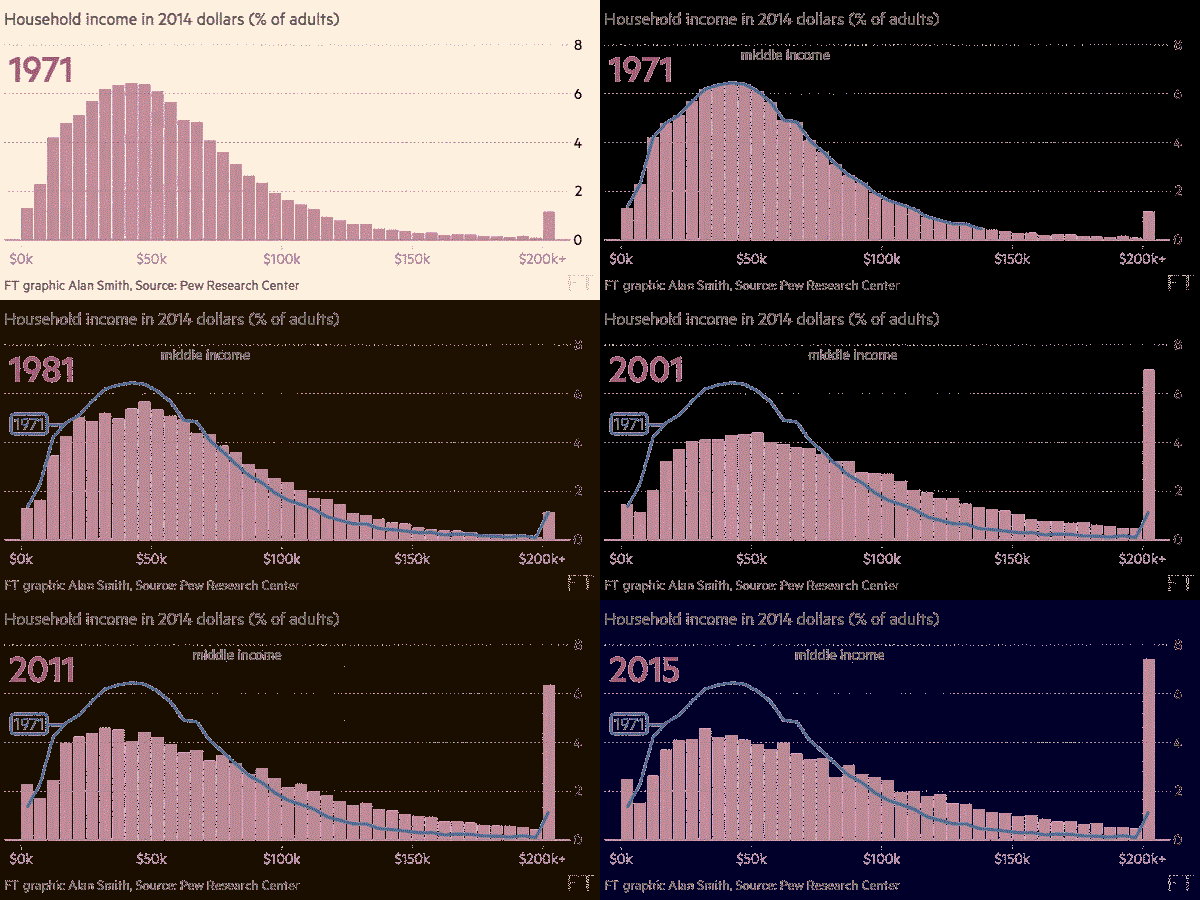
However, a close look at the data shows that the middle class has shrunk since 1971 because more members of the middle class have moved up the income ladder than down it.

Don’t believe me? Look for yourself at the terrific graphic that the Financial Times created to illustrate the data:

ft2015inequalitygraphYou can watch as the folks on the left slowly slide to the right over 44 years. When you compare the 1971 distribution with the 2015 one, what do you see? A growth in households earning around $80,000 or above, adjusted for inflation, since 1971 and a significant decline in those making less than that amount (with the exception of the folks right around $0). It’s true that there’s not a fat middle class anymore, but why should that trouble us if there are more high-income households and fewer low-income households overall?

The funny part of this is that if you read the story in the Financial Times that accompanies this graphic, it’s as if they never actually looked at the graphic they produced. Their narrative is at odds with it, as the narrative proclaims the doom-and-gloom story that the graphic actually refutes. As they say, never let the facts get in the way of a good story.

This growth in household income may, to some extent, be a by-product of the same economic processes that have produced the concerns about inequality, illustrated in this graphic by the significant growth of the ultra-rich.

There are far more very rich people today than there were 44 years ago, but the growth of the upper class has gone hand in hand with the enrichment of a large number of less-well-off households. Are there ways in which economic inequality is good, then? I think the answer to that question is yes. If so, then, what are they? Here are two defenses of economic inequality that proponents of the free market could make.

First is the more obvious one: growing inequality is good because it might be a consequence of economic institutions that produce all kinds of results that we think are desirable. For example, if competitive markets lead to peace and rising prosperity for all but also create inequality along the way by allowing some folks to get very rich, then we should at least tolerate that inequality because the things that produce it also produce other things we like.

This is the usual defense libertarians invoke, and it’s a good argument. The critic, however, might say that even if the defense is true, it doesn’t prove that inequality is necessary for that result. There’s a difference between saying, “Good economic institutions will produce inequality while creating good economic outcomes for all,” and saying, “Good economic outcomes for all can’t be produced without inequality.” The critic would likely ask how reducing the inequality that markets produce will harm their ability to produce those good results.

And here is where we come back to the Pew study and get a second defense of inequality. One way the middle class (and all of us) has become richer in the last generation is that the cost of so many goods and services has dropped in terms of the number of hours we have to work at the average wage in order to purchase them. The lower price of basic goods has enabled more and more people to afford things like large TVs, smartphones, and new, cheaper medications.

One thing that has made this process happen is inequality. In The Constitution of Liberty, F.A. Hayek argued,

A large part of the expenditure of the rich, though not intended for that end, thus serves to defray the cost of the experimentation with the new things that, as a result, can later be made available to the poor.… Even the poorest today owe their relative material well-being to the results of past inequality.

Having a group of very rich people is what enables yesterday’s luxuries to become today’s basics.

There are two parts to this process: cost bearing and discovery. The very rich are able to afford the high prices of new technologies, thereby providing an incentive for firms to market new and expensive products. Once the rich pay the high initial price and cover the fixed costs of research and development, sellers can begin to price closer to the much lower marginal cost of producing additional units, making the good much more affordable to more people.

But the rich are also an economic canary in the coal mine that informs producers whether they are getting it right.

For example, a critic of inequality might complain that no one “really needs” a $100,000 luxury car with all kinds of new high-tech gadgets on it. But the fact that some can afford it and want to buy it helps the car companies figure out which new features might be popular. Rear-view cameras were once only available on top-end cars, but they have slowly become a standard feature. The same may soon be true of collision warning systems now available on high-end models of some cars.

In fact, everything we think of as basics today was once the province of only the well-off. The first microwaves were expensive and bought mostly by the rich. I can remember my parents paying about $900 for a VCR in the late 1970s. VCRs, of course, fetch a price close to zero these days. The rich who bought the early LCD TVs helped manufacturers defray the fixed production costs and figure out what people wanted, and now these TVs are in the vast majority of houses at a more affordable price.

The inequality at any point in time is a key part of the process that creates wealth for the rest of society over the years to follow. The very rich enable producers to experiment and cover their costs, and that makes more goods more affordable for the rest of us, from fun toys to life-saving necessities.

The inequality produced by the market is a key part of how the market moves forward, enriching all of us in the process. And that’s why the middle class is shrinking: the rich, through the competitive market, have helped make the middle class richer.

Steven Horwitz is the Charles A. Dana Professor of Economics at St. Lawrence University and the author of Hayek’s Modern Family: Classical Liberalism and the Evolution of Social Institutions. He is a member of the FEE Faculty Network.

This article was published by The Foundation for Economic Education and may be freely distributed, subject to a Creative Commons Attribution 4.0 International License, which requires that credit be given to the author.