Central Banks and Our Dysfunctional Gold Markets – Article by Marcia Christoff-Kurapovna

Central Banks and Our Dysfunctional Gold Markets – Article by Marcia Christoff-Kurapovna

The New Renaissance Hat
Marcia Christoff-Kurapovna
July 23, 2015
******************************

Many investors still view gold as a safe-haven investment, but there remains much confusion regarding the extent to which the gold market is vulnerable to manipulation through short-term rigged market trades, and long-arm central bank interventions. First, much of the gold that is being sold as shares, in certificates, or for physical hoarding in dubious “vaults” just isn’t there. Second, paper gold can be printed into infinity just like regular currency. Third, new electronic gold pricing — replacing, as of this past February, the traditional five-bank phone-call of the London Gold Fix in place since 1919 — has not necessarily proved a more trustworthy model. Fourth, there looms the specter of the central bank, particularly in the form of volume trading discounts that commodity exchanges offer them.

The Complex World of Gold Investments

The question of rigging has been brought to media attention in the past few months when ten banks came under investigation by the US Commodity Futures Trading Commission (CFTC) and the US Department of Justice in price-manipulation probes. Also around that time, the Swiss regulator FINMA settled a currency manipulation case in which UBS was accused of trading ahead of silver-fix orders. Then, the UK Financial Conduct Authority, which regulates derivatives, ordered Barclays to pay close to $45 million in fines against a trader who artificially suppressed the price of gold in 2012 to avoid payouts to clients. Such manipulations are not limited to the precious-metals market: in November of last year, major banks had to pay several billion dollars in fines related to the rigging of foreign-exchange benchmarks, including LIBOR and other interest-rate benchmarks.These cases followed on the heels of a set of lawsuits in May 2014 filed in New York City in which twenty-five plaintiffs consisting of hedge funds, private citizens, and public investors (such as pension funds) sued HSBC, Barclays, Deutsche Bank, Bank Scotia, and Société Génerale (the five traditional banks of the former London Gold Fix) on charges of rigging the precious-metals and foreign-exchange markets. “A lot of conspiracy theories have turned out to be conspiracy fact,” said Kevin Maher, a former gold trader in New York who filed one of the lawsuits that May, told The New York Times.

Central Banks at the Center of Gold Markets

The lawsuits were given more prominence with the introduction of the London Bullion Market Association (LBMA) on February 20, 2015. The new price-fixing body was established with seven banks: Goldman Sachs, J.P. Morgan, UBS, HSBC, Barclays, Bank Scotia and Société Génerale. (On June 16, the Bank of China announced, after months of speculation, that it would join.)While some economists have deemed the new electronic fix a good move in contrast to behind-closed-door, phoned-in price-fixing, others beg to differ. Last year, the commodities exchange CME Group came under scrutiny for allowing volume trading discounts to central banks, raising the question of how “open” electronic pricing really is. Then, too, the LBMA is itself not a commodities exchange but an Over-The-Counter (OTC) market, and does not publish — does not have to publish — comprehensive data as to the amount of metal that is traded in the London market.According to Ms. Ruth Crowell, the chairman of LBMA, writing in a report to that group: “Post-trade reporting is the material barrier preventing greater transparency on the bullion market.” In the same report, Crowell states: “It is worth noting that the role of the central banks in the bullion market may preclude ‘total’ transparency, at least at the public level.” To its credit, the secretive London Gold Fix (1919–2015) featured on its website tracking data of the daily net volume of bars traded and the history of gold trades, unlike current available information from the LBMA as one may see here (please scroll down for charts).

The Problem with Paper Gold

There is further the problem of what is being sold as “paper” gold. At first glance, that option seems a good one. Gold exchange-traded funds (ETFs), registered with The New York Stock Exchange, have done very well over the past decade and many cite this as proof that paper gold, rather than bars in hand, is just as sure an investment. The dollar price of gold rose more than 15.4 percent a year between 1999 and December 2012 and during that time, gold ETFs generated an annual return of 14 percent (while equities registered a loss).As paper claims on trusts that hold gold in bank vaults, ETFs are for many, preferable to physical gold. Gold coins, for instance, can be easily faked, will lose value when scratched, and dealers take high premiums on their sale. The assaying of gold bars, meanwhile, with transport and delivery costs, is easy for banking institutions to handle, but less so for individuals. Many see them as trustworthy: ETF Securities, for example, one of the largest operators of commodity ETFs with $21 billion in assets, stores their gold in Zurich, rather than in London or Toronto. These last two cities, according to one official from that company, “could not be trusted not to go along with a confiscation order like that by Roosevelt in 1933.”Furthermore, shares in these entities represent only an indirect claim on a pile of gold. “Unless you are a big brokerage firm,” writes economist William Baldwin, “you cannot take shares to a teller and get metal in exchange.” ETF custodians usually consist of the likes of J.P. Morgan and UBS who are players on the wholesale market, says Baldwin, thus implying a possible conflict of interest.

Government and Gold After 1944: A Love-Hate Relationship

Still more complicated is the love-hate relationship between governments and gold. As independent gold analyst Christopher Powell put it in an address to a symposium on that metal in Sydney, October 2013: “It is because gold is a competitive national currency that, if allowed to function in a free market, will determine the value of other currencies, the level of interest rates and the value of government bonds.” He continued: “Hence, central banks fight gold to defend their currencies and their bonds.”It is a relationship that has had a turbulent history since the foundation of the Bretton Woods system in 1944 and up through August 1971, when President Nixon declared the convertibility of the dollar to gold suspended. During those intervening decades, gold lived a kind of strange dual existence as a half state-controlled, half free market-driven money-commodity, a situation that Nobel Prize economist Milton Friedman called a “real versus pseudo gold standard.”The origin of this cumbersome duality was the post-war two-tiered system of gold pricing. On the one hand, there was a new monetary system that fixed gold at $35 an ounce. On the other, there was still a free market for gold. The $35 official price was ridiculously low compared to its free market variant, resulting in a situation in which IMF rules against dealing in gold at “free” prices were circumvented by banks that surreptitiously purchased gold from the London market.

The artificial gold price held steady until the end of the sixties, when the metal’s price started to “deny compliance” with the dollar. Still, monetary doctrine sought to keep the price fixed and, at the same time, to influence pricing on the free market. These attempts were failures. Finally, in March 1968, the US lost more than half its reserves, falling from 25,000 to 8,100 tons. The price of other precious metals was allowed to move freely.

Gold Retreats Into the Shadows

Meawhile, private hoarding of gold was underway. According to The Financial Times of May 21, 1966, gold production was rising, but it was not going to official gold stocks. This situation, in turn, fundamentally affected the gold clauses of the IMF concerning repayments in currency only in equal value to the gold value of such at the time of borrowing. This led to a rise in “paper gold planning” as a substitution for further increases in IMF quotas. (Please see “The Paper Gold Planners — Alchemists or Conjurers?” in The Financial Analysts Journal, Nov–Dec 1966.)By the late 1960s, Vietnam, poverty, the rise in crime and inflation were piling high atop one another. The Fed got to work doing what it does best: “Since April [1969],” wrote lawyer and economist C. Austin Barker in a January 1969 article, “The US Money Crisis,” “the Fed has continually created new money at an unusually rapid rate.” Economists implored the IMF to allow for a free market for gold but also to set the official price to at least $70 an ounce. What was the upshot of this silly system? That by 1969 Americans were paying for both higher taxes and inflation. The rest, as they might say, is the history of the present.Today, there is no “official” price for gold, nor any “gold-exchange standard” competing with a semi-underground free gold market. There is, however, a material legacy of “real versus pseudo” gold that remains a terrible menace. Buyer beware of the pivotal difference between the two.

Marcia Christoff-Kurapovna is at work on the biography of a prominent European head of state and businessman.  Her work has appeared in such publications as The Wall Street Journal, The Economist and Foreign Affairs.

This article was originally published by the Ludwig von Mises Institute. Permission to reprint in whole or in part is hereby granted, provided full credit is given.

Golden Whorl – Fractal Art by Wendy Stolyarov

Golden Whorl – Fractal Art by Wendy Stolyarov

Golden Whorl I - by Wendy Stolyarov

Golden Whorl – by Wendy Stolyarov

Note: Left-click on this image to get a full view of this digital work of fractal art.

An intricate, intertwined, interlocking interplay of light and geometry, created using the program Chaotica.

See the index of Wendy Stolyarov’s art works. 

Visit Wendy Stolyarov’s website and view her art portfolio.

Wendy D. Stolyarov is an accomplished writer, thinker, artist, and graphic designer, who brings her immense talent and capacity for innovation to The Rational Argumentator and the wider movement for the advancement of Reason, Rights, and Progress. Mrs. Stolyarov uses computer technology masterfully to produce precise, realistic, life-affirming art. She has also contributed multiple essays to TRA and designed many of the magazine’s newer logos, including its banner and the New Renaissance top hat. Mrs. Stolyarov is married to G. Stolyarov II, the Editor-in-Chief of The Rational Argumentator and The Progress of Liberty. She is the illustrator for Death is Wrong, the children’s book on indefinite life extension written by Mr. Stolyarov in 2013. 

Rainbow Fish I – Fractal Art by Wendy Stolyarov

Rainbow Fish I – Fractal Art by Wendy Stolyarov

Rainbow Fish I - by Wendy Stolyarov

Rainbow Fish I – by Wendy Stolyarov

Note: Left-click on this image to get a full view of this digital work of fractal art.

Fractal art created using the program Chaotica, reminiscent of fish scales.

See the index of Wendy Stolyarov’s art works. 

Visit Wendy Stolyarov’s website and view her art portfolio.

Wendy D. Stolyarov is an accomplished writer, thinker, artist, and graphic designer, who brings her immense talent and capacity for innovation to The Rational Argumentator and the wider movement for the advancement of Reason, Rights, and Progress. Mrs. Stolyarov uses computer technology masterfully to produce precise, realistic, life-affirming art. She has also contributed multiple essays to TRA and designed many of the magazine’s newer logos, including its banner and the New Renaissance top hat. Mrs. Stolyarov is married to G. Stolyarov II, the Editor-in-Chief of The Rational Argumentator and The Progress of Liberty. She is the illustrator for Death is Wrong, the children’s book on indefinite life extension written by Mr. Stolyarov in 2013. 

The Fed’s Confusion Over the “Natural Rate” of Unemployment and Inflation – Article by Frank Shostak

The Fed’s Confusion Over the “Natural Rate” of Unemployment and Inflation – Article by Frank Shostak

The New Renaissance Hat
Frank Shostak
July 20, 2015
******************************
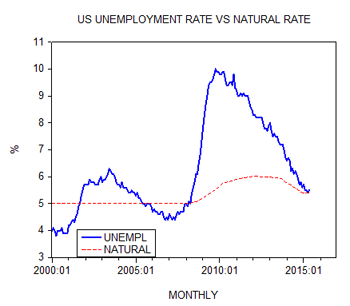
In May, the US unemployment rate stood at 5.5 percent against the rate of 5.3 percent for the “natural unemployment,” also known as the Non-Accelerating Inflation Rate of Unemployment (NAIRU).

According to the popular view, once the actual unemployment rate falls to below the NAIRU, or the natural unemployment rate, the rate of inflation tends to accelerate and economic activity becomes overheated. (This acceleration in the rate of inflation takes place through increases in the demand for goods and services. It also lifts the demand for workers and puts pressure on wages, reinforcing the growth in inflation).

By this way of thinking, the central bank must step in and lift interest rates to prevent the rate of inflation from getting out of control.

daily july 17 350

Recently, however, some experts have raised the possibility that the natural unemployment rate is likely to be much lower than the government official estimate of 5.3 percent. In fact, earlier this year, economists at the Chicago Fed argued that the natural unemployment rate since October last year has fallen to 4.3 percent.

The reasons for this decline are demographic changes and an increase in the level of education. (The natural unemployment rate tends to fall, so it is held, with the rising age of the labor force and with its education.)

Experts are of the view that these factors should continue to lower the natural unemployment rate for at least the remainder of the decade.

It is held that a lower natural rate may help explain why wage inflation and price inflation remain low, despite the actual unemployment rate recently reaching 5.5 percent.

Advocates for a lower natural rate also claim a lower rate would mean the Fed can keep interest rates lower for longer without worrying about lifting the rate of inflation.

Why NAIRU Is an Arbitrary Measure

The NAIRU however, is an arbitrary measure; it is derived from a statistical correlation between changes in the consumer price index and the unemployment rate. What matters here for Fed economists and others is whether the theory “works” (i.e., whether it can predict the future rate of increases in the consumer price index).

This way of thinking doesn’t consider whether a theory corresponds to reality. Here we have a framework, which implies that “anything goes” as long as one can make accurate predictions.

The purpose of a theory however is to present the facts of reality in a simplified form. A theory has to originate from reality and not from some arbitrary idea that is based on a statistical correlation.

If “anything goes,” then we could find by means of statistical methods all sorts of formulas that could serve as forecasting devices.

For example, let us assume that high correlation has been established between the income of Mr. Jones and the rate of growth in the consumer price index — the higher the rate of increase of Mr. Jones’s income, the higher the rate of increase in the consumer price index.

Therefore we could easily conclude that in order to exercise control over the rate of inflation the central bank must carefully watch and control the rate of increases in Mr. Jones’s income. The absurdity of this example matches that of the NAIRU framework.

Inflation Is Not Caused by Increased Economic Activity

Contrary to mainstream thinking, strong economic activity as such doesn’t cause a general rise in the prices of goods and services and economic overheating labeled as inflation.

Regardless of the rate of unemployment, as long as every increase in expenditure is supported by production, no overheating can occur.

The overheating emerges once expenditure is rising without the backup of production — for instance, when the money stock is increasing. Once money increases, it generates an exchange of nothing for something, or consumption without preceding production, which leads to the erosion of real wealth.

As a rule, rises in the money stock are followed by rises in the prices of goods and services.

Prices are another name for the amount of money that people spend on goods they buy.

If the amount of money in an economy increases while the number of goods remains unchanged more money will be spent on the given number of goods i.e., prices will increase.

Conversely, if the stock of money remains unchanged it is not possible to spend more on all the goods and services; hence no general rise in prices is possible. By the same logic, in a growing economy with a growing number of goods and an unchanged money stock, prices will fall.

Frank Shostak is an adjunct scholar of the Mises Institute and a frequent contributor to Mises.org. His consulting firm, Applied Austrian School Economics, provides in-depth assessments and reports of financial markets and global economies.

This article was originally published by the Ludwig von Mises Institute. Permission to reprint in whole or in part is hereby granted, provided full credit is given.
Iran Agreement Boosts Peace, Defeats Neocons – Article by Ron Paul

Iran Agreement Boosts Peace, Defeats Neocons – Article by Ron Paul

The New Renaissance HatRon Paul
July 20, 2015
******************************
Last week’s successfully concluded Iran agreement is one of the two most important achievements of an otherwise pretty dismal Obama presidency. Along with the ongoing process of normalizing relations with Cuba, this move shows that diplomacy can produce peaceful, positive changes. It also shows that sometimes taking a principled position means facing down overwhelming opposition from all sides and not backing down. The president should be commended for both of these achievements.

The agreement has reduced the chance of a US attack on Iran, which is a great development. But the interventionists will not give up so easily. Already they are organizing media and lobbying efforts to defeat the agreement in Congress. Will they have enough votes to over-ride a presidential veto of their rejection of the deal? It is unlikely, but at this point if the neocons can force the US out of the deal it may not make much difference. Which of our allies, who are now facing the prospect of mutually-beneficial trade with Iran, will be enthusiastic about going back to the days of a trade embargo? Which will support an attack on an Iran that has proven to be an important trading partner and has also proven reasonable in allowing intrusive inspections of its nuclear energy program?

However, what is most important about this agreement is not that US government officials have conducted talks with Iranian government officials. It is that the elimination of sanctions, which are an act of war, will open up opportunities for trade with Iran. Government-to-government relations are one thing, but real diplomacy is people-to-people: business ventures, tourism, and student exchanges.

I was so impressed when travel personality Rick Steves traveled to Iran in 2009 to show that the US media and government demonization of Iranians was a lie, and that travel and human contact can help defeat the warmongers because it humanizes those who are supposed to be dehumanized.

As I write in my new book, Swords into Plowshares:

Our unwise policy with Iran is a perfect example of what the interventionists have given us—60 years of needless conflict and fear for no justifiable reason. This obsession with Iran is bewildering. If the people knew the truth, they would strongly favor a different way to interact with Iran.

Let’s not forget that the Iran crisis started not 31 years ago when the Iran Sanctions Act was signed into law, not 35 years ago when Iranians overthrew the US-installed Shah, but rather 52 years ago when the US CIA overthrew the democratically-elected Iranian leader Mossadegh and put a brutal dictator into power. Our relations with the Iranians are marked by nearly six decades of blowback.

When the Cold War was winding down and the military-industrial complex needed a new enemy to justify enormous military spending, it was decided that Iran should be the latest “threat” to the US. That’s when sanctions really picked up steam. But as we know from our own CIA National Intelligence Estimate of 2007, the stories about Iran building a nuclear weapon were all lies. Though those lies continue to be repeated to this day.

It is unfortunate that Iran was forced to give up some of its sovereignty to allow restrictions on a nuclear energy program that was never found to be in violation of the Non-Proliferation Treaty. But if the net result is the end of sanctions and at least a temporary reprieve from the constant neocon demands for attack, there is much to cheer in the agreement. Peace and prosperity arise from friendly relations and trade – and especially when governments get out of the way.

Ron Paul, MD, is a former three-time Republican candidate for U. S. President and Congressman from Texas.

This article is reprinted with permission from the Ron Paul Institute for Peace and Prosperity.

Abstract Orderism Fractal 67 – Art by G. Stolyarov II

Abstract Orderism Fractal 67 – Art by G. Stolyarov II

Abstract Orderism Fractal 67 - by G. Stolyarov II

Abstract Orderism Fractal 67 – by G. Stolyarov II

Note: Left-click on this image to get a full view of this digital work of fractal art.

This is a frosty fractal of spirals upon spirals.

This digital artwork was created by Mr. Stolyarov in Apophysis, a free program that facilitates deliberate manipulation of randomly generated fractals into intelligible shapes.

This fractal is an extension of Mr. Stolyarov’s artistic style of Abstract Orderism, whose goal is the creation of abstract objects that are appealing by virtue of their geometric intricacy — a demonstration of the order that man can both discover in the universe and bring into existence through his own actions and applications of the laws of nature.

Fractal art is based on the idea of the spontaneous order – which is pivotal in economics, culture, and human civilization itself. Now, using computer technology, spontaneous orders can be harnessed in individual art works as well.

See the index of Mr. Stolyarov’s art works.

How Student Loans Create Demand for Useless Degrees – Article by Josh Grossman

How Student Loans Create Demand for Useless Degrees – Article by Josh Grossman

The New Renaissance Hat
Josh Grossman
July 19, 2015
******************************

Last week, former Secretary of Education and US Senator Lamar Alexander wrote in the Wall Street Journal that a college degree is both affordable and an excellent investment. He repeated the usual talking point about how a college degree increases lifetime earnings by a million dollars, “on average.” That part about averages is perhaps the most important part, since all college degrees are certainly not created equal. In fact, once we start to look at the details, we find that a degree may not be the great deal many higher-education boosters seem to think it is.

In my home state of Minnesota, for example, the cost of obtaining a four-year degree at the University of Minnesota for a resident of Minnesota, North Dakota, South Dakota, Manitoba, or Wisconsin is $100,720 (including room and board and miscellaneous fees). For private schools in Minnesota such as St. Olaf, however, the situation is even worse. A four-year degree at this institution will cost $210,920.

This cost compares to an average starting salary for 2014 college graduates of $48,707. However, like GDP numbers this number is misleading because it is an average of all individuals who obtained a four-year degree in any academic field. Regarding the average student loan debt of an individual who graduated in 2013, about 70 percent of these graduates left college with an average student loan debt of $28,400. This entails the average student starting to pay back these loans six months after graduation or upon leaving school without a degree. The reality of this situation is that assuming a student loan interest rate of 6.8 percent and a ten-year repayment period, the average student will be paying $326.83 every month for 120 months or a cumulative total re-payment of $39,219.28. Depending upon a student’s job, this amount can be a substantial monthly financial burden for the average graduate.

All Degrees Are Not of Equal Value

Unfortunately, there is no price incentive for students to choose degrees that are most likely to enable them to pay back loans quickly or easily. In other words, these federal student loans are subsidizing a lack of discrimination in students’ major choice. A person majoring in communications can access the same loans as a student majoring in engineering. Both of these students would also pay the same interest rate, which would not occur in a free market.

In an unhampered market, majors that have a higher probability of default should be required to pay a higher interest rate on money borrowed than majors with a lower probability of default. In summary, it is not just the federal government’s subsidization of student loans that is increasing the cost of college, but the fact that demand for low-paying and high-default majors is increasing, because loans for these majors are supplied at the same price as a major providing high salaries to its possessor with a low probability of default.

And which programs are the most likely to pay off for the student? The top five highest paying bachelor’s degrees include: petroleum engineering, actuarial mathematics, nuclear engineering, chemical engineering and electronics and communications engineering, while the top five lowest paying bachelor’s degrees are: animal science, social work, child development and psychology, theological and ministerial studies, and human development, family studies, and related services. Petroleum engineering has an average starting salary of $93,500 while animal science has an average starting salary of $32,700. This breaks down for a monthly salary for the petroleum engineer of $7,761.67 versus a person working in animal science with a monthly salary of $2,725. Based on the average monthly payment mentioned above, this would equate to a burden of 4.2 percent of monthly income (petroleum engineer) versus a burden of 12 percent of monthly income (animal science). This debt burden is exacerbated by the fact that it is now nearly impossible to have student loan debts wiped away even if one declares bankruptcy.

Ignoring Careers That Don’t Require a Degree

Meanwhile, there are few government loan programs geared toward funding an education in the trades. And yet, for many prospective college students, the trades might be a much more lucrative option. Using the example of plumbing, the average plumber earns $53,820 per year with the employer paying the apprentice a wage and training.

Acknowledging the fact that this average salary is for master plumbers, it still equates to a $20,000 salary difference between it and someone with a four-year degree in animal science while having no student loans as a bonus. Outside of earning a four-year degree in science, technology, engineering, math or, accounting with an average starting salary of $53,300, nursing with an average starting salary of $53,624, or as a family practice doctor on the lower end of physician pay of $161,000, society might be better served if parents and educators would stop using the canard that a four-year degree is always worth the cost outside of a few majors mentioned above. Encouraging students to consider the trades and parents to give their children the money they would spend on a four-year college degree to put a down payment on a house might be a better use of finite economic resources. The alternative of forcing the proverbial square peg into a round hole will condemn another generation to student debt slavery forcing them to put off buying a home or getting married.

Loans Drive Overall Demand

The root of the problem is intervention by the federal government in providing student loans. Since 1965 when President Johnson signed the Higher Education Act tuition, room, and board has increased from $1,105 per year to $18,943 in 2014–2015. This is an increase of 1,714 percent in 50 years. In addition, the Higher Education Act of 1965 created loans which are made by private institutions yet guaranteed by the federal government and capped at 6.8 percent. In case of default on the loans, the federal government — that is, the taxpayers — pick up the tab in order for these lenders to recover 95 cents on every dollar lent. Loaning these funds at below market interest rates and with the federal government backing up these risky loans has led to massive malinvestment as the percentage of high-school graduates enrolled in some form of higher education has increased from 10 percent before World War II to 70 percent by the 1990s. Getting a four-year degree in nearly any academic field seemed to be the way in which to enter or remain in the middle class.

But just as with the housing bubble, keeping interest below market levels while increasing the money supply in terms of loans — while having the taxpayer on the hook for a majority of these same loans — leads to an avalanche of defaults and is a recipe for disaster.

Josh Grossman is a social studies teacher in southeastern Minnesota. He enjoys reading anything he can about Austrian Economics or historical revisionism from the perspective of the Austrian School.

The Intellectual Intolerance Behind “Check Your Privilege” – Article by Gary M. Galles

The Intellectual Intolerance Behind “Check Your Privilege” – Article by Gary M. Galles

The New Renaissance Hat
Gary M. Galles
July 19, 2015
******************************

A decade ago, no one had ever been told to “check your privilege.” Now it commands an appreciable “market share” in academia and social justice rhetoric. But it does so despite sharply opposed interpretations of its meaning. In fact, its expanded footprint is partly because of its ambiguity.

It Could Be an Invitation to Debate

In a sense, “check your privilege” largely amounts to “check your premises” behind your views, and many are willing to recognize that such a reminder can be useful in advancing conversations about social issues.

However, I question whether people are so bereft of concern for, or understanding of, one another that they need repetitive “check your privileges” reminders that imply they would believe more accurately and act more effectively if only they were more empathetic. I tend to agree with Adam Smith, in The Theory of Moral Sentiments, that:

How selfish soever man may be supposed, there are evidently some principles in his nature, which interest him in the fortunes of others, and render their happiness necessary to him, though he derives nothing from it, except the pleasure of seeing it … we often derive sorrow from the sorrows of others.

Further, repeatedly sermonizing to fix people as a way of “uplifting” them becomes little more than nagging, and any insight it may add gets crowded out. In the same way, repeatedly invoking “check your privilege” tends to destroy its usefulness leaving increased irritation and disharmony.

But the Phrase Could Simply Mean “Shut Up”

And when does “check your privilege” become code for “be quiet” rather than “evaluate your premises”? “Check your privilege” is about shutting down discussion when the user is making the assertion that you are hopelessly confused in your understanding, and that your opinions amount to aggression (whether “micro-” or “macro-”). This position was wellarticulated decades ago by Robert Heinlein, in The Moon is a Harsh Mistress:

Where do you start explaining when a man’s words show there isn’t anything he understands about [a] subject, [but] instead is loaded with preconceptions that don’t fit facts and [he] doesn’t even know …?

The assertion of your hopeless confusion then becomes the basis for claims that, unless you are a member of some accepted victimized class, you must be part of the oppressor class. Therefore, as Max Borders put it,

Your rights and opinions are invalid and you have no real complaints or suffering because you belong to X group. Or, more to the point, you are obligated to pay because people who look like you in some ways did bad things at some point.

In other words, others assert that they don’t need to listen to you, much less respect your arguments.

The Ad Hominem Attack

That leap involves several logical failings. Included in that list is the idea that any guilt for what was true of some members of an arbitrarily defined class or group (rather than treating people as the individuals they are) at some point in time passes on to every current and future member of that class or group. In addition, it incorporates the ad hominem fallacy that because you are judged as bad or part of an oppressor class, your argument is false, while conversely, their self-defined goodness and non-oppression means theirs must be true, both of which are unrelated to the logical validity of an argument.

Given that “check your privileges” could mean either “remember to be empathetic, so we can better understand and help” or “we can disregard your beliefs and violate your rights,” how can we tell which one is intended?

Where confusion reigns, to better understand and help requires the confusion to be replaced with clear, accurate understanding. That, in turn, requires a serious, ongoing “give and take” conversation.

However, when “check your privilege” is used to preemptively cut off conversation by stopping those who disagree from any chance to be heard, much less to rebut their demonization and targeting, no improvement in either empathy or results can result. So the key to evaluating “check your privilege” is to ask what would be entailed if it was intended to advance such a serious conversation.

How Real Dialogue Happens

Importantly, any conversation would not stop at “watch your privileges.” It would only begin there. By itself, the phrase says you are wrong in your understanding or views, but it leaves how completely unspecified, beyond having something to do with membership in some allegedly dominant or privileged group. Stopping the conversation there leaves “check your privileges” as an insult, without any ability to clarify understanding or reduce disagreements or disharmony.

Progress toward better understanding and results would require several more steps.

It would start by precisely specifying what faulty premises, assumptions, or arguments someone supposedly holds, either included or excluded inappropriately. Then it would explain why it is inappropriate for the issue being considered. It would lay out the correct or appropriate premise that would take its place and articulate the reasons why.

Building on that foundation, it would show how the “new and improved” premises would change one’s conclusions. Consequently, it would lay out the appropriate remedy based on the alternative analysis. In the process, it would have to explain how the proposed remedy cannot be explained solely on a narrowly self-interested “more for me” basis, completely apart from the argument offered, as part of laying out the new special privileges that would be created for those put forward as victims. It would also have to explain how others will be affected in order to address the asserted problem, including whether there would be coercive impositions on members of the supposedly dominant or victimizer class who had nothing to do with the “sins of the fathers.”

When “check your privilege” means think more carefully about others’ circumstances, which may be far different than yours, and to be empathetic, it can be useful in advancing our potential for mutual understanding. But it has to be only the beginning of a much farther-reaching discussion to bear fruit — a discussion which, carefully and earnestly pursued, would lead us back to the self-ownership and voluntary arrangements of liberty.

In contrast, when “check your privilege” is used as a magic phrase to peremptorily end “social justice” discussions, it is the assertion of a special privilege for some to be allowed to define themselves as white hats and those who disagree as black hats, without ever having to make a real argument. It also allows users to turn it into an epithet of social demonization to try to impose their “solutions,” always at the expense of the supposed black hats. In the process, it undermines social cooperation by undermining the rights upon which it is built.

Gary M. Galles is a professor of economics at Pepperdine University. He is the author of The Apostle of Peace: The Radical Mind of Leonard Read. Send him mail. See Gary Galles’s article archives.

This article was published on Mises.org and may be freely distributed, subject to a Creative Commons Attribution United States License, which requires that credit be given to the author.

Immigration and Crime – What the Research Says – Article by Alex Nowrasteh

Immigration and Crime – What the Research Says – Article by Alex Nowrasteh

The New Renaissance Hat
Alex Nowrasteh
July 17, 2015
******************************

The alleged murder of Kate Steinle in San Francisco by illegal immigrant Juan Francisco Lopez-Sanchez has reignited the debate over the link between immigration and crime. Such debates often call for change in policy regarding the deportation or apprehension of illegal immigrants. However, if policies should change, it should not be in reaction to a single tragic murder.  It should be in response to careful research on whether immigrants actually boost the U.S. crime rates.

With few exceptions, immigrants are less crime prone than natives or have no effect on crime rates.  As described below, the research is fairly one-sided.

There are two broad types of studies that investigate immigrant criminality.  The first type uses Census and American Community Survey (ACS) data from the institutionalized population and broadly concludes that immigrants are less crime prone than the native-born population.  It is important to note that immigrants convicted of crimes serve their sentences before being deported with few exceptions.  However, there are some potential problems with Census-based studies that could lead to inaccurate results.  That’s where the second type of study comes in.  The second type is a macro level analysis to judge the impact of immigration on crime rates, generally finding that increased immigration does not increase crime and sometimes even causes crime rates to fall.

Type 1: Immigrant Crime – Censuses of the Institutionalized Population 

Butcher and Piehl examine the incarceration rates for men aged 18-40 in the 1980, 1990, and 2000 Censuses.  In each year immigrants are less likely to be incarcerated than natives with the gap widening each decade.  By 2000, immigrants have incarceration rates that are one-fifth those of the native-born.  Butcher and Piehl wrote another paper focusing on immigrant incarceration in California by looking at both property and violent crimes by city.  Between years 2000 and 2005, California cities with large inflows of recent immigrants tended have lower violent crimes rates and the findings are statistically significant.  During the same time period, there is no statistically significant relationship between immigration and property crime.

Ewing, Martinez, and Rumbaut summarize their findings on criminality and immigration thusly:

“[R]oughly 1.6 percent of immigrant males 18-39 are incarcerated, compared to 3.3 percent of the native-born.  The disparity in incarceration rates has existed for decades, as evidenced by data from the 1980, 1990, and 2000 decennial census.  In each of those years, the incarceration rates of the native-born were anywhere from two to five times higher than that of immigrants.”

They continue by focusing on immigrant incarceration rates by country of origin in the 2010 Census.  Less educated young Mexican, Salvadoran, and Guatemalan men (poorly educated young men are most likely to be incarcerated) make up the bulk of the unlawful immigrant population but have significantly lower incarceration rates than native-born men without a high-school diploma.  In 2010, 10.7 percent of native-born men aged 18-39 without a high school degree were incarcerated compared to 2.8 percent of Mexican immigrants and 1.7 percent of Guatemalan and Salvadoran immigrants.  These are similar to Rumbaut’s older research also based on Census data from 2000.  Controlling for relevant observable factors, young uneducated immigrant men from Mexico, El Salvador, and Guatemala are less likely to be incarcerated than similarly situated native-born men.

However, studies of immigrant criminality based on Census data alone could fail to give the full picture.  First, many of the answers given to the Census may have been educated guesses from the Census workers and not the inmates.  Second, the government has done a very poor job of gathering data on the nationality and immigration status of prisoners – even when it has tried.  That biases me against the accuracy of prison surveys by the Census Bureau.  Third, incarceration rates may better reflect the priorities of law enforcement than the true rates of criminal activity among certain populations.

Type 2: Macro Level Analysis of Immigrant Criminality

To avoid the potential Census data problems, other researchers have looked at crime rates and immigration on a macro scale.  These investigations also capture other avenues through which immigration could cause crimes – for instance, by inducing an increase in native criminality or by being easy targets for native criminals.

The phased rollout of the Secure Communities (S-COMM) immigration enforcement program provided a natural experiment.  A recent paper by Thomas J. Miles and Adam B. Cox used the phased rollout to see how S-COMM affected crime rates per county.  If immigrants were disproportionately criminal, then S-COMM would decrease the crime rates.  They found that S-COMM “led to no meaningful reduction in the FBI index crime rate” including violent crimes.  Relying on similar data with different specifications, Treyger et al. found that S-COMM did not decrease crime rates nor did it lead to an increase in discriminatory policing that some critics were worried about.  According to both reports, the population of immigrants is either not correlated, or negatively correlated, with crime rates.

Ousey and Kubrin looked at 159 cities at three dates between 1980 and 2000 and found that crime rates and levels of immigration are not correlated.  They conclude that “[v]iolent crime is not a deleterious consequence of increased immigration.”  Martinez looked at 111 U.S. cities with at least 5,000 Hispanics and found no statistically significant findings.  Reid et al. looked at a sample of 150 Metropolitan Statistical Areas (MSAs) and found that levels of recent immigration had a statistically significant negative effect on homicide rates but no effect on property crime rates.  They wrote, “[i]t appears that anti-immigrant sentiments that view immigrants as crime prone are not only inaccurate at the micro-level, they are also inaccurate at the macro-level … increased immigration may actually be beneficial in terms of lessening some types of crimes.”  Wadsworth found that cities with greater growth in immigrant or new immigrant populations between 1990 and 2000 tended to have steeper decreases in homicide and robbery rates.

Using panel data on U.S. counties, Spenkuch finds that a 10 percent increase in the share of immigrants increases the property crime rate by 1.2 percent.  In other words, the average immigrant commits roughly 2.5 times as many property crimes as the average native but with no impact on violent crime rates.  He finds that this effect on property crime rates is caused entirely by Mexican immigrants.  Separating Mexicans from other immigrants, the former commit 3.5 to 5 times as many crimes as the average native.  However, all other immigrants commit less than half as many crimes as natives.  This is the most deleterious finding that I discovered.

Stowell et al. looks at 103 different MSAs from 1994-2004 and finds that violent crime rates tended to decrease as the concentration of immigrants increased.  An immigrant concentration two standard deviations above the mean translates into 40.5 fewer violent crimes per 100,000 compared to a decrease of 8.1 violent crimes in areas that experienced a change in immigration concentration two standard deviations below the mean.  It is easy to focus on the horrible tragedies when somebody is murdered by an immigrant but it’s very hard to imagine all of the people who weren’t murdered because of the lower crime rates created by increased immigration.  In their summary of the research on this topic, they write:

“[T]he weight of the evidence suggests that immigration is not associated with increased levels of crime.  To the extent that a relationship does exist, research often finds a negative effect of immigration on levels of crime, in general, and on homicide in particular.

Some immigrants from certain countries of origin may be more crime prone than others, as Spenkuch finds above.  To test this, Chalfin used rainfall patterns in Mexico to estimate inflows of Mexican immigrants.  The idea is that lower rainfall and a decrease in agricultural productivity in Mexico would push marginal Mexican immigrants out of Mexico and into the U.S. labor market.  Mexican rainfall patterns and the subsequent immigration had no effect on violent or property crime rates in major U.S. metropolitan areas.

These trends have also been found on the local level.  Davies and Fagan looked at crime and immigration patterns at the neighborhood level in New York City.  They find that crime rates are not higher in areas with more immigrants.  Sampson looked at Chicago and found that Hispanic immigrants were far less likely to commit a violent criminal act then either black or white native Chicagoans.  Lee et al. found that trends in recent immigration are either not correlated with homicides or are negatively correlated in Miami, San Diego, and El Paso.  The only exception is that there is a positive relationship between immigration and black homicide rates in San Diego.

Numerous studies also conclude that the high immigration rate of the 1990s significantly contributed to the precipitous crime decline of that decade.  According to this theory, immigrants are less crime prone and have positive spillover effects like aiding in community redevelopment, rebuilding of local civil society in formerly decaying urban cores, and contributing to greater economic prosperity through pushing natives up the skills spectrum through complementary task specialization.

Note on Illegal Immigration

The public focus is on the crime rates of unauthorized or illegal immigrants.  The research papers above mostly include all immigrants regardless of legal status.  However, every problem with gathering data on immigrant criminality is multiplied for unauthorized immigrants.  There is some work that can help shed light here.

With particular implications for the murder of Kate Steinle, Hickman et al. look at the recidivism rates of 517 deportable and 780 nondeportable aliens released from the Los Angeles County Jail over a 30-day period in 2002.  They found that there is no difference in the rearrest rate of deportable and nondeportable immigrants released from incarceration at the same place and time.  Their paper is not entirely convincing for several reasons, the most important being that their sample does not include the higher risk inmates who were transferred to state prison and were subsequently released from there.  There are also findings in their paper that seem to contradict their conclusion that aren’t adequately accounted for.  This is only one study of one sample in one city but the results should be incorporated into any argument over sanctuary cities.

Conclusion

Both the Census-data driven studies and macro-level studies find that immigrants are less crime-prone than natives with some small potential exceptions.  There are numerous reasons why immigrant criminality is lower than native criminality.  One explanation is that immigrants who commit crimes can be deported and thus are punished more for criminal behavior, making them less likely to break the law.

Another explanation is that immigrants self-select for those willing to work rather than those willing to commit crimes.  According to this “healthy immigrant thesis,” motivated and ambitious foreigners are more likely to immigrate and those folks are less likely to be criminals. This could explain why immigrants are less likely to engage in “anti-social” behaviors than natives despite having lower incomes.  It’s also possible that more effective interior immigration enforcement is catching and deporting unlawful immigrants who are more likely to be criminals before they have a chance to be incarcerated.

The above research is a vital and missing component in the debate over the supposed links between immigration and crime.

Alex Nowrasteh is the immigration policy analyst at the Cato Institute’s Center for Global Liberty and Prosperity. His popular publications have appeared in the Wall Street Journal, USA Today, the Washington Post, Houston Chronicle, the Los Angeles Times, the New York Post, and elsewhere. His academic publications have appeared in the Journal of Economic Behavior and Organization, the Fletcher Security Review, and Public Choice. Alex has appeared on Fox News, Bloomberg, and numerous television and radio stations across the United States. He is the coauthor, with Mark Krikorian of the Center for Immigration Studies, of the booklet Open Immigration: Yea & Nay (Encounter Broadsides, 2014).

He is a native of Southern California and received his Bachelor of Arts in economics from George Mason University and Master of Science in economic history from the London School of Economics.

This work by Cato Institute is licensed under a Creative Commons Attribution-NonCommercial-ShareAlike 3.0 Unported License.

Greece Today, America Tomorrow? – Article by Ron Paul

Greece Today, America Tomorrow? – Article by Ron Paul

The New Renaissance HatRon Paul
July 14, 2015
******************************

The drama over Greece’s financial crisis continues to dominate the headlines. As this column is being written, a deal may have been reached providing Greece with yet another bailout if the Greek government adopts new “austerity” measures. The deal will allow all sides to brag about how they came together to save the Greek economy and the European Monetary Union. However, this deal is merely a Band-Aid, not a permanent fix to Greece’s problems. So another crisis is inevitable.

The Greek crisis provides a look into what awaits us unless we stop overspending on warfare and welfare and restore a sound monetary system. While most commentators have focused on Greece’s welfare state, much of Greece’s deficit was caused by excessive military spending. Even as its economy collapses and the government makes (minor) cuts in welfare spending, Greece’s military budget remains among the largest in the European Union.

Despite all the handwringing over how the phony sequestration cuts have weakened America’s defenses, the United States military budget remains larger than the combined budgets of the world’s next 15 highest spending militaries. Little, if any, of the military budget is spent defending the American people from foreign threats. Instead, the American government wastes billions of dollars on an imperial foreign policy that makes Americans less safe. America will never get its fiscal house in order until we change our foreign policy and stop wasting trillions on unnecessary and unconstitutional wars.

Excessive military spending is not the sole cause of America’s problems. Like Greece, America suffers from excessive welfare and entitlement spending. Reducing military spending and corporate welfare will allow the government to transition away from the welfare state without hurting those dependent on government programs. Supporting an orderly transition away from the welfare state should not be confused with denying the need to reduce welfare and entitlement spending.

On reason Greece has been forced to seek bailouts from its EU partners is that Greece ceded control over its currency when it joined the European Union. In contrast, the dollar’s status as the world’s reserve currency is the main reason the US has been able to run up huge deficits without suffering a major economic crisis. The need for the Federal Reserve to monetize ever-increasing levels of government spending will eventually create hyperinflation, which will lead to increasing threats to the dollar’s status. China and Russia are already moving away from using the dollar in international transactions. It is only a matter of time before more countries challenge the dollar’s reserve currency status, and, when this happens, a Greece-style catastrophe may be unavoidable.

Despite the clear dangers of staying on our recent course, Congress continues to increase spending. The only real debate between the two parties is over whether we should spend more on welfare or warfare. It is easy to blame the politicians for our current dilemma. But the politicians are responding to demands from the people for greater spending. Too many Americans believe they have a moral right to government support. This entitlement mentally is just as common, if not more so, among the corporate welfare queens of the militarily-industrial complex, the big banks, and the crony capitalists as it is among lower-income Americans.

Congress will only reverse course when a critical mass of people reject the entitlement mentality and understand that the government is incapable of running the world, running our lives, and running the economy. Therefore, those of us who know the truth must spread the ideas of, and grow the movement for, limited government, free markets, sound money, and peace.

Ron Paul, MD, is a former three-time Republican candidate for U. S. President and Congressman from Texas.

This article is reprinted with permission from the Ron Paul Institute for Peace and Prosperity.