Abstract Orderism Fractal 60 – Art by G. Stolyarov II

Abstract Orderism Fractal 60 – Art by G. Stolyarov II

Abstract Orderism Fractal 60 - by G. Stolyarov II

Abstract Orderism Fractal 60 – by G. Stolyarov II

Note: Left-click on this image to get a full view of this digital work of fractal art.

This is a fractal of exquisitely intertwined spiral patterns, incorporating both rounded and angular elements.

This digital artwork was created by Mr. Stolyarov in Apophysis, a free program that facilitates deliberate manipulation of randomly generated fractals into intelligible shapes.

This fractal is an extension of Mr. Stolyarov’s artistic style of Abstract Orderism, whose goal is the creation of abstract objects that are appealing by virtue of their geometric intricacy — a demonstration of the order that man can both discover in the universe and bring into existence through his own actions and applications of the laws of nature.

Fractal art is based on the idea of the spontaneous order – which is pivotal in economics, culture, and human civilization itself. Now, using computer technology, spontaneous orders can be harnessed in individual art works as well.

See the index of Mr. Stolyarov’s art works.

Abstract Orderism Fractal 59 – Art by G. Stolyarov II

Abstract Orderism Fractal 59 – Art by G. Stolyarov II

Abstract Orderism Fractal 59 - by G. Stolyarov II

Abstract Orderism Fractal 59 – by G. Stolyarov II

Note: Left-click on this image to get a full view of this digital work of fractal art.

This fractal resembles a feather emerging out of a spiral.

This digital artwork was created by Mr. Stolyarov in Apophysis, a free program that facilitates deliberate manipulation of randomly generated fractals into intelligible shapes.

This fractal is an extension of Mr. Stolyarov’s artistic style of Abstract Orderism, whose goal is the creation of abstract objects that are appealing by virtue of their geometric intricacy — a demonstration of the order that man can both discover in the universe and bring into existence through his own actions and applications of the laws of nature.

Fractal art is based on the idea of the spontaneous order – which is pivotal in economics, culture, and human civilization itself. Now, using computer technology, spontaneous orders can be harnessed in individual art works as well.

See the index of Mr. Stolyarov’s art works.

Review of Ilia Stambler’s “A History of Life-Extensionism in the Twentieth Century”: A Source of Perspective, Insight, and Hope for Life Extension – Article by G. Stolyarov II

Review of Ilia Stambler’s “A History of Life-Extensionism in the Twentieth Century”: A Source of Perspective, Insight, and Hope for Life Extension – Article by G. Stolyarov II

The New Renaissance Hat
G. Stolyarov II
September 13, 2014
******************************

A History of Life-Extensionism in the Twentieth Century by Ilia Stambler is the most thorough treatment to date of the ideas of famous thinkers and scientists who attempted to prolong human lifespans. In this detailed and impressively documented work – spanning 540 pages – Dr. Stambler explores the works of life-extensionist thinkers and practitioners from a vast variety of ideological, national, and methodological backgrounds. Dr. Stambler’s opus will enable today’s advocates of human life extension to understand the immensely rich and interesting historical legacy that they can draw upon.

In substance, I agree with Dr. Stambler’s central observation that life-extensionist thinkers tended to adapt to the political and ideological climates of the societies in which they lived. I do suspect that, in some regimes (e.g., communist and fascist ones), the adaptation was partly a form of protection from official persecution. Even then, Soviet life-extensionists were unable to avoid purges and denunciations if they fell out of favor with the dominant scientific establishment. My own thinking is that life-extensionism is a powerful enough human motive that it will attempt to thrive in any society and under any regime. However, some regimes are more dangerous for life-extensionism than others – especially if they explicitly persecute those who work on life extension. If, on the other hand, complete freedom of scientific inquiry exists (with no barriers to performing research that respects all human rights or getting such research published), then significant progress can occur in a variety of political/ideological environments.

Even so, I have been tremendously interested to delve into Dr. Stambler’s discussion of the deep roots of life-extensionist thought in Russian society, where ideas favoring life prolongation have taken hold despite a long history of authoritarianism and more general human suffering. I even remember my own very early years in Minsk, where I found it easy to adopt an anti-death attitude the moment I learned about death – and where, even in childhood, I found my support for human life extension to be largely uncontroversial from an ethical standpoint. When I moved to the United States, I encountered far more resistance to this idea than I ever did in Belarus. While most Americans are not opposed to advanced medicine and concerted efforts to fight specific diseases of old age, there does still seem to be a culturally ingrained perception of some “maximum lifespan” beyond which life extension is feared, even though it is considered acceptable up to that limit. I think, however, that the dynamics of a competitive economy with some degree of freedom of research will ultimately enable most Americans to accept longer lifespans in practice, even if there is no intellectual revolution in their minds. The key challenge in the United States is to remove inadvertent institutional obstacles to progress (e.g., the extremely time-consuming FDA approval process for treatments), and also to prevent new obstacles from being established. Once radical life extension does occur, most Americans will explicitly or tacitly embrace it.

Dr. Stambler portrays American life-extensionist thinking as aligned with a capitalist, free-market, libertarian outlook – and this is often true, but it may be an exception to the book’s thesis that life-extensionist thinkers adapt to the predominant ideological environments that surround them. My own observation regarding American life-extensionism is that it does seem to correspond with a type of free-market libertarianism that is far outside the current ideological mainstream (though it is growing in popularity). The views of Peter Thiel, Ray Kurzweil, Peter Diamandis, Reason (of FightAging.org), and Max More are far from the views of the political establishment in Washington, D.C., which tends to be much more in favor of a centralized welfare/security nation-state with elements of corporatism, but not a libertarian free market. The love of liberty is a strong part of American history and culture – and continues to feature strongly in the attitudes of many Americans (including some wealthy and prominent ones) – but I do not think the political establishment reflects this idea at all anymore.  An interesting thought on this matter is that it might have become easier in recent years for life-extensionists not to represent the dominant paradigm in their society or regime and still to prominently pursue life-extension endeavors. If this is so, then this would be an encouraging sign of a greater emerging diversity of approaches, and generally greater tolerance of such diversity on the part of regimes. After all, the American regime, for all of its flaws, has generally not been cracking down on the libertarian life-extensionists who disagree with it politically. At the same time, as Dr. Stambler points out, the United States remains the leading country in life-extension research – and this occurs in spite of the political disagreements between many life-extensionists and the regime.

A History of Life-Extensionism in the Twentieth Century offers tremendous value to readers in encapsulating a diversity of vantage points on and approaches toward human life extension throughout history. While many of the pioneers in this area failed to achieve their ultimate goal, they did advance human biological knowledge in important, incremental ways while doing so. Furthermore, they navigated political and ideological environments that were often far more hostile to unhampered technological progress than the environments in many Western countries today. This should enable readers to hold out hope that continued biomedical progress toward greater human lifespans could be made in our era and could accelerate with our support and advocacy.

The Strengths and Weaknesses of “Atlas Shrugged: Part III” – Article by G. Stolyarov II

The Strengths and Weaknesses of “Atlas Shrugged: Part III” – Article by G. Stolyarov II

The New Renaissance Hat
G. Stolyarov II
September 13, 2014
******************************

In my reviews of Part I and Part II of the Atlas Shrugged film trilogy, I expressed largely favorable reactions to those films’ message and execution. Naturally, I was eager to see Part III and the completion of the long-awaited Atlas Shrugged trilogy. After I watched it, though, my response to this conclusion is more muted. The film fails to do full justice to the culmination of Ayn Rand’s magnum opus, where one would expect to witness the coalescence into an integrated worldview of all of the philosophical and plot pieces that Rand meticulously introduced during the first two parts. Atlas Shrugged: Part III is not without its merits, and it is inspiring in certain respects – especially in its conveyance of Rand’s passionate defense of the creator-individualist. However, the film is also not a great one, and the creators could have made Rand’s source material shine consistently instead of glowing dimly while occasionally emitting a bright flicker.

Strength 1: There is now a complete film series spanning the entire story arc of Atlas Shrugged. What Ayn Rand herself and many successive filmmakers could not achieve, producers Harmon Kaslow and John Aglialoro have been able to bring into existence. For decades, admirers of Ayn Rand’s work have lamented that no Atlas Shrugged movie had been made. The fact that this particular lament is obsolete constitutes major progress for Objectivism (where the rate of progress is admittedly extremely slow).

Weakness 1: Part III is, in my view, the most poorly executed of the three Atlas Shrugged movies, even though it had the potential to be the best. The extreme brevity of Part III – a mere 90 minutes, compared to 102 minutes for Part I and 112 minutes for Part II – orphaned many of the events of the film from their contexts, as compared to the meticulous rationale for each of Ayn Rand’s decisions in the novel. John Galt’s speech – which received some 70 pages in the novel – had been cut to bare bones and lacks the deep, rigorous, philosophical exposition that Ayn Rand saw as the substance and culmination of the novel.

Strength 2: As was the case with the previous installments, the film’s creators conveyed a plausible sense that the events of Atlas Shrugged could happen in our own world, or at least in a world that greatly resembles ours, as opposed to the world of 1957. In this sense, the film’s creators succeeded in conveying the universality of Atlas Shrugged’s moral message.

Weakness 2: Changes in directors and the entire cast for every single one of the Atlas Shrugged films greatly detract from the continuity of the story, especially for viewers who may watch the films back to back, once all of them are available on DVDs or other media.

Strength 3: The reactions to Galt’s Speech by Ron Paul, Sean Hannity, and Glenn Beck added authenticity and relevance to the film and reinforced the message that the conflict between value-creators and “looters” (cronyists or purveyors of political pull) is very much present in our era. In addition, whether one agrees or disagrees with these notable figures, it was amusing to see them in a dramatization of Ayn Rand’s literary world.

Weakness 3: The film fails to do justice to many important plot elements in Part Three of the book. Hank Rearden – my favorite character from the book and the most compelling character in Part II – barely makes an appearance. Cheryl Taggart’s suicide is only expressed in retrospectives of her realizations that drove her to this desperate act – while she is not actually shown taking any steps toward it. The fate of Eddie Willers at the end of the film is almost completely unaddressed, with a mere intimation that the protagonists have another man in mind for whom they plan to stop – but no validation that this would indeed be Eddie Willers. The treatment of Eddie Willers in the novel is ambiguous; Ayn Rand leaves him beside a broken-down Taggart Transcontinental train engine, abandoned by the railroad workers. He might be rescued, or he might perish – but he has not yet been invited into Galt’s Gulch. The film creators neither pose the ambiguity nor attempt to resolve it. For me, the fate of Eddie Willers – a sincere, moral, hard-working man who respects the achievements of heroic individualists but is not (according to Rand) one of them – is a key concern in Atlas Shrugged. I think Rand treated him with undeserving harshness, considering that people like Eddie Willers, especially if there are millions of them, can be tremendous contributors to human flourishing. The film creators missed an opportunity to vindicate Eddie and give him some more serious hope of finding a place in the new world created by the inhabitants of Galt’s Gulch. In Galt’s Gulch, the film shows Dagny explaining her plan to have a short railroad built to service Francisco d’Anconia’s new copper mine. But who would actually physically build the railroad and do the job well, if not people like Eddie Willers?

Strength 4: The film’s narrator does a decent job at bridging the events of the previous two installments and the plot of Part III. The events in the film begin with Dagny Taggart crash-landing in Galt’s Gulch, and even those who did not read the book or watch the preceding two films would be able to follow how and why she got there. The film is also excellent in displaying the corruption, incompetence, spitefulness, and callous scheming of the crony corporatist establishment that Rand despised – and that we should despise today. The smoky back-room scene where the economic planners toast to the destruction of Minnesota is one of the film’s high marks – a memorable illustration of what the mentality of “sacrificing the parts” for the whole actually looks like.

Weakness 4: While moderately effective at conveying narratives of events and generally decent in its treatment of ethics and politics, the film does not do justice to the ideas on metaphysics and epistemology also featured prominently in Atlas Shrugged. Furthermore, the previous two films were generally superior in regard to showing, in addition to telling, the fruits of the creative efforts of rational individualists, as well as the consequences for a society that shackles these creators. In the Part III film, many of the scenes utilized to illustrate these effects seemed more peripheral than central to the book’s message. Much of the footage hinted at the national and world events that take place in the book, but did not explicitly show them.

Amid these strengths and weaknesses remains an opportunity to continue the discussion about the undoubtedly crucial implications of Ayn Rand’s message to today’s political and societal climate – where there looms the question of how much longer the creator-individualists who power the motor of the world can keep moving forward in spite of the increasingly gargantuan obstacles placed in their way by legacy institutions. Any work that can pose these questions for consideration by wider numbers of people is welcome in an environment where far too many are distracted by the “bread and circuses” of mindless entertainment. Atlas Shrugged: Part III is a film with intellectual substance and relevance and so is worthy of a relatively short time commitment from anyone interested in Ayn Rand, Objectivism, philosophy, and current events. However, those who watch the film should also be sure to read the novel, if they have not already done so, in order to experience much greater depth of both plot and philosophical ideas.

Nixon’s Vindication – Article by Ron Paul

Nixon’s Vindication – Article by Ron Paul

The New Renaissance Hat
Ron Paul
September 8, 2014
******************************
Forty years ago many Americans celebrated the demise of the imperial presidency with the resignation of Richard Nixon. Today it is clear they celebrated too soon. Nixon’s view of presidential powers, summed up in his infamous statement that, “when the president does it that means it is not illegal,” is embraced by the majority of the political class. In fact, the last two presidents have abused their power in ways that would have made Nixon blush.

For example, Nixon’s abuse of the Internal Revenue Service to persecute his political opponents was the subject of one of the articles of impeachment passed by the US House of Representatives. As bad as Nixon’s abuse of the IRS was, he was hardly the first president to use the IRS this way, and the present administration seems to be continuing this tradition. The targeting of Tea Party groups has received the most attention, but it is not the only instance of the IRS harassing President Barack Obama’s political opponents. For example, the IRS has demanded that one of my organizations, Campaign for Liberty, hand over information regarding its major donors.

Nixon’s abuse of federal power to spy on his “enemies” was abhorrent, but Nixon’s abuses of civil liberties pale in comparison to those of his successors. Today literally anyone in the world can be spied on, indefinitely detained, or placed on a presidential “kill list” based on nothing more than a presidential order. For all his faults, Nixon never tried to claim the power to unilaterally order anyone in the world detained or killed.

Many today act as apologists for the imperial presidency. One reason for this is that many politicians place partisan concerns above loyalty to the Constitution. Thus, they openly defend, and even celebrate, executive branch power grabs when made by a president of their own party.

Another reason is the bipartisan consensus in support of the warfare state. Many politicians and intellectuals in both parties support an imperial presidency because they recognize that the Founders’ vision of a limited executive branch is incompatible with an aggressive foreign policy. When Republicans are in power “neoconservatives” take the lead, while when Democrats are in power “humanitarian interventionists” take the lead. Regardless of party or ideological label, they share the same goal — to protect the executive branch from being constrained by the constitutional requirement that the president seek congressional approval before waging war.

The strength of the bipartisan consensus that the president should have limitless discretion in committing troops to war is illustrated by the failure of an attempt to add an article dealing with Nixon’s “secret bombing” of Cambodia to the articles of impeachment. Even at the low point of support for the imperial presidency, Congress still refused to rein in the president’s war-making powers.

The failure to include the Cambodia invasion in the articles of impeachment may well be the main reason Watergate had little to do with reining in the imperial presidency. Because the imperial presidency is rooted in the war power, attempts to rein in the imperial presidency that do not work to restore Congress’ constitutional authority to declare war are doomed to fail.

Repealing Nixon’s legacy requires building a new bipartisan coalition in favor of peace and civil liberties, rejecting what writer Gene Healy calls “the cult of the presidency,” and placing loyalty to the Constitution above partisanship. An important step must be restoring congressional supremacy in matters of war and peace.

Ron Paul, MD, is a former three-time Republican candidate for U. S. President and Congressman from Texas.

This article is reprinted with permission from the Ron Paul Institute for Peace and Prosperity.

March #7 (Glory and Purpose), Op. 44 – Musical Composition and Video by G. Stolyarov II

March #7 (Glory and Purpose), Op. 44 – Musical Composition and Video by G. Stolyarov II

The New Renaissance Hat
G. Stolyarov II
September 7, 2014
******************************

This march, composed by Mr. Stolyarov for piano in 2005, highlights the qualities of determination and grandeur.

Download the MP3 file of this composition here.

See the index of Mr. Stolyarov’s compositions, all available for free download, here.
***

The artwork is Mr. Stolyarov’s Abstract Orderism Fractal II, available for download here and here.

Remember to LIKE, FAVORITE, and SHARE this video in order to spread rational high culture to others.

Gennady and Wendy Stolyarov Interviewed by Roen Horn of the Eternal Life Fan Club About “Death is Wrong”

Gennady and Wendy Stolyarov Interviewed by Roen Horn of the Eternal Life Fan Club About “Death is Wrong”

On September 6, 2014, Roen Horn of the Eternal Life Fan Club interviewed Gennady Stolyarov II and Wendy Stolyarov on the subject of their illustrated children’s book Death is Wrong and related arguments for life extension and technological progress. The interview was extensive, and many subjects were discussed. Watch it here.

ELFC_G+W+Interview_Snapshot Here is the video trailer that was posted two days in advance of the interview.

GSII_Age_5_Quote Wendy_Inspire_One_Child_Quote

By the Numbers: Is Private Gun Ownership Responsible for Police Militarization? – Article by Daniel J. Bier

By the Numbers: Is Private Gun Ownership Responsible for Police Militarization? – Article by Daniel J. Bier

The New Renaissance Hat
Daniel J. Bier
September 3, 2014
******************************

Are private guns to blame for police militarization and racial tensions with cops? That’s the conclusion of Adam Winkler, a Huffington Post blogger and law professor at UCLA. In the wake of a police officer shooting an unarmed black teenager in Ferguson, Missouri, Winkler argues that private gun ownership is a major culprit for the tensions between citizens and cops.

The problems of racial harassment and police militarization are exacerbated by the fact that America has a heavily-armed civilian population. … Whatever one’s personal views about guns, there is no denying their presence in every American city, from Philadelphia to Ferguson. Nor should we fail to recognize the profound impact this has on law enforcement.

Because there are so many guns out there, police officers are trained to live in fear of the very people they are supposed to protect and serve. … At training academies throughout the nation, new recruits are taught that cop-killers need two things: a will to kill and an opportunity to act. There’s little an officer can do about will … Officers can, however, limit the opportunities for a cop-killer to act by being prepared and quick to defend themselves.

He further contends that police militarization is actually in part the result of private gun ownership: “The Brown protests have also set off a debate about militarization of the police since 9/11. That militarization is partially a result of our heavily-armed civilian population. The armored vehicles that have become the symbol of militarization are being purchased by law enforcement agencies to protect officers against gunfire.”

There are many problems with this argument, but first let me note that the armored vehicles Winkler mentions, such as MRAPs, are designed to protect soldiers from landmines and IEDs in wartime, not to protect peace officers from gunfire. They are mine-resistant, not bullet-resistant, vehicles. If guns are really the concern, “overkill” just doesn’t even cut it here.

But the biggest issue with Winkler’s claim is that widespread private gun ownership far predated police militarization. Large numbers of private citizens have owned firearms throughout American history.

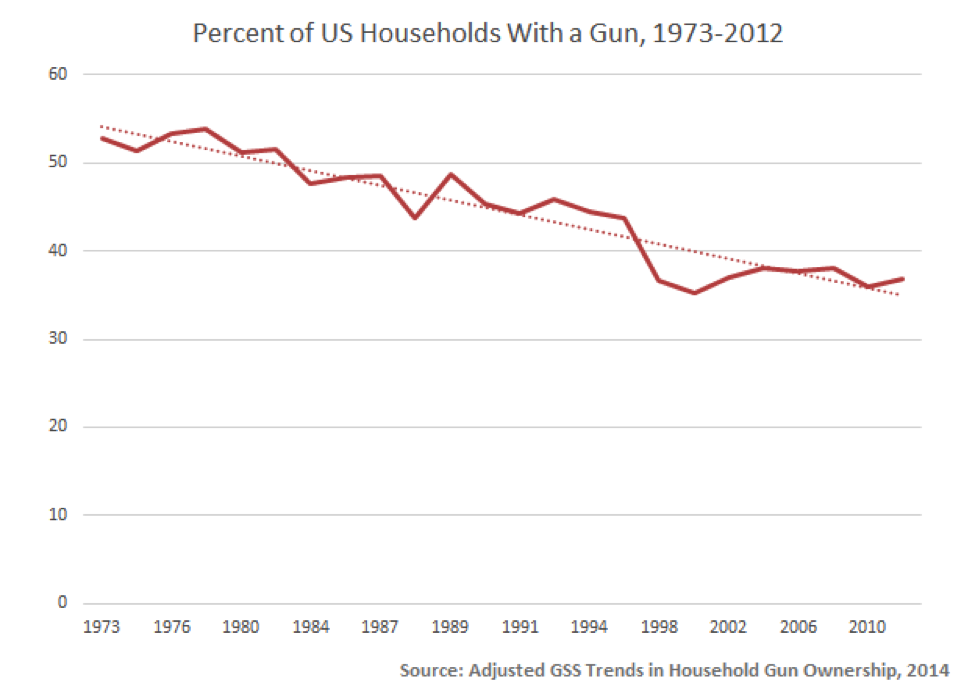
Moreover, gun ownership in the United States has been declining, both before and throughout the process of militarizing law enforcement. The 1980s saw early stirrings of it, with the spread of SWAT teams and Reagan-era “tough on crime” policies. It grew in the mid-1990s under the Clinton administration, which authorized the DoD’s 1033 program, expanding and formalizing the process for giving military gear to police. Finally, after 9/11, militarization took off in earnest, with two wars, paranoia about terrorism, a booming defense industry, and billions of dollars in Homeland Security money to drive it.

Meanwhile, rates of gun ownership through the U.S. dropped or stagnated. Winkler drops the oft-quoted and often misunderstood statistic that there are “320 million guns in the United States, approximately one per person,” but apparently doesn’t recognize that this stat doesn’t mean everyone gets a gun. (A good way to check: Look around you. Do you see any guns? No? Okay, myth busted.) Today, the actual rate of gun ownership is just 34 percent, down from an average of over 52 percent in the 1970s.
Not only is gun ownership down, so is crime—dramatically so. Starting in 1990, and continuing through recessions, terrorist attacks, and wars, crime has fallen. Murder, rape, robbery, assault—even property crimes—are all down. Cops toting .50 caliber machine guns and driving landmine-resistant vehicles cannot be responding to an epidemic of violence, because one simply doesn’t exist.

But even if far fewer people own guns and commit crimes than did so in the past, it’s still possible that police officers are uniquely under threat in recent years. Maybe killings, assaults, and injuries of police are on the rise. But they’re not.

In every way, this theory fails to align with the facts. Not only is gun ownership down, but so are crime and attacks on police. Private gun ownership is not responsible for militarization, racial profiling, or tensions with police.

But Winkler is right about one thing: Police officers are being taught to be paranoid about citizens and guns, and that fear is being channeled against minorities, from ATF stings targeted at poor blacks and Hispanics, to New York’s racist stop-and-frisk program, to New Jersey’s felony prosecution of a single mom who tried to do the right thing.

But the reason isn’t that there is more of a threat than there used to be. It’s that people are being systematically misinformed—by reporting like Winkler’s—about the risks they actually face. Telling poor minorities that hostilities with police are really partly their fault—and that if they would just give up their guns, everything would be okay—is not just absurd, it’s actively harmful.

Daniel Bier is the executive editor of The Skeptical Libertarian. He writes on issues relating to science, skepticism, and economic freedom, focusing on the role of evolution in social and economic development.

This article was originally published by The Foundation for Economic Education.
Obama Has No Middle East Strategy? Good! – Article by Ron Paul

Obama Has No Middle East Strategy? Good! – Article by Ron Paul

The New Renaissance Hat
Ron Paul
September 1, 2014
******************************
Last week President Obama admitted that his administration has not worked out a strategy on how to deal with the emergence of the Islamic State in Iraq and Syria (ISIS) as a dominant force in the Middle East. However, as ISIS continues its march through Syria and Iraq, many in the US administration believe it is, in the words of Defense Secretary Chuck Hagel, a threat “beyond anything we have ever seen.”Predictably, the neocons attacked the president’s speech. They believe the solution to any problem is more bombs and troops on the ground, so they cannot understand the president’s hesitation.

Chairman of the House Armed Services Committee Buck McKeon made it clear that fighting ISIS is going to cost a lot more money and will bring US forces back to Iraq for the third time. The post-Iraq, post-Afghanistan peace dividend disintegrates.

Mr. McKeon said last week:

ISIS is an urgent threat and a minimalist approach, that depends solely on FY15 funding or pinprick strikes that leave fragile forces in Iraq and Syria to do the hard fighting, is insufficient to protect our interests and guarantee our safety in time.

What does this mean in practice? If the neocons have their way, the Federal Reserve will “print” more money to finance another massive US intervention in the Middle East. In reality this means further devaluation of the US dollar, which is a tax on all Americans that will hit the poorest hardest.

A new US military incursion will not end ISIS; it will provide them with the recruiting tool they most crave, while draining the US treasury. Just what Osama bin Laden wanted!

McKeon and the other hawks act as if they had only recently become aware of the ISIS. Or if they noticed it, they pretend US policy had nothing to do with its rise.

McKeon also said last week, “ISIS threat was allowed to build and fester over a period of time.”

In fact, US regime-change policy in Syria was directly responsible for the rise of ISIS over these past three years. As journalist Eric Margolis observed recently, the emergence of ISIS is the “mother of all blowback.” The neocons who want us to get tougher on ISIS, including a US attack on Syria, are the same ones who not long ago demanded that we support groups like ISIS to overthrow the Assad government in Syria. US-trained and funded “moderates” from the Free Syrian Army joined the Islamist militias including ISIS, taking US weapons and training with them.

Three years of supporting any force that might overthrow the secular government of President Assad has produced a new monster in the Middle East that neocons insist the US must slay.

Why can’t they just admit they were wrong? Why can’t the interventionists just admit that their support for regime change in Syria was a terrible and tragic mistake?

If ISIS is as big a threat as they claim, why can’t they simply ask Assad to help out? Assad has never threatened the United States; ISIS has. Assad has been fighting ISIS and similar Islamist extremist groups for three years.

Why does the US government insist on aligning with theocracies in the Middle East? If there is anything that contradicts the US Constitution and American values it is a theocratic government. I do not believe that a majority in the Middle East wants to live under such a system, so why do we keep pushing it on them? Is that what they call promoting democracy?

A lack of strategy is a glimmer of hope. Perhaps the president will finally stop listening to the neocons and interventionists whose recommendations have gotten us into this mess in the first place! Here’s a strategy: just come home.

Ron Paul, MD, is a former three-time Republican candidate for U. S. President and Congressman from Texas.

This article is reprinted with permission from the Ron Paul Institute for Peace and Prosperity.

Discoverer, Op. 16 (2002) – Musical Composition and Video by G. Stolyarov II

Discoverer, Op. 16 (2002) – Musical Composition and Video by G. Stolyarov II

The New Renaissance Hat
G. Stolyarov II
August 31, 2014
******************************

This piece by G. Stolyarov II, composed in 2002, evokes the image of a man submerged in a stream of exploratory thought, moving, by his own volition, toward unraveling the secrets of the natural world.

Download the MP3 file of this composition here.

See the index of Mr. Stolyarov’s compositions, all available for free download, here.

The artwork is Mr. Stolyarov’s Abstract Orderism Fractal 58, available for download here and here.

Remember to LIKE, FAVORITE, and SHARE this video in order to spread rational high culture to others.