Cryptocurrencies as a Single Pool of Wealth: Thoughts on the Purchasing Power of Decentralized Electronic Money – Article by G. Stolyarov II

Cryptocurrencies as a Single Pool of Wealth: Thoughts on the Purchasing Power of Decentralized Electronic Money – Article by G. Stolyarov II

The New Renaissance Hat
G. Stolyarov II
January 12, 2014
******************************

The recent meteoric rise in the dollar price of Bitcoin – from around $12 at the beginning of 2013 to several peaks above $1000 at the end – has brought widespread attention to the prospects for and future of cryptocurrencies. I have no material stake in Bitcoin (although I do accept donations), and this article will not attempt to predict whether the current price of Bitcoin signifies mostly lasting value or a bubble akin to the Dutch tulip mania of the 1630s. Instead of speculation about any particular price level, I hope here to establish a principle pertaining to the purchasing power of cryptocurrencies in general, since Bitcoin is no longer the only one.

Although Bitcoin, developed in 2009 by the pseudonymous Satoshi Namakoto, has the distinction and advantage of having been the first cryptocurrency to gain widespread adoption, others, such as Litecoin (2011), Namecoin (2011), Peercoin (2012), and even Dogecoin (2013) – the first cryptocurrency based on an Internet meme – have followed suit. Many of these cryptocurrencies’ fundamental elements are similar. Litecoin’s algorithm is nearly identical to Bitcoin (with the major difference being the fourfold increase in the rate of block processing and transaction confirmation), and the Dogecoin algorithm is the same as that of Litecoin. The premise behind each cryptocurrency is a built-in deflation; the rate of production slows with time, and only 21 million Bitcoins could ever be “mined” electronically. The limit for the total pool of Litecoins is 84 million, whereas the total Dogecoins in circulation will approach an asymptote of 100 billion.

Bitcoin-coins Namecoin_Coin Dogecoin_logoLitecoin_Logo

The deflationary mechanism of each cryptocurrency is admirable; it is an attempt to preserve real purchasing power. With fiat paper money printed by an out-of-control central bank, an increase in the number and denomination of papers (or their electronic equivalents) circulating in the economy will not increase material prosperity or the abundance of real goods; it will only raise the prices of goods in terms of fiat-money quantities. Ludwig von Mises, in his 1912 Theory of Money and Credit, outlined the redistributive effects  of inflation; those who get the new money first (typically politically connected cronies and the institutions they control) will gain in real purchasing power, while those to whom the new money spreads last will lose. Cryptocurrencies are independent of any central issuer (although different organizations administer the technical protocols of each cryptocurrency) and so are not vulnerable to such redistributive inflationary pressures induced by political considerations. This is the principal advantage of cryptocurrencies over any fiat currency issued by a governmental or quasi-governmental central bank. Moreover, the real expenditure of resources (computer hardware and electricity) for mining cryptocurrencies provides a built-in scarcity that further restricts the possibility of inflation.

Yet there is another element to consider. Virtually any major cryptocurrency can be exchanged freely for any other (with some inevitable but minor transaction costs and spreads) as well as for national fiat currencies (with higher transaction costs in both time and money). For instance, on January 12, 2014, one Bitcoin could trade for approximately $850, while one Litecoin could trade for approximately $25, implying an exchange rate of 34 Litecoins per Bitcoin. Due to the similarity in the technical specifications of each cryptocurrency (similar algorithms, similar built-in scarcity, ability to be mined by the same computer hardware, and similar decentralized, distributed generation), any cryptocurrency could theoretically serve an identical function to any other. (The one caveat to this principle is that any future cryptocurrency algorithm that offers increased security from theft could crowd out the others if enough market participants come to recognize it as offering more reliable protection against hackers and fraudsters than the current Bitcoin algorithm and Bitcoin-oriented services do.)  Moreover, any individual or organization with sufficient resources and determination could initiate a new cryptocurrency, much as Billy Markus initiated Dogecoin in part with the intent to provide an amusing reaction to the Bitcoin price crash in early December 2013.

This free entry into the cryptocurrency-creation market, combined with the essential similarity of all cryptocurrencies to date and the ability to readily exchange any one for any other, suggests that we should not be considering the purchasing power of Bitcoin in isolation. Rather, we should view all cryptocurrencies combined as a single pool of wealth. The total purchasing power of this pool of cryptocurrencies in general would depend on a multitude of real factors, including the demand among the general public for an alternative to governmental fiat currencies and the ease with which cryptocurrencies facilitate otherwise cumbersome or infeasible financial transactions. In other words, the properties of cryptocurrencies as stores of value and media of exchange would ultimately determine how much they could purchase, and the activities of arbitrageurs among the cryptocurrencies would tend to produce exchange rates that mirror the relative volumes of each cryptocurrency in existence. For instance, if we make the simplifying assumption that the functional properties of Bitcoin and Litecoin are identical for the practical purposes of users, then the exchange rate between Bitcoins and Litecoins should asymptotically approach 1 Bitcoin to 4 Litecoins, since this will be the ultimate ratio of the number of units of these cryptocurrencies. Of course, at any given time, the true ratio will vary, because each cryptocurrency was initiated at a different time, each has a different amount of computer hardware devoted to mining it, and none has come close to approaching its asymptotic volume.

 What implication does this insight have for the purchasing power of Bitcoin? In a world of many cryptocurrencies and the possibility of the creation of new cryptocurrencies, a single Bitcoin will purchase less than it could have purchased in a world where Bitcoin was the only possible cryptocurrency.  The degree of this effect depends on how many cryptocurrencies are in existence. This, in turn, depends on how many new cryptocurrency models or creative tweaks to existing cryptocurrency models are originated – since it is reasonable to posit that users will have little motive to switch from a more established cryptocurrency to a completely identical but less established cryptocurrency, all other things being equal. If new cryptocurrencies are originated with greater rapidity than the increase in the real purchasing power of cryptocurrencies in total, inflation may become a problem in the cryptocurrency world. The real bulwark against cryptocurrency inflation, then, is not the theoretical upper limit on any particular cryptocurrency’s volume, but rather the practical limitations on the amount of hardware that can be devoted to mining all cryptocurrencies combined. Will the scarcity of mining effort, in spite of future exponential advances in computer processing power in accordance with Moore’s Law, sufficiently restrain the inflationary pressures arising from human creativity in the cryptocurrency arena? Only time will tell.
Congress Defers to President On NSA Reform – Article by Ron Paul

Congress Defers to President On NSA Reform – Article by Ron Paul

The New Renaissance Hat
Ron Paul
January 12, 2014
******************************
Congress’s decline from the Founders’ vision as “first among equals” in government to an echo chamber of the unitary executive, has been a slow but steady process. In the process we have seen a steady stream of unconstitutional wars and civil-liberties abuses at home. Nowhere is this decline more evident than in the stark contrast between the Congressional response to intelligence agencies’ abuses during the post-Watergate era and its response to the far more serious NSA abuses uncovered in recent years.In 1975, Senator Frank Church (D-ID) convened an historic select committee to investigate the US intelligence services for possible criminality in the wake of Watergate. Thanks in part to reporting by Seymour Hersh and others, abuses by the CIA, NSA, and FBI had come to light, including the monitoring of US peace activists.The Church Committee played its proper Congressional role, checking the power of the executive branch as it had been spiraling out of control since the 1950s and the early CIA covert action programs. The Committee sought to protect US citizens against abuses by their government after those abuses had come to light through leaks of secret government documents.

The parallel to the present NSA scandals cannot be ignored. What is completely different, however, is that Congress is today acting as an advocate for the executive branch’s continuing abuses, and as an opponent to the civil liberties of US citizens. Not only has Congress – with a precious few exceptions – accepted the NSA’s mass spying program on American citizens, it has actually been encouraging the president to continue and expand the program!

Where once there was a Congressional committee to challenge and oppose the president’s abuse of power, today the president himself has been even allowed by a complacent Congress to hand pick his own NSA review commission!

Are we really expected to believe that a commission appointed by the president to look into the activities of the president’s intelligence services will come to anything more than a few superficial changes to give the impression of real reform?

One of the president’s commission recommendations is that the NSA cease holding our phone records and demand that the private phone companies retain those records instead – for the NSA to access as it wishes. This is supposed to be reform?

The president will make a speech this Friday to tell the rest of us which of the suggestions made by his own commission he will decide to implement. Congress has no problem with that. Rep. Adam B. Schiff (D-Calif.) admitted last week that Congress has no intention of asserting itself in the process. “It’s my hope that [Obama will] do as much as he can through the executive process because the legislative process will be difficult, perilous and long.”

Senator Church famously said back in 1975:

In the need to develop a capacity to know what potential enemies are doing, the United States government has perfected a technological capability that enables us to monitor the messages that go through the air… We must know, at the same time, that capability at any time could be turned around on the American people, and no American would have any privacy left… There would be no place to hide…. I know the capacity that is there to make tyranny total in America, and we must see to it that this agency and all agencies that possess this technology operate within the law and under proper supervision so that we never cross over that abyss. That is the abyss from which there is no return.”

Have we reached that point? Let us hope not. Real reform begins with the repeal of the PATRIOT Act and of the 2001 Authorization for the Use of Military Force. If we keep our eye on that goal and not allow ourselves to become distracted with the president’s phony commissions we might force Congress to listen.

Ron Paul, MD, is a former three-time Republican candidate for U. S. President and Congressman from Texas.

This article is reprinted with permission from the Ron Paul Institute for Peace and Prosperity.

Gennady and Wendy Stolyarov’s Forthcoming Presentation on “Death is Wrong” at Transhuman Visions 2.0

Gennady and Wendy Stolyarov’s Forthcoming Presentation on “Death is Wrong” at Transhuman Visions 2.0

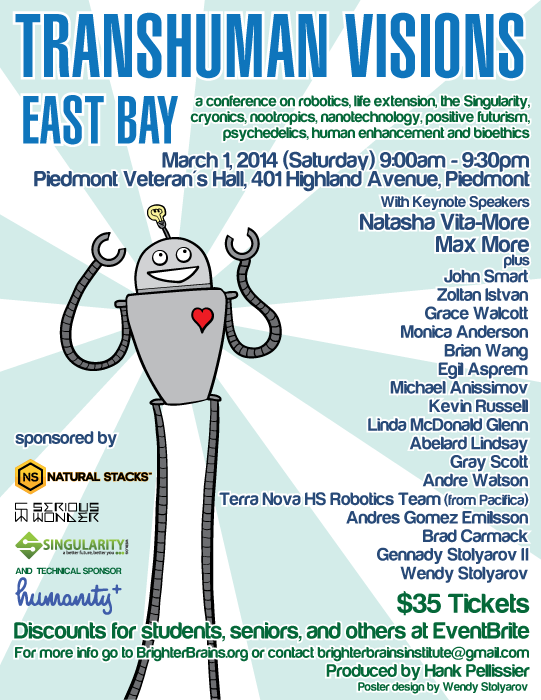
I invite all of my readers to join me at the Transhuman Visions 2.0 East Bay conference in Piedmont, CA, on Saturday, March 1, 2014. I will be there with my wife Wendy Stolyarov to deliver the opening presentation about Death is Wrong, our new ambitious illustrated children’s book on indefinite life extension. For a prelude to my presentation, I invite you to read my article, “Why I Wrote a Children’s Book on Indefinite Life Extension“. Also, autographed copies of Death is Wrong will be available for sale.

The Transhuman Visions 2.0 East Bay conference is produced by the Brighter Brains Institute and its energetic, prolific, and creative founder, Hank Pellissier. For detailed information about the conference, see the official Brighter Brains Institute page here.

The poster for this event was designed by none other than Wendy Stolyarov. It is a testament to her skill in graphic design and the new standard of excellence her art brings to the transhumanist movement.

Transhuman Visions 2.0 East Bay – Poster by Wendy Stolyarov
Liberally Classical – Article by Jeffrey A. Tucker

Liberally Classical – Article by Jeffrey A. Tucker

The New Renaissance Hat
Jeffrey A. Tucker
January 12, 2014
******************************
I was recently in an ornate orchestral hall built in the late Gilded Age, a setting designed to present an opera or symphonic music to a generation before World War I that craved such performance art. The concert I attended was sold out, with tickets running between $40 and $75.
***
The place was vibrating with anticipation as the full orchestra with winds, strings, brass, and percussion came on stage, and a 25-voice choir—live acoustic music without conspicuous electronics—filed in behind. The cheers, even before it all began, were glorious.
***
As I looked around the vast room full of wide smiles, I noted that that average age of the concert goers was late twenty-something. It was a slightly startling sight after having been to so many symphony concerts filled with septuagenarians. Not that there’s anything wrong with old people, but it always seemed to symbolize a dying art to me. Not this time though. This art and this room were alive and youthful and looking to the future.
***
What followed was two hours of dramatic, emotionally gripping symphonic music. The audience couldn’t wait to cheer and stand at every opportunity. At the intermission not a soul failed to return to his or her assigned seat.
***
I’ve been around the art-music sector of the music industry for many years, and, for me, this experience was all dreamy, even surreal. My whole life, I’ve heard the same old complaints from classical musicians. We are underfunded. Governments are stingy. The people are not coming to our concerts. The young are only interested in junk music. High art is being crowded out by pop: it’s Schubert vs. Spears, Beethoven vs. Bieber, Mahler vs. Madonna. Our concert halls and symphonies are being massacred by market forces. We need subsidies in order to uphold real music against the pathetic tastes of the middle class.
***
And so on it goes.
***
The conventional tactics for dealing with this obvious and old problem are well known. There are labor strikes—you know, those oppressed oboists and violists who are clamoring for their surplus value to be given back by the unnamed exploiter. Donors are being squeezed to make up for what can’t be gained in ticket sales. There are hectoring public campaigns to “support the arts” or feel really guilty. There are marketing gimmicks. There are foundations that provide temporary relief. All the while, musicians grow ever more bitter, resentful, and despairing.
***
So what made this event different? Many things. The bar was open with wine, beer, and spirits, and people were welcome to bring them to their seats, just like in a movie theater when people watch with soda and popcorn. Yes! Why doesn’t the Kennedy Center allow this? I don’t know. It should.
***
Also, the fantastic and rightly showy conductor was a young woman—defying the eternal stereotype and addressing another complaint about sexism in the history of orchestral conductors. Another thing: Many members of the audience were dressed in character, sporting funny ears, wigs, and costumes. Character? More on that follows.
***
Finally, the main event was something completely unexpected. The music was a performance of the soundtrack to the video game Legend of Zelda. The full name: “The Legend of Zelda: Symphony of the Goddesses.” Yes, a video game, a cult classic, one that began in 1989 and now has a beloved heritage and rich tradition.
***
The game itself is accompanied by a full suite of serious music composed over the course of 25 years by a dozen or so specialists (all well-trained musicians) from Japan. That means there is not a single god-like composer—we like to pretend they were all sui generis—but rather a crowdsourced, thematically arranged series of pieces, each of which is connected to some iteration of this long-running game.
***
The musicians seemed to love it, and the audience surely did. The exchange relationship between the musical producers and consumers was unlike anything I had experienced. This was not an audience obediently frozen in a stuffy pose waiting for the next assigned time to clap (never, never between movements, dammit!). They were serious, engaged people who were happy to gasp, laugh, cheer, ooh and ahh, and even cry. They did it all, and not on cue.
***
Above the orchestra floated a large screen that played scenes that matched the music, from its earliest and crudest computer animations to the latest and most dazzling visual art. We even saw the characters grow up in the course of their adventures, which are wonderful, faux-medieval tales of danger, courage, chivalry, and devotion.
***
My goodness, the whole scene just moved me so much. Here were the gamers all gathered, those “nerds” everyone made fun of during high school and college, and their love of their computer world was being validated and affirmed. But I suspect that even they didn’t understand the implications of all of this. I wanted to stand up and explain: Do you see what you have done here? Your consumers’ interests have brought back large-scale, live performance art—full choir and orchestra—through the most circuitous route one can possibly imagine.
***
And how different, really, is this from a Rossini opera about a love affair involving barbers, secret letters, singing lessons, stodgy aristocrats made to look silly, and narrow escapes down second-story ladders? Or a Mozart opera involving magic bells and flutes, evil queens, floating boys in an air balloon, and scary dwarfs and dragons? It’s all the same stuff. It’s that beautiful combination of audio and visual art—the sense that something is happening right there in front of you. They didn’t have video games but we do, and good for us!
***
All of this music could have easily been played on a loudspeaker, but that would have taken away the whole sense that something was being created on the spot. You want to see the violinists moving their bows, the percussionists crashing cymbals together, the bassoonist playing that most implausible of instruments. Adding to the irony is that the music on the Zelda game itself is mostly electronic, especially the choirs and their ethereal voices. Not here. It was human. It was life. We all experienced it in real time—fantasy became reality before our eyes and ears.
***
I thought back to my days hanging around the school of music, all those students and professors with long faces and grim demeanors, people down on markets, down on society, down on consumers. No one would have believed that he or she had a future in live performance music, filling up the old orchestral halls, by way of fun and wonderful video games. No, it took entrepreneurs and commerce to blaze this trail. It took markets to make this surprise happen.
***
The world of classical music, in fact, has been pathetically lacking in creative vision for many decades, if not an entire century. In large part, it keeps trying to recreate the past while cursing the present and despairing of the future. Why? Perhaps it is because this sector of life has been ever more removed from the commercial world through centrally planned education, subsidies, union control, copyrighted and monopolized musical scores, a culture of the entitled guild. None of it has worked and, needing to pay the rent, there has been a steady stream of young musicians leaving years of conservatory training to enter some other profession like making lattes.
***
But get outside those establishment circles and you see entirely different things happening. It was in Turkey when I first saw a performance of an all-woman string quartet. During the first part of the evening, they presented a solid program of Schubert, Mozart, and Haydn. Then came the change to leather and boots and an all-electronic/pop program followed by the same players. One can sneer at it as tacky (actually, I don’t think so) but people love it and pay the big bucks for it. Since I saw this performance two years ago, the approach has reemerged at several venues in the United States as well.
***
My point is not to isolate these two types of art-music presentations and say: This is the future for classically trained musicians. Maybe this is just the beginning. Maybe there are dozens of other approaches yet to be explored. What is needed is some serious entrepreneurship to find the new approaches and test them in the marketplace.
***
The main feature in success here is an intimate connection between the players and the audience—the same as you see in the pop music world. It’s not about the style. It’s about the economic and artistic relationship between the producers and consumers. It must be a value enhancing proposition for both sides for a true profit to emerge.
***
Meanwhile, I will never be able to read the quarterly harangue in The New York Times about the death of symphonies without thinking of this wonderful evening. Classical music is not dead. It is just now coming back to life.
***
Jeffrey Tucker is a distinguished fellow at the Foundation for Economic Education (FEE), CEO of the startup Liberty.me, and publisher at Laissez Faire Books. He will be speaking at the FEE summer seminar “Making Innovation Possible: The Role of Economics in Scientific Progress“.
***
This article originally appeared in The Freeman, the magazine of the Foundation for Economic Education.
The Greatest Wealth: Life – Video by G. Stolyarov II

The Greatest Wealth: Life – Video by G. Stolyarov II

What is the greatest wealth of all? Mr. Stolyarov explains that the greatest wealth is the fact that one is alive right now. This reinforces the imperative to support indefinite life extension and to develop improved means to combat the forces of ruin.

Technological Singularities: An Overview – Video by G. Stolyarov II

Technological Singularities: An Overview – Video by G. Stolyarov II

Mr. Stolyarov explains the basic concept of a technological Singularity and his understanding that humankind has already experienced three such Singularities in the form of the Agricultural, Industrial, and Information Revolutions. The next Singularity will come about due to a convergence of technologies such as artificial intelligence, nanotechnology, and biotechnology (including indefinite life extension).

Iraq: The “Liberation” Neocons Would Rather Forget – Article by Ron Paul

Iraq: The “Liberation” Neocons Would Rather Forget – Article by Ron Paul

The New Renaissance Hat
Ron Paul
January 5, 2014
******************************

Remember Fallujah? Shortly after the 2003 invasion of Iraq, the US military fired on unarmed protestors, killing as many as 20 and wounding dozens. In retaliation, local Iraqis attacked a convoy of US military contractors, killing four. The US then launched a full attack on Fallujah to regain control, which left perhaps 700 Iraqis dead and the city virtually destroyed.

According to press reports last weekend, Fallujah is now under the control of al-Qaeda affiliates. The Anbar province, where Fallujah is located, is under siege by al-Qaeda. During the 2007 “surge,” more than 1,000 US troops were killed “pacifying” the Anbar province. Although al-Qaeda was not in Iraq before the US invasion, it is now conducting its own surge in Anbar.

For Iraq, the US “liberation” is proving far worse than the authoritarianism of Saddam Hussein, and it keeps getting worse. Last year was Iraq’s deadliest in five years. In 2013, fighting and bomb blasts claimed the lives of 7,818 civilians and 1,050 members of the security forces. In December alone nearly a thousand people were killed.

I remember sitting through many hearings in the House International Relations Committee praising the “surge,” which we were told secured a US victory in Iraq. They also praised the so-called “Awakening,” which was really an agreement by insurgents to stop fighting in exchange for US dollars. I always wondered what would happen when those dollars stopped coming.

Where are the surge and awakening cheerleaders now?

One of them, Richard Perle, was interviewed last year on NPR and asked whether the Iraq invasion that he pushed was worth it. He replied:

I’ve got to say I think that is not a reasonable question. What we did at the time was done in the belief that it was necessary to protect this nation. You can’t a decade later go back and say, well, we shouldn’t have done that.

Many of us were saying all along that we shouldn’t have done that – before we did it. Unfortunately the Bush Administration took the advice of the neocons pushing for war and promising it would be a “cakewalk.” We continue to see the results of that terrible mistake, and it is only getting worse.

Last month the US shipped nearly a hundred air-to-ground missiles to the Iraqi air force to help combat the surging al-Qaeda. Ironically, the same al-Qaeda groups the US is helping the Iraqis combat are benefiting from the US covert and overt war to overthrow Assad next door in Syria. Why can’t the US government learn from its mistakes?

The neocons may be on the run from their earlier positions on Iraq, but that does not mean they have given up. They were the ones pushing for an attack on Syria this summer. Thankfully they were not successful. They are now making every effort to derail President Obama’s efforts to negotiate with the Iranians. Just last week William Kristol urged Israel to attack Iran with the hope we would then get involved. Neoconservative Senators from both parties recently introduced the Nuclear Weapon Free Iran Act of 2013, which would also bring us back on war-footing with Iran.

Next time the neocons tell us we must attack, just think “Iraq.”

Ron Paul, MD, is a former three-time Republican candidate for U. S. President and Congressman from Texas.

This article is reprinted with permission from the Ron Paul Institute for Peace and Prosperity.

Pioneers on Time’s Trail – Article by Eric Schulke

Pioneers on Time’s Trail – Article by Eric Schulke

The New Renaissance Hat
Eric Schulke
January 5, 2014
******************************

The universe, the cities, the souls, times come and past, the big picture of it all, its fortune and fate, happenstance and chance coiling through the airwaves, weaving in and out throughout the corridors and shores and floors… We call it existence, and it’s big, really big.

History’s timeline is like a long path, and we here represent the spot on that trail that time is currently manifested as. The stars in the background are the only imprint remaining that spans history’s trail of mementos, like Dachau death marches and Choctaw trails. Even relics continue the slide as they slowly fade, mountains of their days, now chiseled away by time’s currents.

It’s all wild, legendary, mythical, incredible, and ours – each one of ours. There are worlds of complex mechanisms inside atoms, inside cells, inside creatures, inside ecosystems, on planets, in galaxies, and on and on, leaving us wondering if it really could be like an endless fractal in both directions, and desperate for a chance to know. The long, arduous labors of our prokaryotic precursors are now beginning to bud curious new transhuman fruit. Each one of us materializes on the timeline of humanity, like rickety roller coasters set up on temporary take-down stages for traveling theater, just hoping to stay on the tracks. We have conquered a planet under these circumstances. Like Alexander the Great crossing countries atop Bucephalus, we ride through the universe atop the planet Earth, trying to keep our grip on the reins while we hop from stage to stage.

Not even a percent of a percent of this territory is mapped. What does that mean for all that is outside of the speck of light we are in so far? Trillions upon trillions upon trillions of lives and scenarios are interacting and going down around us every day. You might see an ant fighting with a mutant form of a June bug and be able to contemplate their struggle, but miss the fact that this mutation will soon change the landscape of the area in profound ways. You might just dirt-bike right over the top of them without ever even contemplating that, all the while thinking about the prospects of a ranch-style house in this area and the philosophy of a progressive struggle in a capitalist climate. All this occurs while unknowns surround us. Maybe an unfathomable machine is being created on a planet whose distance we can’t conceive, illuminating answers we never dreamt possible. Maybe an amazingly complex civilization is at its height. Perhaps there are other dimensions with wonders that would blow our minds while they’re blowing our minds.

The poorest among the industrialized citizens today still have their “junky” cars, and stereos, lighters, cell phones, watches (scratch that, clocks are on cell phones now), 3 TVs with “only” 8 basic channels, “old” computers and “slow” internet connections, FDA-tested food, state-of-the-art health technology with emergency transport, malls and restaurants just down the street, the freedom to fly anywhere in the world after a few weeks’ saving, and so many other things. These are our poorest people. They are richer than the richest kings and queens of old. In the same kind of way that the poorest among us today have many times more than the richest kings and queens of centuries ago, so will the poorest of us in a post-definite lifespan world be richer than the richest Forbes List billionaire among us today.

Think of the ancient history: the richest of the kings and queens with the golden thrones, crowns, everything jewel-encrusted, exotic animals, limitless concubines, slaves, best fish tank, singing canaries, speedy buggies, salted turnips, and best open-hole bathroom that money could buy. What is that money worth to them now? Time is money, and if you don’t have any, then you’re dead broke.

Some of these ancients remain with us as mummies today. Now there’s an interesting collision of worlds. Those who could still be here, who want to be here, gave it their best shot, and are still here, now in rags begging for us to come up with a solution to bring them back to life. It was a nice try. Their notions lived on in the DNA of their progeny, working it out, better and better, building the tools and emerging today among us as cryonics, a surer form of mummification. We don’t have the cures or the salves for the mummies, but you still have a shot. You are them; you are the same people, the same blood; you are the ancients, but the future can still be theirs/yours. 1,000 BC, 2,100 AD – it’s all ancient history to the people of 45,000 AD.

We know what is going on in parts of this place we are in, but what about everywhere else? What about how it all interacts? What it all means as a whole? Do we think we can guess what is going on everywhere? We can hardly ever even guess who the culprit is in a typical television murder mystery. Can we even guess what is going on in all the buildings of one single town? Some of those points of light in the nighttime sky are entire galaxies unto themselves. Some of them are entire universes. That space between might not end.

This paper could be expanded to fill libraries with volumes on the limitless and profound, mind-blowing, unencapsulatable nature of it. No, libraries are filled with volumes on exactly that, and even those haven’t begun to scratch the surface of what it means to exist.

So here we are, pioneers on time’s trail, the precursors, surviving caravans retooling for a star trek. What does the big picture of existence have in store for us on the trail ahead?

Eric Schulke was a director at LongeCity during 2009-2013. He has also been an activist with the Movement for Indefinite Life Extension and other causes for over 13 years.

The Minimum Wage Forces Low-Skill Workers to Compete with Higher-Skill Workers – Article by George Reisman

The Minimum Wage Forces Low-Skill Workers to Compete with Higher-Skill Workers – Article by George Reisman

The New Renaissance Hat
George Reisman
January 4, 2014
******************************

The efforts underway by the Service Employees International Union, and its political and media allies, to raise the minimum wage from $7.25 to $15 per hour would, if successful, cause major unemployment among low-skilled workers, who are the supposed beneficiaries of those efforts.

The reason is not only the fact that higher wages serve to raise costs of production and thus prices, which in turn serves to reduce physical sales volume and thus the number of workers needed. There is also another equally, if not more important reason in this case, and it is a reason which is only very inadequately described by reference to the substitution of machinery or automation for the direct labor of workers when wages are increased.

This is the fact that a low wage constitutes a competitive advantage for less-skilled workers that serves to protect them from competition from more-skilled workers. In other words, a wage of $7.25 per hour for fast-food workers serves to protect those workers from competition from workers able to earn $8 to $15 per hour in other lines of work. The workers able to earn these higher wage rates are not interested in seeking employment at the lower wage rates of the fast-food workers.

But if the wage of the fast-food workers, and all other workers presently earning less than $15 per hour, is raised to $15 per hour, then these more capable workers can now earn as much as fast-food workers as they can in any of the occupations in which they had been working up to now.

Moreover, the widespread rise in wage rates to $15 per hour will cause unemployment in all of the occupations affected. The unemployed clerks, telemarketers, factory workers, and whoever, who otherwise would have earned between $8 and $15 per hour, will have no reason not to apply for work in fast food, which will now pay as much as any other occupation that is open to them. And since those workers are more capable, it is overwhelmingly likely that to the extent that they do seek employment as fast-food workers, they will be preferred over the low-skilled workers who presently work in fast-food establishments. Thus, the rise in the wage of the fast-food workers will serve as an invitation to the competition of large numbers of workers who do not presently think of working as fast-food workers and who, being better qualified, will almost certainly take away their jobs.

Between less employment overall in the least-skilled lines of work such as fast food, and the incentive created for vastly increased competition for employment in those lines coming from more qualified workers, the effect could well be to close those lines altogether to the employment of workers at the low end of skill and ability. That, of course, would deprive these people of the opportunity to acquire skills and abilities from work experience that otherwise would have enabled them to become capable of performing more demanding jobs later on.

What the demand for a $15 an hour minimum wage represents is a case of low-skilled workers being led to reach for a high-wage “bird in the bush,” so to speak. Unfortunately, at the high wage, there are both fewer birds in the bush than are presently in hand and most or all of them will fly away into the hands of others, who possess greater skills and abilities, if the attempt is made to reach for them.

This must ultimately be the result even if somehow the present fast-food workers and the like could be enabled to keep their jobs for a time. Even so, practically every time that it became a question of hiring someone new, the new employees would almost certainly be drawn from the ranks of workers of greater skill and ability than those who had customarily been employed in these jobs. Thus, even if not immediately, in time there would simply be no more room in the economic system for workers at or near the bottom of the skills ladder.

No one can question the desirability of being able to earn $15 an hour rather than $7.25 an hour. Still more desirable would be the ability to earn $50 an hour instead of $15 an hour. However, it is necessary to know considerably more than this about economics before attempting to enact sweeping changes in economic policy, changes to be achieved by attempting to organize a mass movement that is based on nothing but a desire for economic improvement and no real knowledge whatever of how actually to achieve it.

George Reisman, Ph.D., is Pepperdine University Professor Emeritus of Economics and the author of Capitalism: A Treatise on Economics (Ottawa, Illinois: Jameson Books, 1996; Kindle Edition, 2012). See his Amazon.com author’s central page for additional titles by him. His website is www.capitalism.net and his blog is www.georgereismansblog.blogspot.com. Follow him on Twitter.

This article was published on Mises.org and may be freely distributed, subject to a Creative Commons Attribution United States License, which requires that credit be given to the author.

Advancing Pharmaceutical and Medical Technology Does Not Depend on Patents – Article by Nathan Nicolaisen

Advancing Pharmaceutical and Medical Technology Does Not Depend on Patents – Article by Nathan Nicolaisen

The New Renaissance Hat
Nathan Nicolaisen
January 1, 2014
******************************

Pharmaceutical drug manufacturers are often regarded as the successes of the intellectual property regime. It is assumed that their willingness to take risks by investing heavily in R&D is justified by the awarding of patents over their lifesaving discoveries. Proponents of intellectual property claim that without patents many lifesaving drugs would not exist. They assert that generic drug manufacturers would diminish profit margins and dissipate the original manufacturer’s market share and innovation would come to a virtual standstill. Further, manufacturers once willing to create new drugs will no longer do so without sufficient returns on investment. Research into the matter suggests, however, that patent protection may not be required for medical advances.

Unpatented Medical Technologies

The notion that unpatented medical technologies are not feasible is historically false. Surveys of important medical breakthroughs provide insight into whether patents are absolutely necessary and conducive to innovation in medicine. In 2006, the British Medical Journal challenged its readership to submit a list of the most noteworthy medical and pharmaceutical inventions throughout history. The original list contained over 70 different discoveries before being narrowed down to 15. The list goes as follows in no particular order: penicillin, x-rays, tissue culture, ether anesthetic, chlorpromazine, public sanitation, germ theory, evidence-based medicine, vaccines, the pill, computers, oral rehydration therapy, DNA structure, monoclonal antibody technology, and smoking health risk. Of these discoveries, only two of them have remotely anything to do with patents, chlorpromazine and the pill.[1] In another survey conducted by the United States Centers for Disease Control the results are strikingly similar. Of the ten most important medical discoveries of the twentieth century, none of them had anything to do with patents.[2]

Natural Market Advantages and Trade Secrecy

Contrary to popular belief, large pharmaceutical companies may maintain significant market share advantages after the introduction of generics through the help of natural barriers to entry. Large pharmaceutical companies have a first-mover advantage and an established internal and external structure that competitors, large and small, do not. Regardless of how fast competitors can manufacture a generic drug (never mind the fact that they must hire new labor, train new employees, buy raw materials, establish suppliers, organize logistics, create a marketing and advertising plan, and set up competitive shelf space), it can be extremely difficult to make a dent in the market dominance of an already-established drug. Competition data from India suggests that it takes approximately four years for generic drugs to enter the market.[3] In addition, the Congressional Budget Office calculated that an original drug manufacturer could still maintain a market share of more than 20 percent after the introduction of generics. Expanding the scope of research beyond pharmaceutical drugs, a survey of R&D labs and company managers revealed that between 23 percent and 35 percent believe a patent is an effective way of getting a return on investment. At the same time 51 percent believe trade secrets to be an effective way of ensuring returns.[4]

The Truth about R&D Costs and Generic Drugs

Pharmaceutical drug manufacturers enjoy large margins in spite of large R&D. The claim that R&D for pharmaceuticals is high is not unfounded. The cost to bring a new drug to market varies between estimates of $402 million on the lower end and $800 million on the upper end.[5],[6] Regardless of high R&D costs, drug companies still command high margins. For the past two decades pharmaceutical drugs have been one of the most profitable industries in the United States, never dropping below third place.[7] The profitability of pharmaceuticals can be explained away under the assumption that people are living longer and consuming more pharmaceutical drugs. It may also be suggested that the human population is less healthy than in the past and the demand for pharmaceutical drugs is inelastic. But, analysis of the profit margin on pharmaceutical drugs and lack of any serious innovation suggests that this is not always the case.

The pharmaceutical industry globally maintains about a 25 percent operating margin as opposed to 15 percent for consumer goods. In the United States, this number achieved its zenith at almost 35 percent. The high margin on the drugs may not be due directly to high R&D costs, either. As of 2006, the ratio of R&D to sales revenue was about 0.19.[8] Further, the top 30 pharmaceutical firms in the world incur costs for promotions and advertising that are nearly double the costs of R&D. This is not to imply that there is a perfect amount of R&D spending each firm must do, rather it is to show that the inability to recoup R&D costs is greatly exaggerated.

Generic drugs are not just manufactured by small companies that seek to ride on the coattails of the giants. It is believed that generics add nothing innovative to the realm of lifesaving drugs, they merely manufacture competing drugs that are already in the public domain; the real innovation comes from the companies willing to invest in research and development. The National Institute of Health Care Management conducted a survey of drugs that received approval from the FDA from 1989 to 2000 with revealing results. Just over half the drugs in the survey, 54 percent, were using active ingredients that were already in use in the market. Of the drugs that were approved by the FDA, 23 percent were given a priority rating on the basis that they were a sufficient clinical improvement compared to existing alternatives. As a corollary, 77 percent of the approved drugs did not exhibit any kind of significant clinical improvement.[9] In other words, these drugs are functionally generic drugs, offering no kind of advantage over existing treatments. Large drug companies are ironically engaging in the kind of behavior they abhor by developing functionally generic drugs while wasting valuable R&D resources.

Conclusion

In a truly free market, whoever has the resources to manufacture an invention is permitted to do so, and the firms that enter the market first with a new drug enjoy a significant advantage. Moreover, the fact remains that the best way to protect an idea is to keep it a secret, which is why the trade-secret method remains effective. The federal government, however, has made it profitable to conclude that the best way to protect an idea is twisting the wrists and shoulders of one’s competitors with government force. Yet in spite of overwhelming federal-government intervention, innovation and ingenuity prevail, even if to a lesser degree.

Nathan Nicolaisen is a senior at Luther College in Decorah, Iowa studying business management and mathematics. 

This article was published on Mises.org and may be freely distributed, subject to a Creative Commons Attribution United States License, which requires that credit be given to the author.

Notes

[1] This means that the inventions were not patented, due to some previous patent, or discovered out of desire to obtain a patent. Michele Boldrin and David K. Levine, Against Intellectual Monopoly, (Cambridge University Press, January 2010), 258, 259.

[2] ibid, 259.

[3] ibid, 266

[4] ibid, 186

[5] $402 million is in 2000 dollars. James Bessen and Michael J. Meurer, Of Patents and Property, Boston University Shool of Law, 2008), http://object.cato.org/sites/cato.org/files/serials/files/regulation/2008/11/v31n4-4.pdf

[6] $800 million is in 2000 dollars. Michele Boldrin and David K. Levine, Against Intellectual Monopoly, (Cambridge University Press, January 2010), 241.

[7] ibid, 256

[8] ibid, 255

[9] ibid, 261