Browsed by
Category: Culture

Your Problem with Gays or Guns Is Not Political – Article by Robin Koerner

Your Problem with Gays or Guns Is Not Political – Article by Robin Koerner

The New Renaissance Hat
Robin Koerner
******************************

Not too long ago, perhaps as a rite of passage before becoming a new American, I did something I’d done only once before: I went to a range and shot some guns. Lots of guns. All shapes, ages, and sizes.

For a guy born British, such a thing feels very strange – because guns feature nowhere in British culture.

Accordingly, I was unsurprised by the reaction of my mother when I called home and told her that I’d had a great time learning about firearms and discovering I wasn’t a bad shot, even with a second-world-war Enfield. “That’s the last thing I’d ever imagine you’d enjoy doing,” she said to me. She wasn’t being judgmental: it was an expression of genuine surprise.

“That’s because you just can’t imagine why nice or normal people would enjoy guns … because you don’t know any … no Brits know any,” I replied.

Mom thoughtfully agreed.

Many decent people who have no interest in guns simply can’t imagine what it must be like to be someone who is passionate about something whose primary purpose is to kill people. Although the gun debate is waged using words, logic, and fact (to different ends by both sides of course), the arguments constructed using these three tools are not what brings people to their pro- or anti-gun position. Rather, most people are emotionally or intuitively committed to a position first, and deploy these tools retroactively in defense of their position. Despite what we like to think, most, if not all, of our political views come about this way. Studies show, time and time again, that David Hume was right, when he claimed,

And as reasoning is not the source, whence either disputant derives his tenets; it is in vain to expect that any logic, which speaks not to the affections, will ever engage him to embrace sounder principles.

Do You Want to Kill People?

What most anti-gun people are really feeling (rather than thinking) is that there has to be something strange about you if you like guns. I mean, why would you like by something whose primary purpose is to kill people? If you do, you can’t be like me. You are sufficiently different that I am suspicious of your worldview or your motives or both. You are culturally “other.”

Productive engagement, and the pervasive acceptance of individual rights, involves bridging such cultural gaps. With the gun-rights issue, as with all others, the best way to bridge such gaps is the same way all forms of cultural segregation (because that is what we are really talking about) have been permanently broken down over time: get to know, and spend personal time with, those on the other side of the gap.

It works both ways. People who favor more gun regulation are not actually motivated by taking away your liberty. And people who favor robust Second Amendment protections do not have a higher threshold for the acceptance of violence or aggression. You’ll know this when you have them as friends, and having such friends causes the all-or-nothing arguments that make such dramatic claims about the fundamental differences between you and the people on the other side of the issue to cease to be credible.

This mistaking of differences of cultural identity for political differences, or, the erroneous idea that political differences drive different cultural identities, rather than the other way around, severely hobbles our ability to protect all of our liberties and empowers political partisans who have a vested interest in maintaining power by keeping us insolubly divided.

The Rise of Subcultures

Just as gun owners form a kind of (albeit highly porous) sub-culture, the LGBT community does too. Some people who have been brought up in a socially conservative or religious subculture simply can’t imagine even wanting to do (let alone actually doing) the things that those in another subculture (LBGT) do as a matter of course. Again, if I can’t even imagine your experience or desires, then we are deeply culturally separated. Just as gun-control advocates feel a twinge of disgust, or at least condescension, toward the culture of gun owners, some of our religious friends feel similarly about the LBGT subculture.

“Disgust” is of course a very strong word, and most of us sublimate it deeply, but it captures the sense that the division among our “political” subcultures is more visceral than rational. Reason is applied later to justify in the conscious mind the position that the subconscious makes us emotionally comfortable with.

Now, I have, or certainly used to have, a distinctly conservative streak when it comes to the raising of children, and I have an instinctive respect for any political position that is genuinely motivated by requiring adults to do the best by the children whom they create. I can understand, then, the real discomfort of those who sincerely believe that children benefit from having male and female role-models at home, and that society should be very wary of sanctioning anything that does not place the well-being of children above the proclivities of their parents.

However, two of my friends – and two of the kindest and most responsible people I know – happen to be gay partners who adopted a(n American-born) daughter. Phil and Michael are giving their adopted daughter a wonderful life. Their love for her is boundless. The security, values, and richness of experience that they are providing her will set her up forever. And the gap between the life that Mia Joy has and that which she would otherwise have makes the general question “Should gay couples should be able to adopt” sound something between silly and faintly insulting when applied to this particular, inspiring case.

I am blessed with close gay friends with whom I identify as much as I do with many of my straight friends. So for me, the question of gay marriage and adoption, for example, is not so much a political argument that needs logical “deciding,” but the very intuition of the existence of some gay “other” on which the very argument depends has disappeared. As that cultural gap is bridged through actual human relationship, the separateness of that “other group,” on which any suspicion I may have of their motivations depends, ceases to exist.

I’ve had many gay friends for many years. And now I am getting many gun-owning friends too. And because they are all good people (they’d not be my friends otherwise, would they?), I see both groups as doing essentially the same thing when they defend their rights – insisting on being allowed to be themselves, and defend the validity of the way they experience the world – as long as they harm no one else.

But That’s Wrong

Of course, if you’re reading this and you don’t like guns, you’re thinking, “That’s wrong. Guns harm people.” Not in the hands of my friends, they don’t. And if you’re reading this and you don’t like gays, you’re thinking, “That’s wrong. Gay adoption is bad for the children.”

Not by my friends, it isn’t.

If I were going to take a stand against gay adoption, I would have to imagine saying to Phil and Mike, “You should not be allowed to what you have done for Mia Joy, and I would use the force of law to stop you.” Even if I could make an abstract political argument against gay adoption, I cannot say that to them in good conscience. And if I were going to take a stand against my open-carrying friend, Rob, I’d have to imagine saying to him, “You should not be allowed to own that to protect your family – or to protect your country against a tyrannical state, should it ever come to that, and I would use the force of law to stop you.” Even if I could make an abstract political argument against private gun ownership, I could not say that to him in good conscience.

Friendship

By becoming friends with Phil and Mike, and with Rob, their respective subcultures cease to be alien to me.

The truth is that, because I know Rob as a grounded, kind man, I also know that the rest of us are better off when people like him have a few of the guns – rather than their all being in the hands of our political masters. And because I know Phil and Michael as being rather like Rob in those respects, I simply know that the rest of us are better off when people like them have a few of America’s children.

And there’s not a political argument in sight.

You’ll appreciate my delight, then, when, during my day at the range with Rob, he told me that his local organization in defense of the second amendment accepted the open offer made by the organizers of his city’s annual gay pride event to support them by marching with them. The two groups have now formed an ongoing alliance, reflecting the fact, of course, that they are really doing the same thing: protecting the right of people to do anything they want for people they love as long as they harm no one else.

That’s when you know that you really care about liberty: the excitement of marching in support of someone who wants to protect and celebrate their freedom overcomes your “cultural discomfort” (should you have any) with what they want to do with it.

If we can challenge ourselves by focusing as much on nurturing our human connection with our political opponents by relating to them as people, we’d discover a wonderful paradox: we’d all feel, from our opposed initial positions, increased success in getting our opponents to see the world our way.

Dissolving Political Differences

How is that possible?

It’s possible because collapsing the subcultural divides in our society through actual human relationship does something bigger and better than resolving our political differences: it dissolves them. It dissolves them because it reveals that much of what we thought were differences of political principle are really rationalizations of the suspicion we feel toward those whose experiences and pleasures we simply cannot imagine sharing.

As in history, so in psychology: culture precedes politics.

Robin Koerner is British born, and recently became a citizen of the USA. A decade ago, he founded WatchingAmerica.com, an organization of over 200 volunteers that translates and posts in English views about the USA from all over the world.

Now, as a political and economic commentator for the Huffington Post, Independent Voter Network, and other outlets, Robin may be best known for having coined the term “Blue Republican” to refer to liberals and independents who joined the GOP to support Ron Paul’s bid for the presidency in 2011/12 (and, in so doing, launching the largest coalition that existed for that candidate).

Robin’s current work as author of the book, “If You Can Keep It”, a trainer and a consultant, focuses on bringing people together across political divisions, with a view to winning supporters for good causes, rather than just arguments. He is driven by the conviction that more unites us as people and as Americans than divides us as partisans, and if we can find common ground and understand the forces that really drive political change, then “We the People” will be able to do what the Founders implored us to do – maintain our natural rights against power and its abuse. As he says, people and their well-being are the only legitimate ends of politics.

This article was originally published on FEE.org. Read the original article.

If the Word “Liberal” Is Up for Grabs, Can We Have It Back? – Article by Jeffrey A. Tucker

If the Word “Liberal” Is Up for Grabs, Can We Have It Back? – Article by Jeffrey A. Tucker

The New Renaissance Hat
Jeffrey Tucker
******************************

A spectacular column in The New York Times by novelist Lionel Shriver makes the point. The new literary and academic establishment in the humanities has become so illiberal, particularly in its preposterous condemnation of “cultural appropriation,” that even the word liberal itself is falling out of fashion.

It’s so bad that Shriver was denounced and condemned for arguing that it is just fine for novelists to write characters into their work that are not of the same cultural, racial, and demographic background of the writer. Not very controversial, right?

Explosion followed. Yes, that’s how bad it’s gotten out there. The literary habit that built civilization, the musical tactic that brought us the Nutcracker and Carmen, the technological tendency that build modernity from the Middle Ages to the present, the political rhetoric that ended slavery and emancipated women, the artistic strategy that has brought the world together in mutual understanding and in unprecedented ways, now stands condemned as the micro-aggression of cultural appropriation.

She writes:

How did the left in the West come to embrace restriction, censorship and the imposition of an orthodoxy at least as tyrannical as the anti-Communist, pro-Christian conformism I grew up with? Liberals have ominously relabeled themselves “progressives,” forsaking a noun that had its roots in “liber,” meaning free. To progress is merely to go forward, and you can go forward into a pit.

Protecting freedom of speech involves protecting the voices of people with whom you may violently disagree. In my youth, liberals would defend the right of neo-Nazis to march down Main Street. I cannot imagine anyone on the left making that case today.

It’s right. The people who stole the word liberal  – gradually circa 1900-1933 – seem to be in the process of tossing out the last modicum of respect for liberty they had even as recently as ten years ago. If you are considered a thief for showing appreciation for other cultures, learning from people unlike yourself, using art and literature to draw attention to certain human universals, there is really nothing left of liberty.

If these are your views, you really should relinquish the word liberal. And the truly great thing is that this is happening right now thus leaving it, perhaps, to be reappropriated by actual lovers of liberty.

Do Not Talk about Beyoncé’s Lemonade!

I experienced the intolerance for disruptive ideas earlier this year in the strangest way. Beyoncé’s Lemonade – a feature-length pop operetta about betrayal and forgiveness –  had just come out. I devoured it, was challenged by it, learned from it, and found themes within it that I was ready to write about: particularly the Hayekian themes I found in the work.

However, just as I started putting together my thoughts, the Internet filled up with dire warnings: if you are a white man, do not write about Beyoncé’s Lemonade!

I can’t write about Beyoncé’s Lemonade? Really? Why not? Because it is a story about the experience of black women in America, and it would be disrespectful to appropriate this experience and this art to serve your own private desire to interpret the work.

Others took a more moderate position: do not yet write about Beyoncé’s Lemonade. Give it a few days, a few weeks, a few months, so as to allow women of color to at least have the first chance to comment and write.

Now, I can’t say I was entirely intimidated to silence by this demand. However, I did hesitate, maybe briefly perceiving some plausibility to the claim. It makes some sense that the intended audience would become the dominant voice of interpretation. I’m ok with that, but would my adding my voice somehow prohibit this? I doubt it, seriously.

Still, I was thinking. So I let it go. The next day, I actually asked a “woman of color” who is a friend, and she said, “that’s the dumbest thing I’ve ever heard. I want to know what you as a white man have to say about this!” That was cool, but I felt the moment passing.

Did I really relish hurling myself into the meat grinder of leftist fanaticism, being condemned as a racist cultural appropriator because I dared to say something about Beyoncé’s Lemonade? Not much. It is always easier not to speak than to speak.

As I look back, this was a mistake on my part, but it does illustrate how illiberalism and dogmatic demands to keep your thoughts to yourself can have a chilling effect on public culture.

Who Is Against Freedom of Speech Today?

In the postwar period, the mantle of principle on the matter of free speech moved from left to right. Recall that William F. Buckley’s God and Man at Yale (1953) was essentially an argument against academic freedom. It said that leftists were invoking this principle to advocate for ideas (atheism and Keynesianism) that contradict the values of the donating alumni to Yale itself. It was due to this erudite but essentially illiberal treatise that the postwar right gained the impression of being “anti-intellectual.”

What a difference sixty years make. Today the organizations most passionately for academic freedom and freedom of speech are the Young Americans for Liberty, the Students for Liberty, and the Foundation for Individual Rights in Education – three organizations that, rightly or wrongly, are considered to be on the right side of the political debate. At this very time, the other side has developed a kind of allergy to the demand for free speech. Everyone is triggered by everyone else.

Around the same time, Leonard Read and his circle deeply regretted the loss of the term liberal. With some reservations and lingering doubts, they revived the term libertarian as a substitute. It was supposed to be a synonym. But IMHO, it’s not nearly as good because it lacks the history, the broadness of mind, the high aspiration for society as a whole.

The True Meaning of Liberal

There really is only one way forward. That is the way offered by the liberal tradition – a tradition variously and pragmatically sampled by the left and the right but not really believed in full by either. After all, if your ambition is to control society, you can’t really claim the mantle.

It’s a beautiful thing that the word itself seems to have been abandoned by all modern political players, who prefer other terms. Fine. Liberalism has the most brilliant heritage in every language. It means individual rights, freedom of expression and enterprise and association, suspicion of government, and a confidence that society can organize itself better on its own without any institution making and enforcing a central plan.

Liberalism built civilization. It makes sense that the word would be abandoned when the dominant players in politics today have every interest in tearing it down by circumscribing freedom. But therein lies an opportunity.

In 2015 I made a commitment to stop using the term liberal in a derogatory way. I think I’ll complete this year by committing to using it in a completely positive way. Will you join me? We might be the only self-described liberals in the United States, and, perhaps then, we can make a contribution to regaining the term’s true meaning.

Or we might just say, reappropriate it.

Jeffrey TuckerJeffrey Tucker

Jeffrey Tucker is Director of Content for the Foundation for Economic Education and CLO of the startup Liberty.me. Author of five books, and many thousands of articles, he speaks at FEE summer seminars and other events. His latest book is Bit by Bit: How P2P Is Freeing the World.  Follow on Twitter and Like on Facebook. Email

This article was originally published on FEE.org. Read the original article.
Canadians Confused by the Correct Use of the Term “Liberal” – Article by Jeffrey A. Tucker

Canadians Confused by the Correct Use of the Term “Liberal” – Article by Jeffrey A. Tucker

The New Renaissance Hat
Jeffrey Tucker
******************************

The Canadian Broadcasting Corporation has been following the political upheavals in the US with some curiosity. In light of this piece, they called me to discuss where the Republican ticket is representing capitalism well. In the course of the interview, I described myself as a fan of commercial society, free enterprise, deregulation, and therefore a classical liberal. I said later that I’m a radical liberal.

Much to the amazement of the producers, it was this section of the interview (which was heard by more than a million people) that caused the biggest response. They were flooded with comments of confusion. Why does this guy call himself a liberal?

The producers were intrigued enough to do an entire segment on the topic, the results of which were interesting and substantial. Of course the topic is complex because the meaning of the word has changed so much in the last 100 years. The corruption of the term became so intense following World War II that the leftover liberals had to change their name to libertarians.

And today matters are in flux. In Eastern Europe and large parts of Latin America, the term is used correctly. In Europe, it is a mix. In the UK, the word liberal is coming back as a description of people who celebrate commercial society, favor peace, support civil liberties, and reject big government. In the US, the term has been left on the table, but is still mostly associated with the opposite of its traditional meaning.

The result of the CBC’s investigative efforts are as follows.

On last week’s episode of The 180, we spoke with Jeffrey Tucker, a self-described ‘classical liberal.’ He argued Donald Trump is giving capitalism a bad name, by presenting himself as a titan of industry, when he’s really more of an entertainer.

After that interview, we received notes from people questioning Tucker’s bona-fides as a ‘liberal,’ since he spoke highly of individual liberties, free markets, and limited government. Some said Tucker was clearly a ‘neo-liberal,’ some said he was a ‘large R conservative,’ presumably meaning Republican, while others thought the term ‘classical liberal’ had plenty of negative connotations all on its own.

So what is a classical liberal?

First off, you should totally click the play button on this page to hear the audio explainer. It’s got all kinds of fun music and clips of people using the word ‘liberal’ in weird and hilarious ways. Like when Rush Limbaugh said the Soviet Union and Cuba and China were run by ‘liberals.’ Weird.

Part of the problem with the word ‘liberal’ is it’s used differently across time, and across countries. In Canada, the word mostly means a supporter of the Liberal Party, or someone in the political middle. In the United States, it means a strong social progressive, and in some circles can mean a socialist or a communist. In Europe it’s associated with internationalism and free migration. In Australia, in the words of Australian Liberal Party leader Malcolm Turnbull, it means the primacy of “freedom, the individual, and the market.” 

That last one, the Australian definition, is probably closest to what political scientists consider a classical liberal view.

John Locke

If you want to get what classical liberalism is, and where liberalism as an ideology comes from, you gotta know about this guy, John Locke. 

Locke was an English philosopher who lived in the 17th century, and one of the most important people in the development of liberalism, both classical and modern, according to Barbara Arneil, Professor of Political Science at the University of British Columbia.

“In essence what he introduced to the political lexicon was the idea of individual rights. He said individuals have rights by nature, and if the government does not serve those rights, then the people could get together and reject the government. So in essence, this idea of individuals and their rights begins the notion that the government is answerable to individual people.”

This was still a time of kings and emperors and lords and barons, so Locke’s ideas were rather significant. And these liberal ideas influenced a good deal of western society, including the founding documents of the United States of America.

“Thomas Jefferson drew a lot of his philosophy from John Locke. He saw him as the greatest political thinker. So there’s a lot of Locke in the American Declaration of Independence. On the economic side, Locke was also somebody who developed the idea of the right to private property. So we have both the political and economic repercussions and we see them right around the world. All the bills of rights, really originate with Locke’s original idea.” 

So if someone says they’re a classical liberal as opposed to modern liberal, they’re probably more in line with Locke’s original sentiments.

Times change, so do words, and so do ideas

At some point, liberalism shifted from its emphasis on individual liberties, to include regulating business, and using the government to support individuals, rather than simply leaving them alone. According to Lee Ward, Associate Professor of Politics and International Studies at the University of Regina, the shift is part of the industrial revolution throughout the 18th and 19th centuries.

“The term liberalism takes on a new kind of meaning, politically. Sometimes called ‘welfare liberalism. At that point, liberalism is accommodating the new demands produced by industrialization. So classical liberals in the 17th century were talking about an economy that was very rudimentary compared to what we have today. A bank in the 17th century doesn’t mean the same thing as a bank in the 20th century. So by the time you get to the 20th century, liberalism has changed.”

To Barbara Arneil at UBC, it’s not simply that the definition of liberalism changed, it’s that over time, some people changed their conception of ‘freedom’. Whereas classical liberals think of liberty as being free from interference, modern liberalism considers whether the government can support people in society to freely pursue their goals.

“I think the thread that remains throughout all liberal thought is the idea of the individual and their freedom. So initially, freedom is understood as being free of restraints. But now we have a different definition of freedom, and it’s about  having the necessary supports to have freedom that has any meaning.”

The concepts of liberalism, both classical and modern, are political philosophies and ideologies not specific political affiliations, and these concepts, among others, influence parties across the Canadian spectrum.

Labels and insults

In the United States, ‘liberal’ is often used as an epithet. To some degree, the terms ‘neo-liberal’ or ‘social conservative’ or ‘socialist’ are also used as negative descriptors in Canada. 

To Ward, it’s not particularly helpful to use philosophical terminology as a pejorative, or to try and sum up a person’s character or values with a snippy line about liberals, conservatives, socialists, or anarchists.

“I worry that sometimes we throw out terminology as weapons, as rhetorical jabs. Understand that behind all of the different perspectives and ideologies, there’s some claim to justice there. And even if I disagree in large measure with much of what’s being said, there’s is some truth that is being expressed. There’s something good in it. As good as it is to be engaged in politics and to really care about what’s happening, it’s also good to step back sometimes and to understand that when we use terms like conservative, liberal, progressive, socialist, they’re all reflecting a certain claim to justice, and there’s probably something in each of those that we can agree with.”

According to Ward, if we could understand that behind all the terms we throw around to describe people, there is a rich intellectual history, we could have more respectful and constructive political debate.

Jeffrey Tucker

Jeffrey Tucker

Jeffrey Tucker is Director of Content for the Foundation for Economic Education and CLO of the startup Liberty.me. Author of five books, and many thousands of articles, he speaks at FEE summer seminars and other events. His latest book is Bit by Bit: How P2P Is Freeing the World.  Follow on Twitter and Like on Facebook. Email

This article was originally published on FEE.org. Read the original article.
The Bad Economics Behind “Monopoly” – Article by Chris Calton

The Bad Economics Behind “Monopoly” – Article by Chris Calton

The New Renaissance Hat
Chris Calton
******************************

In 1868, a young Henry George wrote an editorial on the nearly completed Pacific Railroad that was soon to connect his state of California with the rest of the country. This editorial, “What the Railroad Will Bring Us,” acknowledged the progress that railroads would signify in the industrializing economy of the Gilded Age, but George saw this as a boon only for the privileged few. Like many thinkers of his time, he was concerned with the “labor question,” which he referred to as one of “the riddles of a Sphinx, which not to answer is death.” Why was there poverty in an age of economic expansion?

Henry George believed that he figured out the riddle after a horseback ride in Oakland Hills, California. While stopping to give his horse a drink of water, George engaged in polite conversation with a farmer, casually asking the value of the land around him. The farmer told him of some land for sale nearby for $1,000 per acre. With this thought in mind, George concluded that land values would inevitably rise as the population grew, and speculators — that economic specter historians love to fear — could own land unproductively to profit merely off its natural increase in value. This, George decided, was the reason why there was poverty in a progressing economy.

In 1879, George published the book Progress and Poverty, formally laying out this conundrum and his answer to it. In it, he detailed for the first time his “Single Tax Plan” that proposed to tax land in proportion to its increase in value, which he believed would lead to the end of property rights in land entirely.

Apparently, George’s idea hit home with a lot of people at the time. His book outsold every book the year it was published except for the Bible, and a movement to form “Single Tax Clubs” spread throughout the country and beyond. Henry George became a Gilded Age rockstar.monopoly1

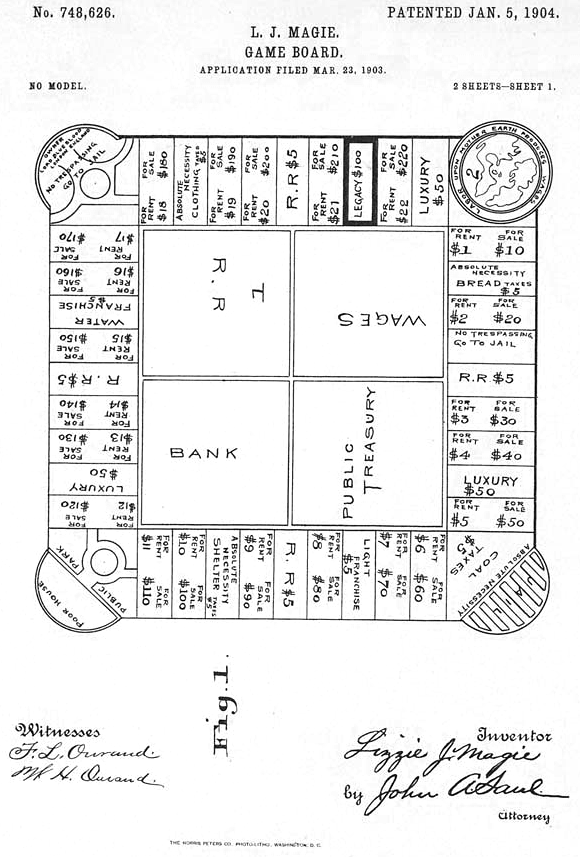
Among his followers was a woman named Elizabeth Magie. She believed that George’s land value tax plan was the solution to economic woes, and she wanted to bring this idea to as many people as she could. To do this, she developed The Landlord’s Game. This board game intended to demonstrate the horrors of land accumulation and rent, and to illustrate the benefit of George’s Single Tax Plan.

The original game, patented in 1904, closely resembles the modern game of Monopoly, that would later evolve out of it. Players started in a square that said “Labor Upon Mother Earth Produces Wages.” As the original rules state, “Each time a player goes around the board he is supposed to have performed so much labor upon Mother Earth, for which after passing the beginning-point he receives his wages, one hundred dollars, and is checked upon the tally-sheet as having been around once.”

Most of the squares look at least somewhat familiar. Many gave sale prices and rent costs, not unlike modern monopoly. This was explicitly meant to illustrate the belief that land rent transactions were involuntary, a notion that Benjamin Powell has already addressed. The railroads are also present, representing “transportation, and when a player stops upon one of these spaces he must pay five dollars to the ‘R.R.’” Less familiar squares demonstrated the horrors of private property rights by saying “No Trespassing. Go to Jail” from which the more ambiguous “Go Directly to Jail” corner would evolve in the modern game.

cal2

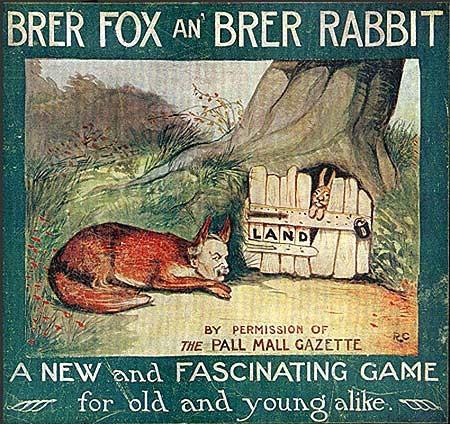
In 1913, a version of the game was picked up in Britain called Brer Fox an’ Brer Rabbit, taking the name from the African fables of Brother Fox and Brother Rabbit (the native language of African slaves lacked the diphthong syllable, so the word “brother” was pronounced “br’er” when told in English). In this, the clever Br’er Rabbit represented the wily landowner earning his immoral rents. The pesky Br’er Fox was meant to represent British reform leader David Lloyd George, who was of no relation to Henry George but was a strong supporter of his land value tax. In 1909, Lloyd George came up with the “People’s Budget” which instituted a version of Henry George’s land tax and planted the seeds for the British welfare state. His face is imposed on the figure of Br’er Fox on the original cover for the British game.

cal3

This version of the game was actually used to educate students about Henry George’s ideas in places like the University of Pennsylvania and Columbia. The Landlord’s Game and its British variant attempted to teach people the socialistic concepts that wages come from land, private property in land was immoral and destructive, and the economy is a zero-sum environment. The game evolved over time into the modern version Monopoly, whose invention is falsely credited to Charles Darrow.

Today, of course, the specifically Georgist elements have been removed from the game. There are no longer any “No Trespassing” squares, and what once was known as “The Poor House” where bankrupt players were forced to go upon running out of money is now the “Free Parking” square. The several “Absolute Necessity Taxes” across the board (perhaps the one aspect of the game’s educational commentary that libertarians could agree with) have been reduced to the Luxury and Income Tax squares. And of course, the unambiguously socialistic “Mother Earth” starting square became simply “Go.” Nonetheless, the modern variant retains the zero-sum myths of monopoly land accumulation, and in this, the legacy of Henry George is retained. If you’ve ever finished a game of monopoly with a frustrated player overturning the board and scattering the pieces, then it’s possible that Lizzie Magie accomplished her original goal.

Chris Calton is a Mises University alumnus and an economic historian. See his YouTube channel here.

This article was published on Mises.org and may be freely distributed, subject to a Creative Commons Attribution United States License, which requires that credit be given to the author.

Why Was Coffee Drinking Once Scandalous? – Article by Jeffrey A. Tucker

Why Was Coffee Drinking Once Scandalous? – Article by Jeffrey A. Tucker

The New Renaissance Hat
Jeffrey Tucker
******************************

In 18th-century Europe, many products and services reached a newly emergent middle class for the first time in human history. The capitalist age was maturing, and that meant that average people had money for the first time and lots of choices on how to spend it. One of the new products they could buy was coffee. With that came a great deal of social suspicion and even dread.

None other than Johann Sebastian Bach satirized the puritanical fear of coffee in his delightful and witty “Coffee Cantata.” It was one of the few times he ever tried his hand at pure pop entertainment. Of course he succeeded brilliantly; he was Bach after all!

The “Coffee Cantata” tells the story of a daughter who scandalized her father due to her devotion to coffee. She couldn’t stop singing about how wonderful it is, while her father corrected her constantly.

“You naughty child, you wild girl, ah!” the father yells at his daughter. “When will I achieve my goal: get rid of the coffee for my sake!”

“Father sir, but do not be so harsh!” she responds. “If I couldn’t, three times a day, be allowed to drink my little cup of coffee, in my anguish I will turn into a shriveled-up roast goat.”

She happily agrees to do everything he says in every area of life except one: she will not give up coffee.

And then follows a beautiful tribute to coffee: “How sweet coffee tastes, more delicious than a thousand kisses, milder than muscatel wine. Coffee, I have to have coffee, and, if someone wants to pamper me, ah, then bring me coffee as a gift!”

The father threatens her: “If you don’t give up coffee for me, you won’t go to any wedding parties, or even go out for walks.”

She still refuses.

Then the daughter plays a little game. She has a husband in mind and extracts from him a promise that if she marries him, he must allow her to drink coffee. He agrees. Then she goes to her father, who opposes the marriage, and makes a deal: if she is permitted to marry him, she will give up coffee. The father is delighted, and agrees.

Thus does the daughter gain a new husband, and, much more importantly, a permanent right to drink coffee whenever she wants!

What was this fear of coffee? Why was this such a big deal? It does have some narcotic properties to it, as we all know so well. It can give you a delightful lift.

But that alone does not account for the early opprobrium with which coffee-drinking, particularly for young girls, was greeted. For a fuller account, we need to understand something larger and more socially transformative: the advent of the coffee house itself.

The coffee house was one of the earliest public institutions, operating on a purely commercial basis, that brought a wide variety of social classes, not to mention a mixture between men and women, in a market-based social setting. In the 18th century, coffee houses spread all over Europe and the UK, attracting young people who would sit and drink together and discuss politics, religion, and business, and exchange any manner of ideas.

What the father in the Cantata is actually objecting to is not coffee as such but unapproved, unchaperoned social wanderings.

The Loss of Control

This was a huge departure from the tradition that entitled parents and other social authorities, including governments, to determine what kind of associations their children would have. Coffee houses introduced a kind of anarchy to the social structure, and introduced new risks of randomized contact with ideas and people that parents could no longer control. Coffee represented freedom itself – the freedom to mix, mingle, and consume what one wanted.

Indeed, coffee houses became a great source of public controversy. In England, in the 17th Century, Charles II tried to ban them all on grounds that they were “places where the disaffected met, and spread scandalous reports concerning the conduct of His Majesty and his Ministers.” Even a century later, women were banned from attending them, and this was true in France as well. Germany had more liberal laws concerning women and coffee but public suspicion was still high, as the “Coffee Cantata” suggests.

houghton_ec65a100674w_-_womens_petition_against_coffee

Women who were banned from coffee houses developed a very clever response. In the famous “Women’s Petition Against Coffee” of 1674, women said that coffee was responsible for the “enfeeblement” of men. Historians say the campaign contributed to the gender integration of coffee houses.

We see, then, that the commercial availability of coffee actually contributed to the advance of women’s rights!

Looking back at the astonishing success of Starbucks in our own time, it doesn’t seem surprising. They too serve as gathering spots, social mixers, places of business, and centers of conversation and ideas. We are more accustomed to it now than centuries ago, and yet even today, how much political controversy is engendered by access to products and services of which social authorities disapprove?

War on pot anyone?

As the “Coffee Cantata” concludes:

Cats do not give up mousing,
girls remain coffee-sisters.
The mother adores her coffee-habit,
and grandma also drank it,
so who can blame the daughters!


Jeffrey Tucker


Jeffrey Tucker

Jeffrey Tucker is Director of Content for the Foundation for Economic Education and CLO of the startup Liberty.me. Author of five books, and many thousands of articles, he speaks at FEE summer seminars and other events. His latest book is Bit by Bit: How P2P Is Freeing the World.  Follow on Twitter and Like on Facebook. Email

This article was originally published on FEE.org. Read the original article.

For the Separation of Stadium and State – Article by David R. Henderson

For the Separation of Stadium and State – Article by David R. Henderson

The New Renaissance HatDavid R. Henderson
******************************

The title of this post is the same as the title of an article by Jonah Goldberg about the Colin Kaepernick incident. (If you haven’t been paying attention to the NFL lately, here’s the summary: Kaepernick is a San Francisco 49er who refused, and still refuses, to stand for the U.S. national anthem.)

I had been pondering writing a similar piece myself. And then I saw his title. Darn, I thought, Goldberg has beat me to it.

Except that he didn’t.

Goldberg’s article is all about his narrow way of keeping politics out of sports: players should stand for the national anthem. Some people would see this as a way of inserting politics into sports.

That means that people who don’t like what Kaepernick did are being forced to pay for the very property on which he did it.

But how would you keep politics out of sports in a fundamental way? It would be by not forcing people to pay for sports.

You don’t have to know a lot about the 49ers or the NFL to know that local governments tax their residents and others heavily to pay for luxurious stadiums.

That means that people who don’t like what Kaepernick did are being forced to pay for the very property on which he did it. On the other hand, it also means that people who don’t like the flag-waving that goes on at NFL games are also forced to pay for the property on which that occurs.

There’s a simple solution here: actually separate sports and state. That is, quit forcing taxpayers to pay for sports.

Now that’s a solution that I will salute.


david-r-henderson
David R. Henderson

David Henderson is a research fellow with the Hoover Institution and an economics professor at the Graduate School of Business and Public Policy, Naval Postgraduate School, Monterey, California. He is editor of The Concise Encyclopedia of Economics (Liberty Fund) and blogs at econlib.org.

This article was originally published on FEE.org. Read the original article.

A Totalitarian State Can Only Rule a Desperately Poor Society – Article by Ryan Miller

A Totalitarian State Can Only Rule a Desperately Poor Society – Article by Ryan Miller

The New Renaissance HatRyan Miller
******************************

I recently finished Anthem by Ayn Rand. In this short novella she tells the story of Equality 7-2521 (later called Prometheus), a man living in a dystopian collectivist society which has eclipsed the individual to such a degree that words such as “I” and “my” no longer even exist. The story is about Prometheus’ discovery of himself as an individual and of the world as it was before.

In this society babies are taken immediately from their “parents”, who were assigned to one another by the Council of Eugenics for the sole purpose of breeding, raised in the Home of Infants and then in the Home of Students, and then finally assigned their life-long profession at the age of 15 by the Council of Vocations. Everything is done for the supposed benefit of your brothers, preference is not allowed, superior ability is not allowed, and back-breaking toil is praised as such and not as a way to improve your own or humanity’s situation.

Dictatorship Means Poverty

But what is striking about this story is how accurately it portrays how the world would look under such life-throttling conditions. The Home of the Scholars is praised for having only recently (100 years ago) (re)invented marvels such as candles and glass. Since the times before the “Great Rebirth” and the discovery of the “Great Truth”—namely, “that all men are one and there is no will save the will of all men together”—humanity has, in reality, lost the progress of thousands of years and has reverted back to a time before even such basic utilities as oil lamps or clocks.

But Ayn Rand’s genius is that this is exactly what would happen to the world should it ever discover and truly act upon this “Great Truth.” Yet this is not typically how dystopian stories portray this type of society. Stories such as Brave New World1984The GiverDivergentEquilibrium, and many others, all love to show some type of ultra-technologically-advanced world in the backdrop of total or near total oppression, suppression of the individual, and enforcement of conformity.

Despite the almost total (and often drug-induced) destruction of individual will, drive, and creativity, these societies have reached unprecedented levels of technological competence. This is especially true when one considers when many of these stories were written.

In Brave New World, written in 1931, everyone has a personal helicopter, science has advanced to such a degree that mothers and fathers are no longer necessary parts of the breeding process, and everyone is kept docile and happy by the apparently side-effect lacking drug Soma.

In 1984 (published in 1949) there are two way telescreens, miniscule microphones and cameras, and speak/writes which turn whatever you say into text. In the other stories technology is advanced enough to, among other things, control weather (The Giver), give kids serum-induced psychological aptitude tests (Divergent), and to completely suppress emotions (Equilibrium). In addition to these there are countless other inventions or practices in these stories and the many others of the dystopian future genre.

Invention Requires Freedom

The question that needs to be asked, however, is who invented all these things? These marvel feats, which in the stories are often used for the end of some malevolent goal, are really all potentially awesome, or at least highly complex and complicated, inventions or innovations. Their conception and ultimate realization would have required years of thought, testing, failure, tinkering, and then success—things which all require individual ingenuity, creativity, and the incentives arising from the prospect of individual pride and gain.

Every great break-through in history was achieved by some odd-ball going against the grain or traditionally accepted view of things in their particular field. If they had done things the way people had always done them, they would never have had the ability to think outside the box and discover or create a unique solution to the problem at hand. Inventors and innovators need their quirkiness, eccentricity, social awkwardness, or will and ability to stand up to the existing order. And they need that coupled with the idea that they have something to gain.

But all of these stories, to different degrees, have built societies that destroy our differences, our emotions, our passions, our ability to think differently, and our incentives to create if were even able to.

So where do these advanced societies come from? Sure they could drink from the well of wealth created by the society that may have preceded it, but only for a while. It would eventually dry up. And without new generations of ambitious and intelligent dreamers, tinkerers, outside-the-boxers, there would be no one around to rebuild the wealth. This is the world that Ayn Rand creates in Anthem. The hopeless world without individuals.

The existence of advanced societies in many dystopian stories is reminiscent of the problem with the thinking in our world today and in the past: the thinking that things “just happen”—that innovation, invention, and progress are phenomena which occur naturally, regardless of conditions. Though the worlds portrayed in these other novels are far from desirable, the progress alone that the societies in them have reached is a reflection of this idea that most people, at least passively or unknowingly, buy into.

In reality the world would look much more like that of Anthem.


ryan_miller

Ryan Miller is a University of Michigan graduate, freelance translator, and aspiring blogger. He is also a Praxis participant in the September 2016 cohort.

This article was originally published on FEE.org. Read the original article.

Don’t Lose Friendships Over Politics – Article by Jeffrey A. Tucker

Don’t Lose Friendships Over Politics – Article by Jeffrey A. Tucker

The New Renaissance HatJeffrey A. Tucker
******************************

Has election season always been this rough on friendships?

So many people I know are getting into Facebook fights, Twitter wars, Instagram arguments, and Snapchat squabbles. What begins as an ideological dispute ends in bitterness. People are provoking others, demanding those who do or don’t support their candidate leave their networks, cutting ties with friends and family, and all because of political differences.

I can’t even imagine what the Thanksgiving table will be like this year!

People perceive the stakes this year to be that high. To be sure, political philosophy does matter and does carry high stakes. However, the partisan struggle for the control of the state apparatus by this or that temporary manager doesn’t matter as much as election season seems to suggest. You might be being manipulated, and friendships and families are actually too precious to throw away for transient reasons.

It’s a pity to cause permanent rifts, and so unnecessary. The people who rearrange their personal relationships for the election imagine that they are taking control of their lives. They don’t seem to realize that they are actually letting strangers control their lives – strangers who care nothing for them in a system that actually seeks to divide people so it can conquer them. To permit politics to fundamentally alter something so important as friendship is to give politicians more importance than they deserve.

Trolling and Banning

Now, of course there is a proviso here. If there is someone in your network who is deliberately trolling you, harassing you, and goading you to respond, the best possible response is to block them. Not talk back. Not engage in a tit for tat. Just quietly block, without drama or announcement, much less denunciation.

Most public people I know have blocked as many as one hundred plus people over the past year, simply because this election season has been so contentious, with the alt-right and alt-left (who oddly agree on so much) battling it out on social media. Blocking is the far better path than engaging them. Vicious back and forths on the Internet can be life-consuming and draining. People who are trying to do that to you deserve exclusion from your conversation circle.

Apart from these cases, it strikes me as pointless to hurl someone out of your life because of political differences.

First, by denying yourself access to different points of view, you risk isolating yourself from a critic who might teach you something you need to know, maybe about anything in life, but maybe even about politics.

Second, talking to people with different opinions keeps you making sense and speaking in a civil way, addressing others in a way that could persuade them.

Third, and most critically, to isolate yourself, hate others for their views, and regard people with different points of view as less deserving of dignified treatment, plays into exactly what the political system wants for you to do.

But Aren’t They Aggressors?

A counter to my point was offered by a friend of mine last year. Speaking as a libertarian, he said, he regards anyone who supports some government action – even just casually and without much thought – as wittingly or unwittingly contributing to an opinion culture that supports rising political violence. The only friends he believes deserve the time of day from him must hold steadfastly to his voluntarist perspective, else he regards them as a direct threat to his life and liberty.

Now, this strikes me as vastly too severe. The truth is that most people who support some government action do not regard themselves as violent people. They believe that they are favoring something that is good for others, perhaps fostering the better life for the community.

For example, if a person favors higher spending on public education, they believe that they are pushing for policies that are good for others, not calling for violence against taxpayers to support unworkable programs. How can you possibly persuade them otherwise if you cut off all ties?

And it’s not just libertarians who can be this way. A good friend of mine was a casual lefty and, like most from his tribe, he was dead serious about the issue of climate change. I had no idea until the subject came up over coffee. I expressed some doubt that the science was truly settled concerning all causes and effects, solutions, costs and benefits, and so on. I was actually very measured in my comments, but somehow they caused him to blow up, call me a science-denying, tin-foil-hat-wearing capitalist apologist, and then actually leave the conversation. And that was it.

I was stunned. I was merely disagreeing with him, however cautiously. But somehow, he had come to believe that anyone who disagreed with him bears some responsibility for the rising sea levels, the melting of the polar ice caps, and the gradual disintegration of the planet, even though I’ve written very little on the topic at all.

He was letting politics control his life and even determine his friendships. Both of us are spiritually poorer as a result of this friendship loss.

And consider the toxic effect the rising politics of personal identity – on the left and the right – are having on the ability of people to find value in each other. Imagine how you would make me feel if you believed my whiteness represents a continuing stain on the world order. There is no chance for any kind of engagement; after all, I cannot change my race. Or what if I believe your blackness or gayness or atheism or whatever is leading to demographic or cultural destruction – how can we possibly be civil to each other? The politics of identity is causing precisely these sorts of irrational and pointless splits among us.

What Is the Point of Friendship?

What the libertarian and the lefty I mentioned above do not realize is that they are guilty of the same error of allowing politics to invade the conduct of their lives and determine the conditions of their personal happiness. Once this kind of thing starts, there is truly no end to it.

Must everyone agree with you on every jot and tittle of your ideology to be your friend? Must there be zero tolerance for even the slightest difference in outlook, priority, application, and goal of your particular political outlook? In other words, must all your friends believe exactly as you believe?

If this is your perspective, you might consider: there is not much point to being friends and engaging in conversation with someone who has the exact same view on all things that you have. It seems rather boring. Might as well stay home and reflect on your own infallibility.

I like to think of friendship much the way we think of economic exchange. In economics, goods and services do not exchange in the presence of perfect sameness. They exchange because each party to the exchange believes himself or herself will be better off than he or she was before the exchange. It is only in the presence of unequal expectations that exchange becomes mutually rewarding.

It is the same with friendship. We need to hear different points of view. We need the insights of others. Even if we don’t accept them in total, we can still hope to understand people and the world better by considering what others have to say – with sincerity, warmth, and honesty. In other words, friendships like this help us have an open mind and keep us all humble and teachable.

Candidates Will Betray You

Neither is it a good idea to give up a friendship based on loyalty to a particular candidate. The top two contenders for the presidency have held many different and conflicting views on a huge range of political issues, from taxation to immigration to war. These people are wired to be adaptable based on the polls. To follow one or the other all the way to the point that it affects your associations is to risk compromising your own intellectual integrity.

Neither is worth that.

One of the great tragedies of politics is that it can take people who in real life would be peaceful and loyal and loving friends and turn them into bitter enemies. I’m always struck by this when I see a political rally, with face offs between backers and protesters. What exactly is gained by this? If you put these same people in a shopping mall or movie theater or restaurant, they would have every reason to get along and no reason to be screaming obscenities at each other.

We should hold on to that realization. Each of us is a human being with feelings, hopes, dreams, and a vision of a life well-lived – every single person, regardless of race, religion, gender identity, or ideology. Politics should change nothing about that.

If we long for a better world of mutual understanding and peace, one way to help achieve it is to live as if it already exists. Above all, that means never letting politics get in the way of rewarding human relationships.

Jeffrey Tucker

Jeffrey Tucker

Jeffrey Tucker is Director of Content for the Foundation for Economic Education and CLO of the startup Liberty.me. Author of five books, and many thousands of articles, he speaks at FEE summer seminars and other events. His latest book is Bit by Bit: How P2P Is Freeing the World.  Follow on Twitter and Like on Facebook. Email

This article was originally published on FEE.org. Read the original article.

The Rational Argumentator’s Fourteenth Anniversary Manifesto: Who Is the Western Man?

The Rational Argumentator’s Fourteenth Anniversary Manifesto: Who Is the Western Man?

The New Renaissance Hat
G. Stolyarov II
August 31, 2016
******************************

Who Is the Western Man?

On the fourteenth anniversary of The Rational Argumentator, it is fitting to consider the tagline that has been featured on TRA since its founding: “A Journal for Western Man”. But who is this Western Man for whom The Rational Argumentator is intended? In 2002, the answer to that question seemed rather apparent for at least a substantial segment of then-prevalent libertarian, conservative, and Objectivist thinkers who, each in their own way, understood the Western Man to stand for the general cultural ideals and noblest aspirations of Western civilization.

Unfortunately, the decade of the 2010s and the past two years especially have seen the rise of a noxious and fundamentally anti-Western, anti-modern, and anti-civilization movement known as the “alt-right”, which has attempted to appropriate the rhetoric of Western culture and even of the Renaissance for itself. The Rational Argumentator will not allow this appropriation to remain unchallenged. TRA stands resolutely in opposition to all forms of bigotry, racism, nativism, misogyny, and any other circumstantially rooted intolerance – all of which are contrary to the ideals of high Western civilization. But at the same time, The Rational Argumentator also cannot cave to the “social justice” campus activism of the far Left, which would have even the very identification of Western culture and civilization banished, lest it offend the ever-more-delicate sensibilities of firebrand youths who resolutely refuse to let knowledge of the external world get in the way of their “feelings” and subjective experiences. TRA will not abandon the Western Man, but will continue to explain what it is that the Western Man represents and why these principles are more important and enduring than any tumultuous, ephemeral, and most likely futile and self-defeating activist movements of our era.

So who is the Western Man? It is a not a particular man from the West. It is not a descriptor limited to a particular subset of individuals based on their birth, skin color, national origin, or even gender. Indeed, my original intent behind the “Western Man” descriptor was specifically to salvage the generic term “man” – meaning an archetypical representative of humankind – from any suggestions that it must necessarily be gender-specific. This subtitle was meant transparently to imply, “Of course, ‘Western Man’ includes women, too!”  Some of the greatest and most courageous Western Men – from Hypatia of Alexandria to Mary Wollstonecraft to Ayn Rand to Ayaan Hirsi Ali – have been women.

A Western Man can have been born anywhere, have any physical features, any age, any gender (or lack of gender identity), any sexual preferences (or lack thereof), any religion (or lack thereof) – as long as he/she/it is a thinking being who accepts the valuable contributions of Western culture and civilization and seeks to build upon them. If self-aware, rational artificial intelligences are developed in the future, or if an intelligent alien species comes into contact with us, these beings could potentially be Western Men as well.

A Western Man will respect and seek to learn from the great philosophy, literature, art, music, natural and social sciences, mathematics, and political theory that flourished in Western societies throughout the past three millennia – although by no means is a Western man required to focus exclusively on ideas that originated in the West. Indeed, Western culture itself has unceasingly interacted with and absorbed the intellectual contributions of Egyptian, Mesopotamian, Arabic, Persian, Indian, Chinese, Korean, and Japanese thinkers and creators – to provide just a few examples. Likewise, a great deal of hope for the future of Western civilization can be found among entrepreneurs in Asia, Africa, and Latin America who have endeavored, with notable success, to spread the technologies of the digital age, construct great buildings, and lift billions of people out of abject poverty and into humane and respectable living standards accompanied by ever-increasing longevity.

A Western Man is someone who embraces the ideal of cosmopolitan universalism – a rejection of circumstantially defined tribalism, of the casting of people as “one of us” or “the other” based on attributes that they did not choose. This cosmopolitan universalism is the product of both a long-evolving philosophical framework and the material abundance that enabled the broadening of what Adam Smith termed our circles of sympathy to encompass ever more people.

The edifice of Western philosophical thought has been built upon by thinkers since the times of Thales, Socrates, and Aristotle – but its greatest intellectual breakthroughs were made during the 18th-century Age of Enlightenment. The Western Men who embraced these ideals were often personally flawed; they were men of their time and constrained by the practical realities and social mores that surrounded them. Some Western Men throughout history have, unfortunately, owned slaves, respected individual liberty only in some instances, or been improperly prejudiced against broad groups of people due to ignorance or gaps in the consistent application of their principles. Nonetheless, the legacy of their work – the notions of universal, inalienable individual rights and the preciousness of each person’s liberty and humanity – has been indispensable for later accomplishments, such as the abolition of slavery, women’s suffrage and liberation, civil and privacy rights, cultural and legal acceptance of homosexuality, and recognition of individual rights for members of religious minorities, atheists, and children. If we are able to see farther and know better than to repeat some of the moral errors of the past, it is because, to paraphrase Sir Isaac Newton, we stand on the shoulders of intellectual giants who paved the way for our embrace of the aforementioned great cultural achievements.

The ideals of peaceful commerce and cultural exchange – indeed, cultural appropriation (in an educated, informed, and deliberate manner) of the best elements of every time, place, and way of life – have resulted in a dramatic reduction in warfare, a general decline in nationalistic and tribal hatreds, and a widespread understanding of the essential humanity of our fellows in all parts of the world. Were it not for the intellectual achievements of Western civilization and the global commercial and industrial networks to which it gave rise, humankind would still be embroiled in a bitter, Hobbesian war of all against all. A Western Man is anyone who gives the essential achievements of modernity their well-deserved recognition and admiration, and who studies and offers justified respect to the forebears and authors of these achievements. A Western Man is also anyone who seeks to build upon these accomplishments and add his, her, or its distinctive bricks to the edifice of human progress.

A Western Man is not a fanatic or a bully, and sees fanatics and bullies as the threats to civilization that they are. A Western Man does not use ideology to stifle peaceful expression or compel others to dutifully “know their place” within some would-be totalitarian static social order. A Western Man knows that some people will disagree with him, her, or it, and they have the right to disagree peacefully. However, they do not have the right to be protected from attempts at persuasion or the presentation of diverse and possibly contrary views.

A Western Man embraces reason as the way to discover more about the external world and about human beings. Reason is not the exclusive province of any subset of people; anyone is capable of it, but it takes training and effort – and great respect for the intellect – to utilize consistently and properly. From reason stem the empirical scientific method, the deductive processes of formal logic and mathematics, and the application of empirical and logical truths to the development of technology which improves the human condition. A Western Man does not vilify technology, but rather sees it as a key driver of human progress and an enabler of moral growth by giving people the time and space which prosperity affords, making possible contemplation of better ways of living and relating to others – a prerogative only available to those liberated from hand-to-mouth subsistence.

The ideal of the Western Man is to maintain the great things which have already been brought into this world, and to create new achievements that further improve human life. There is thus both a conservative and a progressive motive within the Western Man, and they must combine to sustain a rich and vital civilization. A Western Man can go by labels such as “liberal”, “conservative”, “libertarian”, “progressive”, or “apolitical” – as long as they are accompanied by careful thought, study, discernment, work ethic, and an earnest desire to build what is good instead of, out of rage or spite, tearing down whatever exists. Conservation of great achievements and progress in creating new achievements are not antagonists, but rather part of the same essential mode of functioning of the Western Man – transcending petty and often false political antagonisms which needlessly create acrimony among people who should all be working to take civilization to the next level.

The next level of civilization – the unceasing expansion of human potential – is the preoccupation of the Western Man. This – not descending into contrived identitarian antagonisms – is the great project of our era. Building on the philosophical groundwork laid by Enlightenment humanism and its derivatives, a Western Man can explore the next stage of intellectual evolution – that of transhumanism, which promises to liberate humankind from its age-old shackles of death, disease, severe scarcity, Earth-boundedness, and internecine conflict.

Who is the Western Man? If you accept the challenge and the honor of supporting and building upon the great civilization which offers us unparalleled opportunities to create a glorious future for all – then the Western Man can be you.

TRA Statistics and Achievements During Its Fourteenth Year

TRA published 211 regular features during its fourteenth year, a rate of publication comparable to that of the eleventh and thirteenth years, while remaining below the extremely active tenth and twelfth years, as shown in the table below:

TRA Year Regular Features Published Page Views in Year
10th 306 1,302,774
11th 208 1,077,192
12th 314 1,430,226
13th 228 892,082
14th 211 823,968

With slightly less content published during the fourteenth year, and a similar average number of page views per published feature (3,905.06 in the fourteenth year versus 3,912.64 in the thirteenth year), it could be expected that total page views would decline slightly. While TRA did not reach the milestone of 10,000,000 cumulative page views during its fourteenth year, it did come the overwhelming majority of the way toward it. Total lifetime TRA visitation currently stands at 9,892,636 page views. However, I am confident that the 10-million page-view threshold will be exceeded within the next two months.

I have reason to expect that publication activity will again accelerate during TRA’s fifteenth year, although this may not occur immediately. Over the past year, I have been occupied with satisfying some of the last remaining requirements of my actuarial studies, and their successful completion is in sight. In the meantime, I collaborated with ACTEX Publications to produce a major 400-page commercial study guide, Practice Problems in Advanced Topics in General Insurance, for SOA Exam GIADV.

Several large-scale endeavors within the transhumanist and life-extensionist movements were pursued over the past year. TRA’s anniversary (August 31) coincides with the date of formation of the Nevada Transhumanist Party, a non-election-oriented, non-donation-accepting, policy-oriented party that advocates for the widespread adoption of emerging technologies, individual liberty, and the pursuit of indefinite life extension. The Nevada Transhumanist Party has grown to 107 members during its first year and has been a forum for numerous thought-provoking discussions. Nevada Transhumanist Party activities have occurred online via its Facebook page and its hosted video panels, such as the Panel Discussion on Hereditary Religion, a conversation among Transhumanist Libertarians and Socialists, and the panel for International Longevity Day, in collaboration with MILE – the Movement for Indefinite Life Extension – entitled “How Can Life Extension Become as Popular as the War on Cancer?” In-person activities of the Nevada Transhumanist Party included attendance at a university political lecture, a local Libertarian candidate’s campaign event, and RAAD Fest, the largest in-person gathering of life-extension supporters to date, where I personally met and spoke with such luminaries of the life-extension movement as Aubrey de Grey, Bill Andrews, and Zoltan Istvan.

Gradual but fundamental shifts are occurring that will contribute to more frequent and impactful activity on The Rational Argumentator’s pages during its fifteenth year. As the overview of the Western Man in this manifesto indicates, the importance of TRA’s work and ideals remains paramount. TRA will remain a bulwark of thoughtful consistency in an era where it seems entire societies have become unmoored from core principles that are integral to a successful civilization. We will steadfastly champion the virtues of reason and deliberation, discussion and civil debate, individualism and classical liberal tolerance, creation and maintenance. Even when the tumult of current events calls into question the foundations of civilized life, TRA will be here to reaffirm and uphold them.

This essay may be freely reproduced using the Creative Commons Attribution Share-Alike International 4.0 License, which requires that credit be given to the author, G. Stolyarov II. Find out about Mr. Stolyarov here.

Bring Back Classical Feminism – Article by Eileen L. Wittig

Bring Back Classical Feminism – Article by Eileen L. Wittig

The New Renaissance HatEileen L. Wittig
******************************

As a college-educated, employed young woman with Opinions, my conversations and social media posts should be filled with angry tirades against The Oppressive Male and strong words demanding Women’s Rights, preferably at the expense of Men’s Rights. Right?

How sexist of you to assume so. Or it would be, if third-wave feminism hadn’t declared that anyone without those opinions is himself (or herself, to be fair) sexist.

Flipping the Tables

Feminism, as with all movements, has become more and more radical with each wave. Members see themselves go from -5 to 0 to break even, and they decide they want to try to get to +5. Sometimes this escalation is good; or, at least, not harmful. But when it progresses to the point where it commits all the wrongdoings it was originally meant to protest, it becomes a problem.

Feminism has gone from being a movement for equality, to a movement for supremacy. What was feminism, originally? It was a movement that advanced “the radical notion that women are people”: individuals just as deserving of life, liberty, and property as men.

What does feminism mean, now? It is a movement that advocates the radical notion that men are lesser than women as people; that men are less deserving of life, liberty, and property than women; that they are entitled to things just for being women; that one sex is better than the other, just ‘cause. It has gone from being a movement for equality, to a movement for supremacy.

This is stupid.

It seems counterintuitive that I, a woman, who would profit from this inequality, thinks that this is stupid. But I don’t profit. No one does. Moreover, it makes my life complicated, and the whole thing is insulting.

The Modern Manifestations

According to third-wave feminism, I should want to be paid more for simply being a woman; possibly to make up for the many years that women were paid less than men as a matter of course. But the whole idea of being given a raise or promotion based on gender is insulting to my abilities as a person (yes, and as a woman).

I do not need to be given that promotion thanks to something I can’t even help. I can earn it, thank you very much. My brain is more than capable; I don’t need the physical attributes of my double-X chromosomes to do it for me.

Third-wave feminists intimidate me. Just as men do, I get a little nervous when a woman emphatically identifies herself as a feminist to me. I spend the rest of the time waiting to be accused of hating my sex, being a barnacle on the wheel of progress, and just generally being a horrible example of womanhood.

I’m a feminist, but I’m a “classical feminist” – I am all for voting rights and equal pay and the cultural destruction of everyday sexism. I get mad when a man praises me in a voice dripping with patronage, all but resisting the urge to vocalize the implied clause, “…for a girl.”

I’m tired of the double standard we have for sexual promiscuity, one that blames and even attacks women while men are excused for “just being men.” But don’t lower your expectations for me to the standards for men – raise theirs to mine!

I ardently want real equality between the sexes. But to third-wavers, that often does not make me feminist enough.

Third-wave feminists intimidate men, too. That’s the point. But then what happens? Men stop stepping up. They back off, they stop trying, they become enfeebled. Suddenly humanity’s “other half” becomes less productive, less interesting, and more pathetic. Women, feminists included, then have to contribute much more heavily to the economy and society to support the weaker, less productive half they created. They would hate that. So would I.

Men descending to a lower level does not raise women to a higher one: quite the opposite.

Third-wave feminism says I should hate men. I’m supposed to think they’re big, stupid oafs. I don’t. I think men are wonderful. I have a lot of close male friends who I would trust with my life if I had to. I don’t understand them all the time, but I don’t understand women all the time either. I don’t even understand myself all the time. But I don’t hate myself.

Peaceful Feminism

As Ludwig von Mises said in 1922, when my classical feminist forbears were paving the way for their radical followers, “So far as Feminism seeks to adjust the legal position of woman to that of man, so far as it seeks to offer her legal and economic freedom to develop and act in accordance with her inclinations, desires, and economic circumstances – so far it is nothing more than a branch of the great liberal movement, which advocates peaceful and free evolution.”

Fighting for women’s equality is a wonderful thing. But it only works if it’s fighting for equality, not total dominance, to the detriment of everyone else, without earning it. It’s a fine line that needs to be walked in every aspect of life. We need to get used to doing it, but it is possible.

Eileen_WittigEileen L. Wittig

Eileen Wittig is the Associate Editor at the Foundation for Economic Education.

This article was originally published on FEE.org. Read the original article.