Browsed by
Category: Economics

World’s Poor: “We Want Capitalism” – Post-Colonial Capitalism at the Bottom of the Pyramid – Article by Iain Murray

World’s Poor: “We Want Capitalism” – Post-Colonial Capitalism at the Bottom of the Pyramid – Article by Iain Murray

The New Renaissance Hat
Iain Murray
August 31, 2015
******************************

In the forests of India, something exciting is going on. Villagers are regaining property taken from them when the British colonial authorities nationalized their forests. Just as exciting, in urban Kenya and elsewhere, people are doing away with the need for banks by exchanging and saving their money digitally. All over the world, poor people are discovering the blessings of bottom-up capitalism.

Sadly, though, developed country governments and anti-poverty activists ignore this fact and insist that developing nations need a paternalistic hand up. Both are missing an opportunity, because there are billions of capitalists in waiting at the bottom of the pyramid.

Next month, the United Nations will formally announce the successors to its Millennium Development Goals, the global body’s approach to poverty alleviation since the year 2000. These new goals will be touted as “sustainable.” The event will coincide with a visit by the pope, at which he is expected to concentrate on climate change and materialism as the greatest threats to the welfare of the people of the developing world.

Don’t expect to hear much on the way people in the Western world lifted themselves out of poverty: free-market capitalism.

The phrase “the fortune at the bottom of the pyramid” was coined by the late C.K. Prahalad, building on the work of Nobel laureate Amartya Sen. In his groundbreaking 1999 work, Development as Freedom, Sen pointed out that one of the most important aspects of development is freedom of opportunity, a vital part of which is access to capital and credit. Capital and credit, however, appear nowhere in the draft UN goals.

When capital is sufficiently available, would-be entrepreneurs at the bottom of the pyramid have demonstrated a willingness to launch new ventures and invest in their futures — that is, to embrace free-market capitalism to the benefit of all concerned.

There are several ways to ensure access to capital in the developing world, but the most important approach is to unlock the productive potential of the capital already available there.

Land Titling

In many countries, people could possess access to capital by virtue of the real estate they already occupy, but they are unable to prove ownership of the land due to inadequate land-titling systems or because of traditional forms of property ownership where everything belongs to the village chief. As Hernando de Soto explained in his book, The Mystery of Capital, land-titling reforms significantly benefit the poor, enabling

such opportunities as access to credit, the establishment of systems of identification, the creation of systems for credit and insurance information, the provision for housing and infrastructure, the issue of shares, the mortgage of property and a host of other economic activities that drive a modern market economy.

De Soto estimates that up to $10 trillion of capital worldwide is locked away unused because of inadequate titling systems. A recent study by the Peru-based Institute for Liberal Democracy (ILD), which De Soto heads, estimated Egyptian workers’ real estate holdings to be worth around $360 billion, “eight times more than all the foreign direct investment in Egypt since Napoleon’s invasion.”

Similarly, many local assets around the world remain in common ownership — in reality, owned by no one. Initiatives such as India’s privatization of forest resources seek to address this problem by enabling the titling of assets by indigenous peoples, who can then tap into those resources for access to credit to open up new opportunities. Estimates suggest that similar initiatives could be extended to 900 million plots of land across the developing world.

There are also exciting opportunities that could arise for the public recording and utilization of such capital through the distributed public-ledger system known as the blockchain, best known for its role in the development of bitcoin. Development of the blockchain for property recording and titling would significantly reduce both the transaction costs and the widespread corruption  associated with government-controlled titling systems. Significantly, De Soto’s ILD is promoting these initiatives.

Microfinance

Recent innovations have enabled the development of microfinance — access to small amounts of credit for specific purposes. Today, microfinance institutions all over the developing world provide small loans, access to savings, and microinsurance to families or small businesses.

By giving them access to proper investment capital and affordable financial institutions, microfinance providers help small- and medium-sized enterprises in developing countries to grow. Often, these businesses are so small that they can neither afford the interest rates on bank loans nor come up with the capital they need on the their own. When implemented correctly, microfinance loans empower their customers to invest, grow, and be productive, all of which contribute to diminishing poverty within communities.

One of the most prominent examples of microfinance is Muhammad Yunus’s Grameen Bank, first established in Bangladesh. According to a RAND Corporation study, areas where Grameen Bank offers programs saw unemployment rates drop from 31 percent to 11 percent in their first year. Occupational mobility improved, with many people moving up from low-wage positions to more entrepreneurial ones. There is evidence of increased wage rates for local farmers. Women’s participation in income-generating activities also rose significantly.

The Consumers at the Bottom of the Pyramid

Access to capital and credit enable new markets to spring up where none existed before. Entrepreneurial activity is unleashed. Consider one of Prahalad’s case studies of Nirmal, a small Indian firm that sold detergent products designed for rural village uses, such as in rivers. The products came in small packages at low prices suitable for Indian villagers’ daily cash flow. The company soon found itself with a market share equal to that of consumer-goods giant Unilever’s Indian subsidiary. Unilever responded by introducing similar products, thereby growing this new market. In the process, more environmentally friendly products were invented and sold, too.

As Prahalad points out, over four billion people in the world lived on an annual income of $1,500 or less (in 2002 dollars), with one billion living on less than a dollar a day. Nevertheless, based on purchasing power parity, this market represents an economy of $13 trillion or more, not that far off from the entire developed world.

The underdeveloped world is ripe for capitalism. The “unemployed” protestors of the Arab Spring were, in fact, small businessmen who were pushed to the breaking point by continually having their capital and profits expropriated by corrupt government officials, as De Soto points out. So, while the Western media portrayed the protests as being mostly about politics and freedom of expression, they were as much — if not more — about the freedom to do business.

Kenya: Mobile Phones and Payments

Despite corruption and bureaucracy, strong markets have grown up in developing countries. Kenya is a case in point. It leapfrogged the Western world’s development process for mobile communications technology. Kenyans went from having few telephones to virtually everyone having a mobile phone without needing the stage of landline infrastructure in between. A similar process is now taking place in personal finance.

Vodafone, along with its Kenyan subsidiary, Safaricom, developed m-pesa, a mobile payment and value storage system to be used on its phones. Transactions are capped at about $500, but crucially can be person-to-person, acting as digitized cash. Introduced in 2007, it had 9 million users — 40 percent of Kenya’s population — just two years later. By 2013, 17 million Kenyans were using it, with transactions valued at over $24 billion — over half of Kenya’s GDP.

M-pesa has in turn improved access to capital even more, and technology businesses are thriving all over Kenya as a result.

Kenya is not alone. The phenomenon is spreading to other African countries and to some South American countries such as Paraguay.

Environment, education, and health all benefit from wealth creation. Perhaps the real mystery of capitalism is that neither the United Nations nor the pope recognize the benefits it can bring to four billion of the world’s poor. Free enterprise and human welfare boom where governments allow new markets with access to capital and credit. That is all it takes to meet the UN’s development goals.

Iain Murray is Vice President at the Competitive Enterprise Institute.

This article was published by The Foundation for Economic Education and may be freely distributed, subject to a Creative Commons Attribution 4.0 International License, which requires that credit be given to the author.

Bernie Is Wrong: Trade Is Awesome for the Poor and for America – Article by Corey Iacono

Bernie Is Wrong: Trade Is Awesome for the Poor and for America – Article by Corey Iacono

The New Renaissance HatCorey Iacono
August 28, 2015

******************************

The socialist senator is totally wrong about free trade

Sen. Bernie Sanders, the Democratic presidential hopeful, is no fan of free trade. In an interview with Vox, Sanders’ made his anti-trade position clear: “Unfettered free trade has been a disaster for the American people.”

He also noted that he voted against all the free trade agreements that were proposed during his time in Congress and that if elected President he would “radically transform trade policies” in favor of protectionism.

Sanders and his ilk accuse their intellectual opponents of promoting “trickle-down economics,” but that is precisely what he is advocating when it comes to trade. The argument for protectionism ultimately relies on the belief that protecting domestic corporations from foreign competition and keeping consumer prices high will somehow benefit society as whole.

However, the real effect of protectionism is to increase monopoly and consequently reduce overall economic welfare. In fact, according to a paper by economists at the Federal Reserve Bank of Minneapolis, “Government policies…such as tariffs and other forms of protection are an important source of monopoly” that lead to “significant welfare losses.”

In contrast to Sanders’ assertion that the expansion of free trade has been a disaster for the American people, there is a near unanimous consensus among economists that the opposite is true.

An IGM Poll of dozens of the most renowned academic economists found that, weighted for each respondent’s confidence in their answer, 96 percent of economists agreed, “Freer trade improves productive efficiency and offers consumers better choices, and in the long run these gains are much larger than any effects on employment.”

When the vast majority of economists of all sorts of ideological stripes agree that free trade is a good thing, maybe, just maybe, they’re onto something.

In fact, they surely are. Using four different methods, economists at the Petersen Institute for International Economics estimated the economic benefits from the expansion of technology that facilitates international trade (such as container ships), as well as the removal of government-imposed barriers to international trade (such as tariffs). Since the end of World War II, they generated “an increase in US income of roughly $1 trillion a year,” which translates into an increase in “annual income of about $10,000 per household.”

This result is mostly driven by the fact that foreign businesses produce many goods which are used in the production process at a lower cost than their domestic competitors. Access to these low-cost foreign inputs allows American businesses to decrease their production costs and consequently increase their total output, making the nation as a whole much wealthier than it otherwise would have been.

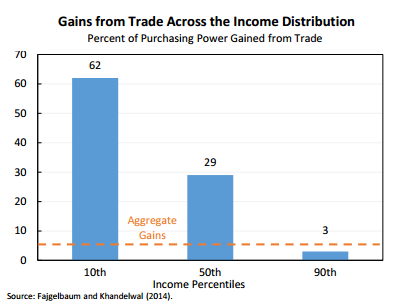
Moreover, contrary to common conjecture, the benefits of international trade haven’t simply accrued to the wealthy alone. Low and middle income individuals tend to spend a greater share of their income on cheap imported consumer goods than those with higher incomes. As a result, international trade tends to benefit these income groups more so than the wealthy.

Corey Iacono Sanders ArticleIndeed, according to the President’s Council of Economic Advisers, middle income consumers have about 29 percent greater purchasing power as a result of international trade.

In other words, middle income consumers can buy 29 percent more goods and services as a result of the access to low-cost imports from foreign countries.

Low income consumers see even greater gains with 62 percent higher purchasing power as a result of trade. In contrast, the top 10 percent of income earners only saw an increase in purchasing power of 3 percent as a result of trade.

On top of that, international trade has provided benefits by bringing new and innovative products to American consumers.

According seminal research by Christian Broda of the University of Chicago and David E. Weinstein of Colombia University, the variety of imported goods increased three-fold from 1972 to 2001. The value to American consumers of this import induced expanded product variety is estimated to be equivalent to 2.6 percent of national income, about $450 billion as of 2014. That’s not exactly small change.

The spread of free trade has also made considerable contributions to environmental protection, gender equality, and global poverty reduction. As a result of the spread of clean technology facilitated by freer trade, “every 1 percent increase in income as a result of trade liberalization (the removal of government-imposed barriers to trade), pollution concentrations fall by 1 percent,” according to the Council of Economic Advisers.

The CEA also has found that “industries with larger tariff declines saw greater reductions in the [gender] wage gap,” suggesting that facilitating foreign competition through trade liberalization reduces the ability of employers to discriminate against women.

In regards to global poverty reduction, research has shown that in response to US import tariff cuts, developing countries, such as Vietnam, export more to the US, leading to higher incomes and less poverty.

Despite the large gains from trade America has already reaped, there is still room for improvement (contrary to Sen. Sanders’ accusations of “unfettered” free trade). The PIIE economists estimate that further trade liberalization would increase “US household income between $4,000 and $5,300 annually,” leading the them to conclude that, “in the future as in the past, free trade can significantly raise income — and quality of life — in the United States.”

Ultimately, the conclusion that most economists seem to reach is that, from being a disaster, the expansion of free trade has been a tremendous success, and that further trade liberalization would most likely make Americans, and the rest of the world, considerably better off.

Don’t let fear-mongering about foreigners and China scare you: free trade benefits everyone, especially the poor, while protectionism benefits only the politically powerful.

Corey Iacono is a student at the University of Rhode Island majoring in pharmaceutical science and minoring in economics. 

This article was published by The Foundation for Economic Education and may be freely distributed, subject to a Creative Commons Attribution 4.0 International License, which requires that credit be given to the author.

Keeping the Bubble-Boom Going – Article by Thorsten Polleit

Keeping the Bubble-Boom Going – Article by Thorsten Polleit

The New Renaissance HatThorsten Polleit
August 19, 2015

******************************

The US Federal Reserve is playing with the idea of raising interest rates, possibly as early as September this year. After a six-year period of virtually zero interest rates, a ramping up of borrowing costs will certainly have tremendous consequences. It will be like taking away the punch bowl on which all the party fun rests.

Low Central Bank Rates have been Fueling Asset Price Inflation

The current situation has, of course, a history to it. Around the middle of the 1990s, the Fed’s easy monetary policy — that of Chairman Alan Greenspan — ushered in the “New Economy” boom. Generous credit and money expansion resulted in a pumping up of asset prices, in particular stock prices and their valuations.

US Federal Funds Rate in Percent and the S&P 500 Stock Market Index

A Brief History of Low Interest Rates

When this boom-bubble burst, the Fed slashed rates from 6.5 percent in January 2001 to 1 percent in June 2003. It held borrowing costs at this level until June 2004. This easy Fed policy not only halted the slowdown in bank credit and money expansion, it sowed the seeds for an unprecedented credit boom which took off as early as the middle of 2002.

When the Fed had put on the brakes by having pushed rates back up to 5.25 percent in June 2006, the credit boom was pretty much doomed. The ensuing bust grew into the most severe financial and economic meltdown seen since the late 1920s and early 1930s. It affected not only in the US, but the world economy on a grand scale.

Thanks to Austrian-school insights, we can know the real source of all this trouble. The root cause is central banks’ producing fake money out of thin air. This induces, and necessarily so, a recurrence of boom and bust, bringing great misery for many people and businesses and eventually ruining the monetary and economic system.

Central banks — in cooperation with commercial banks — create additional money through credit expansion, thereby artificially lowering the market interest rates to below the level that would prevail if there was no credit and money expansion “out of thin air.”

Such a boom will end in a bust if and when credit and money expansion dries up and interest rates go up. In For A New Liberty (1973), Murray N. Rothbard put this insight succinctly:

Like the repeated doping of a horse, the boom is kept on its way and ahead of its inevitable comeuppance by repeated and accelerating doses of the stimulant of bank credit. It is only when bank credit expansion must finally stop or sharply slow down, either because the banks are getting shaky or because the public is getting restive at the continuing inflation, that retribution finally catches up with the boom. As soon as credit expansion stops, the piper must be paid, and the inevitable readjustments must liquidate the unsound over-investments of the boom and redirect the economy more toward consumer goods production. And, of course, the longer the boom is kept going, the greater the malinvestments that must be liquidated, and the more harrowing the readjustments that must be made.

To keep the credit-induced boom going, more credit and more money, provided at ever lower interest rates, are required. Somehow central bankers around the world seem to know this economic insight, as their policies have been desperately trying to encourage additional bank lending and money creation.

Why Raise Rates Now?

Why, then, do the decision makers at the Fed want to increase rates? Perhaps some think that a policy of de facto zero rates is no longer warranted, as the US economy is showing signs of returning to positive and sustainable growth, which the official statistics seem to suggest.

Others might fear that credit market investors will jump ship once they convince themselves that US interest rates will stay at rock bottom forever. Such an expectation could deal a heavy, if not deadly, blow to credit markets, making the unbacked paper money system come crashing down.

In any case, if Fed members follow up their words with deeds, they might soon learn that the ghosts they have been calling will indeed appear — and possibly won’t go away. For instance, higher US rates will suck in capital from around the word, pulling the rug out from under many emerging and developed markets.

What is more, credit and liquidity conditions around the world will tighten, giving credit-hungry governments, corporate banks, and consumers a painful awakening after having been surfing the wave of easy credit for quite some time.

China, which devalued the renminbi exchange rate against the US dollar by a total of 3.5 percent on August 11 and 12, seems to have sent the message that it doesn’t want to follow the Fed’s policy — and has by its devaluation made the Fed’s hiking plan appear as an extravagant undertaking.

A normalization of interest rates, after years of excessively low interest rates, is not possible without a likely crash in production and employment. If the Fed goes ahead with its plan to raise rates, times will get tough in the world’s economic and financial system.

To be on the safe side: It would be the right thing to do. The sooner the artificial boom comes to an end, the sooner the recession-depression sets in, which is the inevitable process of adjusting the economy and allowing an economically sound recovery to begin.

Dr. Thorsten Polleit is the Chief Economist of Degussa (www.degussa-goldhandel.de) and Honorary Professor at the University of Bayreuth. He is the winner of the O.P. Alford III Prize in Political Economy and has been published in the Austrian Journal of Economics. His personal website is www.thorsten-polleit.com.

This article was published on Mises.org and may be freely distributed, subject to a Creative Commons Attribution United States License, which requires that credit be given to the author.

Eminent Domain for Private Gain Is Terrible and Cruel — Even When It “Works” – Article by George C. Leef

Eminent Domain for Private Gain Is Terrible and Cruel — Even When It “Works” – Article by George C. Leef

The New Renaissance HatGeorge C. Leef
August 18, 2015

******************************

Despite a “success” story, eminent domain for economic development is a bad policy

Ilya Somin’s excellent new book The Grasping Hand on the infamous case of Kelo v. New London recently drew a negative response from a professor who defends the use of eminent domain for “economic development.”

In his letter to the editor of the Wall Street Journal, Wayne State University professor John Mogk took issue with Somin’s book and with Ed Glaeser’s favorable WSJ review. Mogk claims that they did not adequately weigh what he regards as a successful use of eminent domain to promote economic growth in Poletown, Detroit.

The New London redevelopment project that cost Suzette Kelo her little pink house was, Mogk admits, a fiasco. But, he says, we shouldn’t paint all eminent domain cases with that brush. He wants to buttress the case that the public welfare can be enhanced by using eminent domain to obtain land for projects that are supposed to stimulate the economy and create jobs.

Mogk believes that the apparent success of Poletown saves the day for eminent domain enthusiasts.

Here are three reasons for believing that he is mistaken.

First, as a policy matter, we either give the green light to property seizures for any “public purpose” conceived by politicians, or we prohibit them and limit eminent domain just to seizures for a clear public use. (That’s the language in the Constitution.)

We cannot have a rule that says, “Eminent domain may be used for economic development plans, but only when it actually produces net benefits.”

No one can know ahead of time whether a plan will “work” (which is to say, produce at least some of the promised gains) or utterly fail. In Kelo, the City of New London’s grand redevelopment plan fell through completely. Where neat, modest houses once stood, you now see only rubble and weeds. Nobody knew that would be the outcome when the plan was conceived.

Consider this analogy: The law forbids warrantless searches by the police, but suppose that, in some illegal searches, important evidence of criminal activity is found. Should we conclude that the Fourth Amendment’s warrant requirement can be discarded because there are some instances where we get good results from warrantless searches?

I don’t think that conclusion follows. And neither should we allow property seizures whenever authorities want to, just because those seizures sometimes have “good results.”

Second, Professor Mogk’s Poletown example isn’t as telling as he thinks. Perhaps it is true, as he writes, that most of the inhabitants were content with their buyouts. What I don’t think anyone can deny, however, is that for some of the residents, especially elderly people, the forced relocation was extremely disruptive and painful.

Outsiders like Mogk and the bigwigs at General Motors (who wanted the land for a new Cadillac plant) may have thought that Poletown was “declining,” but to the people who called it home, living there was their best option.

The right to quietly enjoy their property was taken away from them so that others might be more prosperous — GM stockholders and UAW workers, in particular.

We have to oppose the collectivistic philosophy that says it is permissible to use coercion against some individuals as long as those in power think they might thereby create a net utilitarian gain for more politically powerful (and usually much richer) interests.

Third, all that these economic development eminent domain takings can ever do is to redistribute where economic activity takes place. It cannot create any overall gain.

Let us suppose that the GM management was correct in forecasting an increase in demand for luxury cars. (It appears that they overestimated that demand, at least for their own vehicles, since the plant never employed nearly as many workers as they had said it would.) Free market competition to satisfy that demand would have led to increased output without Detroit confiscating land for a new GM plant.

If it hadn’t been able to resort to coercion to get the land, GM would probably have found other ways of increasing Cadillac production, but even if it couldn’t have done so, other auto-makers would have built more luxury cars. Auto jobs would have been created somewhere, and car buyers would have benefited without property owners losing.

Instead of proving that eminent domain can be a good economic development tool, the Poletown example is just another illustration of Bastiat’s broken window fallacy. Demolishing Poletown to build a new auto factory brought about visible benefits for some people, but only at the expense of benefits for others that would have otherwise occurred.

No, not every eminent domain seizure for economic development purposes is as pointless and utterly destructive as Kelo, but we still ought to stick with this rule: Government should protect property rights, not violate them. The government should do those few order-keeping functions appropriate to it and leave the allocation of resources and planning of production to people who risk their own money and cannot take what isn’t theirs.

George Leef is the former book review editor of The Freeman. He is director of research at the John W. Pope Center for Higher Education Policy.

This article was published by The Foundation for Economic Education and may be freely distributed, subject to a Creative Commons Attribution 4.0 International License, which requires that credit be given to the author.

The War on Air Conditioning Heats Up – Is Climate Control Immoral? – Article by Sarah Skwire

The War on Air Conditioning Heats Up – Is Climate Control Immoral? – Article by Sarah Skwire

The New Renaissance HatSarah Skwire
August 13, 2015
******************************

It started with the Pope. In his recent encyclical, Laudato Si’, he singled out air conditioning as a particularly good example of wasteful habits and excessive consumption that overcome our better natures:

People may well have a growing ecological sensitivity but it has not succeeded in changing their harmful habits of consumption which, rather than decreasing, appear to be growing all the more. A simple example is the increasing use and power of air-conditioning.

Now, it seems to be open season on air conditioning. From a raging Facebook debate over an article that claims that air conditioning is an oppressive tool of the patriarchy to an article in the Washington Post that calls the American use of air conditioning an “addiction” and compares it unfavorably to the European willingness to sweat through the heat of summer, air conditioning is under attack. So I want to defend it.

Understand that when I defend air conditioning, I do so as something of a reluctant proponent. I grew up in the Midwest, and I have always loved sitting on the screened-in porch, rocking on the porch swing, drinking a glass of something cold. I worked in Key West during the summer after my sophomore year of college, lived in an apartment with no air conditioning, and discovered the enormous value of ceiling fans. A lazy, hot summer day can be a real pleasure.

However, let’s not kid ourselves. There were frequent nights in my childhood when it was just too hot to sleep, and the entire family would hunker down in the one air-conditioned room of the house — my father’s attic study — to cool off at night. When we moved from that house to a place that had central air, none of us complained.

And after my recent article on home canning, my friend Kathryn wrote to say,

When I was growing up in the Deep South, everybody I knew had a garden, shelled beans and peas, and canned. It could have been an Olympic event. What I remember most — besides how good the food was — is how hot it was, all those hours spent over huge pots of boiling something or other on the stove in a house with no air conditioning.

There’s a lot to be said for being able to cook in comfort and to enjoy the screened-in porch by choice rather than necessity. Making your family more comfortable is one of the great advantages of an increasingly wealthy society, after all.

So when I read that the US Department of Energy says that you can save about 11 percent on your electric bill by raising the thermostat from 72 to 77 degrees, mostly I want to invite the Department of Energy to come over to my 1929 bungalow and see if they can get any sleep in my refinished attic bedroom when the thermostat is set to 77 degrees, but the room temperature is a cozy 80-something.

And when I read Petula Dvorak arguing that air conditioning is a tool of sexism because “all these women [are freezing] who actually dress for the season — linens, sundresses, flowy silk shirts, short-sleeve tops — changing their wardrobes to fit the sweltering temperatures around them. … And then there are the men, stalwart in their business armor, manipulating their environment for their own comfort, heaven forbid they make any adjustments in what they wear,” mostly I want to ask her if she’s read the dress codes for most professional offices. In my office, women can wear sleeveless tops and open-toed shoes in the summer. Men have to wear a jacket and tie. Air conditioning isn’t sexist. Modern dress codes very well might be.

But arguments based on nostalgia or gender are mostly easily dismissed. Moral arguments, like those made by Pope Francis or by those who are concerned about the environmental and energy impact of air conditioning, are more serious and require real attention.

Is it immoral to use air conditioning?

Pope Francis certainly suggests it is. And the article in the Washington Post that compares US and European air conditioning use agrees, suggesting that the United States prefers the short-term benefits of air conditioning over the long-term dangers of potential global warming — and that our air conditioning use “will make it harder for the US to ask other countries to continue to abstain from using it to save energy.” We are meant to be deeply concerned about the global environmental impact as countries like India, Indonesia, and Brazil become wealthy enough to afford widespread air conditioning. We are meant to set a good example.

But two months before the Washington Post worried that the United States has made it difficult to persuade India not to use air conditioning, 2,500 Indians died in one of the worst heat waves in the country’s history. This June, 780 people died in a four-day heat wave in Karachi, Pakistan. And in 2003, a heat wave that spanned Europe killed 70,000. Meanwhile, in the United States, heat causes an average of only 618 deaths per year, and the more than 5,000 North American deaths in the un-air-conditioned days of 1936 remain a grim outlier.

Air conditioning is not immoral. Possessing a technology that can prevent mortality numbers like these and not using it? That’s immoral.

Air conditioning is, for most of us, a small summertime luxury. For others, it is a life-saving necessity. I am sure that it has environmental effects. Benefits always have costs, and there’s no such thing as a free climate-controlled lunch. But rather than addressing those costs by trying to limit the use of air conditioning and by insisting that developing nations not use the technologies that rocketed the developed world to success, perhaps we should be focusing on innovating new kinds of air conditioning that can keep us cool at a lesser cost.

I bet the kids who will invent that technology have already been born. I pray that they do not die in a heat wave before they can share it with us.

Sarah Skwire is a senior fellow at Liberty Fund, Inc. She is a poet and author of the writing textbook Writing with a Thesis.

This article was published by The Foundation for Economic Education and may be freely distributed, subject to a Creative Commons Attribution 4.0 International License, which requires that credit be given to the author.

Asset-Price Inflation Enters Its Dangerous Late Phase – Article by Brendan Brown

Asset-Price Inflation Enters Its Dangerous Late Phase – Article by Brendan Brown

The New Renaissance HatBrendan Brown
August 12, 2015
******************************

Asset price inflation, a disease whose source always lies in monetary disorder, is not a new affliction. It was virtually inevitable that the present wild experimentation by the Federal Reserve — joined by the Bank of Japan and ECB — would produce a severe outbreak. And indications from the markets are that the disease is in a late phase, though still short of the final deadly stage characterized by pervasive falls in asset markets, sometimes financial panic, and the onset of recession.

Global Signs of Danger

A key sign of danger, recognizable from historical patterns of how the disease progresses, is the combination of steep speculative temperature falls in some markets, with still-high — and in some cases, soaring — temperatures in other markets. Another sign is some pull-back in the carry trade, featuring, in particular, the uncovered arbitrage between a low (or zero) interest rate, and higher rate currencies. For now, however, this is still booming in some areas of the global market-place. Specifically, we now observe steep falls in commodity markets (also in commodity currencies and mining equities) which were the original area of the global market-place where the QE-asset price inflation disease attacked (back in 2009–11). Previously hot real estate markets in emerging market economies (especially China and Brazil) have cooled at least to a moderate extent. Most emerging market currencies — with the key exception of the Chinese yuan — once the darling of the carry traders, are in ugly bear markets. The Shanghai equity market bubble has burst.Yet in large areas of the high-yield credit markets (including in particular the so-called covenant-lite paper issued by highly leveraged corporations) speculative temperatures remain at scorching levels. Meanwhile, Silicon Valley equities (both in the public and private markets), and private equity funds enjoy fantasy valuations. Ten-year Spanish and Italian government bond yields are hovering below 2 percent, and hot spots in global advanced-economy real estate — whether San Francisco, Sydney, or Vancouver — just seem to get hotter, even though we should qualify these last two observations by noting the slump in the Canadian and Australian dollars. Also, there is tentative evidence that London high-end real estate is weakening somewhat.

How to Identify Late Stages of Asset Inflation

We can identify similar late phases of asset price inflation characterized by highly divergent speculative temperatures across markets in past episodes of the disease. In 1927–28, steep drops of speculative temperature in Florida real estate, the Berlin stock market, and then more generally in US real estate, occurred at the same time as speculative temperatures continued to soar in the US equity market. In the late 1980s, a crash in Wall Street equities (October 1987) did not mark the end-stage of asset price inflation but a late phase of the disease which featured still-rising speculation in real estate and high-yield credits.In the next episode of asset price inflation (the mid-late 1990s), the Asian currency and debt crisis in 1997, and the bursting of the Russian debt bubble the following year, accompanied still rising speculation in equities culminating in the Nasdaq bubble. In the episode of the mid-2000s, the first quakes in the credit markets during summer 2007 did not prevent a further build-up of speculation in equity markets and a soaring of speculative temperatures in winter 2007–08 and spring 2008 in commodity markets, especially oil.What insights can we gain from the identification of the QE-asset price inflation disease as being in a late phase?The skeptics would say not much. Each episode is highly distinct and the disease can “progress” in very different ways. Any prediction as to the next stage and its severity has much more to do with intuition than scientific observation. Indeed some critics go as far as to suggest that diagnosis and prognosis of this disease is so difficult that we should not even list it as such. Historically, such critics have ranged from Milton Friedman and Anna Schwartz (who do not even mention the disease in their epic monetary history of the US), to Alan Greenspan and Ben Bernanke who claimed throughout their years in power — and these included three virulent attacks of asset price inflation originating in the Federal Reserve — that it was futile to try to diagnose bubbles.

We Can’t Ignore the Problem Just Because It’s Hard to Measure

Difficulties in diagnosis though do not mean that the disease is phantom or safely ignored as just a minor nuisance. That observation holds as much in the field of economics as medicine. And indeed there may be a reliable way in which to prevent the disease from emerging in the first place. The critics do not engage with those who argue that the free society’s best defense against the asset price inflation disease is to follow John Stuart Mill’s prescription of making sure that “the monkey wrench does not get into the machinery of money.”Instead, the practitioners of “positive economics” demonstrate an aversion to analyzing a disease which cannot be readily identified by scientific measurement. Yes, the disease corrupts market signals, but by how much, where, and in what time sequence? Some empiricists might acknowledge the defining characteristic of the disease as “where monetary disequilibrium empowers forces of irrationality in global markets.” They might agree that flawed mental processes as described by the behavioral finance theorists become apparent at such times. But they despair at the lack of testable propositions.

Mis-Measuring Increases in Asset Prices

The critics who reject the usefulness of studying asset price inflation have no such qualms with respect to its twin disease — goods and services inflation. After all, we can depend on the official statisticians! In the present monetary inflation, a cumulative large decline in equilibrium real wages across much of the labor market, together with state of the art “hedonic accounting” (adjusting prices downward to take account of quality improvements) has meant that the official CPI has climbed by “only” 11 percent since the peak of the last business cycle (December 2007). The severity of the asset price inflation disease makes it implausible that the official statisticians are measuring correctly the force of monetary inflation in goods and services markets.

What Is the Final Stage?

A progression of the asset price inflation disease into its final stage (general speculative bust and recession) would mean the end of monetary inflation and also inflation in goods and services markets. What could bring about this transition? Most plausibly it will be a splintering of rose-colored spectacles worn by investors in the still hot speculative markets rather than Janet Yellen’s much heralded “lift-off” (raising official short-term rates from zero). What could cause the splinter? Perhaps it will be a sudden rush for the exit in the high-yield credit markets, provoked by alarm at losses on energy-related and emerging market paper. Or financial system stress could jump in consequence of the steep falls of speculative temperature already occurring (including China and commodities). Perhaps there will be a run from those European banks and credit funds which are up to their neck in Spanish and Italian government bonds. Or the Chinese currency could tumble as Beijing pulls back its support and the one trillion US dollar carry trade into the People’s Republic implodes. Perhaps scandal and shock, accompanied by economic disappointment will break the fantasy spell regarding US corporate earnings, especially in Silicon Valley. As the late French President Mitterrand used to say, “give time to Time!”

Brendan Brown is an associated scholar of the Mises Institute and is author of Euro Crash: How Asset Price Inflation Destroys the Wealth of Nations and The Global Curse of the Federal Reserve: Manifesto for a Second Monetarist Revolution. See Brendan Brown’s article archives.

This article was published on Mises.org and may be freely distributed, subject to a Creative Commons Attribution United States License, which requires that credit be given to the author.

The Unseen Consequences of Zero-Interest-Rate Policy – Article by Ronald-Peter Stöferle

The Unseen Consequences of Zero-Interest-Rate Policy – Article by Ronald-Peter Stöferle

The New Renaissance HatRonald-Peter Stöferle
August 10, 2015
******************************

In a dynamic economy, an action not only triggers just one effect, but always an entire series of different consequences. While the cause of the first effect is easily recognizable, the other effects often occur only later and no such recognition occurs. Frédéric Bastiat described this phenomenon in 1850 in his ground-breaking essay “What Is Seen and What is Not Seen”:

In the economic sphere, an act, a habit, an institution, a law produces not only one effect, but a series of effects. Of these effects, the first alone is immediate; it appears simultaneously with its cause; it is seen. The other effects emerge only subsequently; they are not seen; we are fortunate if we foresee them …

There is only one difference between a bad economist and a good one: the bad economist confines himself to the visible effect; the good economist takes into account both the effect that can be seen and those effects that must be foreseen. Yet this difference is tremendous; for it is almost always the case that when the immediate consequence is favorable, the later consequences are disastrous, and vice versa. Hence it follows that the bad economist pursues a small present good that will be followed by a great evil, while the good economist pursues a great good to come, at the risk of a small present evil.

A similar phenomenon can be seen with the consequences of artificially suppressed interest rates and monetary stimulus: in the short term, they appear to have positive effects, the long term effects are, however, disastrous. If one studies these processes closely, it becomes clear that the underlying problems cannot be solved by global zero-interest-rate policy (ZIRP), but that this instead undermines the natural selection process of the market.

With artificial stimulus like ZIRP, we only end up with a situation in which governments, financial institutions, entrepreneurs, and consumers who should actually be declared insolvent all remain on artificial life support.

In line with Bastiat’s thoughts, numerous fatal long-term consequences of zero-interest-rate policies can be identified, but are generally ignored:

  • Conservative investors by nature come under increasing pressure with respect to their investments and take on excessive risks in light of the prospect that interest rates will remain low in the long term. This leads to capital misallocation and the emergence of bubbles.
  • The sweet poison of low interest rates leads to massive asset price inflation (stocks, bonds, works of art, real estate).
  • Structurally too low interest rates in industrialized nations due to carry trades lead to the emergence of asset price bubbles and contagion effects in emerging markets.
  • Changes in human behavior patterns occur, due to continually declining purchasing power. While thrift is increasingly mutating into a relic of the past, taking on debt comes to be seen as rational.
  • As a result of the structurally too low level of interest rates, a “culture of instant gratification” is created, which is among other things characterized by the fact that consumption is financed with credit instead of savings. The formation of wealth becomes steadily more difficult.
  • The medium of exchange and unit of account function of money increases in importance, while its role as a store of value declines.
  • Incentives for fiscal discipline decline.
  • Zombie banks are created: Low interest rates prevent the healthy process of creative destruction. Banks are enabled to roll over potentially non-performing loans practically indefinitely and can thus lower their write-off requirements.
  • Newly created money is neither uniformly nor simultaneously distributed amongst the population. This results in a permanent transfer of wealth from later receivers to earlier receivers of newly created money.

Conventional monetary policy — that is, the promotion of credit creation by lowering interest rates — reaches its limits once the “zero-bound” is reached. In order to continue the spiral of stimulus, “unconventional monetary policy” becomes ever more important. The multitude of “newfangled” monetary policy measures is seemingly only limited by the imagination of central bankers, whereby recent years have shown that central bankers can be extraordinarily creative. That this phenomenon is nothing new, is inter alia shown by this observation by Ludwig von Mises in 1922:

But an increase in the quantity of money and fiduciary media will not enrich the world. … Expansion of circulation credit does lead to a boom at first, it is true, but sooner or later this boom is bound to crash and bring about a new depression. Only apparent and temporary relief can be won by tricks of banking and currency. In the long run they must lead to an all the more profound catastrophe.

Ronald-Peter Stöferle is a Chartered Market Technician (CMT) and a Certified Financial Technician (CFTe). During his studies in business administration and finance at the Vienna University of Economics and the University of Illinois at Urbana-Champaign, he worked for Raiffeisen Zentralbank (RZB) in the field of Fixed Income/Credit Investments. In 2006 he began writing reports on gold. His six benchmark reports called “In GOLD we TRUST” drew international coverage on CNBC, Bloomberg, the Wall Street Journal, The Economist and the Financial Times. He was awarded “2nd most accurate gold analyst” by Bloomberg in 2011.

This article was originally published by the Ludwig von Mises Institute. Permission to reprint in whole or in part is hereby granted, provided full credit is given.

Why the Candidates Keep Giving Us Reasons to Use the “F” Word – The Electoral Clown Car Is Full of Nationalistic Socialists – Article by Steven Horwitz

Why the Candidates Keep Giving Us Reasons to Use the “F” Word – The Electoral Clown Car Is Full of Nationalistic Socialists – Article by Steven Horwitz

The New Renaissance HatSteven Horwitz
August 6, 2015
******************************

“There are far too many candidates,” writes Dana Milbank at the Washington Post. “And to gain attention they are juggling, tooting horns and blowing slide whistles like so many painted performers emerging from a clown car.” The two clowns making the most noise in recent weeks are Bernie Sanders and Donald Trump.

At first glance, it would seem they couldn’t be more different: a Democrat and a Republican, a friend of the unions and a CEO, a man of relatively modest means by congressional standards and one of the wealthiest men in the United States. But a closer look reveals some interesting similarities and teaches us an important lesson about the history of ideas. What Sanders and Trump have in common is no laughing matter.

Recent articles by libertarians on both candidates have suggested that they are both strongly nationalist. Dan Bier tore apart Sanders for his views on immigration, and both Jeff Tucker and Jason Kuznicki have associated Trump with nationalism and perhaps even a variant of fascism. I think they are all on to something: Sanders and Trump have a lot more in common than many think. But before I get there, we need to take a detour into the history of socialism and fascism.

In its original conception, Marxian socialism was strongly internationalist. Marx’s theory was based on the idea of class struggle and the disparity in power between those who owned the means of production (the capitalists) and those who did not (the proletariat).

Marxism has nothing to do with nationality. It’s all about class, defined as whether or not one owns capital. For true Marxists, a German worker has much more in common with a Russian worker or an Italian worker than he or she does with a German capitalist. Marxism did not give any importance to national borders.

For many in the early 20th century, this was a problem with Marxism, especially in the aftermath of World War I. Much like today, people were looking for a “third way” between capitalism and socialism. For many of those people, that third way was fascism.

Today we use the word fascism as an epithet, especially for bossy people. We associate it with dictatorships, and especially with Nazism. It turns out that fascism was a fairly well-worked-out theory of how to organize a society, and in its original form was not about racism or anti-Semitism directly. Fascism was an attempt to combine what people saw as the best parts of capitalism and socialism, and then to do so in the context of putting nationality before class.

The most extensive writing about how fascism would work came from the Italians in the 1920s and 1930s, and interested readers should find a copy of Luigi Villari’s The Economics of Fascism to see the details. (You can find a nice summary of those ideas in Sheldon Richman’s entry on fascism in the online Concise Encyclopedia of Economics.)

The fascists argued that the whole notion of class conflict was the problem. Instead of pitting class against class and tearing nations apart, why not bring all the parties together and give them the chance to cooperate with each other rather than struggle their way to socialism? The fascist economy was built around a series of cartels where the state, the nominal owners of the means of production, and the workers (represented by labor unions) would get together and figure out what to produce, how to produce it, what to charge, and how much profit would be “allowed.”

The fascists agreed with socialism’s desire not to leave markets to spontaneous ordering forces, but they thought the nation-state should direct the economy, not the workers. Both capitalism and socialism involved conflict, not cooperation. The same third-way thinking, and some of the same structures, were present in the first two years of the New Deal in the United States. The cartels of the National Recovery Administration were modeled after Italian fascism, and FDR and Mussolini were mutual admirers.

You can see how fascism took elements of both capitalism and socialism, then added nationalism. The idea was to look out for the welfare of the nation-state first. The Italian capitalist and the Italian worker were both Italians first and foremost, and that should be the first call on their allegiance. Lashing socialism to the glorification of the nation-state gives us fascism, and you can see why anyone who represented a threat to national identity would quickly become a problem.

This is one reason why the German version of fascism so easily linked up with a long history of German anti-Semitism. The Nazis were undoubtedly socialist (recall that Nazi is short for National Socialist German Workers Party), as even a quick glance at their 1920 platform will tell you. They were also, even at that date, fiercely nationalist. In Hitler’s hands, that national pride quickly became a desire to glorify the Aryan race.

Plus, recall that Jews were disproportionately both capitalists and supporters of the Marxist revolution in Russia — not to mention the symbol of the cosmopolitan, rootless nomad for centuries. Many of those who wanted to reject both capitalism and Marxian socialism saw the Jews as the symbol of both.

So what does this have to do with Bernie Sanders and Donald Trump?

I would argue that they are both “nationalist socialists.” That is, they both embody key elements of fascism. They both think the nation comes first, and they both think the United States is an organization (not a spontaneous order) that should be under someone’s control.

The difference is that Sanders sees both the problems and the solutions from the workers’ perspective, so he’s focusing on both the exploitation by capitalists and keeping immigrants out to protect the wages of US workers. The losses to US workers matter more than the large gains to foreign-born workers coming here.

Trump sees all of this from the CEO/owner/capitalist perspective. He thinks the United States is, or should be, like a big firm where we all work together for a common goal. He envisions himself as the CEO, negotiating deals with other countries as if they, too, were just big corporate firms. But nations are not firms — they are spontaneous orders.

As I argued in an earlier column, “Socialism Is War and War Is Socialism,” this desire to turn spontaneous orders into hierarchies is characteristic of both war and socialism. It is also deeply embedded in fascism, and Sanders and Trump exemplify that tendency among the presidential candidates, though they do so with different emphases and rhetoric.

Their commonalities are also why our conventional binary left-right political spectrum makes no sense. That one candidate is perceived as far to the left and the other as (to some degree) a right-wing capitalist shows the depth of our failure to understand history. They have both rejected the spontaneous order of the market as well as the cosmopolitanism of liberalism and socialism. They are fascist brothers under the skin.

That both are getting the attention and support of so many Americans should be a matter of grave concern. After all, some clowns are far more scary than funny.

Steven Horwitz is the Charles A. Dana Professor of Economics at St. Lawrence University and the author of Microfoundations and Macroeconomics: An Austrian Perspective, now in paperback.

This article was published by The Foundation for Economic Education and may be freely distributed, subject to a Creative Commons Attribution 4.0 International License, which requires that credit be given to the author.

The Gig Economy Makes Karl Marx’s Dreams Come True – And It’s All Capitalism’s Doing – Article by Max Borders

The Gig Economy Makes Karl Marx’s Dreams Come True – And It’s All Capitalism’s Doing – Article by Max Borders

The New Renaissance HatMax Borders
August 4, 2015
******************************
When Joe Average steps out of his car after completing his shift for Lyft, he does so on his own terms. Nobody tells him when to start. Nobody tells him when to stop. The siren song that is prime time pricing might have coaxed him off the couch, but ultimately it was his call. And with the rest of his day, he’s going to go fishing. You see, Joe loves to fish — even more than he loves making money. After dinner, he might take some time to criticize the second season of True Detective.

Would ole Karl Marx have been happy with this result?

In The German Ideology, Marx wrote,

For as soon as the distribution of labour comes into being, each man has a particular, exclusive sphere of activity, which is forced upon him and from which he cannot escape. He is a hunter, a fisherman, a herdsman, or a critical critic, and must remain so if he does not want to lose his means of livelihood; while in communist society, where nobody has one exclusive sphere of activity but each can become accomplished in any branch he wishes, society regulates the general production and thus makes it possible for me to do one thing today and another tomorrow, to hunt in the morning, fish in the afternoon, rear cattle in the evening, criticise after dinner, just as I have a mind, without ever becoming hunter, fisherman, herdsman or critic.

Marx should be delighted — oh, except that it’s capitalism, not communism, that’s allowing Joe to be a fisherman and a critic on his own terms.

The sharing or “gig” economy is not only disrupting the way people live and work; it’s dividing the left considerably.

On the one hand, you have the nostalgic leftists who want Joe to work a nine-to-five job and skip the fishing. You know, like people did in the 1950s. As Freeman columnist Steve Horwitz writes, presidential candidate Hillary Clinton

longs for a time like the 1950s when workers had the structure of the corporate world and unions through which to lobby and negotiate for pay and benefits, rather than the so-called “gig” economy of so many modern freelance employees, such as Uber drivers. “This on-demand or so-called gig economy is creating exciting opportunities and unleashing innovation,” Clinton said, “but it’s also raising hard questions about workplace protection and what a good job will look like in the future.”

Joe already told us what a good job looks like. It’s one that lets him spend time fishing and criticizing.

More confusing (or confused, perhaps) is Paul Mason’s writing in the Guardian. He lauds “postcapitalism,” which has all the hallmarks of a society Clinton is worried about:

Postcapitalism is possible because of three major changes information technology has brought about in the past 25 years. First, it has reduced the need for work, blurred the edges between work and free time and loosened the relationship between work and wages.

Bingo. The gig economy. But does it make sense to give capitalism a different name? I suppose one could. After all, Marx coined the term. But Marx’s definition of capitalism is a system based on private ownership of the means of production. Has that dynamic fundamentally changed?

Far from it. The sharing economy is simply decentralizing power by allowing ordinary people to use their own small-scale means of production. By solving coordination problems and lowering transaction costs, technology is augmenting capitalism.

When Joe drives for Lyft, for example, his car is still his car. And now more of his time is his, too. Capitalism, even as Marx defined it, hasn’t fundamentally changed. But the use of technology to awaken sleeping private capital is allowing the system to evolve — and rather nicely if you’re Joe Average, or one of thousands of other workers like him.

Now, I’m not saying that there is nothing interesting going on in the electronic commons. Ideas are being configured and reconfigured in the networked economy. Many of those ideas are being taken out of the intellectual-property regime, thanks to open sourcing, and this can be a good thing. There are fierce debates about whether intellectual property (claims to property in ideas and in nonscarce goods) is justifiable. But passing over those debates, more and more open-source technologies are coming online for exploitation by everyone.

Do open sourcing and the creative commons take us to postcapitalism?

I don’t know. But fundamentally, as long as the process is voluntary and carried out peacefully by a community of cooperators, who cares what you call it? Should we be upset that the guy who founded Lyft is getting rich from the tech? Some people are, because they see the accumulation of wealth as taboo. But Joe’s life is better than it would have been in the absence of Lyft. The company allows him to live more of the life he wants to live.

As long as Joe Average is happier, who cares what Hillary Clinton thinks?

Max Borders is editor of The Freeman magazine and director of content for The Foundation for Economic Education (FEE). He is also author of Superwealth: Why we should stop worrying about the gap between rich and poor. A writer and innovator with a decade of experience in the non-profit world, Max works daily towards a condition of peace, freedom and abundance for all people.

This article was published by The Foundation for Economic Education and may be freely distributed, subject to a Creative Commons Attribution 4.0 International License, which requires that credit be given to the author.

Does America Ban Immigration? – The Land of the Free Isn’t, For Most People – Article by David Bier

Does America Ban Immigration? – The Land of the Free Isn’t, For Most People – Article by David Bier

The New Renaissance Hat
David Bier
August 3, 2015
******************************

The United States has a de facto ban on immigration. We can debate about whether this prohibition is necessary, but its existence is undeniable. Other than a few exceptions for family members, refugees, and the highly-educated, it is virtually impossible to come to the United States to live and work legally.

Historically, America held its doors open to all. But in the 1920s, a coalition of unions, progressives, and eugenicists combined to slam them shut. Within a year of passing Alcohol Prohibition, America also banned almost all forms of immigration, cutting immigration by nearly 80 percent.

Alcohol regained its legal status, but immigration never quite recovered.

Today, the government lets in almost a million immigrants each year, but this impressive-sounding number misses the entire legal, historical, and global context of our immigration system. We must compare it to the number who would come if only they could do so legally — and the reality is that most types of immigration are entirely prohibited. To deny the ban on immigration because it has exceptions is like denying Alcohol Prohibition because it allowed communion wine.

The half million people apprehended at the border each year and the 11 million unauthorized immigrants in the country are the clear evidence of this prohibition. The massive immigration underground points to an obvious yet largely ignored fact: If there was a legal way for them to come, they would have taken it. But, trouble is, one doesn’t exist.

The drastic shortage of visas is evident in the unbelievably long wait times for permanent residency. For certain categories, the wait is decades. For employment-based visas, certain Indian and Chinese workers will wait more than a decade. For Mexico, three different family-based categories have wait times over 18 years. There’s northward of 4.3 million people in these lines alone.

Yet these impossible lines hide a deeper problem: most would-be immigrants have no line to stand in at all.

The reality is this: 92 percent of legal immigrants are either 1) immediate family members of US citizens or permanent residents, 2) refugees or asylees, or 3) college graduates — and over 80 percent those needed an advanced degree or at least $500,000 to invest in projects in the United States.

This leaves less than 65,000 visas for everyone else. More two-thirds of these come through a lottery system for which 11 million people applied last year. People in most of the largest countries in the world, including India, China, and Mexico, aren’t even eligible to apply.

This legal flow amounts to barely 7 percent of the average number of immigrants apprehended at the border each year since 2004 (and, of course, that doesn’t count those who crossed successfully, or those who entered and overstayed their visas, or those who would come if there was a legal opportunity). For people without a college degree or a close American relative, the Statue of Liberty’s “Golden Door” is almost completely shut.

Meanwhile, PhDs, scientists, movie stars, pro-athletes, and other elites have a number of different work visas available to them. These allow them to live and work year-round in the United States.

By contrast, there is no work visa that allows lesser-skilled laborers to live and work year-round in this country. Unsurprisingly, this lesser-skilled demographic is disproportionately represented in the illegal population, 85 percent of whom lack a college degree.

Another reason we know that illegal immigration is being driven by the lack of a legal alternative is because of what happened when the government allowed foreign workers to come and go legally.

Thanks to a fluke of history, America had a brief period when it experimented with freer migration between the United States and Mexico. In the 1950s and ‘60s, the Bracero guest worker program let in about 5 million Mexican farmworkers. From 1956 to 1965, when the program was at its height, the number of unauthorized immigrants at the border averaged just 41,000, compared to over 436,000 a year in the prior decade.

After it was terminated in 1966 by another union-led coalition, illegal immigration never again fell to such low levels — not even for a single year, let alone an entire decade. By the 1980s, a million or more immigrants were routinely being caught by Border Patrol every year.

Supporters of the ban on immigration will say that America is at its breaking point, that we’re overwhelmed, that we can’t “handle” any more immigrants. But this fear is groundless: As a share of its population, America admitted four times as many immigrants each year in the early 1900s as it did in 2014. For a century from 1830-1929, immigration was twice as high as a share of the population as it was in the last two decades.

In absolute terms, America admits more immigrants than any other country, but relative to its size, US immigration levels are far lower than many Western countries. Controlling for population, Canada, Australia, and New Zealand all have higher levels of immigration than America today — even as high as the United States in the early 20th century — and they have not collapsed into chaos or poverty.

Immigration prohibition is real. Millions of people cross the border illegally (and thousands of businesses hire them illegally) for the same reason bootleggers had to brew booze in bathtubs. And, for the same reasons we repealed Alcohol Prohibition, we should also finally end America’s ban on immigration.

David Bier is an immigration policy analyst at the Niskanen Center. He is an expert on visa reform, border security, and interior enforcement. From 2013 to 2015, he drafted immigration legislation as senior policy advisor for Congressman Raúl Labrador, a member of the House Judiciary Committee’s Subcommittee on Immigration and Border Security. Previously, Mr. Bier was an immigration policy analyst at the Competitive Enterprise Institute.  

This article was published by The Foundation for Economic Education and may be freely distributed, subject to a Creative Commons Attribution 4.0 International License, which requires that credit be given to the author.