Browsed by
Category: Economics

Central Banks and Our Dysfunctional Gold Markets – Article by Marcia Christoff-Kurapovna

Central Banks and Our Dysfunctional Gold Markets – Article by Marcia Christoff-Kurapovna

The New Renaissance Hat
Marcia Christoff-Kurapovna
July 23, 2015
******************************

Many investors still view gold as a safe-haven investment, but there remains much confusion regarding the extent to which the gold market is vulnerable to manipulation through short-term rigged market trades, and long-arm central bank interventions. First, much of the gold that is being sold as shares, in certificates, or for physical hoarding in dubious “vaults” just isn’t there. Second, paper gold can be printed into infinity just like regular currency. Third, new electronic gold pricing — replacing, as of this past February, the traditional five-bank phone-call of the London Gold Fix in place since 1919 — has not necessarily proved a more trustworthy model. Fourth, there looms the specter of the central bank, particularly in the form of volume trading discounts that commodity exchanges offer them.

The Complex World of Gold Investments

The question of rigging has been brought to media attention in the past few months when ten banks came under investigation by the US Commodity Futures Trading Commission (CFTC) and the US Department of Justice in price-manipulation probes. Also around that time, the Swiss regulator FINMA settled a currency manipulation case in which UBS was accused of trading ahead of silver-fix orders. Then, the UK Financial Conduct Authority, which regulates derivatives, ordered Barclays to pay close to $45 million in fines against a trader who artificially suppressed the price of gold in 2012 to avoid payouts to clients. Such manipulations are not limited to the precious-metals market: in November of last year, major banks had to pay several billion dollars in fines related to the rigging of foreign-exchange benchmarks, including LIBOR and other interest-rate benchmarks.These cases followed on the heels of a set of lawsuits in May 2014 filed in New York City in which twenty-five plaintiffs consisting of hedge funds, private citizens, and public investors (such as pension funds) sued HSBC, Barclays, Deutsche Bank, Bank Scotia, and Société Génerale (the five traditional banks of the former London Gold Fix) on charges of rigging the precious-metals and foreign-exchange markets. “A lot of conspiracy theories have turned out to be conspiracy fact,” said Kevin Maher, a former gold trader in New York who filed one of the lawsuits that May, told The New York Times.

Central Banks at the Center of Gold Markets

The lawsuits were given more prominence with the introduction of the London Bullion Market Association (LBMA) on February 20, 2015. The new price-fixing body was established with seven banks: Goldman Sachs, J.P. Morgan, UBS, HSBC, Barclays, Bank Scotia and Société Génerale. (On June 16, the Bank of China announced, after months of speculation, that it would join.)While some economists have deemed the new electronic fix a good move in contrast to behind-closed-door, phoned-in price-fixing, others beg to differ. Last year, the commodities exchange CME Group came under scrutiny for allowing volume trading discounts to central banks, raising the question of how “open” electronic pricing really is. Then, too, the LBMA is itself not a commodities exchange but an Over-The-Counter (OTC) market, and does not publish — does not have to publish — comprehensive data as to the amount of metal that is traded in the London market.According to Ms. Ruth Crowell, the chairman of LBMA, writing in a report to that group: “Post-trade reporting is the material barrier preventing greater transparency on the bullion market.” In the same report, Crowell states: “It is worth noting that the role of the central banks in the bullion market may preclude ‘total’ transparency, at least at the public level.” To its credit, the secretive London Gold Fix (1919–2015) featured on its website tracking data of the daily net volume of bars traded and the history of gold trades, unlike current available information from the LBMA as one may see here (please scroll down for charts).

The Problem with Paper Gold

There is further the problem of what is being sold as “paper” gold. At first glance, that option seems a good one. Gold exchange-traded funds (ETFs), registered with The New York Stock Exchange, have done very well over the past decade and many cite this as proof that paper gold, rather than bars in hand, is just as sure an investment. The dollar price of gold rose more than 15.4 percent a year between 1999 and December 2012 and during that time, gold ETFs generated an annual return of 14 percent (while equities registered a loss).As paper claims on trusts that hold gold in bank vaults, ETFs are for many, preferable to physical gold. Gold coins, for instance, can be easily faked, will lose value when scratched, and dealers take high premiums on their sale. The assaying of gold bars, meanwhile, with transport and delivery costs, is easy for banking institutions to handle, but less so for individuals. Many see them as trustworthy: ETF Securities, for example, one of the largest operators of commodity ETFs with $21 billion in assets, stores their gold in Zurich, rather than in London or Toronto. These last two cities, according to one official from that company, “could not be trusted not to go along with a confiscation order like that by Roosevelt in 1933.”Furthermore, shares in these entities represent only an indirect claim on a pile of gold. “Unless you are a big brokerage firm,” writes economist William Baldwin, “you cannot take shares to a teller and get metal in exchange.” ETF custodians usually consist of the likes of J.P. Morgan and UBS who are players on the wholesale market, says Baldwin, thus implying a possible conflict of interest.

Government and Gold After 1944: A Love-Hate Relationship

Still more complicated is the love-hate relationship between governments and gold. As independent gold analyst Christopher Powell put it in an address to a symposium on that metal in Sydney, October 2013: “It is because gold is a competitive national currency that, if allowed to function in a free market, will determine the value of other currencies, the level of interest rates and the value of government bonds.” He continued: “Hence, central banks fight gold to defend their currencies and their bonds.”It is a relationship that has had a turbulent history since the foundation of the Bretton Woods system in 1944 and up through August 1971, when President Nixon declared the convertibility of the dollar to gold suspended. During those intervening decades, gold lived a kind of strange dual existence as a half state-controlled, half free market-driven money-commodity, a situation that Nobel Prize economist Milton Friedman called a “real versus pseudo gold standard.”The origin of this cumbersome duality was the post-war two-tiered system of gold pricing. On the one hand, there was a new monetary system that fixed gold at $35 an ounce. On the other, there was still a free market for gold. The $35 official price was ridiculously low compared to its free market variant, resulting in a situation in which IMF rules against dealing in gold at “free” prices were circumvented by banks that surreptitiously purchased gold from the London market.

The artificial gold price held steady until the end of the sixties, when the metal’s price started to “deny compliance” with the dollar. Still, monetary doctrine sought to keep the price fixed and, at the same time, to influence pricing on the free market. These attempts were failures. Finally, in March 1968, the US lost more than half its reserves, falling from 25,000 to 8,100 tons. The price of other precious metals was allowed to move freely.

Gold Retreats Into the Shadows

Meawhile, private hoarding of gold was underway. According to The Financial Times of May 21, 1966, gold production was rising, but it was not going to official gold stocks. This situation, in turn, fundamentally affected the gold clauses of the IMF concerning repayments in currency only in equal value to the gold value of such at the time of borrowing. This led to a rise in “paper gold planning” as a substitution for further increases in IMF quotas. (Please see “The Paper Gold Planners — Alchemists or Conjurers?” in The Financial Analysts Journal, Nov–Dec 1966.)By the late 1960s, Vietnam, poverty, the rise in crime and inflation were piling high atop one another. The Fed got to work doing what it does best: “Since April [1969],” wrote lawyer and economist C. Austin Barker in a January 1969 article, “The US Money Crisis,” “the Fed has continually created new money at an unusually rapid rate.” Economists implored the IMF to allow for a free market for gold but also to set the official price to at least $70 an ounce. What was the upshot of this silly system? That by 1969 Americans were paying for both higher taxes and inflation. The rest, as they might say, is the history of the present.Today, there is no “official” price for gold, nor any “gold-exchange standard” competing with a semi-underground free gold market. There is, however, a material legacy of “real versus pseudo” gold that remains a terrible menace. Buyer beware of the pivotal difference between the two.

Marcia Christoff-Kurapovna is at work on the biography of a prominent European head of state and businessman.  Her work has appeared in such publications as The Wall Street Journal, The Economist and Foreign Affairs.

This article was originally published by the Ludwig von Mises Institute. Permission to reprint in whole or in part is hereby granted, provided full credit is given.
The Fed’s Confusion Over the “Natural Rate” of Unemployment and Inflation – Article by Frank Shostak

The Fed’s Confusion Over the “Natural Rate” of Unemployment and Inflation – Article by Frank Shostak

The New Renaissance Hat
Frank Shostak
July 20, 2015
******************************
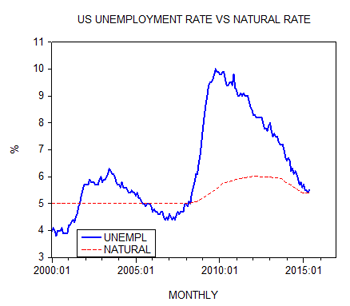
In May, the US unemployment rate stood at 5.5 percent against the rate of 5.3 percent for the “natural unemployment,” also known as the Non-Accelerating Inflation Rate of Unemployment (NAIRU).

According to the popular view, once the actual unemployment rate falls to below the NAIRU, or the natural unemployment rate, the rate of inflation tends to accelerate and economic activity becomes overheated. (This acceleration in the rate of inflation takes place through increases in the demand for goods and services. It also lifts the demand for workers and puts pressure on wages, reinforcing the growth in inflation).

By this way of thinking, the central bank must step in and lift interest rates to prevent the rate of inflation from getting out of control.

daily july 17 350

Recently, however, some experts have raised the possibility that the natural unemployment rate is likely to be much lower than the government official estimate of 5.3 percent. In fact, earlier this year, economists at the Chicago Fed argued that the natural unemployment rate since October last year has fallen to 4.3 percent.

The reasons for this decline are demographic changes and an increase in the level of education. (The natural unemployment rate tends to fall, so it is held, with the rising age of the labor force and with its education.)

Experts are of the view that these factors should continue to lower the natural unemployment rate for at least the remainder of the decade.

It is held that a lower natural rate may help explain why wage inflation and price inflation remain low, despite the actual unemployment rate recently reaching 5.5 percent.

Advocates for a lower natural rate also claim a lower rate would mean the Fed can keep interest rates lower for longer without worrying about lifting the rate of inflation.

Why NAIRU Is an Arbitrary Measure

The NAIRU however, is an arbitrary measure; it is derived from a statistical correlation between changes in the consumer price index and the unemployment rate. What matters here for Fed economists and others is whether the theory “works” (i.e., whether it can predict the future rate of increases in the consumer price index).

This way of thinking doesn’t consider whether a theory corresponds to reality. Here we have a framework, which implies that “anything goes” as long as one can make accurate predictions.

The purpose of a theory however is to present the facts of reality in a simplified form. A theory has to originate from reality and not from some arbitrary idea that is based on a statistical correlation.

If “anything goes,” then we could find by means of statistical methods all sorts of formulas that could serve as forecasting devices.

For example, let us assume that high correlation has been established between the income of Mr. Jones and the rate of growth in the consumer price index — the higher the rate of increase of Mr. Jones’s income, the higher the rate of increase in the consumer price index.

Therefore we could easily conclude that in order to exercise control over the rate of inflation the central bank must carefully watch and control the rate of increases in Mr. Jones’s income. The absurdity of this example matches that of the NAIRU framework.

Inflation Is Not Caused by Increased Economic Activity

Contrary to mainstream thinking, strong economic activity as such doesn’t cause a general rise in the prices of goods and services and economic overheating labeled as inflation.

Regardless of the rate of unemployment, as long as every increase in expenditure is supported by production, no overheating can occur.

The overheating emerges once expenditure is rising without the backup of production — for instance, when the money stock is increasing. Once money increases, it generates an exchange of nothing for something, or consumption without preceding production, which leads to the erosion of real wealth.

As a rule, rises in the money stock are followed by rises in the prices of goods and services.

Prices are another name for the amount of money that people spend on goods they buy.

If the amount of money in an economy increases while the number of goods remains unchanged more money will be spent on the given number of goods i.e., prices will increase.

Conversely, if the stock of money remains unchanged it is not possible to spend more on all the goods and services; hence no general rise in prices is possible. By the same logic, in a growing economy with a growing number of goods and an unchanged money stock, prices will fall.

Frank Shostak is an adjunct scholar of the Mises Institute and a frequent contributor to Mises.org. His consulting firm, Applied Austrian School Economics, provides in-depth assessments and reports of financial markets and global economies.

This article was originally published by the Ludwig von Mises Institute. Permission to reprint in whole or in part is hereby granted, provided full credit is given.

How Student Loans Create Demand for Useless Degrees – Article by Josh Grossman

How Student Loans Create Demand for Useless Degrees – Article by Josh Grossman

The New Renaissance Hat
Josh Grossman
July 19, 2015
******************************

Last week, former Secretary of Education and US Senator Lamar Alexander wrote in the Wall Street Journal that a college degree is both affordable and an excellent investment. He repeated the usual talking point about how a college degree increases lifetime earnings by a million dollars, “on average.” That part about averages is perhaps the most important part, since all college degrees are certainly not created equal. In fact, once we start to look at the details, we find that a degree may not be the great deal many higher-education boosters seem to think it is.

In my home state of Minnesota, for example, the cost of obtaining a four-year degree at the University of Minnesota for a resident of Minnesota, North Dakota, South Dakota, Manitoba, or Wisconsin is $100,720 (including room and board and miscellaneous fees). For private schools in Minnesota such as St. Olaf, however, the situation is even worse. A four-year degree at this institution will cost $210,920.

This cost compares to an average starting salary for 2014 college graduates of $48,707. However, like GDP numbers this number is misleading because it is an average of all individuals who obtained a four-year degree in any academic field. Regarding the average student loan debt of an individual who graduated in 2013, about 70 percent of these graduates left college with an average student loan debt of $28,400. This entails the average student starting to pay back these loans six months after graduation or upon leaving school without a degree. The reality of this situation is that assuming a student loan interest rate of 6.8 percent and a ten-year repayment period, the average student will be paying $326.83 every month for 120 months or a cumulative total re-payment of $39,219.28. Depending upon a student’s job, this amount can be a substantial monthly financial burden for the average graduate.

All Degrees Are Not of Equal Value

Unfortunately, there is no price incentive for students to choose degrees that are most likely to enable them to pay back loans quickly or easily. In other words, these federal student loans are subsidizing a lack of discrimination in students’ major choice. A person majoring in communications can access the same loans as a student majoring in engineering. Both of these students would also pay the same interest rate, which would not occur in a free market.

In an unhampered market, majors that have a higher probability of default should be required to pay a higher interest rate on money borrowed than majors with a lower probability of default. In summary, it is not just the federal government’s subsidization of student loans that is increasing the cost of college, but the fact that demand for low-paying and high-default majors is increasing, because loans for these majors are supplied at the same price as a major providing high salaries to its possessor with a low probability of default.

And which programs are the most likely to pay off for the student? The top five highest paying bachelor’s degrees include: petroleum engineering, actuarial mathematics, nuclear engineering, chemical engineering and electronics and communications engineering, while the top five lowest paying bachelor’s degrees are: animal science, social work, child development and psychology, theological and ministerial studies, and human development, family studies, and related services. Petroleum engineering has an average starting salary of $93,500 while animal science has an average starting salary of $32,700. This breaks down for a monthly salary for the petroleum engineer of $7,761.67 versus a person working in animal science with a monthly salary of $2,725. Based on the average monthly payment mentioned above, this would equate to a burden of 4.2 percent of monthly income (petroleum engineer) versus a burden of 12 percent of monthly income (animal science). This debt burden is exacerbated by the fact that it is now nearly impossible to have student loan debts wiped away even if one declares bankruptcy.

Ignoring Careers That Don’t Require a Degree

Meanwhile, there are few government loan programs geared toward funding an education in the trades. And yet, for many prospective college students, the trades might be a much more lucrative option. Using the example of plumbing, the average plumber earns $53,820 per year with the employer paying the apprentice a wage and training.

Acknowledging the fact that this average salary is for master plumbers, it still equates to a $20,000 salary difference between it and someone with a four-year degree in animal science while having no student loans as a bonus. Outside of earning a four-year degree in science, technology, engineering, math or, accounting with an average starting salary of $53,300, nursing with an average starting salary of $53,624, or as a family practice doctor on the lower end of physician pay of $161,000, society might be better served if parents and educators would stop using the canard that a four-year degree is always worth the cost outside of a few majors mentioned above. Encouraging students to consider the trades and parents to give their children the money they would spend on a four-year college degree to put a down payment on a house might be a better use of finite economic resources. The alternative of forcing the proverbial square peg into a round hole will condemn another generation to student debt slavery forcing them to put off buying a home or getting married.

Loans Drive Overall Demand

The root of the problem is intervention by the federal government in providing student loans. Since 1965 when President Johnson signed the Higher Education Act tuition, room, and board has increased from $1,105 per year to $18,943 in 2014–2015. This is an increase of 1,714 percent in 50 years. In addition, the Higher Education Act of 1965 created loans which are made by private institutions yet guaranteed by the federal government and capped at 6.8 percent. In case of default on the loans, the federal government — that is, the taxpayers — pick up the tab in order for these lenders to recover 95 cents on every dollar lent. Loaning these funds at below market interest rates and with the federal government backing up these risky loans has led to massive malinvestment as the percentage of high-school graduates enrolled in some form of higher education has increased from 10 percent before World War II to 70 percent by the 1990s. Getting a four-year degree in nearly any academic field seemed to be the way in which to enter or remain in the middle class.

But just as with the housing bubble, keeping interest below market levels while increasing the money supply in terms of loans — while having the taxpayer on the hook for a majority of these same loans — leads to an avalanche of defaults and is a recipe for disaster.

Josh Grossman is a social studies teacher in southeastern Minnesota. He enjoys reading anything he can about Austrian Economics or historical revisionism from the perspective of the Austrian School.

Greece Today, America Tomorrow? – Article by Ron Paul

Greece Today, America Tomorrow? – Article by Ron Paul

The New Renaissance HatRon Paul
July 14, 2015
******************************

The drama over Greece’s financial crisis continues to dominate the headlines. As this column is being written, a deal may have been reached providing Greece with yet another bailout if the Greek government adopts new “austerity” measures. The deal will allow all sides to brag about how they came together to save the Greek economy and the European Monetary Union. However, this deal is merely a Band-Aid, not a permanent fix to Greece’s problems. So another crisis is inevitable.

The Greek crisis provides a look into what awaits us unless we stop overspending on warfare and welfare and restore a sound monetary system. While most commentators have focused on Greece’s welfare state, much of Greece’s deficit was caused by excessive military spending. Even as its economy collapses and the government makes (minor) cuts in welfare spending, Greece’s military budget remains among the largest in the European Union.

Despite all the handwringing over how the phony sequestration cuts have weakened America’s defenses, the United States military budget remains larger than the combined budgets of the world’s next 15 highest spending militaries. Little, if any, of the military budget is spent defending the American people from foreign threats. Instead, the American government wastes billions of dollars on an imperial foreign policy that makes Americans less safe. America will never get its fiscal house in order until we change our foreign policy and stop wasting trillions on unnecessary and unconstitutional wars.

Excessive military spending is not the sole cause of America’s problems. Like Greece, America suffers from excessive welfare and entitlement spending. Reducing military spending and corporate welfare will allow the government to transition away from the welfare state without hurting those dependent on government programs. Supporting an orderly transition away from the welfare state should not be confused with denying the need to reduce welfare and entitlement spending.

On reason Greece has been forced to seek bailouts from its EU partners is that Greece ceded control over its currency when it joined the European Union. In contrast, the dollar’s status as the world’s reserve currency is the main reason the US has been able to run up huge deficits without suffering a major economic crisis. The need for the Federal Reserve to monetize ever-increasing levels of government spending will eventually create hyperinflation, which will lead to increasing threats to the dollar’s status. China and Russia are already moving away from using the dollar in international transactions. It is only a matter of time before more countries challenge the dollar’s reserve currency status, and, when this happens, a Greece-style catastrophe may be unavoidable.

Despite the clear dangers of staying on our recent course, Congress continues to increase spending. The only real debate between the two parties is over whether we should spend more on welfare or warfare. It is easy to blame the politicians for our current dilemma. But the politicians are responding to demands from the people for greater spending. Too many Americans believe they have a moral right to government support. This entitlement mentally is just as common, if not more so, among the corporate welfare queens of the militarily-industrial complex, the big banks, and the crony capitalists as it is among lower-income Americans.

Congress will only reverse course when a critical mass of people reject the entitlement mentality and understand that the government is incapable of running the world, running our lives, and running the economy. Therefore, those of us who know the truth must spread the ideas of, and grow the movement for, limited government, free markets, sound money, and peace.

Ron Paul, MD, is a former three-time Republican candidate for U. S. President and Congressman from Texas.

This article is reprinted with permission from the Ron Paul Institute for Peace and Prosperity.

Portugal’s Experiment in Drug Decriminalization Has Been a Success – Article by Mark Thornton

Portugal’s Experiment in Drug Decriminalization Has Been a Success – Article by Mark Thornton

The New Renaissance HatMark Thornton
July 10, 2015
******************************
This month, Portugal celebrates fourteen years of drug decriminalization. The grand experiment is now considered a happy success considering it was adopted out of desperation and in the face of dire warnings from proponents of the global drug war.

What Led to Decriminalization

During the mid-twentieth century, Portugal experienced fifty years of military dictatorship, and when leftist democratic control was reestablished in 1974, many expatriate Portuguese returned to Portugal from its colonies. Of course, many of these people were dissidents, outsiders, and outcasts, and many of them used illegal drugs.

Over the next twenty-five years, there was a surge in drug use, drug abuse, addiction, overdoses, and eventually a very substantial prevalence of HIV/AIDS and other dirty-needle-related diseases. At the peak of this drug epidemic the rate of drug addiction and HIV/AIDS infection was “considerably higher” than the rest of Europe according to Dr. João Goulão, the longtime drug czar of Portugal.

Goulão was on the eleven member anti-drug commission that formulated law 30/2000 which decriminalized all drugs starting July 1, 2001.

The “grand experiment” seems to be the result of two factors. The first is that Portugal is a relatively poor European country and was unable to fight the war on drugs on every front.

The second factor is that the commission was relatively non-partisan and simply adopted the common sense notion that drug abuse and addiction are not criminal problems for the police to solve. Drug abuse and addiction are medical and psychological problems that are better solved by the individual with the help of professionals and social pressures.

Baby Steps Away from the Drug War

Decriminalization is just one baby step away from the war on drugs, and drug smugglers and dealers are still sought out and punished. Individuals are only permitted to possess very small amounts of illegal drugs without being punished as a dealer. Under current laws, you can still be arrested and sent to counselors, but you do not face imprisonment unless you are an uncooperative multiple offender.

While certainly not ideal, decriminalization has straightforward benefits over complete prohibition. First, otherwise law-abiding citizens will not be criminalized for possessing illegal drugs. Second, drug addicts will be more likely to seek professional help when government treats addiction as a medical rather than criminal problem. Third, the police will have more resources to address real crimes and possibly to provide subsidies for drug treatment programs. Fourth, drug addicts will turn away from dangerous synthetic drug substitutes and turn more to the natural illegal drugs like marijuana and cocaine. Fifth, if needles are legal too, then you should see fewer cases of diseases such as HIV/AIDS and hepatitis. Sixth, junkie ghettos will shrink in size and visibility. In sum, decriminalization should result in fewer people dying and being sent to prison and more people living “normal” lives.

Of course, the biggest concern prior to decriminalization was the quantity of illegal drugs consumed. That concern is even more dominant when discussing outright legalization of drugs. Back when Portugal was considering decriminalization, I was interviewed by the “Time Magazine of Portugal,” and the reporter stressed that this was the prime concern in Portugal at the time. I responded that you cannot know the answer to that question in advance, that you will never know the answer to that question, and that the question was unimportant.

Too many factors impact the markets for illegal drugs to be able to say definitively that drug consumption will increase or decrease after decriminalization. Factually, statistics on drug consumption are necessarily imprecise. This is true for statistics prior to and after decriminalization. The existing statistics are based either on things like surveys and educated guesswork with the actual facts mired in the secretive world of the black market. Consumption aside, the real question is whether prohibition does more harm than decriminalization and the answer is yes.

When I was pressed by the reporter for a guess, I responded that overall consumption would not change much; it might increase some in the short run and would decrease in the long run, unless the drugs were legalized in the future for medical or recreational uses. However, I stressed that there are undeniable benefits (listed above) and there is no reason that consumption would explode due to decriminalization.

Many Still Refuse to See the Success

It is hard to blame the Portuguese for their concerns at that time. Decriminalization was considered a dangerous experiment and a dodge of the United Nations’ rules of the global war on drugs. However, mainstream drug policy experts remained “skeptical” of the Portuguese experiment even after nearly eight years of experience.

Mark Kleiman, director of the drug policy analysis program at UCLA, claims that Portugal was an unrealistic model. Peter Reuter, another leading drug policy expert, claimed that despite achieving its central goal (decreased consumption) it could be explained by the fact that Portugal was a small country and that drug abuse is cyclical in nature.

Remarkably, Dr. Goulão, who helped design and oversee the new law seems uninformed and perplexed at the positive outcomes even to this very day. He was recently quoted as saying: “it’s very difficult to identify a causal link between decriminalization by itself and the positive tendencies we have seen.”

One picture that sums up the Portuguese success story shows that Portugal has the second lowest death rate from illegal drugs in all of Europe after experiencing one of the worst rates with prohibition.

Drug-induced deaths in Portugal
It is also interesting to note that the European Monitoring Center for Drugs and Drug Addiction (EMCDDA) is headquartered in Lisbon. One analyst who works at EMCDDA, Frank Zobel, calls Portugal’s policy “the greatest innovation in this field” and “that the policy is working. Drug consumption has not increased severely. There is no mass chaos. For me as an evaluator, that’s a very good outcome.”

It is a happy anniversary for the Portuguese, but a scary one for all the drug warriors around the world whose incomes and power depend on continued ignorance about the effects of prohibition.

Mark Thornton is a senior resident fellow at the Ludwig von Mises Institute in Auburn, Alabama, and is the book review editor for the Quarterly Journal of Austrian Economics. He is the author of The Economics of Prohibition, coauthor of Tariffs, Blockades, and Inflation: The Economics of the Civil War, and the editor of The Quotable Mises, The Bastiat Collection, and An Essay on Economic Theory. Send him mail. See Mark Thornton’s article archives.

This article was published on Mises.org and may be freely distributed, subject to a Creative Commons Attribution United States License, which requires that credit be given to the author.

Frédéric Bastiat’s “Economic Sophisms” Is Now More Important Than Ever – Article by Julian Adorney and Matt Palumbo

Frédéric Bastiat’s “Economic Sophisms” Is Now More Important Than Ever – Article by Julian Adorney and Matt Palumbo

The New Renaissance HatJulian Adorney and Matt Palumbo
June 29, 2015
******************************

The great economist Frédéric Bastiat would have turned 214 today. His contributions to liberty have been many, but while so many advocates of free markets focus on The Law, there is another book that represents his legacy even better: Economic Sophisms. This short work of essays epitomizes perhaps his most important contribution: using taut logic and compelling prose to bring the dry field of economics to hundreds of thousands of laymen. Bastiat did not, generally, clear new ground in the field of economics. He read Adam Smith and Jean-Baptiste Say and found little to add to these giants of economic thought. But Bastiat possessed a keen wit and a clear, pithy writing style. His writings have become immensely popular. One-hundred-and-fifty years after his death, essays like “A Petition” are still circulated as an effective counter to progressive economics. Bastiat makes three central contributions in Economic Sophisms. First, he reminds us that we should care about the consumer, not just the producer. Second, he dismantles the argument that there are no economic laws. Third, and more generally, he is one of the few politicians and writers who thought with his head, not with his heart. Bastiat used logic to clearly lay out the consequences of political actions instead of hiding behind good intentions.

Surplus, Not Scarcity

Economic Sophisms expresses a common theme over and over again: we should craft policies that focus on consumers, not on producers.When Bastiat uses these phrases, it can be easy to misinterpret him. Keynes, writing 100 years after Bastiat, hijacked the terms. But Bastiat wasn’t a Keynesian. When he discusses how consumption is the end goal of the economy, what he means is: having goods (which benefits consumers) is more important than making goods (which benefits producers). Put another way, producers prefer scarcity, because it drives up prices. Consumers prefer surplus for the opposite reason. Producers advocate all sorts of methods for reducing the total quantity of goods (theirs excepted, of course). Producers seek to tax goods from other countries that compete with their own. They outlaw machines that would replace them. Producers even favor policies like burning food to drive up food prices, a policy that caused much starvation when it was enacted in the United States during the Great Depression. Consumers, by contrast, prefer abundance. They are happiest when they have a plethora of goods to choose from at a low price. Bastiat points out that we are all consumers, including the producers. The man who produces railroads also uses his wages to buy goods. One can imagine a world with no producers, a paradise in which man’s every need is fulfilled by nature or a benevolent God. But one cannot imagine a world with no consumption. In such a world, man would not eat or drink, have clothing or buy luxuries. Consumption, and quality of life, is the essential yardstick to measure a society’s economic prosperity.

When we enact producer-backed measures like tariffs, Bastiat argues, we favor producers’ interests over consumers’. We show that we’d rather have scarcity than surplus. Taken to its logical extreme, such a policy is absurd. Would anyone truly argue that total scarcity is preferable to having plenty?

The Principle of No Principles

In Bastiat’s day, it was fashionable to claim that no real principles exist. X may cause Y, but a smaller X needn’t cause a smaller Y; it could cause Z instead, or A. Today, we see the same logic: people who claim, for instance, that a minimum wage hike to $100 would kill jobs but that a hike to $10.10 would somehow create them. In essay after essay, Bastiat destroys this myth. Economics is not a foggy morass where up is sometimes down, left can be right, and there are no absolute truths. Economics is not like nutrition, where a glass of wine can heal while two gallons can kill.In economics, a cause will produce a correlational effect, regardless of how large the cause is. If small X causes small Y, large X causes large Y. A minimum wage hike to $100 will kill many jobs; a minimum wage hike to $10.10 will still kill some. The effect does not vary, only the size of it. Indeed, one of Bastiat’s most common argumentative tools is reductio ad absurdum, or carrying a concept to its logical conclusion. Opponents of mechanization want to force railroads to stop at one city and unload goods, thereby generating work for the porters? Very well, says Bastiat. Why not have them stop at three cities instead? Surely that would generate even more work for the porters. Why not stop at twenty cities? Why not have a railroad composed of nothing but stops that will make work for the porters?

By carrying concepts to their logical conclusion, Bastiat provides a firm antidote to the fuzzy thinking of protectionist advocates.

Think with Your Head

In Bastiat’s time, just as today, it was popular to think with one’s heart. “We must do something!” went the rallying cry; never mind the consequences. Good intentions were enough. Make-work, for instance, has always been a favorite policy of those who think with their hearts. They see men and women unemployed and demand government take action. Often, this action takes the form of impeding human progress: using porters instead of railroads, for instance. The initial consequence, for the porters, is positive: more end up employed. But Bastiat recognizes that such policies, while they may protect the porters, harm the economy as a whole. They raise prices and create scarcity. Bastiat looked at more than just the direct consequence of an action. He examined all the outcomes, using taut chains of logic to demonstrate how each policy would impact those whom he was most focused on — the consumer.

Bastiat’s Legacy

Bastiat did not invent any new economic tools or schools of thought. But the clear logic with which he thought through economic ideas, and the clear and witty prose with which he lambasted those who did not do so, have made him one of the most popular economic figures of all time. Bastiat’s ideas in this text have been borrowed, rehashed, and republished for over 150 years. His insights have been appropriated by dozens of prominent thinkers. Most famously, Henry Hazlitt based Economics in One Lesson largely on the essays in Economic Sophisms. As we make note of his 214th birthday, perhaps we should raise a toast to the man whose ideas — in all their adopted formats — have done so much for the cause of liberty.

Julian Adorney is an economic historian, entrepreneur, and fiction writer.

Matt Palumbo is the author of The Conscience of a Young Conservative and In Defense of Classical Liberalism.

This article was published on Mises.org and may be freely distributed, subject to a Creative Commons Attribution United States License, which requires that credit be given to the author.


Unsustainable: Little Ways Environmentalists Waste the Ultimate Resource – Article by Timothy D. Terrell

Unsustainable: Little Ways Environmentalists Waste the Ultimate Resource – Article by Timothy D. Terrell

The New Renaissance HatTimothy D. Terrell
June 23, 2015
******************************

The memo told me to get rid of my printer — or the college would confiscate it.

The sustainability director — let’s call him Kermit — is an enthusiastic and otherwise likable fellow whose office is next door to mine. Kermit had decided it would be better if the centralized network printers in each department were used for all print jobs. He believed that the environment was going to benefit from this printer impoundment.

Some sustainability advocates object to printers because little plastic ink cartridges sometimes wind up in landfills — but I saw no effort at the college to promote cartridge recycling; the sustainability policy had skipped persuasion and gone straight to confiscation.

Certainly the IT people didn’t want to maintain the wide variety of desktop printers or supply them with cartridges — but the printer on my desk was not college-supplied or maintained, and I provided all my own cartridges. Personal printers were now verboten. Period. The driver behind the policy, apparently, was the rectangular transformer box plugged into the wall, which consumed a trickle of a few watts of electricity 24/7.

A typical household inkjet printer draws about 12 watts when printing, and when it’s not, it draws about 5 watts. At 5 watts per hour, then, with a few minutes a week burning 12 watts, my lightly used inkjet would use around 46 kWh a year, which at the commercial average rate of 11 cents per kilowatt-hour translates to an annual cost of $5.06. There may be side effects, or externalities, to use a term from economics. A 2011 study in the that renewable energy advocates often cite estimates that the side effects of coal-produced electricity cost about 18 cents per kWh, so assuming that all the electricity saved would have been produced by burning coal (nationwide, it’s actually less than 40 percent), that brings the total annual cost to $13.34.

Kermit must have calculated that confiscating printers would collectively generate several hundred dollars a year of savings for the college — and allow the college to put another line on its sustainability brag sheet.

There’s certainly nothing wrong with trying to save electricity. But Kermit had forgotten the value of an important natural resource: human time.

Time is a valuable resource: labor costs are a large chunk of most businesses’ costs. The college basically wanted to save electricity by wasting my time — and everyone else’s.

Here’s how that works. Suppose I want to print out a recommendation letter and envelope on college letterhead. Using the network printer involves the following steps:

  1. Walk down hall with letterhead and insert letterhead in single-feed tray.
  2. Return to office.
  3. Hit Enter and walk back to printer.
  4. Discover that page was oriented the wrong way and printed upside down.
  5. Return to office.
  6. Walk back to printer with new letterhead page.
  7. Return to office.
  8. Hit Enter and walk back to printer.
  9. Discover that someone else had sent a job to the printer while I was in transit and printed his test on my letterhead.
  10. Return to office.
  11. Walk back to printer with new letterhead page.
  12. Wait for other guy’s print job to finish.
  13. Insert letterhead, properly oriented.
  14. Run back to office to reduce chances of letterhead being turned into another test.
  15. Hit Enter and walk back to printer.
  16. Pick up successfully printed letter.
  17. Walk back to office, quietly weeping at the thought of repeating the process to print the envelope.

This “savings” turns into more than 12 trips to and from the communal printer, plus any time spent waiting for another print job. The environmentalist may bemoan the two wasted sheets of paper, but he would quickly remember that there’s a recycling bin beside the printer. The more significant cost of this little fiasco is human time.

Let’s suppose that’s a total of six minutes. Of course, I’ve learned the right way to orient paper and envelopes after a mistake or two, and printer congestion is rarely a problem. And I never did higher-volume print jobs, such as tests for classes, on my own inkjet anyway, so the lost time in trotting back and forth would apply mainly to one- or two-sheet print jobs, envelopes, and scanning. Suppose the confiscation of my inkjet means, conservatively, five additional minutes a week during the school year. That’s about three hours a year sucked out of my life, absorbed in walking back and forth.

Suppose, again to be conservative, my time is worth what fast food restaurant workers in Seattle are getting paid right now — $15 per hour. So the university is wasting $45 of my salary to save $13.34 in utilities. Does that sound like the diligent stewardship of precious resources?

(I will assume that any health benefits from the additional walking are canceled out by the additional stress caused by sheer aggravation.)

I am pleased to say that the desktop printer kerfuffle ended with the sustainability director backing down. We were all allowed to keep our printers, and I thereby kept three hours a year to do more productive work. Kermit and I remained on good terms, though he never took me up on my offer to provide an economist’s voice on the sustainability committee.

But we must make the most of small victories, for college and university sustainability proponents march on undeterred. If anything, the boldness and scale (and the waste) of campus initiatives has only increased. The National Association of Scholars (NAS) recently released a report showing that colleges trying to reduce their environmental impact have spent huge amounts of money on sustainability programs for little to no gain.

The unintended consequences of these programs abound. And though each initiative may destroy only a small amount of human time, the collective impact of these microregulations is a death by a thousand cuts.

Many college cafeterias are now “trayless,” in the hopes of reducing dish use and wasted food. But students must manage unwieldy loads of dishes, leading to inevitable spills, or make multiple trips (and student time is valuable, too). One study mentioned in the NAS report found that “students without trays tend to run out of hands and to skip extra dishes — usually healthy dishes such as salads — in order to better carry their entrée and dessert. This leads to students consuming relatively fewer greens and more sweets.”

A college’s “carbon footprint” has also become the object of campus policy. Middlebury College, for example, pledged in 2006 that it would be “carbon neutral” by 2016. So it has spent almost $5 million a year (over $2,000 per student) on things like a biomass energy plant, organic food for the dining hall, and staff and faculty tasked with improving sustainability. All of this has cost the college about $543 per ton of CO2 reduction. So even if one accepts the $39 per ton figure the Obama administration has stated as the value of reducing carbon dioxide emissions (and I, for one, am skeptical), Middlebury has greatly overpaid.

We can all appreciate the desire to be good stewards of the resources entrusted to us. But this doesn’t mean that every environmental sustainability initiative makes sense. Overpaying to reduce CO2 emissions, as with Middlebury, means that the product of hours of our work is needlessly consumed, and we have fewer resources for other valuable pursuits.

Sustainability advocates need to remember that resources include more than electricity, water, plastic, paper, and the like. Humans have value, too, here and now. Chipping away at our lives with little directives to expend several hours saving a bit of electricity, water, or some other resource, is to ignore the value of human life and to waste what Julian Simon called “the ultimate resource.”

Timothy Terrell is associate professor of economics at Wofford College in South Carolina.

This article was published by The Foundation for Economic Education and may be freely distributed, subject to a Creative Commons Attribution 4.0 International License, which requires that credit be given to the author.

Will Seizure of Russian Assets Hasten Dollar Decline? – Article by Ron Paul

Will Seizure of Russian Assets Hasten Dollar Decline? – Article by Ron Paul

The New Renaissance HatRon Paul
June 23, 2015
******************************

While much of the world focused last week on whether or not the Federal Reserve was going to raise interest rates, or whether the Greek debt crisis would bring Europe to a crisis, the Permanent Court of Arbitration in The Hague awarded a $50 billion judgment to shareholders of the former oil company Yukos in their case against the Russian government. The governments of Belgium and France moved immediately to freeze Russian state assets in their countries, naturally provoking the anger of the Russian government.

The timing of these actions is quite curious, coming as the Greek crisis in the EU seems to be reaching a tipping point and Greece, having perhaps abandoned the possibility of rapprochement with Europe, has been making overtures to Russia to help bail it out of its mess. And with the IMF’s recent statement pledging its full and unconditional support to Ukraine, it has become even more clear that the IMF and other major multilateral institutions are not blindly technical organizations, but rather are totally subservient lackeys to the foreign policy agenda emanating from Washington. Toe the DC party line and the internationalists will bail you out regardless of how badly you mess up, but if you even think about talking to Russia you will face serious consequences.

The United States government is desperately trying to cling to the notion of a unipolar world, with the United States at its center dictating foreign affairs and monetary policy while its client states dutifully carry out instructions. But the world order is not unipolar, and the existence of Russia and China is a stark reminder of that. For decades, the United States has benefited as the creator and defender of the world’s reserve currency, the dollar. This has enabled Americans to live beyond their means as foreign goods are imported to the US while increasingly worthless dollars are sent abroad. But is it any wonder after 70-plus years of a depreciating dollar that the rest of the world is rebelling against this massive transfer of wealth?

The Europeans tried to form their own competitor to the dollar, and the resulting euro is collapsing around them as you read this. But the European Union was never considered much of a threat by the United States, existing as it does within Washington’s orbit. Russia and China, on the other hand, pose a far more credible threat to the dollar, as they have both the means and the motivation to form a gold-backed alternative monetary system to compete against the dollar. That is what the US government fears, and that is why President Obama and his Western allies are risking a cataclysmic war by goading Russia with these politically motivated asset seizures. Having run out of carrots, the US is resorting to the stick.

The US government knows that Russia will not blithely accept Washington’s dictates, yet it still reacts like a petulant child flying into a tantrum whenever Russia dares to exert its sovereignty. The existence of a country that won’t kowtow to Washington’s demands is an unforgivable sin, to be punished with economic sanctions, attempting to freeze Russia out of world financial markets; veiled threats to strip Russia’s hosting of the 2018 World Cup; and now the seizure of Russian state assets.

Thus far the Russian response has been incredibly restrained, but that may not last forever. Continued economic pressure from the West may very well necessitate a Sino-Russian monetary arrangement that will eventually dethrone the dollar. The end result of this needless bullying by the United States will hasten the one thing Washington fears the most: a world monetary system in which the US has no say and the dollar is relegated to playing second fiddle.

Ron Paul, MD, is a former three-time Republican candidate for U. S. President and Congressman from Texas.

This article is reprinted with permission from the Ron Paul Institute for Peace and Prosperity.

Let’s Hope Machines Take Our Jobs: We Want Wealth, Not Jobs – Article by Peter St. Onge

Let’s Hope Machines Take Our Jobs: We Want Wealth, Not Jobs – Article by Peter St. Onge

The New Renaissance Hat
Peter St. Onge
June 11, 2015
******************************

The job-threatening rise of the machines is an economically illiterate meme that refuses to die. We’re actually probably in the early stages of it, a bull-market in neo-luddism, if you will. Bastiat’s “Candlemakers’ Petititon” answered this one long ago, but today I’ll run a little thought experiment that owes it all to good old Bastiat.

Let’s say Weird Al Yankovic invents a machine capable of making everything with a single push of a button. The first thing he does is print up a bunch of machines and sell them for a ton. Weird Al is now a billionaire, and there are thousands of make-everything machines.

This diffusion of Weird Al’s new technology replicates the market process, where new tech spreads in proportion to its usefulness. If you doubt this, because of patents, for example, check out Brazil’s experience with AIDS drugs, where they tore up the patents on humanitarian grounds.

Weird Al’s machines will, at a minimum, be mass produced in Brazil. Or China. Or Mozambique.

So, one way or another, we get a bunch of make-everything machines.

What happens to the jobs? We’re getting everything for near-free now. So all the production jobs disappear. There are still lots of jobs, of course — child care, gardeners, musicians. But all the production jobs have vanished — something like 20 percent of jobs, maybe up to 50 percent when you include knock-on replacement of people by capital (truck drivers, robot bartenders). Heck, let’s go crazy and say 90 percent of the jobs vanished. Nobody’s got a job outside of preschool or performing on a stage. It’s the end of the world, right?

Well, the key is that, now that everything is made with the push of a button, everything’s extremely cheap. For example, a sixteen-bedroom house or a Lamborghini costs almost nothing. Let’s say they now cost ten cents.

The main expense in such a world is probably surface space. All those dime-a-dozen cars have to park somewhere. It’d take a while to “run out” of space, though — divide the world by the people and you get about twenty acres (eight hectares) for a family of four — about 100 large surburban yards. Add in the oceans — floating islands cost nothing, remember — and triple that. We end up with about 300 homes’ worth of space per family.

What about those unemployed people? Well, when a house or a year’s food costs a dime, they’ll be willing to work really cheap. We’ll work for a penny a day. After all, that’s a new house or a year’s food every two weeks.

Who would hire these workers for a penny? Plenty of people. Heck, if workers cost a penny a day I’d hire several for each of my children, just to keep the kids from getting bored. I’d hire another to cook, one to clean, one to run errands. One to keep track of my mail. One to check Facebook for me. At a penny a day I’d personally hire 100 people, easy. You would too — a buck a day’s nothing.

So the remaining 10 percent of workers who didn’t lose their jobs — babysitters, baristas, musicians — would want 100 workers each. Even at a penny, they’d take them all, and they’d be paying an outrageous rate — a tenth-house per day! That’s a daily rate of $15,000 in today’s terms.

Now, those who kept their jobs would, of course, see dropping wages. A barista who made $12 an hour in the old days would have to compete with the hordes of unemployed workers. Maybe her wage would drop to a penny, too. But, remember, a penny now buys $15,000 worth of stuff.

When the smoke clears, most people would make some extremely low wages — a penny a day. And that extremely low wage would be worth an awful lot — $15,000 a day, implying an annual income north of several million dollars in today’s values. Some lucky few would make a dollar a day — probably the people who are good at things machines cannot do: entertainment, child care, being a good listener, strumming the guitar at the retirement home, and laughing at jokes. At a dollar a day, this super-rich elite that excels at human skills — such as making us laugh — would be billionaires in today’s values.

Either way, there would be nothing we think of even remotely as “poverty.” Sure, there’ll be inequality, but it’ll be relative: “Sarah’s got 200 Lamborghinis and I’ve only got 40.”

The upshot is that wages plunge, but production costs plunge even more. Of course, this is based on the ridiculous Weird Al machine. Why do this? To illustrate the absolute worst-case scenario, when machines make everything for near-nothing.

What about going one step further: That the machine destroys all jobs in the whole world — it makes every single thing for us free, and it even keeps the folks entertained and the warm fuzzies flowing at the old folks’ home.

Well, we’ve already got a case study there — the sun. It gives us warmth and mangos for free. And how do we respond? We sit around and lazily enjoy it. So a machine that truly replaced all jobs would simply mean nobody works anymore — life’s somewhere between a non-stop party and a non-stop pleasant walk in the woods followed by a nice bonfire with friends and chardonnay.

We should all be so lucky that the machines do actually take every last job there is.

Peter St. Onge is an assistant professor at Taiwan’s Fengjia University College of Business. He blogs at Profits of Chaos.
***
This article was published on Mises.org and may be freely distributed, subject to a Creative Commons Attribution United States License, which requires that credit be given to the author.
Fact-Checking Paul Krugman’s Claim To Be “Right About Everything” – Article by Andrew Syrios

Fact-Checking Paul Krugman’s Claim To Be “Right About Everything” – Article by Andrew Syrios

The New Renaissance Hat
Andrew Syrios
June 10, 2015
******************************

But can the debate really be as one-sided as I portray it? Well, look at the results: again and again, people on the opposite side prove to have used bad logic, bad data, the wrong historical analogies, or all of the above. I’m Krugtron the Invincible!

Thus wrote the great Paul Krugman. A man so modest as to proclaim that “I think I can say without false modesty, a huge win; I (and those of like mind) have been right about everything.”

Quite a claim. Indeed, predictions are extraordinarily difficult. Even to an expert in a subject who has dedicated his life to a field of study, predicting the future proves elusive. Daniel Kahneman referenced a study of 284 political and economic “experts” and their predictions and found that “The results were devastating. The experts performed worse than they would have if they had simply assigned equal probabilities to each of three potential outcomes.”

A whole book of such wildly inaccurate predictions by experts was compiled into the very humorous The Experts Speak with such prescient predictions as Dr. Alfred Velpeau’s “The abolishment of pain in surgery is a chimera. It is absurd to go on seeking it” and Arthur Reynolds belief that “This crash [of 1929] is not going to have much effect on business.” Indeed, a foundational block of Austrian economics (that some Austrians unfortunately forgot regarding premature predictions of hyperinflation) is that the sheer number of variables in the world at large makes accurate forecasting extraordinarily difficult.

So it must be a rare man indeed that can be right about everything. And this man, Paul Krugman is not.

Predicting a Bubble He Recommended

Paul Krugman likes to reference the fact that he predicted the housing bubble. Of course, he also sort of recommended it. From a 2002 column of his,

To fight this recession the Fed needs more than a snapback; it needs soaring household spending to offset moribund business investment. And to do that, as Paul McCulley of Pimco put it, Alan Greenspan needs to create a housing bubble to replace the Nasdaq bubble.

In 2009, when this came out, he denied its obvious implication and wrote, “It wasn’t a piece of policy advocacy, it was just economic analysis. What I said was that the only way the Fed could get traction would be if it could inflate a housing bubble. And that’s just what happened.” So that doesn’t count as a recommendation? It certainly sounded like he was agreeing with Paul McCulley on inflating a housing bubble. And he verified that that’s exactly what he meant in a 2006 interview where he said,

As Paul McCulley of PIMCO remarked when the tech boom crashed, Greenspan needed to create a housing bubble to replace the technology bubble. So within limits he may have done the right thing. But by late 2004 he should have seen the danger signs and warned against what was happening; such a warning could have taken the place of rising interest rates. He didn’t, and he left a terrible mess for Ben Bernanke.

The best Krugman can possibly say is that he thought Greenspan went too far with the housing bubble he recommended.

Deflation is Around the Corner

While running victory laps because the United States hasn’t seen massive price inflation, Krugman seems to have forgotten what his prediction actually was. In 2010 he wrote, “And what these measures show is an ongoing process of disinflation that could, in not too long, turn into outright deflation … Japan, here we come.”

Robert Murphy called him on this and noted Krugman’s response,

… Krugman himself … said of his 2010 analysis: “(In that post, I worried about deflation, which hasn’t happened; I’ve written a lot since about why).”

Note the parenthetical aside, and the timing: Krugman in April 2013 is mentioning in parentheses to his reader that oh yes, as of February 2010 he was “worried about deflation, which hasn’t happened.” In other words, Krugman entered this crisis with a model that predicted how prices would move in response to the economic situation, and chose his policies of government stimulus accordingly. He was wrong, and yet maintains the same policy recommendations.

But of course to Krugman, anyone who predicted price inflation can’t explain why that hasn’t happened. Such people are just those “… who take a position and refuse to alter that position no matter how strongly the evidence refutes it.” Krugman is different.

Europe Will Do Better Than the United States

In 2008, Krugman wrote:

… tales of a moribund Europe are greatly exaggerated. … The fact is that Europe’s economy looks a lot better now — both in absolute terms and compared with our economy.”

Later he noted that “Americans will face increasingly strong incentives to start living like Europeans” and that “he has seen the future and it works.” (I should probably note that that is a quote he borrowed from Lincoln Steffens about the Soviet Union.)

Then Greece went bankrupt and the international consensus is unquestionably that the crisis hit Europe harder.

The Euro Will Collapse

Niall Ferguson counted eleven different times between April of 2010 and July 2012 that Krugman wrote about the imminent breakup of the euro. For example, on May 17th, 2012, Krugman wrote,

Apocalypse Fairly Soon. … Suddenly, it has become easy to see how the euro — that grand, flawed experiment in monetary union without political union — could come apart at the seams. We’re not talking about a distant prospect, either. Things could fall apart with stunning speed, in a matter of months, not years. And the costs — both economic and, arguably even more important, political — could be huge.

Most of these predictions are laced with weasel words such as “might,” “probably,” and “could” (more on that shortly). Still, while I’m no fan of the euro, and it might still collapse, as of today, three years later, it has not. If the word “imminent” means anything at all, Krugman was wrong.

The Sequester Will Doom Us All

Paul Krugman at least admitted the sequester was “relatively small potatoes.” But for “relatively small potatoes” he makes a big deal about it, referring to it as “one of the worst policy ideas in our nation’s history.” And it “will probably cost ‘only’ around 700,000 jobs.” (Note the word “probably” again.)

Then later, he decided that these were actually quite large potatoes, stating,

And, somehow, both sides decided that the way to buy time was to create a fiscal doomsday machine that would inflict gratuitous damage on the nation through spending cuts unless a grand bargain was reached. Sure enough, there is no bargain, and the doomsday machine will go off at the end of next week.

The economy has done quite well since then actually. Indeed, how $85.4 billion dollars in “cuts” (from the next year’s budget not the previous year’s spending) could affect anything in a $17 trillion dollar economy is simply beyond me. And of course, it didn’t.

Interest Rates Can’t Go Below Zero

In March of this year, Krugman wrote in regard to some European bonds with negative nominal yields,

We now know that interest rates can, in fact, go negative; those of us who dismissed the possibility by saying that people could simply hold currency were clearly too casual about it.”

But as Robert Murphy points out, “The foundation for the Keynesian case for fiscal stimulus rests on an assumption that interest rates can’t go negative.” Murphy also points out that Krugman should admit he was wrong again because back in 2009, Krugman wrote,

And the reason we’re all turning to fiscal policy is that the standard rule, which is that monetary policy plus automatic stabilizers should do the work of smoothing the business cycle, can’t be applied when we’re hard up against the zero lower bound. [i.e. zero percent interest]

“Inflation Will be Back”

In 1998, Paul Krugman predicted “Inflation will be back.”

Nope.

“The Rate of Technological Change in Computing Slows”

Same article as the last one, “… the number of jobs for IT specialists will decelerate, then actually turn down.”

Aside from a short dip after the 2001 recession, the answer would be nope again.

Weasel Words and “Accurate Predictions”

Let’s take a look at Paul Krugman’s “accurate prediction” of the financial crisis. On March 2nd, 2007, he predicted the following explanation would be given a year from then for the financial crisis he was sort of predicting,

The great market meltdown of 2007 began exactly a year ago, with a 9 percent fall in the Shanghai market, followed by a 416-point slide in the Dow. But as in the previous global financial crisis, which began with the devaluation of Thailand’s currency in the summer of 1997, it took many months before people realized how far the damage would spread.

So the crisis would begin in China? Almost.

He concluded that column by saying, “I’m not saying that things will actually play out this way. But if we’re going to have a crisis, here’s how.”

That’s a good hedge, just like with the euro. He can say he got the financial crisis right (albeit happening in a different way than he expected), but then say he didn’t get the euro wrong because he added “probably” before any prediction about it.

Normally, there would be nothing wrong with these weasel words. Given the nature of predictions, any prediction that is made should have a qualifier in front of it. It’s simply an admission that you aren’t omniscient. But you can’t eat your cake and have it too. Either Krugman was right about the crisis (sort of) and wrong about the euro (and many other things) or neither should count at all.

Or course, this doesn’t refute Krugman’s theories. But then again, Krugman may want to slow down on his victory laps.

Andrew Syrios is a partner in the real estate investment firm Stewardship Properties. He graduated from the University of Oregon with a degree in Business Administration and a Minor in History.

This article was published on Mises.org and may be freely distributed, subject to a Creative Commons Attribution United States License, which requires that credit be given to the author.