Browsed by
Category: Economics

How Viennese Culture Shaped Austrian Economics – Article by Erwin Dekker

How Viennese Culture Shaped Austrian Economics – Article by Erwin Dekker

The New Renaissance HatErwin Dekker
******************************

Schools of thought are frequently named after their country or place of origin. The Chicago School, the Frankfurt School, and the Scottish Enlightenment are just some of the many examples. The geographical place is a simple shorthand for something that would otherwise be difficult to specify and name. That is also the case for the Austrian School of Economics. Or at least that is what we commonly believe. Austrian is nothing more than a shorthand for a school of economics that focuses on market process rather than outcomes, emphasizes the subjective aspects of economic behavior, and is critical of attempts to plan or regulate economic processes. Sure it originated in Austria, but it is largely neglected there today, and currently the school lives on in some notable economics departments, research centers, and think tanks in the United States. The whole ‘Austrian’ label is thus largely a misnomer, a birthplace, but nothing else.

But what if Austrian, or more specifically Viennese, culture is essential to understanding what makes this school of thought different? What if the coffeehouse culture of the Viennese circles, the decline of the Habsburg Empire, the failure of Austrian liberalism, the rise of socialism and fascism, and the ironic distance at which the Viennese observed the world, are all essential to understanding what the school was about? It would be exciting to discover that the Vienna of Gustav Mahler, Ludwig Wittgenstein, Sigmund Freud, Gustav Klimt, and Adolf Loos, would also be the Vienna of Carl Menger, Ludwig von Mises, and Friedrich Hayek. And if that is so, how would that change how we think about this school and about the importance of cultural contexts for schools of thoughts more generally?

That is the subject of my recent book The Viennese Students of Civilization (Cambridge University Press, 2016). It demonstrates that the literature, art, and cultural atmosphere are all essential ingredients of Austrian economics. The Viennese circles, of which the most famous was the Vienna Circle or Wiener Kreis, are the place where this type of economics was practiced and in which it came to maturity in the interwar period.

The hands-off attitude first practiced at the Viennese Medical School, where it was called therapeutic skepticism, spread among intellectuals. They dissected a culture which was coming to an end, without seemingly worrying too much about it. As one commentator wrote about this attitude “nowhere is found more resignation and nowhere less self-pity.”¹ One American proponent of the Viennese medical approach even called it the ‘laissez-faire’ approach to medicine.² The therapeutic skepticism, or nihilism as the critics called it, bears strong resemblance to the Austrian school’s skepticism of the economic cures propounded by the government. Some of the Austrian economists, for instance, have the same ironic distance, in which the coming of socialism is lamented, but at the same time considered inevitable. That sentiment is strongest in Joseph Schumpeter. But one can also find it in Ludwig von Mises, especially in his more pessimistic writings. In 1920, for example, he writes: “It may be that despite everything we cannot escape socialism, yet whoever considers it an evil must not wish it onward for that reason.”³

That same resignation, however, is put to the test in the 1930’s when Red Vienna, the nickname the city was given when it was governed by the Austro-Marxists, becomes Black Vienna, the nickname it was given under fascism. The rise of fascism posed an even greater threat to the values of the liberal bourgeois, and at the same time it demonstrated that socialism might not be inevitable after all. One of my book’s major themes is the transformation from the resigned, and at times fatalistic, study of the transformation of the older generation, to the more activist and combatant attitude of the younger generation. Friedrich Hayek, Karl Popper, Peter Drucker as well as important intellectual currents in Vienna start to oppose, and defend the Habsburg civilization from its enemies. That is one of the messages of Freud’s Civilization and its Discontents, of Hermann Broch’s novel The Death of Virgil, of Malinowski’s Civilization and Freedom, of Hayek’s The Road to Serfdom, Drucker’s The End of Economic Man, and of course Popper’s The Open Society and its Enemies. It is also the message of the most famous book of the period on civilization The Civilizing Process by the German sociologist Norbert Elias. These intellectuals fight the fatalism and the acceptance of decline, and instead start to act as custodians or defenders of civilization.

In the process the relationship between natural instincts, rational thought, and civilization undergoes a major transformation. Civilization — our moral habits, customs, traditions, and ways of living together — is no longer believed to be a natural process or a product of our modern rational society. Rather, it is a cultural achievement in need of cultivation and at times protection. Civilization is a shared good, a commons, which can only be sustained in a liberal culture, and even there individuals will feel the ‘strain of civilization’ as Popper put it. That is the strain of being challenged, of encountering those of different cultures, and of carrying the responsibility for our own actions. Hayek adds the strain of accepting traditions and customs which we do not fully understand (including the traditions and customs of the market). Similar arguments are made by Freud and Elias.

If that is their central concern then the importance and meaning of their contributions is much broader than economics in any narrow sense. That concern is the study, cultivation and, when necessary, protection of their civilization.

To some this might diminish the contributions of the Austrian school of economics for they might feel that they were responding to a particular Viennese experience. The respected historian Tony Judt for example has claimed that: “the Austrian experience has been elevated to the status of economic theory [and has] come to inform not just the Chicago school of economics but all significant public conversation over policy choices in the contemporary United States.”⁴ He maximizes the distance between us and them, saying that they were immigrants and foreigners with a different experience than ours. But that response only makes sense if the alternative is some disembodied truth, outside of historical experience.

My book, to the contrary, argues that what is valuable, interesting, and of lasting value in the Austrian school is precisely its involved, engaged approach in which economics is one way of reflecting on the times. And those times might be more similar to ours than you might think, as the great sociologist Peter Berger has argued. Troubled by mass migration, Vienna experienced populist politics. The emancipation of new groups lead to new political movements which challenged the existing rational way of doing politics. A notion of liberal progress which had seemed so natural during the nineteenth century could no longer be taken for granted in fin-de-siècle and interwar Vienna. That foreign experience, might not be so foreign after all.

Viennese-Students-Civ

For more information on my book, The Viennese Students of Civilization: The Meaning and Context of Austrian Economics Reconsidered, click here.


Erwin Dekker is a postdoctoral fellow for the F. A. Hayek Program for Advanced Study in Philosophy, Politics, and Economics. He is assistant professor in cultural economics at the Erasmus University in Rotterdam, the Netherlands.


References

1. Edward Crankshaw. (1938). Vienna: The Image of a Culture in Decline, p. 48.
2. Maurice D. Clarke. (1888). “Therapeutic Nihilism.” Boston Medical and Surgical Journal 119 (9), p. 199.
3. Ludwig von Mises. (1920). Nation, State, and Economy. p. 217.
4. Tony Judt. (2010). Ill Fares The Land. p. 97–98.

Want to Stop Gun Violence? End The War On Drugs – Article by Jay Stooksberry

Want to Stop Gun Violence? End The War On Drugs – Article by Jay Stooksberry

The New Renaissance HatJay Stooksberry
******************************

Every December 5th, American beer, wine, and spirit enthusiasts celebrate Repeal Day. It was on this day in 1933 that the United States officially passed the 21st Amendment, effectively ending the failed “noble experiment” known as Prohibition. This was not only a good day for liberty and libations; it also marked the end of a violent era in American history.

The transport and sale of illicit booze became a prolific criminal enterprise backed by well-armed, violent gangs. The result: a homicide rate in the United States that steadily climbed between 1920 and 1933. In addition, the rise of “victimless crimes”—namely, consumption or possession of alcohol—added to the already overburdened judicial system. Furthermore, alcohol consumption—what Prohibition laws sought to minimize—actually increased nearly 70 percent.

To call Prohibition a failure would be an understatement.

This time we call it the “War on Drugs,” and its impact is even more deadly.

Repealing Prohibition destroyed the monopoly on alcohol maintained by organized crime. Disempowering the black market produced a noticeable decline in the homicide rate. In fact, homicides continued to diminish each year for eleven years straight.

Prohibition All Over Again

Fast forward 82 years, and we are in the midst of Prohibition 2.0. This time we call it the “War on Drugs,” and its impact is even more deadly.

If concerned citizens want to get serious about reducing gun violence, then they should be encouraged to focus less on policies that are ineffective—“assault weapons” bans, gun buyback programs, and outright confiscation—and focus more on ending our failed, four-decade long, overly-militarized, trillion-dollar battle against narcotics.

Let’s put gun violence into perspective. There is no doubt that gun violence is a problem. Guns are used in nearly three-fourths of all American homicides.

What typically brings gun control to the forefront of our political dialogue is the recurring tragedy of a mass shooting. However, mass shootings receive a disproportionate amount of media attention considering how much they actually contribute to our national homicide rate.

According to Mass Shooting Tracker, in 2014, mass shooting incidents resulted in the deaths of 383 people—about 3% of total gun homicides for the year. In comparison, the violence caused by the Drug War overshadows the bloodshed of mass shootings. Though difficult to quantify due to inconsistent reporting, estimates of drug-related homicides reach as high as 50 percent of the total homicides in the United States.

Without legal mechanisms in place, the only option for arbitration in the black market is violence.

Though recent tragic events shock the collective conscious, it is important to consider them in perspective of what is truly killing so many people. The War on Drugs is less of a spectacle than these mass shootings; instead, it is a slow-killing, institutionalized type of violence.

Predictable Black Market Violence

Without legal mechanisms in place, the only option for arbitration in the black market is violence. This violence takes many forms: turf wars between drug suppliers where civilians are also caught in the crossfire; no-knock police raids (sometimes occurring at the wrong house) where suspects are gunned down; drug addicts assaulting others to secure money for their addiction. The multi-faceted nature of the violence makes the task of fully grasping the available data difficult.

The violence of the American Drug War has even spilled over internationally—primarily in Latin America. Between 2007 and 2014, Mexican authorities estimates that 164,000 homicides were the result of cartel violence. For perspective, during the same time period, civilian deaths in Afghanistan and Iraq totaled 103,000 combined.

A Way Forward

How the Drug War is to be dismantled is open for debate; deescalating law enforcement militarization, emphasizing treatment over incarceration, decriminalizing certain substances, or outright legalization are all on the table for consideration.

Despite our backwardness regarding most drug policies, the United States is ahead of most of the international community when it comes to the legalization of cannabis—and we are witnessing some of the positive effects of those efforts.

Even if we ignored the violence inherent in this failed policy, the War on Drugs would still be considered a complete waste of public resources.

Colorado legalized recreational marijuana with Amendment 64 in 2013, resulting in a “green rush” of population growth. Despite the increase in population, Denver police reports indicate a drop in overall crime, including a 24 percent drop in reported homicides.

Granted, the Colorado experiment with legalized marijuana and its benefits is still new. Plus, it is difficult to demonstrate correlation with such a small sample of data. However, there is a distinct correlation between increased policing of controlled substances and the escalating violence of the black market in those substances. The Independent Institute examined arrest and homicide rates throughout the 20th century and concluded that the greatest contributor to violence is “a violent black market caused by the War on Drugs today, and Prohibition in the 1920’s.”

A Terrible Investment

Even if we ignored the violence inherent in this failed policy, the War on Drugs would still be considered a complete waste of public resources. The United States has invested close to a trillion dollars in drug-related law enforcement over the past four decades.

And what was the return on investment? A black market valued at $100 billion annually and a drug use rate that is the highest in the world.

Einstein defined insanity as repeating a specific action and expecting different results. If that’s the case, our current Drug War is—in the words of Ethan Nadelmann of the Drug Policy Alliance—the “international projection of a domestic psychosis.”

If we choose to continue down this costly and deadly path, we will continue to reap what we sowed over 82 years ago during our first failed experiment with prohibition: increased use of the banned substance, increased burden of cost on public coffers, and increased loss of life—all due to failed policy.

jay-stooksberry


Jay Stooksberry

Jay Stooksberry is a freelance writer with a passion for liberty, skepticism, humor, and whiskey. When he’s not writing, he splits his time between marketing consultation and spending time with his wife and son. Follow him on Facebook and Twitter.

This article was originally published on FEE.org. Read the original article.

Protectionism is All Around Us – Article by Daniel Gold

Protectionism is All Around Us – Article by Daniel Gold

The New Renaissance HatDaniel Gold
******************************

In political speak, a protectionist is someone who is against free trade. They want to protect American businesses, and indirectly American workers, from cheap labor offered abroad.

The underlying argument is that American workers require protection from competition.The underlying argument is that American workers require, or benefit from, protection from competition.

This same argument is used to restrict many other liberties.

Crusaders against immigration lament that low wage earning immigrants steal jobs from, and drive down the wages of American born workers.

Opponents of Uber and AirBnB claim that hotel owners, and taxi drivers, need to be protected from cheap competition offered in the sharing economy.

Even advocates of the minimum wage are protectionists. They feel that workers need to be protected from other workers who would offer to sell their labor at a lower price. This was evident in the first debate over the minimum wage, when white workers felt they needed protection against cheaper, African-American labor.

The minimum wage was first implemented in the United States nationally in 1931 by the Davis-Bacon act. During the debate in the House of representatives, Rep. William Upshaw (D-Ga.) complained of the “superabundance or large aggregation of Negro labor.” Rep. Miles Allgood (D-Ala.) said, “That contractor has cheap colored labor that he transports, and he puts them in cabins, and it is labor of that sort that is in competition with white labor throughout the country.”

Opposition to immigration, trade, the sharing economy, and a wage set by the market is all the same tired argument, rebranded to hide its proven failure.

It’s Always Anti-Competitive

Protectionism fails because the harms of protectionist policies are guaranteed to exceed the benefits. Any benefits transferred to the producers are passed onto the consumer in the form of higher prices. However, because less exchange takes place at a higher price, there is a deadweight loss to the economy as a whole.

Protectionism is propped up by a political system of concentrated benefits and dispersed costs that make it difficult to defeat. Imagine you own a hotel, and a bill is sitting on your legislator’s desk to ban AirBnB.

You will make it known to your legislator, that your support for him, and the support of 100 other hotel owners like you, depends on him signing the bill. Meanwhile the hundreds of thousands of consumers who are hurt by this bill, care more about other things.

The Damage Adds Up

The individual consumer may not care much about the hurt she suffers from a more expensive hotel, but it adds up. Hundreds of thousands of goods are more expensive because of tariffs or quotas. Hundreds of services become more expensive for everyone because of occupational licensing laws.

Because of the incentives within the system, this will be one of the most difficult economic problems to fix. It requires vigilance, it requires us to call our representatives while they consider protectionist laws, it requires us to vote for non-protectionist candidates. If we do all this, we can rid ourselves of the largest drag on our economy.

danielgold
Daniel Gold

Daniel Gold is a student at Carleton College.

This article was originally published on FEE.org. Read the original article.

One of the Greatest Entrepreneurs in American History – Article by Daniel Oliver and Lawrence W. Reed

One of the Greatest Entrepreneurs in American History – Article by Daniel Oliver and Lawrence W. Reed

The New Renaissance HatDaniel Oliver and Lawrence W. Reed
******************************
Introduction by Lawrence W. Reed
***

One hundred years ago this May, James J. Hill, the subject of this fine 2001 essay by Daniel Oliver, passed away. Hill was 77 when he died on May 29, 1916, leaving a legacy of achievement surpassed only by a handful of the many great entrepreneurs in American history. He defied the now-infamous epithet, “You didn’t build that.”

James J. Hill was a “1 percenter” of his day who improved the lives of others not by giving speeches but by creating wealth.  

Hill was no Leland Stanford, who used his political connections to get the California legislature to ban competition with his Central Pacific Railroad. Hill was happy to compete because he knew he could. Perhaps he also had the conscience and good character that political entrepreneurs often lack. He built the only privately funded transcontinental railroad in American history. Unlike the ones that he competed with and that were government subsidized, his operation never went bankrupt.

Thirty years ago, I wrote a newspaper column about Hill. One of the papers that published it was the Havre Daily News in northern Montana. It turned out that the little town of Havre was the headquarters of the western division of the Burlington Northern, the successor railroad to Hill’s Great Northern. The division’s president contacted me to express appreciation and to invite me to give a couple of speeches in town. If I accepted, he promised to put me up in an old but restored executive rail car that Hill had built himself. How could I say no?!

For two nights, I lodged on the tracks in that beautiful car, marveling at its turn-of-the-19th-century fixtures and thinking how cool it was that all around me were vestiges of Hill himself. Only two other people were housed in the car during my stay — the cook who prepared my breakfasts and a security guard. After my speeches, Burlington Northern workers hooked the car to a locomotive. Accompanied by the division president and the local newspaper editor, I then experienced one of the most memorable rides of my life — west across northern Montana, through the Marias Pass that Hill himself chose as the best route for his tracks, ultimately arriving and disembarking at the town of Whitefish.

As Oliver explains, Hill deserves to be remembered as a builder, a risk-taker, and an innovator. He was a “1 percenter” of his day who immeasurably improved the lives of others not by giving speeches but by creating wealth.

— Lawrence W. Reed
President, Foundation for Economic Education


In 1962, Ayn Rand gave a lecture titled “America’s Persecuted Minority: Big Business” (collected in Capitalism: The Unknown Ideal), in which she identified two types of businessmen. Burton W. Folsom Jr. later called these “economic and political businessmen.” The first were self-made men who earned their wealth through hard work and free trade; the second were men with political connections who made their fortunes through privileges from the government.

Never before had someone tried to build a railroad without government land and grants. 

James Jerome Hill, builder of the Great Northern Railroad, was the only 19th century railroad entrepreneur who received no federal subsidies to build his railroads. All other builders, such as Cornelius Vanderbilt, received aid. Perhaps more than any other American, Hill helped to transform the American Northwest by opening it to widespread settlement, farming, and commercial development. In the process, he became one of the wealthiest men of the Gilded Age, amassing a fortune estimated at $63 million.

Some critics have charged that Hill did indeed receive federal subsidies to construct the Great Northern. But this charge confuses federal subsidies with land grants. Unlike a taxpayer subsidy, a land grant is the ceding of unimproved government land to a private developer. Critics wrongly assume that government has the power to acquire land by non-Lockean means — that is, by simply claiming to own it without “mixing one’s labor with the land.”

Early Career

Hill was born in the small town of Rockwood in southern Ontario, on September 16, 1838. Because his father died when Hill was young, he had to temporarily forgo formal education to help with family finances. Showing academic ability, however, he received free tuition at Rockwood Academy. Hill later lost an eye to an accidental arrow shot, which prevented him from pursuing the career in medicine that his parents had hoped for.

At age 18, Hill became interested in the Far East and decided on a career in trade. He headed west in hopes of joining a team of trappers, arriving by steamboat in St. Paul, a major fur-trading center, on July 21, 1856. However, Hill missed the last brigade of the year and had to stay in the city. Nonetheless, he grew to like St. Paul and decided to remain there.

Hill’s first job was as a forwarding agent for the Mississippi River Steamboat Company. He set freight and passenger rates and learned about steamboat operations. Unable to fight in the War between the States because of his eye, Hill organized the First Minnesota Volunteers. He also worked as a warehouseman, pressing and selling hay for the troops’ horses. It was there that he learned how to buy and sell goods at a profit and use the least expensive method to ship goods.

After the war, Hill became an agent for the First Division of the St. Paul & Pacific Railroad. At the time, the line used wood for fuel. Hill believed rightly that coal would be cheaper, so he made a contract with the company to supply it. He also formed a business with Chauncey W. Griggs, a Connecticut man in the wholesale grocery business. Together, they created Hill, Griggs & Company, a fuel, freighting, merchandising, and warehouse company.

Hill later became interested in the Red River of the North that flows north to Lake Winnipeg. Since Fort Garry (now Winnipeg) was an important Hudson’s Bay Company trading post, Hill began transporting personal belongings there. Later, Hudson’s Bay employee Norman Kittson left the company to join Hill in forming the Red River Transportation Company.

In 1870, Hill traveled up the Red River to investigate a French and Indian mob that had captured Fort Garry. During that trip and others, Hill saw the region’s rich soil while observing the St. Paul & Pacific’s steady decline. He became convinced that he could make the line profitable by extending it to Fort Garry. When the panic of 1873 put the railroad under receivership, he saw his chance to buy it and other lines in crisis.

Hill and Kittson went to Donald Smith of the Hudson’s Bay Company and told him their plan. Smith offered money and approached George Stephen, president of the Bank of Montreal. Together, the four bought the St. Paul & Pacific for $280,000 (millions in today’s dollars), which Hill estimated as only 20 percent of its real value.

Hill purchased rails, rolling stock, and locomotives and hired laborers who laid more than a mile of track a day. In 1879, the tracks were connected at St. Vincent, Minnesota, to a Canadian Pacific branch from Fort Garry. Since the Canadian Pacific’s transcontinental route was not yet completed, all traffic through Fort Garry had to use Hill’s route. He received two million acres of land through the Minnesota Land Grant for completing the rail line on time. He also renamed his railroad the St. Paul, Minneapolis, & Manitoba. His timing was perfect since the area experienced two exceptional harvests that brought extra business. In addition, a major increase of immigrants from Norway and Sweden allowed Hill to sell homesteads from the land grant for $2.50 to $5.00 an acre.

Expanding the Line

While planning the St. Paul, Minneapolis, & Manitoba, Hill was also involved in constructing the Canadian Pacific Railway. While Donald Smith and George Stephen led this transcontinental route, Hill gave advice about selecting routes and construction techniques. But because the Canadian Pacific would soon compete with his own planned transcontinental route, Hill resigned from the business and sold all his stock in 1882.

Only a year after purchasing the St. Paul & Pacific, Hill decided to extend his railroad to the Pacific. Many thought that he could never do it. Never before had someone tried to build a railroad without government land and grants. Railroads like the Union Pacific, Central Pacific, and Northern Pacific were all given millions of acres of government land to build their transcontinental routes. People thought that even if Hill could achieve his dream, he wouldn’t be able to compete with government-funded lines. His quest came to be known as “Hill’s Folly.”

The St. Paul, Minneapolis, & Manitoba reached Minot, North Dakota, in 1886. Because the Northern Pacific had steep grades and high interest charges and was saddled by high property taxes, the new railroad resulted in a much more profitable route.

A railroad line would obviously help the economy of any town it passed, so Hill was able to get good rights of way. However, one town, Fort Benton, Montana, rejected Hill’s request for a right of way. He decided to cut the town off by building around it. Showing his attitude toward those who tried to stand in his way, Hill left Fort Benton one mile from the railroad.

After speedy construction using 8,000 men and 3,300 teams of horses, the St. Paul, Minneapolis, & Manitoba reached Great Falls in October 1887. Hill connected it there with the Montana Central Railroad, which went on to Helena, bringing lots of new business. In 1890, he consolidated his railroad into the Great Northern Railroad Company.

Hill also encouraged settlement along the lines by letting immigrants travel halfway across the country for $10. In addition, he rented cheap freight cars to entire families. These strategies, rarely used by other railroads, encouraged even more business.

People thought Hill wouldn’t be able to compete with government-funded lines.

In 1893, the St. Paul, Minneapolis, & Manitoba reached Puget Sound at Everett, Washington. However, during the same year, a panic put the Northern Pacific as well as the Santa Fe and Union Pacific into receivership. Hill made an agreement with businessman Edward Tuck and Bank of Montreal associate Lord Mount Stephen to buy the Northern Pacific. A stockholder objected, however, arguing the deal would violate Minnesota law, and the agreement was stopped. But Hill got around this by having his associates help buy Northern Pacific stock as individuals instead of as a company. The Northern Pacific became part of the Great Northern in 1896. The lines came to be widely known as the “Hill Lines.”

Hill realized that the only eastbound traffic for the first few years would be lumber, and this limitation would make the line less profitable than it might be. Wishing to acquire a line to Chicago and St. Louis, where he could deliver the lumber, Hill researched the Chicago, Burlington, & Quincy railroad that stretched from the Great Lakes to the Rocky Mountains. This acquisition would also give him a line that could haul cotton to St. Louis and Kansas City and connect to the smelters of Denver and the Black Hills. The trains would be kept full at all times. Working with J.P. Morgan, Hill purchased the Chicago, Burlington, & Quincy.

Hill began to expand his shipping empire internationally via Seattle. He supplied Japan with cotton from the south and shipped New England cotton goods to China. He also shipped northern goods such as Minnesota flour and Colorado metals to Asia.

Hill continued to expand his railroads in the early 20th century. He bought the Spokane, Portland, & Seattle Railway and added a 165-mile line from Columbia along the Deschutes River to the town of Bend. He also purchased several electric rail lines to compete with the Southern Pacific, and an ocean terminal at the mouth of the Columbia River near Astoria. He had two large steamships that operated between the terminal and San Francisco. This proved to be good competition for the Southern Pacific.

Conservation

Hill had many other business interests, including coal and iron-ore mining, shipping on the Great Lakes, finance, and milling. A major related interest was farmland conservation. Hill was widely known in his day as a leader in this area. Unlike most environmentalists today, Hill believed that natural resources should be privately owned and locally controlled, although in some cases he believed state-level ownership was justifiable. He considered the federal government too distant to competently manage resources. Indeed, he once criticized the US Forest Service, saying that “The worst scandals of state land misappropriation, and there were many, are insignificant when compared with the record of the nation.”

His interest in conservation stemmed both from his concern for the nation’s food supply, a popular philanthropic cause at the time, and from business concerns. Since his railroads largely transported agricultural products, Hill paid close attention to fluctuations in the grain markets. Falling grain yields in the Great Plains would mean fewer goods to transport.

Believing that better farming methods would both increase yields and conserve soil quality, Hill used his own resources for agricultural research and for the dissemination of findings to farmers. He even had his own greenhouse that served as a laboratory. He hired agronomy professor Frederick Crane to do soil analyses in Minnesota, Montana, and North and South Dakota. Farmers were paid to cultivate experimental plots on their land according to Crane’s instructions. These were a tremendous success, yielding 60 to 90 percent more than the conventional acreage of the time.

In a speech, Hill once said,

Out of the conservation movement in its practical application to our common life may come wealth greater than could be won by the overthrow of kingdoms and the annexation of provinces; national prestige and individual well-being; the gift of broader mental horizons, and best and most necessary of all, the quality of a national citizenship which has learned to rule its own spirit and to rise by the control of its desires.

In 1908, President Theodore Roosevelt invited Hill to a governors’ conference on conservation and appointed him to a lands commission. Hill was never pleased with the position, preferring action to talking, but he did make his views known.

Hill was also a major philanthropist. He supported the Roman Catholic seminary in St. Paul and endowed the Hill Reference Library, which operates to this day.

Views on Government

Hill was a great champion of free markets. He was particularly critical of tariffs, calling them “a great enemy of conservation” and pointing out that by prohibiting imports of such products as timber from other countries, the United States was accelerating the depletion of its own. Regarding the federal government’s ability to conserve resources, he once said, “The machine is too big and too distant, its operation is slow, cumbrous and costly.”

A 1910 speech to the National Conservation Congress in St. Paul summarizes Hill’s views on government. He remarked,

Shall we abandon everything to centralized authority, going the way of every lost and ruined government in the history of the world, or meet our personal duty by personal labor through the organs of local self-government, not yet wholly atrophied by disuse…? Shall we permit the continued increase of public expenditure and public debt until capital and credit have suffered in the same conflict that overthrew prosperous and happy nations in the past, or insist upon a return to honest and practical economy?

Hill once said, “The wealth of the country, its capital, its credit, must be saved from the predatory poor as well as the predatory rich, but above all from the predatory politician.”

A Classic Entrepreneur

In 1907, at the age of 69, Hill turned over leadership of the Great Northern to his son, Louis W. Hill. But he remained active in running his railroads and went to his office in St. Paul every day.

In May 1916, Hill became ill with an infection that quickly spread. He went into a coma and died on May 29 at the age of 77. At 2:00 p.m. on May 31, the time of his funeral, every train and steamship of the Great Northern came to a stop for five minutes to honor him.

“Shall we abandon everything to centralized authority, going the way of every lost and ruined government in the history of the world?” — James J. Hill  

Hill exhibited the classic traits of a successful entrepreneur. He diligently studied all aspects of his businesses, such as which mode of transport was best for carrying track to be laid: caboose, handcar, horse, locomotive, or passenger coach. He did all the analyses of grades and curves himself and often argued with his engineers and track foremen, demanding changes that he felt necessary. He insisted on building strong bridges made with thick granite and on using the biggest locomotives and the best quality steel.

At the end of his life, a reporter asked Hill to explain the reason for his success. He replied simply that it was due to hard work. His hard work earned him the title “the Empire Builder,” and at the 1915 Panama-Pacific Exposition in San Francisco, he was named Minnesota’s greatest living citizen.

Hill was remarkable because he developed an area that most people thought never could be developed. His railroads made Minnesota and the Dakotas major destinations for huge waves of immigrants. In fact, Hill sent employees to Europe to show slides of western farming in efforts to urge Scotsmen, Englishmen, Norwegians, and Swedes to settle in the Pacific Northwest. As a result, more than six million acres of Montana were settled in two years. And because of Hill, the small town of Seattle, Washington, became a major international shipping port.

James Jerome Hill has rightly earned a place as one of the greatest entrepreneurs in American history.


Daniel Oliver

Daniel Oliver is a research associate at the Washington, DC-based Capital Research Center and a freelance writer. 

Lawrence W. Reed

Lawrence W. Reed is President of the Foundation for Economic Education and the author of the forthcoming book, Real Heroes: Inspiring True Stories of Courage, Character and Conviction. Follow on Twitter and Like on Facebook.

This article was originally published on FEE.org. Read the original article.

Protectionism Will Not Make America Great – Article by Pierre-Guy Veer

Protectionism Will Not Make America Great – Article by Pierre-Guy Veer

The New Renaissance HatPierre-Guy Veer
******************************

At the end of June, presumptive Republican nominee Donald Trump made a fiery speech about trade in Pittsburgh. Using many of Bernie Sanders’ talking points on the subject, Trump said, among others, that he would hold China accountable for the manipulation of its currency and unfair trade practices, withdraw from the Trans-Pacific Partnership, and renegotiate the North American Free Trade Agreement with Mexico and Canada.

Trade vs. Trade Treaties

There is some wisdom on Trump’s part about NAFTA. This agreement would deserve the label “bureaucratic agreement on trade” rather than “free trade agreement.”

For example, Annex 313 states that Bourbon and Tennessee Whiskey can only be called as such (and be sold) if they are produced in Tennessee “in accordance with the laws and regulations of the United States governing the manufacture of Bourbon Whiskey and Tennessee Whiskey.”

The same rule applies to Canadian Whisky in Canada and Tequila and Mezcal in Mexico. Annex 703.2.A.4, on its side, contains a truckload of products which are exempted from free trade, including Canada’s milk supply management which may cost the average family $267 a year.

Trump is also right about being hesitant to support the TPP. What has leaked out of it shows that the agreement has more to do about protecting intellectual property rather than genuine trade liberalization. Such protection would stifle innovation and slow economic growth – just imagine if there had been a patent on the wheel or iron casting when it was first invented.

Fairness is Buying What You Want from Wherever

However, Donald Trump is wrong to advocate for “fair” trade. In his platform he calls for a level playing field in order to have a “fairer” trading relationship with China, known for its heavy top-down approach on foreign businesses.

This amounts to protectionism that could set off a very costly trade war. American consumers will pay the price – a form of tax. It could set off a deep recession. When you consider the stakes here, you see that all of Trump’s valid complaints about trade treaties are designed to bring about something that is even worse.

If, however, Trump’s goal is really to “make America great again,” then he should not be caring about China’s trade practices, but embracing unilateral free trade.

Of course there would be unavoidable, short-term pain with job losses in industries that cannot compete with China and other industries. The steel industry, for example, would not be protected by the recently enabled 266-percent tariff imposed on Chinese steel and would shed many jobs.

However, people using steel (for construction, manufacturing, etc.) would save so much money by being able to import cheaper steel. This surplus money will not evaporate; it will return in the economy in the form of savings, job creation, and economic growth.

This is not trade theory: unilateral free trade has successfully happened. Famous French liberal Frédéric Bastiat has abundantly talked about England turning to unilateral free trade and how it helped the country become even richer.  It even “gave them bread” during a bad harvest 1847 thanks to wheat imports.

By walking down this “bold path,” to quote minister Peel who enacted free trade, America would truly be great. Government would stop subsidizing agriculture in every single form, thereby not only improving the quality of the water supply, but also reversing the contentious debate about undocumented Mexicans whose livelihood was destroyed by U.S. corn subsidies. Capital resources would be allocated in a more efficient way according to supply and demand – it might still be farming, but it could become manufacturing, mining, or even services – and save an average of $6.1 billion per year until 2019.

Trade liberalization, combined with Trump’s promises to lower business income tax to 15 percent and tackle the deficit and debt, would truly “make America great again.” Because after the unavoidable short-term pain of adjusting to new incentives, Americans will get back to work and better supply the world’s demand on their own.

Pierre-Guy Veer


Pierre-Guy Veer

Pierre-Guy Veer is a Linguistic Reviewer at Lionbridge

This article was originally published on FEE.org. Read the original article.

Globalization’s So-Called Winners and Losers – Article by Chelsea Follett

Globalization’s So-Called Winners and Losers – Article by Chelsea Follett

The New Renaissance HatChelsea Follett
******************************

A recent Washington Post analysis has argued that political events as diverse as the Brexit and the rise of Donald Trump can be explained by a “revolt” of the world’s economic “losers.”

Before proceeding, it is important to keep in mind that all income groups in the world have seen gains in real income over the last few decades. That said, some have gained more than others. Between 1988 and 2008, for example, the lowest gains were made by people whose incomes fit beteen the world’s 75th to 90th income percentiles. That includes much of the middle and working class in rich countries.

The Washington Post calls the people in this group the bitter “losers” of globalization. But, are they?

follett1There are at least two problems with characterizing such people as “losers.” First, it seems to suggest that income growth rate matters more than absolute income level. Yet a person in the 80th income percentile globally would not want to trade places with or envy someone in the bottom 10th percentile, despite the latter’s much higher income growth rate.

Consider real GDP per person, adjusted for differences in purchasing power, in China and the United States. Between 1988 and 2008, China’s per person GDP grew by over 340 percent. America’s per person GDP, in contrast, grew by “only” 40 percent. China may be making gains more quickly, but it would be wrong to argue that the United States was a “loser,” for American GDP per person in 2008 was $52,704 and China’s $8,104.

chinagrowth

Poor countries are seeing faster income gains partially because their starting point is so much lower—it’s a lot easier to double per person GDP from $1,000 to $2,000 than from $40,000 to $80,000.

The second problem is that the Washington Post piece suggests that the incredible escape from poverty that has occurred in poor countries during my lifetime has come at the expense of the middle classes in the developed world. (This is a fascinating reversal of the more popular, but equally inaccurate, opinion that the Western riches came at the expense of poor countries).

Thus, the Washington Post piece claims, “global capitalism didn’t always work so well for workers in the United States and Europe even as—or, in some cases, because [emphasis mine]—it pulled hundreds of millions of people out of poverty everywhere else.”

Fortunately, prosperity is not a zero sum game.

When trying to understand the “winners” and “losers” of globalization, it is important that we do not compare income growth rates over the last few decades with some imagined ideal. Instead, we should compare income growth to what would have happened in a world without globalized trade. In such a world, hundreds of millions of people would have remained in extreme poverty. And the middle class of the developed world would also have made fewer gains. Just look at the amazing reduction in price of consumer goods that we have collected at HumanProgress.

A few individuals in select industries would benefit from protectionism, like the U.S. sugar industry does now. But on average everyone would be poorer, just as in 2013 Americans collectively paid 1.4 billion dollars more for sugar than they would have without protectionism. (The U.S. manufacturing industry, it may be worth noting, would not be among the “select industries” to benefit—most manufacturing job losses have come from mechanization rather than outsourcing, and have been offset by new jobs in other sectors).

Thanks to trade and exchange, people in all income percentiles have made real gains, and living standards for the middle class in advanced economies have soared in ways not captured by looking at income alone. America’s middle class is getting richer, and the people in the world’s 75th to 90th income percentiles are also winners.

Chelsea Follett is the Managing Editor of HumanProgress.org, a project of the Cato Institute which seeks to educate the public on the global improvements in well-being by providing free empirical data on long-term developments. Her writing has been published in the Wall Street Journal, Newsweek, and Global Policy Journal. She earned a Bachelor of Arts in Government and English from the College of William & Mary, as well as a Master of Arts degree in Foreign Affairs from the University of Virginia, where she focused on international relations and political theory.

This work by Cato Institute is licensed under a Creative Commons Attribution-NonCommercial-ShareAlike 3.0 Unported License.

Taking the Low Road on Free Trade – Article by Chris Baecker

Taking the Low Road on Free Trade – Article by Chris Baecker

The New Renaissance HatChris Baecker
******************************

During the holidays, I took my daughters to my aunt and uncle’s house in Rogers, TX. Over the last few years, when not working their day jobs at Scott and White hospital in Temple, they have grown a large garden of marketable produce, devoting more than 4 acres to the operation. I sent some photos to a friend of mine who has his own backyard garden. His enthusiasm was palpable. This is a guy who once told me, “everyone should have a garden.”

Fast forward to this spring. I finally got around to buying a bookshelf. As I set about putting it together, I started thinking, “I could put together a nicer, sturdier one than this. All I’d need is some wood, sandpaper, stain/paint, braces … never mind. This one will do for now.”

I don’t have all the tools at my disposal to carry out that sort of a project, any more than I do for gardening. My interests lie elsewhere. In a free society like ours, each person is allowed to pursue their own preferred interests. Eventually, however, we do require other goods for sustenance, and leisure, so we trade with each other.

In what has been the most unpredictable and surprising election season of my lifetime, one issue that has come under unusually widespread attack is free trade.

The Opposition

Resistance to free trade has typically been found in the Democratic Party. Its union supporters fret about their jobs being “shipped overseas,” and environmentalists express concerns about trading with countries that lack “adequate” protections thereof. A few decades ago, that bloc was countered by the relatively more market-friendly Democratic Leadership Council, whose influence peaked with the election of Bill Clinton as president.

Remaining democratic opposition was joined by a couple of protesters from the center-right, H. Ross Perot and Patrick Buchanan. Mr. Perot famously claimed during a 1992 presidential debate that we would hear “a giant sucking sound” of manufacturing going south to Mexico. Four years later, while seeking the Republican Party nomination for President, Mr. Buchanan campaigned on a fear of losing nationality as goods and labor move more seamlessly across borders.

Nowadays, the DLC is defunct (2011) while the spirit of Messrs. Perot and Buchanan has morphed into this election season’s wild card, Donald Trump. The similarities amongst the three are many: businessmen (Perot and Trump), populist streaks, insurgent outsiders, meticulously crafted coifs, etc. They also share a skepticism of free trade.

A few Trump talking points have jumped out at me: “we don’t make things anymore,” we’re in “imbalance (deficit) with” other countries and threatening a 45% tariff on Chinese goods.

Trade protectionism has been around for ages. Our Founding Fathers supported tariffs, which used to be a prominent source of government revenue. Alexander Hamilton even coined the “infant industry” argument, whereby the government shields from international competition new and developing industries deemed important to self-sufficiency and independence.

Trade and Trump

In trade debates of modern times, Republicans have typically argued for “free” trade, whereas “fair trade” was sought by Democrats. Mr. Trump has picked up the mantle of the latter, saying the 45% tariff is merely a threat to achieve such fairness.

I’m reminded of the interrogation scene in the movie “Starsky and Hutch” where
Ben Stiller tries to coerce some information out of a suspect … by pointing the gun at his own head. Why threaten the American consumer with price hikes? Why not, for example, allow domestic steel-input consumers to benefit from rock-bottom prices that result from Chinese overproduction? How does it make sense to protect the American steel industry with a tariff of more than 500% if employment in, and value produced by, those input consumers is greater?

The answer also happens to explain why we’re lagging behind the rest of the world in the sugar trade: concentrated benefits (domestic industry) vs. dispersed costs (artificially inflated prices for consumers). Such beneficiaries typically have more clout with policymakers than consumers do. It’s this kind of rent-seeking that prevents us from being able to take advantage of the shortcomings of a centrally-planned (though certainly less so than a couple generations ago) economy like China’s, or the fact that some countries just flat out produce something more efficiently than we do.

Ironically enough, if Mr. Trump is so concerned with illegal immigration from our south, perhaps he should first take a look at the agricultural and dairy subsidies Uncle Sam doles out that put Mexican farmers out of business and drive them north to get a piece of our artificially- inflated industry.

Moreover, when he asks “(w)ho the hell cares if there’s a trade war?” someone should remind him of the Smoot-Hawley Tariff Act of June 1930. In an effort to protect domestic agricultural and industrial interests, President Herbert Hoover signed it into law over a petition signed by a thousand economists. Other nations retaliated and the world headed toward depression. And that was when trade was a smaller part of the global economy.

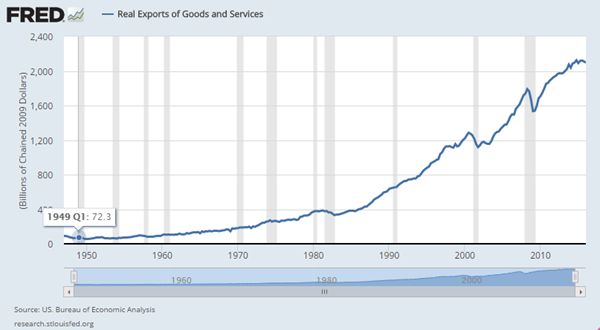
Lesson learned, after the war, the world moved toward freer trade. In that time, our real exports of goods and services rose steadily, accelerating in the mid-1980s, belying the claim that “we don’t make” stuff.

fred_graph1

As Harvard professor and former Chairman of the President’s Council of Economic Advisers Greg Mankiw recently pointed out in The New York Times, manufacturing is currently at an all-time high. The problem, as it were, is that we’re doing it with less manpower.

The Effectiveness of Efficiency

That very transformation is currently underway in the energy industry. Even after the price of oil started tanking, and rigs were idled, and jobs were being eliminated, production still increased. We became more efficient. It won’t take the same quantity of capital and labor to respond to $50 oil the next time it rises to that level. The displaced resources can be redeployed to other areas of the economy.

There are undoubtedly industry shakeups in freer markets. Labor, capital, and entrepreneurs are reshuffled. But our society encourages innovation by safeguarding intellectual and property rights. That allows us to find new and better ways of doing things.

This is just the latest example of our capacity to achieve the self-sufficiency that was the goal of our first Treasury Secretary (Mr. Hamilton) when he submitted to the second Congress suggestions of “encouragement” and “protection of government” in his “Reports on Manufactures.” All the “protection” we need for the aforementioned “encouragement” is between our ears. The human capital that we’ve built up over the years doesn’t go away, but rather accumulates.

Without free trade, there might be an erosion of two of its most important exports: peace and freedom. The world has to cooperate and get along if we all want to prosper. And the freer the people, the greater the likelihood of greater prosperity. Besides, should that peace unfortunately break down again someday, the Second Amendment and our bread basket give us time to dust off and tap that know-how to rev up the necessary industries.

Counterbalancing Deficits

Nevertheless, more trade liberalization is afoot. My industry has a new market: the rest of the world, thanks to the repeal of the oil export ban last December. That’ll surely alleviate something else nearly all our leaders are prone to complain about: our trade deficit.
fred_graph2

It’s a curious thing that you rarely hear that it’s actually only half of an equation, but it is.

The balance of payments (BoP) is basically an accounting of our international transactions. The current account (trade) is the one we always hear about when it’s in deficit. Interestingly enough, it tends to trend back toward break-even only when we’re heading toward recession. It makes sense that imports rise in good times. “We’re Americans,” I tell my students, “we like to buy stuff. We like to buy stuff so much, we rent storage facilities in which to put all our extra stuff!” Regardless, there’s nothing inherently wrong with a trade deficit.

The counterbalance is the capital account. We have a big example of that in our backyard: the Toyota plant in south San Antonio. This is foreign direct investment. That plant is in the heart of truck country. It gives Toyota direct access to that market here. And, they employ highly-skilled Texans. That seems like a win-win, a sign of strength perhaps, when a foreign company wants to locate operations here.
fred_graph3

You actually contribute to the capital account when you crack open a Bud Light after feeding Purina to Scooby, who was hungry because you forgot to feed him while you were eating a Smithfield ham steak (that had been stored in a GE freezer) for dinner before going to see “X-Men: Apocalypse” at the AMC Rivercenter 11. All those companies are foreign-owned. The profit portion of the prices paid for those goods is exported to another country. Foreign entities saw value in the brand recognition of items Americans know and love. And they were able to buy those companies in part because they do more of something that we don’t: save.

When the consumer expenditure portion of the Gross Domestic Product [GDP] started climbing in the 1980s from 60% to almost 70% today, it was arguably fueled by the concurrent proliferation of the all-purpose credit card. Perhaps it goes without saying, but when you’re spending, you’re not saving. And when you’re borrowing, you are dissaving. Much of the consumer savings derived from more efficient global production of goods could go to more savings. Instead, it seems to go toward buying more stuff.
fred_graph4

When you think about it though, our incentive to save has slid right alongside available interest rates.

fred_graph5

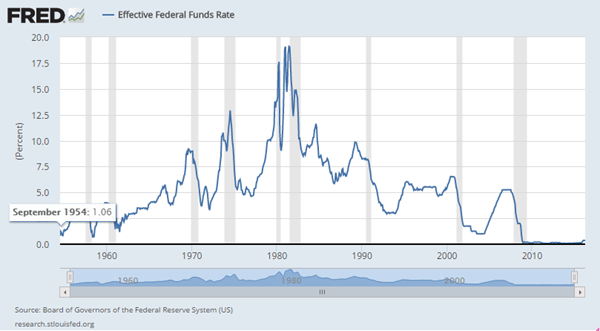
A couple years after they were pushed way up to break the inflation of the 1970s, interest rates have been on a steady march downward: ~7-8% in 1980s, ~5% in the 1990s, half that in the 2000s, and now near 0%. Monetary policy that could be enticing us to invest in learning new skills, opening a new business, guarding against unforeseen events, etc., instead has nudged us toward $1,000,000,000,000 in both credit card and automobile debt this year. What was the current trade deficit again?

If bringing down the trade deficit is the goal, increasing domestic savings and investment is preferable to erecting trade barriers. And if curbing interest-bearing consumer indebtedness happens as well, all the better.

While former Secretary of State Hillary Clinton seems like little more than a 21st century version of the pandering, “meaningless platitude-spouting” Kevin Fogerty from a classic episode of “Cheers,” Senator Bernie Sanders and Mr. Trump have been more consistent in their views toward free trade. But the aggressive tone they sometimes take toward it and our trading partners reminds me of when my four daughters (average age, 9) bicker with one another. Only it’s more understandable that my girls have to be taught to take the high road.

As for me, one of these days I could take up woodworking, or gardening, or some other hobby/trade that produces tangible output. Right now though, my spare time is best served educating. It’s what I like to do. It’s where I feel most productive. And given this season’s crop of presidential aspirants, there seems to be a need for it.


Chris Baecker

Christopher E. Baecker manages fixed assets for Pioneer Energy Services and is an adjunct lecturer of economics at Northwest Vista College in San Antonio.  He can be reached via www.chrisbaecker.com, @chrisbaecker71 & LinkedIn.com

This article was originally published on FEE.org. Read the original article.

 

Yes, We Still Make Stuff, and It Wouldn’t Matter if We Didn’t – Article by Steven Horwitz

Yes, We Still Make Stuff, and It Wouldn’t Matter if We Didn’t – Article by Steven Horwitz

The New Renaissance HatSteven Horwitz
******************************

One of the perennial complaints about the US economy is that we don’t “make stuff” anymore. You hear this from candidates from both major parties, but especially from Donald Trump and Bernie Sanders. The argument seems to be that our manufacturing sector has collapsed and that all US workers do is to provide services, rather than manufacturing tangible goods.

It turns out that this perception is wrong, as the US manufacturing sector continues to grow and in 2014 manufacturing output was higher than at any point in US history. But even if the perception were correct, it does not matter. The measure of an economy’s health isn’t the quantity of physical stuff it produces, but rather the value that it produces. And value comes in a variety of forms.

Manufacturing is Up

The path to economic growth is not to freeze into place the US economy of the 1950s. Let’s deal with the myth of manufacturing decline first. The one piece of evidence in favor of that perception is that there are fewer manufacturing jobs today than in the past. Total manufacturing employment peaked at around 19 million jobs in the late 1970s. Today, there are about 12.5 million manufacturing jobs in the US.

However, manufacturing output has never been higher. The real value of US manufacturing output in 2014 was over $2 trillion. The real story of the US manufacturing sector is that we have become so much more efficient, that we can produce more and more manufactured goods with less and less labor. These efficiency gains are largely the result of computer technology and automation, especially in the last fifteen years.

The labor that we no longer need in order to produce an ever-increasing amount of stuff is now available to produce a whole variety of other things we value, from phone apps to entertainment to the expanded number and variety of grocery stores and restaurants, to the data analyses that makes all of this growth possible.

Just as the workers in those factories we are so nostalgic for were labor freed from growing food thanks to the growth in agricultural productivity, so are today’s web designers, chefs at the newest hipster café, and digital editors in Hollywood the labor that has been freed from producing “stuff” thanks to greater technological productivity.

Or, put differently: those agricultural, industrial, and computer revolutions collectively have enabled us to have more food, more stuff, and more entertainment, apps, services, and cage-free chicken salads served with kale. The list of human wants is endless, and the less labor we use to satisfy some of them, the more we have to start working on other ones.

But notice something: all of the things that we produce have something in common. Whether it’s food or footwear, or automobiles or apps, or manicures or massages, the point of production is to rearrange capital and labor in ways that better satisfy wants. In the language of economics, the point of production (and exchange) is to increase utility.

When we produce more cars that people wish to buy, it increases utility. When we open a new Asian fusion street food taco stand, it increases utility. When Uber more effectively uses the existing stock of cars, it increases utility. When we exchange dollars for manicures, it increases utility.

Adam Smith helped us to understand that the wealth of nations is not measured by how much gold a country possesses. Modern economics helps us understand that such wealth is not measured by how much physical stuff we manufacture. Increases in wealth happen because we arrange the physical world in ways that people value more.

Neither producing cars nor providing manicures changes the number of atoms in the universe. Both activities just rearrange existing matter in ways that people value more. That is what economic growth is about.

Misplaced Nostalgia

We’re richer because we have allowed markets to produce with fewer workers. When we are fooled into believing that “growth” is synonymous with “stuff,” we are likely to make two serious errors. First, we ignore the fact that the production of services is value-creating and therefore adds to wealth.

Second, we can easily believe that we need to “protect” manufacturing jobs. We don’t. And if we try to do so, we will not only stifle economic growth and thereby impoverish the citizenry, we will be engaging in precisely the sort of special-interest politics that those who buy the myth of manufacturing often rightly complain about in other sectors.

The path to economic growth is not to freeze into place the US economy of the 1950s. We are far richer today than we were back then, and that’s due to the remaining dynamism of an economy that can still shed jobs it no longer needs and create new ones to meet the ever-changing wants of the consumer.

The US still makes plenty of stuff, but we’re richer precisely because we have allowed markets to do so with fewer workers, freeing those people to provide us a whole cornucopia of new things to improve our lives in endless ways. We can only hope that the forces of misplaced nostalgia do not win out over the forces of progress.

Steven_Horwitz

Steven Horwitz

Steven Horwitz is the Charles A. Dana Professor of Economics at St. Lawrence University and the author of Hayek’s Modern Family: Classical Liberalism and the Evolution of Social Institutions.

He is a member of the FEE Faculty Network.

This article was originally published on FEE.org. Read the original article.

We’re Going Deeper into Debt as Real Incomes Fall – Article by Victor Xing

We’re Going Deeper into Debt as Real Incomes Fall – Article by Victor Xing

The New Renaissance HatVictor Xing

New York Fed President Dudley recently commented that “real consumer spending growth appears to have moderated somewhat from the relatively robust pace of the second half of 2015.” While this may suggest headwinds from cyclical economic conditions, there are emerging signs that ultra-accommodative policy also acts as a constraint on consumer spending via income effects. Instead of inducing savers to spend and borrow, rapid asset price appreciation as a result of monetary easing has outpaced wage growth, and pass-through services inflation subsequently reduced discretionary income and forced already-levered consumers to save instead of spend. This unintended consequence worked against accommodative policy’s desired substitution effects and suggests further easing would likely yield diminishing results if asset price appreciation continues to outpace real income growth.

Asset Price and Services Inflation Outpaced Real Wage Growth
Post-2008 policy accommodation broadly lowered funding costs for consumers and businesses to supported asset price appreciation. However, rising prices have also made assets less affordable, and home buyers “priced out” of their respective housing markets subsequently became involuntary renters. Not only do they not benefit from rising home values, higher education, and medical care inflation also outpaced aggregate real wage growth (Chart 1) to weigh on renters’ discretionary spending.

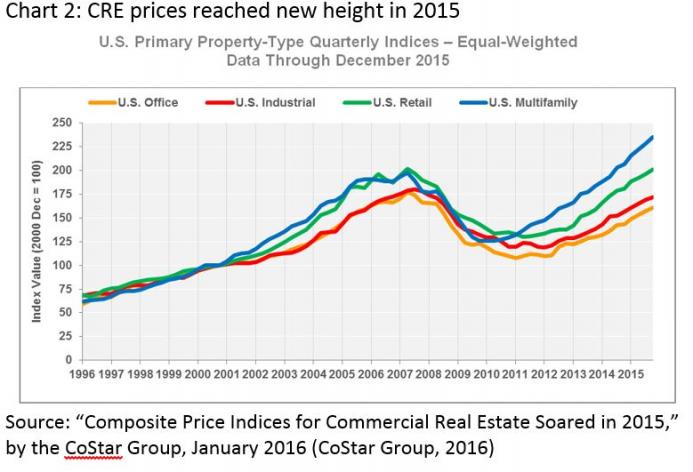
xing1In response with rising commercial real estate prices (Chart 2), businesses also pass on higher operating costs in the form of services inflation. Year-over-year personal consumption expenditure — services (chain-type price index) has been well-anchored in the 2% range (2.13% in Feb 2016) since 4Q 2011.

xing2Another factor constraining consumer spending is the well-publicized effect of student debt burden. This supports a view that household spending may be at a lower potential than during prior cycles, thus magnifying the costs of higher services inflation as a result of asset price appreciation.

Consumers Redlining their Engines: Inability To Pay $400 Emergency Expense
Accommodative monetary policy encourages consumers to spend and borrow rather than hoarding cash. However, cash-strapped consumers already facing the pressure of debt burden would likely do neither.

Federal Reserve’s recent Report on the Economic Well-Being of U.S. Households highlighted signs that some consumers are already stretching their spending power to meet existing obligations. 47% of respondents reported that a $400 emergency expense would be “more challenging to handle” (unable to use cash or a credit card that they pay off at the end of the mouth). Results from middle-income household with $40,000 to $100,000 annual income were similarly downbeat, where 44% of respondents indicated difficulties (Chart 3).

Chart 3: Percent of respondents who would completely pay an emergency expense that costs $400 using cash or a credit card that they pay off at the end of the month (by race/ethnicity and household income)

xing3Source: Federal Reserve Board of Governors

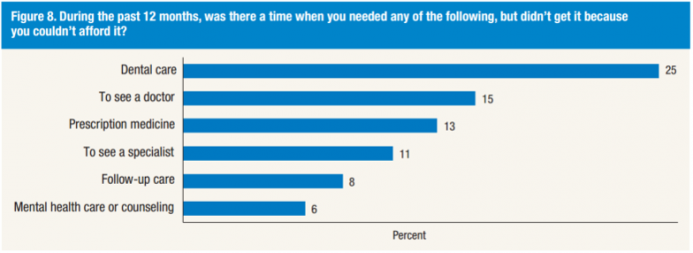
Chart 4: During the past 12 months, was there a time when you needed any of the following, but didn’t get it because you couldn’t afford it?

xing4Source: Federal Reserve Board of Governors

A survey on health-care expenses was also discouraging. 31% of respondents reported going without some type of medical care in the preceding 12 months due to inability to afford the cost. 45% of those surveyed under a household income of $40,000 reported similar decisions to defer treatment.

In the section “spending relative to income,” Fed researchers reported that one-in-five respondents with spending exceeded their income (leveraged spending). These are signs that consumers were taking advantage of lower rates, but the spending does not appear to be sustainable without corresponding rise in real wage growth.

Rising Renter Cost Burden
Another factor constraining discretionary spending is rising renter cost burden. The Harvard Joint Center for Housing Studies projected a “fairly bleak picture of severe renter burden across the U.S. for the coming decade.” The report acknowledged falling incomes among renters and the persisting gap between renter income and renter housing costs (Chart 6), as well as severely burdened renter households (housing costs of more than 50% of household income) reaching 11.8 million in 2015 (Chart 7), or about one in four renters.

Assuming the correlation between rental price inflation and asset price inflation holds, further declines in housing affordability as a result of policy easing would exacerbate renter burden — one likely needs rising real wages to offset.

Chart 5: In the past 12 months, would you say that your household’s total spending was more, less, or the same as your income? (by household income)

xing5Source: Federal Reserve Board of Governors

xing6xing7

Impacts of “Long and Variable Lags” Between Asset Price Inflation and Real Wage Growth
Financial market participants play an essential role in the transmission of Federal Reserve’s monetary policy by affecting financial conditions — the following components are part of the GS Financial Conditions Index:

  • Short-term bond yield
  • Long-term corporate credit spread
  • Stock market variable
  • Exchange rate

The Federal Reserve only has effective control of the very front-end of the Treasury curve via conventional monetary policy. Nevertheless, unconventional policies such as QE, as well as forward guidance on SOMA principal reinvestments also allow the central bank to affect longer-term funding costs via the expectations and “recruitment channel.” Under this mechanism, asset prices take little time to react to changing policy stances, while impacts on income growth and economic conditions would often take longer to manifest.

Such lag between asset price appreciation and changing economic conditions carries a hidden cost — if asset price inflation becomes well entrenched ahead of broad-based economic growth, those without assets would be penalized just to maintain their life-style, and the reduction in their discretionary spending would serve as a disinflationary drag to Federal Reserve’s effort to reflate the economy.

Conclusion
Inefficiencies within the monetary policy transmission mechanism have resulted in income effects becoming greater than the substitution effects. Under this scenario, ultra-accommodative policy may induce further saving by asset-less consumers to further weigh on aggregate demand. Additionally, policymakers should exercise caution if increasingly aggressive and unconventional reflationary policies do not yield intended results.

Victor Xing is founder and investment analyst at Kekselias, Inc. He is formerly a fixed-income trading analyst for the Capital Group Companies with 5 years of experience on its interest rates trading desk.

This article was published on Mises.org and may be freely distributed, subject to a Creative Commons Attribution United States License, which requires that credit be given to the author.

Why Modern Luddites Are Attacking Uber Drivers – Article by Mateusz Machaj

Why Modern Luddites Are Attacking Uber Drivers – Article by Mateusz Machaj

The New Renaissance HatMateusz Machaj
******************************

Earlier this year, a number of Uber cars in Poland came under attack by a group of vandals who were likely taxi drivers. In general, these types of vandalism have a long tradition in human history and have contributed to keeping populations’ general living standards at very low levels.

Attacks on Uber drivers are simply the latest chapter in a long story of efforts to intimidate and destroy innovators who are moving markets and societies in new and unfamiliar directions.

Reactions to Early Machines
For a very long time, separation of grain from the chaff was done in a very primitive manner. The process took weeks, involved hard working men, hard working women feeding them, and also children working as additional helpers. Finally, someone invented a threshing machine that allowed farmers to get rid of all this hard work: the machine could do the job much faster with less physical labor involved.

The change happened contrary to what many historical books claim: the move to threshing machines did not occur because of the patent system put in place 150 years before the change. It happened because social and political forces were too weak to stop it from happening.

Beginning in the eighteenth century in Europe, the entrepreneurial class was growing. They were a group of small profit-driven innovators interested in selling various products, and beating their competitors to markets. This “Great Change” was driven forward by many cultural, religious, political, legal, and technological factors.

At first, threshing machines were very imperfect. They didn’t always work well, and they also were expensive. There was a lot of room for improvements, and for making them better, faster, and cheaper. As they were slowly improved, it quickly became apparent the new machines were more efficient than the old manual methods. It was only a matter of time until someone would realize that steam engines could be combined with the threshing machines.

Not surprisingly, threshing machines were not welcomed by everyone. Swing Riots flared up and the Luddite movement attempted to crush technological innovation. Despite such obstacles, the entrepreneurs won out, paving the way for the future chain of market innovations, well symbolized by the modern farmer sitting in the modern air-conditioned tractor (with a good stereo system). Over the past two hundred years, agricultural workers were reduced from more than 80 percent of workers to less than 5 percent.

Economic Growth and Social Change
One of the big mysteries of human history is the question of why rapid technological and innovative growth started only around the nineteenth century. Many new ideas and technological changes were present for ages (and invented centuries before). Other cultures introduced many new innovative ideas as well.

Some steam engines were even being used in ancient times. They were applied in narrow places, however, due to social and political circumstances.

One early example of political resistance is related to us through the Roman Emperor Vespasian’s opposition to new labor saving innovations. Faced with the prospect of replacing workers with machines, Vespasian reputedly said: “You must let me feed my poor commons.”

Vespasian’s reaction is understandable; it is hard to predict what will happen in response to innovations that make certain job skills obsolete. And it’s not just the workers who fear the change. The ruling class, faced with an idle and unemployed population might also fear social upheaval.

The words of Peter Green summarize many of these concerns:

The ruling class were scared, as the Puritans said, of Satan finding work for idle hands to do. One of the great things about not developing the source of energy that did not depend on muscle power was the fear of what the muscles might get up to if they weren’t kept fully employed. The sort of inventions that were taken up and used practically were the things that needed muscle power to start with, including the Archimedean screw. On the other hand, consider that marvelous box gear of Hero’s: it was never used. That would have been a real conversion of power. What got paid for? The Lagids tended to patronize toys, fraudulent temple tricks in large quantities, and military experiments.

Naturally, human history is complicated and subject to many different factors. Nevertheless, there appears to be some truth in the argument that fixed social and political structure did not favor society open to the widespread adoption of innovation. Otherwise, it is hard to explain why so many new technical discoveries were not applied for so long, even though science and intelligence supplied them centuries before. We had to wait for the new political and social arrangements that either were tolerant of new innovations, or were unable to stop them.

Uber and Beyond
Everywhere we look, we see both the creative and destructive power of innovation. First threshing machine sellers lead to reductions in agricultural employment. Later, tractors killed the threshing machines. Telegraph and railway killed communication systems that relied on horses. Cars destroyed the horse industry. Mass production of textiles destroyed the demand for hand-crafted items. Big stores destroyed smaller shops, now discount shops (in parts of Europe) are destroying big stores. Video rentals hampered the cinema industry, now Netflix and others killed video rentals, while Napster’s success (despite its illegality) predicted a coming end to the old music industry. China’s growth and cheap efficient outsourcing reshaped traditional industries in developed countries. (From an economic perspective there is no difference between hiring cheaper labor or hiring a better machine.)

Dell smashed the traditional computer industry with eliminating many middle men. Ikea did something similar in the furniture industry. The internet destroyed regular newspapers, while Google smashed the marketing industry. Amazon destroys bookstores around the world, while Uber is doing the same with the taxi industry.

Economic progress decreases employments in one place, allows for creation of new ones, even in the service sector. During the process of liquidating employment positions, huge economic development is capable of multiplying per capita production within one generation, positively affecting all social classes.

The current state of affairs is not the end of history. Those companies, innovative today, will be endangered tomorrow. Even Jeff Bezos, creator of Amazon.com, admits Amazon won’t last forever:

Companies have short life spans. … And Amazon will be disrupted one day. I don’t worry about it ’cause I know it’s inevitable. Companies come and go. And the companies that are, you know, the shiniest and most important of any era, you wait a few decades and they’re gone.

Mateusz Machaj, PhD in economics; is a founder of the Polish Ludwig von Mises Institute. He has been a summer fellow at the Ludwig von Mises Institute. He is assistant professor at the Institute of Economic Sciences at the University of Wroclaw.

This article was published on Mises.org and may be freely distributed, subject to a Creative Commons Attribution United States License, which requires that credit be given to the author.