Browsed by
Category: Economics

Why Was Coffee Drinking Once Scandalous? – Article by Jeffrey A. Tucker

Why Was Coffee Drinking Once Scandalous? – Article by Jeffrey A. Tucker

The New Renaissance Hat
Jeffrey Tucker
******************************

In 18th-century Europe, many products and services reached a newly emergent middle class for the first time in human history. The capitalist age was maturing, and that meant that average people had money for the first time and lots of choices on how to spend it. One of the new products they could buy was coffee. With that came a great deal of social suspicion and even dread.

None other than Johann Sebastian Bach satirized the puritanical fear of coffee in his delightful and witty “Coffee Cantata.” It was one of the few times he ever tried his hand at pure pop entertainment. Of course he succeeded brilliantly; he was Bach after all!

The “Coffee Cantata” tells the story of a daughter who scandalized her father due to her devotion to coffee. She couldn’t stop singing about how wonderful it is, while her father corrected her constantly.

“You naughty child, you wild girl, ah!” the father yells at his daughter. “When will I achieve my goal: get rid of the coffee for my sake!”

“Father sir, but do not be so harsh!” she responds. “If I couldn’t, three times a day, be allowed to drink my little cup of coffee, in my anguish I will turn into a shriveled-up roast goat.”

She happily agrees to do everything he says in every area of life except one: she will not give up coffee.

And then follows a beautiful tribute to coffee: “How sweet coffee tastes, more delicious than a thousand kisses, milder than muscatel wine. Coffee, I have to have coffee, and, if someone wants to pamper me, ah, then bring me coffee as a gift!”

The father threatens her: “If you don’t give up coffee for me, you won’t go to any wedding parties, or even go out for walks.”

She still refuses.

Then the daughter plays a little game. She has a husband in mind and extracts from him a promise that if she marries him, he must allow her to drink coffee. He agrees. Then she goes to her father, who opposes the marriage, and makes a deal: if she is permitted to marry him, she will give up coffee. The father is delighted, and agrees.

Thus does the daughter gain a new husband, and, much more importantly, a permanent right to drink coffee whenever she wants!

What was this fear of coffee? Why was this such a big deal? It does have some narcotic properties to it, as we all know so well. It can give you a delightful lift.

But that alone does not account for the early opprobrium with which coffee-drinking, particularly for young girls, was greeted. For a fuller account, we need to understand something larger and more socially transformative: the advent of the coffee house itself.

The coffee house was one of the earliest public institutions, operating on a purely commercial basis, that brought a wide variety of social classes, not to mention a mixture between men and women, in a market-based social setting. In the 18th century, coffee houses spread all over Europe and the UK, attracting young people who would sit and drink together and discuss politics, religion, and business, and exchange any manner of ideas.

What the father in the Cantata is actually objecting to is not coffee as such but unapproved, unchaperoned social wanderings.

The Loss of Control

This was a huge departure from the tradition that entitled parents and other social authorities, including governments, to determine what kind of associations their children would have. Coffee houses introduced a kind of anarchy to the social structure, and introduced new risks of randomized contact with ideas and people that parents could no longer control. Coffee represented freedom itself – the freedom to mix, mingle, and consume what one wanted.

Indeed, coffee houses became a great source of public controversy. In England, in the 17th Century, Charles II tried to ban them all on grounds that they were “places where the disaffected met, and spread scandalous reports concerning the conduct of His Majesty and his Ministers.” Even a century later, women were banned from attending them, and this was true in France as well. Germany had more liberal laws concerning women and coffee but public suspicion was still high, as the “Coffee Cantata” suggests.

houghton_ec65a100674w_-_womens_petition_against_coffee

Women who were banned from coffee houses developed a very clever response. In the famous “Women’s Petition Against Coffee” of 1674, women said that coffee was responsible for the “enfeeblement” of men. Historians say the campaign contributed to the gender integration of coffee houses.

We see, then, that the commercial availability of coffee actually contributed to the advance of women’s rights!

Looking back at the astonishing success of Starbucks in our own time, it doesn’t seem surprising. They too serve as gathering spots, social mixers, places of business, and centers of conversation and ideas. We are more accustomed to it now than centuries ago, and yet even today, how much political controversy is engendered by access to products and services of which social authorities disapprove?

War on pot anyone?

As the “Coffee Cantata” concludes:

Cats do not give up mousing,
girls remain coffee-sisters.
The mother adores her coffee-habit,
and grandma also drank it,
so who can blame the daughters!

 

Jeffrey Tucker


Jeffrey Tucker

Jeffrey Tucker is Director of Content for the Foundation for Economic Education and CLO of the startup Liberty.me. Author of five books, and many thousands of articles, he speaks at FEE summer seminars and other events. His latest book is Bit by Bit: How P2P Is Freeing the World.  Follow on Twitter and Like on Facebook. Email. 

This article was originally published on FEE.org. Read the original article.
Our Economic Malaise Is Impacting Young Workers the Most – Article by Ryan McMaken

Our Economic Malaise Is Impacting Young Workers the Most – Article by Ryan McMaken

The New Renaissance Hat
Ryan McMaken
******************************

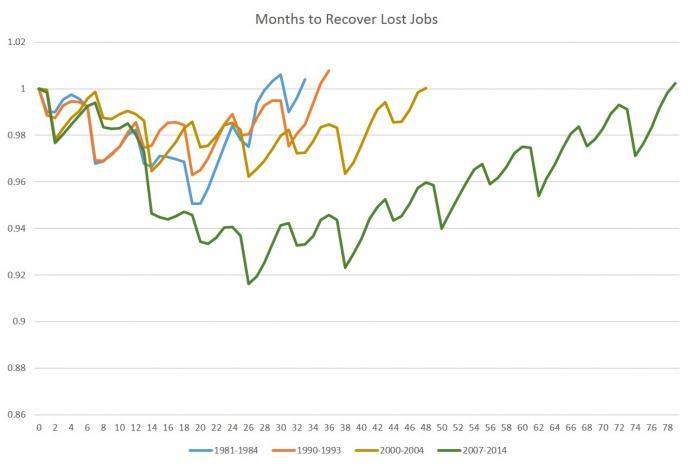
In the wake of the 2007-2009 recession, 78 months passed before employment returned to where it had been before the crisis. This was, by far, the longest period needed to recover from job losses in decades. The second-longest period needed to recover jobs occurred after the 2002 recession when about 50 months were needed to recover lost jobs:

economic_malaise_young_people_1

Moreover, we see that in recent cycles, job growth during each recovery has been getting weaker and weaker over time:

economic_malaise_young_people_2

Some observers of the rose-colored-glasses-wearing variety have attempted to explain away the most recent malaise in job gains by claiming that fewer jobs are needed because so many Baby Boomers are aging out of the work force, and because people are so much wealthier, they argue, workers are leaving the labor force for non-economic reasons. That is, people are leaving the labor force for reasons other than being discouraged workers.

These claims are plausible, but the empirical data we have does not support them.

Keep in mind that ever since the 2007-2009 recession, the U-6 unemployment rate, which includes underemployed workers (i.e., involuntary part timers) and discourage workers, has reached multi-decade highs in recent years, and even now, is only at levels seen during the worst of the last recession:

economic_malaise_young_people_3

This is not simply a matter of fewer jobs being created because workers are going away.

To get a sense of the situation, we have to first look at the demographics of the working age population and the labor force.

(This demographic data on the working-age population is only currently available through the first quarter of 2015, so the time series ends in early 2015.)

economic_malaise_young_people_4

The top line is the total working age population (ages 15-65) published by the OECD and the World Bank. According to this measure, there is no decline in the working age population.

If people were aging out of the work force in droves to the point of driving a net exodus, we would see a downturn in the blue line. We don’t see that. In fact, from the beginning of the last recession at the end of 2007 to the first quarter of 2015, the working age population increased by 7.5 million people.

During that same period, the US economy added 801,000 jobs. That is, after the initial loss of 10 million jobs, the US economy began to add jobs again, but after more than seven full years, had only added a net of 801,000 jobs.

But maybe only 801,000 jobs were added because very few of those 7.5 million people wanted to be in the work force.

Well, it’s a safe bet that not all of them wanted to be in the work force, but we do know that using the standard BLS measure for the work force that 2.4 million people entered the work force during the period when only 801,000 jobs were added. (See the green line above.) That means over that time period, you had 1.6 million new people in the labor force while half that many jobs were added.

And this labor force measure only takes into account active job seekers and employed people. It ignores discouraged workers and involuntary part timers.

So we find that both the official labor force and the working age population were increasing at levels substantially above the employment levels.

Indeed, the only way we can find a number that suggests more jobs were added than workers is to look at the working-age population for ages between 25 and 54. That is, if we exclude all potential workers under 25 and all above 54, then yes, the working age population did decline by 1 million jobs. (See the red line above.)

In real life, though, the work force includes quite a few people who are, say, 22 years old, and quite a few who are 60 years old. If those people are included, the working age population is growing considerably.

Meanwhile, workforce participation has been falling for a number of years, and is now at some of the lowest levels that have been seen in more than 30 years. From 2014 to 2016, work force participation ranged from about 62 percent to 64 percent. That’s the lowest participation rate seen since the the early 1980s.

economic_malaise_young_people_5

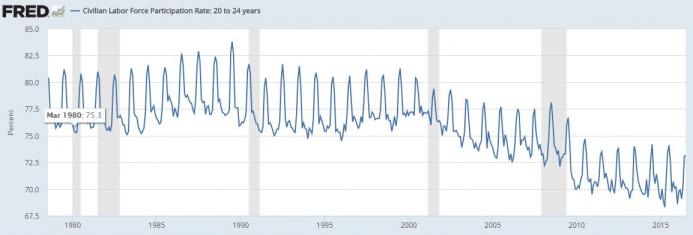
Many have assumed this means that many older workers are leaving the work force. Unfortunately, it seems that it is young workers who are most likely to leave the labor force, which is problematic for future productivity. For young workers in the 20-24 age range, work force participation has been falling for more than a decade, and fell off significantly during the last recession:

economic_malaise_young_people_6

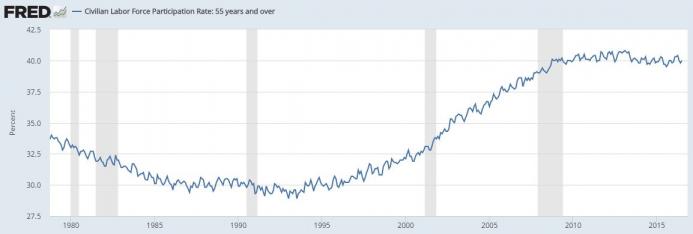
Meanwhile, labor force participation for 55-and-older individuals has held steady:

economic_malaise_young_people_7

It appears unlikely that it is now unnecessary to add jobs at a rate comparable to past recoveries because so many older workers are leaving the work force. Nor is it likely that young people are leaving the work force because they are so prosperous. It’s more likely that young people are leaving the work force as discouraged workers.

This supposition is further strengthened by the fact that the unemployment rate in the 16-24 age range has been above 10 percent for the past nine years. It was especially high even before the last recession.

But, unemployment among over-55 workers is among the lowest of all demographic groups, with a rate between 3 percent and 4 percent in recent years.

In other words, older workers are sticking around and doing relatively well. It appears that younger workers, meanwhile, are more likely to be unemployed, underemployed, or even totally out of the workforce as discouraged workers.

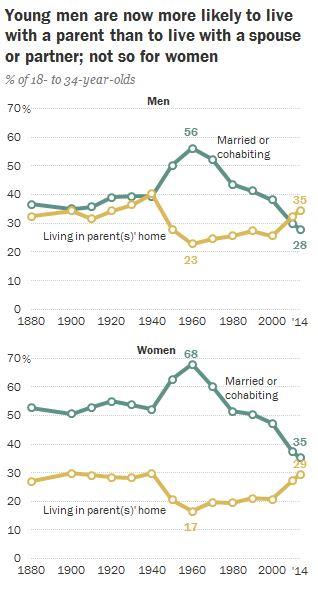
One phenomenon that gives us a reason to think this is the fact that the number of young people living with their parents has reached historic highs in the United States. As Pew recently reported:

In 2014, for the first time in more than 130 years, adults ages 18 to 34 were slightly more likely to be living in their parents’ home than they were to be living with a spouse or partner in their own household.

Living at home is more likely for men than for women, but in both cases, more young people are living with their parents than during any other period since World War II:

economic_malaise_young_people_8

Those who attempt to spin the current job numbers as simply the effects of people happily leaving the work force appear to be mistaken in assuming that older workers are leaving, and that younger workers need not work because they’re so unusually productive.

If young workers were so productive, is it too much to believe that they would choose to rent an apartment rather than live with their parents?

Once we look a the demographics behind the current job numbers, we actually find the situation is more alarming that we might have thought otherwise. We seem to be in a situation where younger workers are participating in the work force less, and putting off acquiring essential job skills that will lead to more productivity later.

Older workers are still sticking around in numbers large enough to keep the overall labor force number growing.

However, while both the working age population and the labor force are growing, overall job creation simply is not keeping up.

At some point, those 30-year olds living with their parents are doing to need full-time work, but will they have the job experience necessary (and thus the productivity) necessary to support the lifestyle to which they have become accustomed?

Or, will they simply enter the workforce with few job skills following a decade of part-time work or no work forced on them by our weak economy? When that happens, we’re likely to see a continued decline in the household and personal incomes.

Ryan W. McMaken is the editor of Mises Daily and The Free Market. He has degrees in economics and political science from the University of Colorado, and was the economist for the Colorado Division of Housing from 2009 to 2014. He is the author of Commie Cowboys: The Bourgeoisie and the Nation-State in the Western Genre. 

This article was published on Mises.org and may be freely distributed, subject to a Creative Commons Attribution United States License, which requires that credit be given to the author.

The ADA Attack on Online Courses Hurts the Disabled, Too – Article by Alex Tabarrok

The ADA Attack on Online Courses Hurts the Disabled, Too – Article by Alex Tabarrok

The New Renaissance HatAlex Tabarrok
******************************

The Department of Justice has sent a letter to UC Berkeley threatening a lawsuit unless the university modifies all of its free online educational materials to meet conditions of accessibility. In response the Vice Chancellor for Undergraduate Education writes:

…we have attempted to maximize the accessibility of free, online content that we have made available to the public. Nevertheless, the Department of Justice has recently asserted that the University is in violation of the Americans with Disabilities Act because, in its view, not all of the free course and lecture content UC Berkeley makes available on certain online platforms is fully accessible to individuals with hearing, visual or manual disabilities.

…We look forward to continued dialog with the Department of Justice regarding the requirements of the ADA and options for compliance. Yet we do so with the realization that, due to our current financial constraints, we might not be able to continue to provide free public content under the conditions laid out by the Department of Justice to the extent we have in the past.

In many cases the requirements proposed by the department would require the university to implement extremely expensive measures to continue to make these resources available to the public for free. We believe that in a time of substantial budget deficits and shrinking state financial support, our first obligation is to use our limited resources to support our enrolled students. Therefore, we must strongly consider the unenviable option of whether to remove content from public access.

In short, the DOJ is saying that unless all have access, none can and UC Berkeley is replying that none will. I sympathize with UC Berkeley’s position. The cost of making materials accessible can be high and the cost is extremely high per disabled student. It would likely be much cheaper to help each disabled student on an individual basis than requiring all the material to be rewritten, re-formatted and reprogrammed (à la one famous example).

An even greater absurdity is that online materials are typically much easier to access than classroom materials even when they do not fully meet accessibility rules. How many teachers, for example, come with captions? (And in multiple languages?) How about volume control? How easy is it for the blind to get to campus? In theory, in-class materials are also subject to the ADA but in practice everyone knows that that is basically unworkable. I guarantee, for example, that professors throughout the UC-system routinely show videos or use powerpoints that do not meet accessibility guidelines. Thus, by raising the costs of online education, the most accessible educational format, the ADA may have the unintended consequence of slowing access. Put simply, raising the costs of online education makes it more difficult for anyone to access educational materials including the disabled.

Addendum: By the way, if you are wondering, all of MRU’s videos for our Principles of Microeconomics and Principles of Macroeconomics courses are captioned in English and most are also professionally captioned in Spanish, Arabic and Chinese.

This post first appeared at Marginal Revolution.

Alex Tabarrok is a professor of economics at George Mason University. He blogs at Marginal Revolution with Tyler Cowen.

Does Star Trek Boldly Go Beyond Scarcity? – Article by Frederik Cyrus Roeder

Does Star Trek Boldly Go Beyond Scarcity? – Article by Frederik Cyrus Roeder

The New Renaissance HatFrederik Cyrus Roeder
******************************

As a long-time Trekkie (with several conventions and selfies with William Shatner) and an economist, I was more than delighted when a good friend of mine gave me the recently published book Trekonomics: The Economics Behind Star Trek by Manu Saadia.

Saadia’s highly exciting book attempts to explain the economy of Star Trek and describes the Federation of United Planets (which includes Earth) as a post-scarcity society that no longer uses money because everyone maximizes their utility by just doing what they want to do. The main driving force behind people’s behavior is vanity, not profit. He calls this economic system “Trekonomics.”

Economics Is an Intergalactic Concept

While describing a post-scarcity society, Saadia admits that there are some resources that are scarce. He mainly focuses on dilithium crystals that are the source of energy in the Star Trek universe:

Logic would dictate that near-absolute abundance has driven prices to zero on all but few strategic goods. These strategic goods are of limited use for most people anyway. I do not need a big chunk of dilithium crystals in the course of my everyday life. Matter-antimatter power plants require it, whether on board starships or on the ground, but not me. I am not in the market for it, society as a whole is.

While Saadia praises the replicator (Star Trek’s version of the universal 3D printer) as the driving force behind post-scarcity, he omits the fact that replicators (and holodecks, and warp drives needed in delivery shuttles bringing the latest vintage of Chateau Picard to your cottage on Mars) require energy in order to create food out of nothing.

If there’s a shortage of dilithium, there needs to be a market in order to efficiently allocate energy. Therefore, every individual is interested in a sufficient supply of dilithium crystals. An analogy to our world can be seen in oil dwells or nuclear power plants. While individuals rarely explore oil fields or build power plants, they do purchase their product (energy) on a daily basis.

Even if every one of the tens of billions of citizens of the Federation would act altruistically, it would be impossible to allocate energy to the projects with the highest priority. Only central planning or a market for energy can solve this.

The 24th century’s technological progress has reduced all physical resources to one: energy. Humans and aliens can nearly produce everything out of energy. This is great and probably significantly cuts down value/supply-chains, but there is still scarcity.

Price Controls in the Trek Universe

The value chain of the Federation’s economy most likely includes the following few stakeholders: dilithium explorers and miners, dilithium transporters/shippers, dilithium power plant operators, power grid operators, B2B replicator manufacturers (those replicators that replicate replicators), replicator owners, and replicator maintenance providers. 

Assuming there’s a natural monopoly in running these services, one company or institution running all of this might also be thinkable (though given our experiences with centrally managed energy supply, I would highly doubt that there’s a natural monopoly in the dilithium value chain).

Without a price for the resource energy, a single individual could deplete the Federation’s dilithium supplies by merely replicating a galaxy full of larger-than-life Seven of Nine action figures. Thus a price system for energy is crucial in order to allow consumer choice in the Federation. The only other way to solve this issue would be the creation of the United Socialist Republics of the Galaxy (USRG) and centrally plan the energy distribution. Good luck with queuing for holodeck time in that USRG!

Light-Speed, Among Other Things, Isn’t Immune to Scarcity

Dilithium seems to perfectly qualify as a private good because both rivalry (it is scarce and you need to find it somewhere in deep and hostile space) and exclusivity (it’s pretty easy to cut someone off the energy grid) apply.

While Saadia acknowledges the scarcity of dilithium, he misses several other scarce goods:

Private Property: rivalry also exists when it comes to the use of land. Imagine a beautiful cliff in Europe that gives you a perfect view of Saturn during sunset. The cliff has space for exactly one cottage. Who decides who can build and live there? Galactic homesteading is probably a feasible means of solving this problem in times of early inter-planetary exploration, but the moment the galaxy gets more crowded, a land-registry proving property rights will be necessary in order to prevent and solve disputes and facilitate the transfer of ownership.

Unique locations and goods: Saadia admits that there’s a scarcity of seats at Sisko’s restaurant or bottles of the famous Chateau Picard, but as people have overcome the idea of enjoying status, they are not interested in over-consuming such gems in the galaxy.

In trekonomics, the absence of money implies that status is not tied to economic wealth or discretionary spending. Conspicuous consumption and luxury have lost their grip on people’s imaginations. The opposition between plenty and scarcity, which under our current conditions determines a large cross section of prices and purchasing behaviors, is no longer relevant.

This reasoning comes short in explaining how people demand dinner at Sisko’s or a good bottle of wine at all, and what happens if the demand is higher than the supply. Would first customers start hoarding? Are there black markets for these non-replicated goods and experiences?

Incentives: a Terran settler on Mars craves the 2309 vintage of Chateau Picard and wants to get it delivered in light speed from the South of France. How do we incentivize the shuttle pilot (beaming wine spoils the tannins) to stop soaking in the sun in the Mediterranean and swing his body behind the helm of a shuttle? How do we compensate him for the time and energy he spent delivering the wine to the Red Planet? If vanity is the major driving force in trekonomics, one can just hope that someone sees more vanity in the delivery of this excellent wine instead of chugging it day-in day-out himself. A more realistic way of getting people to do (annoying) things is to create incentives (e.g. to pay in dilithium units).

Live long and prosper as long the central planners allow it?

Star Trek Federation is a great thought experiment on what a post-scarcity society could look like. However, there are major shortcomings such as the allocation of property rights, a price system for energy, incentivization of services, and the existence of rivalry.

A free, prosperous, and open society such as the Federation can only function with a price system in place in order to deal with the scarcity of energy. If trekonomics would really be applied in the Federation, we would see a much more repressive version of this interplanetary union forcing its citizens to work in certain professions and rationing energy.

frederik-roeder


Frederik Cyrus Roeder

Fred Roeder is the Vice President of Students for Liberty and member of the Executive Board at Young Voices. He is based in Germany.

This article was originally published on FEE.org. Read the original article.
For the Separation of Stadium and State – Article by David R. Henderson

For the Separation of Stadium and State – Article by David R. Henderson

The New Renaissance HatDavid R. Henderson
******************************

The title of this post is the same as the title of an article by Jonah Goldberg about the Colin Kaepernick incident. (If you haven’t been paying attention to the NFL lately, here’s the summary: Kaepernick is a San Francisco 49er who refused, and still refuses, to stand for the U.S. national anthem.)

I had been pondering writing a similar piece myself. And then I saw his title. Darn, I thought, Goldberg has beat me to it.

Except that he didn’t.

Goldberg’s article is all about his narrow way of keeping politics out of sports: players should stand for the national anthem. Some people would see this as a way of inserting politics into sports.

That means that people who don’t like what Kaepernick did are being forced to pay for the very property on which he did it.

But how would you keep politics out of sports in a fundamental way? It would be by not forcing people to pay for sports.

You don’t have to know a lot about the 49ers or the NFL to know that local governments tax their residents and others heavily to pay for luxurious stadiums.

That means that people who don’t like what Kaepernick did are being forced to pay for the very property on which he did it. On the other hand, it also means that people who don’t like the flag-waving that goes on at NFL games are also forced to pay for the property on which that occurs.

There’s a simple solution here: actually separate sports and state. That is, quit forcing taxpayers to pay for sports.

Now that’s a solution that I will salute.


david-r-henderson
David R. Henderson

David Henderson is a research fellow with the Hoover Institution and an economics professor at the Graduate School of Business and Public Policy, Naval Postgraduate School, Monterey, California. He is editor of The Concise Encyclopedia of Economics (Liberty Fund) and blogs at econlib.org.

This article was originally published on FEE.org. Read the original article.

The Fed Plans for the Next Crisis – Article by Ron Paul

The Fed Plans for the Next Crisis – Article by Ron Paul

The New Renaissance HatRon Paul
******************************

In her recent address at the Jackson Hole monetary policy conference, Federal Reserve Chair Janet Yellen suggested that the Federal Reserve would raise interest rates by the end of the year. Markets reacted favorably to Yellen’s suggested rate increase. This is surprising, as, except for one small increase last year, the Federal Reserve has not followed through on the numerous suggestions of rate increases that Yellen and other Fed officials have made over the past several years.

Much more significant than Yellen’s latest suggestion of a rate increase was her call for the Fed to think outside the box in developing responses to the next financial crisis. One of the outside-the-box ideas suggested by Yellen is increasing the Fed’s ability to intervene in markets by purchasing assets of private companies. Yellen also mentioned that the Fed could modify its inflation target.

Increasing the Federal Reserve’s ability to purchase private assets will negatively impact economic growth and consumers’ well-being. This is because the Fed will use this power to keep failing companies alive, thus preventing the companies’ assets from being used to produce a good or service more highly valued by consumers.

Investors may seek out companies whose assets have been purchased by the Federal Reserve, since it is likely that Congress and federal regulators would treat these companies as “too big to fail.” Federal Reserve ownership of private companies could also strengthen the movement to force businesses to base their decisions on political, rather than economic, considerations.

Yellen’s suggestion of modifying the Fed’s inflation target means that the Fed would increase the inflation tax just when Americans are trying to cope with a major recession or even a depression. The inflation tax is the most insidious of all taxes because it is both hidden and regressive.

The failure of the Federal Reserve’s eight-year spree of money creation via quantitative easing and historically low interest rates to reflate the bubble economy suggests that the fiat currency system may soon be coming to an end. Yellen’s outside-the-box proposals will only hasten that collapse.

The collapse of the fiat system will not only cause a major economic crisis, but also the collapse of the welfare-warfare state. Yet, Congress not only refuses to consider meaningful spending cuts, it will not even pass legislation to audit the Fed.

Passing Audit the Fed would allow the American people to know the full truth about the Federal Reserve’s conduct of monetary policy, including the complete details of the Fed’s plans to respond to the next economic crash. An audit will also likely uncover some very interesting details regarding the Federal Reserve’s dealings with foreign central banks.

The large number of Americans embracing authoritarianism — whether of the left or right-wing variety — is a sign of mass discontent with the current system. There is a great danger that, as the economic situation worsens, there will be an increase in violence and growing restrictions on liberty. However, public discontent also presents a great opportunity for those who understand free-market economics to show our fellow citizens that our problems are not caused by immigrants, imports, or the one percent, but by the Federal Reserve.

Politicians will never restore sound money or limited government unless forced to do so by either an economic crisis or a shift in public option. It is up to us who know the truth to make sure the welfare-warfare state and the system of fiat money ends because the people have demanded it, not because a crisis left Congress with no other choice.

Ron Paul, MD, is a former three-time Republican candidate for U. S. President and Congressman from Texas.

This article is reprinted with permission from the Ron Paul Institute for Peace and Prosperity.

Markets Are Breaking Down India’s Caste System, Turning Untouchables into Millionaires – Article by Malavika Nair and G. P. Manish

Markets Are Breaking Down India’s Caste System, Turning Untouchables into Millionaires – Article by Malavika Nair and G. P. Manish

The New Renaissance HatMalavika Nair and G. P. Manish
******************************

This year marks the 25th anniversary of liberal reforms in India that led to the dismantling of many socialist economic policies and the end of the draconian License Raj. Liberalization has changed life for many in India over the past couple of decades, although much more remains to be done. Just the middle class alone has exploded from 30 million people in 1991 to 300 million in 2014.

So this is a good occasion to tell the story of perhaps the most unexpected beneficiaries of these reforms: the rising Dalit millionaires. In recent years, many thousands of so-called “untouchables,” or Dalits, members of the lowest group in the Indian caste order, have risen out of poverty to become wealthy business owners, some even millionaires.

By taking advantage of the greater economic opportunity brought about by market reforms, these Dalit entrepreneurs provide us with an important example of the power of markets, not just to bring about economic emancipation, but to fight deeply entrenched social discrimination.

The Plight of the Dalits

The Indian caste system is an ancient and complex social order that divides society into groups based on a somewhat rough division of labor. The Dalits belong to the lowest group, below the four-tiered hierarchy of priests, warriors, merchants and artisans. Traditionally, Dalits were relegated to a life of doing “dirty” jobs such as cleaning floors and toilets or handling garbage: hence gaining the name “untouchable” as others would refuse to come into contact with them.

Since one’s caste was determined by birth, and it was impossible to switch castes throughout one’s life, being born an untouchable meant a lifetime of being trapped in a low income “dirty” job with very low social status. Marriages would only take place among caste members, and hence one’s children would be faced with the same hurdles brought by the untouchable identity, leading to systematic discrimination locked into place for generations.

It isn’t surprising that the Dalits consistently rank near the bottom of poverty statistics in an already poverty-ridden country. The term “poorest of the poor” would be an apt description of their socio-economic status in general. For decades, this made them the targets of several affirmative-action programs as well as many a politician looking to champion a cause.

While affirmative action has helped some get ahead, it has by no means been a panacea. For as long as all industry was state-controlled and subject to extensive licensing, the state effectively made all production decisions and awarded licenses to a few chosen oligarchs. This meant that opportunities for entrepreneurship and business were slim to none, and affirmative-action programs only served to redistribute pieces of a fixed pie from one to another.

Slumdog Millionaires

But there is a new heartwarming trend of entrepreneurship and self-help among Dalits since the liberal reforms in India, especially in urban areas. A visit to the Dalit Chamber of Commerce website (see also the Facebook page) reveals slogans such as “Fight Caste with Capital” and “Be Job givers, not Job seekers” as well as a spokesperson who favorably cites the invisible hand, a la Adam Smith! This voluntary Chamber of Commerce, set up in 2003 to bring Dalit entrepreneurs together, currently has 5,000 members whose enterprises jointly boast over half a billion dollars in sales revenue. The actual number of entrepreneurs in the population is much higher.

To what do they owe their success? Fascinating new qualitative research that tracks the life stories of several of these Dalit entrepreneurs reveals a common thread. The opening up of production processes to market forces created new opportunities like never before. Starting small and scraping together resources and capital, many of these Dalits now run business empires that actually provide employment to upper caste members.

There is Thomas Barnabas who was born into a family of bonded laborers, all eight of whom lived in a one-room house. Thomas recalls being thrown out of an upper caste friend’s home as a child after eating and drinking there because he was “untouchable.” They then proceeded to purify and wash the floor where he sat and threw away the dishes from which he ate.

Thomas now owns an industrial waste recycling and disposal business that has an annual sales revenue of $2.3 million and employs 200 people (including many upper caste members) outside the city of Chennai. He strove to fulfill an unmet demand for the processing of industrial waste generated by large corporations like Samsung, Dell, and Mercedes that set up manufacturing facilities in India after liberalization.

Or there is M.M. Rao, who was just one of two children to get an education in a family of bonded laborers with eight children. His family was so poor that they could not afford to buy shoes. His mother and sister were forced to walk barefoot to work in a nearby town.

Rao now owns a group of companies that specialize in construction, especially in the telecom sector, with a sales revenue of $7.4 million in 2010 alone. He was able to use his education as a civil engineer to start a small sub-contracting business laying telephone cables for large companies after the liberalization of the telecom sector. Owing to the quality of his work as well as his business acumen, he was able to grow that small sub-contracting business into what it is today.

Sushil Patil grew up in a 200-square-foot house in a slum, and his father was a laborer in a factory where he was discriminated against for his low caste status. Sushil was able to complete his engineering degree only because his father had to request the college dean to waive the fees that they could not afford to pay. He recalls, “I can never forget my father bowing before the dean, that hit me hard.” He now owns a construction and engineering company with revenues of $45 million a year. His main business is to handle the construction of power plants for major power companies. He has friends who still live in the slum that he grew up in and hopes to construct a charitable hospital that will offer medical services free of charge to the poor.

Markets Break Down Barriers

These stories constitute but a tiny sliver of many thousands, if not more. They lead us to an interesting question: how is it exactly that markets fight social discrimination? Markets work in very different ways than the obvious and visible hand of state-driven policies. While the state seeks to outlaw and abolish caste identity by making discrimination illegal, markets work in quiet and invisible ways by making caste identity irrelevant.

Competition brings about the existence of meaningful and relevant alternatives that raise the opportunity cost of discrimination for everyone participating in the market. It is in an entrepreneur’s economic interest to hire and contract with those who have the highest marginal productivity regardless of their caste identity. For if he does not, his competitor might potentially steal away profits that he could have earned. The more open and competitive a market, the more true this holds.

Once liberal reforms were put in place, they created choice and opportunity for many like never before. Market forces unwittingly brought about economic and thus social progress for society’s poorest and most discriminated against.

But can we go as far as saying the caste system has withered away? Not at all. It is unfortunately alive and well, especially in the rural areas where 68% of the population still lives, despite its being legally “outlawed” for decades.

Can we say that discrimination melts away in a market setting? Not necessarily. Anyone is free to discriminate on the basis of caste identity, even in a market. However, the greater the economic opportunity out there, the greater the chance that the cost of discrimination will be borne by the discriminator himself, not the one being discriminated against.

This is not true under socialism. When the state has a monopoly over all production and its chosen oligarchs (employers) sell to a captive market, discriminating against a certain group of people does not have negative economic consequences for the employer, but only for the ones being discriminated against. Naysayers claim that this rise among Dalits is marginal and not representative of Dalits as a proportion to the total population of the country. Some are getting ahead, but most are still left behind.

While this may be true in terms of numbers, the fact that this has happened at all is nothing short of marvelous. It’s not a coincidence that there were no Dalit millionaires emerging under socialism. It is a direct consequence of the underlying institutional setting. The Dalits exemplify the theory of the so-called poverty trap: being locked into a low-income equilibrium for generations. And yet, given a little opportunity and choice, we see many leaving a life of poverty and social discrimination behind to become well-respected business leaders and philanthropists.

Most encouraging is the recognition among them that it is the invisible hand of the market that has been instrumental for social and economic progress in their community. It is a step in the right direction for the future of classical liberalism and its role in alleviating poverty at a time when many who are more fortunate seem to be forgetting or ignoring its importance.

References

  1. The unexpected rise of Dalit millionaires: Swaminathan Aiyar
  2. Capitalism is changing caste much faster than any human being: Shekhar Gupta
  3. Defying the odds: The Rise of Dalit Entrepreneurs: Devesh Kapur, D Shyam Babu, Chandra Bhan Prasad
  4. Capitalism’s Assault on the Indian caste system: Swaminathan Aiyar, Cato policy paper
  5. 5. Dalit Chamber of Commerce website: www.dicci.org.

Malavika Nair is an Assistant Professor of Economics in the Johnson Center for Political Economy at Troy University. She is also an associated scholar of the Ludwig von Mises Institute.

G.P. Manish is an Assistant Professor of Economics in the Sorrell College of Business and a member of the Manuel H. Johnson Center of Political Economy at Troy University.

This article was published by The Foundation for Economic Education and may be freely distributed, subject to a Creative Commons Attribution 4.0 International License, which requires that credit be given to the authors.

A Totalitarian State Can Only Rule a Desperately Poor Society – Article by Ryan Miller

A Totalitarian State Can Only Rule a Desperately Poor Society – Article by Ryan Miller

The New Renaissance HatRyan Miller
******************************

I recently finished Anthem by Ayn Rand. In this short novella she tells the story of Equality 7-2521 (later called Prometheus), a man living in a dystopian collectivist society which has eclipsed the individual to such a degree that words such as “I” and “my” no longer even exist. The story is about Prometheus’ discovery of himself as an individual and of the world as it was before.

In this society babies are taken immediately from their “parents”, who were assigned to one another by the Council of Eugenics for the sole purpose of breeding, raised in the Home of Infants and then in the Home of Students, and then finally assigned their life-long profession at the age of 15 by the Council of Vocations. Everything is done for the supposed benefit of your brothers, preference is not allowed, superior ability is not allowed, and back-breaking toil is praised as such and not as a way to improve your own or humanity’s situation.

Dictatorship Means Poverty

But what is striking about this story is how accurately it portrays how the world would look under such life-throttling conditions. The Home of the Scholars is praised for having only recently (100 years ago) (re)invented marvels such as candles and glass. Since the times before the “Great Rebirth” and the discovery of the “Great Truth”—namely, “that all men are one and there is no will save the will of all men together”—humanity has, in reality, lost the progress of thousands of years and has reverted back to a time before even such basic utilities as oil lamps or clocks.

But Ayn Rand’s genius is that this is exactly what would happen to the world should it ever discover and truly act upon this “Great Truth.” Yet this is not typically how dystopian stories portray this type of society. Stories such as Brave New World, 1984, The Giver, Divergent, Equilibrium, and many others, all love to show some type of ultra-technologically-advanced world in the backdrop of total or near total oppression, suppression of the individual, and enforcement of conformity.

Despite the almost total (and often drug-induced) destruction of individual will, drive, and creativity, these societies have reached unprecedented levels of technological competence. This is especially true when one considers when many of these stories were written.

In Brave New World, written in 1931, everyone has a personal helicopter, science has advanced to such a degree that mothers and fathers are no longer necessary parts of the breeding process, and everyone is kept docile and happy by the apparently side-effect lacking drug Soma.

In 1984 (published in 1949) there are two way telescreens, miniscule microphones and cameras, and speak/writes which turn whatever you say into text. In the other stories technology is advanced enough to, among other things, control weather (The Giver), give kids serum-induced psychological aptitude tests (Divergent), and to completely suppress emotions (Equilibrium). In addition to these there are countless other inventions or practices in these stories and the many others of the dystopian future genre.

Invention Requires Freedom

The question that needs to be asked, however, is who invented all these things? These marvel feats, which in the stories are often used for the end of some malevolent goal, are really all potentially awesome, or at least highly complex and complicated, inventions or innovations. Their conception and ultimate realization would have required years of thought, testing, failure, tinkering, and then success—things which all require individual ingenuity, creativity, and the incentives arising from the prospect of individual pride and gain.

Every great break-through in history was achieved by some odd-ball going against the grain or traditionally accepted view of things in their particular field. If they had done things the way people had always done them, they would never have had the ability to think outside the box and discover or create a unique solution to the problem at hand. Inventors and innovators need their quirkiness, eccentricity, social awkwardness, or will and ability to stand up to the existing order. And they need that coupled with the idea that they have something to gain.

But all of these stories, to different degrees, have built societies that destroy our differences, our emotions, our passions, our ability to think differently, and our incentives to create if were even able to.

So where do these advanced societies come from? Sure they could drink from the well of wealth created by the society that may have preceded it, but only for a while. It would eventually dry up. And without new generations of ambitious and intelligent dreamers, tinkerers, outside-the-boxers, there would be no one around to rebuild the wealth. This is the world that Ayn Rand creates in Anthem. The hopeless world without individuals.

The existence of advanced societies in many dystopian stories is reminiscent of the problem with the thinking in our world today and in the past: the thinking that things “just happen”—that innovation, invention, and progress are phenomena which occur naturally, regardless of conditions. Though the worlds portrayed in these other novels are far from desirable, the progress alone that the societies in them have reached is a reflection of this idea that most people, at least passively or unknowingly, buy into.

In reality the world would look much more like that of Anthem.


ryan_miller

Ryan Miller is a University of Michigan graduate, freelance translator, and aspiring blogger. He is also a Praxis participant in the September 2016 cohort.

This article was originally published on FEE.org. Read the original article.

How Not to Fall for the Sunk-Cost Fallacy – Article by T. Norman Van Cott

How Not to Fall for the Sunk-Cost Fallacy – Article by T. Norman Van Cott

The New Renaissance HatT. Norman Van Cott
******************************

My wife and I frequently vacation near Asheville, North Carolina. Perhaps it’s the economist in me, but an interesting spot that I visit is the Western North Carolina Farmers’ Market. The WNC market is large (36 acres) with vendors selling every seasonal fruit and vegetable item you can imagine. Georgia and South Carolina peaches are always a highlight. Therein lies the basis for a teachable moment in economics.

Chasing Peaches

While returning to Indiana one year, we decided to stop at the market to buy peaches for ourselves and friends. Going west on I-40, we exited for the market. Turning left, we took the bridge over I-40 toward our intended exit. Since the on-ramp for I-40 east and the entrance to the market are not that far apart, we accidentally missed our exit. That was about a 6 mile mistake for me. Unavoidable costs should not figure in the decision about whether to pursue peaches.

By the time we had gotten back to the exit for the WNC market, the question arose whether we should (try again to) buy peaches. I pointed out to my wife that had we known the first time that getting to the peaches was going to entail an additional 6 or so miles of driving, we might not have ever tried to stop.

However, the gasoline, traffic delay and self-incriminating frustration associated with the 6 mile mistake were what economists call “sunk costs.” That is, there was no way to avoid them at that point. Being unavoidable means they should not figure in the decision about whether to pursue peaches. The only costs that matter at that point are the costs of exiting a second time, not both times. So we exited, bought peaches, and continued on our way.   

In retrospect, the net benefits of the peaches were less than what initially motivated us to try to buy them. The net benefits could actually have been negative, but had we not exited the second time, the loss would have been greater!

Sunken Soybeans

Let’s consider another example. Living in rural Indiana, I’ve heard farmers complain at harvest time about how the price of corn and soybeans has fallen so much during the summer. Seeing as they’re going to lose money for the year, “why even harvest” is the lament of some. This is bad thinking. At harvest time many of the costs associated with their crops are “sunk.” That is, the cost of the seed, pesticides, herbicides, fuel, etc. associated with getting to harvest time has already been incurred. Nothing can be done to get that investment back so it should be ignored. The only costs that matter at harvest time are the costs of harvesting itself. The only issue is whether lower prices will cover these costs.

When it comes to tax time those costs, previously labeled sunk at harvest time, suddenly become important in figuring farmers’ taxable income. The accountant is going to want to know them. Moreover, the IRS is going to be interested in their accuracy.

The following spring yields yet another issue. Those seeds, pesticides, herbicides, and fuel costs that didn’t matter last fall now matter, and not just for tax reasons. With planting not yet started, these costs are no longer sunk because they have yet to be incurred. If expectations are that the coming fall is to be a repeat of the previous fall, the farmers will be planting something different than corn and soybeans in the coming spring.

Sunk Costs Might Cost You a Championship

One final example. As a sports fan I have long noted the gargantuan salaries with multi-year, guaranteed contracts for professional baseball and basketball players. What’s interesting is the responses of team owners and general managers when “their” players perform below expectations. More often than not the owner or general managers will say something like “this guy’s contract means we’re paying him umpteen thousands of dollars for this season, so we have to play him to get our investment back.” Another case of bad thinking. Don’t put a bad player in the game just because you paid for them.

The player’s salary for the duration of his contract is a sunk cost. It has to be paid regardless of whether the player plays; it therefore shouldn’t figure in the decision about how much play time needs to be utilized from the player. What matters at this point is whether you can find somebody who can play better. If your favorite team(s) have owners and general managers who think sunk costs matter, I recommend you switch your allegiances.

I’ll admit that ignoring sunk costs is difficult to do. It seems like people have an innate desire to include them in their business and household decisions. But doing so can result in less than optimal decisions, which can include not being able to enjoy those large, juicy Georgia and South Carolina peaches.

T. Norman Van Cott; Economics
T. Norman Van Cott

T. Norman Van Cott, professor of economics, received his Ph.D. from the University of Washington in 1969. Before joining Ball State in 1977, he taught at University of New Mexico (1968-1972) and West Georgia College (1972-1977). He was the department chairperson from 1985 to 1999. His fields of interest include microeconomic theory, public finance, and international economics. Van Cott’s current research is the economics of constitutions.

This article was originally published on FEE.org. Read the original article.
Laissez-Faire in Tokyo Land Use – Article by Alex Tabarrok

Laissez-Faire in Tokyo Land Use – Article by Alex Tabarrok

The New Renaissance HatAlex Tabarrok
******************************

Tokyo, Japan’s capital city, has a growing population of over 13 million people but house prices have hardly increased in twenty years. Why? Tokyo has a laissez-faire approach to land use that allows lots of building subject to only a few general regulations set nationally. Robin Harding at the FT has a very important piece on the Tokyo system:

Here is a startling fact: in 2014 there were 142,417 housing starts in the city of Tokyo (population 13.3m, no empty land), more than the 83,657 housing permits issued in the state of California (population 38.7m), or the 137,010 houses started in the entire country of England (population 54.3m).

Tokyo’s steady construction is linked to a still more startling fact. In contrast to the enormous house price booms that have distorted western cities — setting young against old, redistributing wealth to the already wealthy, and denying others the chance to move to where the good jobs are — the cost of property in Japan’s capital has hardly budged.

This is not the result of a falling population. Japan has experienced the same “return to the city” wave as other nations.House_Prices_2

How is this possible? First Japan has a history of strong property rights in land:

Subject to the zoning rules, the rights of landowners are strong. In fact, Japan’s constitution declares that “the right to own or to hold property is inviolable”. A private developer cannot make you sell land; a local government cannot stop you using it. If you want to build a mock-Gothic castle faced in pink seashells, that is your business.

But this alone cannot explain everything because there was a huge property price-boom in Japan circa 1986 to 1991. In fact, it was in dealing with the collapse of that boom that Japan cleaned up its system, reducing regulation and speeding the permit approval process.

…in the 1990s, the government relaxed development rules, culminating in the Urban Renaissance Law of 2002, which made it easier to rezone land. Office sites were repurposed for new housing. “To help the economy recover from the bubble, the country eased regulation on urban development,” says Ichikawa. “If it hadn’t been for the bubble, Tokyo would be in the same situation as London or San Francisco.”

Hallways and public areas were excluded from the calculated size of apartment buildings, letting them grow much higher within existing zoning, while a proposal now under debate would allow owners to rebuild bigger if they knock down blocks built to old earthquake standards.

Rising housing prices are not an inevitable consequence of growth and fixed land supply–high and rising housing prices are the result of policy choices to restrict land development.

The policy choices were made–they can be unmade.

tokyo-japanThis post first appeared at Marginal Revolution.

Alex Tabarrok is a professor of economics at George Mason University. He blogs at Marginal Revolution with Tyler Cowen.