Browsed by
Category: Economics

Demagoguery vs. Data on Employment in America – Article by Tyler Watts

Demagoguery vs. Data on Employment in America – Article by Tyler Watts

The New Renaissance Hat
Tyler Watts
******************************

Demagogue politicians love to play on popular fears that low-wage foreigners are “stealing” good-paying American jobs by way of outsourcing and globalization. The claim is made by nativists and protectionists of all political stripes, whether leftists complaining of a “rigged economy” or rightists speaking of other countries “beating us” economically.

A sound economic analysis of the claim about job losses due to international trade should address two questions: First, is it true that the US has lost jobs due to trade (or other factors)? Second, is this phenomenon good or bad overall for the US and world economies?

On the first point, it can appear as though the US has lost jobs. For example, as Figure 1 shows, manufacturing employment in the US has declined by about 2 million from pre-Great Recession levels, and is down by over 7 million, or 37 percent, from the all-time high reached in 1979.

Figure 1: Total Manufacturing Employment, 1940–2016

watts1

The problem, though, is that by looking at manufacturing in terms of jobs, we’re missing the full picture of industrial production.

Nevertheless, the demagogues still argue that, even though high-paying service sector jobs have more than replaced lost factory jobs, “we don’t make things here anymore” and we should lament this. This oft-heard refrain is patently false. We don’t make certain things, such as garments, toys or electronics, because global free trade and technological advances tend to shift America’s output into those industries in which our comparative advantage is greatest. But Americans do indeed make things — quite valuable things.

This can be seen in Figure 2, which shows the US Industrial Production Index for the “de-industrialization” period. After the expected steep decline following the Great Recession of 2008–2009, US manufacturing has slowly bounced back and is now producing more products, in value-added terms, than ever before. Indeed, this index, which consists mainly of manufacturing, has grown by over 100 percent since the 1979 peak in manufacturing employment.

Figure 2: Industrial Production Index for the United States, 1979–2016

watts2

In other words, thanks to productivity gains, we need fewer workers to make more stuff.

From an economic perspective, nothing could be better news. US manufacturing creates 100 percent more value with 37 percent fewer workers. Creating more value with fewer workers means we’re more efficient than ever, or put another way, more productive than ever. These awesome productivity gains have many sources, especially in the form of technological advances in areas like software, robotics, and communications. Globalization and outsourcing have also played a role, as they allow American workers a greater degree of specialization in those sectors where our productivity edge is largest.

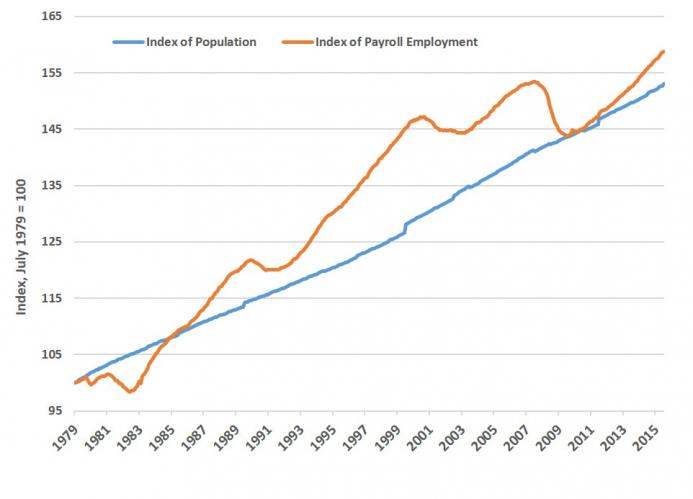
The good news gets better, though: not only have we gained jobs on net, but jobs have grown faster than the population over time. Since the 1979 peak in manufacturing employment, the US adult population grew by 53 percent, whereas employment grew by 59 percent, as shown in Figure 3.

Figure 3: Population Growth vs. Employment Growth Since 1979
watts3Source: Federal Reserve Economic Data

Despite these generally positive facts, some still contend that we’ve replaced “good” manufacturing jobs with lousy service sector jobs. Well, of course it must be true that, if we’ve lost manufacturing jobs, but gained jobs overall, then all of the job gains must have come from non-manufacturing sectors. And indeed the service sector, broadly defined, has seen employment growth of 90 percent since our 1979 benchmark. But beware of making hasty earnings assumptions about a sector that employs nearly 124 million people. To see whether the newly-created “service sector” jobs really don’t pay as well as the vaunted manufacturing jobs, we need to drill down into the employment and earnings data. What we’ll find is that a large majority of the new service sector jobs pay just as well or much better than manufacturing jobs.

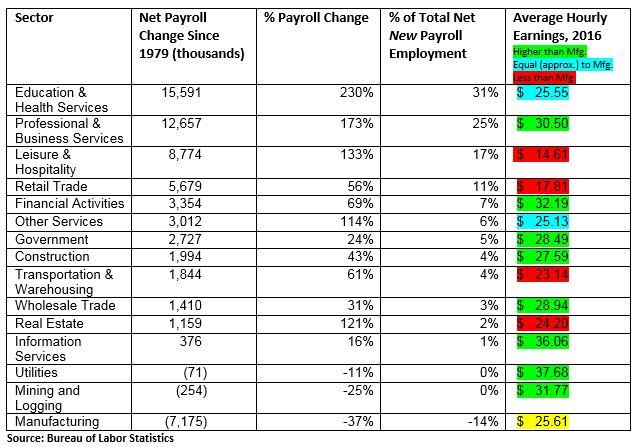
Table 1 presents Bureau of Labor Statistics data on the 15 largest sectors and sub-sectors of the US economy, which together represent over 96 percent of the total net increase in payroll employment for the post-peak manufacturing jobs era (1979 to 2016). This might come as a surprise to the anti-globalization crowd: despite the loss of 7 million manufacturing jobs (and some mining, logging, and utilities sector jobs), we’ve seen a net increase of nearly 53 million total jobs. Of these net new jobs, fully 62 percent of them feature, as of January 2016, average hourly earnings equal to or greater than current average hourly manufacturing earnings. In other words, most of the 53 million new jobs pay the same or better wages than the demagogues’ benchmark “good” manufacturing jobs. So we lost 7 million good jobs, only to gain about 32 million equal or better-paying jobs, along with about 19 million lower-paying jobs (about 38 percent of net new jobs pay less than manufacturing).

Table 1: Employment Changes and Current Earnings by Sector
watts4Source: Bureau of Labor Statistics

We’ve established that, despite a major decrease in employment in the manufacturing sector, we’ve gained many more jobs than we’ve lost in the past 35 years or so, and that most of these new jobs pay better to boot. Economic changes, while painful in the short run, have brought gains in output and employment not only for the US, but for the rest of the world as well. Overall, this is good news for the US and world economies.

So, as the campaign season heats up, let’s not be misled by baseless arguments about America “losing jobs” or other countries “beating us” at trade. Trade is a positive sum game, and the benefits for both the US and world economies are, shall we say, “yuge.”

Tyler Watts earned his PhD in economics at George Mason University in 2010. He currently teaches economics at East Texas Baptist University and runs the Institute for Economic Education (see YouTube channel here), a public outreach focused on integrating economics with a Biblical worldview and providing unique teaching tools for high school and college economics students.

This article was published on Mises.org and may be freely distributed, subject to a Creative Commons Attribution United States License, which requires that credit be given to the author.

Will Trump Boycott Grocery Stores for Their Unfair Trade? – Article by Edward Hudgins

Will Trump Boycott Grocery Stores for Their Unfair Trade? – Article by Edward Hudgins

The New Renaissance HatEdward Hudgins
******************************

Donald Trump’s stump thump against Mexico is that it runs a $58 billion annual trade surplus with the United States. Trump somehow thinks this leaves America the poorer.

He claims that it is out of that money, presumably sitting in some giant vault in Tijuana, that Mexico will pay for the border fence he wants to build to keep immigrants from entering the United States illegally. Trump’s pronouncements only demonstrate how he keeps facts and reason from entering his thoughts and, how he would keep Americans from making their own free choices in a free market.

International free trade is win-win
Trump’s very language reveals a glaring error concerning trade. Mexico and America do not trade. Mexicans and Americans do. Mexicans have $58 billion more in cash (pieces of paper with George Washington’s picture on them or the equivalent credits on bank ledgers) and Americans have $58 billion more in goods (electrical equipment, Trump-themed apparel).

And Trump doesn’t bother to ask, what are those Mexicans supposed to do with those pieces of paper? If they don’t spend them in America, they’ve got nothing but useless paper. So the Mexican trade surplus also means that Mexicans are investing an equivalent amount in America, helping the U.S. economy grow.

Further, the fundamental nature of trade between individuals is a win-win situation. Someone who buys an orange Donald hat for $20 to show his support for the former host of “The Apprentice” values the hat more than the twenty. And the manufacturer in Mexico who has a warehouse full of said head gear prefers the $20.

If The Donald slaps a 30% tariff on all goods coming from Mexico, maybe his starry-eyed supporters would shell out $26, the higher cost of the hat. But a poor mother with five kids seeing the price of a pair of shoes jump from $20 to $26 might be hard-pressed to afford the extra $30 she’d need to cover the feet of all her five little ones. But Trump doesn’t care. He wants to get rid of that pesky trade imbalance and what better way than to discourage that mom from buying Mexican-made shoes for her family! On the other hand, maybe he will notice when Mexican investors pull out of his latest golf resort or skyscraper projects, because his policies have destroyed their profits.

Trump’s grocery store trade deficit
If Trump is so against trade deficits, he should have a serious problem in his own household. Trump no doubt runs a huge trade deficit with his grocery store. He gives them piles of money when he buys food—no doubt top-priced cuisine—but the store never buys anything from him. Maybe he should boycott it. Maybe we should all boycott our local grocery stores lest we be victims of a trade deficit. Maybe if elected president, Trump will slap a 30 percent “grocery tariff” on everything that those stores try to sell to us poor, exploited schleps until those stores start purchasing stuff from us.

Trumps versus liberty
Trump poses as a friend of the people, but he wants to use government to prohibit the Americans from purchasing goods from whomever they wish—including Mexicans. The Donald presumes to know better what individual Americans should buy with their own money and at what price than they do. He’s determined to drive up the prices for Americans buying from Mexicans to teach those Mexicans a lesson. So what if American consumers and businesspeople are collateral damage.

Trump’s policies would only add more instability to an already unstable world. Ayn Rand explained that “The essence of capitalism’s foreign policy is free trade—i.e., the abolition of trade barriers… the opening of the world’s trade routes to free international exchange and competition among the private citizens of all countries dealing directly with one another. During the nineteenth century, it was free trade that liberated the world, undercutting and wrecking the remnants of feudalism and the statist tyranny of absolute monarchies.”

When governments take away the liberty of individuals to pursue their self-interest by trading freely with other individuals—a win-win situation—they set the stage for conflicts and even wars between countries. Trump’s proposed trade war is really a war on the American people.

Dr. Edward Hudgins directs advocacy and is a senior scholar for The Atlas Society, the center for Objectivism in Washington, D.C.

Copyright The Atlas Society. For more information, please visit www.atlassociety.org.

Star Wars: Intellectual Property Strikes Back – Article by Matthew McCaffrey

Star Wars: Intellectual Property Strikes Back – Article by Matthew McCaffrey

The New Renaissance HatMatthew McCaffrey
******************************

IP Deflates the Expanded Universe

Star Wars: The Force Awakens is already one of the most successful films of all time, and the Star Wars franchise is poised to grow at .5 past light speed for the foreseeable future. Yet, while Disney rapidly develops new chapters for the saga, it’s also quietly deleting some old ones: in 2014, Lucasfilm announced that to make way for the new films, the Star Wars Expanded Universe (or EU) would no longer be considered canon, a decision that disappointed many longtime fans.

The EU refers to the vast number of novels, short stories, comics, and games that explore the Star Wars universe outside the major films. These works enjoy an enormous following but are now consigned to a kind of alternate universe called Star Wars Legends. In other words, they will be disregarded by Lucasfilm’s officially licensed material, and any new Star Wars stories will have to fit the new canon. The original EU is discontinued, which understandably has fans feeling abandoned.

Why should the EU pose a problem, though? Why can’t artists and fans simply continue developing the canon they love, while Lucasfilm does the same? The answer is simple: intellectual property law.

Disney’s ownership of Lucasfilm allows it to license the Star Wars brand and all related intellectual property rights, especially its copyrights and trademarks. Anyone adding to the universe can only do so with permission, giving Lucasfilm power over any content within the universe or even similar to it.

In fact, Lucasfilm has a long history of aggressively litigating its IP, suing everyone from small businesses to major corporations. One of the most infamous cases was brought against the original Battlestar Galactica TV series, which was accused of copying at least 34 distinct ideas from Star Wars. These included such astonishingly original concepts as a friendly robot, an imprisoned heroine, and a movie ending with an awards ceremony.

Returning to the EU, it does make some artistic and financial sense for Disney to steer the franchise in a new direction by discontinuing older content. At the same time, artists and fans want to enjoy the EU they already know and love, something Lucasfilm legally prohibits by enforcing its IP.

My point is not that one stream of content is objectively better, but that it’s vital for all involved to freely choose the kind of content they want to create and sell. By increasing costs to both consumers and innovators, IP has already played a role in the decline of art forms like classical music, and copyrights and trademarks have similar effects in the world of pop art.

For Star Wars, original content mainly revolves around trademark rights, of which Lucasfilm owns many. Its usual defense of these properties is that unlicensed content causes confusion: without legally enforceable restrictions, consumers might think they’re buying “genuine” products when they’re actually getting cheap imitations. Furthermore, products similar to those created by Lucasfilm might be used to earn profits for noncreators who capitalize on confusion. A licensing deal from the original source ensures people won’t be taken in by unskilled or unscrupulous artists.

Assuming this is the real motivation for trademark protection, the argument is still weak. Like many consumer-oriented regulations, trademark law is patronizing: its basic assumption is that people are too dim to distinguish between official products and knockoffs or other free riders on the brand. But consumers, especially the kind of devoted fans Star Wars inspires, are perfectly capable of figuring out for themselves which content they prefer. The real issue boils down to revenue: Lucasfilm doesn’t want other businesses profiting from ideas it “owns,” and it’s perfectly happy to use monopoly privileges to protect its bottom line.

But Lucasfilm doesn’t need to litigate its trademarks to preserve profits or brand identity, which would likely be stronger in the long run without IP. For example, without trademarks, Lucasfilm would continue to officially sanction content it approves of and let consumers know which works are not “official.” If fans respect its judgment, the official Star Wars brand would thrive as people adopted Lucasfilm’s endorsement as a benchmark for quality and narrative continuity.

Competition for fan loyalty would drive official and unofficial creators alike to produce high-quality content. Different groups of creators would specialize in their own alternate universes that would succeed or fail based on their ability to satisfy fans. This would also eliminate the uncertainty surrounding fan fiction, which exists in the complex gray area of “fair use” laws. Most importantly, we’d all be able to decide for ourselves which works we treat as canon and which we abandon to the garbage masher of history.

The only truly expanded universe — one that’s creative, innovative, and prosperous — is one without IP protectionism. When we embrace genuine competition in ideas instead of competition through legal privilege, then, as Obi-Wan Kenobi would say, we’ve “taken a first step into a larger world.”

Matthew McCaffrey is assistant professor of enterprise at the University of Manchester and editor of Libertarian Papers.

This article was published by The Foundation for Economic Education and may be freely distributed, subject to a Creative Commons Attribution 4.0 International License, which requires that credit be given to the author.

Bernie Sanders’ Anti-Foreign Crankery – Article by Daniel Bier

Bernie Sanders’ Anti-Foreign Crankery – Article by Daniel Bier

The New Renaissance HatDaniel Bier
******************************

A Vesuvius of Tribalism and Economic Illiteracy

At Sunday’s Democratic presidential debate, Bernie Sanders attacked American trade with Mexicans, Chinese, Vietnamese, and presumably all other foreigners who might try to steal our jobs. Sanders harangued Hillary Clinton,

NAFTA, supported by the Secretary, cost us 800,000 jobs nationwide, tens of thousands of jobs in the Midwest. Permanent normal trade relations with China cost us millions of jobs.

Look, I was on a picket line in early 1990’s against NAFTA because you didn’t need a PhD in economics to understand that American workers should not be forced to compete against people in Mexico making 25 cents an hour.

… And the reason that I was one of the first, not one of the last to be in opposition to the TPP is that American workers … should not be forced to compete against people in Vietnam today making a minimum wage of $0.65 an hour.

Look, what we have got to do is tell corporate America that they cannot continue to shut down. We’ve lost 60,000 factories since 2001. They’re going to start having to, if I’m president, invest in this country — not in China, not in Mexico.

First, let’s note his dodgy job numbers. As Dan Griswold noted in 2011, in response to a similar claim about jobs “lost” from the “trade deficit” with Mexico,

In the first five years after NAFTA’s passage, 1994-98, when we could have expected it to have the most impact, the U.S. economy ADDED a net 15 million new jobs, including 700,000 manufacturing jobs.

Behold, the horror unleashed on US manufacturing jobs by trade with Mexico:nafta-manufacturing

In fact, since NAFTA went into effect in 1994, total US employment has increased by 28 million jobs. Even if we buy the dubious claim that NAFTA “cost us 800,000 jobs” over the last 22 years, this amounts just 36,000 jobs a year.

As Griswold noted, even in good times, 300,000 Americans file for unemployment each week. The US economy creates and destroys more than 15 million jobs every year. This alleged displacement amounts to less than one day’s worth of job losses.

It’s true that, in the long-run, manufacturing jobs have been in decline in the United States. But this is not because manufacturing is in decline. The myth (promoted by the other nationalist blowhard in the race) that United States “doesn’t make stuff anymore” is not just wrong — it couldn’t be further from the truth.

Real US manufacturing output is the highest it has ever been. Simply put, the US makes more stuff than ever.

manufacturing-indexHow can this be? Because manufacturing productivity — the amount of value added per hour worked — has gone up dramatically in recent decades. Manufacturing employment is declining because of automation; a US factory worker today can add a lot more value per hour than one in 1970.

manufacturing-employees-output-per-hour

It’s simply not true that trade devastated the US economy and wiped out millions of jobs. Employment has shifted within the US economy, out of industry into service jobs, and manufacturing has shifted around the globe, aligning production with the comparative advantages of each country’s labor and capital markets.

The resentment stoked by nationalists like Trump and Sanders is based on a nonsensical proposition, a mirage of high-paying blue collar jobs stolen by conniving foreigners, which we could reclaim if only we had the will to wage a trade war.

But the machines and global production chains are here to stay, and the jobs being done in Vietnam and China for fifty cents an hour are on the extreme low end of the value-added chain — which should be obvious, when you think about it, since they pay so little. (On the back of every iPhone is a short economics lesson on this point: “Designed by Apple in California. Assembled in China.”)

Do we really want to “bring those jobs back”? Do we envision a future where the American middle class is sewing textiles in sweatshops for a dollar an hour? Of course not. Americans today likely wouldn’t do those jobs at any wage, but especially not at the wages paid to low-skilled workers in developing Asian and Latin American countries. Those jobs only exist at those wages; at higher wages, they are scarcer, higher-skilled, and more capital intensive.

True, we could make t-shirts and Happy Meal toys in the United States, but we’d be doing it with far, far fewer workers and a lot more capital. Instead of 30 workers at fifty cents an hour, it’d be one person with a machine for $20 an hour.

The real difference would be that everyone would be poorer as a result: consumers paying higher prices, foreigners working in worse conditions and for less money, and American resources being diverted away from where they are most productive.

This is where economic ignorance stops being morally neutral and becomes a real threat to the life and well-being of the poor, especially in the developing world.

Not content to merely keep Mexicans from working in the United States (where, thanks to US capital and infrastructure, they could earn three or four times more than they make in Mexico), Bernie Sanders now objects to the right of Mexicans to work in Mexico, if they dare to sell goods and services to Americans — or, God forbid, try to compete with American firms.

For a champion of the poor like Sanders, there’s a double irony here, in that poor Americans are already much wealthier than poor Mexicans, and that tariffs also make goods more expensive for native consumers, disproportionately hurting the poorest Americans. Not only are poor Mexicans made worse off, by losing access to the US market and thus losing jobs, but poor Americans are also made worse off by having less disposable income, which is thus not spent elsewhere in the economy to sustain other American jobs.

And this is just the first order effects of closing off trade with Mexico. When the Mexican government inevitably retaliates, US exports to Mexico (which totaled $236 billion in 2015) will also be devastated and more jobs will be lost. And of course, simply multiply this orders of magnitude for China, Vietnam, and every other country on the nationalistic hit list.

Who gains from this? In the long run, nobody, which is why (after decades of gradual reform) we finally got relatively free trade with our closest neighbors, signed into law by a liberal Democrat. But in the short run, a few US corporations and labor unions would benefit from trade tariffs — at the expense of both poor foreigners and poor Americans as a whole.

(For those keeping score, this makes it an ironic hat trick for Sanders, whose tirades against free trade and open borders are laced with fear-mongering about “corporations.”)

Finally, let us ponder Sanders’ Alice-in-Wonderland solution to the imagined ills of free trade:

Look, what we have got to do is tell corporate America that they cannot continue to shut down. We’ve lost 60,000 factories since 2001. They’re going to start having to, if I’m president, invest in this country — not in China, not in Mexico.

Did I say Alice in Wonderland? I meant Atlas Shrugged. Ayn Rand was justly accused of having unbelievable, one-dimensional stereotypes, but sadly, American politics seems to have the same problem.

It’s anyone’s guess how Sanders imagines he could force factories not to close and order companies to stay in the United States, but the “you can’t shut down” solution is almost directly lifted from “Directive 10-289,” the order that Rand’s antagonists use to try to “stabilize” the economy:

All workers, wage earners and employees of any kind whatsoever shall henceforth be attached to their jobs and shall not leave nor be dismissed nor change employment… All industrial, commercial, manufacturing and business establishments of any nature whatsoever shall henceforth remain in operation…

Faced with economic decline, the government believed that the only option was to stop the decline, rather allowing people to go where they choose, buy what they choose, and make what they choose. “What it comes down to is that we can manage to exist as and where we are, but we can’t afford to move!” archvillain Wesley Mouch exclaims. “So we’ve got to stand still… We’ve got to make those bastards stand still!”

When Rand first published this in 1957, this was hyperbole about the fear of change, the reductio ad absurdum of the argument for keeping things as they are. Now, it’s an applause line for mainstream presidential candidates.

Daniel Bier is the site editor of FEE.org He writes on issues relating to science, civil liberties, and economic freedom.

This article was published by The Foundation for Economic Education and may be freely distributed, subject to a Creative Commons Attribution 4.0 International License, which requires that credit be given to the author.

Free Trade Is the Path to Prosperity – Article by Georgi Vuldzhev

Free Trade Is the Path to Prosperity – Article by Georgi Vuldzhev

The New Renaissance HatGeorgi Vuldzhev
******************************

The political circus of the 2016 presidential election has revived and reinvigorated popular belief in age-old protectionist fallacies. Currently Donald Trump and Bernie Sanders are both in favor of expanding protectionist trade policy, with both of them arguing that free trade “destroys” jobs and hurts domestic workers and producers by exposing them to foreign competition. Both candidates espouse an utterly misguided zero-sum view of economics, in which one side to an exchange wins only when the other side loses. Both men are, of course, completely wrong.

Free Trade Does Not Destroy Jobs

It is true that greater competition between domestic and foreign workers can lead to a decline in wage rates and possibly unemployment in some sectors of the economy. But this is only a short-term effect. Free competition between foreign and domestic producers also naturally leads to lower prices for the goods and services which can now be freely imported from abroad. So, while nominal wage rates are pushed down in some sectors, real wage rates rise overall for everyone in the economy because of the decline in prices.

Thanks to free trade consumers spend less money on certain goods and services and this allows them to spend more money on others, which leads to rising demand and thus profits in the sectors providing the latter, and consequently leads also to more investment by entrepreneurs. This higher rate of investment naturally leads to the creation of more jobs in these sectors and thus offsets any original rise in unemployment that might have occurred.

Alternatively, the consumers may choose to save the extra disposable income that was freed up by the decline in prices. This rise in the savings rate will lead to a decline in interest rates, which makes profitable certain long-term capital-intensive projects which were not profitable beforehand. Seizing the opportunity presented by this increase in savings, entrepreneurs will start borrowing and investing in those long-term capital intensive projects, which on its own already creates more jobs, but it also leads to a rise in demand for capital goods, which raises profits in the capital goods industries and consequently leads to more investment and job openings in those sectors.

Free Trade Is Win-Win

Free trade not only doesn’t “destroy” jobs, but it also promotes specialization between nations, which improves the efficiency and productivity of workers, and leads to a rise in living standards for all. Trade is not some kind of a zero-sum game in which if one side wins, the other has to lose.

When two countries such as the United States and China, for example, trade freely with one another, their citizens are incentivized to specialize in those lines of production in which they have a comparative advantage. Due to the difference in factors of production endowments it is best for different countries to specialize in producing those types of goods and services which they can produce most efficiently in comparative terms. A higher level of specialization, through the effect of economies of scale, makes production more cost-efficient.

By specializing in a certain line of production and then exchanging the goods and services produced for those that others are specialized in producing, the people of a given country can substantially raise their living standards because the gains in productivity are naturally followed by an increasing supply of goods and services and thus rising real incomes. This way free trade allows for the flourishing of what can be called an “international” division of labor. Just like a greater degree of division of labor can lead to big gains in productivity and thus real incomes on an intra-national (i.e., internal for a given country) level it can also do so on an international level.

Protectionism Makes You Poor

When international trade is restricted, for example, by protectionist legislation which places tariffs on certain imports, this process of specialization is hindered and thus the gains in productive efficiency are diminished. By artificially raising the price of imports, tariffs allow otherwise uncompetitive and inefficient domestic businesses to remain in operation. Consumers are forced to pay higher prices for the goods the importation of which is penalized by tariffs, and this effectively constitutes a redistribution of resources from the consumers to the domestic producers.

More importantly, protectionism hinders the process of specialization described in the previous section and thus prevents living standards from rising in the long-term, or worse — it can even lead to their decline. By propping up the profits of comparatively inefficient domestic producers and keeping in business, tariffs prevent the labor shift from those inefficient sectors, to more comparatively efficient ones. Consequently, because this prevents a higher degree of specialization from taking place, or even reverses it, the benefits that specialization leads to cannot be obtained. Productivity does not increase (or at least not to the same degree as it could) and thus real incomes do not rise.

Contrary to the popular political rhetoric nowadays, free trade does not “destroy jobs.” It can only lead to a shift of resources (labor, capital, and other factors) from one comparatively inefficient sector or group of sectors in the domestic economy to another more comparatively efficient one. This process of specialization in the comparatively advantageous lines of production not only does not destroy jobs, but it also enables big gains in efficiency and productivity to take place, which leads to a rise in real incomes. This is how, far from somehow hurting the domestic workers, free trade actually does the opposite — it makes them richer. It is, in fact, protectionism which makes us all poorer, workers included, by artificially propping up inefficient businesses, leading to a misallocation of resources and a decline in standards of living for us all.

Georgi Vuldzhev is a student and an intern at the Institute for Market Economics in Sofia, Bulgaria. He has written articles on economics and politics for the European Students for Liberty blog, where he is a regular contributor, and various Bulgarian publications. His main interests are Austrian economics and libertarian political theory.

This article was published on Mises.org and may be freely distributed, subject to a Creative Commons Attribution United States License, which requires that credit be given to the author.

A Conversation with My Neighbor “Sam” – Article by Mark Brandly

A Conversation with My Neighbor “Sam” – Article by Mark Brandly

The New Renaissance HatMark Brandly
******************************

Lately, I’ve wondered how my neighbor, Sam, affords to buy so much stuff. He appears to have an unlimited budget. When I asked him about this, Sam asked, “Do you think I’m spending too much?”

“That depends,” I said, “How much money do you make?”

“I take home $100,000 a year.”

That surprised me. I would guess that he’s spending more than that. But I tried to be encouraging, “That sounds like plenty of income. With a little planning, you should be able to budget your spending and be financially stable.”

“But my finances are a mess,” Sam replied. “I spend more than I take home. Last year I had to borrow $12,000 just to cover my spending.”

“Well maybe things will be better this year,” I said, hoping that Sam’s spending issues was a one year problem.

“No,” Sam replied. “Actually, in the first three months of this year, I’ve already spent $19,000 more than I’ve made. It looks like my budget deficit this year will be much worse than it was last year.”

Now I was starting to worry. “Have you been borrowing money to cover your spending for a long time?”

“Oh yes. I have a lot of debt. Part of the problem is that I owe myself $150,000.”

I wondered if Sam misspoke, “Wait, wait, wait, you owe yourself $150,000? Why do you think that you’re in debt to yourself?”

“Well you see, over the years I promised myself that I was going to use my paychecks to pay for a fund for my children’s education, but instead of spending $150,000 on colleges, I spent the money on other expenses. So I figure that I owe myself this money so that I can pay for my children’s college tuitions.”

Obviously Sam doesn’t understand the definition of the word “debt.”

I tried to be polite in my response: “That doesn’t make any sense. It’s true that you’ve made some horrible decisions regarding your spending, but it’s ridiculous to claim that you owe yourself money. A debt occurs when one person owes another person money. Just because you changed your mind about how to spend your paychecks doesn’t mean that you’ve borrowed money from yourself.

“So the first thing you need to do is to think clearly about the amount of debt you have. You don’t owe yourself any money. Now, forgetting about this ridiculous notion of self-debt, how much do you owe?”

“Alright, I think I see your point. Let’s just talk about the rest of my debt. I owe various banks about $420,000. This debt is more than four times my take-home income.”

Sam often lies about his income and spending issues, but he always understates his budget problem. If he’s lying now, then I can be sure that the problem is even greater than he says. I wanted more information.

“That a pretty high debt to income ratio. But that might be somewhat manageable, although unwise, if you’ve borrowed that money at low interest rates.”

“I have some good news and some bad news,” Sam said. “Interest rates are low. In fact, in the last fourteen years, my debt has more than quadrupled, but my interest payments have increased less than 50 percent. That’s because interest rates have collapsed during that time. Isn’t that good news?”

“I suppose, but do you know that interest rates are going to increase over the next several years?”

“Yes, that’s the bad news. In the past year, I only paid $7,000 of interest, but within ten years my debt will increase over 50 percent, and possibly much more, and with higher interest rates I expect to be paying at least four to five times that much in interest annually.”

“That’s a huge problem. So to be able to make your loan payments, I assume that you’ve taken out some long-term loans.”

“No, no, no. In order to take advantage of the low interest rates, most of my borrowing is short term. I rollover my loans quickly. In the past year my principal payments on these loans totaled $207,000.”

“Let me get this straight. Your loan payments, including principal and interest, are well over twice your take home pay?”

“Yes, I take home a little over $8,000 per month and my loan payments are over $17,000 per month. But it’s no problem. In the past year I borrowed $223,000 to cover everything.”

Shocked, I said “How can you say borrowing more than twice your income is not a problem?”

“I simply borrow all the money I need to make all of my loan payments. I never pay any of the loans down. I’ve been doing this for years, ever since I started spending more than I make.”

“Okay. Most of your borrowing goes to cover your increasingly large principal and interest payments. And as interest rates rise, interest payments will become a bigger percentage of your spending. When that happens, your total debt will increase faster than your income. What is your plan, say in the next ten years, to correct this situation?”

“Well I don’t have a plan for correcting anything, because I don’t see how I can cut my spending.”

“What if the banks stop loaning you money to make your payments on your loans? What happens then?”

“I guess I’m assuming that won’t happen.”

Sam’s Budget Situation in Real Numbers
If one of our neighbors budgeted in this manner, we would obviously conclude that the guy is crazy. No such plan could work. Eventually lenders would refuse to fund Sam’s spending.

However, Sam’s situation looks a lot like the federal government budget plan. Take a look at some recent federal budget information and some Congressional Budget Office projections:

  • In FY (fiscal year) 2015, the feds had a budget deficit, counting only debt held by the public, of $339 billion, which is about 10 percent of their tax revenues of $3,248 billion. The deficit has been declining the last few years, but that is now changing.
  • In fact, in the first three months of FY 2016, according to the Treasury Department, federal debt held by the public increased $548 billion. Admittedly, some of this debt was due to the fact that the feds were cooking the books in FY 2015 when they hit the debt ceiling limit. Nonetheless, the first quarter 2016 deficit is already 60 percent larger than the overall 2015 deficit.
  • The federal government claims to owe itself over $5 trillion (they call it intragovernmental debt here). This $5 trillion represents tax revenues that were earmarked for specific spending programs, such as Social Security, but were spent on other programs. Since the feds collected taxes to pay for Social Security, but spent the money on something else, they conclude that they owe it to themselves to collect those tax revenues again. That’s the essence of intragovernmental debt. We should not count this as debt. Give the Treasury Department credit for ignoring this type of “debt” in their Daily Treasury Statements and in their end of the year debt reports.
  • As of September 30, 2015, the feds had $13.1 trillion of debt owed to the public. FY 2015 tax revenues totaled $3.248 trillion. So just like Sam the government has a 4-to-1 debt-to-tax-revenue ratio.
  • In the past fourteen years, from September 30, 2001 (the start of George Bush’s first budget) to September 30, 2015 (the end of Barack Obama’s sixth budget), debt owed to the public increased from $3,339.3 billion to $13,123.8 billion. That’s an increase of 293 percent.
  • According to the Daily Treasury Statements, in the past fourteen years, interest on treasury securities increased from $162.5 billion in fiscal year 2001 to $233.1 billion in fiscal year 2015. That’s a 44 percent increase during the same period when federal debt owed to the public almost quadrupled.
  • In FY 2015, again according to the Daily Treasury Statements, the feds borrowed $7,251.4 billion (see the Public Debt Cash Issues for September 30, 2015), an average of almost $20 billion per day. They spent $6,740.3 billion of this borrowing rolling over their debt. So, Federal principal and interest payments are more than double federal tax revenues.
  • According to the Congressional Budget Office’s baseline projections, debt held by the public in 2025 should exceed $21 trillion and during that time interest rates are expected to increase. Interest rates have been kept artificially low for years. If interest rates return to a more normal level, say to the rates they were paying when George Bush took office fifteen years ago, then interest payments in 2025 will exceed $1.2 trillion. That’s over a 400 percent increase compared to the FY 2015 interest payments. I should note here that the baseline budget projections are optimistic. We should expect the debt situation in 2025 to be significantly worse than these projections.

The federal government’s debt has exploded under the Bush and Obama administrations. Low interest payments due to the low interest rates have masked their budget problems. As interest rates and the spending gap on entitlement programs such as Social Security both increase, the budget problem will compound.

The federal government’s plan is to borrow all of the money they need to pay all of their principal and interest payments and to also pay for the budget deficits in their spending programs. The question we should ask is: what’s going to happen when the world’s lenders refuse to bankroll DC’s spending schemes?

Mark Brandly is a professor of economics at Ferris State University and an adjunct scholar of the Ludwig von Mises Institute.

This article was published on Mises.org and may be freely distributed, subject to a Creative Commons Attribution United States License, which requires that credit be given to the author.

Trump and Sanders Are Both Conservatives – Article by Steven Horwitz

Trump and Sanders Are Both Conservatives – Article by Steven Horwitz

The New Renaissance HatSteven Horwitz
******************************

Shared Visions of Fear, Force, and Collectivism

Those of us who reject the conventional left-right political spectrum often see things that those working within it cannot. For example, in “Why the Candidates Keep Giving Us Reasons to Use the ‘F’ Word” (Freeman, Winter 2015), I argue that Donald Trump and Bernie Sanders, seen by many as occupying opposite ends of the ideological spectrum, both embrace the thinking of economic nationalism, if not fascism.

They also share a different political tradition. It may seem to contradict their shared fascist pedigree, but Trump and Sanders are both, in a meaningful sense, conservatives.

Trump, of course, has been lambasted by many self-described conservatives precisely because they believe he is not a conservative. And Sanders, the self-described “democratic socialist,” hardly fits our usual conception of a conservative. What exactly am I arguing, then?

They are both conservatives from the perspective of classical liberalism. More specifically, they are conservatives in the sense that F.A. Hayek used the term in 1960 when he wrote the postscript to The Constitution of Liberty titled “Why I Am Not a Conservative.” There he said of conservatives,

They typically lack the courage to welcome the same undesigned change from which new tools of human endeavors will emerge.… This fear of trusting uncontrolled social forces is closely related to two other characteristics of conservatism: its fondness for authority and its lack of understanding of economic forces.… The conservative does not object to coercion or arbitrary power so long as it is used for what he regards as the right purposes. He believes that if government is in the hands of decent men, it ought not to be too much restricted by rigid rules.

That description would seem to apply to both Trump and Sanders. They share a fear of uncontrolled and undesigned change, especially in the economy. This is most obvious in Trump’s bluster about how America never “wins” and his desire to raise tariffs on Chinese imports and close the flow of immigrants, especially from Mexico. Economic globalization is a terrific example of uncontrolled change, and using foreign workers and producers as scapegoats for that change — especially when those changes have largely benefited most Americans — is a good example of this fear of the uncontrolled.

Those policies also show the much-discussed economic ignorance of Trump and his supporters, as shutting off trade and migration would impoverish the very people Trump claims to care about — those who are, in fact, supporting him. International trade and the free migration of labor drive down costs and leave US consumers with more money in their pockets with which to buy new and different goods. They also improve living standards for our trade partners, but Trump and his followers wrongly perceive their gains as necessitating American losses.

The same concerns are echoed in Sanders’s criticisms of free trade and in his claim that immigration is undermining good jobs for the native-born. Trump’s rhetoric might be more about how the US needs to “beat” the Chinese, and Sanders might focus more on the effects on working class Americans, especially union workers, but both fear the uncontrolled change of globalized markets, seeing commerce as a zero-sum game. (See “Why Trump and Sanders See Losers Everywhere,” FEE.org, January 20, 2016.)

For Sanders, fear of change also bubbles up in his criticisms of Uber — even though he uses the service all the time. Part of Hayek’s description was the fear of change producing “new tools of human endeavor.” The new economy emerging from the reduction of transaction costs will continue to threaten labor unions and the old economic understanding of employment and the firm. Sanders’s view of the economy is very much a conservative one as he tries to save the institutions of an economy that no longer exists because it no longer best serves human wants.

In addition, both Trump and Sanders are more than willing to use coercion and arbitrary power to attempt to resist that change. These similarities manifest in different ways, as Trump sees himself as the CEO of America, bossing people and moving resources around as if it were one of his own (frequently bankrupt) companies. CEOs are not bound by constitutional constraints and are used to issuing orders to all who they oversee. This is clearly Trump’s perspective, and many of his followers apparently see him as Hayek’s “decent man” who should not be too constrained by rules.

The same is true of Sanders, though he and his supporters would deny it. One need only consider his more extreme taxation proposals as well as the trillions in new spending he would authorize to see that he will also not be bound by constraints and will happily use coercion to achieve his ends. This is also clear in his policies on trade and immigration, which, like Trump’s, would require a large and intrusive bureaucracy to enforce. As we already know from current immigration restrictions, such bureaucracies are nothing if not arbitrary and coercive. Both Trump and Sanders believe that with the right people in charge, there’s no need for rule-based constraints on political power.

Hayek also said of conservatives that they are characterized by a

hostility to internationalism and [a] proneness to a strident nationalism.… [It is] this nationalistic bias which frequently provides the bridge from conservatism to collectivism: to think in terms of “our” industry or resource is only a short step away from demanding that these national assets be directed in the national interest.

As noted, Sanders and Trump share exactly this hostility and proneness. And despite being seen as political opposites, their distinct views converge in the idea that resources are “ours” as a nation and that it is the president’s job (and the state’s more generally) to direct them in the national interest. For Trump, that interest is “making America great again” and making sure we “beat” the Chinese. For Sanders, that interest is the attempt to protect “the working class” against the predation of two different enemies: the 1 percent and foreign firms and workers, all of whom are destroying our industries and human resources.

All of this fear of uncontrolled change and economic nationalism is in sharp contrast with the position of what Hayek calls “liberalism” or what we might call “classical liberalism” or “libertarianism.” In that same essay, Hayek said of classical liberalism, “The liberal position is based on courage and confidence, on a preparedness to let change run its course even if we cannot predict where it will lead.”

This is why classical liberalism rejects the idea that the path toward progress entails electing the right people (the “decent men”) and the cult of personality that frequently accompanies that idea, as we’ve seen with Trump and Sanders. Classical liberalism understands how, under the right rules and institutions, progress for all is the unintended outcome of allowing each to pursue their own values and ends with an equal respect for others to do the same, regardless of which side of an artificial political boundary they reside on.

If we want to live in peace, prosperity, and cooperation, we need to recognize that progress is a product of unpredictable, uncontrolled, and uncontrollable change.

Trump and Sanders can stand on their porches telling us to get off their lawn, but we’re going to do it in an Uber imported from Asia and driven by a nonunionized immigrant, because we classical liberals welcome the change they fear.

Steven Horwitz is the Charles A. Dana Professor of Economics at St. Lawrence University and the author of Hayek’s Modern Family: Classical Liberalism and the Evolution of Social Institutions. He is a member of the FEE Faculty Network.

This article was published by The Foundation for Economic Education and may be freely distributed, subject to a Creative Commons Attribution 4.0 International License, which requires that credit be given to the author.

No, Mr. Trump, Victims of Eminent Domain Do Not “Get a Fortune” – Article by George C. Leef

No, Mr. Trump, Victims of Eminent Domain Do Not “Get a Fortune” – Article by George C. Leef

The New Renaissance HatGeorge C. Leef
******************************

Trump’s huge mistake about eminent domain

During the debate among Republican presidential candidates last month, Jeb Bush hammered Donald Trump on his abuse of eminent domain. But Trump apparently sees nothing wrong in having government officials force people to sell their property.

Trump replied,

Eminent domain is an absolute necessity for a country, for our country. Without it, you wouldn’t have roads, you wouldn’t have hospitals, you wouldn’t have anything. You would have schools, you wouldn’t have bridges.

And what a lot of people don’t know because they were all saying, oh, you’re going to take their property. When somebody — when eminent domain is used on somebody’s property, that person gets a fortune. They at least get fair market value, and if they’re smart, they’ll get two or three times the value of their property.

This last assertion led George Mason law professor Ilya Somin (an expert on eminent domain) to quip at the Volokh Conspiracy, “If eminent domain really were a good way to make a fortune, the Donald Trumps of the world would be lobbying the government to condemn their property. But that rarely, if ever, happens.”

Put aside Trump’s hyperbole about the supposed impossibility of schools, hospitals, and bridges without eminent domain. What I want to focus on is his claim that eminent domain is not objectionable because people who have their property taken make out just fine financially.

That claim is simply indefensible. The truth is that people who lose their property to eminent domain proceedings are almost never made whole.

Legal scholars have for many years been writing about the injustice that usually befalls people who have to settle for what the government deems “just compensation” under the Fifth Amendment. I wouldn’t expect Mr. Trump to know about that because he is too busy making deals. But the kind of deals businessmen usually make involve two parties who can say “no,” unless and until they think the deal will improve their positions.

With eminent domain takings, however, the property owner can’t say “no,” and usually must settle for much less than he or she would have bargained for in a voluntary setting.

Professor Gideon Kanner has written extensively about the problem of inadequate compensation for people who’ve been forced to sell under eminent domain. In his article “[Un]Equal Justice under Law: The Invidiously Disparate Treatment of American Property Owners in Taking Cases,” he writes:

The true standard of compensation is not indemnity, but rather fair market value so artfully defined as to exclude factors that sellers and buyers in voluntary transactions would consider, and that the government need only pay for what it acquires, not for what the owner has lost.

Those losses include business goodwill, relocation expenses, and the emotional damage of having to leave a community where one may have strong ties. In the government’s calculus, people are expected to suffer such losses as part of the price of living in America.

As the Supreme Court stated in the 1949 takings case Kimball Laundry v. U.S., “Loss to the owner of non-transferable values … is properly treated as part of the burden of common citizenship.” That “tough luck, property owner” mindset still prevails.

Knowing that they hold the high cards (and ultimately the guns) when they deal with property owners, government officials take full advantage. As Kanner observes, “Condemning agencies regularly reap unjustified windfalls from the fact that the majority of their offers (including the many low-ball ones) are accepted without litigation or even involvement by a private appraiser or lawyer.”

Therefore, eminent domain causes many property owners to suffer uncompensated losses.

Far from “getting a fortune” or “two or three times” the market value of their property, most owners are left substantially worse off for their unwanted encounter with condemning government agencies. Few if any of them shrug off the losses as their part of the “burden of common citizenship.”

Although the eminent domain issue came up during a debate among presidential candidates, there is hardly anything that the president can do to rectify the problem of under-compensation for property owners. He (or she) cannot issue an executive order mandating that property owners be made whole.

If there is to be a solution, it must come from the judiciary.

Judges, and especially the justices of the Supreme Court, will have to stop ruling that merely because an individual is paid an amount deemed “fair market value,” the Fifth Amendment’s requirement of “just compensation” has been satisfied.

It would also help property owners if the Supreme Court would overturn Kelo v. New London and establish that property can only be taken for actual “public use,” as the Fifth Amendment requires, and not for private use that local politicians think might have some “public benefit.”

Since we are going to have confirmation hearings for a new member of the Court eventually, it would be important to find out precisely what the nominee thinks “just compensation” and “public use” actually mean.

George Leef is the former book review editor of The Freeman. He is director of research at the John W. Pope Center for Higher Education Policy.

This article was published by The Foundation for Economic Education and may be freely distributed, subject to a Creative Commons Attribution 4.0 International License, which requires that credit be given to the author.

Central Banks Should Stop Paying Interest on Reserves – Article by Brendan Brown

Central Banks Should Stop Paying Interest on Reserves – Article by Brendan Brown

The New Renaissance Hat
Brendan Brown
******************************

In 2008, the Federal Reserve began paying interest on reserve balances held on deposit at the Fed. It took more than seven decades from the US leaving the gold standard — in 1933 — for the fiat regime to do this and thus revoke a cardinal element of the old gold-based monetary system: the non-payment of any interest on base money.

The academic catalyst to this change came from Milton Friedman’s essay “The Optimum Quantity of Money” where he argued that the opportunity cost of paper money (any foregoing of interest compared to on alternative money-like instruments such as savings deposits) should be equal to its virtually-zero marginal cost of production. Opportunity cost could indeed be brought down to zero if base money (bank reserves, currency) in large part paid interest at the market rate. Under the gold standard, the opportunity cost of holding base money largely in metallic form (gold coin) was indeed typically significant. All forms of base money paid no interest. And the stream of interest income foregone in terms of present value was equal in principle to the marginal cost of gold production (this was equal to the gold price).

Interest on Reserves are Important to Controlling Markets and Imposing Negative Rates
Friedman, however, did not identify the catch-22 of his proposal. If the officials of the fiat money regime indeed take steps to close the gap between the marginal production cost and opportunity cost of base money, with both at zero, then there can be no market mechanism free of official intervention and manipulation for determining interest rates.

That is what we are now finding out in the few years since central banks in the US, Europe, and Japan started paying interest on reserves. (The ECB was authorized to do this since its launch in 1999, while the Fed and BoJ began following the 2008 financial crisis.) Central banks can now bind the invisible hand operating in the interest rate market to an extent almost unprecedented in peacetime. In some cases, central banks have even deployed a negative interest rate “tool” which would have been impossible under the prior status quo where base money paid no interest.

How We Got Here
The signing into law of the Financial Services Regulatory Relief Act in 2006 authorized the Federal Reserve to begin paying interest on reserves held by depository institutions beginning October 1, 2011. On the insistence of then Fed Chief Bernanke, that date was brought forward to October 1, 2008 by the Emergency Economic Stabilization Act. He was in the process of dispensing huge loans to troubled financial institutions but wanted nonetheless to keep interest rates at a positive level (one purpose here was to protect the money market fund industry).

Accordingly, the Federal Reserve Board amended its regulation D so that the interest rate paid on required reserves and on excess reserves would be at levels tied (according to distinct formulas at the start) to market rates. An official communiqué explained that the new procedure would eliminate the opportunity cost of holding required reserves (and thereby “deregulate”) and help to establish a lower limit for the Federal Funds rate, becoming thereby a useful tool of monetary policy.

This was useful indeed from the viewpoint of rate manipulators: by setting the rate on excess reserves the Fed could now determine the path of short-term interest rates and strongly influence longer term rates regardless of how the supply of monetary base was growing relative to trend demand. By contrast, under the gold standard and the subsequent first seven decades of the fiat money regime, interest rates in the money market were determined by forces which brought demand for base money into balance with the path of supply as set by gold mining conditions or by central bank policy decision respectively. A rise in rates meant that the public and the banks would economize on their direct or indirect holdings of base money and conversely.

Back Before the Fed Paid Interest on Reserves
Yes, under the fiat money system the central bank could effectively peg a short-term rate and supply whatever amount of base money was needed to underwrite that — but the consequential growth of supply in base money was a variable which got wide attention and remained an ostensible policy concern. Right up until the Greenspan era, the FOMC implemented policy decisions by directing the New York Fed money desk to increase or reduce the pace of reserve growth and changes in the Fed funds rate occurred ostensibly to accomplish that purpose. This old method of determining money market interest rates under a fiat regime — in which banks’ need for reserves was minute given deposit insurance, a generous lender of last resort, and too-big-to-fail — depended on the banking industry enduring what was essentially a tax on its deposit business, which was then magnified by fairly high legal reserve requirements. Thus, it is not surprising that the original impetus to paying interest on reserves, whether in the US or Europe, came from the banking lobby. There was no such burden under the gold standard even though the yellow metal earned no interest. Banks in honoring their pledge to deposit clients that their funds were convertible into gold had to visibly hold large amounts of the metal in their vaults or at hand in a reserve center. Actual and potential demand for monetary base by the public is more limited under a fiat money regime than under the gold standard as bank notes are hardly such a distinct asset as gold coin from other financial instruments.

More Problems with Friedmanite “Solutions”
Friedman, when he advocated eliminating the opportunity cost of base money under a fiat regime, hypothesized that this could occur under a long-run declining trend of prices rather than by the payment of interest. The real rate of return on base money could then be in line with the equilibrium real interest rate. This proposal for perpetually declining prices would also have been problematic, though. The interest rate would fluctuate, and in boom times be well above the rate of price decline. In any case, the rate of price decline would surely vary (sometimes into positive territory) in a well-functioning economy even when the long-run trend was constant (downward). The equilibrium real interest rate would be below the rate of price decline sometimes (for example, during business downturns), meaning that market rates even at zero would be too high. That situation did not occur often under the gold standard where prices were expected to be on a flat trend from a very long-run perspective and move pro-cyclically (falling to a low-point in the recession from which they were expected to rise in the subsequent business expansion, meaning that real interest rates would then be negative).

What Can Be Done?
So what is to be done to escape the curse? A starting point in the US would be for Congress to ban the payment of interest on bank reserves. And the US should use its financial power with respect to the IMF to argue that Japan and Europe act similarly within a spirit of G-7 coordination such as to combat monetary instability. We have seen in recent years how rate manipulation and negative rates are made possible by the payment of interest on reserves, and are potent weapons of currency warfare. Yes, the ban in the immediate would force the Federal Reserve to slim down its balance sheet so that supply and demand for base money would balance at a low positive level of interest rates. The Fed might have to swap its holdings of long-maturity debt for T-bills at the Treasury window so as to avoid any dislocation of the long-term interest rate market in consequence. That, not the Yellen-Fischer “rate lift off day and beyond,” is the road back to monetary normalcy.

Brendan Brown is an associated scholar of the Mises Institute and is author of Euro Crash: How Asset Price Inflation Destroys the Wealth of Nations and The Global Curse of the Federal Reserve: Manifesto for a Second Monetarist Revolution. See Brendan Brown’s article archives.

This article was published on Mises.org and may be freely distributed, subject to a Creative Commons Attribution United States License, which requires that credit be given to the author.

Why Free-Market Advocates Are Not Obligated to Defend the Economic Status Quo – Video by G. Stolyarov II

Why Free-Market Advocates Are Not Obligated to Defend the Economic Status Quo – Video by G. Stolyarov II

The New Renaissance Hat
G. Stolyarov II
******************************

Many on the political left today equate advocacy of free-market capitalism with an “anything goes” support for the economic status quo. Many on the political right give credence to this perception by, indeed, seeking to defend the status quo just because it happens to be so. Yet this is neither an obligatory nor an advisable approach for characterizing a genuinely well-considered free-market outlook.

Suppose that you are a free-market advocate and also an engineer, well-versed in the principles and methods for constructing durable, safe structures. Suppose you also identify severe deficiencies in a bridge proposed to be constructed by a completely private enterprise. Mr. Stolyarov explores the implications of this dilemma and the appropriate responses in a free society.

Reference

– “Why Free-Market Advocates Are Not Obligated to Defend the Economic Status Quo” – Article by G. Stolyarov II