Browsed by
Category: Education

Will the Fed Let Innovation Work Its Magic? – Article by Edin Mujagic

Will the Fed Let Innovation Work Its Magic? – Article by Edin Mujagic

The New Renaissance Hat
Edin Mujagic
April 21, 2015

******************************

Sometimes one finds true gems in one’s archives. Recently I came across a speech by then-chairman of the Fed, Ben Bernanke, from May 18, 2013. It was the commencement speech at Bard College at Simon´s Rock, in Great Barrington, Massachusetts. In it, Bernanke chose to forget for a while the dire straits the Western economy is in and focused on prospects for economic growth in the long run, which he defined as “measured in decades, not months or quarters.”

In short, Bernanke focused on scientific and technological progress, more commonly described as innovation. He envisaged a fourth wave of innovation — the first three being the early industrial era (mid-1700s until mid-1800s), the modern industrial era (from 1880 onwards), and the IT-revolution.

His commencement speech was a speech of hope and of encouragement. But Bernanke did not tell the whole story. The then-Fed chairman failed to mention that living standards will depend on more than innovation. At least as important is the role of the very institution he chaired, the Federal Reserve, and what it does or does not do. If it allows high inflation to take hold — either through action or inaction — that would annihilate a very substantial part of the increase in living standards due to innovation.

And yet, recent history strongly suggests that the Fed will end up destroying a large part of the increase in living standards of those graduates Bernanke was speaking to. For example, at the beginning of 2013 Bernanke spoke at another American college. During the Q&A session, he said that “the worst mistake the Fed can make is to tighten monetary policy too soon.” In other words, the then-chairman essentially promised to raise interest rates too late. Nowadays, Bernanke may be gone from the Fed, but his line of thinking on monetary policy certainly has not, and indeed, this line of thinking reflects dominant Fed policy well beyond the Bernanke years.

Innovation and Living Standards

Bernanke, like Greenspan before him, is counting on innovation to keep the economy moving. As well he should. Technological innovation often leads to more efficient production and greater worker productivity which leads to higher wages and more affordable goods.

But if Bernanke is going to tell students that technology will make their lives better, he should also mention the role that he himself and other central bankers play in stifling the positive effects of innovation.

We can see multiple examples of this phenomenon in recent decades. For example, if we consider the effect that China’s entrance into the global economy should have had on living standards in the US, we find the actual results to be somewhat underwhelming. We should have witnessed growth in living standards similar to what we witnessed toward the end of the nineteenth century as the US industrialized. But in fact, the record of growth in real wealth in the US has been disappointing at best.

For example, technological progress due to the Industrial Revolution and globalization in the late nineteenth century led to continuous deflation in the US, and hence unprecedented increases in welfare. Research by Michael Bordo at Rutgers, shows that on average, prices fell by 1.2 percent each year between 1870 and 1896. Real living standards increased substantially over the same time period. Labor market economists in the United States have been able to reconstruct wage development in the United States since 1830. In every decade the real wage was higher than the preceding decade. That is, until the 1970s.

In contrast, in the decades since the early 1980s, as Asia was joining the world with its own industrial revolution, each year prices increased in the US by more than 2 percent. According to the statistics available from US Census, real median household income in the United States (i.e., income adjusted for inflation) barely moved between 1980 and 2012. This is odd, given the fact that economic growth averaged some 3 percent per annum and labor productivity soared by some 50 percent in total. A working American male earned approximately $48,000 in 1969. Adjusted for inflation, his income had barely grown by the time the current economic crisis started.

The main difference between the two periods is that in 1800s there was no Federal Reserve, and the money supply, while certainly not completely non-inflationary, was restrained by the absence of a central bank.

Lost Opportunities

In an unhampered market, technological progress, innovation, and globalization in the decades before the current crisis should have led to three things: slower wage growth, larger profits, and lower prices. In other words, what firms like Apple accomplished (i.e., the creation of innovative, labor-saving products made available at ever-lower prices) on a micro scale, should have happened on the macro-level as well. Slower wage growth would have been inevitable because of increased global competition in the labor market and the constant and increasing threat of jobs being offshored. Larger profits would have occurred economy-wide because of this fact, and the fact that production costs fell. And finally, lower prices would have spread throughout the economy because, due to technological progress, globalization, falling wages, and falling transportation costs.

The first two effects manifested themselves. As mentioned, real income barely budged in the last few decades in the United States. This becomes evident when we take a look at the total employee compensation in the United States. Measured as a share of GDP, US wages in recent years have been lower than during any other period since World War II. At the end of the war, the ratio was 53.6 percent. Nowadays, we find it below 45 percent.

Moreover, as a rule of thumb, the lower the share of wages in any country’s GDP, the higher the share of profits. So we find the second effect evident as well: profits increased.The third effect, however, falling prices, has been largely prevented by the intervention of the central bank. In fact, the Fed aimed for, and continues to aim for some 2 percent inflation per annum. The Fed has been very successful in preventing prices from falling even when the downward pressure on prices was strong, due to the aforementioned combination of technological progress, innovation, globalization, and free trade.

In more than a century before the inception of the Fed in 1913, cumulative inflation in the United States was approximately 0 percent. Between January 1, 1914 and July 2013, cumulative inflation in the United States stood at 2,236 percent, prompting Milton Friedman to write — way back in 1988 —that “no major institution in the US has so poor a record of performance over so long a period, yet so high a public reputation.”

A logical consequence of any “fourth wave” of innovation should be deflation, or falling prices. Then and only then will the living standards of those graduates who were listening to Bernanke indeed increase strongly. It will not happen as long as the Fed continues to aim for inflation every year and certainly not if the Fed continues to follow its current policy that will, according to many, cause even higher inflation in years to come.

Edin Mujagic has a Master’s degree in macro and monetary economics from Tilburg University (The Netherlands) and is an independent macro-economist and author of Money Murder: How the Central Banks Are Destroying Our Money (published in Dutch, as Geldmoord). He is the youngest-ever member of the Monetaire Kring (Monetary Circle) in the Netherlands, a by-invitation-only policy forum of university professors and senior officials at the central bank, ministry of Finance, banks, pension funds and other financial institutions.

This article was published on Mises.org and may be freely distributed, subject to a Creative Commons Attribution United States License, which requires that credit be given to the author.

How Can Virtual Worlds Help to Improve the Physical World? – G. Stolyarov II Interviews Peter Rothman

How Can Virtual Worlds Help to Improve the Physical World? – G. Stolyarov II Interviews Peter Rothman

Mr. Stolyarov invites Peter Rothman to discuss the question, “How can virtual worlds help to improve the physical world?”

Peter Rothman, M.S. is Editor of H+ Magazine where he is looking for great articles about the future of technology, humanity, the mind, society, and human culture.

Peter is an engineering and management professional with deep experience in the design, development, and launch, of commercial software products, internet services, and other mission critical systems. He is currently doing research into analysis and visualization of text for a consumer facing application.

He was previously chief scientist of a biometrics-based fraud prevention company. He led the development of Live365.com, one of the largest providers of streaming audio on the Internet. He operated a product development and engineering team for the global multi-million dollar public software company MetaTools/MetaCreations. He founded and operated a startup software company, raised capital, and negotiated eventual sale of company. He has designed and implemented cutting-edge software, algorithms, and technologies.

Peter’s specialties include biometrics, mathematics, streaming media, virtual reality, simulation, text analysis, data visualization, and artificial intelligence.

Peter was an early developer of VR technologies, including developing applications of VR to financial visualization and a concept for unencumbered infantry training using VR for the US Army.

References
– “Welcome To Mixed Reality” – Article by Peter Rothman
– “Retro VR — a brief review of some 1990s HMDs” – Article by Peter Rothman
Microsoft HoloLens – Official Site
– “VRML” – Wikipedia
– “WebGL” – Wikipedia
SBIRSource – Avatar Partners
“Back in the Day” – Pictures of early VR and software products – Posted by Peter Rothman
H+ Magazine – Articles on Mixed Reality

Little Free Libraries: A Love Letter – Article by Sarah Skwire

Little Free Libraries: A Love Letter – Article by Sarah Skwire

The New Renaissance Hat
Sarah Skwire
February 14, 2015
******************************
Still falling for the written word, despite America’s killjoys

The Little Free Library movement began in 2009 when Todd Bol built a miniature model schoolhouse, put it on a post in his front yard, filled it with books, and put up a sign stating, “Free Books.” It was a way to honor his mom — a former school teacher — and to share his love of reading with his neighborhood. The idea took off, and now there are thousands of Little Free Libraries.

The idea is simple. You put a small book box up on a post in your front yard, stock it with books, and people who are passing by on the way to the park, or the mailbox, or the ice cream store, or the coffee shop grab a book, read it, and return it later. Or maybe they keep it and replace it with one of their own. It’s a quiet way of building community and of sharing the pleasure of books with your neighbors. It’s simple. It’s something one person can do to make a difference.

So, naturally, people want to shut it down.

Shreveport, Louisiana, recently declared Little Free Libraries to be “commercial enterprises,” which cannot operate in residential zones. Whitefish Bay, Wisconsin, told citizens that Little Free Libraries could only be put in backyards — which completely destroys the whole idea of offering books to casual passers-by. Leawood, Kansas, made a nine-year-old take down his Little Free Library until the town council managed to pass an emergency moratorium that allowed him to return it to his yard. As soon as the Little Free Libraries go up, it seems, some killjoy finds them annoying and wants them taken down.

I know a lot of words. I’m not sure I have any that are harsh enough for people who want to stop others from making it easy and pleasant and fun and free to bring a book into your life.

Maybe that’s because I remember almost nothing that happened before the day I learned to read. But I do remember the day I learned. I was 3 1/2. My brother had just started kindergarten and was learning how to read. In the grand tradition of annoying little sisters everywhere, I immediately insisted on doing the same. So my earliest clear memories are of sitting cross-legged on the kitchen floor while Mom loaded the dishwasher and listened to me sound out Arnold Lobel’s Small Pig one slow and painstaking phoneme at a time.

Vacuum.

Cement.

The words were difficult. But I was stubborn, and Mom was patient.

Over the course of two weeks or so, I read the whole book. By myself.

Having figured out the general principle, I assumed I could read anything and everything. And so I did. I stayed up past midnight to finish the Wizard of Oz because I had to make sure that Dorothy got home okay. I sat on the sidelines at recess, reading. I walked into more than a few walls, reading. And the local library should probably have named a wing after me because I racked up so many late fees on books I just couldn’t bear to give back.

Miserable and lonely middle school years were leavened by friends in books and by fantasy novels about escapes to other worlds. Heartbreaks in high school were softened by Jane Austen’s wit and by the greater tragedies in Edith Wharton’s House of Mirth and Theodore Dreiser’s Sister Carrie. Well-thumbed, borrowed paperbacks of Interview with the Vampire and Forever Amber provided another kind of education. And college? And graduate school? Orgies of the written word.

I loved all of it. I still love all of it. From the most erudite and complex poetry to comic books and genre fiction to (when I’m really stuck) the text on the back of the cereal box, my first and best and longest-lasting romance has been with the written word.

It started with Small Pig. It started on the kitchen floor. I fell in love, and I have never stopped falling.

And because I am so smitten, I want everyone else to be. I write this column and post on Facebook and annoy my friends by evangelizing about my latest book obsessions because I want a world of people whose minds and lives and hearts are changed by reading. I want a world of people who have the chance to have the experience that Quilliam founder Maajid Nawaz had when he read Orwell. Reading, he realized that if the jihadis with whom he was allied ever achieved their goals, “they would be the Islamist equivalent of Animal Farm.” I want a world of people who find books that overturn everything they think is true and that challenge them to become better.

I want a world of people who do what Yeon-mi Park did. After escaping North Korea, she “read and read and read, even when I didn’t know what I was reading.” She read Orwell, too, and found that “it made complete sense to me. I was still so angry and hateful at this time because of the way I’d been treated.” Reading Gandhi and Mandela, she says, taught her compassion to balance that anger.

And because I want that world — a world where we exchange books and ideas peacefully and productively — the people who began and spread the Little Free Library movement are some of my heroes.

So I thought I’d write them a love letter.

Happy Valentine’s Day.

Sarah Skwire is a fellow at Liberty Fund, Inc. She is a poet and author of the writing textbook Writing with a Thesis.
***
This article was originally published by The Foundation for Economic Education.
Math Education Should Be Set Free – Article by Bradley Doucet

Math Education Should Be Set Free – Article by Bradley Doucet

The New Renaissance Hat
Bradley Doucet
February 12, 2015
******************************
At different times in my life, I have earned my living tutoring high school math, helping struggling students struggle a little less with quadratic equations and trigonometric functions. I always excelled at math when I was in high school, and my temperament is well-suited to being patient with kids who are not understanding, and to figuring out why they’re not understanding. The experience of assisting a couple of hundred different students over the years has convinced me that just about anyone can learn to understand high school math. Some people simply need more time than others to become proficient with numbers and graphs and such.
 ***
Given my background, I read with interest The Globe and Mail’s write-up in January 2014 on what they are calling the Math Wars, “a battle that’s been brewing for years but heated up last month when this country dropped out of the top 10 in international math education standings.” Specifically, since the year 2000, Canada has fallen from 6th to 13th in the OECD’s Programme for International Student Assessment (PISA). Robert Craigen, a University of Manitoba mathematics professor, points out that this slippage coincides with the move away from teaching basic math skills and the adoption of discovery learning. In much of Canada today, this latest fad has children learning (or failing to learn) math by “investigating ideas through problem-solving, pattern discovery and open-ended exploration.”
 ***

Interestingly, when the Canadian provinces are included in the PISA rankings, Quebec is first among them, places 8th overall, and has lost practically no ground over the last dozen years. Why is Quebec suddenly ahead of the pack? Another Globe and Mail article from last month says that little work has been done on this question, but that “researchers have started focusing on Quebec’s intensive teacher training and curriculum, which balances traditional math drills with problem-solving approaches.” Basic math skills and problem solving sounds like a winning combination to me—and I bet the extra teacher training doesn’t hurt either.

Personally, I have long thought that math students should be allowed to progress at different rates. Currently, the brightest students shine out by scoring 90s and 100s while weaker students flounder with 60s and 70s and are forced to move on to more complex topics without having mastered more basic ones, almost ensuring their continued difficulties. With student-paced learning, the brightest students could still shine out by progressing more quickly, but weaker students would be given the time they need to master each topic before tackling harder problems. Everyone would get 90s and 100s; some would just get them sooner. Teaching would have to change, of course, in such a system. Maybe students would end up watching pre-recorded lessons, a la Khan Academy, and teachers could become more like flexible aides in the classroom, in addition to monitoring individual students to make sure they aren’t slacking off.

The Globe and Mail ended its editorial on Canada’s math woes last Thursday with a call to action: “If our students’ success in math really matters—and it does—it’s time to a have national policy discussion on how to move forward. Everything should be on the table, including curriculum reform. Let’s think big.” I can’t think of a worse idea. Even if you put me in charge of developing this national policy, it would still be a bad idea. After all, who’s to say if I’m correct in supposing that learning at your own pace is the way to go, that it would help everyone succeed and take away some of the anxiety many feel about math? Maybe it would be good for some, and less good for others. Maybe some people need the thrill of competing for top marks, while others would thrive in a less overtly competitive environment. Maybe people are different.

It’s bad enough that governments fix policies for entire provinces; the last thing we need is for everyone in the entire country to be doing the same thing. To the extent that there is a better way (or that there are better ways) to teach math, ways that we may not have even tried yet, the best means of discovering them is to allow different schools to teach math differently, to vary curriculum and teaching style and class size and whatever else they think might help. Let them compete for students, and let the best approaches win, and the worst approaches fall by the wayside, instead of having everyone follow the latest fad and doing irreparable damage to an entire cohort of kids.

It’s very hard to imagine this happening, though, in a system that is financed through taxation. Even though it’s ultimately the same people paying, whether directly as consumers or indirectly as taxpayers, people get into the mental habit of thinking that the government is paying, as if the government had a source of income other than the incomes of its people. And if the government is paying, then the government has to make sure it’s getting its money’s worth, and it’s only natural then that the government (i.e., politicians and bureaucrats) should set the curriculum and educational approach and make sure everyone is progressing at the same pace, in flagrant disregard of human diversity. It seems that we have a choice between “free” education and setting education free. Politicians and bureaucrats won’t give up control without a fight, though, which is a shame in the short term. But it may not matter in the longer term, as private initiatives like the Khan Academy make government schooling increasingly irrelevant.

I love math, and I furthermore believe that it is important for people to learn math. Mastery of math does indeed matter, which is precisely why we should think small and avoid the siren song of a “national policy discussion on how to move forward” on the educational front. Instead, we should let a thousand flowers bloom, and work with, not against, the natural diversity of humankind.

Bradley Doucet is Le Québécois Libre‘s English Editor and the author of the blog Spark This: Musings on Reason, Liberty, and Joy. A writer living in Montreal, he has studied philosophy and economics, and is currently completing a novel on the pursuit of happiness.
“Death is Wrong” Reviewed by Robert W. Franson of Troynovant

“Death is Wrong” Reviewed by Robert W. Franson of Troynovant

Read the excellent new review by science-fiction author and literary essayist Robert W. Franson of Death is Wrong. The review is published on Mr. Franson’s website Troynovant, which offers extensive literary and philosophical analysis.

Here is an excerpt: “Death is Wrong is a short book, clearly written and easy to read. I like the personal approach: it doesn’t talk down and is quite accessible. A striking concept presented quite reasonably and supported matter-of-factly. There are apt quotations from a variety of thinkers, including several of my personal heroes of modern times: Francis Bacon, Benjamin Franklin, Friedrich Nietzsche. These people and some scenes from nature are nicely illustrated by Wendy Stolyarov. For readers who want a little more about the background concepts, there is a brief Appendix discussing the seven basic causes of senescence, such as cell loss and atrophy. There are some links for further learning. It’s a good book, entertaining and thoughtful, and certainly gives us a challenge to think about.

Mr. Stolyarov Interviewed by La República Democrática de Leo About “Death is Wrong”

Mr. Stolyarov Interviewed by La República Democrática de Leo About “Death is Wrong”

The New Renaissance Hat
G. Stolyarov II
August 30, 2014
******************************

Listen to the excellent and entertaining recent interview of me by Leonardo Nunes Ricucci on La República Democrática de Leo, where we discuss my children’s book Death is Wrong, transhumanism, indefinite life extension, risk management, and related topics.

You can listen to the podcast and download an MP3 file of the episode at https://soundcloud.com/rdleo/ep-33

“La muerte está mal” – Spanish Translation of “Death is Wrong” – Translated by Néstor Duno – Post by G. Stolyarov II

“La muerte está mal” – Spanish Translation of “Death is Wrong” – Translated by Néstor Duno – Post by G. Stolyarov II

The New Renaissance Hat
G. Stolyarov II
August 16, 2014
******************************BookCover_Spanish_Flat_FrontOnly_small

The Spanish translation of Death is Wrong – La muerte está mal – generously translated by Néstor Duno – is now available via The Rational Argumentator, Amazon, and Createspace.

A paperback version can be obtained from Createspace for $9.13 here.

Amazon has begun to carry the paperback version for $8.67 here.

The Kindle version is available for $0.99 (the lowest price Amazon permits) here.

Also, a free PDF version is available here.

You have my permission to spread the electronic version of the book to Spanish-speaking audiences as widely as possible, with no strings attached.

“Death is Wrong” Free PDF Files Available for Download – Post by G. Stolyarov II

“Death is Wrong” Free PDF Files Available for Download – Post by G. Stolyarov II

The New Renaissance Hat
G. Stolyarov II
August 11, 2014
******************************

Now that my campaign to spread over 1,000 Death is Wrong books to children has succeeded, I have asked myself what I could do to spread the book and its message even further. In an effort to increase the readership of the book, I have made the Second Edition available for FREE download as a PDF file. Perhaps, in this way, the book could reach tens or even hundreds of thousands of readers. Thus far, PDF versions are available in English, Russian, and Spanish.

PDF URL – Death is Wrong – English Edition: http://rationalargumentator.com/Death_is_Wrong_Second_Edition_Full.pdf

PDF URL – «Смерть неправильна!» – Russian Edition (translated by Marcus Baylin): http://rationalargumentator.com/Death_is_Wrong_Russian_Edition_Full.pdf

PDF URL – La muerte está mal – Spanish Edition (translated by Néstor Duno): http://rationalargumentator.com/Death_is_Wrong_Spanish_Edition.pdf

If you have read the PDF version and enjoyed it, consider purchasing the paperback version on Amazon for yourself, a friend, or a child, and/or consider making a PayPal or cryptocurrency donation via the sidebar on The Rational Argumentator.

Death is Wrong - by Gennady Stolyarov II, Illustrated by Wendy Stolyarov

Death is Wrong – by Gennady Stolyarov II, Illustrated by Wendy Stolyarov

Click on the cover for a high-resolution image that you can download, save, and distribute.

Over 1,000 Kids Will Indeed Be Taught That Death is Wrong – Article by G. Stolyarov II

Over 1,000 Kids Will Indeed Be Taught That Death is Wrong – Article by G. Stolyarov II

The New Renaissance Hat
G. Stolyarov II
August 7, 2014
******************************

At least 1,029 children in at least 14 countries will be taught that death is wrong as a result of the successful provision of Death is Wrong books to 50 longevity activists throughout the world. On August 7, 2014, the last book shipment, free for all recipients, was made, paid for by the funds raised through the Indiegogo campaign I ran in coordination with the Movement for Indefinite Life Extension (MILE) from February 22 through April 23, 2014. (Read Eric Schulke’s earlier article about the success of the fundraiser and the tremendous efforts and publicity that made it possible.) While some of my critics, such as Slate’s Joelle Renstrom, preemptively proclaimed that the funds raised would fall well short of the goal, we actually not only reached the goal in time but even exceeded it – and we have already spent all the money raised on providing free books to children.

I am triumphantly proud to report that the fundraiser’s target of providing a book for every $5 raised has been strictly adhered to. In repeated postings to various social-media outlets – conducted at least once weekly – I did not stop seeking out new dedicated recipients until 1,029 books were provided. My persistence paid off, as every posting made new people aware of the book and its promise in spreading the message of indefinite longevity to children.

I have created a table displaying the numbers of books sent to longevity activists in each of 14 countries, the total cost of shipments in each country, the costs per book by country, and the total project costs.

DIW_Distribution_Summary Our Indiegogo campaign raised $5,141.00 in total. Printing and shipping the books cost slightly more than this amount – $5,259.23 – largely because international shipments are often more expensive than domestic shipments within the United States. An additional amount of $453.05 was paid in fees to Indiegogo, PayPal, and the payment processor used by Indiegogo to make transfers to my bank account. However, all of the cost overruns were covered out of my personal funds – and therefore I consider myself to have made an additional $571.28 donation to this distribution effort. This is certainly a worthwhile expenditure for facilitating the spread of life-extensionist ideas among the next generation of scientists, technologists, doctors, philosophers, and activists – people whom we will need to join us in the struggle against death, so that we might have any hope of personally achieving indefinite lifespans.

While some shipments are still en route, many of the ones that have reached their destinations have already begun to have significant impacts.

Some activists have sent us videos and pictures of children responding to Death is Wrong and its message.

Watch this brief, charming video of Aleksander Kelley interviewing his sister Hanna, who has been giving out Death is Wrong books to kids she knows. Thanks go to David J Kelley for making this possible.

Here is Hanna again, handing a book to a friend. This is a wonderful and inspiring vignette of what can happen as a result of our dedicated and persistent activism in support of indefinite life extension.

DIW_Hanna

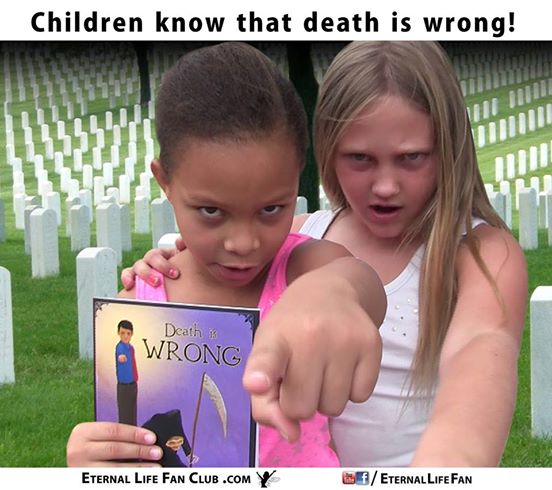
Roen Horn of the Eternal Life Fan Club has begun a strongly publicized series of book giveaways, the first of which he captured on camera. Here is his video featuring two kids who know that death is wrong.

Accompanying Roen’s video are excellent graphics like this one.

Children_Know_That_Death_is_WrongThe books were enthusiastically received at the Church of Perpetual Life in Hollywood, FL, a science-based Transhumanist church, whose primary focus is on ending death and reversing aging. Here is a picture kindly provided by Officiator Neal VanDeRee, where he presents a copy of Death is Wrong to the music teacher Dr. Angie Cook Wong and one of her students, who sang at the service.

DIW_IMG_0687Some of the book recipients have been librarians throughout the United States. Jameson Rohrer, the Transhumanist Librarian, has connected me with fellow librarians who have placed the books in libraries near them. Here are images of Death is Wrong books on display.

DIW_Rohrer_2DIW_Rohrer_3Successes like this one and many others have been chronicled on The Rational Argumentator, on a dedicated page that I continually update, informing readers of new developments in this unprecedented distribution effort. The updates are not finished. As the remaining book shipments arrive and books are given out to children, there will be more pictures, videos, and promising news to share. Indeed, even these impacts will just be the beginning. The true effects of this effort will be seen years and decades in the future – as the young readers of the books grow up and are hopefully motivated to develop their lives and pursuits in directions that will aid us all in overcoming the greatest enemy – death. I will know that my success is complete once even one young researcher or activist informs me, “I read Death is Wrong all those years ago, and it was this book that nudged me onto the path of discovery and development toward who I am today.” We supporters of indefinite life extension still have tremendous obstacles to overcome in achieving our vision. I hope that this effort to distribute over 1,000 Death is Wrong books will erode those obstacles at least somewhat – gradually injecting the ideas of indefinite life extension into the cultural mainstream and nurturing the next generation of advocates for this most worthwhile of endeavors.

DIW_World_MapPhotograph Courtesy of Eric Schulke

“Death is Wrong” Distribution Campaign Nears Completion – Update of August 6, 2014 – by G. Stolyarov II

“Death is Wrong” Distribution Campaign Nears Completion – Update of August 6, 2014 – by G. Stolyarov II

The New Renaissance Hat
G. Stolyarov II
August 6, 2014
******************************

Only 9 Death is Wrong books remain to be sent out as part of our worldwide distribution effort! If you wish to help in providing the books out to children, this is your last chance to get your free shipment now.

10 books were recently sent to Jason Limbert – a long-time supporter of radical life extension in Mississauga, Ontario, Canada. He will be distributing these books to children in his extended family, their friends, and children of neighbors.

3 books were sent to children of relatives of Wendy Stolyarov, my wife and the illustrator of Death is Wrong.

2 books were sent to RJ Lewis in California, a mother, inventor, publicist, and supporter of life extension and cryonics.

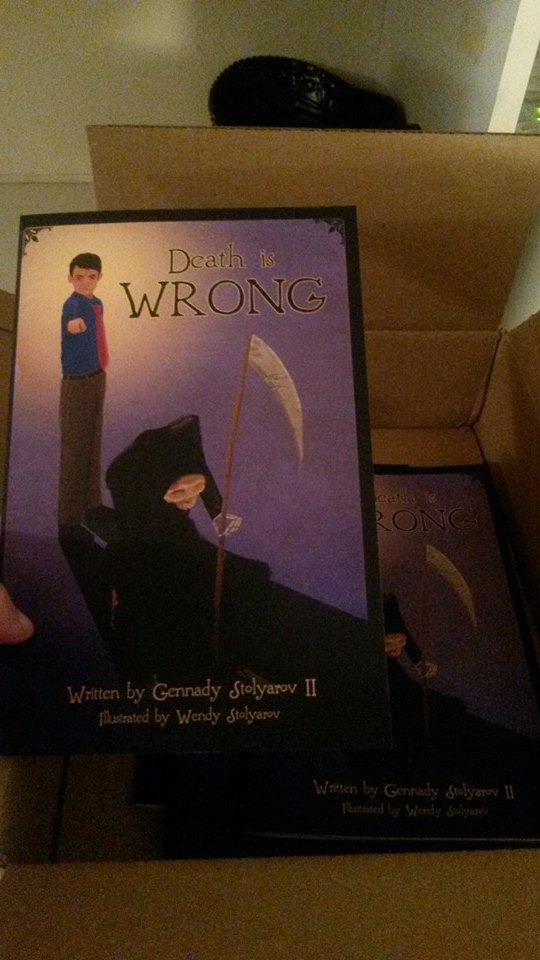
We continue to receive excellent exposure from the previous shipments. Here is a picture sent by Jennifer Huse of the shipment that recently arrived at the Spot the Knot medical spa in Eatontown, New Jersey.

DIW_Books_Received_Huse Roen Horn of the Eternal Life Fan Club has begun a strongly publicized series of book giveaways, the first of which he captured on camera. Here is his video featuring two kids who know that death is wrong.

Accompanying Roen’s video are these excellent graphics.

Children_Know_That_Death_is_WrongChildren_Know_That_Death_is_Wrong_2

All this was made possible by our distribution campaign. We see here great examples of the impact this book is having right now. We are making history by gradually injecting the ideas of indefinite life extension into the cultural mainstream. Help us finish this effort by spreading our last freely available books! To receive your free shipment, e-mail me at gennadystolyarovii@gmail.com with (i) your name, (ii) your MAILING ADDRESS, (iii) your support for indefinite life extension, (iv) the NUMBER OF COPIES of Death is Wrong requested, and (v) your plan for spreading the books to children, free of cost to them.