Browsed by
Category: History

Ancient Chinese Inventions and Discoveries (2002) – Essay by G. Stolyarov II

Ancient Chinese Inventions and Discoveries (2002) – Essay by G. Stolyarov II

The New Renaissance Hat
G. Stolyarov II
July 18, 2014
******************************
Note from the Author: This essay was originally written in 2002 and published in three parts on Associated Content (subsequently, Yahoo! Voices) in 2007.  The essay earned over 10,900 page views on Associated Content/Yahoo! Voices, and I seek to preserve it as a valuable resource for readers, subsequent to the imminent closure of Yahoo! Voices. Therefore, this essay is being published directly on The Rational Argumentator for the first time.  ***
***
~ G. Stolyarov II, July 18, 2014
***

The civilization of ancient China produced a wide array of innovations in science and technology which preceded the rest of the world by centuries and sometimes by millennia. This essay examines some of these remarkable inventions and discoveries.  Chinese inventors developed numerous mechanical implements, engineering advances, and new substances such as gunpowder, which took centuries to spread to or be replicated in other parts of the world. Furthermore, this essay explores the reasons for ancient China’s lack of systematic progress or an industrial revolution despite the presence there of numerous inventive thinkers.

Mathematics

Beginning in the 14th Century BC, the Chinese developed a decimal, or base ten system of recording numbers. This is one of the earliest such systems known.

In the first century AD, Chinese scholars compiled a volume of mathematics, Jin Zhang Suanshu,(Arithmetic in Nine Chapters). Mathematician Zu Chongzhi (429-500) calculated the first 12 digits of the value of pi, while his son, Zu Gengzhi, updated the Jin Zhang Suanshu and determined the correct formula for the volume of a sphere, V= (pi/4)d^3, where d is the diameter.

Paper

Paper was invented by Cai Lun, a scientist at the Imperial Court in 105 AD. It was produced from bamboo and hemp fibers dissolved in water situated in a mold. When the water was drained and the mixture dried, the first genuine design of paper appeared. The Chinese also developed a precursor to the first paper currency in the world, printed in the Ninth Century AD in order to lighten the load carried by tax collectors.

Cast Iron

The first methods for developing raw iron into workable material with the capacity to be crafted into weapons and ornaments were developed in the 4th Century BC, when the Chinese became able to lower iron’s melting temperature by adding phosphorus to the heated metal.

In the 2nd Century BC, this technology served to bring about the manufacture of steel by mixing wrought and cast iron at high temperatures or draining the carbon component from cast iron.

Chain Pump

Invented in China during the 1st Century BC, A chain pump consists of a chain attached to itself at the ends, which carries along it pallets of raw materials, such as water or sand, which are elevated to impressive heights up to about four meters.

Agricultural Technology

The Chinese were the first civilization in the world to plant crops in rows, beginning in the 6th Century BC, in order to obtain rapid crop growth without the crops’ mutual interference. Chinese farmers accomplished this 2200 years before any other culture.

Beginning in the 3rd Century BC, horses were utilized in China to haul loads on farms using an upgraded harness with a collar and chest strap (known a trace harness or horse collar) , which reduced the attachment’s burden on the animal and permitted a single horse to move a ton and a half of material.

The 3rd Century BC also saw the advent of the moldboard plow, or kuan, the design of which included a sharp center for digging into the ground and gradually-sloped wings at the side in order to discard excess soil and ease the friction on the plow.

The wheelbarrow was invented in the 1st Century BC and enabled Chinese farmers to transport massive loads over vast distances with ease.

Gunpowder

Gunpowder was invented in China during the 8th Century AD as a mixture of charcoal, sulfur, and saltpeter and used primarily for fireworks. The fireworks were launched from rockets made of hollowed bamboo tubes. These rockets were lighted through use of matches, invented in the 6th Century AD, carved of pinewood and coated with sulfur. Other civilizations borrowed this aspect and discovered its military utility.

In 1150, fireworks were elaborated as a result of the first multi-staged rockets, where several smaller tubes were attacked to main meter-tall stick, which were ignited in mid-air after the main rocket’s energy became depleted.

Natural-Gas Drilling

During the 1st Century BC, the Chinese discovered methods to drill some 1.5 kilometers into the Earth’s surface. A derrick was constructed, followed by a small shaft that extended until the Earth’s layer of hard rock was reached. Then a cast iron drill would be lowered with bamboo cables, after which the process would often consume years before any actual fuels were located.

Mechanical Clock

Invented in the 8th Century AD, the mechanical clock rapidly spread to other regions of the world. Chinese designs were crucial to inspiring European clock inventors such as Pope Sylvester II. The Chinese mechanical clock was powered by falling water or mercury, which then transmitted the energy to a chain-drive.

Segmental Arch Bridge

A segmental arch, invented by engineer Li Ch’un in the 7th Century AD, consists of only a small fragment of a circle instead of earlier semicircular arches. Ch’un constructed his first bridge over the Chiao Shui River in 610, which was notably lighter, more durable, and more material-efficient than earlier bridges. It is still in frequent use today.

Belt-Drive

A belt-drive (or driving belt) was attached around wheels to ensure smooth transition of mechanical energy between them. Invented in China during the 1st Century BC, the belt-drive was applied extensively to silk manufacture and spinning machines.

The belt-drive made possible the invention of the spinning wheel in 1270, since it provided sufficient cover and attachment for a rimless construction such as a spinning wheel, where a network of threads replaces the rim.

Printing Press

Movable character blocks were invented by Bi Sheng in 1045. A method for arranging and printing pages in mass quantities was devised. However, this was not efficient when applied to the Chinese language, which possesses over 5000 characters, and thus could not spur on the same printing revolution as that which occurred in Europe.

Magnetic Compass

The first magnetic compass was invented in China during the 3rd Century AD, utilizing a piece of magnetite (an ore of iron) which was heated and aligned in a North/South position, afterward being contained in a bowl of water where it floated on a piece of reed. This was integral to early 2nd millennium Chinese explorations in the Indian Ocean.

Other Noteworthy Advances

The Chinese were the first to develop a kite in the 4th Century BC. Craftsmen like Kungshu P’an possessed mastery to the extent of developing kites that stayed afloat for three days. These kites had military applications as well, carrying messages to isolated troop formations on the battlefield.

Commissioned by the imperial government in 132 AD, mathematician and cartographer Chang Heng devised the first seismograph, which allowed fairly accurate forecasts of earthquakes, leading to more efficient economic planning.

The Yellow Emperor’s Manual of Corporeal Medicine, composed in the 2nd Century BC, contains an advanced treatise on the circulation of blood. This was published fifteen centuries before William Harvey developed a work of comparable caliber in the West.

Why the Ancient Chinese Failed to Achieve Routine Technological Progress

Despite numerous ingenious technological innovations throughout its history, China failed to develop an industrial revolution and a routine theory like the Scientific Method to render inventions and discoveries systematic and not merely the spontaneous products of ingenious minds.

Ancient China was a generally stagnant society which, despite the presence of numerous brilliant thinkers, failed to achieve any regular technological progress until the late 19th century. So dramatic was this stagnation that it led Victor Hugo to compare China to “a fetus in a jar.” While it witnessed numerous promising technological developments in their embryonic stages, ancient China failed to harness these developments into a consistent advance.

The reason for this unfortunate lack of progress was above all institutional. Although the earlier Han and Tang dynasties among others were receptive to advancements and scientific practice, the Ming, following the defeat of the Mongols, isolated China from the remainder of the world and focused on civil stability to a greater extent than technological progress.

The heavily Confucian paradigm of the era from 1368 to 1911 focused more on adaptation to nature and the arts rather than the sciences. Scholars were trained in extensive law memorization rather than further studies of the external world. This caused China to lag behind the West, and contact with the Occident was required to re-establish its rich technological tradition.

Sources

1997 World Book Encyclopedia: Vol. 3 C-Ch. World Book Inc. Chicago. 1997.

Franklin Institute Online. “China: Ancient Arts and Sciences.” Available March 31, 2002: http://sln.fi.edu/tfi/info/current/china.html

Latourette, Kenneth S. A Short History of the Far East. The Macmillan Company. New York. 1964.

Reischauer, Edwin O. Fairbank, John K. East Asia: The Great Tradition. Houghton Mifflin Company. Boston. 1960.

Schurmann, Franz. Schell, Orville. Imperial China. Random House Inc. New York. 1967.

Think Quest Library of Entries. “Ancient Chinese Technology.” Available March 31, 2002: http://www.thinkquest.org/library/lib/site_sum_outside.html?tname=23062&url=23062/frameset.html.

Wagner, Donald B. “Liu Hui and Zu Gengzhi on the Volume of a Sphere.” Available March 31, 2002: http://www.staff.hum.ku.dk/dbwagner/SPHERE/SPHERE.html.

Collectivism is Ancient; Freedom, Reason, and Progress Are New (2010) – Article by G. Stolyarov II

Collectivism is Ancient; Freedom, Reason, and Progress Are New (2010) – Article by G. Stolyarov II

The New Renaissance Hat
G. Stolyarov II
Originally Published April 23, 2010
as Part of Issue CCXLV of The Rational Argumentator
Republished July 18, 2014
******************************
Note from the Author: This essay was originally published as part of Issue CCXLIV of The Rational Argumentator on April 23, 2010, using the Yahoo! Voices publishing platform. Because of the imminent closure of Yahoo! Voices, the essay is now being made directly available on The Rational Argumentator. The arguments in it continue to be relevant to discussions regarding reason, individualism, and liberty, and therefore it is fitting for this publication to provide these arguments a fresh presence.
***
~ G. Stolyarov II, July 18, 2014
***

Irrational, illiberal collectivism had its beginnings along with the beginnings of the human species. How else could it be the case that the overwhelming majority of the history of our species took place with virtually no progress whatsoever? Indeed, even the advent of basic agriculture and the written word occurred quite late in our history, considering that humans virtually identical in body and mind to our contemporaries appeared circa 50000 B.C.E., whereas the beginnings of agriculture occurred circa 10000 B.C.E., and writing emerged even later. How could this have been the case? Surely, with the proper freedom-respecting, individualistic mindsets and institutions, our remote ancestors could have accomplished noticeable progress every generation. Instead, about 80% of human history passed without any progress whatsoever, and another 19% passed with minimal progress and centuries where previous progress had been reversed and nearly eliminated (e.g., the Dark Ages and the 14th Century in Europe, and the era of Mongol conquests in Russia, the Middle East, and the Far East). And yet superbly intelligent, capable people existed in every generation, and would, if placed in our time or the recent past, have become great innovators.

The sensible explanation of these otherwise perplexing facts is that absolutely stifling mindsets afflicted the majority of human societies during the majority of history. Although they left no written records, most Paleolithic hunter-gatherer societies can be safely assumed to have held ultra-tribalist, collectivist views of the world – in addition to a persistently animistic, superstitious view of the inanimate world and a violently intense xenophobia. Moreover, in a small nomadic tribe, an “us versus them” attitude would have been quite easy and tempting to adopt; one relied on one’s fellow tribesmen to protect one against aggression by other humans, wild animals, and myriad miscellaneous perils. Departure from the norms and societal structures of the tribe, through either material or intellectual innovation, would likely have resulted in ostracism from the tribe or worse.

What is relatively new in human history – dating back to ancient Greece – is early true liberal, pro-freedom thinking; I still believe that we are in the early stages of the development of liberal thought, considering how illiberal the majority of human societies today are and how the majority of human progress (and, indeed, of human sanity altogether) can be attributed to only a handful of forward-thinking individuals. Free the human mind just a little, give even a few reasonably intelligent people just a small amount of material and intellectual space to decide how to live and to think – and you get all that human civilization has accomplished thus far. Free humans completely, and astonishing accomplishments would be possible, even from the “average” person.

Of course, the reverse is possible, too: such a severe degeneration of human thinking and institutions as to produce a relapse into barbarism. This would be the worst, most tragic outcome to befall mankind.

The Single Bullet That Killed 16 Million – Article by Edward Hudgins

The Single Bullet That Killed 16 Million – Article by Edward Hudgins

The New Renaissance Hat
Edward Hudgins
June 27, 2014
******************************
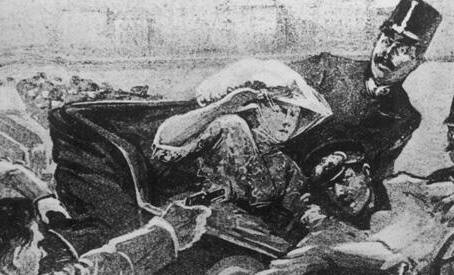
A century ago, on June 28, 1914, Serbian nationalist Gavrilo Princip shot and killed Archduke Franz Ferdinand, heir to the emperorship of Austria-Hungary, along with his wife, on their visit to Sarajevo.
Gavrilo Pirincip fires on the Archduke and Archduchess, June 28, 1914

World War I led to 16 million military and civilian deaths, plus nearly 20 million wounded. And the misery and horror of that war resulted in another casualty: confidence in the Enlightenment enterprise and human progress.

Enlightenment Europe

In the late seventeenth century Isaac Newton’s discovery of the laws of universal gravitation dramatically demonstrated the power of the human mind. Understanding of the world and the universe—what we call modern science—became a central Enlightenment goal.

At the same time, the struggle for Parliamentary supremacy in England led John Locke to pen his powerful treatise on individual liberty. Creating governments limited to protecting life, liberty, and the pursuit of happiness also became a central Enlightenment goal, which culminated in the creation of United States.

Enlightenment values were not limited to Britain or America. They were universal and created a European-wide culture of individualism, freedom, and reason.

Collectivist anti-Enlightenment

But Enlightenment thinkers and activists not only had to fight entrenched oligarchs and rigid religious dogma. Starting with Jean-Jacques Rousseau, a school of thought—if thought it could be called—arose that opposed individualism with the good of “society,” or the group, and rejected reason in favor of emotion and instinct.

The French Revolution starting in 1789 saw Enlightenment ideas losing ground to reactionary and collectivist forces. The result was the Terror and the guillotine, dictatorship and a new monarchy, and the carnage of the Napoleonic wars–the first great modern global conflict, which ended in 1815 at Waterloo.

In the century that followed Europe suffered only short regional conflicts, most relating to the unification of Italy and of Germany. The Industrial Revolution was creating prosperity. Governments were granting citizens rights to political participation and were recognizing their civil liberties. By the early twentieth century, continued progress seemed inevitable.

Pernicious nationalism

But the pernicious collectivist ideology combined with a major European cultural defect: nationalism. This form of collectivism meant more than just an appreciation for the aesthetic achievements—art, music, literature—of the individuals in one’s ethnic group. It meant putting one’s group or one’s country, right or wrong, ahead of universal values and principles. Kill for King or Kaiser!

There’s an irony in the fact that poor Franz Ferdinand wanted to recreate Austria-Hungary as a federation in which the minority groups—that were always either dominated by Viennese elites or at one another’s throats—would have autonomy similar to that enjoyed by the American states. If only Princip had waited a while.

Unfortunately, the volatile combination of nationalism, an interlocking treaty system, and the Britain-Germany imperial rivalry only required a spark like the Sarajevo assassination to set off a global conflagration.

Collectivism vs. collectivism

After World War I, individualism and “selfishness” got much of the blame for the conflict. And science was no longer associated only with progress. It had created machine guns, tanks, and poison gas, and made possible a fearful slaughter.

Idealists created the League of Nations to prevent such wars in the future. But they tried to cure the problem of nationalism with more nationalism, simply accentuating the problem. Indeed, Hitler used the principle of self-determination of peoples as an excuse to unify all Germans into one Reich by force. His form of collectivism also entailed enslaving and wiping out “inferior” races.

The catastrophe of World War II was followed by a Cold War, which saw the Soviet Union asserting another form of collectivism, pitting one economic “class” against another. Western Europe opposed the brutal Soviet kill-the-rich socialism with a kinder, gentler, loot-the-rich democratic socialism. The Soviet Union with its communist empire collapsed in 1991, and Western European democratic socialism is going through a similar disintegration in slow motion.

Still recovering from the Great War

Today, Enlightenment values are making a comeback. The communications and information revolutions, and the application of new technologies in medicine, transportation, and other fields, again demonstrate the power of the human mind and the benefits it confers.

Furthermore, many of the new entrepreneurs understand that it is they as individual visionaries who are transforming the world. And while their achievements benefit everyone, they strive because they love their work and they love to achieve. They pursue happiness. They hold Enlightenment values—though in many cases their politics still need to catch up.

The world is still digging out from the consequences of that single bullet a century ago, which led to the deaths of millions. Putting our country and the world back on the path to liberty and prosperity will require a recommitment to the Enlightenment values that created all the best in the modern world.

***

Dr. Edward Hudgins directs advocacy and is a senior scholar for The Atlas Society, the center for Objectivism in Washington, D.C.

Copyright, The Atlas Society. For more information, please visit www.atlassociety.org.

Haven’t We Already Done Enough Damage in Iraq? – Article by Ron Paul

Haven’t We Already Done Enough Damage in Iraq? – Article by Ron Paul

The New Renaissance Hat
Ron Paul
June 16, 2014
******************************
In 2006, I invited the late General Bill Odom to address my Thursday Congressional luncheon group. Gen. Odom, a former NSA director, called the Iraq war “the greatest strategic disaster in American history,” and told the surprised audience that he could not understand why Congress had not impeached the president for pushing this disaster on the United States. History continues to prove the General’s assessment absolutely correct.In September, 2002, arguing against a US attack on Iraq, I said the following on the House Floor:

No credible evidence has been produced that Iraq has or is close to having nuclear weapons. No evidence exists to show that Iraq harbors al Qaeda terrorists. Quite to the contrary, experts on this region recognize Hussein as an enemy of the al Qaeda and a foe to Islamic fundamentalism.

Unfortunately, Congress did not listen.

As we know, last week the second largest city in Iraq, Mosul, fell to the al-Qaeda allied Islamic State in Iraq and Syria (ISIS). Last week an al-Qaeda that had not been in Iraq before our 2003 invasion threatened to move on the capitol, Baghdad, after it easily over-ran tens of thousands of Iraqi military troops.

The same foreign policy “experts” who lied us into the Iraq war are now telling us we must re-invade Iraq to deal with the disaster caused by their invasion! They cannot admit they were wrong about the invasion being a “cakewalk” that would pay for itself, so they want to blame last week’s events on the 2011 US withdrawal from Iraq. But the trouble started with the 2003 invasion itself, not the 2011 troop withdrawal. Anyone who understands cause and effect should understand this.

The Obama administration has said no option except for ground troops is off the table to help the Iraqi government in this crisis. We should not forget, however, that the administration does not consider Special Forces or the CIA to be “boots on the ground.” So we may well see Americans fighting in Iraq again.

It is also likely that the administration will begin shipping more weapons and other military equipment to the Iraqi army, in the hopes that they might be able to address the ISIS invasion themselves. After years of US training, costing as much as $20 billion, it is unlikely the Iraqi army is up to the task. Judging from the performance of the Iraqi military as the ISIS attacked, much of that money was wasted or stolen.

A big US government weapons transfer to Iraq will no doubt be favored by the US military-industrial complex, which stands to profit further from the Iraq meltdown. This move will also be favored by those in Washington who realize how politically unpopular a third US invasion of Iraq would be at home, but who want to “do something” in the face of the crisis. Shipping weapons may be an action short of war, but it usually leads to war. And as we have already seen in Iraq and Syria, very often these weapons fall into the hands of the al-Qaeda we are supposed to be fighting!

Because of the federal government’s foolish policy of foreign interventionism, the US is faced with two equally stupid choices: either pour in resources to prop up an Iraqi government that is a close ally with Iran, or throw our support in with al-Qaida in Iraq (as we have done in Syria). I say we must follow a third choice: ally with the American people and spend not one more dollar or one more life attempting to re-make the Middle East. Haven’t we have already done enough damage?

Ron Paul, MD, is a former three-time Republican candidate for U. S. President and Congressman from Texas.

This article is reprinted with permission from the Ron Paul Institute for Peace and Prosperity.

Motivated Time Prospectors – Article by Eric Schulke

Motivated Time Prospectors – Article by Eric Schulke

The New Renaissance Hat
Eric Schulke
May 16, 2014
******************************

Think of all the people’s lots in life that you don’t have. You will regret not having more chances to stand here as you are now. It is said that if everybody put their worries into a pile and then took an equal share from the pile, then most people would be content to take back their own share of them. I was reading an article that said,

“To be sick and dying in Vegas has its own existential horror. Not only do you realize that you are going to die and that you don’t matter to the world, but you also realize that much of the world is awful and yet you still would do anything to live.”

Struggling to survive on this planet can be miserable, and yet we continue to stick with it. Why? Because we know that with life there is a chance to engage in more experience. It seems that a person can live, in part, on the desire for continued experience. That chance drives us to keep reaching for achievement and progress.

What does one want to experience in life? What does that honest-to-life list look like? If you had to draw up a complete list, could you do it, or describe the nature of it? The active wanting of experience, it seems, is a major cure to indifference toward death. It seems that it might be a life-or-death question.

We have become really good at being indifferent to the most widespread forms of death, in order to spare ourselves from stressing out on futilely trying to do something about it. Now that we have the tools and techniques, and the times have changed, we have to change that way of thinking from indifference back toward letting that horror affect us. Horror benefits us in that it is our cue to be driven to action to make sure that the horror can’t happen again. If a poltergeist starts ravaging your house, that’s your signal to get out of there, in the same way that the horror that general death, aging, and other diseases are your signal to get death, aging, and other diseases away from you and out of your cells.

Carl Sagan’s daughter once related his words that “there was nothing he would like more in the world than to see his mother and father again.” I was thinking about what an insult added to injury he must have felt in his final days, to have the paralyzing misery of impending death heaped on top of crushing pain. Let that kind of pain course through your mind, face it, bring it to a steaming rage, and let the energy power you to help execute any of the various assaults on aging and disease that are underway in laboratories in various places around the world.

In another article, I was reading about a guy whose daughter went missing in 1971, and was never found. He lived to be 102 and died in the fall of 2013. He had stated that one of the hardest burdens for him was never knowing what happened to his daughter. What misery, for all those years… Think of that… Then five days after he died, his daughter’s car was found upside down in a river; she was the apparent victim of a decades-old car crash.

I can’t fathom that life could inflict such a bitter spite upon somebody. That story stirs up the kind of despair and anguish that each death seems to deserve. It’s the kind of anguish you need to figure out how to allow in, in order to have the right kinds of drive to help pull the Movement for Indefinite Life Extension forward with us.

So once we get there, back to that place where we stand amidst realization of the horror of death, how do we face it? One good basic and natural way to do so, it seems, is to purposefully enjoy the good parts of life, and strategize and take action in helping to fix the worst of the broken things. It’s fun and fulfilling. Life isn’t bad, it’s an adventure. A tough challenge is like a choppy sea, like two armies clashing, or mountain climbers fighting the elements. The implementation of the solution of each challenge is like a Renaissance of scale, some miniature, some very large, like Caesar vs. Vercingetorix, or Charlemagne vs. the Vikings. It’s like the writings of Caesar, the writing-resurgence work of the Carolingians, Vercingetorix and the fate of an entire Celtic confederation, or the first times the Vikings set sail out beyond Greenland.

A few days ago I was thinking about a typical farm hand of Medieval times, walking outside to smell the heavy wet grass and earth of a cold wet spring day. How did they remember the great Lombard migrations, or Scandinavian raiders docking at Pisa? Who was Charlemagne to people before negationists took hold? What did they think might become of the future? Many of them must have felt lost at that kind of thought.

Focus on your heartbeat, feel it pulsing. Theirs pulsed like that. They thought of their hearts stopping and of how it couldn’t possibly be lost to the dust of history anytime soon. You think that, too. Their hearts are lost to the dust of history. Yours is next.

What does every year, and every moment mean to the history of everything? I read recently that if you throw a pebble, it could be offsetting the center of gravity of the universe. Every moment means everything, every moment is everything. Every moment is a world in itself, a great painting, a great work of art, a great burning torch, a water well built in inhospitable lands. Think of how many heartbeats have come to a stop, how many paintings have been burned… So many tangled groves in forests have had the wind blowing through them for all of these years, without one person, without one spoken word, in a place near a stream, where there was once a mighty, crackling stone fireplace that warmed multiple generations of families across the 6th through 8th centuries. It was a place that hosted countless memories which later tormented the souls of dying, now long-dead grandfathers.

They don’t deserve to be dead. They deserve what they earned: the world that is paying exponentially exciting, satiating, and fullfillingly valuable dividends today. This is an incredibly motivating and driving factor in what pushes me to pursue indefinite life extension. People take on a variety of diverse augmentations over time, becoming unique collections of intriguing insight – dynamic power tools for slicing and dicing the elements. We can’t afford for these wealths of rare and powerful abilities and resources to be pillaged and killed off. Sometimes it seems as if life-extensionists like me have to explain to people why it’s bad to let people be killed before we can get down to business in a worldwide effort to reach the goals that can get this done.

We are like the union for the people that make a profession out of being human. We are creating better and better pay, and we demand longer hours. I want every feasible remedy that can restore and maintain life to be a permanent fixture in this reality, for it to be harvested like air. There is no reason a heart has to give out. There is no reason we cannot prevent tangles from forming in the brain. Our organs and cells don’t have to degrade. We have tools, techniques, and brains. We will make it through these obstacles.

How long will it be before our times are old, before 2015 cars look like old classics, and thoughts of our times are most often associated with the smell of the pages of books that have been moved from their years of service on shelves, to boxes of outdated material in back rooms? Many experiences and voyages that could have happened, and could have been chronicled in those boxes, can never exist.

That’s the problem, it seems: There are experiences that could have existed, but that now never can. Thoughtful experience – there is no reason to forgo it or allow it to be lost – hence the basic, inherent reasoning for supporting indefinite life extension, it seems.

Every moment is the gold, the thing to be mined, the thing to be in awe of, to seek, pursue, and strategize toward, to work for, to feel victorious for possessing. Let’s mine more time: support the Movement for Indefinite Life Extension. Don’t be distracted by fool’s gold while the most valuable gold, time, slips through your fingers.

One of these days, we will put funeral homes across the world out of business, and it will be a great victory. We will celebrate, and the festivities will be grand. But we must get a move on now, because our chances are turning into sand.

Eric Schulke was a director at LongeCity during 2009-2013. He has also been an activist with the Movement for Indefinite Life Extension and other causes for over 13 years.

Military Conscription Shows the Evil of Ukraine’s Government – Article by G. Stolyarov II

Military Conscription Shows the Evil of Ukraine’s Government – Article by G. Stolyarov II

The New Renaissance Hat
G. Stolyarov II
May 1, 2014
******************************

I have, in the past, expressed ambivalence regarding the government of Oleksandr Turchynov and Arseniy Yatseniuk in Ukraine, but that government’s decision on May 1, 2014, to impose military conscription for men aged 18 to 25 clearly reveals it to be evil and unworthy of even verbal support, not to mention the material assistance and economic bailouts currently lavished on it by Western governments and the International Monetary Fund.

As I wrote in 2008 in “Why Freedom is Free and Rights Are Right: The Case Against Conscription, Compulsion, and Confiscation”, conscription is murder by lottery: “By fielding an army of conscripts, a government necessarily guarantees that some of those conscripts will be killed – although nobody knows in advance who will die. In effect, this is no different from selecting a large number of fit young men, assigning numbers to each of them, and picking a few of the numbers out of a hat – whereafter those whose numbers have been picked will be shot. Conscription is just such a murder by lottery – except that the picking of numbers is performed by the vicissitudes of the battlefield rather than the luck of a draw. The responsibility for the deaths of millions of young men from conscripted armies throughout world history lies solely on the shoulders of the governments who conscripted them. The enemy soldiers who killed them were mere instruments of murder; they were likely only following orders – and were likely themselves under compulsion to do so. The government officials who drafted the men, however, did so of their own free will and even with enthusiasm.”

It would be a complete contradiction of the principles of liberty and peace to support any government that conscripts its young men to become cannon fodder – disposable pawns in the power struggles of older, powerful leaders who will not themselves bear the physical costs of their desires to dominate over one group of people or another. Vladimir Putin’s regime is evil, too, and so are many of the militants aligned with it, as I have acknowledged previously. But supporting one evil just because it is arrayed against another is neither moral nor effective. American foreign policy engages in this support for the “enemy of the enemy” at almost every available opportunity, and this always comes back to hurt Americans in both the long and the not-so-long term.

Ironically, it was the overthrown Viktor Yanukovych who had abolished conscription in 2013 – perhaps the only good and liberty-friendly decision he made. Yanukovych deserved to be overthrown for instigating the killings of his own people, but this new government of thugs is no better. Indeed, it has managed to undo the one good legacy of Yanukovych’s reign! And yes, it is a government of thugs. This March 5 article from Channel 4 News in the United Kingdom – no Putin mouthpiece! – explains how many of the top posts in the Ukrainian government are occupied by leaders of Svoboda and Right Sector, two ultra-nationalist groups that grew out of explicitly fascist movements that use explicit Nazi symbols such as the Wolfsangel. Here are two images: at the top, Svoboda’s Oleh Tyahnybok delivers a Nazi salute; at the bottom, he poses with arch-interventionist and neoconservative warmonger John McCain. Right Sector’s leader Dmytro Yarosh is Ukraine’s Deputy Secretary of National Security – security, that is, for those who meet Yarosh’s standards of ethnic and linguistic “purity”.

Neither side in the conflict in Eastern Ukraine is just or right, or anything but destructive to the interests of the only innocent parties in the mix – civilians who seek to live and work in peace. No principle, no signal, no feverish nationalistic pride, no set of lines drawn on a map is worth the life of a single human being. As Voltaire poignantly and perceptively expressed it in his Philosophical Dictionary, “It needs twenty years to lead man from the plant state in which he is within his mother’s womb, and the pure animal state which is the lot of his early childhood, to the state when the maturity of the reason begins to appear. It has needed thirty centuries to learn a little about his structure. It would need eternity to learn something about his soul. It takes an instant to kill him.” No worthless, ephemeral power struggles and posturing can ever justify sacrificing the existence of the rich individual universe – the incomparably intricate and sophisticated mind and body – of any actual human being.

The Ukrainian government is forcing young men to kill their fellow Ukrainian and Russian young men, against whom they have no individual grievances. This is vile and reprehensible, and the Ukrainian government deserves to fall. It would be easy for it to fall and would not require active external intervention; the West would just need to withdraw its support and let the situation unfold as it would with only the involvement of local actors. If the West continues to prop it up with aid, this would only prolong the spree of destruction engaged in by people who should never have had a chance at high office in any civilized society, who should have been marginalized much like the Ku Klux Klan and various neo-Nazi parties are treated in the United States today. No government that uses its own people as cannon fodder against their will deserves to exist; no country whose “territorial integrity” must be maintained by a conscript army deserves for its territory to remain intact.

As to the young Ukrainian men about to suffer under the yoke of military conscription, my advice to them can be found in my poem “The Draft Dodger”, written in 2004 but still just as relevant ten years later. As one who proudly escaped Alexander Lukashenko’s Belrusian military conscription myself (I have subsequently become a US citizen – so I am thankfully safe from that particular tyranny), I wish these innocent young men all the best in finding peaceful, prosperous lives outside the heinous havoc which they did not create.

The Draft Dodger (2004)
G. Stolyarov II

I have been sentenced to a war.
And my offense? Naught but my age.
I’ll suffer pestilence and gore,
And die upon a foreign stage.
The verdict has been passed by those
Who wish to equal me to rags,
Plug sand into a breathing nose,
Borrow my life, return dog-tags.

They tell me, “Freedom is not free,”
And thus they seek mine to deprive.
But no! I’ll courage have to flee,
To choose to prosper and survive!
The right that mine was from the womb,
That I had bought with Reason’s gold,
I shall not lay before a tomb,
But will Self’s Shrine from robbers hold.

I claim no more than what is mine;
To rise each morning when I will,
To build, compose, create, refine,
And heed no Congressman’s dread bill,
Whose parasitic voting bloc
My soul as spoils of war would claim,
No noble war of awe and shock,
But rabble-rousers’ power game.

When nations seek me for their slave,
Their cause, their plight shall pass in vain.
Let no man give but what he gave,
Of his own will, for his own gain.
Freedom can’t stand on sacrifice;
With blood and bones I shan’t it craft.
I shall not offer prey to vice,
And, proudly, I shall dodge this draft!

Ron Paul, Richard Cobden, and the Risks of Opposing War – Article by Ryan McMaken

Ron Paul, Richard Cobden, and the Risks of Opposing War – Article by Ryan McMaken

The New Renaissance Hat
Ryan W. McMaken
May 1, 2014
******************************

Since at least as early as the eighteen century, classical liberalism, and its modern variant libertarianism, have opposed warfare except in cases of obvious self-defense. We see this anti-war position clearly among the anti-federalists of eighteenth-century America (who opposed all standing armies) and more famously within George Washington’s Farewell Address. Thomas Jefferson frequently inveighed against war, although in moves typical for Jefferson, he acted against his own professed ideology on a number of occasions.

On the other side of the Atlantic, liberalism finally made significant gains in Britain with the rise of the Anti-Corn Law League in the late 1830s. The head of the league, a radical liberal named Richard Cobden, rose to prominence throughout the 1840s and is notable today for his active defense of laissez-faire capitalism as a member of the House of Commons, and also for his staunch anti-interventionism in foreign affairs.

For a time, his political star rose quickly, but by the time the Crimean War ended, Cobden, had been cast aside by both a ruling class and a public enthusiastic for both empire and war.

Prior to the war Cobden traveled Europe as an honored guest at international peace conferences while advocating for free markets, civil liberties, and libertarianism everywhere he traveled. But in the end, as has been so often the case, his political career was ended by his opposition to war, and his refusal to buy into nationalistic propaganda.

Like the Crimean crisis of today, the Crimean crises of the early 1850s were caused by little more than the efforts of various so-called great powers to tip the global balance of power in their favor. Foremost among those grasping for global power was the British Empire.

But even as early as the 1830s, the British were seized by a series of national hysterias whipped up by a variety of anti-Russian pundits who were obsessed with increasing British military spending and strength in the name of “defense” from the Russians.

As is so often the case in securing the case for war, the pro-militarist argument among the Brits rested on perpetuating and augmenting the public’s nationalistic feelings that the Russians were uncommonly aggressive and sinister. Cobden, obviously far better informed on the matter than the typical Brit, published a pamphlet on Russia in 1836 actually considering the facts of Russian foreign policy, which he often compared favorably to the hyper-aggressive foreign policy employed by the British Empire.

Cobden began by comparing Russian expansion to British expansion, noting that “during the last hundred years, England has, for every square league of territory annexed to Russia, by force, violence, or fraud, appropriated to herself three.” And that among the self-professed opponents of conquest, the British failed to recognize that “If the English writer calls down indignation upon the conquerors of the Ukraine, Finland, and the Crimea, may not Russian historians conjure up equally painful reminiscences upon the subjects of Gibraltar, the Cape, and Hindostan?”

In an interesting parallel to the modern Crimean crisis, much of the opposition to the Russian among British militarists was based on the assertion that the Russians had annexed portions of Poland in aggressive moves that were deemed by the British as completely unwarranted. Cobden, however, understanding the history of the region to be much more murky than the neat little scenarios painted by militarists, recognized that neither side was angelic and blameless and that many of the “annexed” territories were in fact populated by Russians that had earlier been conquered and annexed by the Poles.

The Russians, while themselves no doubt hostile toward neighbors, were surrounded by hostile neighbors themselves, with the origins of conflicts going back decades or even centuries. The puerile and simplistic arguments of the British militarists, who advocated for what would become a global, despotic, and racist British Empire, added little of value to any actual public knowledge of the realities in Eastern Europe.

For his efforts in gaining a true understanding of global conflicts, and for seeking a policy of negotiation and anti-nationalism, Cobden was declared to be un-patriotic and a friend to the great enemy Russia during the Crimean war. Cobden, who had perhaps done more to consistently advance the cause of liberty than anyone else in Europe of his day, was declared to be a friend of despots.

The similarities to today’s situation are of course striking. The Crimea, an area of highly ambiguous ethnic and national allegiance is declared by the West to be a perpetual territory of anti-Russian forces much like the Eastern Polish provinces of old, in spite of the presence of a population highly sympathetic to Russian rule.

Moreover, the successor to the British Empire, the United States, with its global system of client states and puppet dictatorships and occupied territories declares itself fit to rule on a Russian “invasion” that, quite unlike the American invasion of Iraq, resulted in exactly one reported casualty.

As was the case with Cobden in the nineteenth century, however, merely pointing out these facts today earns one the label of “anti-American” or “pro-Russian” as in the obvious case of Ron Paul.

Like Cobden, Paul spent decades denouncing oppressive regimes domestically and internationally, only to now be declared “pro-Putin,” “pacifist,” “unpatriotic,” and “anti-American” by a host of ideologues utterly uninterested in familiarizing themselves with Paul’s actual record, including his denunciations, while in Congress, of Communist regimes and his warnings about Putin’s desire to expand Russian influence in Afghanistan.

Of course, Russia has not been the only target. For those who can remember the lead up to the Iraq War in 2003, this should all feel like déjà vu since many at that time, including some libertarians, claimed that opponents of invasion were “pro-Saddam Hussein” for pointing out that Iraq clearly had no weapons of mass destruction, and that his secular regime was probably preferable to the murderous Islamist oligarchy that has replaced it.

Paul remains in good company with the likes of Cobden, H.L. Mencken, William Graham Sumner, and virtually the entire membership of the American Anti-Imperialist League, including Edward Atkinson who encouraged American soldiers in the Philippines to mutiny. These were radical principled opponents of militarism who opposed government violence at great risk to themselves and their reputations. Some modern American libertarians, on the other hand, well out of reach of the Russian state, would rather spend their time stating what everyone already knows: Russia is not a libertarian paradise.

Ryan W. McMaken is the editor of Mises Daily and The Free Market. Send him mail. See Ryan McMaken’s article archives.

This article was published on Mises.org and may be freely distributed, subject to a Creative Commons Attribution United States License, which requires that credit be given to the author.

Transhumanism and Minarchism Are Compatible: A Response to The Sliceman – Article by G. Stolyarov II

Transhumanism and Minarchism Are Compatible: A Response to The Sliceman – Article by G. Stolyarov II

The New Renaissance Hat
G. Stolyarov II
April 27, 2014
******************************

This essay is part of a debate with The Sliceman on whether transhumanism and minarchism are compatible. For prior installments of the conversation, see the following essays:

– “Why I Do Not Adhere to Anarcho-Capitalism” by G. Stolyarov II

– “In Response to G. Stolyarov II and his Transhumanist Minarchism” by The Sliceman

I appreciate that The Sliceman has taken the time to post his thoughts on the question of the compatibility of transhumanism and minarchism, and I thank him for his good words regarding my work. If, as he writes, we agree on 90% of the issues, “with the lone exceptions being minarchy and monogamy”, then we have plenty of common ground that could also be used to reach some points of agreement on the question of transhumanist minarchism.

My aim in this discussion will not be to discredit or refute anarcho-capitalism; instead, I will strive to show that transhumanist minarchism is a fully reasonable and logically consistent position. Empirically, transhumanist anarcho-capitalism also clearly has articulate adherents and holds out promise for the incremental improvement of the human condition. The Sliceman writes of my views, “Your stance is that, [anarcho-capitalism] would be better than normal statism, but not as good as minarchism.” This is correct, meaning that I would see transhumanist anarcho-capitalism as an improvement over the status quo both politically and technologically. However, transhumanist minarchism would be superior still, because it would contain a method for resolving tensions and disputes that would have escalated into violence under transhumanist anarcho-capitalism.

The Sliceman writes in response to my statement that anarcho-capitalism has no practical application in today’s world that “yes, there has never been a practical application of Anarcho-Capitalism replacing a state but there has never been an economic powerhouse minarchy that didn’t evolve into totalitarianism either. We are BOTH in the realm of theory here, my friend.”

In an important way, I agree. I wrote in “Why I Do Not Adhere to Anarcho-Capitalism” that “Neither my position nor the anarcho-capitalists’ has any existing real-world incarnation. The question before us, then, is which of these positions would result in less overall violence and coercive dishonesty if implemented in practice?” However, in another important way, I disagree with the argument that an empirical refutation of minarchism can be offered by observing formerly freer societies that have devolved into totalitarian or near-totalitarian ones. The Sliceman is correct that the United States has undertaken this trajectory over the past 238 years, while in the meantime facilitating considerable prosperity and economic growth through political structures that were freer than most. However, at no point in history was the United States minarchistic – not even by a long shot. The U.S. Constitution and Bill of Rights were closer to the libertarian ideal than the governance structures of 18th-century Europe, to be sure, so they constituted steps in the right direction for their time. But the very language of these documents – including the “Commerce Clause”, the “General Welfare Clause”, and the “Necessary and Proper Clause” – opened the floodgates for extensive centralized intervention as these clauses were interpreted to have increasingly expansive and open-ended meanings. The devolution of the United States to the near-totalitarianism it exhibits today is not the result of minarchism, but israther due to the infusion of non-minarchistic elements into the US political structure at its founding. (The recognition of slavery certainly did not help, either; it paved the way for the bloody Civil War, which led to the first round of attempted totalitarianism by central governments under Abraham Lincoln in the Union and Jefferson Davis in the Confederacy.) I also note that the non-minarchistic nature of the early United States can be clearly seen in such travesties against liberty as the Alien and Sedition Acts of 1798 (which effectively forbade criticism of the government) and even Thomas Jefferson’s Embargo Act of 1807 (which effectively forbade all overseas trade) – neither of which would be conceivable even in today’s United States.

So the historical trajectory of the United States is no more an argument against minarchism than the brutal infighting and miserable standards of living in Somalia today are an argument against anarchism. The argument presented by The Sliceman that bureaucracies tend to try to grab more power for themselves may be true, but, if so, its only implication is that non-minarchistic elements of a government will tend to expand over time, changing the proportions of an initial mix of coercive and non-coercive government functions to be more heavily dominated by the coercive functions over time. However, if a minarchist government lacks the coercive functions (which involve non-retaliatory use of force) to begin with, and both the constitution and public opinion provide strong barriers to the emergence of such coercive functions, then the trajectory toward totalitarianism need not occur.

The Sliceman writes, “In fact, I believe minarchy to be much more theoretical than anarchy. Anarchy can be seen all over the world every day in the form of capitalism and voluntary association and order. Minarchy is almost never seen in all of history.” Both minarchy and anarchy are similarly theoretical, in my view, because, just as there has never been a completely minarchist government in history, there has never been a complete anarcho-capitalism in any society. Because every person encounters some dose of coercion in going about his or her daily life, that coercion necessarily shapes individual incentives and the kinds of markets and goods and services that arise in the society where the coercion exists. It is true, for instance, that unregulated black markets arise virtually everywhere that a government attempts to prohibit a good or service, but the content, environment, and limitations of those black markets are very much determined by the fact that the prohibition exists in the first place, as well as the extent and manner of the prohibition’s enforcement. Just as a true minarchism could only exist if a government did not have any legitimate power to initiate force, so a true anarcho-capitalism could only exist if there were no need to develop workarounds for the limitations imposed by a centralized authority.

This leads me to the conclusion that what matters more is the incremental direction of political change that one advocates – rather than one’s desired theoretical destination. For instance, abolishing NSA surveillance of the general population, dismantling the TSA, repealing the income tax, withdrawing all overseas US troops, halting the War on Drugs, and ending the requirement that the FDA approve all medicines prior to their availability for purchase by the general public, would all be measures favored by both minarchists and anarcho-capitalists. Their implementation would greatly increase the liberty enjoyed by people in practice, and such measures would also dramatically accelerate the rates of technological progress and economic growth. Whether the changes could be best accomplished by working within or outside the political system is an empirical question, and various strategies can be, at their core, compatible with both minarchism and anarcho-capitalism.

The Sliceman writes: “how dare you consider yourself a transhumanist, yet scoff at that which hasnt been tried yet[?] The automobile has not yet been created, but that is no reason to think the future is a faster horse. If history has taught us anything, it’s that someone’s lack of imagination does not deter future technological advancement in the areas of industry, economy, religion, or government.”

My argument regarding the lack of practical application for anarcho-capitalism does not hinge on the fact that it has not been tried yet in its full form. In fact, I would encourage some group of people to try it – perhaps on a seastead, a small island, or a space colony. The results of such an experiment would provide valuable empirical evidence and fuel for further thought and work in political philosophy. As I have previously stated, my preferred political system of minarchism also has not been tried in its consistent form, so my preference for it does not stem from any aversion for the new and untried.

Rather, when I say that anarcho-capitalism has no practical application today, my exact meaning is that I have yet to see a viable proposal for bringing it about through a transition from the status quo. Unlike minarchism, for whose attainment a sequence of political reforms can be articulated, many strains of anarcho-capitalism reject working within the political system, period, so it is unclear how exactly the transformation from a militaristic welfare state to an anarcho-capitalist society is envisioned to occur. As I wrote in “Why I Do Not Adhere to Anarcho-Capitalism”, “I happen to believe that political theory is more than a mind game; it has relevance to the real world, and it ought to have real-world implications for how we act in our own lives. It is not enough to simply state that one would like the world to be a certain way. Rather, a specific, technical, and quite involved series of steps is necessary to transition from the status quo to any state considered desirable. To simply contemplate the end outcome without any idea of how to attain it or even approach it is to divorce one’s political thinking from reality.” It also appears to me that, when an anarcho-capitalist does propose ways of working “outside the system” – including seasteading, cryptocurrencies, informal markets, and digital communities – these ways are also perfectly compatible with minarchism. They involve the use of technological innovation, jurisdictional competition, and civil society to motivate a reduction of political power from without. Yet, unfortunately, too many anarcho-capitalists let the perfect (in their minds) be the enemy of the good, and they reject or resist any attempts at bringing about incremental change (even outside of politics proper), for fear that those attempts are somehow intertwined with and corrupted by the existing political or social order. I do support the practical efforts of anarcho-capitalists to achieve their vision in peaceful ways. However, if and when they do this, they do not engage in any activities that are exclusively anarcho-capitalist or that would require adherence to anarcho-capitalism to pursue. A minarchist could undertake those same actions just as effectively.

I note that the lack of a concrete proposal to achieve anarcho-capitalism is quite different from what one observes with transhumanist projects and aspirations. Virtually every transhumanist vision, from indefinite life extension to various incarnations of the technological Singularity, has an associated detailed sequential plan for attaining it or view of the unfolding events that would bring it about. Consider, as examples of this, Aubrey de Grey’s SENS roadmap to reversing all the types of age-related damage, or Ray Kurzweil’s Law of Accelerating Returns, forecasting the continued exponential growth of emerging technologies. I certainly see the amount of centralized control in a society as capable of having a powerful impact on the rate at which these transhumanist aspirations can be realized; the more centralized control, the slower the rate. However, neither minarchism nor anarcho-capitalism would impose coercive restrictions on transhumanist projects, and so both are, in theory, quite compatible with transhumanism. Minarchism has the added advantage that it more readily embraces incremental political reforms that could help make an existing society more free, even if any given reform will not completely achieve the libertarian ideal. Minarchist activism could therefore be one effective way to increase the rate of technological progress in the near-to-intermediate term, paving the way for massive prosperity in the long term, which would increasingly consign the “social service” role of many welfare states to irrelevance.

The Sliceman writes, “Libertarian Tranhumanism and Minarchism is an extremely rare match. The creed of Transhumanism is to use historical patterns and trends to predict the future. I’m sure this study greatly contributed to your [belief] and support for indefinite life extension. The creed of Libertarianism is to increase liberty, freedom, and the protection of private property by decreasing the institutionalized initiation of the use of force that is the state.”

I disagree with the proposition that libertarian transhumanism and minarchism are a rare match. It is important to keep in mind that, among libertarians today, anarcho-capitalism is still a significant minority position. Transhumanism attracts significant interest from both libertarians and non-libertarians alike, but its affinity with libertarianism is stronger, so a larger proportion of libertarians are transhumanists as compared to non-libertarians. I have seen no evidence to suggest that anarchist libertarians are more inclined toward transhumanism than minarchist libertarians. While I have done no polling on this question (and some empirical research would certainly be extremely interesting here), a more plausible hypothesis is that transhumanism attracts libertarians independently of their views on the question of minarchy versus anarchy. So if X% of libertarians are anarchists, and (100-X)% are minarchists, and Y% of libertarians are attracted to transhumanism, then it would appear that, as long as X% < 50%, then X%*Y% would be less than (100-X)%*Y%, so there would be more minarchist transhumanists than anarcho-capitalist transhumanists. Again, this is only a hypothesis at present, and conducting a scientific poll of libertarian transhumanists would enable a more in-depth exploration of this question.

The Sliceman continues by describing an “exponential curve of liberty” that has unfolded throughout history, as greater technological advancement, especially in communication technology, has increased individual sovereignty. I agree with this general characterization. In fact, it fits with Steven Pinker’s immensely well-researched look in The Better Angels of Our Nature into the decline in rates of human violence over time, as technology, culture, and political liberty have tended to progress. However, Pinker is certainly no anarchist. He points out that hunter-gatherer “stateless” societies experienced per capita rates of violence and murder greatly exceeding those of the most despotic governments or those that were manifested during the two World Wars of the 20th century. Pinker’s view is that even despotic government is preferable to tribalism or lawlessness, while constitutional or limited government is greatly preferable to despotic government in reducing the rates of violence (which are at their lowest point now as compared to any prior era) and maximizing the scope of individual liberty. I have read the entirety of The Better Angels of Our Nature, and it appears that the evidence Pinker presents suggests that technology, commerce, and culture – rather than political structures – offer the greatest contributions to the reduction of violence, perhaps because political structures are very much conditioned by the technological, economic, and cultural environments in which they arise.

The Sliceman writes, “The question here is what kind of liberty this technology will lead us to. Your answer seems to be that the exponential change in liberty will come to a stop at minarchy and we will just stay there, where my answer is that the exponential change will continue and the only logical conclusion is that we will approach 100% liberty with only [a] few tiny fractions of a percent of violence being accounted for by the fact that we are still, in fact, animals, and animals are violent.”

Supposing that exponential increases in liberty through technological progress can be achieved, this is not per se a sufficient argument that all government would disappear. For instance, exponential advances have been made to store data in ever-smaller volumes of physical space. This does not, however, suggest that we will ever arrive at a point where no physical space at all will be required for the storage of data. At most, we could perhaps keep reducing the space required without any lower limit, but we would only asymptotically approach zero space without ever getting there. The same reasoning could apply to government. Indeed, I see in accelerating technological progress our best prospect for minarchism. As advancing technology raises the prevailing levels of prosperity, fewer people will find themselves in need of government services to rectify any perceived deficiencies in their lives. The more the role of the redistributive welfare state dwindles away, the more governments would be relegated to their theoretically justified roles under minarchism – the resolution of disputes and protection against the initiation of force. It is quite feasible that additional private mechanisms for dispute resolution would emerge, and people would become generally more comfortable and less likely to want to engage in violence in the first place – both of which phenomena would reduce the frequency with which the government would resolve disputes in practice or interject its retaliatory force. If many humans receive augmentations to their minds, increasing both their intelligence and their moral sense, then the result will be an even further-reduced inclination to initiate force. But would this trend ever result in the elimination of government altogether? I doubt it – for the simple reason that the ability to have an ultimate arbiter of disputes or an entity that can interject itself to prevent violence would be too valuable for a future society to do away with altogether. 99.9999% of future transhumans may be entirely peaceful and capable of dealing with one another solely through market arrangements. But suppose there is even one person who rejects all transhumanist paths for humankind and who seeks, in some way, to use violence to wage war on the transhumanist society. Maintaining some very minimal government to deter this person would be wise. Furthermore, if the situation improves to the point where no such person exists, then the mechanisms of a minimal government might well lie dormant for a time – but there would be no reason to abolish them. It would be better to keep them available, just in case a future threat of violence arises, and all market-based methods for preventing it fail. After all, what would happen if some barbarous militaristic alien species discovers the transhumanist Earth and simply launches an invasion, with no questions asked?

The Sliceman writes, “You don’t need an ultimate arbiter when you are running your contracts through the Bitcoin Blockchain or its future replacement. You don’t need an ultimate arbiter when everything on Earth is constantly being recorded and a murderer (whose act can be proven 10 ways from Sunday through constant voluntary surveillance i.e.: Google glass, dashcams, and their future equivalents) can be given a voluntary unanimous Yelp review of ‘exile’.” In some cases, technologies such as the blockchain or universal sousveillance might actually generate more of a need for an ultimate arbiter. It is true that those technologies can facilitate more transparency and discovery of facts, but, in some cases, they are just as open to exploitation for nefarious motives. For technologies based on the blockchain, this is evidenced by the many thefts that have occurred from third-party Bitcoin services or the dishonesty and consequent failure of Mt. Gox. For sousveillance, there is an extremely fine but important line between monitoring that can help deter or prevent crime and monitoring that can infringe on individual privacy and deter innocent behaviors that could only occur in private. When such conflict areas arise (as is inevitable with transformative new technologies), it would be nice to have an impartial arbiter that could resolve conflicting legitimate interests and help overcome the “growing pains” of technological change. Of course, today’s archaic and cumbersome legal system is not the answer to this challenge, but a highly streamlined, extremely knowledgeable, and technologically sophisticated minarchist court might be.

The Sliceman writes that “Technology does not stop at minarchy.” I respond that, ultimately, no single form of government can be seen as the final form, upon which there cannot be any improvement. I do not rule out the existence of true anarcho-capitalism at some future time, somewhere. In “Why I Do Not Adhere to Anarcho-Capitalism”, I wrote that “Perhaps the anarcho-capitalist ideal will be realizable in some distant future time, once human beings have progressed morally and technologically to such an extent that the initiation of force is no longer lucrative to anybody.” I would have no quarrel with transhumanists who attempt to implement anarcho-capitalism through emerging technologies – but, at the same time, minarchism appears to be a far more proximate prospect, and, in the next several decades at least, the very same concrete methods that any anarcho-capitalist would effectively pursue, could also be used to pursue minarchism (since societies would be moved in the direction of both ideals by the application of such methods). Perhaps one implication of my argument is that, for the time being, it does not really matter whether one is a minarchist or an anarcho-capitalist, as long as one supports pro-liberty incremental changes. Another implication, however, is that minarchism and transhumanism are fully compatible, at least for the foreseeable future.

No Excuses for Militant Barbarism in Ukraine – But the West Should Stay Out – Article by G. Stolyarov II

No Excuses for Militant Barbarism in Ukraine – But the West Should Stay Out – Article by G. Stolyarov II

The New Renaissance Hat
G. Stolyarov II
April 26, 2014
******************************

I was initially reluctant to accept the Ukrainian government’s reference to the pro-Putin separatists in Eastern Ukraine as “terrorists” – since terrorists deliberately target civilians in order to achieve political and ideological objectives. However, during the past week, it has become clear that at least a significant fraction of the separatists have engaged in exactly that: hostage-takings and killings of civilians in an effort to “secure bargaining chips” or “send a message” to their political enemies.

While very little news that comes out of Eastern Ukraine now can be trusted as being unaffected by propaganda for one interest or another, I do completely trust this account by Simon Ostrovsky, a VICE journalist who was captured by armed gunmen, beaten, held in captivity for four days, and subsequently released. His account relates the identities of some of the other prisoners; a few may themselves be militants working for the other ugly nationalist group in the mix – Right Sector – but many are completely innocent: journalists, political activists, and civilians. It is completely unacceptable to abduct and hold such people hostage, for political leverage or otherwise, no matter what one’s goals or objectives are.

The separatists have committed other crimes as well. The torture and murder of Vladimir Rybak, a councilman who supported the Ukrainian government, is the most heinous among them. Rybak was a peaceful man who spoke his mind; he was vocal and passionate, but never posed a physical threat to anyone. The fact that he would be whisked away in the middle of the night, mutilated, killed, and thrown into a river smacks of Stalin-era tactics to suppress political dissidents and critics.

A further travesty is the abduction of OSCE monitors and unarmed foreign military observers, who were clearly not in Eastern Ukraine to stoke up hostilities, but rather could have negotiated a peaceful resolution to the conflict. The fact that the separatists are inclined to take the observers hostage instead of speaking with them, expressing their grievances, and attempting a diplomatic solution, shows their true colors.

While I had hoped that the multilateral Geneva Statement would be the beginning of a de-escalation in Eastern Ukraine, this has, unfortunately, not come to pass. Vladimir Putin’s regime did not play its part. Putin could have easily defused tensions by publicly speaking about the need for separatists to vacate occupied government buildings in the Donetsk region and to engage OSCE monitors and other third-party negotiators peacefully and sincerely. The fact that he failed to do this, and continues to support the separatists rhetorically, in spite of their record of hostage-takings, murders, and intimidation, gives me substantial doubts regarding his good faith.

Then again, there are very few good people involved in this entire mess – apart from the innocent civilians who are trying to live and work in peace, and to speak their minds in civilized ways, instead of resorting to violence, brutality, and brinksmanship. The pro-Putin separatists and the Putin regime are not the only guilty parties here. This past weekend, Sergei Rodenko – a beloved figure in his community – and two other civilians who performed part-time duty at a checkpoint northwest of Slovyansk, were probably murdered by Right Sector thugs. This situation increasingly reminds me of the nightmare that has unfolded in Syria over the past two years, where the regime of the tyrant and murderer Bashar Assad is fighting a war of attrition against barbarous and often equally brutal Islamic fundamentalist fanatics. Once ancient hatreds – be they religious or nationalistic – are unleashed, all goodness is at risk of being washed away by rivers of blood. It is good that, in 2013, a major public outcry in the United States prevented the US government and military from becoming involved in a conflict where it is absolutely not clear who the greater evil is. (Nor is it ever justifiable to aid evil, period – all the misguided rhetoric regarding the “greater good” notwithstanding.) A similar public outcry is needed against intervention in Ukraine; American foreign policy is terrible at dealing with “gray areas” – especially where every side has clear evil elements. One can only hope that sanity and reason will prevail in Eastern Ukraine, and peace will somehow be achieved, before the body count approaches anywhere near the catastrophic levels it has reached in Syria. As for us in the West, we can only condemn – and hope.

What should the United States government do? This is vital: nothing – except condemnation of all atrocities and attempts to secure the release of all captured civilians. Diplomacy has unfortunately not succeeded in resolving the present mess, and further intervention of any sort will only reinforce the perception (held by the Putin regime and many of its sympathizers in Eastern Ukraine) that the Ukrainian government is simply a tool of Western and especially American geopolitical interests. While military occupation of Ukraine has thankfully been ruled out by the United States and NATO, economic sanctions would, too, be a grave folly. The free-market argument against sanctions includes the recognition that sanctions almost never harm the regime in power; they always harm ordinary civilians and rally them around the hostile regime. In the words of Frédéric Bastiat, “When goods don’t cross borders, armies will.” Economic sanctions always set up the scene for war, because they break the ties of commerce that enable peaceful cooperation, mutual understanding, and cosmopolitanism. As the great Ludwig von Mises put it, “Wars, foreign and domestic (revolutions, civil wars), are more likely to be avoided the closer the division of labor binds men.” Mises also said that military conflicts “are an outgrowth of the various governments’ interference with business, of trade and migration barriers and discrimination against foreign labor, foreign products, and foreign capital.” To the extent that advocates of sanctions depart from this understanding, they are sacrificing free-market principles to the desire to undermine and punish Putin and Russia. Putin may deserve punishment, but his innocent subjects certainly do not.

Do nothing and allow a local solution – fueled by what Friedrich Hayek called “knowledge of the circumstances of time and place” – to emerge. The United States and European Union cannot improve on any resolution that Ukrainians and Russians might be able to arrive at, even if that resolution would be grossly sub-optimal from any reasonable standpoint. For us Westerners to inject ourselves into this horrific mess would only risk dragging us down into the thick quagmire of hatreds, hostilities, and recriminations. This is not a part of the world that can be easily fixed, and it has always suffered from deep cultural maladies. The penetration of the 18th-century Enlightenment there is only superficial and limited to a small segment of society. Those who truly seek a better life are better off just leaving than attempting to resolve the deep problems that have persisted since at least the 13th-century Mongol conquests! They are better off just leaving – as I fortunately did during my childhood – and we are better off just staying out. By attempting to “solve” the problems of post-Soviet republics, the Western powers only risk importing those problems – nationalism, xenophobia, militarism, jingoism, propagandism, and economic isolationism, just to name a few – into their own countries.

The Humility of Futurism – Article by Adam Alonzi

The Humility of Futurism – Article by Adam Alonzi

The New Renaissance Hat
Adam Alonzi
April 20, 2014
******************************

Civilization operates as if its troubles and their solutions will be as relevant tomorrow as they are today. Likely they were obsolete yesterday. How preposterous do the worries and aspirations of yesteryear seem now? What has not been refined since its conception? Our means of subsistence, entertainment, expression and enlightenment continue to change, although, at least unconsciously, they are accepted as stable. Change, once gradual, now quickens exponentially. Countless professions have been created and destroyed by advances; old orders have been destroyed, new ones have arisen; our world outlooks have been revolutionized by new discoveries over and over, although a sizable portion of the world is unwilling or unable to understand a man like Aubrey de Grey and an equally sizable portion of the population is still struggling with Copernicus. A Futurist accepts himself and his ideas as incomplete, therefore he actively works to improve upon them. Futurism is the first ideology that explicitly accepts the necessity and desirability of change.

It is a mistake to think we have reached the final stage of our journey. Plateaus are mirages conjured by the shortsighted; human evolution is a mountain without a peak. If a man has eyes, let him see all we have done and all we have yet to do. Let him gain the humility religion and liberalism have failed to inculcate into him and so many others. Each generation repeats this mistake. There is no evidence to suggest we are complete or are doomed now only to regress. Naysayers seem motivated to dismiss the triumphs of others out of fear they themselves will appear even less significant. Historically the distant future has received little attention compared to such pressing questions as the number of angels on the head of a pin or the labor theory of value. This may be thanks to a fondness for the apocalyptic, a fascination which certainly has not faded with time, but it is also attributable to the egotistical need to stand out. All epochs are transitions. The advances of this decade have failed to restore popular faith in progress, yet the very word is misleading. Faith does rest not upon an empirical foundation. There are scores of popular beliefs founded upon little or no evidence. Yet the proof of progress is all around us. Death wishes and earth-annihilating misanthropy aside, we can trace the modern disdain for the march forward to the fashionable nonsense of academia.


Speculations and prophecies, even conservative estimates based on careful analysis, are treated with derision by the public. To say one has faith in technology is misleading. To compare the singularity to the rapture is like comparing planetary motion to Santa Claus. One is rooted in scripture, the other in observation. The doomsayers, secular and religious alike, enjoy forecasting our demise. The essential corruption critics charge Western civilization with is common to all; it is called human nature. It is meant to be transcended, not through critiques of immaterial “cultural entities,” but by improving our bodies and our minds through bioengineering. No belief is needed here. We do not rely upon a outworn holy book or the absurd dialectic of the Marxists. We change and adapt because we must. This is a point of pride, not one of shame. We do not worship the past; we have shrugged it off. Compared to the ridiculous claims circulating in the cesspool collectively referred to as “the humanities” this is a sane position, yet it is treated with nothing by scorn by those who, wishing so ardently to distance themselves from Western civilization, bite the hands that feed them, clothes them, and shelters them. While they navigate by GPS, post their inane tangents on social media sites, and try with all their might to discredit the culture to which they owe their lives and livelihoods, others push forward. Self-proclaimed critics of Western civilization should consider trading their general practitioner for an Angolan witch doctor. It is hard to respect those who do not practice what they preach.

Postmodernism and cultural relativism, though they have pretensions of completeness and delusions of permanence, are but passing fads. Something devoid of usefulness or, for that matter, a coherent hypothesis, cannot last long when technology is generating so much benefit to so many people. A meme will continue to propagate itself long after it has served its purpose, to the detriment of competitors and to society at large. It is the duty of Futurists and Transhumanists to demolish the acceptability of rubbish in academia and in the media. The Luddites are more dangerous than the Creationists. Hubris is barely acceptable in the hard sciences, but in an absolutely unempirical discipline like philosophy, it is deplorable. Our first priority should not be political or religious; it should be scientific. To whom do we owe our prosperity, and to whom do we owe our future? To whom do we owe our lives and the lives of our children? How many of us would not be here today were it not for the men and women of modern medicine? This is not the end. Forget the weary and the overwhelmed; they are weak. Forget the ones who have no desire to climb higher; they are unfit. Cast aside the ones who pray fervently for the undoing of their own species; they are the most vile of all. This is not the end. This is our beginning.
***
Adam Alonzi is the author of Praying for Death and A Plank in Reason. He is also a futurist, inventor, DIY enthusiast, biotechnologist, programmer, molecular gastronomist, consummate dilletante and columnist at The Indian Economist. Read his blog Cool Flickers.
***
Help the next generation embrace a progress-filled vision of the future by supporting the illustrated children’s book Death is Wrong (free in Kindle format until April 22, 2014), and the campaign to distribute 1000 paperback copies to children, free of cost to them. The Indiegogo fundraising period ends on April 23, so please consider making a contribution today.
***